Cephalometric variables used to predict the success of interceptive
treatment with rapid maxillary expansion and face mask. A longitudinal study
Daniele Nóbrega Nardoni1, Danilo Furquim Siqueira2, Mauricio de Almeida Cardoso2, Leopoldino Capelozza Filho2
How to cite this article: Nardoni DN, Siqueira DF, Cardoso MA, Capelozza Filho L. Cephalometric variables used to predict the success of interceptive treat-ment with rapid maxillary expansion and face mask. A longitudinal study. Dental Press J Orthod. 2015 Jan-Feb;20(1):85-96. DOI: http://dx.doi.org/10.1590/2176-9451.20.1.085-096.oar
Submitted: December 12, 2013 - Revised and accepted: September 07, 2014
Contact address: Daniele Nóbrega Nardoni SHS Qd. 06 Ed Brasil 21 Bloco E salas 317 e 318 Asa Sul - CEP: 70.316-000 — Brasília/DF —Brazil E-mail: [email protected]
1 Master’s student in Oral Biology, Sacred Heart University (USC). 2 Professor, Undergraduate and postgraduate program in Orthodontics, USC.
» The authors report no commercial, proprietary or financial interest in the prod-ucts or companies described in this article.
» Patients displayed in this article previously approved the use of their facial and intraoral photographs.
Introduction: Prognosis is the main limitation of interceptive treatment of Class III malocclusions. The interceptive procedures of rapid maxillary expansion (RME) and face mask therapy performed in early mixed dentition are capable of achieving immediate overcorrection and maintenance of facial and occlusal morphology for a few years. Individuals presenting minimal acceptable faces at growth completion are potential candidates for compensatory orthodontic treatment, while those with facial involvement should be submitted to orthodontic decompensation for orthognathic surgery. Objectives: To investigate cephalometric variables that might predict the outcomes of orthopedic treatment with RME and face mask therapy (FM). Methods: Cephalometric analysis of 26 Class III patients (mean age of 8 years and 4 months) was performed at treatment onset and after a mean period of 6 years and 10 months at pubertal growth completion, includ-ing a subjective facial analysis. Patients was divided into two groups: success group (21 individuals) and failure group (5 individuals). Discriminant analysis was applied to the cephalometric values at treatment onset. Two predictor variables were found by stepwise procedure. Results: Orthopedic treatment of Class III malocclusion may have unfavorable prognosis at growth completion whenever initial cephalometric analysis reveals increased lower anterior facial height (LAFH) combined with reduced angle between the condylar axis and the mandibular plane (CondAx.MP). Conclusion: The results of treatment with RME and face mask therapy at growth completion in Class III patients could be predicted with a probability of 88.5%.
Keywords:Angle Class III malocclusion. Prognosis. Discriminant analysis.
DOI: http://dx.doi.org/10.1590/2176-9451.20.1.085-096.oar
Introdução: a principal limitação do tratamento interceptivo das más oclusões de Classe III está no prognóstico. Os procedimentos interceptivos de expansão rápida da maxila e de tração reversa, adotados ao início da dentição mista, são capazes de propiciar sobre-correção imediata e manutenção da morfologia facial e oclusal por alguns anos. Pacientes que, ao final do crescimento, apresentam, no mínimo, faces aceitáveis, são candidatos ao tratamento ortodôntico compensatório, ao passo que aqueles com comprometimento facial deveriam ser submetidos a tratamento ortodôntico descompensatório para cirurgia ortognática. Objetivo: investigar variáveis cefalo-métricas preditoras dos resultados do tratamento ortopédico com expansão rápida da maxila e tração reversa (ERM e TM). Métodos: uma avaliação cefalométrica foi aplicada, ao início do tratamento, em 26 crianças com má oclusão de Classe III (média de idade de 8 anos e 4 meses). Após um período médio de 6 anos e 10 meses, ao final do crescimento pubertário. sob o crivo de uma análise facial subjetiva, foram constituídos dois grupos, sendo um grupo de sucesso (21 pacientes) e um grupo de insucesso (5 pacientes). Análise discriminante foi aplicada aos valores cefalométricos ao início do tratamento, por meio do procedimento stepwise, assim, identificamos duas variáveis preditoras. Resultados: o tratamento ortopédico de uma má oclusão Classe III pode ter prognóstico desfavorável ao final do crescimento quando, nos registros cefalométricos iniciais, for observada uma altura facial anteroinferior aumentada (AFAI) associada a uma diminuição do ângulo entre o eixo condilar e o plano mandibular (CondAx.PM). Conclusão: os resultados para o final de crescimento de um tratamento com ERM e TM, para cada novo paciente com má oclusão de Classe III, poderiam ser previstos com uma probabilidade de acerto de 88,5%.
INTRODUCTION
Treatment of Class III malocclusions is particu-larly limited in its prognosis1-4 which is usually
com-plicated in cases of skeletal malocclusion with ge-netic determination.5,6 Subjects with malocclusion
resulting from sagittal plane imbalance between the maxilla and the mandible are referred to as Class III malocclusion patients. This pattern includes subjects with maxillary retrusion and/or mandibular progna-thism,7,8 regardless of the molar relationship
estab-lished between dental arches.5,6,7,9,10 Although
maloc-clusion tends to present a Class III molar relationship, it does not always express association with the sever-ity of skeletal relationship6 and, as a consequence,
with facial balance. This process depends on growth pattern and raises uncertainty over the stability of results after the active period has finished. Such un-certainties go beyond occlusal relationships and may compromise facial balance.
Skeletal discrepancies may, therefore, not only lead to malocclusion, but also to disharmony capable of impacting facial balance in a negative way.6
In fact, a limited number of studies demonstrate that Class III patients, who are in permanent den-tition and have reached total facial growth, present characteristics that could have been observed at an early age.7,11,12,13 Additionally, the morphogenetic
pat-terns of each patient remains during growth.
One of the protocols that is considered as effec-tive in the orthopedic treatment of Class III maloc-clusions consists of RME associated with face mask therapy,14-18 preferably initiated in early mixed
denti-tion more than it is in late mixed dentidenti-tion.19-23
Patients who have received orthopedic treatment are admittedly benefitted during the active phase of treatment with favorable results not only for great-er maxillary growth, about four times greatgreat-er (from 1.9 mm to 2.3 mm), but also for restriction of man-dibular growth due to redirecting the condyle up-ward and forup-ward (from 1.3 to 3 mm) when com-pared to patients who have not received any kind of treatment.1,19,21,22,24 In general, positive overjet may
be obtained in most patients after 6 to 9 months of treatment.24 However, after a four-year follow-up,
25% of patients relapse into anterior crossbite or negative overjet. These data have been reported by Ngan et al24 and were obtained from patients who
presented excessive mandibular horizontal growth partially compensated by incisors, were at puberty and, therefore, had an unsatisfactory prognosis at growth completion.
Thus, results generally capable of providing im-mediate overcorrection and maintenance of facial and occlusal morphology for a few years have a long-term prognosis that is absolutely dependable on facial growth pattern. Orthodontic success or identiication of which patients would beneit from early orthopedic treatment performed to disguise skeletal discrepancy requires growth prediction.25 Battagel26 was one of the
irst investigators who recognized the need for devel-oping a model of predictors that fulill this purpose. With similar intentions, Baccetti et al25 and Ghiz,
Ngan and Gunel27 conducted retrospective studies,
selecting cephalometric variables capable of predict-ing the future growth of a Class III patient. Ghiz et al27
found that the cephalometric variables for the mandi-ble (size, length and gonial angle) were related to un-satisfactory results ater pubertal growth, while none of the variables was related to size or position of the max-illa. The studies conducted by Baccetti et al25 found
that orthopedic treatment of Class III malocclusions could be unfavorable when, on initial cephalometric records, patients present a long mandibular ramus (in-creased posterior facial height), acute skull base angle and inclined mandibular plane.
Fudalej et al28 conducted a systematic literature
re-view aiming at assessing the possibility of inding pre-dictors for the results of an interceptive treatment of Class III malocclusions, on the basis of 14 studies se-lected from a total of 232 publications. It is clear that the review of 14 articles did not present any studies that shared a common model of predictors. On the contrary, there was a signiicant variety of predictors, although most authors reported huge classiication power for the development of a model of predictor (the classiication power of predictors varied from 95.6%29 to 83.33%25).
The gonial angle was the variable most frequently iden-tiied by the diferent groups of researchers, it occurred in 36% of the 14 studies analyzed.27,30-34
Figure 1 - Sequence of orthopedic treatment by means of RME/FM in Class III patients.
MATERIAL AND METHODS
The research project that resulted in the develop-ment of the present study was approved by the Institu-tional Review Board of Sacred Heart University under protocol number 117/11. The sample comprised 26 pa-tients, 11 boys and 15 girls, whose initial mean age was of 8 years and 4 months. All patients had maxillary de-iciency and/or mandibular prognathism with Class I or Class III malocclusion in mixed dentition. Patients were submitted to RME/FM therapy performed by the same group of clinicians, under standardized procedures. Pa-tients’ records were iled at the Center of Surgery and Orthodontics, Bauru, São Paulo/Brazil. In selecting the sample, the following exclusion criteria were considered: previous orthodontic treatment, presence of craniofacial anomalies and signiicant facial asymmetries.
The diagnosis of Pattern III facial growth was de-termined on the basis of subjective frontal and profile facial analysis,5,6,35 and confirmed by lateral
radio-graph of the face.
The average duration of active orthopedic treatment (RME + FM) was of 6 months. The children began us-ing face mask ater expansion was considered clinically
evident, for at least 10 hours a day (generally at night). Treatment inished when positive overjet or overcorrec-tion were obtained (Fig 1).
Patients were monitored ater interceptive treat-ment had been carried out and reassessed ater an aver-age period of 6 years and 10 months, without any type of retainer, at the end of pubertal growth (mean age of 15 years) which can be detected by biological indicators such as full pubescence for the boys and two years ater menarche for the girls. Whenever necessary, hand-wrist analysis was conducted on the search for IJ stage of the radius, in accordance with maturation indicators and pubertal growth spurt36 (Fig 2).
In this phase, all parts comprising the sample were as-sessed by the same evaluator in order to determine whether interceptive treatment was successful or not, in accordance with the criteria for subjective facial analysis.5,6,35
Figure 3 - Subjective facial analysis of patients in the successful group.
seal in accordance with parameters previously estab-lished.38,39 In addition to technical criteria for
sub-jective facial analysis adopted by the evaluator, pa-tients’ self-perception with regard to facial balance is an important factor that influences the decision of those involved in surgical correction. In the suc-cessful group, facial esthetics met patients’ as well as their guardians’ expectations, thus allowing orth-odontic treatment to be considered ideal as a pri-mary compensatory measure (Fig 3).
Five patients were classiied as unsuccessful, being considered as unsatisfactory in terms of facial balance5,35,38
in accordance with the aforementioned patterns, and/or signiicant malocclusion, which hindered compensatory orthodontic treatment. Therefore, these patients presented needs that could only be eliminated by corrective orthodon-tic treatment associated with orthognathic surgery (Fig 4).
Lateral radiographs taken at treatment onset were analyzed and adjusted under a magniication factor of 9%. Identiication of cephalometric landmarks was based on classic deinitions available in the literature.
Cephalometric analysis was based on a basicranial refer-ence system29 which was digitized and imported into
Ra-diocef Studio 2 sotware (Belo Horizonte / MG, Brazil).
Figure 6 - Linear measurements assessing sagittal relationships (A-VertT, B-VertT, Pog-VertT, Co-VertT). Angular measurements for assessing base angulation (Ba.T.SBL, Ar.T.SBL). Linear and angular measurements assessing vertical relationships (PP.SBL, MP.SBL, PP.MP, ALFH).
Figure 7 - Linear measurements assessing maxillary dimensions (CoA). Lin-ear and angular measurements assessing mandibular dimensions (CoGn, Co-Goi, Goi-Pog, Co-Pog, Ar.Goi.Me) and angular measurements assessing condylar inclination (CondAx.SBL ,CondAx.MP).
Figure 8 - Predictive measurements. 1) ALFH. 2) Angle between the condy-lar axis and the mandibucondy-lar plane (CondAx.MP).
SBL
MP
CondAx Gn Me Goi
T
V
ert
T Pog
A Ar
Co Cs
ANS
2
MP
CondAx Me Goi
Cs Co
1 SBL
MP Me Goi
Ba
T
B PP
V
ert
T Pog
A Co
Ar
PNS
ANS
Figure 5 - Basicranial reference system. Stable basicranial line (SBL) and vertical line T (VertT). Palatal plane (PP) and mandibular plane (MP).
ANS PP
SBL
Me MP
V
ert
T
Goi T
This system comprised two perpendicular lines — stable basicranial line (SBL) that passes through point T and tan-gent to the cribriform plate of the ethmoid bone; and verti-cal line T (VertT) perpendicular to SBL and passing through point T. This point can be easily found in the cephalogram and does not undergo any modiication due to growth, as the sella point does.39 The stable basicranial line (SBL) used
is not remodeled ater the patient is 4 to 5 years old.40 Two
reference lines were also used — palatal plane (PP) that pass-es through ANS and PNS; and the mandibular plane (MP) that passes through Goi and Me points (Fig 5).
The 18 cephalometric measurements generated ten linear and eight angular measurements, as shown in Figures 6 and 7.
The error of the method of all cephalometric mea-surements was assessed by means of ten radiographs randomly selected. There was a two-week interval between the first and second assessment. T-test was used for intraexaminer systematic error calculation, whereas the random error was calculated by Dahl-berg’s formula.41 The random error ranged from 0.64
to 1.11o for angular measurements and from 0.35 to
1.34 mm for linear measurements.
Discriminant analysis was applied to the cephalo-metric values of the 26 patients at treatment onset, and the stepwise method was used to identify, among the 18 variables studied, the smallest group that could point out any differences between the two groups de-termined at growth completion: successful and un-successful. In order to attain the best discrimination model, the first phase of analysis consisted in select-ing the most important variables in order to divide the groups into successful and unsuccessful.
To verify the normality of groups, Shapiro-Wilk test was employed, with signiicance level set at 5% (P < 0.05).
RESULTS
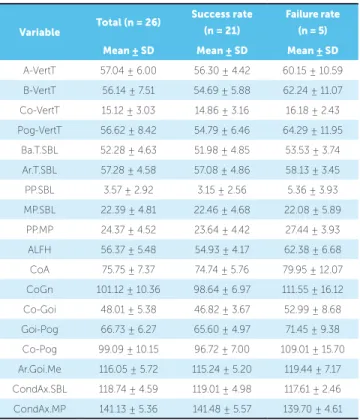
Descriptive statistics for all cephalometric variables in the irst observation phase (T1), for the total sample and for both groups (successful, n = 21; and unsuccessful n = 5) is shown in Table 1.
Shapiro-Wilk test showed that all variables were normally distributed, except for: Co-Pog, Co-Goi, Goi-Pog, PP.SBL, CoA and Co-Gn. Since none of these variables remained in the model ater discriminant analysis was carried out, the aforementioned normality deviations did not hinder analysis.
Discriminant analysis assesses all variables together, whereas Student’s t-test assesses each one separately. Discriminant analysis was performed for all cephalo-metric variables of the 26 patients at treatment onset (T1). In order to attain a better discrimination model that could anticipate the prognosis of an early maloc-clusion Class III treatment, the stepwise procedure was used to select the variables, using F = 3 in order to keep or remove the variable from the model. When the small-est group of variables was selected, the predictive power (classiication power) of the model was tested by means of discriminant analysis. An equation was then devel-oped and applied to all 26 cases, and the total prediction model was calculated. This last procedure provides a prediction model that allows a new patient to be includ-ed in each one of the groups. The stepwise procinclud-edure identiied satisfactory predictors and generated a two-variable model that produced the most eicient division between the two groups. The variables selected were anterior lower facial height (ALFH) and inclination of the condylar axis with the mandibular plane (CondAx. MP), a plane that represents the mandibular body, pass-ing through Goi and Me points (Fig 8 and Table 2). An increased ALFH and a decreased mandibular plane ,in relation to the condylar axis, happening at the same time, signal a predictive capacity towards failure.
The classiication power of the model for both vari-ables selected was 88.5% (Table 3). Only one in every ive patients of each group was not correctly classiied. The non-standard discriminant function coeicient of the variables selected, and the calculation of the con-stant (Table 4) resulted in the equation below, which provides an individual score of attribution that allows each new patient to remain either in the successful or unsuccessful group (equation 1):
Discriminant function:
Individual value = 0.232 x ALFH – 0.116 x CondAx.MP + 3.289
Table 4 - Coefficients produced by discriminant analysis.
Discriminant values (centroid values of groups):
Success rate = -0.372; Failure rate = 1.562; Critical value = 0.595.
Predicting variable Non-standardized coeicients
ALFH 0.232
CondAx.MP -0.116
Constant 3.289
Variable Total (n = 26)
Success rate
(n = 21)
Failure rate
(n = 5)
Mean ± SD Mean ± SD Mean ± SD
A-VertT 57.04 ± 6.00 56.30 ± 4.42 60.15 ± 10.59 B-VertT 56.14 ± 7.51 54.69 ± 5.88 62.24 ± 11.07 Co-VertT 15.12 ± 3.03 14.86 ± 3.16 16.18 ± 2.43 Pog-VertT 56.62 ± 8.42 54.79 ± 6.46 64.29 ± 11.95
Ba.T.SBL 52.28 ± 4.63 51.98 ± 4.85 53.53 ± 3.74 Ar.T.SBL 57.28 ± 4.58 57.08 ± 4.86 58.13 ± 3.45 PP.SBL 3.57 ± 2.92 3.15 ± 2.56 5.36 ± 3.93 MP.SBL 22.39 ± 4.81 22.46 ± 4.68 22.08 ± 5.89
PP.MP 24.37 ± 4.52 23.64 ± 4.42 27.44 ± 3.93 ALFH 56.37 ± 5.48 54.93 ± 4.17 62.38 ± 6.68 CoA 75.75 ± 7.37 74.74 ± 5.76 79.95 ± 12.07 CoGn 101.12 ± 10.36 98.64 ± 6.97 111.55 ± 16.12 Co-Goi 48.01 ± 5.38 46.82 ± 3.67 52.99 ± 8.68 Goi-Pog 66.73 ± 6.27 65.60 ± 4.97 71.45 ± 9.38 Co-Pog 99.09 ± 10.15 96.72 ± 7.00 109.01 ± 15.70 Ar.Goi.Me 116.05 ± 5.72 115.24 ± 5.20 119.44 ± 7.17 CondAx.SBL 118.74 ± 4.59 119.01 ± 4.98 117.61 ± 2.46 CondAx.MP 141.13 ± 5.36 141.48 ± 5.57 139.70 ± 4.61
Table 1 - Cephalometric variables at T1. Table 2 - Stepwise procedure to select model variables.
Table 3 - Discriminant analysis classification results.
Value to remove the model F=3.
Percentage of correctly classified values = 88.5%.
Model variables F = 3
Variables
outside the model
F = 3
ALFH 13,801 A-VertT 0,022 CondAx.MP 3,296 B-VertT 0,430 Co-VertT 0,185 Pog-VertT 0,672 Co-Pog 0,019 Co-Goi 0,257 Goi-Pog 0,281 Ba.T.SBL 0,365 Ar.T.SBL 0.392 PP SBL 1,211 MP.SBL 0,159 PP.MP 1,235 Ar.Goi.Me 1,951 CondAx.SBL 0,159
CoA 0,345
GoGn 0,000
treated by means of RME/ FM therapy with progno-sis of success. Conversely, patients whose value ob-tained for the discriminant function was above the critical value shall be treated with prognosis of fail-ure, i.e., they may not have satisfactory results by the end of orthopedic treatment.
Group Number of cases
Prediction based on the model
Success rate Failure rate
n % n %
Success rate 21 19 90.5 2 9.5
Failure rate 5 1 20.0 4 80.0
DISCUSSION
Interceptive treatment of Class III malocclusion complies with a protocol most likely to be the most uni-form in Orthodontics, and which although upheld by undeniable eiciency,1,3,14,17,24 has some limitations
losses overtime. Within this context, prognosis depends on the skeletal discrepancy given by Pattern III facial growth,5 which causes some concern to the people
in-volved: patient, guardians and the clinician. Other stud-ies have tried to overcome this problem and aim at ind-ing out the discriminant variables; in other words, the characteristics that, once identiied in the pre-treatment phase, may contribute to deining a long-term progno-sis at the end of growth.
That was the objective of this research. A group of 26 patients submitted to RME/FM therapy had their lateral radiographs of the face assessed before treatment and after a 6-year follow-up, without any type of retainer, by the end of facial growth (mean age of 15 years old). The maturation status was de-termined by biological indicators and confirmed by hand-wrist radiograph assessment36 (Fig 2).
The criteria provided by subjective facial analy-sis were used to divide the groups at active growth completion, a critical moment for the deinition of the therapeutic procedure and, hence, for the success or failure of interceptive therapy. Such criteria were then associated with the identiication of predictive mea-sures with signiicant prognostic power at treatment onset of Class III patients. Facial analysis was used to identify positive and negative facial features and, there-fore, suggest a method to treat the occlusion. Success or failure of orthopedic treatment requires growth pre-diction. No accurate methods employed to predict the future of mandibular growth are yet available.27 Our
indings speciically aimed at searching for predictabil-ity of results yielded by an interceptive treatment pro-tocol of Class III malocclusion.
All 21 patients in the successful group were con-sidered acceptable according to the subjective facial analysis criteria.5,35,37 Despite having a skeletal error
that had not been corrected in its essence, these pa-tients’ facial pattern displayed a balanced and close-to-normal face. The magnitude of error was not significant enough so that it could be seen in frontal assessment,38 in mandibular growth properly related
to maxillary growth, and in the signs of excessive mandibular growth — considered as mild. Most of times, it was considered as acceptable, thus suggest-ing a reduction in profile convexity, which is typical of Classe III patients. Facial asymmetry, whenever present, had no significant progress or impact.
All ive patients in the unsuccessful group presented sagittal imbalance, severe enough so that it could be identiied even by frontal assessment. Straight or con-cave proile conirms studies that brought out a direct relationship between proile convexity and unpleasant esthetic appearance,38 evident signs of prognathism,
mandibular imbalance with regard to size, shape and position, with increased chin-throat length. Morpho-logical signs of maxillary deiciency were clearly iden-tiied, transposing the limits of acceptability. The na-sogenian fold was evident, zygomatic projection was absent and there were signs of exophthalmia, which damage the medium third of the face, especially if pa-tients’ age is considered. Additionally, two out of ive patients in the unsuccessful group presented remark-able and severe facial asymmetry.
The results obtained, with 80.7% of the sample considered as successful, confirm the presupposed efficiency of the orthopedic correction protocol (RME/FM) employed as an intervention to treat Class III malocclusion. These data corroborate those found in the literature19,20,24,42,43 which report
a similar success rate with regard to this procedure when employed in mixed dentition.
Taking the aforementioned information into ac-count as well as the main purpose of this research, the following question arises: Could patients destined for diferent results by the end of growth, whether suc-cessful or unsucsuc-cessful, have a prognosis deined a priori, i.e., before interceptive treatment is performed?
Comparison between the successful and unsuccess-ful groups, carried out by means of discriminant analy-sis applied to cephalometric data obtained at treatment onset, revealed two variables with predictive power: ALFH and condyle inclination in relation to the man-dibular plane. In practical terms, the smaller number of variables included in the discriminant analysis, the more relevant it will be.29,34 Discriminant analysis was
chosen as an eicient technique used to identify the cephalometric variables capable of predicting the re-sults of early orthopedic treatment performed in Class III patients.25,26,29,31,34 Although discriminant analysis
was considered as relatively eicient, the authors,26,34
heredity, should be included in the analysis with the purpose of increasing the ability of prediction.
By means of discriminant analysis, Baccetti et al25
identified three cephalometric variables with prog-nosis ability present at initial cephalometric register: Long mandibular ramus or increased posterior fa-cial height (Co-Goi), greater cranial base angulation (Ba.T.SBL) and increased angle between the man-dibular plane and the cranial base(MP.SBL), all of which were related to unfavorable results at active growth completion, with a classification power of variables of 83.33%. Such rate was similar to that found in our research: 88.5%.
Moon et al34 reported that patients with a lower
value for the gonial angle and a more horizontal skel-etal pattern present better prognosis for orthopedic treatment of Class III malocclusion. Additionally, by means of the stepwise procedure employed to select the variables, they obtained the measure between the mandibular plane (Go-Me) and the anteroposterior relationship between the maxilla and the mandible (AB), with higher predictive power, particularly re-garding the identification of surgical cases.
Therefore, it seems reasonable to admit that, in both studies,25,34 the results suggest that an increased
angle between the mandibular plane and the cranial base (MP.SBL)25, as well as lower angle between the
mandibular plane and the AB line (AB to Go-Me) define an unsatisfactory prognosis.
In a retrospective study, based on the results of or-thopedic treatment (RME/FM) performed in 64 Class III patients, Ghiz, Ngan and Gunel27 selected four
cephalometric variables with higher predictive power for unsatisfactory treatment results; all variables were related to the mandible: shorter distance from the condyle to the cranial base, shorter length of the ra-mus, longer mandibular length. The gonial angle was signiicantly greater in the unsuccessful group, which corroborates the indings of this research (Table 1).
Moreover, changes in facial height can also be con-sidered, since posterior facial height or the length of the ramus (Co-Goi), obtained by Baccetti et al,25
in-creased. Conversely, our results considered increased ALFH as an unfavorable prediction variable at treat-ment onset. Such fact agrees with previous studies25,28
in which Class III patients with vertical growth pat-tern are associated with unsatisfactory results.
Franchi et al29 accounted Class III patients with
greater angle between the palatal plane and man-dibular plane in deciduous dentition as an unfavor-able prognostic sign, emphasizing the important role vertical standards play.
Thus, in general, it seems that mandibular shape and growth are more important than the initial max-ilomandibular sagittal relationship for a long-term prognosis of early Class III malocclusion treatment.27,34
From this broad perspective, comparison between our results and those yielded by other
research-es25,27,34 presents some limitations, given the
the same time in our research is what determines the predictive power towards failure (Fig 8).
The limitations of this process of identifying vari-ables capable of expressing prediction and allowing a prognosis are as evident as the possibilities that were raised. The greatest limitation is expressed in the large number of predictors found and in the rare repetition of variables in the predictors models found in the lit-erature. As usual, the search for knowledge should be ongoing. It seems reasonable to consider that includ-ing the predictors that occur with higher frequency in the researches carried out, for instance, the gonial angle, the changes in mandibular shape and size as well as the information regarding heredity, in the analysis model, can enhance the prognostic ability.
CONCLUSION
Based on the results of this retrospective and longitu-dinal study conducted with young Class III patients who underwent an interceptive orthopedic treatment proto-col (RME/FM) and were assessed by the end of facial growth, it is reasonable to conclude that an unfavorable prognosis can be predicted when cephalometric analysis carried out at treatment onset reveals that patients present, at the same time, increased ALFH and decreased value of the angle between the condylar axis and the mandibu-lar plane (CondAx.MP). The outcomes at active growth completion of an interceptive orthopedic treatment per-formed in Class III patients can be predicted with a hit probability of 88.5%.
1. Baccetti T, Franchi L, McNamara Jr JA. Treatment and post treatment
craniofacial changes after rapid maxillary expansion and face mask therapy. Am J Orthod Dentofacial Orthop. 2000;118(4):404-13.
2. Williams DM, Saver MD, Sadowsky L, Bradley E. Combined rapid maxillary
expansion and protraction face mask in the treatment of class III malocclusions in growing children: a prospective long term study. Semin Ortod. 1997;3(4):265-74.
3. Merwin D, Ngan P, Hagg U, Yiu C, Wei SH. Timing for efective application of anteriorly directed orthopedic force to the maxilla. Am J Orthod Dentofacial Orthop. 1997;112(3)292-99.
4. Miyajima K, McNamara JA Jr, Sana M, Murata S. An estimation of
craniofacial growth in the untreated Class III female with anterior crossbite. Am J Orthod Dentofacial Orthop. 1997;112:425-34.
5. Capelozza Filho L. Diagnóstico em ortodontia. Maringá: Dental Press;
2004.
6. Capelozza Filho L. Metas terapêuticas individualizadas. Maringá: Dental Press; 2011.
7. Sugawara J, Mitani H. Facial growth of skeletal Class III malocclusion and the efects, limitations and long-term dentofacial adaptation to chincap therapy. Semin Orthod. 1997;3(4):244-54.
8. Ellis E, McNamara JA Jr. Components of adult Class III malocclusion. J Oral Maxillofac Surg. 1984;42:295-305.
9. Guyer EC, Ellis EE, McNamara JA Jr, Behrents RG. Components of Class
III malocclusion in juveniles and adolescents. Angle Orthod. 1986;56:7-30. 10. Tollaro I, Baccetti T, Franchi L. Craniofacial change induced by early
functional treatment of Class III malocclusion. Am J Orthod Dentofacial Orthop. 1996;109(3):310-8.
REFERENCES
11. Mitani H. Prepubertal growth of mandibular prognathism. Am J Orthod. 1981;80(5):546-53.
12. Sakamoto M, Sugawaraj, Umemori M, Mitani H. Craniofacial growth of mandibular prognathism during pubertal growth period in Japanese boys--Longitudinal study from 10 to 15 years of age. J Jpn Orthod Soc. 1996;55:372-86.
13. Mitani H, Sato K, Sugawara J. Growth of mandibular prognathism after pubertal growth peak. Am J Orthod Dentofacial Orthop. 1993;104(4):330-6.
14. Cha KS. Skeletal changes of maxillary protraction in patients exhibiting skeletal class III malocclusion: a comparison of three skeletal maturation groups. Angle Orthod. 2003;73:26-35.
15. McNamara JR, JA. An orthopedic approach to the treatment of class III malocclusion in young patients. J Clin Orthod. 1987;21(9):598-608. 16. Hata S, Itoh T, Nakagawa M, Kamogashira K, Ichikawa K, Matsumoto M,
et al. Biomechanical efects of maxillary protraction on the craniofacial complex. Am J Orthod Dentofacial Orthop. 1987;91(4):305-11. 17. Ngan P, Wei SHY, Hagg U, Yiu CKY, Merwin D, Stickel B. Efect of
protraction headgear on class III malocclusion. Quintessence Int. 1992;23:197-207.
18. Turley PK. Orthopedic correction of Class III malocclusion: Retention and phase II therapy. J Clin Orthod. 1996;30(6):313-24.
19. Baccetti T, McGill JS, Franchi L, McNamara JA Jr, Tollaro I. Skeletal efects of early treatment of class III malocclusion with maxillary expansion and face-mask therapy. Am J Orthod Dentofacial Orthop. 1998;113(3):333-43. 20. Kapust J, Sinclair PM, Turley PK. Cephalometric efects of face mask
Orthod Dentofacial Orthop. 1998;113(2):204-12.
21. Franchi L, Baccetti T, McNamara JA Jr. Shape-coordinate analysis induced by rapid maxillary expansion and facial mask therapy. Am J Orthod Dentofacial Orthop. 1998;114(4):418-26.
22. Baccetti T, Franchi L. Updating cephalometrics through morphometrics: thin-plate spline analysis of craniofacial growth/treatment changes. In: McNamara JA Jr. Ed. Growth modiication: what works, what doesn’t, and why. Monograph No 35. Cranio-facial Growth Series. Ann Arbor: Center for Human Growth and Development, University of Michigan; 1999. p. 257-73. 23. Nartallo-Turley PE, Turley PK. Cephalometric efects of combined palatal
expansion and face mask therapy on Class III malocclusion. Angle Orthod. 1998;68(3):217-24.
24. Ngan PW, Hagg U, Yiu C, Wei SHY. Treatment response and long term dentofacial adaptations to maxillary expansion and protraction. Semin Orthod. 1997;3(4):255-64.
25. Baccetti T, Franchi L, McNamara JA Jr. Cephalometric variables predicting the long-term success or failure of combined rapid maxillary expansion and facial mask therapy. Am J Orthod Dentofacial. 2004;126(1):16-22. 26. Battagel J. Discriminant analysis: a model for the prediction of relapse in
Class III children treated orthodontically by a non-extraction technique. Eur J Orthod. 1993;15(3):199-209.
27. Ghiz, AM, Ngan P, Gunel E. Cephalometric variables to preside future success of early orthopedic class III treatment. Am J Orthod Dentofacial Orthop. 2005;127(3):301-6.
28. Fudalej P, Gragan M, Wedrychowska-Szulc B. Predcition of the outcome of orthodontic treatment of Class III malocclusions a systematic review. Eur J Orthod. 2011;33(2):190-7.
29. Franchi L, Baccetti T, Tollaro I. Predictive variables for the outcome of early functional treatment of Class III malocclusion. Am J Orthod Dentofacial Orthop. 1997;112(1):80-6.
30. Ko Y-I, Baek S-H, Mah j, Zang W-S. Determinant of successful chincup therapy in skeletal Class III malocclusion. Am J Orthod Dentofacial Orthop. 2004;126(1):33-41.
31. Tahmina K, Tanaka E, Tanne K. Craniofacial morphology in orthodontically treated patients of Class III malocclusion with stable and unstable treatment outcomes. Am J Orthod Dentofacial Orthop. 2000;117(6):681-90.
32. Yoshida I, Yamaguchi N, Mizoguchi I. Prediction of post-treatment outcome after combined treatment with maxillary protraction and chincap appliances. Eur J Orthod. 2006;28:89-96.
33. Zentnera A, Doll GM, Peylo M. Morphological parameters as predictors of successful correction of Class III malocclusion. Eur J Orthod. 2001;23(4):383-92.
34. Moon YM, Ahn Sj, Chang YI. Cephalometric predictors of long term stability in the early treatment of Class III malocclusion. Angle Orthod. 2005;75(5):747-53.
35. Reis SAB. Análise facial numérica e subjetiva do peril e análise da relação oclusal sagital em brasileiros, adultos, leucodermas, não tratados ortodonticamente [dissertaçãou]. São Paulo (SP): Universidade Metodista de São Paulo; 2001.
36. Hägg U, Taranger J. Maturation indicators and the pubertal growth spurt. Am J Orthod. 1982;82(4):299-309.
37. Martins DR. Estudo comparativo dos valores cefalométricos das análises de Downs e Tweed, com os descendentes brasileiros; leucodermas, de origem mediterrânea. Ortodontia. 1999;14(2):101-6.
38. Reis SAB, Abrão J, Capelozza Filho L, Claro CAA. Evaluation of the determinants of facial proile aesthetics. Dental Press J Ortod. 2011;16(1):57-67.
39. Viazis AD. The cranial base triangle. J Clin Orthod. 1991;25(9):565-70. 40. Melsen B. The cranial base. Acta Odontol Scand. 1974;32(Suppl 62). 41. Houston, WJB. The analysis of errors in orthodontic measurements. Am J
Orthod. 1983;83(5):382-90.
42. Westwood PV, McNamara JA Jr, Baccetti T, Franchi L, Sarver DM. Long-term efects of class III treatment with rapid maxillary expansion and face mask therapy followed by ixed appliances. Am J Orthod Dentofacial Orthop. 2003;123(3):306-20.