Dacron Graft Intussusception Technique for
Treatment of Type A Aortic Dissections: Technical
Notes and Preliminary Results
Bruno Botelho Pinheiro
1, MD, MSc; Walter V. Fagundes
2, MD; Luís F. F. Muniz
2, MD; Mats Dreifaldt
3, MD, PhD;
Mikael Arbeus
3, MD; Domingos S. R. Souza
3, MD, PhD
Abstract
Introduction: Optimal surgical management for acute type A aortic dissection (AAAD) remains unclear. The in-hospital mortality rate is still high (15%), and the intraoperative bleeding is an independent risk factor for hospital mortality.
Objective: The aim of our study was describe a new method for aortic anastomosis in the repair of AAAD and report the hospital mortality and bleeding complications.
Methods: Between January 2008 and November 2014, 24 patients, 16 male, median age 62 years, underwent surgical treatment of AAAD. The surgical technique consisted of intussusception of a Dacron tube in the dissected aorta, which is anastomosed with a first line of 2-0 polyester everting mattress suture and a second line of 3-0 polypropylene running suture placed at the outermost side. Open distal anastomosis was performed with bilateral selective antegrade cerebral perfusion in 13 (54.1%) patients.
Results: Cardiopulmonary bypass and aortic clamping time ranged from 75 to 135 min (mean=85 min) and 60 to 100 min (mean=67 min), respectively. The systemic circulatory arrest ranged from 29 to 60 min (mean=44.5 min). One (4.1%) patient required reoperation for bleeding, due to the use of preoperative clopidogrel. The postoperative bleeding was 382-1270 ml (mean=654 ml). We used an average of 4.2 units of red blood cells/patient. There were two (8.3%) hospital deaths, one due to intraoperative bleeding and another due to mesenteric ischemia. The average length of stay in the intensive care unit and hospital was 44 hours and 6.7 days, respectively.
Conclusion: This new method for surgical correction of AAAD was reproducible and resulted in satisfactory clinical outcomes.
Keywords: Aortic Diseases. Aorta, Thoracic. Hemorrhage. Cardiovascular Surgical Procedures.
DOI: 10.5935/1678-9741.20160042
1Serviço de Cirurgia Cardiovascular Clinicord, Goiânia, GO, Brazil. 2Hospital Evangélico Goiano (HEG), Anápolis, GO, Brazil. 3Orebro University Hospital, Orebro, Sweden.
This study was carried out at Hospital do Coração Anis Rassi, Goiânia, GO, Brazil. No financial support.
Correspondence Address: Bruno Botelho Pinheiro Hospital do Coração Anis Rassi
Av. José Alves, 453 – St. Oeste – Goiânia, GO, Brazil – Zip code: 74110-020 E-mail: [email protected]
Article received on May 12th, 2015
Article accepted on May 17th, 2016
INTRODUCTION
Acute type A aortic dissection (AAAD) is a cardiovascular emergency with a high potential for death. Rapid surgical treatment is indicated to prevent fatal complications. Despite improved
Abbreviations, acronyms & symbols
AAAD ACPB
CPB DHCA ICU IRAD SD TEE
= Acute type A aortic dissection
= Aortic clamping on hypothermic cardiopulmonary bypass
= Cardiopulmonary bypass
= Deep hypothermic circulatory arrest = Intensive care unit
= International Registry of Acute Aortic Dissections = Standard deviation
= Transesophageal echocardiography
surgical techniques and perioperative care, mortality remains high, between 15% and 30%[1,2].
Bleeding from anastomotic sites, especially sites of aorta-to-artificial graft and graft-to-graft anastomoses, is one of the major factors leading to increase in the operative time, rate of blood transfusion and surgical mortality in aortic surgery[3]. This type of bleeding may become
uncontrollable because of severe coagulopathy, mainly induced by deep hypothermia, a long cardiopulmonar bypass (CPB) time[4,5] or
fragile aortic walls by acute aortic dissection[6].
A lot of methods have been reported to prevent this bleeding, such as anastomosis techniques to reinforce a suture line, glues for anastomosis or wrapping methods, such as the Cabrol shunt[3,6-11].
However, these techniques are not always perfect and are also complex to be performed for every anastomosis during a tough operation.
Fig. 2 - First line of mattress suture passed through an extraluminal circumferential felt strip, the dissected aorta and the graft.
Fig. 1 - Eversion of the Dacron graft.
Fig. 3 - Second line of 3-0 polypropylene running suture. METHODS
A total of 24 patients from three medical centres (Örebro University Hospital/Sweden; Anis Rassi Hospital/Brazil and Hospital Evangélico Goiano/Brazil) underwent repair of AAAD with a new method for aortic anastomosis between January 2008 and November 2014.
A preoperative diagnosis of aortic dissection was performed by using computed tomography angiography or transesophageal echocardiography (TEE).
Continuous data are presented as means [standard deviation (SD); range]. Categorical data are presented as proportions.
Technique
Cardiopulmonary bypass was established with venous drainage from the right atrium and return into the axillary or brachiocephalic artery. The systemic temperature was lowered to 32°C. In patients whose open distal anastomosis was performed the temperature was lowered to 25°C and bilateral antegrade cerebral perfusion (10 ml/kg/min) was established, via axillary or brachiocephalic artery and left carotid artery. The aorta was cross clamped and opened 1.0 cm above the sinotubular junction.
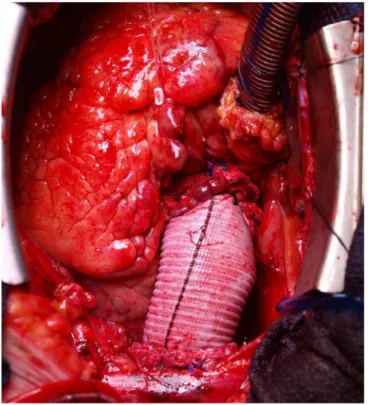
An appropriate Dacron tube graft, which is usually a little smaller than the diameter of the aortic stump, was selected. The last 3 cm of the end of the graft was everted (Figure 1). Twelve mattress sutures of 2-0 polybutylate-coated braided polyester (Ethibond, Ethicon Inc., Somerville, NJ, USA) was passed through an extraluminal circumferential felt strip, the dissected aorta and the graft (Figure 2). A second line of 3-0 polypropylene (Prolene, Ethicon Inc., Somerville, NJ, USA) running sutures was placed at the outermost side (Figure 3). This technique was used for all distal and proximal anastomoses of the aorta (Figure 4), except for the proximal anastomosis of an aortic root replacement.
Plication of the aortic valve was performed if needed. Substitution of the aortic root with a composite graft (Bentall-DeBono operation) was performed in cases with compromised aortic roots.
RESULTS
During the study period, 24 consecutive patients underwent surgery for acute ascending aortic dissection. The preoperative data for all patients are shown in Table 1.
Cardiopulmonary bypass and aortic clamping time ranged from 75 to 135 min (mean+SD = 85.4±12.7 min) and 60 to 100 min (mean±SD = 67.5±6.8 min), respectively.
In 13 (54.1%) patients, we used an open distal anastomosis at 25oC with bilateral antegrade cerebral perfusion (10 ml/kg/min).
The systemic circulatory arrest ranged from 29 to 60 min (mean±SD = 44.5±4.7 min). One (4.1%) patient presented a postoperative cerebrovascular accident and was discharged with a persistent right hemiplegia.
Bentall-DeBono operation was performed in 10 (41.6%) patients due to a compromised aortic root with severe aortic valve insufficiency. In one (4.1%) patient, additional coronary bypass grafting was performed because of a right coronary ostium disruption due to the dissection.
Table 1. Preoperative patient characteristics (N=24). Mean age [years (SD; range)] 58 (13; 45–81) Male/female ratio (%/%) 16/8 (66.6/33.4) Prior cardiac surgery/PCI 0%/16.6% (N=4)
Hypertension 70.8% (N=17)
Diabetes mellitus 29.1% (N=7)
COPD 20.8% (N=5)
Prior myocardial infarction 8.3% (N=2)
Prior CVA 4.1% (N=1)
Dissection type
DeBakey type 1 91.7% (N=22)
DeBakey type 2 8.3% (N=2)
Etiology
Idiopathic 95.8% (N=23)
Marfan 4.1% (N=1)
Systolic LVF
Good (EF > 50%) 79.2% (N=19) Impaired (EF < 50%) 20.8% (N=5) Aortic insufficiency
None 12.5% (N=3)
Grade I–II 33.3% (N=8)
Grade III–IV 54.2% (N=13)
Shock 25.0% (N=6)
Tamponade 12.5% (N=3)
SD=standard deviation; PCI=percutaneous coronary intervention; COPD=chronic obstructive pulmonary disease;
CVA=cerebrovascular accident; LVF=left ventricular function
Table 2. Perioperative data.
Variable Mean±SD Range
CPB (min) 85.4±12.7 75–135
Clamping time (min) 67.5±6.8 60–100
SACP time (min) 44.5±4.7 29–60
Blood transfusion (U) 4.2±1.7 0–12
Blood loss (24h) 654±128 382–1270
CPB=cardiopulmonary bypass; SACP=selective antegrade cerebral perfusion
Fig. 4 - Final aspect.
bleeding was 382-1270 ml (mean±SD = 654±128 ml). We used an average of 4.2 units of red blood cells/patient (Table 2).
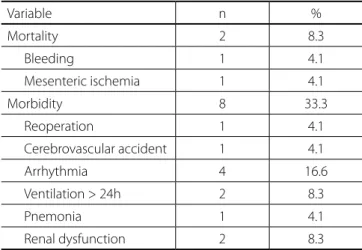
There were two (8.3%) hospital deaths, one due to intraoperative bleeding (uncontrolled coagulopathy) and another due to mesenteric ischemia. The average length of stay in the Intensive Care Unit (ICU) and hospital was 44 hours and 6.7 days, respectively. Postoperative data are summarized in Table 3.
DISCUSSION
There is a consensus that AAAD is an urgent surgical disease, given the high mortality in patients who receive medical treatment. The International Registry of Acute Aortic Dissections (IRAD) data have further confirmed this statement: in this registry, which includes aortic centers around the world using different policies regarding diagnosis and management, the overall surgical mortality was 23.9%, whereas patients treated medically had an in-hospital mortality of 58.1%[1,12]. Others have also confirmed that surgical
results remain suboptimal, showing a mortality rate from 15% to 30%[1,12].
Major complications after surgery for AAAD – bleeding or infection requiring reoperation, renal and respiratory failure, temporary and permanent neurological dysfunction, organ dysfunction, and multisystem organ failure – are worthwhile studying if their prevalence is relatively high and if they substantially influence surgical outcomes, that is, early or late mortality[13].
Persistent oozing and bleeding after aortic anastomosis can occur during aortic surgery. This type of bleeding may become uncontrollable because of severe coagulopathy, mainly induced by deep hypothermia and a long cardiopulmonary bypass time[4,5],
or fragile aortic walls by acute aortic dissection[6]. A lot of methods
have been reported to prevent this bleeding, such as anastomosis techniques to reinforce a suture line, glues for anastomosis or wrapping methods[3,6-11].
Table 3. Postoperative data.
Variable n %
Mortality 2 8.3
Bleeding 1 4.1
Mesenteric ischemia 1 4.1
Morbidity 8 33.3
Reoperation 1 4.1
Cerebrovascular accident 1 4.1
Arrhythmia 4 16.6
Ventilation > 24h 2 8.3
Pnemonia 1 4.1
Renal dysfunction 2 8.3
Authors’ roles & responsibilities
BBP
WVF
LFFM
MD
MA
DSRS
Conception and design study; realization of operations and/or trials; analysis and/or data interpretation; manuscript writing or critical review of its content; final manuscript approval
Realization of operations and/or trials; final manuscript approval
Realization of operations and/or trials; final manuscript approval
Realization of operations and/or trials; final manuscript approval
Realization of operations and/or trials; final manuscript approval
Conception and design study; realization of operations and/or trials; analysis and/or data interpretation; final manuscript approval
REFERENCES
1. Rampoldi V, Trimarchi S, Eagle KA, Nienaber CA, Oh JK, Bossone E, et al. Simple risk models to predict surgical mortality in acute type A aortic dissection: the International Registry of Acute Aortic Dissection score. Ann Thorac Surg. 2007;83(1):55-61.
2. Bonser RS, Ranasinghe AM, Loubani M, Evans JD, Thalji NM, Bachet JE, et al. Evidence, lack of evidence, controversy, and debate in the provision and performance of the surgery of acute type A aortic dissection. J Am Coll Cardiol. 2011;58(24):2455-74.
3. Ohira S, Watanabe T, Yaku H. Layered wrapping technique combined with oxidized cellulose and vascular prosthesis for effective haemostasis in aortic surgery. Interact Cardiovasc Thorac Surg. 2015;20(2):276-7.
Chiappini et al.[14] published a large series of 487 consecutive
patients with AAAD treated surgically with an in-hospital mortality rate of 22%. Post-operative complications included re-operation for bleeding in 115 (23.8%) patients.
Hansson et al.[15] demonstrated that the 30-day mortality in
patients operated for AAAD on dual antiplatelet therapy was 30.4% compared with 13% in patients with no or single antiplatelet therapy (P=0.038).
The intraoperative factors of long perfusion time (cardiopulmonary bypass time > 4 hours), prolonged operation time (> 6 hours), and massive blood transfusion (> 20 units) were found to be statistically significant risk factors for hospital death including operative death. Massive blood transfusion during operation can mean technical difficulties, unfavorable anatomy, or intraoperative complications, and these factors can contribute to prolonged operation or cardiopulmonary bypass time and, therefore, affect surgical outcome[16-18].
In our study, cardiopulmonary bypass time ranged from 75 to 135 min (mean=85 min) and the postoperative bleeding was 382-1270 ml (mean=654 ml). We used an average of 4.2 units of red blood cells/patient. None of our patients used > 20 units of blood transfusion.
Stamou et al.[19] compared the early and late clinical outcomes
of open distal anastomosis under deep hypothermic circulatory arrest (DHCA) with distal aortic clamping on hypothermic cardiopulmonary bypass (ACPB) during a repair of AAAD. Early postoperative complications, such as cerebrovascular accident and renal failure were comparable between the two groups. A comparable five-year actuarial survival was also observed with both techniques[19]. We performed an open distal anastomosis with
bilateral antegrade cerebral perfusion in 13 (54.1%) patients, and one patient presented a postoperative cerebrovascular accident in the early postoperative period.
The substitution of the aortic root with a composite graft (Bentall-DeBono operation) was performed in 41.6% of our patients. Bekkers et al.[20]. reported long-term results and incidence of
reoperations after surgery for AAAD. Late survival was comparable for patients with preserved native valves versus patients with various
types of valve replacement. Aortic valve preservation in patients presenting with severe aortic insufficiency was associated with an increased risk of aortic valve reoperation.
Study Limitations
The main limitation of our study is because it is a non-randomized trial, with a small sample size. Investigation of the causes of late mortality, late reoperations on the remaining dissected aorta (aortic arch, descending aorta), as well as the fate of the false lumen were beyond the scope of our study and need to be the focus of future reports.
CONCLUSION
4. Tanaka M, Kawahito K, Adachi H, Ino T. Platelet dysfunction in acute type A aortic dissection evaluated by the laser light-scattering method. J Thorac Cardiovasc Surg. 2003;126(3):837-41.
5. Paparella D, Rotunno C, Guida P, Malvindi PG, Scrascia G, De Palo M, et al. Hemostasis alterations in patients with acute aortic dissection. Ann Thorac Surg. 2011;91(5):1364-9.
6. Vander Salm TJ, Toran AJ. An aortic cinch to quell suture line bleeding. Ann Thorac Surg. 2010;89(3):990-1.
7. Salerno TA, Carvalho EM, Panos AL, Ricci M. Modified Cabrol shunt after complex aortic surgery. Ann Thorac Surg. 2008;86(2):669-70. 8. Kan CD, Yang YJ. Double telescopic anastomosis with interrupted
suture technique in acute aortic dissection. Ann Thorac Surg. 2011;91(5):1630-1.
9. Sakakibara Y, Koshiji T, Hagio K, Ishigami M, Nakatsu T. Novel wrapping technique with insertion of fat tissue for hemostasis in aortic surgery. Ann Thorac Surg. 2010;89(3):992-3.
10. Rignano A, Keller GC, Carmo M, Anguissola GB, Settembrini PG. A new approach for proximal anastomosis in type “A” acute aortic dissection: prosthesis eversion. Ann Thorac Surg. 2003;76(3):949-51.
11. Ohata T, Miyamoto Y, Mitsuno M, Yamamura M, Tanaka H, Ryomoto M. Modified sandwich technique for acute aortic dissection. Asian Cardiovasc Thorac Ann. 2007;15(3):261-3.
12. Trimarchi S, Nienaber CA, Rampoldi V, Myrmel T, Suzuki T, Mehta RH, et al. Contemporary results of surgery in acute type A aortic dissection: The International Registry of Acute Aortic Dissection experience. J Thorac Cardiovasc Surg. 2005;129(1):112-22.
13. Olsson C, Franco-Cereceda A. Impact of organ failure and major
complications on outcome in acute type A aortic dissection. Scand Cardiovasc J. 2013;47(6):352-8.
14. Chiappini B, Schepens M, Tan E, Dell’ Amore A, Morshuis W, Dossche K, et al. Early and late outcomes of acute type A aortic dissection: analysis of risk factors in 487 consecutive patients. Eur Heart J. 2005;26(2):180-6.
15. Hansson EC, Dellborg M, Lepore V, Jeppsson A. Prevalence, indications and appropriateness of antiplatelet therapy in patients operated for acute aortic dissection: associations with bleeding complications and mortality. Heart. 2013;99(2):116-21.
16. Kawahito K, Adachi H, Yamaguchi A, Ino T. Preoperative risk factors for hospital mortality in acute type A aortic dissection. Ann Thorac Surg. 2001;71(4):1239-43.
17. Ranucci M, Baryshnikova E, Castelvecchio S, Pelissero G; Surgical and Clinical Outcome Research (SCORE) Group. Major bleeding, transfusions, and anemia: the deadly triad of cardiac surgery. Ann Thorac Surg. 2013;96(2):478-85.
18. Issa M, Avezum A, Dantas DC, Almeida AF, Souza LC, Sousa AG. Risk factors for pre, intra, and postoperative hospital mortality in patients undergoing aortic surgery. Braz J Cardiovasc Surg. 2013;28(1):10-21. 19. Stamou SC, Kouchoukos NT, Hagberg RC, Khabbaz KR, Robicsek
F, Nussbaum M, et al. Does the technique of distal anastomosis influence clinical outcomes in acute type A aortic dissection? Interact Cardiovasc Thorac Surg. 2011;12(3):404-8.