Mazama gouazoubira
Fischer, 1817 (Cervidae: Odocoileini)
from Brazilian Pantanal wetlands, with considerations on
Pygarginema verrucosa
(Molin, 1860) Kadenatzii, 1948
(Spirocercidae: Ascaropsinae)
Lux Hoppe, EG.
a,b*, Tebaldi, JH.
aand Nascimento, AA.
a aDepartamento de Medicina Veterinária Preventiva e Reprodução Animal,Faculdade de Ciências Agrárias e Veterinárias – FCAV, Universidade Estadual Paulista – UNESP, Via de Acesso Prof. Paulo Donato Castellane, s/n, CEP 14887-900, Jaboticabal, SP, Brazil
bCentro Universitário de Rio Preto – UniRP, Av. Yvette Gabriel Atique, 45,
CEP 15025-400, São José do Rio Preto, SP, Brazil *e-mail: [email protected]
Received December 19, 2008 – Accepted April 14, 2009 – Distributed May 31, 2010 (With 5 figures)
Abstract
The Brazilian Pantanal wetlands are a unique ecosystem with a faunistic composition similar to that of the adjacent biomes but in higher densities. The early establishment of domestic cattle husbandry in that area introduced patho-gens that may influence the indigenous Pantanalian fauna. In this paper, the authors describe the helminthfauna of ten free-ranging adult Mazama gouazoubira from the Paiaguás sub-region, along with the descriptors of infection. Morphological description of Pygarginema verrucosa is supplied, with comments on other species of this genus. The helminth species found are similar to domestic cattle helminthfauna of the same physiographic region, suggesting an adaptation of bovine parasites to this host.
Keywords: Cervidae, Mazama gouazoubira, Brazilian Pantanal wetlands, helminthfauna, Pygarginemaverrucosa, Brazil.
Avaliação helmintológica de veados-catingueiros
Mazama gouazoubira
Fischer,
1817 (Cervidae: Odocoileini) de vida livre, procedentes do Pantanal brasileiro,
com considerações sobre
Pygarginema verrucosa
(Molin, 1860) Kadenatzii, 1948
(Spirocercidae: Ascaropsinae)
Resumo
O Pantanal brasileiro é um ecossistema único, com composição faunística semelhante à dos biomas adjacentes, mas com densidades superiores. O gado introduzido na região pode ter carreado patógenos nesse ecossistema que podem, de alguma forma, influenciar a fauna local. Neste artigo, é descrita a helmintofauna de dez indivíduos adultos de Mazama gouazoubira provenientes da sub-região de Paiaguás, juntamente com os indicadores de infecção helmínti-ca. Ainda, são fornecidas informações sobre a morfologia de Pygarginema verrucosa, com comentários sobre outras espécies deste gênero. As espécies de helmintos diagnosticadas são semelhantes àquelas encontradas em bovinos da mesma região, sugerindo adaptação destas no hospedeiro estudado.
Palavras-chave: Cervidae, Mazama gouazoubira, Pantanal brasileiro, helmintofauna, Pygarginema verrucosa, Brasil.
1. Introduction
The Brazilian Pantanal wetlands are a unique eco-system comprised of areas of flooded plains, with fau-nistic composition similar to that of adjacent biomes, but in higher populational densities (Rodrigues et al., 2002).
lactophenol. Morphometry was accomplished under Image Pro-Plus® v4.1 software, based on images ob-tained with an Olympus BX-51® microscope equipped with a QColor3® digital camera. Measurements of morphological characters are expressed in millimetres (±standard deviation) and were based on five speci-mens of each sex, otherwise stated. Drawings were made with a drawing tube attached to a Carl-Zeiss® binocular microscope. Species identification followed Travassos (1937), Durette-Desset (1983), Gibbons and Khalil (1982), and Vicente et al. (1997). The descrip-tors of infection were elaborated based on Bush et al. (1997). All the helminths have been deposited at the FCAV Laboratory of Helminthology collection and vouchers were sent to the Helminthological Collection of the Instituto Oswaldo Cruz Foundation (CHIOC), Rio de Janeiro, Brazil.
3. Results and Discussion
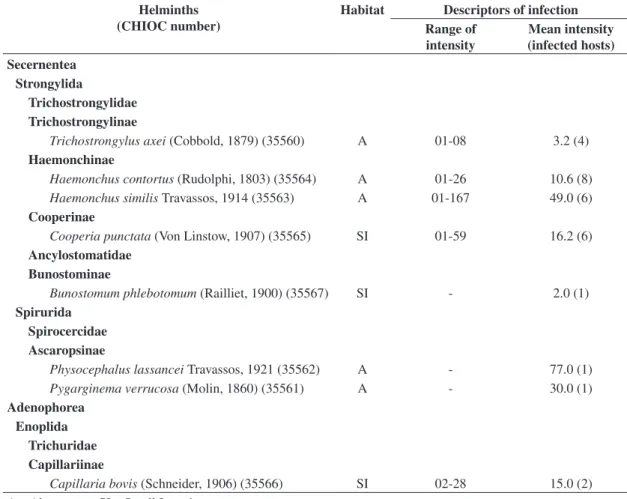
All analysed animals were parasited by helminthes. Eight nematode species, divided in seven genera and four families, were diagnosed, with a parasitic species richness of 0.8. Helminthfauna composition is detailed in Table 1, along with their quantitative descriptors and CHIOC deposit number. Species representing helminth Classes other than Nematoda were not found.
The parasite species found in these hosts are simi-lar to those previously related by Silva et al. (1999) and Nascimento et al. (2000) in deer from the states of São Paulo and Mato Grosso do Sul, Brazil, and those of Uhart et al. (2003) in Argentinean Ozotocerus bezoarticus (Linnaeus, 1758). There was great similarity with the do-mestic Zebu cattle (Catto and Furlong, 1983) from the same physiographic area, Paiaguás sub-region, suggest-ing an adaptation of bovine parasites in M. gouazoubira, despite works of Prestwood et al. (1975), Prestwood et al. (1976) and Mckenzie and Davidson (1989) that relates little evidence on cross transmission between cer-vids and domestic species.
Remarkably, Haemonchus spp showed prevalences equal or higher than 60%. Albon et al. (2002) demon-strated that Ostertagia gruehneri Skrjabin, 1929 has such an impact on Rangifer tarandus Linnaeus, 1758 that regulates the host population. Thus, the presence of high prevalences of a pathogenic helminth like Haemonchus spp could also interfere with M. gouazoubira popula-tional dynamics.
Experimental infection of North American white-tailed deer Odocoileus virginianus (Zimmermann, 1780) (Foreyt and Trainer, 1970) with H. contortus (Rudolphi, 1803) Cobb, 1989 larvae obtained from do-mestic sheep evidenced the pathogenicity of this para-site in deer, and Prestwood and Kellogg (1971) report-ed the death of one free-ranging O. virginianus due to clinical haemonchosis, confirming the importance of Haemonchus spp in deer. Studies should be accomplished Unlike other deer species, they are generalists and
conse-quently more tolerant to environmental changes (Pinder and Leeuenberg, 1997). Although this species is not in-cluded on extinction lists (IBAMA 2003, CITES 2006, IUCN 2006), its status still remains undefined due to the little information on subspecies distribution (Pinder and Leeuenberg, 1997).
It is known that exotic species introduced in a deter-mined ecosystem may have a negative influence on bio-diversity (Clout, 2002). In the early 18th century, cattle herding started in the Brazilian Pantanal wetlands con-comitantly with the Cuiaban gold rush, and the number of cattle herds in that region has increased since then. In the 1940’s, the Pantanalian cattle herd represented 90% of the total Mato Grosso State (Catto et al. 1997). The similarity observed between bovine and cervid helminth-fauna (Nascimento et al., 2000) may represent an evi-dence of cross transmission.
This study aims to evaluate and supply information on Brazilian pantanalian free-ranging grey brocket deer helminthfauna from the Paiaguás sub-region.
2. Material and Methods
2.1. Study area
The Brazilian Pantanal wetlands comprises a set of flooding plains in the High Paraguay River basin, with a total area of 138,183 Km2, located between the states of Mato Grosso and Mato Grosso do Sul, in the Brazilian central region (Silva and Abdon, 1998). This ecosystem is greatly influenced by three adjacent biomes, Chaco, Amazonian rainforest and Cerrado savanna, which ex-plains in part the heterogeneity of the pantanalian land-scape (Silva et al., 2000). Silva and Abdon (1998) divide the Brazilian Pantanal wetlands into 11 sub-regions, de-termining the Paiaguás sub-region as the largest, with a total estimated area of 27,082 km2.
2.2. Animals
Aiming to evaluate their helminthfauna, ten adult grey brocket deer were captured in their natural habitat (18° 07’ 25” S and 54° 32’ 15” W) by professional hunt-ers, under license 061/95 Devis/IBAMA, between 1994 and 1997.
2.3. Parasitological methods
The animals were captured and subsequently necrop-sied. After detailed examination, the gastrointestinal tract was removed, partitioned in its anatomical segments, slit open and washed. Gastrintestinal contents were fixed and conserved in Railliet and Henry solution and sent to the Laboratory of Helminthology, Preventive Veterinary Medicine and Animal Reproduction Department of the Agrarian and Veterinary Sciences Faculty, São Paulo State University “Julio de Mesquita Filho”, Jaboticabal, São Paulo State, Brazil.
to elucidate the pathogenical effects of Haemonchus spp in grey-brocket deer and other Neotropical species.
Hoberg et al. (2002), based on the diagnosis of Ashworthius patriciapillitae Hoberg, Abrams, Carreño and Lichtenfels, 2002 in O. virginianus from Costa Rica, suggest that this genus is more adapted to the Odocoileinae than Haemonchus, and that previous re-ports of the latter in Neotropical deer may be due to misdiagnosis. Data of this study and previous works by Travassos (1937), Nascimento et al. (2000), and Uhart et al. (2003) confirm the occurrence of Haemonchus in Neotropical Odocoileinae, discarding misdiagnosis hy-pothesis.
Low abundances observed are similar to those report-ed by Prestwood et al. (1975), Prestwood et al. (1976), Díaz et al. (1977), and could be due to host-parasite equilibrium. The parasitic diversity observed differ from that of Deem et al. (2004), who reports only Moniezia Blanchard, 1891, Trichuris Roederer, 1761 and Taenia hydatigena Pallas, 1766 cysticerci in M. gouazoubira from Bolivia. This difference may be due to the
meth-Table 1. Quantitative descriptors of helminthic infection observed in Mazama gouazoubira Fischer, 1817 from Brazilian Pantanal wetlands.
Helminths (CHIOC number)
Habitat Descriptors of infection
Range of intensity
Mean intensity (infected hosts) Secernentea
Strongylida
Trichostrongylidae Trichostrongylinae
Trichostrongylus axei (Cobbold, 1879) (35560) A 01-08 3.2 (4)
Haemonchinae
Haemonchus contortus (Rudolphi, 1803) (35564) A 01-26 10.6 (8) Haemonchus similis Travassos, 1914 (35563) A 01-167 49.0 (6)
Cooperinae
Cooperia punctata (Von Linstow, 1907) (35565) SI 01-59 16.2 (6)
Ancylostomatidae Bunostominae
Bunostomum phlebotomum (Railliet, 1900) (35567) SI - 2.0 (1)
Spirurida Spirocercidae Ascaropsinae
Physocephalus lassancei Travassos, 1921 (35562) A - 77.0 (1) Pygarginema verrucosa (Molin, 1860) (35561) A - 30.0 (1)
Adenophorea Enoplida
Trichuridae Capillariinae
Capillaria bovis (Schneider, 1906) (35566) SI 02-28 15.0 (2) A – Abomasum; SI – Small Intestine
odology employed in that work, based on coproparasito-logical methods.
The abomasal spirurid Pygarginema verrucosa (Molin, 1860) Kadenazii, 1948 is first described in this host species, although previous diagnosis in other Neotropical deer (Grisi, 1975). However, controversial data on some morphological aspects of Pygarginema species (Chabaud and Rousselot, 1956) may lead to misindentification, hindering future systematic studies of this group. Herein, a detailed morphological descrip-tion of this parasite is given.
Spirocercidae Chabaud, 1975 Ascaropsinae Alicata and McIntosh, 1933 Pygarginema verrucosa (Molin, 1860) Kadenazii, 1948
pa-Figures 1-5. Pygarginema verrucosa. 1) Stoma, en face view; 2) Anterior ending, lateral view; 3) Male posterior portion,
pillae originating close to the medial-lateral lips inser-tion. Amphids are observed next to the lateral lips origin, internally to the four papillae row. Each lip is endowed with a large, parenchimatous, refringent lobe (Figure 1). Deirids and lateral alae have not been observed on the studied specimens. The oesophagus is divided into two distinct portions: one glandular, and one pronouncedly muscular (Figure 2).
Male: Total body length 11.7529 (±0.2403), width
0.3666 (±0.0154) at oesophagean-intestinal junction. Protorhabdion length is 0.0552 (±0.0079). Oesophagus is 1.9328 (±0.0287) long, with glandular and muscular por-tions measuring 0.2476 (±0.0116) and 1.6851 (±0.0226), respectively. Nerve ring and excretory pore opening are situated 0.3885 (±0.0079) and 0.4285 (n = 1) from an-terior ending. Spicules are unequal in shape and length. The right spicule is larger and sharp-tipped, 2.2444 (±0.0401) long. The left one is thicker than the right, with a slightly rounded tip, measuring 0.4037 (±0,0154). Gubernacule shape is kind of triangular, with maximum length of 0.0777 (±0.0082). Strongly coiled tails, typical of the Spirurida, have been observed in all specimens. Consequently, only a lateral description of the caudal pa-pillae could be accomplished. Four pairs of pre-anal and two pairs of post-anal pedunculated papillae, as well as five pairs of sessile papillae in the point of the tail have been observed. These sessile papillae are grouped in one cluster of four pairs of papillae slightly distant from the tail tip pair. The caudal alae are well-developed, with a fine striation on its surface (Figure 3).
Female: Total body length 16.6167 (±0.3288), width 0.3740 (±0.0274) at the esophageal-intestinal junction. Pharynx measures 0.0511 (±0.0032). Oesophagus total length is 2.5351 (±0.1012), and the glandular and mus-cular parts are 0.7666 (±0.0353) and 1.7685 (±0.0686) long. Nerve ring and excretory pore opening are 0.2925 (±0.0154) and 0.4074 (±0.0261, only two specimens) distant from anterior ending. Didelphic females, with vulvar opening 8.5764 (±0.2012) from anterior ending. Thin-shelled, embryonated eggs in utero (Figure 4). Short and conical smooth tail, with sub-terminal anal opening, at 0.1740 (±0.0101) from tail tip (Figure 5).
3.1. Taxonomic summary
Hosts: M. nana (Hensel, 1872) (=Cervus nambi sensu Natterer, 1835), Blastocerus dichotomus (Illiger, 1815), O. bezoarticus (Linnaeus, 1758).
New host record:M. gouazoubira.
Habitat: Lumen of abomasum
New locality record: Pedro Gomes county,
Mato Grosso do Sul state, Brazil (18° 07’ 25“ S and 54° 32’ 15” W).
Deposited specimens: Voucher in CHIOC, under collection number 35561
Remarks: Species of Pygarginema Kadenatzii, 1948 have been described in Cervidae and Bovidae from Paleartical, Afrotropical (Chabaud and Rousselot, 1956) and Neotropical regions (Grisi, 1975). Smales (2004) considers this genus as part of the Cosmopolitan group of the Ascaropsinae Alicata and MacIntosch, 1933. The type species of the genus, P. skrjabini Kadenatzii, 1948, was described based only on female nematodes obtained from Capreolus pygargus (Pallas, 1771) (Artyodactyla: Bovidae) (Chabaud and Rousselot, 1956). Kadenatzii (after Chabaud and Rousselot, 1956) also considers Spiroptera verrucosa Molin, 1859 as a member of this newly erected genus, naming it P. verrucosa (Molin, 1859) Kadenatzii, 1948. Later, Lubimov (after Chabaud and Rousselot, 1956) describes another species of this genus based on male and female nematodes obtained from Cervus nippon Temminck, 1838, naming it P. cervi Lubimov, 1953. Chabaud and Rousselot (1956), study-ing nematode parasites of Cephalophus dorsalis Gray, 1846 from Congo, Africa, describe P. africana Chabaud and Rousselot, 1956, places P. cervi as junior syno-nym of P. skrjabini, and comment on the morphology of the three valid species of the genus, regarding that P. verrucosa male caudal morphology is slightly differ-ent of the other two species.
Grisi (1975) reports the presence of three pairs of post-cloacal papillae, with the first pair next to the cloa-cal opening. None of the analysed specimens showed these extra papillae. Therefore, the irregularities ob-served in the caudal alae internal face may have lead to this misinterpretation.
The labial morphology of P. verrucosa is very simi-lar to P. africana and P. cervi, but with a lesser number of papillae.
4. Conclusions
Based on the obtained data, the authors suggest that the studied M. gouazoubira helminthfauna may be de-rived from that of domestic cattle. Still, H. contortus and H. similis Travassos, 1914 were the parasites with the most expressive descriptors of infection, suggesting a good adaptation on this host species. This deer is report-ed as a new host for P. verrucosa, whose morphology is described here.
for species of the genus in the Western hemisphere. Journal of Parasitology, vol. 88, no. 6, p. 1187-1199.
Instituto Brasileiro do Meio Ambiente e Recursos Naturais Renováveis - IBAMA, 2003. Lista das espécies da fauna brasileira ameaçadas de extinção. Brasília.
International Union for Conservation of Nature - IUCN, 2006.
The 2006 IUCN Red List of Threatened Species. Cambridge: IUCN. Available from: <http://www.redlist.org>. Access in: 28/10/2006.
MCKENZIE, ME. and DAVIDSON, WR., 1989. Helminths parasites of intermingling axis deer, wild swine and domestic cattle from the island of Molokai, Hawaii. Journal of Wildlife Diseases, vol. 25, no. 2, p. 253-257.
NASCIMENTO, AA., BONUTI, MR., MAPELI, EB., TEBALDI, JH., ARANTES, IG. and ZETTERMANN, CD., 2000. Infecções naturais em cervídeos (Mammalia: Cervidae) procedentes dos Estados do Mato Grosso do Sul e São Paulo por nematódeos Trichostrongyloidea Cram, 1927. Brazilian JournalofVeterinaryResearch andAnimal Science, vol. 37, no. 1, p. 153-158.
NOWAK, RM., 1999. Walker’s mammals of the world. 6 ed.
Baltimore: Johns Hopkins University Press. p. 1051-1238. (vol. 2).
PINDER, L. and LEEUENBERG, F., 1997. Veado-catingueiro (Mazama gouazoubira Fischer, 1814). In BARBANTI, JMB. (Ed.). Biologia e conservação de Cervídeos Sul-americanos: Blastocerus, Ozotocerus e Mazama. Jaboticabal: FUNEP. p. 60-67.
PRESTWOOD, AK. and KELLOGG, FE., 1971. Naturally occurring haemonchosis in a white-tailed deer. Journal of Wildlife Diseases, vol. 7, no. 2, p. 133-134.
PRESTWOOD, AK., KELLOGG, FE., PURSGLOVE, SR. and HAYES, FA., 1975. Helminthic parasitism among intermingling insular populations of white-tailed deer, feral cattle and feral swine. Journal of the AmericanVeterinary Medical Association,
vol. 166, no. 1, p. 787-790.
PRESTWOOD, AK., PURSGLOVE, SR. and HAYES, FA., 1976. Parasitism among white-tailed deer and domestic sheep on common range. Journal of Wildlife Diseases, vol. 12, no. 3, p. 380-385.
RODRIGUES, FHG., MEDRI, IM., TOMAS, WM. and MOURÃO, GM., 2002. Revisão do conhecimento sobre ocorrência e distribuição de mamíferos do Pantanal. Corumbá:
EMBRAPA. 196 p. (série documentos no. 38).
SILVA, JSV. and ABDON, MM., 1998. Delimitação do pantanal brasileiro e suas sub-regiões. Pesquisa AgropecuáriaBrasileira,
vol. 33, p. 1703-1711.
SILVA, MIS., NASCIMENTO, AA., BONUTI, MR., MAPELI, EB. and ARANTES, IG., 1999. Ascaropsinae (Alicata and McIntosch, 1933) parasites of deer from the lowlands region of the State of Mato Grosso do Sul, Brazil. Brazilian Journal of Veterinary Parasitology, vol. 8, no. 2, p. 133-136.
SILVA, MP., MAURO, R., MOURÃO, GM. and COUTINHO, M., 2000. Distribuição e quantificação de classes de vegetação do Pantanal através de levantamento aéreo. RevistaBrasileira de Botânica, vol. 23, no. 2, p. 143-152.
SMALES, LR., 2004. Spirosprattus scyphiformis n. g., n. sp. (Nematoda: Spirurida), from the Cape York Rat, Rattus leucopus
References
ALBON, SD., STIEN, A., IRVINE, RJ., LANGVATN, R., ROPSTAD, E. and HALVORSEN, O., 2002. The role of parasites in the dynamics of a reindeer population. Proceedings of the Royal Society B, vol. 269, p. 1625-1632.
BUSH, AO., LAFFERTY, KD., LOTZ, JM. and SHOSTAK, AW., 1997. Parasitology meets ecology on its own terms: Margolis et al. revisited. Journal of Parasitology, vol. 83, no. 4, p. 575-583.
CATTO, JB. and FURLONG, J., 1983. Nematodioses gastrintestinais em bezerros zebus no pantanal matogrossense: III sub-região de Paiaguás. Pesquisa AgropecuáriaBrasileira, vol. 18, no. 11, p. 1265-1271.
CATTO, JB., SERENO, JRB. and COMASTRI-FILHO, JA., 1997. Tecnologias e informações para a pecuária de corte no Pantanal. Corumbá: EMBRAPA. 182 p.
CHABAUD, AG. and ROUSSELOT, R., 1956. Pygarginema africana n. sp. (Nematoda: Ascaropsinae) parasite d’un céphalophe africain. Annales de Parasitologie Humaine et Comparee, vol. 31, no. 3, p. 248-254.
CLOUT, MN., 2002. Biodiversity loss caused by invasive alien vertebrates. European Journal of Wildlife Research, vol. 48,
no. 1, p. 51-58.
Convention on International Trade in Endangered Species of Wild Fauna and Flora –CITES, 2006. Canada. Available from: <http://www.cites.ec.gc.ca/eng/sct0/index_e.cfm>. Access in: 28/10/2006.
DEEM, SL., NOSS, AJ., VILLARROEL, R., UHART, MM. and KARESH, WB., 2004. Disease survey of free-ranging grey brocket deer (Mazama gouazoubira) in the Gran Chaco, Bolivia.
Journal of Wildlife Diseases, vol. 40, no. 1, p. 92-98.
DÍAZ, L., RÍOSECO, H. and CUBILLOS, V., 1977. Prospección y patología del parasitismo en cérvidos autóctonos y exóticos en el sur de Chile. Boletin Chileno Parasitologia, vol. 32, no. 3-4,
p. 86-89.
DURETTE-DESSET, MC., 1983. Keys to the genera of the Superfamily Trichostrongyloidea. In ANDERSON, RC., CHABAUD, AG. and WILMOTT, S. (Eds.). CIH keys to the nematode parasites of vertebrates. Farnham Royal: Commonwealth Agricultural Bureaux. 86 p. (no. 10).
FOREYT, W. and TRAINER, DC., 1970. Experimental haemonchosis in white-tailed deer. Journal of Wildlife Diseases,
vol. 6, no. 1, p. 36-42.
GIBBONS, LM. and KHALIL, LF., 1982. A key for identification of the genera of the nematode family Trichostrongylidae Leiper, 1912. Journal of Helminthology, vol. 56, p. 182-233.
GRISI, L., 1975. Sobre Pygarginema verrucosa (Molin, 1860) em Ozotocerus bezoarticus L., no estado de Mato Grosso (Nematoda, Spiruridae). RevistaBrasileira de Biologia, vol. 35,
no. 1, p. 109-112.
(Ozotocerus bezoarticus celer) at campos Del Tuyú Wildlife Reserve, Argentina. Journal of Wildlife Diseases, vol. 39, no. 4, p. 887-893.
VICENTE, JJ., RODRIGUES, HO., GOMES, DC. and PINTO, RM., 1997. Nematóides do Brasil. RevistaBrasileira de Zoologia, vol. 14, no. 1, p. 1-194. (parte V, Nematódeos de
mamíferos). (Gray, 1867) (Rodentia: Muridae), in Cape York, Australia.
ComparativeParasitology, vol. 71, no. 2, p. 154-185.
TRAVASSOS, L., 1937. Revisão da família Trichostrongylidae Leiper, 1912. Monographias do Instituto Oswaldo Cruz, no. 1,
p. 1-512.