TEMPORAL AND SPATIAL VARIATION ON HEAVY METAL
CONCENTRATIONS IN THE OYSTER
Ostrea equestris
ON THE NORTHERN COAST OF RIO DE JANEIRO
STATE, BRAZIL
FERREIRA, A. G., MACHADO, A. L. S. and ZALMON, I. R.
Laboratório de Ciências Ambientais, Centro de Biociências e Biotecnologia, Universidade Estadual do Norte Fluminense, Avenida Alberto Lamego, 2000,
Parque Califórnia, CEP 28013-602, Campos dos Goytacazes, RJ, Brazil
Correspondence to: Alexandre Gomes Ferreira, Laboratório de Ciências Ambientais, Centro de Biociências e Biotecnologia, Universidade Estadual do Norte Fluminense, Avenida Alberto Lamego, 2000, Parque Califórnia, CEP 28013-602, Campos dos Goytacazes, RJ, Brazil, e-mail: [email protected]
Received December 16, 2002 – Accepted September 9, 2003 – Distributed February 28, 2005 (With 3 figures)
ABSTRACT
Heavy metal (Cd, Cr, Cu, Fe, Mn, Ni, Pb, and Zn) concentrations were determined by ICP-AES in
Ostrea equestris from three beaches (Barra do Furado, Buena, and Ponta do Retiro) on the northern
coast of Rio de Janeiro State. The average concentration was 0.8 ± 0.18, 0.4 ± 0.21, 58 ± 25.6, 249 ± 52.3, 11 ± 1.31, 0.55 ± 0.16, 0.13 ± 0.11, and 1131 ± 321 µg.g–1 dry weight for Cd, Cr, Cu, Fe, Mn,
Ni, Pb, and Zn respectively. Significant spatial variation (p < 0.05) between the samples areas oc-curred for Cr, Pb, and Zn with higher values in Barra do Furado; and for Cu in Ponta do Retiro. Significant temporal variations (p < 0.05) were observed for all metals except Cu. Temporal variability may be related to changes in the inputs of metals associated with suspended particles. Concentrations were similar to those found in areas under low pollution impact, except for Zn, the high concentra-tions of which probably reflect the physiological characteristics of these organisms.
Key words: heavy metals, mollusks, spatial variation and temporal variation.
RESUMO
Variação temporal e espacial da concentração de metais pesados na ostra Ostrea equestris na costa norte do Estado do Rio de Janeiro, Brasil
Foram determinadas as concentrações de metais pesados (Cd, Cr, Cu, Fe, Mn, Ni, Pb e Zn) na ostra
Ostrea equestris em três praias (Barra do Furado, Buena e Ponta do Retiro) da costa norte do Estado
do Rio de Janeiro utilizando-se ICP-AES. As concentrações médias foram 0,8 ± 0,18; 0,4 ± 0,21; 58 ± 25,6; 249 ± 52,3; 11 ± 1,31; 0,55 ± 0,16; 0,13 ± 0,11; e 1131 ± 321 µg.g–1 de peso seco para Cd, Cr,
Cu, Fe, Mn, Ni, Pb e Zn, respectivamente. Entre as áreas amostradas, houve variação espacial significativa (p < 0,05) das concentrações de Cr, Pb e Zn com maiores valores na Barra do Furado, e de Cu apenas em Ponta do Retiro. Foi observada variação temporal significativa (p < 0,05) para todos os metais, exceto Cu. Essa variabilidade provavelmente está associada a entradas de metais associados ao material particulado em suspensão. Os bivalves apresentaram concentrações similares àquelas encontradas em áreas com baixo impacto de contaminação por metais, exceto para Zn, cujo acúmulo provavelmente está associado às características fisiológicas desses organismos.
INTRODUCTION
Coastal waters are commonly an endpoint of toxic and environmentally harmful chemicals released by direct and indirect inputs to the coast (Moraes & Silva, 1995; Nybakken, 1997). Trace elements are natural components of the hydrosphere although anthropogenic activity has altered their geochemical cycles, thus generating further cause for environmental concern.
In addition, heavy metal toxicity in aquatic organisms, in association with the long residence time within food chains, and the potential for human exposure makes it necessary to monitor heavy metal concentrations in aquatic organisms.
Marine organisms accumulate and concentrate heavy metals to high levels. Consequently, they are widely used as biomonitors indicating the extent of metal pollution in coastal waters (Lacerda et al.,
1985; Szefer et al., 1998). One of the most successful
examples of their use in biomonitoring is called the Mussel Watch Program (Cantillo, 1998).
The aim of this work is to determine Cd, Cr, Cu, Fe, Mn, Ni, Pb, and Zn concentrations in the oysterOstrea equestris collected on the northern
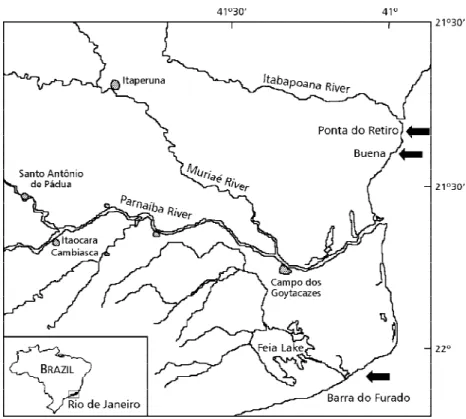
coast of Rio de Janeiro State at three beaches: Barra do Furado (BF), Buena (B), and Ponta do Retiro (PR) (Fig. 1), so as to evaluate temporal and spatial variation of these metals concentrations and identify the critical elements at each beach sampled.
MATERIAL AND METHODS
Oysters with similar lengths (4.0-6.0 cm) were collected at the low-middle littoral of three beaches every 45 days approximately (from July 1998 to May 1999). The samples were washed with local seawater and transported in plastic bags to the laboratory. The soft tissues were removed from their shells, grouped (n = 15), oven-dried at 60oC, and ground
to a fine powder with a porcelain pestle and mortar. Aliquots (approximately 1.00 g of dried tissue) were digested (triplicate) in concentrated HNO3, evaporated and redissolved in 0.5 N HNO3 (Páez-Osunaet al., 1995; Riget et al., 1997). The extracts
were analyzed by atomic emission spectrophotometry with induced coupled plasma (ICP-AES).
Standard reference material was analyzed in order to estimate the accuracy of the digestion method (muscle tissue of Squalus acanthias – DORM
1) supplied by the Marine Analytical Chemistry Standards Programs (Canada). The heavy metal recovery rates were 84% (Cr), 102% (Cu), 99% (Fe), 87% (Mn), 93% (Ni), and 88% (Zn).
The Mann-Whitney statistical analysis (p < 0.05) was applied to compare metal concentrations between the sampled areas. Kruskal-Wallis (p < 0.05) variance analysis was used to compare the temporal variation of metal concentrations in each sampled area.
RESULTS
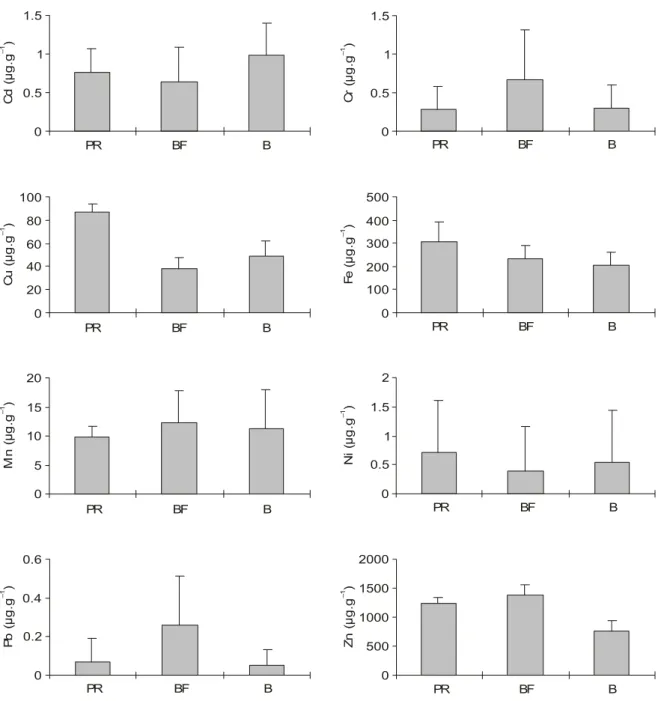
Metal concentrations remained on average within the variation commonly described in the literature for natural areas or areas slightly affected by metal pollutants (Table 1). This indicates that the contents of these elements in the oysters reflect the variations and natural availability for incorporation by marine bivalves on the northern coast of Rio de Janeiro State. Among the analyzed metals, there were no significant differences (p < 0.05) among the beaches in the concentration of Cd, Fe, Mn, and Ni, suggesting similar bioavailabilities of these metals among the sampling sites (Fig. 2).
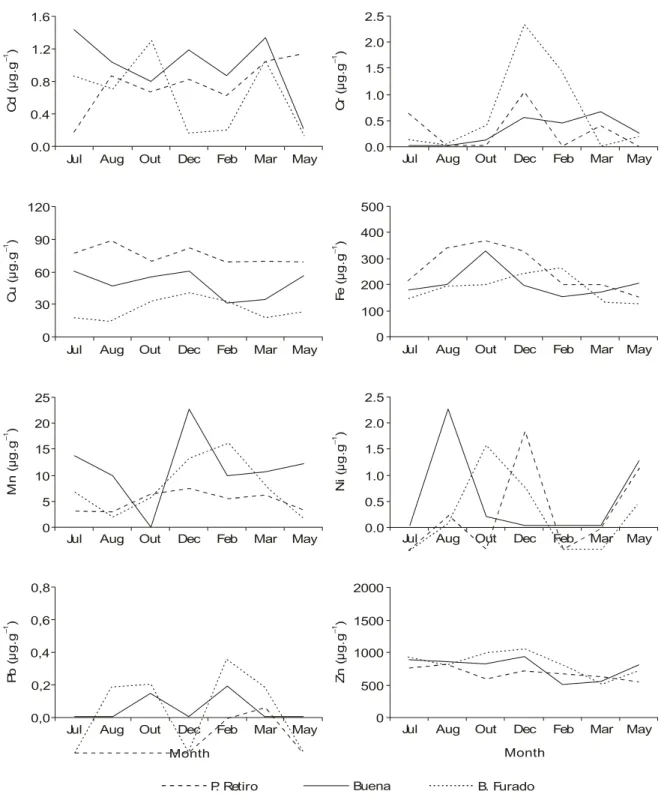
Concentrations of Cd, Ni, and Pb presented a significant temporal variation in all the sampling sites (Fig. 3). Despite these results, it is likely that such variability is associated to natural fluctuations of these concentrations, as the highest levels are below the values commonly cited in the literature for non-contaminated areas.
DISCUSSION
Only the Zn concentration, with average values of 162 µg.g–1 wet weight, was above the
maximum limit of tolerance (MLT) established for human consumption: 50 µ g.g–1 wet weight
(Brazilian Ministry of Health, 1978,apudLima,
1997). However, the MLT values shown do not correspond to those commonly cited in the literature (usually higher) for fish, even when they come from nonpolluted areas (Table 1). The well-known element Zn, which easily accumulates in oysters, by far surpasses the MLT (Pfeiffer et al., 1985;
Limaet al., 1986; Carvalho et al., 1993; Rabelo et al., 1998). Our results confirm this trend, showing
Ke & Wang (2001) noticed that Zn incorpo-ration through feeding in Crassostrea rivularis and Saccostrea glomerata, contributed by more than 50%
to the accumulation of this metal. These same authors show that the bivalve digestive process is divided into two phases: one extracellular, in which digestive
enzymes act upon ingested particles, and a second one in which cells of the digestive diverticulum account for the intracellular degradation of ingested particles, with extremely efficient absorption of the final product. This partially explains the oyster’s high capacity to assimilate metals like Zn and Cu.
Sampled area/Specie Pollut. Cd Cr Cu Fe Mn Ni Pb Zn Reference
Mexico/C. virginica (b) 4.1 – 326 949 38 – 8.8 628 Vázquezet al., 1993
El Salvador/O. iridescens (b) < 1.2 15.8 622 – – 10.6 < 1.2 2040 Michel & Zengel, 1998
B. Sepetiba/C. brasiliana (b) 9.5 8.03 – 227 – – – 8881 Limaet al., 1986
B. Ribeira/C. brasiliana (a) 3.2 5.1 – 314 – – – 1773 Limaet al., 1986
B. Sepetiba/C. brasiliana (b) 8.5 – 24.5 – 30.1 18.1 13.5 9500 Gomeset al., 1991
A. dos Reis/C. brasiliana (a) 1.7 – 227 – 30.5 25 < 1.3 2349 Gomeset al., 1991
B. Guanabara/C. brasiliana (b) 0.4 – 148 – 35.8 3.4 < 1.3 1303 Gomeset al., 1991
Mexico/C. iridescens (a) 1.5 < 0.7 2.4 109 11.5 2.1 < 1.2 500 Páez–Osunaet al., 1995
P. Retiro/O. equestris 0.8/0.11 0.3/0.04 86/12.3 300/42.9 9.7/1.39 0.7/0.1 0.07/0.01 1200/171.4 Present work, 1999
Buena/O. equestris 1.0/0.14 0.3/0.04 50/7.14 200/28.6 11/1.57 0.5/0.07 0.05/0.01 800/114.3 Present work, 1999
B. Furado/O. equestris 0.6/0.09 0.7/0.1 39/5.57 240/34.3 12/1.71 0.4/0.06 0.25/0.04 1400/200 Present work, 1999
MC (w.w.) 1 0.1 30 – – – 20 50 Brazilian Federal Legislation, 1978
Concentrations are expressed in µg.g–1 of dry weight and in µg.g–1 of wet weight (µg.g–1 d.w./µg.g–1 w.w.).
TABLE 1
Average concentrations of Cd, Cr, Cu, Fe, Mn, Ni, Pb, and Zn (µµg.g–1 dry weight) in oysters of non-impacted (a)
and impacted (b) areas for heavy metals. MC = maximum concentration for human consumption inµµg.g–1 of wet weight (w.w.).
Fig. 1 — Northern coast of Rio de Janeiro State with the sampled sites (set points): Ponta do Retiro beach (21o29’S; 40o59’W),
Fig. 2 — Average and standard deviation of Cd, Cr, Cu, Fe, Mn, Ni, Pb, and Zn concentrations µg.g–1 (dry weight) in each sampled
area (PR = Ponta do Retiro, BR = Barra do Furado; and B = Buena) (N = 30).
0 0.5 1 1.5
PR BF B
Cd
(
g
.g
)
µ
–1
0 0.5 1 1.5
PR BF B
Cr
(
)
µ
g.
g
–1
0 20 40 60 80 100
PR BF B
Cu
(
)
µ
g.
g
–1
0 100 200 300 400 500
PR BF B
Fe
(
)
µ
g.
g
–1
0 5 10 15 20
PR BF B
Mn
(
)
µ
g.
g
–1
0 0.5 1 1.5 2
PR BF B
Ni
(
)
µ
g.
g
–1
0 0.2 0.4 0.6
PR BF B
Pb
(
)
µ
g.g
–1
0 500 1000 1500 2000
PR BF B
Zn
(
)
µ
g.
g
–1
Although Zn plays an important role in the composition of approximately 90 enzymes in ani-mal metabolism (Bowen, 1979, apud Carvalho et al., 1993), mistakes in measurements affecting
restrictions on the consumption of oysters may have been made.
When we compare the results for Ostrea equestris to the ones described for the mussel Perna
perna in the same sampling sites (Ferreira, 2000),
what is shown are different capacities to concentrate metals. The high capacity of P. perna to accumulate
Fe and Ni, and, in lower proportions, Cr and Mn was not observed for O. equestris in the present study.
Fig. 3 — Temporal variation of Cd, Cr, Cu, Fe, Mn, Ni, Pb, and Zn concentrations µg.g–1 (average in dry weight) in each sampled
area (Ponta do Retiro, Barra do Furado, Buena).
0.0 0.4 0.8 1.2 1.6
Cd
(
g
.g
)
µ
–1
0.0 0.5 1.0 1.5 2.0 2.5
Cr
(
)
µ
g.g
–1
0 30 60 90 120
Cu
(
)
µ
g.
g
–1
0 100 200 300 400 500
Fe
(
)
µ
g.
g
–1
0 5 10 15 20 25
Mn
(
)
µ
g.
g
–1
0.0 0.5 1.0 1.5 2.0 2.5
Ni
(
)
µ
g.
g
–1
0,0 0,2 0,4 0,6 0,8
Jul Aug Out Dec Feb Mar May
Month
Pb
(
)
µ
g.
g
–1
0 500 1000 1500 2000
Jul Aug Out Dec Feb Mar May
Month
Zn
(
)
µ
g.
g
–1
P. Retiro Buena B. Furado
Jul Aug Out Dec Feb Mar May Jul Aug Out Dec Feb Mar May
Jul Aug Out Dec Feb Mar May Jul Aug Out Dec Feb Mar May
Opposite results were observed when comparing the concentration of Cu and Zn in P. perna
andO. equestris. The latter showed a capacity at
least 10 to 25 times higher to accumulate these metals, respectively. Other authors (Gomes et al.,
1991; Carvalho et al., 1993; Michel & Zengel, 1998)
have described this characteristic. Differences in concentrations of Cu and Zn among mussels and oysters have been attributed to the presence of the respiratory pigment hemocyanin in oyster blood and its absence in mussels (Ke & Wang, 2001). Zata (1984) showed that each functional unit of hemocyanin is capable of linking two Cu atoms and four of Zn. These findings help to understand the oyster’s high capacity to concentrate those metals.
Spatial variation on heavy metal concentrations The Cr concentration varied significantly between Barra do Furado (0.7 µg.g–1) and the remaining beaches
(average of 0.3 µg.g–1 in Ponta do Retiro and Buena),
indicating a higher availability of this metal at the first beach. As there are apparently no sources of this metal in the local environment, these values can be related to natural inputs, coming from the Flechas channel, the only link between Feia lagoon and the sea, and flowing into Barra do Furado (Fig. 1).
Machado (1999) observed the same pattern when determining the Cr concentration in benthic marine algae at these beaches. Considering that marine algae are likely to accumulate metals in the dissolved fraction (Karez et al., 1994), the present results might
indicate that this fraction is an important source of this element’s incorporation by oysters.
A significant spatial difference (p < 0.05) was recorded for Cu in O. equestris in Ponta do Retiro
(86 µg.g–1) when compared to Buena (50 µg.g–1) and
Barra do Furado (39 µg.g–1). As the main source of
this metal in coastal environments is associated to domestic sewage (Pfeiffer et al., 1985; Rezende &
Lacerda, 1986), the higher values of this metal at the first beach may indicate anthropogenic inputs of Cu from the Itabapoana river. Its estuary is about 12 km away from the sampling site and it carries urban waste, visible at the site (plastic material, decomposed organic garbage, etc.) through the coastal drift.
The concentration of Zn in O. equestrisdiffered
significantly (p < 0.05) between Buena (800 µg.g–1)
and the other two beaches (1200 µg.g–1 in Ponta do
Retiro and 1400 µg.g–1 in Barra do Furado) (Fig. 2).
Ferreira (2000) found higher concentrations of Zn
ones in Ponta do Retiro and Buena. Higher Zn values at Ponta do Retiro, which is relatively close to Buena where lower concentrations were observed, reinforce results found by Lima et al. (1986) and Lima (1997).
Both studies reported a wide range of concentration variation of this metal among individuals of the same population. On the other hand, as this is an essential metal involved in a wide variety of metabolic functions (Hamer, 1980; Páez-Osuna et al., 1995; Almeida et al., 1997) there may be a contribution of certain
individual physiological variables (e.g., increase of gonadal maturation) and environmental variables (e.g., increase in suspended particulate-matter content), which possibly influence the bioaccumulation of this metal.
Wardet al. (1986) and Olivier et al. (2002),
hypothesize the existence of an antagonism between the Zn accumulation in bivalve mussels to the detriment of Cd accumulation. This hypothesis is confirmed by the present results, in which we observed that on average, the highest Zn con-centration (1400 µg.g–1) corresponded to the lowest
Cd concentration (0.6 µg.g–1) in Barra do
Fura-do. The same was true for the samples collected in Buena beach, where the lowest average Zn concentration (800 µg.g–1) corresponded to the
highest Cd values (1.0 µg.g–1). This hypothesis
would directly relate to the similar chemical behavior of those metals, both belonging to the same group in the periodic table.
A significant difference in the Pb concentration inO. equestris in Barra do Furado (0.04 µg.g–1) with
that found in Buena and Ponta do Retiro (both with 0.01 µg.g–1) may be related to anthropogenic inputs
at these beaches, although low concentrations have been recorded. They were inferior to those described in the literature for nonimpacted areas. Phillips et al. (1982) and Riget et al. (1997) reported that Pb
is not significantly accumulated by marine biota, even when its concentration is high in abiotic compartments. Besides, the main input, caused by atmosphere deposition of this element into the marine environment, has been drastically reduced after the prohibition of this element in gasoline, which explains the observed low concentration. Páez-Osuna
et al. (2002) observed a significant correlation
Temporal variation on heavy metal concentrations at Barra do Furado beach
Significant temporal variations of all elements except Cu were observed at Barra do Furado beach. This result is in accordance with those obtained by Thompsonet al. (1987) and Ringwood et al. (1998)
who reported regulator mechanisms in oysters that are capable of maintaining organism homeostasis even during periods of intensive exposure to Cu. Increasing Cr, Fe, Mn, Ni, and Zn concen-trations were shown from October 1998 to February 1999. We believe that such results are related to continental inputs together with a period of intensive rain, which could increase the fluvial input of these metals to the region. During the period from October to December 1998, the rain was on average more intense (average of 88 mm) than during the three earlier months (average of 38 mm) and the later ones (average of 66 mm).
The waters of Campos plain drain mainly into the estuary in Barra do Furado. This region is characterized by soils with high levels of organic material, the origin of which is principally vegetal material in different stages of composition (CIDE, 1997), and possibly enriched by metals like Fe e Mn (Salomão, 1997). These flooded areas release metals from superficial drainage as well as suspended particulate material (SPM) into the Flechas channel, and from there to the estuary (Kremiling (1988) men-tioned SPM as an important source of metals in estuaries).
Regarding Pb, we observed two temporal peaks: from August to October 1998 and from February to March 1999. However, the high variation along the sampling period, in many cases with concentrations below the detection limits of the method used, makes the statistical significance of findings for Pb questionable. Another researcher (Ferreira, 2000) describes a similar pattern of accumulation in the mussel P. perna at this beach
during the same sampling period.
The only element for which concentrations were lower during the period of more intensive rain was Cd. Ke & Wang (2001) and Mouneyrac et al.
(1998) reported that Cd incorporation by oysters is drastically reduced with the increase of salinity. This finding has been linked to an increase of the complexation of chloride ions with the metal. This phenomenon is more evident in estuaries, as is the case in Barra do Furado.
Buena and Ponta do Retiro beaches
In Ponta do Retiro, the concentrations of Cd, Ni, and Pb varied significantly along the sampling period. No correlations were observed in the concentration of any of the metal elements at this beach. The Cu concentration remained constant throughout the sampling period.
Olivieret al. (2002) observed that temporal
variation in the Cd concentrations in Saccostrea commercialis resulted from the dry weight of the
individuals. The authors observed assert that Cd concentration tends to diminish with the increase of dry weight, thus a dilution effect occurs as the organism grows. In the present study, the previous selection of the size of the individuals collected (same size range) led to a decrease in the effect of size on heavy metal accumulations. However, belonging to the same size range does not necessarily imply that individuals are of the same age and weight. As they assume the irregular shape of the substrate to which they are attached, individuals can grow along a different axis from the longitudinal growing pattern expected. They assume, in this way, the internal shape of the shell, with enough space to develop and, thus, their true size is not obvious. This pattern has not been observed in Barra do Furado, whose substrate is formed exclusively by flat-surfaced granite rocks. In Buena there was a significant temporal variation in the Cd, Fe, Mn, Ni, Pb, and Zn concen-trations. According to Haynes & Toohey (1998), seasonal differences in the metal concentrations in mussels from nonimpacted environments are usually related to physicochemical variations of the water (which can alter metal bioavailability) and/or the feeding rates of the organism. Bryan (1993) mentions that the temporal variations in metal concentrations in the bivalves Pecten maximus and Chlamys opercularis are related to variations in local
phyto-plankton productivity. His observations are reinforced by the fact that an increase in phytoplankton produc-tivity implies an increase in bivalve nutritional status, which in turn leads to an increase in metal concen-tration in organisms observed. Olivier et al. (2002)
described similar results for the oysterSaccostrea commercialis.
The Fe concentration varied significantly along the period in Buena, reaching its highest value in October 1998 (328 µg.g–1). In the same period,
the highest concentrations were observed in Ponta do Retiro (417 µg.g–1), indicating a common origin
of this metal in both beaches (probably the Itabapoana river, whose estuary is close to both sampling sites).
In Buena the Mn concentration varied significantly through time. This variation was different from that observed in Ponta do Retiro. These results make evident the complexity of the dynamic of heavy metals in marine environments. Different factors, whether biological (e.g., size, gonodal stage, filtration rate) or not (e.g., physicochemical characteristics of the water, sediment flux) can determine metal bioavailability in the environment.
The analysis of the suspended particulate material (SPM) mentioned as a source of several metals for the marine environment (Pfeiffer, 1980; Páez-Osunaet al., 1995; De Gregori et al., 1996)
could better clarify the results observed at the beaches on the São Francisco do Itabapoana coast, since the Itabapoana river is the main exporter of this component. A more detailed analysis of metal contents in the SFM could provide clearer infor-mation. Furthermore, it should be taken into account that: (1) the drainage basin of this river is different from Feia lagoon regarding its hydrographical composition; (2) different pluvial indices in these locations could signify different loads of metals recently discharged into the sea and, consequently, their incorporation into the biota.
CONCLUSION
Ponta do Retiro, Buena, and Barra do Furado beaches can be classified as free from contamination by Cd, Cr, Cu, Fe, Mn, Ni, and Pb.
The Zn concentration in O. equestris showed
contents surpassing the maximum limit allowed for human consumption by the Brazilian Ministry of Health, which warrants a detailed investigation of the origin of this substance with respect to these organisms.
There were no significant differences in the Cd, Fe, Mn, and Ni concentrations among the studied beaches. As for the remaining metals, the variations observed are probably related to anthropogenic input (e.g., sewage as well as pollution caused by small
Regarding temporal variation in Barra do Fu-rado, increases were observed in Cr, Fe, Mn, and Zn concentrations in the samples collected in December 1998, a rainy period, suggesting possibly similar origins of these metals, e.g., suspended particulate material.
In Ponta do Retiro and Buena, no similar trend was detected of metal accumulation in specific months. This shows that the dynamic of these elements at those beaches needs additional studies so as to identify the sources, e.g., the Itabapoana river, ultimately resulting in their incorporation in the biota.
Considering the variations in the discharges, both in the lower part of the Itabapoana river and in the Flechas channel, which are exporters of suspended particulate material and, therefore, potential sources of metals at the studied beaches, more detailed studies, including collection of bivalves at shorter time intervals, could provide additional information about the influence of heavy metals affecting these areas.
Special attention should be given to the organisms collected at Ponta do Retiro and Buena. Since their shape is determined by the substract to which they are attached, their weight as well as size can be considered a limiting factor with respect to heavy metal accumulation.
We recommend the use of young individuals ofOstrea equestris for biomonitoring of Cd, Cu,
and Zn at Ponta do Retiro, Buena, and Barra do Fu-rado, as the species, besides showing a relative capacity to concentrate such metals, has a suitable size range, is widely distributed, and presents great population density in the majority of the stone reefs.
Acknowledgements — The authors thank Dr. Carlos Veiga de Carvalho for suggestions and comments during manuscript revision. This work has been supported by Conselho Nacio-nal de Desenvolvimento Científico e Tecnológico (CNPq) and Fundação Estadual do Norte Fluminense (FENORTE).
REFERENCES
ALMEIDA, E. A., MEDEIROS, I. D., VENTURA, E. C., MEZZARI, M. P. & BAINY, A. C. D., 1997, Análise de biomarcadores bioquímicos em mexilhões Perna perna de
diferentes regiões do estado de Santa Catarina. An. 5o Enc.
Brasil. Ecotox., Itajaí, SC, 25p.
BRYAN, G. W., 1993, The occurrence of seasonal variations of trace metals in Pecten maximus andMytilus edulis L.
J.Mar. Biol. Assoc.,53: 145-166.
CANTILLO, A. Y., 1998, Comparison of results of mussel watch programs of the United States and France witch wordwide Mussel Watch Studies. Mar. Pollut. Bullet.,36(9): 712-717.
CARVALHO, C. E. V., LACERDA, L. D. & GOMES, M. P., 1993, Metais pesados na biota bêntica da Baía de Sepetiba e Angra dos Reis, RJ. Acta Limno. Brasil.,6: 222-229.
CIDE, 1997, Centro de Informação de Dados do Rio de Janeiro. Estado do Rio de Janeiro. Território, Rio de Janeiro, Relatório, 80p.
DE GREGORI, I., PINOCHET, H., GRAS, N. & MUNOZ, L., 1996, Variability of cadmium, copper and zinc levels in molluscs and associated sediments from Chile. Environ. Pollut.,92(3): 359-368.
FERREIRA, A. G., 2000, Metais pesados em moluscos bivalves no litoral norte do Rio de Janeiro. Dissertação de Mestrado, Universidade Estadual do Norte Fluminense, Laboratório de Ciências Ambientais.
GOMES, M. P., CARVALHO, C. E. V. & LACERDA, L. D., 1991, Monitores biológicos de metais pesados no litoral do Estado do Rio de Janeiro. An. Sem. Reg. Ecol., São Carlos,6: 319-329.
HAMER, D. H., 1980, Metallothionein. Ann. Rev. Biochem.,
55: 913-951.
HAYNES, D. & TOOHEY, D., 1998, The use of transplanted, cultered mussels (Mytilus edulis) to monitor pollutants along the ninety Mile Beach, Victoria, Australia III. Heavy Metals.
Mar. Pollut. Bull.,36(5): 396-399.
KAREZ, C. S., AMADO-FILHO, G. M., MOLL, D. M. & PFEIFFER, W. C., 1994, Concentração de metais em algas marinhas bentônicas de três regiões do Estado do Rio de Janeiro.Na. Acad. Brás. Ci.,66(2): 205-211.
KE, C. & WANG, W., 2001, Bioaccumulation of Cd, Se and Zn in an Estuarine Oyster (Crassostrea rivularis) and a
Coastal Oyster (Saccostrea glomerata).Aquatic Toxicology, 56: 33-51.
KREMILING, K., 1988, Metal cycles in the coastal environments.
In: W. Seeliger, L. D. Lacerda & S. R. Patchineelam, Metals in coastal environments of Latin America. Berlin Heidelberg, Spring-Verlag, New York, pp. 198-214.
LACERDA, L. D., TEIXEIRA, V. I. & GUIMARÃES, V. R. D., 1985, Seasonal variation of heavy metals in seaweeds from Conceição de Jacareí, Brasil. Bot. Mar., 49(3): 847-849.
LIMA, N. R. W., LACERDA, L. D., PFEIFFER, W. C. & FISZMAN, M., 1986, Temporal and spatial variability in Zn, Cr, Cd, and Fe concentrations in oyster tissues (Crassostrea rhyzophorae, Lamarck, 1819) from Sepetiba
Bay, Brazil. Environ. Tech. Let.,7: 453-460.
LIMA, E. F. A., 1997, Determinação de cádmio, cromo, cobre e zinco em mexilhões Perna perna (Llnné, 1758) do litoral do Estado do Rio de Janeiro. Dissertação de Mestrado, Depto.
de Química, PUC/RJ, 151p.
MACHADO, A. L. S., 1999, Distribuição de metais pesados em macroalgas marinhas bentônicas no litoral norte do Estado do Rio de Janeiro. Monografia, Ciências Ambientais, UENF,
51p.
MICHEL, J. & ZENGEL, S., 1998, Monitoring of oyster and sediments in Acajutla, El Salvador.Mar. Pollut. Bull.,36(4):
256-266.
MORAES, R. B. C. & SILVA, M. L. P., 1995, Toxicidade do zinco ao mexilhão Perna perna (Linné, 1758). Arq. Biol Tecnol.,38(2): 541-547.
MOUNEYRAC, C., AMIARD, J. C. & AMIARD-TRIQUET, C., 1998, Effects of natural factors (salinity and body weight) on cadmium, cooper, zinc and metallothionein-like protein levels in resident populations of oysters Crossostrea gigas
from a polluted estuary.Marine Ecology Progress Series.,
162: 125-135.
NYBAKKEN, J. W., 1997, Marine biology: an ecological approach. Addison Wesley Educational Publishers Inc., 4th
ed.,11: 433-440.
OLIVIER, F., RIDD, M. & KLUMPP, D., 2002, The use of transplanted cultured tropical oysters (Saccostrea commercialis) to monitor Cd levels in North Queensland Coastal waters (Australia). Mar. Pollut. Bull., 44: 1051-1062.
PÁEZ-OSUNA, P., FRIAS-ESPERICUETA, M. G. & OSUNA-LÓPEZ, J. I., 1995, Trace metal concentrations in relation to season and gonadal maturation in the oyster Crassostrea iridescens.Mar. Environ. Res., 40(1): 19-31.
PÁEZ-OSUNA, F., RUIZ-FERNANDEZ, A. C., BOTELLO, A. V., PONCE-VÉLEZ, G., OSUNA-LÓPEZ, J. I., FRIAS-ESPERICUETA, M. G., LÓPEZ-LÓPEZ, G. & ZAZUETA-PADILLA, H. M., 2002, Concentrations of selected trace metals (Cu, Pb, Zn), organochlorines (PCB’s, HCB) and total PAHs in mangrove oysters from the Pacific Coast Mexico: an overview.Marine Pollution Bulletin. Article in press.
PFEIFFER, W. C., 1980, Trânsito do cromo em ecossistemas aquáticos.I Seminário sobre Poluição por Metais Pesados.
SEMA, Brasília, Distrito Federal, pp. 29-37.
PFEIFFER, W. C., LACERDA, L. D., FISZMAN, M. & LIMA, N. R. W., 1985, Metais pesados no pescado da Baía de Sepetiba, Estado do Rio de Janeiro. Ciência e Cultura,37(2): 297-302.
PHILLIPS, D. J. H., 1979, Trace metals in the common mussel
Myttilus edulis, and in the alga Fucus vesiculosus from the
region of the Sound (Öresund). Environ. Pollut.,18: 31-43. PHILLIPS, D. J. H., THOMPSON, G. B., GABUJI, K. M. & HO, C. T., 1982, Trace metals of toxicological significance to man in Hong-Kong seafood. Environ. Pollut. Ser. B.,3: 27-45.
RABELO, M. F., AMADO-FILHO, G. M., CORREA JR., J. D., BASTOS, W. R. & PFEIFFER, W. C., 1998, Bioindicators of heavy metal contamination in the Sepetiba bay, Rio de Janeiro.An. 5., Enc. Brasil. Ecotox., Itajaí, SC.
RIGET, F., JOHANSEN, P. & ASMUND, G., 1997, Uptake and release of lead and zinc by blue mussels. Experience from transplantation experiments in Greenland. Mar. Pollut. Bull., 34(10): 805-815.
RINGWOOD, A. D., CONNERS, D. E. & DINOVO, A., 1998, The effects of copper exposures on cellular responses in oysters.Mar. Environ. Res.,46(1-5): 591-595.
SALOMÃO, M. S. M. B., 1997, Dinâmica do material particulado em suspensão e de metais pesados na porção inferior do rio Paraíba do Sul. Monografia, Laboratório de Ciências Ambientais, UENF, Campos dos Goytacazes, RJ. SZEFER, P., GELDON, J., ALI, A. A., PÁEZ-OSUNA, F.,
RUIZ-FERNANDES, A. C. & GALVAN, S. R. G., 1998, Distribution and association of trace metals in soft tissue and byssus of Mitella strigata and other benthal organisms
from Mazatlan Harbour, Mangrove lagoon of the Northwest Coast of Mexico. Environ. Inter.,24(3): 359-374.
THOMPSON, M. F., SAROJINE, R. & NAGABHUSHANAM, R., 1987, Biology of benthic marine organisms. Techniques
and methods as applied to the Indian Ocean. Balkema/ Rotterdam, pp. 96-109.
VÁZQUEZ, G. F., SANCHEZ, G. M. & VIRENDER, K. S., 1993, Trace metals in the oyster Crassostrea virginica of the Terminos lagoon, Campeche, Mexico. Mar. Pollut. Bull.,
26(7): 398-399.
WARD, T. J., CORRELL, R. L. & ANDERSON, R. B., 1986, Distribution of cadmium, lead and zinc amongst the marine sediments, seagrasses and fauna and the selection of sentinel accumulators, near a lead smelter in South Australia. Marine Pollution Bulletin., 17: 567-585.