Renata Karina Reis
I, Elizabete Santos Melo
I, Elucir Gir
II Universidade de São Paulo, Nursing School of Ribeirão Preto,
Postgraduate Program in Fundamental Nursing. Ribeirão Preto, São Paulo, Brazil.
How to cite this article:
Reis RK, Melo ES, Gir E. Factors associated with inconsistent condom use among people living with HIV/Aids. Rev Bras Enferm [Internet]. 2016;69(1):40-6. DOI: http://dx.doi.org/10.1590/0034-7167.2016690106i
Submission: 05-15-2015 Approval: 09-11-2015
ABSTRACT
Objective: to analyze the prevalence and factors associated with inconsistent use of condoms among people living with HIV/
Aids (PLWHA). Method: it is a cross-sectional study with 228, with individual interviews conducted in 2011. A multivariate
analysis was performed with a logistic regression model. Results: 143 participants met the inclusion criteria, and the prevalence
of inconsistent condom use was 28.7%. However, there was greater adherence among men (79.3%). In the multivariate analysis, the independent variable daily use of alcohol (OR=11.02; 95% CI 1.84, 65.92; p=0.021) was associated with inconsistent condom use. The chance of men making consistent condom use was higher than women (OR=0.36, 95% CI 0.15, 0.81;
p=0.015). Conclusion: the prevalence of inconsistent condom male use among PLWHA was low, however, evidenced greater
compliance among men over women with a statistically signifi cant difference and the daily use of alcohol was associated with inconsistent condom use.
Key words: Condoms; HIV Infections; Sexual Behavior; Risk Factors; Transmissible Disease Prevention
RESUMO
Objetivo: analisar a prevalência e fatores associados ao uso inconsistente do preservativo masculino entre pessoas vivendo
com o HIV/Aids (PVHA). Método: estudo transversal realizado em serviços de atendimento especializados (SAE), com 228
PVHA. Realizou-se análise multivariada com modelo de regressão logística. Resultados: 143 participantes preencheram os
critérios de inclusão e a prevalência do uso inconsistente do preservativo foi de 28,7%. Observou-se maior adesão entre os homens (79,3%). Na análise multivariada, a variável independente uso diário do álcool (OR=11,02; IC95% 1,84;65,92; p=0,021) teve associação com o uso inconsistente do preservativo. A chance dos homens fazerem uso consistente
do preservativo foi maior que as mulheres (OR=0,36; IC95% 0,15;0,81; p=0,015). Conclusão: a prevalência do uso
inconsistente do preservativo masculino entre PVHA foi baixa, entretanto foi evidenciado maior adesão entre os homens em relação as mulheres com diferença estatisticamente signifi cativa e o uso do álcool diariamente mostrou-se associado com o uso inconsistente do preservativo.
Descritores: Preservativos; Infecções por HIV; Comportamento Sexual; Fatores de Risco; Prevenção de Doenças Transmissíveis.
RESUMEN
Objetivo: analizar la prevalencia y factores asociados al uso inconsistente del preservativo masculino entre personas viviendo
con el VIH/SIDA (PVHA). Método: estudio transversal con 228, con entrevistas individuales realizadas en 2011. Se realizó
análisis multivariado con modelo de regresión logística. Resultados: 143 participantes completaron los criterios de inclusión
Factors associated with inconsistent condom use among
people living with HIV/Aids
INTRODUCTION
There is more than three decades since the discovery of infection with Human Immunodeficiency Virus (HIV) remains a global health problem. It is estimated that there are about 35 million people living with HIV worldwide, being
approxi-mately 1 million and a half only in Latin America(1) and Brazil
has 757,042 registered cases(2).
While in many countries the number of new infections of people with HIV continues to decline, a decline of 75% in 10 countries and by more than 50% in 27 countries in Latin America, there was a decline in new infections of 3% between 2005 and 2013. However, we observe different standards be-tween countries, for example, in Mexico, in the same period, were the decrease was 39% while in Brazil, that is the country with the largest number of people living with HIV/Aids in the
region, the number of new infections increased 11%(1).
Worldwide, the majority of new HIV infections occur through sexual contact. Heterosexual transmission is increas-ing, and women are about three times more prone to acquire
HIV from a male partner than a man from a woman(3). In Latin
America the Conjunct United Nations Program of HIV/Aids (UNAIDS) estimated that about 450,000 women living with HIV in 2013, just in Brazil, the estimate is nearly that half that
amount, 210,000 are women(1).
Heterosexual relationships are often characterized by a sexual division of power, for many couples, unprotected sex can be in-terpreted as intimacy and trust, acting as a barrier not only to the
use of condoms, but communication about safe sex in general(3).
In Brazil, the free condom distribution policy started in 1994 and was distributed to health services across the coun-try. According to the Ministry of Health, the distribution of input prevention grew by over 45% between 2010 to 2011,
rising from 333 million to 493 million of units(2).
Nevertheless, the sexual transmission of HIV is the most prevalent, and in women, 86.8% of cases registered in 2012 resulted from heterosexual sex with HIV-infected people. Among men, 43.5% of the cases were by heterosexual
con-tact, 24.5% by homosexual and 7.7% by bisexual(2).
Among people living with HIV/Aids, the consistent use of condoms is an important preventive measure among serodis-cordant and seroconserodis-cordant couples, as it aims to prevent reinfection of already resistant strains to antiretroviral drugs,
reducing viral burden during sex and avoid transmission other sexually transmitted infections.
The risk of HIV transmission in serodiscordant couples var-ies widely according to the type and frequency of sexual
activ-ity as well as the viral burden of the infected partner(4-5).
In this sense, in the full health care perspective, health ser-vices should be structured to include aspects of sexual life, including the guarantee of prevention materials, as well as assistance targeted to the preventive aspects, since the fact that the condom is distributed for free, does not eliminate the barriers of cultural, social and emotional nature involving in unprotected sexual practices.
The inconsistent use of male condoms has been reported in studies conducted in countries with different levels of
de-velopment(6-9) which suggest that interventions for HIV
preven-tion should involve complex issues related to couples(10-11).
In this sense, this study aimed to analyze the prevalence and factors associated with inconsistent use of condoms among people living with HIV/Aids.
METHOD
It is a cross-sectional and analytical study performed in Ri-beirão Preto, São Paulo, in 2011, with 228 members of two specialized services in the care of people living with HIV/Aids (PLWHA).
Study participants were men and women living with HIV/ Aids over the age of 18, sexually active in the last three months, aware of their status of HIV/Aids for at least six months and who were in clinical follow-up in the studied services. Con-stituted as an exclusion criterion: individuals with inactive sex life, which had no clinical or cognitive condition to partici-pate in the interview, and confined individuals such as prison-ers and institutionalized, living in safe houses.
Data were collected through individual interviews, in the ambulatory rooms before or after medical consultation. Sub-jects who met the inclusion criteria were invited to participate in the study. Two interviewers, previously trained by the study coordinator, conducted the interviews.
A structured questionnaire containing questions about socio-demographic characteristics was used (gender, age, in-come, schooling) and clinical (T-CD4 cell count, detectable viral burden or undetectable, comorbidities).
Renata Karina Reis E-mail: [email protected]
CORRESPONDING AUTHOR
y la prevalencia del uso inconsistente del preservativo fue de 28,7%. Entre ambos, se observó mayor adhesión entre los hombres (79,3%). En el análisis multivariado, la variable independiente uso diario del alcohol (OR=11,02; IC95% 1,84;65,92; p=0,021) tuvo asociación con el uso inconsistente del preservativo. La oportunidad de los hombres hacer uso consistente
del preservativo fue mayor que en las mujeres (OR=0,36; IC95% 0,15;0,81; p=0,015). Conclusión: la prevalencia del uso
inconsistente del preservativo masculino entre PVHA fue baja, entre ambos fue evidenciado mayor adhesión entre los hombres en relación a las mujeres con diferencia estadísticamente significativa y el uso del alcohol diario se mostró asociado con el uso inconsistente del preservativo.
About the use of alcohol they were asked about the con-sumption in the last three months and laid out four options for answers: Daily (use seven days a week), common (use of three to six times a week), occasional (once a week or less per week) and did not use alcohol.
They also were asked about aspects of affective-sexual life (sexual orientation), the factors related to the sexual partner as the type of partnership (steady or casual) and serological diagnosis of the partner’s HIV (reagent, non-reactive or do not know). The male condom use was assessed through the use of questioning frequency (always, sometimes, never) in the last three months and the consistent use was considered for those who always reported use that is, in all sexual relations; while the inconsistent use was considered in those who reported using sometimes or never.
All data were cataloged and organized in an electronic spreadsheet and double typing. Statistical analysis was per-formed using SPSS software version 17.0. The frequencies of the variables and their confidence intervals were included, as well as gross and adjusted analysis to determine the variables associated with the inconsistent use of condoms.
Bivariate analysis was performed using the Chi-square test to analyze the association between socio-demographic vari-ables, and those related to affective-sexual life, clinical and life habits with consistent and inconsistent use of male con-doms in the last three months.
To verify which factors increase the probability of incon-sistent classification, it was performed multivariate logistic re-gression. Independent used variables were socio-demographic variables (gender, age, schooling, marital status, employment, income) related to affective-sexual life (sexual orientation, relationship type, diagnosis of sexual partnership, partner in medical segment) clinics (CD4 lymphocyte count, viral bur-den, infection classification, presence of comorbidities) and lifestyle (alcohol use).
Due to a large number of independent variables in the mod-el it was decided as a first step the mod-elimination of variables, by the use of the automatic selection procedure called ‘stepwise.’
This procedure performs the insertion and removal of indepen-dent variables based on the stipulated level of significance. The statistics of the Wald test was used, adopting p-value <0.20 for the candidate variable get into the model. For output, if p-value were greater than 0.10 the variable was removed.
The approval by the Ethics in Research Committee of the Ribeirão Preto Nursing School was obtained by following the recommendations of the National Health Council Resolution 196/96. The participants were informed about the study ob-jectives and guaranteed seal and anonymity of the informa-tion. The Informed Consent and Informed (IC) was read for individuals with low schooling. The interview was performed after reading and consent of the patient and signed the In-formed Consent.
RESULTS
Of the total of 505 registered in the service, 228 people were interviewed and of these 143 participants met the inclu-sion criteria. Of these, 82 (57.3%) were male, and 90 partici-pants (62.9%) were aged above 35 years old, with a mean age of 39 years.
As to schooling, it was found that 84 (58.7%) reported in-complete elementary education (less than eight years of study) and only 17 (11.9%) had higher education. Concerning in-come, 122 (85.3%) of respondents reported receiving up to three minimum wages per month.
About the clinical aspects relevant to HIV, 70 (49.0%) had T-CD4 greater than 500 cells/mm³, and 53 (37.0%) T-CD4 less than 200 cells/mm³. Regarding Viral Burden (CV), 75 (52.4%) had an undetectable Viral Burden. Furthermore, in 86 (60.1%) were identified comorbidities.
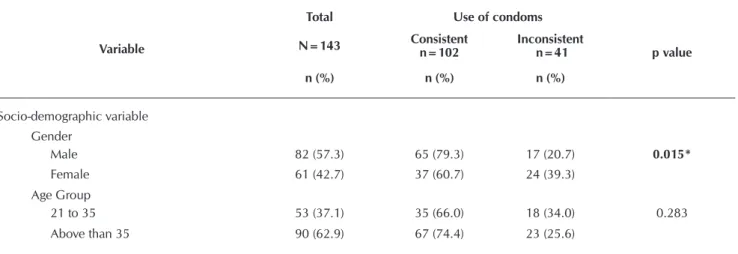
As for the aspects of affective-sexual life, it was identified that 79.0% declare themselves as heterosexual, 44.0% had relationships with serodiscordant partners, and 34.2% lived with seroconcordant partner; and, 21.6% were related to people with serological evaluation for HIV unrealized or un-known (Table 1).
Table 1 - Sample characterization according to affective-sexual life of PLWHA, Ribeirão Preto, São Paulo, Brazil, 2011
Variable
Total Use of condoms
p value N=143 Consistent n=102 Inconsistent n=41
n (%) n (%) n (%)
Socio-demographic variable Gender
Male 82 (57.3) 65 (79.3) 17 (20.7) 0.015*
Female 61 (42.7) 37 (60.7) 24 (39.3)
Age Group
21 to 35 53 (37.1) 35 (66.0) 18 (34.0) 0.283
Variable
Total Use of condoms
p value
N=143 Consistent
n=102
Inconsistent n=41
n (%) n (%) n (%)
Schooling R**
Elementary School 84 (58.7) 49 (65.3) 26 (34.7) 0.037*
High School 42 (29.4) 35 (83.3) 07 (16.7)
Higher Education 17 (11.9) 14 (82.4) 03 (17.6)
Income R**
Up to 3 minimum wages 122 (85.3) 85 (69.7) 37 (30.3) 0.291
More than 3 minimum wages 21 (14.7) 17 (81.0) 04 (19.0)
Variables related to affective-sexual life Sexual orientation R**
Heterosexual 113 (79.0) 78 (69.0) 35 (31.0) 0.398
Homosexual 19 (13.3) 16 (84.2) 03 (15.8)
Bisexual 11 (7.7) 08 (72.7) 03 (27.3)
Partner Diagnosis R**
Seropositive to HIV 49 (34.3) 30 (61.2) 19 (38.8) 0.064
Seronegative to HIV 63 (44.0) 51 (81.0) 12 (19.0)
Untested/do not know 31 (21.7) 21 (67.7) 10 (32.3)
Partnership Type R**
Fixed/steady 116 (81.1) 80 (69.0) 36 (31.0) 0.195
Not fixed /occasional 27 (18.9) 22 (81.5) 05 (18.5)
Variables related to the clinical aspects T-CD4 Count
Over than 500 70 (49.0) 44 (71.0) 18 (29.0) 0.842
499-200 20 (14.0) 44 (73.3) 16 (26.7)
Less than 200 53 (37.0) 14 (66.7) 07 (33.3)
Viral burden
Undetectable 75 (52.4) 52 (69.3) 23 (30.7) 0.579
Detectable 68 (47.6) 50 (73.5) 18 (26.5)
Comorbidities
Yes 86 (60.1) 65 (75.6) 21 (24.4) 0.167
No 57 (39.9) 37 (64.9) 20 (35.1)
Variables related to lifestyle Alcohol use
Daily 08 (5.7) 02 (25.0) 06 (75.0) 0.008*
Frequently 30 (20.9) 26 (40) 04 (60)
Occasionally 52 (36.4) 37 (79.2) 15 (29.8)
Never 53 (37.0) 37 (69.8) 16 (30.2)
Notes: * Chi-square test; R** mentioned variables.
About condom use, in general, the prevalence of incon-sistent use was 28.7%. However, when comparing the adhe-sion by gender, there is greater adherence to men (79.3%) than among women with statistically significant difference (p=0.005).
Individuals with higher schooling levels (p <0.037), and who reported never having used alcohol (p <0.008), had higher rates of adherence to condoms (Table 02).
Although not observed statistically significant differences, con-sistent condom use was higher in individuals over the age of 35 years (p <0.283), who had partner with negative serology HIV (p <0.064), and also with the occasional partner (p <0.195). As the viral burden count was identified that 73.5% of subjects with detectable viral burden were inconsistent using condom.
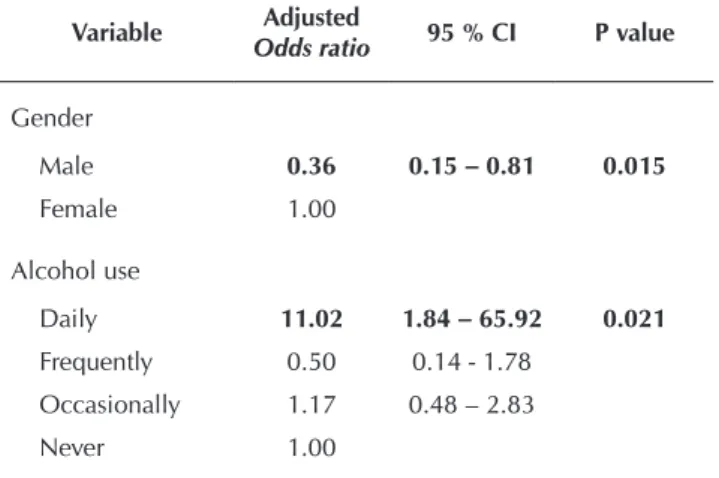
condom use (OR = 11.02; 95% CI: 1.84; 65.92). Also, it was observed that being male was constituted as a protective fac-tor for consistent use compared to women (Table 2).
Table 2 - Result of the logistic regression analysis: indepen-dent variables associated with the use of male condoms, Ribeirão Preto, São Paulo, Brazil, 2011
Variable Adjusted
Odds ratio 95 % CI P value
Gender
Male 0.36 0.15 – 0.81 0.015
Female 1.00
Alcohol use
Daily 11.02 1.84 – 65.92 0.021
Frequently 0.50 0.14 - 1.78
Occasionally 1.17 0.48 – 2.83
Never 1.00
DISCUSSION
A prevalence of 28.7% of inconsistent condom use among people living with HIV/Aids was identified. This result high-lights the need for interventions to improve adherence to pre-ventive practices in health services accompanying these in-dividuals. The inconsistent condom use was also reported in
studies conducted in other countries(6,9,12).
There are few studies in Brazil about the inconsistent condom
use among people living with HIV/Aids(13-14). In this sample, it
was observed that more than 60% of them were sexually active. It has been seen that women living with HIV differentiate more inconsistent use of condoms (39.3%) than men. A study performed by women from all regions of Brazil also showed
low rates of adherence to condoms(14). A research conducted
in Italy corroborated these results, showing that among 343 interviewed women, the prevalence of inconsistent condom
use was 44.3%(7). This result is alarming as the male condom
is man use and their use depends primarily on the negotiation between the couple, which reinforces the need for the distri-bution of condoms and counseling for training and empower-ing women to negotiate condom use.
Also, a meta-analysis showed that behavioral interventions have little effect on the increase in condom use among wom-en living with HIV. The authors recommwom-end using a combi-nation of interventions to reduce viral burden between these women and their partners, which are promoting the use of
condoms, family planning offer and advice(15).
Several aspects related to gender inequalities(16) determine
low power of women’s sexual negotiation, making them more likely to have unprotected sex increasing consequently their chances of exposure to HIV. These aspects can be observed in a study, that shows high rates of women infected by their
steady partners and inconsistent use of condoms(14).
Despite the implementation of public policies, recognized progressive advances in care for PLWHA in Brazil, the preven-tive work and the provision of inputs, such as condoms, the epidemic continues to impose serious challenges to its con-trol, particularly among women, adolescents, and youth.
The determinants of gender, cultural aspects and the social and economic exclusion processes have great influence on women’s vulnerability to HIV/Aids and may form an obstacle to the perceived risk of infection or reinfection with HIV. In-equality between the sexes is historical, showing the power of men over women.
Also, the low perception of their vulnerability linked to the trust in the partner with the idea of Aids as a disease of the other, in which the other appears as more vulnerable to con-tracting the disease(17).
In this sense, the very health services do not provide a comprehensive approach that encourages the empowerment of women and the inclusion of men in health care, as in the list of activities offered by primary care units in health, is largely directed in outpatient visits for prenatal care and fam-ily planning groups to care for the health of women focused on reproductive health and performed practically without the presence of men, reproducing the idea that reproduction is of
exclusively female responsibility(18).
Thus, public policies should ensure investments in broader actions to promote the integral health of women living with HIV/Aids, combined with inter-sectorial public policies, artic-ulated to reduce socioeconomic inequalities of gender, to pro-mote economic and financial autonomy and empowerment of women, recognizing and protecting their right to autonomy and freedom over their body and sexuality, at all stages of life as a fundamental dimension of life and health.
Moreover, it is necessary to invest in alternatives and ex-pand the options for protection methods controlled by
wom-en(19) as the female condom. Study about the female condom
indicates that its offer is still very limited, although the results indicate that women are willing to meet new alternatives that avoid an unwanted pregnancy and do not cause side effects, and also conducive to the protection against STDs/Aids (dou-ble protection), showing that if condoms are made availa(dou-ble for health care, there will be groups of people willing to adopt
them(20), similar to what has been reported worldwide.
Another variable that was highlighted was the inconsistent use of condoms among individuals who were using alcohol daily, which was identified OR = 11.02; 95% CI: 1.84; 65.92 when compared to those who never ingest. This finding was corroborated by an investigation in India, where it was seen that 48% of men reported having consumed alcohol before their last sexual intercourse, and the statistical analysis it was seen that men who consumed alcohol were three times more
likely not to use condoms in their sexual relationship(21).
In another research conducted in sub-Saharan Africa, includ-ing Kenya, Tanzania and Namibia countries, the association be-tween alcohol users and risky sexual behavior in people living with HIV was evaluated. The same highlights the need to inte-grate alcohol counseling in routine monitoring in people living
and HIV, it is necessary the implementation of policies focusing on reducing alcohol consumption and risk behavior.
Thus, comprehensive care to people living with HIV/Aids in specialized services is being increasingly discussed and in these discussions is important that this care should include aspects of affective-sexual life with a view to promoting sexual and reproductive health of PLWHA, contemplating the use of condoms to help them overcome difficulties and emotional barriers, relational and sociocultural stemming from
seroposi-tivity to HIV, that interfere with maintaining safe sex(10).
Thus, some authors have associated the use of alcohol to multiple sexual partnerships with consequently inconsistent condom use, which added confer a higher risk of HIV
trans-mission(23-24). In the population that already lives with viruses,
such actions can confer additional risk for increased viral bur-den among partners and the HIV mutants infections.
It should be noted that the study has limitations related to selection of participants, as it was used non-probability sam-ple and moreover, it is noteworthy that the patients were asked about past practices at the time of the interview that may rep-resent a memory bias.
CONCLUSION
The prevalence of inconsistent condom use among people living with HIV/Aids was 28.7%, however evidenced greater adherence among men than among women with statistically significant difference and the daily use of alcohol was associ-ated with inconsistent condom use.
Thus, for comprehensive care to people living with HIV/ Aids in specialized services is relevant to include aspects of affective-sexual life in order to promote the sexual health of people living with HIV/Aids, covering preventive strategies such as the use of condom helping them to overcome dif-ficulties and emotional barriers, relational and sociocultural stemming from seropositivity to HIV, that interfere with main-taining safe sex.
The implementation of more effective strategies that in-clude the couple to face the socio-cultural and gender aspects is required. These aspects influence the difficulty of negotia-tion and adopnegotia-tion of preventive strategies regarding the re-infection by HIV and other re-infections through sex, such as consistent condom use.
REFERENCES
1. World Health Organization. Global Reports: UNAIDS re-port on the global AIDS epidemic 2014 [Internet]. Gene-va, 2014[cited 2015 May 01]; Available from: http://www. unaids.org/sites/default/files/media_asset/GARPR_2014_ guidelines_en_0.pdf
2. Brasil. Ministério da Saúde. Coordenação Nacional de DST-Aids. Boletim Epidemiológico Aids – DST. [Internet] Brasília: Ministério da Saúde; 2014[cited 2015 May 01]; Available from: http://www.aids.gov.br/publicacao/2014/ boletim-epidemiologico-2014
3. LaCroix JM, Pellowski JA, Lennon CA, Johnson BT. Be-havioural interventions to reduce sexual risk for HIV in heterosexual couples: a meta-analysis. Sex Transm Infect [Internet]. 2013[cited 2015 May 01];89(8):620-7. Avail-able from: http://www.ncbi.nlm.nih.gov/pubmedhealth/ PMH0059155/.
4. Powers KA, Poole CP, Pettifor AE, Cohen MS. Rethinking the heterosexual infectivity of HIV-1:a systematic review and meta-analysis. Lancet Infect Dis [Internet]. 2008[cited 2015 May 01];8:553-63. Available from: http://www.thelancet. com/pdfs/journals/laninf/PIIS1473-3099(08)70156-7.pdf 5. Dosekun O, Fox J. An overview of the relative risks of
dif-ferent sexual behaviours on HIV transmission. Curr Opin HIV AIDS [Internet]. 2010[cited 2015 May 01];5(4):291-7. Available from: http://www.ncbi.nlm.nih.gov/pubmed/205 43603
6. Engedashet E, Alemayehu W, Gezahegn T. Unprotected sexual practice and associated factors among People Liv-ing with HIV at Ante Retroviral Therapy clinics in Debrezeit Town, Ethiopia: a cross sectional study. Reprod Health [Inter-net]. 2014[cited 2015 May 01];11(56):1-9. Available from: http://www.ncbi.nlm.nih.gov/pmc/articles/PMC4112610/
pdf/1742-4755-11-56.pdf
7. Cicconi P, Monforte AD, Castagna A, Quirino T, Alessan-drini A, Gargiulo M. et al. Inconsistent condom use among HIV-positive women in the “Treatment as Prevention Era”: data from the Italian DIDI study. J Int AIDS Soc [Internet]. 2013[cited 2015 May 01];16(1):18591. Available from: http://www.ncbi.nlm.nih.gov/pmc/articles/PMC3798584/ pdf/JIAS-16-18591.pdf
8. McGrathc N, Eaton JW, Barnighausen TW, Tanser F, Newell ML. Sexual behaviour in a rural high HIV preva-lence South African community: time trends in the an-tiretroviral treatment era. AIDS [Internet]. 2013[cited 2015 May 01];27(15):2461-70. Available from: http:// www.ncbi.nlm.nih.gov/pmc/articles/PMC3773237/pdf/ aids-27-2461.pdf
9. Kilembe W, Wall KM, Mokgoro M, Mwaanga A, Dissen E, Kamusoko M, et al. Knowledge of HIV serodiscordance, transmission and prevention among couples in Durban, South Africa. Plos One [Internet]. 2015[cited 2015 May 01];10(4):1-12. Available from: http://www.plosone.org/ article/fetchObject.action?uri=info:doi/10.1371/journal. pone.0124548&representation=PDF
10. Reis RK, Gir E. Difficulties faced by HIV mixed status cou-ples in maintaining safe sex. Rev Latino-am Enfermagem [Internet]. 2005[cited 2015 May 01];13(1):32-7. Available from: http://www.scielo.br/pdf/rlae/v13n1/v13n1a06.pdf
12. Yalew E, Zegeye DT, Meseret S. Patterns of condom use and associated factors among adult HIV positive clients in North Western Ethiopia: a comparative cross sectional study. BMC Public Health [Internet]. 2012[cited 2015 May 01];12(308):1-6. Available from: http://www.biomedcentral. com/content/pdf/1471-2458-12-308.pdf
13. Lima M, Schraiber LB. Violência e outras vulnerabilidades de gênero em mulheres vivendo com HIV/Aids. Temas Psicol [Internet]. 2013[cited 2015 May 01];21(3):947-60. Available from: http://pepsic.bvsalud.org/pdf/tp/v21n3/v21 n3a11.pdf
14. Santos NJS, Barbosa RM, Pinho AA, Villela WV, Aidar T, Filipe EMV. [Contexts of HIV vulnerability among Brazil-ian women]. Cad Saúde Pública [Internet]. 2009[cited 2015 May 01];25(Sup2):321-33. Available from: http:// www.scielo.br/pdf/csp/v25s2/14.pdf Portuguese. 15. Carvalho FT, Gonçalves TR, Faria ER, Shoveller JA,
Pic-cinini CA, Ramos MC, et al. Behavioral interventions to promote condom use among women living with HIV. Cochrane Database Syst Rev [Internet]. 2011[cited 2015 May 01];7(9):1-35. Available from: http://apps.who.int/ rhl/reviews/CD007844.pdf?ua=1
16. Hardee VS, Ayer LA, Rose GL, Naylor MR, Helzer JE. Al-cohol, moods and male-female differences: daily interac-tive voice response over 6 months. Alcohol Alchol [Inter-net]. 2014[cited 2015 May 01];49(1):60-5. Available from: http://alcalc.oxfordjournals.org/content/49/1/60.long 17. Silva CM, Vargens OMC. Women’s perception about
female vulnerability to STD and HIV. Rev Esc Enferm USP [Internet]. 2009[cited 2015 May 01];43(2):399-404. Available from: http://www.revistas.usp.br/reeusp/article/ viewFile/40371/43309
18. Pinheiro TF, Couto MT. Sexualidade e reprodução: discutin-do gênero e integralidade na atenção primária à saúde. Phy-sis [Internet]. 2013[cited 2015 May 01];23(1):73-92. Avail-able from: http://www.scielo.br/pdf/physis/v23n1/05.pdf 19. UNFPA. Fundo de População das Nações Unidas.
Preservativo feminino: das políticas globais à realidade brasileira. Brasília: UNFPA [Internet]. 2011[cited 2015 May 01]; Available from: http://www.unfpa.org.br/arqui-vos/preservativo_feminino.pdf
20. Kalckmann S, Farias N, Carvalheiro JR. Evaluation of con-tinuity of use of female condoms among users of the Bra-zilian National Health System (SUS): longitudinal analysis in units in the metropolitan region of São Paulo, Brazil. Rev Bras Epidemiol [Internet]. 2009[cited 2015 May 01];12(2):132-43. Available from: http://www.scielo.br/ pdf/rbepid/v12n2/en_04.pdf
21. Rizwan SA, Kant S, Goswami K, Rai SK, Misra P. In-fluence of alcohol on condom use pattern during non-spousal sexual encounter in male migrant workers in north India. J Postgrad Med [Internet]. 2014[cited 2015 May 01];60(3):276-81. Available from: http://www.jpg-monline.com/article.asp?issn=0022-3859;year=2014; volume=60;issue=3;spage=276;epage=281;aulast= Rizwan
22. Medley A, Seth P, Pathak S, Howard AA, DeLuca N, Matiko E, et al. Alcohol use and its association with HIV risk be-haviors among a cohort of patients attending HIV clinical care in Tanzania, Kenya, and Namibia. AIDS Care [Internet]. 2014[cited 2015 May 01];26(10):1288-97. Available from: http://www.tandfonline.com/doi/pdf/10.1080/09540121.2 014.911809
23. Choudhry V, Agardh A, Stafström M, Östergren PO. Pat-terns of alcohol consumption and risky sexual behavior: a cross-sectional study among Ugandan university stu-dents. BMC Public Health [Internet]. 2014[cited 2015 May 01];14(128):1-11. Available from: http://www.ncbi.nlm.nih. gov/pmc/articles/PMC3933239/pdf/1471-2458-14-128.pdf 24. Shiferaw Y, Alemu A, Assefa A, Tesfaye B, Gibermedhin E,