Invited author (full paper)
Using psychophysical tools to quantify body
image perception: a tutorial
Eliane Mauerberg-deCastro
Universidade Estadual Paulista, Rio Claro, SP, Brazil
Carolina Paioli Tavares Adriana Inês de Paula
Universidade Estadual de Ponta Grossa, Ponta Grossa, PR, Brazil
Gabriella Braga Crozara
Academia da Força Aérea Brasileira, Pirassununga, SP, Brazil
Debra Frances Campbell
Universidade Estadual Paulista, Rio Claro, SP, Brazil
Abstract––This article presents a tutorial about two protocols that can be used to measure an individual’s perception of body image, direct and indirect, and which follow S.S. Stevens (1951) methods. Two psychophysical task approaches illustrate the ability of individuals to quantify body image distortions. We selected psychophysical tasks that indirectly assess a participant’s behavioral component of body image (i.e., satisfaction tendencies about body image); and second, the cognitive component of body image (i.e., individuals’ perceptual accuracy in magnitude estimation tasks, which depend on a familiarity with interval scales and the use of numbers and ratios to represent physical dimensions of stimuli). We determined individuals’ perceptual sensitivity (i.e., his or her perceptual style) to manipulations of the body’s size by using Stevens’ power function (Stevens, 1951).
Keywords: psychophysics, body image, magnitude estimation, power function
Resumo––“Usando ferramentas psicofísicas para quantiicar a percepção da imagem corporal: um tutorial.” Este artigo apresenta um tutorial sobre dois protocolos que podem ser usados para medir a percepção de imagem corporal, direta e indiretamente, com base nos métodos de S.S. Stevens (1951). Duas abordagens psicofísicas ilustram a capacidade dos
indivíduos para quantiicar as distorções da imagem corporal. Nós selecionamos tarefas psicofísicas que avaliam indiretamente
o componente comportamental da imagem corporal do participante (ou seja, tendências de satisfação sobre imagem corporal); e segundo, o componente cognitivo da imagem corporal (ou seja, precisão perceptual nas tarefas de estimativa
de magnitude, que dependem de uma familiaridade com escalas de intervalo, e com o uso de números e proporções para representar dimensões físicas dos estímulos). Determinamos a sensibilidade perceptual dos indivíduos (ou seja, seu estilo perceptual) em tarefas de manipulação do tamanho do corpo, usando a função de potência de S.S. Stevens (Stevens, 1951).
Palavras-chave: psicofísica, imagem corporal, estimativa de magnitude, função de potência
Resumen––“Utilizando herramientas psico-física para cuantiicar la percepción de imagen corporal: un tutorial.” Este artículo presenta un tutorial en dos protocolos que pueden utilizarse para medir la percepción de imagen corporal,
directa e indirectamente, con base en métodos de S.S. Stevens (1951). Dos enfoques físicos ilustran la capacidad de
los individuos para cuantiicar las distorsiones de la imagen corporal. Hemos seleccionado las tareas psico-físicas
que evalúan indirectamente el componente conductual de la imagen corporal del participante (es decir, tendencias
de satisfacción sobre imagen corporal); y en segundo lugar, el componente cognitivo de la imagen corporal (es decir,
precisión perceptiva en las tareas de estimación de magnitud que dependen de una familiaridad con las escalas de
intervalo, y con el uso de los números y proporciones para representar dimensiones físicas de los estímulos). Determinar la sensibilidad perceptual de los individuos (es decir, su estilo perceptual) en tareas de manipulación del tamaño
corporal, usando la función de potencia de S.S. Stevens (Stevens, 1951).
Introduction
The study of body image is dominated by studies that investigate
perceptual distortions and dissatisfaction that relect neurologi -cal (e.g., brain lesion, peripheral lesion, epileptic seizure, etc.) and psychiatric (e.g., eating disorders, dissociative disorders, dysmorphia, etc.) disorders (De Vignemont, 2010; Lovo, 2006; Smolak, 2002). In typical groups, such studies also focus on patterns of responses during body image assessment, with the purpose of identifying the developmental effects of gender,
exercise practices, media and peer inluences, etc.
Because (visual) perception and satisfaction of body image
relect a complex process of bodily awareness, we can infer that
such a process can easily be disrupted by a number of environ-mental (cultural) and intrinsic factors. For instance, media has played an important role in affecting peoples’ standards about size and shape—distinctive in females and males (Knight & Giuliano, 2001). The frequent viewing of fashion models’
bod-ies, considered “beautiful” in terms of media standards, can raise
the level of the observer’s dissatisfaction with her own body and trigger inappropriate behaviors such as obsessive scrutiny of her own body parts, food restrictions, or compulsive engagement
with physical activity (Alves, Vasconcelos, Calvo, & Neves, 2008; Bamber, Cockerill, Rodgers, & Carroll, 2003; Nunes et al., 2007). Intrinsic factors such as health condition or even the
presence of a disability inluence body satisfaction, and can
color or diminish one’s own perception of skills or movement competencies—the universal measure of a functional body, especially in the presence of a disability.
According to De Vignemont (2010), the ways through which we can relate to our bodies include touch, vision, proprioception, motor behavior, semantic understanding, and emotion. Such
relationships, established via bodily awareness, however, relect
a reductionist perception about body image, which is constrained by externally imposed patterns of ideal bodies (e.g., ideal weight). In colloquial terms, body image has little to do with competence and a lot to do with looks. While an individual’s body is in motion, he or she must dynamically integrate complex sets of information that come from senses, muscles, organs, and tissues. Yet, the individual’s self-perceived visual appearance seems to be the most important factor in triggering positive emotions, even in establishing the individual’s criteria of what is healthy. That is, with this type of self-talk, if an individual is
thin and its the attractive ideal of the mass media, he or she must
be healthy (Campbell, & Mauerberg-deCastro, 2011). In fact, such cognitive distortions related to eating disorders include this thought-shape fusion phenomenon, in which just imagining the consumption of high-caloric food leads individuals to feel fatter and to perceive weight gain (Coelho, Jansen, & Bouvard, 2011). Because today obesity is found worldwide in epidemic
proportions (WHO, 2014), individuals are commonly aware that the dificulty in maintaining a weight within the “normal”
range of body mass index (BMI) (between 18.5 and 24.9) stems from widespread environmental factors that promote overeating, physical inactivity, and sedentary leisure activi-ties. Such awareness makes scrutiny and awareness of body
size a routine, even for children as young as ive years old
(Gehrman, Hovell, Sallis, & Keating et al., 2006; Li et al., 2005).
Individuals who scrutinize body size typically assign a simple value such as BMI to express an acceptable measure.
However, in today’s world, a majority of men and women
perceive that their bodies deviate from their ideal body di-mension, even when their body’s nutritional status (BMI) is within the normal range (Fiske, Fallon, Blissmer, & Redding,
2014; Murray, Rieger, & Byrne, 2013). Three in four women are dissatisied with their bodies and wish they were thinner
(Campbell & Mauerberg-deCastro, 2011). As related to body image, these projections follow a pervasive and consistent pattern: For women, the pattern is the ideal thin body; for men, the ideal is the strong, large body.
There are two main domains in assessments of body per-ception: the cognitive (or representational) and behavioral (or attitudinal). The cognitive domain relates to an individual’s recognition of body dimensions, usually shape and size, and include the estimation of metric parameters, whether direct (e.g., assigning numeric values to an image), or indirect (e.g., adjusting the sizes of an image using the computer tools of a photo editor). The behavioral domain refers to the individual’s feelings, beliefs, and attitudes about the body’s appearance. Body dissatisfaction often is the result of an individual’s dis-pleasure with the look of his or her body (negative feelings) (Cash, 2002), and deeply affects a person’s body image. Some individuals, especially adolescents and adult women (Siegel, 2002; Richardson, Paxton, & Thompson, 2009), older men and
women (Twigg, 2004; Tribess, Virtuoso, & Petroski, 2010), and
disabled people (men and women) (Lease, Cohen, & Dahlbeck, 2007) are especially vulnerable to body dissatisfaction.
The issue of body image, along with its association with the risk of developing or worsening eating disorders and body image dysmorphia, is often investigated through the use of im-age distortion tasks. Experimental settings in this area include tasks with distorted images (typically graphic enlargements or reductions of an actual person’s body image) in varying groups and socio-cultural contexts, and clinical conditions (e.g., often with eating disorders). Furthermore, these studies also can include groups of various ages (e.g., teens) (Kakeshita, 2008;
Sand, Lask, Hoie, & Stormark, 2011; Ojala, Tynjala, Valimaa, Villberg, & Kannas, 2012), racial and ethnic inluences (e.g.,
African-Americans, Asians, Caucasians) (Li et al., 2005;
Sampei, Sigulem, Novo, Juliano, & Colugnati, 2009; Smolak,
2002), gender differences (i.e., heterosexual females and males, homosexuals, transsexuals, etc.) (Kakeshita & Almeida, 2006; Mohr, Porter, & Benton, 2007), various health and disability conditions (e.g., amputees, genetic disorders, obesity) (Mussap, McCabe, & Ricciardelli, 2008; Tovée, Benson, Emery, Mason, & Cohen-Tovée, 2003), and effects of participation in sports and physical activities (Slater & Tiggemann, 2006).
Assessing body image perception
silhouettes (Stewart, Benson, Michanikou, Tsiota, & Narli,
2003; Stunkard, Sorenson, & Schlusinger, 1983; Tavares, Campana, Tavares Filho, & Campana, 2010). Qualitative in nature, these instruments mainly attempt to determine the ex-tent of attitudinal dimensions that interfere with accurate body awareness and opinions about appearance.
Despite the increased interest in the phenomenon of body image as a modern-day cultural construct and as a risk factor for the development of eating disorders (Adams, Turner, & Bucks, 2005; Kakeshita & Almeida, 2006), evaluation meth-ods often are questioned with regard to their validity and reliability, particularly with respect to the subjective nature of outcomes derived from qualitative impressions of bodily dimensions. Questionnaires, for example, rely on qualitative variables from verbal input. These inputs later are converted into scores to indirectly represent perceptual dimensions of a
body’s image (Lu & Hou, 2009; Stewart et al., 2003; Toveé et al., 2003). An instrument such as the Stunkard silhouettes uses pictorial images of bodies, and requires an observer to estimate his or her body’s size by choosing an image that
most closely represents it. However, these silhouettes offer
no metric units (Stunkard et al., 1983). Such tools provide a
“glimpse” into the qualitative phenomena (i.e., inluences of
socio-cultural aspects of behavior) that surround a person’s perception of body image.
Some researchers recommend the use of distortion tech-niques, along with questionnaires, to measure body image (Paula, 2010; Stewart et al., 2003; Thompson, 2004; Tovée,
Emery, & Cohen-Tovée, 2000). Others (Probst, VanCoppenolle,
Vandereycken, & Goris, 1992; Probst, Vandereycken, & VanCoppenolle, 1997) apply video distortion techniques that alter the body in the vertical and horizontal axes, but do not use the actual values of the individuals’ body dimensions. Such experimental settings distort the actual body image of the participant in order to assess his or her perception of this distortion, under the assumption that deviations of accuracy can be symptoms of body image disturbances.
Stewart, Allen, Han, and Williamson (2009) developed
a computerized measure of body image, the Body Morph Assessment, which utilizes a computer ‘‘morph’’ movie of a human body to measure an individual’s estimates of his or her actual body size, ideal body size estimates, acceptable body size estimates, and body image/size dissatisfaction. The program
uses 100 “avatar” representations for male and female bodies,
and individuals are asked to choose, for example, an image that
answers the query, “What is an ideal body?” This computerized
tool demonstrated that an ideal body size, and to some degree an
acceptable body size, remains a ixed ‘‘constant’’ of the body’s image (no matter what size a person is, they must it a certain
standard size).
Another computerized tool, the Virtual Body (Alcañiz et al.,
2000; Perpiña et al., 1999), was designed to evaluate body image
disturbances. It employs a graphic interface of 3-D igures pro -jected onto a computer screen. Participants typically are asked to modify the sizes of different body parts by adjusting components of a distorted body image until they achieve what they believe to be an accurate image of themselves. Differences between their
results and an accurate image are indicative of levels of perceptual distortion and body dissatisfaction.
Together with speciically designed questionnaires, image
distortion techniques can provide consistent parameters that
relect body image dissatisfaction and dysmorphia (Johnstone,
2008; Paula, 2010; Stewart et al., 2003; Thompson, 2004; Toveé et al., 2003).
A thorough analysis of the complex issue of body image distortion depends largely on the instrument used to acquire data. We suggest that a broader understanding of this issue can be achieved not only through investigations that employ qual-itative data, but through those that use a conceptual base that is centered in the canonical approach by S.S. Stevens (1951): scalar psychophysical methods.
This article presents a tutorial about two protocols that can be used to measure an individual’s perception of body image, direct and indirect, and which follow S.S. Stevens (1951) methods. We developed an experimental design that employs these two psychophysical task approaches to assess an observer’s ability to quantify body image distortions while viewing two-dimensional photographic images. Such distortions, embedded into the psychophysical tasks, provide
a setting to indirectly assess, irst, the participant’s behavioral component of body image, in which his or her satisfaction tendencies are indirectly determined using the individual’s own body image as well as that of a stranger’s body; and second, the cognitive component of body image. The latter provides direct measurements of the individual’s perceptual accuracy in magnitude estimation tasks using distorted body images. Furthermore, from magnitude estimation tasks, we are able to determine the individual’s perceptual sensitivity (i.e., the perceptual style) to the manipulation of the body’s size in the images by using Stevens’ power function (Stevens,
1951). Results from the female and male participants relect the extent of inluences of their knowledge, and their attitudes
about body image.
Psychophysics as a concept and as an approach to assessing perception
Perception is the result of an adaptive process of spatio-tem-poral experiences and relationships, both in quantitative as well as qualitative aspects of physical stimuli. Psychophysics, there-fore, is concerned with investigating the quantitative relation-ships between the physical and the psychological magnitudes within and between these experiences and relationships. The most salient question in the history of the study of psychology,
“How do the brain and mental processes work?,” relates to perception, the mind’s “gateway to the world.” Yet, in addition
to being the mind’s gateway to the world, perception provides
researchers with a “window to the mind,” to help us understand
how it works.
distorted image paired to an actual, undistorted image (also known as the standard image) of a body (either of a stranger or his or her own image). The participant is given a value for the physical dimension of the actual (standard) image; then the observer must estimate the new values for several comparative distorted images.
In psychophysics, researchers have demonstrated that the visual perception of a volume of objects can be accu-rately estimated (Ekman & Junge, 1960). A simple task of magnitude estimation requires an observer to scale the size of several objects based on a standard object—one that is arbitrarily assigned a magnitude size of 10, for ex-ample. According to Da Silva and Macedo (1981) and Da Silva and Ribeiro-Filho (2006), the relationship between stimulus and response is constrained by scalar values. For example, during a magnitude estimation task, the observer is asked to assign a value (either verbally or written) to each stimulus (e.g., object) of a series of stimuli that vary in their physical dimensions. The observer’s numeric response is assigned a position on a scale (i.e., scalar variable) or on a line, which then reflects the production of a dimensional magnitude that will consistently fit into this psychophysical scale. The psychophysical scale here, therefore, demonstrates how a perceptual process can be
“measured” (Stevens, 1951).
In an experimental task, the values assigned (perceived) to a series of objects that are ordered on a (psychological) scale are each matched with the corresponding actual (physi-cal) value. Therefore, equal ratio between the stimuli results in equal ratio between responses. The observers’ abilities to scale up and down sizes using values reflect their famil-iarity with metric or ratio scales. Accuracy depends on how correctly and proportionally individuals adjust the numeric scale (i.e., assigning numbers to an object) as the metrics of
a real object changes. In addition to the use of perceptual cues, an individual’s estimation of the size of a body image involves the ability to retrieve cognitive representations, which are used to calibrate judgments of form, volume, and size (Braga, 2012; Paula, 2010).
Although, currently, no single assessment tool measures an individual’s perceptions of the complexities of a
body—simpli-ied here in two-dimensional representations, psychophysical
techniques allow us to identify general, yet reliable, behavioral mechanisms underlying sensation and the perception of events or objects. According to Mauerberg-deCastro and Moraes (2002), these techniques allow us to objectively measure changes in a subjective sense modality—magnitude estimation, for example. In this procedure, individuals assign numbers to quantitative variations of a given stimulus. A range of stimuli is assessed, which results in a perceptual scale paired with a physical scale. To illustrate this relationship, we adopted the experimental model of image distortion initially proposed by Paula and Mauerberg-deCastro (Mauerberg-deCastro, 2006; Paula, 2010). Evaluation tools that examine body image perception pose a unique perspective on how complexity can be represented in simple quantitative parameters by using a psychophysical approach.
The “how to,” or steps, of our psychophysical approach
The construction of a body image psychophysical task
Step 1. Obtaining the physical body mass index (BMI) A participant’s BMI was calculated by dividing the individ-ual’s body mass (in kilograms) by his or her squared height (in meters), as described in Equation 1:
Since the late 18th Century, scientists have used psychophysics to measure perceptual and sensory systems. Simply deined, psychophysics is, “The branch of psychology concerned with the effects of physical stimuli on mental processes” (DaSilva & Ribeiro-Filho, 2006). However, psychophysics is both an area of study and a methodology. The investigation of human perception is centered on human experiences—at different levels of development or adaptation—of space, objects, and events, and of their dimensions.
Wundt, in 1879, founded the irst laboratory of experimental psychology in which studies about consciousness and perception included introspective methods (Stevens, 1951; 1975). Introspective methods in the ield of perception and psychophysics were abandoned because of the lack of validity, reliability, and new developments in the ield, with the advancement of technology and the appearance of animal psychology.
For almost two centuries, scientists of human behavior—mostly psychologists—were intrigued with the possibility of measuring, predicting, and eventually explaining how humans perceive the world. The reliability of early investigations conlicted with the subjectivism of introspective techniques. Given the vast range of possibilities an individual has to express himself, in an experimental situation his impressions of a given stimulus lent little reliability to introspective methods (i.e., analytical insight). These methods left it open to the individual to describe (typically verbal replies) what he perceived about a stimulus.
Studies on sensation and perception since psychometrics’ early history have resulted in numerous applications, including: • Information theory (marketing, advertising, education, internet applications, intelligence)
• Development of communication technology and radar systems (military use)
• Space programs (humans outside of the terrestrial environment and effects of microgravity) • Artiicial intelligence (human-machine analogies, computers, robots)
• Ergonomics (implementation of service equipment in daily life activities, sport, work, leisure) • Rehabilitation (prostheses, implants, stimulation techniques, adaptations after intervention) • Public health (consumerism, hygiene habits, disease prevention, lifestyle choices)
BMI = kg/m2 (Equation 1)
Step 2. Construction of the stimuli (test image) for the psy-chophysical tasks
For the purpose of selecting the psychophysical stimuli, each participant’s full body was photographed, front view. Participants wore black Lycra shorts and a black cotton sleeveless shirt. This personalized photograph was used
as a “standard” image (i.e., the actual, undistorted body
image of the individual participant) in two psychophysical experiments: silhouette task and body size magnitude esti-mation task.
The standard image capture uses a monochrome background (blue) and is later distorted using Photoshop 7.0 image management software (Adobe®). The distortion (in percentages) of the original image results in a bi-dimensional outcome by using the functions:
ilter, distort and spherize. The criteria for constructing the scale of
body size distortions uses an interval of BMI limits for thinness and
heaviness/obesity, 16 kg/m² and 40 kg/m², according to the World Health Organization (WHO, 2014). The two psychophysical tasks
arbitrarily included:
• 10 stimuli for the silhouette task
• 6 stimuli for the body size magnitude estimation task The scale of these stimuli was built following a geo-metric progression of the limited scale method, which used Equation 2 (Da Silva & Macedo, 1981; Mauerberg-deCastro,
2004).
St = Si + (n − 1)r (Equation 2)
St is the value (stimulus) of the terminal stimulus (i.e., 40 kg/m²)
Si is the value (stimulus) of the initial stimulus (i.e., 16 kg/m²) n is the number of stimuli (arbitrarily determined)
r ratio (outcome of the equation, i.e., ratio of increment)
Silhouette task
A participant’s BMI value was irst converted to a percentage
to accommodate individual differences in participants. Table 1 illustrates the calculation for a participant whose BMI is 26.6 (stimulus). Then, each corresponding extreme BMI values were entered in Equation 2.
Table 1. Example of the calculation of a geometric progression of a limited scale of image sizes for a participant (BMI = 23.3).
BMI limit for thinness BMI limit for heaviness/obesity BMI: 16 (Si, or initial stimulus)
Si = 16 ∙ 100/23.3 Si= ~68.7 (%)
BMI: 40 (St, or terminal stimulus) St = 40 ∙ 100/23.3
St = ~171.7 (%) St = Si + (n − 1)r
171.7 = 68.7 + (10 − 1)r 9r = 103
r = 11.4
Each manipulated photo is based on the limited scale meth-od. Therefore, 10 images are distorted, plus the standard image (i.e., 11 images). The task scale is presented in ascending order of increasing magnitudes of BMI (Figure 1).
Body size magnitude estimation task
Similar to the behavioral task above, the manipulation of im-ages can be achieved via the limited scale method (Equation 2).
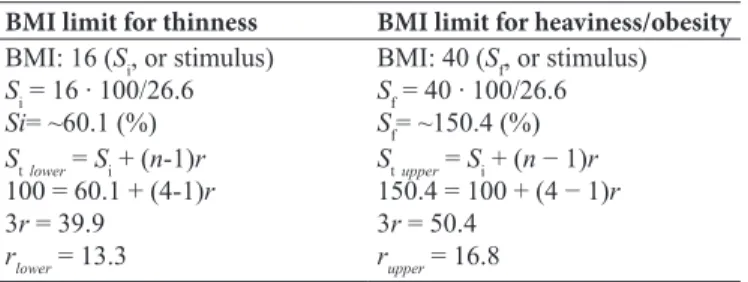
However, in order to maintain the standard BMI value (partici -pant’s actual, undistorted image) at the middle of the task scale, two separate calculations of the intervals can be used (Table 2). This strategy also can be incorporated into the previous task. This decision, however, can cause images to be distorted, with little variation, when the BMI of the actual, undistorted image is closer to the extremes of the limits of the scale, i.e., 16 and
40 in the illustration above.
When two sub-scales are used, the irst portion will include
3 images with BMI dimensions using the BMI 16 (limit for
thinness) and the actual, undistorted participant’s BMI (4th
im-age) and limiting values. Therefore, the lower limit of the scale
refers to stimuli between images 1 and 4, i.e., BMI 16 and the
actual, undistorted image) 26.9 BMI, calculated via Equation 2. Secondly, for the upper limit of the scale we calculated the values for S4, S5, and S6, while S7 is the maximum BMI value, or 40.
Table 2. Example of the calculation of two sub-scales of a geometric progression of a limited scale of image sizes for a participant (BMI = 26.6).
BMI limit for thinness BMI limit for heaviness/obesity BMI: 16 (Si, or stimulus)
Si = 16 ∙ 100/26.6 Si= ~60.1 (%)
BMI: 40 (Sf, or stimulus) Sf = 40 ∙ 100/26.6 Sf= ~150.4 (%) Stlower = Si + (n-1)r
100 = 60.1 + (4-1)r 3r = 39.9
rlower = 13.3
Stupper = Si + (n − 1)r 150.4 = 100 + (4 − 1)r 3r = 50.4
rupper = 16.8
Table 3 shows the sequence of calculations, using the sub-scales of geometric progression for one participant. Ranges for both BMI and % values appear in a single scale that is used to compose the psychophysical task of magnitude estimation.
Notice that the standard value (i.e., the actual, undistorted im -age of the participant) remains at the middle of the scale. This
strategy was used to prevent a 4th image from appearing with a
similar size dimension as the actual, undistorted image—which is part of the task scale. Magnitude estimation tasks should not use confusing images such as those with a reduced threshold of differences, which makes them hard to discriminate. Differences between the actual, undistorted image and distorted images should be evident.
Table 3. Outcome of the calculation of the two sub-scales of a geo -metric progression of a limited scale of image sizes for a participant with a BMI of 26.6.
Calculating the
stimu-lus increment using r Percentage (%) BMI value
S1 60.1 16
S1 + r lower = S2 73.4 19.5
S2 + r lower = S3 86.7 23.1
S4 100 26.6
S4 + r upper = S5 116.8 31.1 S5 + r upper = S6 133.6 35.5
S7 150.4 40
The next process described in this tutorial is the procedure for determining parameters that integrate the concepts and the diagno-sis of body image perception accuracy, represented as behavioral and cognitive components. The quantitative variables show the magnitude of perceptual distortions as well as perceptual styles with respect to the visual image of one’s own or others’ bodies.
Step 3. Evaluating the behavioral component of body image
The behavioral component of body image involves aspects such as feelings, beliefs, actions, and attitudes that relate to preoccupation with appearance. In an experimental session, in order to determine the behavioral variable of body image that indicates levels of dissatisfaction, a female participant, while viewing a set of distorted body images of herself—like the one displayed in Figure 1, responds by choosing an image of herself, according to the following questions:
• “Which image relects your body now?” (perceived AIP)
• “Which image you would like to look like?” (desired AIP)
The actual image of the participant (AIP—is the BMI of the participant that corresponds to the actual image which is displayed in the scale along with the distorted images), measured for BMI is used to calculate perceptual inaccuracy and levels of dissatisfaction with one’s own body image. The assigned
choices for each question are submitted to Equations 3 and 4.
Perceptual inaccuracy = perceived AIP – AIP (Equation 3)
Level of dissatisfaction = desired AIP – perceived AIP (Equation 4)
• Perceived AIP refers to the calculated BMI for the chosen image from the scale of distorted images that indicates the perceived actual body image.
• Desired AIP refers to the calculated BMI for the chosen image from the scale of distorted images that indicates the desired body image.
For example, if the participant (in Figure 1) chooses her actual image (i.e., 23.3) as her perceived AIP, then the degree of
perceptive accuracy is considered perfect (i.e., 23.3 − 23.3 = 0). On the other hand, if the participant chooses as her desired AIP an image with a BMI equivalent to 21.3, and, as her perceived AIP an image with a BMI equivalent to 29.3, the result of her level of dissatisfaction is -8 points (BMI). The negative value shows the direction of her dissatisfaction, towards thinness (relative to her real BMI).
Step 4. Evaluating the cognitive component of body image
The cognitive component of body image requires an observer to identify physical properties of an image such as size, volume, or any other visual dimension that relate to apparent perception on a metric scale. In an experimental session, in order to deter-mine the cognitive variable of body image that indicates levels of accuracy and perceptual style (e.g., visual constancy, visual underconstancy, or visual overconstancy), a participant is asked to view images such as those displayed in Figure 2, and to attri-bute numbers that are proportional to a standard number (e.g., 100), which is assigned to an actual (or unmanipulated) image (also called standard stimulus). In our example below, a male participant with a BMI of 26.6 is used. In this psychophysical task, the experimenter provides the following initial instruction prior to the display of the participant’s image: “We attributed a
value of 100 to your actual, undistorted image (standard).” Then,
a second image (distorted) appears, and the experimenter asks, “If the previous image was worth 100, how much is this (distorted)
image worth?” This question is repeated in print for each pair of
sequential images (Figure 2).
Figure 2. Pair of two images of a participant’s body, undistorted (100% or BMI = 26.7, top) and distorted (200% or BMI = 40, bottom).
Step 5. Data analysis using psychophysics
In the behavioral component, body image is assessed via two parameters, perceptual inaccuracy and level of dissatisfaction
(see Equations 3 and 4). However, the cognitive component via the magnitude estimation task provides a larger set of variables. These variables, representing the verbal (numeric) response to distorted images, are then plotted against the veridical scale that comprises the distorted image.
The irst data processing of the magnitude estimation pro -vides us with the magnitude of perceptual accuracy for each image in the scale. Two variables are the absolute error (AE) and the constant error (CE).
Table 4 depicts an example of a scale (i.e., stimulus) that
was constructed using the geometric progression of a limited scale of image sizes for a female participant (BMI = 23.8), in both percentage and BMI units. The participant’s respective es-timated magnitude of the image (i.e., response) to each distorted image also appears in percentage and BMI units. Results of a participant’s responses are initially processed using the absolute error (AE: Equation 5), which is the difference between the actual distorted image value and the estimated magnitude, or
the participant’s response to this same image (Table 4). In psy -chophysics, absolute error is the difference between the judged value of a stimulus and its true value, ignoring the direction of the difference. The closer the AE value is to zero the more ac-curate is the participant’s perception of the body size distortion.
AE = ƩǀRi − Siǀ/n (Equation 5)
Table 4. Participants’ responses (% and BMI) to seven distorted im -ages, and outcomes, respectively, for %dif and BMIdif.
Stimulus (S) (%)
Stimulus (S) (BMI)
Response (R) (%)
Response
(R) (BMI) %dif BMIdif 69.3 16.5 55 13.1 -14.3 -3.4
80.3 19.1 65 15.5 -15.3 -3.6
93.1 22.1 80 19.0 -13.1 -3.1
107.9 25.7 120 28.6 12.1 2.9
123.0 29.7 150 35.7 25.0 5.9
144.8 34.5 170 40.5 25.2 6.0
167.8 39.9 250 59.5 82.2 19.5
Absolute error (AE) 26.7 6.3
The constant error (CE) measures any potential bias from direction of the BMIs, to over- or underestimate a BMI extent for any given body image distorted magnitude, by calculating the difference between the judged value of a stimulus and
its true value. Negative values indicate that the estimated
increase as the distortion of the image approaches the obesity level (Figure 3).
Figure 3. Magnitude estimation of perceived size of distorted body im-ages (psychological scale) and the actual size of distorted body imim-ages (physical scale) representing the CE (BMIdif) of a female individual.
Power function in psychophysics
Da Silva and Macedo (1981) proposed that the perceptual and cognitive processes are interrelated and produce a single
dimension that speciies such processes (e.g., an individual that
uses a numeric representation for multi-dimensional changes of
a particular stimulus). To conirm such dimensional speciicity,
experiments in psychophysics attempt to demonstrate percep-tual constancy, accuracy of processes, and to test mathematical model predictions.
Psychophysical experiments measure perception and sen-sation through a variety of methods. These include fractioning, equisection scaling, magnitude estimation and magnitude production, and cross modal matching, among others. Direct scalar psychophysics methods were popularized by Stevens (1951; 1961; 1975) in order to validate a psychophysical law.
The analysis of the perception of a stimulus’ dimension (such as size) typically employs mathematical functions, such as the psychophysical power function proposed by Stevens in 1951 (Dang & Macedo, 1983). The power function aligns perceptual
judgments with the magnitude of physical stimuli (actual value) in a wide variety of perceptual modalities (e.g., visual, auditory, tactile, etc.). The relationship between the subjective perceived magnitude and the actual magnitude of a stimulus set obeys what has become known as the Law of Stevens (Stevens, 1951), and takes the form:
R = K ∙ Sn (Equation 6)
R is the magnitude of the perceived stimulus, K is an arbitrary scalar constant (which depends on the unit of measurement–– height, for example), S is the actual value (or intensity) that corresponds to the stimulus, and the exponent n is the power law exponent and determines the slope of the function. The n parameter varies according to the sensory continuum (for exam-ple, auditory threshold for loudness) or perceptual modality (for example, perception of visual distance) that is being measured.
An exponent value of 1 means that the psychophysical func-tion follows a constant symmetrical line between the two conti-nua (i.e., physical and psychological). The subjective response varies in the same proportion as the intensity of the stimulus; that is, there is a perceptual constancy (the angle of inclination of
the line ascends to 45º). A psychophysical function (e.g., visual
perception of line length) that have exponents equal to 1 depict a linear relationship between a stimulus’ physical magnitude and
its perceptual magnitude (Da Silva, 2004; Da Silva & Macedo,
1981; Da Silva & Ribeiro-Filho, 2006; Mauerberg-deCastro,
Paula, Tavares, & Moraes, 2004). On the other hand, if the
exponent is greater than 1, the result is a positively accelerated or expansive psychophysical function (overconstant perceptual
style), and the slope of the function is greater than 45°. If the
exponent is less than 1, a negatively accelerated or compres-sive psychophysical function (underconstant perceptual style)
appears, with a slope of less than 45º.
The logarithmic metric form of the two continua, log(R) = nlog(E) + log(K), are mathematically equivalent and the data it
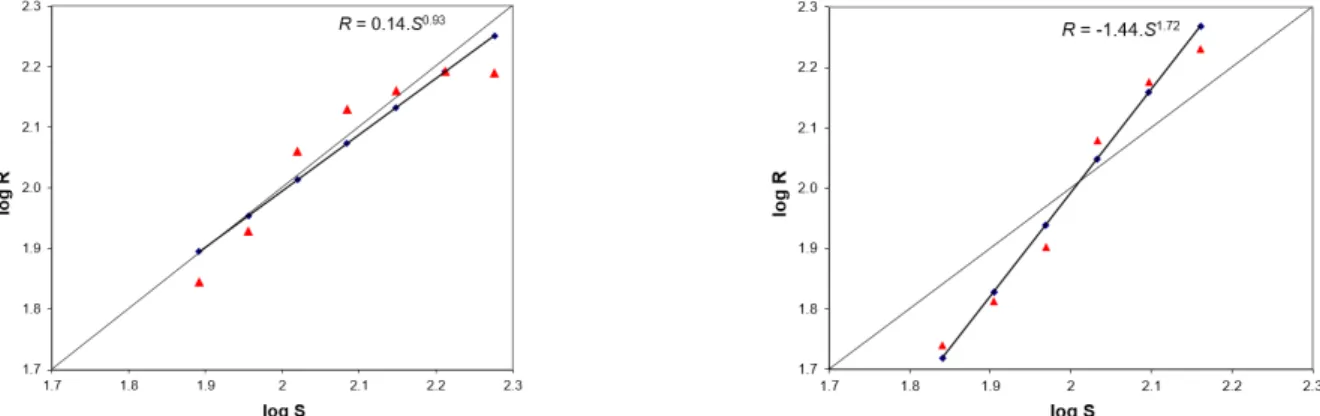
linearly. Figure 4 illustrates two female participants’ perceptions
of body sizes. The line in the graph on the left (Participant 1) increased linearly and proportionally, indicating that the mag-nitude of perceived body size increased as the magmag-nitude of the actual body size increased. The slope indicates an approximation of a perceptual constancy (power function exponent is close to
1, i.e., n = 0.93). The graph on the right (Participant 2) indicates
that the participant tended to inlate the values in her responses
as the magnitude of the body size increased. The slope indicates a perceptual overconstancy (n = 1.72).
Calculating the power function
To calculate the power function, we employ the least square method, an algebraic procedure for itting linear equations to data. First, individual values for the standard stimulus (the actual photographic image of the participant), and the values of the magnitude estimation (the participant’s responses), are transformed into logarithms. Then, by applying the method of least squares to these values, the power function parameters are determined (see Equation 6), where the exponent n and the logK are calculated as follows:
e = N (Σxy) − (Σx ∙ Σy)
N (Σx2) − (Σx)2 (Equation 7)
logK = (Σx2 ∙ Σy) − (Σx ∙ Σxy)
N (Σx2) − (Σx)2 (Equation 8)
From the parameters of Equation 6, the stimuli (S) are now x (log of Si), and the responses (R) are now y (logRi). The number of distorted images is N. See the example in Table 5.
Table 5. Example of an experimental trial with seven distorted images with respective values, S (%), and a participant’s magnitude estima-tion response, R (%). Each magnitude set (S and R) was converted into log, xi (logSi), and yi (logRi).
S R x y xy x2
77.9 70 1.891537 1.845098 3.490072 3.577914 90.29 85 1.95564 1.929419 3.773248 3.824526 104.65 115 2.019739 2.060698 4.162072 4.079347 121.29 135 2.083825 2.130334 4.439243 4.342327 140.58 145 2.147924 2.161368 4.642453 4.613576 162.94 156 2.212028 2.193125 4.851252 4.893067 188.85 155 2.276117 2.190332 4.985451 5.180709 Ʃ 14.58681 14.51037 30.34379 30.51146 N = 7
n = 7 (30.34379) − (14. 14.58681 ∙ 14.51037)
7 (30.51146) − (14.58681)2
n = 0.92705
logK = (30.51146 ∙ 14.51037) − (14.58681 ∙ 30.34379)
7 (30.51146) − (14.58681)2
logK = 0.14109
AntilogK = 1.38
By adjusting the parameters, logRj = logK+ n ∙ logRi (or xi), we have Ri…n = 0.14109 + (0.92705 ∙ Si…n), where logRj is the
predicted parameter outcome for the itting of the psychophys -ical power function. To construct a di-log psychometric graph, we must plot each logRjagainst each corresponding logSi , as shown in Figure 5.
Variables that affect the power function in body image psychophysical tasks
Perceiving the body image of a stranger vs. perceiving one’s own image
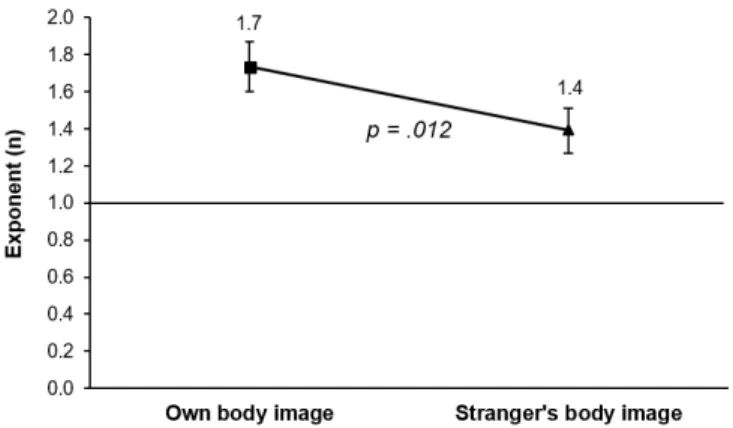
The exponents of the psychophysical power function in-dicate that perceiving the body image of a stranger can be a different experience than perceiving one’s own image. In 2010, Paula, using the methodological procedure presented above, investigated levels of perceptual consistency and accuracy of female adolescents in body image psychophysical tasks. She included distorted images of each individual’s own body as well as a stranger’s body. Forty-three participants at risk for body image disorders completed a psychophysical task in which their levels of satisfaction with body image were assessed using each individual’s image, both actual and distorted, as compared to a stranger’s image (Figure 5).
Figure 5. Geometric mean of the power function’s exponents in two psychophysical magnitude estimation tasks, with distorted body imag-es of own body and a stranger’s body of a group of female adolimag-escents at risk for body image disorders (Paula, 2010). (Standard errors in bars.)
Although each of the female participants in this study had
a normal BMI (21.4 + 2.9), each also perceived herself as being overweight, felt she was obese, or wanted to be thinner. Participants showed a tendency toward perceptual overconstan-cy in both tasks, with a signiicant difference for tasks using images of the participants’ own bodies. Both tasks, when using body images that were compared to a magnitude estimation task that used a neutral image (i.e., a cube, n = 1.1), showed a
images of small-sized bodies (BMI lower than normal), and they overestimated the distorted images of larger-sized bodies. Similar results were found in a control group of col-lege-aged females in a different study that used the same protocol methodology as presented in the current article. The exponent for perception of one’s own body size was 1.6, while the perception of a stranger’s body size was 1.3 (p = .05) (Braga, 2012).
In both studies, females perceived themselves differently than when they viewed the body images of a female stranger. When viewing images of themselves during the psychophysical task, these females tended to increase the magnitude ratio be-tween the standard image and the distorted image, as the body
size increased toward a BMI that is considered “obese.” While
the adolescents at risk for developing body image disorders
presented a larger exponent, they were not signiicantly different
from the females that were not at risk.
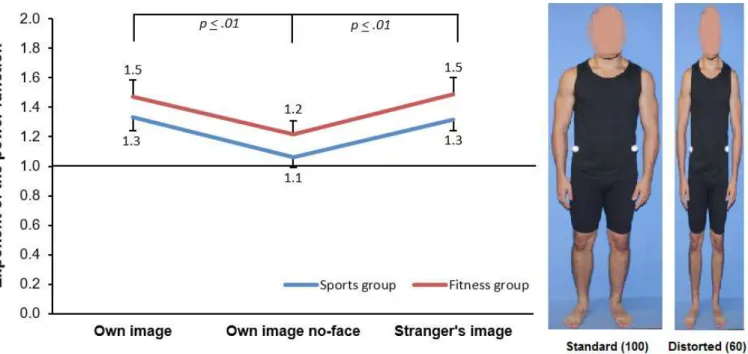
Recently, Tavares (2015) detected no such image effect in males. Using the same protocol, she tested 25 male college-aged students, and a second group of 25 males at risk for body
dysmorphia. Both groups showed no signiicant difference be -tween tasks that used their body images and a stranger’s image,
although the group at risk showed a slightly (non-signiicant)
larger exponent than that of the control group. In both tasks, the control group showed a geometric mean for the exponent
of 1.4 in both tasks (own image and stranger’s), and, similarly,
1.5 for the group at risk for body dysmorphia.
Psychophysical exponents found for estimation tasks of own body size in males replicated the results found for females’ perceptions of a stranger’s body image. This gender bias is well documented in studies of body image (Cash & Pruzinsky, 2002). Females tend to perceive themselves as larger (fatter) than do males, and many would like to be thinner, even though their BMIs fall into what is considered a normal range (Braga 2012; Paula, 2010). Males prefer to be larger, or heavier, than they actually are.
Consistency in the magnitude estimation task can be mea-sured using the determination coeficient, denoted as r2. The
outcome indicates how well the psychophysical data it the
function. An r2 of 1 indicates that the regression line perfectly
its the data, while an r2 of 0 indicates that the line does not
it the data due to a non-linear trend, or because responses are random. In the irst study using manipulated body images and
the psychophysical estimation of magnitude task, Paula (2010)
found a determination coeficient of .91 for the group of females at risk for body image disorders, and .94 for the control group.
Braga (2012), who used this method to study stroke survivors,
also found high determination coeficients: .93 for females and
.95 for males.
Reliability in the magnitude estimation task for body image perception
In 2012, Braga investigated stroke survivors’ perceptions of body size. Two-thirds of the participants had suffered right-side
brain damage. She manipulated the hemispheric dimensions of the image by distorting half of the body (Figure 6). She used the same procedure for range of distortion as used by Paula (2010). In the magnitude estimation task, the participant’s actual, undistorted, split image, however, was presented si-multaneously with a distorted split image (i.e., the other half of the body). Participants estimated magnitudes in tasks that used the entire image, and bisected images (two conditions: 1. actual, undistorted half-body image on the right side, and distorted half-body image on the left side; and 2. actual, undis-torted half-body image on the left side, and disundis-torted half-body image on the right side).
Figure 6. Two examples of pairs of images that are distorted on one side only (on right is the actual, undistorted image; on left is the dis-torted image). Male participant is from the control group (Braga, 2012).
An interesting aspect of this experiment is the control group individuals’ reliable responses (i.e., r2 > .90) with regard to the
bisected images and the entire images of their own bodies. Table 6 summarizes the results of parameters of the psychophysical
power function and the determination coeficient. For the stroke survivors, the main limitation of this experiment was the difi -culty in maintaining their attention and dispositions during the task. Many of them became tired, did not consistently respond to the task, and, therefore, were not included in the sample.
Their coeficient of determination was smaller than that of the
Table 6. Exponent of the psychophysical power function and the co-eficient of determination of participants in two groups: Young adults and stroke survivors performed an estimation of magnitude task in which their own body images were bisected.
Young adults (N = 17)
Whole body Right-side distortion Left-side distortion
n 1.2 1.4 1.4
r2 .91 .93 .93
Stroke survivors (N = 15) Whole body
(N = 11)
Right-side distortion (N = 9)
Left-side distortion (N = 7)
n 1.2 0.90 0.88
r2 .83 .78 .77
The stroke survivors had a tendency to show a perceptual underconstancy in both of the tasks with bisected images.
However, there was no statistical effect, since the large
intra-group variability prevented a consistent outcome that could be associated with the disability condition. It appears that, since only a few participants responded with certainty to all of the tasks, this relatively small sample prevented reliable
comparisons. On the other hand, the young adults showed a
reliable perception of the bisected body images. Although the geometric mean of both exponents indicated perceptual overconstancy, they were nearly identical. It is important to note that the group of young adults was composed of males and females equally, and, because they did not show a sta-tistical difference for this task, these results were collapsed into a single group.
Final considerations
The identity and visual perspective effects on perception of body image
One of the main concerns of researchers is to connect an
experimental manipulation with a conceptual perspective that explains empirical problems. Disturbances and (mis)perceptions
of body image are colloquial (as well as scientiic) evidences of
humans’ dissatisfaction with how we appear. The knowledge of
such conlicts is well understood in the ield of visual communi -cation—often with the purpose of selling products and methods
of body “transformation.” How humans perceive ourselves—in
ways that justify a seemingly ubiquitous and unending desire for such transformations—is quite a complex topic of research. Yet, some commonalities appear through simple perceptual pa-rameters, even for this complex object (and construct), the body. When assessing cognitive components of body image per-ception, psychophysical parameters seem to detect not only accuracy levels, but also can provide a reliable sensitivity index via a psychophysical power function using canonical experimen-tal procedures (Stevens, 1975). The exponent of this function
relects a particular way of assessing body size in groups with
body image disturbances. Females, for example, assess their own body image versus a stranger’s body image differently than do males (Paula, 2010).
As for assessing the behavioral component, we demonstrat-ed that the extent of levels of satisfaction using a dimensional scale of distorted body images can provide new insights about
gender, lifestyle, and presence of body image disturbances. Tavares (2015) found that male individuals, for instance, are
as dissatisied with their body sizes as women, except in the
opposite direction. Females in her study desired thinner bodies and erroneously perceived themselves as larger (fatter) than their actual BMIs indicated; males desired larger bodies, and erroneously perceived themselves as smaller (leaner) than their actual BMIs indicated.
Tavares (2015) also found that males with varying lifestyles with respect to exercise are biased when judging their own body sizes. A group of male athletes desired an increase of 3.1 BMI points, towards larger body size; while a group of males who
exercised in order to gain muscle mass through itness protocols
desired an increase of 6.6 BMI, towards larger body size. The second group is at risk for body dysmorphia. The literature shows that some individuals with behavioral disturbances can
accurately estimate size, but are excessively dissatisied with
shape and or size (Cash & Brown, 1987; Cash & Pruzinsky,
2002; Gardner, 1996; Gardner & Brown, 2014).
Another interesting inding by Tavares (2015) was that if
we remove the face details (by blurring the face image), males become more objective in assessing body size dimensions, regardless of lifestyle. In the trials of body images without a
face, their exponents relect a perceptual constancy (exponent
close to 1), regardless of their lifestyle of physical activity (Figure 7).
Such results conirm the potential use of psychophysical
tools for assessing body image size and constitute a test of conceptual premises, such as the role bi-dimensional visual cues of distorted body images play in the complex
phenom-ena related to perception of the body. Simplicity in scientiic
experimentation is desirable, but this also should open new perspectives of theoretical accounts and validate criticism
of reductionism. Our methodological account corroborates
human tendencies towards body image dissatisfaction widely discussed in the literature, and reveals some unique outcomes, resulting from additional experimental manipulations (e.g., perception of bisected body images; perception of faceless body images). It also prompts a discussion of its limitations.
One is that manipulated images that are (bi-dimensionally)
reduced to photography eliminate the subtleties of motion and the utilitarian function of the body. If attitudes about the body require experience with it, then body competency, mood states, as well as visual appearance are all challenges to assessment techniques. Furthermore, bi-dimensional representations of a body are scaled down to a computer screen, but life-sized im-ages (as studied by Probst, Vandereycken, & VanCoppenolle,
1997) are dificult to display in a laboratory due to high costs
and limited convenience. Therefore, questions about the va-lidity of the body image scale at different dimensional levels can prove (or disprove) universal transference or perceptual invariance of body image size.
Reliable and simple tools require scholars to identify co-herent research questions that integrate experimental manipu-lations as part of their predictions. Perception of body image is a complex construct, and the determination of parameters that
are relevant to the demonstration of functions and inluences is
not an easy task, especially when the goal is to quantify these dimensions. The psychophysical approach can be useful for the measurement of perception because it offers both experimental task protocols and mathematical tools, or functions, to reduce and quantitatively represent data patterns that can prove or disprove conjectures. This article provided a glimpse of how such tools can be used, and attempted to guide readers into a practical scenario in which participants perceived the sizes of body images.
Some of the experimental contexts and literature indings
related to the perception of body image have shown how the human body can indeed coherently measure objects and events. Da Silva (personal communication, 1992) stated that humans routinely use a “collection of measuring tools that are embedded
in their bodies.” That is, they accurately weigh food in a market
simply by lifting it; they precisely calibrate distances and force when throwing a basketball toward a basket; they measure their
bodies to it into clothes simply by looking at their igures in
the mirror, and so on. Metaphorically, humans are measuring tapes, dynamometers, scales, decibel meters, and a seemingly
endless array of other devices, which are “built into” our or
-ganisms. “The beauty of the thing,” Da Silva continued (ibid), “is that humans can rely on using their senses and perceptual
modalities to accomplish such tasks without external devices.” Psychophysical tools help us ind the “signatures” of such sen -sory and perceptual functions.
References
Adams, G., Turner, H., & Bucks, R. (2005). The experience of body dissatisfaction in men. Body Image, 2 (3), 271-283, <doi:10.1016/j. bodyim.2005.05.004>.
Alcañiz, M., Botella, C., Perpiña, C., Baños, R., Lozano, J.A., Montesa, J., … Alozano, J. (2000). A new realistic 3D body representation in virtual environments for the treatment of disturbed body image in eating disorders. CyberPsychology & Behavior, 3 (3), 433-439, <http://online.liebertpub.com/doi/ pdf/10.1089/10949310050078896>.
Alves, E., Vasconcelos, F.A.G., Calvo, M.C.M., & Neves, J. (2008). Prevalência de sintomas de anorexia nervosa e insatisfação com a imagem corporal em adolescentes do sexo feminino do Município de Florianópolis, Santa Catarina, Brasil (Prevalence of symptoms of anorexia nervosa and dissatisfaction with body image among female adolescents in Florianópolis, Santa Catarina State, Brazil). Caderno de Saúde Pública, 24 (3), 503-512, <http://dx.doi. org/10.1590/S0102-311X2008000300004>.
Bamber, D.J., Cockerill, I.M., Rodgers, S., & Carroll, D. (2003). Diagnostic criteria for exercise dependence in women. Brazilian Journal of Sports Medicine, 37, 393–400, <doi:10.1136/ bjsm.37.5.393>.
Campbell, D.F. & Mauerberg-deCastro. E. (2011). Estereótipos e dei -ciência: a mídia e a cultura da perfeição (Stereotypes and disability: media and the culture of perfection). In E. Mauerberg-deCastro (Ed.). Atividade Física Adaptada (Adapted Physical Activity) (2nd ed.) (pp 83-112). Ribeirão Preto: Novo Conceito.
Cash, T.F. (2002). Cognitive-behavioral perspective on body image: Cash T.F., Pruzinsky T. (Eds.). Body image: a handbook of theory, research, and clinical practice. New York: Guilford.
Cash, T.F., & Brown, T.A. (1987). Body image in anorexia nervosa and bulimia nervosa: A review of the literature. Behavior Modiication, 11, 487-521.
Cash, T.F., & Pruzinsky, T. (2002). Body Image: A Handbook of Theory, Research, and Clinical Practice. NY: Guilford Press.
Coelho, J.S., Jansen, A., & Bouvard, A. (2011). Cognitive distor-tions in normal-weight and overweight women: susceptibility to thought-shape fusion. Cognitive Therapy and Research, 36 (4), <doi:10.1007/s10608-011-9372-0>.
Da Silva, J.A. (2004). O uso da avaliação e a avaliação de seu uso: acerca da avaliação da qualidade do ensino (The use of assess -ment and evaluation of its use: on the evaluation of the quality of education). Paidéia, 14 (29), 255-264, <http://dx.doi.org/10.1590/ S0103-863X2004000300002>.
Da Silva, J.A., & Macedo, L. (1981) Análise do fenômeno da supercon-stância e suas implicações para a Psicologia do desenvolvimento e da percepção (Analysis of the super constancy phenomenon and its implications for developmental psychology and perception). Arquivos Brasileiros de Psicologia, 33, 5-31, <http://bibliotecadig-ital.fgv.br/ojs/index.php/abp/article/view/18440/17190>. Da Silva, J.A., & Macedo, L. (1983). A função potência na per
-cepção: significado e procedimentos de cálculo do expoente (The power function in perception: meaning and exponent calculation procedures). Arquivos Brasileiros de Psicologia, 34, 27-45, <http://bibliotecadigital.fgv.br/ojs/index.php/abp/article/ viewFile/18835/17578>.
Da Silva, J.A., & Ribeiro-Filho, N.P. (2006). Avaliação e mensuração de dor: pesquisa, teoria e prática (Assessment and measurement of pain: research, theory and practice). Ribeirão Preto: Funpec, 467p. Da Silva, J.A., Santos, R.A., & Silva, C.B. (1983). Análise psicofísi-ca do espaço visual. Teoria e pesquisa: Tributo a S.S. Stevens (Psychophysical analysis of visual space. Theory and research: Tribute to S. S. Stevens). Arquivos Brasileiros de Psicologia, 35, 3-53, <http://bibliotecadigital.fgv.br/ojs/index.php/abp/article/ view/18932>.
De Vignemont, F. (2010). Body schema and body image—Pros and cons, Neuropsychologia, 48 (3), 669-680, <http://dx.doi. org/10.1016/j.neuropsychologia.2009.09.022>.
Ekman, G., & Junge, K. (1960). Psychophysical relations in the visual perception of length, area and volume. Sweden: Stockholm univ. Fiske, L., Fallon, E.A. Blissmer, B., & Redding, C.A. (2014). Prevalence
of body dissatisfaction among United States adults: Review and recommendations for future research. Eating Behaviors, 15 (3), 357-365, <http://dx.doi.org/10.1016/j.eatbeh.2014.04.010>. Gardner, R.M. (1996). Methodological issues in assessment of the
per-ceptual component of body image disturbance. British Psychological Society, 87 (2), 327-337, <doi:10.1111/j.2044-8295.1996.tb02593.x>. Gardner, R.M., & Brown, D.L. (2014). Body size estimation in anorex -ia nervosa: A brief review of indings from 2003 through 2013.
Psychiatry Research, 219, 407-410. Available: <http://dx.doi. org/10.1016/j.psychres.2014.06.029>. Access: Sept 20, 2014. Gehrman, C.A., Hovell, M.F., Sallis, J.F., & Keating, K. (2006).
The effects of a physical activity and nutrition intervention on body dissatisfaction, drive for thinness, and weight concerns in pre-adolescents. Body Image, 3 (4), 345-351, <doi:10.1016/j. bodyim.2006.07.006>.
Johnstone, A.M., Stewart, A.D., Benson, P.J., Kalafati, M., Rectenwald, L., & Horgan, G. (2008). Assessment of body image in obesity using a digital morphing technique. Journal of Human Nutrition & Dietetics, 21 (3), 256-267, <doi:10.1111/j.1365-277X.2008.00862.x>. Kakeshita, I.S. (2008). Adaptação e validação de Escalas de Silhuetas
para crianças e adultos brasileiros (Adaptation and silhouettes scales validation for Brazilian children and adults). Tese (Doutorado em Psicobiologia), Universidade de São Paulo, Ribeirão Preto. Kakeshita, I.S., & Almeida, S.S. (2006). Relação entre índice de
massa corporal e a percepção da auto-imagem em universitários (Relationship between body mass index and the perception of self-image in undergraduate). Revista de Saúde Pública, 40 (3), 497-504, <http://dx.doi.org/10.1590/S0034-89102006000300019> Knight, J.L., & Giuliano, T.A. (2001). He’s a Laker; She’s a “Looker:”
The consequences of gender-stereotypical portrayals of male and female athletes by the print media. Sex Roles, 45, 217–229. doi:10.1023/A:1013553811620.
Lease, S.H., Cohen, J.E., & Dahlbeck, D.T. (2007). Body and sexual esteem as mediators of the physical disability-interpersonal com-petencies relation. Rehabilitation Psychology, 52 (4), 399-408, <doi:10.1037/0090-5550.52.4.399>.
Lovo, T.M.A. (2006). Anosognosia: Imagem corporal na hemiplegia (Anosognosia: Body image in hemiplegia). 137f. Dissertação (Mestrado em Educação Física), Universidade Estadual de Campinas, Campinas.
Mauerberg-deCastro, E. (2004). Percepção e ação: direções teóricas e experimentais atuais (Perception and action: current theoretical and experimental directions). Paidéia, 14 (27), 63-73, <http://dx.doi. org/10.1590/S0103-863X2004000100009>.
Mauerberg-deCastro, E. (2006). Imagem corporal e inluências da mídia sobre o corpo (Body image and media inluences on body). Projeto de pesquisa UNESP.
Mauerberg-deCastro, E., Paula, A.I., Tavares, C.P., & Moraes, R. (2004). Orientação espacial em adultos com deiciência visual: efeitos de um treinamento de navegação (Spatial orientation in adults with visual impairment: effects of a navigation training). Psicologia: Relexão e Crítica, 17 (2), 199-210, <http://dx.doi. org/10.1590/S0102-79722004000200008>.
Mauerberg-deCastro, E., & Moraes, R. (2002). Parâmetros psicofísi-cos e biomecânipsicofísi-cos da percepção háptica durante a locomoção em crianças (Psychophysical and biomechanical parameters of haptic perception during locomotion in children). Psicologia: Relexão e Crítica, 15, 103-112, <http://www.scielo.br/pdf/prc/ v15n2/14360.pdf >.
Mohr, C., Porter, G., & Benton, C.P. (2007). Psychophysics reveals a right hemispheric contribution to body image distortions in women but not men. Neuropsychologia, 45 (13), 2942-2950, <doi:10.1016/j.neuropsychologia.2007.06.001>.
relationship between stress and body dissatisfaction in adolescent females and males, Body Image, 10 (4), 544-551, <http://dx.doi. org/10.1016/j.bodyim.2013.07.011>.
Mussap, A.J., McCabe, M.P., & Ricciardelli, L.A. (2008). Implications of accuracy, sensitivity, and variability of body size estimations to disordered eating. Body image, 5 (1), 80-90, <doi:10.1016/j. bodyim.2007.07.003>.
Nunes, R.T., Lopes, E.C.D., Damasceno, V.O., Oliveira, V., Miranda, R., & Bara Filho, M.G. (2007). Dependência do exercício físico e insatisfação com a imagem corporal (Dependence on physical exercise and dissatisfaction with body image). HU Revista, 33 (4), 113-118, <http://hurevista.ufjf.emnuvens.com.br/hurevista/ article/view/63>.
Ojala, K., Tynjala, J., Valimaa, R., Villberg, J., & Kannas, L. (2012). Overweight adolescents self-perceived weight and weight control behavior: HBSC study in Finland 1994-2010. Journal of Obesity, 2012, <http://dx.doi.org/10.1155/2012/180176>.
Paula, A.I. (2010). Percepção de dimensões corporais de adolescentes do sexo feminino. Aspectos psicofísicos e comportamentais (Perception of body size of female adolescents. Psychophysical and behavioral aspects). 82 f. Tese (Doutorado em Ciências da Motricidade), Departamento de Educação Física, Universidade Estadual Paulista (UNESP), Rio Claro.
Perpiña, C., Botella, C., Baños, R., Marci, H., Alcañiz, M., & Quero, S. (1999). Body image and virtual reality in eating disorders: Is exposure to virtual reality more effective than the classical body image treatment? CyberPsychology and Behavior, 2 (2), 149-155, <doi:10.1089/cpb.1999.2.149>.
Probst, M., VanCoppenolle, H., Vandereycken, W., & Goris, M. (1992). Body image assessment in anorexia nervosa patients and university students by means of video distortion: A reliabil-ity study. Journal of Psychosomatic Research, 36 (1), 89-97, <doi:10.1016/0022-3999(92)90117-K>.
Probst, M., Vandereycken, W., & VanCoppenolle, H. (1997). Body size estimation in eating disorders using video distortion on a life-size screen. Psychotherapy and Psychosomatics, 66 (2), 87-91, <doi:10.1159/000289114>.
Richardson, S.M., Paxton, S.J., & Thompson, J.S. (2009). Is body think an eficacious body image and self-esteem program? A controlled evaluation with adolescents. Body Image, 6 (2), 75-82, <doi:10.1016/j.bodyim.2008.11.001>.
Sampei, M.A., Sigulem, D.M., Novo, N.F., Juliano, Y., & Colugnati, F.A.B. (2009). Atitudes alimentares e imagem corporal em meninas adolescentes de ascendência nipônica e caucasiana em São Paulo (SP) (Eating attitudes and body image in adolescents Nipponese descent and Caucasian girls in São Paulo (SP)). Jornal de Pediatria, 85 (2), 122-128, <http://dx.doi.org/10.1590/ S0021-75572009000200007>.
Sand, L., Lask, B., Hoie, K., & Stormark, K.M. (2011). Body size estimation in early adolescence: factors associated with perceptu-al accuracy in a nonclinicperceptu-al sample. Body Image, 8 (3), 275-81, <doi:10.1016/j.bodyim.2011.03.004>.
Siegel, J.M. (2002). Body image change and adolescent depres-sive symptoms. Journal of Adolescent Research, 17 (1), 27-41, <doi:10.1177/0743558402171002>.
Slater, A., & Tiggemann, M. (2006). The contribution of physical activity and media use during childhood and adolescence to adult women’s body image. Journal of Health Psychology, 11 (4), 553-565, <doi:10.1177/1359105306065016>.
Smolak, L. (2002). Body image development in children. In: Cash T.F., Pruzinsky T. (Eds.). Body Image: a handbook of theory, research, and clinical practice. New York: Guilford.
Stevens, S.S. (Ed.) (1951). Handbook of Experimental Psychology. New York: Wiley.
Stevens, S.S. (1961). To honor Fechner and repeal his law. Science, 133, 80–6.
Stevens, S.S. (1975). Psychophysics: introduction to its perceptual, neural and social prospects. New York: Wiley.
Stewart, A.D., Benson, P.J., Michanikou, E.G., Tsiota, D.G., & Narli, M.K. (2003). Body image perception, satisfaction and somatotype in male and female athletes and non-athletes: results using a novel morphing technique. Journal of Sports Sciences, 21 (10), 815-823, <doi:10.1080/0264041031000140338>.
Stewart, T.M., Allen, H.R., Han, H., & Williamson, D.A. (2009). The development of the body morph assessment version 2.0 (BMA 2.0): tests of reliability and validity. Body Image 6 (2), 67-94, <doi:10.1016/j.bodyim.2009.01.006>.
Stunkard, A.J., Sorenson, T., & Schlusinger, F. (1983). Use of the Danish adoption register for the study of obesity and thinness. In: Kety, S.S., Rowland, L.P., Sidman, R.L., & Matthysse, S.W. (Eds.). The genetics of neurological and psychiatric disorders. New York: Raven, 115-20.
Tavares, C.P. (2015). Aspectos psicofísicos da imagem corporal e a sua relação com a dismoria muscular e a dependência de exercício (Psychophysical aspects of body image and their rela-tionship with muscle dysmorphia and exercise dependence). 122 f. Tese (Doutorado em Ciências da Motricidade), Departamento de Educação Física, Universidade Estadual Paulista (UNESP), Rio Claro.
Tavares, M.C.C.F., Campana, A.N.N.B., Tavares Filho, R.F., & Campana, M.B. (2010). Avaliação perceptiva da imagem corporal: história, reconceituação e para o Brasil (Perceptual body image: History, reconceptualization and Brazil). Revista Psicologia em Estudo, 15 (3), 509-518, <http://www.scielo.br/pdf/pe/v15n3/ v15n3a08.pdf>.
Thompson, J.K. (2004). The (mis)measurement of body image: ten strategies to improve assessment for applied and research purposes. Body Image, 1 (1), 7-14, <doi:10.1016/S1740-1445(03)00004-4>. Tovée, M.J., Benson, P.J., Emery, J.L., Mason, S.M., & Cohen-Tovée, E.M. (2003). Measurement of body size and shape perception in eating-disordered and control observers using body-shape software. British Journal of Psychology, 94, 501-516, <http://dx.doi.org/10. 1348/000712603322503060>.
the observer’s own body mass index. Proc Biol Sci, 267 (1456), 1987-1997, <doi:10.1098/rspb.2000.1240>.
Tribess, S., Virtuoso Junior, J.S., & Petroski, E.L. (2010). Estado nutricional e percepção da imagem corporal de mulheres idosas residentes no nordeste do Brasil (Nutritional status and perception of body image of older women living in northeastern Brazil). Ciência e Saúde Coletiva, 15 (1), 31-38, <http://dx.doi.org/10.1590/ S1413-81232010000100008>.
Twigg, J. (2004). The body, gender, and age: Feminist insights in social gerontology. Journal of Aging Studies, 18, 59-73, <https://kar.kent. ac.uk/id/eprint/410>.
World Health Organization (WHO). (2014). Relatórios mundiais de saúde (World Health reports), <http://www.who.int/eportuguese/ publications/pt/>.
Authors’ note
Eliane Mauerberg-deCastro (Sc.D., Psychobiology) and Debra Fran-ces Campbell (Ph.D., Technology and Human Development) are af -iliated with the Laboratory of Action and Perception, São Paulo State University (Universidade Estadual Paulista), Rio Claro, SP, Brazil. Carolina Paioli Tavares (Ph.D., Movement Sciences) and Adriana Inês de Paula (Ph.D., Movement Sciences) are afiliated with the State University of Ponta Grossa (Universidade Estadual de Ponta Grossa), Ponta Grossa, PR, Brazil.
Gabriella Braga Crozara (M.S., Movement Sciences) is afiliated with the Brazilian Air Force Academy (Academia da Força Aérea Brasileira), Pirassununga, SP, Brazil.
Corresponding author
Eliane Mauerberg-deCastro, Sc.D. LAP, DEF, UNESP
Av. 24-A, 1515, Bela Vista, Rio Claro 13506-900 SP, Brazil E-mail: [email protected]
Manuscript received on November 4, 2015 Manuscript accepted on November 24, 2015