Biopolymers and Cell. 2015. Vol. 31. N 4. P. 243–248 doi: http://dx.doi.org/10.7124/bc.0008E7
UDC 577.21
CRISPR/Cas9 technology for targeted genome editing
N. A. Lomov
1, 3, V. V. Borunova
1, 3, M. A. Rubtsov
1, 2, 31 M. V. Lomonosov Moscow State University,
Leninskie Gory, 1/12, Moscow, Russian Federation, 119991
2 I. M. Sechenov First Moscow State Medical University,
8, Trubetskaya Str. Moscow, Russian Federation, 119991
3 LIA 1066 French-Russian Joint Cancer Research Laboratory
Villejuif, France–Moscow, Russian Federation [email protected]
CRISPRs (Clustered Regularly Interspaced Short Palindromic Repeats) are the segments of prokary-otic DNA containing short repeats in its nucleotide sequence. Today we know that this is a bacterial protection system against viral DNA. The molecular components of CRISPR/Cas9 system have been used for a gene editing in eukaryotes since 2013. But as any other method it also has the limitations and drawbacks. Here we are going to review the history of CRISPR biology and to discuss the possi-bilities that this new technology provides to researchers as well as the prospects for its use in the medical research and treatment.
K e y w o r d s: CRISPR/Cas9, genome targeting, genome editing, personalized therapy, chromosomal translocations, DNA repair.
© 2015 N. A. Lomov et al.; Published by the Institute of Molecular Biology and Genetics, NAS of Ukraine on behalf of Biopolymers and Cell.
This is an Open Access article distributed under the terms of the Creative Commons Attribution License (http://creativecommons.org/licenses/by/4.0/), which permits unrestricted reuse, distribution, and reproduction in any medium, provided the original work is properly cited
History
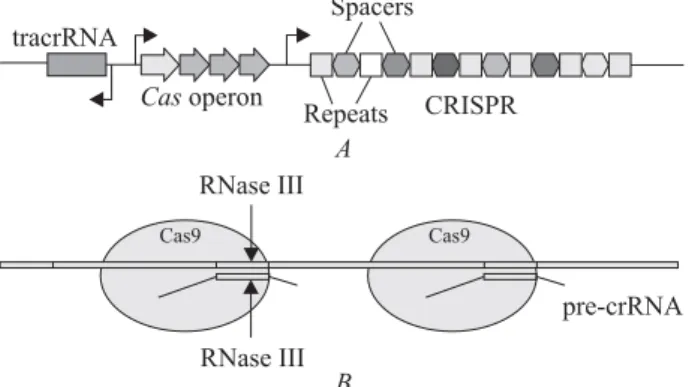
The specifi c sequences in bacterial genomes, called CRISPR, were discovered in 1987. They consist of repeats, alternating by unique sequences or «spac-ers» [1] (Fig. 1, A). Its function has been unsolved until 2005 when it was found that these «spacers» have a sequence equal to a viral DNA. It was also observed that there are the CRISPR-associated genes and these genes encode nucleases. After-wards it was supposed that the bacteria use these nucleases to cleave a foreign DNA wherein the spacer sequence is used as an example of which ex-actly DNA sequence is necessary to be cut [2, 3]. This hypothesis was experimentally proven in 2007 [4]. A detailed mechanism of the complex matura-tion and directed cleavage of DNA was fi nally stud-ied in 2011 [5] (Fig. 1, B). It was found that the
Cas9 enzyme formed a ternary complex with crRNA and tracrRNA encoded in the cluster. This complex unwinds DNA and introduce a double-stranded break in DNA if crRNA binds complementary to one of the DNA chains (Fig. 2, A). A year later it was shown that crRNA can be joint to tracrRNA and that this «single guide» RNA (sgRNA) together with the Cas9 enzyme might be used to modify the genome of eukaryotes [6] (Fig. 2, B)..This idea was
realized in 2013 and since then thousands of papers where such technology was applied have been pub-lished [7–9].
par-ticular sequence [10, 11].Compared to the these technologies the CRISPR/Cas9 system has proved to be much more simple, available, affordable and three to four times more effi cient [12].
The basic principle
of CRISPR/Cas9 technology
At the heart of all the methods that use the CRISPR/ Cas9 system lies the possibility to introduce a break in DNA in an exactly desired locus. It’s enough to deliver the Cas9 gene (or its mRNA) together with sgRNA into the cell, wherein sgRNA at its 5’-end should have 20 nucleotide sequence complimentary
to a target DNA fragment. There is also easy way to introduce the multiple breaks at the same time – just to use several different sgRNAs [13].
Application of CRISPR/Cas9 technology
The fi rst example of application of the CRISPR/ Cas9 technology is the modeling of tumor-associat-ed chromosomal translocations: CRISPR/Cas9 in-duces the double-stranded DNA breaks (DSBs) in the precise loci which are known to participate in the oncogenic rearrangements. Typically, DSBs used to be repaired by the mechanism of non-homologous end joining (NHEJ). This error prone mechanism fre-quently leads to joining the DNA ends belonging to different chromosomes [14]. The cellular models of certain types of cancer might be obtained using this method. Inducing the human specifi c types of cancer in laboratory animals is also possible. So, the mu rine model of non-small-cell lung cancer (NSCLC) was developed. Using lentiviral delivery the Cas9 gene and sgRNA were brought into lung cells in order to induce a cleavage of the murine endogenous Eml4 and Alk loci and to generate the Eml4-Alk fused gene found recurrently in NSCLCs. The result was the de-velopment of the disease in the treated mice [15]. To date the murine in vivo models of human leukemia (namely, AML) have also been developed [16, 17]. These and other similar murine models can be uti-lized to study the carcinogenesis and to test new treatment approaches.The next purpose which might be successfully achieved by application of the CRISPR/Cas9 technol-ogy is knocking genes out. The DSB formation often leads to the deletion or insertion of several nucleotides in an initial sequence even in case of effi cient DSB repair [18]. Thus, introducing a break into a particular gene one may cause its knockout. So the Cas9-ex-pressing cell line treated with various sgRNA can be used for searching for the genes responsible for a spe-cifi c disease. A few years earlier each gene knockout was a complicated time-consuming procedure, but in case of CRISPR/Cas9 it requires only to treat the Cas9-expressing cells with a specifi c sgRNA [19].
In addition, one may insert the desired DNA frag-ment into the specifi c broken DNA site. There are
Fig. 2. A – Targeted cleavage of DNA by a ternary complex of Cas9 with crRNA and tracrRNA. B – Targeted cleavage of DNA by a complex of Cas9 with «single guide» RNA (sgRNA)
two major mechanisms of DSB repair: homology-directed repair (HDR) and non-homologous end joining (NHEJ). HDR requires a fragment of DNA homologous to the damaged one as a template. Oth-erwise, in the absence of such a fragment, NHEJ takes place. It is possible to achieve insertion of a desired DNA fragment in both cases. If a DNA frag-ment with homology arms surrounding a desired gene is available, it will be inserted via HDR. In case of the NHEJ repair it is suffi cient to deliver a linear DNA fragment with the ends protected from the ac-tion of cellular exonucleases. There is a chance that this fragment will be joined to the ends of the break.
So, the CRISPR/Cas9 technology makes possible the insertion of the desired DNA fragment into the ge-nome. It is widely used in scientifi c research and offers great opportunities for the treatment of hereditary dis-eases and viral infections. For example, this technology allows generation of the stable cell lines with the de-sired inserts in the genome. The CRISPR/Cas9 gene knocking occurs with a much higher effi ciency than the random integration of a plasmid into the genome and solely at the particular pre-selected site in almost 100 % of cases. Until recently the generation of a stable cell line usually took at least few months, with the CRISPR/ Cas9 technology – up to one month [20].
Moreover, until recently, the gene therapy implied the insertion of the desired gene into the random place in the genome. In its turn, the CRISPR/Cas9 system allows changes in a certain place, where one may not only insert the gene but also remove or replace the certain DNA fragments. Several in vivo studies in mice have shown the possibility of gene therapy by means of the CRISPR/Cas9 application. A deletion of 1 bp in the CRYGC gene is known to cause the cata-ract in mice. After injection of the Cas9 mRNA, sgRNA and the DNA fragment containing a wild-type allele into the mouse embryos with this mutation the mousekins were born healthy [21]. In a recent work the researchers have successfully applied the CRISPR/ Cas9 system in order to reduce the level of cholesterol in the blood of mice by turning off the PCSK9 gene in the liver cells. They used adenovirus particles to de-liver the Cas9 gene and sgRNA into hepatocytes. As a result more than 50 % of hepatocytes were «edited»
and it resulted in a decrease in the cholesterol level to a value that is typical for the PCSK9 knockout mice [22]. Striking results were achieved with CRISPR/ Cas9 in the prevention of Duchene’s muscular dystro-phy (DMD) in mice by correcting the dmd dystrophin gene. A copy of the normal dmd gene was integrated in the zygotes via the CRISPR/Cas9 system. The born animals were mosaic in the dmd gene but nonetheless even a partial gene editing has prevented the disease development [23].
The ability to deliver the CRISPR/Cas9 system elements into the brain cells has been also recently demonstrated. Because of the packaging size limita-tion of the adeno-associated viral (AAV) vectors, the dual-vector system was designed composed of two se-parate vectors that package the SpCas9 (AAV-SpCas9) and sgRNA (AAV-SpGuide) expression cassettes. However, the co-transfection effi ciency was shown to be rather high [19].
Taken together, these in vivo studies on animals prove the excellent prospects for the genome editing via application of the CRISPR/Cas9 technology.
On the other hand, many studies ex vivo show the ability to edit DNA in human cells. The particular mutations in the CCR5 gene which occur in some people are known to make it resistant to HIV. A re-cent study has established that the CRISPR/Cas9-based editing of CCR5 in the induced pluripotent stem cells (iPSCs) may lead to the HIV-1 resistance of descendant lymphocytes [12].
The possibility to treat the latent virus infection has also been recently demonstrated: the patient-de-rived cells from a Burkitt’s lymphoma with latent Epstein–Barr virus infection showed a proliferation arrest and a concomitant decrease in viral load after targeting the viral genome by the CRISPR/Cas9 sys-tem elements [24]. Finally, the healthy gene copy was introduced in cells of the patients with cystic fi -brosis via CRISPR/Cas9. As a result the cells dem-onstrated a healthy phenotype [25].
pa-tients. This considerably strengthens the position of gene therapy among the advanced treatments of the genetic and viral diseases in humans.
An especial theme is the editing of the human em-bryo genome. Such possibility opens up broad pros-pects for the prenatal correction of the «broken» genes. The researchers from Sun Yat-sen University, China, have already tested this potential. They used triplonuclear zygotes (for ethical reasons) and re-placed the HBB gene using the CRISPR/Cas9 tech-nique. As a result it was shown that: 1) the effective-ness of the replacement of a normal gene copy by means of HDR in these cells was relatively low; 2) the edited embryos were mosaic; 3) the mutations in the genome located in not-planned loci was identifi ed (so-called «off-target» mutations); 4) another high ly ho-mologous gene (HBD) could serve as a donor tem-plate for HDR. However, despite the diffi culties this study shows the fundamental possibility of the ge-nome editing in human embryos [27].
Drawbacks of CRISPR/Cas9 technology
The common problem of all genome editing meth-ods is so called «off-target» effects – when a nucle-ase cleaves DNA not in the place where it was in-tended. It may impair the function of any incidental gene or may lead to integration of the desired gene in the wrong place and genome surrounding. In case of human embryos such a risk is absolutely unaccepta-ble. In the abovementioned work with the human embryos several off-target mutations have been fo-und and documented, but later the authors noticed that three out of four of them were polymorphisms already presented in the germline and were not as-sociated with the CRISPR/Cas9 action. The special studies show that the level of off-target mutations in case of the CRISPR/Cas9 application is in fact ex-tremely low [28]. Today, several methods for meas-uring the off-target editing have been developed. Thefi rst method is based on the fl uorescent in situ hy-bridization (FISH): one fl uorescent probe anneals to the insertion fragment and another fl uorescent probe detects the insertion site. Normally these two probes have to be colocalized otherwise it is the erroneous insertion [29]. Other method (GUIDE-seq) is based
on the addition of short DNA fragments which would be integrated at the breaks. These fragments of DNA are then used as anchors when surrounding DNA is amplifi ed by PCR and sequenced. So one we can see all sites of insertion of these fragments and count off-target mutations [30]. These eva luation methods have shown that not all of the off-target sites might be predicted by special computer software and that the different sgRNA provides a different number of these effects.
The various methods to improve the accuracy and effi ciency of insertion were proposed. For example, in order to obtain a higher specifi city a «double nick-ing» method might be used [31]. It consists in spe-cial modifi cation of Cas9 resulting in an ability of the enzyme to introduce break in only one DNA strand («nick»). Thus, for the formation of a double-stranded break two such nickases should work vis-a-vis. Furthermore, each of the enzymes has to bind its own sgRNA which should recognize its own (mutu-ally complementary) DNA sequence. Thus, the prob-ability of double-stranded breakage in the off-target sites reduces dramatically.
In order to increase the effi ciency of the insertion in the genome the HDR mechanism should prevail. To achieve this goal the NHEJ-inhibiting agents might be used. In particular DNA ligase IV which plays an important role in NHEJ might be turned off by using the Scr7 agent. This may increase the effi -cacy of DNA integration up to 19 times [32].
The selection of sgRNA sequences should be per-formed in such a way to reduce the probability of the off-target effects. The special algorithms have been developed for this purpose (CRISPR Design Tool: http://tools.genome-engineering.org). If there is need for especial accuracy it is necessary to check a num-ber of the off-target sites by applying the GUIDE-seq technique.
«genomic safe harbors» (GSHs). They should be lo-cated far from other genes especially protooncogenes and at the same time should be outside the transcrip-tion units and the ultra-conserved DNA regions. The sites suitable as GSHs might be identifi ed by the bio-informatics methods but also require experimental confi rmation [33].
Conclusion
So far we can say with confi dence that the CRISPR/ Cas9-based technologies have revolutionized the bio-medical science and are spreading at a remarkable speed by virtue of their simplicity and effi ciency. The CRISPR/Cas9 application dramatically facili-tates the manipulation with DNA in terms of provid-ing the targeted genome editprovid-ing, foremost deletions or gene replacement. Despite some drawbacks this technology has a wide perspective in the fi elds of basic research, biotechnology, translational and per-sonalized medicine.
Acknowledgments
N. A. L., V. V. B., and M. A. R.: RFBR (grants 14-04-93105-CNRS_a, 15-54-16007-CNRS_a).
Competing interests
The authors declare no competing interests.
REFERENCES
1. Ishino Y, Shinagawa H, Makino K, Amemura M, Nakata A. Nucleotide sequence of the iap gene, responsible for alka-line phosphatase isozyme conversion in Escherichia coli, and identifi cation of the gene product. J Bacteriol. 1987;169
(12):5429–33.
2. Bolotin A, Quinquis B, Sorokin A, Ehrlich SD. Clustered re-gularly interspaced short palindrome repeats (CRISPRs) ha-ve spacers of extrachromosomal origin. Microbiology. 2005;
151(Pt 8):2551–61.
3. Makarova KS, Grishin NV, Shabalina SA, Wolf YI, Koonin EV. A putative RNA-interference-based immune system in pro-karyotes: computational analysis of the predicted enzymatic machinery, functional analogies with eukaryotic RNAi, and hypothetical mechanisms of action. Biol Direct. 2006;1:7. 4. Barrangou R, Fremaux C, Deveau H, Richards M, Boyaval P,
Moineau S, Romero DA, Horvath P. CRISPR provides acqu-i red resacqu-istance agaacqu-inst vacqu-iruses acqu-in prokaryotes. Scacqu-ience. 2007;
315(5819):1709–12.
5. Deltcheva E, Chylinski K, Sharma CM, Gonzales K, Chao Y, Pirzada ZA, Eckert MR, Vogel J, Charpentier E. CRISPR RNA maturation by trans-encoded small RNA and host fac-tor RNase III. Nature. 2011;471(7340):602–7.
6. Jinek M, Chylinski K, Fonfara I, Hauer M, Doudna JA, Cha-rpentier E. A programmable dual-RNA-guided DNA en do-nuc lease in adaptive bacterial immunity. Science. 2012;337
(6096):816–21.
7. Cong L, Ran FA, Cox D, Lin S, Barretto R, Habib N, Hsu PD, Wu X, Jiang W, Marraffi ni LA, Zhang F. Multiplex genome engineering using CRISPR/Cas systems. Science. 2013; 339
(6121):819–23.
8. Mali P, Yang L, Esvelt KM, Aach J, Guell M, DiCarlo JE, Norville JE, Church GM. RNA-guided human genome en-gineering via Cas9. Science. 2013;339(6121):823–6. 9. Jinek M, East A, Cheng A, Lin S, Ma E, Doudna J.
RNA-pro grammed genome editing in human cells. Elife. 2013; 2: e00471.
10. Bibikova M, Beumer K, Trautman JK, Carroll D. Enhancing gene targeting with designed zinc fi nger nucleases. Science. 2003;300(5620):764.
11. Christian M, Cermak T, Doyle EL, Schmidt C, Zhang F, Hu-mmel A, Bogdanove AJ, Voytas DF. Targeting DNA double-strand breaks with TAL effector nucleases. Genetics. 2010;
186(2):757–61.
12. Ye L, Wang J, Beyer AI, Teque F, Cradick TJ, Qi Z, Chang JC, Bao G, Muench MO, Yu J, Levy JA, Kan YW. Seamless modifi cation of wild-type induced pluripotent stem cells to the natural CCR5Δ32 mutation confers resistance to HIV infection. Proc Natl Acad Sci U S A. 2014;111(26):9591–6. 13. Kabadi AM, Ousterout DG, Hilton IB, Gersbach CA. Multi-plex CRISPR/Cas9-based genome engineering from a sin-gle lentiviral vector. Nucleic Acids Res. 2014;42(19):e147. 14. Lieber MR, Gu J, Lu H, Shimazaki N, Tsai AG.
Nonhomolo-gous DNA end joining (NHEJ) and chromosomal transloca-tions in humans. Subcell Biochem. 2010;50:279–96. 15. Blasco RB, Karaca E, Ambrogio C, Cheong TC, Karayol E,
Minero VG, Voena C, Chiarle R. Simple and rapid in vivo generation of chromosomal rearrangements using CRISPR/ Cas9 technology. Cell Rep. 2014;9(4):1219–27.
16. Heckl D, Kowalczyk MS, Yudovich D, Belizaire R, Puram RV, McConkey ME, Thielke A, Aster JC, Regev A, Ebert BL. Generation of mouse models of myeloid malignancy with combinatorial genetic lesions using CRISPR-Cas9 genome editing. Nat Biotechnol. 2014;32(9):941–6.
17. Chen C, Liu Y, Rappaport AR, Kitzing T, Schultz N, Zhao Z, Shroff AS, Dickins RA, Vakoc CR, Bradner JE, Stock W, LeBeau MM, Shannon KM, Kogan S, Zuber J, Lowe SW. MLL3 is a haploinsuffi cient 7q tumor suppressor in acute myeloid leukemia. Cancer Cell. 2014;25(5):652–65. 18. Ran FA, Hsu PD, Wright J, Agarwala V, Scott DA, Zhang F.
19. Swiech L, Heidenreich M, Banerjee A, Habib N, Li Y, Trom-betta J, Sur M, Zhang F. In vivo interrogation of gene func-tion in the mammalian brain using CRISPR-Cas9. Nat Bio-technol. 2015;33(1):102–6.
20. Merkle FT, Neuhausser WM, Santos D, Valen E, Gagnon JA, Maas K, Sandoe J, Schier AF, Eggan K. Effi cient CRISPR-Cas9-mediated generation of knockin human pluripotent stem cells lacking undesired mutations at the targeted locus. Cell Rep. 2015;11(6):875–83.
21. Wu Y, Liang D, Wang Y, Bai M, Tang W, Bao S, Yan Z, Li D, Li J. Correction of a genetic disease in mouse via use of CRISPR-Cas9. Cell Stem Cell. 2013;13(6):659–62. 22. Ding Q, Strong A, Patel KM, Ng SL, Gosis BS, Regan SN,
Cowan CA, Rader DJ, Musunuru K. Permanent alteration of PCSK9 with in vivo CRISPR-Cas9 genome editing. Circ Res. 2014;115(5):488–92.
23. Long C, McAnally JR, Shelton JM, Mireault AA, Bassel-Duby R, Olson EN. Prevention of muscular dystrophy in mice by CRISPR/Cas9-mediated editing of germline DNA. Science. 2014;345(6201):1184–8.
24. Wang J, Quake SR. RNA-guided endonuclease provides a therapeutic strategy to cure latent herpesviridae infection. Proc Natl Acad Sci U S A. 2014;111(36):13157–62. 25. Schwank G, Koo BK, Sasselli V, Dekkers JF, Heo I,
Demir-can T, Sasaki N, Boymans S, Cuppen E, van der Ent CK, Nieuwenhuis EE, Beekman JM, Clevers H. Functional re-pair of CFTR by CRISPR/Cas9 in intestinal stem cell orga-noids of cystic fi brosis patients. Cell Stem Cell. 2013;13(6): 653–8.
26. Yui S, Nakamura T, Sato T, Nemoto Y, Mizutani T, Zheng X, Ichinose S, Nagaishi T, Okamoto R, Tsuchiya K, Clevers H, Watanabe M. Functional engraftment of colon epithelium expanded in vitro from a single adult Lgr5+ stem cell. Nat Med. 2012;18(4):618–23.
27. Liang P, Xu Y, Zhang X, Ding C, Huang R, Zhang Z, Lv J, Xie X, Chen Y, Li Y, Sun Y, Bai Y, Songyang Z, Ma W, Zhou C, Huang J. CRISPR/Cas9-mediated gene editing in human tripronuclear zygotes. Protein Cell. 2015;6(5):363–72. 28. Iyer V, Shen B, Zhang W, Hodgkins A, Keane T, Huang X,
Skarnes WC. Off-target mutations are rare in Cas9-modifi ed mice. Nat Methods. 2015;12(6):479.
29. Paulis M, Castelli A, Lizier M, Susani L, Lucchini F, Villa A, Vezzoni P. A pre-screening FISH-based method to detect CRISPR/Cas9 off-targets in mouse embryonic stem cells. Sci Rep. 2015;5:12327.
30. Tsai SQ, Zheng Z, Nguyen NT, Liebers M, Topkar VV, Tha-par V, Wyvekens N, Khayter C, Iafrate AJ, Le LP, Aryee MJ, Joung JK. GUIDE-seq enables genome-wide profi ling of off-target cleavage by CRISPR-Cas nucleases. Nat Biotech-nol. 2015;33(2):187–97.
31. Ran FA, Hsu PD, Lin CY, Gootenberg JS, Konermann S, Tre vino AE, Scott DA, Inoue A, Matoba S, Zhang Y, Zhang F. Double nicking by RNA-guided CRISPR Cas9 for enhanced genome editing specifi city. Cell. 2013;154(6): 1380–9. 32. Maruyama T, Dougan SK, Truttmann MC, Bilate AM,
In-gram JR, Ploegh HL. Increasing the effi ciency of precise genome editing with CRISPR-Cas9 by inhibition of nonho-mologous end joining. Nat Biotechnol. 2015;33(5):538–42.
CRISPR/Cas9 і
і а а
. . , . . , . . Р
CRISPRs (Clustered Regularly Interspaced Short Palindromic
Repeats) – ,
, щ
. Ц
-Д . 2013
-, є
. У
CRISPR / Cas9
-, є
.
К а: CRISPR/Cas9, ,
, ,
, Д .
CRISPR/Cas9 и
а и а и а
. . , . . , . . Р
CRISPRs (Clustered Regularly Interspaced Short Palindromic
Repeats) – ,
, щ
-. Э
щ Д .
2013
-,
.
-CRISPR/Cas9 ,
-.
К а: CRISPR/Cas9, ,
, ,
, Д .