54 WEB ECOLOGY 9: 2009 Studying plant–plant interactions provides the capacity for
both detailed and conceptually broad insights into com-munity assembly. Generally, studies of plant interactions focus on either competition or facilitation, but the former has a much longer and extensive body of foundational lit-erature (Fowler 1986, Welden and Slauson 1986, Mead 1979, Tilman 1990, Connolly et al. 2001, McPhee and Aarssen 2001) while the latter has only recently been inte-grated conceptually into community theory (Connolly et al. 2001, Stachowicz 2001, Bruno et al. 2003, Callaway 2007, Brooker et al. 2008). Despite the binary focus on
these two forms of interaction, competition and facilita-tion represent two sides of the same coin, occur at the same time within a given system, and combine to produce a net interaction effect (Callaway 2007). Yet, very different ex-perimental approaches and assumptions are used for each (Gibson et al. 1999, Freckleton and Watkinson 2000, Brooker et al. 2005). Both sets of studies have substan-tially advanced our understanding of communities, but a polarized approach to analysis can lead to conclusions that either competition or facilitation dominates in a system and this is underscored by studies that only self-reference
David and Goliath: comparative use of facilitation and
competition studies in the plant ecology literature
Christopher J. Lortie ([email protected]), Dept of Biology, York Univ., Toronto, ON, M3J 1P3, Canada. – Ragan M. Callaway, Division of Biological Sciences, Univ. of Montana, Missoula, MT 59812, USA.
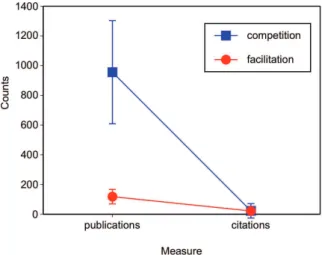
Competition and facilitation are extensively studied in plant ecology and are central to ecological theory. However, these processes do not occur in isolation from each other and should be studied concurrently and synthetically. Here, we compare the relative citation success of studies that focus on either side of the same interaction coin in terms of number of publications and citations per publication in six of the following major themes in plant ecology: biogeography, populations, communities, ecosystems, evolu-tion and conservaevolu-tion. There were eight times more publicaevolu-tions on plant competievolu-tion than on facilitation but this is not surprising given its long history of comprehensive and relatively exclusive study in plant ecology. Although studies of facilitation comprised a smaller body of literature, the mean citation rate for each publication was equivalent to that of competition studies. Thus, facilitation studies are being used as much as com-petition. These patterns of use by the ecological community clearly indicate that both aspects of plant interactions address broad themes and that studies on plant interactions should now strive to either test both simultaneously or at the very minimum include interpretations and relevant literature from both sets of ideas. Importantly, these broad trends illustrate the old axiom that quality and not quantity of studies may be a consid-eration in the success of a sub-discipline.
Web Ecology 9: 54–57.
Accepted 13 June 2009 Copyright © EEF ISSN 1399-1183
55 WEB ECOLOGY 9: 2009
the ideas most closely related to their side of the coin. These weaknesses are not unique to ecology, and perhaps progress is best served by testing one specific idea well and then switching to another idea and beginning anew. How-ever, the time is ripe to broadly explore the use of literature to estimate how each focus is contributing to ecological progress.
At a recent special symposium of the British Ecologi-cal Society on facilitation in Aberdeen, Scotland, facilita-tion and its conceptual links to other ecological focal areas were thoroughly explored. It was evident that facilitation means different things even among plant ecologists but importantly that studies of positive interactions have in-fluenced virtually every aspect of plant ecology (Pakeman et al. 2009). Here, we present a direct test of whether the contribution of facilitation studies to the major dominant themes in ecology are proportionally comparable to those made by studies of competition. The hypothesis is that mean citation per publication on facilitation is equal to competition if facilitation is impacting broad ecologi-cal themes and becoming incorporated into ecology at a rate comparable to competition. The null hypothesis is that competition studies accrue relatively higher citation rates per paper since this set of studies is more established, comprehensive, and likely more numerous. Furthermore, a larger body of scientists in that field using the literature increases the likelihood of citation (Kokko and Sutherland 1999). In other words, a more established field has had more time, opportunity, and participants in the literature able to attract citations and one would expect it to do bet-ter.
Competition vs facilitation
Citations are a useful metric of the success of a publication in reaching a desired audience and being used by others in subsequent publications. Admittedly, it is not a perfect tool and should be used judiciously (Kotiaho 1999, Adam 2002, Krell 2002, Leimu and Koricheva 2005, Monaster-sky 2005, Lawrence 2007). Nonetheless, we avoid many of these concerns here by using citations to determine only relative usage and not to infer quality of the publications. Importantly, we also calculate citations per publication to control for potential sampling effects, i.e. more publica-tions in a given discipline generate the capacity de facto for more citations. In May 2009, we used the Web of Sci-ence (ISI Thomson Reuters) to complete sets of searches to compare the total number of publications and citations per publication for studies on plant competition and facili-tation in six major themes we identified for ecology. The search terms were plant*competition*ecological theme and then again for facilitation. All years were used, and the same set of searches was repeated for the terms positive and negative plant interactions. To explore the potential contribution of studies that included both topic terms
conjunctly and to ensure that there was not significant overlap in the values associated with the two fields, the search was repeated for each theme with all four possible sets of terms, i.e. plant*competition*facilitation*ecological theme. The six ecological themes included biogeography, population, community, ecosystem, evolution, and con-servation and were generated by inspecting most current editions of major textbooks on ecology. Each of the val-ues associated with competition and facilitation were then treated as an independent replicate test of the success of those studies therefore n = 12, and general linear models were used to determine whether number of publications or citations per publication differed. The process tested or study type, competition or facilitation, was the main effect in the model and modeled as a fixed effect while the response variables, number of studies and citations per publication, were treated as linear responses. Statistics were done using Jmp 7.0.2 (SAS 2007).
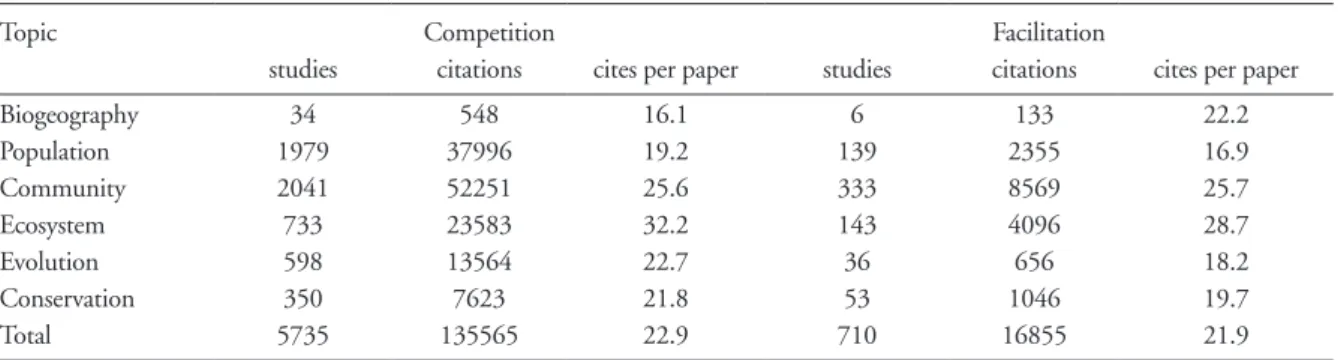
There were significantly more publications on plant competition relative to facilitation (Fig. 1, GLM, chi-square = 5.4, p = 0.02, n = 12). All major themes in ecol-ogy were also dominated by studies on competition (Table 1). These findings support our assumptions that the study of competition is a more established field of study relative to facilitation (Callaway 2007), that plant competition has a long history, and that it has furthered all major themes of ecology (Connolly et al. 2001, Vandermeer and Goldberg 2003) excepting perhaps plant biogeography (Table 1).
The alternative hypothesis that the study of facilitation has at least caught up with the usage of competition by ecologists was supported. Citations per publication were not significantly different between studies of competition and facilitation (Fig. 1, GLM, chi-square = 0.14, p = 0.7,
56 WEB ECOLOGY 9: 2009 n = 12). In fact, we view the proportional equivalence in
use by the ecological community of fewer available studies as evidence that facilitation is outperforming competition in explaining virtually every one of the broad themes typi-cally studied. This contradicts the assumptions discussed at the BES symposium that facilitation has been poorly incorporated into the study of evolution in particular (but see Kikvidze and Callaway 2009). Competitive and facili-tative interactions are not only two faces of the same coin but in reality a continuum of interactions (Lortie et al. 2004) from positive to negative varying in both intensity and importance (Brooker et al. 2005) and citation use supports this view. The citation success of both in ecosys-tems and conservation is a profoundly interesting finding since the humble roots of plant interaction studies began with the study of processes at the individual level yet now significantly contribute to use by authors at much higher levels of ecological organization.
Nonetheless, it is worthwhile to consider whether a more balanced or expansive approach to plant interactions and general ecology is now necessary. A small proportion of the total publications testing competition included the term facilitation (the mean of all themes was 6.5% ± 1%), however facilitation studies commonly included both concepts (mean of all themes = 53% ± 8%). While it is possible that these proportions are underestimates, i.e. additional publications that either tested competition or facilitation did reference the other, it seems unlikely since the topic term search for both within publications is broad in the Web of Science. These findings support the posi-tion that plant ecologists to date focus or at least discuss in a given paper either competition or facilitation but not both. It does appear that facilitation studies are less guilty, but this field and term is more recent, and the interpreta-tion of the term competiinterpreta-tion is also likely evolving over time. Importantly however, studies that did focus on both forms of interactions accrued far more citations per pub-lication than either independently (mean relative increase of all themes was 43% ± 2.5%). Clearly, there is a signifi-cant citation or recognition benefit in using, and hopefully
testing, both concurrently. The ecological community in general has clearly embraced the findings associated with the study of facilitation and is moving, or at least reading and citing, more synthetically.
Conclusions
Competition studies comprise the majority of publications and citations in the plant ecology literature. Most major themes in ecology use competition studies extensively and always more so than facilitation. While facilitation stud-ies account for less of the published literature, the mean citations per publication are equivalent to those of com-petition studies. Facilitation is arguably a biblical David in plant ecology in that its relative usage is much greater given fewer total participants in the publication process. How-ever, the time has come for David and Goliath to reconcile since there are clear citation benefits to incorporating both concepts into publications. Both sets of studies have the capacity to speak larger themes in ecology such as the com-munity and ecosystem yet to date are not heavily used nor contributing to the theme of biogeography.
References
Adam, D. 2002. The counting house. – Nature 415: 726–729. Brooker, R. W. et al. 2005. The importance of importance. –
Oikos 109: 63–70.
Brooker, R. W. et al. 2008. Facilitation in plant communities: the past, present, and the future. – J. Ecol. 96: 18–34.
Bruno, J. F. et al. 2003. Inclusion of facilitation into ecological theory. – Trends Ecol. Evol. 18: 119–125.
Callaway, R. M. 2007. Positive interactions and interdependence in plant communities. – Springer.
Connolly, J. et al. 2001. Interspecific competition in plants: how well do current methods answer fundamental questions? – Am. Nat. 157: 107–125.
Fowler, N. 1986. The role of competition in plant communi-ties in arid and semiarid regions. – Ann. Rev. Ecol. Syst. 17: 89–110.
Table 1. A summary of the major topics studied in plant ecology using competition and those using facilitation. Data were collected from the Web of Science in May 2009 using the appropriate set of search terms. The values reported in the final row are the totals associated with number of studies and citations and the mean is listed for the cites per paper.
Topic Competition Facilitation
studies citations cites per paper studies citations cites per paper
Biogeography 34 548 16.1 6 133 22.2
Population 1979 37996 19.2 139 2355 16.9
Community 2041 52251 25.6 333 8569 25.7
Ecosystem 733 23583 32.2 143 4096 28.7
Evolution 598 13564 22.7 36 656 18.2
Conservation 350 7623 21.8 53 1046 19.7
57 WEB ECOLOGY 9: 2009
Freckleton, R. P. and Watkinson, A. R. 2000. Designs for green-house studies of interactions between plants: an analytical perspective. – J. Ecol. 88: 386–391.
Gibson, D. J. et al. 1999. Designs for greenhouse studies of in-teractions between plants. – J. Ecol. 87: 1–16.
Kikvidze, Z. and Callaway, R. M. 2009. Ecological facilitation may drive major evolutionary transitions. – Bioscience 59: 399–404.
Kokko, H. and Sutherland, W. J. 1999. What do impact factors tell us? – Trends Ecol. Evol. 14: 382–384.
Kotiaho, J. S. 1999. Unfamiliar citations breed mistakes. – Na-ture 400: 307.
Krell, F. T. 2002. Why impact factors don’t work for taxonomy. – Nature 415: 957.
Lawrence, P. A. 2007. The mismeasurement of science. – Curr. Biol. 17: R583–585.
Leimu, R. and Koricheva, J. 2005. What determines the cita-tion frequency of ecological papers? – Trends Ecol. Evol. 20: 28–32.
Lortie, C. J. et al. 2004. Rethinking plant community theory. – Oikos 107: 63–70.
McPhee, C. S. and Aarssen, L. W. 2001. The separation of above- and below-ground competition in plants. A review and cri-tique of methodology. – Plant Ecol. 152: 119–136. Mead, R. 1979. Competition experiments. – Biometrics 35:
41–54.
Monastersky, R. 2005. The number that’s devouring science. – Chron. High. Ed. 10: 1–13.
Pakeman, R. J. et al. 2009. Is the cask of facilitation ready for bottling? A symposium on the connectivity and future direc-tions of positive plant interacdirec-tions. – Biol. Lett., in press. SAS 2007. Jmp 7.0.2. – SAS Inst.
Stachowicz, J. J. 2001. Mutualism, facilitation, and the structure of ecological communities. – Bioscience 51: 235–246. Tilman, D. 1990. Constraints and tradeoffs: towards a predictive
theory of competition and succession. – Oikos 58: 3–15. Vandermeer, J. H. and Goldberg, D. E. 2003. Population
ecol-ogy. First principles. – Princeton Univ. Press.