J Educ Eval Health Prof 2011, 8: 11 • http://dx.doi.org/10.3352/jeehp.2011.8.11
ORIGINAL RESEARCH
Open Access
Student feedback about The Skeptic Doctor, a module on
pharmaceutical promotion
P. Ravi Shankar
*, Kundan K. Singh, Rano M. Piryani
KIST Medical College, Lalitpur, Kathmandu, Nepal
Abstract
Pharmaceutical promotion is an integral part of modern medical practice. Surveys show that medical students have a positive attitude towards promotion. Pharmaceutical promotion is not adequately taught in medical schools. A module based on the manual produced by Health Action International was conducted for second year medical students at KIST Medical College, Lalitpur, Nepal. Student feedback on various aspects of the module was obtained using a semi-struc-tured questionnaire. Eighty-six of the 100 students (86%) provided feedback about the module. Forty-ive (52.3%) were female and 39 (45.3%) were male. Participant feedback about the module was positive. Small group work and role plays were appreciated, and the ratings of the module and the manual were satisfactory. Respondents felt pharmaceutical promotion will play an important role in their future practice and that the module prepared them to respond appropri-ately to promotion and select and use medicines properly. The module further developed on issues covered during phar-macology practical and majority felt the module was of relevance to Nepal. Students appreciated the module though there were suggestions for improvement. The module should be considered during the years of clinical training (third and fourth years) and internship and in other medical schools.
Key Words: Learning; Marketing; Students, medical; Nepal; Problem-based learning
INTRODUCTION
Pharmaceutical promotion is a ubiquitous aspect of mod ern medicine [1], which involves and targets essentially all ele ments of medicine and healthcare. Students begin to have con tact with the pharmaceutical industry early in their career [2]. Medical students and postgraduate trainees may have positive attitudes towards pharmaceutical promotion [3], frequently engage in contacts with the industry [4], and deny they are in luenced by promotion [3]. A similar result was shown by a review carried out in the US [5].
A national survey conducted in the US concluded that stu dent experiences and attitudes suggest that as a group they may
be at risk of unrecognized inluence by marketing eforts by the industry [6]. A Canadian survey showed a large majority of medical students were not opposed to interacting with the industry in medical school and felt comfortable accepting in dustry gits [7]. A similar result was noted in a survey in India where 95% believed that information provided by medical representatives (MRs) was reliable and 75% opined conirma tion of the claims was not required [8]. In Nepal, pharmaceu tical companies strongly promote their medicines to doctors, and most hospitals allow free and unrestricted access of MRs to doctors [9]. In 2002, the American Medical Students Asso ciation (AMSA) launched a nationwide PharmFree campaign encouraging doctors in training to seek out objective and un biased sources of medicine information [10].
At the University of Chicago in the US, interested internal medicine residents participated in a controlled intervention across the three years of residency [11]. Residents’ perceptions towards gits and interactions with the industry changed mod
*Corresponding email: [email protected] Received: October 11, 2011; Accepted: November 5, 2011; Published: November 30, 2011
estly ater the educational intervention. At the Manipal Col lege of Medical Sciences, Pokhara, Nepal, an educational ini tiative on pharmaceutical promotion was conducted for sec ond year undergraduate medical (MBBS) students [9]. Criti cal analysis of promotional material and drug advertisements and role plays of interaction between MRs and doctors [12] were among the activities conducted. At KIST Medical Col lege (KISTMC), Lalitpur, Nepal, students learn to critically analyze drug advertisements and promotional material, learn to optimize time spent with MRs, and become familiar with sources of medicine information [13]. Critical analysis of drug advertisements and promotional material is assessed during the pharmacology practical examination [14]. Recently, the World Health Organization (WHO) and Health Action Inter national (HAI) have produced a manual on pharmaceutical promotion that aims to enable medical and pharmacy profes sionals to reconsider their central role as a target for pharma ceutical marketing and prepare them to respond appropriate ly. A module on promotion based on the manual was designed and conducted for second year MBBS students of KISTMC. he module was designed to add to and build upon the teach ing about pharmaceutical promotion during pharmacology practical sessions. he present study was conducted with the following objectives:
1) Obtain participant feedback about ‘he Skeptic Doctor’, the module on pharmaceutical promotion
2) Understand problems and diiculties during the module, and
3) Obtain suggestions for further improving the module in the future.
MATERIALS AND METHODS
he module entitled ‘he Skeptic Doctor’ was held on Mon days during early clinical exposure from April to early August of 2011. he 100 students of the 2009 intake were divided into two batches of 50 students each. Each batch was further sub divided into ive small groups of 10 students. he sessions were held on alternate Mondays for a particular batch from 8.05 to 9.10 am and used facilitator presentations, case scenarios, brain storming sessions, group activities, and role plays to explore diferent aspects of pharmaceutical promotion. Two of the au thors (PRS and RMP) acted as facilitators for the small group sessions. For certain sessions, students acted as facilitators un der our guidance and supervision. At the same time, the other batch completed assignments and group exercises based on the manual under the supervision and guidance of the author (KKS).
he sessions conducted were ‘Promotion of medicines and public health’, ‘Techniques that inluence the use of medicines’,
‘Analyzing pharmaceutical advertisements in medical jour nals’, ‘Pharmaceutical sales representatives’, ‘Promotion to con sumers’, ‘Students and the pharmaceutical industry’, and ‘Us ing unbiased prescribing information’. he topics were select ed based on the manual and considering their present and fu ture importance in medical practice. The activities were to ‘Create a poster advertisement for a new antibiotic belonging to the group Macrolides and targeted at doctors’, ‘Create a 2 minute radio advertisement for a sleeping pill targeted at the lay public’, analyze advertisements in medical journals and in dustry promotional material using criteria mentioned in the manual, and analyze videos of television advertisements of a fairness cream, antidepressants, hypnotics, and a blog site to promote medicines. Students critically analyzed and explored offers by the pharmaceutical industry to promote different student events and ofers of free textbooks and other equip ment. hey also developed criteria to assess the quality of heal th websites on the internet, which was followed by a discus sion and facilitator input. Ethical issues concerning the rela tion between pharmaceutical companies and doctors were also analyzed using role plays.
Participant feedback regarding the module was obtained using a semistructured questionnaire in midAugust, 2011. he questionnaire was tested for readability and ease of un derstanding among two faculty members and two third year students. Participants were explained the aims and objectives of the study and invited to participate. Written informed con sent was obtained. he study was approved by the Institution al Review Board of KIST Medical College. he demographic information collected included gender and method of inanc ing of medical education. Participants were asked to provide two overall comments about the module, and their comments about group work and role plays used in the module. he ap propriateness of the scenarios used, suggestions for further improving the module, and reasons why future doctors should know about promotion were solicited.
Participants were asked to rate on a scale of 1 to 10 (with 1 being least and 10 being the maximum) their perception re garding the efectiveness of the module. On a scale of 1 to 5 (1 being the least and 5 being the maximum), they rated their enjoyment of the module and the manual on which the mod ule was based.
RESULTS
Eightysix of the 100 second year students (86%) gave their feedback about the module. Fortyfive (52.3%) were female and 39 (45.3%) male. Two respondents did not indicate their gender. here were nine scholarship students and 76 students (88.4%) were selfinancing, with one not mentioning this in formation.
Table 1 shows the overall comments of student respondents about the module. Other comments were as follows: certain group members did not participate as expected; students learn ed to critically analyze drug promotional material and learnt to assess internet health information. Two respondents stated the module was a bit boring at times.
Respondents’ comments about group work, which was an important part of the module, were that the group in which they were working was cooperative (16 respondents, 18.6%), in the group each member had freedom to express his/her views (15 respondents, 17.4%), and the group work increased group participation (15 respondents, 17.4%). Table 2 shows the participants’ perception about how role plays helped in re alizing the objectives of the module. In addition participants felt role plays helped in addressing many issues in a short pe riod of time, provided visual and auditory inputs, and helped solve problems in practice.
Participants were not aware about similar modules in other medical schools though the Institute of Medicine and Patan Academy of Health Sciences have stated that they conduct some sessions on promotion. The mean ± SD effectiveness of the module according to the respondents was 7.75 ± 0.88 and the mean ± SD enjoyment score was 3.53 ± 0.72. Eightytwo of the 86 respondents felt the scenarios covered during the small
group activities and role plays were appropriate. Among the reasons mentioned were that the scenarios covered future pro blems in students’ medical practice and also addressed possi ble ways of tackling these (19 respondents, 22.1%), the sce narios represented the real situation of the country (7 respon dents, 8.1%) and the scenarios were based on session objec tives (6 respondents, 7%). Other reasons mentioned were that the scenarios promoted active learning and enhanced creativ ity. Table 3 lists respondents’ suggestions for further improv ing the module. Other suggestions were to make the module compulsory and include it in the syllabus, have more facilita tors, conduct the module for future cohorts, have more mate rial from Nepal, and simplify the language and explain the sta tistics more.
The mean ± SD rating of the manual was 3.81 ± 0.64. Stu dents felt the manual was informative and enjoyable and pro vided basic knowledge about promotion that every doctor should know. hey felt more scenarios from South Asia and Nepal should be included. Twentysix respondents (30.2%) experienced diiculties during the module. Among the dii culties were new terminology and phrases, diiculty in under standing certain topics, and problems with statistics, too little time for the sessions, and diiculty in analyzing long articles during the assignments. Fityseven respondents did not re port any problems.
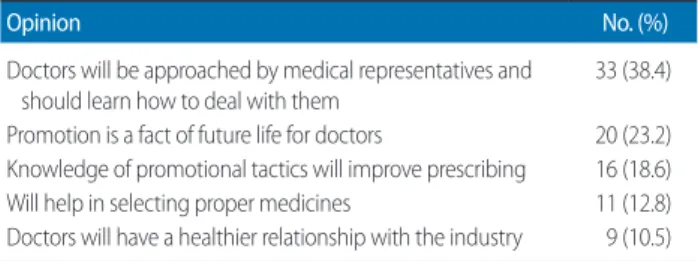
Table 4 shows respondents’ opinions about why future doc tors should learn about pharmaceutical promotion. Regarding the application of what they learned from the module, 29 re spondents stated they would deal in a better manner with MRs, 19 stated they would assess promotion more carefully, 12 said they would be more careful in choosing drugs, and 7 stated they would be more patientcentered and put the patient irst
Table 1. Common overall comments of student respondents about the module (n = 86)
Comment No. (%)
The module gave knowledge about promotion which would help in future practice 55 (63.9)
Provided practical knowledge of diferent situations 11 (12.8)
Provided knowledge about new topics 10 (11.6)
Sessions were informative 10 (11.6)
Insight about dealing with medical representatives & assessing information about promotion 8 (9.3)
Table 2. Participants perception of how role plays helped in realizing mo-dule objectives
Comment No. (%)
Made learning enjoyable 28 (32.5)
Helped in making objectives more concrete 22 (25.6)
Improved knowledge retention 19 (22.1)
Addressed real and important scenarios 19 (22.1) Helped in simplifying and understanding problems 12 (13.9)
Table 3. Common suggestions for further improving the module in the future (n = 86)
Comment No. (%)
More use of role plays, preferably during every session 19 (22.1)
More use of videos during the module 9 (10.5)
The sessions should be more interactive 8 (9.3) More time should be provided for group activities 6 (7)
in their medical practice. Students were conident about uti lizing the skills learned in future industry interactions.
he participants felt the module linked up with and built on issues covered during pharmacology small group practical sessions. he module added to the information provided, stu dents were able to apply theoretical knowledge practically, and had a better idea of practical scenarios they might encounter in the future. Fiftythree students (61.6%) stated they were confident about using statistics to interpret clinical research and evidence presented in the scientific literature while 25 (29%) stated they were not conident and wanted more classes in statistics and using statistics to interpret clinical trial data. Seventyone students (82.5%) wanted a similar module in the future.
Among the other comments were ‘thank you for conducting the programme’, ‘the sessions were most efective’ and ‘I think the module should be compulsory in every medical school. Ater this module I learnt how much drug companies spend on doctors, MRs and how this is afecting patients’ health.’ An other stated ‘It was a wonderful experience and probably a uni que one.’
DISCUSSION
Participant feedback about the module was positive. Small group work and role plays were appreciated and the ratings of the module and the manual were satisfactory. he respondents felt pharmaceutical promotion will play an important role in their future practice and the module prepared them to respond appropriately to promotion and select and use medicines pro perly. he module further expanded on issues covered during the pharmacology practical and majority felt the module was of relevance to Nepal.
The module was not a formal part of the curriculum and was not assessed. Attendance was a problem during certain sessions though overall attendance during the module was over 70%. he learning methods used were similar to those employed during the Medical Humanities module. Small group work, brainstorming sessions, and role plays were used during this module also. his was also the irst time we conducted the
module, and hopefully we will improve it in future.
A survey of educational initiatives for medical and pharma cy students about pharmaceutical promotion showed that over 60% of institutions worldwide had used small group discus sions in tutorials or workshops [15]. Response to case scenari os was used in about 25% of institutions while role playing was used in only 10%. Most schools had a one or two hour lecture on the topic. At the University of California Los Angeles in the US, a university pharmacist played the role of a pharmaceuti cal representative (PR) promoting a nonsedating antihista mine before small groups of students and faculty [16]. Students were unaware that these PRs were actually university pharma cists. hey were encouraged to ask questions ater the presen tation. Student attitudes towards promotion were favorably impacted by the exercise.
We use role plays to teach students to optimize the time spent with MRs [13]. In the US, an innovative workshop used role plays with pharmaceutical representatives to demonstrate ap propriate and inappropriate interaction strategies [17]. Using former MRs or even working MRs would be a good strategy to sensitize students to the techniques used but might be dii cult to organize. his ‘initial’ module based on the manual aim ed to generate evidence of acceptability and effectiveness so that a case can be made for introducing a similar module in other medical schools and eventually including it in the cur riculum of diferent universities in Nepal. Our students do not usually read journal articles. Journal articles (including origi nal articles, and diferent types of reviews are important inde pendent information sources for doctors and obtaining rele vant information from these sources have been mentioned in the HAIWHO manual. As several respondents noted, the module may be more efective during the inal year or even during the internship when students have more interactions with MRs and are more exposed to promotion.
Student rating of the manual was positive. he manual is well designed and organized and easy to read and understand. Cer tain parts may be diicult. he major problem is the paucity of studies from South Asia and Nepal. his may be because data from this region and other developing nations are lacking and put a major responsibility on the present authors and oth ers from developing countries to generate this data for the mo dule. At the end of the module many respondents stated that they will be able to deal in a better manner with MRs. Resis tance to misleading promotion can be improved by making physicians understand that they are vulnerable to the influ ence of promotion [18].
Role modeling by clinician teachers and other doctors and their attitudes towards promotion play an important role in determining student attitudes towards the industry and pro motion [19]. In our institution, the Medicine and herapeu
Table 4. Respondents’ opinion about why future doctors should learn about promotion (n = 86)
Opinion No. (%)
D octors will be approached by medical representatives and should learn how to deal with them
tics Committee regulates interactions between prescribers and MRs [20], and many clinicians are aware of the negative im pact of promotion on prescribing behavior.
he strengths of the study were the high response rate and enthusiastic response of the students who participated in the module. he study had limitations. Student feedback was ob tained using a questionnaire and was not triangulated with information from other sources. he questionnaire was devel oped by the authors and was not validated. he students may have had diiculty understanding certain questions. his could be because English the language of instruction is not the irst language of the students and certain students were educated in the vernacular medium in school. Also the questionnaire was not validated and revised.
CONCLUSION
he authors conducted a module on pharmaceutical pro motion using available resources and the Health Action Inter national manual. Students appreciated the module, and they felt it prepared them for issues they will encounter in future practice. Improvements are required and will be carried out in the future. he module could be conducted during the clinical years of training and internship. he module could also be con sidered for inclusion in other medical schools within and out side the country.
CONFLICT OF INTEREST
No potential conlict of interest relevant to this article was reported.
REFERENCES
1. Carmody D, Mansield PR. What do medical students think about pharmaceutical promotion? Aust Med Stud J. 2010;1:54-7. 2. Mintzes B. Promotion of medicines and patient health. In: World
Health Organization, Health Action International, editors. Un-derstanding and responding to pharmaceutical promotion: a practical guide. World Health Organization, Health Action In-ternational; 2011. p. 9-24.
3. Steinman MA, Shlipak MG, McPhee SJ. Of principles and pens: attitudes and practices of medicine housestaf toward pharma-ceutical industry promotions. Am J Med. 2001;110:551-7. 4. Hodges B. Interactions with the pharmaceutical industry:
expe-riences and attitudes of psychiatry residents, interns and clerks. CMAJ. 1995;153:553-9.
5. Zipkin DA, Steinman MA. Interactions between pharmaceutical
representatives and doctors in training. A thematic review. J Gen Intern Med. 2005;20:777-86.
6. Sierles FS, Brodkey AC, Cleary LM, McCurdy FA, Mintz M, Frank J, Lynn DJ, Chao J, Morgenstern BZ, Shore W, Woodard JL. Med-ical students’ exposure to and attitudes about drug company in-teractions: a national survey. JAMA. 2005;294:1034-42. 7. Barfett J, Lanting B, Lee J, Lee M, Ng V, Simkhovitch P.
Pharma-ceutical marketing to medical students: the student perspective. McGill J Med. 2004;8;21-7.
8. Ingole S, Yegnanarayan R. Attitudes of medical students towards relationship with pharmaceutical company: do we need a change? Int J Pharm Sci Res. 2011;2:49-57.
9. Giri BR, Shankar PR. Learning how drug companies promote medicines in Nepal. PLoS Med. 2005;2:e256.
10. Moghimi Y. he “PharmFree” campaign: educating medical stu-dents about industry inluence. PLoS Med. 2006;3:e30.
11. Schneider JA, Arora V, Kasza K, Van Harrison R, Humphrey H. Residents’ perceptions over time of pharmaceutical industry in-teractions and gits and the efect of an educational intervention. Acad Med. 2006;81:595-602.
12. Shankar PR, Dubey AK, Subish P. Critical evaluation of drug pro-motion using role-plays. Med Educ. 2006;40:472.
13. Shankar PR, Jha N, Bajracharya O, Shrestha R, hapa HS. Teach-ing pharmacology at a Nepalese medical school: the student per-spective. Australas Med J. 2010;1:14-22.
14. Shankar PR, Gurung SB, Jha N, Bajracharya O, Ansari SR, hapa HS. Practical assessment in pharmacology at a new Nepalese medical school. J Clin Diagn Res. 2010;4:3314-6.
15. Mintzes B. Educational initiatives for medical and pharmacy students about drug promotion: an international cross-sectional survey. World Health Organization and Health Action Interna-tional; 2005.
16. Wilkes MS, Hofman JR. An innovative approach to educating medical students about pharmaceutical promotion. Acad Med. 2001;76:1271-7.
17. Woford JL, Ohl CA. Teaching appropriate interactions with ph-armaceutical company representatives: the impact of an innova-tive workshop on student attitudes. BMC Med Educ. 2005;5:5. 18. Sagarin BJ, Cialdini RB, Rice WE, Serna SB. Dispelling the
illu-sion of invulnerability: the motivations and mechanisms of re-sistance to persuasion. J Pers Soc Psychol. 2002;83:526-41. 19. Haferty FW. Beyond curriculum reform: confronting medicine’s
hidden curriculum. Acad Med. 1998;73:403-7.