Comunicação Breve
Laís Alves Jacinto1
Karen Barros Ribeiro1
Aparecido José Couto Soares1
Maria Silvia Cárnio1
Descritores
Educação Redação Surdez Avaliação Linguagem de sinais
Keywords
Education Writing Deafness Evaluation Sign language
Correspondence address:
Laís Alves Jacinto
Av. Presidente Castelo Branco, 393, Jardim Zaíra, Mauá (SP), Brasil, CEP: 09321-375.
E-mail:[email protected]
Received: 5/13/2011
Accepted: 11/10/2011
Study conducted at the Reading and Writing Research Laboratory, Department Physical Therapy, Speech-Language Pathology and Audiology, and Occupational
Therapy, School of Medicine, Universidade de São Paulo – FMUSP – São Paulo (SP), Brazil.
(1) Department Physical Therapy, Speech-Language Pathology and Audiology, and Occupational Therapy, School of Medicine, Universidade de São Paulo – FMUSP – São Paulo (SP), Brazil.
Conflict of interests: None
Estímulos visuais e produção escrita de surdos
sinalizadores
ABSTRACT
Purpose: To verify the interference of visual stimuli in written production of deaf signers with no complaints regarding reading and writing. Methods: The research group consisted of 12 students with education between the 4th and 5th grade of elementary school, with severe or profound sensorineural hearing loss, users of LI-BRAS and with alphabetical writing level. The evaluation was performed with pictures in a logical sequence and an action picture. The analysis used the communicative competence criteria. Results: There were no diffe-rences in the writing production of the subjects for both stimuli. In all texts there was no title and punctuation, verbs were in the infinitive mode, there was lack of cohesive links and inclusion of created words. Conclusion:
The different visual stimuli did not affect the production of texts.
RESUMO
Objetivo: Verificar a interferência de estímulos visuais na escrita de surdos sinalizadores sem queixas de lei-tura e escrita. Métodos: O grupo de pesquisa foi composto por 12 alunos com escolaridade entre o quarto e o quinto ano do ensino fundamental, com perda neurossensorial de grau severo ou profundo, usuários de Língua Brasileira de Sinais (LIBRAS) e com nível alfabético de escrita. Os sujeitos foram orientados a elaborar um texto para cada estímulo visual apresentado: figuras de sequência lógica e uma figura de ação. A análise foi realizada seguindo-se os critérios das competências comunicativas. Resultados: Não foram observadas dife-renças na produção escrita dos sujeitos da pesquisa para ambos os estímulos. Observou-se ausência de título e pontuação, verbos no modo infinitivo, ausência de elos coesivos e inclusão de palavras inventadas. Conclusão:
INTRODUCTION
Deaf users of sign language may have impaired written production and decreased vocabulary due to the structural characteristics of the sign language which differs from written Portuguese that results in a difficulty in relating one-another(1,2).
This way, to deaf signers, the acquisition of written language uses mainly the visual channel(3).
Thus, it is important to develop strategies that might im-prove the use of written Portuguese by this group once it may provide better academic development and social inclusion. Accordingly, this study aimed to verify the influence of visual stimuli on the writing production of deaf signers with no com-plaints regarding reading and writing.
METHODS
This research was approved by the Research Ethics Committee of the School of Medicine, Universidade de São Paulo (CEP-FMUSP) under protocol number 003/10 and it was performed at a special education school for deaf persons. All parents/caretakers signed the consent form.
Participants were 12 students aged between 9-13 years, of both genders. The inclusion criteria were: severe or profound sensorineural hearing loss; absence of neurological, behavio-ral and cognitive disorders; alphabetical writing level; lack of complain regarding reading and writing acquisition (any complaint from parents or teachers regarding the academic performance of students).
In order to confirm the inclusion criteria, the teachers answered to a questionnaire concerning the academic per-formance of the students indicating if that perper-formance was appropriate to their age and schooling level. The parents answered to an interview and all the subjects were screened by a speech-language pathologist.
Experimental tests
All students were instructed to write a text based on two different stimuli: picture in logical sequence and an action picture. The instruction was given by a deaf instructor, in signal language, through a recorded video. There was no ins-truction concerning the production of specific textual genres. The subjects were divided in small groups in order to avoid communication between them.
Following it a sequence of four pictures printed in paper, selected from an international study(5) was presented in order to
the prompt the subjects’ first written text. In another moment it was shown an action picture selected from a book used in the language field(6,7) for the purpose of prompting the production
of a second text.
The written productions were analyzed according to the Communicative Competences(8) (Generic, Linguistic and
Encyclopedic) adapted in a protocol by a Brazilian study (Appendix 1). Generic Competence is the ability to produce texts in the scope of certain number of genres. Linguistic Competence is related to the language domain and Encyclopedic
Competence refers to the knowledge about the world(8).
Each written production was qualitatively and quantitatively analyzed by five judges with experience in the reading and writing field and previously trained by the researchers. All judges analyzed the written productions individually. The di-vergent cases were discussed during a meeting. The quantitative analysis used the McNemar test with significance level of 5%.
RESULTS
Concerning Generic Competence, the narrative genre pre-dominated for both stimuli used.
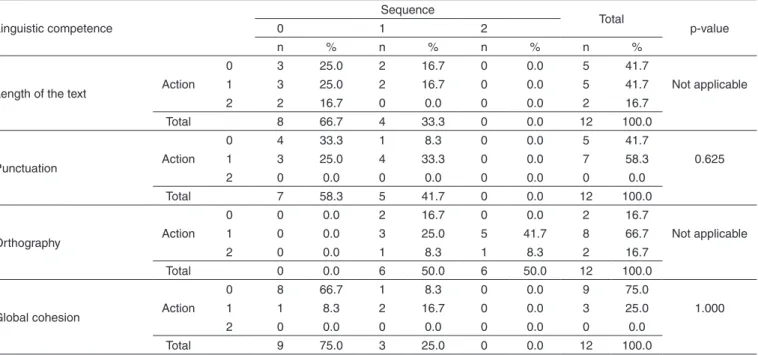
Regarding Encyclopedic Competence (Table 1) and Linguistic Competence (Table 2) the statistical test was only applied to the following items: Topic Fidedignity, Use of Inferences, Punctuation and Global Cohesion and there were no differences to both stimuli presented. About the remaining items the statistical test could not be applied due to its own limitations.
DISCUSSION
It is known that the use of images is considered a strong support in working with deaf people because they need the visual support to grasp the meaning(5).Thus, this study confirms
this data considering that bothstimuli elicited the production of written texts by deaf signers.
It is possible to state that this study provides an innovative contribution in proposing a new way to analyze written pro-ductions using an adaptation(9) of discourse analysis that uses
the Communicative Competence concept. This allowed a more precise characterization of the potentials and needs of the sub-jects of this study, which can allow better therapeutic targeting. In the written text, the predominance of narratives in Generic Competence may be due to the fact that this is one of the first textual genres taught at school(10) and can be found in
children’s book(11).
Disorders in Encyclopedic Competence indicates that deaf persons have little knowledge about the world and establish a certain distance from reading and writing revealing immaturity in what refers to the written language(12-14).
Regarding Linguistic Competence, the orthographic errors and the lack of cohesion confirm findings of other studies(9,10,14).
This may occur because frequently teachers of deaf students provide words and phrases already written that meet the mor-phosyntax requirements of the Portuguese(13), but does not
allow its creative use.
Table 1. Comparison of the items of encyclopedic competence on written productions based on pictures in logical sequence and action pictures
Encyclopedic competence
Sequence
Total
p-value
0 1 2
n % n % n % n %
Encyclopedic knowledge Action
0 0 0.0 3 25.0 0 0.0 3 25.0
Not applicable
1 1 8.3 7 58.3 0 0.0 8 66.7
2 0 0.0 1 8.3 0 0.0 1 8.3
Total 1 8.3 11 91.7 0 0.0 12 100.0
Reliability to the theme Action
0 1 8.3 1 8.3 1 8.3 3 25.0
0.284
1 0 0.0 4 33.3 4 33.3 8 66.7
2 0 0.0 1 8.3 0 0.0 1 8.3
Total 1 8.3 6 50.0 5 41.7 12 100.0
Use of title Action
0 12 100.0 0 0.0 0 0.0 12 100.0
Not applicable
1 0 0.0 0 0.0 0 0.0 0 0.0
2 0 0.0 0 0.0 0 0.0 0 0.0
Total 12 100.0 0 0.0 0 0.0 12 100.0
Intertextuality Action
0 12 100.0 0 0.0 0 0.0 12 100.0
Not applicable
1 0 0.0 0 0.0 0 0.0 0 0.0
2 0 0.0 0 0.0 0 0.0 0 0.0
Total 12 100.0 0 0.0 0 0.0 12 100.0
Organization of ideas Action
0 3 25.0 4 33.3 0 0.0 7 58.3
Not applicable
1 0 0.0 4 33.3 1 8.3 5 41.7
2 0 0.0 0 0.0 0 0.0 0 0.0
Total 3 25.0 8 66.7 1 8.3 12 100.0
Use of inference Action
0 10 83.3 0 0.0 0 0.0 10 83.3
1,000
1 1 8.3 1 8.3 0 0.0 2 16.7
2 0 0.0 0 0.0 0 0.0 0 0.0
Total 11 91.7 1 8.3 0 0.0 12 100.0
Vocabulary Action
0 0 0.0 0 0.0 0 0.0 0 0.0
Not applicable 1 0 0.0 1 100.0 0 0.0 1 100.0
2 0 0.0 0 0.0 0 0.0 0 0.0
Total 0 0.0 1 100.0 0 0.0 1 100.0 McNemar test (p<0.05)
Table 2. Comparison of the items of linguistic competence on written production based on pictures in logical sequence and action pictures
Linguistic competence
Sequence
Total
p-value
0 1 2
n % n % n % n %
Length of the text Action
0 3 25.0 2 16.7 0 0.0 5 41.7
Not applicable
1 3 25.0 2 16.7 0 0.0 5 41.7
2 2 16.7 0 0.0 0 0.0 2 16.7
Total 8 66.7 4 33.3 0 0.0 12 100.0
Punctuation Action
0 4 33.3 1 8.3 0 0.0 5 41.7
0.625
1 3 25.0 4 33.3 0 0.0 7 58.3
2 0 0.0 0 0.0 0 0.0 0 0.0
Total 7 58.3 5 41.7 0 0.0 12 100.0
Orthography Action
0 0 0.0 2 16.7 0 0.0 2 16.7
Not applicable
1 0 0.0 3 25.0 5 41.7 8 66.7
2 0 0.0 1 8.3 1 8.3 2 16.7
Total 0 0.0 6 50.0 6 50.0 12 100.0
Global cohesion Action
0 8 66.7 1 8.3 0 0.0 9 75.0
1.000
1 1 8.3 2 16.7 0 0.0 3 25.0
2 0 0.0 0 0.0 0 0.0 0 0.0
in this study induced predominantly the production of texts with narrative genre.
CONCLUSION
The visual stimuli did not influence the written production of the deaf subjects. This data might indicate new paths to the speech language pathology practice and denotes the importance of using multiple stimuli for deaf people in order to improve the use of the written Portuguese by them. Furthermore this study proposes a new way to analyze the written production.
ACKNOWLEDGMENTS
We thank the Fundação de Amparo à Pesquisa do Estado
de São Paulo (São Paulo Research Foundation(FAPESP), for
the support granted to carry out this research in the processes number 2010/00500-5.
We thank the deaf instructor Maria Lúcia Garcia de Almeida for her competence and partnership in data collection and analysis.
We thank the professionals and students from the researched school for their availability and acceptance in this study.
REFERENCES
1. Carvalho CD, Rafaeli YM. A língua de sinais e a escrita – possibilidades de se dizer para o surdo. Estilos Clín. 2003;8(14):60-7.
2. Biser E, Rubel L, Toscano RM. Bending the rules: when deaf writers leave college. Am Ann Deaf. 2007;152(4):361-73.
3. Hermans D, Knoors H, Ormel E, Verhoeven L. Modeling reading vocabulary learning in deaf children in bilingual education programs. J Deaf Stud Deaf Educ. 2008;13(2):155-74.
4. Ferreiro E, Teberosky A. A psicogênese da língua escrita. Porto Alegre: Artes Médicas; 1985.
5. Burman D, Nunes T, Evans D. Writing profiles of deaf children taught through british sign language. Deafness Educ Int. 2007;9(1):2-23. 6. Mayer M. Frog, where are you? New York: Dial Press; 1969
7. van Beijsterveldt LM, van Hell JG. Evaluative expression in deaf children’s written narratives. Int J Lang Commun Disord. 2009;44(5):675-92.
8. Maingueneau D. Análise de textos de comunicação. São Paulo: Cortez; 2002.
9. Lima FT, Cárnio MS. Análise da produção escrita de surdos do ensino superior. In: 16o. Congresso de fonoaudiologia [Internet]. Campos do Jordão (SP); 24 a 28 Setembro; 2008. [citado 2012 Jun 4]; Disponível em: www.sbfa.org.br/portal/anais2008/resumos/R0457-2.pdf. [Adaptado de Romano-Soares S. Práticas de narrativas escritas em estudantes do ensino fundamental [dissertação]. São Paulo: Universidade de São Paulo, Faculdade de Educação; 2007.]
10. Dolz J, Noverraz M, Schneuwly B. Sequências didáticas para o oral e a escrita: apresentação de um procedimento. In: Schneuwly B, Dolz J. Gêneros orais e escritos na escola.Campinas: Mercado das Letras; 2004. p. 95-128.
11. Silva IR, Kauchakje S, Gesueli ZR. Cidadania, surdez e linguagem: desafios e realidades. São Paulo: Plexus; 2003.
12. Antia SD, Reed S, Kreimeyer KH. Written language of deaf and hard-of-hearing students in public schools. J Deaf Stud Deaf Educ. 2005;10(3):244-55.
13. Crato AN, Cárnio MS. Marcação de tempo por surdos sinalizadores brasileiros. Pró-Fono. 2010;22(3):163-8.
Appendix 1. Classification and score criteria of written productions according to Lima and Cárnio (2007)(9)
Competence Description Classification Score
Generic Discourse type
Narrative: Report: Argumentation: Exposure: Description:
Encyclopedic
Encyclopedic knowledge
Knowledge of the topic Partial knowledge of the topic No knowledge of the topic
2 points 1 point 0 point
Reliability to the theme
Topic maintenance Partial topic maintenance No topic maintenance
2 points 1 point 0 point
Title use
Use of title related to text production Use of title not related to text production No title
2 points 1 point 0 point
Intertextuality
Present Partially present Absent
2 points 1 point 0 point
Organization of ideas
Adequate Partially adequate Inadequate
2 points 1 point 0 point
Organization of ideas
Adequate Partially adequate Inadequate
2 points 1 point 0 point
Vocabulary Complex Simple Inadequate
2 points 1 point 0 point
Linguistic
Text extension
Long: 5 or more paragraphs Medium: 2 to 4 paragraphs Short: 1 paragraph
2 points 1 point 0 point
Punctuation
Sufficient and adequate in most paragraphs Insufficient or inadequate
Absent
2 points 1 point 0 point
Orthography
Up to 2 orthographic errors From 2 to 5 orthographic errors More than 5 orthographic errors
2 points 1 point 0 point
Global cohesion
Present Partially present Absent