Fatores associados à mortalidade em pacientes hospitalizados por asma aguda grave em 1994, 1999 e 2004 na Espanha e América Latina
Gustavo Javier Rodrigo1, Vicente Plaza2, Santiago Bardagí Forns3, Miguel Perpiñá Tordera4, Jorge Salas5
Abstract
Objective: To evaluate, for the first time, the characteristics of patients with acute asthma who died during hospitalization in Spain and Latin America, as well as to evaluate factors associated with asthma mortality. Methods: A retrospective review of hospital records of 3,038 patients with asthma (aged 15-69 years) admitted to nineteen tertiary care hospitals in Spain and in eight Latin-American countries in 1994, 1999, and 2004. Results: There were 25 deaths (0.8% of all hospitalized patients) during the three years studied. Although there was a tendency towards a reduction in in-hospital mortality (from 0.97% in 1994 to 0.69% in 2004), there were no significant differences in terms of year or geographic area. Intensive care unit admissions and cases of out of hospital cardiopulmonary arrest increased the mortality rates to 8.3% and 24.7%, respectively. The multivariate analysis showed that gender (female; OR = 25.5; 95% CI: 2.6-246.8), out of hospital cardiopulmonary arrest (OR = 22.5; 95% CI: 4.4-114.7), and arterial pH < 7.3 during hospitalization (OR = 1.0; 95% CI: 1.1-3.4) were strongly associated with asthma mortality. Conclusions: Our study on mortality in patients hospitalized for acute severe asthma showed that deaths occurred almost exclusively in female patients and in patients who suffered out of hospital cardiopulmonary arrest, confirming previous findings from studies conducted in developed countries.
Keywords: Asthma/mortality; Asthma/epidemiology; Hospitalization; Hospital mortality.
Resumo
Objetivo: Avaliar, pela primeira vez, as características de pacientes com asma aguda que morreram durante a hospitalização na Espanha e na América Latina, bem como avaliar fatores associados à mortalidade por asma. Métodos: Revisão retrospectiva dos registros hospitalares de 3.038 pacientes com asma (com idade entre 15 e 69 anos) internados em dezenove hospitais de atendimento terciário na Espanha e em oito países da América Latina em 1994, 1999 e 2004. Resultados: Houve 25 mortes (0,8% de todos os pacientes hospitalizados) durante os três anos estudados. Embora tenha havido uma tendência de redução da mortalidade hospitalar (de 0,97% em 1994 para 0,69% em 2004), não houve diferenças significativas quanto ao ano ou à área geográfica. Internações em unidade de terapia intensiva e casos de parada pulmonar pré-hospitalar aumentaram as taxas de mortalidade para 8,3% e 24,7%, respectivamente. A análise multivariada mostrou que sexo (feminino; OR = 25,5; IC95%: 2,6-246,8), parada cardiopulmonar pré-hospitalar (OR = 22,5; IC95%: 4,4-114,7) e pH arterial < 7,3 durante a hospitalização (OR = 1,0; IC95%: 1,1-3,4) estavam fortemente associados à mortalidade por asma. Conclusões: Nosso estudo sobre mortali-dade em pacientes hospitalizados por asma aguda grave mostrou que as mortes ocorreram quase que exclusivamente entre pacientes do sexo feminino e entre pacientes que sofreram parada cardiopulmonar pré-hospitalar, confirmando achados anteriores de estudos realizados em países desenvolvidos.
Descritores: Asma/mortalidade; Asma/epidemiologia; Hospitalização; Mortalidade Hospitalar.
* Multicenter study carried out in Spain and Latin America.
1. Physician in the Emergency Room. Hospital Central de las Fuerzas Armadas, Montevideo, Uruguay. 2. Physician in the Pulmonology Department. Hospital de la Santa Creu i Sant Pau, Barcelona, Spain. 3. Physician in the Pulmonology Department. Hospital de Mataró, Barcelona, Spain.
4. Physician in the Pulmonology Department. Hospital Universitario La Fe, Valencia, Spain. 5. Physician in the Instituto Nacional de Enfermedades Respiratorias, Mexico City, Mexico.
Correspondence to: Gustavo Javier Rodrigo. Departamento de Emergencia, Hospital Central de las Fuerzas Armadas, Av. 8 de Octubre, 3020, Montevideo, 11600, Uruguay.
Tel 59 82 487-0165. Fax 59 82 487-2506. E-mail: [email protected].
Financial support: This study received financial support from AstraZeneca, Spain, as a part of the Programa de Investigación Integrada (PII, Integrated Investigation Program) of the Asthma Section of the Sociedad Española de Neumología y Cirugía Torácica (SEPAR, Spanish Society of Pulmonology and Thoracic Surgery). AstraZeneca was not involved in data collection or interpretation, nor was it involved in the writing of the manuscript.
Submitted: 21 August 2007. Accepted, after review: 13 November 2007.
emergency room, and an intensive care unit (ICU). In each health facility, we reviewed and identified all hospital records of patients (aged 15-69 years) admitted with a primary diagnosis of acute asth-ma—International Classification of Diseases, ninth (493.01) and tenth (J45, J46) revisions. Since some patients were admitted more than once in each selected year, the analysis was restricted to the last admission of each patient in each year.
The detailed review of the records included demo-graphic data, year/month of admission, previous hospitalization data—use of inhaled corticoster-oids, long-acting beta-agonists, or theophylline as controller medications; asthma severity according to the Global Initiative for Asthma criteria(16); and
previous hospitalizations for asthma—and data obtained during hospitalization: lowest arterial pH at admission; forced expiratory volume in one second/peak expiratory flow ratio (FEV1/PEF) in the
emergency room; length of hospitalization; admis-sion to the ICU and length of stay; cardiopulmonary arrest; intubation or mechanical ventilation during hospitalization; length of intubation or mechan-ical ventilation; and in-hospital mortality. As for seasonal variations in hospital admissions, summer was defined as July-September in the northern hemisphere, and as January-March in the southern hemisphere; fall was defined as October-December in the northern hemisphere, and as April-June in the southern hemisphere; winter was defined as January-March in the northern hemisphere, and as July-September in the southern hemisphere; and spring was defined as April-June in the northern hemisphere, and as October-December in the southern hemisphere.
All data were analyzed using the Statistical Package for the Social Sciences, version 12.0 for Windows (SPSS Inc., Chicago, IL, USA). Data are presented as mean ± standard deviation for contin-uous variables. The primary outcome measure was asthma mortality. The subjects were divided into two groups: those who died during hospitaliza-tion and those who were discharged (controls).
Introduction
Asthma is one of the most common chronic diseases worldwide.(1) In the United States, it is
responsible for more than 1.5 million emergency room visits, approximately 500,000 hospitalizations, and almost 5,000 deaths each year.(2-4) In the last
decade, epidemiological studies have shown that mortality rates have stabilized or gradually decreased in different countries.(5-11) Although most deaths
occur out of the hospital, a significant number still occur in the emergency room or, more often, during hospitalization. However, there have been few studies assessing the characteristics of patients with acute asthma who died during hospitalization, and most have been conducted in countries such as the United States or those in the United Kingdom.(12-13)
Very few studies have reported data from Latin America or Spain.(14)
In order to address this lack of information, we conducted a multinational, multicenter retro-spective study to evaluate, for the first time, the characteristics of patients with acute asthma who died during hospitalization in Spain and Latin America, as well as to evaluate factors associated with asthma mortality.
Methods
In order to perform this study, we used the data-base of the project designated Estudio del Asma Grave en Latinoamérica y España (EAGLE, Study of Severe Asthma in Latin America and Spain), created by the respective asthma sections of the Spanish Society of Pulmonology and Thoracic Surgery and the Latin-American Thoracic Society.(15)
The study population included all inpatient hospital admissions (>48 h) for acute severe asthma in major urban areas of Spain (nine health facili-ties) and Latin America (ten health facilities in eight countries: Argentina, Brazil, Chile, Colombia, Mexico, Peru, Uruguay, and Venezuela) occurring in the years 1994, 1999, and 2004. Each hospital evaluated had, in the selected years, more than 200 beds, an active
Table 1 - Mortality rates stratified by year and geographic area.
1994 1999 2004 p
All nine countriesa 7/718 (0.97%) 10/1166 (0.85%) 8/1154 (0.69%) 0.7
Spain 4/393 (1.01%) 4/643 (0.62%) 6/673 (0.89%) 0.6
Latin America 3/325 (0.92%) 6/519 (1.10%) 2/481 (0.41%) 0.2
56.4% of the total sample (nine large urban hospi-tals), and Latin America accounted for 43.6% (ten health facilities in eight countries).(15) At emergency
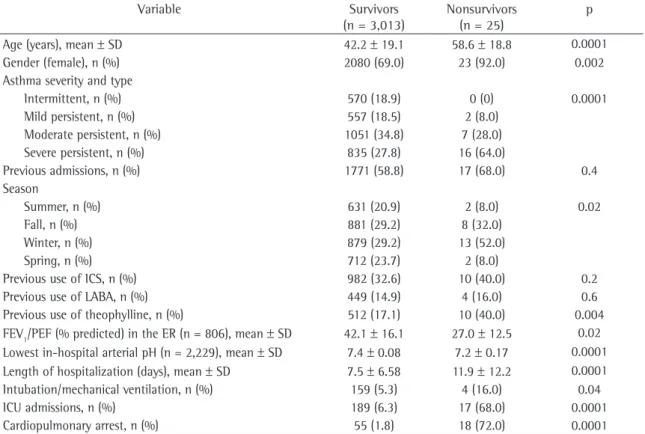
room admission, 49.2% of the patients with asthma had severe exacerbations (baseline FEV1/PEF < 50% of predicted), 27.2% had life-threatening exacer-bations (FEV1/PEF < 30% of predicted), and only 23.6% presented mild to moderate attacks (FEV1/ PEF > 50% of predicted). However, this variable was recorded in only 806 cases (26.5% of all patients admitted). Overall, there were 25 deaths (0.8% of all hospitalized patients) during the three years studied. There were no significant differences in terms of year or geographic area (Table 1), although there was a tendency towards a reduction in in-hospital mortality (from 0.97% in 1994 to 0.69% in 2004). The occurrence of events such as ICU admission or cardiopulmonary arrest increased the mortality rates to 8.3% and 24.7%, respectively. In the univariate analysis (Table 2), we found pronounced differences between surviving and nonsurviving asthma patients. There was a relationship between mortality and age, Continuous variables with normal distribution were
compared using the t-test for independent samples, and continuous variables with non-normal distri-bution were compared using the Mann-Whitney U test. Categorical variables were compared using the chi-square test with Yates’ correction or Fisher’s exact test. Factors associated with asthma mortality at a significance level of p = 0.05 in the univariate analysis were selected for inclusion in a multivar-iate analysis (multiple logistic regression). Values of p < 0.05, using a two-tailed test, were considered to be significant for all statistical tests. Ninety-five percent confidence intervals (95% CIs) were calcu-lated using standard formulas.(17)
The study was approved by the local ethics committees.
Results
A total of 3,038 patients with asthma (37.5% aged 15-34 years, 32.5% aged 35-55 years, and 30% aged 56 years or older) were audited. Spain accounted for
Table 2 - Univariate analysis comparing survivors and nonsurvivors.
Variable Survivors
(n = 3,013)
Nonsurvivors (n = 25)
p
Age (years), mean ± SD 42.2 ± 19.1 58.6 ± 18.8 0.0001
Gender (female), n (%) 2080 (69.0) 23 (92.0) 0.002
Asthma severity and type
Intermittent, n (%) 570 (18.9) 0 (0) 0.0001
Mild persistent, n (%) 557 (18.5) 2 (8.0)
Moderate persistent, n (%) 1051 (34.8) 7 (28.0)
Severe persistent, n (%) 835 (27.8) 16 (64.0)
Previous admissions, n (%) 1771 (58.8) 17 (68.0) 0.4
Season
Summer, n (%) 631 (20.9) 2 (8.0) 0.02
Fall, n (%) 881 (29.2) 8 (32.0)
Winter, n (%) 879 (29.2) 13 (52.0)
Spring, n (%) 712 (23.7) 2 (8.0)
Previous use of ICS, n (%) 982 (32.6) 10 (40.0) 0.2
Previous use of LABA, n (%) 449 (14.9) 4 (16.0) 0.6
Previous use of theophylline, n (%) 512 (17.1) 10 (40.0) 0.004
FEV1/PEF (% predicted) in the ER (n = 806), mean ± SD 42.1 ± 16.1 27.0 ± 12.5 0.02
Lowest in-hospital arterial pH (n = 2,229), mean ± SD 7.4 ± 0.08 7.2 ± 0.17 0.0001
Length of hospitalization (days), mean ± SD 7.5 ± 6.58 11.9 ± 12.2 0.0001
Intubation/mechanical ventilation, n (%) 159 (5.3) 4 (16.0) 0.04
ICU admissions, n (%) 189 (6.3) 17 (68.0) 0.0001
Cardiopulmonary arrest, n (%) 55 (1.8) 18 (72.0) 0.0001
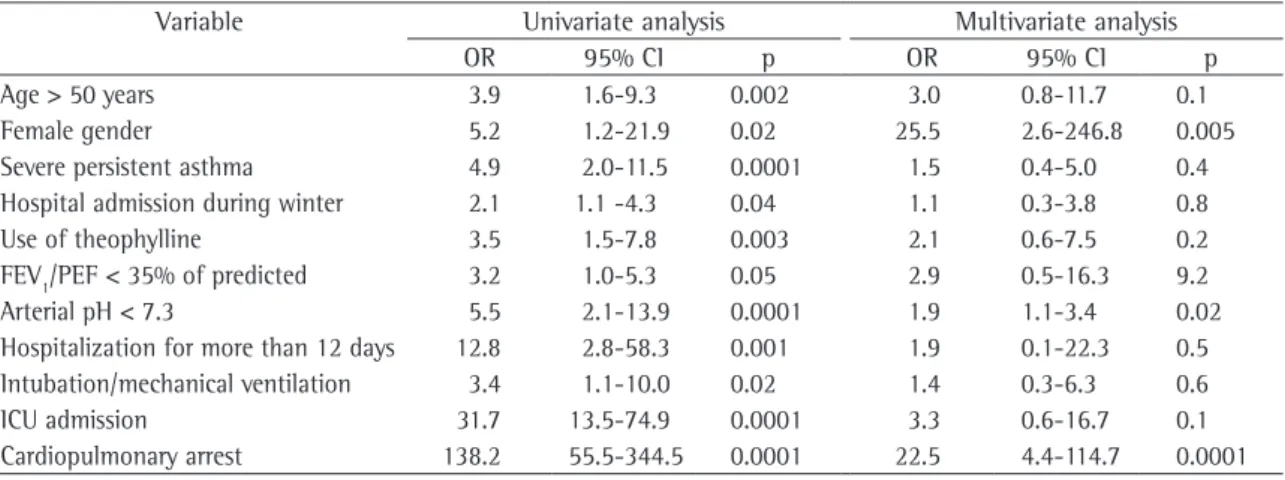
arterial pH < 7.3 during hospitalization (OR = 1.9; 95% CI: 1.1-3.4), was also associated with a signifi-cant increase in asthma mortality.
Discussion
We found that the overall mortality rate during the three years studied was less than 1% of all patients admitted, and that there was a tendency towards a reduction in in-hospital mortality (from 0.97% in 1994 to 0.69% in 2004). Since this tendency cannot be explained by a decline in asthma prevalence, it could be argued that it was produced by an improvement in the management of patients with asthma in the periods between severe attacks and during hospitalizations.(15)
Among the patients who died during hospitaliza-tion, the mean interval between hospital admission and death was approximately 12 days. Deaths occurred more frequently among certain classes of patients: those > 50 years of age; those with severe persistent asthma; those hospitalized during the winter; those having previously used theophylline; those presenting more severe airway obstruction in the emergency room; those hospitalized for longer periods; those admitted to the ICU; and those submitted to intubation, mechanical ventilation, or both. However, the multivariate analysis showed that female gender and cardiopulmonary arrest were the only variables that were independently associated with a significantly increased mortality risk. Deaths occurred almost exclusively in female patients (92% since most asthma deaths occurred in patients over
the age of 50 (68% vs. 12% in patients younger than 35 and 20% in patients aged 35-50). In addi-tion, almost all deaths occurred in female patients. Nonsurviving asthma patients presented greater asthma severity, and there was a seasonal variation in the mortality rate among such patients (an excess of in-hospital deaths during winter months). Finally, the use of theophylline was significantly greater among nonsurviving asthma patients. It is of note that there was no difference between the groups in terms of the use of long-acting beta- agonists. Asthma attacks during hospitalization were more severe among nonsurviving asthma patients than among surviving asthma patients in terms of FEV1/PEF and arterial pH. In addition, nonsur-viving asthma patients were hospitalized for longer periods, were more often submitted to intubation/ mechanical ventilation, were more often admitted to the ICU, and more often suffered cardiopulmo-nary arrest.
The variables significantly associated with asthma mortality during hospitalization were included in a multivariate analysis (Table 3). After adjusting for the other predictors in the model, we found three variables to be associated with asthma mortality. Two of those variables presented a partic-ularly strong association with asthma mortality, independently increasing the probability of death during hospitalization: gender (female; OR = 25.5; 95% CI: 2.6-246.8) and cardiopulmonary arrest (OR = 22.5; 95% CI: 4.4-114.7). A third variable,
Table 3 - Univariate and multivariate analyses of factors potentially associated with mortality.
Variable Univariate analysis Multivariate analysis
OR 95% CI p OR 95% CI p
Age > 50 years 3.9 1.6-9.3 0.002 3.0 0.8-11.7 0.1
Female gender 5.2 1.2-21.9 0.02 25.5 2.6-246.8 0.005
Severe persistent asthma 4.9 2.0-11.5 0.0001 1.5 0.4-5.0 0.4
Hospital admission during winter 2.1 1.1 -4.3 0.04 1.1 0.3-3.8 0.8
Use of theophylline 3.5 1.5-7.8 0.003 2.1 0.6-7.5 0.2
FEV1/PEF < 35% of predicted 3.2 1.0-5.3 0.05 2.9 0.5-16.3 9.2
Arterial pH < 7.3 5.5 2.1-13.9 0.0001 1.9 1.1-3.4 0.02
Hospitalization for more than 12 days 12.8 2.8-58.3 0.001 1.9 0.1-22.3 0.5
Intubation/mechanical ventilation 3.4 1.1-10.0 0.02 1.4 0.3-6.3 0.6
ICU admission 31.7 13.5-74.9 0.0001 3.3 0.6-16.7 0.1
Cardiopulmonary arrest 138.2 55.5-344.5 0.0001 22.5 4.4-114.7 0.0001
Acknowledgments
We wish to thank Dr. Carlos Barcina (AstraZeneca, Spain) for his technical assistance. We would also like to acknowledge the contribution of the researchers of the EAGLE project: Argentina: R. Gené (Hospital de Clínicas, Buenos Aires); and L. J. Nannini (Hospital General Baigorria, Rosario)— Brazil: R. Stirbulov (Santa Casa de São Paulo)—Chile: R. Sepúlveda (Instituto del Tórax)—Colombia: I. Solarte (Fundación Neumológica Colombiana, Bogota)—Mexico: J. Salas (Instituto Nacional de Enfermedades Respiratorias, Mexico City)—Peru: M. Tsukayama (Clínica Ricardo Palma, Lima)—Spain: J. Armengol (Hospital de Terrassa); S. Bardagí (Hospital de Mataró); M. T. Bazús (Instituto Nacional de Silicosis, Oviedo); J. Bellido (Hospital de la Santa Creu i Sant Pau, Barcelona); A. J. Cosano (Hospital Rein Sofí, Cordoba); A. Lopez-Viña (Hospital Puerta de Hierro, Madrid); E. Martinez Moragón (Hospital de Sagunto); M. Perpiñá (Hospital La Fe, Valencia); V. Plaza (Hospital de la Santa Creu i Sant Pau, Barcelona); G. Rodriguez-Trigo (Hospital Juan Canalejo, La Coruña); and J. Sanchis (Hospital de la Santa Creu i Sant Pau, Barcelona)—Uruguay: L. Piñeyro (Hospital Maciel, Montevideo); and G. J. Rodrigo (Hospital Central de las Fuerzas Armadas, Montevideo)—and Venezuela: G. Levy (Hospital Universitario, Caracas).
References
1. Global Initiative for Asthma, National Heart, Lung, and Blood Institute. Global strategy for asthma management and prevention. NIH publication, no. 02-3659. Bethesda: National Institutes of Health, National Heart, Lung, and Blood Institute; 2002.
2. Centers for Disease Control and Prevention. [homepage on the Internet]. Atlanta: Centers for Disease Control and Prevention. [cited 2007 Mar 10]. Asthma. Available from: www.cdc.gov/asthma/asthmadata.htm.
3. Division of Data Services. Asthma prevalence: health care use and mortality, 2001-2001. Hyattsville, MD: National Center for Health Statistics; 2002.
4. Kochanek KD, Murphy SL, Anderson RN, Scott C. Deaths: Final data for 2002. National vital statistics reports; 53 n° 5. Hyattsville: National Center for Health Statistics. 2004. 5. Sly RM. Continuing decreases in asthma mortality in the United
States. Ann Allergy Asthma Immunol. 2004;92(3):313-8. 6. Chatkin G, Chatkin JM, Fritscher CC, Cavalet-Blanco D,
Bittencourt HR, Sears MR. Asthma mortality in southern Brazil: is there a changing trend? J Asthma. 2007;44(2):133-6. 7. Albacar E, Borrell C. Trends in infant mortality in Barcelona
[Spain], 1983-1998. [Article in Spanish] Gac Sanit. 2004;18(1):24-31. Erratum in: Gac Sanit. 2005;19(2):102.
of all deaths), and the mortality rate was quite high (24.7%) among patients suffering cardiopulmonary arrest. Arterial pH < 7.3 during hospitalization was also associated with an increased mortality risk.
Our data are in agreement with those of previous studies. The mortality rate among patients hospital-ized in Spain and Latin America was similar to that found in previous studies conducted in the United States and the United Kingdom (less than 1% of all admissions).(12-13) Most of the patients who died
were over 34 years of age. In addition, recent studies have reported that the incidence of asthma-related in-hospital mortality is higher among women than among men.(13-14,18) Although it is difficult to
under-stand why the mortality risk is greater for female patients hospitalized for asthma, it might be due to the gender bias (predominance of females) among adults with asthma. Among patients with severe asthma, the female/male ratio can be as high as 4:1.(13-14,19) In addition, biological differences and
other factors, including environmental concerns, poverty, and quality of care, might play a role.(20)
Finally, 72% of the deaths appeared to be attribut-able to out of hospital cardiopulmonary arrest and the resulting anoxic encephalopathy.
This study had several limitations. Despite being a multinational and multicenter study, it was retro-spective and focused on three discrete time periods. Therefore, there is a possibility that not all records in the years studied were located, and that contin-uous data might not show the same tendencies in patients hospitalized for acute severe asthma. Since there were no standardized admission criteria, some of the patients (such as those with chronic obstruc-tive pulmonary disease and, in particular, those over the age of 50) might have been misdiagnosed. Although we selected a large sample of hospitalized patients with asthma from nineteen health facilities in major urban areas in Spain and in eight Latin American countries, the results are not necessarily representative of all patients hospitalized for acute severe asthma.
15. Rodrigo GJ, Plaza V. Características clínicas de la agudización grave del asma en Latinoamérica y España. Similitudes y diferencias (proyecto EAGLE). In: Plaza V, Rodrigo GJ, editors. Asma aguda. Barcelona: Ergón, 2007. p. 107-123. 16. Global Initiative for Asthma (GINA) [homepage on the
Internet]. Bethesda: National Heart, Lung and Blood Institute. National Institutes of Health, US Department of Health and Human Services; c2000 [updated Sep 2006; cited 2007 Apr 29]. Available from: http://www.ginasthma.org 17. Altman DG, Machin D, Bryant TN, Gardner MJ, editors.
Statistics with confidence. London: BMJ Publishing Group; 2000.
18. Afessa B, Morales I, Cury JD. Clinical course and outcome of patients admitted to an ICU for status asthmaticus. Chest. 2001;120(5):1616-21.
19. The ENFUMOSA cross-sectional European multicentre study of the clinical phenotype of chronic severe asthma. European Network for Understanding Mechanisms of Severe Asthma. Eur Respir J. 2003;22(3):470-7.
20. Redline S, Gold D. Challenges in interpreting gender differences in asthma. Am J Respir Crit Care Med. 1994;150(5 Pt 1):1219-21.
8. Vandale S, Rascón-Pacheco RA, Kageyama ML. Time-trends and causes of infant, neonatal and postneonatal mortality in Mexico, 1980-1990. Salud Publica Mex. 1997;39(1):48-52. 9. Kuo LC, Shau WY, Yang PC, Kuo SH. Trends in asthma
mortality in Taiwan, 1981-2000. J Formos Med Assoc. 2003;102(8):534-8.
10. Ito Y, Tamakoshi A, Wakai K, Takagi K, Yamaki K, Ohno Y. Trends in asthma mortality in Japan. J Asthma. 2002;39(7):633-9.
11. Neffen H, Baena-Cagnani C, Passalacqua G, Canonica GW, Rocco D. Asthma mortality, inhaled steroids, and changing asthma therapy in Argentina (1990-1999). Respir Med. 2006;100(8):1431-5.
12. Krishnan V, Diette GB, Rand CS, Bilderback AL, Merriman B, Hansel NN, et al. Mortality in patients hospitalized for asthma exacerbations in the United States. Am J Respir Crit Care Med. 2006;174(6):633-8.
13. Watson L, Turk F, James P, Holgate ST. Factors associated with mortality after an asthma admission: a national United Kingdom database analysis. Respir Med. 2007;101(8):1659-64.