External validation of EORTC risk scores to predict recurrence
after transurethral resection of brazilian patients with non
-muscle invasive bladder cancer stages Ta and T1
_______________________________________________
Gilberto L. Almeida
1,2, Wilson F. S. Busato Jr.
1, Carmen Marcondes Ribas
2, Jurandir Marcondes
Ribas-Filho
2, Ottavio De Cobelli
3,41Universidade do Vale do Itajaí, SC, Brasil/Instituto Catarinense de Urologia (INCAU), Itajaí, Brasil; 2Faculdade Evangélica do Paraná (FEPAR)/Instituto de Pesquisas Médicas (IPEM), Curitiba, Brasil; 3Università degli Studi di Milano, Milano, Italia; 4 Dipartimento di Urologia, Istituto Europeo di Oncologia (IEO), Milano, Italia
ABSTRACT
ARTICLE
INFO
______________________________________________________________ ______________________
Validate the EORTC risk tables in Brazilian patients with NMIBC.
Methods: 205 patients were analyzed. The 6 parameters analyzed were: histologic
grading, pathologic stage, size and number of tumors, previous recurrence rate and concomitant CIS. The time for first recurrence (TFR), risk score and probability of re-currence were calculated and compared to the probabilities obtained from EORTC risk tables. C-index was calculated and accuracy of EORTC tables was analyzed. Results: pTa was presented in 91 (44.4%) patients and pT1 in 114 (55.6%). Ninety-seven (47.3%) patients had solitary tumor, and 108 (52.7%) multiple tumors. One hundred and three (50.2%) patients had tumors smaller than 3 cm and 102 (40.8%) had bigger than 3 cm. Concomitant CIS was observed in 21 (10.2%) patients. Low grade was presented in 95 (46.3%) patients, and high grade in 110 (53.7%). Intravesical therapy was utilized in 105 (56.1%) patients. Recurrence was observed in 117 (57.1%) patients and the mean TFR was 14,2 ± 7,3 months. C-index was 0,72 for 1 year and 0,7 for 5 years. The re-currence risk was 28,8% in 1 year and 57,1% in 5 years, independently of the scoring risk. In our population, the EORTC risk tables overestimated the risk of recurrence in 1 year and underestimated in 5 years.
Conclusion: The validation of the EORTC risk tables in Brazilian patients with NMIBC
was satisfactory and should be stimulated to predict recurrence, although these may overestimated the risk of recurrence in 1 year and underestimated in 5 years.
Keywords:
Urinary Bladder; Carcinoma; Recurrence; Transurethral Resection of Prostate
Int Braz J Urol. 2016; 42: 932-41
_____________________
Submitted for publication: March 25, 2015
_____________________
Accepted after revision: October 26, 2015
INTRODUCTION
At least 85% of patients with bladder can-cer (BCa) present the disease confined to the mu-cosa (Ta and Tis) or submumu-cosa (T1), representing non-muscle invasive bladder cancer (NMIBC). These are heterogeneous tumors with high
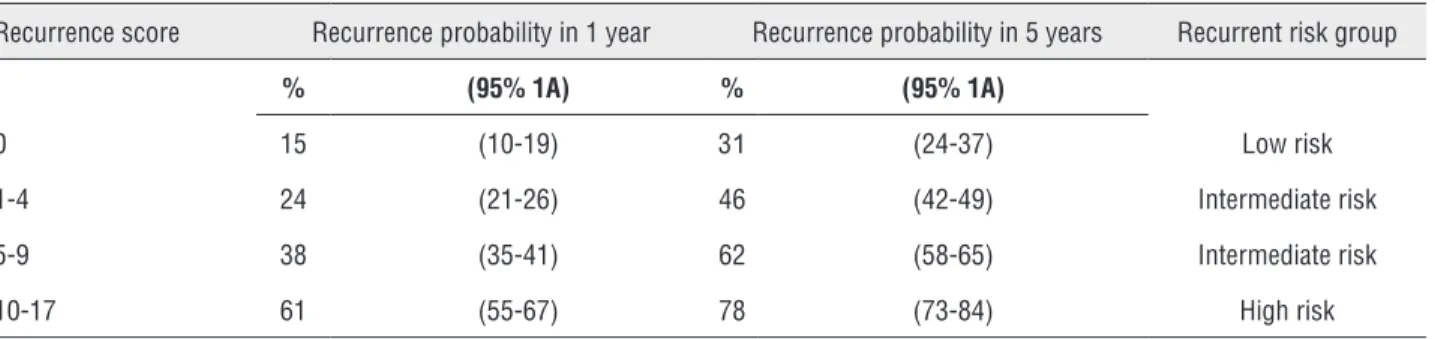
varia-tion of reported recurrence rates in literature. They vary from 15-61% at first year to 31-78% at five years (1, 2). Stratification is responsible for the correct choice of treatment, based on recurrence and progression risks (3).
score system based on the risks of progression and recurrence of patients with NMIBC following TRUS (4). Recently, the European Association of Urology (EAU) has adopted in its guidelines the risk tables and recommends stratification of NMIBC with low, intermediate and high risk of recurrence (5). However, external validations are necessary to adopt these risk tables in clinical practice and in different populations (6-9).
Although score EORTC risks are widely used in daily urological practice, there are not enough data from South America, particularly from Brazil, to apply them in the Brazilian population.
MATERIAL AND METHODS
Prospectively and consecutively, 205 pa-tients with NMIBC stages Ta and T1 submitted to bladder TRUS resection, from January 2003 to Oc-tober 2010 were analyzed. Patients were treated at the Department of Uro-oncology of Instituto Catarinense de Urologia in Itajaí, Santa Catarina, Brazil. The patients were attended by the public health service and private practice and had all socio-economic status. Ethnic background was not considered, since it is virtually impossible to distinguish these characteristics in this widely ge-netic and ethnic variant population.
New and recurrent cases were considered. It was excluded patients submitted to previous ra-diotherapy and chemotherapy due to other tumors throughout the period of study, patients with in-complete data or follow-up, who missed clinical and laboratory follow-up, and those who refused to participate in the study and failed to sign the Consent Form. These excluded patients were not considered for evaluation. Data collection was performed by one author and histologic exam by two pathologists, in order to minimize interpreta-tion variability among observers. Pathologic exam was performed in a non-blind manner, that is, the pathologists had access to all clinical and labora-tory data. The study was approved by the Ethical Committee of the Universidade do Vale do Itajaí.
Use of intravesical therapy (IVT) was de-termined previously to inclusion and during follow-up: none IVT, use of intravesical mitomi-cin C, intravesical immunotherapy with BCG and
combined mitomicin C and BCG IVT. Mitomicin C administration was performed in the post-surgical period after up to 12 hours of TURS. BCG was ad-ministered using induction protocol (once a week during 6 weeks after 2 to 4 weeks of TURS) and maintenance protocol (one series of three weekly cycles of IVT during 6 weeks repeated at 3, 6, 12, 18, 24, 30 and 36 months after induction proto-col). A second bladder TRUS was performed 2 to 6 weeks after the initial TURS and always when it was detected incomplete initial resection or ab-sence of muscle, T1 and/or high grade except pri-mary CIS, according to EAU guidelines (5).
Follow-up included urological consulta-tion, urethrocistoscopy, urinary cytology and ima-ge exams. It was performed every 3 months in the first 2 years, every 6 months in the next 3 years, and annually until the end of the study and/or one of the end-points. Recurrence was defined as a new lesion after the treatment of the primary tu-mor diagnosed by cystoscopy and/or image exam and confirmed by histopathology.
The six parameters described by EORTC study (4) were analyzed: histologic grade, pT stage (TNM 2009), size and number of tumors, presence of in situ carcinoma (CIS) and previous recurrence rate. Risk scores (Table-1) and recurrence probabi-lity in 1 and 5 years and time to first recurrence (TFR) were estimated in order to compare them with the data of the study by Silvester et al. (4) and accuracy analysis. Patients were divided in 4 risk groups according to their scores (Table-2) and it was determined the number of patients in risk of TFR in 1 and 5 years.
Five end-points were analyzed for the end of the study: free of disease, death, death due to disease, noncompliance with treatment, and dise-ase progression.
Statistical analysis
observed (10). When C is equal to 0.5, there is no discrimination (random distribution) or when it is 1, there is discrimination with perfect accordance (11). An adequate C index was assumed when it was equal or higher than the one of Sylvester et al. study (4). Accuracy was determined by calibration betwe-en recurrbetwe-ence probabilities in 1 and 5 years obtai-ned by the present study and by Silvester et al. (4).
RESULTS
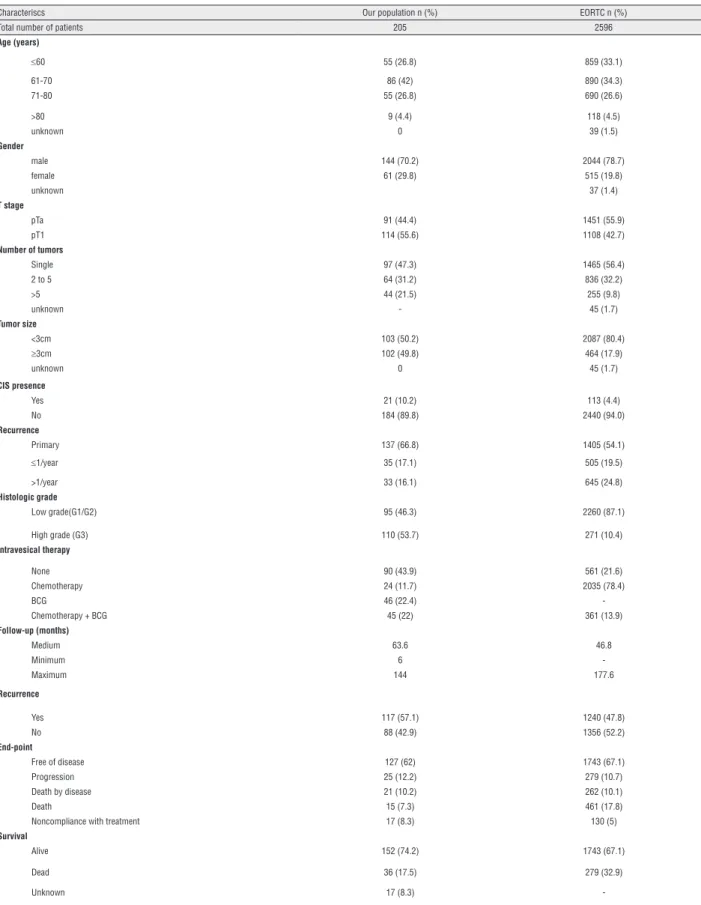
Table-3 shows patients characteristics and comparison with Siylvester et al. data (4).
Tumor recurrence was observed in 117 (57.1%) patients. 137 (66.5%) presented primary tumor and 68 (33.2%) previous recurrent tumors, among which 35 (17.1%) with less than 1 recur-rence per year and 33 (16.1%) with more than 1 recurrence per year. TFR medium was 14.2±mon-ths, minimum 3 and maximum 36 months. Re-currence in 1 year was identified in 59 (28.8%) patients and in 5 years in all 117 (571%) patients. Figures 1 and 2 show TFR in 1 and 5 years, respec-tively, stratified according to risk score groups of EORTC and show the number of patients at risk in each interval of 3 months, when TFR was evalu-ated in 1 year, and every 12 months, when it was evaluated in 5 years.
Calculated C index for tumor recurrence was 0.72 for 1 year and 0.7 for 5 years, superior to 0.66 described by Sylvester et al. (4) for the same periods.
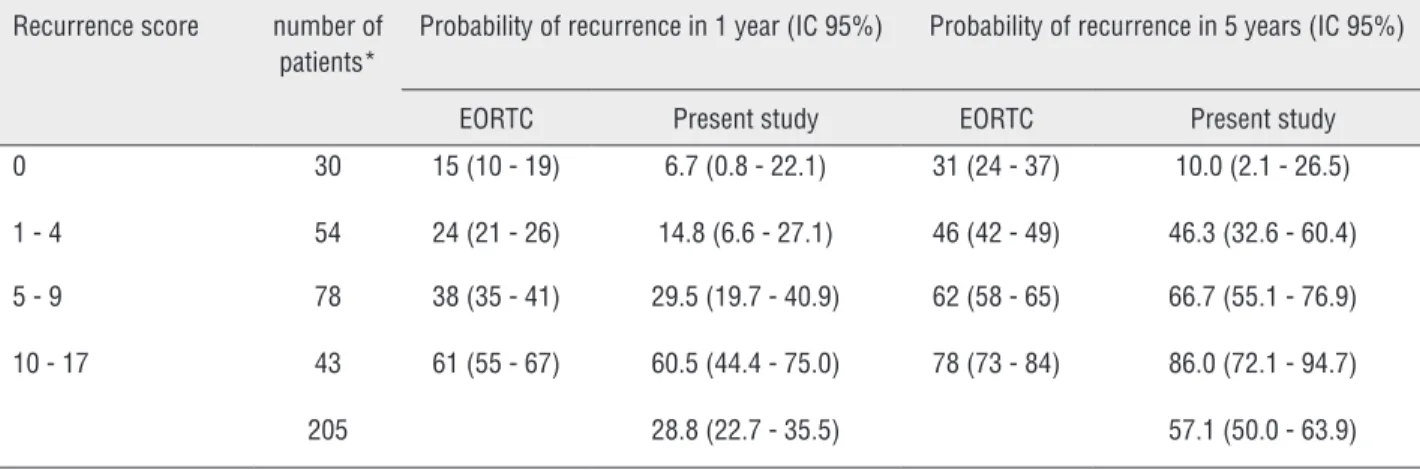
Risk of recurrence was 28.8% in 1 year and 57.1% in 5 years, regardless the score. Comparison of probabilities of recurrence in 1 and 5 years with Sylvester et al. results (4) in each group of risk score is shown in Table-4. Probability of recur-rence in 1 year was lower in all risk groups than those described by Sylvester et al. (4). In 5 years, risk was superior, except in risk group score zero. For this sample, EORTC Tables overestimated the risk of recurrence in 1 year and underestimated in 5 years, except when score was zero, but the confidence interval overlapped.
Table 1 - Recurrence predictors for risk score calculus.
Factor Recurrence
Number of tumors
Single 0
2 to 7 3
>or=8 6
Tumor diameter
<3.0cm 0
>or=3.0cm 3
Primary previous recurrence
<or=1 recurrence/year 2 >1 recurrence/year 4
Cathegory
pTa 0
pT1 1
Concomitant CIS
No 0
Yes 1
Histologic grade (OMS 1973)
G1 0
G2 1
G3 2
Total score 0-17
Source - Babjuk M et al., 2013
Table 2 - Score system for NMIBC risk of recurrence calculus.
Recurrence score Recurrence probability in 1 year Recurrence probability in 5 years Recurrent risk group
% (95% 1A) % (95% 1A)
0 15 (10-19) 31 (24-37) Low risk
1-4 24 (21-26) 46 (42-49) Intermediate risk
5-9 38 (35-41) 62 (58-65) Intermediate risk
10-17 61 (55-67) 78 (73-84) High risk
Table 3 - Sample characteristic of the present study and of EORTC series.
Characteriscs Our population n (%) EORTC n (%)
Total number of patients 205 2596
Age (years)
≤60 55 (26.8) 859 (33.1)
61-70 86 (42) 890 (34.3)
71-80 55 (26.8) 690 (26.6)
>80 9 (4.4) 118 (4.5)
unknown 0 39 (1.5)
Gender
male 144 (70.2) 2044 (78.7)
female 61 (29.8) 515 (19.8)
unknown 37 (1.4)
T stage
pTa 91 (44.4) 1451 (55.9)
pT1 114 (55.6) 1108 (42.7)
Number of tumors
Single 97 (47.3) 1465 (56.4)
2 to 5 64 (31.2) 836 (32.2)
>5 44 (21.5) 255 (9.8)
unknown - 45 (1.7)
Tumor size
<3cm 103 (50.2) 2087 (80.4)
≥3cm 102 (49.8) 464 (17.9)
unknown 0 45 (1.7)
CIS presence
Yes 21 (10.2) 113 (4.4)
No 184 (89.8) 2440 (94.0)
Recurrence
Primary 137 (66.8) 1405 (54.1)
≤1/year 35 (17.1) 505 (19.5)
>1/year 33 (16.1) 645 (24.8)
Histologic grade
Low grade(G1/G2) 95 (46.3) 2260 (87.1)
High grade (G3) 110 (53.7) 271 (10.4)
Intravesical therapy
None 90 (43.9) 561 (21.6)
Chemotherapy 24 (11.7) 2035 (78.4)
BCG 46 (22.4)
-Chemotherapy + BCG 45 (22) 361 (13.9)
Follow-up (months)
Medium 63.6 46.8
Minimum 6
-Maximum 144 177.6
Recurrence
Yes 117 (57.1) 1240 (47.8)
No 88 (42.9) 1356 (52.2)
End-point
Free of disease 127 (62) 1743 (67.1)
Progression 25 (12.2) 279 (10.7)
Death by disease 21 (10.2) 262 (10.1)
Death 15 (7.3) 461 (17.8)
Noncompliance with treatment 17 (8.3) 130 (5)
Survival
Alive 152 (74.2) 1743 (67.1)
Dead 36 (17.5) 279 (32.9)
-Score Number of patients at risk in the beginning of each interval
0 30 30 30 29 25
1-4 54 54 54 52 47
5-9 78 78 74 69 59
10-17 43 43 38 27 17
Table shows the number of patients at risk in every interval of 3 months. Figure 1 - Time to first recurrence in 1 year according to EORTC score in this series.
Score Number of patients at risk in the beginning of each interval
0 30 25 23 22 21 18
1-4 54 47 33 18 18 18
5-9 78 59 32 21 12 11
10-17 43 17 5 4 3 3
Table with the number of patients at risk at intervals of 12 months. Figure 2 - Time to first recurrence in 5 years according to eortc score in this series.
Table 4 - Comparision of recurrence probabilities according to risk score of EORTC and of this study in 1 and 5 years
Recurrence score number of patients*
Probability of recurrence in 1 year (IC 95%) Probability of recurrence in 5 years (IC 95%)
EORTC Present study EORTC Present study
0 30 15 (10 - 19) 6.7 (0.8 - 22.1) 31 (24 - 37) 10.0 (2.1 - 26.5)
1 - 4 54 24 (21 - 26) 14.8 (6.6 - 27.1) 46 (42 - 49) 46.3 (32.6 - 60.4)
5 - 9 78 38 (35 - 41) 29.5 (19.7 - 40.9) 62 (58 - 65) 66.7 (55.1 - 76.9)
10 - 17 43 61 (55 - 67) 60.5 (44.4 - 75.0) 78 (73 - 84) 86.0 (72.1 - 94.7)
205 28.8 (22.7 - 35.5) 57.1 (50.0 - 63.9)
DISCUSSION
BC has a higher incidence in men, 3 to 4 times higher than in women. Median age of pa-tients with BC is 70 years (12). Sylvester et al. (4) identified a relationship of men/women of 3.96 with 80% of male patients and median age of 65 years. We observed a 2.3/1 proportion of men/wo-men with 70.2% of male patients and a median age of 66.61 years. This observed difference may have occurred to the increasing smoking habitus and higher search for preventive medical attention of women observed in daily practice.
Our sample showed higher tumor potential aggressiveness and of high risk than literature (1, 3) and Sylvester et al. study (4) due to a higher proportion of patients stage T1 than literature (1, 3) (5.6% versus 20%) and of high grade tumors (53.7 versus 10.7%), multiple (52.7% versus 42%), larger than 3cm (49.8% versus 17.9%) and with CIS (10.2% versus 4.4%) than Sylverster et al. stu-dy (4). Also, the reduced number of CIS cases in Sylvester et al. (4) study lead to low accuracy of EORTC risk tables to predict recurrence and pro-gression of these patients (3). However, the present study observed the same proportion of CIS descri-bed in literature (1, 3, 5) expressing a population close to reality.
Pillai et al. (9) described some limitations of Sylvester et al. study (4): collection of data by a single researcher and pathologic exam by a single pathologist may minimize interpretation variabi-lity among observers. The present study has not shown significant variability among observers, re-ducing the possibility of bias of interpretation and analysis of data.
Sylvester et al. (4) based their study in 7 clinical trials, that used several IVT for adjuvant treatment following TURS. In their sample, 78.4% of patients received IVT, a number significantly higher when compared to present study and to the actual need on clinical daily practice. Intra-vesical chemotherapy protocols used by Sylvester et al. (4) were old and the use of instillation of chemotherapy drug right after surgery, protocol of induction and maintenance of adjuvant intravesi-cal BCG and re-TURS were not considered for the development of EORTC risk Tables. In our sample,
43.9% of patients did not receive any adjuvant IVT. In the other 56.1% patients, 11.7% received chemotherapy using mitomicin C, 22.45 BCG and 22% a combination of Mitomicin C and BCG. The high use of intravesical chemotherapy and the old protocols used by Sylvester t al. (4), the impro-vement of chemotherapy administration and the increased adjuvant use of BCG nowadays may re-duce the predictive power of the EORTC Tables.
Although submitted to adequate treatment, up to 70% of patients with Ta and T1 tumors will present recurrence in 1 year following TURS as single treatment (1, 13). Sylvester et al. (4) repor-ted 47.8% of recurrence in a 14-year follow-up and 44.3% with at least one recurrence when ad-mitted to study. Among these, recurrence occur-red at least once a year in 19.5% and more than once a year in 24.8%. Our results are slightly close to those reported in literature (1, 3, 5) than those of Sylvester et al. (4). Recurrence rate was 57.1% in the 12-year follow-up. Also, 33.2% of patients had already presented previous recurrence prior to admittance to study. Among these, 17.1% with less than one recurrence per year and 16.1% with more than one recurrence per year. The lowest recurrence observed by Sylvester et al. (4) when compared to literature (1, 3, 5) and to this study may be explained by the significant difference of patients that received IVT (78.4% versus 56.1%). This fact may have been caused by a selection bias of Sylvester et al. study (4), that included patients from clinical studies proposed to analyze pro-phylactic value of IVT following TURS and not the study of prognostic factors of recurrence and progression. A vicious sample was selected, since almost 80% of patients received IVT.
could be explained by the lack of use of intravesi-cal chemotherapy and due to tumor characteristics previously described.
Evaluated end-points were similar to tho-se of Sylvester et al. (4) except for death, with a significant difference in this study (32.9% versus 7.3%). Their study showed a higher proportion of men, with a usually lower life expectancy that can explain this difference between studies. Follow-up was similar to Sylvester et al. (4), although lower in total (144 versus 177.6 months) but with a me-dium higher time (66 versus 46.8 months).
Our C index was 0.72 for recurrence in 1 year and 0.7 for 5 years, superior to 0.66 described by Sylvester et al. (4) for both periods. When C indexes are compared, we conclude that there was discrimination or accordance between them. Also, our C-index showed a better performance than those of Sylvester et al. (4) showing a better accor-dance of our results to clinical reality. This aspect allows this study to be applied in daily practice.
In relation to accuracy, risk tables overes-timated the recurrence risk in 1 year and underes-timated in 5 years, probably due to the low use of BCG and high use of intravesical chemotherapy with old protocols utilized by the Sylvester et al. study (4), the use of immediate intravesical che-motherapy with more modern drugs, more ade-quate use of BCG and routine use of re-TURS in the high risk groups of our study.
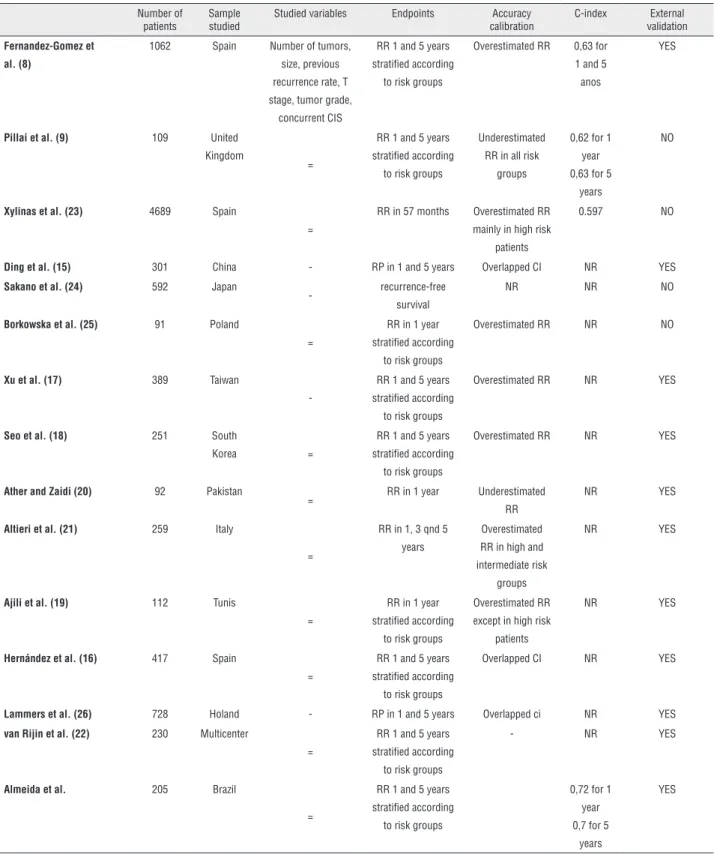
In a recent systematic review, Kluth et al. (14) pointed out the importance of treatment im-pact on end-points of the predictive models and the need of external validations before incorpora-tion in daily practice. External validaincorpora-tions of EOR-TC tables are shown in Table-5.
Fernandez-Gomez et al. (8) performed ex-ternal validation of EORTC risk Tables in patients treated with intravesical BCG, although overes-timated the recurrence risk. Ding et al. (15) and Hernandez et al. (16) validated the EORTC model, since the confidence intervals of recurrence ra-tes matched those of Sylvester et al. (4). Xu et al. (17) also validated the model in patients treated with intravesical epirrubicin, although the score overestimated the recurrence rate. Seo et al. (18) validated the risk Tables, since identified a recur-rence rate similar to Sylvester et al. (4). Ajili et al.
(19) and Ather and Zaidi (20) identified significant correlation for recurrence in 1 year with the Syl-vester et al. study (4). Altieri et al. (21) identified a recurrence rate similar to those of EORTC Tables and confirmed their use essential to daily practice. Van Rijin et al. (22) validated the EORTC Tables with a multicenter study treating patients with primary NMIBC and they also advocated their use in that population.
Pillai et al. (9) showed a significant diffe-rence of recurdiffe-rence probabilities between their stu-dy and that of Sylvester et al. (4). An inadequate number of patients did not allow a conclusion for external validation. Xylinas et al. (23) analyzed the discrimination of the EORTC Tables and the CUETO score system and identified that both mo-dels overestimated the recurrence risk of patients with high risk, but their study was retrospective and multicenter. Sakano et al. (24) affirmed that the EORTC model could not be used in Japanese patients. Borkowska et al. (25) pointed out that risk scores of EORTC overestimated the recurrence risk but, similar to Sylvester et al. (4) study, their sample did not use modern intravesical protocols, what could have limited their results.
Our study presents several limitations. Although our population was homogeneous and close to clinical reality, the size was significan-tly smaller than the original EORTC study (4). However, the inclusion of 205 patients was satis-factory after comparison with already published validations; the design study and long follow-up allow us to trust in our results. However, although we had a rigorous control of data inclusion and follow-up, sometimes clinical follow-up is diffi-cult in Brazil. It is common diffidiffi-culties to re-TURS following 3 months, as recommended, delayed control cystoscopies, delayed ambulatory consul-tation, and lack of comprehension of the actual severity of the disease by the patients.
Table 5 - Comparision of external validation studies of risk tables of EORTC.
Number of patients
Sample studied
Studied variables Endpoints Accuracy calibration
C-index External validation
Fernandez-Gomez et al. (8)
1062 Spain Number of tumors, size, previous recurrence rate, T stage, tumor grade,
concurrent CIS
RR 1 and 5 years stratiied according
to risk groups
Overestimated RR 0,63 for 1 and 5 anos
YES
Pillai et al. (9) 109 United
Kingdom
=
RR 1 and 5 years stratiied according
to risk groups
Underestimated RR in all risk
groups
0,62 for 1 year 0,63 for 5
years
NO
Xylinas et al. (23) 4689 Spain
=
RR in 57 months Overestimated RR mainly in high risk
patients
0.597 NO
Ding et al. (15) 301 China - RP in 1 and 5 years Overlapped CI NR YES
Sakano et al. (24) 592 Japan
- recurrence-free survival
NR NR NO
Borkowska et al. (25) 91 Poland
=
RR in 1 year stratiied according
to risk groups
Overestimated RR NR NO
Xu et al. (17) 389 Taiwan
-RR 1 and 5 years stratiied according
to risk groups
Overestimated RR NR YES
Seo et al. (18) 251 South
Korea =
RR 1 and 5 years stratiied according
to risk groups
Overestimated RR NR YES
Ather and Zaidi (20) 92 Pakistan
= RR in 1 year Underestimated RR
NR YES
Altieri et al. (21) 259 Italy
=
RR in 1, 3 qnd 5 years
Overestimated RR in high and intermediate risk
groups
NR YES
Ajili et al. (19) 112 Tunis
=
RR in 1 year stratiied according
to risk groups
Overestimated RR except in high risk
patients
NR YES
Hernández et al. (16) 417 Spain
=
RR 1 and 5 years stratiied according
to risk groups
Overlapped CI NR YES
Lammers et al. (26) 728 Holand - RP in 1 and 5 years Overlapped ci NR YES
van Rijin et al. (22) 230 Multicenter
=
RR 1 and 5 years stratiied according
to risk groups
- NR YES
Almeida et al. 205 Brazil
=
RR 1 and 5 years stratiied according
to risk groups
0,72 for 1 year 0,7 for 5
years
YES
the idea to stablish a mechanism to calculate the recurrence risk of patients with NMIBC. However, EORTC Tables must be adapted in order to become more reliable and used in daily urological practice.
CONCLUSIONS
The already accepted use of the EORCT model requires some reflections. There is a need to improve risk tables of recurrence in order to minimize distinct ethnic, geographic and clini-cal practice differences around the World. Tu-mor markers and genetic mapping are necessary to identify more precisely the biologic behavior of those tumors.
Although EORTC risk Tables overestimated the recurrence risk of tumor in 1 year and unde-restimated in 5 years, their external validation in patients with NMIBC in the south region of Brazil was adequate and their use to predict recurrence must be reinforced.
ABBREVIATIONS
BC = bladder cancer
CIS = carcinoma in situ
EORTC = European Organization for Research and Treatment of Cancer
EAU = European Association of Urology
IVT = intravesical treatment
NMIBC = Non-muscle invasive bladder cancer
TURS = Transurethral resection
TFR = Time to first recurrence
CUETO = Club Urológico Español de Tratamiento Oncológico
CONFLICT OF INTEREST
None declared.
REFERENCES
1. Van der Heijden AG, Alfred Witjes J: Recurrence, Progression, and Follow-Up in Non-Muscle-Invasive Bladder Cancer. Eur. Urol. Supplements. 2009;8:556-562.
2. Sylvester RJ. Natural history, recurrence, and progression in supericial bladder cancer. ScientiicWorldJournal. 2006;6:2617-25.
3. Colombel M, Soloway M, Akaza H, Bóhle A, Palou J, Buckley R et al. Epidemiology, Staging, Grading, and Risk Stratiication of Bladder Cancer. Eur. Urol. Supplements. 2008;7:618-626.
4. Sylvester RJ, van der Meijden AP, Oosterlinck W, Witjes JA, Boufioux C, Denis L, et al. Predicting recurrence and progression in individual patients with stage Ta T1 bladder cancer using EORTC risk tables: a combined analysis of 2596 patients from seven EORTC trials. Eur Urol. 2006;49:466-5; discussion 475-7.
5. Babjuk M, Burger M, Zigeuner R, Shariat SF, van Rhijn BW, Compérat E, et al. EAU guidelines on non-muscle-invasive urothelial carcinoma of the bladder: update 2013. Eur Urol. 2013;64:639-53.
6. Mallett S, Royston P, Waters R, Dutton S, Altman DG. Reporting performance of prognostic models in cancer: a review. BMC Med. 2010;8:21.
7. Sylvester RJ. How well can you actually predict which non-muscle-invasive bladder cancer patients will progress? Eur Urol. 2011;60:431-3; discussion 433-4.
8. Fernandez-Gomez J, Madero R, Solsona E, Unda M, Martinez-Piñeiro L, Ojea A, et al. The EORTC tables overestimate the risk of recurrence and progression in patients with non-muscle-invasive bladder cancer treated with bacillus Calmette-Guérin: external validation of the EORTC risk tables. Eur Urol. 2011;60:423-30.
9. Pillai R, Wang D, Mayer EK, Abel P. Do standardised prognostic algorithms relect local practice? Application of EORTC risk tables for non-muscle invasive (pTa/pT1) bladder cancer recurrence and progression in a local cohort. ScientiicWorldJournal. 2011;11:751-9.
10. Harrell FE Jr, Lee KL, Mark DB. Multivariable prognostic models: issues in developing models, evaluating assumptions and adequacy, and measuring and reducing errors. Stat Med. 1996;15:361-87.
11. Harrell FE Jr, Lee KL, Matchar DB, Reichert TA. Regression models for prognostic prediction: advantages, problems, and suggested solutions. Cancer Treat Rep. 1985;69:1071-77.
12. BRASIL. Ministério da Saúde. Incidência de Câncer no Brasil. Internet. Disponível em: <http://www.inca.gov.br/>. Accessed in: 16 jun. 2014.
13. Allard P, Bernard P, Fradet Y, Têtu B. The early clinical course of primary Ta and T1 bladder cancer: a proposed prognostic index. Br J Urol. 1998;81:692-8.
15. Ding W, Chen Z, Gou Y, Sun C, Xu K, Tan J, et al. Are EORTC risk tables suitable for Chinese patients with non-muscle-invasive bladder cancer? Cancer Epidemiol. 2014;38:157-61.
16. Hernández V, De La Peña E, Martin MD, Blázquez C, Diaz FJ, Llorente C. External validation and applicability of the EORTC risk tables for non-muscle-invasive bladder cancer. World J Urol. 2011;29:409-14.
17. Xu C, Jiang XZ, Zhang NZ, Ma L, Xu ZS. [Eficacy of European Organization for Research and Treatment of Cancer (EORTC) risk tables for the prediction of recurrence and progression of non-muscle invasive bladder cancer after intravesical pirarubicin instillation]. Zhonghua Zhong Liu Za Zhi. 2012;34:609-12.
18. Seo KW, Kim BH, Park CH, Kim CI, Chang HS. The eficacy of the EORTC scoring system and risk tables for the prediction of recurrence and progression of non-muscle-invasive bladder cancer after intravesical bacillus calmette-guerin instillation. Korean J Urol. 2010;51:165-70.
19. Ajili F, Darouiche A, Chebil M, Boubaker S. The eficiency of the EORTC scoring system for the prediction of recurrence and progression of non-muscle-invasive bladder cancer treated by bacillus Calmette-Guerin immunotherapy. Ultrastruct Pathol. 2013;37:249-53.
20. Ather MH, Zaidi M. Predicting recurrence and progression in non-muscle-invasive bladder cancer using European organization of research and treatment of cancer risk tables. Urol J. 2009;6:189-93.
21. Altieri VM, Castellucci R, Palumbo P, Verratti V, Sut M, Olivieri R, et al. Recurrence and progression in non-muscle-invasive bladder cancer using EORTC risk tables. Urol Int. 2012;89:61-6.
22. van Rhijn BW, Zuiverloon TC, Vis AN, Radvanyi F, van Leenders GJ, Ooms BC, et al. Molecular grade (FGFR3/MIB-1) and EORTC risk scores are predictive in primary non-muscle-invasive bladder cancer. Eur Urol. 2010;58:433-41. 23. Xylinas E, Kent M, Kluth L, Pycha A, Comploj E, Svatek
RS, et al. Accuracy of the EORTC risk tables and of the CUETO scoring model to predict outcomes in non-muscle-invasive urothelial carcinoma of the bladder. Br J Cancer. 2013;109:1460-6.
24. Sakano S, Matsuyama H, Takai K, Yoshihiro S, Kamiryo Y, Shirataki S, et al. Risk group stratiication to predict recurrence after transurethral resection in Japanese patients with stage Ta and T1 bladder tumours: validation study on the European Association of Urology guidelines. BJU Int. 2011;107:1598-604.
25. Borkowska EM, Jedrzejczyk A, Marks P, Catto JW, Kału ewski
B. EORTC risk tables - their usefulness in the assessment of recurrence and progression risk in non-muscle-invasive bladder cancer in Polish patients. Cent European J Urol. 2013;66:14-20.
26. Lammers RJ, Palou J, Witjes WP, Janzing-Pastors MH, Caris CT, Witjes JA. Comparison of expected treatment outcomes, obtained using risk models and international guidelines, with observed treatment outcomes in a Dutch cohort of patients with non-muscle-invasive bladder cancer treated with intravesical chemotherapy. BJU Int. 2014;114:193-201.
_______________________ Correspondence address:
Gilberto Laurino Almeida, MD Avenida Marcos Konder 1120,