Predictor factors of peritoneal dialysis-related
peritonitis
Authors
João Victor Duarte Lobo1
Keila Ribeiro Villar2
Manoel Pacheco de Andrade Júnior3
Kleyton de Andrade Bastos4
1Hospital Universitário – Universidade Federal do Sergipe (UFS), Aracaju, SE, Brazil
2Department of Medicine (UFS), Aracaju, SE, Brazil 3Clínica de Nefrologia do Estado de Sergipe (Clinese), Aracaju, SE, Brazil
4Department of Medi-cine (UFS) and Clinese, Aracaju, SE, Brazil
Submitted: 09/30/2009 Accepted: 01/19/2010
Correspondence to:
Kleyton de Andrade Bastos. Av. Deputado Silvio Teixei-ra, nº 651, ap. 1602, Jardins – Aracaju – SE – Brasil. CEP: 49025-100. Tel.: (79) 3232-2751 / 8103-6987. E-mail: kleytonbastos@ yahoo.com.br
This study was conducted at the Clínica de Nefrologia do Estado de Sergipe (Cli-nese) and Federal Universi-ty of Sergipe (UFS).
We declare no confl ict of interest.
A
BSTRACTIntroduction: Peritonitis remains a ma-jor complication of peritoneal dialysis (PD). Objective: Evaluate peritonitis in-cidence, etiology and outcome in cronic PD patients. Methods: A retrospective cohort study was carried out on 330 patients (mean age of 53 ± 19 years) who had been treated by PD in a di-alysis center in Aracaju/SE, Brazil be-tween January 1st, 2003 and December 31th, 2007. Data of patients with and without peritonitis were compared us-ing Student’s t-test, chi-squared statistic and multiple logistic regression. Results:
There were 213 peritonitis among 141 patients (1.51 episode/patient) result-ing in a rate of 28.44 patient/episode/ month (0.42 patient/episode/year). Sta-phylococcus aureus was the most fre-quent micro-organism isolated (27.8%), followed by Escherichia coli (13.4%) and 32.5% were culture-negative peri-tonitis. A greater risk of peritonitis was identified at the patients with hypoalbu-minemia [relative risk (RR) = 2.0; 95% confidence interval (CI) = 1.21 – 3.43; p < 0,01], < 4 school years (RR = 2.15; CI = 1.09 – 4.24; p = 0.03) and catheter’s exit site infection (RR = 2.63; IC = 1.57 – 4.41; p < 0.01). There were no significant dif-ference among gender, age, family in-come, diabetes mellitus, type of dialysis treatment, type of catheter and its sur-gical implant. Conclusions: Hypoalbu-minemia, low schooling and catheter’s exit site infection were associated with greater risk to peritonitis. Although peri-tonitis rate follow international pattern, prophylactic strategies are recommended.
Keywords: kidney failure chronic, peritoneal dialysis, peritonitis.
[J Bras Nefrol 2010;32(2):156-164©Elsevier Editora Ltda.
I
NTRODUCTIONPeritoneal dialysis (PD) is an accepted and widely used form of renal replacement therapy (RRT), peritonitis being its main complication.1,2
Sociodemographic3,4,5 and nutritional6,7
factors, climatic circumstances,8 diabetes
mellitus,3,5,6,7 PD modality,9 and the
pre-sence of peritoneal catheter tunnel or exit site infection (PCESI) have been reported as possible risk factors associated with the development of peritonitis.10,11
Although occurring with an increa-sing frequency, due to the development of specific programs,1,2 peritonitis represents
one of the major reasons for hospitaliza-tion and dialysis technique failure,10,12,13
and remains as the main cause of death in patients treated with PD.1,11 Its
preven-tion is, thus, of fundamental importance for a successful dialysis program.1 This
article aimed at assessing the possible pre-dictive factors of peritonitis in patients on a PD program, and at comparing the findings with indicators described in the literature.
M
ETHODThis was a retrospective study of a cohort of 330 chronic renal patients belonging to the PD program of the Nephrology Clinic of the State of Sergipe (Clinese), in the city of Aracaju. The patients had undergone dialysis therapy for at least 30 uninter-rupted days from January 1st, 2003, to December 31st, 2007.
used in surgery as antibiotic prophylaxis and imme-diately at the beginning of therapy or after break-in, depending on the need for emergency dialysis treat-ment. At the time, neither antibiotic prophylaxis of peritonitis or of exit site infections was prescribed, nor routine search for Staphylococcus aureus nasal carriers was performed.
Each patient provided the following information: clinical and demographic profile; history of the dialy-sis treatment; catheter history; infectious complica-tions inherent in treatment; and laboratory tests at the beginning of PD therapy. The patient’s age at the beginning of PD was considered for data analysis. Patients on automated peritoneal dialysis (APD) and on continuous ambulatory peritoneal dialysis (CAPD) were not separated into different groups. Peritoneal catheter exit site infection was defined by the presence of purulent secretion, with or without skin erythema in the pericatheter region.10,14 If a certain patient had
more than one peritoneal catheter, the catheter pre-sent at the time of the peritonitis episode was conside-red when analyzing that particularity, or the catheter with the longest time of stay, for individuals who did not have that complication.
The peritonitis episodes were assessed regarding their incidence, causative agents, and possible predic-tive factors related to their development. Diagnosis was confirmed by the simultaneous occurrence of at least two of the following criteria: abdominal pain; cloudy peritoneal effluent; leukocyte count in the dialysate > 100/µL; and positive culture of the peri-toneal fluid.14 Peritonitis rate was calculated through
the number of episodes as a function of time of expo-sure to the dialysis technique, according to the recom-mendations of the International Society for Peritoneal Dialysis (ISPD).10 For determining the predictors of
peritonitis, patients were divided into two groups, de-pending on the presence (141 patients – 42.7%) or absence (189 patients – 57.3%) of peritonitis, and the first episode of peritonitis was considered.
D
ATAA
NALYSISThe data obtained were checked and submitted to statistical analysis by using the programs Epi Info 2005, version 3.3.2, and Statistical Package for Social Sciences (SPSS) 16.0 for Windows (SPSS Inc., Chicago, Illinois). The significance level adopted for rejecting the null hypothesis was p < 0.05.
The statistical comparisons between the conti-nuous variables and the calculations of the means we-re performed by using Student t test. The percentages
of the categorical variables (presence or absence of peritonitis) were compared by use of the two-tailed chi-square test. To further explore the individual effects of the predictors involved in the peritonitis episodes, a logistic regression model was built throu-gh the analysis of multiple variables (adjusted by the Hosmer-Lemeshow test), including sociodemographic factors and the variables that had p < 0.25 in the non adjusted analysis.
R
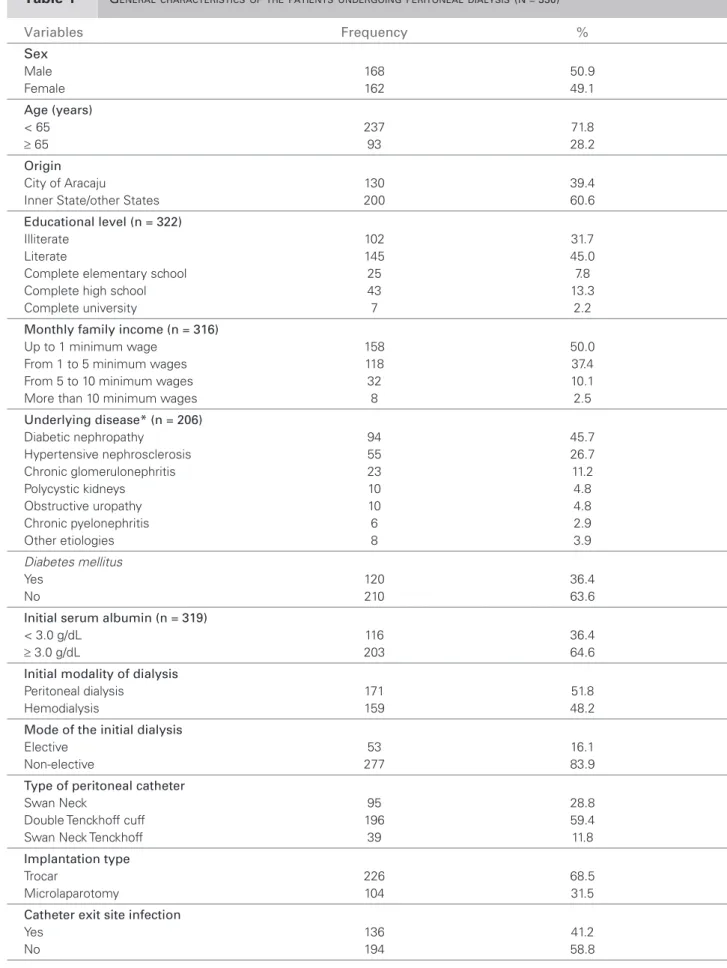
ESULTSThe mean age of the 330 patients studied at the begin-ning of the dialysis therapy was 53 ± 19 years. Their general characteristics are shown in Table 1.
In those patients, 381 peritoneal catheters we-re implanted (1.15/patient), and the Tenckhoff type predominated (59.8%). Forty-four patients (11.5%) used more than one catheter during the period. All catheters of the Swan Neck type were implanted through microlaparotomy, and those of the Swan Neck Tenckhoff type, through trocar. Most of those of the Tenckhoff type (95.2%) were implanted throu-gh trocar.
Peritonitis occurred in 141 individuals (42.7%), in a total of 213 episodes (1.51/patient). The overall peritonitis rate for the period studied was one episode every 28.4 months (0.42 episode/patient/year). Of the patients with peritonitis, 90 (63.8%) had an episode; 34 (24.1%), two; 13 (6.1%), three; and four patients (1.8%), four episodes.
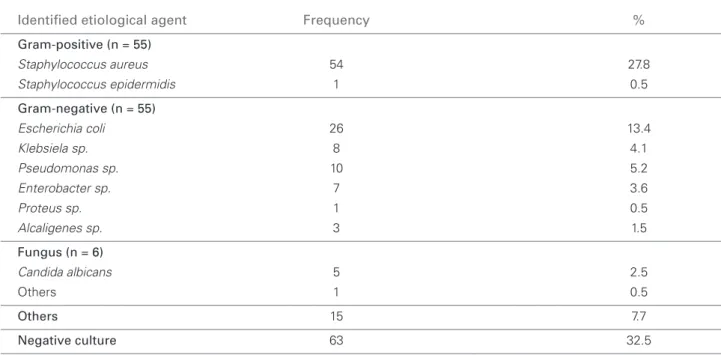
Table 2 shows the distribution of the cases of peri-tonitis as a function of the etiologic agent identified in culture. Gram-positive and Gram-negative microor-ganisms – 55 episodes each – were the most frequent, and Staphylococcus aureus was the commonest agent isolated in the series (54 episodes – 25.4%). The ne-gative culture rate was 32.5% (63 cases). Culture was not performed in 19 opportunities (8.9%).
Peritoneal catheter exit site infection was identi-fied in 136 patients (42.1%), 73 of whom (53.7%) later developed peritonitis. In 28 (38.4%) of those pe-ritonitis episodes, Staphylococcus aureus was the cau-sative agent. Peritonitis due to Staphylococcus aureus
following PCESI represented 50.9% of the episodes from which that microorganism was isolated.
Table 1 GENERALCHARACTERISTICSOFTHEPATIENTSUNDERGOINGPERITONEALDIALYSIS(N = 330)
Variables Frequency %
Sex
Male 168 50.9
Female 162 49.1
Age (years)
< 65 237 71.8
≥ 65 93 28.2
Origin
City of Aracaju 130 39.4
Inner State/other States 200 60.6
Educational level (n = 322)
Illiterate 102 31.7
Literate 145 45.0
Complete elementary school 25 7.8
Complete high school 43 13.3
Complete university 7 2.2
Monthly family income (n = 316)
Up to 1 minimum wage 158 50.0
From 1 to 5 minimum wages 118 37.4 From 5 to 10 minimum wages 32 10.1 More than 10 minimum wages 8 2.5
Underlying disease* (n = 206)
Diabetic nephropathy 94 45.7
Hypertensive nephrosclerosis 55 26.7 Chronic glomerulonephritis 23 11.2
Polycystic kidneys 10 4.8
Obstructive uropathy 10 4.8
Chronic pyelonephritis 6 2.9
Other etiologies 8 3.9
Diabetes mellitus
Yes 120 36.4
No 210 63.6
Initial serum albumin (n = 319)
< 3.0 g/dL 116 36.4
≥ 3.0 g/dL 203 64.6
Initial modality of dialysis
Peritoneal dialysis 171 51.8
Hemodialysis 159 48.2
Mode of the initial dialysis
Elective 53 16.1
Non-elective 277 83.9
Type of peritoneal catheter
Swan Neck 95 28.8
Double Tenckhoff cuff 196 59.4
Swan Neck Tenckhoff 39 11.8
Implantation type
Trocar 226 68.5
Microlaparotomy 104 31.5
Catheter exit site infection
Yes 136 41.2
No 194 58.8
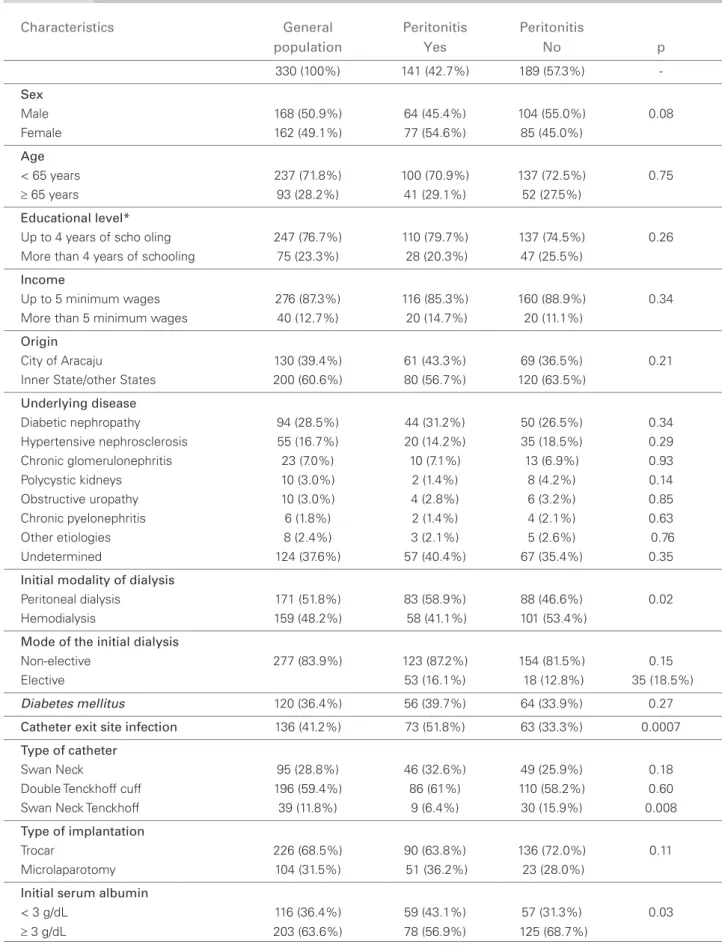
while the use of the Swan Neck Tenckhoff catheter provided protection (p < 0.01).
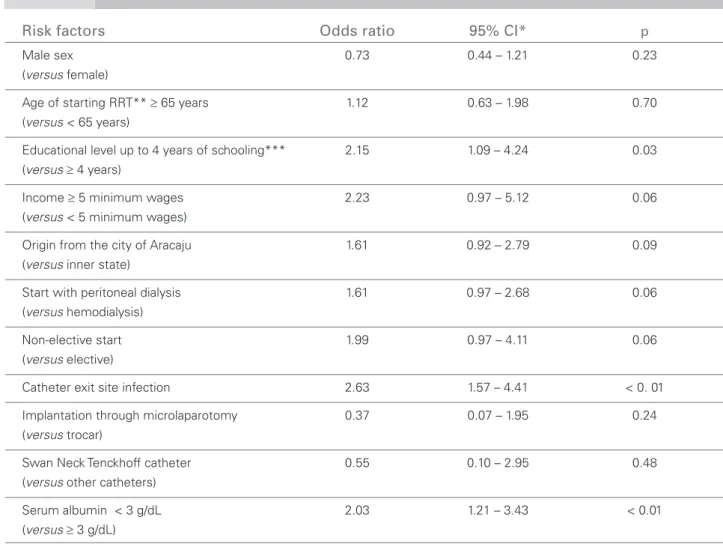
In the analysis with multiple variables (Table 4), the following independent peritonitis predictors were identified: serum albumin < 3 g/dL at the beginning of therapy (p < 0.01); PCESI (p < 0.01); and less than four years of schooling (p = 0.03). Monthly family income ≥ 5 minimum wages (p = 0.06) and begin-ning RRT through PD (p = 0.06) showed statistical tendency.
D
ISCUSSIONPeritonitis rates have been decreasing in the past years due to advances in PD techniques.1,2,15 Nevertheless,
peritonitis still remains as the major cause of thera-peutic failure, in addition to sometimes culminating in patient’s death.1,10,11,13,15
In an observation period of five years, 330 patients belonged to the PD program of the dialysis center stu-died for at least 20 uninterrupted days, 171 of whom (51.8%) began RRT with PD.
On December 31st, 2007, 31.67% of the dialy-sis patients at that institution were on PD. That per-centage was proportionally higher than the North-American (8.8%)16 and national (10.6%)17 means,
similar to the mean in Holland (30%)18, and lower
than the 74% reported in Mexico, the major user of
PD worldwide.7 This reflects our police of impartially
presenting the available therapies, allowing patients and their families to freely choose in situations wi-th no contraindication to any mewi-thod. The fact wi-that 51.8% of the patients had PD as their first dialysis modality emphasizes that observation. The suppres-sed demand for RRT and the sympathy of the pro-fessionals working at the institution for the method can have contributed to the magnitude of the PD pro-gram, making Sergipe the State that proportionally has the greatest percentage of patients on that dialysis modality in the country.17
Data have revealed that patients of this study ha-ve characteristics similar to those described in other Brazilian series regarding sociodemographic and cli-nical indicators.19 The percentage of elderly (28.2%)
and patients living away from the dialysis center (60.6% live in the countryside or other States) is hi-gh, most patients are illiterate or have not completed elementary school (76.7%), and their monthly family income is lower than five minimum wages (87.4%). The lack of access to conservative treatment of most patients has hindered the identification of the under-lying disease in 37.5% of the cases and has contribu-ted, along with problems of vascular access to hemo-dialysis, to the high index of therapy beginning as an emergency indication (83.9%).
Table 2 DETIOLOGICALISTRIBUTIONAGENTOFTHE(N = 194)EPISODESOFPERITONITISINPATIENTSONPERITONEALDIALYSISASAFUNCTIONOFTHEIDENTIFIED
Identifi ed etiological agent Frequency %
Gram-positive (n = 55)
Staphylococcus aureus 54 27.8
Staphylococcus epidermidis 1 0.5
Gram-negative (n = 55)
Escherichia coli 26 13.4
Klebsiela sp. 8 4.1
Pseudomonas sp. 10 5.2
Enterobacter sp. 7 3.6
Proteus sp. 1 0.5
Alcaligenes sp. 3 1.5
Fungus (n = 6)
Candida albicans 5 2.5
Others 1 0.5
Others 15 7.7
Negative culture 63 32.5
Culture was not performed in 19 episodes (8.9%).
DISTRIBUTIONOFTHEEPISODESOFPERITONITISINPATIENTSONPERITONEALDIALYSISASAFUNCTIONOFTHEIDENTIFIED ETIOLOGICALAGENT(N = 194)
Table 2
Table 3 SDIALYSISTATISTIC (NUNIVARIATE = 330) ANALYSISOFPOSSIBLEPREDICTIVEFACTORSOFPERITONITISINPATIENTSUNDERGOINGPERITONEAL
Characteristics General Peritonitis Peritonitis
population Yes No p
330 (100%) 141 (42.7%) 189 (57.3%) -
Sex
Male 168 (50.9%) 64 (45.4%) 104 (55.0%) 0.08 Female 162 (49.1%) 77 (54.6%) 85 (45.0%)
Age
< 65 years 237 (71.8%) 100 (70.9%) 137 (72.5%) 0.75
≥ 65 years 93 (28.2%) 41 (29.1%) 52 (27.5%)
Educational level*
Up to 4 years of scho oling 247 (76.7%) 110 (79.7%) 137 (74.5%) 0.26 More than 4 years of schooling 75 (23.3%) 28 (20.3%) 47 (25.5%)
Income
Up to 5 minimum wages 276 (87.3%) 116 (85.3%) 160 (88.9%) 0.34 More than 5 minimum wages 40 (12.7%) 20 (14.7%) 20 (11.1%)
Origin
City of Aracaju 130 (39.4%) 61 (43.3%) 69 (36.5%) 0.21 Inner State/other States 200 (60.6%) 80 (56.7%) 120 (63.5%)
Underlying disease
Diabetic nephropathy 94 (28.5%) 44 (31.2%) 50 (26.5%) 0.34 Hypertensive nephrosclerosis 55 (16.7%) 20 (14.2%) 35 (18.5%) 0.29 Chronic glomerulonephritis 23 (7.0%) 10 (7.1%) 13 (6.9%) 0.93 Polycystic kidneys 10 (3.0%) 2 (1.4%) 8 (4.2%) 0.14 Obstructive uropathy 10 (3.0%) 4 (2.8%) 6 (3.2%) 0.85 Chronic pyelonephritis 6 (1.8%) 2 (1.4%) 4 (2.1%) 0.63 Other etiologies 8 (2.4%) 3 (2.1%) 5 (2.6%) 0.76 Undetermined 124 (37.6%) 57 (40.4%) 67 (35.4%) 0.35
Initial modality of dialysis
Peritoneal dialysis 171 (51.8%) 83 (58.9%) 88 (46.6%) 0.02 Hemodialysis 159 (48.2%) 58 (41.1%) 101 (53.4%)
Mode of the initial dialysis
Non-elective 277 (83.9%) 123 (87.2%) 154 (81.5%) 0.15 Elective 53 (16.1%) 18 (12.8%) 35 (18.5%)
Diabetes mellitus 120 (36.4%) 56 (39.7%) 64 (33.9%) 0.27
Catheter exit site infection 136 (41.2%) 73 (51.8%) 63 (33.3%) 0.0007
Type of catheter
Swan Neck 95 (28.8%) 46 (32.6%) 49 (25.9%) 0.18 Double Tenckhoff cuff 196 (59.4%) 86 (61%) 110 (58.2%) 0.60 Swan Neck Tenckhoff 39 (11.8%) 9 (6.4%) 30 (15.9%) 0.008
Type of implantation
Trocar 226 (68.5%) 90 (63.8%) 136 (72.0%) 0.11 Microlaparotomy 104 (31.5%) 51 (36.2%) 23 (28.0%)
Initial serum albumin
< 3 g/dL 116 (36.4%) 59 (43.1%) 57 (31.3%) 0.03
≥ 3 g/dL 203 (63.6%) 78 (56.9%) 125 (68.7%)
Despite the unfavorable sociodemographic and cli-nical characteristics, 141 patients (42.7%) had perito-nitis, summing up to 213 episodes, and the peritonitis rates are in accordance with the international recom-mendations and the reports of current series.6,13,20,21,22
According to the ISPD, the goal of a dialysis center is peritonitis rates lower than one episode every 18 months (0.67 episode/patient/year).10 Fernandes et al.,20 in a large national multicenter study (Brazilian
Peritoneal Dialysis Multicenter Study – BRAZPD), have reported a peritonitis rate of one episode every 30 months, while Moraes et al.,22 when describing
25-year cumulative data, have reported one episode every 14.63 months in the city of Curitiba, in the State of Paraná. It is worth emphasizing that, as the latter study relates to a prolonged experience, that rate en-compasses all the evolution of PD connections. When analyzing data separately and for five-year intervals,
the authors have reported one episode of peritonitis for every 3.38 patients/month from 1980 to 1985, and one episode for every 17.64 patients/month from 2000 to 2005, better representing the results obtained with current connections.22
Analysis of the information about the etiologic agent of peritonitis was partially hindered because culture was not performed in 8.9% of the cases. This may be justified by the fact that 200 patients (60.7%) lived away from the dialysis center, and sometimes their first visit to a health care service and the begin-ning of the antimicrobial therapy occurred at non-reference hospitals. National authors have reported rates of culture non-performance ranging from 7% to 22.7%.2,23
Most international authors have described Gram-positive microorganisms as the major causative agents of peritonitis, Staphylococcus epidermidis being the
Table 4 STATISTICALANALYSISWITHMULTIPLEVARIABLESOFPOSSIBLEPREDICTIVEFACTORSOFPERITONITISINPATIENTS UNDERGOINGPERITONEALDIALYSIS
Risk factors Odds ratio 95% CI* p
Male sex 0.73 0.44 – 1.21 0.23
(versus female)
Age of starting RRT** ≥ 65 years 1.12 0.63 – 1.98 0.70 (versus < 65 years)
Educational level up to 4 years of schooling*** 2.15 1.09 – 4.24 0.03 (versus≥ 4 years)
Income ≥ 5 minimum wages 2.23 0.97 – 5.12 0.06 (versus < 5 minimum wages)
Origin from the city of Aracaju 1.61 0.92 – 2.79 0.09 (versus inner state)
Start with peritoneal dialysis 1.61 0.97 – 2.68 0.06 (versus hemodialysis)
Non-elective start 1.99 0.97 – 4.11 0.06 (versus elective)
Catheter exit site infection 2.63 1.57 – 4.41 < 0. 01
Implantation through microlaparotomy 0.37 0.07 – 1.95 0.24 (versus trocar)
Swan Neck Tenckhoff catheter 0.55 0.10 – 2.95 0.48 (versus other catheters)
Serum albumin < 3 g/dL 2.03 1.21 – 3.43 < 0.01 (versus≥ 3 g/dL)
* CI = 95% confi dence interval; ** RRT – renal replacement therapy; *** up to 4 years of schooling includes illiterate and literate; more than 4 years of schooling includes complete elementary school, complete high school, and complete university.
STATISTICALANALYSISWITHMULTIPLEVARIABLESOFPOSSIBLEPREDICTIVEFACTORSOFPERITONITISINPATIENTS UNDERGOINGPERITONEALDIALYSIS
Table 4 Table 4
most frequent.5,21,24 Latin-American authors 4,22
have reported Staphylococcus aureus as the major etiologic agent. In our series, the same proportion of Gram-positive and Gram-negative agents (55 episo-des each) was found, Staphylococcus aureus being the most frequently isolated microorganism (27.8%), and
Escherichia coli (13.4%) and Klebsiela sp. (9.7%) the most frequently identified Gram-negative microorga-nisms. Although Barretti et al.2 and Kavanagh et al.13
have also reported higher prevalence of Escherichia coli, that distribution varies.2 The results of that
stu-dy regarding the prevalence of fungi in positive cul-tures (2.8%) are similar to those reported by other researchers.21,22,24
The peritoneal fluid cultures of 63 episodes of pe-ritonitis (32.5%) were negative, a value greater than that recommended in the ISPD guidelines (< 20%).10 Moraes et al.22 and Lima et al.25 have reported
ne-gative culture rates of 26% and 33.7%, respectively. According to Barretti et al.,2 a factor that can
contri-bute to a high frequency of negative cultures is the fact that reference laboratories do not comply with some recommendations of the ISPD10 regarding
cultu-re specimen collection and inoculation. Nevertheless, in that series, the rate of cure of peritonitis with ne-gative culture was similar to the rate of cure of epi-sodes caused by Gram-positive agents, 77.8% and 83.6%, respectively, as reported by Mujais.21 As
su-ggested by Fernandes et al.,20 our predominance of
Staphylococcus aureus-caused peritonitis can be due to the high rate of negative cultures, which can hide the presence of other microorganisms that prevail in most studies, such as coagulase-negative Staphylococcus.
Sociodemographic variables have been considered as possible risk factors associated with the unfavo-rable evolution of dialysis patients, more specifically regarding the variations in quality of life scores, pe-ritonitis, and mortality.2,3,4,5,26,27,28 Diabetic
nephropa-thy, advanced age, lower family income, and lower educational level have been associated with worse prognosis in some reports.3,5,26,27,28 In our case series,
beginning treatment at advanced age, being diabetic, or having a monthly family income lower than five minimum wages were not associated with the deve-lopment of peritonitis. However, in accordance with Aslam et al.3 and Chow et al.,5 low educational level
was identified as a risk factor in the analysis through multiple variables.
Hypoalbuminemia, at the beginning of treat-ment, is associated with a higher chance of develo-ping peritonitis, in accordance with the reports of other authors.3,5,6 Hypoalbuminemia, here defined as
albumin < 3.0g/dL, was identified in 36.4% of the pa-tients admitted to the program and in 43.1% of those developing peritonitis, and could have been associated with the low socioeconomic level of the population, as well as with the late referral to a nephrologist.
The benefit of one type of catheter over another has not been conclusively demonstrated by rando-mized and prospective studies.10,29,30 A
compari-son of 107 Swan Neck Missouri catheters and 153 Tenckhoff catheters implanted in 236 patients at the same center from December 2000 to June 2005 has shown no differences in survival and prevalence of the major causes of failure. Based on this, from 2007 on, the institution began to adopt the routine use of the Swan Neck Tenckhoff catheter, implanted by a nephrologist through trocar.31 Univariate analysis has
shown that the Swan Neck Tenckhoff catheter provi-ded protection against the development of peritonitis, but that was not confirmed after logistic regression. Maybe the still nonrepresentative number of that type of catheter may have hindered the observation of any difference.
Previous catheter tunnel infection and PCESI have shown to be the major independent risk factors for the development of peritonitis, being associated with a 2.6-time increase in the occurrence of that complication. The elevated incidence of peritonitis in patients who had previously had PCESI can relate to the fact that, at that time, no antimicrobial agent was used at our institution for the prophylaxis of peritonitis or PCESI. Lima et al.25 have reported a PCESI-related peritonitis
rate of 35.7% at a service where routine prophylaxis with mupirocin is not performed, to avoid the appe-arance of multiresistant Staphylococcus aureus.25
Moreira et al.32 have shown a significant reduction in the incidence of peritonitis in patients using mupirocin. Takei33 has reported that the use of mupirocin reduced
the colonization by Staphylococcus aureus at catheter exit site and nasal mucosas. Barretti et al.2 have
repor-ted that the daily use of mupirocin at the catheter exit site reduced the peritonitis rate from 1/16.2 episode/ patient/month to 1/24.2 episode/patient/month, and was associated with changes in the epidemiological profile, with a strong reduction in the prevalence of peritonitis caused by Staphylococcus aureus. Piraino et al.34 have reported an overall reduction in the
peritoni-tis rate with the use of topical gentamicin, mainly due to the reduction in peritonitis caused by Gram-negative agents from 0.52 to 0.34 episode/year. Those authors have also reported a 63% reduction in the risk of in-fectious complications due to Staphylococcus aureus
Climatic factors were not assessed in this stu-dy, but in the northeastern region of Brazil, the weather is hot and humid during almost the entire year. Szeto et al.8 have shown a higher incidence of catheter infection in countries of hot and humid weather because of the accumulation of sweat and dirt around the catheter exit site. That explanation has also been provided by Stinghen, Barretti, and Pecoits-Filho,15 who have recommended that
main-taining the catheter and the exit site orifice drier can help to reduce the incidence of infections in tro-pical countries.
The present study has some limitations, such as the fact that the analysis was retrospective and limi-ted to a single center, and, thus, the particularities of the study should be carefully considered before results can be generalized. In addition, measuring serum al-bumin at the beginning of the PD treatment to infer the patient’s nutritional status should be considered with reservation, because that is not a reliable marker and neither serial measurements nor values immedia-tely prior to episodes of peritonitis were considered. Finally, it is worth emphasizing that, when consi-dering a possible association of peritoneal catheter tunnel or exit site infection with the occurrence of peritonitis, no interval between the two events was observed, which does not allow a cause-effect relation to be established.
C
ONCLUSIONHypoalbuminemia, low educational level, and cathe-ter exit site infection have shown to be independent predictive factors of peritonitis.
Although the socioeconomic level has been histo-rically considered a contraindication for PD, this was not a limiting factor, because in the study population, even with unfavorable sociodemographic and clinical indicators, the peritonitis rates observed were within the international recommendations. Finally, conside-ring the high penetration of Staphylococcus aureus
as an etiological agent, prophylactic strategies in
Staphylococcus aureus nasal carriers and for PCESI, as currently recommended by the international guide-lines, should be universally applied.
R
EFERENCES1. Krishnan M, Thodis E, Ikonomopoulos D et al.
Predictor of outcome following bacterial peritonites in peritoneal dialysis. Perit Dial Int 2002; 22(5):573-81. 2. Barretti P, Bastos KA, Dominguez J, Caramori JCT.
Peritonitis in Latin America. Perit Dial Int 2007; 27(3):332-9.
3. Aslam N, Bernardini J, Fried L, Burr R, Piraino B. Comparison of infectious complications between inci-dent hemodialysis and peritoneal dialysis patients. Clin J Am Soc Nephrol 2006; 1(6):1226-33.
4. Caramori, JCT. Peritonites em pacientes tratados com diálise peritoneal ambulatorial contínua: estudo clíni-co e microbiológiclíni-co [tese de doutorado]. São Paulo: Faculdade de Medicina de Botucatu, Universidade Estadual Paulista, 1999.
5. Chow KM, Szeto CC, Leung CB, Law MC, Li PKT. Impact of social factors on patients on peritoneal dialy-sis. Nephrol Dial Transplant 2005; 20(11):2504-10. 6. Chow KM, Szeto CC, Leung CB, Kwan BC, Law MC,
Li PK. A risk analysis of continuous ambulatory peri-toneal dialysis-related peritonitis. Perit Dial Int 2005; 25(4):374-9.
7. Cueto-Manzano AM, Rojas-Campos E. Status of renal replacement therapy and peritoneal dialysis in Mexico. Perit Dial Int 2007; 27(2):142-8.
8. Szeto CC, Chow KM, Wong TY, Leung CB, Li PK. Influence of climate on the incidence of peritoneal dialy-sis-related peritonitis. Perit Dial Int 2003; 23(6):580-6. 9. Oo TN, Roberts TL, Collins AJ. A comparison of peri-tonitis rates from the United States Renal Data System database: CAPD versus continuous cycling peritoneal dialysis patients. Am J Kidney Dis 2005; 45(2):372-80. 10. Piraino B, Bailie GR, Bernardini J et al. ISPD Guidelines/ recommendations peritoneal dialysis-related infections recommendations 2005 update. Perit Dial Int 2005; 25(2):107-31.
11. Voinescu CG, Khanna R. Peritonitis in peritoneal dialy-sis. Int J Artif Organs 2002; 25(4):249-60.
12. Szeto CC, Chow KM, Wong TY et al. Feasibility of re-suming peritoneal dialysis after severe peritonitis and Tenckhoff catheter removal. J Am Soc Nephrol 2002; 13(4):1040-5.
13. Kavanagh D, Prescott GJ, Robert A. Peritoneal dialysis-associated peritonitis in Scotland (1999-2002). Nephrol Dial Transplant 2004; 19(10):2584-91.
14. Keane W, Bailie G, Boeschoten E et al. Adult peritoneal dialysis-related peritonitis treatment recommendations: 2000 update (published erratum appears in Perit Dial Int 2000; 20:828-9). Perit Dial Int 2000; 20(4):396-411. 15. Stinghen AE, Barretti P, Pecoits-Filho R. Factors
contri-buting to differences in peritonitis rates between centers and reagions. Perit Dial Int 2007; 27(S2):281-5. 16. Collins AJ, Kasiske B, Herzog C et al. United States
Renal Data System 2005 Annual Data Report . Am J Kidney Dis 2006; 47(Suppl 1):A5-6.
17. Censo SBN 2008. Resultados do Censo [serial online] 2008; 1(1):[1 screen]. Internet on site: http://www.sbn. org.br/censos.htm. Access in: March 10, 2009.
18. Saxena R, West C. Peritoneal dialysis: a primary care perspective. JABFM 2006; 19(4):380-9.
19. Fernandes N, Bastos MG, Pecoits-Filho R et al. Sucessos e fracassos – uma análise dos dados do BRAZPD com-parados às diretrizes espanholas. J Bras Nefrol 2008; 30(1):22-31.
20. Fernandes N, Bastos MG, Cassi HV et al. The
21. Mujais S. Microbiology and outcomes of peritonitis in North America. Kidney Int 2006; 70(103):S55-62. 22. Moraes TP, Pecoits-Filho R, Ribeiro SC et al. Peritoneal
dialysis in Brazil: twenty-five years of experience in a single center. Perit Dial Int 2009; 29(5):492-8.
23. Pecoits-Filho RFS, Pasqual DD, Fuerbringer R, Sauthier SM, Riella MC. Diálise peritoneal contínua ambulato-rial (DPCA): experiência de 15 anos em Curitiba. J Bras Nefrol 1998; 20(1):22-30.
24. Kim DK, Yoo TH, Ryu DR, Xu ZG, Kim HJ, Choi KH. Changes in causative organisms and their anti-microbial susceptibilities in CAPD peritonitis: a single centers experience over one decade. Perit Dial Int 2004; 24(5):424-32.
25. Lima RC, Barreira A, Cardoso FL, Lima MHS, Leite Jr M. Ciprofloxacin and cefazolin as a combination for empirical initial therapy of peritoneal dialysis-related peritonitis: five-year follow-up. Perit Dial Int 2007; 27(1):56-60.
26. Vonesh EF, Snyder JJ, Foley RN, Collins AJ. Mortality studies comparing peritoneal dialysis and hemodialysis: what do they tell us? Kidney Int 2006; 70(103):S3-11. 27. Mujais S, Story K. Peritoneal dialysis in the US:
evalu-ation of outcomes in contemporary cohort. Kidney Int 2006; 70(103):S21-6.
28. Lopes AA, Bragg-Gresham JL, Goodkin DA et al. Factors associated with health-related quality of life among hemodialysis patients in the DOPPS. Qual Life Res 2007; 16(4):545-57.
29. Ash SR. Chronic peritoneal dialysis catheters: overview of design, placement, and removal procedures. Semin Dial 2003; 16(4):323-34.
30. Gokal R, Alexander S, Ash S, Chen Tw, Danielson A, Holmes C. Peritoneal catheters and exit-site practices toward optimum peritoneal access: a review of current developments. Perit Dial Int 2005; 25(2):132-9. 31. Bastos KA, Neto PJS, Andrade Jr. MP, Barbosa LMM,
Júnior AA, Faro SRS. Comparison between Swan Neck Missouri and Tenckhoff peritoneal dialysis cathe-ters. Survival and complications. [Abstract] In: World Congress of Nephrology, Rio de Janeiro, Brazil, 2007. 32. Moreira PRR, Ferreira S, Almas ACG, Peralva LEL,
Brega AP. Mupirocina tópica no orifício de saída do cateter reduz infecção decorrente de DPCA. J Bras Nefrol 2002; 24(1):1-6.
33. Takei, NL. Avaliação da colonização por Staphylococcus aureus após uso crônico de mupirocin em pacientes em diálise peritoneal ambulatorial continua [dissertação]. São Paulo: Universidade Federal de São Paulo, 2003. 34. Piraino B, Bernardini J, Bender FH. An analysis of