www.jped.com.br
ORIGINAL ARTICLE
Maternal perception and attitudes regarding healthcare
professionals’ guidelines on feeding practices in the
child’s first year of life
夽
Mônica C. Broilo
a,∗, Maria Laura C. Louzada
b, Maria de Lourdes Drachler
c,
Lucia M. Stenzel
d, Márcia R. Vitolo
eaNutritionist. Doctoral Student. Programa de Ciências da Saúde, Universidade Federal de Ciências da Saúde de Porto Alegre
(UFCSPA), Porto Alegre, RS, Brazil
bNutritionist. Doctoral Student in Nutrition and Public Health, Universidade de São Paulo, São Paulo, SP, Brazil cPediatrician. PhD, Professor Adjunto, Universidade Luterana do Brasil, Gravataí, RS, Brazil
dPsychologist. PhD, Professor Adjunto, Departamento de Psicologia, UFCSPA, Porto Alegre, RS, Brazil eNutritionist. PhD, Professor Adjunto, Departamento de Nutric¸ão, UFCSPA, Porto Alegre, RS, Brazil
Received 5 October 2012; accepted 9 January 2013 Available online 10 July 2013
KEYWORDS Maternal behavior; Feeding habits; Infants; Health care professionals; Primary health care
Abstract
Objective: To evaluate the maternal perceptions and attitudes related to adherence to health-care professionals’ guidelines on breastfeeding and complementary feeding, and associated factors.
Methods: A cross-sectional analysis of data from a randomized field trial was performed, in which 20 health centers (HCs) were selected in the city of Porto Alegre, state of Rio Grande do Sul, from eight Health Management Districts of the city. Pregnant women were selected from these HCs, and when the children were aged between six and nine months, data regarding the maternal perception of adherence to professional advice and consequences of feeding practices on child health were obtained during home visits. Association analyses were performed using Poisson regression.
Results: Data were collected from 631 mother-child binomials. According to the mothers’ per-ception, 47% reported not following instructions received in the HU. Among these, 45.7% did not recognize the importance of eating habits for the child’s health. The perception of adherence to professional advice was associated with higher prevalence of exclusive breastfeeding (EBF), introduction of solid food (ISF) after four months, introduction of non-recommended foods after six months, and higher family income. A higher prevalence of EBF and ISF was observed after four months (p < 0.05) among mothers who believed in the importance of feeding habits for the child’s health.
夽 Please cite this article as: Broilo MC, Louzada ML, Drachler MdL, Stenzel LM, Vitolo MR. Maternal perception and attitudes regarding healthcare professionals’ guidelines on feeding practices in the child’s first year of life. J Pediatr (Rio J). 2013;89:485---91.
∗Corresponding author.
E-mail:[email protected] (M.C. Broilo).
Conclusion: There was a high prevalence of mothers who did not follow the advice of health professionals; the perception that food does not affect the child’s health can be a barrier to the improvement of eating habits in childhood.
© 2013 Sociedade Brasileira de Pediatria. Published by Elsevier Editora Ltda. All rights reserved.
PALAVRAS-CHAVE Comportamento marterno; Alimentac¸ão; Lactentes; Pessoal de saúde; Atenc¸ão primária à saúde
Percepc¸ão e atitudes maternas em relac¸ão às orientac¸ões de profissionais de saúde referentes a práticas alimentares no primeiro ano de vida
Resumo
Objetivo: Avaliar a percepc¸ão e as atitudes maternas relacionadas à adesão às orientac¸ões de profissionais de saúde sobre aleitamento materno e alimentac¸ão complementar e fatores associados.
Métodos: Análise transversal de dados de ensaio de campo randomizado, em que foram sorteadas 20 Unidades de Saúde (US) de Porto Alegre-RS das oito gerências distritais de saúde do município. Gestantes atendidas nestas US foram selecionadas e, aos 6-9 meses de idade das crianc¸as, foram obtidos, em visitas domiciliares, dados quanto à percepc¸ão materna de adesão às orientac¸ões dos profissionais e de consequências das práticas alimentares na saúde da crianc¸a. Análises de associac¸ão foram realizadas por meio de Regressão de Poisson.
Resultados: Foram obtidos dados de 631 binômios mãe-crianc¸a. Conforme a percepc¸ão das mães, 47% relataram não seguir orientac¸ões recebidas nas US. Dentre essas, 45,7% não recon-hecem a importância da alimentac¸ão para a saúde da crianc¸a. A percepc¸ão de adesão às orientac¸ões dos profissionais foi associada com maiores prevalências de aleitamento materno exclusivo (AME), introduc¸ão de alimentos sólidos (IAS) após quatro meses e introduc¸ão de alimentos não recomendados após seis meses, além de maior renda familiar. Observaram-se maiores prevalências de AME e IAS após quatro meses (p < 0,05) entre as mães que acreditam na importância da alimentac¸ão para a saúde da crianc¸a.
Conclusão: Houve elevada prevalência de mães que não seguem as orientac¸ões dos profissionais de saúde e a percepc¸ão de que a alimentac¸ão não influencia a saúde da crianc¸a pode ser uma barreira para melhorias nas práticas alimentares na infância.
© 2013 Sociedade Brasileira de Pediatria. Publicado por Elsevier Editora Ltda. Todos os direitos reservados.
Introduction
Dietary guidelines for children under two years recommend exclusive breastfeeding (EBF) until the sixth month of life and complementary feeding after this age in order to ensure proper growth and development and to prevent morbidities, especially iron-deficiency anemia.1,2In Brazil, data from the Second Survey on the Prevalence of Breastfeeding in Brazil-ian Capitals3demonstrated that half of the children had EBF for 54.1 days or less. Furthermore, the introduction of other foods in the child’s diet proved to be inadequate: approxi-mately 18% of children consumed liquids such as teas, juices, and other types of milk in the first month of life; 21% con-sumed salty foods between three and six months of age; and 8.9% consumed non-recommended foods such as cook-ies and snacks at ages between three and six months 46.4% between six and nine months, and 71.7% between nine and 12 months.3
The reasons related to weaning and early introduction of foods are many; socioeconomic and demographic factors,4---7 psychological and behavioral characteristics of the mother and the family,6,8 and factors related to the health professional9---12 should be highlighted. Among the deter-minants related to the healthcare professionals and their guidelines, the lack of information from professionals,13the difficulties in communication between the professional and
postpartum women,10 the mother’s personal divergences regarding the dietary guidelines received,14and the mater-nal belief that feeding practices have little influence on child development must be emphasized.15Intervention stud-ies on breastfeeding (BF) and complementary feeding in different populations concluded that there are barriers in several areas that can influence maternal nonadherence to healthcare professionals’ guidelines.16---18Considering this evidence, this study aimed to evaluate the maternal per-ceptions and attitudes regarding adherence to healthcare professionals’ guidelines on BF practices and complemen-tary feeding, and associated factors.
Methods
The selection of the HCs participating in the study con-sidered as eligible those that had attended to children under 1 year of age over 100 times in 2006 and that did not partic-ipate in the Family Health Strategy or maintain partnerships with other health, education, or business institutions at the beginning of the study. Of the 56 HCs of the munic-ipality, 31 were eligible. The names of eligible HCs were inserted in a black envelope and, for each of the eight health management districts, two HCs were drawn: one would be the intervention group that would receive healthcare pro-fessionals’ intervention as part of the the governmental program ‘‘Ten steps for healthy feeding for Brazilian chil-dren from birth to 2 years of age’’,19and the other would be the control group, which would follow their routine without intervention from the research group. Four additional HCs were selected for the two groups in order to achieve the previously planned sample size of 20 HCs.
The data collection team consisted of previously trained undergraduate and graduate students of Nutrition. This team identified pregnant women in the last trimester of pregnancy among patients of the participating HCs, and invited them to participate in the study. After reading and signing the informed consent form, the mothers answered a questionnaire regarding their age, level of education, occu-pation, parity, marital status and family income, probable date of delivery, and address and telephone contact for pos-terior home visits. Human immunodeficiency virus-positive pregnant women were excluded from the study.
The second phase of data collection occurred during home visits between six and nine months after the expected date of delivery. During these visits, the mothers answered a structured questionnaire regarding BF and introduction of other foods in the children’s diet, as well as their per-ceptions and attitudes towards healthcare professionals’ guidelines on the child’s dietary habits. BF was classified as EBF when the child received only breast milk, with no water, tea, juice, other types of milk, or other foods, and as BF when the child received breast milk, with or without other types of food according to the definitions of the World Health Organization (WHO).20 The introduction of foods in the child’s diet was analyzed in relation to the introduc-tion of solid foods and non-recommended foods, specifically honey, coffee, processed soups, chocolate, artificial juices, soft drinks, cream-filled biscuits, cookies, ‘‘petit suisse’’ cheese, processed meats, chocolates, candies, snacks, jello, ice cream, and fried foods.
Maternal attitudes regarding the healthcare profession-als’ guidelines were investigated through closed questions developed specifically for this study. Regarding the percep-tion of adherence to healthcare professionals’ guidelines regarding the feeding of infants, the mothers answered the following question (Q1): ‘‘Do you think you accurately follow the appropriate recommendations on BF and infant feed-ing?’’ The answer to this question was classified into two categories: 1 - follows the guidelines, 2 - does not follow the guidelines.
Mothers who reported not following the guidelines answered an additional question (Q2), with five alternative answers: ‘‘Thus, you do not accurately follow the recom-mendations on BF and infant feeding, however: (1) you are sure that what he/she eats does not harm his/her health; (2) you worry that what he/she eats can cause him/her any
problem; (3) you think you should change his/her diet, so that he/she eats healthy foods; (4) you already know what you have to do to change this situation; (5) you are already changing it for the better.’’ For the statistical analyses of these outcomes, the mothers were grouped as: A) has no perception of the influence of food on the child’s health (mothers who chose option 1 in question Q2) and B) have the perception that food can influence the child’s health (mothers who chose options 2-5 in response to question Q2). Data were entered in duplicate using the Statistical Package for Social Science (SPSS) release 16.0, and validated using Epi Info, release 6.4. Maternal and family characteris-tics were categorized, and their association with maternal perception of adherence to healthcare professionals’ guide-lines was assessed by the chi-squared test. Characteristics with p ≤ 0.20 in the crude analysis were tested in the
multiple model study using Poisson regression with robust estimate. The magnitude of the associations between feed-ing practices and maternal perception (a) of havfeed-ing followed the healthcare professionals’ guidelines and (b) of consid-ering feeding habits important for the child’s health were estimated using prevalence ratios and their 95% confidence intervals (95% CI).
The study was approved by the Research Ethics Commit-tee of the Universidade Federal de Ciências da Saúde de Porto Alegre under protocol No. 471/07, and by the Ethics Committee of the Health Department of Porto Alegre.
Results
In the first phase of data collection, 715 pregnant women were interviewed. When the children were aged between six and nine months, 29 mothers refused to continue partic-ipating in the study, 11 moved to another city, eight were excluded due to illness or death of the mother or child; 14 children were excluded due to congenital malformations, and 22 mother-child pairs were not found, resulting in a sample size of 631.
Data from the intervention and control groups were used together in the present study, as there was no statistical difference between the groups regarding maternal percep-tion of adherence to healthcare professionals’ guidelines, the main outcome of this study. Among the participants, 20.9% were younger than 20 years, 46.9% had eight years or less of schooling, 68% did not work outside of the home, 22.3% were living without a partner, 55.5% already had other children, 52.3% were overweight, and 47.7% of households had a monthly income of up to two Brazilian minimum wages.
Table 1 Association between maternal and family characteristics and the perception of adherence to healthcare professional’s dietary guidelines (n = 619).
Follows guidelinesa
(n = 330)
crudePRb adjustedPRc
n % PR 95%CI p-value PR 95%CI p-value
Age
< 20 years 66 50.8
≥20 years 264 54 1.06 (0.88-1.28) 0.58 - -
-Years of schooling
≤8 years 152 52.2
> 8 years 178 54.3 1.04 (0.90-1.21) 0.67 - -
-Family incomed
≤2 Brazilian minimum wages 138 48.1
> 2 Brazilian minimum wages 185 58.9 1.23 (1.05-1.43) 0.01 1.21 (1.04-1.41) 0.01
Parity
Multiparous 174 50.6
Primiparous 156 56.7 1.12 (0.97-1.30) 0.15 1.14 (0.96-1.29) 0.15
Marital status
No partner 71 51.1
With partner 259 54 1.06 (0.88-1.27) 0.62 - -
-Maternal occupation
Does not work outside the home 230 54.6
Works outside the home 100 50.5 0.92 (0.79-1.09) 0.38 - -
-95% CI, -95% confidence interval; PR, prevalence ratio.
aMaternal perception of adherence healthcare professionals’ dietary guidelines. b Pearson’s chi-squared test.
c Poisson regression performed with variables with p≤0.20 in the crude analysis (parity and family income). d Missing data (n = 18).
Table 2 Dietary practices during the children’s first year of life according to the maternal perception of adherence to healthcare professionals’ recommendations (n = 619).
Does not follow recommendationsa(n = 289)
Follows recommendationsa(n = 330)
n % n % adjusted PRb 95%CI p-value
Exclusive breastfeeding
Absent at 4 months 238 82.4 231 70
Present at 4 months 51 17.6 99 30 1.63 (1.20-2.21) 0.002
Breastfeeding
Absent at 6 months 136 47.1 119 36.1
Present at 6 months 153 52.9 211 63.9 1.21 (1.05-1.40) 0.007
Introduction of solid foods
< 4 months 115 39.8 87 26.4
≥4 months 174 60.2 243 73.6 1.20 (1.07-1.35) 0.002
Non-recommended foodsc
< 6 months 265 91.7 273 82.7
≥6 months 24 8.3 57 17.3 1.08 (1.03-1.13) 0.001
95% CI, 95% confidence interval; PR, prevalence ratio.
aInformation reported by the mother regarding her perception of adherence to the recommendations of healthcare professionals. b Poisson regression adjusted for total household income.
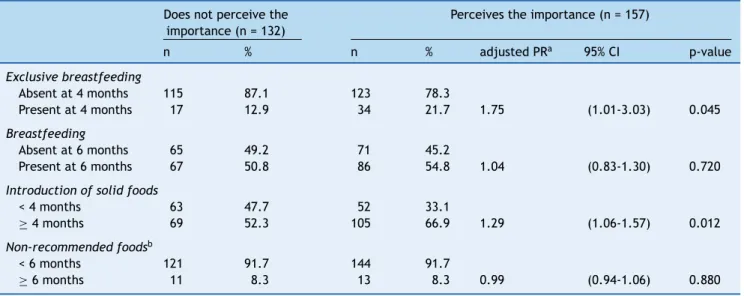
Table 3 Dietary practices during the children’s first year of life according to the maternal perception of the importance of nutrition for the child’s health, among mothers who reported not following the recommendations of healthcare professionals (n = 289).
Does not perceive the importance (n = 132)
Perceives the importance (n = 157)
n % n % adjusted PRa 95% CI p-value
Exclusive breastfeeding
Absent at 4 months 115 87.1 123 78.3
Present at 4 months 17 12.9 34 21.7 1.75 (1.01-3.03) 0.045
Breastfeeding
Absent at 6 months 65 49.2 71 45.2
Present at 6 months 67 50.8 86 54.8 1.04 (0.83-1.30) 0.720
Introduction of solid foods
< 4 months 63 47.7 52 33.1
≥4 months 69 52.3 105 66.9 1.29 (1.06-1.57) 0.012 Non-recommended foodsb
< 6 months 121 91.7 144 91.7
≥6 months 11 8.3 13 8.3 0.99 (0.94-1.06) 0.880
95%CI, 95% confidence interval; PR, prevalence ratio. a Poisson regression adjusted for total household income.
b Non-recommended foods: honey, coffee, chocolate, artificial juices, soft drinks, processed soups, processed meat, cookies, cream-filled biscuits, ‘‘petit-suisse’’ cheese, chocolates, candies, snacks, ice cream, jello, fried foods.
months, when the introduction of solid foods occurred after four months of age, and when the consumption of non-recommended food occurred after six months, after adjusting for total household income (Table 2).
When data from the mothers who reported not follow-ing the healthcare professionals’ guidelines were analyzed separately, it was observed that 54% (157/289) of them acknowledged the influence of food on the child’s health. The maternal perception of the importance of nutrition for the child’s health was associated with healthy eating habits in the first year of the child’s life (p < 0.05). There was a higher prevalence of EBF at four months of age and solid foods introduced after four months of age among moth-ers who perceived that dietary habits influenced the child’s health (Table 3).
Discussion
This study was performed aiming to understand the maternal perception and attitudes related to healthcare profession-als’ guidelines regarding feeding practices in the first year of life. According to the results, approximately 50% of mothers stated they did not follow the guidelines. Other studies with the same object of investigation concluded that the mother’s decision regarding the type of food to be offered to the infant is strongly influenced by the partner, family, or friends, and that perhaps healthcare profession-als are not properly training regarding the child’s feeding habits or beliefs regarding the subject.9,10,21,22These results suggest that the transmission of information alone is not enough to motivate or to determine the actions of moth-ers regarding the child’s dietary practices. However, an intervention study with healthcare professionals showed that motivational interviewing techniques increased patient
adherence to treatment,23 suggesting that the healthcare professionals’ communication strategy in primary care can be a tool to improve maternal adherence to guidelines on the feeding practices of their children.
Among the maternal and family characteristics analyzed in this study, family income was the only variable associ-ated with the group of mothers who reported following the healthcare professionals’ guidelines. Several studies that investigated the socioeconomic and demographic factors associated with adherence to healthy eating habits early in life demonstrated associations between adherence and maternal characteristics such as age, education, income, and maternal occupation, but the results differ among the studies, perhaps due to differences among the studied populations.5,12,13,21,24---26
Regarding the limitations of the present study, the lack of data on the frequency and quality of dietary guidelines provided by healthcare professionals to the mothers must be highlighted. Moreover, the mothers’ responses regarding their perception of whether or not they followed healthcare professionals’ guidelines may have been biased in relation to other sources of information on this subject. Another limita-tion may be based on the mother’s predisposilimita-tion to respond positively regarding their adherence to dietary practices recommended by healthcare professionals for fear of being judged by the interviewer. This, however, reflects the pos-sibility that the prevalence of mothers who do not follow the healthcare professionals’ guidelines may be even higher than that observed in this study.
Based on the present results, a high prevalence of moth-ers who reported not following primary healthcare health professionals’ guidelines was observed, as well as a large percentage of mothers who did not associate feeding prac-tices in the first year of life with health outcomes for the child. Perhaps the lack of understanding of the importance of nutrition for healthy growth and development is a barrier to maternal adherence to healthcare professionals’ guide-lines and, as suggested by another study, the inclusion of more information on the importance of nutrition in the first year of life during routine visits30 may be an effective tool for better maternal adherence to these recommendations. The need for qualitative studies that investigate maternal perceptions, beliefs, and attitudes in relation to their chil-dren’s early dietary habits is emphasized.
Funding
Fundac¸ão de Amparo à Pesquisa do Estado do Rio Grande do Sul (FAPERGS).
Conflict of interest
The authors declare no conflicts of interest.
References
1. Monte CM, Giugliani ER. Recommendations for the comple-mentary feeding of the breastfed child. J Pediatr (Rio J). 2004;80:S131---41.
2. Sociedade Brasileira de Pediatria. Avaliac¸ão nutricional da crianc¸a e do adolescente: Manual de orientac¸ão. In: Departa-mento de Nutrologia. São Paulo; 2009.
3. Ministério da Saúde. Secretaria de Atenc¸ão à Saúde. II Pesquisa de Prevalência de Aleitamento Materno nas Capitais Brasileiras e Distrito Federal. 1st ed. Brasília: Editora do Ministério da Saúde; 2009.
4. Caetano MC, Ortiz TT, Silva SG, Souza FI, Sarni RO. Complemen-tary feeding: inappropriate practices in infants. J Pediatr (Rio J). 2010;86:196---201.
5. Ladomenou F, Kafatos A, Galanakis E. Risk factors related to intention to breastfeed, early weaning and suboptimal duration of breastfeeding. Acta Paediatr. 2007;96:1441---4.
6. Chaves RG, Lamounier JA, Cesar CC. Factors associated with duration of breastfeeding. J Pediatr (Rio J). 2007;83:241---6. 7. Espírito-Santo LC, de Oliveira LD, Giugliani ER. Factors
associ-ated with low incidence of exclusive breastfeeding for the first 6 months. Birth. 2007;34:212---9.
8. O’Brien M, Buikstra E, Fallon T, Hegney D. Exploring the influence of psychological factors on breastfeeding duration, phase 1: perceptions of mothers and clinicians. J Hum Lact. 2009;25:55---63.
9. Heinig MJ, Follett JR, Ishii KD, Kavanagh-Prochaska K, Cohen R, Panchula J. Barriers to compliance with infant-feeding recommendations among low-income women. J Hum Lact. 2006;22:27---38.
10. Olson BH, Horodynski MA, Brophy-Herb H, Iwanski KC. Health professionals’ perspectives on the infant feeding practices of low income mothers. Matern Child Health J. 2010;14: 75---85.
11. Geraghty SR, Riddle SW, Shaikh U. The breastfeeding mother and the pediatrician. J Hum Lact. 2008;24:335---9.
12. Santiago LB, Bettiol H, Barbieri MA, Guttierrez MR, Del Ciampo LA. Promotion of breastfeeding: the importance of pediatricians with specific training. J Pediatr (Rio J). 2003;79:504---12. 13. Wijndaele K, Lakshman R, Landsbaugh JR, Ong KK, Ogilvie
D. Determinants of early weaning and use of unmodified cow’s milk in infants: a systematic review. J Am Diet Assoc. 2009;109:2017---28.
14. Alder EM, Williams FL, Anderson AS, Forsyth S, Florey Cdu V, van der Velde P. What influences the timing of the introduction of solid food to infants? Br J Nutr. 2004;92:527---31.
15. Tatone-Tokuda F, Dubois L, Girard M. Psychosocial determinants of the early introduction of complementary foods. Health Educ Behav. 2009;36:302---20.
16. Ziol-Guest KM, Hernandez DC. First- and second-trimester WIC participation is associated with lower rates of breastfeeding and early introduction of cow’s milk during infancy. J Am Diet Assoc. 2010;110:702---9.
17. Murimi M, Dodge CM, Pope J, Erickson D. Factors that influence breastfeeding decisions among special supplemental nutrition program for women, infants, and children participants from Central Louisiana. J Am Diet Assoc. 2010;110:624---7.
18. Alexander A, Dowling D, Furman L. What do pregnant low-income women say about breastfeeding? Breastfeed Med. 2010;5:17---23.
19. Brasil. Ministério da Saúde. Dez passos para uma alimentac¸ão saudável para crianc¸as menores de 2 anos: álbum seriado. 2 ed. Brasília; 2004.
20. World Health Organization. Indicators for assessing infant and young child feeding practices --- part I: definition. Washington, DC, USA: WHO; 2008.
21. Kools EJ, Thijs C, de Vries H. The behavioral determinants of breast-feeding in the Netherlands: predictors for the initiation of breast-feeding. Health Educ Behav. 2005;32:809---24. 22. Susin LR, Giugliani ER, Kummer SC. Influence of
grandmoth-ers on breastfeeding practices. Rev Saude Publica. 2005;39: 141---7.
23. Pollak KI, Alexander SC, Tulsky JA, Lyna P, Coffman CJ, Dolor RJ, et al. Physician empathy and listening: associations with patient satisfaction and autonomy. J Am Board Fam Med. 2011;24:665---72.
24. Golley RK, Smithers LG, Mittinty MN, Brazionis L, Emmett P, Northstone K, et al. An index measuring adherence to comple-mentary feeding guidelines has convergent validity as a measure of infant diet quality. J Nutr. 2012;142:901---8.
25. Giovannini M, Riva E, Banderali G, Scaglioni S, Veehof SH, Sala M, et al. Feeding practices of infants through the first year of life in Italy. Acta Paediatr. 2004;93:492---7.
26. Rasheed S, Frongillo EA, Devine CM, Alam DS, Rasmussen KM. Maternal, infant, and household factors are associated with breast-feeding trajectories during infants’ first 6 months of life in Matlab, Bangladesh. J Nutr. 2009;139:1582---7.
28. Persad MD, Mensinger JL. Maternal breastfeeding attitudes: association with breastfeeding intent and socio-demographics among urban primiparas. J Community Health. 2008;33:53---60. 29. Nunes LM, Giugliani ER, Santo LC, de Oliveira LD. Reduction of unnecessary intake of water and herbal teas on breast-fed
infants: a randomized clinical trial with adolescent mothers and grandmothers. J Adolesc Health. 2011;49:258---64.