2011 Nov.-Dec.;19(6):1462-9
www.eerp.usp.br/rlae
Corresponding Author: David Sancho Cantus
Passeig República de Malta 1-2-10
46760, Tavernes de la Valldigna, Valencia, España E-mail: [email protected]
Ischemic heart disease in women
David Sancho Cantus
1María del Carmen Solano Ruiz
2Nowadays, Coronary Diseases (CDs) represent the main mortality cause in men and
women, but there are gender differences regarding their presentation, progression and
the way the disease is tackled. This study mainly focuses on reviewing literature about the
CD and its gender approach. The authors carried out a search of texts that use qualitative
methodology, published between 2003 and 2009 in the following databases: PUBMED, IME,
CUIDEN and CINAHL. Factors that hinder the early diagnosis of Ischemic Heart Disease in
women are identified as the main findings, and the possible consequences are pointed out.
In the fifty-six texts that were selected initially, we can see the difficulty women face to
recognize early symptoms of the CD and their low risk perception of this disease. Greater
awareness on Ischemic Heart Disease is needed, so that the high morbidity and mortality
rates can be reduced.
Descriptors: Coronary Disease; Gender and Health; Myocardical Infarction; Qualitative
Research.
1 RN, Doctoral Student in Nursing, Profesor, Universidad Católica de Valencia San Vicente Mártir, Spain.
E-mail: [email protected].
2 RN, Ph.D. in Nursing, Full Professor, Escuela Universitaria de Enfermería, Universidad de Alicante, Spain.
A cardiopatia isquêmica na mulher
As doenças coronárias (DC) são o principal motivo de mortalidade no sexo feminino e
masculino. Existem diferenças de gênero na apresentação, na evolução e na maneira
como a doença é abordada. Este trabalho teve como objetivo principal revisar a
literatura sobre a DC e o seu enfoque de gênero. Os autores pesquisaram diferentes
textos caracterizados por uma abordagem qualitativa, publicados entre 2003 e 2009,
nas bases de dados PubMed, IME, CUIDEN e CINAHL. Como principais resultados são
identiicados os fatores que diicultam o diagnóstico precoce da doença isquêmica nas
mulheres, e as possíveis consequências desse diagnóstico tardio são apontadas. Nos
56 textos selecionados, inicialmente mostra-se a diiculdade da mulher relacionada ao
reconhecimento dos primeiros sintomas da doença coronária, e a baixa percepção do
risco dessa doença. É necessária maior sensibilização sobre a cardiopatia isquêmica (CI),
para se reduzir o elevado índice de morbidade e mortalidade.
Descritores: Doença das Coronárias; Gênero e Saúde; Infarto do Miocárdio; Pesquisa
Qualitativa.
La cardiopatía isquémica en la mujer
Las Enfermedades Coronarias (EC) suponen la principal causa de mortalidad en el
sexo femenino y masculino, pero existen diferencias de género en aspectos como
la presentación, evolución o el abordaje de la enfermedad. Este trabajo se centra
principalmente en revisar la literatura sobre la EC y el enfoque de género. Los autores
han realizado una búsqueda de artículos que utilizan metodología cualitativa publicados
entre 2003 y 2009 en las bases de datos PUBMED, IME, CUIDEN y CINAHL. Como
hallazgos principales se identiican los factores que diicultan el diagnóstico precoz de la
cardiopatía isquémica en la mujer, y se apuntan las posibles consecuencias que puede
comportar. En los 56 textos seleccionados, inicialmente se evidencia la diicultad de
la mujer para reconocer los síntomas iniciales de EC, así como la baja percepción de
riesgo sobre dicha enfermedad. Es necesaria una mayor concienciación sobre la CI con
la inalidad de reducir las altas cifras de morbimortalidad.
Descriptores: Enfermedad Coronaria; Género y Salud; Infarto de Miocardio, Investigación
Cualitativa.
Introduction
Nowadays, Cardiovascular Diseases (CVD)
represent the main cause of death all of the world
among women and men, preceding illnesses like cancer
or trafic accidents(1-2). According to data by the World
Health Organization, it is estimated that, in 2005,
17.5 million people died of CVD, which represents
about 30% of deaths registered all over the world(3).
In Europe, CVD are the main cause of death among
men and women and responsible for almost half of
all deaths(3). Among CVD, the main group is Ischemic
Heart Disease (mainly Angina Pectoris and Myocardial
Infarction). At those moments, it is assumed that an
increasing number of men and women live with a CVD,
and it is estimated that, each year, the number of cases
of infarction and angina that demand hospitalization
will increase by 1.5%(2), including the socioeconomic
impact this entails.
Countless studies(4-6) have revealed gender
differences in Ischemic Heart Disease (IHD), a fact that
is of vital importance if we intend to approach a gender
focus of this disease. Differences exist not only in the
the therapeutic approach or in the way of responding to
a cardiac event. Therefore, we can only value the true
dimension of the problem we are facing when we are
able to discover how women experience their disease
and why they react as they do. In this sense, it is essential to ask what previous information or knowledge
level women have about their disease when they get
ill, so as to better understand how they respond to the
disease and why.
Another issue of interest is related to the reasons
conditioning this observed behavior in women; why they
tend to postpone their request for specialized care, how
they interpret the irst signs of IHD and why they react as they do. All of this will lead to a justiication of qualitative
foci as a method to approach the study phenomenon.
The answer women adopt when they experience the irst
IHD symptoms is conditioned by multiple factors that
need to be explored, broken down and later integrated
with a view to an easier understanding of certain attitudes and behaviors.
All of these proposals should contain greater
awareness raising about CVD in general and IHD in particular; a course that needs to include gender foci in
future studies and research, and in which women stop
being and feeling discriminated against because of their presence as witnesses in current research. The male
model has traditionally been taken as a reference to
study diseases and health-related processes, although
this male-centered focus has aroused confusion and has hampered the supposed impartiality and objectivity of
medical sciences.
The main goal of this paper is to develop a qualitative literature review on coronary disease
in women. As a secondary goal, the authors aim to
understand how women experience and feel coronary disease, an essential aspect to plan adequate
preventive policies and try to reduce the impact of
these diseases.
Method
A bibliographic review was developed with a focus
on scientiic production related to ischemic heart disease
in women between 2003 and 2009. In total, 56 papers were selected. The following databases were consulted:
MEDLINE, CUIDEN, CINAHL and IME. This search was
carried out between March and May 2010.
The search strategy followed departs from the more general aspects (like the epidemiological aspects
of CVD for example) and progressively moves the focus
of interest towards the main study object, which is the
gender focus on the disease(6-7).
Practically 50% of the revised literature is very recent, as the papers were published in the last three
years. The journals that contribute with a larger number
of articles are, irst, journals specialized in the study
theme, such as Enfermería en Cardiología, European
Journal of Cardiovascular Nursing, la Revista Española
de Cardiología, The Journal of Cardiovascular Nursing,
la Revista de la Federación Argentina de Cardiología,
Progress in Cardiovascular Nursing, Critical Pathways in
Cardiology or Journal of the American Heart Association.
Other Nursing journals in which some of the texts
analyzed were published are: International Journal of
Nursing Studies, British Journal of Nursing or Medsurg
Nursing, among others. Among journals that are not
Nursing and Cardiology journals in the strict sense,
the American Journal of Critical care, Australian Critical
Care or Women’s Health stand out as examples. In total,
about 30 scientiic journals were represented in this
literature review.
In compliance with the inclusion criteria, those
papers were selected that are directly related with
cardiovascular illness in women, basically qualitative
texts that intend to approach women’s experiences of
the disease(6). In fact, in 25 papers included (almost
45% of the total sample), the authors survey how
women perceive their disease and which are the reasons
for this behavior. In principle, 5562 texts on coronary
disease were identiied, of which 56 were selected in
total because they complied with the inclusion criteria
set for this research. This selection was based on a
thematic analysis, using the following key words or
descriptors(7): irst, general terms were introduced,
such as: “enfermedad cardiovascular”, “cardiopatía
isquémica”, “infarto de miocardio”, “angina de pecho”,
“enfermería” or “factores de riesgo”. Next, the analysis
was further elaborated to direct the search towards the
concrete goals. In this case, the following descriptors
were used: “percepción del riesgo”, “mujer”, “género”,
“conocimientos previos” or “síntomas de cardiopatía
isquémica”. At a higher complexity level, Boolean
operators were used in order to more speciically
narrow down to the intended goals and avoid
unnecessary interference. That is, descriptors were
crossed in the search, like in the following example:
“género” or “infarto de miocardio” or “fenomenología”
Sancho Cantus D, Solano Ruiz MC.
After elaborating the search, those papers were
selected which, in our opinion, were most closely related
with the study theme, discarding more general texts
and papers that did not contribute further (information
saturation)(6-7).
Inclusion criteria
- Papers published in English or Spanish in scientiic
health journals between 2003 and 2009;
- Qualitative texts that explore patients’ experiences
with coronary disease, mainly women;
- Texts speciically focusing on illnesses like Angina
Pectoris or Myocardial Infarction.
Results
In this literature review, various main themes
emerge (Figure 1): the importance of cardiovascular
diseases (CVD) in terms of morbidity-mortality and
social and health consequences; the role of gender in
ischemic heart disease (IHD) regarding the presentation
of the disease, its evolution over time or how both health
professionals and patients themselves should approach
it; or the women’s behavior towards the irst symptoms of coronary disease and the possible justiications for
and implications of this attitude.
Author (s) Main findings
Anguita M (2008), Baena JM (2005), Salvador MJ (2008)
Importance of CVD regarding morbidity-mortality
Sancho D (2010), Heras (2006) Repercussion of IHD for CVD
Alfonso F (2006), Fernandez Al (2005), Higginson R (2008), Sjöstrom-Strand A (2008)
Women’s behavior in view of coronary disease
Lockyer L (2005), Sánchez C (2003), Rohlfs I (2004), Ruiz MT (2004)
Awareness raising about the importance of coronary disease in women
Figure 1 – Main themes found in the texts
Current situation: a silent epidemic
Consensus exists about the vital importance of
CVD for morbidity and mortality. Countless studies
consider CVD as the main cause of death around the
world(4-5). These authors defend that CVD is the main
cause of death in both genders in developed countries,
among which the United Kingdom, the USA or Spain,
for example, are expressively mentioned. It is estimated
that, in 2005, 17.5 million people all over the world
died of CVD, which represents approximately 30% of
all deaths(5). The authors of this study consider CVD an
“epidemic” without any distinctions in terms of race, age
or geography; it is probably the main health problem
in developed countries(8-10). In Europe, the number of
dysfunctions due to this reason equals approximately
50%. This proportion is deinitely a source of concern,
not only because of what it represents, but also because
of existing forecasts, showing a hardly tranquilizing
future.
In this scenario, mortality due to CVD exceeds
igures due to trafic accidents or cancer(5), although the
media attention the latter receive hides a reality that
cannot be ignored.
Among the CVD, IHD are the most numerous group
in terms of deaths. In fact, it is considered that, out
of 17.5 million dysfunctions that occur every year in
Europe because of CVD, 7.6 million correspond to
IHD-related deaths(7).
Forecasts appoint that, in 2050, mortality due
to Myocardial Infarction will be about 30% higher in
women than in men(11); nevertheless, cancer is still
feared more(4,12).
As for the incidence of IHD in women, various
studies support the hypothesis that, every year, this
disease kills approximately twice as much women than
all kinds of cancer together, and that it constitutes the
main cause of disability in women(6).
Approach of IHD from a gender focus: Learning to
understand
CVD (including IHD) has some well-known
cardiovascular risk factors (CVRF), such as arterial
hypertension, hypercholesterolemia, smoking or
diabetes mellitus what modiiable factors is concerned; and gender and age as non-modiiable factors(2,6). Despite
this evidence, it has been proven that, among women,
knowledge on these risk factors and their relation
with IHD is quite poor, which is undoubtedly of vital
importance for the inal analysis of decision making(5).
It is precisely this lack of knowledge about CVRF that
enhances low levels of risk perception in society in
general and women in particular(5,13-14); to the extent
that, despite high IHD mortality rates, news on these
diseases are not the center of media attention(15). Health
professionals themselves face dificulties for correct AMI
(Acute myocardial infarction) diagnosing in women or to
identify its symptoms(11). In addition, another aspect is
that, traditionally, women have played an anecdotic role
in this type of studies as from the 1990’s, which is why
knowledge in this respect is relatively scarce.
Today, IHD are marked by particular characteristics
in function of sex, which conditions differences in
frequency, predisposing factors or presentation modes,
among others(8,12). Also, IHD have traditionally been
considered a disease connected with the male sex,
which has enhanced aspects like health professionals’
and the population’s low levels of awareness on the true
dimensions of the problem(6,12-13).
One of the main problems when addressing
this pathology is related with the presentation of its
characteristic symptoms; symptoms that women tend
to misinterpret and underestimate in most cases. In
fact, different recent studies appoint that about 60%
of women who experience an AMI did not previously
acknowledge the symptoms(14,16). The consulted
literature is rather uniform with regard to the symptoms
women tend to experience more frequently during an
AMI, despite differences among the distinct studies.
Women usually refer prodromal symptoms like
migraine, shoulder problems and even temporary
blindness episodes; nevertheless, the most frequent
symptom is fatigue, which starts between 2-4 weeks
before the AMI and continues after the acute episode(14).
The most common AMI symptom in both sexes, in
turn, is chest pain(16), which is located at the center
of the chest and irradiates towards the left arm. This
pain tends to appear in women in combination with
psychosocial stress, and electrocardiograms at rest
tend to be normal. In comparison, it is known that
men usually deine the precordial pain triggered during
physical exercise, irradiating towards the jaw and/or left
arm and accompanied by vagal symptoms like nausea,
vomiting and dyspnea(13). Back pain frequency is twice
as high among women with AMI than among men, and
the former are more prone to mentioning symptoms like
arm, shoulder, jaw, throat pain or toothache. Moreover,
it is appointed that women are more inclined to suffering
certain types of AMI symptoms when they are under
psychological pressure (stress), with worse prognoses
in the female group in case of AMI. In other studies,
the presence of atypical symptoms like epigastric or
abdominal pain, nausea, vomiting and “feeling ill” are
described(10). IHD symptoms in women seem to be
insidious, although previous studies have not deined
prodromal symptoms very well(11). There seems to be a
directly proportional relation between physical exercise
and IHD. It has also been proposed that women present
higher prevalence rates of silent infarctions that men
after the age of 55 years, as well as Heart Failure as the
irst sign of AMI(17).
These are mostly atypical symptoms like
diaphoresis, jaw pain, epigastric pain, fatigue, dyspnea
or chest pain, among others, symptoms that differ from
the classical presentation of the disease in men and,
therefore, are more complex to detect over time(10,17). As
a result of this dificulty to recognize symptoms, it takes
longer for women to request specialized care. In fact,
one of the main problems emerging when treating IHD
in women is the delay in the so-called “decision time”,
that is, the time passed between the onset of symptoms
and the demand for medical care(8,10,18). Some authors
appoint that this delay tends to take about 4 hours,
ranging between 1.5 and 6 hours(19). Nevertheless, it
is crucial to identify the reasons provoking this delay,
as a drastic reduction in post-AMI mortality has been
evidenced in case of early intervention, that is, during
the irst hours(16).
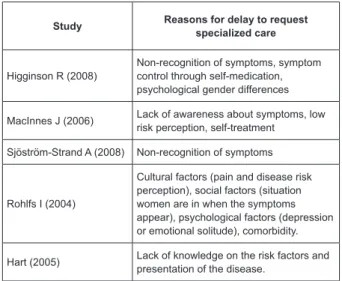
When attempting to explore the reasons underlying
this delay described in literature, a range of personal,
psychosocial, professional and cultural factors emerges(18)
(Figure 2). Aspects like education level, social status or
family burden indirectly affect women’s attitude towards
the irst symptoms of an AMI. Different authors have
attempted to approach this phenomenon(17-19); some
even propose theoretical constructs that try to respond
to women’s behavior, such as the “health beliefs model”,
the “cognitive model”, the “self-regulation model” or the
“model of reasoned action”(20).
Study Reasons for delay to request specialized care
Higginson R (2008)
Non-recognition of symptoms, symptom control through self-medication, psychological gender differences
MacInnes J (2006) Lack of awareness about symptoms, low risk perception, self-treatment
Sjöström-Strand A (2008) Non-recognition of symptoms
Rohlfs I (2004)
Cultural factors (pain and disease risk perception), social factors (situation women are in when the symptoms appear), psychological factors (depression or emotional solitude), comorbidity.
Hart (2005) Lack of knowledge on the risk factors and presentation of the disease.
Figure 2 – Reasons and factors related with the delay
One of the most frequent underlying motives for
Sancho Cantus D, Solano Ruiz MC.
knowledge on CVRF and the disease itself. More than
50% of the sample in a study on the theme was unable
to correctly identify the risk factors for CVD(7), which
supposes scarce knowledge and little awareness on the
causes and CVRF. In the same text, a direct relation is
appointed between the level of knowledge on CVD and
certain socio-demographic risk factors on the one hand
and the acquisition of health promotion behaviors on the
other. In another study(16), the “self-regulation model”
is proposed, according to which the representation
and knowledge of a previous experience are used to
interpret new experiences and modify behaviors. Some
deinitely alarming igures appear, like for example that
only 21.5% of the interviewees knew when to go to the
emergency care service in case of precordial pain(21).
Women’s little knowledge on their disease is a fact
that has been contrasted in the consulted literature,
but one question remains: Where does the information
come from? Communication means, scientiic reports
and the family itself are directly appointed as patients’
information sources on their disease(11). Another piece
of information is no less concerning: the information
patients obtain about CVD does not usually come from
the Nursing group.(22)
In the same line, some authors defend that health
education should start in school and be a source of
permanent relection(22). In fact, it has been proven
that patients who receive health education about IHD
through conversations with nurses, accompanied by
written information in practical guides, mainly to gain
and maintain cardiohealthy habits(22). Different studies
have signaled the need for greater awareness on IHD,
among women as well as health professionals themselves
and society in general, as a means to reduce morbidity
and mortality(23). All of this greater awareness should
include better early recognition of the disease, with a
view to taking early action and avoiding unnecessary
delays in care requests, which in turn affects morbidity
and mortality(7). Nursing plays a fundamental role here,
as it occupies a privileged position to raise women’s
awareness and help them to develop effective CVRF
control strategies(13).
But differences in IHD regarding women not only
regard the way the disease presents itself or the delay to
request specialized care, but also extend to aspects like
the treatment received. In this sense, it has been proven
that women are in situation of total inequality when
compared to men(1), as the treatment women receive
tends to be less aggressive, although igures show higher
mortality and severity rates in comparison with men,
mainly in advanced phases of life(24). Different studies
have conirmed that women who turn to emergency care
due to an AMI have to wait longer to receive care and
that less diagnostic tests are applied(19-20). When women
decide to seek specialized help, they indicate dificulties
in the diagnostic process, and on many occasions are
not taken seriously(24-25). They tend to be treated with
anxiolytics or antidepressants, as care professionals
mistakenly identify the symptoms they refer with
anxious-depressive disorders(14).
Discussion
In this literature review, certain limitations need to
be highlighted in its proposal and the obtained results.
One of them is undoubtedly the selection bias, as mainly
qualitative texts were collected, which mostly address
the study theme from a gender perspective, which is
exactly what the researchers intended to explore. Thus,
the texts mostly relect what women experience, feel
and perceive with regard to the IHD, which can induce
towards the selected bias. On the other hand, this
limitation affected the strategy followed to locate the
articles as, when the texts were selected that were going
to be part of the review, the criteria were extremely
clear; those studies were interested that somehow
explored the IHD from a female perspective.
On the other hand, it is certain that more articles
could have been selected, but a characteristic principle
of qualitative research was applied: that of information
saturation. In this respect, relatively scarce scientiic
production was found about women with IHD, and from
mostly Anglo-Saxon origins. This can be due to a factor
that has appeared throughout the text: women’s little
representativeness in IHD research until a short time ago.
Another factor that needs to be taken into
account with regard to limitations is that, recently, a
predominance of phenomenological or qualitative studies
has been observed; perhaps in the attempt to answer
certain concerns that emerged from recent evidence on
the disease. It is undeniable that women have assumed
a perhaps involuntary protagonist role in IHD, which has
generated an important turn in the classical focus on the
disease, which in turn will provoke substantial changes
in the future approach of this disease.
This review shows that a deicit exists in women’s
knowledge level on IHD when they suffer from the
disease, in line with other authors’ contributions. This
is probably a core element when exploring coronary
takes the form of actions marked by a delay to request
specialized medical care and undervaluation of IHD
symptoms, so that, on most occasions, the disease is
not recognized early. All of this entails a worse prognosis
and a less favorable evolution of IHD in general.
Conclusions
The indings in this review are extremely useful, as
they provide us with an extremely valuable perspective
on the current situation of IHD in women. It should lead
to the proposal of short and medium-term objectives
that broaden the course ahead. In this respect, it is
fundamental to shorten the decision time, so as to be
able to improve the outcomes and survival of women
with AMI. As appointed, the prognosis increases
exponentially with the reduction in the decision time.
One practical way of reaching this goal would be to raise
women’s awareness on the importance of IHD, and that
is where Nursing inds an activity area with extensive
possibilities. Thus, programs need to be put in practice
that, from a Primary Care perspective, inform women
about CVRF, disease peculiarities, myths and existing
beliefs in public opinion, the possible symptoms of IHD
and, maybe the most crucial aspects, how to respond
to these symptoms. Primary prevention and health
promotion are strategies health policies in this respect
should be based on.
Today, we have reached an inlection point regarding
coronary disease, as gender has turned into a factor
that needs to be taken into account in the approach of
this disease. This has entailed a new perspective that
can help us understand this type of illnesses better
and, therefore, to plan preventive strategies aimed at
decreasing the associated morbidity and mortality. An
increasing number of studies echo this reality and intend
to approach the way patients experience and feel their
disease, as a means to gain effectiveness in the ight
against cardiovascular illnesses.
In this context of progressive awareness on the true
situation of CVD around the world, the cooperation of
communication media is fundamental, which should play
a suggestive and progressive leadership role. IHD should
be known and disseminated. In this respect, written
and audiovisual media represent an effective weapon
to make this information women should have reach its
target. In this sense, Nursing professionals represent a
necessary vehicle to educate and inform the population
about cardiovascular risk factors, the consequences CVD
entail and prevention and management-related aspects.
Thus, further qualitative research is needed,
going further in the approach of women’s experiences
with the disease, as a means to elaborate effective
personal, social, family and cultural approach strategies.
It is exactly this multidimensionality of the illness the
intended focus on IHD should be based on, in which
women gain awareness of their disease as a preliminary
step for its further control and self-care.
References
1. Anguita M, Alonso J, Bertomeu V, Gómez-Doblas J,
López-Palop R, Pedreira M, et al. Proyecto de estudio
sobre la situación de la enfermedad cardiovascular de
la mujer en España: conclusiones y recomendaciones
finales. Rev Esp Cardiol Supl. 2008;8:55-8.
2. Baena JM, Del Val J, Tomàs J, Martínez J, Martín R,
González I, et al. Epidemiología de las enfermedades
cardiovasculares y factores de riesgo en atención
primaria. Rev Esp Cardiol. 2005;58(4):367-73.
3. Gabriel R, Alonso M, Segura A, Tormo M, Artigao
L, Banegas J, et al. Prevalencia, distribución y
variabilidad geográfica de los principales Factores
de Riesgo Cardiovascular en España. Rev Esp Cardiol
2008;61(10):1030-40.
4. Alfonso F, Bermejo J, Segovia J. Enfermedades
cardiovasculares en la mujer: ¿por qué ahora? Rev Esp
Cardiol. 2006;59(3):259-63.
5. Heras M. Cardiopatía isquémica en la mujer:
presentación clínica, pruebas diagnósticas y tratamiento
de los síndromes coronarios agudos. (2006). Rev Esp
Cardiol. 2006;59(4):371-8.
6. Solano Ruiz MC. Fenomenología-hermenéutica
y enfermería. Cult Cuidados: Rev Enf Hum.
2007;10(19):5-6.
7. García-Moriche N, Rodríguez-Gonzalo A, Muñoz-Lobo
J, Parra-Cordero S, Fernández-De Pablos A. Calidad de
vida en pacientes con ictus. Un estudio fenomenológico.
Enferm Clin. 2010;20(2):80-7.
8. Fernández AL, Mgueraman R, Cruzado C. Campaña
de prevención de factores de riesgo cardiovascular
y Educación para la Salud. Enferm Cardiol.
2005;12(36):35-9.
9. Higgison R. Women’s help-seeking behaviour
at the onset of myocardical infarction. Br J Nurs.
2008;17(1):10-4.
10. Sjöström-Strand A, Fridlund B. Women’s descriptions
of symptoms and delay reasons in seeking medical care
et the time of a first myocardical infraction: a qualitative
Sancho Cantus D, Solano Ruiz MC.
11. Lockyer L. Women’s interpretation of their
coronary heart disease symptoms. Eur J Cardiovasc
Nurs.2005;4:29-35.
12. Sánchez C, Suárez C. Patología cardiovascular de la
mujer. Hipertensión. 2003;20(4):171-82.
13. Rohlfs I, García M, Gavaldà L, Medrano MJ, Juvinyà
D, Baltasar A, el al. Género y cardiopatía isquémica. Gac
Sanit. 2004;18(supl 2):55-64.
14. McSweeney J, Cody M, Crane P. Do you Know them
when you see them? Women’s prodromal and acute
symptoms of myocardical infraction. J Cardiovasc Nurs.
2003;15(3):26-38.
15. Ruiz MT, Martín M, La Parra D, Vives C, Albadalejo M.
El enfoque de género en las noticias de salud. Gac Sanit.
2004;18(supl 2):65-74.
16. Lockyer L. Women’s interpretation of cardiac
symptoms. Eur J Cardiovasc Nurs. 2008;4(7):161-2.
17. Marrugat J, Sala J, Aboal J. Epidemiología de las
enfermedades cardiovasculares en la mujer. Rev Esp
Cardiol. 2006;59(3):264-74.
18. Urquijo S, Giles M, Richard’s M, Pianzola E. Variables
psicológicas asociadas a las patologías
isquémico-cardiovasculares. Un estudio de género. Rev Fed Arg
Cardiol. 2003;32:190-8.
19. Rosenfeld A, Lindauer A, Darney B. Understanding
treatment-seeking delay in women with acute
myocardical infarction: descriptions of decision-making
patterns. Am J Crit Care. 2005;14(4):285-93.
20. Waller C. Understanding prehospital delay behaviour
in acute myocardial infarction in women. Crit Pathways
Cardiol.: J Evidence Based Med. 2006;5(4):228-34.
21. López J, Martínez E, Pardo L, Escudero S, Cañón
R, Costas MT. Encuesta a los pacientes con cardiopatía
isquémica sobre el modo de actuación ante los distintos
síntomas de alarma. Aten Primaria 2003;31(4):239-47.
22. Del Río O, Maldonado A, Carmena O, Davós R, Garoz
B, Gutiérrez A et al. Educación sanitaria a pacientes con
cardiopatía isquémica. Enferm Cardiol. 2005;35(2):24-7.
23. Franco B, Rejane E, Goldemeyer S, Nogueira E.
Patients with acute myocardical infarction and interfering
factors when seeking emergency care: implications
for health education. Rev. Latino-Am. Enfermagem.
2008;16(3):414-8.
24. Sancho Cantus D, Romero Sánchez J, Pastor Montero
S, Martínez Sabater A, Sánchez Esteban B. Atención
integral a la mujer con cardiopatía isquémica tras el alta
hospitalaria. Biblioteca Lascasas, 2010; 6(2). Disponible
en: http://www.indexf.com/lascasas/documentos/
lc041.php.
25. Hart PL. Women’s perceptions of coronary heart
disease: an integrative review. J Cardiovasc Nurs.
2005;20(3):170-6.
Received: Jan. 5th 2011