Functional Validation of a Constitutive
Autonomous Silencer Element
Heyuan Qi1,2,3☯, Mingdong Liu3☯, David W. Emery3,4, George Stamatoyannopoulos3*
1CAS Key Laboratory of Genome Sciences and Information, Beijing Institute of Genomics, Chinese Academy of Sciences, Beijing, China,2University of Chinese Academy of Sciences, Beijing, China, 3Department of Medicine, Division of Medical Genetics, University of Washington, Seattle, WA, United States of America,4Institutional Biosafety Committee Services, WIRB-Copernicus Group, Puyallup, WA, United States of America
☯These authors contributed equally to this work. *[email protected]
Abstract
Sequences of the genome that are capable of silencing gene expression are thought to play a key role in gene regulation. However, very few silencer elements capable of functioning in mammalian cells have been described, and only a fraction of these have been tested for the ability to function in an autonomous fashion. We report here the characterization and func-tional validation of a constitutive autonomous silencer element from the human genome called T39, and the comparison of T39 to three other putative silencer elements previously described by others. Functional analysis included one assay for enhancer-blocking insula-tor activity and two independent assays for silencer activity, all based on stable transfection and comparison to a neutral spacer control. In erythroid K562 cells, T39 exhibited potent si-lencer activity, the previously described element PRE2-S5 exhibited modest sisi-lencer activi-ty, and the two other previously described elements exhibited no silencer activity. T39 was further found to be capable of silencing three disparate promoters, of silencing gene expres-sion in three disparate cell lines, and of functioning as a single copy in a topology-indepen-dent manner. Of the four elements analyzed, only T39 exhibits a constitutive pattern of DNase hypersensitivity and binding by CTCF. In its native location the T39 element also ex-hibits a unique interaction profile with a subset of distal putative regulatory elements. Taken together, these studies validate T39 as a constitutive autonomous silencer, identify T39 as a defined control for future studies of other regulatory elements such as insulators, and pro-vide a basic chromatin profile for one highly potent silencer element.
Introduction
Mammalian gene expression is regulated incisby DNA sequences that serve as binding sites
for proteins which support or suppress transcription either by directly interacting with tran-scription factors or by modifying the surrounding chromatin. Information generated by the ENCODE project [1], as well as similar studies have led to the chromatin profiling and
OPEN ACCESS
Citation:Qi H, Liu M, Emery DW,
Stamatoyannopoulos G (2015) Functional Validation of a Constitutive Autonomous Silencer Element. PLoS ONE 10(4): e0124588. doi:10.1371/journal. pone.0124588
Academic Editor:Ferenc Müller, University of Birmingham, UNITED KINGDOM
Received:July 29, 2014
Accepted:March 14, 2015
Published:April 24, 2015
Copyright:© 2015 Qi et al. This is an open access article distributed under the terms of theCreative Commons Attribution License, which permits unrestricted use, distribution, and reproduction in any medium, provided the original author and source are credited.
Data Availability Statement:All relevant data are within the paper and its Supporting Information files.
Funding:This work was supported by National Institutes of Health grant PO1 HL53750. The funders had no role in study design, data collection and analysis, decision to publish, or preparation of the manuscript.
functional characterization of several classes of chromatin regulatory sequences, including en-hancers, promoters, and more recently chromatin insulators [2–4]. Regulatory elements
capa-ble of silencing gene expression have also been described in several species (for example, see [5,6]). However, the number of silencers indentified in the mammalian genomes has been very limited, resulting in a dearth of information regarding silencer-specific chromatin profiles and mechanisms of action. Limited information suggests there are two general categories of silenc-ers: elements that only function in a specific context to repress promoter activity (termed nega-tive regulatory elements [5]); and elements that function in an autonomous,
context-independent manner. Negative regulatory elements function by recruiting proteins which dis-rupt or inactivate the formation of functional Pol II transcription complexes at otherwise acces-sible promoters. This is accomplished by recruiting repressor proteins, blocking the nearby binding of activator proteins, or competing directly with activator proteins for the same bind-ing site (reviewed in [6]). Autonomous silencers function by establishing a repressive chroma-tin state that can be stably inherited [7]. This is typically accomplished by recruiting proteins capable of modifying DNA (e.g. methyltransferases) or histone tails (e.g. histone deacetylases) in a manner that supports the formation of heterochromatin, or proteins that help stabilize and propagate heterochromatin (e.g. polycomb group proteins, heterochromatin protein 1). This in turn prevents activators and transcription factors from accessing gene promoters.
The availability of a very limited number of autonomous mammalian silencer elements de-scribed in the scientific literature has made it difficult to identify common mechanisms of ac-tion, as well as common chromatin profiles. Advances toward indentifying and characterizing autonomous silencer elements have also been hampered by the lack of independently-validated functional assays. A question even remains as to whether silencer activity determined by tran-sient transfection of reporter constructs can accurately predict whether a particular sequence is capable of providing silencer activity in the setting of intact chromatin. We report here the use of two functional assays based on stable transfection of K562 cells, which allow for the identifi-cation of potential silencers in the human genome. Using these assays we characterize a novel silencer element from the human genome, silencer T39, which is active in mammalian cells. We also use these stable transfection assays to functionally characterize elements previously re-ported to function as silencers on the basis of transient assays. Finally, we present data indicat-ing that the T39 silencer is functional in combination with three distinct promoters and in three distinct cell lines, and that it physically interacts with other putative regulatory elements within its native locus.
Materials and Methods
Cell lines
The following human cell lines were used for these studies: K562 (bone marrow, myelo/erythro-leukemia, ATCC CCL-243), HEK-293 (embryonic kidney, ATCC CRL-1573), HeLa (epithelial, adenocarcinoma, ATCC CCL-2), and HepG2 (liver, hepatocellular carcinoma, ATCC HB-8065). K562 cells were cultured in Iscove's Modified Dulbecco's Medium supplemented with 10% fetal bovine serum (IMDM/FBS) and the other cell lines were cultured in Dulbecco's Modi-fied Eagles Medium supplemented with 10% fetal bovine serum (DMEM/FBS) at 37°C, 5% CO2.
Drug-resistant colony assay
The drug-resistant colony assay has been described previously [4,8,9]. The reporter plasmids contain an expression cassette for the G418-resistance geneneo, transcribed by a promoter from
DNase I hypersensitive site 2 (HS2) of the mouseβ-globin gene cluster and placed 30of theneo
expression cassette. In order to assess both silencer and enhancer-blocking insulator activity, candidate sequences are inserted immediately 50of theneoexpression cassette and 30between
theneoexpression cassette and HS2 enhancer. In order to assess silencer activity only, candidate
sequences are inserted immediately 50of theneoexpression cassette and 30of the HS2 enhancer.
Candidate sequences were inserted by MultiSite Gateway exchange [9]. Reporter plasmids were linearized and transfected into K562 cells at a dose of 2μg per 106cells using the Amaxa
Biosys-tems Nucleofector II electroporator and Nucleofector V kit (Lonza Group Ltd., Basel, Switzer-land). The cells were then resuspended in 5 mL IMDM/FBS and cultured for 2 days to allow for genomic integration of the plasmid. After this, the cells were collected, counted, resuspended at a dose of 5 x10⁵cells in 5 mL IMDM, 20% FBS, 0.8% low-melting agarose, and 1 mg/mL of the neomycin drug analog G418 (active component), and plated in 60 mm tissue culture dishes in triplicate. These semisolid cultures were incubated another 2–3 weeks and then scored for colony
formation. Inserts included the PRE2-S5, MECP2 F3, PDGFA 50SHS, and T39 putative silencers
listed inTable 1, the 1.2 kb version of the prototypic chromatin insulator cHS4 element as a pos-itive insulator control [8], and a 308 bp fragment from the bacterial drug resistance genezeoas a
neutral spacer control [10]. SeeS1 Tablefor details on datasets.
GFP reporter assay
The GFP reporter plasmids contain an expression cassette for GFP terminated with a polyade-nylation sequence from the virus SV40. This cassette is transcribed either by the same HBG1 promoter used for the drug-resistance colony assay reporter plasmid, the promoter from cyto-megelovirus (CMV), or the promoter from the human PGK gene. These reporter constructs were either used directly or with the T39 silencer element inserted either 50or 3' of the
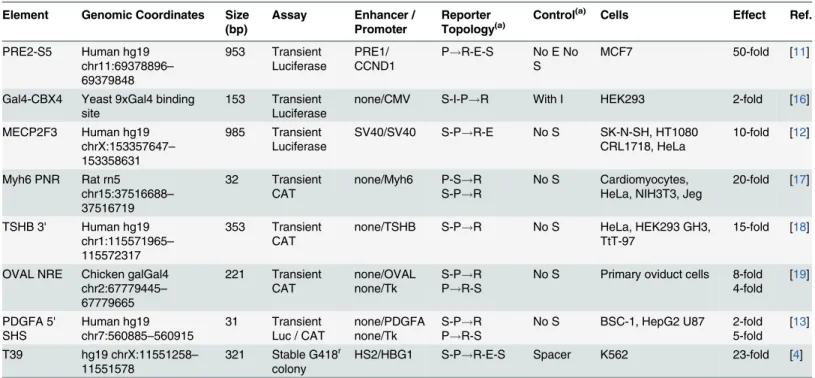
Table 1. Putative silencers reported in the literature.
Element Genomic Coordinates Size (bp)
Assay Enhancer / Promoter
Reporter Topology(a)
Control(a) Cells Effect Ref.
PRE2-S5 Human hg19 chr11:69378896– 69379848 953 Transient Luciferase PRE1/ CCND1
P!R-E-S No E No S
MCF7 50-fold [11]
Gal4-CBX4 Yeast 9xGal4 binding site
153 Transient Luciferase
none/CMV S-I-P!R With I HEK293 2-fold [16]
MECP2F3 Human hg19 chrX:153357647–
153358631
985 Transient Luciferase
SV40/SV40 S-P!R-E No S SK-N-SH, HT1080 CRL1718, HeLa
10-fold [12]
Myh6 PNR Rat rn5
chr15:37516688–
37516719
32 Transient CAT
none/Myh6 P-S!R S-P!R
No S Cardiomyocytes, HeLa, NIH3T3, Jeg
20-fold [17]
TSHB 3' Human hg19 chr1:115571965–
115572317
353 Transient CAT
none/TSHB S-P!R No S HeLa, HEK293 GH3,
TtT-97
15-fold [18]
OVAL NRE Chicken galGal4 chr2:67779445– 67779665 221 Transient CAT none/OVAL none/Tk S-P!R P!R-S
No S Primary oviduct cells 8-fold 4-fold
[19]
PDGFA 5' SHS
Human hg19 chr7:560885–560915
31 Transient Luc / CAT
none/PDGFA none/Tk
S-P!R P!R-S
No S BSC-1, HepG2 U87 2-fold 5-fold
[13]
T39 hg19 chrX:11551258–
11551578
321 Stable G418r colony
HS2/HBG1 S-P!R-E-S Spacer K562 23-fold [4]
(a)P
!R, Promoter transcribing Reporter gene; S, silencer; E, enhancer, I, barrier insulator.
expression cassette. Reporter plasmids were either left circularized or were linearized with Sca I, and transfected into HEK293 cells, K-562 cells, HeLa cells, or HepG2 cells as for theneo
colo-ny assay, except that the cells were expanded in DMEM/FBS for 7 days without selection. The cells were then collected, washed, and analyzed by flow cytometry for reporter GFP expression. The level of expression was determined by measuring the mean fluorescence of the cells located within the GFP-positive gate. SeeS1 Tablefor details on datasets.
Informatics
Data involving chromatin profiles, including CTCF binding, Digital DNase footprinting, DNase I hypersensitivity, and CTCF Interactions, where derived from data publically available on the UCSC Genome Browser (http://genome.ucsc.edu).
Track names used for analysis include the following:
CTCF binding: K562 CTCF TFS ChIP-seq raw signal rep 1/2 from ENCODE/UW.
Digital DNase I footprinting: K562 DNase I DGF per-base signal rep 1/2 from ENCODE/UW.
DNase I hypersensitivity: K562 DNase I HS raw signal rep 1/2 from ENCODE/UW.
CTCF interactions: K562 CTCF ChIA-PET Interactions rep 1/2 form ENCODE/GIS.
Results
Experimental Approach
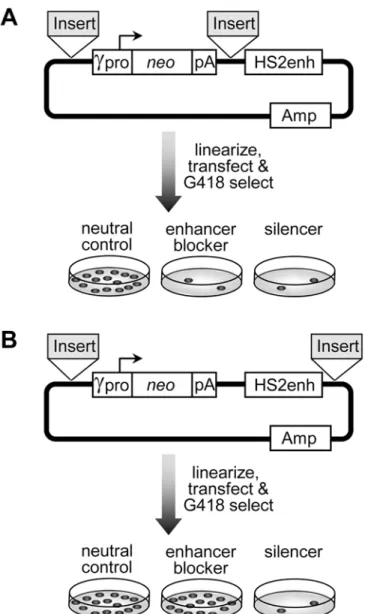
In our search for enhancer-blocking insulators from the human genome, we used reporter constructs in which candidate sequences were placed between an expression cassette for the drug-resistance geneneoand a potent enhancer (Fig 1A) as described previously [4,8,9]. If the
insert contains an enhancer blocking insulator, it will disrupt communication between the en-hancer and promoter, resulting in a decreased level ofneogene expression and a decreased rate
of colony formation when transfected K562 cells are grown in a semisolid culture in the pres-ence of neomycin drug analog G418. However, this assay cannot distinguish between enhanc-er-blocking insulators and elements capable of silencing gene expression, since both activities cause a decrease inneogene expression. To distinguish between these two activities, it is
neces-sary to use a second assay in which the candidate element is instead used to bracket the enhanc-er andneogene expression cassette from the outside (Fig 1B) as described previously [4,8]. In
this configuration, blocking insulators are no longer capable of blocking enhancer-promoter interactions and thus have no effect onneogene expression or the rate of
drug-resis-tant colony formation. In contrast, elements capable of silencing gene expression should still be capable of reducingneogene expression in this setting, resulting in a reduction in the rate of
drug-resistant colony formation.
Initial characterization of the T39 silencer
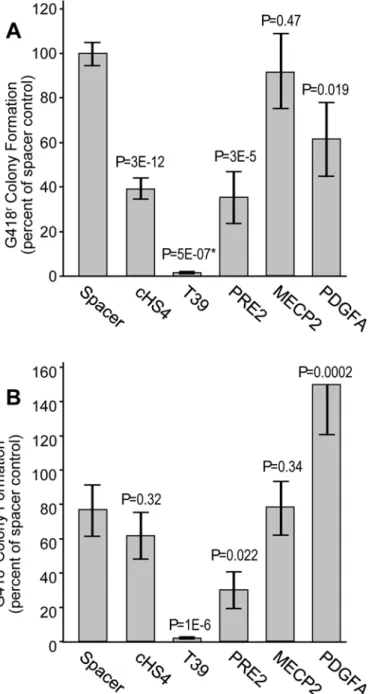
insulator cHS4. However, as seen inFig 2B, the T39 element also decreased the rate of colony formation to 2% of that for the neutral spacer control in the silencer assay. In comparison, the cHS4 insulator had no statistically distinguishable effect on colony formation in this assay. Taken together, these studies demonstrate that the T39 element is a powerful silencer element. Fig 1. Schema for drug-resistant colony assay.(A) Enhancer-blocking and silencer assay. The reporter plasmid used for this assay contains an expression cassette for the bacterial drug resistance geneneo
transcribed by an erythroid promoter from theγ-globin gene HBG1 and terminated with the SV40
polyadenylation signal. An erythroid HS2 enhancer from theβ-globin locus control region is located 30of this
cassette. Candidate elements are inserted 50of the expression cassette and 30between the expression
cassette and the enhancer. After being linearized, the plasmid is transfected into erythroid K562 cells, which are then analyzed for the frequency of colony formation under selection with the neomycin drug analog G418. Both enhancer-blocking insulator and silencers are expected to reduce the rate of G418-resistant colony formation. (B) Silencer-only assay. The reporter plasmid is the same as for the enhancer-blocking assay, except that candidate elements are inserted 50of theneoexpression cassette and 30of the HS2 enhancer in
a manner that brackets both elements and allows the enhancer to interact with the promoter. As above, the plasmids are linearized and transfected into K562 cells, which are then analyzed for the frequency of drug-resistant colony formation. In this case, only silencers are expected to reduce the rate of G418-drug-resistant colony formation.
Fig 2. Assessment of silencer activity by drug-resistance colony formation.(A) Assessment of putative silencer elements in the enhancer-blocking insulator assay. The indicated candidates were inserted into the enhancer-blocking insulator reporter construct and analyzed for G418-resistant colony formation in K-562 cells. (B) Assessment of putative silencer elements in the silencer assay. The indicated candidates were inserted into the silencer reporter construct and analyzed for G418-resistant colony formation in K-562 cells. Data are shown for the mean±s.e. from two or more independent transfections plated in triplicate, and are normalized the colony formation achieved with the spacer control. Spacer, 308 bp fragment from the bacterial gene zeo; cHS4, 1.2 kb fragment containing the cHS4 chromatin insulator. P values are based on one-sided
t-test compared to the spacer control, except for the T39 sample in panel A. As indicated by (*), in this one case the data did not follow a normal distribution determined by the Lilliefors test, so the P value is based on the Wilcoxon rank-sum test compared to the spacer control. SeeS1 Tablefor details on datasets.
The T39 element is located on the short arm of the X chromosome (p22.2) in the first intron of the gene ARHGAP6 (Fig 3A). The sequence of T39 contains three CTCF motifs, all from the same CTCF class 38, which exhibits an average CTCF occupancy of 90.79% [4]. Genomic pro-files of the T39 sequence suggested that all three sites are bound by CTCF in K562 cells (Fig 3B), and that binding by CTCF results in distinct footprints detected by digital DNase I geno-mic footprinting analysis in K562 cells (Fig 3C). These properties of the T39 element appear to be ubiquitous, since strong peaks of CTCF binding and DNase hypersensitivity are seen in 19 independent cell lines [4].
Comparison of T39 with other silencers from the literature
A partial list of silencers from the literature appears inTable 1. These silencers have been iden-tified in cells of various species using transient reporter assays based on expression of luciferase, chloramphenicol acetyltransferase, or both. Silencer activity was uniformly assessed by
Fig 3. Genomic properties of the native T39 locus.(A) Chromosome location. The location of the T39 element is shown within the body of the ARHGAP6 gene at p22.2 of the human X chromosome. Below this is shown the primary sequence of the T39 element used for functional studies, with the consensus sequences for the three class-38 CTCF-binding motifs indicated in underlined bold type face (see [4] for details of CTCF-binding motif classes). (B) CTCF ChIP-seq profile for the native T39 sequence in K562 cells. The density of ChIP-seq reads are presented as vertical bars. The location of the CTCF binding motifs are indicated underneath the histogram. The putative distribution of CTCF binding is shown as shaded curves centered on each CTCF binding motif. (C) Digital DNase footprint profile for the native T39 sequence in K562 cells. The density of single-base DNase-seq reads are presented as vertical bars. The location of the CTCF binding motifs are indicated underneath the histogram.
transient transfection and ranged from 2-fold to 50-fold. For comparison with T39 we selected three silencers. PRE2-S5 is a silencer studied in a breast cancer cell line (MCF7) and was shown to reduce expression 50-fold compared to a no-insert control [11]. MECP2 F3 is a silencer ac-tive in several cell lines and was shown to reduce expression an average of 10-fold compared to a no-insert control [12]. PDGFA 50SHS is a silencer active in several cell lines and was shown
to reduce expression 2- to 5-fold compared to a no-insert control [13]. When assessed using the enhancer-blocking assay described inFig 1A, the PRE2-S5 element reduced the frequency of G418-resistant colony formation 2.4-fold compared to the neutral spacer control, while the MECP2 F3 and PDGFA 5' SHS elements had no statistically distinguishable effect on the rate of G418-resistant colony formation (Fig 2A). In comparison, the cHS4 element used as an insu-lator control reduced G418-resistant colony formation 2.5-fold, and the T39 silencer reduced G418-resistant colony formation 77-fold. When assessed using the silencer configuration, the PRE2 element reduced the frequency of G418-resistant colony formation 2.2-fold compared to the spacer control, while the MECP2 element had no statistically distinguishable effect on the rate of colony formation and the PDGFA element actually increased the rate of colony forma-tion (Fig 2B). In this configuration, the cHS4 insulator had no statistically distinguishable effect on the rate of G418-resistant colony formation as expected, while the T39 silencer reduced the rate of colony formation 36-fold. Taken together, these studies indicate that PRE2-S5 functions as an autonomous silencer, while MECP2-F3 and PDGFA 50SHS do not function as silencers
in this integration-based assay. These studies also demonstrate that the T39 element is a far more potent autonomous silencer than the PRE2-S5 element. Chromatin profiling of the PRE2, MECP2, and PDGFA native loci revealed the absence of constitutive DHSs in five inde-pendent cell lines used in their original characterizations while the native T39 loci exhibited strong DHS peaks in all five of these cell lines (S1 Fig). These profiles suggest only the T39 ele-ment should be expected to exhibit constitutive activity.
Silencer activity is marginally influenced by context
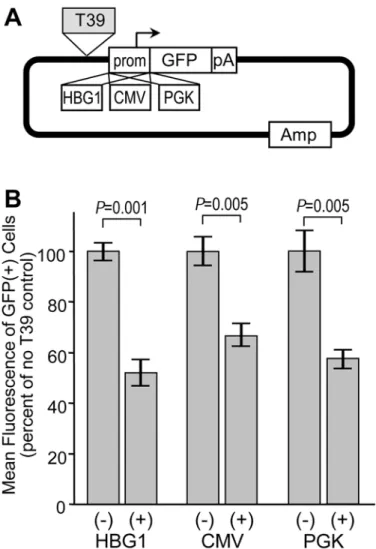
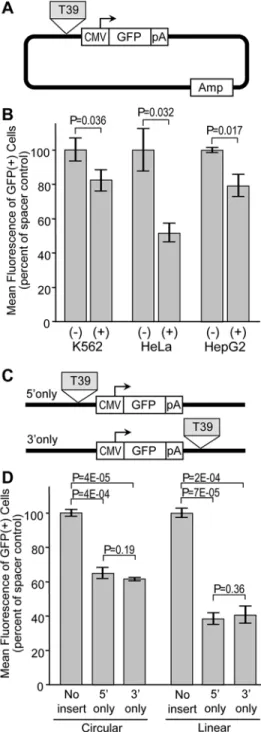
In theory, autonomous silencer elements should be capable of exerting their activity on different sources of promoters and within multiple cell lines. The G418-reisistant colony assay and asso-ciated reporter construct could not be easily used to assess these properties, since the HS2 en-hancer does not function with all promoters, the HBG1 promoter does not function in all cell types, and not all cell types are capable of forming distinct colonies in agarose. For these rea-sons, we turned to the reporter construct diagramed inFig 4A. This construct links various pro-moters to a GFP expression cassette, with candidate insulators inserted immediately 5' of the promoter. In this assay, the degree of silencing is assessed by comparing the intensity of reporter GFP expression in GFP-positive cells following stable plasmid transfection. As with the drug-re-sistance colony assay, this GFP reporter assay provides an opportunity to detect silencer activity in the context of stable integration and intact chromatin. However, the use of GFP provides for a very wide dynamic range that makes it possible to assess reporter gene expression from a wide range of promoters and in a wide range of cell types. Using this reporter system in easily trans-fectable HEK293 cells, we found that the T39 element was capable of silencing the activity of three very distinct promoters: the HBG1 promoter, a constitutive promoter from cytomegalovi-rus (CMV), and the constitutive promoter from the human PGK gene (Fig 4B). The degree of silencing was nearly uniform, ranging from 1.5-fold for CMV to 1.9-fold for HBG1.
basal activity of this promoter. This in turn restricts the dynamic range available for detecting the effect of a silencer. Taking this into account, we chose the reporter construct with the highly active CMV promoter for further studies (Fig 5A). As summarized inFig 5B, we found that the T39 element silenced this promoter in erythroid K-562 cells, epithelial HeLa cells, and HepG2 liver cells. In this case the degree of silencing ranged a little more broadly, from 1.2-fold in K-562 cells to 1.9-fold in HeLa cells. In order to determine whether the silencing activity of T39 was affected by reporter construct topology, we placed this element either 5' only or 3' only of this CMV-GFP expression cassette (Fig 5C), and analyzed the effects on reporter GFP expres-sion following transfection of HepG2 cells. As a further control, we also compared circular ver-sus linear plasmids, since the circular topology would, in effect, place the T39 element both 5' and 3' of the CMV-GFP expression cassette. As seen in the newFig 5D, the T39 element was Fig 4. Influence of promoter on silencer activity.(A) GFP reporter construct. The reporter plasmid contains a GFP expression cassette terminated with the SV40 polyadenylation signal, linked to one of the three indicated promoters. The reporter constructs were either used directly or with the T39 silencer inserted 50of the promoter. (B) Assessment of reporter expression. Reporter plasmids were linearized and transfected
into HEK293 cells. After 7 days, the level of reporter gene expression was analyzed by measuring the mean fluorescence of the cells expressing GFP by flow cytometry. Data are shown for the mean±s.e. from three independent transfections, and are normalized to the mean fluorescence of the construct without the T39 silencer. P values based on one-sidedt-test comparing constructs with and without the T39 silencer for each promoter. SeeS1 Tablefor details on datasets.
Fig 5. Influence of cell type and silencer topology on silencer activity.(A) GFP reporter construct for assessment in different cell lines. The reporter plasmid is the same as inFig 3, except in this case only the constructs using the CMV promoter with and without the T39 silencer were compared. (B) Assessment of reporter expression in different cell lines. Reporter plasmids were linearized and transfected into the indicated cell lines. After 7 days, the level of reporter gene expression was analyzed by measuring the mean
fluorescence of the cells expressing GFP by flow cytometry. (C) GFP reporter constructs for assessment of silencer topology. The reporter plasmids are the same as in panel A, except the T39 silencer was inserted either 5' only, or 3' only, of the CMV-GVP cassette. (D) Assessment of reporter expression for assessment of silencer topology. Reporter plasmids were left circular or were linearized and transfected into HepG2 cells. After 7 days, the level of reporter gene mean fluorescence was assessed by flow cytometry as for panel B. Data are shown for the mean±s.e. from three independent transfections, and are normalized to the mean
fluorescence of the construct without the T39 silencer. P values based on one-sidedt-test comparing constructs with and without the T39 silencer for each cell line. SeeS1 Tablefor details on datasets.
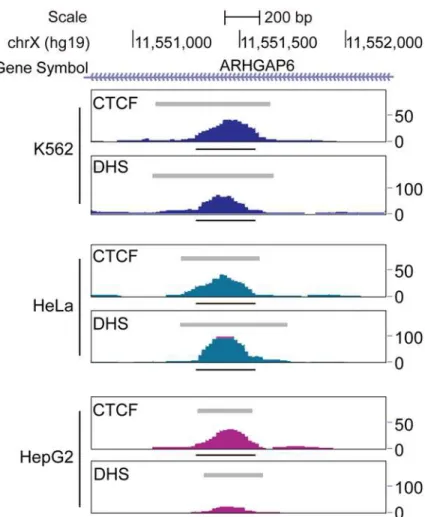
equally effective at silencing expression when located in either position, with an average degree of silencing of 1.6-fold when the reporter was circular and 2.5-fold when the reporter was line-ar. Genomic profiling demonstrated that the T39 element is both bound by CTCF and contains a DHS in all three of the cell lines used for these studies (Fig 6).
Discussion
studied in the context of stable gene transfer, where the reporter constructs were allowed to inte-grated into the target cell genome in a manner that allowed for the formation of intact chroma-tin; all of the other elements were studied with transient transfection assays. In addition, only the studies with the T39 element included the use of a neutral "spacer" sequence as a control, making it possible to distinguish between the direct effects of the candidate silencer element and the indi-rect effects of changes in spacing between enhancers, promoters, and other regulatory elements.
Of the three elements we identified from the studies of others and analyzed in the drug-re-sistance colony assay, only PRE2-S5 [11] exhibited autonomous silencer activity. It remains un-clear why the other two elements, MECP2 F3 [12] and PDGFA 50SHS [13], failed to exhibit
autonomous silencer activity in the drug-resistant colony assay. Both of these elements had been shown by others to function in the context of heterologous promoters, but they were not previously tested with the HBG1 promoter used in this particular assay. Likewise, neither of these elements had been previously tested in erythroid K562 cells, although they had been shown to function in several other cell lines. Perhaps most importantly, neither of these two el-ements had previously been tested in the context of stable gene transfer, where they would be required to function in the context of intact chromatin. Chromatin profiling suggests that these elements are not constitutively active and thus unlikely to function in a constitutive manner.
Regardless to the reasons for the discrepancies between our results and the results of others, our studies demonstrate that these two elements do not function as fully autonomous silencers.
The T39 element functioned as the most potent autonomous silencer out of the four ele-ments analyzed here. As reported here, the T39 silencer reduced the rate of G418-resistant col-ony formation 77-fold in the enhancer-blocking configuration and 36-fold in the silencer configuration. Although less dramatic, this element also reduced expression of the GFP report-er constructs in the context of three distinct promotreport-ers and three distinct cell lines. In addition, this silencing activity can be achieved when T39 is used as a single copy, and when the T39 ele-ment is placed either 5' or 3' of an expression cassette. From these studies we conclude the T39 element acts as a potent, constitutive, autonomous silencer.
The T39 silencer exhibited statistically significant silencer activity in both of the drug-resis-tant colony assays and the GFP expression assay. However, the magnitude of this effect varied greatly between these two assay systems. Previous studies demonstrated that the drug-resistant colony assay measures the frequency of transfection events in which expression of theneo
re-porter gene exceeds a specific threshold [3]. This property allows the drug-resistant colony assay to amplify small differences in gene expression. The GFP expression assay, on the other hand, allows for a direct and linear measurement of reporter gene expression in a manner that does not amplify small differences. In addition, the drug-resistant reporter constructs contain two copies of the silencer element in a flanking arrangement, while the GFP reporter construct only contains one copy of the silencer element. This represents a difference both in the silencer dose and the ability of the silencer to block interactions between tandemly integrated reporter constructs or interactions between integrated reporter constructs and the surrounding genome.
the X-inactivation complex of Drosophila and humans [15]. Future addition/deletion studies will be needed to specifically link CTCF binding to the silencing activity of the T39 element, as has been done in other settings [20].
In conclusion, our studies independently validated two integration-based reporter assays for the identification of silencer elements, and use these assays to validate two autonomous silencer elements: PRE2-S5 and T39. The drug-resistant colony assay provides the greatest degree of sen-sitivity, while the GFP reporter assay allows for a more direct assessment of silencer activity and provides a greater degree of experimental flexibility. These studies also suggest that the T39 se-quence functions as a potent, constitutive autonomous silencer in a manner that is independent of the promoter or cell line. This element can be used as a positive control for studies into other silencer elements, as well as chromatin insulators. More studies are needed to dissect the mecha-nisms underlying silencer function, and to link these activities to specific chromatin profiles.
Supporting Information
S1 Fig. DHS profile for putative insulators in multiple cell lines.The DNase I hypersensitive site (DHS) profiles are presented for the four putative insulators in the 5 indicated cell lines. The four putative silencer elements T39, PRE2- S5, MECP2-F3, and PDGFA 50SH5, are
de-scribed at length in the main manuscript. The five cell lines were chosen based on their use in the previous characterization of the putative insulators and the availability of publicly accessible DHS profiles. The density of DNase-seq reads are presented as vertical bars, with gray horizon-tal bars indicating the presence of statistically significant DHS peaks. The locations of the puta-tive silencer sequences are indicated underneath the histograms. Each window is set at 1000 bp. (PDF)
S2 Fig. CTCF interactome for the native T39 locus.The image shows the genomic organiza-tions of a 710 kb window around the native T39 locus in K562 cells, derived from publically available data on the UCSC Genome Browser. The location of the T39 element and three sur-rounding genes (ARHGAP6, AMELX, and MSL3) are indicated. Also indicated are the pro-moters for these genes (P). The middle two tracks show the CTCF and DHS profiles for the region. At the bottom is indicated the CTCF interactome for the region, as determined by chro-matin capture technologies. Interactive regions are connected by red arches, with the intensity of the red representing the frequency of the interaction. Note that T39 interacts with a DHS/ CTCF element inside the same ARHGAP6 intron, with a DHS/CTCF element at the distal end of the ARHGAP6 gene, and with a DHS/CTCF element in the intron of the adjoining MSL3 gene, but not with any of the gene promoters.
(PDF)
S1 Table. Summary of Raw Data. (PDF)
Acknowledgments
The authors wish to thank G. Felsenfeld and D.M. Bodine for reagents and help with the plas-mid-based insulator and silencer assays.
Author Contributions
References
1. ENCODE Project Consortium, et al. Identification and analysis of functional elements in 1% of the human genome by the ENCODE pilot project. Nature. 2007; 447: 799–816. PMID:17571346
2. Xi H, Shulha HP, Lin JM, Vales TR, Fu Y, Bodine DM, et al. Identification and characterization of cell type-specific and ubiquitous chromatin regulatory structures in the human genome. PLoS Genet. 2007; e136. PMID:17708682
3. Groth AC, Liu M, Wang H, Lovelett E, Emery DW. Identification and characterization of enhancer-block-ing insulators to reduce retroviral vector genotoxicity. PLoS One. 2007; e76528.
4. Liu M, Maurano MT, Wang H, Qi H, Song CZ, Navas PA, et al. Genomic discovery of potent chromatin insulators for human gene therapy. Nat Biotech. 2015; 33: 193–203.
5. Ogbourne S, Antalis TM. Transcriptional control and the role of silencers in transcriptional regulation in eukaryotes. Biochem J. 1998; 331 (Pt 1): 1–14. PMID:9512455
6. Maston GA, Evans SK, Green MR. Transcriptional regulatory elements of the human genome. Annu Rev Genomics Hum Genet. 2006; 7: 29–59. PMID:16719718
7. Dean A. In the loop: long range chromatin interactions and gene regulation. Brief Funct Genomics. 2011; 1: 3–10.
8. Chung JH, Whiteley M, Felsenfeld G. A 5' element of the chicken beta-globin domain serves as an insu-lator in human erythroid cells and protects against position effects inDrosophila. Cell. 1993; 1993; 74: 505–514. PMID:8348617
9. Tubb J, Groth AC, Leong L, Emery DW. Simultaneous sequence transfer into two independent loca-tions of a reporter vector using MultiSite Gateway technology. Biotechniques. 2005; 39: 553–557.
PMID:16235567
10. Aker M, Tubb J, Groth AC, Bukovsky AA, Bell AC, Felsenfeld G, et al. Extended core sequences from the cHS4 insulator are necessary for protecting retroviral vectors from silencing position effects. Hum Gene Ther. 2007; 18: 333–343. PMID:17411365
11. French JD, Ghoussaini M, Edwards SL, Meyer KB, Michailidou K, Ahmed S, et al. Functional variants at the 11q13 risk locus for breast cancer regulate cyclin D1 expression through long-range enhancers. Am J Hum Genet. 2013; 92: 489–503. doi:10.1016/j.ajhg.2013.01.002PMID:23540573
12. Liu J, Francke U. Identification of cis-regulatory elements for MECP2 expression. Hum Mol Genet. 2006; 15: 1769–1782. PMID:16613900
13. Liu B, Maul RS, Kaetzel DM Jr. Repression of platelet-derived growth factor A-chain gene transcription by an upstream silencer element. Participation by sequence-specific single-stranded DNA-binding pro-teins. J Biol Chem. 1996; 271: 26281–26290. PMID:8824279
14. Brand AH, Breeden L, Abraham J, Sternglanz R, Nasmyth K. Characterization of a "silencer" in yeast: a DNA sequence with properties opposite to those of a transcriptional enhancer. Cell. 1985; 41: 41–48.
PMID:3888409
15. Kadlec J, Hallacli E, Lipp M, Holz H, Sanchez-Weatherby J, Cusak S, et al. Structural basis of MOF and MSL3 recruitment into the dosage compensation complex by MSL1. Nat Struct Mol Biol. 2011; 18: 142–149. doi:10.1038/nsmb.1960PMID:21217699
16. Raab JR, Chiu J, Zhu J, Katzman S, Kurukuti S, Wade PA, et al. Human tRNA genes function as chro-matin insulators. EMBO J. 2012; 31: 330–350. doi:10.1038/emboj.2011.406PMID:22085927
17. Gupta M, Zak R, Libermann TA, Gupta MP. Tissue-restricted expression of the cardiac alpha-myosin heavy chain gene is controlled by a downstream repressor element containing a palindrome of two ets-binding sites. Mol Cell Biol. 1998; 18: 7243–7258. PMID:9819411
18. Kim MK, Lesoon-Wood LA, Weintraub BD, Chung JH. A soluble transcription factor, Oct-1, is also found in the insoluble nuclear matrix and possesses silencing activity in its alanine-rich domain. Mol Cell Biol. 1996; 16: 4366–4377. PMID:8754837
19. Haecker SA, Muramatsu T, Sensenbaugh KR, Sanders MM. Repression of the ovalbumin gene in-volves multiple negative elements including a ubiquitous transcriptional silencer. Mol Endocrinol. 1995; 9: 1113–1126. PMID:7491104
20. Klochkov D, Rincón-Arano H, Ioudinkova ES, Valadez-Graham V, Gavrilov A, Recillas-Targa F, et al. A CTCF-dependent silencer located in the differentially methylated area may regulate expression of a housekeeping gene overlapping a tissue-specific gene domain. Mol Cell Biol. 2006; 26: 1589–1597.