A Goal-Directed Implementation of Query
Answering for Hybrid MKNF Knowledge Bases
Ana Sofia Gomes, Jos´e J´ulio Alferes and Terrance Swift CENTRIA, Departamento de Inform´atica
Faculdade Ciˆencias e Tecnologias Universidade Nova de Lisboa 2829-516 Caparica, Portugal
submitted 1 June 2010; revised 18 October 2010; accepted 10 March 2011
Abstract
Ontologies and rules are usually loosely coupled in knowledge representation formalisms. In fact, ontologies use open-world reasoning while the leading semantics for rules use non-monotonic, closed-world reasoning. One exception is the tightly-coupled framework of Minimal Knowledge and Negation as Failure (MKNF), which allows statements about individuals to be jointly derived via entailment from an ontology and inferences from rules. Nonetheless, the practical usefulness of MKNF has not always been clear, although recent work has formalized a general resolution-based method for querying MKNF when rules are taken to have the well-founded semantics, and the ontology is modeled by a general oracle. That work leaves open what algorithms should be used to relate the entailments of the ontology and the inferences of rules. In this paper we provide such algorithms, and describe the implementation of a query-driven system,CDF-Rules, for hybrid knowl-edge bases combining both (non-monotonic) rules under the well-founded semantics and a (monotonic) ontology, represented by a CDF Type-1 (ALCQ) theory.
KEYWORDS: Knowledge representation, well-founded semantics, description logics, im-plementation.
1 Introduction
Ontologies and rules offer distinctive strengths for the representation and trans-mission of knowledge over the Semantic Web. Ontologies offer the deductive ad-vantages of first-order logics with an open domain while guaranteeing decidability. Rules employ non-monotonic (closed-world) reasoning that can formalize scenarios under locally incomplete knowledge; rules also offer the ability to reason about fixed points (e.g. reachability) which cannot be expressed within first-order logic.
Example 1
one can define several axioms about countries (e.g. Scandinavian countries are Eu-ropean countries; Norway is a Scandinavian country; etc). Moreover, one can also model in the ontology knowledge that is certain, in the sense that it does not al-low for exception. In such certain knowledge, first-order logics deduction is what is desired. For example, in this scenario, one could state that Scandinavian countries are always considered safe countries. All of this can be easily represented by an ontology defined in a Description Logic (DL) language (Baader et al. 2007)1(1).
ScandinavianCountry⊑EuropeanCountry N orway:ScandinavianCountry
ScandinavianCountry⊑Saf eCountry
(1)
Besides these axioms about countries, one may want to specify some additional knowledge, e.g. for defining conditions about whether or not to inspect entering shipments based on their country of origin. For example, we may want to state that one should inspect any vessel containing a shipment coming from a country that is not guaranteed to be safe. Note here that the closed world assumption is needed to define such a statement. In fact, intuitively one wants in general to assume that, if one is unsure about a given country being safe or not, then (at least for the sake of this statement) we should consider that it is not, and proceed with the inspection. By using description logic, with classical negation, this behavior would not be obtained, as a condition¬Saf eCountry(country) would only be true in case one knows for sure that the country is not safe. However, this statement can be easily expressed by using a (non-monotonic) rule with default negation2 as in (2).
inspect(X)←hasShipment(X, Country),notsaf eCountry(Country). (2)
Rules like this one are non-monotonic in the sense that further knowledge, in this case about safety of countries, can invalidate previous conclusions about inspection. This kind of non-monotonic rule is quite useful to specify default knowledge that may be subject to exceptions. In this sense rule (2) can be seen as stating that by default shipments should be inspected, but an exception to this default rule are shipments coming from safe countries.
Note that, in general, having defined some default statements about a predicate does not necessarily mean that all statements defining that predicate are default rules. For example, we may want to state that diplomatic shipments are not sub-ject to inspection, regardless their country of origin. Here no default reasoning is involved. Moreover, negation here is not the default negation of logic programming,
1
We write DL formulas with the usual notation and the usual DL operators (see (Baader et al. 2007)), and where the argument variable of a unary predicate is not displayed, and the first letter of the predicate’s name is capitalized.
2
but rather classical negation. Having the possibility to use an ontology, formalized as a fragment of first-order logic, it is easy to express such a statement:
DiplomaticShipment⊑ ¬Inspect (3)
This example briefly illustrates some advantages of combining features of ontolo-gies with features of logic programming-like rules, and of doing so in a way that allows knowledge about instances to be fully inter-definable between rules and an ontology (as happens with the predicateinspect/1 above, which is both defined in the rules and the ontology).
In fact, this combination of ontology and rule languages gained particular impor-tance in the context of the Semantic Web (Horrocks et al. 2006). In this context, a family of languages for representing background knowledge in the Web, OWL 2 (Hitzler et al. 2009), has been recommended by the World Wide Web Consortium (W3C). OWL 2 languages are based on Description Logics (Baader et al. 2007), which, as in the example above, employ open-world assumption. In addition, the rule interchange language RIF (Morgenstern et al. 2010) has recently been formally recommended to the W3C. RIF has many similarities with the logic programming language used in the example above, and adopts the closed-world assumption.
The existence of both rules and ontology languages should make it possible to combine open and closed world reasoning, and this combination is indeed important in several domains in the Semantic Web. As a further example where this combi-nation is desired, consider the large case study described in (Patel et al. 2007), containing millions of assertions about matching patient records for clinical trials criteria. In this case study, open world reasoning is needed in deductions about domains such as radiology and laboratory data: unless a lab or radiology test as-serts a negative finding no arbitrary assumptions about the results of the test can be made (e.g. we can only be certain that some patient does not have a specific kind of cancer if the corresponding test is known to have negative result). However, as observed in (Patel et al. 2007), closed world reasoning can and should be used with pharmacy data to infer that a patient is not on a medication if this is not as-serted. The work of (Patel et al. 2007) applies only open world reasoning but claims that the usage of closed world reasoning in pharmacy data would be highly desir-able. Similar situations occur e.g. in matchmaking using Semantic Web Services (cf. (Grimm and Hitzler 08)), where again a combination of ontology languages relying on open-world reasoning, with rule languages relying on closed-world reasoning is considered highly desirable.
is more skeptical), but has the advantage of a lower complexity, and that it can be evaluated in a query-oriented fashion and so has been integrated into Prolog systems.
Several formalisms have concerned themselves with combining ontologies with WFS rules (Drabent and Ma luszynski 2007; Eiter et al. 2004b; Knorr et al. 2008). Among these, the Well-Founded Semantics for Hybrid MKNF knowledge bases (MKNFW F S), introduced in (Knorr et al. 2008) and overviewed in Section 2 below, is the only one which allows knowledge about instances to be fully inter-definable between rules and an ontology that is taken as a parameter of the formalism. MKNFW F S assigns a well-founded semantics to Hybrid MKNF knowledge bases, is sound w.r.t. the original semantics of (Motik and Rosati 2007) and, as in (Motik and Rosati 2007), allows the knowledge base to have both closed- and open-world (classical) negation.
Example 2
The following fragment, adapted from an example in (Motik and Rosati 2007), concerning car insurance premiums illustrates several properties of MKNFW F S. The ontology consists of the following axioms, which state that M arried and N onM arriedare complementary concepts, that anyone who is not married is high risk, and that anyone with a spouse is married:
N onM arried≡ ¬M arried
¬M arried⊑HighRisk
∃Spouse.⊤ ⊑M arried.
The rule base consists of the following rules, which state that anyone who is not known to be married is to be assumed as being non-married, and that those who are known to be high-risk should have a surcharge:
K nonM arried(X)←Kperson(X),notmarried(X). K surcharge(X)←KhighRisk(X),Kperson(X).
Note that marriedand nonMarried are defined both by axioms in the ontology and by rules. Within the rule bodies, literals with the K or not operators (e.g. K highRisk(X)) may require information both from the ontology and from other rules; other literals are proven directly by the other rules (e.g. person(X)). Intu-itively,Kϕstands for “ϕis known to be true”, whereasnotϕstands for “ϕis not known to be true”.
related tojohneither through rules nor axioms in the ontology, do not need to be considered.
In the original definition of MKNFW F S, the inter-dependencies of the ontology and rules were captured by a bottom-up fixed-point operator with multiple levels of iterations. Recently, a query-based approach to hybrid MKNF knowledge bases, called SLG(O), has been developed using tabled resolution (Alferes et al. 2009). SLG(O) is sound and complete, as well as terminating for various classes of pro-grams (e.g. datalog). In addition SLG(O) is relevant in the sense of Example 2, i.e. in general one does not need to compute the whole model (for every object in the knowledge base) to answer a specific query. This relevancy is a critical require-ment for scalability in numerous practical applications (e.g. in the area of Semantic Web): without relevance a query about a particular individualImay need to derive information about other individuals even if those individuals were not connected to Ithrough rules or axioms. This is also clear e.g. in the above mentioned case study about matching patient records for clinical trials criteria (Patel et al. 2007): where one is interested in finding out whether a given patient matches the criteria for a given trial or, at most, which patients match a given criteria; for scalability, it is crucial that such a query does not need to go over all patients and all criteria. In a similar manner, when assessing a shipment in Example 1, it is unfeasible to have to consider all shipments into a country: the query must be relevant to be useful.
SLG(O) serves as a theoretical framework for query evaluation of MKNFW F S knowledge bases, but it models the inference mechanisms of an ontology abstractly, as an oracle. While this abstraction allows the resolution method to be parameter-ized by different ontology formalisms in the same manner asMKNFW F S, it leaves open details of how the ontology and rules should interact and these details must be accounted for in an implementation.
This paper describes, in Section 4, the design and implementation of a proto-type query evaluator3forMKNF
W F S, called CDF-Rules, which fixes the ontology part to ALCQ theories, and makes use of the prover from XSB’s ontology man-agement library, the Coherent Description Framework (CDF) (Swift and Warren 2003) (overviewed in Section 3). To the best of our knowledge, this implementa-tion is the first working query-driven implementaimplementa-tion for Hybrid MKNF knowledge bases, combining rules and ontology and complete w.r.t. the well-founded semantics.
2 MKNF Well-Founded Semantics
Hybrid MKNF knowledge bases, as introduced in (Motik and Rosati 2007), are essentially formulas in the logics of minimal knowledge and negation as failure (MKNF) (Lifschitz 1991), i.e. first-order logics with equality represented as the congruence relation≈, and two modal operatorsKandnot, which allow inspection of the knowledge base. Intuitively, given a first-order formulaϕ,Kϕasks whether
3 The implementation is available from the XSB CVS repository as part of the CDF package in
ϕis known, whilenotϕis used to check whetherϕis not known. A Hybrid MKNF knowledge base consists of two components: a decidable description logic (DL) knowledge base, translatable into first-order logic; and a finite set of rules of modal atoms.
Definition 1
LetO be a DL knowledge base built over a languageL with distinguished sets of countably infinitely many variables NV, along with finitely many individuals NI and predicates (also called concepts) NC. An atomP(t1, . . . , tn), where P ∈ NC and ti ∈ NV ∪NI, is called a DL-atom if P occurs in O, otherwise it is called non-DL-atom.
An MKNF ruleris of the form
KH ←KA1, . . . ,KAn,notB1, . . . ,notBm (4) where Hi, Ai, andBi are atoms.H is called the(rule) head and the sets{KAi}, and {notBj}form the (rule) body. Atoms of the formKAare also called positive literals ormodalK-atoms while atoms of the formnotAare callednegative literals or modal not-atoms. A rule r is positive if m = 0 and a fact if n = m = 0. A program P is a finite set of MKNF rules and ahybrid MKNF knowledge base K is a pair (O,P).
In Definition 1, the modal operators of MKNF logics are only applied to atoms in the rules, which might indicate that it would suffice to use a simpler logic that does not deal with the application of the modal operators to complex formulae. However, for defining the meaning of these hybrid knowledge bases, modal operators are also applied to more complex formulas, namely to the whole ontologyO (cf. Definition 7). Intuitively, a hybrid knowledge base specifies that: atom H is known if all the Ai are known and none of the Bj is known for each rule of the form (4) in P; and that the whole ontologyO is known (i.e.KO). As such, using a more general logic, like MKNF, eases the definition of the semantics of hybrid knowledge bases so, similarly to what is done in (Motik and Rosati 2007) and (Knorr et al. 2008), we resort to the full MKNF logic (Lifschitz 1991).
For decidability DL-safety is applied, which basically constrains the use of rules to individuals actually appearing in the knowledge base under consideration. Formally, an MKNF rulerisDL-safeif every variable inroccurs in at least one non-DL-atom KB occurring in the body ofr. A hybrid MKNF knowledge baseK is DL-safe if all its rules are DL-safe (for more details we refer to (Motik and Rosati 2007)).
Definition 2
Consider a hybrid MKNF knowledge base K= (O,P). The set of K-atoms ofK, writtenKA(K), is the smallest set that contains (i) all modalK-atoms occurring in P, and (ii) a modal atomKξ for each modal atomnotξoccurring inK.
Furthermore, for a set of modal atoms S, SDL is the subset of DL-atoms of S (Definition 1), andSb={ξ|Kξ∈S}.
Basically KA(K) collects all modal atoms of predicates appearing in the rules, and
b
S just removesKoperators from the argument set S.
To guarantee that all atoms that are false in the ontology are also false by default in the rules, we introduce new positive DL atoms which represent first-order false DL atoms, and a program transformation making these new modal atoms available for reasoning with the respective rules.
Definition 3
LetKbe a DL-safe hybrid MKNF knowledge base. We obtainK+fromKby adding an axiom¬P ⊑NPfor every DL atomP which occurs as head in at least one rule inK whereNPis a new predicate not already occurring inK. Moreover, we obtain K∗
fromK+
by addingnotN P(t1, . . . , tn) to the body of each rule with a DL atom P(t1, . . . , tn) in the head.
InK+
,NPrepresents¬P (with its corresponding arguments) andK∗
introduces a restriction on each rule with such a DL atom in the head, saying intuitively that the rule can only be used to conclude the head if the negation of its head cannot be proved4. For example, to guarantee in Example 1 that proving falsity ofInspect for some shipment (in the ontology) enforces default negation of Inspectfor that shipment, one would build K+ by adding to the ontology the axiom ¬Inspect ⊑ N Inspect (where N Inspect is a new symbol not appearing elsewhere), and in K∗
all original rules withinspect(X) in the head would be transformed by adding notn inspec(X) to the body. In this case, the rule in (2) would be transformed to:
K inspect(X)←KhasShipment(X, Country),notsaf eCountry(Country), notn inspect(X).
We continue by recalling the definition in (Knorr et al. 2008) of an operator TK
to allow conclusions to be drawn from positive hybrid MKNF knowledge bases (i.e. knowledge bases where rules have no default negation).
Definition 4
4 Note thatK+andK∗are still hybrid MKNF knowledge bases, so we only refer toK+andK∗
For K a positive DL-safe hybrid MKNF knowledge base, RK, DK, and TK are
defined on the subsets ofKA(K∗
) as follows:
RK(S) = S∪ {KH | Kcontains a rule of the form (1) such that KAi ∈S
for each 1≤i≤n}
DK(S) = {Kξ|Kξ∈KA(K∗) andO ∪SDLb |=ξ} ∪ {KQ(b1, . . . , bn)| KQ(a1, . . . , an)∈S\SDL,KQ(b1, . . . , bn)∈KA(K∗), and O ∪SDLb |=ai≈bi for 1≤i≤n}
TK(S) = RK(S)∪DK(S)
RKderives consequences from the rules in a way similar to the classicalTP operator
of definite logic programs, whileDK obtains knowledge from the ontologyO, both
from non-DL-atoms and the equalities occurring inO, where the≈operator defines a congruence relation between individuals.
The operator TK is shown to be monotonic in (Knorr et al. 2008) so, by the
Knaster-Tarski theorem, it has a unique least fixed point, denoted lfp(TK), which
is reached after a finite number of iteration steps.
The computation of the well-founded models follows the alternating fixed point construction (van Gelder 1989) of the well-founded semantics for logic programs. This approach requires turning a hybrid MKNF knowledge base into a positive one to make TK applicable.
Definition 5
Let KG = (O,PG) be a ground DL-safe hybrid MKNF knowledge base and let S ⊆ KA(KG). The MKNF transform KG/S = (O,PG/S) is obtained by PG/S containing all rulesKH ←KA1, . . . ,KAn for which there exists a rule
KH ←KA1, . . . ,KAn,notB1, . . . ,notBm in PG withKBj6∈S for all 1≤j≤m.
The above transformation resembles that used for answer-sets (Gelfond and Lifs-chitz 1990) of logic programs and the following two operators are defined.
Definition 6
LetK= (O,P) be a DL-safe hybrid MKNF knowledge base andS⊆KA(K∗). We
define:
ΓK(S) =lfp(TK+
G/S), and Γ
′
K(S) =lfp(TK∗G/S)
Both operators are shown to be antitonic (Knorr et al. 2008), hence their compo-sition is monotonic and form the basis for defining the well-founded MKNF model. Here we present its alternating computation.
T0 = ∅ TU0 = KA(K∗)
Tn+1 = ΓK(TUn) TUn+1 = Γ′K(Tn)
Tω = STn TUω = TTUn
Definition 7
Let K= (O,P) be a DL-safe hybrid MKNF knowledge base and letTK,TUK ⊆
KA(K), with TK being Tω and TUK being TUω both restricted to the modal atoms only occurring in KA(K). Then
MW F ={KA|A∈TK} ∪ {Kπ(O)} ∪ {notA|A∈KA(K)\TUK}
is the well-founded MKNF model of K, where π(O) denotes the first-order logic formula equivalent to the ontologyO(for details on the translation ofOinto first-order logic see (Motik and Rosati 2007)) .
All modalK-atoms inMW F are true, all modal not-atoms are false and all other modal atoms fromKA(K) are undefined.
As shown in (Knorr et al. 2008), the well-founded model is sound with respect to the original semantics of (Motik and Rosati 2007), i.e. all atoms true (resp. false) in the well-founded model are also true (resp. false) according to (Motik and Rosati 2007). In fact, the relation between the semantics of (Knorr et al. 2008) and (Motik and Rosati 2007), is tantamount to that of the well-founded semantics and the answer-sets semantics of logic programs. Moreover, this definition is in fact a generalization of the original definition of the well-founded semantics of normal logic programs, in the sense that if the ontology is empty then this definition exactly yields the well-founded models according to (van Gelder et al. 1991). For more properties, as well as motivation and intuitions onMKNFW F S, the reader is referred to (Knorr et al. 2008).
3 XSB Prolog and the Coherent Description Framework
Our implementation ofMKNFW F Smakes use of XSB Prolog (xsb.sourceforge.net) for two reasons. First, XSB’s tabling engine evaluates rules according to WFS, and ensures rule termination for programs and goals with the bounded term-size property5
. Second, the implementation uses the prover from XSB’s ontology man-agement system, the Coherent Description Framework (CDF) (Swift and Warren 2003).
CDF has been used in numerous commercial projects, and was originally devel-oped as a proprietary tool by the company XSB, Inc6
. Since 2003, CDF has been used to support extraction of information about aircraft parts from free-text data fields, about medical supplies and electronic parts from web-sites and electronic cat-alogs, and about the specifics of mechanical parts from scanned technical drawings. Also, CDF is used to maintain screen models for graphical user interfaces that are driven by XSB and its graphics package, XJ(www.xsb.com/xj.aspx). We discuss features of CDF that are relevant to the implementation described in Section 4.
5 Intuitively, a programP and goal Ghave the bounded term-size property if there is a finite
numbernsuch that all subgoals and answers created in the evaluation of the goalGtoP have a size less thann.
6 Most of CDF is open-source, including all features used in this paper. CDF is distributed as a
M an⊑P erson⊓M ale
isa(cid(man),cid(person)) isa(cid(man),cid(male))
Husband⊑M an⊓ ∃Spouse.P erson
isa(cid(husband),cid(man)).
hasAttr(cid(husband),rid(spouse),cid(person)
adam:Husband
isa(oid(adam),cid(husband)
Fig. 1. Some DL Axioms and their Type-0 Counterparts
Type-0 and Type-1 Ontologies All classes in CDF are represented by terms of the formcid(Identifier, Namespace), instances by terms of the formoid(Identifier, Namespace), and relations by terms of the formrid(Identifier, Namespace), where IdentifierandNamespace can themselves be any ground Prolog term.
Commercial use has driven CDF to support efficient query answering from Prolog for very large knowledge bases. A key to this is that ontologies in CDF can have a restricted, tractable form. Type-0ontologies do not allow representation of nega-tion or disjuncnega-tion within the ontology itself, and implicitly use the closed-world assumption. As such, Type-0 ontologies resemble a frame-based representation more than a description logic, and do not add any complexity to query evaluation beyond that of WFS. Support for query answering motivates the representation of Type-0 ontologies. The predicate isa/2 is used to state inclusion: whether the inclusion is a subclass, element of, or subrelation depends on the type of the term (not all combinations of types of terms are allowed in a CDF program). Relational atoms in CDF have the form:
• hasAttr(T erm1, Rel1, T erm2) which has the meaningT erm1⊑ ∃Rel1.T erm2; • allAttr(T erm1, Rel1, T erm2) with the meaning T erm1⊑ ∀Rel1.T erm2; • along with other forms that designate cardinality constraints on relations.
Figure 1 presents some DL Axioms and their Type-0 counterparts, where names-pace information has been omitted for readability. The fact that Type-0 ontologies cannot express negation is crucial to their ability to be directly queried. In other words,isa/2,hasAttr/3and other atoms can be called as Prolog goals, with any instantiation pattern for the call. Query answering for Type-0 goals checks inher-itance hierarchies and does not rely on unification alone. Type-0 ontologies use tabling to implement inheritance and use tabled negation so that only the most specific attribute types for ahasAttr/3or other query are returned to a user.
Besides the constructs of Type-0 ontologies, Type-1 ontologies further allow atoms of the form
necessCond(T erm1, CE)
axiom
W oman⊑P erson⊓ ¬M an would be represented by the atom
necessCond(cid(woman),(cid(person),not(cid(man))))
where the comma represents conjunction, as in Prolog. Because they use open-world negation, atoms for Type-1 ontologies cannot be directly queried; rather they are queried through goals such as allM odelsEntails(T erm, ClassExpr), succeeding if T erm ⊑ ClassExpr is provable in the current state of the ontology. Type-1 ontologies deduce entailment using a tableau prover written in Prolog.
System Features of CDF Regardless of the type of the ontology, atoms such as isa/2,hasAttr/2, etc. can be defined extensionaly via Prolog atoms, or intensionaly via Prolog rules. For instance, evaluation of the goal
hasAttr(Class1,Rel,Class2)
would directly check extensional Prolog facts through a subgoal
hasAttr_ext(Class1,Rel,Class2)
and would also check intensional rules through a subgoal
hasAttr_int(Class1,Rel,Class2)
Intensional definitions are used so that atoms can be lazily defined by querying a database or analyzing a graphical model: their semantics is outside that of CDF. In fact, using combinations of rules and facts, Type-0 ontologies are commonly used comprising tens of thousands of classes and relations, and tens of millions of individ-ualss. At the same time, intensional definitions in a Type-1 ontology provide a basis for the tableau prover to call rules, as is required to support the interdependencies ofMKNFW F S, and will be further discussed in Section 4.2.
Despite their limitations, the vast majority of knowledge used by XSB, Inc. is maintained in Type-0 ontologies. Although Type-0 ontologies have supported nu-merous commercial projects, their limitations of course preclude the full use of information in ontologies. Support of a uniform querying mechanism for individu-alss inMKNFW F S as described below is intended as a means to allow commercial projects to use a more powerful form of knowledge representation.
Related Work
approach was developed which attempts to examine as small a portion of the on-tology as possible when proving entailment (cf. e.g. (Horrocks and Patel-Schneider 1999) for a discussion of how search may be pruned in tableau provers for on-tologies). CDF’s approach may be distinguished from (Lukacsy et al. 2008), which also combines ontological deduction with Prolog. Type-0 ontologies rely on WFS reasoning and so achieve good scalability under a weak semantics; theorem prov-ing for Type-1 ontologies is used only when needed; (Lukacsy et al. 2008) takes a more uniform approach to deduction which relies on WAM-level extensions for efficiency; to our knowledge this approach is research-oriented, and has not been used commercially.
4 Goal-Driven MKNF Implementation
In Section 2 we presented a bottom-up computation that constructs the complete well-founded model for a given hybrid knowledge base. However, in practical cases, especially when considering the context of the Semantic Web, this is not what is intended. In fact, it would make little sense to compute the whole model of anything that is related to theWorld Wide Web. Instead, one would like to query the knowledge base for a given predicate (or propositional atom) and determine its truth value. As an illustration, recall Example 1 where we wanted to know if a given shipment should be inspected or not when it arrived, or in the case study of (Patel et al. 2007) where one usually wants to know whether a given patient matches the criteria for a given trial. Deriving all the consequences of the knowledge base to answer a query about a given shipment, or about a given patient, would be impractical.
In this section we describe the algorithms and the design ofCDF-Rules, a goal-driven implementation for Hybrid MKNF Knowledge Bases under the Well-Founded Semantics that minimizes the computation to the set of individuals that are relevant to a query. CDF-Rules makes use of XSB’s SLG Resolution (Chen and Warren 1996) for the evaluation of a query, together with tableaux mechanisms supported by CDF theorem prover to check entailment on the ontology. CDF-Rules is tuned for Type-1 ontologies, and thereby is also compatible with Type-0 ontologies. For the description of the solution, we assume that the reader has a general knowledge of tabled logic programs (cf. e.g. (Swift and Warren 2011)).
4.1 A Query-Driven Iterative Fixed Point
In its essence, a tableau algorithm decides the entailment of a formulaf w.r.t. an ontologyOby trying to construct a commonmodel for¬f andO, sometimes called a completion graph (cf. e.g. (Schmidt-Strauss and Smolka 1990)). If such a model can not be constructed, O |= f; otherwise O does not entail f. Similar to other description logic provers, the CDF theorem prover attempts to traverse as little of an ontology as possible when provingf. As a result, when the prover is invoked on an atom A, the prover attempts to build a model for the underlying individual(s) to whichArefers, and explores additional individuals only as necessary.
For our purposes, given the particular interdependence between the rules and the ontology in MKNFW F S, the prover must consider the knowledge inferred by the rules in the program for the entailment proof, as a DL-atom can be derived by rules, which in turn may rely on other DL-atoms proven by the ontology. Thus, a query to a DL-atomp(o), iteratively computes a (sub-)model foro, deriving at each iteration new information about the roles and classes ofo, along with information about other individuals related too either in the ontology (via CDF’s tableau algorithm) or in the rules (via SLG procedures) until a fixed point is reached.
We start by illustrating the special case of positive knowledge bases without default negation in the rules.
Example 3
Consider the following KB (with the program on the left and the ontology on the right7) and the querythird(X):
Kthird(X)←p(X),K second(X).
Kf irst(callback). F irst⊑Second p(callback).
The query resolves against the rule forthird(X), leading to the goalsp(X) and Ksecond(X). The predicatep, although not a DL-atom, assures DL-safety, restrict-ing the application of the rules to known individuals. The call p(X) returns true for X =callback. Accordingly, the next subgoal isthird(callback) which depends on the DL-atom second(callback), corresponding in the ontology to the proposi-tionSecond. At this point, the computation calls the CDF theorem prover which starts to derive a model for all the properties of the individualcallback. Yet in this computation, the proposition Second itself depends on a predicate defined in the rules – F irst. It can thus be seen that the evaluation of the query third(callback) must be done iteratively – the (instantiated) goal third(callback) should suspend (using tabling) until second(callback) is resolved. Furthermore, second(callback) needs first to prove f irst(callback) from the rules. In general, goals to DL-atoms may need to suspend in order to compute an iterative fixed point, after which they may either succeed or fail.
To formalize the actions in Example 3 on the special case of definite programs,
7
we start by considering the computation for all individuals (i.e. temporarily disre-garding the relevance of individuals, as discussed above).
Definition 8
LetK= (O,P) be a DL-safe hybrid MKNF knowledge base, wherePdoes not con-tain default negation. LetI be a fixed set of individuals. The functionTableau(O) computes for a theoryOthe entailments ofOforI, disregarding the rules compo-nent. The functionSLG(P) computes via tabling the set of DL-atoms true in the minimal model ofP for a set of individuals,I, disregarding the ontology component. The model is obtained as the union of the least fixed point of the sequences:
D0=T ableau(O) R0=SLG(P) D1=T ableau(O ∪R0) R1=SLG(P ∪D0)
. . . .
Dn=T ableau(O ∪Rn−1) Rn=SLG(P ∪Dn−1)
Definition 8 resembles Definition 4 of the operator TK in Section 2. In fact, the
Ri sequence is similar to the RK(S) operator which collects new conclusions from
the rules, whereas theDi sequence is similar to theDK(S) operator which collects
new conclusions from the ontology. Rather than starting with the empty set of con-clusions from the rules, as is the case forTK of Definition 4, here the Ri sequence
starts with all conclusions that can be drawn from the program alone. However, sinceTKis monotonic, it is clear that starting the iteration of this operator with all
conclusions drawn from the rules alone would yield exactly the same (least) fixed point. Given these minor differences, taking the function Tableau(O) as correct w.r.t. the consequence relation of the description logic in use, and taking the func-tionSLG(P) as correct w.r.t. the least model semantics of definite logic programs, it is easy to see that ifI is the set of all individuals in the knowledge base then the union of the Dn and Rn at the fixed point exactly coincides with the least fixed point of TK. Furthermore, as long as the program P respects DL-safety, MKNF
rules are lazily grounded with respect to the set of individuals I. In fact, given a DL-safe set of MKNF rules, and a set of queries grounded with the individuals in I, the evaluation of the queries results in a complete grounding of the rules, and so the fixed point is guaranteed in a finite number of steps.
anything else about these individuals, i.e., when both the set of individuals and the classes and roles of those individuals have reached a fixed point. The details of this iterative increase in the set of considered individuals can be found in the algorithm of Figure 2, which also deals with default negation and its interplay with first-order negation.
The following example considers the presence of default negation in rule bodies.
Example 4
Consider the following knowledge base:
K third(X)←p(X),Ksecond(X). F irst⊑Second K f ourth(X)←p(X),notthird(X). F ourth⊑F if th K f irst(callback).
p(callback).
In this example a predicatef ourth(X) is defined at the expense of the negation of third(X). Sincef ourth(X) is defined in the rules, the negation isclosed world, that is, f ourth(X) should only succeed if it is not possible to prove third(X). Consequently, if we employed SLG resolution blindly, an iteration where the truth of second(callback) had not been made available to the rules from the ontology might mistakenly fail the derivation ofthird(callback) and so succeed f ourth(callback). Likewise, the rules may pass to the ontology knowledge, that after some iterations, no longer applies — in this case if the ontology were told that f ourth(callback) was true, it would mistakenly derive F if th.
Example 4 illustrates the need to treat default negation carefully, as the truth of default literals requires re-evaluation when new knowledge is inferred. Recall the manner in which the operators ΓK and Γ′K of Definition 6 address the problem of
closed-world negation. Roughly, one step in ΓK(or Γ′K) is defined as the application
of TK until reaching a fixed point. Applying Γ′K followed by ΓK is a monotonic
operation and thus is guaranteed to have a least fixed point. In each dual application of ΓK and Γ′K two different models follow – a monotonically increasing model of
true atoms (i.e. true predicates and propositions), and a monotonically decreasing model of non-false atoms.
In a similar way, the implementation ofCDF-Rules makes use of two fixed points: aninnerfixed point where we apply Definition 8 corresponding toTK; and anouter
fixed point for the evaluation of nots, corresponding to ΓK (and Γ′K). In the outer
iteration, the evaluation of closed-world negation is made by a reference to the previous model obtained by ΓK. Thus in CDF-Rules, not(A) succeeds if, in the
previousouter iteration,Awas not proven.
Example 5
As an illustration of the need for the application of the two fixed points, consider the knowledge base below and the queryc(X):
K c(X)←p(X),Ka(X),notb(X). A⊑B K a(object).
When evaluating the queryc(X),X is first bound to object byp, and then the nested iteration begins. The inner iteration follows the steps of Definition 8, and since these operators are defined only for definite rules, each negative body literal in a rule such asp(X) is evaluated according to its value in the previousouterfixed point, or is simply evaluated as true in the first outer iteration. (As we will see, this is done lazily byCDF-Rules). The first stage of the inner iteration is to compute via the rulesR0, which containsa(object),p(object) andc(object); and to compute via the ontologyD0, which is empty asO 6|=A. In the second inner stage the rules achieve the same fixed point as in the first, so R1 =R0, but the ontology derives B forobject in D1. After sharing this knowledge, there is nothing else to infer by either components, and we achieve the first inner fixed point with:
T1={a(object), b(object), c(object), p(object)}
So now, the second outer iteration will start the computation of the inner iteration again and, in this iteration,nots are evaluated w.r.t.T1. As a consequence,c(object) fails, since b(object) ∈ T1. The fixed point of the second inner iteration contains p(object), a(object) and b(object), which is in fact the correct model for object. Afterwards, a final outer iteration is needed to to determine that an outer fixed point has in fact been reached. Sincec(object) is in the model of the final iteration, the query c(X) succeeds forX =object.
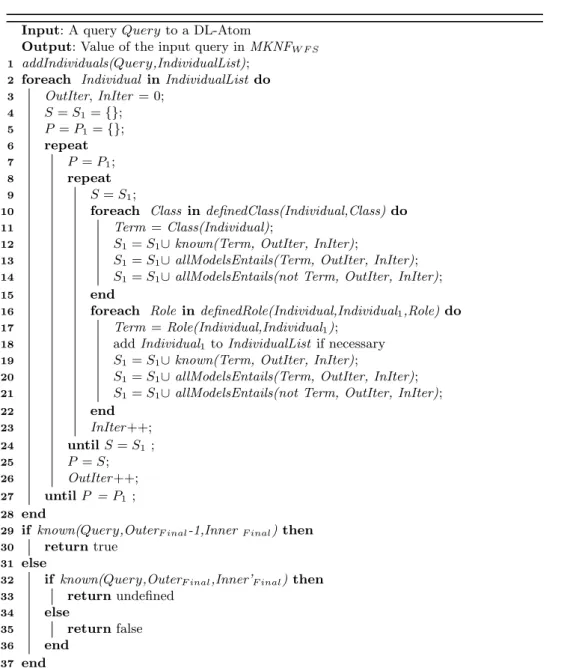
The procedure for a lazily invoked iterative fixed point described above is sum-marized in Figure 2 using predicates that are described in detail in Section 4.2. The tabled predicate known/3 is used in each inner iteration to derive knowledge from the rules component, while allM odelsEntails/3 infers knowledge from the ontol-ogy via a tableau proof. Within rules evaluated byknown/3, the default negation of a DL-atom A is obtained by the predicate dlnot(A), which succeeds if A was not proven in the last outer iteration. Whenever a role is encountered for an indi-vidual, a check is made to determine whether the related individual ir is already in the list of individuals in the fixed point, andir is added if not. The predicates def inedClass/2 and def inedRole/3 are used to obtain the relevant classes and roles defined for a given individual over a DL-safe MKNF Hybrid Knowledge Base. We assume that these predicates are defined explicitly by the compiler or program-mer, but they can also be inferred via the DL-safe restriction. In fact, by bounding our program to DL-Safe rules, every rule in the hybrid knowledge base must con-tain a positive predicate that is only defined in the rules. This predicate limits the evaluation of the rules to known individuals, so that CDF-Rules can infer the set of individuals that are applicable to a given rule, that is, itsdomain.
cor-Input: A queryQueryto a DL-Atom
Output: Value of the input query inMKNFW F S
addIndividuals(Query,IndividualList);
1
foreach Individual inIndividualList do
2
OutIter,InIter = 0;
3
S=S1={};
4
P =P1={};
5
repeat
6
P =P1;
7
repeat
8
S=S1;
9
foreach Classin definedClass(Individual,Class)do
10
Term =Class(Individual);
11
S1=S1∪known(Term, OutIter, InIter);
12
S1=S1∪allModelsEntails(Term, OutIter, InIter);
13
S1=S1∪allModelsEntails(not Term, OutIter, InIter);
14
end
15
foreach Role indefinedRole(Individual,Individual1,Role)do
16
Term =Role(Individual,Individual1);
17
addIndividual1 toIndividualList if necessary
18
S1=S1∪known(Term, OutIter, InIter);
19
S1=S1∪allModelsEntails(Term, OutIter, InIter);
20
S1=S1∪allModelsEntails(not Term, OutIter, InIter);
21
end
22
InIter++;
23
untilS=S1 ;
24
P =S;
25
OutIter++;
26
untilP =P1 ;
27
end
28
if known(Query,OuterF inal-1,InnerF inal)then 29
returntrue
30
else
31
if known(Query,OuterF inal,Inner’F inal)then 32 returnundefined 33 else 34 returnfalse 35 end 36 end 37
Fig. 2. The Top-Level Algorithm:ComputeFixedPoint(Query)
said to be undefined if known(Query, OuterF inal, InnerF inal), and is false other-wise.
4.2 Implementing MKNFW F S Components
We now provide a description of the various predicates in the algorithm of Fig-ure 2, discussing the manner in which the rule and ontology components exchange knowledge, and how the fixed point is checked.
4.2.1 Rules Component
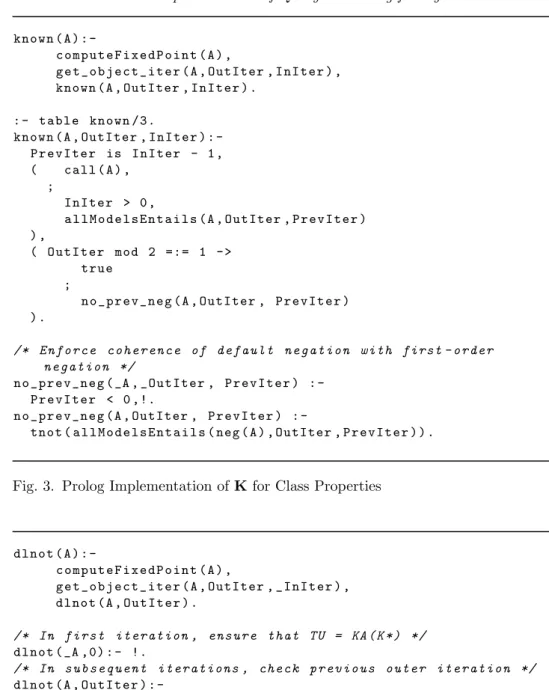
As mentioned, inferences from rules are obtained using the predicatesknown/1 cor-responding toKanddlnot/1 corresponding tonot. As shown in Figure 3, given the goalknown(A) withA=p(O), the code first callscomputeF ixedP oint(p(O)) which begins the fixed point computation for the object instanceO.computeF ixedP oint/1 was summarized in Figure 2 and calls the lower-level known/3 and dlnot/3 to determine the truth of a goal in previous iterations. Once the fixed point has been reached, the final iteration indices for O are obtained from a global store usingget object iter(p(O),Outer,Inner), andknown/3 is called again to determine whether p(O) in fact true in the current iteration. This post-fixed point call to known/3 simply checks the table, and so is not computationally expensive.known/3 is always called with the iteration indices (arguments 2 and 3) bound, and ifp(O) is true in the current iteration, the table entry will contain the iteration indices. Within a given iteration,p(O) may be known if it can be directly derived from the rules; alternately, or ifO∈P was entailed by the the ontology in the previous inner iteration step, as determined by the callallM odelsEntails/3, which checks for the entailment of O ∈ P in the previous inner iteration. In both cases, care must be taken so that it is guaranteed that if¬Aholds, thennot Aholds as well. In Defini-tion 3 this is guaranteed by considering the addiDefini-tion ofnotN P in bodies of rules with headP in one of the alternating operators. Analogously, when we try to derive known(A, OutIter, InIter) and the iterationOutIteris even (i.e. corresponding in Definition 7 to aT U step where Γ′
K, rather than ΓK, is being applied), we further
check if the ontology derived ¬A in the previous inner iteration via the predicate no prev neg/3. If ¬A is derived, then no prev neg/3 fails via the call to tnot/1, which is XSB’s operator for tabled negation, and the top-level goal also fails.
known ( A ) :
-c o m p u t e F i x e d P o i n t ( A ) ,
g e t _ o b j e c t _ i t e r (A , OutIter , InIter ) , known (A , OutIter , InIter ) .
: - table known /3.
known (A , OutIter , InIter ) : -P r e v I t e r is InIter - 1 , ( call ( A ) ,
;
InIter > 0 ,
a l l M o d e l s E n t a i l s (A , OutIter , P r e v I t e r ) ) ,
( OutIter mod 2 =:= 1 -> true
;
n o _ p r e v _ n e g (A , OutIter , P r e v I t e r ) ) .
/* Enforce c o h e r e n c e of default n e g a t i o n with first - order n e g a t i o n */
n o _ p r e v _ n e g ( _A , _OutIter , P r e v I t e r ) : -P r e v I t e r < 0 ,!.
n o _ p r e v _ n e g (A , OutIter , P r e v I t e r ) :
-tnot ( a l l M o d e l s E n t a i l s ( neg ( A ) , OutIter , P r e v I t e r ) ) .
Fig. 3. Prolog Implementation ofK for Class Properties
dlnot ( A ) :
-c o m p u t e F i x e d P o i n t ( A ) ,
g e t _ o b j e c t _ i t e r (A , OutIter , _InIter ) , dlnot (A , OutIter ) .
/* In first iteration , ensure that TU = KA ( K *) */
dlnot ( _A ,0) : - !.
/* In s u b s e q u e n t iterations , check p r e v i o u s outer i t e r a t i o n */
dlnot (A , OutIter ) :
-P r e v I t e r is OutIter - 1 ,
g e t _ f i n a l _ i t e r (A , PrevIter , FinIter ) , tnot ( known (A , PrevIter , FinIter ) ) .
Fig. 4. Prolog Implementation ofnotfor Class Properties
increasing whileT U sets are monotonically decreasing. To assure that the firstT U set is the largest set (KA(K∗
: - table a l l M o d e l s E n t a i l s /3.
a l l M o d e l s E n t a i l s ( not ( Atom ) , _OutIter , _InIter ) : - ! ,
/* t r a n s f o r m Atom to CDF object i d e n t i f i e r and class e x p r e s s i o n */
/* add i n d i v i d u a l s to current fixed point list */
( r e c _ a l l M o d e l s E n t a i l s ( Id , CE ) -> fail ; true ) . a l l M o d e l s E n t a i l s ( Atom , _OutIter , _InIter ) :
-/* t r a n s f o r m Atom to CDF object i d e n t i f i e r and class e x p r e s s i o n */
/* add i n d i v i d u a l s to current fixed point list */
( r e c _ a l l M o d e l s E n t a i l s ( Id , not ( CE ) ) -> fail ; true ) .
Fig. 5. Prolog Pseudo-code for allmodelsEntails/3
4.2.2 Ontology Component
The tabled predicate allModelsEntails/3 provides the interface to CDF’s tableau theorem prover (Figure 5). It is called with a DL-literal Land with the indices of its outer and inner iterations both bound. Although the iterations are not used in the body ofallModelsEntails/3, representing the iteration information in the head ensures that tabled answers will contain the iteration information. This information is used when allModelsEntails/3is called by known/1(throughknown/3). allMod-elsEntails/3 first converts the atomic form of a proposition to one used by CDF. That is, it translates a 1-ary DL-atom representing an individual’s class member-ship to the CDF predicateisa/2, and a 2-ary DL-atom representing an individual’s role to the CDF predicatehasAttr/3 (see Section 3). In addition, ifAtomis a 2-ary role, the target individual may be added to the fixed point set of individuals. As is usual with tableau provers, entailment of L by an ontology O is shown if the classical negation ofLis inconsistent withO. Thus,rec alModelsEntails/2 immedi-ately fails if the classical negation ofLis consistent withOin the present iteration; otherwise,Lis entailed.
isa_int ( oid ( Obj , NS ) , cid ( Class , NS1 ) ) : -ground ( Obj ) , -ground ( Class ) ,! ,
Call =.. [ Class , Obj ] , /* Call = Class ( Obj ) */
l a s t K n o w n ( Call ) .
/* Find all p o s s i b l e classes for Obj if called with s u p e r c l a s s a r g u m e n t u n i n s t a n t i a t e d */
isa_int ( oid ( Obj , NS ) , cid ( Class , NS ) ) : -ground ( Obj ) , var ( Class ) ,! ,
d e f i n e d C l a s s ( Call , Class , Obj ) , l a s t K n o w n ( Call ) .
h a s A t t r _ i n t ( oid ( Obj1 , NS ) , rid ( Role , NS1 ) , oid ( Obj2 , NS2 ) ) : -ground ( Obj1 ) , -ground ( Obj2 ) , -ground ( Role ) ,! ,
Call =.. [ Role , Obj1 , Obj2 ] , /* Call = Role ( Obj1 , Obj2 ) */
l a s t _ k n o w n ( Call ) .
/* Find all p o s s i b l e rules for Obj if called with role a r g u m e n t u n i n s t a n t i a t e d */
h a s A t t r _ i n t ( oid ( Obj1 , NS ) , rid ( Role , NS1 ) , oid ( Obj2 , NS2 ) ) : -ground ( Obj1 ) , -ground ( Obj2 ) , var ( Role ) ,! ,
d e f i n e d R o l e ( Call , Role , Obj1 , Obj2 ) , l a s t _ k n o w n ( Call ) .
Fig. 6. Callbacks from the ontology component to the rules component
4.2.3 Usage
An MKNF Hybrid Knowledge base is defined over a XSB-Prolog knowledge base together with an ontology specified over CDF. InCDF-Rules such a knowledge base is written into two files as follows:
• rules.P – containing the set of MKNF rules and facts. A rule is defined as standard Prolog rules as follows:
Head :- A1, ... Ak,known(B1),. . .,known(Bn),dlnot(C1),. . .,dlnot(Cm).
wherek, n, m≥0, and theAis are all non-DL predicates (i.e. predicates that are not defined in the ontology), and theBis andCis are predicates that can be both defined in the rules and in the ontology. Ifk=n=m= 0 then the rule is a fact, and it is written as usual in Prolog, omitting the ‘:-’ operator. Note that the transformation to include the negationN Headin the body of a rule forHeadas specified in Definition 3 is not needed: such a check is done by the call tono prev neg/3in known/3.
• cdf extensional.P – comprising ordinary ontology facts and concepts defined over the CDF syntax.
• cdf intensional.P – containing predicates allowing the ontology to access information in the rules as in Figure 6. In addition, the file may contain other intensional rules to lazily access information from a database, off of the semanitc web, or from other sources external toCDF-Rules.
Example 6
The knowledge base of Example 1 can be easily coded inCDF-Rules as:
% rules
inspect ( X ) : - h a s S h i p m e n t (X , C ) , dlnot ( s a f e C o u n t r y ( C ) ) .
% c d f _ e x t e n s i o n a l
isa_ext ( cid ( sc a nd i na v ia nC t r , ont ) , cid ( safeCountry , ont ) ) . isa_ext ( cid ( sc a nd i na v ia nC t r , ont ) , cid ( EuropeanCtr , ont ) ) . isa_ext ( oid ( norway , ont ) , cid ( sc a nd i na vi a nC t r , ont ) ) .
n e c e s s c o n d _ e x t ( cid ( Di p lo ma t ic S hi p t , ont ) , not ( cid ( inspect , ont ) ) ) .
Note that the ontological portion is Type-1, due to the use of necessCond/2.
4.2.4 Discussion
As described,CDF-Rules implements query answering to hybrid MKNF knowledge bases, and tries to reduce the amount of relevance required in the fixed point op-eration. Relevance is a critical concept for query answering in practical systems, however a poorly designed ontology or rules component can work against one an-other if numerous individuals depend on one anan-other through DL roles. In such a case the relevance properties of our approach will be less powerful; however in such a case, a simple query to an ontology about an individual will be inefficient in itself. The approach of CDF-Rules cannot solve such problems; but it can make query answering as relevant as the underlying ontology allows.
We do not present here a formal proof of soundness and completeness for our algo-rithm, since this would require the full presentation of the formal derivation proce-dures on which both XSB-Prolog and CDF implementations rely. However, we have given an informal argument along with our description by referring to complemen-tarity between the implementation and the bottom-up definition ofMKNFW F S. In particular, there is a close correspondence between the core of our computation rep-resented in Definition 8 and the Definition 4 from the 3-valued MKNF definition, as well as between the operators Γ / Γ′
and our inner / outer fixed points. As a result, one can view our goal-driven implementation as an optimization of the bottom-up approach where the computation is limited to the set ofrelevant objects, and where the evaluation of positive predicates and the handling of iterations is performed by the use of SLG resolution.
Within computeF ixedP oint/1 another optimization would be to maintain depen-dencies among individuals. Intuitively, if individual I1 depended on individual I2 but not the reverse, a fixed point for I2 could be determined before that of I1. However, these optimizations are fairly straightforward elaborations ofCDF-Rules as presented.
5 Conclusions
In this paper we have described the implementation of a query-driven system, CDF-Rules, for hybrid knowledge bases combining both (non-monotonic) rules and a (monotonic) ontology. The system answers queries according toMKNFW F S(Knorr et al. 2008) and, as such, is also sound w.r.t. the semantics defined in (Motik and Rosati 2007) for Hybrid MKNF knowledge bases. The definition ofMKNFW F S is parametric on a decidable description logic (in which the ontology is written), and it is worth noting that, as shown in (Knorr et al. 2008), the complexity of reasoning inMKNFW F S is in the same class as that in the decidable description logic; a com-plexity result that is extended to a query-driven approach in (Alferes et al. 2009). In particular, if the description logic is tractable then reasoning in MKNFW F S is also tractable. Our implementation fixes the description logic part to CDF ontolo-gies that, in its Type-1 version, supports ALCQ description logic. CDF Type-0 ontologies are simpler, and tractable and, when using Type-0 ontologies only, our implementation exhibits a polynomial complexity behavior. This fact derives from the usage of tabling mechanisms, as defined in SLG resolution and implemented in XSB Prolog8In fact, one of the reasons that highly influenced the choice of CDF as the parameter ontology logic in our query-driven implementation for Hybrid MKNF knowledge bases, was the very existence of an implementation of CDF relying on tabling, that could be coupled together with the tabling we needed forMKNFW F S. But the algorithms presented here do not rely on particularities of CDF, and we believe that, for other choices of parameter logics, implementations could be made in a way similar to the one described in this paper. Of course, such an implementa-tion would require first an implementaimplementa-tion in XSB-Prolog of a prover for the other description logic of choice, providing at least a predicateallM odelsEntails/3 with the meaning as described above.
Though our choice for the implementation was the Well-Founded Semantics for Hybrid MKNF knowledge bases,MKNFW F S, (Knorr et al. 2008), there were other formalisms concerned with combining ontologies with WFS rules (Eiter et al. 2004b; Drabent and Ma luszynski 2007). The approach of (Eiter et al. 2004b) combines ontologies and rules in a modular way, i.e. keeps both parts and their semantics separate, thus having similarities withMKNFW F S. The interface for this approach is done by the dlv-hex system (Schindlauer 2006). Though with identical data complexity toMKNFW F S for a tractable DL, it has a less strong integration, hav-ing limitations in the way the ontology can call back program atoms (see (Eiter
8 The proof of tractability of the implementation ofCDF-Ruleswith CDF Type-0 ontologies is
et al. 2004b) for details). Hybrid programs of (Drabent and Ma luszynski 2007) are even more restrictive in the combination: in fact it only allows to transfer informa-tion from the ontology to the rules and not the other way around. Moreover, the semantics of this approach differs from MKNF (both the one of (Motik and Rosati 2007) andMKNFW F S) and also(Eiter et al. 2004b) in that if an ontology expresses B1∨B2then the semantics in (Drabent and Ma luszynski 2007) derivespfrom rules p←B1 and p←B2,pwhile MKNF and (Eiter et al. 2004b) do not. For further comparisons of MKNF with other proposals, including those not based on WFS rules, see (Motik and Rosati 2007; Knorr et al. 2008), and for a survey on other proposals for combining rules and ontologies see (Hitzler and Parsia 2009)
CDF-Rulesserves as a proof-of-concept for queryingMKNFW F Sknowledge bases. As discussed, XSB and tractable CDF ontologies have been used extensively in commercial semantic web applications; the creation ofCDF-Rules is a step towards understanding whether and howMKNFW F S can be used in such applications. As XSB is multi-threaded, CDF-Rules can be extended to a MKNFW F S server in a fairly straightforward manner. Since XSB supports CLP, further experiments in-volve representing temporal or spatial information in a hybrid of ontology, rules, and rule-based constraints. In addition, since the implementation of Flora-2 (Yang et al. 2003) and Silk (Grosof 2009) are both based on XSB, CDF-Rules forms a basis for experimenting withMKNFW F S on these systems.
References
Alferes, J. J.,Knorr, M.,and Swift, T.2009. Queries to hybrid MKNF knowledge bases through oracular tabling. InThe Semantic Web - ISWC 2009. LNCS, vol. 5823. Springer, 1–16.
Baader, F.,Calvanese, D.,McGuinness, D. L.,Nardi, D.,and Patel-Schneider, P. F., Eds. 2007. The Description Logic Handbook: Theory, Implementation, and Ap-plications, 2 ed. Cambridge University Press.
Baral, C.2002. Knowledge Representation, Reasoning, and Declarative Problem Solving. Cambridge University Press.
Chen, W. and Warren, D. S.1996. Tabled Evaluation with Delaying for General Logic Programs. Journal of the ACM 43,1 (January), 20–74.
Drabent, W. and Ma luszynski, J.2007. Well-founded semantics for hybrid rules. In RR2007. Springer, 1–15.
Eiter, T., Lukasiewicz, T.,Schindlauer, R.,and Tompits, H. 2004a. Combining answer set programming with description logics for the semantic web. InKR. 141–151.
Eiter, T.,Lukasiewicz, T.,Schindlauer, R.,and Tompits, H.2004b. Well-founded semantics for description logic programs in the semantic web. InRuleML’04. 81–97.
Gelfond, M. and Lifschitz, V. 1990. Logic programs with classical negation. In International Conference on Logic Programming, Warren and Szeredi, Eds. MIT Press, 579–597.
Grimm, S. and Hitzler, P. Winter 2007–08. Semantic matchmaking of web resources with local closed-world reasoning. International Journal of e-Commerce 12,2, 89–126.
Grosof, B. 2009. SILK: Semantic rules take the next big step in power. http://silk.semwebcentral.org.
Eds. 2009.OWL 2 Web Ontology Language: Primer. W3C Recommendation 27 October 2009. Available fromhttp://www.w3.org/TR/owl2-primer/.
Hitzler, P. and Parsia, B.2009. Ontologies and rules. InHandbook on Ontologies, 2 ed., S. Staab and R. Studer, Eds. Springer.
Horrocks, I., Motik, B., Rosati, R., and Sattler, U.2006. Can OWL and logic programming live together happily ever after? In Proc. of the 5th Int. Semantic Web Conference (ISWC 2006), volume 4273 of LNCS, I. F. Cruz, S. Decker, D. Allemang, C. Preist, D. Schwabe, P. Mika, M. Uschold, and L. Aroyo, Eds. Springer, 501–514.
Horrocks, I. and Patel-Schneider, P. 1999. Optimizing description logic subsump-tion. Journal of Logic and Computation 9,3.
Knorr, M.,Alferes, J. J.,and Hitzler, P.2008. A coherent well-founded model for hybrid MKNF knowledge bases. InEurop. Conf. on Artificial Intelligence. IOS Press, 99–103.
Lifschitz, V. 1991. Nonmonotonic databases and epistemic queries. In International Joint Conference on Artificial Intelligence. 381–386.
Lukacsy, G.,Szeredi, P.,and Kad`ar, B.2008. Prolog based description logic reason-ing. InInternational Conference on Logic Programming. 455–469.
Morgenstern, L., Welty, C., and Boley, H., Eds. 2010. RIF
Primer. W3C Recommendation 22 June 2010. Available from
http://www.w3.org/2005/rules/wiki/Primer.
Motik, B.2006. Reasoning in description logics using resolution and deductive databases. Ph.D. thesis, University of Karlsruhe.
Motik, B. and Rosati, R.2007. A faithful integration of description logics with logic programming. InInternational Joint Conference on Artificial Intelligence. 477–482.
Patel, C.,Cimino, J. J.,Dolby, J.,Fokoue, A.,Kalyanpur, A.,Kershenbaum, A.,
Ma, L.,Schonberg, E.,and Srinivas, K.2007. Matching patient records to clinical trials using ontologies. InISWC/ASWC. Springer, 816–829.
Schindlauer, R. 2006. Answer-set programming for the semantic web. Ph.D. thesis, Technischen Universitaet Wien Fakultaet fuer Informatik, Glockengasse 6/19, A-1020 Wien.
Schmidt-Strauss, M. and Smolka, G. 1990. Attributive concept descriptions with complements. Artificial Intelligence 48, 1–26.
Swift, T.2004. Deduction in ontologies via answer set programming. InInternational Conference on Logic Programming and Non-Monotonic Reasoning. 275–289.
Swift, T. and Warren, D. 2011. XSB: Extending the power of Prolog using tabling. Theory and Practice of Logic Programming. To appear.
Swift, T. and Warren, D. S.2003.Cold Dead Fish: A System for Managing Ontologies. Available viahttp://xsb.sourceforge.net.
van Gelder, A. 1989. The alternating fixpoint of logic programs with negation. In Principles of Database Systems. ACM Press, 1–10.
van Gelder, A.,Ross, K. A.,and Schlipf, J. S.1991. Unfounded sets and well-founded semantics for general logic programs. Journal of the ACM 38,3, 620–650.