EQUITY VALUATION: NESTLÉ S.A.
Tiago Fernandes de Macedo Martins
Project submitted as partial requirement for the conferral of
Master in Finance
Supervisor:
Prof. Pedro Leite Inácio, Assistant Professor,
ISCTE Business School, Finance Department
I
Abstract
Equity investment decisions are partially based on expected share price increases. Other factors may influence an investment decision, such as risk, expected dividends and portfolio diversification. In this perspective, one must establish an opinion regarding the value (or expected value) of the issuer.
According to Damodaran (2012), three approaches can be used to value a company: option pricing models, discounted cash flow models and relative valuation. Within each approach, different models can be used.
Most models include parameters that carry some subjectivity, such as cash flow forecasting, growth rates, market conditions and several others. This means that, even though valuation models are quantitative, valuation is subjective. “If a business is complex and subject to constant change, we’re not smart enough to predict future cash flows” – Warren Buffett.
In this study we analyze and value Nestlé, the number one consumer goods company in the world in terms of sales. We then compare our valuation with the market’s and conclude whether the company is under or overvalued (under the scope of our assumptions).
To do so we use the following valuation methods: Free Cash Flow to the Firm (FCFF) and Relative Valuation through peer group multiples. We then compare our research to an investment bank’s to understand whether the valuation (based on the assumptions we make) is realistic.
Our results indicate that Nestlé shares were priced below their true value as at 31-12-2016. Therefore, we would have recommended buying the stock at that time.
Keywords: Nestlé; Valuation; Free Cash Flow to the Firm; Equity investment JEL Classification: G32 – Value of Firms
II
Resumo
As decisões de investimento em acções são parcialmente baseadas em expectativas de incremento no preço das mesmas. Há outros factores que também podem influenciar esta decisão, tais como o risco, os dividendos esperados e a diversificação da carteira de investimento. Nesta perspectiva, deve-se estabelecer uma opinião relativamente ao valor (ou valor esperado) da empresa emitente.
Damodaran (2012) sugere três abordagens que podem ser utilizadas para valorizar uma empresa: modelos de avaliação por opções, modelos de cash flows descontados e avaliação relativa. Em cada abordagem diferentes modelos podem ser empregues.
A maioria dos modelos inclui parâmetros cuja estimativa é subjectiva, tais como previsões de cash flows, taxas de crescimento, condições de mercado, entre outros. Isto significa que, apesar de os modelos de avaliação serem quantitativos, a avaliação é subjectiva. “Se um negócio é complexo e está sujeito a mudanças constantes, não temos inteligência suficiente para prever cash flows futuros” – Warren Buffett.
Nesta dissertação procedemos à análise e avaliação da Nestlé, a maior empresa de bens de consumo actualmente (em termos de vendas). Seguidamente comparamos a nossa avaliação com o preço de mercado das acções da empresa e concluímos se a empresa está sobre ou subvalorizada. Para o fazermos utilizamos os seguintes modelos de avaliação: Free Cash Flow to the Firm (FCFF) e avaliação por comparáveis através de múltiplos. Seguidamente realizamos uma análise comparativa com um relatório de avaliação do Deutsche Bank de forma a verificar se a avaliação (baseada nos nossos pressupostos) é realista.
Os nossos resultados indicam que as acções da Nestlé estão subvalorizadas no mercado à data de 31-12-2016, pelo que a nossa recomendação seria de COMPRA a essa data.
III
Acknowledgements
I would like to use this opportunity to express my profound gratitude to everyone who supported me throughout my academic years at ISCTE-IUL, from my family and friends to the teachers and support staff.
Regarding this dissertation, I wish to express my gratefulness to Professor Pedro Leite Inácio, my tutor and supervisor of this project, for the mentorship, availability and feedback; to my parents, for giving me the opportunity to invest in my future and for always standing by my side, pushing me to be better; to Jorge Frade for helping me by sharing both market and technical knowledge which improved my research; and to my colleagues and friends, who supported and kept me motivated throughout, namely Gonçalo Mendes, Catarina Ramos, João Castro, Tomás Romeiro, João Martins, Pedro Pereira, Gonçalo Nascimento, João Pires, Gonçalo Couto, Joana Teixeira, Marta Brás, Fausto Moura, Catarina Castro, Leonor Paiva and Manuel Gamito.
I wish to dedicate this work to my grandparents, Beatriz and José, for all the love, care and support, for always believing and making me believe in myself.
IV
Agradecimentos
Gostaria de aproveitar a oportunidade para expressar a minha profunda gratidão para com todos aqueles que me apoiaram ao longo do meu percurso académico no ISCTE-IUL, desde a minha família e amigos aos professores e pessoal de apoio.
Relativamente a esta dissertação, quero agradecer ao Professor Pedro Leite Inácio, orientador e supervisor deste projecto, pela tutoria, disponibilidade e feedback; aos meus pais, por me facultarem a oportunidade de investir no meu futuro e pelo apoio incondicional, incentivando-me sempre a superar-me; ao Jorge Frade por me ajudar partilhando os seus conhecimentos técnicos e de mercado, que contribuíram para a melhoria deste estudo; e aos meus colegas e amigos, que me apoiaram e me mantiveram motivado ao longo de todo o processo, nomeadamente Gonçalo Mendes, Catarina Ramos, João Castro, Tomás Romeiro, João Martins, Pedro Pereira, Gonçalo Nascimento, João Pires, Gonçalo Couto, Joana Teixeira, Marta Brás, Fausto Moura, Catarina Castro, Leonor Paiva e Manuel Gamito.
Quero dedicar esta dissertação aos meus avós, Beatriz e José, por todo o amor, carinho e apoio, e por sempre acreditarem em mim e fazerem-me acreditar em mim próprio.
V
Glossary of Terms
APV Adjusted Present Value LLC Limited Liability Corporation
AUD Australian Dollar NOK Norway Krone
BC Bankruptcy Costs NOPLAT Net Operating Profit Less Adjusted Taxes
CAD Canadian Dollar NZD New Zealand Dollar
CAGR Compounded Annual Growth Rate P&L Profit and Loss
CAPEX Capital Expenditures P/B Price-to-book
CAPM Capital Asset Pricing Model P/E Price-to-earnings
CEO Chief Executive Officer P20xx Projected values
CHF Swiss Franc PP&E Property, Plant and Equipment
CoCo Comparable Company PPS Price per share
COGS Cost of Goods Sold PV Present Value
D Value of debt QE Quantitative Easing
D&A Depreciation and Amortization R&D Research and Development
D/E Debt-to-Equity ratio rDebt Cost of debt
DCF Discounted Cash Flow rEquity Cost of equity
DDM Dividend Discount Model rf Risk-free rate
DPS Dividends per share rM Market risk rate
E Value of Equity ROA Return on Assets
EBIT Earnings Before Interests and Taxes ROAA Return on Average Assets
EBITDA Earnings Before Interests, Taxes,
Depreciations and Amortizations ROAE Return on Average Equity
EC European Commission ROE Return on Equity
EPS Earnings per share ROIC Return on Invested Capital
ERP Equity Risk Premium rU Required return on assets unlevered
EV Enterprise Value RV Residual Value
EVA Economic Value Added SGR Sustainable Growth Rate
FCF Free Cash Flow SMI Swiss Market Index
FCFE Free Cash Flow to Equity SWOT Strengths, Weaknesses, Opportunities and
Threats
FCFF Free Cash Flow to the Firm t Effective tax rate
FED Federal Reserve System TC Marginal tax rate
FMCG Fast-moving consumer goods TS Tax Shield
g Perpetuity growth rate TV Terminal Value
GBP Great Britain Pound UK United Kingdom
GDP Gross Domestic Product USA United States of America
H20xx Historic values USD United States Dollar
HKD Hong Kong Dollar VU Value Unlevered
IC Invested Capital WACC Weighted Average Cost of Capital
IMF International Monetary Fund WC Working Capital
JPY Japanese Yen YTM Yield to maturity
VI
Table of Contents
Abstract ... I Resumo ... II Acknowledgements ... III Agradecimentos ... IV Glossary of Terms ... V Table of Contents ... VI List of Tables ... IX List of Graphs ... X List of Figures ... X 1. Introduction ... 1 2. Literature Review ... 22.1. Discounted Cash Flows ... 2
2.2. Dividend Discount Model ... 5
2.3. Adjusted Present Value ... 6
2.4. Economic Value Added ... 8
2.5. Multiples Valuation ... 9 3. Company Presentation ... 10 3.1. Company History ... 10 3.2. Recent Performance ... 11 3.3. Nestlé Today... 15 3.3.1. Business Segments ... 16
3.3.1.1. Powdered and Liquid Beverages ... 16
3.3.1.2. Water ... 17
3.3.1.3. Milk Products and Ice Cream ... 18
3.3.1.4. Nutrition and Health Science ... 19
3.3.1.5. Prepared Dishes and Cooking Aids ... 20
3.3.1.6. Confectionery ... 21
3.3.1.7. Pet Care... 21
3.3.2 Company Strategy ... 22
3.3.3 SWOT Analysis ... 24
VII
4.1. Macroeconomic Outlook ... 25
4.2. Fast-Moving Consumer Goods ... 27
4.3. Segments ... 29
4.3.1. Powdered and Liquid Beverages ... 29
4.3.2. Water ... 30
4.3.3. Milk Products and Ice Cream ... 31
4.3.4. Nutrition and Health Science ... 32
4.3.5. Prepared Dishes and Cooking Aids ... 33
4.3.6. Confectionery ... 34
4.3.7. Pet Care... 35
5. Valuation ... 36
5.1. Sales Growth ... 36
5.1.1. Powdered and Liquid Beverages ... 37
5.1.2. Water ... 38
5.1.3. Milk Products and Ice Cream ... 38
5.1.4. Nutrition and Health Science ... 39
5.1.5. Prepared Dishes and Cooking Aids ... 40
5.1.6. Confectionery ... 41
5.1.7. Pet Care... 42
5.2. Cost Efficiency ... 42
5.3. Depreciation and Amortization... 44
5.4. CAPEX ... 45
5.5. Investment in Working Capital ... 46
5.6. Effective Tax Rate ... 46
5.7. WACC ... 47
5.7.1. Market Value of Equity ... 47
5.7.2. Market Value of Debt ... 48
5.7.3. Cost of Equity ... 49
5.7.3.1. Risk-Free Rate ... 49
5.7.3.2. Beta ... 49
5.7.3.3. Market Risk Premium... 50
VIII
5.7.4.1. Risk-Free Rate ... 52
5.7.4.2. Credit Spread ... 52
5.8. Perpetual Growth Rate (g) ... 54
5.9. FCFF Valuation ... 54
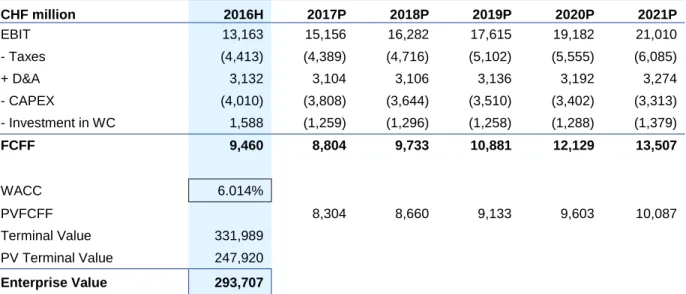
5.9.1. Enterprise Value ... 55
5.9.2. Equity Value ... 55
5.10. Relative Valuation ... 56
5.10.1. Peer Group Selection ... 57
5.10.2. Multiples ... 58
5.11. Sensitivity Analysis ... 59
5.12. Comparison with Deutsche Bank Report ... 61
6. Conclusions... 63
7. References ... 66
IX
List of Tables
Table 1 Other Key Performance Indicators ... 13
Table 2 Five dominant forces that will drive changes in consumer landscape ... 28
Table 3 Milk products and ice cream sales projections ... 39
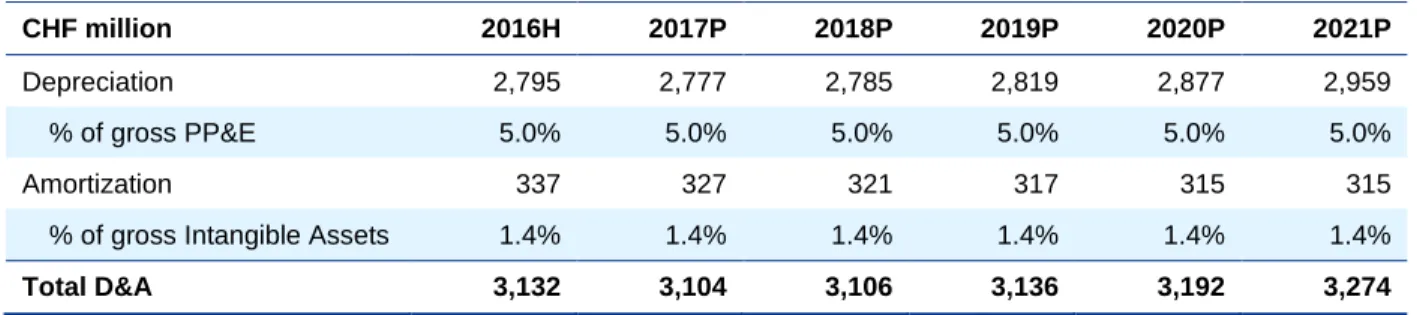
Table 4 Projected Gross PP&E and Intangible assets ... 44
Table 5 Projected Depreciation and Amortization ... 44
Table 6 Projected CAPEX... 45
Table 7 Investment in Working Capital ... 46
Table 8 Market value of bank loans ... 48
Table 9 Market risk premium ... 51
Table 10 Credit Spread computation ... 53
Table 11 Nestlé’s Enterprise Value ... 55
Table 12 Nestlé’s PPS valuation ... 56
Table 13 List of Comparable Companies ... 58
Table 14 Nestlé multiples valuation ... 59
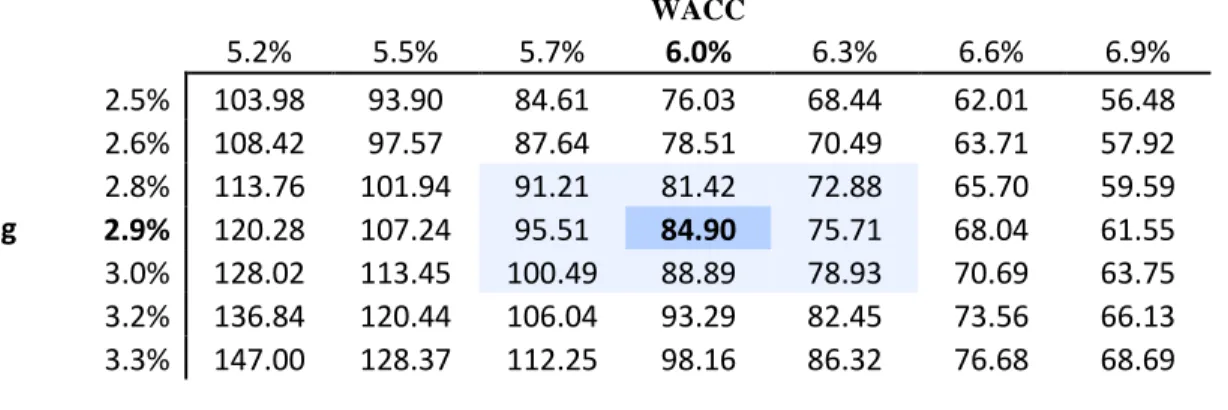
Table 15 Sensitivity Analysis: WACC vs Perpetual growth rate... 60
Table 16 Key analysis indicators ... 61
Table 17 Main valuation forecasts comparison... 62
Table 18 Comparable Companies score board ... 71
Table 19 Swiss Franc exchange rates ... 72
Table 20 Market value of outstanding bonds ... 73
Table 21 Historical Balance Sheet ... 75
Table 22 Projected Balance Sheet ... 76
Table 23 Historical Income Statement ... 77
Table 24 Projected Income Statement ... 78
Table 25 Income Statement comparison ... 78
Table 26 KPI’s comparison ... 79
X
List of Graphs
Graph 1 Nestlé performance indicators ... 12
Graph 2 Nestlé and Swiss Market Index performance ... 14
Graph 3 Acid-test ratio and current ratio – peer analysis (2016) ... 15
Graph 4 Sales evolution and segment’s weight ... 16
Graph 5 GDP growth rates ... 25
Graph 6 Nestlé’s main markets by continent and by country in 2016 ... 26
Graph 7 Trading Operating Profit and Cost of Goods Sold as a percentage of sales ... 43
Graph 8 Price targets from different analysis ... 64
Graph 9 Biggest FMCG companies of the world in terms of total sales (2015) ... 70
Graph 10 Biggest Food and Beverage companies of the world in terms of F&B sales (2015) .. 70
List of Figures
Figure 1 Nestlé Strategic Roadmap ... 23Figure 2 Nestlé SWOT analysis ... 24
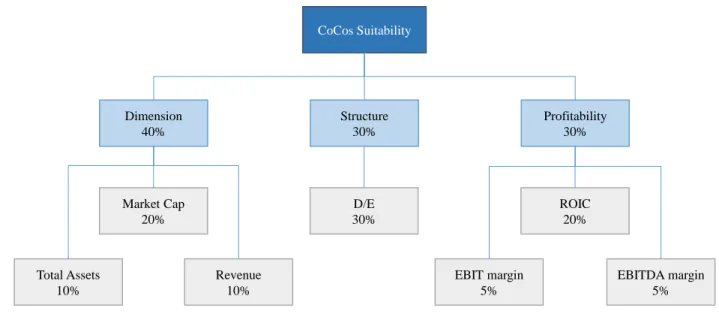
Figure 3 CoCo’s variable weight factors ... 57
1
1. Introduction
This dissertation is a case study which is carried out under the scope of the Master’s Degree in Finance at ISCTE-IUL.
It consists in analyzing and valuing the largest consumer goods firm today: Nestlé. The main goal with this thesis is to understand whether the market is fairly valuing the company, and making a recommendation (buy, hold or sell) based on that analysis.
We will be valuing Nestlé using a Discounted Cash Flow Model (Free Cash Flow to the Firm), cross-checking the results with relative valuation (multiples) and comparing our projections with an investment bank research report. We chose to validate our results through multiples valuation due to the fact that many of the inputs of our cash flow model need to be estimated and carry a strong degree of subjectivity.
Nestlé is a company that operates worldwide and has different business segments (seven in total). In order to obtain more realistic results, one must make a detailed research. With that in mind, there are two alternatives. An analysis based on the business segments (with different growth rates, market betas, etc.) or an analysis based on the geographic areas in which the company operates. We have decided to make our valuation based on business segments. This will also allow us to conduct a study on the profitability of each individual sector and its contribution for the overall performance of the firm, by projecting sales for each individual business segment based on the company’s strategy and industry outlook.
A key aspect that has been shaping the company’s focus and performance is the shift in strategy towards Nutrition, Health and Wellness. This allied with market outlooks and Nestlé’s recent efforts to increase operational efficiency entail the basis for our model assumptions and forecasts.
2
2. Literature Review
There is not a consensus as to which approach or methodology is the most accurate to value a company, as different firms have different key drivers on which their value is based. Due to the fact that there are many aspects of the business and its industry sector that must be taken into consideration, there are different models that analyze different aspects of the firm.
Bottom line, there is no valuation method perfect for all situations. However, one does not have to be limited to using just one method. Oftentimes investors use more than one model to value a business, get a range of possible valuations and proceed from there by selecting one model that they believe to be the closest to reflect the company’s true value or average all the valuations into one.
In this section we will present the different methodologies that can be applicable to the valuation of Nestlé, pointing out their unique characteristics, as well as their strengths and weaknesses. After such appraisal is done it will be easier to select the best combination of models to conduct Nestlé’s valuation.
2.1. Discounted Cash Flows
In Discounted Cash Flows (DCF) models we need to estimate the future free cash flows of the company and discount them to obtain a present value estimate. Usually the discount rate that is applied is the Weighted Average Cost of Capital (WACC). The DCF formula is as follows:
Net Present Value = (1+𝑊𝐴𝐶𝐶)𝐹𝐶𝐹1 1 + (1+𝑊𝐴𝐶𝐶)𝐹𝐶𝐹2 2 + … + (1+𝑊𝐴𝐶𝐶)𝐹𝐶𝐹𝑛 𝑛 + (1+𝑊𝐴𝐶𝐶)𝑇𝑉𝑛 𝑛 (1) Where:
FCF – Free Cash Flow
The analyst must choose the forecast period (n), after which he will set a fixed growth rate and calculate the Terminal Value at time n (TVn). The Terminal Value is calculated as follows:
3
Relatively to the period of the forecast, there isn’t a defined number of years that fits every company. Periods from 5 to 10 years are the most commonly used, but it varies. What one must ensure here is that the forecast goes until the company reaches a steady growth level. Additionally, one must also be aware that this constant growth rate is lower than (or equal to) the growth rate of the economy where the firm is operating (otherwise we would be assuming that the company would “grow to be bigger than the economy”, which makes no sense). One other aspect to which the analyst must pay attention, and to which Fernandez and Bilan (2015) advert, is that FCFn+1 =
FCFn*(1+g) only if CAPEX expenses exceed depreciation and amortization expenses; otherwise
this would imply that the firm would register negative non-financial assets in the future, which is not possible. As such, in perpetuity, these expenses should be assumed to be equal according to Kaplan and Ruback (1995).
As previously mentioned, the most commonly used discount rate is the WACC, and that’s the rate we will compute and apply when valuing Nestlé. The formula is presented below.
WACC = Debt+EquityDebt ∗ r𝐷𝑒𝑏𝑡∗ (1 − t) +Debt+EquityEquity ∗ r𝐸𝑞𝑢𝑖𝑡𝑦 (2)
In the formula above, rDebt represents the average cost of Debt and rEquity the average cost of
Equity; also, debt and equity refer to market values. By observing the formula one can see that the WACC includes the tax shield effect (an advantage of having debt, since higher debt means a higher tax shield). The WACC is not without drawbacks though; it is criticized by only being useful in companies which have a constant capital structure (Luehrman – 1997). The existence of exotic instruments within a company’s capital structure can also lead to a reduction in the reliability of this model. However, it is still considered by most the best one in terms of simplicity vs reliability.
Cash Flows based Valuation methods demand the use of an asset pricing model so that the analyst obtains a discount factor (cost of capital). The most used pricing model is the Capital Asset Pricing Model (CAPM). There are other models that are considered “extensions” to the CAPM such as the Fama and French three factor model (1993), which adds size and value factors in addition to CAPM’s market risk factor, by considering that value and small cap stocks often outperform the market. However, since the CAPM is still the most used model when trying to
4
value a company, it is the one we are going to apply to estimate the cost of capital of Nestlé. The formula for the CAPM model is the following:
rE = rf + β (rM – rf) (3)
CAPM’s general idea is that investors must be compensated due to two factors: time value of money, represented by rf (the risk-free rate) thus compensating the investor for placing an
investment over a period of time, and risk, which is represented in the other half of the formula. The latter is calculated by multiplying β (a risk measure – beta – that provides the company’s correlation with the market) by the market risk premium. According to Fernandéz (2004) and Koller et al (2005), the risk-free rate used in the model must be the government bond interest rate in the same currency of the cash-flows. The market risk premium can be computed as the historical or the geometric average of the difference between market returns and risk-free government bond returns. We will be using the historical average, as it is the most commonly used. The market return must be the return of a stock market which accurately reflects the scope of business the company engages in. To estimate the company’s beta we will perform a regression of the firm’s returns with the market returns, as Damodaran suggests.
The Discounted Cash Flows model demands a deep understanding of the firm’s drivers, as well as of the industry in which it operates. Forecasting the firm’s cash flows demands an intensive study on the company’s operations and market conditions. Such study is also good for managers to realize which segments of their firm are less efficient / profitable.
We will be using two approaches, forecasting Free Cash-Flows to the Firm (FCFF) and Free Cash-Flows to Equity (FCFE). These two approaches must yield the same results if performed under the same assumptions, but they differ in nature. The FCFF, as the name suggests, analyses the free cash-flows that the firm will have available to all investors, both equity and debt holders, and is discounted by the WACC. The FCFE is the cash available to equity holders and is discounted by the cost of equity (rE). The latter can be derived from the first:
FCFE = FCFF − Interest ∗ (1 − t) + ∆Net debt (4)
As we can see, FCFE equals FCFF deducted from the interest net of taxes plus any cash from taking on debt (variation of net debt).
5
Although the DCF method is one of the most used approaches by professionals, it has some shortcomings. It is not suitable for companies such as start-ups, as it is nearly impossible to estimate future cash-flows, and to do so would require long term forecasts until reaching a period of stable growth; also to account for investments that will only generate cash-flows in the medium / long term, long term forecasts would be required. Additionally, as previously mentioned, it is not suitable for companies that have a lot of changes in their capital structure (CAPM). Another big drawback is the inherent assumption in the model that, after dividends, all the cash-flow is invested in projects that have the same returns as the discount rate being applied.
2.2. Dividend Discount Model
The Dividend Discount Model (DDM) was introduced in Gordon, et al (1956) and it is a very straight-forward and easy to understand model. According to this valuation method, the company is as valuable as the present value of the future dividends it will pay to its shareholders. This model has some variations, and obviously isn’t applicable to companies that do not pay dividends. In fact, it is only accurate if the dividend is stable and predictable. Mature blue-chip companies in well-developed and mature industries are the ones that typically pay stable and predictable dividends: Nestlé is inserted in these categories and, as such, we will be using this model in our analysis. If, historically, the earnings per share have been growing at a constant average rate and the payout ratio has remained consistent, this is probably both the easiest and most accurate model to estimate the value of a company. The formula is presented below.
Stock value = 𝑟𝐷𝑃𝑆
𝐸−𝑔 (5)
Where:
DPS – Dividends per share g – Perpetual growth rate
If that is not the case, one can use variations of the model, such as the supernormal dividend growth model, which considers two periods: a first period of high growth followed by a lower and constant growth period.
6
2.3. Adjusted Present Value
The Adjusted Present Value (APV) Model was introduced by Meyers (1974) with the purpose of management teams being able to assess the relation between financing and investment decisions. This model values financial events independently and bulks their value to the company value. As such, by computing the APV, a manager can get a better perception regarding the different components of the business, their respective challenges or areas of improvement, and their contribution to the company’s profitability (Luehrman – 1997).
This model was made popular due to the shortcomings and limitations of the Discounted Cash Flow models that we have referred before. The fundamental difference between APV and DCF models, as stated by Damodaran (2006), is that the latter include the effects of debt financing in the computed discount rate, while the APV model estimates the costs (and benefits) of debt financing independently. Therefore, the Enterprise Value (both equity and debt) is estimated using the following formula:
Enterprise Value = VU + PVTS – Expected Bankruptcy Costs (6)
Where:
VU – Value of the Firm unlevered
PVTS – Present Value of Interest Tax Shields
Ergo, this model discounts the cash flows at the cost of equity (estimating the value of the firm unlevered) and adds the effects of debt financing to the company structure separately. It is important to note that the cost of equity of the company unlevered is lower than the cost of equity of the company with debt, since the shareholders don’t have to bear the additional risks inherent to having debt in the capital structure. The formula used to estimate the value of the firm unlevered is: 𝑉𝑈 = (1+𝑟𝐹𝐶𝐹𝐹1 𝑈)1+ 𝐹𝐶𝐹𝐹2 (1+𝑟𝑈)2+ (… ) + 𝐹𝐶𝐹𝐹𝑁+𝑅𝑉𝑁 (1+𝑟𝑈)𝑁 (7) Where:
FCFFN – Free Cash Flow to the Firm in period N
RVN – Residual Value of the company in year N
7
The Present Value of interest tax shields reflects the savings that the company would have by contracting a certain amount of debt. There has been much debate on which is the most appropriate way to compute the present value of interest tax shields. Modigliani and Miller (1963) suggested that it can be calculated simply by multiplying the value of debt by the marginal tax rate:
𝑃𝑉𝑇𝑆 = 𝐷×𝑟𝐷×𝑇𝐶
𝑟𝐷 = 𝐷 × 𝑇𝐶 (8)
Where:
D – Value of debt TC – Marginal tax rate
rD – Cost of debt
This framework was adopted by Meyers when he introduced the APV model, and assumes that the cash flows are all subject to the risk that is represented by the cost of debt. Fernandéz (2004) argues, however, that this formula is only valid if the firm maintains its capital structure. Since there is no consensus regarding the best formula / approach to adopt, analysts use the one that best fits their methodologies and conditions.
Companies with a high level of leverage have a higher probability of losing investment opportunities, employees, customers and suppliers, as stated by Koller et al. (2010). Considering that these events result in the decrease of firm value, one can argue that bringing debt into a company’s capital structure generates higher costs (due to the higher implied risks previously mentioned), known as bankruptcy costs. According to Damodaran (2006), the expected bankruptcy costs can be estimated by weighting the present value of bankruptcy costs with the probability of bankruptcy, as illustrated in the following formula:
Expected Bankruptcy Costs = PVBC X PBankruptcy (9)
Where:
PVBC – Present Value of bankruptcy costs
PBankruptcy – Probability of bankruptcy
Computing the Expected Bankruptcy costs is the most challenging and less direct step of the APV model, as referred by Damodaran (2002). The likelihood of a company going bankrupt obviously cannot be estimated without a margin for error, but it is computed taking into consideration two factors: operating cash flows net of debt obligations cash flows and the variance
8
of cash flows. One methodology commonly used is the estimation of a bond rating for each debt level, and for each rating a default probability is computed based on empirical data.
There are two types of bankruptcy costs: direct and indirect. According to Welch (2009), direct bankruptcy costs are “costs that the company bears at the time of bankruptcy, being it legal and administrative costs or time spent by the stakeholders in the process”. According to Weiss (1990) and Warner (1977), these costs represent between 3.1% and 5.3% of firm value (respectively). Indirect bankruptcy costs, according to Damodaran (2001), are the result of the perception that the company is in financial distress, resulting in the increase of working capital requirements (due to the loss of customers and shorter terms demanded by the suppliers, who then view the firm as riskier) and decreased FCFF, also due to the difficulty to get funding and, thus, finance new projects.
The APV model is not used for simple analysis, such as the assessment of whether a project has a positive NPV, as it is more complex than discounted cash flow models based on the WACC and produces similar results. Nonetheless, if the analysis is regarding the implementation of a new business unit and its monitoring, the APV is probably the best option because it enables the financier to assess the impact of each business decision, as it was mentioned above.
2.4. Economic Value Added
This model was developed by the management consulting firm Stern Stewart and it is a performance metric that calculates the remaining profits for shareholders after deducting the costs of its capital (both debt and equity) from its operating profit. The line of thought here is simple: true profit should account for the cost of capital (shareholders’ expected return). On this note, the Economic Value Added (EVA) of a company is calculated by deducting the WACC times the total invested capital (minimum amount of return expected by the shareholders) to the Net Operating Profit After Tax (NOPLAT): EVA = NOPLAT – WACC * IC
A new version of this model is presented by Koller et al (2005) and derives from the Discounted Cash-Flows model; it should produce the similar results as long as the assumptions are constant: Invested Capital and ROIC have to be calculated accordingly, Invested Capital is the last year’s, and a constant WACC. The formula is as follows:
9
𝑉𝑓𝑖𝑟𝑚= 𝐼𝐶0+ ∑ (𝐼𝐶𝑛−1∗(𝑅𝑂𝐼𝐶𝑛−𝑊𝐴𝐶𝐶)(1+𝑊𝐴𝐶𝐶)𝑛 )
∞
𝑛=1 (10)
As we have seen, this method is based on profitability. Looking at the formula we can conclude that the value of the firm is equal to the book value of the invested capital plus the present value of future economic profit the company will generate to its shareholders (additional to their minimum required return). We can also conclude from analyzing the formula that the company only generates economic value if the ROIC is higher than its cost of capital, and if they are the same, the value of the firm is equal to the invested capital.
2.5. Multiples Valuation
This method consists on comparing some of the company’s financial indicators with those of similar companies in the market (that have similar capital structure, operate in the same industry and that are similar in size). It is very straightforward and simple, which is probably why it is such a popular valuation method. However, this is not commonly used as “the” method for valuing a company; it is most often used to compare its valuation with other methods’.
We can use Equity or Enterprise Multiples, which should be selected depending on the industry in which the company operates. Some examples are the earnings ratio (P/E), the price-to-book ratio (P/B), Enterprise value to Sales, Enterprise value to EBIT, Enterprise value to EBITDA, Enterprise value to FCF, and others.
10
3. Company Presentation
3.1. Company History
The company has its roots in 1866, when the Anglo-Swiss Condensed Milk Company was founded. In 1867, Henri Nestlé started an infant food company, which he later merged with the Anglo-Swiss, in 1905, forming what is now known as the Nestlé Group. In this period the industrial development allowed for a reduction in commodity costs, which boosted the international trade of consumer goods. In 1905, Nestlé went international and started using overseas branches to secure a sales network in all continents. Before World War One Nestlé was already a global dairy company.
The war started in 1914 and led to an increase in demand for chocolate and condensed milk; this imposed both an opportunity and a challenge for Nestlé. The challenge was the shortage of raw materials, allied with the limits on cross-border trade. To solve this issue the company invested in processing facilities in the US and Australia; by the end of the war, Nestlé had a total of 40 factories.
Nestlé went through two major crisis, with the decline of the military demand (in 1921) and the Wall Street Crash in 1929. In order to survive them the company became more efficient, with a professionalized management, centralized research and pioneering products being presented to the market, such as Nescafé.
The World War Two in 1939 affected every business segment, but Nestlé continued to operate despite the difficult circumstances. In 1947, the company added Maggi soups and seasonings to its product range, and adopted the name Nestlé Alimentana.
After the war there was a period of prosperity both in the US and Europe, characterized by a change in consuming habits: people started buying refrigerators, freezers and products alike, and favoring convenience food. Nestlé met these needs with the launch of new products, such as Nesquik and Maggi ready meals.
Nestlé grew its business through acquisitions rather than organic growth; this enabled it to enter fast-growing areas such as frozen foods, as well as develop its traditional businesses in
11
canned food, milk and coffee. The company entered into the cosmetics and pharmaceuticals in the 1970s and got heavily criticized by activist groups, claiming its marketing of infant food was unethical.
The following years Nestlé presented a new ambition, ‘Nutrition, Health and Wellness’. Accordingly, it disposed of unprofitable brands and promoted those that met the needs of increasingly health conscious consumers. The company expanded in Asia, Eastern Europe and the US, also targeting leadership in the water, ice cream and animal food segments.
In 2006 Nestlé launched its Nestlé Cocoa Plan and Nescafé Plan, as a part of its new approach, ‘Creating Shared Value’, the central premise being that the competitiveness of the company and the health of the community around it are mutually dependent. The Nestlé Cocoa Plan and Nescafé Plan were launched to develop the company’s sustainable supply chains in cocoa and coffee, improve social conditions in farming communities, and ensure their profitability.
In line with this new focus on healthcare and sustainability, Nestlé established Nestlé Health Science and the Nestlé Institute of Health Sciences in 2011, with the goal of researching science-based nutritional products to prevent and treat chronic medical conditions. In 2014 it took full control of the Galderma dermatology joint venture it had with L’Oréal since 1981. In the past years Nestlé has made it its mission to “enhance lives with science‑based nutrition and health solutions for all stages of life, helping consumers care for themselves and their families”.
3.2. Recent Performance
To assess Nestlé’s recent performance we will interpret the company’s key performance indicators (KPI’s). There are a number of indicators one can take into consideration to measure performance (dividend payout ratio, earnings per share, profit margin, price-to-earnings ratio, return on assets, return on equity), activity (total assets, asset turnover, inventory turnover), financing (debt ratio, debt-to-equity ratio) and liquidity (acid-test ratio, current ratio, working capital). In some instances, a peer analysis may be necessary to conclude on the indicators’ interpretation.
12
Graph 1 Nestlé performance indicators
Source: Nestlé, S.A
The company’s sales have increased in the period under analysis, having displayed some volatility mainly due to divestments and acquisitions in line with its strategy and stated ambition, as well as foreign exchange rates volatility (the sales are presented in million CHF; however, most of Nestlé’s sales are in foreign currency). The company has also been focusing in increasing its efficiency. Its operating profit as a percentage of total sales increased slightly, and its gross profit margin also increased in the period under analysis. Its profit margin, however, decreased, mainly to an increase in marketing and R&D expenditures, as the company has been repositioning itself under the “Nutrition, Health and Wellness” concept. The spike in net income (and, consequently, in profitability) registered in 2014 was due to an extraordinary gain with associates and joint ventures: 4.6 billion CHF profit on partial disposal of L’Oréal shares and a 2.8 billion CHF revaluation gain on the 50% position already held in Galderma. Return on Equity and Return on Assets have decreased in this period due to a decrease in net income in the past two years and a constant increase of the asset and equity base.
12,538 13,464 14,047 14,019 13,382 13,693 15.0% 15.0% 15.2% 15.3% 15.1% 15.3% 2011H 2012H 2013H 2014H 2015H 2016H Operating profit % operating profit
16.3% 16.3% 15.6% 20.1% 14.2% 12.9% 8.3% 8.1% 8.3% 10.8% 7.3% 6.5% 2011H 2012H 2013H 2014H 2015H 2016H ROE ROA 9,487 10,228 10,015 14,456 9,066 8,531 11.3% 11.4% 10.9% 15.8% 10.2% 9.5% 47.2% 47.1% 47.8% 48.1% 49.6% 50.6% 2011H 2012H 2013H 2014H 2015H 2016H Net income Profit margin Gross profit margin 83,642
89,721 92,158 91,612 88,785 89,469
2011H 2012H 2013H 2014H 2015H 2016H Sales
13
Table 1 Other Key Performance Indicators
CHF million 2011H 2012H 2013H 2014H 2015H 2016H Total assets 114,091 125,877 120,442 133,450 123,992 131,901 Total equity 58,274 62,664 64,139 71,884 63,986 65,981 Market capitalization 171,287 190,038 208,279 231,136 229,947 226,310 Asset turnover 0.73x 0.71x 0.77x 0.69x 0.72x 0.68x Inventory turnover 9.0x 10.0x 11.0x 10.0x 10.9x 10.6x PPS 54.00 59.60 65.30 72.95 74.55 73.05 EPS 2.97 3.21 3.14 4.53 2.90 2.76 DPS 1.95 2.05 2.15 2.20 2.25 2.30
Dividend payout ratio 65.7% 63.9% 68.5% 48.5% 77.7% 83.3%
Price-to-earnings ratio 18.2x 18.6x 20.8x 16.1x 25.7x 26.5x Debt ratio 19.6% 21.8% 18.1% 15.9% 17.1% 17.6% Debt-to-Equity ratio 48.9% 50.2% 46.7% 46.1% 48.4% 50.0% Acid-Test ratio 0.61x 0.58x 0.59x 0.68x 0.54x 0.58x Current ratio 0.95x 0.88x 0.91x 1.03x 0.88x 0.85x Working capital (1,908) (4,577) (2,851) 1,066 (3,887) (5,475)
Source: Nestlé, S.A
In the period under analysis, total asset turnover (calculated as sales/total assets) has decreased and inventory turnover (calculated as sales/inventories) has increased. As previously mentioned, the asset base increased between 2011 and 2016. This was mainly due to an increase in the carrying amount of intangible assets, more specifically brands and intellectual property rights, which increased almost 10 billion CHF between 2011 and 2016. Therefore, the fact that the asset turnover decreased doesn’t mean the company is less efficient. In fact, in this period there was an increase in inventory turnover and in gross profit margin.
14
Graph 2 Nestlé and Swiss Market Index performance
Source: Reuters
As noticeable in Graph 2 Nestlé’s stock price is highly correlated to the market (specifically, to the Swiss Market Index). In the period under analysis the company’s stock has appreciated significantly, especially considering it is a blue-chip stock. However, earnings per share fell significantly in the last two years, standing at a lower amount in 2016 than in 2011; dividends per share, however, have been steadily increasing, with the payout ratio rising to 83.3% in 2016. This may indicate the company is confident regarding its future earnings; Nestlé may also be concerned about decreasing (or not increasing) the dividends due to the negative message that could send to the markets. Due to the increasing dividends in a scenario of slightly decreasing earnings, the price-to-earnings ratio has increased in this period.
The company’s debt ratio (calculated as Nestlé’s total financial debt carrying amount divided by total assets) has decreased in the period under analysis, while the debt-to-equity ratio has remained relatively constant. The acid-test ratio is a liquidity measure, and is a strong indicator of whether a firm has sufficient liquid assets to cover its immediate liabilities. Theoretically companies with an acid-test ratio lower than 1 do not have readily available funds to pay their current liabilities, and should be treated with caution; however, this depends highly on business
5,000 5,500 6,000 6,500 7,000 7,500 8,000 8,500 9,000 9,500 10,000 50 55 60 65 70 75 80 85 30-12-2011 30-12-2012 30-12-2013 30-12-2014 30-12-2015 30-12-2016 Nestlé SMI
15
models and the industry in which the company operates. In this case, a peer analysis is appropriate to assess Nestlé’s liquidity situation in relation to its competitors.
Graph 3 Acid-test ratio and current ratio – peer analysis (2016)
Source: Annual reports and own calculations
Analyzing Graph 3 we can see that PepsiCo and Coca-Cola have higher, Philip Morris and Unilever NV have lower and Procter & Gamble has a similar acid-test ratio when compared to Nestlé. However, Nestlé presents a current ratio of 0.85, which is the fifth lowest in this peer group of six comparable companies. Finally, Nestlé’s working capital has deteriorated in the past two years, standing at (5.5) billion CHF. Taking this into consideration, we conclude that Nestlé must adopt measures in order to improve its liquidity.
3.3. Nestlé Today
Nowadays Nestlé SA is the largest consumer goods company in the world, with more than two thousand brands and sales of almost 90 billion CHF in 2016. Its headquarters are located in Vevey, Switzerland, and employed approximately 328 thousand people in 2016. Currently Nestlé operates in 189 countries and benefits from its decentralized structure, which allows key decisions to be made as close as possible to its customers, accordingly to their specific needs.
-0.20x 0.40x 0.60x 0.80x 1.00x 1.20x - 0.20x 0.40x 0.60x 0.80x 1.00x 1.20x 1.40x A c id -t e s t Current ratio
16
3.3.1. Business Segments
Nestlé’s activity can be divided into 7 business segments, which we will analyze in detail: Powdered and Liquid Beverages, Water, Milk Products and Ice Cream, Nutrition and Health Science, Prepared Dishes and Cooking Aids, Confectionery and Pet Care. The main brands within each business segment are presented in Appendix 1.
Graph 4 Sales evolution and segment’s weight
Source: Nestlé, S.A.
3.3.1.1. Powdered and Liquid Beverages
The Powdered and Liquid beverages is the highest selling segment in Nestlé. The big majority of this segments’ revenue derives from coffee, mainly through Nescafé, the worlds’ number one selling coffee brand, and Nespresso, Nestlé’s innovative and premium coffee brand.
In an attempt to make the Nescafé brand more appealing to younger customers, Nescafé started a repositioning campaign called ‘REDvolution’ in June 2014. Under the repositioning campaign, all the products that were sold under the Nescafé brand would share the same visual identity, communication, and digital strategy, which continues to build brand equity. The brand growth is also supported by the success of Nescafé Dolce Gusto system, now present in 84 countries worldwide, which has seen a new manufacturing facility making Nescafé Dolce Gusto capsules open in Brazil, in 2015 (demonstrating Nestlé’s continued investment in emerging economies). Two other important factors for this brand’s success is the Nescafé Plan, an initiative that supports
Powdered and Liquid Beverages 22% Nutrition and Health Science 17% Milk products and
Ice cream 16% Prepared dishes
and cooking aids 14% PetCare 13% Confectionery 10% Water 8% 89,721 92,158 91,612 88,785 89,469 15.0% 15.0% 15.2% 15.3% 15.1% 2012 2013 2014 2015 2016 Sales Trading Operating Profit as a % of Sales
17
responsible farming, production and supply of coffee, improving its sustainability, and the constant innovations, meeting customers’ demands, like the new flagship coffee houses Nescafé Harajuku in Tokyo and Nescafé Itaewon in Seul, that offer interactive displays and new coffee creations inspired by the local trendsetting communities, thus appealing to younger customers in particular. Nespresso is, ironically, a competitor to Nescafé, and symbolizes the changing trend in the industry that is causing Nescafé’s sales to gradually decrease: a consumer shift from instant coffee to a higher perceived quality and premium coffee. This obviously depends on the perceptions about instant coffee, which are different in different parts of the world: in Asia, for example, instant coffee is seen as a luxury product. Nespresso has been reporting strong performances, mainly due to the above-mentioned shift in consumer tastes, and has inaugurated a new factory in Switzerland in 2016 to satisfy the growing demand for its capsules and provide support to its expansion plans in North America through its VertuoLine system (high-quality, long-cup freshly brewed coffee). Keeping up with the company’s innovative spirit, Nespresso has opened in Austria the first Nespresso Café, a premium coffee shop with takeaway service that uses robotic technology to prepare customers’ orders. Nespresso’s constant innovation and its positioning in boutiques, e-commerce and call centers help build consumer intimacy and accelerates its sales growth.
3.3.1.2. Water
Water is a key segment for Nestlé’s Nutrition, Health and Wellness strategy. Nestlé Waters has a portfolio of 52 brands. Through Nestlé Pure Life, Nestlé’s largest bottled water brand, this segment has been growing particularly in emerging markets. Nestlé Pure Life became the world’s top selling water brand in 2014. It comprises local water brands in different countries, as well as premium international mineral waters Perrier and S. Pellegrino (thus being inserted in the premiumisation growth driver).
More than half of Nestlé’s Water sales are in North America, where the tendency and research show that bottled water will become the top selling beverage by the end of the decade, to the detriment of carbonated sugary drinks. This is mainly due to the shift of consumer habits to healthier drink alternatives. Emerging markets have also registered solid growth rates, boosted by
18
growing urbanization and the increase of purchase power of the middle class in many parts of the world.
3.3.1.3. Milk Products and Ice Cream
In this segment we have two different markets: the dairy products market and the ice cream market. For one, dairy products are considered to be essential for good health in most cultures, and often represent children’s first experience of a Nestlé product. In the other hand, Nestlé has been divesting in the ice cream segment overall, making an effort to enhance the nutritional labelling and focusing on its premium brands, Haggen-Dazs and Movenpick.
Nestlé’s dairy products have a wide range of varieties, providing products targeting all segments of the population. The product portfolio provides micronutrients specific to account for the specificities of the area where it is commercialized. For example, Nido Golden Start was launched in Mexico and it is designed for children who skip breakfast because they are in a rush, providing proteins, calcium, vitamin C and fiber. Other examples include Nestlé Milo Nutri G, a ready-to-drink whole grains blend aimed at young adults, launched in Malaysia, and Nesfit, launched in Brazil and designed for people watching their weight to stay motivated.
Regarding the ice cream business, Nestlé has been focusing on improving the nutritional profile and health benefits of its product range, in line with its Wellness, Health and Nutrition ambition. It is important to note, however, that Nestlé has been showing a tendency of divestment in this market, having sold some of its mass-market ice cream operations, for example, in South Africa and in the United Kingdom to R&R Ice Cream, which makes sense, as analysts suggest that Nestlé doesn’t want to expand its unhealthy ice cream businesses due to its afore-mentioned ambition, being leader in Wellness, Health and Nutrition. That allied with the premiumisation strategy adjacent to all segments leads analysts to believe that Nestlé will focus on its premium ice cream brands, Haggen-Dazs and Movenpick.
19
3.3.1.4. Nutrition and Health Science
This segment must also be split and analyzed taking into consideration the specificities of Nutrition, for one, and Health Science. Nestlé’s nutrition business targets mainly mothers and infants, while the health science category is divided into two subsidiaries, Nestlé Health Science, which started operating in 2011, and Nestlé Skin Health, which started operating in 2014.
Nestlé Nutrition acts on different fronts. It provides breast-milk substitutes for situations in which breastfeeding is not possible, solutions for infants with specific medical needs, who are unable to absorb, digest or metabolize standard infant formulas, and also provides a range of complementary foods such as growing-up milks, infant cereals and meals and drinks. Nestlé Nutrition launched an interactive, science-based education program designed to help parents provide adequate nutrition in the 1000 firs days of life, entitled “Start Healthy Stay Healthy”, which is now present in 25 countries. Also, the BabyNes system, available in 4 countries and expected to grow, which provides age specific, single-serve formulas for infants up to 3 years of age.
Nestlé Health Science’s portfolio is focused on three pillars: how to age healthily, how to maintain brain health and gastrointestinal health, and how to support those born with inborn errors of metabolism. Its business is organized into three main areas: consumer care, medical nutrition and novel therapeutic nutrition. Consumer care focuses on products people pay for themselves in a pharmacy, a retail outlet or via websites; the two main brands are Boost and Meritene. Medical nutrition, Nestlé Health Science’s largest business, covers products recommended by healthcare professionals and mainly reimbursed by insurers or served in institutions; its key focus targets are older people suffering from disease-related malnutrition and people who suffer from food allergy and intolerances. Novel Therapeutic Nutrition is a new segment, focused on gastrointestinal health and brain health.
Nestlé Skin Health’s products focus on providing solutions for the health of skin, hair and nails. Its main business is Galderma, a pharmaceutical subsidiary specializing in the research, development and marketing of dermatological treatments; formed in 1981 as a joint venture between Nestlé and L'Oréal, Nestlé acquired L’Oréal’s stake in 2014. Other brands in this segment include Restylane, Cetaphil and Daylong.
20
3.3.1.5. Prepared Dishes and Cooking Aids
This segment’s strategy is in line with the company’s new ambition, ‘Nutrition, Health and Wellness’, as it has been actively focusing its food portfolio to meet the demand of increasingly health conscious consumers. By divesting in brands that are perceived as being unhealthy and investing in brands that contribute to a healthy diet, the company’s driver is to reduce the amount of salt, sugar and saturated fats in its products and removing trans fats.
As per this new strategy, Lean Cuisine (one of this segment’s most important brands) has been through a brand renovation and has reintroduced itself as a modern eating brand. To keep up with the change of consumer habits, the brand is no longer focused on diet and currently focuses in offering modern benefits such as organic ingredients, high-protein, gluten free options, and others. Also, the Stouffer’s Fit Kitchen range is primarily aimed at men and has been primarily developed due to a research which indicated that most men felt there were not enough nutritious and tasty meals in the frozen food segment. Varieties offering protein, complex carbohydrates and vegetables have been successfully introduced in the market.
This segment’s most important brand is Maggi, which has also introduced a new mix of products to support the company’s strategy. Through this particular brand, the company is leveraging what it calls the ‘Kitchen Cupboard’ approach, renovating its portfolio with the purpose of using recognizable and familiar ingredients by the consumer such as spices and herbs, while removing artificial additives. This also contributes to the company’s efforts in building trust with the consumers, providing transparency in regards to product composition. Also, in emerging markets, fortified products like Maggi soups and bouillon cubes play a significant role in the company’s stated responsibility of addressing the problems of under-nutrition by countering the effects of micronutrient deficiencies. Finally, in developed countries with high rates of obesity, Maggi provides a range of balanced low-fat meals in order to address problems caused by over-nutrition.
All these initiatives helped Nestlé become the number 1 food company in Fortune magazine’s list of ‘Companies that Change the World’ in 2016.
21
3.3.1.6. Confectionery
Nestlé’s confectionery segment is divided into three categories: chocolate (74%), biscuits (15%) and sugar (11%). This segment is also being the target of significant changes regarding strategy and product lines in order to respond to consumers’ demands.
One good example of this shift in strategy is this segment’s most significant brand, KitKat. In 2016, after a study showed costumers wanted personalized and interactive experiences, Nestlé opened KitKat Chocolatery boutiques, a concept which offers people the opportunity to create their own personalized KitKat chocolate with a wide range of possible combinations. In 2017 new boutiques will continue to open globally, according to Nestlé’s Annual Review 2016.
Chocolate is a highly attractive category for the company, with growth increasingly fuelled by premiumisation. Recently, Nestlé has launched internationally its premium Swiss chocolate brand Cailler, with a special focus on China and the United States. A significant investment in the internationalization of Baci Perugina, a famous Italian premium chocolate brand, is also underway.
Nestlé’s commitment to enhance people’s lives by delivering healthier food options has also influenced this segment, with the replacement of artificial colours and flavours for natural ingredients. In 2014 Nestlé stopped marketing confectionery to children under the age of 12 years. Another recent example in 2016 of this strategy was the improvement to the recipes of several brands for children, such as Passatempo, Baton and Milkybar, increasing their milk content and reducing added sugar. According to the company, this focus on providing healthier treats will continue in 2017, including KitKat.
3.3.1.7. Pet Care
The pet care segment is a strong growth driver for Nestlé. The company’s ambition regarding nutrition, health and wellness also applies to pets, and it expects to continue presenting sustainable growth through its Purina portfolio and with the introduction of new premium brands such as Merrick Backcountry, in 2016.
22
Purina includes many top of mind brands of dog and cat food. Since 2015 its portfolio has gone through a process of innovation and renovation. In the US the Purina Pro Plan Bright Mind was launched, with a new diet that promotes healthy aging and healthy cognition in senior dogs. In Europe, the Purina Pro Plan brand presented new formulas to address the changing nutritional needs of dogs in different life-stages, from building a growing puppy’s natural defenses to helping adult dogs maintain a healthy weight. These and other initiatives, such as educational programs promoted in schools, Petfinder, a searchable web database of pets in need of adoption, and the donation of $8 million to pet-related causes and community organizations and civic groups across America in 2016, contribute to the development of a recognizable and respected brand, and are achieved due to a constant investment in R&D.
This segment includes other recognizable brands such as Felix and Friskies. Felix cat food has been expanding its business, recently launching in Japan and growing in Australia. Its production facilities in Europe have been enlarged and now include more efficient, sustainable technology. Friskies is a global brand of cat food and treats, and has launched in 2016 Friskies Pull ‘n Play in the US, the first ever tender, edible strings for cats, as a new way for pet owners to treat and play with their cats.
The investment in premium brands is also expected to continue with the increase in demand due to the ongoing trend of “pet humanization”. This will provide the company with an opportunity to increase both its market share and its margins, while staying in line with its mission and overall company strategy.
3.3.2 Company Strategy
Nestlé’s “objective is to be the leader in Nutrition, Health and Wellness, and the industry reference for financial performance, trusted by stakeholders”. This has shaped the company’s focus and performance, as it has been shifting its operations to offer products and services that help people live healthier lives.
For Nestlé to maintain and consolidate its position in the market, it is crucial to keep up with market trends and consumer preferences, which are changing at a fast pace, as digital disruption is
23
reshaping the industry. It is important for the company to invest in R&D and to take advantage of the new opportunities provided by the advances in science and technology. On the other hand, in recent years Nestlé has also attributed increasing importance to maximizing resources by means of cost control, and plans to increase its effectiveness in the future.
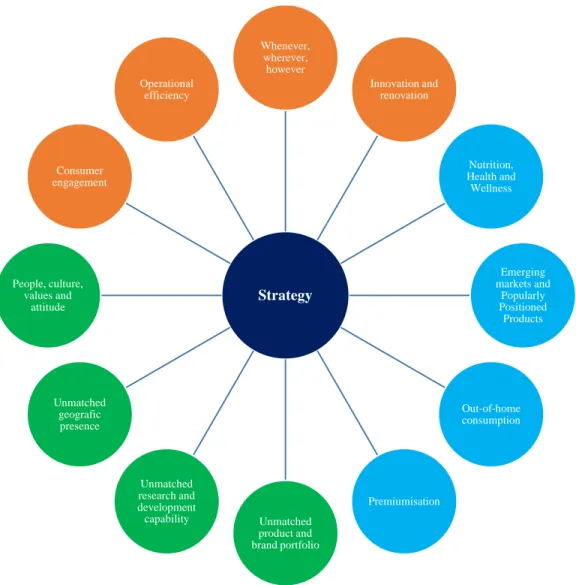
The graph below defines the set of priorities Nestlé has defined in order to reach the above-mentioned ambition of being a leader in Nutrition, Health and Wellness, while in a fast-changing environment. The items in orange are the company’s operational pillars, in blue are its growth drivers and in green are its competitive advantages.
Figure 1 Nestlé Strategic Roadmap
Source: Nestlé, S.A
Strategy Whenever, wherever, however Innovation and renovation Nutrition, Health and Wellness Emerging markets and Popularly Positioned Products Out-of-home consumption Premiumisation Unmatched product and brand portfolio Unmatched research and development capability Unmatched geografic presence People, culture, values and attitude Consumer engagement Operational efficiency
24
3.3.3 SWOT Analysis
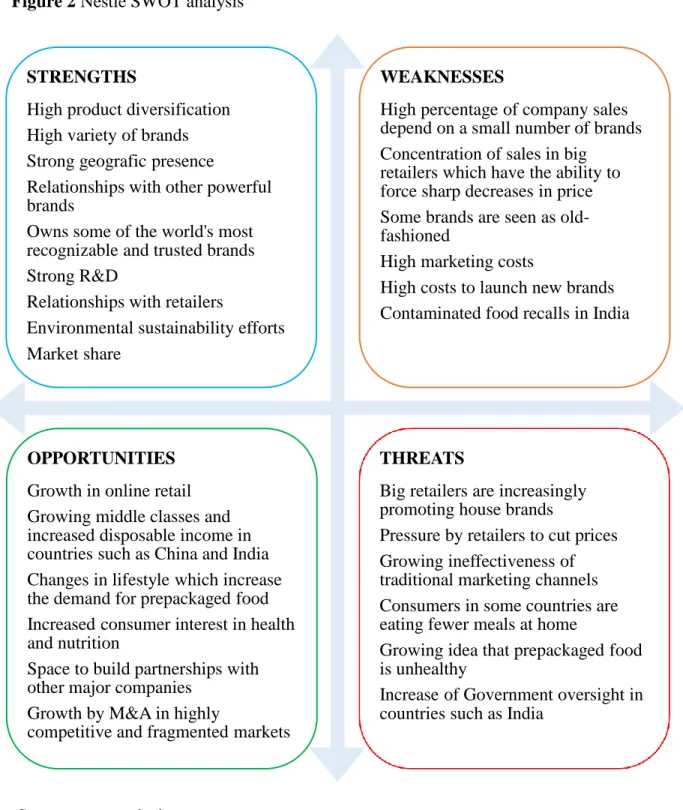
The following graph shows a comprehensive SWOT (Strengths, Weaknesses, Opportunities and Threats) analysis for Nestlé.
Figure 2 Nestlé SWOT analysis
Source: own analysis STRENGTHS
High product diversification High variety of brands Strong geografic presence
Relationships with other powerful brands
Owns some of the world's most recognizable and trusted brands Strong R&D
Relationships with retailers
Environmental sustainability efforts Market share
WEAKNESSES
High percentage of company sales depend on a small number of brands Concentration of sales in big
retailers which have the ability to force sharp decreases in price Some brands are seen as old-fashioned
High marketing costs
High costs to launch new brands Contaminated food recalls in India
OPPORTUNITIES Growth in online retail Growing middle classes and increased disposable income in countries such as China and India Changes in lifestyle which increase the demand for prepackaged food Increased consumer interest in health and nutrition
Space to build partnerships with other major companies
Growth by M&A in highly
competitive and fragmented markets
THREATS
Big retailers are increasingly promoting house brands
Pressure by retailers to cut prices Growing ineffectiveness of traditional marketing channels Consumers in some countries are eating fewer meals at home
Growing idea that prepackaged food is unhealthy
Increase of Government oversight in countries such as India
25
4. Industry Overview
4.1. Macroeconomic Outlook
According to the IMF, in 2017 the global growth (represented by the increase in global gross domestic product) is projected to be higher than in 2016, with a gradual increase in the following years (as shown on Graph 5). The last years have presented low growth rates due to the financial crisis of 2008. High uncertainty and price volatility marked the global economy in the past decade, which negatively affected economies around the globe. Central banks and governments were forced to intervene with measures to prevent
the collapse of the financial system, such as the Quantitative Easing (also known as Large Scale Assets Purchases) to lower interest rates and control inflation, and austerity measures as to reduce deficits and avoid a debt crisis in specific countries. This depression affected both emerging markets and developed countries; however, according to IMF, emerging markets growth is expected to steadily increase in the next years.
As a global player, Nestlé faces exposure to different risks in different countries. It is important to analyze the global economic outlook, while taking into consideration the countries in which Nestlé has the highest exposure (in this case, we will consider sales per geographic region).
Graph 5 GDP growth rates
2.3% 4.4% 5.4% 5.7% 6.0% 6.3% 3.1% 3.3% 3.3% 3.3% 3.2% 3.2% 7.2% 7.6% 7.8% 8.0% 8.1% 8.1% 2016H 2017P 2018P 2019P 2020P 2021P World Developed countries Emerging countries
Graph 5: GDP growth rates
26
Graph 6 Nestlé’s main markets by continent and by country in 2016
Source: Nestlé, S.A
Graph 6 shows that the United States are, by far, the most relevant market to Nestlé in terms of sales, accounting for almost 30% of the company’s revenue in 2016. One can also conclude that 5 markets (USA, China, France, Brazil and Germany) make up 50% of Nestlé’s total revenue sources. Taking into consideration the impact of Donald Trump’s policies, the IMF forecasts a 2.2% and 2.1% increase in real GDP growth in the United States in 2017 and 2018, respectively. Inflation is expected to increase, forecasted to stand at 1.6% in 2017 and 2.0% in 2018. The Federal Reserve System (“Fed”) expects to raise the fed funds rate to 1.5% by the end of 2017; it will normalize it at 2.0% in 2018 and raise it to 3.0% in 2019. This is the result of the end of the Quantitative Easing program in the United States, which terminated in 2014. As a result, long-term and fixed interest rates will rise in the coming years. The unemployment rate is expected to decrease to 4.2% in 2018, considerably lower than the Fed’s 6.7% target (however, a lot of works are part-time and overall job growth is in low-paying industries, meaning structural unemployment may actually increase).
According to the European Commission, the European economy has entered its fifth year of recovery, and it is expected to keep increasing its growth rates steadily in the next two years. The EC’s Spring 2017 Economic Forecast refers a GDP growth (in real terms) of 1.9% in the European Union for each of the next two years, and inflation of 1.6% and 1.3% in 2017 and 2018. Private consumption has been the main growth driver in the past years and is expected to moderately slow due to inflation partly eroding gains in family purchasing power. Unemployment is expected to keep falling, investment to remain steady and the state of public finances to improve. There is,
29.8% 7.3% 5.0% 4.6% 3.2% 3.1% 3.0% North America 32% Europe 28% Asia 20% Central and South America 14% Africa 4% Oceania 2%
27
however, a high level of uncertainty regarding this region’s economic stability due to external risks, such as the future US economic and trade policies, and China’s economic adjustment efforts; also, in Europe, the health of the banking sector and the Brexit negotiations pose threats to Europe’s financial and economic stability.
The economy in the Asia Pacific region is expected to keep presenting solid growth rates in the next years. According to the World Bank, the outlook for developing East Asia is expected to remain positive in the next three years, fueled by an increase in demand and moderate recovery in commodity prices. China is the second most relevant market for Nestlé in terms of sales, and its economy is forecasted to grow 6.5% and 6.3% in 2017 and 2018, respectively, as the government adjusts toward services and consumption. Growth is expected to stand at 5.0% and 5.1% in the rest of the region (including the large economies in Southeast Asia), in 2017 and 2018. Poverty in the region will decrease, private investment will increase and a strengthening in regulation is expected. Risks include inflation hikes, environmental regulation and public debt levels.
4.2. Fast-Moving Consumer Goods
Fast-moving consumer goods (FMCG) are typically products that have a short shelf life, high volumes, relatively low prices, frequent purchase and rapid consumption. This industry is often categorized into 4 segments: Household care, Personal care, Food and beverages and Health care. The FMCG industry is mature, which means that high growth rates in sales are not forecasted for this market. However, in general it has low income elasticity, which means that it is very resilient to recession, as most companies in the sector were able to overcome the recent financial crisis. Also, this industry is highly concentrated, displaying high market saturation and low consumer switching costs, making it highly competitive.
Regarding market trends, this industry is a fast-changing one and it tends to follow major global trends. McKinsey & Co. identifies the five dominant forces that will drive changes in consumer landscape over the next 15 years as follows: