ISSN 0101-2061 Food Science and Technology
OI:
D http://dx.doi.org/10.1590/1678-457X.6745
1 Introduction
Dried pasta represents a basic food for populations living in several countries of Southern Europe, particularly in Italy. The concept of pasta quality for Italian consumers comes from their traditional habits and it is strictly dependent on the usage of durum wheat (Triticum durum) as raw material (Noni & Pagani, 2010). Pasta being stable food product is produced mainly by mixing durum semolina and water. Although more recently other grains have been used to partially replace durum semolina (Chillo et al., 2008). In addition, pseudo cereals have also been used to prepare gluten free (GF) or low glycemic index pastas for special nutrition (Caperuto et al., 2001; Alamprese et al., 2007). However, some people with a specific genetic nature suffer from celiac disease which is usually manifested as a digestive malfunction of the intestines caused by the presence of gluten. This diet excludes intake of storage proteins found in wheat, rye, barley, and oats (Yalcin & Basman, 2008; Schoenlechner et al., 2010; Juszczak et al., 2012). As millets are gluten free thus these are appropriate food for those with celiac disease or other forms of allergies or wheat intolerance (Saravana & Soam, 2010). This information indicates the need for new gluten reduced or gluten-free products in the market such as pasta.
Functional properties determine the quality characteristics of pasta including firmness, gruel loss and overall acceptability. High quality pasta has a good cooking resistance and firmness, does not release an excessive amount of organic matter into the
cooking water and does not show stickiness. Moreover the pasta quality is related to a low breakage susceptibility to dry conditions. Many studies have been carried out to develop functional pasta viz, cereal brans enriched pasta (Kaur et al., 2012), fresh rice pasta (Fernandes et al., 2013).
Finger millet (Eleusine coracana) also known as ragi is one of the important millet consumed without dehulling. It has a well-balanced amino-acid profile and is good source of methionine, cysteine and lysine. It also contains 72% carbohydrates major proportion of which is in the form of non-starchy polysaccharides and dietary fiber, which upon consumption helps in constipation and lowering of glucose level in blood. It is a rich source of vitamins viz, thiamine, riboflavin, folic acid, and niacin (Vidyavati et al., 2004).
Pearl millet (Pennisetum typhoids) is an important coarse cereal grain. Nutritive value of pearl millet is equivalent or even superior to other cereals (Obilana & Manyasa, 2002). It has high levels of calcium, iron, zinc, lipids and a well- balance protein with high concentrations of threonine and tryptophan along with less (but adequate) leucine than other cereals.
Carrot is one of the important root vegetable rich in bioactive compounds like carotenoids and dietary fibers with appreciable levels of several other functional components having significant health promoting properties (Sharma et al., 2012).
Optimization and functionality of millet supplemented pasta
Amir GULL1, Kamlesh PRASAD1, Pradyuman KUMAR1*
Received 26 May, 2015 Accepted 14 Aug., 2015
1Department of Food Engineering and Technology, Sant Longowal Institute of Engineering and Technology, Punjab, India
*Corresponding author: [email protected]
Abstract
Millets are having superior nutritional qualities and health benefits; hence they can be used for supplementation of pasta. Pasta was prepared using composite flour (CF) of durum wheat semolina (96%) and carrot pomace (4%) supplemented with finger millet flour (FMF, 0-20g), pearl millet flour (PMF, 0-30g) and carboxy methyl cellulose (CMC, 2-4g). Second order polynomial described the effect of FMF, PMF and CMC on lightness, firmness, gruel loss and overall acceptability of extruded pasta products. Results indicate that an increasing proportion of finger and pearl millet flour had signed (p≤0.05) negative effect on lightness, firmness, gruel loss and overall acceptability. However, CMC addition showed significant (p≤0. 05) positive effect on firmness, overall acceptability and negative effect on gruel loss of cooked pasta samples. Numeric optimization results showed that optimum values for extruded pasta were 20g FMF, 12g PMF and 4g CMC per 100g of CF and 34ml water with 0.981 desirability. The pasta developed is nutritionally rich as it contains protein (10.16g), fat (6g), dietary fiber (16.71g), calcium (4.23mg), iron (3.99mg) and zinc (1.682mg) per 100g.
Keywords: finger millet; pearl millet; pasta; firmness; gruel loss; carboxy methyl cellulose.
Carrot juice yield reported to be only 60-70% and one third of the raw material remain as pomace which is mainly disposed as feed which contains large amounts of valuable components such as carotenes and dietary fiber. Carrot consumption has been shown to positively influence antioxidant status in healthy human subjects (Bub et al., 2000).
Generally gums and thickeners such as (carboxy methyl cellulose and guar gum) aid in gelling, thickening, water retention and texture improvement (Gallagher et al., 2004) can be utilized for the development of healthy pasta products. The nutritional value of pasta is not very high as it is rich in starch and devoid of dietary fiber. Incorporation of high fiber material enhances the nutritional and functional quality of pasta (Sudha & Leelavathi, 2012). Keeping in view of the above findings of researchers, finger and pearl millet flour incorporated with carrot pomace was used to develop the pasta. The use of hydrocolloid may yield acceptable pasta with good texture and minimum cooking loss.
Therefore the present study was aimed to optimize the pasta formulations of high nutritive value comprising finger millet flour (FMF), pearl millet flour (PMF) and carboxy methyl cellulose (CMC).
2 Materials and methods
Durum wheat semolina was procured from Goyal Wheat Milling Industries, Indore (India). Finger millet and Pearl millet (HHB-67) were obtained Shimla and Hisar (India). Millet flours and carrot pomace was prepared as per method used by (Gull et al., 2015). Carboxy methyl cellulose was procured from Loba Chemie Pvt. Ltd (Mumbai). All the chemicals used for analysis were of analytical grade.
2.1 Experimental design
Second order polynomial (SOP) model was used to describe the effect of finger millet flour (FMF), pearl millet flour (PMF) and carboxymethyl cellulose (CMC) for the development of nutrient rich and functional pasta. Each independent variable was used according to preliminary trials. Central composite rotatable design (CCRD) was selected for conduct of 30 runs by varying finger millet flour 0-20g, pearl millet flour 0-30g, CMC 2-4g 100g-1of composite flour (CF) (containing durum wheat semolina and carrot pomace in ratio of 96:4) and water 31-35ml 100g-1 of ingredient premix. Levels of these variables along with the experimental plan are shown Table 1. The proportion of FMF, PMF and CMC was optimized with a target for the development of nutrient rich and functional pasta.
2.2 Preparation of pasta
Weighed amount of composite flour and other supplemented ingredients (Table 1, run 1–30) were put into pasta mixer-extruder. Measured amount of water (Table1) was slowly added mixed and kneaded into stiff plastic and homogenous dough. The dough was then passed through a single screw extruder (Model: Dolly La Monferrina Italy) fitted with an adjustable die (diameter 7 mm). The extruded product tube type pasta (Ziti-Cut) was cut into pieces of uniform length (2.54 cm) with a knife moving over the outer die surface. The extruded pasta was dried at 60°C for about 3- 4 h to attain moisture content to about 9% (db).
The resultant dried pasta products of various blends were packed in high density polyethylene (HDPE) bags kept in refrigerator for further analysis.
2.3 Cooking characteristics of pasta
Optimal Cooking Time (OCT)
The optimal cooking time (OCT) was evaluated every 30s during cooking by observing the time of disappearance of the core of pasta by squeezing between two transparent glass slides according to the AACC approved method 66-50 (American Association of Cereal Chemists, 2000).The time at which the core completely disappeared was taken as the OCT using method (AACC 16-50).
Color evaluation
Color of the cooked pasta samples was determined using a colorimeter (Model CR-10, Konica Minolta Sensing, Inc. Japan) equipped with D65 illuminant. Measurements were made at random locations on the surface of the cooked pasta and lightness (L*) values were noted. Three measurements were taken for each sample and their average value was reported.
Gruel loss
Ten grams of the sample were cooked in pan containing 300 ml of boiling water for optimum cooking time. The cooking water was drained into beaker and 25 ml of the cooking water was pipetted out and evaporated to dryness in hot air oven at 105°C to determine the solids loss in the gruel and expressed as % gruel loss using method (AACC 16–50). Three measurements were taken for each sample and their average value was reported (American Association of Cereal Chemists, 2000).
Texture analysis
The firmness was measured as described by Prabhasankar et al. (2009) with slight modification. The firmness of cooked pasta samples was measured by using a texture analyzer model (TA-XT2., Stable Micro systems, UK). Three-cooked pasta samples were sheared at a 90° angle. The shear was performed at a crosshead speed of 10 mm/min and load cell of 5 kg. The force required to shear the pasta was measured. The results reported are the averaged of three readings.
Overall acceptability
Sensory analysis of cooked pasta was carried out using nine point hedonic scale (Ranganna, 1986) by a semi-trained panel of 15 members. The panel evaluated the pasta for sensory parameters like color, appearance, texture and taste and mean value of the score was considered as overall acceptability.
2.4 Statistical analysis
3 Results and discussion
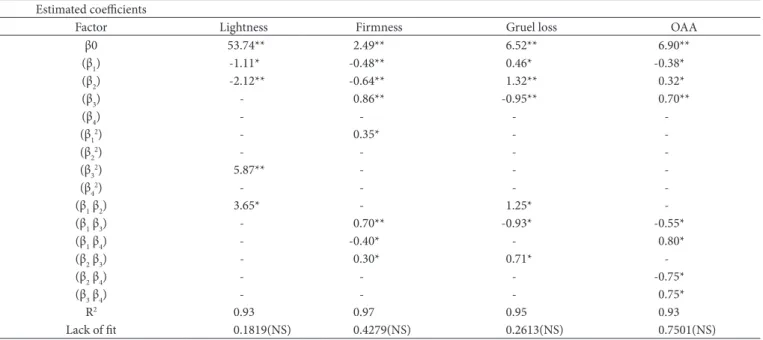
Diagnostic checking of the second order polynomial fitted models for all responses are given in Table 2. The linear, quadratic and interaction effects were calculated for each model. The regression coefficients and correlation coefficients for each model are shown in Table 3. The model was considered adequate when the multiple coefficients of correlation (R2) were more than 93% and the lack of fit test was non-significant. The (R2) values for the responses i.e. lightness, firmness, gruel loss and overall acceptability were 0.93, 0.97, 0.95, and 0.93. The calculated F-values were more than the tabulated value for the responses indicating adequacy of the models at 5% level of significance. Thus all four responses were considered adequate to describe the effect of variables on the quality of pasta.
3.1 Color
Color plays a major role in consumer’s perception and acceptability of the product. The observed color (L*) value of cooked pasta with different combinations of the ingredients
varied from 50.10 to 59.83 as shown in Table 1. Figure 1 a represents change in lightness (L*) value of pasta with addition of finger and pearl millet flours, both millet flours significantly (p≤0.05) decreased the lightness (L*) value of prepared pasta samples at linear level. This may be due to the brick red color of finger millet seed coat and grey color of pearl millet flour (Gull et al., 2015). Rathi et al. (2004) also observed that L* value of pasta prepared from native pearl millet was lower than the pasta prepared from depigmented pearl millet flour. This difference in color of millet flours is due to the polyphenolic pigments present in pericarp, aleuronic layer and in endosperm region (McDonough & Rooney, 1989).
3.2 Texture
Texture has been defined as one of the important attribute of pasta structure and textural characteristics are recognized as more important for consumers (Brennan & Tudorica, 2007). The observed firmness values for different combinations varied from 1.45N to 3.29N as shown in Table 1. Regression coefficient Table 3 showed that firmness of pasta samples is significantly Table 1. Effect of independent variables on functional qualities of pasta.
Run No.
FMF (g.100g-1 CF)
PMF (g.100g-1
CF)
CMC (g.100g-1 CF)
Water (mL.100g-1
ingredient premix)
Lightness L*
Firmness (N) Gruel loss (%)
OAA
1 10 15 2 33 59.83 1.51 7.60 6.40
2 15 7.5 2.5 34 54.75 2.08 7.10 6.40
3 5 7.5 2.5 32 57.40 2.98 6.60 6.80
4 5 7.5 3.5 34 57.40 3.70 5.80 7.90
5 15 22.5 2.5 32 54.58 1.50 8.12 7.20
6 10 15 3 33 54.02 2.40 6.50 7.10
7 5 22.5 3.5 32 53.60 2.65 6.63 8.10
8 15 22.5 3.5 34 53.30 2.85 7.58 7.50
9 10 15 4 33 58.50 3.29 5.30 7.40
10 5 22.5 2.5 34 54.10 2.39 6.96 6.20
11 5 7.5 2.5 34 57.00 3.13 6.21 6.30
12 15 22.5 3.5 32 54.45 2.81 7.60 7.00
13 10 30 3 33 50.10 1.73 8.12 7.50
14 20 15 3 33 52.33 2.30 7.10 6.30
15 10 15 3 33 54.19 2.43 6.58 6.90
16 10 15 3 33 53.10 2.70 6.90 7.00
17 10 15 3 33 54.00 2.51 6.39 7.00
18 10 15 3 31 52.40 2.50 6.43 7.00
19 10 15 3 35 52.00 2.45 6.52 7.00
20 15 7.5 2.5 32 54.98 2.12 7.02 6.10
21 15 7.5 3.5 32 55.10 3.18 5.03 6.50
22 0 15 3 33 56.10 3.26 6.35 7.30
23 10 15 3 33 53.00 2.38 6.48 6.50
24 10 0 3 33 55.10 3.22 5.10 6.80
25 5 22.5 2.5 32 54.40 2.01 6.94 7.30
26 10 15 3 33 54.15 2.53 6.28 6.90
27 5 7.5 3.5 32 58.00 3.11 6.12 7.50
28 15 7.5 3.5 34 54.80 3.09 5.13 7.50
29 5 22.5 3.5 34 52.70 3.02 6.60 7.40
30 15 22.5 2.5 34 56.90 1.45 8.40 6.70
affected (p≤0.05) by the CMC at linear level. This may be due to the hydrophilic component of hydrocolloids interacts with proteins as a result of ionic charges and thereby improving the structure of pasta (Raina et al., 2005). Yadav et al. (2014) also reported increase in firmness of non-wheat pasta based with CMC. Figure 1b, c shows that both finger and pearl millet flour caused significant decrease (p≤0.05) in firmness value at linear level. It is due to the dilution of gluten strength by addition of non gluten containing millet flours and carrot pomace which interrupts and weakens the overall structure of pasta thus reducing firmness. Similarly (Krishnan & Prabhasankar, 2010) reported the same results in durum wheat pasta incorporated with sprouted finger millet and green banana flours.
3.3 Gruel loss
The amount of residue in the cooking water is commonly used as an indicator of pasta quality. Low amount of residue indicates high quality pasta. For high quality pasta, the residue
should not exceed 7-8% of the dry weight of pasta. The observed gruel loss of different combinations of pasta varied from 5.03 to 8.12 Table 1. As shown in Figure 1d gruel loss of cooked pasta decreased significantly (p≤0.05) with increase in CMC level. This could be due to the fact that gum network formation occurred around starch granules which encapsulate them during cooking and restricting the excessive swelling and diffusion of amylose content. Chillo et al. (2007) also observed decrease in gruel loss in spaghetti due to the addition of CMC. Shiau (2004) reported the similar reports that reduction in gruel loss in pasta containing gums. Figure 1d, e shows that both millet flours cause significant increase (p≤0.05) in gruel loss at linear level. This could be due to the reason, as millets are gluten free and addition of these dilutes gluten results in poor protein network and thus allow more leaching out of solids from pasta into the cooking water, hence increased the gruel loss.
Table 2. Analysis of variance for different models.
Response Source of variation df Sum of squares Mean square F-value
Lightness Model 14 124.3 8.88 15.99*
Residual 15 8.33 0.56
Cor.Total 29 132.6
-Firmness Model 14 9.43 0.67 41. 42*
Residual 15 0.24 0.01
Cor.Total 29 9.67
-Gruel Loss Model 10 20.3 2.03 30.49*
Residual 19 1.27 0.06
Cor.Total 29 21.6
-OAA Model 14 6.90 0.49 14.87*
Residual 15 0.50 0.03
Cor.Total 29 7.40
-*Significant at p<0.05.
Table 3. Estimated coefficients of the best fitted SOP equation for different response of pasta.
Estimated coefficients
Factor Lightness Firmness Gruel loss OAA
β0 53.74** 2.49** 6.52** 6.90**
(β1) -1.11* -0.48** 0.46* -0.38*
(β2) -2.12** -0.64** 1.32** 0.32*
(β3) - 0.86** -0.95** 0.70**
(β4) - - -
-(β12) - 0.35* -
-(β22) - - -
-(β32) 5.87** - -
-(β42) - - -
-(β1 β2) 3.65* - 1.25*
-(β1 β3) - 0.70** -0.93* -0.55*
(β1 β4) - -0.40* - 0.80*
(β2 β3) - 0.30* 0.71*
-(β2 β4) - - - -0.75*
(β3 β4) - - - 0.75*
R2 0.93 0.97 0.95 0.93
Lack of fit 0.1819(NS) 0.4279(NS) 0.2613(NS) 0.7501(NS)
3.4 Overall acceptability
Sensory evaluation is most reliable test as it allows overall characteristics of cooked pasta. Effect of various process parameters on overall acceptability (OAA) is indicated in Figure 1f, g. The overall acceptability of cooked pasta with in the combinations varied from 6.2 to 8.1 Table 1. As shown in Figure 1f OAA decreased by increasing the proportion of finger and pearl millet flours. This may be due to unattractive dark color of finger millet and grey to yellow color of pearl millet which limits the wider acceptability of its food products. As shown in Figure 1g addition of CMC increased OAA of cooked pasta. This could be attributed due to improvement in texture. Similarly Yadav et al. (2014) also observed increase in OAA with CMC for
non-wheat pasta based on pearl millet flour containing barley and whey protein concentrate.
4 Optimization
and Agriculture, 81(1), 95-101. http://dx.doi.org/10.1002/1097-0010(20010101)81:1<95::AID-JSFA786>3.0.CO;2-T.
Chillo, S., Laverse, J., Falcone, P. M., & Del Nobile, M. A. (2007). Effect of carboxy methyl cellulose and pregelatinized corn starch on the
quality of amaranthus spaghetti. Journal of Food Engineering, 83(4),
492-500. http://dx.doi.org/10.1016/j.jfoodeng.2007.03.037. Chillo, S., Laverse, J., Falcone, P. M., & Del Nobile, M. A. (2008). Quality
of spaghetti in base amaranthus wholemeal flour added with quinoa,
broad bean and chick pea. Journal of Food Engineering, 84(1),
101-107. http://dx.doi.org/10.1016/j.jfoodeng.2007.04.022.
Fernandes, M. D. S., Sehn, G. A. R., Leoro, M. G. V., Chang, Y. K., & Steel, C. J. (2013). Effect of adding unconventional raw materials
on the technological properties of rice fresh pasta. Food Science and
Technology, 33(2), 257-264.
Gallagher, E., Gormley, T. R., & Arendt, E. K. (2004). Recent advances in
the formulation of gluten-free cereal-based products. Trends in Food
Science & Technology, 15(3-4), 143-152. http://dx.doi.org/10.1016/j. tifs.2003.09.012.
Gull, A., Prasad, K., & Kumar, P. (2015). Effect of millet flours and carrot pomace on cooking qualities, color and texture of developed
pasta. LWT Food Science and Technology, 63(1), 470-474. http://
dx.doi.org/10.1016/j.lwt.2015.03.008.
Juszczak, L., Witczak, T., Ziobro, R., Korus, J., Cieślik, E., & Witczak, M. (2012). Effect of inulin on rheological and thermal properties of
gluten-free dough. Carbohydrate Polymers, 90(1), 353-360. http://
dx.doi.org/10.1016/j.carbpol.2012.04.071. PMid:24751052. Kaur, G., Sharma, S., Nagi, H. P. S., & Dar, B. N. (2012). Functional
properties of pasta enriched with variable cereal brans. Journal of Food
Science and Technology, 49(4), 467-474. http://dx.doi.org/10.1007/ s13197-011-0294-3. PMid:23904655.
Krishnan, M., & Prabhasankar, P. (2010). Effect of pasting, microstructure, sensory and nutritional profile of pasta influenced by sprouted finger
millet (Eleucina Coracana) and green banana (Musa Paradisiaca)
flours. Journal of Texture Studies, 41(6), 825-841. http://dx.doi.
org/10.1111/j.1745-4603.2010.00257.x.
McDonough, C. M., & Rooney, L. W. (1989). Structural characteristics of Pennisetum americanum (pearl millet) using scanning electron
and florescence microscopy. Food Microstructure, 81, 137-149.
Noni, I., & Pagani, M. A. (2010). Cooking properties and heat damage of dried pasta as influenced by raw material characteristics and
processing conditions. Critical Reviews in Food Science and Nutrition,
50(5), 465-472. http://dx.doi.org/10.1080/10408390802437154.
PMid:20373190.
Obilana, A. B., & Manyasa, E. (2002). Millets. In P. S. Belton & J. R. N.
Taylor (Eds.), Pseudocereals and less common cereals (pp. 177-214).
Berlin: Springer. http://dx.doi.org/10.1007/978-3-662-09544-7_6.
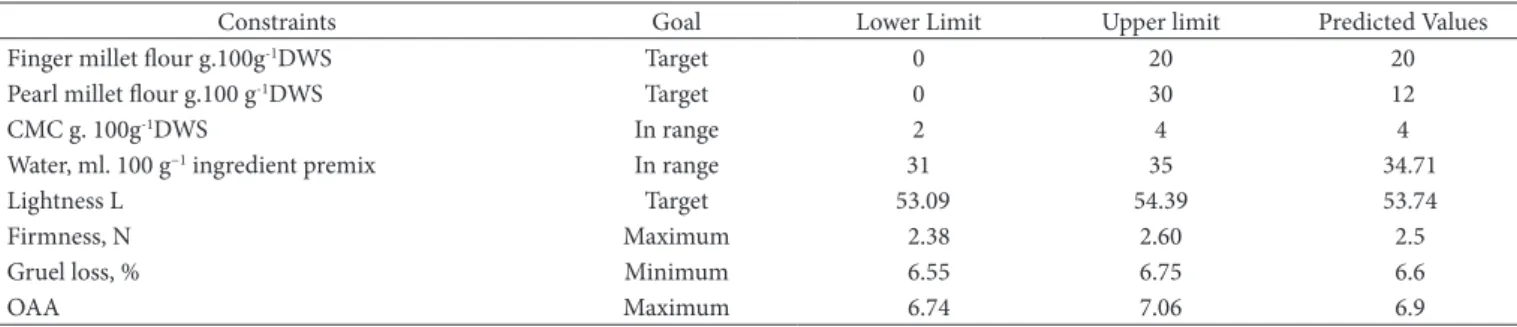
whey protein concentrate. Product response values resulted in identification of a combination that satisfied the constraints. Finally the Pasta was prepared using the recommended level of ingredients. The developed pasta was analyzed for its nutritional values and it was found that developed pasta (per 100g) contains protein (10.16g), fat (6.0g), dietary-fiber (16.71g), calcium (4.23mg), iron (3.99mg) and zinc (1.682mg).
5 Conclusions
Product responses lightness, firmness, gruel loss and overall acceptability of the prepared pasta were affected by ingredients FMF, PMF and CMC. The present study showed that pasta with good nutritional and functional properties can be obtained from blends by incorporating 20gFMF, 12gPMF, 4gCMC 100 g-1 CF with OAA (8.1). The pasta prepared from the composite flours contained higher levels of protein, dietary fiber, calcium, iron and zinc and may offer the inherent health benefits of millets especially phytochemicals to the consumer. Moreover the results of this study could provide the industry useful information about potential utilization of millet grains in food formulations and product development for new functional foods.
Acknowledgements
The first author thanks UGC New Delhi for the grant of (MANF) junior research fellowship to carry out this research work.
References
Alamprese, C., Casiraghi, E., & Pagani, M. A. (2007). Development of gluten free fresh egg pasta analogues containing buckwheat.
European Food Research, 225(2), 205-213. http://dx.doi.org/10.1007/ s00217-006-0405-y.
American Association of Cereal Chemists - AACC. (2000). Approved
methods of the AACC (10th ed.). St. Paul.
Brennan, C. S., & Tudorica, C. M. (2007). Fresh pasta quality as
affected by enrichment of nonstarch polysaccharides. Journal of
Food Science, 72(9), S659-S665. http://dx.doi.org/10.1111/j.1750-3841.2007.00541.x. PMid:18034751.
Bub, A., Watzl, B., Abrahamse, L., Delincée, H., Adam, S., Wever, J., Müller, H., & Rechkemmer, G. (2000). Moderate intervention with carotenoid-rich vegetable products reduces lipid peroxidation in
men. The Journal of Nutrition, 130(9), 2200-2206. PMid:10958813.
Caperuto, L., Amaya-Farfan, J., & Camargo, C. R. O. (2001).
Performance of quinoa (Chenopodium quinoa Willd) flour in the
manufacture of gluten-free spaghetti. Journal of the Science of Food
Table 4. Constraints, criteria for optimization solution along with predicted and actual response values.
Constraints Goal Lower Limit Upper limit Predicted Values
Finger millet flour g.100g-1DWS Target 0 20 20
Pearl millet flour g.100 g-1DWS Target 0 30 12
CMC g. 100g-1DWS In range 2 4 4
Water, ml. 100 g−1 ingredient premix In range 31 35 34.71
Lightness L Target 53.09 54.39 53.74
Firmness, N Maximum 2.38 2.60 2.5
Gruel loss, % Minimum 6.55 6.75 6.6
Prabhasankar, P., Ganesan, P., Bhaskar, N., Hirose, A., Stephen, N., Gowda, L. R., Hosokawa, M., & Miyashita, K. (2009). Edible Japanese
seaweed, wakame (Undaria pinnatifida) as an ingredient in pasta:
chemical, functional and structural evaluation. Food Chemistry,
115(2), 501-508. http://dx.doi.org/10.1016/j.foodchem.2008.12.047.
Raina, C. S., Singh, S., Bawa, S., & Saxena, D. C. (2005). Textural characteristics of pasta made from rice flour supplemented with
proteins and hydrocolloids. Journal of Texture Studies, 36(4),
402-420. http://dx.doi.org/10.1111/j.1745-4603.2005.00024.x.
Ranganna, S. (1986). Handbook of analysis and quality control for
fruits and vegetable products (chapt. 1, pp. 1-30). New Delhi: Tata McGraw-Hill.
Rathi, A., Kawatra, A., & Sehgal, S. (2004). Influence of de-pigmentation
of pearl millet (Pennisetum glaucum) on sensory attributes,
nutrient composition, in vitro protein and starch digestibility of
pasta. Food Chemistry, 85(2), 275-280. http://dx.doi.org/10.1016/j.
foodchem.2003.06.021.
Saravana, M., & Soam, S. K. (2010). Exploitation of minor millets genetic resources for poverty alleviation in India. In National Conference on Biodiversity, Development and Poverty Alleviation, Lucknow, India. Schoenlechner, R., Mandala, I., Kiskini, A., Kostaropoulos, A., &
Berghofer, E. (2010). Effect of water, albumen and fat on the
quality of gluten-free bread containing amaranth. International
Journal of Food Science & Technology, 45(4), 661-669. http://dx.doi. org/10.1111/j.1365-2621.2009.02154.x.
Sharma, K. D., Karki, S., Thakur, N. S., & Attri, S. (2012). Chemical composition, functional properties and processing of carrot-a review.
Journal of Food Science and Technology, 49(1), 22-32. http://dx.doi. org/10.1007/s13197-011-0310-7. PMid:23572822.
Shiau, S. Y. (2004). Effect of emulsifiers on dough rheology properties
and the texture of extruded noodles. Journal of Texture Studies,
35(1), 93-110. http://dx.doi.org/10.1111/j.1745-4603.2004.tb00824.x.
Sudha, M. L., & Leelavathi, K. (2012). Effect of blends of dehydrated green pea flour and amaranth seed flour on the rheological,
microstructure and pasta making quality. Journal of Food Science
and Technology, 49(6), 713-720. http://dx.doi.org/10.1007/s13197-010-0213-z. PMid:24293690.
Vidyavati, H. G., Begum, M. G., Vijayakumar, J., Gokavi, S. S., & Begum,
S. (2004). Utilization of finger millet in preparation of Papad. Journal
of Food Science and Technology, 41(4), 379-382.
Yadav, D. N., Balasubramanian, S., Kaur, J., Anand, T., & Singh, A. K. (2014). Non-wheat pasta based on pearl millet flour containing
barley and whey protein concentrate. Journal of Food Science and
Technology, 51(10), 2592-2599. http://dx.doi.org/10.1007/s13197-012-0772-2. PMid:25328200.
Yalcin, S., & Basman, A. (2008). Effects of gelatinization level, gum and transglutaminase on the quality characteristics of rice noodle.