1(Trabalho 125-13). Recebido em: 15-03-2013. Aceito para publicação em: 04-02-2014.
2Instituto Federal Catarinense-Câmpus Araquari, Caixa postal 21, CEP 89245-000, Araquari, SC. E-mail: [email protected] 3Depto. de Engenharia Rural CCA-UFSC, CP 476, 88040-970 Floriranópolis-SC. E-mail: [email protected];
4Epagri, Rua João José Godinho, s/n, 88.506-080 Lages-SC. E-mail: [email protected]
5UFSC/Câmpus de Curitibanos, Cx. Postal 101, CEP. 89.520-000, Curitibanos-SC. E-mail: [email protected] COMUNICAÇÃO CIENTÍFICA
PINEAPPLE (
Ananas comosus
) CV. PÉROLA
ex vITRo
GROWTH AND MYCORRHIZAL COLONIZATION
AFFECTED BY
In vITRo
SUCROSE CONCENTRATION
1ALCEU KUNZE2, PAULO EMÍLIO LOVATO3,
MURILO DALLA COSTA4, LÍRIO LUIZ DAL VESCO5
ABSTRACT – The aim of this study wasto evaluate the effect of sucrose concentration in the culture
medium on growth and on the establishment of mycorrhizas during the acclimatization of pineapple cv.
Pérola. The plantlets were micropropagated in MS culture medium with 0, 10, 20 and 30 g L-1 of sucrose and then they were acclimatized during 12 weeks under greenhouse conditions, in a sandy soil - compost mixture, uninoculated or inoculated with a Rhizophagus clarus isolate. Plantlets from the culture medium with 20 g and 30 g of sucrose L-1 showed higher shoot and root biomass than those from sugar-free medium.
Mycorrhizal colonization was lower in plantlets micropropagated in sucrose-free medium, but the intensity of arbuscules did not differ among treatments. In the 12-week period of acclimatization, mycorrhizal colonization had no effect on plant biomass.
Index terms: Rhizophagus clarus, micropropagation, weaning, arbuscular mycorrhiza.
CRESCIMENTO
ex vITRo
E COLONIZAÇÃO MICORRÍZICA DE
ABACAXI (
Ananas comosus
) CV. PÉROLA AFETADOS PELA
CONCENTRAÇÃO DE SACAROSE NA FASE
In vITRo
RESUMO – O objetivo deste trabalho foi avaliar o efeito da concentração de sacarose no meio de cultura sobre crescimento e o estabelecimento de micorrizas na fase de aclimatização de plantas de abacaxi (cv. Pérola). As plantas foram micropropagadas em meio de cultura MS com 0;10; 20 ou 30 g L-1 de sacarose e
depois aclimatizadas por 12 semanas em casa de vegetação, em uma mistura de solo arenoso e composto, inoculada ou não com um isolado de Rhizophagus clarus. Plantas originadas do meio de cultura com 20 g e 30 g L-1 de sacarose apresentaram maior massa de parte aérea e raiz que aquelas do meio sem açúcar. A colonização micorrízica foi menor nas plantas micropropagadas no meio de cultura sem sacarose, mas a intensidade de arbúsculos não diferiu entre tratamentos. No período de 12 semanas de aclimatização, a colonização micorrízica não teve efeito sobre a produção de biomassa das plantas.
Termos para indexação: Rhizophagus clarus, micropropagação, aclimatização, micorrizas arbusculares.
Micropropagation of pineapple has been successfully achieved with the establishment of regeneration protocols for the species through organogenesis in liquid culture medium (DAL VESCO et al., 2001) and use of temporary immersion bioreactor (FIROOZABADY; GUTTERSON, 2003). This allows large-scale clonal multiplication of healthy plantlets of varieties obtained by breeding, and up to 930 thousand plantlets can be obtained and weaned in one year from one single explant (DAL VESCO et al., 2001). Besides maintenance of genetic
gains and mass production of plantlets, tissue culture of pineapple helps in controlling pathogens, such
as Fusarium subglutinans, which spreads via
Inoculation of arbuscular mycorrhizal fungi during the weaning stage of micropropagated plants can reduce abiotic stress and increase survival rate in this phase of plant establishment (KAPOOR et al., 2008, KOZAI & KUBOTA, 2005). In the production of the pineapple plants through in vitro tissue culture or by conventional methods (RODRÍGUEZ-ROMERO et al., 2011), this association has positive effects on development and absorption of nutrients. Mycorrhizas have been shown to reduce the incidence of nematodes (GUILLEMIN et al., 1994a) and alleviate the effects of the pathogen Phytophthora cinnamomi on pineapple growth (GUILLEMIN et al. 1994b).
The aim of this study was to evaluate the effect of sucrose concentrations in the in vitro culture medium on growth and establishment of the mycorrhizal symbiosis during the ex vitro stage.
Pineapple microplants (cv. Pérola) were grown in Murashige & Skoog medium with vitamins (MOREL; WETMORE, 1951) and different
concentrations of sucrose (0, 10, 20 and 30 g L-1).
The culture medium had its pH adjusted to 5.8 and was autoclaved (121 ° C, 15 minutes). After 45 days of growth, plantlets were weaned in 170-mL tubes containing a 4:1 (v/v) mixture of autoclaved (60 min) sandy soil (Orthic Quartzipsament) and unsterile municipal compost produced with food scraps, grass clippings, and animal bedding with wood shavings (INÁCIO; MILLER, 2009; BRITO et al., 2010). The mix had the following physicochemical
attributes: pH (water) 7.1, P> 50 mg dm-3, K 3.8
mmolc dm-3, organic matter 22 g kg-1, Ca 20 mmol c
dm-3, Mg 14 mmol
c dm
-3. Each plant received 3.0
g of Rhizophagus clarus (T.H. Nicolson & N.C. Schenck) C. Walker & A. Sch. Wal (synonymy = Glomus clarum) inoculum, a mixture of Paspalum notatum roots and growth substrate (ZEMKE et al., 2003), placed near the root system. Non-mycorrhizal plants received a filtrate (Whatman n. 2 filter paper) of the inoculum, in order to reestablish the non-mycorrhizal biota. Plants were kept in a greenhouse and after 12 weeks shoot and root biomass were evaluated. Part of the root system was sampled to estimate the rate of mycorrhizal root colonization (TROUVELOT et al., 1986), after clearing with KOH and staining with acidified 0.05% trypan blue glycerol solution (KOSKE; GEMMA, 1989). The experiment had a 4x2 factorial design, corresponding to four concentrations of sucrose (0, 10, 20 e 30 g L-1)
in the previous culture medium and two treatments, with or without arbuscular mycorrhizal inoculation during the weaning stage, arranged in complete blocks design with three replications composed of
six plants each. Data were submitted to analysis of variance (ANOVA) to check effects of factors and their interaction, and a regression analysis was done with sucrose concentrations as independent variable. Percentage data were transformed to arcsen√(x⁄100) previously to statistical analyses. All statistical analyses were performed with ASSISTAT software (SILVA, 2013).
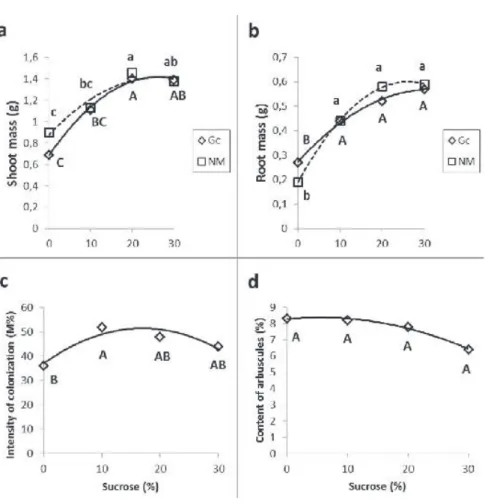
After acclimatization, ANOVA showed that pineapple plantlets propagated in medium with 2% and 3% sucrose had higher shoot and root biomass than those previously grown in medium without sucrose, regardless of inoculation of the mycorrhizal fungus (Figure 1a, 1b). Growth of non mycorrhizal plantlets fitted a linear pattern while mycorrhizal plantlets showed a quadratic response to the sucrose concentration. These results demonstrate the possibility of lowering sucrose concentration in growth media for this species, as shown for ornamental pineapple by Oliveira et al (2010). Although low, pineapple plants showed some growth after being micropropagated in sucrose-free culture medium, suggesting that the in vitro explants were performing some photosynthesis.
their behavior fitted a quadratic model, similarly to the behavior of mycorrhizal colonization. That suggests that the intermediate levels of sucrose in the growth media result in plants that are more conducive to the establishment of this mutualistic association. Recent work in Brazil has shown that response of micropropagated pineapple plantlets to mycorrhizal inoculation varies with plant and fungal genotypes (SANTOS et al., 2011), meaning that specific procedures must be tested for each
plant genotype. It has also been demonstrated that mycorrhizal inoculation can stimulate root development in micropropagated plants during the weaning stage (LOCATELLI et al., 2002a, 2002b) and that the effects of mycorrhizal inoculation can persist under field conditions (LOVATO et al., 2006). Therefore, in order to optimize a set of procedures for pineapple production through micropropagation, before evaluating field responses, it is necessary to carry out research departing from the in vitro phase.
FIGURE 1- Response to concentration of sucrose in the multiplication medium by pineapple plantlets
inoculated with Rhizophagus clarus (Gc) ou uninoculated (NM) a, shoot biomass of inoculated
(Y(Gc)= -0,0011x2 + 0,0561x + 0,6815; r2 = 0,9957) and uninoculated plantlets (Y= -0,0008x2
+ 0,0409x + 0,8745; r2 = 0,9329); b, root biomass of inoculated (Y = -0,0003x2 + 0,0188x +
0,273; r2 = 0,9965) and uninoculated plantlets (Y = -0,0006x2 + 0,0314x + 0,189; r2 = 0,9998);
c, intensity of mycorrhizal colonization in roots of inoculated plantlets (Y = -0,05x2 + 1,7x
+ 37; r2= 0,8571); d, content of arbuscules in roots of inoculated plantlets (Y = -0,0032x2 +
REFERENCES
BRITO, F. S.; MILLER, P. R. M.; STADNIK, M. Presença de Trichoderma spp em composto e suas características para o controle de fitopatógenos.
Revista Brasileira de Agroecologia, Pelotas, v. 5, p. 43-53, 2010.
DAL VESCO, L.L.; PINTO, A. de A.; ZAFFARI, G.R.; NODARI, R.O.; REIS, M.S. dos; GUERRA, M.P. Improving pineapple micropropagation protocol through explant size and medium composition manipulation. Fruits, Paris, v. 56, n. 3, p. 143-154, 2001.
FIROOZABADY, E.; GUTTERSON, N. Cost-effective in vitro propagation methods for pineapple.
Plant Cell Reports, Berlin, v.21, n.9, p.844-850, 2003.
GUILLEMIN, J.P.; GIANINAZZI, S.; GIANINAZZI-PEARSON, V.; MARCHAL, J. Contribution of arbuscular mycorrhizas to biological protection of micropropagated pineapple (Ananas comosus (L.) Merr.) against Phytophtora cinnamomi Rands.
Agricultural Science in Finland, Jokioinen, v. 3, n. 3, p. 241-251, 1994a.
GUILLEMIN, J.P.; GIANINAZZI, S.; GIANINAZZI-PEARSON, V.; MARCHAL, J. Control by arbuscular endomycorrhizae of Pratylenchus brachyurus in
pineapple microplants. Agricultural Science in
Finland, Jokioinen, v. 3, n. 3, p. 253-262, 1994b.
INÁCIO, C. T.; MILLER, P. R. M. Compostagem:
ciência e prática para a gestão de resíduos orgânicos. Rio de Janeiro: Embrapa Solos, 2009.
KAPOOR, R.; SHARMA, D.; BHATNAGAR, A.K. Arbuscular mycorrhizae in micropropagation
systems and their potential applications. Scientia
Horticulturae, Amsterdam, v. 116, n. 3, p. 227-239, 2008.
KOZAI, T.; KUBOTA, C. In vitro root zone environment and their effects on growth and development of plants. In: KOZAI, T.; AFREEN,
F.; ZOBAYED, S. M. A. (Ed.). Photoautotrophic
(sugar-free medium) micropropagation as a new micropropagation and transplant production system. Dordrecht: Springer, 2005. p 53-60.
KOSKE, R.E.; GEMMA, J.N. A modified procedure for staining roots to detect VA mycorrhizas.
Mycological Research, Cambridge, v.92, n.4, p.486-488, 1989.
LOCATELLI, L. M.; LOVATO, P. E.; PEDROTTI, E. L Crescimento e desenvolvimento radicular do porta-enxerto Marubakaido (Malus prunifolia) micropropagado submetido à inoculação micorrízica e à poda de raízes, Revista Brasileira de Fruticultura, Jaboticabal, v. 24, n.2, p. 486-490, 2002a.
LOCATELLI, L. M.; VITOVSKI, C. A.; LOVATO, P. E. Sistema radicular de porta-enxertos micropropagados de macieira colonizados com
fungos micorrízicos arbusculares. Pesquisa
Agropecuária Brasileira, Brasília, v. 37, n. 9, p. 1239-1245, 2002b.
LOVATO, P. E.; TROUVELOT, A.; GIANINAZZI-PEARSON, V.; GIANINAZZI, S. Enhanced growth of wild cherry using micropropagated plants and
mycorrhizal inoculation. Agronomy for Sustainable
Development, Paris, v.26, p.209-213, 2006.
MOREL, G. M.; WETMORE, R. H. Fern callus
tissue culture. American Journal of Botany,
Columbus, v. 38, p. 141-143, 1951.
OLIVEIRA, Y.; ANSELMINI, J. A.; CUQUEL, F. L.; PINTO, F.; QUOIRIN, M. Pré-aclimatização in vitro
de abacaxi-ornamental. Ciência e Agrotecnologia,
Lavras, v.34, p. 1647-1653, 2010.
RODRIGUEZ-ROMERO, A.S.; AZCON, R.; JAIZME-VEJA, M.D.C. Early mycorrhization of two tropical crops, papaya (Carica papaya L.) and pineapple [Ananas comosus (L.) Merr.], reduces the necessity of P fertilization during the nursery stage.
Fruits, Paris, v. 66, n.1, p 3-10, 2011.
SANTOS, P. C.; FREITAS, S. J.; FREITAS, M. S. M.; SOUZA, L. B.; CARVALHO, A. J. C. Production of seedlings of type suckers, using crows of three cultivars of pineapple inoculated
with mycorrhizal fungi. Revista Brasileira de
Fruticultura, Jaboticabal, v. 33, n. 3, p 954 – 961, 2011.
SCHROEDER, M.S.; JANOS, D.P. Plant growth, phosphorus nutrition, and root morphological responses to arbuscular mycorrhizas, phosphorus
fertilization, and intraspecific density. Mycorrhiza,
SILVA, F. A. S. Assistat versão 7.6, 2013. Disponível em: www.assistat.com/indexp.html#down. Acesso em 02 de setembro de 2013.
T R O U V E L O T , A . ; K O U G H , J . L . ; GIANINAZZIPEARSON, V. Mesure du taux de mycorhization VA d’un sistème radiculaire: recherche de méthodes d’estimation ayant une signification fonctionnelle. In: GIANINAZZI, S.;
GIANINAZZI-PEARSON, V. (Ed.). Mycorhizes:
physiologie et genétique. Dijon: Inra, 1986. p. 217-220.
ZEMKE, J. M.; PEREIRA, F.; Lovato, P. E.; SILVA, A. L. Avaliação de substratos para inoculação micorrízica e aclimatização de dois porta-enxertos de
videira micropropagados. Pesquisa Agropecuária