Assessment of female sexual function in remote postpatum period: a
cross-sectional study
Thalita Rodrigues Christovam Pereira 1
Elissa Hanayama Dottori 2
Flávia Maciel de Aguiar Fernandes Mendonça 3
Ana Carolina Sartorato Beleza 4
1Programa de Pós-graduação Interdisciplinar em Ciências da Saúde. Universidade Federal de São Paulo (UNIFESP). Rua Silva Jardim, 136. Vila Mathias. Santos, SP, Brasil. CEP: 11015-020. E-mail: [email protected]
2Programa de Pós-graduação em Reeducação Funcional da Postura e do Movimento. Universidade de São Paulo. São Paulo, SP, Brasil.
3Instituto Geração Mãe. Ribeirão Preto, SP, Brasil.
4Departamento de Fisioterapia. Universidade Federal de São Carlos. São Carlos, SP, Brasil.
Abstract
Objectives: (i) to evaluate female sexual function in remote postpartum period within Brazilian women and (ii) to compare female sexual dysfunction in relation to the mode of delivery.
Methods: in this cross-sectional study, two groups of remote postpartum women, who underwent vaginal delivery (n=30) and cesarean (n=48), were studied. The sexual function of participants was assessed through an online Brazilian version of FSFI between 45 and 180 days after delivery. Data were analyzed by descriptive and inferential statistics using Fisher exact test, and Student t test.
Results: based on the data of 78 women who completed the online questionnaire, 78% (n=61) showed sexual dysfunction on remote postpartum period being that the FSFI mean score for vaginal postpartum was 22.17 and for cesarean postpartum, 21.12 (p=0.443).
Introduction
During postpartum period, women experience a wide variety of hormonal, physical and emotional changes that can affect their well-being, partnership and sexuality.1 Thus, this period is vulnerable to the
onset of sexual dysfunction. Sexuality problems like low sexual desire, arousal, lubrication and difficulty to reach orgasm can be associated with postpartum hormonal status.2Furthermore, breastfeeding
stimu-lates secretion of prolactin which suppresses libido.3
In addition, psychological factors can be involved, like depression, anxiety,1 body dissatisfaction,
parenting stress and fatigue.2Other points like
sleep-less nights, baby care and waiting for medical permission4can also contribute to inhibition of the
sexual response cycle.
Vaginal delivery has as main feature the involve-ment of the pelvic floor muscles which play an important role for sexual pleasure. Physical changes in female genitalia caused by childbirth, perineal trauma and pain experience during intercourse are frequently reported in literature.2,3,5 However,
vaginal delivery is known as advantageous for both maternal and neonatal health. Perineal complications during childbirth both can be avoided with Physiotherapy intervention in prenatal preparation and recovered on postpartum period.
On cesarean there is no change on perineum for fetus output,6but all experienced changes during
pregnancy can be added to other factors like discom-fort on operation section, consequently influencing negatively sexual function. The rates of cesarean in Brazil are increasing7 and, consequently, more
adverse effects for both postpartum women and baby has been observed.8,9
The sexual function may be a factor influencing women’s choice of mode of delivery.2,6On the last
decade, some studies have investigated sexual func-tion of postpartum women according to the mode of delivery. Previous evidence suggested that elective cesarean and vaginal delivery with an intact perineum protect female sexuality.3 However, a
recent review10 showed that there is no clear
evidence of an association between mode of delivery and changes in sexual function.
Although this theme has been increasingly studied around the world, little has been investigated on Brazilian puerperal population. Thus, investi-gating the relationship between mode of delivery and sexual function during remote postpartum period among Brazilian women is important in order to consider the particularities about this population and their health context and, hence, to plan health care
management.
Therefore, the objectives of this study were (i) to evaluate the female sexual function in remote post-partum period in Brazilian women and (ii) to compare the female sexual dysfunction in relation to the mode of delivery.
Methods
This cross-sectional study was approved by Ethics Committee of the Federal University of São Paulo under protocol 786,227/2014. The recruitment of volunteers occurred via dissemination in virtual media (website for pregnant and postpartum women, social networks and e-mail).
Brazilian women in remote postpartum (between 45 and 180 days after childbirth) were included in this study, age range 18-35 years, literate, able to understand the research instrument, with healthy and single newborn, active sexually in the last four weeks and with a steady partner at the time of evalu-ation. The exclusion criteria were: puerperal women with over 180 days after childbirth; with new current pregnancy; who were unable to have sex for puer-peral complications and who had babies admitted or with risk of death.
For data collection, a form was used, with personal, social, cultural and related to pregnancy and puerperal data. The sexual function of partici-pants was assessed through an online Brazilian version of Female Sexual Function Index (FSFI)11
on remote postpartum period.
The FSFI analyzes female sexual function over the last four weeks by means of six domains: sexual desire, arousal, lubrication, orgasm, satisfaction, and pain. The questionnaire is easy to understand, self-administered and has acceptable statistical validity in the literature.11The FSFI optimal cutoff score is
26.55, to differentiate women with and without sexual dysfunction.12The cutoff score of FSFI was
considered the criteria to classify the postpartum women in “with sexual dysfunction” and “without sexual dysfunction” in the present study.
A previous study with online FSFI in Brazilian population11presented 7.6 points for standard
devia-tion on total score of the quesdevia-tionnaire. Sample calculation considered a clinical difference of five units on FSFI score, test power of 0.80 and signifi-cance level of 0.05. Thus, the minimum sample size should be 28 women for each group (vaginal post-partum group and cesarean postpost-partum group).
and the type of delivery. Student t test for unrelated samples was used to check whether there was diffe-rence between the study groups regarding the vari-ables: time to return to sexual activity, domains (sexual desire, arousal, lubrication, orgasm, satisfac-tion, and pain) and FSFI total score. The level of significance used for every comparison was 5% (p≤0.05).
Results
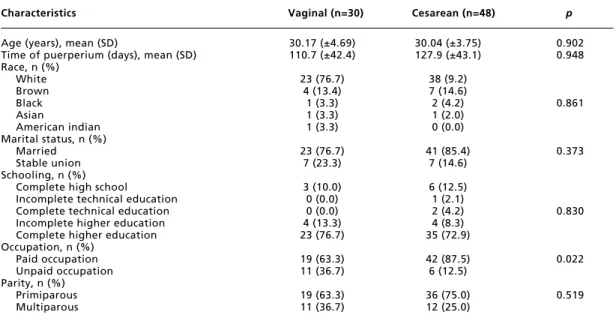
Eighty-three puerperal women completed the online questionnaire. Of these, 5 women were excluded because they are over 180 days after childbirth. Among the included women, 30 have gone through vaginal delivery and 48 by cesarean. Table 1 shows the profile characteristics of participants.
During pregnancy, 35.9% (n=28) of postpartum women reported having had some sexual complica-tions, being 30% (n=9) belonging to vaginal post-partum and 39.6% (n=19) to cesarean postpost-partum. Among the cited complications were “pain”, “low libido”, “fear” and “fatigue”.
Among the participants, 91% (n=71) had some type of complaint on postpartum period. Of these, 59.2% (n=42) were from cesarean postpartum, while 40.8% (n=29) from vaginal postpartum. Table 2 below shows the complaints reported by participants according to the mode of delivery.
Perineal trauma was reported by 53.3% (n=16) of participants from vaginal postpartum. During remote postpartum, 21.8% (n=17) of participants practiced some exercise, being 20% (n=6) from vaginal postpartum and 22.9% (n=11) from cesarean postpartum, (p=0.999).
In relation to menstrual cycle, 32.1% (n=25) of the women returned to menstruate, being 33.3% (n=10) participants from vaginal postpartum and 31.5% (n=15) from cesarean postpartum. Among the participants, 74.4% (n=58) reported taking a contra-ceptive, being 73.3% (n=22) from vaginal post-partum and 75% (n=36) from cesarean postpost-partum.
All participants reported having returned to sexual activity. The mean time to return to sexual activity was 52.83 (±20.4) days after vaginal delivery and 52.94 (±19.88) days after cesarean. Sexual dysfunction was present in 78.2% (n=61) of the study participants. Table 3 shows the comparison of each domain and the total FSFI score between modes of delivery.
Figure 1, below, illustrates the total score obtained by the FSFI according to mode of delivery. Women from vaginal postpartum had a median of 22.45 FSFI total score, while women from cesarean postpartum had a median of 21.9 FSFI total score.
Table 1
General characteristics of participants.
Characteristics Vaginal (n=30) Cesarean (n=48) p
Age (years), mean (SD) 30.17 (±4.69) 30.04 (±3.75) 0.902
Time of puerperium (days), mean (SD) 110.7 (±42.4) 127.9 (±43.1) 0.948
Race, n (%)
White 23 (76.7) 38 (9.2)
Brown 4 (13.4) 7 (14.6)
Black 1 (3.3) 2 (4.2) 0.861
Asian 1 (3.3) 1 (2.0)
American indian 1 (3.3) 0 (0.0)
Marital status, n (%)
Married 23 (76.7) 41 (85.4) 0.373
Stable union 7 (23.3) 7 (14.6)
Schooling, n (%)
Complete high school 3 (10.0) 6 (12.5)
Incomplete technical education 0 (0.0) 1 (2.1)
Complete technical education 0 (0.0) 2 (4.2) 0.830
Incomplete higher education 4 (13.3) 4 (8.3)
Complete higher education 23 (76.7) 35 (72.9)
Occupation, n (%)
Paid occupation 19 (63.3) 42 (87.5) 0.022
Unpaid occupation 11 (36.7) 6 (12.5)
Parity, n (%)
Primiparous 19 (63.3) 36 (75.0) 0.519
Multiparous 11 (36.7) 12 (25.0)
Table 2
Remote postpartum period complaints.
Complaints Vaginal Cesarean p
n % n %
Neck pain 2 6.7 10 20.8 0.115
Low back pain 8 26.7 19 39.6 0.329
Upper limbs discomfort 1 3.3 8 16.7 0.142
Lower limbs discomforts 2 6.7 8 16.7 0.301
Perineum discomforts 24 80.0 6 12.5 0.001
Abdominal wound/scar discomforts - - 9 18.8
-Abdominal pain 2 6.7 2 4.2 0.636
Involuntary urine loss 3 10.0 1 2.1 0.292
Involuntary loss of feces 0 - 1 2.1 0.999
Fisher exact test; n=number of participants; %=percentage of participants.
Table 3
Comparison of domains and total score of online Brazilian version of Female Sexual Function Index (FSFI) between mode of delivery.
FSFI domains, mean Vaginal postpartum Cesarean postpartum p
(SD) scores scores
Sexual desire 2.82 (±1.14) 2.66 (±1.18) 0.560
Arousal 3.68 (±1.53) 3.52 (±1.52) 0.664
Lubrication 4.03 (±1.59) 3.78 (±1.70) 0.510
Orgasm 3.88 (±1.63) 3.65 (±1.41) 0.526
Satisfaction 4.16 (±1.54) 4.10 (±1.66) 0.872
Pain 3.59 (±0.75) 3.40 (±1.02) 0.342
Total Score 22.17 (±5.34) 21.12 (±6.56) 0.443
Student t test; n=number of participants; %=percentage of participants; SD=standard deviation (±).
Figure 1
Distribution of FSFI total score (minimum, maximum and median) according to the mode of delivery.
Vaginal Cesarean
FSFI
t
o
ta
l
sc
o
re
5 10 15 20 25 30
Discussion
The present study showed high frequency of sexual dysfunction among women in remote postpartum period. Sexual dysfunction was independent of mode of experienced childbirth. Sexual desire was the FSFI domain with lowest score, followed consecu-tively by pain, arousal, orgasm, lubrication and satis-faction.
These findings are in line with previous interna-tional surveys data that had reported no sexual func-tion difference between mode of delivery.3,13,14
Others authors supported that obstetric interven-tion on primiparous women might affect negatively the postpartum sexual function. A multicentre prospective cohort study15 suggests that vacuum
extraction and cesarean contribute to persisting dyspareunia which affects a significant proportion of women up to 18 months postpartum period. In addi-tion, other authors16 concluded that there was no
difference on sexual function between women who had vaginal delivery with mediolateral episiotomy and those who experienced cesarean.
According to Qian et al.,17postpartum sexual
function after cesarean has a greater incidence of adverse effects and does not provide long-term protective effects against postpartum stress urinary incontinence. Cesarean postpartum was associated with higher pain levels that persisted at the first 6 months, a higher level of depressive symptoms at 3 months and lower sexual satisfaction at 4-6 weeks more than vaginal postpartum.18
Sexual function is complex and is affected by many others factors, like lifestyle, interpersonal rela-tionships and cultural conditions.16Since the mode
of delivery did not influence the results related to sexual function, other issues should be analyzed in this sample.
Pregnancy has a negative impact on female sexual function, particularly on sexual desire and arousal.19 Women with anxiety and depressive
comorbidities, but not those with pure anxiety or pure depression, are in an increased risk of sexual dysfunction during pregnancy and postpartum period, which might interfere with their relationship.1
The time taken to sexual intercourse resumption after childbirth depends of determining factors like fear of a new pregnancy, fear of pain, the health professional’s discharge, the shame of her own body and changes in libido.4Degree of perineal injuries,
breastfeeding, maternal age, race,6baby care, fatigue
also might contribute. Women who experienced
severe maternal morbidity delay resumption of sexual activity.20Morbidity on postpartum period
influences physical and psychological women’s health and consequently might be negative for some female sexual function aspects, such as sexual desire, pain and satisfaction.
McDonald and Brown21 reported that women
who underwent an operative vaginal birth, cesarean or perineal trauma (perineal tear or episiotomy) appear to delay sexual intercourse resumption. In the present study, all participants had a fixed partner and returned to sexual activity on average after 52 days after delivery in both groups (vaginal and cesarean). It is assumed that a stable relationship might be a facilitator for resumption of an active sex life, however, this did not guarantee a satisfactory sexual function, since more than half of the sample had FSFI score indicative of sexual dysfunction.
A limitation of this study is that perineal trauma was not divided into spontaneous perineal tears, episiotomy or others. As this was an online study and women have not been evaluated by a health profes-sional, the adopted term “perineal trauma” aimed to reduce the risk of reporting errors.
The current study differed from previous studies because our investigation uses the online Brazilian version of FSFI for identifying female sexual func-tion among Brazilian women on remote postpartum period according to the modes of delivery. Although similar studies have been developed internationally, in Brazil we do not have this kind of prior research to understand the particularities of our population. Furthermore, these findings may contribute for women to choose the mode of delivery based on real needs, since we demonstrated no difference in sexual function on postpartum between vaginal and cesarean delivery as it is the popular belief.
The design of this study was on the remote post-partum period. It is suggested that future longitu-dinal studies can evaluate women during pregnancy and postpartum in order to determine whether the type of delivery associated with other factors may influence on sexual function during puerperal preg-nancy cycle. It is also important to carry out surveys with the partners, as they also experience intense changes with the arrival of parenthood that can influ-ence the sexual function of the couple. Besides that, in order to evaluate the couple’s sexual function, it may be relevant the adoption of health promotion measures.
desire was the FSFI domain with lowest score, followed consecutively by pain, arousal, orgasm, lubrication and satisfaction. There were no signifi-cant differences in sexual function between modes of delivery. Our findings should be taken into
account by health care professionals in order to design interventions that seek to promote the quality of sexuality and quality of life for postpartum women.
References
1. Asselmann E, Hoyer J, Wittchen H-U, Martini J. Sexual problems during pregnancy and after delivery among women with and without anxiety and depressive disorders prior to pregnancy: a prospective-longitudinal study. J Sexual Med. 2016; 13: 95-104.
2. Barbara G, Pifarotti P, Facchin F, Cortinovis I, Dridi D, Ronchetti C, Calzolari L, Vercellini P. Impact of mode of delivery on female postpartum sexual functioning: sponta-neous vaginal delivery and operative vaginal delivery vs cesarean section. J Sexual Med. 2016; 13: 393-401.
3. Song M, Ishii H, Toda M, Tomimatsu T, Katsuyama H, Nakamura T, Nakai Y, Shimoya K. Association between sexual health and delivery mode. Sexual Med. 2014; 2 (4): 153-158.
4. Enderle, CF, Kerber NPC, Lunardi VL, Nobre CMG, Mattos L, Rodrigues EF. Condicionantes e/ou determi-nantes do retorno à atividade sexual no puerpério. Rev Latino-Am Enferm. 2013; 21 (3).
5. Lipzschuetz M, Cohen SM, Liebergall-Wischnitzer M, Zbedat K, Hochner-Celnikier D, Lavy Y, Yagel S. Degree of bother from pelvic floor dysfunction in women one year after first delivery. Eur J Obstet Gynecol Reprod Biol. 2015; 191: 90-4.
6. Dabrini F, Yabandeh AP, Shahi A, Kamjoo A, Teshnixi SH. The effect of mode of delivery on postpartum sexual func-tioning in primiparous women. Oman Medical J. 2014; 29 (4): 276-9.
7. Leal MC, da Silva AAM, Dias MAB, da Gama SGN, Rattner D, Moreira ME, Theme Flha MM, Domingues RMSM, Leite AJM, Cavalcante RS, Lansky S, Diniz CSG, Szwarcwald CL. Birth in Brazil: national survey into labour and birth. Reprod Health. 2012; 9: 15.
8. Hardy-Fairbanks AJ, Lauria MR, Mackenzie T, Mccarthy Jr M. Intensity and unpleasantness of pain following vaginal and cesarean delivery: a prospective evaluation. Birth. 2013; 40 (2): 125-33.
9. Spong CY, Berghella V, Westrom KD, Mercer BM, Saade GR. Preventing the first cesarean delivery: summary of a joint Eunice Kennedy Shriver National Institute of Child Health and Human Development, Society for Maternal-Fetal Medicine, and American College of Obstetricians and Gynecologists Workshop. Obstet Gynecol. 2012; 120 (5): 1181-1193.
10. Yeniel AO, Petri E. Pregnancy, childbirth, and sexual func-tion: perceptions and facts. International Urologynecol J. 2014; 25: 5-14.
11. Latorre GFS, Bilck PA, Cardoso FL, Sperandio FF. Confiability and reliability of an on-line version of the Female Sexual Function Index by test-retest. Rev Bras Ginecol Obstet. 2013; 35 (10): 469-74.
12. Weigel M, Meston C, Rosen R. The Female Sexual Function Index (FSFI): cross-validation and development of clinical cutoff scores. J Sex Marital Ther. 2005; 31: 1-20.
13. Laganà AS, Burgio MA, Ciancimino L, Sicilia A, Pizzo A, Magno C, Butticè S, Triolo O. Evaluation of recovery and quality of sexual activity in women during postpartum in relation to the different mode of delivery: a retrospective analysis. Minerva Ginecol. 2015; 67 (4): 315-20.
14. Lurie S, Aizenberg M, Sulema V, Boaz M, Kovo M, Golan A, Sadan O. Sexual function after childbirth by the mode of delivery: a prospective study. Arch Gynecol Obstet. 2013; 288 (4): 785-92.
15. McDonald EA, Gartland D, Small R, Brown SJ. Dyspareunia and childbirth: a prospective cohort study. BJOG. 2015; 122: 672-9.
16. Amiri FN, Omidvar S, Bakhtiari A, Yazdani S, Hajiahmadi M. Comparison of sexual function in primiparous women pre-pregnancy and postpartum: difference of the sexual function after the normal vaginal delivery and the cesarean section. Health. 2015; 7: 1379-86.
17. Qian R, Chen Z, Tang L, Zhang W. Postpartum adverse effects and sexual satisfaction following cesarean delivery in Beijing. Int J Gynecol Obstet. 2016; 132: 200-5.
18. Chang S-R, Chen K-H, Ho H-N, Lai Y-H, Lin M-I, Lee C-N, Lin WA. Depressive symptoms, pain, and sexual dysfunction over the first year following vaginal or cesarean delivery: a prospective longitudinal study. Int J Nurs Stud. 2015; 52: 1433-44.
19. Pardo DS, Lima RV, de Lima LMMR. Impact of pregnancy on female sexual function. Rev Bras Ginecol Obstet. 2013; 35 (5): 205-9.
20. Andreucci CB, Cecatti JG, Pacagnella RC, Silveira C, Parpinelli MA, Ferreira, EC, Angelini CR, Santos JP, Zanardi DM, Bussadori JC, Cecchino GN, Souza RT, Sousa MH, Costa ML. Does severe maternal morbidity affect female sexual activity and function? Evidence from a Brazilian cohort study. PLoS ONE. 2015; 10 (12): 1-14.
21. McDonald EA, Brown SJ. Does method of birth make a difference to when women resume sex after childbirth? BJOG. 2013; 120: 823-30.