Repositório ISCTE-IUL
Deposited in Repositório ISCTE-IUL:
2018-12-11Deposited version:
Publisher VersionPeer-review status of attached file:
Peer-reviewedCitation for published item:
Marques, A. S., Rebola, J. L. & Cartaxo, A. V. T. (2018). Transmission of CPRI signals along weakly-coupled multicore fibers for support of 5G networks. In 20th International Conference on Transparent Optical Networks, ICTON 2018. Bucharest: IEEE.
Further information on publisher's website:
10.1109/ICTON.2018.8473957Publisher's copyright statement:
This is the peer reviewed version of the following article: Marques, A. S., Rebola, J. L. & Cartaxo, A. V. T. (2018). Transmission of CPRI signals along weakly-coupled multicore fibers for support of 5G networks. In 20th International Conference on Transparent Optical Networks, ICTON 2018.
Bucharest: IEEE., which has been published in final form at
https://dx.doi.org/10.1109/ICTON.2018.8473957. This article may be used for non-commercial purposes in accordance with the Publisher's Terms and Conditions for self-archiving.
Use policy
Creative Commons CC BY 4.0
The full-text may be used and/or reproduced, and given to third parties in any format or medium, without prior permission or charge, for personal research or study, educational, or not-for-profit purposes provided that:
• a full bibliographic reference is made to the original source • a link is made to the metadata record in the Repository • the full-text is not changed in any way
The full-text must not be sold in any format or medium without the formal permission of the copyright holders.
Serviços de Informação e Documentação, Instituto Universitário de Lisboa (ISCTE-IUL) Av. das Forças Armadas, Edifício II, 1649-026 Lisboa Portugal
Phone: +(351) 217 903 024 | e-mail: [email protected] https://repositorio.iscte-iul.pt
Transmission of CPRI Signals along Weakly-Coupled Multicore
Fibers for Support of 5G Networks
André S. Marques2, João L. Rebola1,2, and Adolfo V. T. Cartaxo1,2
1Optical Communications and Photonics Group, Instituto de Telecomunicações, Lisboa, Portugal 2Instituto Universitário de Lisboa (ISCTE-IUL), Lisboa, Portugal
e-mail: [email protected], [email protected], [email protected]
ABSTRACT
The impact of intercore crosstalk (ICXT) of weakly-coupled multicore fibers on the transmission performance of a Common Public Radio Interface (CPRI) signal in 5G networks is studied by numerical simulation. The results show that forward error correction-supported CPRI signals (accepting higher bit error rates) have more tolerance to ICXT, which increases with the skew between cores. Improvement of the tolerance of CPRI signals to the ICXT, due to the increase of the skew, by 1.7 dB is shown.
Keywords: bit-error rate, intercore crosstalk, multicore fiber, 5G, CPRI. 1. INTRODUCTION
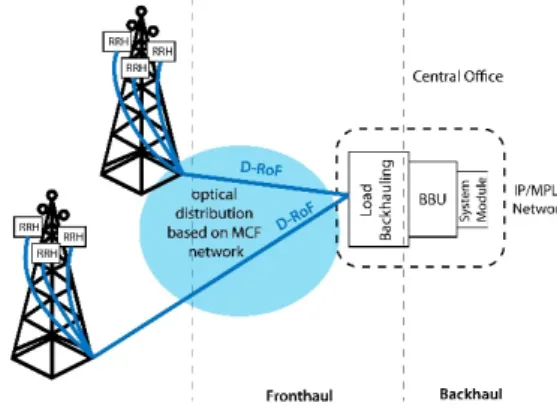
The emergence of 5G and the steady growth of traffic in communication networks [1] led to new proposals on the radio access networks architecture in order to make data transmission more efficient and increase capacity. One of these proposals is the Cloud Radio Access Network [2]-[3] which proposes a physical separation between the base stations units (BBUs) and the transmitter/receiver remote radio-head (RRH) antennas [2]-[3], as shown in Fig. 1. With this new architecture, a new network segment known as fronthaul, which makes the connection between BBU and RRH, is deployed. One way to implement this link is through optical fiber using Radio over Fiber or Digital Radio over Fiber transmission using one of the protocols defined at the Common Public Radio Interface (CPRI) [4] with a bit rate around 10 Gbps [5]. Weakly-coupled multicore fibers (MCFs) are a good solution to support the fronthaul because they can accomplish the bit rate requirements, the fiber availability, the dynamic capacity allocation and the compatibility with the existing and future versions of passive optical networks [4]. However, the transmission in weakly-coupled MCFs, in which cores can be used as independent channels, is affected by intercore crosstalk (ICXT) [6].
In this work, we investigate, through numerical simulation, the transmission of CPRI signals along weakly-coupled MCFs and how the ICXT affects the transmitted signal performance. The paper is organized as follows. Section 2 presents the simulation model, the estimation of bit error rate (BER) and the type of CPRI signals investigated. Section 3 presents and discusses the numerical results. Section 4 provides the conclusions.
2. SIMULATION MODEL, BER CALCULATION AND CPRI BIT RATES
As a first assessment of the impact of ICXT on the CPRI signal transmission performance, we consider only a single interfering CPRI signal transmitted in core m that may degrade the performance of other similar CPRI signal transmitted in core n. Therefore, as illustrated in Fig. 2, two optical transmitters, each one generating an on-off keying (OOK) signal with the same CPRI bit rate and ideal extinction ratio, are considered.
Figure 2. Equivalent system model used to study the impact of ICXT on a 5G fronthaul with direct detection.
Linear single-mode propagation is assumed in each core. The transmission in core n is modelled by the optical fiber transfer function HSMF(ω) given by HSMF(ω)= e-jβn(ω)L where L is the fiber length, ω is the low-pass
equivalent angular frequency and βn(ω) is the intrinsic propagation of core n. A Taylor series expansion up to the
ICTON 2018 We.B2.7
2
second order in ω is considered for βn(ω), i.e. propagation delay and fiber dispersion effects are considered. The
same fiber attenuation is assumed in the two cores. Hence, the fiber attenuation level is not relevant as our analysis considers the receiver sensitivity. The interfering signal in core n resulting from ICXT caused by the signal in core m is obtained using the transfer function [6]:
F(ω)=-jKnme-jβn(ω)L∑ eNk=1p -j∆βmn(ω)zke-jϕk (1)
where Knm is the discrete coupling coefficient between cores m and n, Δβmn(ω) is the difference of the intrinsic
propagation constants of cores m and n, zk is given by zk=�k-1� L N⁄ +ξ, with Np p the number of phase-matching
points and ξ a random variable uniformly distributed between 0 and L N⁄ . ϕp k is a random variable uniformly
distributed between [0,2π] that models random fluctuations in bending radius, twist rate or other conditions of the MCF [6]. The ratio between the crosstalk power at the interfered core (n) output and the power of the signal at the interfering core (m), Xc, is related to the parameters of Eq. 1 by Xc=Np|Knm|2. The skew between cores m
and n is given by Smn=dmnL where dmn, is the walkoff between the cores m and n and is related to Eq. 1 by
∆βmn(ω)=Δβ0,mn+dmnω-12ΔDmnλ 2
2πc ω2 [6], where Δβ0,mn is the difference of propagation constants of cores m and n
at zero frequency, ΔDmn is the difference of dispersion parameters of cores m and n, λ is the wavelength and c is
the speed of light in vacuum. One fiber realization is calculated in each simulation iteration, where the bits of the CPRI signal to be transmitted in core m are randomly generated.
At the optical receiver, the signal at the MCF output is photodetected by a PIN with responsivity of 1 A/W. Then, it is filtered by an electrical filter modelled by a 2nd order Butterworth filter with a cut-off frequency of
0.65×Rb, being Rb the bit rate. The electrical noise, referred to the electrical filter input, is characterized by a
noise equivalent power of 1×10-12 W/√Hz [7]. After electrical filtering, the decision circuit samples the signal at
the time instants tk=topt+kTb, where topt is the optimum sampling time, Tb is the bit period and k = 1, 2, …, Nb,
with Nb being the number of bits generated in transmitter n in each simulation iteration, and decides on the
transmitted bit.
We use semi-analytical simulation to evaluate the BER [8]. The impact of electrical noise on the performance is taken into account analytically, and the effects of fiber chromatic dispersion and intercore crosstalk on the BER are evaluated using waveform simulation of each simulation iteration. Hence, the BER is given by [8]:
BER=N1 b �∑ Q � F-i0,k σ0,k� + ∑ Q � i1,k-F σ1,k� Nb k=1 j=1 Nb k=1 j=0 � (2) where Q(x)=√2π1 ∫ 𝑒𝑒+∞ −λ2⁄2
x dλ [8] and ij,k and σj,k are the mean and standard deviation of the current at the
decision circuit input at time instants tk, conditioned on the transmitted bit j (0 or 1). The decision threshold F is
optimized using the bisection method to minimize the BER. Here, σ0,k=σ1,k as we consider electrical noise only.
In this work, two CPRI bit rates are studied: (i) option 7, with Rb = 9.8304 Gbps, 8B/10B line coding and
without Forward-Error Correction (FEC), and (ii) option 8, with Rb = 10.1376 Gbps, 64B/66B line coding and
with FEC [4]. For systems without FEC, the target BER is 10−12 [4]. For systems with FEC, the target BER
depends on the FEC implementation [9]. We assume the FEC implementation with the target BER set to 10−3 [9].
3. NUMERICAL RESULTS AND DISCUSSION
In this section, the impact of ICXT on the transmission performance of the CPRI signals is studied by simulation. The simulation parameters that are kept constant throughout this work are the nominal wavelength
λ0=1550 nm, the dispersion parameter Dλ=17 ps/(nm∙km) (the same for both cores), the number of simulated
OOK bits per fiber realization Nb=29, the Np=1000, the fiber length L=20 km and Δβ0,mn=0.
First, we start by studying the number of fiber realizations that are necessary to achieve a stabilized value of the average BER. To provide a certain margin for BER degradation due to ICXT, we set the BER in the absence of ICXT to two orders of magnitude lower than the target BER. Hence, our studies for line option 8 consider the BER of 10−5 in the absence of ICXT. Following the same reasoning for systems without FEC, the BER in
absence of ICXT is 10−14. Figures 3a) and 3b) depict the BER for each MCF realization and the average BER as
a function of the number of fiber realizations for dmn = 1 ps/km. Figure 3a) refers to the CPRI signal with the bit
rate of 9.8304 Gbps (which does not consider FEC and the BER without ICXT is 10−14). The crosstalk level is
Xc = −30 dB. Figure 3b) refers to the CPRI signal with Rb = 10.1376 Gbps (which considers FEC and the BER
without ICXT is 10−5) and X
c = -15 dB. These crosstalk values are chosen to lead to an average BER degradation
relative to the one in absence of ICXT by about two orders of magnitude. Figure 3a) shows that the average BER can be considered stabilized after about 4000 MCF realizations. In the subsequent studies for the CPRI signal with 9.8304 Gbps, we have set the number of fiber realizations to 104 as a conservative choice. Figure 3b) shows
that the average BER is nearly stable after 400 MCF realizations. For the subsequent studies, we have set the number of MCF realizations to 103 as a conservative choice for the CPRI signal with 10.1376 Gbps. We have
BERs for different crosstalk levels, different fiber lengths (other than 20 km), different walkoffs between the fiber cores and CPRI signals with different bit rates. The difference between the number of fiber realizations leading to a stabilized average BER is attributed to the order of magnitude of the average BERs considered in Fig. 3a) and 3b).
Figure 3. BER for each MCF realization (blue symbols) and average BER (red symbols) as a function of fiber realizations. In a), Rb=9.8304 Gbps, Xc= −30 dB and BER in the absence of ICXT is 10−14. In b), Rb=10.1376
Gbps, Xc= −15 dB and BER in the absence of ICXT is 10−5.
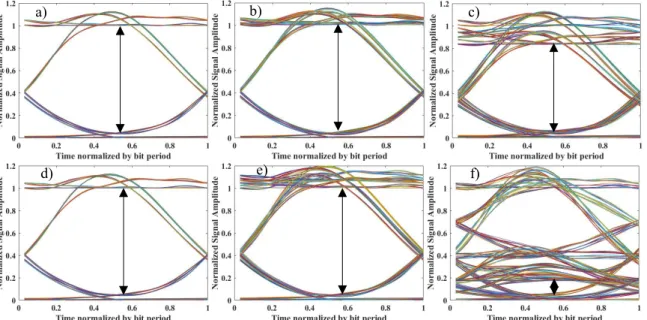
Figures 3a) and 3b) show that the randomness of the ICXT mechanism leads to a strong variation of the BER per fiber realization. The BER can be degraded severely or even improved. In Fig. 3a), the best BER obtained per fiber realization is 6.3×10⁻¹⁵ and the worst BER is 1.1×10⁻⁹. Figure 3b) exhibits a best BER of 6.3×10⁻⁶ and
a worst BER of 3.9×10⁻². The eye-patterns corresponding to these BERs per fiber realization are presented in
Fig. 4 where the ICXT impact on the eye-patterns can be seen. These eye-patterns do not show the effect of the electrical noise to make clear the ICXT effect. Figures 4a) and 4d) correspond to the cases where no ICXT is present. As the bit rates are similar in these plots, no significant difference is observed between the two eye-patterns. Figures 4b) and 4e) show the eye-patterns corresponding to the improvement of BER due to ICXT relative to the case of absence of ICXT. Figures 4c) and 4f) correspond to the MCF realizations in which the worst BER occurs. Figure 4c) shows that the eye-closure for the worst BER realization is not as severe as the one obtained in Fig. 4f). This justifies the higher number of MCF realizations needed to get a stabilized average BER for lower BERs [see Fig. 3a)], since any slight signal distortion caused by ICXT can degrade the average BER a few orders of magnitude. For higher BERs [see Fig. 3b)], a higher crosstalk level is necessary to close the eye-pattern significantly in order to get BERs per fiber realization with a few orders of magnitude above the reference BER of 10−5. Analysis of Fig. 4a), 4b) and 4c) [and extending the same analysis to Fig. 4d), 4e) and
4f)] reveals that the impact of the ICXT on the eye-pattern is felt only at the amplitudes of bit ‘1’ while, at bit ‘0’, the amplitude values remain essentially the same.
Figure 4. Eye-patterns at the receiver input corresponding to the BER without ICXT and the worst and best BER obtained in Fig. 3a) and 3b). In a) and d) there is no ICXT. In b) and e): best BER cases for Fig. 3a) and 3b), respectively. In c) and f): worst BER cases for Fig. 3a) and 3b), respectively. The eye opening is indicated in each eye-pattern.
a) b)
d) e) f)
c)
ICTON 2018 We.B2.7
4
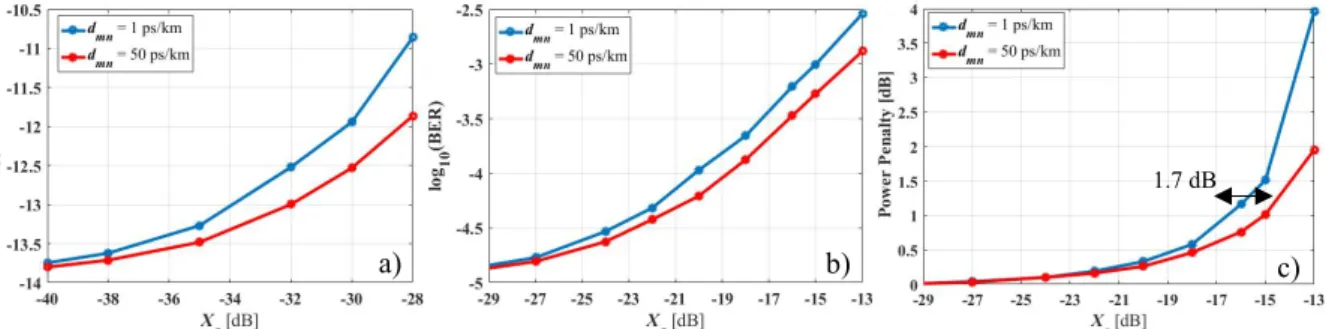
After having established the number of MCF realizations required to reach a stabilized value of the average BER, the performance degradation imposed by the increase of the crosstalk level is investigated. Figure 5 depicts the average BER as a function of the crosstalk level, for dmn = 1 ps/km and dmn = 50 ps/km. These values of
walkoff correspond to two distinct levels of skew: one (dmn = 50 ps/km), much higher than the bit period and
other (1 ps/km) much lower than the bit period. Figure 5a) corresponds to the CPRI signal with 9.8304 Gbps and Fig. 5b) relates to the CPRI signal with 10.1376 Gbps. As expected, the BER becomes higher with the increase of the crosstalk level. In Fig. 5a), as the BER without ICXT is very low (10−14), lower values of X
c lead to
a significant BER degradation. An average BER of 10−12 is reached for X
c = -30 dB and Xc = -28.3 dB, for
dmn = 1 ps/km and for dmn = 50 ps/km, respectively. In Fig. 5b), as the BER without ICXT is higher (10−5), higher
ICXT levels are required to degrade the average BER. An average BER of 10−3 is reached for X
c = -15 dB and
Xc = -13.7 dB, for dmn = 1 ps/km and dmn = 50 ps/km, respectively. The reduction of the impact of ICXT with the
increase of the skew between the cores dmn is in qualitative accordance with the results presented in [10].
Figure 5. In a) and b), BER as a function of crosstalk level, Xc in dB, for dmn = 1 ps/km (blue line) and
dmn = 50 ps/km (red line). In a), CPRI signal with Rb = 9.8304 Gbps; in b), CPRI signal with Rb = 10.1376 Gbps.
In c), power penalty as a function of crosstalk level Xc for a BER of 10−3 and Rb=10.1376 Gbps for dmn = 1 ps/km
(blue line) and dmn = 50 ps/km (red line).
We estimate also the system power penalty due to ICXT for the 10.1376 Gbps CPRI signal with BER = 10−3
and the two levels of skew. Fig. 5 c) show the results obtained. For dmn = 1 ps/km, a power penalty of 1 dB
occurs for an ICXT level of -16.7 dB and, for dmn= 50 ps/km, a power penalty of 1 dB occurs for a ICXT level of
-15 dB. Therefore, we conclude that the skew effect can improve the tolerance of CPRI signals to the ICXT by 1.7 dB.
4. CONCLUSIONS
We have investigated the weakly-coupled MCF ICXT impact on the CPRI signal transmission performance in a 5G network. The results have shown that FEC-supported CPRI signals (accepting higher BER) have more tolerance to ICXT, which increases with the skew enhancement between cores. Improvement of the tolerance of CPRI signals to the ICXT, due to the increase of the skew, by 1.7 dB has been shown.
ACKNOWLEDGEMENTS
This work was supported in part by Fundação para a Ciência e a Tecnologia (FCT) from Portugal under the project of Instituto de Telecomunicações AMEN-UID/EEA/50008/2013.
REFERENCES
[1] C. Mobile, “C-RAN: The road towards green RAN,” White Paper, version 2.5, pp. 15–16, 2011.
[2] P. Chanclou et al., “Optical fiber solution for mobile fronthaul to achieve cloud radio access network,” in Proc. 2013
Future Network and Mobile Summit, pp. 1–11, 2013.
[3] J. M. Galve, I. Gasulla, S. Sales, and J. Capmany, “Reconfigurable radio access networks using multicore fibers,”
IEEE J. of Quantum Elect., vol. 52, no. 1, pp. 1–7, January 2016.
[4] Common Public Radio Interface, “CPRI Specification V7.0,” Standard Document Specification, vol. 1, 2015. [5] P. Parolari et al., “Operation of RSOA WDM PON self-seeded transmitter over more 50 km of SSMF up to 10 Gb/s,”
in Proc. Opt. Fiber Commun. Conf. Exhib., 2014, pp. 1–3.
[6] A. V. T. Cartaxo et al., “Dispersion impact on the crosstalk amplitude response of homogeneous multi-core fibers,”
IEEE Photon. Technol. Lett., vol. 28, no. 17, pp. 1858–1861, September 2016.
[7] G. P. Agrawal, Fiber-Optic Communication Systems, Third Edition, 2002.
[8] J. Rebola and A. Cartaxo, “Gaussian approximation for performance assessment of optically preamplified receivers with arbitrary optical and electrical filters,” IET Optoelectronics, vol. 148, no. 3, pp. 135–142, 2001.
[9] B. J. Puttnam et al., “Impact of inter-core crosstalk on the transmission distance of QAM formats in multi-core fibers,”
IEEE Photon. J., vol. 8, no. 5, Apr. 2016, Art. ID. 0601109.
[10] G. Rademacher, R. S. Luis, B. J. Puttnam, Y. Awaji, and N. Wada, “Crosstalk dynamics in multi-core fibers,” Opt.
Express, vol. 25, no. 10, pp. 12020–12028, May 2017.
a) b) c)