
Escola de Engenharia
Departamento de Inform´atica
Humberto Jo˜ao Alves Vaz
Chatbot for Digital Marketing
and Customer Support
An Artificial Intelligence approach
Escola de Engenharia
Departamento de Inform´atica
Humberto Jo˜ao Alves Vaz
Chatbot for Digital Marketing
and Customer Support
An Artificial Intelligence approach
Master dissertation
Master Degree in Computer Science
Dissertation supervised by
Rui Mendes
Ana Anjo
During the writing of this dissertation I have received a great amount of support and
assis-tance. I would like to thank my supervisor Dr. Rui Mendes, whose expertise and attention
led me to a good path on the research topic.
I would like to acknowledge my colleagues at VILT for their wonderful spirit and
collab-oration. You supported me whenever I needed and were always ready to help me. I would
like to single out some members at VILT: M´ario Lameiras for the excellent opportunity that
was conceded to me, Raphael Gonc¸alves for the patience and guidance, Lucas Oliveira and
Gonc¸alo Rodrigues for their expert advices in the last few months.
Finally I would like to thank my parents Maria Jos´e and Agostinho for their wise counsels
and for being present whenever I needed. I would like to thank my sister B´arbara and her
boyfriend Jos´e for their kind support, my friend Carlos Afonso for providing the right
amount of distraction, my two ”homonymous” friends Jo˜ao Dias who spent great times in
the past with me and all of my friends as well that heard my complains through rough
times.
Human interaction with machines has never been so frequent as nowadays. In order to
reduce the redundant workload of a human being that answers repeated and trivial
ques-tions regarding customer support on a digital marketing website, this work has the purpose
of replacing this tedious job with an informatics tool, a dialogue tool.
A dialogue tool like a Chatbot that could handle customer support to a digital marketing
website, provides the opportunity of placing human resources on ”non mechanical tasks”.
Given that Chatbots exchange messages directly with customers, they could collect required
protocol information in all the interactions. In spite of the possibility of needing human
assistance, he will not need to ask these standard questions and will improve its efficiency.
By automating these required dialogues to answer questions about certain products, that
would otherwise be responded by a human, the organizations will have the opportunity to
place human resources in another sectors that are not so easily automated.
Keywords— Chatbot, Artificial Intelligence, Machine Learning
A interac¸˜ao humana com m´aquinas nunca foi t˜ao frequente como nos dias de hoje. Com a intenc¸˜ao de reduzir a quantidade de trabalho de um ser humano que receberia ao responder a quest ˜oes triviais e repetidas no que diz respeito a Suporte ao Cliente, este trabalho tem o prop ´osito de substituir um trabalho entediante por uma ferramenta inform´atica, uma ferramenta que possibilite o di´alogo entre o cliente e o servic¸o de suporte.
Uma ferramenta como um Chatbot que poderia fornecer suporte ao cliente num website de mar-keting digital iria providenciar ´as empresas a oportunidade de alocar trabalhadores para tarefas ”menos mecˆanicas”. Dado que os Chatbots trocam mensagens diretamente com os clientes, estes
po-dem recolher informac¸ ˜oes que s˜ao sempre necess´arias e protocolares em todas as interac¸ ˜oes. Assim sendo, mesmo que este di´alogo requira possivelmente um ser humano, este ir´a prescindir de fazer estas perguntas padr˜ao, melhorando assim a eficiˆencia deste trabalho (Suporte ao Cliente).
Ao automatizar di´alogos necess´arios para responder a quest ˜oes acerca de produtos que, de outra forma seriam respondidas por um ser humano, as organizac¸ ˜oes estar˜ao a poupar tempo e dinheiro que podem ser aplicados noutros sectores menos prop´ıcios a serem automatizados.
Keywords— Chatbot, Artificial Intelligence, Machine Learning
1 i n t r o d u c t i o n 1
1.1 Motivation 1
1.2 Objectives and Goals 2
1.3 Planning 3
2 s tat e o f t h e a r t 4
2.1 Natural Language Processing 4
2.2 Machine Learning 5
2.3 Chatbots 9
2.3.1 Web Chatbots 11
2.3.2 Dialogue tools for Human Resources Services 15
2.3.3 Virtual Personal Assistants 19
2.4 Artificial Intelligence Markup Language 25
2.5 Chatbot Developing Platforms/AI Chatbot Frameworks 26
2.5.1 Dialogflow 27 2.5.2 Wit.ai 29 2.5.3 IBM Watson 30 2.5.4 Leadbot 31 2.5.5 Summary 32 2.6 Glossary 33 3 t h e p r o b l e m a n d i t s c h a l l e n g e s 34 3.1 System Architecture 34 3.2 Development 37 3.2.1 Decisions 37 3.2.2 Implementation 39 3.2.3 User experience 42 3.2.4 Feedback System 45 3.2.5 Book a Demo 47 3.3 Data persistence 49 3.4 System Summary 51 3.5 Experiment setup 53 3.6 Results 53 3.7 Discussion 53 3.8 Study Summary 53 4 c o n c l u s i o n 56 4.1 Conclusions 56
4.2 Prospect for future work 57
.1 Appendinx 63
.1.1 Experiment with Recursive Neural Networks 63
Figure 1 Gantt’s Diagram table 3
Figure 2 Gantt’s Diagram chart 3
Figure 3 Example of a Hidden Markov Model [Ghahramani and Jordan(1997)] 7
Figure 4 Example of an Artificial Neural Network with two hidden layers [Glorot
et al.(2011)] 8
Figure 5 Example of a Bi-directional Recurrent Neural Network [Graves et al.(2013)] 8
Figure 6 Chatobts using modern API’s [Ecommerce-Nation- visited at 23/07/2019] 10
Figure 7 Cleverbot [Cleverbot-website- visited at 05/11/2018] 11
Figure 8 Endurance’s Landing page Chatbot [Endurance- visited at 05/11/2018] 12
Figure 9 Roof.ai Chatbot [Roof.aivisited at 08/11/2018] 13
Figure 10 Gusto [Gusto- visited at 06/12/2018] 15
Figure 11 Zenefits [Zenefits- visited at 23/12/2018] 16
Figure 12 Zoho [zoho- visited at 23/12/2018] 17
Figure 13 Example of an Amazon Echo device [Amazon(b) - visited at 26/07/2019] 20
Figure 14 Example a Google Home device [Googlevisited at 26/07/2019] 21
Figure 15 Siri [Jason Cross- visited at 26/07/2019] 22
Figure 16 Cortana [Matt Mcgeevisited at 26/07/2019] 23
Figure 17 Dialogflow console [Dialogflow- visited at 26/07/2019] 28
Figure 18 Wit.ai console [Wit.ai- visited at 24/07/2019] 29
Figure 19 IBM Watson console [IBM Cloud- visited at 26/07/2019] 30
Figure 20 IBM’s DeepQA [Zhang(2011)] 30
Figure 21 Leadbot [Drift- visited at 26/07/2019] 31
Figure 22 System Architecture 35
Figure 23 Scheme of a Docker container [Docker] 36
Figure 24 Intent feature with context, training phrases [Dialogflow- visited at 26/07/2019] 39
Figure 25 Intent feature with Actions, Parameters and Responses [Dialogflow- visited
at 26/07/2019] 40
Figure 26 Knowledge Base feature [Dialogflow- visited at 26/07/2019] 41
Figure 27 Adjust Knowledge Base results [Dialogflow- visited at 26/07/2019] 42
Figure 28 The website with Chatbot closed at the bottom right corner [Dialogflow
-visited at 26/07/2019] 42
Figure 29 The website with Chatbot opened at the bottom right corner 43
Figure 30 Mac the helping Chatbot 43
Figure 31 Prompting the Chatbot with same intention but different phrases in Mobile
environment 44
Figure 32 Before a click on like button 45
Figure 33 Hover on like button 46
Figure 34 After a click on like button 46
Figure 35 Make an Appointment in Mobile environment 47
Figure 36 Email to user that requested a demo 48
Figure 37 Email to the support team 48
Figure 38 Database Entity Relation (ER) Diagram 50
Table 1 Comparison between different Web Chatbots 14
Table 2 Comparison between different dialogue/communication systems available
on Human Resources Services 18
Table 3 Comparison between different Virtual Personal Assistants 24
Table 4 Comparison between the different Chatbot developing tools 32
Table 5 Glossary 33
Table 6 Study Results 54
Table 7 Extracted Metrics from the study 54
1
I N T R O D U C T I O N
”Hey my name is MacGyver, but you can call me Mac! How can I help you?”
Online retail transactions represent a huge part of the money earned by companies these days. It seems like a good idea to leverage the possible profit, offering easy and intuitive ways to increase the customer’s happiness regarding the user experience while purchasing an enterprise Software-as-a-Service (SaaS) for their own companies.
VILT proposed this project with the intention of upgrading from an old-fashion FAQ into a Chat-bot that could satisfy possible doubts from clients. The domain covered by this tool should be about the product(s) to be sold.
The aim is to create a tool that could collect new recurrent questions retrieved from users/clients day after day. This way we could achieve a list of frequent questions to be answered by a company worker with the perspective of updating the tool’s domain with relevant information.
1.1 m o t i vat i o n
Humanity is living in years where information is easily accessible. With the help of the massification of information due to the internet and the technology’s leap, people are increasingly buying only when well informed about the product. The availability and the clarity of the information gives confidence and satisfaction to the customer to proceed and buy a given product.
In the early days, people were afraid to buy on the internet. The way e-commerce works lacks in confidence comparing to traditional commerce. The product is not always the expected. There are a lot of ”Fishing schemes” and counterfeit products out there. There is a certain risk regarding sensible information security as well. These factors along with lack of organized information could be a barrier purchasing a product.
Nowadays, if a company wants to be the ”best selling company”, it will have to provide essential and complementary information about the products to be sold.
According to IBM, Chatbot solutions can reduce customer service costs by as much as 30% [Reddy].
In conclusion, if two of the company’s premises are to maximize profit and customer satisfaction, and additionally it is willing to invest on Research and Development, this research should represent a good foundation.
1.2 o b j e c t i v e s a n d g oa l s
To transform this project into a successful work, it needs a clear list of intentions. Also, to achieve success it is needed an objective direction of what is expected to do. Therefore, it was defined the following goals for this project:
• Better understanding of the interaction between humans and machines; • Exploration of Machine Learning state of the art solutions;
• Exploration of Natural Language Processing and Natural Language Understanding;
• Development of a tool that has the ability to establish a bond with a Human being and formerly answer possible doubts or desires;
• Exploration of relevant actions that could be automatized by an informatics tool; • Replacement of a Human-being or an old-fashion FAQ page with the developed tool.
1.3 p l a n n i n g
The following figures1and2illustrate the work plan undertaken in this project.
Figure 1.: Gantt’s Diagram table
2
S TAT E O F T H E A R T
This chapter will approach the conducted research according to the theme of the existing conversa-tional interfaces and some relevant models used ”inside” these devices to accomplish astonishing voice-driven Chatbots also called ”Intelligent Virtual Assistants” or ”Virtual Personal Assistants”.
Initially research was based on Machine Learning. Some general concepts were analyzed on sev-eral research articles and books [Domingos(2012)] [Sordoni et al.(2015)] [Mitchell(1997)] .
In the following part, the research was about the existing Web Chatbots and Virtual Personal Assistants. It is possible to conclude that these assistants are life’s facilitators due to their useful capabilities and the ease of use. Those capabilities are possible using natural language directed by the human to the personal assistant. This research was made analyzing several related works and experiencing real-life situations Chatbots available on the Web and also testing those devices [Macaza(2017)][Bhagwat(2018)][Coheur(2015)][Vinyals and Le(2015)].
The latter phase consisted of analyzing and testing several tools on the market to build a proper Chatbot [Kurilchik(2017)] [Macaza(2017)] [Coheur(2015)] [Miguel and Ferreira(2017)] .
The following pages will present relevant methods and solutions related to the target goal.
2.1 nat u r a l l a n g ua g e p r o c e s s i n g
In this section the document will explain to the reader Natural Language Processing (NLP) and other related concepts.
• Natural Language Processing (or NLP) is an area of research that explores how computers process and manipulate natural language. Natural language can be divided in two categories, text and speech [De Feo and Hindriks(2016)]. Natural Language researchers are responsible
for the design of language and acoustic models to be used in speech recognition systems and similar applications [Stylegar and Grimm(2003)].
Many of the applications include a number of fields of study like speech recognition, arti-ficial intelligence, expert systems and multilingual/cross language processing [De Feo and Hindriks(2016)].
• Natural Language Understanding is a subtopic of Natural Language Processing that studies the intention of sentences, it is also the study of the prediction of the elements of communi-cation that lie outside the conceptual content of a sentence. Deals with problems concerning machine reading comprehension.
NLU It is based on a set of ”rules”. It has a conceptual base that consists of a formal structure, can make predictions based on that conceptual structure, it is not limited to the understanding of isolated sentences and has formal rules for analyzing natural language utterances into the conceptual base [Schank(1972)].
2.2 m a c h i n e l e a r n i n g
In this section the document will explain to the reader Machine Learning (ML) and other related concepts.
Machine Learning is the study of automatic performance improvement algorithms. The most fundamental idea behind Machine Learning is generalization [Domingos(2012)].
Since Machine Learning studies the generalization necessary for applying learning algorithms on data to build a model, it seems reasonable to ask ourselves ”How does learning performance vary with the number of training examples presented?” or ”Which learning algorithms are most appropriate for various types of learning tasks?”[Mitchell(1997)].
The following concepts will clarify the reader about some concepts that are inherent to Machine Learning.
• The hypothesis space is the set of all the evaluating functions that can represent the model [Mitchell(1997)]. For instance, if the problem we are dealing is a classification problem, the
hypothesis space should be the set of all possible classifiers that could represent the model. However, not all of the functions can accurately represent the model, i.e. the true hypothe-sis/unknown function.
• A feature is a specification of the object in the hypothesis space. Each input variable, {X1,X2,...Xn} ∈ X represents a feature value of an object X. These values are usually aggregated in a vec-tor whose size is determined by the number of properties of that object [Sebastiani (2002)].
For instance, if our data-set was composed by patients, gender, age or blood type could be examples of features from those patients.
• ”Supervised learning is the most common form of ML. Usually the desired result is a mapping from problem instances to a set of class values. A training set that contains examples of problem instances along with their desired class label are given to the system. The task now is to take the training set and use it to construct a generalized mapping that can label the instances correctly but, in addition, that can label other unseen examples correctly too. An example of such a problem can be found in direct marketing. Let us assume a company has much information about its customers, for example buying habits, living environment, age, income and so on. Based on previous experience on which customers respond to prospects the company sends out, a learning algorithm could use a relatively small set of customers to learn a mapping that classifies customers into responsive and non- responsive” [Otterlo
• Classification is the process of determining the class of an object using a classifier. The method consists of approximating a mapping function (f) from input values/features to discrete sym-bols (Y), [Otterlo(2010)]. A good example of classification usage is determining the genre of
texts using features found on texts [Frost(2010)].
• ”A classifier is a system that inputs (typically) a vector of discrete and/or continuous feature values and outputs a single discrete value, the class” [Domingos(2012)].
• Conditional Random Field or CRF is a framework for building probabilistic models to seg-ment and label sequence data. CRF avoid a fundaseg-mental limitation of Maximum Entropy Markov models (MEMMs) and other discriminative Markov models based on directed graph-ical models, which can be biased towards states with few successor states [Lafferty et al.
(2001)].
• Support Vector Machines or SVMs are classification algorithms that have been shown to be highly effective at traditional text categorization. The core idea behind the first procedure, i.e the training procedure is to find an hyperplane that is represented by a vector −→W , that separates the document vectors in one class from those in other class by a margin as large as possible. It corresponds to a constrained optimization problem; letting cj ∈ {1,−1} be the
correct class of document dj, the solution can be written as:
−→ W =
∑
j
ajcj~dj, aj ≥0,
where the aj’s are obtained by solving a dual optimization problem. Those ~dj such that aj
is greater than zero are called support vectors, since they are the only document vectors contributing to−→W . Classification of test instances is simply determining which side of −W ’s→ hyperplane they belong [Frost(2010)].
• Hidden Markov Models or HMMs were built with the a generalization of mixture models [Ghahramani and Jordan(1997)]. HMMs are composed with a set of States, a set of Observables,
a transition probabilities table and an emission probabilities table. The transition probabilities table has the probabilities of transitioning from a state to the same and to all the others states. The emission probabilities table has the conditional probabilities of being in a state s’ given that we acknowledged an observation o’, which represents P(s’ |o’). Hidden Markov Models can be represented with a dynamic Bayesian network. It is to be noticed that to an external observer, the states are hidden, this is, only observations are visible to the observer [Parr(2003)]. It is
possible to observe a Hidden Markov Model in figure3.
• Maximum Entropy Markov Model or MEMM is a statistical model based on Hidden Markov Models (HMMs) that uses contextual features to predict/classify Part-Of-Speech (POS) tags. This technique is used in Natural Language Processing to accurately predict unseen text [ Rat-naparkhi].
• Artificial Neural Networks (ANNs) are learning methods for discrete, real and vector valued functions using examples. There are several learning algorithms such as Back-propagation that use gradient descent to tune the network parameters to best fit a training set of input-output pairs.
These types of networks are among the most effective learning methods available today. ANNs have been mostly inspired by the observation of biological learning systems which are built of complex webs of interconnected neurons. Artificial Neural Networks could have more than one hidden layer of neutrons. When an ANN has more than one hidden layer between the input and the output layers are considered a type of Deep Neural Networks or DNNs [Graves et al.(2013)]. An example of a an ANN with two hidden layers can be found on figure4.
In a coarse analogy, Artificial Neural Networks are constructed from a densely interconnected set of simple units, where each unit takes a number of real-valued inputs (that could be the output from previous units) and produces a single real-valued output that could become the input to many other units [Mitchell(1997)].
• Recurrent Neural Networks or RNNs are a variation of Artificial Neural Networks.
In the case of RNNs used in language modeling, they are responsible for reading an input word xi, and predict the next word xi+1.
Given an input sequence x = (x1,..,xT), a Recurrent Neural Network computes the hidden
vector sequence h = (h1,..,hT) by iterating the following equations starting in t=1 until T:
ht=H(Wxhxt+Whhht-1+bh)
yt=Whyht+by
where the W terms stand for weight matrices, b terms are Bias Vectors and H is the hidden layer function [Graves et al.(2013)]. There are some variations of Recurrent Neural Networks.
An example of a RNN can be seen in figure5.
Figure 4.: Example of an Artificial Neural Network with two hidden layers [Glorot et al.(2011)]
2.3 c h at b o t s
A Chatbot is a computer program that can interact with a human using natural language with textual or auditory inputs simulating a human being during the whole interaction.
In 1950, there was a brilliant mathematician, Alan Turing, the father of the Artificial Intelligence, that asked the question ”Can machines think?”, [Turing(1950)], proposing a way of testing the
intel-ligence of a machine, the Turing Test.
That test proposed that a human would judge natural language conversations between a machine designed to generate human-like responses and another human. These three participants were phys-ically separated from each other. The judge would have to guess who was the machine, knowing from the beginning that was ”talking” with a human and a machine using only a computer key-board to type messages [Turing(1950)].
In 1966, the first Chatbot that came to public was called ELIZA, a program developed by Joseph Weizenbaum that was able to establish a conversation with human beings pretending to be one as well. ELIZA’s conversational model was based in the rephrasing of input sentences, when these matched the Knowledge Base. The intent of Weizenbaum, was to simulate a Rogerian psychothera-pist [Weizenbaum(1966)].
Many years after, ELIZA is still one of the most widely known applications in AI and it is a base for numerous Chatbots exceeding the expectations given that many of the users believed that they were talking to a real human-being.
In 1972, a Neuropsychiatric Kenneth Colby formed at Yale School of Medicine created PARRY, a bot which impersonated a paranoid schizophrenic person. Colby considered ELIZA as a tool capa-ble of handling several patients per hour and PARRY as a tool to model a mental disorder, paranoia [Colby(1999)].
Since 1991, many Chatbots with different goals started to rise. That happened because Hugh Loebner, an American inventor, back in 1990, created the first annual competition in artificial in-telligence that awards prizes to the computer programs considered by the judges to be the most human-like, called ”Loebner Prize”. The contest was held each year and consisted in attempting to run the Turing Test on every contestant. The first winner of this challenge was Joseph Weintraub, the president of Thinking Software, Inc., in Woodside, New York. His computer program fooled 5 out of 10 judges into thinking it was an human [Epstein(2009)].
It was the year of 1995, and an interesting competing system in the Loebner prize came up. It was called ”ALICE” and was invented by Dr. Richard Wallace, American author of AIML (Artificial Intelligence Markup Language) [Wallace(2009)].
ALICE was based on ELIZA, but differs from it by not playing a specific role, instead it tries to reflect a human in general. ALICE won a total of three times the competition of Loebner Prize (in 2000, 2001 and 2004). AIML it is an extension of XML still used these days that provides a simple mechanism for generating responses by pattern matching [Epstein and Roberts(2009)].
Nowadays, due to the technology evolution and the constant need of quick and valid information, Chatbots are becoming a large field in expansion. It is interesting to observe the diversity of services that they are applied to. The most common uses are related to e-commerce and Virtual Personal Assistants. Amazon’s Echo and Alexa, Apple’s Siri, and Microsoft’s Cortana are examples of modern Chatbots available on the market [Weinberger(2017)].
Some of these bots take advantage of the advances in the Machine Learning field to provide rele-vant information based on web searches made by the bot. Some use APIs (Application Programming Interfaces) to automate actions (see figure6). Other bots have a more spontaneous generative model
to respond. The latter ones, use ”Statistical Machine Translation”(SMT) with Recurrent Neural Net-works (RNN’s) to encode and decode inputs to respond to the user [Jurafsky(2018)].
2.3.1
Web Chatbots
Since our project will reside on a website, it seemed crucial to explore other Web Chatbots to have a broad vision of what are the tendencies and what features our tool should have.
The following part will present to the reader some of the relevant Web Chatbots found on the Web. We are going to do a comparison side-by-side in a table later presented.
Cleverbot
Cleverbot is a Chatbot that is available on the Web. It learns from the textual interaction with users. It has an API to develop a custom Chatbot or even using one of their pre-built ones. Cleverbot is not Open-Source and the services provided to the users related to building a Chatbot are paid [Cleverbot]. During a dialogue with a user seems to save the dialogue context. If a user asks him about some-thing in one interaction like a person’s name, and refers it in the following interaction as ”him”, Cleverbot will respond accordingly with an answer referring to that person’s name.
It has knowledge about well known facts. For instance, if the user asks him about ”Donald Trump”, he knows that he’s a president and other factual topics.
It seems to be confused about object pronouns. For instance, when it should refer to a single person as ”him”, it refers to single person as ”them”. It is possible to see part of a conversation with Cleverbot on figure7.
Endurance
There is an Open Source project being developed by a company named Endurance that has great potential for scientists to better understand how Alzheimer’s affects the patients’ brains [Shewan
(2017)].
The Endurance’s Chatbot is being developed to be an universal robot-companion for older people. The core idea is to provide to senior people and Alzheimer’s patients an opportunity to communi-cate, stimulating their brains, by sharing their experiences, their memories or just making small talk on a daily basis [Endurance]. In figure8we can see an image of the Chatbot found on Endurance’s
landing page.
Roof.ai
Roof.ai is a Chatbot developed for real-estate marketeers with the intention of generating potential leads interacting with customers via social media.
The bot uses Facebook to identify possible leads and then starts a friendly dialogue with a human-like tone to gather relevant data. After gathering the required information, it assigns the lead to a sales agent.
The bot is still under development, however Roof.ai seems to be incredibly accurate and it is likely to be interesting for real-estate marketeers [Shewan(2017)].
Figure 9.: Roof.ai Chatbot [Roof.aivisited at 08/11/2018]
It is possible to observe in figure9, that this Chatbot was developed using Drift bots that will be
Summary
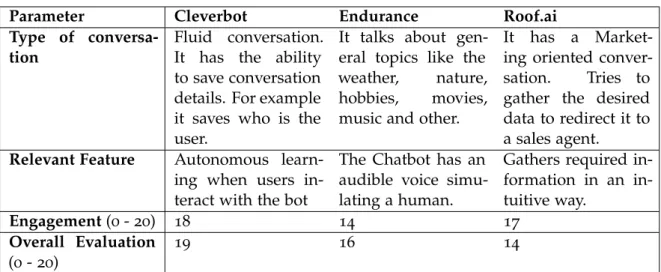
With the intention of providing a comparative analysis about Chatbots available on the Web, it was decided to present a table with some aspects that are visible when using the referred Chatbots.
Those aspects were chosen to perform a study regarding the User Experience in a holistic point of view. The aspects are the following: ”Type of Conversation”, ”Relevant Feature”, ”Engagement” and ”Overall Evaluation”. The first two aspects are qualitative evaluations and the latter two are quantitative evaluations on a scale from zero to twenty.
The table1intends to summarize information regarding Web Chatbots approached in this
docu-ment. It should be noticed that it is a subjective analysis.
Parameter
Cleverbot
Endurance
Roof.ai
Type of
conversa-tion
Fluid conversation.
It has the ability
to save conversation
details. For example
it saves who is the
user.
It talks about
gen-eral topics like the
weather,
nature,
hobbies,
movies,
music and other.
It has a
Market-ing oriented
conver-sation.
Tries to
gather the desired
data to redirect it to
a sales agent.
Relevant Feature
Autonomous
learn-ing when users
in-teract with the bot
The Chatbot has an
audible voice
simu-lating a human.
Gathers required
formation in an
in-tuitive way.
Engagement
(0 - 20)
18
14
17
Overall Evaluation
(0 - 20)
19
16
14
2.3.2
Dialogue tools for Human Resources Services
Since our goal is to add a Chatbot system to a Human Resource Service commercial Website, it seems indispensable to observe and compare dialogue systems or methodologies regarding the communi-cation between clients and responsible company staff.
This following part will present some of the actual dialogue tools competitors. Among these tools there are forms to contact customer support, FAQs (Frequently Asked Questions) and non-autonomous Chatbots.
Non-autonomous Chatbots are characterized by a certain lack of domain that only a Customer Support employee can fill. These Chatbots use a Decision Tree dialogue system to gather data and frequently have to book a meeting with a customer support employee. These Chatbots have a clear advantage that can save hours of work to a company. They ask protocol questions that are strictly required. An example of these questions could be the purpose of the visit to the website, or they could ask questions with the purpose of gathering required protocol information like the name, professional email, or even their company’s name.
Gusto - User Impression
The dialogue tool provided by the Gusto platform is basically a FAQ page to answer frequent ques-tions. It is complemented with a form to respond to non-approached topics to provide a full domain of the knowledge.
It seems to present less engagement to the customer in comparison with a dynamic tool like a Chatbot. It is possible to observe the dialogue tool presented by Gusto in figure10.
Zenefits - User Impression
Zenefits seems to provide a more engaging dialogue tool for customer support. This tool could be called as a ”non-autonomous” Chatbot, because it can only schedule a meeting. The bot asks the email address to contact the customer and afterwards presents a decision tree with the availability of the customer support worker. If the customer support worker is available, it starts the dialogue right away. In figure11it is possible to observe Zenefits’ Chatbot on the right side.
Zoho - User Impression
Zoho dialogue tool seems to be more conservative. It provides a FAQ page complemented with a customer support team to clarify doubts uncovered by the FAQ section. The presented Chatbot is autonomous, i.e. doesn’t have a human interaction. It seems an effective method to approach this task. However, it could have more engagement with the user. We can see the FAQ page and Zoho’s Chatbot in figure12.
Summary
The idea behind this section is to provide an analysis on the communication tools available on similar Human Resources Services software.
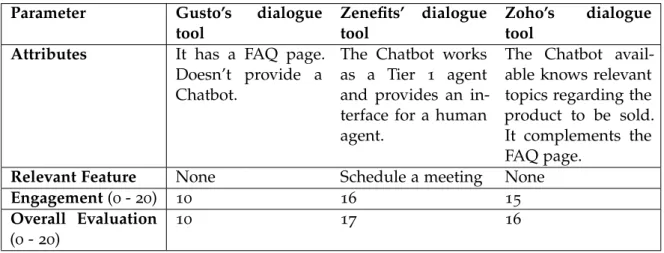
These dialogue tools provided by the Human Resources Services Websites were evaluated by cer-tain criteria to provide a comprehensive analysis when comparing them side-by-side. These criteria were the following: ”Attributes”, ”Relevant Feature”, ”Engagement” and ”Overall Evaluation”. The first two parameters are qualitative evaluations and the latter two are quantitative evaluations on a scale from zero to twenty.
The table2purpose is to summarize information regarding dialogue systems present on
commer-cial Websites of Human Resources tools approached in this document. It should be noticed that it is a subjective analysis.
Parameter
Gusto’s
dialogue
tool
Zenefits’
dialogue
tool
Zoho’s
dialogue
tool
Attributes
It has a FAQ page.
Doesn’t provide a
Chatbot.
The Chatbot works
as a Tier 1 agent
and provides an
in-terface for a human
agent.
The Chatbot
avail-able knows relevant
topics regarding the
product to be sold.
It complements the
FAQ page.
Relevant Feature
None
Schedule a meeting
None
Engagement
(0 - 20)
10
16
15
Overall Evaluation
(0 - 20)
10
17
16
Table 2.: Comparison between different dialogue/communication systems available on Human Re-sources Services
2.3.3
Virtual Personal Assistants
It was decided to approach Virtual Personal Assistants (VPA’s) for two reasons. The first reason is because it has similar features to an Electronic Commerce Chatbot, since it establishes a dialog between a human and a machine using textual or voice methodologies. The second reason is due to a Chatbot Framework (Dialogflow, former API.ai) that was based on a Virtual Personal Assistant.
In the last decade, the Chatbot world had a major impact in our daily routine. For instance, the newspapers reading were replaced by a simple voice request directed to a Virtual Personal Assistant (VPA) that will tell the news with a imitation of a human voice. The restaurant reservation phone call has been changed to another voice request redirected to the restaurant’s calendar or to a phone call between a human and a VPA pretending to be a human. These examples are one of the endless type of appointments that today is being done with cutting edge technology.
For a proper analysis an investigation was carried out by trying several Virtual Personal Assis-tants (VPAs) in order to collect and summarize their differences.
The table that will be presented later aims to compare side-by-side some relevant features concern-ing several voice Chatbots integrated in physical devices. The followconcern-ing part intends to demonstrate these VPA’s referred below in a comparative way. The details chosen were based on specifications like the user-agent voice change according to the type of the dialogue between the Chatbot and the user, or the availability on different devices and other aspects.
Amazon Echo
Figure 13.: Example of an Amazon Echo device [Amazon(b) - visited at 26/07/2019]
Amazon Echo is a brand of smart speakers developed by Amazon. There is a voice-controlled intelligent personal assistant named ”Alexa” which connects to ”Echo devices”. Users can call her ”Alexa” but can change this wake word to ”Amazon”, ”Echo” or ”Computer” [Amazon(a)].
The device’s main features are the following: voice interaction, making shopping lists, music playback, making to-do lists, setting up alarms, streaming pod-casts, and playing audiobooks, in addition to providing weather, traffic and other real-time information, it can also control several smart devices, acting as a home automation hub [Amazon(a)].
In the default mode, Amazon Echo continuously listens to all speech, monitoring for the wake word to be spoken, which is primarily set up as ”Alexa”. The device’s microphones can be disabled by pressing a mute button to turn off the audio processing circuit [Bloomberg]. We can observe an Amazon Echo device on figure13.
Google Home/Assistant
Figure 14.: Example a Google Home device [Googlevisited at 26/07/2019]
Google Home devices are speakers that enable users to speak voice commands and interact with the services through the Google’s intelligent personal assistant named Google Assistant [Techradar
(2019)].
There is available an enormous number of native and third-party apps. The main features are the following: play music, receive updated news, control playback of video and photos using only the voice to dictate orders [Techradar(2019)].
These devices also have integrated a support for home automation that provides voice activated smart home appliances [Techradar(2019)].
One of the latest updates, brought by Google in May 2017, enables some functionalities like: setting reminders on Google Calendar, making appointments, hands-free phone calling and other interesting features [Palmer(2017)]. We can see an example of a Google Home device in figure14.
Siri
Figure 15.: Siri [Jason Cross- visited at 26/07/2019]
Siri is a Virtual Personal Assitant (VPA) that is part of Apple’s Operating Systems such as macOS, iOS and other operating systems built-in Apple’s IoT’s (Internet of Things) devices. The VPA is capable of making recommendations, answering questions and performing actions by using several Webservices APIs when the user issues a voice query using natural language [Bosker(2013)].
Siri is a project originally developed by SRI International Artificial Intelligence Center. It uses a speech recognition engine provided by Nuance Communications and an advanced Machine Learn-ing model to function properly [Bosker(2013)].
The VPA supports a variety of user commands including phone call actions, scheduling events and reminders, making reservations, handling device setting, searching the internet and several interesting features [Purewal and Cipriani(2017)]. It is possible to observe an iPhone device whose
Cortana
Figure 16.: Cortana [Matt Mcgeevisited at 26/07/2019]
Cortana is a Virtual Personal Assistant (VPA) created by Microsoft for its Operating Systems, i.e., Windows 10, Windows 10 Mobile, Windows Phone 8.1, etc [Foley(2014)].
It is capable of setting reminders, recognizing natural voice and answering questions using the Bing Search engine API. [Sams(2015)]
This VPA is currently available with the following languages: Portuguese, English, German, French, Spanish, Italian, Chinese and Japanese [Microsoft].
Cortana appeared for the first time at Micrsoft BUILD Developer Conference that took place in San Francisco in April 2014 [Lau(2014)]. We can observe a Windows phone whose user is currently
Summary
In order to compare new trends on dialogue tools we decided to do a research on different platforms known as Virtual Personal Assistants and evaluate them side-by-side.
To accomplish the desired evaluation we decided to choose relevant parameters. Those were the following: ”Waiting time”, ”Type of conversation”, ”User agent voice change”, ”Available on different devices”, ”Making a reservation”.
The table3intends to summarize information regarding Virtual Personal Assistants approached
in this document. It should be noticed that it is a subjective analysis.
Parameter
Amazon Echo
Google Home
Siri
Cortana
Manufacturer
Amazon
Apple
Microsoft
Waiting time
5
secs
2
secs
5
secs
3
secs
Type of
conver-sation
It
is
quite
limited.
Some-times there is
no proper voice
recognition.
Alexa
(Ama-zon
Echo’s
agent)
specifi-cally
answers
to
the
users
interactions.
There is more
dialogue
be-tween the user
and the Google
Assistant
(the
Home
agent).
The
agent interacts
even
if
the
dialogue
is
rhythmically
paused.
The
agent
specifically
answers to the
users
interac-tions.
It only
answers to the
voice
of
the
user.
There
is
no
voice
change
ac-cording to the
theme of the
conversation.
It
is
quite
limited
too.
Sometimes
there
is
no
proper
voice
recognition.
The
agent
specifically
answers to the
users
interac-tions.
User
agent
voice change
No
Yes
No
No
Available
on
different
devices
No
No
Yes
Yes
Making a
reser-vation
Yes
Yes
Yes
Yes
2.4 a r t i f i c i a l i n t e l l i g e n c e m a r k u p l a n g ua g e
This section should provide an analysis of the AIML language as an option to develop the desired Chatbot. AIML or Artificial Intelligence Markup Language is a Markup Language based on XML designed between 1995 and 2002 by Richard Wallace, initially to extend ELIZA into ALICE, Artificial Linguistic Internet Computer Entity.
This technology allows a developer to create a natural language software agent using an abstrac-tion of Regular Expressions called AIML Elements. The most important AIML Elements are the following:
- Categories: A category consists of at least two elements, a pattern and template. - Patterns: A pattern is a String to match one or more user inputs.
- Templates: A template is intended to be the response to a Pattern. It can reference variables. The following example was elaborated to give a little immersion in the AIML language as well as expressing the interaction between a human and a Chatbot designed with this markup language .
<category>
<pattern>WHAT IS YOUR NAME</pattern>
<template><![CDATA[My name is <bot name="name"/>.]]></template> </category>
These rules represent the Chatbot Knowledge Base. In this research it was possible to experiment some Chatbot AIML interpreters written in languages like Java or PHP. It is possible to conclude that most of them are similar and do not stand out very much from each other.
2.5 c h at b o t d e v e l o p i n g p l at f o r m s/ai chatbot frameworks
With the increased need of developing Chatbots for commercial and informative use, platforms that facilitate the creation of a Chatbot from scratch have risen. These platforms were created by big name companies like Google or Facebook with the perspective of automatically deploying the ”gen-erated Chatbot” to several platforms like the chat of some company’s Facebook page for such tasks as providing information of facilitating the acquisition of goods or services.
The Chatbot’s domain is defined using Entities and Intents. An Entity is a powerful tool used for extracting parameter values from natural language inputs. And an Intent represents what the user is trying to achieve.
According to most of these tools’ communities, it is good practice to provide several examples of the same Entity in every Intent.
Chatbot Developing Platforms presented ahead are responsible for the resolution of two prob-lems.
The first problem is a classification problem and can be solved with different approaches. This classification is related to the identification of the user’s Intent when prompting the system.
The model used depends on the amount of data and the number of intents that the domain re-quires. In these tools the user can not choose the model, instead it is likely that the model is chosen automatically by the tool. The most commonly used model for solving this problem is Support Vector Machines (SVM) [Mctear(2018)].
The second problem is colloquially named as Slot Filling. It is a task that is responsible for parsing the strings that mainly correspond to the predicate part of a sentence and put them in the right slot. For example if the user prompts: ”How much costs your platform?”, the agent has to map the following words: ”costs” and ”platform” to an Intent and Entity respectively. A suited model for this task could be Conditional Random Fields (CRF) [Mctear(2018)].
The ”Slot Filling” problem is also being solved using Recurrent Neural Networks. [Yang and Liu
(2015)].
Knowing that ”In ML terminology, the classification problem is an activity of supervised learning, since the learning process is “supervised” by the knowledge of the categories and of the training instances that belong to them”, [Sebastiani(2002)] and given the previously mentioned facts it seems reasonable to
presume that it is an ensemble of a Rule-based and a Supervised Learning classification problem. To conclude, the assumption above is not a guarantee but a suspicion of the methodologies used in the Chatbot development tools.
2.5.1
Dialogflow
Dialogflow is the platform developed by Google to achieve an intelligent Chatbot using a user friendly UI. Formerly known as API.ai originally developed by Speaktoit acquired by Google in 2016.
This tool was based on the Virtual Personal Assistant named ”Assistant” developed by Speaktoit that used Natural Language Understanding (NLU) to interact with its users.
Since Dialogflow is not Open-Source we can not know for sure what type of Machine Learning is happening within it. But there is some tweaks that can improve the performance of the agent:
1 - Match Mode- The user can choose between ML only and Rule-based and ML;
2 - ML Classification Threshold- Defines the threshold value for the confidence score. If the returned value is less than the threshold value, then a fallback intent will be triggered or, if there are no fallback intents defined, no intent will be triggered.
3 - Training Set- Adding or removing phrases to the agent;
4 - Validation Set- It is recommended by the Dialogflow community to repeat phrases or words to induce the learner to tune the model hyper-parameters;
Dialogflow defines a large group of concepts that makes its gears turn smoothly. It uses entities, in-tents, actions, contexts along with machine learning for training the intended (classification) model. It has built-in knowledge about some topics off the shelf like casual talk and weather for instance. So there is no need for the user to train the agent for these topics.
This platform enables the user to create ”Agents” that are individual customizable Chatbots. Enti-ties and Intents can be added to the Agent in order to improve its Knowledge Base and conversation domain.
”Dialogflow allows follow-up intents to be added to any parent intent and provides several built-in follow-up intents that address the most common use cases: fallback (for queries that the Chatbot cannot answer), yes/no, later, cancel, and custom.” [Mctear(2018)].
Dialogflow has an ability to extend its knowledge using fulfillment [Ho(2018)]. With this ability
it extends queries using a Backend that communicates via Http requests with the Dialogflow platform. A huge advantage of Dialogflow is its Pre-built agents. Pre-built agents are a knowledge collection and structured data that are always ready to be added to an agent. The Pre-built agents include common verbs and context types. There are some pre-built Chatbots for different purposes like buying movie tickets, currency conversion, food delivery and many others.
Another useful feature in Dialogflow is Small Talk. It has several customizable modules regarding the type of conversation that the user is having with the bot. ”About the agent”, ”Courtesy” and ”Emotions” are one of the few customizable Small Talk modules that can improve the dialogue be-tween the user and the agent. It is possible to observe a glance of the Dialogflow’s console in figure17.
2.5.2
Wit.ai
Wit.ai is an Open-Source service acquired by Facebook in 2015 that supplies a combination of speech recognition and machine learning to developers. Wit.ai has a feature that allows users to create their voice commands. Those commands are recognized and converted to JSON (JavaScript Object Notation) [Wit.ai Team].
Just like Dialogflow, Wit.ai has Intents and Entities. Intents represent an action to be executed. En-tities represent a specific object, or a specific thing that the Chatbot has to know to execute an Intent [Wit].
The application has a feature called roles used to learn to differentiate entities in different contexts. It has special entities to recognize URLs, emails, duration, temperature and other special words.
Wit.ai, just like Dialogflow, has a console to create and control the Chatbot. A perspective of the console can be observed in figure18.
2.5.3
IBM Watson
IBM’s Watson is a tool capable of providing to the user a favourable Chatbot development environ-ment. It is capable of answering questions in natural language. This tool was developed in IBM’s DeepQA project [Ferrucci et al.(2013)]. Figure20should illustrate the pipeline of procedures from
the question asked by the user to the answer provided by the Chatbot. This tool provides a console to control the Chatbot agent. It is possible to observe IBM Watson’s console in figure19.
When created, IBM stated that, ”more than 100 different techniques are used to analyze natural language, identify sources, find and generate hypotheses, find and score evidence, and merge and rank hypotheses” [IBM].
Figure 19.: IBM Watson console [IBM Cloud- visited at 26/07/2019]
2.5.4
Leadbot
Leadbot is a product developed by a company called Drift that provides tools for developing Chat-bots for companies’ websites. The final product will consist of a custom Chatbot built for the com-pany’s purposes. It provides a dialogue based on a decision-tree. When the dialogue falls off the bot’s Knowledge Base’s domain, it books meetings with Company’s workers. This feature is known as ticket creation. There are pre-built Chatbots available off the shelf and there is an option for building a custom Chatbot too. Those pre-built Chatbots are designed to cover a variety of use cases and they are named Playbooks [Drift]. We can see part of a conversation with LeadBot in figure21.
2.5.5
Summary
The content of the table4summarizes the tools available on the market to develop a Chatbot.
Parameter
Wit.ai
IBM
Wat-son
Dialogflow
(API.ai)
Pure AIML
Driftbot
Manufacturer
IBM
None
Drift
Type
Chatbot
Framework
Chatbot
Framework
Chatbot
Framework
Rule-based
Rule-based
Open
Source
Yes
No
No
Yes
Yes
Pros
Free
Automated
predictive
analysis;
Multilin-gual
(10
languages).
Pre-built
base agents;
SDK
sup-ports several
program-ming
lan-guages;
Multilin-gual
(15
languages).
The
Chat-bot’s
be-haviour
is
much more
predictable
in
compari-son with ML
alternatives.
The
Chat-bot’s
be-haviour
is
much more
predictable
in
compari-son with ML
alternatives.
Cons
The
learn-ing
curve
seems to be
steeper.
Expensive
compar-ing
to
Dialogflow.
Unsatisfactory
documenta-tion.
Can’t
an-swer
ques-tions
that
are not
pre-conceived
in
the
Chatbot’s
domain.
Can’t
an-swer
ques-tions
that
are not
pre-conceived
in
the
Chatbot’s
domain;
It
will
book
a
meeting
frequently
with
a
Company
worker;
Need
Cus-tomer
Sup-port.
Usage limit
No
strict
limit
10
.000
messages/-month
180
mes-sages/minute
No
No
Paid
No
Freemium
Freemium
No
Yes
Learning
Curve
8
7
6
9
5
2.6 g l o s s a r y
The following glossary present on table5 has an intent of clarifying the reader for some general
concepts approached in this document.
Concept
Definition
Artificial Intelligence (AI)
Intelligence demonstrated by machines, in
contrast with the natural intelligence
dis-played by humans and other animals.
Machine Learning
Field of Artificial Intelligence that focuses
on the ability of machines to receive a
data-set and learn for themselves instead of
be-ing programmed.
Class
Final Prediction/label.
Classification
Process of predicting a class.
Classifier
Entity that executes classification.
Feature
Attribute or quality.
Support Vector Machines
Classification algorithm.
Artificial Neural Network
Computing system based in the biological
neural network.
Recurrent Neural Network
Variation of Artificial Neural Network
com-puting system.
Dialogflow
Google’s Chatbot Framework.
Wit.ai
Facebook’s Chatbot Framework.
IBM Watson
IBM’s Chatbot Framework.
API
Application Programming Interface.
REST
Representational State Transfer (REST) is a
software architectural style that defines a
set of constraints to be used for creating
Web services.
Liquibase
Open-Source database-independent library
for tracking,
managing and applying
database schema changes.
Hibernate
Object-relational mapping tool for the Java
programming language.
JPA
Java Persistence API.
Spring Boot
Application Framework and inversion of
control container for the Java platform.
Kotlin
Programming language.
Java
Programming language.
NGINX
Reverse Proxy.
PostgreSQL
Object-Relational Database system.
HTTP
HyperText Transfer Protocol. This protocol
is used all over the web.
Table 5.: Glossary3
T H E P R O B L E M A N D I T S C H A L L E N G E S
This chapter is intended to expose to the reader the decisions and the problems found developing the solution.
The solution found was based on some aspects, such as time available, learning curve of the chosen technologies, and others.
After this research, it was decided that the Chatbot model used should be a Rule-based model with Machine Learning since our main requirement is to satisfy doubts related to the product to be sold on the commercial Website. In order to make this happen, a proper Chatbot framework was chosen to be able to retrieve an interaction by typing directly on the console.
3.1 s y s t e m a r c h i t e c t u r e
The intended architecture for this system is composed by three distinctive parts. The client-side app, the server-side app, and the ”Chatbot-side app”.
In order to achieve a stable environment it was chosen to use containers in all the pieces of this project. All the components illustrated in figure22are Docker containers.
The system uses three apps that have different purposes. The client-side app is supposed to supply the user interface for the end user. Also provides an entry to a secure channel with the function of exchanging messages between the user and the Chatbot itself using a server app. The server-side app or just server app is supposed to receive messages, deliver them to the Chatbot, receive its response and finally hand over the message to the user. Finally, the Chatbot app, will receive messages, process them and respond accordingly to its Knowledge Base. In the figure22we have a graphical
representation of the system architecture.
Figure 22.: System Architecture
The technology stack used in this project had to fit seamlessly in the Website architecture. So we had to adapt the development process to our requirements. The user interface, that is the ”Chat-bot Frontend” app would have to ”live” in a Liferay Server system that builds Http requests using Javascript on top of a Apache Tomcat, however not using it for communications with the Chatbot Back-end app since it wasn’t compatible with our version of Hibernate (later presented).
Docker Container
A container is a standard unit of software that packages up code and all its dependencies so the ap-plication runs quickly and reliably from one computing environment to another. A Docker container image is a lightweight, standalone, executable package of software that includes everything needed to run an application: code, system tools, system libraries and settings [Docker]. It is possible to observe a scheme of a Docker container in figure23.
Figure 23.: Scheme of a Docker container [Docker]
Liferay
Liferay is an Open-Source CMS (Content Management System) written in Java whose main purpose is to supply a tool to update or modify the content of a Website that non-experts could use without any programming language skills. Since it is Java based we had to integrate the HTML and CSS code into JSP (Java Server Page) that could execute the rendering of our page on server-side and deploy it to the Liferay Server as .war (Web application ARchive) file.
Chatbot Backend
We could develop a system that could communicate directly between Chatbot portlet and the Chat-bot agent, but it wouldn’t be safe to expose sensible information like JWT tokens in the ChatChat-bot portlet. In terms of the server-side application, we had to think about performance and security related questions. Since the used version (v2beta1) of the Dialogflow agent had several API’s like Node.Js, Python, and Java regarding the preference of the programming language by the developer, it would make sense to use and develop a Backend in a JVM language like Java or Kotlin. Kotlin was chosen because it carries almost all the advantages from Java and several more related to the ease,
quickness of development and safety related operations.
The server-side framework chosen was the Spring Boot 2 Framework with an embebed Apache Tomcat to help the Kotlin app to create a REST API and consequently receive messages from users, deliver them to the Chatbot agent, receive the response from Chatbot agent, and finally, hand the message to the user (Chatbot portlet).
Chatbot’s Database
In order to store data related to Chatbot’s user feedback we had to think in a Database to make data persistent. PostgreSQL was chosen since it is an Open-Source relational database with a wide community. This Database is going to be used to gather the user experience by classifying each message and to save the scheduled meetings to clarify possible clients about the platform that is being sold on the commercial Website.
Chatbot Agent
The core of this bot resides in a Chatbot Framework maintained by Google, named Dialogflow. This tool’s main purpose is to detect the user intent present in a message and respond according to its Knowledge Base. This tool was deeply analyzed and reported in section ”Chatbot Developing Tools/AI Chatbot Frameworks” of the previous chapter.
3.2 d e v e l o p m e n t
This section is supposed to introduce to the reader the strategy used in the development, the deci-sions made in order to implement the desired solution supplying the desired outcome.
These topics will be approached in the following sections. It is to be noticed that every decision regarding the strategy of the implementation was made taking in account some factors like time needed to implement a given solution by always seeing the big picture of the desired end product.
3.2.1
Decisions
In this journey we came across some possible solutions. The decisions had to be taken focusing on the overall final result, that was a functional Chatbot that could serve the initial purposes. It is to be noticed that the research provided different paths with different levels of difficulty. For instance, we could chose other machine learning models and train/tweak them from scratch. But we would have to consume much more resources. Those resources would include time and advanced computational hardware like a set of expensive high-end Graphics Processing Units (GPUs).
Instead, the aim was set on delivering a functional product in short time. To do that, we chose the proper tools to help the process of developing the Chatbot.
One of the requirements of the Chatbot was to work on different environments. To ensure that, some actions had to be taken in the Dialogflow console and on the Backend app.
Three different Environments were created on Dialogflow, called dev, qa, and prod. These environ-ment names correspond to the following environenviron-ments respectively:
• Development - local environment to run the program.
• Quality Assurance - remote environment for running the program and allow to test the changed code via either automated checks or non-automated techniques.
• Production - remote environment that users directly interact with.
Were created three different configurations in the Backend with the proper location of the resources and desired properties.
These environments would run on different machines and development environments. They would also contain different Knowledge Bases as well.
To conduct the user in the desired way and to prevent him or her from ”wandering” the bot’s Knowledge Base, when the user prompts some message that is off the bot’s Knowledge Base, it was decided to use a decision tree structure to make the user choose the topic that he or she wants to be clarified. This works as a fallback intent and will be approached in the section System Summary.
Regarding the quality of the service, it was decided to provide a ”switch” to enable and disable the Chatbot. To accomplish that, first it was decided to use the Spring Boot tools to read an environ-ment variable. Depending on the state of that variable (true or false), the Chatbot would appear or not appear to the user. Given that the Liferay environment was making it difficult to accomplish the intended behaviour, it was decided to approach the problem in another way.
In order to accomplish the desired mechanism/switch, it was decided to make a simple ajax re-quest from the client-side that basically queries the server-side app about the state of that variable. If the server-side responds with ”true”, the Chatbot is going to appear to the user. That is accomplished by removing the CSS class hidden. If the server-side responds with ”false”, the HTML object that is rendering the Chatbot will be removed from DOM to ensure that the user wouldn’t undesirably exploit the Chatbot.
To ensure that the dialogue is quite similar to a dialogue with a human being, it was decided to use an animation of a typing message with a time of response corresponding to the bot’s time of thinking/processing the message, and answering accordingly.
It was decided to implement a Feedback System to improve the Knowledge Base of the Chatbot. To validate each answer given by the Chatbot, we decided to ”mark” each answer as relevant or non-relevant to our Feedback System. So, if an answer is related with the platform it will have a ”like” button attached that sends information to the database.
Since the user could have more specific doubts that falls off the Chatbot domain, we decided to implement a ”Book a Demo” feature that builds the bridge between our Chatbot (Tier 1) and a human
worker (Tier 2). This way our Chatbot could inform the platform’s Support Team and confirm the user intent of scheduling a meeting with the support team by sending emails to both of them.
Both features will be later presented.
3.2.2
Implementation
Regarding the system’s backbone implementation, it was decided to use an iterative methodology, that was based on CI/CD (Continuous Integration/Continuous Deployment). That methodology con-sisted in a cycle that increasingly develops features of the Chatbot (Continuous Integration), and deploys them to the chosen developing environment (Continuous Deployment). This methodology was chosen because it eases the software development and system’s deployment. This mechanism is capable of building, testing and deploying the app for each merge request to the master branch on the repository, softening the implementation and deployment job.
Concerning the Chatbot agent, we have used two features: Intent and Knowledge Base. Intents are more interactive and are capable of defining complex dialogues with more than one context (enlightened later), also could provide different responses for the same Intent if we want to express a random response from a list. This feature can be observed in figures24and25.
We used the feature Knowledge Base to keep the questions and answers of a FAQ. This feature was able to create a model which could classify the user intent and respond with one straight answer. Both features (Intents and Knowledge Base) were used in the desired solution. It is possible to observe the Knowledge Base section of the console in figure26.
Figure 25.: Intent feature with Actions, Parameters and Responses [Dialogflow - visited at 26/07/2019]
Regarding the Context feature, it is responsible for providing the user with a concise dialogue with several interactions of questions and answers forcing the Chatbot agent to ”jump” between intents approaching a human conversation with several queries to get one response. This feature was explored although abandoned since introduced more problems than benefits concerning the
determinism of the answers.
Figure 26.: Knowledge Base feature [Dialogflow- visited at 26/07/2019]
Since we could have intents overlapping Knowledge Base answers, this Chatbot tool provide us a mechanism to control the preference when the system has close matches between intents and the Knowledge Bases. Basically it displays an interval varying from -1 to 1 in a decimal interval. If the user chooses a negative number it should make the agent prefer the result from the Intent, otherwise it makes the agent prefer the result from the Knowledge Bases as it can be seen in figure27.
Figure 27.: Adjust Knowledge Base results [Dialogflow- visited at 26/07/2019]
3.2.3
User experience
The Chatbot interface will be presented below. It was accomplished thinking about the user expe-rience. This Chatbot is present in every page to escort the user along the website. It should be like a tourist guide for the Web page in order to clarify the user regarding the questions they may have. Also it should be polite to the users when asking about unknown topics. When the user prompts greetings messages or make small talk and the Chatbot agent should respond properly. In figure28, 29 and30 we can see three different views of Mac, the Chatbot either closed, opened or having a
conversation with a user respectively.
Figure 28.: The website with Chatbot closed at the bottom right corner [Dialogflow - visited at 26/07/2019]
Figure 29.: The website with Chatbot opened at the bottom right corner
Figure 31.: Prompting the Chatbot with same intention but different phrases in Mobile environment
When asking about the product ”Doleedo” or even about the terms and features that comes along with it, ”Mac” (the Chatbot), presents an answer with a clarified message about the topic queried. Also, in order to ease the navigation on the website, ”Mac” presents messages with ”redirectable” hyperlinks for some of the website pages. Those messages with hyperlinks can be seen in figure31.
It is to be noticed that the user could type the same question in other words or form, that would represent no issue regarding the classification of the message. That behaviour can be observed in figure31.

![Figure 5 .: Example of a Bi-directional Recurrent Neural Network [Graves et al. ( 2013 )]](https://thumb-eu.123doks.com/thumbv2/123dok_br/17220393.786503/18.892.240.701.451.779/figure-example-bi-directional-recurrent-neural-network-graves.webp)
![Figure 6 .: Chatobts using modern API’s [Ecommerce-Nation - visited at 23 / 07 / 2019 ]](https://thumb-eu.123doks.com/thumbv2/123dok_br/17220393.786503/20.892.213.730.387.775/figure-chatobts-using-modern-api-ecommerce-nation-visited.webp)
![Figure 8 .: Endurance’s Landing page Chatbot [Endurance - visited at 05 / 11 / 2018 ]](https://thumb-eu.123doks.com/thumbv2/123dok_br/17220393.786503/22.892.309.638.375.860/figure-endurance-s-landing-page-chatbot-endurance-visited.webp)
![Figure 9 .: Roof.ai Chatbot [Roof.ai visited at 08 / 11 / 2018 ]](https://thumb-eu.123doks.com/thumbv2/123dok_br/17220393.786503/23.892.344.597.354.1006/figure-roof-ai-chatbot-roof-ai-visited.webp)
![Figure 10 .: Gusto [Gusto - visited at 06 / 12 / 2018 ]](https://thumb-eu.123doks.com/thumbv2/123dok_br/17220393.786503/25.892.127.832.682.1047/figure-gusto-gusto-visited.webp)
![Figure 11 .: Zenefits [Zenefits - visited at 23 / 12 / 2018 ]](https://thumb-eu.123doks.com/thumbv2/123dok_br/17220393.786503/26.892.139.836.502.863/figure-zenefits-zenefits-visited.webp)
![Figure 13 .: Example of an Amazon Echo device [Amazon (b) - visited at 26 / 07 / 2019 ]](https://thumb-eu.123doks.com/thumbv2/123dok_br/17220393.786503/30.892.319.625.209.602/figure-example-amazon-echo-device-amazon-b-visited.webp)