© 2016 Alexandre F. Santos et al., published by De Gruyter Open.
ICEUBI 2015
*Open Access
Alexandre F. Santos*, Heraldo J. L. de Souza, Mauricio P. Cantăo, and Pedro D. Gaspar
Analysis of geothermal temperatures for heat
pumps application in Paraná (Brasil)
DOI 10.1515/eng-2016-0063
Received March 24, 2016; accepted August 11, 2016
Abstract: Geothermal heat pumps are broadly used in
de-veloped countries but scarcely in Brazil, in part because there is a lack of Brazilian soil temperature data. The aims of this work are: to present soil temperature mea-surements and to compare geothermal heat pump system performances with conventional air conditioning systems. Geothermal temperature measurement results are shown for ten Paraná State cities, representing different soil and climate conditions. The measurements were made year-long with calibrated equipment and digital data acquisi-tion system in different measuring staacquisi-tions. Geothermal and ambient temperature data were used for simulations of the coefficient of performance (COP), by means of a working fluid pressure-enthalpy diagram based software for vapor-compression cycle. It was verified that geother-mal temperature measured between January 13 to Octo-ber 13, 2013, varied from 16 to 24 °C, while room tem-perature has varied between 2 and 35 °C. Average COP values for conventional system were 3.7 (cooling mode) and 5.0 kW/kW (heating mode), corresponding to 5.9 and 7.9 kW/kW for geothermal system. Hence it was verified an average efficiency gain of 59% with geothermal system uti-lization in comparison with conventional system.
Keywords: geothermal heat pumps; cooling; geothermal
temperature measurement
*Corresponding Author: Alexandre F. Santos:University of Beira Interior, Marquês d’Ávila e Bolama Street, 6201-001, Covilhã, Portu-gal, E-mail: [email protected]
Heraldo J. L. de Souza:Professional College – FAPRO, 2213, Eng. Rebouças Street, Curitiba – PR, Brazil
Mauricio P. Cantăo:Federal University of Paraná, 100, Coronel Francisco Heráclito dos Santos Avenue, Curitiba – PR, Brazil Pedro D. Gaspar:University of Beira Interior, Marquês d’Ávila e Bolama Street, 6201-001, Covilhã, Portugal
*International Conference on Engineering 2015 – 2–4 Dec 2015 –
University of Beira Interior – Covilhã, Portugal
1 Introduction
The word "geothermal" according to Egg & Howard [1], comes from the Greek “geo” (earth) and “thermos” (heat) and is applied to the use of heat from the ground. There are basically two energy applications of geothermal heat. The first is the generation of electricity, typically held in huge generation systems in which water is introduced into the soil of geothermal areas of high temperature, generating steam to drive turbines and generate electricity. Such fa-cilities exist only in places with high geothermal activity, some Asian and European countries. In the Philippines, for example, geothermal energy accounts for 8,900 MW and represents 25% of the electricity generated [1]. The sec-ond way to use geothermal energy consists of the use of temperature at constant value below the earth’s surface in geothermal heat pumps (GHP). Geothermal heat source favors the increase of energy efficiency and can be used in urban building cooling systems, with an energy saving ranging from 70% to 140% in winter, compared to air heat pumps [2].
According to the EERE (Office of Energy Efficiency & Renewable Energy) [3, 4], agency linked to the Department of Energy, a geothermal heat source is an effective mecha-nism for energy efficiency and can be used in urban build-ing coolbuild-ing systems, geothermal (ground-source or water-source) heat pumps achieve higher efficiencies by transfer-ring heat between one house and the ground or a nearby water source. Heat pumps are devices with simple oper-ation and good thermal performance, characteristics that indicate a great potential in the air conditioning market. Although they cost more to install, geothermal heat pumps have low operating costs because they take advantage of relatively constant ground or water temperatures. Geother-mal (or ground source) heat pumps have some major ad-vantages. They can reduce energy use by 30%-60%, com-pared to conventional air conditioning and refrigeration systems. As an illustrative example, during study for the demand curve of the Professional Technical School build-ing costs (ETP), established in Curitiba, it was found that 50% of electricity demand used refer to the consumer cool-ing and heatcool-ing [5].
ing equipment market and the consequent development of the sector companies. According to the Science Globe [6], six of the 10 weather stations with the highest tempera-tures worldwide were in Rio de Janeiro; three other pointed to temperatures of other states and the only temperature measured at a station outside Brazil was in the city of El Vigia, Venezuela. The ranking was made by the me-teorologist for Weather Forecasting and Climate Studies Center Giovanni Dolif, based on information gathered by 4,232 stations worldwide accessed by the National Insti-tute for Space Research (INPE). The stations that registered the highest temperatures were the Jacarepaguá, in the city of Rio de Janeiro, with thermal sensation of 52 °C, and Joinville in Santa Catarina, with thermal sensation of 51 °C. On the other hand, the winter of 2013 was marked by ex-tremely low temperatures in Curitiba with the return of the snow after nearly 40 years.
Therefore, in a country like Brazil, air conditioning is a necessity and refrigeration and air conditioning systems alternatives that generate energy savings are essential.
According to the EERE approximately 60,000 geother-mal heat pumps are installed in the United States, indicat-ing a highly promisindicat-ing market. The air conditionindicat-ing sys-tems market in Brazil is significant, and there was 60% growth in the residential air conditioning sales compared to the first three months of 2012. However, these systems are conventional and a few geothermal systems installed in the country [3, 4].
Brazil does not have the same climatic conditions of the countries where geothermal heat pumps are widely used, which raises doubts about the technical feasibility of the GHP system. Geothermal heat pumps will achieve a sig-nificant share of Brazilian air conditioning market only af-ter the evaluation of the soil thermal potential in different locations, in order to ensure that heat pumps show satis-factory performance in many applications. It is worth men-tion that currently in Brazil there is scarce informamen-tion on shallow geothermal temperatures and data on the specific geothermal potential for use in heat pumps due to the lack of installed systems. The evaluation of geothermal poten-tial of a significant surface area will help the assessment of the GHP technology feasibility at regional and national level.
Thus, the need to develop this study to determine the technical feasibility of geothermal heat pumps is clearly justified. The results indicate the possibility of creating a consumer market of cooling systems based on geothermal heat pumps.
tial surface was made by measuring soil temperature at 2 m below the surface, typical depth of geothermal loops in closed loop system (Figure 1), which is the most widely used GHP.
Figure 1: Geothermal heat pump in a closed circuit and thermal bathing ground and lake [3, 4].
The installation of geothermal heat pumps provides reduced power consumption, confirming opportunities for the emergence of the product factories in Brazil. The com-mercialization of the product in the domestic market may favor the creation of a new market niche in Brazil.
2 Materials and Methods
The selection of cities for the station installation was based on the representation of the different soils of Paraná. In-stallation locations in different cities were chosen based on ease of measuring the temperature in depth of 2 m, de-termined primarily by access to the site and carrying ca-pacity of the holes. In these places, the temperature sta-tions have been installed, as shown in Figure 2. The site selection to install the stations prioritized areas covered with awnings to protect sun controllers against the rain, and this fact does not interfere in the obtained results.
The temperature measurement was performed by means of a thermocouple supplied by Full Gauge Con-trols, inserted and fixed in a PVC tube with a diameter of 9.5 mm. According to the manufacturer, this sensor is
in-Figure 2: FTemperature analysis station model.
tended for temperature control of cooling systems in con-junction with electronic controllers also manufactured by the company. Figure 3 shows the sensor protected with a PVC film and the sensor-tube assembly installed on the ground.
Figure 3: Sensor (left) and sensor-tube assembly inserted in the soil.
The depth was defined according to Egg & Howard [1], which measured the variation of geothermal temperature in the United States of America (averaged across the coun-try) as function of depth and season. According to the au-thors, the closest point on the surface and where soil tem-peratures in summer and winter are almost equal, is lo-cated about two meters below the surface level.
Four daily readings were performed making use of a Full Gauge Controls SITRAD system with serial RS-485 in-terface and a computer. The four readings were performed at the following times of day:
• 2:00 a.m. (dawn, lower external temperature); • 8:00 a.m. (morning period, influence of radiation
east);
Figure 4: Pressure-enthalpy diagram of a refrigerant. • 12:00 p.m. (higher external temperature); • 16:00 p.m. (west irradiation peak).
The device memory is enough to store the 4 daily val-ues for one year.
3 Thermal Performance
Assessment
The method to measure the efficiency of a virtual reversible heat pump was the coefficient of performance (COP). The COP of a geothermal heat pump is the ratio of the heating or cooling output to the energy input to run the machine
The results obtained in the measurement stations were used to calculate the COP of a virtual reversible heat pump operating with the ground as the heat source. The COP calculation was performed with the software de-veloped by the company Bitzer GmbH [7]. The calcula-tion is based on the pressure-enthalpy refrigerant diagram (PERD) for the R-410A fluid, adopted in this study. A typi-cal P-h diagram containing the steam compression refrig-eration cycle is shown in Figure 4. The COP was calcu-lated from the high pressure (evaporation) and low pres-sure (condensation) values for superheated refrigerant at the output the evaporator (step 1’-1 in Figure 4) and for sub-cooled refrigerant at the condenser outlet (step 3’-3). The Bitzer software uses the same calculation principle.
Software input data are: evaporating, Tevap, (in win-ter) and condensation, Tcond, (in summer) temperatures, estimated from the values of external, TEXT, and geother-mal, TGEO, temperatures. It was also necessary to insert compressor and refrigerant types, and the superheating and subcooling fluid temperatures.
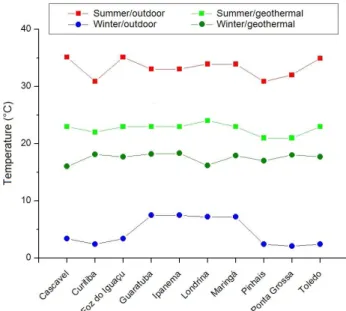
Figure 5: Summary of external and geothermal temperatures, deter-mined in different measuring stations in summer and winter.
The temperature difference (also known as “ap-proach”), ∆T, was determined by means of the system characteristics and of values adopted in real projects of air conditioning systems. For instance: in Foz do Iguaçu city (Iguazu River Mouth) a system was installed with the wa-ter cooling tower condensing at 35 °C and wawa-ter inlet tem-perature of 29 °C (Santos [8]), resulting in ∆T = 6 °C. On the other hand, the values used for a Curitiba air cooling design consisted in a condensation temperature of 42 °C and an outdoor temperature of 31 °C (Santos [9]), resulting in ∆T = 11 °C. Therefore, ∆T values used in Bitzer software were 11 °C for conventional heat pump and 6 °C for geother-mal pump.
3.1 Outdoor temperatures
The temperatures of the outdoor air in measuring stations were obtained from standard basic design parameters set-tled in Brazilian standard NBR 16401-1/08 [10] or by mea-surement. Standard design data were used for Curitiba, Foz do Iguaçu and Londrina stations. Tabulated values of these three cities were used for stations located at less than 150 km: Maringa (Londrina), Pinhais (Curitiba) and Cas-cavel (Foz do Iguaçu). For the remaining stations, the data were obtained from measurements of the winter outdoor temperature, performed in the field using the standard procedure (average of 35 hours warmer or colder months). The design data NBR 16401-1/08 [10] and the measured av-erage values are shown in Table 1.
PLACE/City Tsummer(°C) Twinter(°C)
Cascavel 35.1 3.4 Curitiba 30.9 2.4 Foz do Iguaçu 35.1 3.4 Guaratuba 33.0 7.5 Ipanema 33.0 7.5 Londrina 33.9 7.2 Maringá 33.9 7.2 Pinhais 30.9 2.4 Ponta Grossa 32.0 2.1 Toledo 34.9 2.4
3.2 Geothermal temperatures
It was found for all measuring stations that the geothermal temperature changed up to 0.1 °C in one day, 0.3 °C in one week and from 4 to 7 °C during the year, which confirms the thermal stability of soil at 2 m deep. The summer and winter values were obtained from the average of the hottest and coolest 25 hours, respectively, as the procedure stated in NBR 16401-1/08 [10]. Table 2 shows the geothermal tem-perature values obtained for the summer and the winter in Paraná different stations.
Table 2: Values of geothermal temperatures of summer and winter. PLACE/City Tsummer(°C) Twinter(°C)
Cascavel 22.9 16.0 Curitiba 22.1 18.1 Foz do Iguaçu 23.0 17.7 Guaratuba 22.9 18.2 Ipanema 23.0 18.3 Londrina 24.0 16.2 Maringá 23.0 17.9 Pinhais 20.9 17.0 Ponta Grossa 21.1 18.0 Toledo 23.0 17.7
3.3 Summary of temperature measurements
A summary of all the temperatures obtained in the monitoring stations is shown in Figure 5. The av-erage values are: 33.3 °C (external/summer), 22.7 °C (geothermal/summer), 4.8 °C (external/winter) and 17.5 °C (geothermal/winter). It was found that the differencebe-tween the mean outdoor temperature (TEXT) and geother-mal temperature (TGEO) is 11 °C in summer and 13 °C in winter. The differences between the average summer and winter temperatures are 28.7 °C for the outdoor tempera-ture and 5.1 °C for geothermal temperatempera-tures.
It appears that geothermal temperatures have a lower variation and are less extreme than outdoor temperatures. However, there is no clear trend of temperature depen-dence with the location, except for the outdoor tempera-ture winter, higher in the cities of Seaside (Guaratuba and Ipanema) and North of Paraná (Londrina and Maringá), as it can be seen in Table 3.
Figure 6: COP values for the measuring stations in alphabetical order.
In summer the difference between the external and geothermal temperature was 11 °C, while in winter this dif-ference was 12 °C. The average efficiency gains was 59% in two temperature extremes, but with greater variation in winter.
The COP values for winter and summer, obtained from external and geothermal temperature data, are shown in Figure 6. The average gain in absolute value of ∆COP was 2.2 kW/kW for summer and 2.9 kW/kW for the winter, in the ten evaluated Paraná stations.
The efficiency gains values, calculated with the data of Table 3, are shown in Figure 7.
The efficiency gains (∆COP) in summer ranged from 50% (Curitiba) to 67% (Foz do Iguaçu), while for winter the efficiency gain ranged from 43% (Londrina) to 72% (Ponta Grossa). Six stations showed efficiency gains over 50% in winter, while in summer the efficiency gains were all above 50%. The average gain values were 59% for both the
sum-Figure 7: Energy efficiency gain in summer and winter in all stations with the replacement of the conventional system by geothermal system.
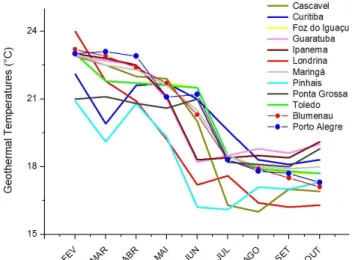
Figure 8: Geothermal temperature between February and October 2013.
mer and winter, and in all measuring stations it was found an efficiency gains associated with the use of the geother-mal system.
The observed efficiency gains is lower than the US-DOE recommended values, between 70% and 140% [2]. This range is expected for the coldest nights of the North American winter, and is consistent with a linear variation of ∆COP with ∆T = TGEO∆TEXTand with the lowest exter-nal temperature in the colder states of the USA. However, the situation should be different in summer because tem-peratures observed in Paraná are higher than in most of the US states. In this case, ∆T (and therefore ∆COP) should be higher in Brazil.
OUT GEO ∆T OUT GEO ∆T (°C) OUT GEO ∆COP (%) OUT GEO ∆COP (%) (%) Cascavel 35.10 22.90 12.20 3.40 16.00 12.60 12.40 3.51 5.87 67.24 4.82 7.64 58.51 62.87 Curitiba 30.90 22.10 8.80 2.40 18.10 15.70 12.25 4.01 6.00 49.63 4.69 8.02 71.00 60.31 Foz do Iguaçu 35.10 23.00 12.10 3.40 17.70 14.30 13.20 3.51 5.86 66.95 4.82 7.94 64.73 65.84 Guaratuba 33.00 22.90 10.10 7.50 18.20 10.70 10.40 3.76 5.87 56.12 5.40 8.03 48.70 52.41 Ipanema 33.00 23.00 10.00 7.50 18.30 10.80 10.40 3.76 5.86 55.85 5.40 8.06 49.26 52.56 Londrina 33.90 24.00 9.90 7.20 16.20 9.00 9.45 3.65 5.69 55.89 5.35 7.67 43.36 49.63 Maringá 33.90 23.00 10.90 7.20 17.90 10.70 10.80 3.65 5.86 60.55 5.35 7.99 49.35 54.95 Pinhais 30.90 20.90 10.00 2.40 17.00 14.60 12.30 4.01 6.20 54.61 4.69 7.82 66.74 60.68 Ponta Grossa 32.00 21.10 10.90 2.10 18.00 15.90 13.40 3.88 6.17 59.02 4.64 8.00 72.41 65.72 Toledo 34.90 23.00 11.90 2.40 17.70 15.30 13.60 3.54 5.86 65.54 4.69 7.94 69.30 67.42 AVERAGE 33.27 22.59 10.68 4.55 17.51 12.96 11.82 3.73 5.92 59.14 4.99 7.91 59.34 59.24 Standard deviation 1.60 0.95 1.12 2.45 0.83 2.51 1.45 0.19 0.16 5.88 0.34 0.15 10.85 6.42
4 Change in Geothermal
Temperatures
Figure 8 shows the values of geothermal temperatures in the ten Paraná stations measured between January and October, 2013 [11, 12]. The minimum temperature was 16 °C observed in Cascavel during August, and the maximum was 24 °C observed in Londrina during February.
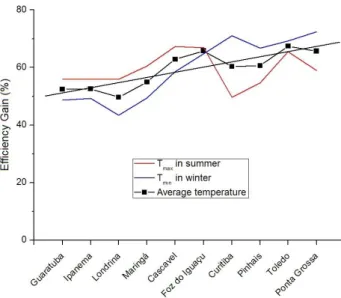
Figure 9: Efficiency gain as function of the winter outdoor temper-ature (measuring stations in descending order of winter external temperature).
The values shown in Figure 8 form a small data set to the territory of the state, but indicate that it is possible to determine average values of COP, if the measurement is ex-tended to a much larger number of stations and the tem-perature data geothermal are analyzed along with the av-erage outdoor temperature data. The calculation was not
done due to the small number of installed stations and insufficient measurement period for a thorough examina-tion. Considering, however, the significant observed effi-ciency gains, it is expected that the detailed study should corroborate the technical feasibility of geothermal heat pumps throughout the state territory.
The efficiency gains values for summer, winter and the average of both were analyzed for the different cities as function of the geothermal and outdoor temperatures, with the aim of evaluating a possible trend in the COP vari-ation. No tendency was found, except when the COP gain was ordered according to the outdoor winter temperature, as shown in Figure 9. The lower the winter outdoor temper-ature, the greater the energy is gained by the use of GHP systems, which explains the difference in the performance observed for the US [2].
Figure 10: Efficiency gain as function of ∆T = TEXT− TGEO.
Although it was observed a trend of higher gain with lower external temperatures of winter, it cannot be
estab-lished that there is a direct relationship between ∆COP and
TEXTor TGEO. However, it was found that the average effi-ciency gain varies linearly with the difference between the external temperature and geothermal (∆T = TEXT− TGEO). This behavior is seen in Figure 10.
Average values of ∆COP are important for evaluation of the system during the year. The average temperature dif-ference ∆T varied between 9 and 14 °C, corresponding to a range of average efficiency gains between 48% and 67%. Therefore, a small variation ∆T results in great variation in efficiency gains.
5 Conclusions
Geothermal temperatures of Paraná State are very simi-lar to geothermal temperatures of other temperate climate places like the state of Florida in the United States.
Geothermal temperatures in Paraná State, measured at 2 meters from the surface, showed feasibility for GHP technology with efficiency gains ranging between 20% and 45%. These values are coherent with the values of en-ergy savings reported by USDOE (25% to 50%).
In winter the gain ranging between 43% and 72% and in summer between 50% and 67%.
The purpose of the study was achieved. The evalu-ation confirmed the viability of the use of an environ-mentally friendly technology, based on natural resources (land). The insertion of GHP technology can reduce the energy matrix expansion needs in the state of Paraná in Brazil.
Acknowledgement: The authors want to thank the
com-pany Full Gauge Controls for the assignment of measuring and temperature control devices and also for the interest in the research.
Thanks also to Torno Climatizaçăo company, which provided space for the installation of sensors in Pinhais city. In particular, A. F. Santos thanks Eng. Darlo Torno for the development of soil drilling tool.
Employees of the school “Escola Técnica Profissional” for their help during the preparation of this work.
References
[1] Egg, J., Howard, B. C., Geothermal HVAC, MacGraw Hill, 2011. [2] USDOE, Geothermal Heat Pumps, 2013, http://energy.gov/
energysaver/articles/geothermal-heat-pumps
[3] EERE. Ground-Source Heat Pumps: Overview of Market Sta-tus, Barriers to Adoption, and Options for Overcoming Barri-ers, Final report of USDOE/EERE, 2009, www1.eere.energy.gov/ geothermal/pdfs/gshp_overview.pdf
[4] EERE. Geothermal Technologies Program At The U.S. De-partment of Energy, 2014 www1.eere.energy.gov/geothermal/ heatpumps.html
[5] ETP. Apostille of Refrigeration and Air Conditioning Mechanic. Advanced course. Courseware. Curitiba : Professional Technical School, 2012.
[6] Ackermann L., Six of the 10 highest temperatures in the world today have been registered in Rio, Sci-ence Globe globo.com, 3 January 2014 (in Portuguese), oglobo.globo.com/ciencia/seis-das-10-temperaturas-mais-altas-do-mundo-hoje-foram-registradas-no-rio-11205132 [7] Bitzer software, version 6.4.0, The BITZER Group, Germany,
2012, https://www.bitzer.de/websoftware/Default.aspx, accessed in October 29, 2014.
[8] Santos, A. F., Memorial of air conditioning system reform for the
Court of Justice at Foz do Iguaçu, Technical report, Curitiba:
Es-cola Técnica Profissional, 2011 (in Portuguese).
[9] Santos, A. F., Memorial of climatization Project for Krajcberg
Space in Curitiba,Technical report, Curitiba: Escola Técnica
Profissional, 2010 (in Portuguese).
[10] ABNT, Facilities of air conditioning stations for comforting –
ba-sic desing parameters, NBR 16401-1/08, 2008 (in Portuguese).
[11] Santos, A. F., Cantăo, M. P., Applicability of geothermal heat
pumps in Paraná, Revista ASBRAV, 2013, julho/agosto, 22-24
(in Portuguese).
[12] Santos, A. F., Analysis of geothermal temperatures for use in
heat pumps in Paraná, Master Science Dissertation, Mestrado
Profissional, Institutos LACTEC, Curitiba, Brasil, 2014 (in Por-tuguese).
![Figure 1: Geothermal heat pump in a closed circuit and thermal bathing ground and lake [3, 4].](https://thumb-eu.123doks.com/thumbv2/123dok_br/18041679.862206/2.892.469.814.239.534/figure-geothermal-heat-closed-circuit-thermal-bathing-ground.webp)