~.,~
·'FUNDAcAO
GETULIO VARGAS
AlBUDto: S.minário.
P."qui.a
&on6miçafi
(I'
parte)
Coordenadores: Pro! Fernando de
H.
Barbosa
e Pro! Gregório Lowe
Stulaat
Convidamos V.Sa. para participar do Seminário de Pesquisa Econ6mica
fi
(1&parte) a
lalizar-se na próxima
s'
reira:
JATA:
16I08l93
oRÁRlO: lS:3111
-ÁlCAL:
Aaü6rto Elllllllo Gadlll
6'EMA:
"INTERE.Çrs
PRlCE.~AND THE BARaV1' ..
~UMMER.~RE.WLUTlON OF THE GIBMJN
PARADOX UNDER THE GOLD STANDARD"
pelo
Dr.
~oAlltollio
CIIIIIPOSMIIrdas
-(Senado
Federal).
Rio
de
Jaoeiro.
19
de
IIOIto
de
1993 .
... 1\ ••
ilellMa
BaIhIa
e
Prot.
Gna6rio
lAw.
Stllkat
Coorc.t.aadcn • • SemiD*i0l
de PesquiasIEPGE
1
lU
'
.•
perc.nt per y.ar
~~~--~---~---~---~
Shon-T erm Rale
\
"'
...
'-'World War • Posa WorId
w ••
._----
.-'--
-----_
.._---
..-
._---Short-Term Rate
-s--18-- Rale of PflCt' Cna"!le -2i
--.... o~le V\'a' I F-OSl .... OflC • .,. ar I.
,36--' , I I i I I ! : , I : I I I I I ! , I I : ! I ! I I -18 -27 -36
perc.m per year
2i ~-18 ...J -I-2i
...,
~-36 - - ' -4~ , , I : , I i ! I i i I : , : , 11_45 E 57 '59 '61 636567 '69 7~ 73 '75,
:
892
~T
'r
JOU1lNAL O, POLITlCAL &CONOM'Y
"
10•
~--~----~----~--~--~~----~----12
t?a.
,,"
'
...
,
...
'I"
",.
Fu:. 1.·'-Thr 101 of lhe prir,· índrx (P) ôlnei IM IllnS'll"nn inl""C flUr (R), Driliah dala. Srr Apl'rnc!i& for IOUrce of dala.
consiu"f"S tht' majnr chnn!tt" in social, political, nnd cconomic structure which took place over this pericx.i.' Kcynes calleei this correlation "one oí the most completely established empirical facts in the whole field oí q uantitative economia" (1930, 2: 198).
Over the shorter time period íor which good British data on short-term
interest rates are available, there is a1so a substantial but leu pronounced
positive correlation between short-term interest rates and prices. The short-term interest rate I is ploneei in figure 2, with the same price serles
p, The correlatinn is not only lesa pronounceei than that in figure I; Z i,c
I Thr Ciibv>n Parado& apprare in dôlla from Olhei' eoun&riet u 'weU. Fale (1972)
conc\uürd 1h.'\llh .. pôlraeio& holds in IM DuICh reonomy. The paraciox alio appeare over Ih ... h"rll"r limc' pt'riod for ",'hich dala are available in lhe Unilrd Stales and Canacia. For IM U.S. d:lla. lhe relalion belween a Iont-lerm bond yielcl series and prices ia apin
a Inn~.ic·"n OllC', and shorl .. r·nlll movrnwnll in lhe ~rit'l Ihow liule relationthip. One mal' 1101, of e .. unr, r('lard 1111' C'llpt'riencf' 01' thae Olher countries u indepenclent obo ... "'alinm •• illl''' Ihrir inl"rrsl raln aliei pricn arl" rl"lalf'd Ihmufh financiai markeu. 'rhC'n' I', hOlOo,,'\'('r, ",I_lanlial varialion betM'ell U.S. and BriciIb price seria and
U.s.
and 8rilish huml yirlel lime ...nn.n.r
data Ihow thal U.s. federal pwmmrnt bond yiclds wc'rI" dram:uleaUy above lhe Briliah CCIIIICII yieIda durine lhe War 011812 and lheCivil War. ancl Ih ... prriocia corrl"lpiwlàtd 10 prrioda of \'t'ry hil" pricn in lhe United
Slah-s n'hui\'t' In ürilaln. ~&prrirncn n f _ otherCOUftlriee, bowever, .... ' becCICIItNed
I
as discoflflnnillC Ih .. Giblon Paradall. Fnr illllance. lhe rrice In'l"l in 'rance rwe eiurin, Ihr S,'rnncl W,'rld "'ólr In a plalrau which wu. in lhe 19so.. 2/cOO JIC'fCl'nl hictwr lhan
111 1'1,17, IlIu'ro"1 raln clid 1101 ri .. 10 a l _ hithn ,Jlalf'AU. WeC'oukllind .imilarCOUllln-rlCamplc, ill IIIl' c'&IJel'itonce
ar
cenain 1.aIia American coun&ries widl ciramaúc:all,ull5lahl,. priec' 1('\'0·1a.
J Tlu' curro'lali.,n 1IC'1wn-1I lhe R anel P ciata in rapn: I ia .74', while lhaa bclweea R and AP (lhf' ralr nf inftaaian) ia .045. The canelaaian betWft'ft land P in ficure 2 ia .421,
bctwt'f'n I alMI AP i. -.01.
,.,..
...
_-
.-'.~-.
i, '. : i , 't'" ' I , ,.'
,.
..
".
.
" I ",..,
. .
J' .::1:\2 4.5 4.0 3,5 3,0 2.5 ,I I I,
,I ,I l I I,jOllRNAL Of l'UU;'ICI\I. ECONOI:\"
World PrtCe - - - Consol Yield
,
2.0!
...
.G._.
1820 1840 1860 18'80 ,1900 O"FIG, 1.-The world price levei alld lhe consol yield
an R2 of aboUI 07) \\tould propcrly lead to rejection aI lhe 5-10
per-cem leveI. We take this as our criterion for significance of the
regres-sions in leveis. \
Table 1 prcscnts Gib!:on regrcssions, in both leveis and firsl diffcr-ences, for various subperiods /)f 1730-1938 (lable 2 reporlS analo-gous regressions using lhe Brilish open markel rale of discounl, a
shorl-lerm rale given b mer (1977». The rcsults juslify several
~I
importanl conclusio . Firs Gjbson's paradox is nol an example ofl'L_ I . s ressio eno non aI leasl nOI during lhe dassical ~
gold slandard years 1821-1913. The regressions in lable I using lhe consol yield in diffcrences are signi6canl aI lhe 1 percent 1··\·01 for
lhe period as a whole and aI leasl aI lhe 5 perccnl levei I 'Clth
ofthe subperiods 1821-71 and 1872-1913. The regressions in leveis
REt;Rt"~S'ON OF
(l:ei"t'rS ana Flr51 O.IIt"rences) Codficienls frice LevelslFirsl 01'
Sample I'eriod Series Differellces Consnl Yield
1730-96 8rilish l.cvels .15
(.02) Firsl differences -.02 (.02)
British leveis -.OR
(.05) Finl dilferellccs -.05 (.04) Wnrld Leveis .40 (.03) Fim differellces .15 (.04) Brilish l.evels .38 (.03) Finl diffcrences .16 (.05) 1821-71 World leveis .17 (.05) Firsl differences .14 (.06) 8rilish Leveis .16
@
(.06) Fim differellces .14 (.06) World leveis .43 (.04) Fim differences .21 (.OB) Brilish leveis .41 (.05) Firsl differences .24 [~8!2-193B. 8ritish Levc;1s (.09) .36 / (.02) FirSl differences .24 . ( 1921-38=:J (.05) 8rilish leveis .31 (.06) Firsl differellces .16 (.09) • Th~ world In' ·'lu·~t:ovenonl,.1821-19J' .#'~: f DUll>in· \ValSon SliIlislic jjl .44 .43 1.88 .01 .12 .11 ir . I.fi8
~OI;
.47G
1.73 .11 44 .65 ~ 171 .10 r.: .61 .114~,
1.72 .10 .52 .11.
~ 1.77 .OS .32,,~
179 .11 ,28 ,fi7 1.50 .14 .40 .78 \.57 .24 .62 .58 . \.97 .09INTERESTS, PRICES ANO THE BARSKY ANO SUMMERS RESOLUTION OF THE GIBSON PARAOOX UNDER THE GOLO STANDARO SVSTEM
MARCO ANTONIO CAMPOS MARTINS
Abstract
This paper presents a structural monetary úamework featunng a demand function for non-monetary uses of gold, such as the one drawn by Barsky and Summers in their 1988 analy8ÚI of the Gibson Paradox as a natural concomitant of the gold standard period. That structural model predicts that the laws of behavior of nominal prices and interest rates are functions of the rules set by the government to command the money supply. !ta fiduciary vemon obtaina Fisherian relationships &8
particular cases. !ta gold atandard 801ution yields a modelsimilar to the Barsky and Summers model, in which interest rates are exogeneous and subject to shocb. This paper integrates governnment bonds into the analysis, treats interest rates endogenously, and ahifts the responsibility for the shocb to the government budgetary financing policies. The Gibson paradox appears as "practically" the only cl&18 of behavioral pattern open for interest rates and price movements under apure gold standard economy. Fisherian-like relationshipe are utterly ruled out.
Introduction
Fisherian economics leads us to exped a strong empirical correlation between changes in the rate oí change in nominal prices and changes in the levei oí nominal rates oí interest. Yet, the acute conclusion drawn by Dwyer (1979), from his dodoral di88ertation, as quoted by Friedman and Schwartz (1982, p. 537), seems to summarize everything we know about actual empirical find-ings and cast a great deal oí doubt on the Fiaherian p08tulate: ''There is no stable relationship between interest rates and prices". The' author is clearly reíering himself to empinc4l, not to tAeoretic41, relationship. In that regard,
the mún purpoee oí thia paper ia to argue that a better understanding oí in-terest rates and nominal prices empirical behavior requires the abandonment
of Irving Fiaher (1930) theory oí interest lU an untouchable scientific axiom,
valid for any imaginable economic circumstances. Aware we are, that this ia euy to say, but diflicult to demonstrate. Aíter aU, the Fisherian proposi-tion comes up toa naturally írom monetary modela that determine the real
interest rate in the real side of the economy, treat government bonds as if they were off-set by future tax liabilities, and concludes that money is a veH, an extremely appealing intelectual idea, when one is dealing with fiduciary monetary systems.
The gold standard years 1821-1913, however, were neither fiduciary, nor displayed even a hint of the type of correlation predicted by Fisherian anal-ysis. They were obsessiveIy Gibsonian and exhibited the striking positive correlation between interest rates and prices called by Keynes (1930, 2: 198) "one of the most completely established empirical facta in the whole field of quantitative economics". Moreover, the work done by Klein (1975), and
promptly confirmed by Shiller and Siegel (1977, p. 894-5), seems to warn us
that the major change in the pattern of behavior of interests and prices, oc-curred since World War 11, may have everything to do with the fundamental change in the character of the world monetary system, that took place coin-cidently. Ought the Fisherian theory of the nominal rate of interest, clearly inspired by the working of a fiduciary economy, be outright applied to the goId standard system too? Couldn't it be better to view the c~movements of interests and prices within the goId standard years as a function of the standard itseIf, being the Gibson paradox just a natural implication of the working of a system which has its own particular versions of a more general economic laws?
This is exactly the direction pointed to by Barsky and Summers (1988) in order to rationalize the occurrence of the Gibso paradox in the gold standard years. By noting the historical coincidence of these two events they focused their analysis in the key elements of the standard itseIf and drew an extremeIy simpIe and sharp model in which the paradox appeara not as such one, but as a natural consequence of the working of a gold standard economy. Pegging of the nominal price of gold, maintenance of full convertibility between gold and dollara at this fuced ratio and distinction between monetary and non-monetary uses of gold, are the only crucial features of their expIanation of the phenomenom. That is,it is the standard itself, the prevailing rules of the monetary game, that implies the factually observed relationship between pric:e8 and interest rates in that period. Their solution of the paradox is basically the following: an external shock that pushes (pulls) the exogeneous interest rate upward (downward) increases (decreases) the costs of holding gold for non-monetary uses and the economic agents go to the banks in order
to exchange gold for paper money at that given fuced ratio. The resulting
increase (decrease) in the quantities supplied of money pushes (pull) the levei of nominal prices upward (downward), and the presumed paradoxical
co-movements between these two variables shows itself up quite naturally. Although they treat interest rates exogeneously, they do show how the positive correlation between them and nominal prices can arise. The message is clear: the structure of the economy and the rules of the monetary game are the dominant elements in the determination of these key economic variables.
If we do. not look at these elements, paradoxes will continue to hold. In their set up, there is no place for Fisherian relationships, they are literally undone. By the way, their model is not a Fisherian one, however, so inspired. Their analysis was carried out by assuming stationary equilibrium conditions. Consequently, they just by-passed the theoretical problems which would come up, had they focused on steady state inftationary equilibria and on the notion that a Fisherian inftation premium should be paid to interest-bearing wealth holdings.
This paper attempts to explore Barsky and Summers'message a little bit further. It argues that their message basicaUy applies to any economic circumstances and that it will continue to be hard to fuU understand what is going on with interests, prices and other key variables ifwe do not model these circumstances explicitly. We feel that quite general econpmic laws undedy the functioning of market economi~ everywhere, and that the speciallaws that come empirically about, such as the Gibson paradox and the correlations between leveIs of nominal interest rates and rates of inftation, are the result of the special rules imposed by government upon economic agents, at each point in time. Within this conception, we should never expect the predominance of the Fisherian relationship, for any prevailing monetary rules. Anything can happen, only the structure and the rules bounding the outcomes.
We shall try to convince you of that by drawing a very simple model which is nevertheless comprehensive enough to accept both gold standard and fidu-ciary monetary rules. This model directly springs from our own original analysis of interesta and prices (Martins, 1979 and 1980) based upon the three periods version of Samuelson's pure consumption loan model (Samuel-son, 1958) and incorporates a demand for non-monetary uses of gold, as in Barsky and Summers (1988). Besides, it integrates government bonds into the analyais, treata interest rates endogeneously and shifta the responsabilities of the shocb conceiv~ by Barsky and Summers to the govemment budgetary financing policies. In this model, special monetary rules will imply special lawa of behavior of interesta and prices, the structure being kept constant. Both Fisherian-like and Gibsonian-like behaviors will come up quite natu-rall" as in their analysia. Moreover, it is predicted that the Gibson paradox is "practically" the only class of behavioral pattern open for interest rates
and price movements under the pure gold standard economy.
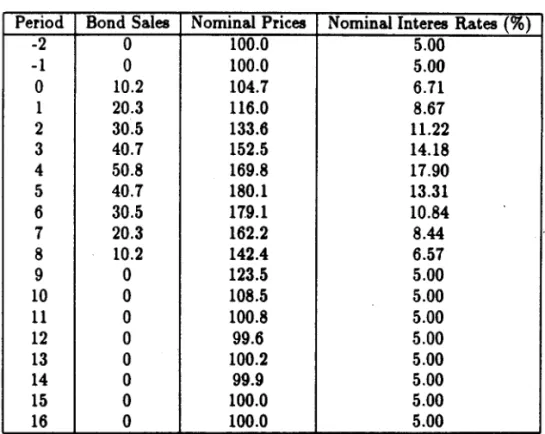
In the next section we present a number oí the prominent empirical ev-idences bearing on the behaviors oí interests and prices from 1730 to our days. The emphasis will be put on the ones that stress the dependence oí these behaviors on the change oí the character of the world mooetary sys-tem .that took place during World War 11. In the third section we highlight the pioneering theoretical contribution oí Barsky and Summers. The íourth section is devoted to the presentation oí our own simple structural monetary framework of analysis. Is is specialized for a fiduciary standard economy in the fifth section, and for a gold standard in the next one. Here, a simmulation of Gibson paradox is presented.
Empirical Evidence
We present below some crucial empirical evidences on the relationship be-tween nominal prices and interest rates, ·ones which also have a great deal to do with our own line oí reasoning. We shall quote extensively the authQrs themselves, as there is no attempt to improve on their words:
(1) Current monetary theory predicts a dose relationship between changes in the rate oí change in nominal prices and changes in the leveI oí nominal interest rates. To mention only a few, amongmany others, works done by Sargent (1973), Shiller and Siegel (1977), Friedman and Schwartz (1982) and, Barsky and Summers (1988) strongly support, however, the view·that there is no stable empirictJ/relationship between interest rates and prices. Together, their researches cover data spanning írom 1730 to 1975!
(2) "For the past quarter oímilleniumíor which British data are available, there is a strong p08itive correlation between the price leveI as measured by a (log) price index, and the long-term interest rate, as measured by the yield to maturity of long term bonds. This phenomenum is named by Keynes
(1930) the "Gibson Paradox", after A. H. Gibson (1923), the man Keynes
thought had discovered the relationship ... The simmilarity of the two series is m08t impreuive specially when one considers the major changes in social, political, and economic structure which took place over this period". Shiller and Siegel (op. cit., pp. 891-2). The "relations are essentially unlagged" (idem, p. 894).
(3) Moreover, and first of alI, "Gibson's paradox is not an example of the
SpuriOU8 regreuion phenomenom, at least during the dassical gold standard
yean 1821-1913 ... Second [it] is by no means a wartime phenomenom. Not only is the relationship significant and stable during the peace time, gold
standard years from the 1821 ressumption of the gold standard in Britain to the eve of the World War I, but it completely breaks down during the Napoleonic war period of 1790-1820, when the gold standard was abandoned. Over this period, the correlation was negative ... Finally, the evidence of the Gibson correlation is weaker for the pre-Napoleonic period 1730-96 and the inter.war years 1921-38 than for the classical gold standard period ... Although Britain was effectively on a gold standard beetween 1730 and 1796, most of the rest of the world was noto Likewise, the past 1921 gold standard was closely 'managed' by central banks and encumbered by formal and informal restrictions limiting convertibility". Barsky and Summers (1988, pp. 533-5). (4) Furthermore, a dramatic change in the character of the behavior of prices occurred after the end of the gold standard. This was originally found by Klein (1975) and confirmed by Shiller and SiegeI (1977) for 60th prices
and interest rates: "Since [bel found changes in the behavior of prices after the gold standard, we tried dividing the sample period rather arbitrarily at 1913. As a first approximation, it is useful to regard both of these series 'as random walks for the period up through 1913, and as a positively serially correlated ... integrated moving average process for 1914-74. Thus, as Klein emphasized, our impression that inflation is forecastable, is valid for the present time, but not for most of the period covered by our data" (op. cit., pp. 894-5). Moreover, "Based on the stochastic properties ofthe price levei alone, before 1914 investors should have projected a near zero rate ofinflation consistently, since the price levei displayed little upon which to project future rates of inflation" (op. cit., p. 899).
(5) Klein (1975) receives the same strong support from Friedman and Schwartz (1982): "[bel argues that there has been fundamental change in the character of the monetary system since World War 11, that before World War 11, and to a lesser extent to the end of the World War 11, the United States and the United Kingdom were regarded as being on species standard which limited the price leveI. Prices might rise or falI over short perioda, but the price levei was widely expected to revert to a roughly constant levei, and it did". After World War 11 the monetary system becomes strictly fiduciary and "Cunent rates of price changes contain iníormation about íuture rates oí price changes ... and interest rates now respond to recent rates of price change as they did not do before" (op. cit., pp. 569-70). "By the mid or late 1950's the participanta in the market ... came to regard the price leveI... as largelly affected by government authorities, and they saw the species standard as a relic. The final explicit step did not occur until the formal severing of the United States link with gold in 1971 and the explicit adoption of a floating
exchange rate system in 1973 and thereafter". "The net result has apparently been to replace the long-term Gibson-phenomenom with the short-term direct Fisher relationship between nominahates ofprice change" (op. cit., pp. 571-2).
(6) So, "a dramatic shift in the relation between interest rates and prices occurred in the late 60's". Friedman and Schwartz (1976, p. 289), and as "becomes specially clear after 1965, the interest rate follows the rate of inflation rather than the price leveI. The complete dissapereance of Gibson's paradox by the early 1970's coincides with the final break with gold at that time". 8arsky and Summers (op. cit., p. 535). And, "there is little evidence of a rational Fisherian premium in nominal interest rates prior to 1914" (idem, p. 537, footnote 7).
(7) That is, the available empirical evidence inexorably point to the con-clusion that "Gibson's paradox is largely, or perhaps solely, a gold standard phenomenom". 8arsky and Summers 1988 (p. 535). Or, as emphasized by Friedman and Schwartz (1982, p. 586) earlier, "For the period our date cover, it [the paradox] holds clearly and unambigously for the United States and the United Kingdom only for the period from 1880 to 1914, and lesa clearly for the interwar period" .
(8) To summarize, empirical finding lead to the conclusion that (i) "There
is a Gibson-paradox that is more than a spurius correlation between two
ran-dom walks", (ii) "Far from being primarily a wartime phenomenom, Gibson's
paradox characterizes the gold standard years 1821-1913, and those years represent the only long period over which the correlation held continuously.
Gibson's paradox had clearly vaniahed by the 1970's", (iii) "The paradox
appears to involve the real rate [of interest]". 8arsky and Summers (1988, p.
538-9). Finally, (iv) "the dominant proximate determinant of the movement
of prices and money during the period was variation in the stock oí monetary gold" (idem, p. 529) and "there ia literary evidence suggesting that the de-mand for non-monetary gold was an important determinant oí the monetary gold stock" (idem, p. 547).
To conclude, the impressive empirical evidenceS presented above strongly suggest too, that íactual relationships between nominal prices and interest rates are crucially dependent on rules imposed by government upon the op-eratinc monetary systems. That ia, that a better understanding oí both Gib-sonian and Fiaherian, and other interest-price phenomena, requires a prior specification of these rules. From 1730 to 1913 the world economy operated
mainl, according to gold standard rules, and írom 1821 to 1913 it indeed rested on a quite pure gold standard system. Thereafter the fiduciary system
carne gradually into operation, until "the formal severing of the U nited States link with gold in 1971 and the explicit adoption of a floating exchange rate system in 1973" launched the world economy into apure operating fiduciary system. AU these evidences together are highly suggestive that the dramatic change in the character of the behavior of prices occurred after the end of
the gold standard has everythíng to do with the fundamental change in the
character of the monetary system, as pointed out by the work done by Klein (1975). One of the m08t important purposes of this paper is to argue that by bringing these two sharply distinct monetary systems explicitly into the analysis we can do nothing but fuUy agree with him.
The Barsky and Summers Model of the Gibson Paradox
Robert B. Barsky and Lawrence H. Summers 1988 model of the Gibson para-dox departs from three crucial factual observatioos and one key "theoretical assumption (see op. cit., p. 529 and 539-540) j (1) there ia a striking coinci-dence between the gold standard period and the occurrence of the paradoxj (2) during that period goId couId be alternativeIy used as monetary as weU as non-monetary (jewelry, objecta of art, etc) assetsj (3) during that period both nominal prices and the stock af (paper) money tended to be p08itively correIated to the stock ofmonetary goIdj and (4) non-monetary gold ia an as-set that provides flowa of services over time and as such its demand should be sensitive not only to its own price but it also shouId be negatively correIated to interest rates. That ia, they start from the observation that the goId stan-dard system has crucial diatinctive characteriatics and mo deI them to obtain the paradox as an in/aerent feature of the system's working -"as a natural concomitant of a monetary standard based on durabIe commodity" , as they put it - , not as something alien to the working of a quite weU functioning economy. To do the job they define goId standard "as the maintenance of fuH convertibility between goId and dolIara at a fixed ratio. The goId backing of the money stock need not to be one for one... and, for simplicity there are no goId coios" (op. cit., p. 539), and sharpIy devise a simpIe modeI with four buic equatioD8, which we represent in the folIowing way:
M
li"
=
Ver) ,Vi
<
O pg"
=
g( -) , gl>
O r (A) (B)I M
=
JJgm ,
JJ>
o
gm +gn
=
g
(C) (D)
in which M is the nominal quantity of dollara outstanding; P the price levei;
V(r). the real quantity demanded for money as a decreasing function of the interest rate
r;
gn
the stock of non-monetary gold;gm
the stock of monetary goid (monetary reserves);g
the given total stock of gold; and JJ a fixed parameter that represents the degree of "backing" of the dollara in circulation. (A) to (D) represent a stationary gold standard economy. Expression (A) is a conventional demand for real balances; it is a downward sloped function of the interest rate r, which is itself the alternative rate of return earned onphysical capital and bonds. Expression (D) is the demand for non-monetary gold, an upward function of the price leveI P, and a downward sloped one with respect to r. The supply of dollara, (C), states that issuances of M
must be backed by bank's (or government) accumulations of monetary gold reserves. Finally, the balance equation (D) is self-evident.
The aim of the model is to simmulate co-movements of prices P and interest rates r as a natural concomitant of the gold standard system. The above representation is somewhat different from the author's (cf. op. cit., pp. 539-541) but reftects, we believe, the essence of theira. Moreover, we
have already started with a description of a stable stationary equilibrium and preferred to focus the analysis directly on the price leveI P rather than on the price of gold.
The demand equation (B) is the theoretical core of the model. It views non-monetary gold as an asset and as such, as providing ftows of services over time. The present value of these ftows of services must then be equilibrated, at the margin, to the user's cost. In stationary equilibrium this C08t is readily reckoned as the product of the ongoing (long run) interest rate r times the price of gold. Assuming decreasing marginal returns of non-monetary gold obtains the quantity demanded for this asset as a decreasing function of the gold price as well as of the interat rate r. However, the key characteristic of the gold standard is that the nominal price of gold is pegged at a fixed ratio and thia would imply that the "Determination of the general price leveI
[P]
then amounta to .the microeconomic problem of determining the relative price of gold" (op. cit, p.529). That ia, in the model (A) to (D), variable Pstands for both the general price leveI and the reciprocal of the gold price, the latter having been taken as unity for convenience. Therefore, the demand for non-monetary gold can also be represented as an upward function of P,
i as in (B).
In model (A) to (D) the interest rate ris exogeneous to the economy but subject to productivity or thrift shocks (op. cit., pp. 530-539 and 546). To
solve it for the general price levei P, and for the distinction oí
g
betweenmonetary use,
gm,
and non-monetary use,g,.,
is straightforward. We justinsert (C) into (D) to obtain the balance equation in terms of 1',
g,.
andg
-the two uses of gold will be negatively related to each o-ther. Then plug this
result into (A) to express P in terms of
g,..
Collapse it and (B) to obtain:JJg - JJg,.
g,.
=
f( r.V(r) ),ft
>
O (E)The left-hand side of (E) is a one-to-one increasing function of
g,..
Theright-hand side is a decreasing function of the same
g,.j
for simplicity it isassumed that for
g,.
=
O, it crosses the ver.tical coordinate atg,.
=
g.
The twofunctions intercept each other at a positive
g,.
stock of non-monetary gold andso, for a given leveI of the interest rate r, the model determines
g,.
through(E) and M and
gm
through (C) and (D). Plugging this equilibrium value ofMinto (A) we obtain the price leveI P. To analyse the occurrence ofinterest
rates and price co-movements within this framework we now remember that
the demand for non-monetary gold is afunction ofthe product r.V(r),
Vi
<
o.
Ifwhen r increases Ver) decreases'more than proportionally, the equilibrium stock of non-monetary gold would rise.
So, what happens to
g,.
when r changes depends on considerationsre-garding the empirical elasticities of the real demand for money, Ver), with respect to interest rates. "Available empirical estimates suggest that this elasticity is much smaller than unity [in absolute value] (see Friedman and Schwartz 1982) "(op. cit., p.542).
With unitary or less than unitary (in absolute value) elasticities of Ver)
with respect to r, the predictionsof the model are clear cut and the Gibson
paradox showl itself up as a trulIy natural concomitant of the gold standard system. For instance, an exogeneous falI in thrift that pushes interest rates up would diminish the equilibrium quantity of non-monetary gold people
ia willing to hold. The gold handed to the bano would be exchanged for
paper money at the accorded fixed ratio, and this would entail an increase in the quantity of circulating dolIara. The general price levei in (A) would
then rise on two accounts: the increased money supply and the fallen
de-sired real balances. The same reasoning holds true for an exogeneous rise in
I
of 8uch shock8, we would concomitantly obtain a Gibson paradox picture of
the economic life under gold standard. .
Barsky and 5ummers made it clear that they folIowed the classical treat-ment of the gold standard by Friedman (1953) and used.a framewbrk which is very close to that of Barro (1979), both of which highlighted the infiuence of non-monetary uses of gold in the determination of nominal price leveIs. They also do stress, as a commanding contribution, there own emphasis "on the crucial distinction between monetary and non-monetary gold and on the service flows from non-monetary gold" (op. cit., p. 540) so that their model "involves substitution between monetary and non-monetary gold as a promi-nent future" (op.cit., p. 546). Their analysis ia sharp. It has a minimum of theoretical parameters, neatly explores crucial implications of the two key rules of the gold standard game and makes one feel that, after alI, the Gibson paradox is not the result of a devilish amount of lags blurring people's ability to anticipate correctly what is going on in their lives.
The merits of their model of the Gibson paradox are too obvious. Nev-ertheless, we dare saying that we shalI attempt to improve at least a little bit on it, in the next sections. We shalI retain the core of their analysis, in particular the emphasis pointed toward "the rules of the game". 50, our own working mechanism will oft'er no novelty. But t.he reader must have no-ticed the almost obsessive number of times we underlined the word thrift in this section. WelI, if the demand for government bonda was also downward sloped with respect to interest rates, as welI as the demand for non-monetary gold was assumed to be, increases in its supply would crowd out private sav-ings, and this could perfectly appear as a falI in thrift, in a model that does not incorporate them. And that ia exactly what we are going to do nextly: to defend the explicit incorporation of government bonda into the analysis. With this additional variable we shall be able to analyse the interest rates endogeneously and shift the responsibility of the shocks it receives to the gov-ernment itself. By so doing we hope to oft'er a possible explanation for the only puzzle that really bothered Barsky and 5ummers along their analysis: during the years 1896-1913 gold diacoveries accounted for a large fraction of the accompanying increase in the price leveI. According to their model, inter-est rates should not have been aft'ected; but they also went up. The solution to this puzzle, while retaining the thrust of their analysia ia, we guess, heavy govemment indebtment along the same period.
•
The Theoretical Framework
This section presents a simple structural monetary model comprehensive enough to accomodate quite distinct sets of monetary rules, to wbich the behavior of key variables such as interests and prices must adapto It sbaU be specialized for a fiduciary system and for apure gold standard economy in the next two sections. Tbis mo dei springs directly from our own original analysis of interests and prices (Martins 1975 and 1980). The crucial novelty is the incorporation of a demand function for non-monetary uses of gold, as proposed by Friedman (1953), Barro (1979) and Basky and Summers (1988). Unlike their models, however, ours higbligbts tbe role of government bonds in the determination of the equilibrium leveIs of interests and prices by in-corporating the fuU government budget constraint into tbe analysis, rather than assuming tbat tbese bonds are crossed out by tbe discounting of future tax liabilities.
The model is as folIows: generations overlap. An individual life only covers tbree periods. At each point in time t, exaetly one member of each generation is alive simultaneously. Let C.(j) stand for his j-tla period of life consumption and K n. for the quantity of pbysical gold be carries over bis tife time for non-monetary uses (jewelry, objects of art, etc.). To simplify, tbe flow of services provided by this hoarding vanishes if be seUs the gold before the end oí his liíe. Each individual is endowed with Q. units oí tbe non-storable consumption good in the first period of his life, nothing aíterwards. So, he must aecumulate securities at least to provide for consumption needs during tbe seeond period of bis tiíe. A "representative" member oí tbe t-tla
generation is assumed to value his consumption plan and bis non-monetary gold boldings aecording to the value oí a "regularly sbaped" utility function
U.[C.(t), C.(t
+
1), C.(t+
2), Kn.], oí non-negative consumptions C.(j) andgold holdings K n.. Tbat is, tbia utility indieator ia a twiee differentiable, strictly monotonic increasing íunction, and the marginal utility of consump-tion in any period, and oí tbe gold boarding, go to infinity as tbeir leveis go to zero. Tbia lut condition guarantees that, ií ineome ia positive, eonsumption and gold boardingl are positive in any period·. Aiming to simmulations, we shallapecialize thia utility indicator.
The demand side of the model ean tben be represented by the following problem: tbe representative member oí generation t maximizes
U,
=
logC,(t)+
logC.(t+
1)+
logC.(t+
2)+
{Jlog Kn.c--~~-~---~---~~--~---Bt PtCt(t)
+
Mt(t+
1)+
-1 - .+
PgtKnt=
P,Qt+
Gt -Ti
+
Pgt(Kt - Kt-d+
It ( la) PtHCt(t+
1)+
Mt(t+
2)=
Mt(t+
1) (lb) ( 1e)where Ct(t), Ct(t
+
1) and Ct(t+
2) stand for his eonsumption leveis duringperiods t, t
+
1 and t+
2 respeetively; Kn, is the physieal amount ofnon-monetary gold he holds during his life time, so {J
>
O; M,(t+ 1) and M,(t+2)are the nominal quantities of money earried under the physieal form of paper
claims over periods t
+
1 and t+
2; B, is the nominal value of two-periodsgovernment bonds bought at the beginning of t; P" P'H and P'H are the
nominal priees of the eonsumption good, Pg, and Pgt+2 are t4e nominal
priees of gold and i, is the two periods nominal rate of return of this mo deI
eeonomy. At the beginning of period t this individual is endowed with
Q,
units ofnon-storable eonsumption good, and with K, -K'-l physieal units of
indestruetible gold, where K, is the totalstock of gold ready to be used at that
same instant. Besides, he anticipates G, - T, nominal units of net government
transfer payments, where G, represents expenditures and
Ti
taxes. To solvehis problem the individual t takes P, , P'+1 , P'H , Pg, , Pg'H , it ,
Q, ,
K, , Kt-l , G, and
Ti
as given and chooses M,(t+
1) , M,(t+
2) , Bt andKn, .
With the above "regularly shaped" utility functions, C,(t
+
1)>
O; thenM,(t
+
1)>
O. Now only eonsider the class of solutions for whieh i,>
O;then M,(t
+
2)=
O and the term t+
1 can be dropped from the notation ofM,(t
+
1) . For B,>
O, the marginal first order conditions are:PtH C,(t
+
1)=
P, C,(t) (2a) P'H Ct(t+
2)=
p,
C (t+
1) 1+
i, '+1 , (2b) (2c) Bt P, Ct(t) +Mt+
-1 - . +Pg, Knt=
Pt Q, +Gt -T, +Pgt (K, - K'-l )+
I, (2d)(2e) (2f) Collapsing (2b), (2e) and (2f) yields expression (5) below, which is valid for all t. Hence, it reminds us that Pgt had already been determined at the
start of t - 2. Insert (5) into (2c) and obtain (4), a truly striking expression. It represents the joint demand function for non-monetary gold and govern-ment bonds and it assures us both that: (a) asset prices ofsuch an economy are constrained by the "liquidity value" Mt ; (b) government cannot create wealth out of the air. For a given value of Mt the greater the present-value of bonds the smaller the value of non-monetary gold holdings at t and vice-versa. Now collapse (2a) and (2e) to find Pt Ct(t)
=
Mt. Plug both thislatter result and expression (4) below into (2d) to obtain (3), a simplified and interest inelastic demand for money. This leaves the demand side of the model prepared for further analysis.
(3 + f3)Mt
=
Pt Qt + Gt -1; + Pgt (Kt - Kt-l ) (3) Bt Pgt Knt+
-1-.=
(1+
f3)Mt (4)+
It Pgt+2 Knt+
Bt=
(1+
it)Mt (5) Bt Bt-2 + Pgt (Kmt - Kmt_l ) + Gt=
Mt - Mt-l + -1-. + 1; (6)+
IfThe supply side of the model is straightforward. The issuance of gov-ernment securities is restricted by the behavior of its budget constraint over time, described by (6) above. At the beginning of t the government retires
Bt-2 unita of bonda issued at t - 2, tr&nsÍers Gt unita of income to gener-ation t and accumulates Pgt (Kmt - Kmt-t ) unita of gold, alI in nominal terma, being Kmt it:s physical quantity of gold holdings at that same instant. The revenue due to fin~ce these expeditures comprises the issuance of Mt
-Mt-t unita of money, the sale of Bt nominal unita of bonda at the unitary
price of 1/(1+it) and the collection of1; nominal unita oftaxes from genera-tion
t,
as shown in the right hand side of (6). This completes the government budget constraint and 80 the joint supply function of its securities.At the beginning of t there are Knf_l , Knt and Kmt physical units of
gold in the hands of generation t - 1, generation t and government,
respec-tively. For the sake of simplicity, there are no monetary gold coins. Hence
those three uses must add up to Kt , the total stock of gold, as in' definition
(7). Clearly, it is assumed that Knf can be converted in to Kmfand
vice-versa; at no cost. To complete the supply side of the basic mo dei described by equations (3) to (7) it is enough for our purposes to assume that both
Qf
and Kf - Kt-l spring costlessly in this economy.A few comments are in order before going on to the next section. First of alI the most important characteristic of the above model is the complete abandonment of Irving Fisher's theory of the nominal rate of interest as an irreducible axiom, valid in any situation. Here there are no privileges: nomi-nal interest rates depend upon the structure of the economy and particularly upon the monetary and fiscal rules imposed by the government and its be-havior must be deduced from them according to the same principIes used to derive any other nominal prices entering the model. An outside imposition of a Fisherian-like relationship upon the above extremely basic and simple set of equations would amount to the imposition of a theoretically unwelcomed add-hoc restriction. Second, the economic agente of such an economy only
need information about nominal specific prices to undertake consumption and
investment decisions. That is, they look directly at Pt , Pf+l , P'+2 , Pg, ,
Pg'+l , Pgt+2 , i" etc and do not even attempt to figure out what "real" prices of consumption goods, of gold and of government bonds, and what "real" interest rates, look like. By the same token, they are not concerned with any notion of "general price leveI" and in view of the great number of current and future prices they face they would find quite difficult to meaning-fully define such a "general" concept. Third, they always take into account the path of the complete government budget constraint over time and do not accept the elimination of government bonds out of their own budget con-straints on grounds that their nominal or "real" values are somewhat off-set by anticipations of future tu liabilities presumably associated to them. On the contrary, they demand bonds, according to the same behavioral rules they set to demand any other existing economic asset. Fourth, the above structure haa been submitted only to a minimum of unexplained parameters and restrictions. For instance, it does not feature an independent liquidity preference function which by itself would require the introduction of addi-tional concepts such as "general price level"and "real" interest rates and
would lead. to the notion that monetary and fiscal policies are to be viewed
The most important parameter of the model is the assumption of perfect foresight which does not lead to immutable laws linking rates of change in' consumption good prices to the leveIs of interest rates. Fifth, despite its underlying simplicity, this paper claims that the structure represented by the set of equations (3) to (7) is comprehensive enough to simmulating, un-der precisely controlled circumstances, important empirical evidences such as the Gibson-paradox. Sixth, this paper is also motivated by the same very basic and simple question we tried to face in 1980 and 1988: "What does the relationship between nominal prices and nominal interest rates should look like if instead of crossing bonds out of investor's budget constraints and imposing Fisher's interest theory on virtually any type of macro- economic structures we just bring these bonda to the center of the stage and let these rates be influenced by the structures themselves and by government rules?" In other words, although we have been stressing that the theory in this paper is capable of simmulating both Fisherian and Gibsonian phenomena from a minimum of hypothesis, these implications have in no way been forced upOn the modelj no attempt was made to design a kind of "general" equation to fit these two phenomena. These possibilities just came up naturally from the analysis. If We do believe in "economic laws" then they should be invariant with respect to particular institutional arrangements imposed by government upon economic agents. That is, a basic macroeconomic structure valid for a certain monetary regime (e.g., the gold standard), should also be valid for another one (e.g., the gold standard), the dift'erences in behavior of key variables such as prices and interests being fully explained by dift'erences in these arrangements, not by dift'erences in the structure. Seventh, this paper is strongly motivated by the sharp theoretical experience performed by Barsky and Summers in 1988. In addition to the above question we also ask here "Can our simple 1980 model be adapted to the gold standard regime and still replicate their experience?" The answer is yes. In addition the analysis suggests that the Gib80n-paradox is "practically" the only type of behavioral pattern theoretically open for consumption good prices and interest rates movements under apure gold standardj Fisherian-like relationships are just ruled out.
In the next eection we solve the model for a fiduciary economy, show that it can simmulate central prop08itions of monetary theory and discuss the conditiona under which co-movements of nominal conaumption good prices and nominal interest rates may come about.
•
A Fiduciary Economy
Analysis oí the nominal prices and interests entering a monetary íramework such as the one represented by exprelisions (3) to (7) involves the preliminary choice oí a set oí government rules "to command the supply oí money. This point has been outright emphasized by Barro (1979, p. 13) in connection with his own gold standard model. A variety oí monetary regimes can be imposed upon that íramework. This paper, however, is only concerned with apure fiduciary system and apure gold standard economy. This section deals with the first. In particular, it attempts to show that model (3) to (7) is capable oí simmulating the two central implications oí the widely accepted standard quantity-theory models: "that a given change in the rate oí change in the
quantity of money induce (i) an equal change in the nominal rates oí price
inflation; and (ii) an equal change in the nominal rates of interests", these two laws possessing a combination oí theoretical coherence and empirical verification shared by no other prop08itions in monetary economics." (Lucas 1980, p. 1005).
In monetary framework based upon indepedently drawn demand íunctions íor money (e.g., quantity-theory models) the control ofthe supplied quantities of money is usually enougb to limit tbe leveI oí nominal prices. In tbis paper one could períectly conceive tbe issuance oí only unbacked government bonds, no money at ali, and still obtain a new set oí equilibrium nominal prices and
interest rates related to these bonds. It tberefore seems natural to expect
that the issuance of bonda in íramework (3) to (7) will press both nominal prices and interest rates upward. To limit tbem requires the control of the
nominal quantities oí bonds too.
To represent tbe fiduciary version of (3) to (7) let P, , Pg, , Pgt+2 and
i, be market determined, treat tbe time patbs of Q, and K, as data and
take M, and B, , ali t, as tbe nominal quantities actually supplied by tbe
government. At tbe beginning of period t tbe economic agents already know
ali the past variables and correctly anticipate tbe time patbs of M, • B, and
1f -
Gt • Tbe anuysis will naturally disclose the degrees of freedom open tbegovernment cboices ofpolicy variables. Now, wt!just re-write (3) conveniently as (3'), below. Tbe governemnt demand for gold plays no conceptual role bere. So, set Kf7&t =0, ali t, in equations (6) to (7) to re-write tbe first as
(11) and to obtain (12) and (13) from tbe otber. Tben plug the value of
B./{1
+
i.) 88 given by (11) into (4) to obtain expression (8). It is valid for two perioda abead, as in (9) to find (10). An adequate representation oí our fiduciary economy may tben be casted by tbe íollowing group of equations:·
' Bt-2+
Mt-l+
Pgt Knt=
(2+
/3)Mt+
1f -
Gt Bt+
Mt+l+
Pgt+2 K nt+2=
(2+
/3)Mt+2+
Tt+2 - Gt+2 (1+
it)Mt K;t+2+
Mt+l=
ntB.
B.-2+
M._l=
M.+
-1-'+
7t -
G.+
I. K.=
Kn.+
Kn._l (3') (8) (9) (11) (12) (13) Equation (3') could be alternatively written 88 (14) or (15) below. To get the first plugg into (3') the value of7t -
G. 88 given by (8) and the value ofK. - K.-l that fonows from (12). To obtain (15) just re-writte (5) for t - 2 and insert the result into (14).
p.
Q.
=
M.+
M.-l+
B.-2+
Pg. Kn._2 (14)(15) Expression (3'), (14) and (15) solve for the leveI of the nominal con-sumption good price p. ; (8) and (9) for the nominal good prices Pg. and
Pg.+2 respectively; (10) for the nominal interest rate
i.;
(12) and (13) for the physical quantities of gold,K
n. andK
".+2 , held by individuaIs. To find these last two variables ia straightforward and we shall not bother with their solution procedures in thia section. Expression (11) ia the government budget conatraint at t. The solution ia presented in terms of the government policy variables M.>
O, B. ~ O, G. ~ O,1f
~ O over time, and in terms of the time patha oí Q.>
O and K.>
O. It ia clear from (9) and (10) that at any point in time the economic agentes must anticipate the government behavior for at least two penoda ahead. So, at the start of t they already have fuH information about Mt , Mt+l , 7t - Gt and 7t+l - Gt+l , otherwise it-l could not have been found at the beginning of t - 1. Hence, examination"
of (3') and (8) teU us that P, , P'+l , Pg, , and Pg'+1 are also known at t,
With no growth of the stock of gold it is then enough to give information on
Mt+2 and T'+2 - Gt+2 to solve for i, using (10) and then for B, through
(11), The leveI of Pgt+2 would come about quite easily from (9), after that.
With changes in the gold stock we should first plug the value of B, as given
by (11) into (10) in order to solve for i" B, and Pg'+2 . Clearly, we could also
represent this solution in terms of the time path of the government revenue B'/(l
+
i,), got at each point in time from bond sales, letting other policy variables to be endogeneously determined. Indeed, with the full operation of the government budget constraint over time it is unnecessary trying to figure out which policy variables are endogenously and which one are exogeneously determined. The solution may we11 be viewed as a whole and a given rep-resentation is better than an other only if it fits the purpoee of the analysisbetter. For instance, if we want to emphasize the role of the ftow of B, over
time on P, we should prefer (14) over (3'); if the goal is to stress that P,and
i, are associated to each other, (15) is to be preferred.
Let us now make two brief comments. First, the set of equations (3'), (8), (9), (10), (11), (12) and (13) describes a structural system in which a11 variables may be moving over time. A sorting out or any particular dy-namica11y equilibrated equation in' order to submit it to comparative static may therefore prove quite misleading. Second, dose examination of the price equations (3'), (8), (9), and (10) suggests that the nominal rate of interest is a price as any other, of the same theoretical dass, except for its dimensional unit of meassurement. As such it is submited to a11 the inftuences that affect the other prices and theoretica11y it does not need to display any immutable relationship to them. The resulting relationship over time can be "alm08t" anything for it is only bound by the structure of the monetary system and by the paths of the government policy variables.
Now use (3') and (8) to (13) to simmulate the two central implications
of standard quantity-theory modela, 88 mentioned above. We only present a
very simple example. Assume B,
=
0,Qf
=
Q
>
0, Knf=
Kn>
0, alIconstant over time and call 'Ir the constant one-period rate or change of the
money supply. With thia monetary regime the model collapses to:
Pc Q
=
(3+
{J)M.+
Ta -
Gf (16)(17) (18)
T, - Gt
=
Mt-l - MtMt
=
(1+
1I')Mt_1(19) (20) Solution is straigbtforward: just insert into (16), (17) and (18' the equa-tions· (19) and (20), taking care of time subscripts. We obtain;
Pt Q
=
(2 + ,8)(1 + 1I')Mt-l + Mt-l Pt+2=
(1+
11')2 Pt Pg, Kn=
(1+
,8)M, Pgt+2=
(1+
11')2 Pg, 1 + i,=
(1 + ,8)(1 + 11')2=
(1 +,8) P;;'2 (21) (22) (23) (24) (25)and so the model predicts that under the stated sim pie assumptions (other could be devised) a given change. in the rate oí change in the quantity of money induce (i) an equal change in the rate oí change oí nominal prices. oí consumption goods and oí gold, as in (22) and (24); and (ii) an equal change in the levei oí tbe nominal rate oí interest, as in (25). This last equation represents an eXllet Fisher-eJJeet. Despite its wide empirical verification this effect carne about only as one theoretical p088ibility, among many others, within the model in this paper. In particular, it was assumed, to obtain a simple and sharp example, that B. =0, ali t. Standard quantity-theory mo deis used to derive the same prop08itions al80 assume no influence oí B. .
We now relax this last assumption and discuss the conditions for obtaining co-movementa oí nominal prices and nominal interest rates even in the context oí a fiduciary economy. To simplify we shall look only at stationary states represented by constant leveis oí
Mt ,
B, ,Ta , Ta -
G, ,
Q, , K n, , P, , Pg. and i,.In
thia monetary regime the model (3') and (8) to (13) collapses to:PQ
=
(3+
,8)M+
T - GB
+
Pg Kn=
(1+
,8)M+
T - G(26) (27)
(1
+
i)M=
(1+
,8)M+
T - G i -.B=T-G 1+
I (28) (29) Solution is al50 straightforward: insert (29) into the other three and sim-plify' to obtainj PQ=
(3+
,8)M+
- 1 i .B=
(3+
i)M+.
I -PgKn =~M 1+
i /J (1+
i)( i - ,8) B i =MCollapsing (29) and (32) al50 yields:
i=~+T-G
/J M' (30) (31) (32) (33)The 5Olution (30) to (33) states that inthe context of this simple fiduciary model economy the stationary levei of nominal priees and nominal interest rates are fully determined by the bond to money ratio and are p08itively
associated to it - or, altematively, by the ratio of the government fiscal
surplus to money, being also p08itively correlated to it. This is implied out-right by the alternative interests equations (32) and (33). The funetion at
the left hand side of (32) increases monotonically with i and this is enough
to dem08trate that higher leveis of
BIM
are 8880ciated to higher ones of i.It also says that if B ~ O then i ~,8. Equation (33) is too dear to require
any comment 80 let U8 look at (30) and (31). Together with the two others
they state that stationary equilibrium leveis of P and Pg are, respeetively,
monotonically increuing and decreuing fundions of i and 50 of
B IM
too.Therefore, it seems dear that the passage of this economy from one
station-ary equilibrium of this kind to another one very dose to it is likely to display
c~movementa of consumption good price and nominal interest rate. But that
ia juat one pOll8ibility. Out of this stationary state anything can happen with
resard the relationships exhibited by prices and interest rates.
The IIOlution (30) to (33) also predicts, quite naturally, thatj (i) economies
P and i; (ii) the two central implications of the quantity-theory mo deis will follow along inftationary paths that keeps B / M constant; (iii) a constant rate of change in the bond to money ratio would lead to the increase of the nominal interest rates over time and of the rate of change in the nominal prices of consumption good; (iv) bond financing (as well as money financing) of góvernment expeditures distorts upwardly the private rate of discounting of economic agents.
Looking at expression (33) suggests that the stationary nominal rate of interest might very well be decomposed in two parts, apure Fisherian one which in this framework is represented by
/3,
the demand for gold parameter, and apure Gibsonian one given by (T - G)/ M, the ratio of the government fiscal surplus to money. This last term entirely refteds the degree of the predominance of bond over money financing of government expeditures over time and in the model it is the one that can account for co-movements of nominal prices and nominal interests. Coincidently, such a predominance is nothing but absolute under apure gold standard economy. So, it should come at no surprise that the Gibson-paradox will openly shows itself up in the next sedion.The Gold Standard and the Gibson Paradox
This section solves the strudural model (3) to (7) for apure gold standard economy. The solution is likely to display Gibson-paradox patterns of be-havior under m08t reazonable circumstances, associated to government bud-getary financing. Fisherian-like relationships are, coincidently, utterly ruled out.
To set about we foUow Friedman (1953, pp. 205-6), Barro (1979, pp. 13-4), Barsky and Summers (1988, p. 539). Under gold standard: (i) the medium of exchange consists either of gold itself or of nominal paper money which representa gold c1aimsj (ii) fuH convertibility between gold and paper claims is maintained at a fixed nominal price of gold. The government stands ready to buy or seU any amount of gold oft'ered or demanded in exchange for money at the acearded price. That ia, the supply of money beeames market determinedj and (iii) the govemment backs ita monetary liability with gold acearding to a known rule.
Therefore, in order to put model (3) to (7) to work as a gold standard one ia only necesaary to impose upon it two rules to command the moneysupply and govemment gold hoardinp: first, the nominal gold price is fixed by the government at each point in time at a levei Pgsf as in (34)j second, changes
~--~~---~~--~----~--~~~---in the outstand~--~~---~~--~----~--~~~---ing stock of paper money must be followed by changes ~--~~---~~--~----~--~~~---in the same direction of the value of government gold reserves, as in (35), where the parameter
JJ.,
which satisfies O<
IA.:5
1 measures the degree of the gold backing of the outstanding stock of money.(34) (35)
The key assumption in (34) and (35) is the un-relatedness of Pg,. and
IA.. This is of no concern, in a perfect foresight model such as this one~ Nonetheless it is worthing to stress that the crucial element for running the model is people's beliefs in the government's hability to peg the goid price at the stated leveI; not at a11 the quantity of gold reserves.
Together with the government budget constraint (6), (35) reveals the amount of leverage there is for financing government expenditures through
money creation, in a partial gold standard, with O
<
IA.<
1; together with thedefinition ofthe total gold stock (7), it states the rate at which non-monetary gold can be transformed into money and vice-versa. This section assumeS a
pure gold standard; 50 set IA.
=
1 a11 t. For conveniennce, take Pg,.=
1,a11 t. Then M.
=
Km. easily fo11ows from (35). Insert these reslilts into thestructural model (3) to (7) to get the fo11owing pure gold standard economy:
p. Q.
=
(3+
f3)M.+
1i -
G. - K.+
K'-l Bt Kn.+
-1-'=
(1+
f3)M.+
I. B. B'-2+
Gt=
1+ ;. +
1i
(36) (37) (38) (39) (40) The following commenta are in order. First, the government obvioualy cannot finance anyexpeditures by the iasuance ofmoney; this isstated in (39). Bond financing then becomea a prominent feature, as ia the fiduciary special case (30) to (33). Second, the quantities aupplied ofmoney and non-monetary gold are negatively related and restricted by (40). So, the total available stockof gold implies an upper limit to the outstanding stock of money. However, due to the presence of bonds in the analysis, it does not imply an upper limit to the nominal consumption good price. Third, the model emphasizes the role of non-monetary gold and involves substitution between it and money, as in Friedman (1953), Barro (1979) and Barsky and 5ummers (1988). Besides, the analysis explicitly accounts for the presence of government bonds and lets the nominal rate of interest to be determined within the model. Fourth, the particular special economic structure that determines the nominal interest
rates in the pUle gold standard equation (36) to (40) is radically distinct
from the one that determines this same variable in the fiduciary model (3') and (8) to (13). Fifth, gold enters the individuals's utility functions as welI as consumption good does. From apure theoretical point of view none embodies privileges over the other. An "inftation" of gold would for instance be mostly welcomed by the inhabitants of this gold standard economy - "more is better than less".· 5ixth, as the nominal gold price was taken fixed and
equal to 1, the consumption good price P, can be ready interpreted as the
relative price of consumption to gold. TheoreticalIy, this is just a matter of convention; one could perfectly welI write the model in terms of the relative price of gold to consumption good. No privileges are alIowed. This means
that it is quite arbitrary only on th~retical grounds, to calI P, the "general
price" leveI" which, by the way, is not determined by the model. It is just a relative price such as its own reciprocal. Seventh, both money and bonds
are expressed above in terms of the unitary nominal price of gold. It does
not help, however, to think of them as "real" variables inasmuch as they are not fixed in terms of the consumption good price. 50, the bonds in this pure gold standard economy shoul not be thought as "real bonds", however expressed in gold prices. Eight, this special economy does not embody any
clear cut theoretical concept of the rate of inftation, as for instance the other
special case (21) too (25) does. Bere, a consumption good price inftation must be accompanied by a gold relative price deftation, and both goods enter individuals's utility fundions. 50, what it is actually happening, an inftation or a deftation? A. stressed above, an "inftation" of gold would indeed be quite welcomed in this economy. 50, the structural monetary framework (3)
to (7), does not embody any natural or absolute theoretical concept of the
rate of inftation. This notion only comes about unambiguosly under special circumstanees such as those deseribed by (21) and (25), regardless of their
being empirically prominent. Lastly, if the concept of the rate of inftation is
not an absolute one and is theoretically bounded to special solution of the strudural model (3) to (7), then it is hard to conceive how Fisher's theory