António Afonso,
Ana Sofia Guimarães
The relevance of fiscal rules for fiscal
and yield developments
WP05/2014/DE/UECE
_________________________________________________________
De pa rtme nt o f Ec o no mic s
W
ORKINGP
APERS1
The relevance of fiscal rules for fiscal and yield
developments
António Afonso
$,
Ana Sofia Guimarães
#2014
Abstract
Numerical fiscal rules mitigate the bias of pro-cyclicality, as an alternative to discretionary measures conducted by policy makers. We assess whether fiscal rules impact budget balances and sovereign yields, and we perform a simulation exercise to compute debt developments of EU countries, assuming that they had implemented a numerical expenditure rule in 1990. Our panel analysis covers 27 EU countries between 1990 and 2011. We find that fiscal rules contribute to the reduction of budget deficits, specifically expenditure rules, which significantly impact primary expenditure and conclude that countries with rules experienced lower sovereign bond yields. The simulations show that when the same rule is applied to different countries, it produces very different results, particularly on account of the initial level of primary expenditure.
Keywords: numerical fiscal rules, expenditure rules, budget balance, sovereign yields. JEL: C33, E62, G15, H62
$ ISEG/ULisbon – University of Lisbon, Department of Economics; UECE – Research Unit on Complexity and Economics, R. Miguel Lupi 20, 1249-078 Lisbon, Portugal, email: [email protected]. UECE is supported by the Fundação para a Ciência e a Tecnologia (The Portuguese Foundation for Science and Technology) through the PEst-OE/EGE/UI0436/2011 project. European Central Bank, Directorate General Economics, Kaiserstraße 29, D-60311 Frankfurt am Main, Germany.
2 1. Introduction
Over the years, concern over high budget deficits and pro-cyclical fiscal policies has grown. In the European Union (EU) several efforts have been undertaken to control this bias. The Maastricht Treaty was implemented in 1992, which defined specific criteria for entering the Economic and Monetary Union (EMU): that debt-to-GDP ratio should not be over 60% and that the budget deficit has to be limited to 3% of GDP. In addition, the Stability and Growth Pact (SGP) was introduced to guarantee the fulfilment of the referred criteria, establishing sanctions for those countries that exceeded these limits. Later on, some reforms were made to the SGP, however EU countries constantly ran budget balances and debt ratios that were above the accepted thresholds.
Some additional measures were taken to strengthen the framework of the SGP and to ensure fiscal sustainability. The Fiscal Compact and the Six Pack were signed in 2012, which reinforced and introduced new rules at both national and supranational level. These rules are: a maximum limit of annual structural deficits of 0.5 per cent of GDP, and the implementation of automatic mechanisms that are triggered when deviations from the rule occur. The supranational rules focus on debt and non-discretionary expenditure. Debt ratio has to be reduced at an annually rate of no less that 1/20th of the difference between the observed level and the target level, and annual growth of expenditure should not exceed a medium-term rate of growth.
Numerical fiscal rules are cited in the literature as a solution for this bias of pro-cyclicality and as an alternative to discretionary measures being introduced by policy makers (Kopits & Symansky, 1998). Such rules contribute to macroeconomic stabilisation and sustainability of public finances, by targeting fiscal aggregates such as budget balance and government debt, or even subsets of these aggregates, such as public expenditure or revenue. .
Our analysis is based on two datasets of numerical fiscal rules, elaborated by the European Commission and by the IMF, for the EU 27 Member States from 1990 to 2011. We assess the link between improvements of budget balance and developments of yield spreads and the use of fiscal rules. Moreover, we focus only on rules that target public expenditure and we perform a simulation of the expenditure path and debt level that is associated with the application of a specific rule.
3
stylised facts; Section 4 presents the methodology and the main results and. finally, Section 5 concludes.
2. Related literature
The existing literature has proven the impact of better fiscal policies on output gap and on cyclically adjusted primary balance (CAPB) (Gali & Perotti, 2003; Turrini, 2008). More specifically, some authors have tried to explain the contribution of numerical fiscal rules to the improvement of fiscal stance (Ayuso et al., 2007; Debrun et al., 2008). Additionally, more attention has been given to the expenditure side of the balance sheet, as Ayuso (2012) explains, because it is the one variable that can be controlled more directly by governments. Generally, the results indicate that fiscal rules do improve public finances and that numerical expenditure rules can enhance budgetary discipline (Hauptmeier et al., 2010; Holm-Hadulla et al., 2010; Wierts, 2008).
The most common definition of such rules is the one suggested by Kopits and Symansky (1998), whereby fiscal rules are a permanent numerical constraint on fiscal policy applied to an indicator of fiscal performance, or to subsets of these overall aggregates. The authors also make assumptions about the criteria for applying rules and in what conditions this occurs. The motivations for implementation that are more often cited are: macroeconomic stability; support for other macro policies; sustainability of public finances and adverse market reactions and spillover effects. Some aspects that are considered when introducing a fiscal rule include: the statutory basis; enforcement; monitoring of compliance and long-term commitment. Several institutional arrangements can easily work, such as: constitutional, legal or treaty provision and regulation or policy guidelines. For enforcement and monitoring, the authors recommend that this should be carried out by an independent authority. Finally, Kopits and Symansky (1998) stress that fiscal rules can bring about great gains in credibility if the government commits itself to the rules with total transparency.
4
especially for the time inconsistency problems1, as they limit the behaviour of governments. Further clarification is needed concerning types of fiscal rules, as the type of fiscal rule depends on the fiscal aggregate targeted. Budina et al. (2012) have a simple definition, which is described below:
- Debt rules that target the public debt as a percentage of GDP are the most effective in terms of convergence to the defined objective. However, there are a few setbacks, as debt levels are not easily influenced by budgetary measures in the short-term and they offer no practical guidance to policy makers. Moreover, when the target is binding, fiscal policy can become pro-cyclical when the economy is hit by a shock.
- Budget balance rules affect the variable that influences debt ratios, which is under the control of policy makers, allowing for operational guidance which debt rules do not provide. These rules can account for cyclicality, allowing for economic stabilisation and addressing the consequences of economic shocks.
- Expenditure rules can limit total, primary or current spending. They do not have direct impact on debt sustainability, as they do not limit the revenue side. They are, however, appropriately used as a tool for consolidation and sustainability, when matched with debt or budget balance rules. Expenditure rules are not consistent with discretionary fiscal stimulus and the amount of resources spent by the government is directly established by these rules.
- Revenue rules set the upper and lower limit on revenue and are intended to prevent excessive tax burdens and improve revenue collection. Similar to expenditure rules, revenue rules also have no effect on the control of public debt. The revenue side is very cyclical, so it might be difficult to impose limits on their development. Similar to expenditure rules, they have greater impact when the objective is to change the size of government.
Implementation of fiscal rules cannot be done without compromising other aspects. Ayuso et al. (2007) refer to the tension between fiscal discipline and the achievements of fiscal policy over the cycle, due to the pressure of resorting to contractionary fiscal policy in periods of slow growth. The authors defend that the existence of clear escape-clauses
5
contributes to the minimisation of tension. They also identify second trade-off effects between low deficits and the desirable level of specific types of government spending. The creation of protection categories of expenditure not covered by rules is presented as a solution. Finally,
the attainment of low deficits can be due to “creative accounting” practices and one-off procedures, which can be diminished by designing proper rules and by creating adequate institutions for fiscal monitoring and control.
Empirically, we can find a plethora of results that justify and support the use of fiscal rules. Firstly, Turrini (2008) states that fiscal policy has been increasingly recognised as being effective on output (when properly designed) and that it could be the only tool left to offset demand shocks with a supranational monetary policy. Gali & Perotti (2003) found that, after the Maastricht Treaty, fiscal policy became a-cyclical, which Turrini (2008) also concludes, essentially at the margin. This is a concept that needs further explanation: fiscal policy becoming a-cyclical at the margin means that the cyclically adjusted primary balance (CAPB) is not influenced by changes in the cycle. Therefore, this cannot be used to conclude whether fiscal policy contributes, or not, to improvements in the output gap. However, the results evaluated across the cycle can be different: by analysing fiscal policy on average, it is possible to come to conclusions about the impact of reducing, or expanding, existing imbalances. Turrini (2008) reports that CAPB tends to fall when output is above potential levels, and rises when it is below.
Furthermore, the effective impact of fiscal rules on budget balance has also been tested in the existing literature, and results show a robust link between numerical fiscal rules and fiscal performance. Therefore, stronger rules lead to a higher CAPB, and this effect becomes weaker when the dependent variable is debt. This link is also robust with respect to the criteria used to construct the fiscal rules indexes (Ayuso et al., 2007; Debrun et al., 2008). (Afonso & Hauptmeier, 2009) also observe that fiscal rules have an impact on primary balance, and conclude that if the debt ratio is below 80%, a strong fiscal rule contributes to the improvement of primary surplus.
6
Procedure fiscal forecasts, Pina and Venes (2011) report that a higher coverage of strong expenditure rules is associated with more prudent forecasts.
Some authors tried to go further by assessing the different impacts of fiscal revenue and expenditure. The results show that revenue is essentially a-cyclical and that expenditure is significantly pro-cyclical, which explains the behaviour of fiscal policy (Gali & Perotti, 2003; Wierts, 2008).
In a paper dedicated to the survey of expenditure rules’ characteristics and forms of
their implementation, Ayuso (2012) explains why these types of rules are more beneficial to use. His argument is that they provide a better balance between macroeconomic stabilisation and budgetary discipline. The reasoning is straightforward: expenditure is the part of the budget that governments can most easily control and it is also more likely to induce deficit bias. The formulation and monitoring of the rule is simpler, leading to more transparency and does not prevent automatic stabilisers from operating.
7
Table I - Related Literature
Author Data Study Conclusions
Afonso & Hauptmeier , (2009) 1990 -2005 EU-27
Impact of fiscal rules and government decentralisation on a country’s fiscal position.
The primary balance surplus increases as a result of increases in the stock of government debt. Fiscal rules and a lower degree of public spending decentralisation contribute to a better primary surplus.
When debt-to-GDP ratio is below 80 per cent a strong fiscal rule contributes to improving the primary budget balance.
1 1
it i it it it it t it
s b z f x u
Debrun et al. ( 2008)
1990 –
2005 EU - 25
Assesses the link between fiscal rules and fiscal discipline and the determinants of their implementation.
Fiscal rules lead to higher cyclically-adjusted primary balances and the types and design of rules affects their effectiveness.
Fiscal rules are more efficient than expenditure rules, if the target is budget balance and general government debt.
, 0 , 1 , ', ,
i t i t i t i t i i t p d Rules x
Holm-Hadulla et al. (2010)
2002-2008 EU
Analyses the impact of expenditure rules on the propensity of governments to deviate from expenditure targets when surprised by cyclical conditions.
Government spending reacts pro-cyclically to changes in the output gap.
Strong expenditure rules contribute to reducing this tendency.
Flexible Spending items have greater influence on the behaviour of government spending.
, , ( , ) , ,
k k
i t i t i t i t i i t i t
dev c d OG OG ER X u
Turrini,
(2008) 1980-2005 EU - 11
The estimation of fiscal reaction functions in good and bad times and for expenditures and revenues.
Fiscal policy is pro-cyclical in good times, due to the behaviour of public expenditure. Expenditure rules, when strong, can be the solution for bias.
Hauptmeier et al. (2010)
1999-2009 DE, IT, FR, PT, ES, EL,
IR.
A comparison study between actual expenditure trends and debt paths and rule-based expenditure developments.
For the period 1999-2009, neutral expenditure rules resulted in lower primary expenditure ratios. (2-3 1/2 p.p. in 2009).
Public debt rations would have been around 60% in 2009.
Wierts
(2008) 1998-2005 EU-15
Assesses the role of national expenditure rules in limiting expenditure bias and pro-cyclicality.
Higher values of the institutional strength of expenditure rules lead to a more neutral response to revenue shocks. Results are not conclusive about the causality of expenditure rules in expenditure outcomes. The existence of a third variable can be the explanation: political preferences.
3. Data and Variables
3.1. Data
8
All fiscal and macroeconomic variables were extracted from the AMECO dataset These are: CAPB, Debt-to-GDP ratio (debt), Primary expenditure (pe), Output gap measured as the gap between actual and potential gross domestic product (outputgap), 10-year sovereign bond yield (yield), short-term interest rate (I), current account balance (CA), consumer price index (CPI), real effective exchange rate (REER), industrial production (IP) and finally, GDP growth rate (GDPgr). The measurement of international risk aversion is taken from the Chicago Board Options Exchange Market Volatility Index (VIX), from Yahoo! Finance.
In order to access the impact of particular events on the dependent variable in consideration, we include a set of dummy variables in the regressions, with the following definitions:
EMU: is a dummy for the run-up to the EMU, that takes the value 1 for the EU-15 countries and years between 1994 and 1998 (Ayuso et al., 2007; Debrun et al., 2008).
SGP: represents the introduction of the SGP and takes the value 1 for Euro-area countries and years after 1998 (Ayuso et al., 2007; Debrun et al., 2008).
Enlargement: is set to 1 for the 10 countries entering EU in 2003 and after (Ayuso et al., 2007; Debrun et al., 2008).
Election year: takes the value 1 if Parliamentary elections took place (Klaus Armingeon, 2012).
Change in Government Ideology: takes the value 1 if a change took place in the ideological composition of the Cabinet (Armingeon et al., 2012).
The EC’s fiscal rule index (FRI) is constructed based on information collected
directly from Members States. The dataset covers all types of numerical fiscal rules: budget balance, debt, expenditure and revenue rules; and all level of government: central, regional and local, general government and social security. The survey reports information that is divided into five criteria: the statutory base of the rule, the room for revising objectives, mechanisms for monitoring compliance and enforcement of the rule, the existence of predefined enforcement mechanisms, and the media visibility of the rule. This index covers the period of 1990-2011.
9
the ones of the EC’s index. For the purpose of comparability, we only consider this index for the countries and for the years available in the EC’s index.
The statistical information regarding the number of observations, average and standard deviation of all variables used in the empirical analysis can be found in Appendix B.
3.2. Stylised Facts
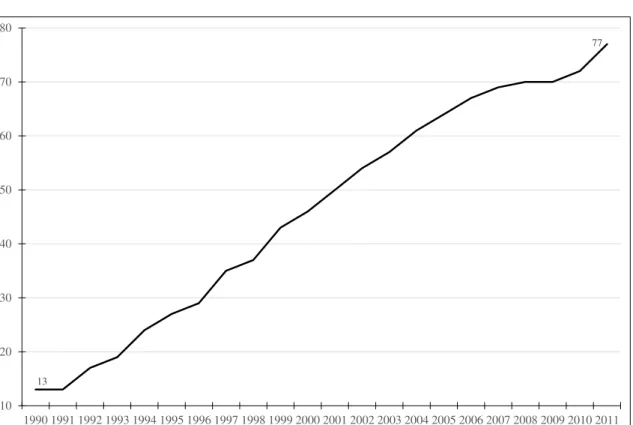
Based on the EC’s FRI, the number of numerical fiscal rules in place since 1990
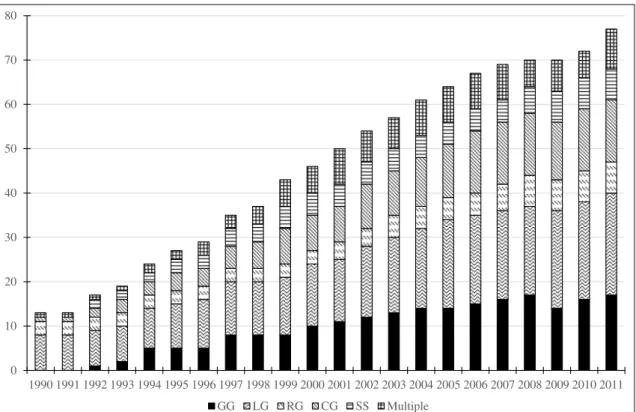
has grown continuously from 13 rules to a total of 77 in 2011 (Figure A-I in Appendix A). Rules targeting budget balance represent the majority of rules in place from 1990 to 2011, with debt rules and expenditure rules increasing considerably in recent years. Rules targeting government revenue are those that have less representation (Figure A-II).
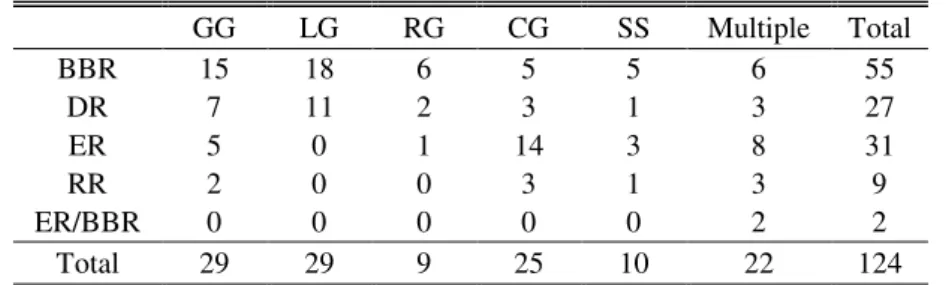
Concerning the type of government covered, most of the rules were applied to Local Government throughout the years, with a growing representation in recent years of rules applied to General Government (Figure A-III in Appendix A). Central Government applied the most expenditure rules, whereas General Government and Local Government were the ones that targeted budget balance more (Table II).
Table II Total numerical fiscal rules by type of government and aggregate targeted (1990-2011)
GG LG RG CG SS Multiple Total
BBR 15 18 6 5 5 6 55
DR 7 11 2 3 1 3 27
ER 5 0 1 14 3 8 31
RR 2 0 0 3 1 3 9
ER/BBR 0 0 0 0 0 2 2
Total 29 29 9 25 10 22 124
Note: BBR – Balance Budget Rule; DR – Debt Rule; ER – Expenditure Rule; RR
– Revenue Rule; GG – General Government; LG – Local Government ; RG –
Regional Government; SS – Social Security.
Source: Numerical Fiscal Rule Database, European Commission.
10
Turning now to the analysis of the evolution of FRI per country, we can see countries that have no variation in the way they implemented numerical fiscal rules, starting with the countries already mentioned above that have no rules in force (Cyprus, Greece and Malta), to countries like The Netherlands, Latvia, Romania which have only changed their rules a few times, through to more dynamic countries that make more frequent changes to the rules, such as Germany (Appendix A, Figure A-VI to A-IX).
4. Empirical Strategy and Results
4.1. Empirical specifications
For the empirical analysis, we use a fiscal reaction function to assess the impact of the existence of fiscal rules on the primary balance (Debrun et al., 2008). Therefore we have estimated a fiscal reaction function following the common approach in the literature (see Table I for a review of the literature on the subject):
(1)
where capbit is the cyclically adjusted primary balance in country i, at time t, βi
represents the individual effects of each country i, debtit-1 is the debt-to-GDP ratio of
country i in period t-1, outputgapit-1 is the lagged output gap, friit is the fiscal rule index
and finally, xit represents a set of variables that can have additional explanatory power,
focusing on specific events (e.g. election years and the run-up to EMU).
After computing the results we expect ϕ > 0, which means that more and better rules (better FRI) impact positively on the value of CAPB, leading to a healthier fiscal position.
As mentioned above, we undertake this exercise using FRI from the EC and compare these results with the ones using the IMF’s FRI. In addition, in order to assess the effectiveness of expenditure rules, we compute an expenditure rule index based on the EC Fiscal Rule Dataset and use primary expenditure as a dependent variable.
In order to have an additional assessment of the importance of numerical fiscal rules for long-term government bond yields, we also estimate a specification for the analysis of the impact of FRI on 10-year maturity bond yields:
11
where, is the 10-year maturity bond yield, ̅ is a vector comprising CAPB, debt, CA, REER, IP, GRPgr and CIP, for period t, and country i. vixit is the measure of
investors’ willingness to take risk. Iit is the short-term interest rate for each period t, and
country i and fri have the definition already mentioned above.
4.2. Baseline Results
Our baseline results for the EC index overall suggest that FRI is significant with a positive coefficient, which means that if the FRI increases by 1 unit, then CAPB can increase by up to 0.52 percentage points (p.p.). In column 1, Table III, the control variables were omitted to see if they bias the impact of the rules and the effect is still robust.
When control variables are included in column (2), Table III, the following have a significant impact on the dependent variable: run-up to the EMU, election period and ideological change in government composition. The interpretation is that during the years of implementation of the EMU in the EU-15 countries, CAPB is 1.19 p.p. higher. The years where ideological change took place resulted in an increment on CAPB of 0.43 p.p. and, finally, years of election have a negative impact of 0.77. The ten member countries after 2003 have an increment of 1.23 p.p. on CAPB and those that have been part of the Euro-area since 1998 have a negative impact on CAPB of -0.87.
The results obtained from a fixed effects OLS regression, column (3), Table III, are essentially the same, with two more variables becoming statistically significant, namely: the EU-10 countries after 2003 have an increment of 1.23 p.p. on CAPB and those that have been part of the Euro-area since 1998 have a negative impact on CAPB of 0.87. Column 4, Table III, reports a Two Stage Least Squares, with the instrument of FRI being its own lag and a variable that captures the commitment of governments2. FRI is no longer significant and the p-value of the Wu-Hausman test shows that there are no problems of endogeneity. However, there are concerns about reverse causality between the fiscal stance and FRI. However, by analysing the Granger Causality Test (Appendix CTable C-III), we cannot conclude whether, in fact, it is the implementation of fiscal rules that leads to better balances, or whether it is better fiscal outcomes that lead to the implementation of more rules.
12
Table III - Baseline results: fiscal rules and fiscal performance
EC IMF
Dependent Variable Cyclically Adjusted Primary Balance OLS
(1) OLS (2) OLS (3) 2SLS (4) OLS (5) OLS (6) OLS (7) 2SLS (8) c -098 ** -0.70 ** -0.60 -0.16 -1.37 ** -0.88 -0.73 0.01
(0.42) (0.30) (0.47) (0.54) (0.56) (0.52) (0.65) (0.95) capb(-1) 0.63 *** 0.83 *** 0.68 *** 0.71 *** 0.61 *** 0.87 *** 0.75 *** 0.80 ***
(0.10) (0.06) (0.12) (0.13) (0.10) (0.08) (0.15) (0.17) debt(-1) 0.02 ** 0.01 ** 0.01 0.01 0.01 ** 0.00 0.01 0.00 (0.01) (0.00) (0.01) (0.01) (0.01) (0.00) (0.01) (0.01) outputgap(-1) -0.03 -0.02 -0.06 -0.06 -0.06 -0.03 -0.04 -0.04 (0.04) (0.04) (0.04) (0.04) (0.04) (0.04) (0.05) (0.05) fri 0.51 *** 0.25 *** 0.52 *** 0.31 0.29 * 0.18 0.07 -0.15 (0.16) (0.09) (0.17) (0.24) (0.17) (0.11) (0.18) (0.26) emu - 1.19 *** 2.05 *** 2.34 ** - 0.89 ** 3.89 *** 3.76 ***
(0.31) (0.76) (1.06) (0.38) (0.80 ) (0.83) enlargement - 0.20 1.23 ** -1.30 *** - 0.25 0.49 1.05
(0.28) (0.48) (0.44) (0.34) (0.63) (0.70) sgp - -0.06 -0.87 * 1.30 ** - -0.13 -1.00 ** -1.01 **
(0.20) (0.44) (0.54)
(0.21) (0.48) (0.57) legelec - -0.77 *** -0.72 *** -0.64 *** - -0.70 *** -0.72 *** -0.73 ***
(0.17) (0.17) (0.18) (0.18) (0.19) (0.20) gov_new - 0.43 ** 0.50 ** 0.59 ** - 0.52 ** 0.66 *** 0.75 ***
(0.20) (0.23) (0.25) (0.24) (0.25) (0.27)
mdms - 0.00 0.00 0.00 ** - 0.00 0.00 * 0.00 **
(0.00) (0.00) (0.00) (0.00) (0.00) (0.00) Number of observations 463 437 437 397 420 366 366 324
R2 0.72 0.69 0.76 0.77 0.73 0.67 0.78 0.78
Adjusted R2 0.69 0.68 0.73 0.73 0.70 0.66 0.74 0.74
Endogeneity test - - - 0.21 - - - 0.74
Fixed Effects 1.97 *** - 2.16 *** - 2.55 *** - 2.05 *** - Random effects
(Hausman test)
Period - 20.66 ** - - 15.94 - -
Cross-section - 13.40 - - 9.82 - - Notes: Robust standard errors are reported in parenthesis *, **, and *** denoting, respectively,
significance at the 10, 5 and 1% level. Period range for EC’s FRI: 1991-2011 (463 observations),
1991-2010 (437 observations and 397 observations). Period range for IMF’s FRI: 1990-2011 (420 observations), 1991-2010 (366 observations and 324 observations). Instrumental variables are the FRI own lag and a variable for capturing government commitment.
The use of the IMF’s Fiscal Rule Index generates some different results,
13
significant at a level of 10%, with no control variables included. Although the index takes into account the same characteristics and types of rules, the methodology used is different, so therefore the results might differ on account of that (see column (5)-(8), Table III). Thus, the methodology used to compute the index may have an important effect on the conclusions that can be made about the impact of fiscal rules on fiscal outcomes.
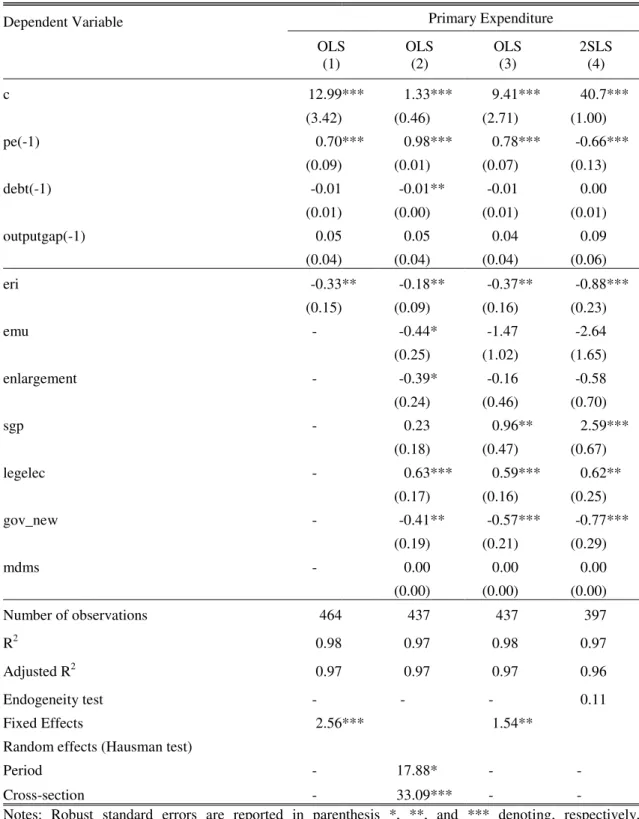
We performed the same exercise for the IMF Expenditure Rule Index (ERI), using a calculation based on the methodology provided in the EC’s FRI database, which was only applied to rules targeting public expenditure. We considered Primary Expenditure as the dependent variable - interest payments are hardly controlled by governments - as expenditure rules are more effective with regard to expenditure alone, and not to the whole balance sheet (see Table IVTable IV).
14
Table IV - The impact of expenditure rules on primary expenditure
Dependent Variable Primary Expenditure
OLS
(1) OLS (2) OLS (3) 2SLS (4)
c 12.99 *** 1.33 *** 9.41 *** 40.7 ***
(3.42) (0.46) (2.71) (1.00)
pe(-1) 0.70 *** 0.98 *** 0.78 *** -0.66 ***
(0.09) (0.01) (0.07) (0.13)
debt(-1) -0.01 -0.01 ** -0.01 0.00
(0.01) (0.00) (0.01) (0.01)
outputgap(-1) 0.05 0.05 0.04 0.09
(0.04) (0.04) (0.04) (0.06)
eri -0.33 ** -0.18 ** -0.37 ** -0.88 ***
(0.15) (0.09) (0.16) (0.23)
emu - -0.44 * -1.47 -2.64
(0.25) (1.02) (1.65)
enlargement - -0.39 * -0.16 -0.58
(0.24) (0.46) (0.70)
sgp - 0.23 0.96 ** 2.59 ***
(0.18) (0.47) (0.67)
legelec - 0.63 *** 0.59 *** 0.62 **
(0.17) (0.16) (0.25)
gov_new - -0.41 ** -0.57 *** -0.77 ***
(0.19) (0.21) (0.29)
mdms - 0.00 0.00 0.00
(0.00) (0.00) (0.00)
Number of observations 464 437 437 397
R2 0.98 0.97 0.98 0.97
Adjusted R2 0.97 0.97 0.97 0.96
Endogeneity test - - - 0.11
Fixed Effects 2.56 ***
1.54 **
Random effects (Hausman test)
Period - 17.88 * - -
Cross-section - 33.09 *** - -
Notes: Robust standard errors are reported in parenthesis *, **, and *** denoting, respectively, significance at the 10, 5 and 1% level. Period range: 1991-2011 (464 observations), 1991-2010 (437 observations and 397 observations). Instrumental variables are the ERI own lag and a variable for capturing government commitment.
15
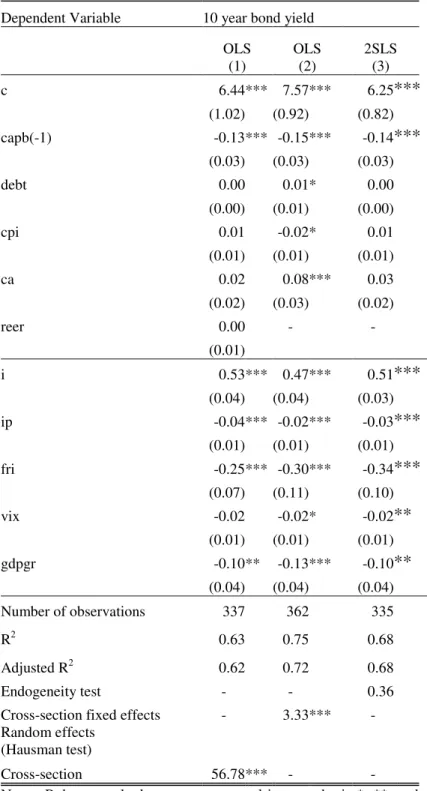
investors become more risk averse - vix increases – and we can see that, if everything else is held constant, yields decrease by 0.02 p.p. As expected, the variables representing better economic environment – GDPgr and IP – lead to lower values of sovereign bond yields. In column (3) of Table V, we performed a 2SLS. The endogeneity tests show that FRI is not endogenous with regards to causality. The Granger tests in Appendix C show that causality runs from FRI to the yields.
In Appendix C, Error! Reference source not found., it is possible to observe regression results when considering different sets of explanatory variables and also the same regressions, but considering yield spread against Germany as the dependent variable. The conclusions are the same - that FRI is significant in all regressions and that variables capturing economic developments maintain their statistical significant as well.
16
Table V - The impact of FRI on 10-Year Bond Yield Dependent Variable 10 year bond yield
OLS
(1) OLS (2) 2SLS (3)
c 6.44 *** 7.57 *** 6.25 ***
(1.02) (0.92) (0.82) capb(-1) -0.13 *** -0.15 *** -0.14 ***
(0.03) (0.03) (0.03)
debt 0.00 0.01 * 0.00
(0.00) (0.01) (0.00)
cpi 0.01 -0.02 * 0.01
(0.01) (0.01) (0.01)
ca 0.02 0.08 *** 0.03
(0.02) (0.03) (0.02)
reer 0.00 - -
(0.01)
i 0.53 *** 0.47 *** 0.51 ***
(0.04) (0.04) (0.03)
ip -0.04 *** -0.02 *** -0.03 ***
(0.01) (0.01) (0.01)
fri -0.25 *** -0.30 *** -0.34 ***
(0.07) (0.11) (0.10)
vix -0.02 -0.02 * -0.02 **
(0.01) (0.01) (0.01) gdpgr -0.10 ** -0.13 *** -0.10 **
(0.04) (0.04) (0.04) Number of observations 337 362 335
R2 0.63 0.75 0.68
Adjusted R2 0.62 0.72 0.68
Endogeneity test - - 0.36
Cross-section fixed effects - 3.33 *** - Random effects
(Hausman test)
17 4.3. Simulation
Finally, we performed a simulation of the level of government debt, by computing an expenditure rule and applying it to real expenditure level, based on the specifications in Hauptmeier et al. (2010). For the detailed methodology please see Appendix D.
The simulation exercise was made with the purpose of understanding debt developments of EU countries, assuming that they had adopted a rule for the discretionary component of public expenditures.
Firstly, there are a few countries with unusual situations during the period considered, showing years where public expenditures were greater than the consolidated gross debt. For that reason, rule-based expenditure levels would lead to negative values of debt.
Secondly, in the majority of countries the debt ratio is lower than the actual ratio when GDP was computed only using an expenditure multiplier of 0.3, taking into consideration only the last five year of the analysis. In 2013, only three countries do not present rule-based values with debt ratio above the actual one: Italy, Greece and Sweden. Sweden is the only case in the EU-15 countries that would not benefit much from a ruled-based expenditure path, with new debt developments very similarly to those of the actual path.
Considering the SGP constraint of maintaining debt ratio below 60%, this barrier would have been exceeded much later and for Denmark this means that it would never experience debt ratios above 60%. For Austria, instead of being over 60% in 1993, it would only reach this value in 2009, as well as France and Portugal, instead of 2003 and 2004, respectively. Greece would not enter the EMU although adopted the SGP with debt ratios already above 60%, but would only pass it in 1996 and the barrier of 100% debt would only be achieved in 2009, instead of 1996.
18
19 5. Conclusions
The purpose of this paper was to assess whether those countries that implemented more, or better, fiscal rules have better budget balances, and consequently, better debt ratios. From the theory discussed, the general idea is that there is a relation between fiscal rules and fiscal balances. From our empirical study we confirm that countries with more fiscal rules, have better CAPB in fact, but we could not guarantee that causality runs from FRI to CAPB. Also, the methodology used to compute this type of indexes seems to be instrumental, given that the IMF’s FRI for the same countries
produces different results from the ones computed with the EC’s FRI, even though broadly the same criteria are considered.
With regard to the perspective of capital markets, we studied the impact of FRI on 10-year bond yields. Investors seem to reward countries that have implemented fiscal rules. This can be explained by the commitment associated with such rules and by greater certainty about fiscal results.
With revenues being essential a-cyclical, we tried to see whether rules applied to public expenditures contribute to their control and to the consolidation of fiscal balances. Our regression results show that ERI has the ability to explain developments in primary expenditure. Therefore, it is justifiable to construct rules that specifically target the expenditure side of the budget. This leads to the second objective of our paper: to simulate debt developments of EU countries, assuming that they had implemented an expenditure rule in 1990. If public expenditure had increased at the growth rate of potential GDP, countries would have experienced smaller debt ratios in comparison to the actual ones, and would have complied more easily with the SGP constraint of keeping debt ratios below 60%. The results show that the fiscal stance of most EU countries would have been sounder if an expenditure rule had been used since 1990.
20 References
Afonso, A., & Hauptmeier, S. (2009). Fiscal behaviour in the European Union - rules, fiscal decentralisation and government indebtedness, ECB Working Paper Series, 1054.
Annett, A. (2006). Enforcement and the Stability and Growth Pact: How Fiscal Policy did, and did not change under Europe’s Fiscal Framework, IMF Working
Papers, 06/116.
Ayuso, J. (2012). National Expenditure Rules – Why, How and When, EC Economic Papers, 473.
Ayuso, J., Debrun, X., Kumar, M. S., Moulin, L., & Turrini, A. (2007). Beyond the SGP - Features and effects of EU national-level numerical fiscal rules, Centre for Economic Policy Research.
Baum, A., Ribeiro, M. P., & Weber, A. (2012). Fiscal Multipliers and the State of the Economy, IMF Working Papers, 12/286.
Boussard, J., de Castro, F., & Salto, M. (2012). Fiscal Multipliers and Public Debt Dynamics in Consolidations, Directorate General Economic and Monetary Affairs (DG ECFIN), European Commission.
Budina, N., Schaechter, A., Weber, A., & Kinda, T. (2012). Fiscal Rules in Response to the Crisis - Toward the "Next-Generation" Rules. A New Dataset, IMF Working Papers, 12/187.
Debrun, X., Moulin, L., Turrini, A., Ayuso-i-Casals, J., & S. Kumar, M. (2008). Tied to the mast? National fiscal rules in the European Union. Economic Policy, 23, 297-362.
European Commission. (2008). Fiscal rules in the EU at national level : experiences and lessons. Presupuesto y gasto público, 51(2), p.59-82.
Gali, J., & Perotti, R. (2003). Fiscal Policy and Monetary Integration in Europe. Economic Policy, 18(37), 533-572.
Hallerberg, M., Strauch, R., & Hagen, J. v. (2009). Fiscal Governance in Europe. Hauptmeier, S., Sanchez-Fuentes, J., & Schuknecht, L. (2010). Towards expenditure
rules and fiscal sanity in the Euro area. 1266.
21
Armingeon, R., Weisstanner, D. Engler, S., Potolidis, P., Gerber, M. (2012). Comparative Political Data Set III (35 OECD Countries and/or EU-member
countries).
Kopits, G., & Symansky, S., A. (1998). Fiscal Policy Rules, IMF Occasional Papers, 162.
Kumar, M., Baldacci, E., Schaechter, A., Caceres, C., Kim, D., Debrun, X., . . . Zymek, R. (2009). Fiscal Rules - Anchoring Expectations for Sustainable Public Finances, IMF staff paper.
Pina, Á. M., & Venes, N. M. (2011). The political economy of EDP fiscal forecasts: An empirical assessment. European Journal of Political Economy, 27(3), 534-546. Schuknecht, L. (2004). EU fiscal rules: issues and lessons from political economy, ECB
Working Paper Series, 421.
Turrini, A. (2008). Fiscal policy and the cycle in the Euro Area: The role of the government revenue and expenditure. European Economy - Economic Papers, 323.
22 Appendix A – Stylised facts - figures
0 10 20 30 40 50 60 70 80
1990 1991 1992 1993 1994 1995 1996 1997 1998 1999 2000 2001 2002 2003 2004 2005 2006 2007 2008 2009 2010 2011 BBR DR ER RR ER/BBR
Figure A-II: Numerical fiscal rules by type of aggregate targeted since 1990 Figure A-I: Evolution of total number of rules from 1990 to 2011
13
77
10 20 30 40 50 60 70 80
23
0 1 2 3 4 5 6 7 8 9 10
AT BE BG CY CZ DE DK EE EL ES FI FR HU IE IT LT LU LV MT NL PL PT RO SE SI SK UK
Figure A-III: Total numerical fiscal rules by country
0 10 20 30 40 50 60 70 80
1990 1991 1992 1993 1994 1995 1996 1997 1998 1999 2000 2001 2002 2003 2004 2005 2006 2007 2008 2009 2010 2011 GG LG RG CG SS Multiple
24
0 1 2 3 4 5 6
AT BE BG CY CZ DE DK EE EL ES FI FR HU IE IT LT LU LV MT NL PL PT RO SE SI SK UK
25
-1 .2 -0 .8 -0 .4 0 . 0 0 . 4 0 . 8
1990 1995 2000 2005 2010
Austria -.8 -.4 . 0 . 4 . 8
1990 1995 2000 2005 2010
Belgium -2 -1 0 1 2
1990 1995 2000 2005 2010
Bulgaria
-1 .1 2 -1 .0 8 -1 .0 4 -1 .0 0 -0 .9 6
1990 1995 2000 2005 2010
Cyprus
-1 .2 -0 .8 -0 .4 0 . 0 0 . 4
1990 1995 2000 2005 2010
Czech Republic
-2 -1 0 1 2
1990 1995 2000 2005 2010
Denmark
-1 .5 -1 .0 -0 .5 0 . 0 0 . 5 1 . 0 1 . 5
1990 1995 2000 2005 2010
Estonia -2 -1 0 1 2
1990 1995 2000 2005 2010
Finland
26
-0 .8 -0 .4 0 . 0 0 . 4 0 . 8 1 . 2
1990 1995 2000 2005 2010
France
0 . 8 0 . 9 1 . 0 1 . 1 1 . 2
1990 1995 2000 2005 2010
Germany
-1 .1 2 -1 .0 8 -1 .0 4 -1 .0 0 -0 .9 6
1990 1995 2000 2005 2010
Greece
-1 .2 -0 .8 -0 .4 0 . 0 0 . 4 0 . 8
1990 1995 2000 2005 2010
Hungary -1 .1 -1 .0 -0 .9 -0 .8 -0 .7 -0 .6
1990 1995 2000 2005 2010
Ireland -1 .2 -1 .0 -0 .8 -0 .6 -0 .4 -0 .2
1990 1995 2000 2005 2010
Italy
-1 .2 -0 .8 -0 .4 0 . 0 0 . 4
1990 1995 2000 2005 2010
Latvia
-0 .5 0 . 0 0 . 5 1 . 0 1 . 5 2 . 0
1990 1995 2000 2005 2010
Lithuania
27
-1 .0 -0 .5 0 . 0 0 . 5 1 . 0 1 . 5
1990 1995 2000 2005 2010
Luxembourg
-1 .1 2 -1 .0 8 -1 .0 4 -1 .0 0 -0 .9 6
1990 1995 2000 2005 2010
Malta -2 -1 0 1 2
1990 1995 2000 2005 2010
Netherlands -2 -1 0 1 2
1990 1995 2000 2005 2010
Poland -1 .2 -1 .0 -0 .8 -0 .6 -0 .4 -0 .2
1990 1995 2000 2005 2010
Portugal -.7 5 -.7 0 -.6 5 -.6 0 -.5 5 -.5 0
1990 1995 2000 2005 2010
Romania
-1 .2 -0 .8 -0 .4 0 . 0 0 . 4
1990 1995 2000 2005 2010
Slovakia -.8 -.4 . 0 . 4 . 8
1990 1995 2000 2005 2010
Slovenia
28
-0 .5 0 . 0 0 . 5 1 . 0 1 . 5 2 . 0
1990 1995 2000 2005 2010
Spain
-2 -1 0 1 2
1990 1995 2000 2005 2010
Sweden
-2 -1 0 1 2 3
1990 1995 2000 2005 2010
United Kingdom
29 Appendix B – Data statistics
Table B-I - Descriptive statistics
Sample: 1990-2014 Mean Median Std. Dev. Skewness Kurtosis Observations Cyclically
Adjusted Primary
Balance CAPB 0.30 0.39 3.06 -1.09 10.67 647
Debt-to-GDP DEBT 60.43 49.97 44.59 2.46 12.34 678
Primary
Expenditure PE 41.50 42.66 10.58 -2.54 11.65 657
Output Gap OUTPUTGAP -0.12 -0.03 2.93 -0.06 6.21 669
CE's FRI FRI 0.00 -0.21 1.00 0.59 2.13 593
IMF's FRI FRI_IMF 2.40 2.44 0.86 0.44 1.85 443
Expenditure Rule
Index ERI 0.00 -0.50 1.00 2.31 8.91 594
Run-up of the
EMU Dummy EMU 0.11 0.00 0.31 2.47 7.13 675
Entrance of 10 countries in EU
Dummy ENLARGEMENT 0.18 0.00 0.38 1.69 3.84 675
Introduction of
SGP Dummy SGP 0.38 0.00 0.49 0.50 1.25 675
Election Year
Dummy LEGELEC -19.04 0.00 137.67 -6.98 49.77 621
Government Ideological Change Dummy
GOV_NEW 0.27 0.00 0.44 1.03 2.06 539
District Magnitude MDMS -425.45 -999.00 738.15 0.78 2.03 618
10 Year Bond
Yield YIELD 5.96 4.99 2.94 2.36 11.68 479
Chicago Board Options Exchange Market Volatility Index
VIX 20.45 21.98 5.89 0.30 2.15 713
Short-term interest
rate I 6.51 4.39 8.12 5.10 39.12 524
Current Account
Balance CA -2.90 -2.77 3.24 -1.13 9.51 632
Real Effective
Exchange Rate REER 99.22 99.48 14.24 0.39 5.38 540
30 Appendix C – Additional Results
Table C-I - Estimation results considering the impact of FRI on 10 Year Bond Yield Dependent Variable 10 year bond yield
OLS (1) OLS (2) 2SLS (3)
c 5.89 *** 5.77 *** 5.66 ***
(1.04 ) (1.20 ) (1.07)
capb(-1) -0.04 - -0.03
(0.03 )
(0.04)
debt 0.00 - 0.00)
(0.00 )
(0.00)
cpi 0.02 ** 0.02 ** 0.03 **
(0.01 ) (0.01 ) (0.01)
cab 0.01 0.00 0.01
(0.02 ) (0.02 ) (0.03)
reer 0.00 0.00 0.00
(0.01 ) (0.01 ) (0.01)
i 0.54 *** 0.53 *** 0.53 ***
(0.04 ) (0.04 ) (0.04)
ip -0.04 *** -0.03 *** -0.03 ***
(0.01 ) (0.01 ) (0.01) fri -0.30 *** -0.32 *** -0.42 ***
(0.07 ) (0.07 ) (0.10)
vix -0.03 *** -0.03 ** -0.04 ***
(0.01 ) (0.01 ) (0.01) gdpgr -0.12 *** -0.13 *** -0.12 ***
(0.04) (0.04) (0.05) Number of observations 338 338 311
R2 0.60 0.59 0.60
Adjusted R2 0.59 0.58 0.59
Endogeneity test - - 0.01
Random effects
(Hausman test) - - -
31
Table C-II - Estimation results considering the impact of FRI on 10-Year Yield Spreads against Germany
Dependent Variable 10-year yield spread against Germany
OLS
(1) OLS (2) 2SLS (3) OLS (4) OLS (5) 2SLS (6) c -2.46 ** -2.68 ** -2.74 *** c -1.92 ** -0.65 -3.68 ***
(0.98) (1.16) (1.03)
(0.96) (0.73) (0.78) capb -0.06 * - -0.05 capb(-1) -0.15 *** -0.14 *** -0.16 ***
(0.03) (0.04)
(0.03) (0.03) (0.03)
debt 0.00 - 0.00 debt 0.00 0.02 *** 0.00
(0.00) (0.00)
(0.00) (0.01) (0.00) cpi 0.09 *** 0.09 *** 0.09 *** cpi 0.07 *** 0.02 ** 0.06 ***
(0.01) (0.01) (0.01)
(0.01) (0.01) (0.01)
cab 0.00 -0.01 0.00 cab 0.02 0.10 *** 0.03
(0.02) (0.02) (0.03)
(0.02) (0.02) (0.02) reer -0.02 *** -0.02 ** -0.02 ** reer -0.02 ** - -
(0.01) (0.01) (0.01)
(0.01)
i 0.42 *** 0.41 *** 0.41 *** i 0.41 *** 0.27 *** 0.34 *** (0.03) (0.03) (0.04)
(0.03) (0.03) (0.04) ip -0.03 *** -0.03 *** -0.03 *** ip -0.03 *** -0.02 ** -0.02 **
(0.01) (0.01) (0.01)
(0.01) (0.01) (0.01) fri -0.28 *** -0.32 *** -0.37 *** fri -0.23 *** 0.09 -0.19 **
(0.07) (0.07) (0.09)
(0.06) (0.09) (0.10) vix -0.04 *** -0.04 *** -0.04 *** vix -0.02 * -0.02 -0.01
(0.01) (0.01) (0.01)
(0.01) (0.01) (0.01) gdpgr -0.12 *** -0.13 *** -0.12 ** gdpgr -0.10 ** -0.12 *** -0.08 *
(0.04) (0.04) (0.05)
(0.04) (0.04) (0.04) Number of observations 338 338 311
337 362 335
R2 0.57 0.56 0.57
0.62 0.73 0.54
Adjusted R2 0.56 0.55 0.56
0.61 0.70 0.53
Endogeneity test - - 0.08
- - 0.99
Cross-section fixed effects - - - - 8.60 *** -
Random effects
(Hausman test) - - - -
32
Table C-III - Granger Causality
33
Appendix D – Simulation Methodology and Figures
The methodology of the simulation exercise is based on Hauptmeier et al. (2010). The first step is to construct a new expenditure path that follows a predetermined rule of growth. For the purpose of this exercise we define the rule growth rate as the same growth rate of potential GDP. The formulas used are defined as follows:
Table D-I - Simulation’s Methodology
Concept Formula
Expenditure path
( )
is the rule-based expenditure path. is the actual expenditure path. is the growth rule
Debt path is the difference between the rule-based expenditure path and the actual , where expenditure path.
Interest rate r is the implicit interest rate computed as Interests over Gross Consolidated ,
Debt at period t.
GDP
( ),
is the difference between the rule-based expenditure path and the actual expenditure path in percentage of GDP, m is the expenditure multiplier – we
consider four possible values 0.3, 0.75, 1, 1.53.
We used total expenditure excluding interest, consolidated gross debt, GDP at market prices - all expressed in billions of national currency for each country extracted from the AMECO Database.
34
35
36
37
38
39
40
41
42
43
44