Abstract. Cells of Catharanthus roseus (L.) G. Don were genetically engineered to over-express the enzymes strictosidine synthase (STR; EC 4.3.3.2) and tryptophan decarboxylase (TDC; EC 4.1.1.28), which catalyze key steps in the biosynthesis of terpenoid indole alkaloids (TIAs). The cultures established after Agrobacterium-mediated transformation showed wide phenotypic di-versity, re¯ecting the complexity of the biosynthetic pathway. Cultures transgenic for Str consistently showed tenfold higher STR activity than wild-type cultures, which favored biosynthetic activity through the pathway. Two such lines accumulated over 200 mg á L)1 of the glucoalkaloid strictosidine and/or
strictosidine-derived TIAs, including ajmalicine, cathar-anthine, serpentine, and tabersonine, while maintaining wild-type levels of TDC activity. Alkaloid accumulation by highly productive transgenic lines showed consider-able instability and was strongly in¯uenced by culture conditions, such as the hormonal composition of the medium and the availability of precursors. High trans-gene-encoded TDC activity was not only unnecessary for increased productivity, but also detrimental to the normal growth of the cultures. In contrast, high STR activity was tolerated by the cultures and appeared to be necessary, albeit not sucient, to sustain high rates of alkaloid biosynthesis. We conclude that constitutive over-expression of Str is highly desirable for increased TIA production. However, given its complexity, limited intervention in the TIA pathway will yield positive results only in the presence of a favorable epigenetic environment.
Key words: Cell culture ± Genetic engineering ± Secondary metabolism ± Strictosidine synthase ± Terpenoid indole alkaloids ± Tryptophan decarboxylase
Introduction
Catharanthus roseus (L.) G. Don, a tropical plant of the Apocynaceae family, produces a wide variety of terpenoid indole alkaloids (TIAs), including some of medicinal importance such as ajmalicine, used to treat circulatory disorders, and the bisindoles vinblastine and vincristine, used in the treatment of various forms of cancer. The biosynthesis of bisindole TIAs involves over twenty enzymatic steps, which take place in at least three subcellular compartments, the cytosol, the plastids, and the vacuole (Meijer et al. 1993). This process requires inter-organellar coordination of enzy-matic activity and metabolite transport, and is strictly regulated by the plant's developmental program (Aerts et al. 1990, 1994). While relatively large amounts of ajmalicine can be obtained from roots of C. roseus, the antineoplastic alkaloids are far less abundant in the plant. The development of cell cultures, including those of C. roseus, as alternative sources of scarce, econom-ically important phytochemicals has long been consid-ered, but has suered from their characteristically low productivity (Verpoorte et al. 1993). The accumulation of secondary metabolites generally requires a degree of cellular dierentiation and tissue organization that does not exist in cell cultures (Sakuta and Komamine 1987). Advances in the understanding of the TIA biosynthetic pathway at the DNA level and the possibility of eciently transferring genes into plant cells oer novel opportunities to improve alkaloid yields by cell cul-tures. The genes Tdc and Str are transcriptionally regulated in C. roseus (Pasquali et al. 1992). These genes respectively encode the enzymes tryptophan decarboxylase (TDC), an important link between primary and secondary metabolism catalyzing the
*Present address: USDA, ARS, NPURU, Natural Products Center,
Room 2021, University, MS 38677, USA
Abbreviations: 2,4-D 2,4-dichlorophenoxyacetic acid; GUS b-glucuronidase; PM production medium; STR strictosidine synthase; TDC tryptophan decarboxylase; TIA terpenoid indole alkaloid
Correspondence to: C. Canel; E-mail: [email protected]; Fax: 1 (601) 232 1035
Eects of over-expression of strictosidine synthase
and tryptophan decarboxylase on alkaloid production
by cell cultures of Catharanthus roseus
Camilo Canel1*, M. IneÃs Lopes-Cardoso2, Serap Whitmer1, Leslie van der Fits2, Giancarlo Pasquali2,
Robert van der Heijden1, J. Harry C. Hoge2, Robert Verpoorte1
1Division of Pharmacognosy, Gorlaeus Laboratories, Leiden University, P.O. Box 9502, NL-2300 RA Leiden, The Netherlands 2Institute of Molecular Plant Sciences, Clusius Laboratory, Leiden University, P.O. Box 9505, NL-2300 RA Leiden, The Netherlands
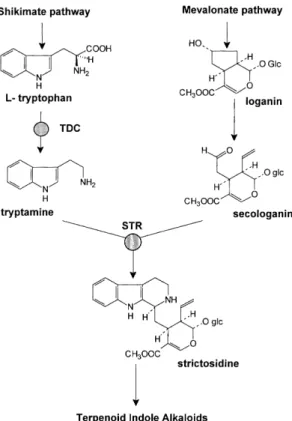
conversion of tryptophan into tryptamine, and strict-osidine synthase (STR), which condenses tryptamine and the iridoid secologanin to yield strictosidine, the universal precursor of TIAs (Fig. 1). Freeing the expression of key enzymatic activities from the strict regulation to which they are normally subjected is expected to increase ¯ux through the pathway and product formation. We report the introduction of gene constructs containing cDNA clones of Str and Tdc under the control of the strong constitutive cauli¯ower mosaic virus (CaMV) 35S promoter into C. roseus cells, and the characterization of the resulting transgenic cultures.
Materials and methods
Culture media. (i) MS24 (per liter): MS salts (Murashige and Skoog 1962), 1 mg benzylaminopurine, 1 mg a-naphthaleneacetic acid (NAA), 30 g sucrose; (ii) MS58: MS salts, 0.1 g myo-inositol, 0.4 mg thiamine, 0.2 mg NAA, 1 mg kinetin, 30 g sucrose; (iii) MS0: MS58 without NAA and kinetin; (iv) MS67: MS salts, 0.1 g myo-inositol, 1 mg thiamine, 0.5 mg pyridoxine, 0.5 mg niacin, 2 mg glycine, 1 mg 2,4-dichlorophenoxyacetic acid (2,4-D), 0.2 mg kinetin, 30 g sucrose; (v) production medium (PM): MS salts devoid of phosphate and nitrate, 0.1 g myo-inositol, 0.4 mg thiamine, 80 g sucrose; (vi) LC: 10 g tryptone, 5 g yeast extract, 8 g NaCl. Solid media contained 10 g of Daishin agar (Brunschwig, Amsterdam, The Netherlands). Antibiotics and sucrose were purchased from Duchefa (Haarlem, The Netherlands), loganin from Extrasynthese (Genay, France), salts, vitamins, and hormones from Merck (Darmstadt, Germany).
Genetic transformation. The binary vectors pMOG22 and pMOG402 (Mogen, Leiden, The Netherlands), encoding resistance to the antibiotics hygromycin and kanamycin, respectively, and containing a version of the gus reporter gene, whose coding sequence is interrupted by an intron (Vancanneyt et al. 1990), were used in the form of seven dierent constructs (Table 1). All transgenes use the CaMV 35S (35S) promoter and the nos terminator sequences, except npt, which uses the nopaline synthase (nos) promoter, and gus, which uses the 35S terminator; Str and Tdc use a 35S promoter with a double enhancer region. The transgene Tdc1 encompasses the complete open reading frame (ORF) of a C. roseus root cDNA (nucleotides 2349±3855 of Genbank sequence X67662). The coding sequence of Tdc2 consists of a 55-bp synthetic oligonucleotide fused to the partial cDNA clone pCCR2, isolated from a C. roseus cell-culture library (Goddijn et al. 1992), has two amino acid alterations, and lacks the ®rst 10 codons of the ORF of Tdc1. The complete coding sequence of Str (Genbank sequence X61932) was generated by replacing the 135-bp SmaI/BsmI fragment of the partial root cDNA clone pCCR383 with the corresponding 150-bp HincII/BsmI fragment of C. roseus genomic DNA clone pGCR1815 (Genbank sequence Y10182). The binary constructs were introduced into strain LBA1119 of Agrobacterium tumefaciens by triparental mating (Ditta et al. 1980); transformed cells were selected on LC medium containing 50 mg á L)1 rifampicin and 100 mg á L)1
kanamycin. Seeds of C. roseus cv. Morning Mist (Blokker, The Netherlands) were germinated axenically on half-strength solid MS0, at 28 °C, 12-h photoperiod, 4300 lx. Sixty to 80 leaves, excised from 6- to 8-week-old seedlings, were used with each construct. Leaves were wounded by making parallel transverse incisions with a sterile surgical knife, and incubated in MS24 containing a 100-fold dilution of an overnight culture (OD590 1.0) of A. tumefaciens for 30 min. After blotting the
Fig. 1. Biosynthesis of terpenoid indole alkaloids in Catharanthus roseus. STR, strictosidine synthase; TDC, tryptophan decarboxyl-ase
Table 1. Gene constructs and derived
cul-tures T-DNA constructa Number of established callus lines Established Total Antibiotic-resistant GUS-positive cell cultures <npt-gus>-Str>-Tdc1> 38 1 1 ST1 <hpt-<Tdc2-<Str-gus> 146 8 5 none <npt-<gus-<Str 45 2 2 S1 <hpt-<gus-<Str 330 22 19 S4, S6, S7, S10, S11 <npt-gus>-Tdc1> 47 2 2 T11 <hpt-gus>-Tdc1> 288 11 9 T21 <hpt-<Tdc2-<gus 50 2 2 T22
aThe antibiotic resistance gene is always placed near the left border of the T-DNA; <, >
indicate the direction of transcription. In addition, two sets of three lines transformed with either of the unmodi®ed binary vectors were established
treated leaves between sterile sheets of ®lter paper, co-cultivation proceeded at 28 °C, 12-h photoperiod, 3200 lx, for 4 d. The leaves were then transferred to MS24 containing 0.4 mg á mL)1cefotaxim
and 0.1 mg á mL)1vancomycin.
Initiation and maintenance of cultures. Three weeks after co-cultivation, calli growing along the incisions were excised and transferred to solid MS58 containing 100 mg á L)1hygromycin or
200 mg á L)1kanamycin; calli were subcultured every 20 to 30 d.
Suspension cultures were initiated by transferring 1±2 g of callus tissue into 250-mL wide-mouthed Erlenmeyer ¯asks containing 50 mL of liquid MS58 supplemented with 50 mg á L)1hygromycin
or 100 mg á L)1kanamycin. Cell suspensions were kept on
gyra-tory shakers (110±120 rpm) at 25 °C, in continuous light (2000± 4000 lx); cells in growth media were subcultured in a 1:2 to 1:4 ratio every 7±10 d.
Nucleic acid analysis. Ribonucleic acid was isolated from frozen biomass by phenol/chloroform extraction followed by precipitation with 2 M LiCl (Van Slogteren et al. 1983). Ten micrograms of total RNA per sample was electrophoresed through 1.5% agarose/ formaldehyde gel and transferred to Hybond-N membrane (Amer-sham, Buckinghamshire, UK) by capillary blotting. The RNA blots were probed with digoxigenin-labeled cDNAs of the Str and Tdc genes using the DIG DNA system (Boehringer Mannheim, Almere, The Netherlands).
Enzyme assays. Soluble proteins were extracted from 350 mg of frozen biomass by homogenization in 350 lL of extraction buer (0.1 M sodium phosphate, pH 7.2; 2 mM EDTA; 4 mM DTT), in the presence of 17.5 mg of polyvinylpolypyrrolidone. Homogeni-zation was performed at 4 °C in 1.5-mL microfuge tubes using hand-held plastic micropestles (Van Oortmerssen, Rijswijk, The Netherlands). A clear supernatant containing the enzymes of interest was obtained by centrifugation of the homogenate at 16 000 g, 4 °C, for 30 min. Protein concentration was determined using the protein-staining reagent and 3550-UV Microplate Reader from Bio-Rad (Veenendaal, The Netherlands), and bovine serum albumin as standard. The procedures to assay STR and TDC activity have been described (Pennings et al. 1987, 1989). b-Glu-curonidase (GUS) activity was assayed histochemically by incu-bating 100±200 mg of fresh biomass in 0.5 mL of 50 mM phosphate buer (pH 7), 5 mM EDTA, 0.5 mM each of ferro-and ferricyanide, 1 mg á mL)1 X-gluc (Sigma, Zwijndrecht, The
Netherlands), at room temperature for up to 24 h.
Analysis of alkaloids. Production in MS58 and MS67 was measured either 10 or 14 d after inoculating 5 g of stationary-phase cells into 50 mL, while in PM production was always measured 14 d after inoculation. Measurements were made after pooling duplicate or triplicate samples. Loganin was added from a ®lter-sterilized 100 mM solution, on the ®rst day of the production phase. Tryptamine was extracted from 50 mg of frozen biomass using 5 mL of dichloromethane (Schripsema and Verpoorte 1992), and detected by HPLC (Van der Heijden et al. 1987). For extraction of TIAs, 100 mg of freeze-dried biomass was homogenized in 15 mL of absolute ethanol; after centrifugation at 4000 g for 20 min, 10 mL of the extract was dried under reduced pressure, and the residue was dissolved in 1 mL of 1 M H3PO4. Following
centrif-ugation at 16 000 g for 5 min, 50 lL of supernatant was analyzed by HPLC; the identities of the analytes were established by photodiode-array detection of their UV spectra (Van der Heijden et al. 1987).
Results
The callus stage. Forty eight callus lines (5% of all obtained from the Agrobacterium-inoculated leaves) survived transfer to antibiotic-containing selective
growth medium; 40 of them were con®rmed to be transgenic by histochemical GUS-activity assays (Table 1). A marked contrast between the growth characteristics of S and T lines (lines transgenic for Str and Tdc, respectively) was observed. All S lines grew vigorously on solid medium MS58 and showed good friability, while T lines, with the exception of T22, grew slowly and tended to darken and harden. The growth of T lines greatly improved on MS67, a medium containing the more potent auxin 2,4-D. Transgene expression, monitored at the mRNA and enzymatic activity levels, varied greatly among the callus cultures. Initially, GUS activity was uniformly high in all transgenic calli, but after repeated subcultures, some calli showed reduced GUS activity and lack of staining uniformity, while still other calli lost their GUS activity altogether. The intensity and uniformity of GUS staining correlated poorly with the level of expression of the co-introduced transgene, but was a reliable predictor of the stability of transgene-encoded STR and TDC activity. High GUS expression was accompanied by stable enzymatic activ-ity. A good correlation between mRNA and enzymatic activity levels was observed. The activity of STR in S lines ranged from 2.5 to 12 times that of wild-type calli (63 pkat á mg)1 42; n 89, SD); TDC activity in
T lines ranged from levels not signi®cantly dierent from the wild-type (14 pkat á mg)1 9; n 67, SD) to
241 pkat á mg)1. Elevated transcription levels of both
Str and Tdc were detected in the double transgenic ST1 (Fig. 2), which were accompanied by high STR (387 pkat á mg)1 12; n 5, SD) and TDC (69 pkat á
mg)1 14; n 5, SD) activity. Lines S1, S7, S10,
ST1, and T21 showed remarkably stable over-expression of transgene-encoded enzymatic activity; line T22 grad-ually lost its initially high level of GUS and TDC activities, but retained the ability to grow on hygro-mycin-containing medium. No statistically signi®cant (P > 0.05) increase in tryptamine content was measured among T lines relative to lines not carrying the Tdc transgene. However, when compared only to control lines carrying unmodi®ed binary vectors, all but one of
Fig. 2. Detection of Str and Tdc mRNA in wild-type (wt) and transgenic cultures of Catharanthus roseus by Northern blotting RNA was extracted from 3- to 4-d-old cell suspensions growing in MS58, except the ST1 RNA, which was obtained from callus. Ten micrograms of total RNA was loaded per sample
the T lines, as well as one third of the S lines, showed increased tryptamine levels. The TIAs strictosidine, ajmalicine, and serpentine were detected in most callus cultures; generally, alkaloid accumulation was very variable and did not correlate with the level and stability of transgene expression. Control lines contained 0.013% 0.014 (n 14, SD) of TIAs, on a dry-weight basis; signi®cantly higher amounts were found at some point in most S lines, but consistently only in S10 and T22. Line S10 accumulated the highest amounts of TIAs (0.2%), including catharanthine and tabersonine. Transgenic cell cultures. Cell-suspension cultures were initiated from transgenic callus lines showing stably high transgene expression and/or good friability. Lines S1, T22, and S10 readily adapted to the liquid medium, while S6, S7, ST1, T11, and T21 showed varying degrees of aggregation. Cultures of ST1, T11, and T21 tended to brown and produced large amounts of phenolics. Switch-ing T21 from MS58 to MS67 resulted in vigorously growing, clump-free cultures. Lines T11 and ST1 showed only a temporary improvement in MS67; browning invariably occurred within two months of initiation. Cultures of S4, S6, S11, and ST1 quickly deteriorated when transferred to production medium (PM) and could not, therefore, be tested under production conditions.
The transgenic cell cultures showed diverse patterns of alkaloid accumulation; no single culture medium proved most favorable for alkaloid production by all lines (Table 2). Remarkably, lines S1 and T22 were most productive during the growth phase, when accumulation of large amounts of TIAs, mostly in the form of strictosidine, was accompanied by cell enlargement. Upon transfer to PM, their strictosidine content rapidly decreased and remained low throughout the production phase, when ajmalicine and serpentine became the predominant alkaloids. Although never approaching the levels found in S lines, STR activity in T22 was signi®cantly higher (P < 0.05) than in other lines not carrying the Str transgene (Table 2). The constitutively high Tdc expression of T21 in MS58 (Fig. 2) was maintained in MS67, along with the ability to accumu-late tryptamine (Table 2). Regardless of the culture medium, lines T21 and S6 were unable to accumulate
more than trace amounts of TIAs. Loganin, the imme-diate precursor of secologanin, was supplied to T21 to test whether its failure to accumulate TIAs was due to a limitation in the iridoid pathway. In the presence of exogenous loganin (0.5 mM), cultures of T21 produced only small quantities of ajmalicine (<20 lmol á L)1);
tryptamine remained abundant but very little residual iridoids (<1 lmol á L)1) were detected. Induction of
TDC activity and tryptamine accumulation occurred in S7 upon transfer to PM, but reached only low levels and was not accompanied by a detectable induction of the iridoid pathway. Line S7 performed very poorly despite its high STR activity (Table 2).
Tryptamine was the most abundant indole compound in S10 at the end of the growth period. The line showed strong induction of Tdc transcription upon transfer to fresh medium (Fig. 2), at which point TDC activity was highest (59 pkat á mg)1). The level of TDC activity was
otherwise similar to that of wild-type cultures (Table 2). A rapid utilization of tryptamine for the synthesis of TIAs was observed upon transfer to PM. Very little strictosidine ever accumulated in S10; rather, large amounts of ajmalicine, serpentine, catharanthine, and tabersonine were found. Production of up to 209 mg á L)1 (606 lmol á L)1) of strictosidine-derived
TIAs was achieved after 14 d of culture. The relative abundance of ajmalicine was highest during the ®rst week of culture, and later decreased as the amount of serpentine increased; no clear trend in the accumulation of catharanthine and tabersonine was observed. The productivity of S10 showed wide variation; only one of three sub-lines was capable of consistently producing more than 100 mg á L)1. Alkaloid production was
strongly in¯uenced by culture conditions, such as the presence of hygromycin, hormones, and biosynthetic precursors. The alkaloid content of S10 was drastically reduced in PM containing a-naphthaleneacetic acid, while growth in the presence of 2,4-D completely eliminated alkaloid accumulation. Addition of loganin to the medium greatly enhanced alkaloid production, reaching up to 280 mg á L)1. A set of control lines
consisting of two untransformed lines and two lines carrying the unmodi®ed binary vector pMOG22 were also examined; TIAs were not detected in those lines.
Table 2. Enzyme activities, tryptamine, and alkaloid production by cell cultures of Catharanthus roseus in selected mediaab
Cell line Enzyme activity (pkat á mg)1 SD) Production (mg á L)1 SD)
Medium TDC STR Tryptamine TIAs (Highest)c
S1 MS58 3.7 2.2 940 280 NDd 123 66 (243) S6 MS67 ND 1180 110 ND ND ± S7 PM 1.0 0.6 500 220 1.2 0.3 ND ± S10 PM 14.4 4.8 1310 330 0.4 0.4 82 53 (209) T21 MS67 65.6 11.9 24.5 9.4 5.7 0.7 ND ± T22 MS58 3.2 2.8 95.1 56.5 ND 75 33 (129) Wild type PM 13.5 3.3 16.8 10.8 0.1 0.03 ND ±
aOnly the performance in the medium most favourable for alkaloid production is shown bn = 16 for S10, 8 for T22, and 6 for other lines
cNot including precursor-feeding experiments dND = none detected or too little to quantify
Discussion
The stable introduction of constitutively transcribed versions of Str and Tdc into C. roseus yielded transgenic cell cultures with high enzymatic activity. In addition, increased metabolic activity through the genetically manipulated biosynthetic steps was evidenced by the accumulation of tryptamine, strictosidine, and their derivatives. Wild-type lines of C. roseus normally produce from undetectable amounts to rarely more than 50 mg á L)1 of TIAs. The highest alkaloid production
any such culture ever achieved in our laboratories was 77 mg á L)1 of ajmalicine, obtained after 16 d in a
bioreactor under optimized conditions (Schlatmann et al. 1993). Some of the genetically engineered lines proved more productive. Given the levels of productivity obtained under sub-optimal conditions, accumulation of over 300 mg á L)1by S1 and S10 appears possible once
the production phase is optimized. Such levels, however, still need to be improved tenfold before production of ajmalicine or catharanthine is high enough to make the process economically viable (Verpoorte et al. 1993). On the other hand, equivalent amounts of the far more valuable bisindole alkaloids could render the process pro®table; more attention should therefore be given to the elements responsible for the conversion of taberso-nine.
The transgenic cultures have provided valuable insight into the regulation of the TIA pathway. The statistically signi®cant, positive correlation between STR activity and tryptamine content observed among the transgenic callus lines is consistent with the capacity of two S cell lines to accumulate over 200 mg á L)1 of
TIAs, and with the detection of elevated STR activity in the highly productive line T22. These ®ndings suggest that high STR activity positively in¯uences the ¯ow of metabolites through the indole pathway. Conversely, the inability of T21 cultures to accumulate TIAs in the presence of precursors may partly result from their low STR activity. A positive correlation between STR activity and alkaloid accumulation has also been found in tissues of Cinchona ledgeriana (Aerts et al. 1990, 1992), and in C. roseus seedlings (Aerts et al. 1994). The available data thus support the desirability of over-expressing Str. However, as the poor performances of S6 and S7 show, high STR activity is not sucient to increase alkaloid production.
The synthesis of large quantities of TIAs by cultures having wild-type levels of TDC activity indicates that over-expression of Tdc is not necessary to achieve high levels of alkaloid accumulation. Rather, constitutively high TDC activity appears to be detrimental to the growth of C. roseus cultures. The expression of Str and Tdc in C. roseus is similarly regulated at the transcrip-tional level. Unlike Str, though, which encodes a very stable enzyme that is not inhibited by end-products, the Tdc mRNA and the product enzyme have short half-lives, and both protein degradation and feedback inhi-bition by tryptamine have been implicated in the regu-lation of TDC activity (Meijer et al. 1993). As the analysis of Tdc transformants of other plant species
shows, the tight control exerted on the expression of Tdc has great physiological relevance. The introduction of Tdc in potato caused an imbalance in the shikimate and phenylpropanoid pathways; accumulation of tryptamine in potato tubers was accompanied by a steep decrease in the levels of tryptophan, phenylalanine, and phenylala-nine-derived phenolics, and by a reduction of lignin synthesis that made them susceptible to Phytophthora infection (Yao et al. 1995). Blackening of wounded stems of tobacco transformants was interpreted as an alteration of secondary metabolism caused by the introduction of the Tdc gene (Thomas et al. 1995). We found a similar situation in C. roseus. Callus and cell cultures over-expressing Tdc showed signs of stress and poor growth characteristics. Only when the cultures were transferred to media containing 2,4-D, a potent inhibitor of second-ary metabolism in plant cell cultures that has longer lasting and more pronounced eects than other auxins (Sakuta and Komamine 1987), did the health of the Tdc transformants improve. This means that by closely controlling the activity of TDC, C. roseus cells seek to prevent the over-utilization of tryptophan and its pre-cursors, which are also needed for the synthesis of aromatic amino acids and phenylpropanoids. Our hy-pothesis is further supported by the observation that TDC activity in developing Cinchona seedlings increases after a large pool of tryptophan has formed, and falls to undetectable levels once the tryptophan has been con-verted into tryptamine (Aerts et al. 1990). We propose that Tdc expression is strictly regulated not simply because control over the temporal and spatial expression of alkaloid biosynthesis may be desirable, but, perhaps more importantly, because other branches of the shiki-mate pathway need to maintain a certain level of ¯ux. Over-expression of Tdc may be useful only under the control of an inducible promoter and an abundant supply of tryptophan. The maintenance of very high STR activity under diverse culture conditions, including the presence of 2,4-D, shows that transcriptional control of Str is the decisive regulatory step aecting the presence of an active enzyme in cells of C. roseus. In the case of TDC, the fact that T lines never reached the transgene expression levels of S lines may re¯ect the relatively high importance of other regulatory mechanisms.
The continued usefulness of our transgenic lines will ultimately depend on their stability. Suspension cultures of C. roseus are dynamic entities, the inherent instability of which can result in superior phenotypes, but can also render them unproductive and unpredictable. Cell cul-tures of C. roseus producing over 300 mg á L)1 of
serpentine and ajmalicine have been obtained by selec-tion of intensely ¯uorescent colonies; however, rapid loss of their productivity invariably occurred during the ®rst few months of subculture (Deus-Neumann and Zenk 1984). Our highly productive transgenic lines are no exceptions. The degree of instability and susceptibility to culture conditions that S10 has shown within one year of initiation calls for the periodic adjustment of those conditions and negatively aects its value as a reliable experimental system. The phenotypic diversity and culture variability observed among the transgenic lines
re¯ects the complexity of the TIA pathway and the characteristic dynamism of plant cell cultures. Clearly, elevating the activity of a single key enzyme in such a complex pathway will enhance alkaloid production only when accompanied by a favorable epigenetic environ-ment.
This material is based upon work supported by the US National Science Foundation under a grant awarded to C.C. in 1995. L.v.d.F was ®nancially supported by the Ministry of Agriculture, Nature Management and Fishery in the framework of an industrially relevant research program of the Netherlands Association of Biotechnology Centers in the Netherlands (ABON). M.I.L.-C. was supported by a grant from Programa CieÃncia of JNICT of Portugal.
References
Aerts RJ, Van der Leer T, Van der Heijden R, Verpoorte R (1990) Developmental regulation of alkaloid production in Cinchona seedlings. J Plant Physiol 13: 86±91
Aerts RJ, De Waal A, Pennings EJM, Verpoorte R (1992) The distribution of strictosidine synthase activity and alkaloids in Cinchona plants. Planta 183: 536±541
Aerts RJ, Gisi D, De Carolis E, De Luca V, Baumann TW (1994) Methyl jasmonate vapor increases the developmentally con-trolled synthesis of alkaloids in Catharanthus and Cinchona seedlings. Plant J 5: 635±643
Deus-Neumann B, Zenk MH (1984) Instability of indole alkaloid production in Catharanthus roseus cell suspension cultures. Planta Med 50: 427±431
Ditta G, Stan®eld S, Corbin D, Helinski D (1980) Broad host range DNA cloning system for gram-negative bacteria: construction of a gene bank of Rhizobium meliloti. Proc Nat Acad Sci USA 77: 7347±7351
Goddijn OJM, De Kam RJ, Zanetti A, Schilperoort RA, Hoge JHC (1992) Auxin rapidly down-regulates transcription of the tryptophan decarboxylase gene from Catharanthus roseus. Plant Mol Biol 18: 1113±1120
Meijer AH, Verpoorte R, Hoge JHC (1993) Regulation of enzymes and genes involved in terpenoid indole alkaloid biosynthesis in Catharanthus roseus. J Plant Res (Special Issue) 3: 145±164 Murashige T, Skoog F (1962) A revised medium for rapid growth
and bioassays with tobacco tissue cultures. Plant Physiol 15: 473±497
Pasquali G, Goddijn OJM, De Waal A, Verpoorte R, Schilperoort RA, Hoge JHC, Memelink J (1992) Coordinated regulation of two indole alkaloid biosynthetic genes from Catharanthus roseus. Plant Mol Biol 18: 1121±1131
Pennings EJM, Hegger I, Van der Heijden R, Duine JA, Verpoorte R (1987) Assay of tryptophan decarboxylase from Catharanthus roseus cell cultures by high-performance liquid chromatogra-phy. Anal Biochem 165: 133±136
Pennings EJM, Van den Bosch RA, Van der Heijden R, Stevens LH, Duine JA, Verpoorte R (1989) Assay of strictosidine synthase from plant cells by high-performance liquid chroma-tography. Anal Biochem 176: 412±415
Sakuta M, Komamine A (1987) Cell growth and accumulation of secondary metabolites. In: Constabel F, Vasil IK (eds) Cell culture and somatic cell genetics of plants, vol 4. Academic Press, San Diego, pp 97±114
Schripsema J, Verpoorte R (1992) Search for factors involved in indole alkaloid production in cell suspension cultures of Tabernaemontana divaricata. Planta Med 58: 245±249
Schlatmann JE, Nuutila A-M, Van Gulik WM, Ten Hoopen HJG, Verpoorte R, Heijnen JJ (1993) Scale-up of ajmalicine produc-tion by plant cell cultures of Catharanthus roseus. Biotechnol Bioeng 41: 253±262
Thomas JC, Adams DG, Nessler CL, Brown JK, Bohnert HJ (1995) Tryptophan decarboxylase, tryptamine, and reproduc-tion of the white¯y. Plant Physiol 109: 717±720
Van der Heijden R, Lamping PJ, Wijnsma R, Verpoorte R (1987) High-performance liquid chromatographic determination of indole alkaloids in a suspension cell culture of Tabernaemontana divaricata. J Chromatogr 396: 287±295
Van Slogteren GMS, Hoge JHC, Hooykaas PJJ, Schilperoort RA (1983) Clonal analysis of heterogeneous crown gall tumor tissues by wild-type and shooter mutant strains of Agrobacte-rium tumefaciens ± expression of T-DNA genes. Plant Mol Biol 2: 321±333
Vancanneyt G, Schmidt R, O'Connor-Sanchez A, Willmitzer L, Rocha-Sosa M (1990) Construction of an intron-containing marker gene: splicing of the intron in transgenic plants and its use in monitoring early events in Agrobacterium-mediated plant transformation. Mol Gen Genet 220: 245±250
Verpoorte R, Van der Heijden R, Schripsema J, Hoge JHC, Ten Hoopen HJG (1993) Plant cell biotechnology for the produc-tion of alkaloids: present status and prospects. J Nat Prod 56: 186±207
Yao K, De Luca V, Brisson N (1995) Creation of a metabolic sink for tryptophan alters the phenylpropanoid pathway and the susceptibility of potato to Phytophthora infestans. Plant Cell 7: 1787±1799