A Pattern-based Testing Framework for
IoT Ecosystems
Pedro Martins Pontes
Mestrado Integrado em Engenharia Informática e Computação
Supervisor: João Pascoal Faria Co-Supervisor: Bruno Lima
Pedro Martins Pontes
Mestrado Integrado em Engenharia Informática e Computação
Approved in oral examination by the committee:
Chair: Doctor Ana Paiva
External Examiner: Doctor Rui Maranhão Supervisor: Doctor João Pascoal Faria
The emergence of Internet of Things (IoT) technology is expected to bring forward new promising solutions in various domains and, consequently, impact many aspects of everyday life. However, the development and testing of software applications and services for IoT systems encompasses several challenges that existing solutions have not yet properly addressed.
Implementing test cases covering multiple aspects, interfaces, and protocols is a demanding task due to the heterogeneous and distributed nature of IoT systems. This fact — along with and the importance of testing in the development process — gives rise to the need for an efficient way to implement automated testing in IoT. Although there are already several tools that can be used in the testing of IoT systems, a number of issues can be pointed out: a technological review of ex-isting solutions reveals the lack of a comprehensive test solution for automated integration testing. Focusing on a specific platform, language, or standard, limiting the possibility of improvement or extension, and not providing out-of-the-box functionality are among the most common shortcom-ings detected.
A pattern-based approach to testing IoT systems that aims to address these faults is proposed. As part of this approach, a feature model was devised, enabling the representation of the plurality of components and features of an IoT ecosystem. This was a first step in identifying a set of recur-ring behaviors of IoT applications and a set of corresponding test strategies, which are defined as test patterns specific to the IoT domain. A pattern-based test automation framework for integration testing of IoT ecosystems — Izinto — that implements in a generic way this set of test patterns which can be easily instantiated for concrete IoT scenarios is described.
Izinto was validated in a number of test cases, within a concrete application scenario in the
domain of Ambient Assisted Living (AAL), which allowed to confirm its potential to reduce the effort that needs to be put into the test process. Furthermore, the framework enabled the identifi-cation of errors introduced both on purpose and by accident, proving its effectiveness.
Finally, some courses of investigation are laid out as future work, which can include the defi-nition of additional IoT Test Patterns and further developing Izinto.
A ascenção da Internet das Coisas — Internet of Things (IoT) — deverá trazer novas soluções promissoras em vários domínios e, consequentemente, ter impacto em muitos aspetos da vida cotidiana. No entanto, o desenvolvimento e o teste de aplicações e serviços de software para sistemas IoT acarretam vários desafios aos quais as soluções existentes ainda não dão uma resposta adequada.
A implementação de casos de teste que abrangem vários aspetos, interfaces e protocolos é uma tarefa exigente devido à natureza heterogénea e distribuída dos sistemas de IoT. Esse facto — juntamente com a importância que os testes assumem no processo de desenvolvimento — dá origem à necessidade de uma maneira eficiente de implementar testes automatizados em IoT. Em-bora já existam várias ferramentas que podem ser usadas no teste de sistemas IoT, podem ser-lhes apontadas várias lacunas: uma revisão tecnológica das soluções existentes revela a necessidade de encontrar uma solução de teste abrangente para testes de integração automatizados. Entre as limi-tações mais comuns encontram-se o focar numa única plataforma ou linguagem de programação, o limitar a possibilidade de melhoria ou extensão, e não fornecer funcionalidades prontas para uso. É apresentada uma abordagem baseada em padrões para testar sistemas de IoT que visa col-matar essas falhas. Como parte dessa abordagem, um modelo de funcionalidades foi criado, per-mitindo a representação da pluralidade de componentes e funcionalidades de um ecossistema de IoT. Este foi o primeiro passo para identificar um conjunto de comportamentos recorrentes em apli-cações IoT e um conjunto de estratégias de teste correspondentes, que são definidos como padrões de teste específicos para o domínio IoT. Izinto é uma framework de automação de testes baseada em padrões para testes de integração de ecossistemas IoT que implementa de forma genérica este conjunto de padrões de teste, que podem ser facilmente instanciados para cenários de IoT concre-tos.
Izintofoi validada em vários casos de teste, dentro de um cenário concreto de aplicação na área de Ambient Assisted Living (AAL), o que permitiu confirmar seu potencial para reduzir o esforço que precisa ser colocado no processo de teste. Além disso, a estrutura permitiu a identificação de erros introduzidos de propósito e por acidente, comprovando sua eficácia.
São ainda apresentadas algumas linhas de investigação para o trabalho futuro, que pode incluir a definição de outros padrões de teste IoT e o desenvolvimento da framework.
This section is reserved for the acknowledgement of all those who — directly or indirectly — played a part in the development of this master’s thesis. Therefore, this a message of thanking and recognition for those people.
I would first like to thank my thesis supervisor, Professor João Pascoal Faria for his support, guidance, and oversight along the writing of this dissertation.
I would also like to acknowledge Bruno Lima as the co-supervisor of this dissertation work, and I am indebted to him for his invaluable comments and suggestions.
Additionally, I would like to thank all the professors, colleagues, and friends of the Faculty of Engineering of the University of Porto, for everything they taught me and for every memorable moment we shared these last five years.
Finally, I cannot pass up the opportunity to thank my family — my mother and my sister in particular —, for their unwavering support and continuous encouragement throughout my years of study and through the process of researching and writing this dissertation. This accomplishment would not have been possible without them.
Thank you.
1 Introduction 1
1.1 Context . . . 1
1.2 Objectives and Motivation . . . 4
1.3 Document Structure . . . 4
2 Background and State-of-the-Art 7 2.1 IoT Concepts, Architecture and Technologies . . . 8
2.2 IoT for Healthcare Ecosystems . . . 10
2.3 Software Development for IoT . . . 13
2.3.1 Challenges . . . 13
2.3.2 Existing Solutions . . . 14
2.4 Testing for IoT . . . 16
2.4.1 Challenges . . . 17
2.4.2 Existing Solutions . . . 18
2.5 Patterns and IoT . . . 22
2.6 Summary . . . 23
3 A Feature Model and Test Patterns for IoT 25 3.1 Feature Model . . . 26
3.2 Test Patterns . . . 28
3.2.1 Test Periodic Readings . . . 29
3.2.2 Test Triggered Readings . . . 31
3.2.3 Test Alerts . . . 33
3.2.4 Test Actions . . . 35
3.2.5 Test Actuators . . . 37
3.3 Summary . . . 38
4 Izinto Test Framework 39 4.1 Functionality . . . 39
4.2 Architecture and Implementation . . . 41
4.2.1 Test Logic Module . . . 42
4.2.2 IoT Module . . . 45 4.3 Usage . . . 48 4.3.1 Test Duration . . . 49 4.3.2 Data Sources . . . 49 4.3.3 Devices . . . 50 4.3.4 Triggers . . . 51 4.4 Summary . . . 53
5 Validation 55
5.1 Application Scenario . . . 56
5.1.1 Functionality . . . 57
5.1.2 Components . . . 59
5.1.3 Architecture and Implementation . . . 62
5.2 Test cases . . . 67
5.2.1 Temperature/Humidity Test . . . 70
5.2.2 Heart Rate Monitoring Test . . . 71
5.2.3 Air Quality Monitoring Test . . . 72
5.2.4 Luminosity Test . . . 73
5.2.5 Weight Monitoring Test . . . 74
5.2.6 Blood Pressure Monitoring Test . . . 75
5.3 Results . . . 76 5.4 Discussion . . . 77 5.5 Summary . . . 78 6 Conclusion 79 6.1 Overview . . . 79 6.2 Contributions . . . 80 6.3 Future Work . . . 81
6.3.1 IoT Test Patterns . . . 81
6.3.2 IoT Testing Framework . . . 81
References 83 A Configuration File Example 93 B Scientific Publications 103 B.1 Izinto: A Pattern-based IoT Testing Framework . . . 103
1.1 Evolution in the number of IoT connected devices worldwide from 2015 to 2025. 2
1.2 Population aged 60 or over: world and development regions, 1950-2050. . . 3
2.1 Three-layered architecture. . . 9
2.2 Detailed view of the emerging end-to-end IoT architecture, including its individual elements. . . 9
2.3 Edge-Fog Cloud architecture for IoT. . . 10
2.4 Levels of testing across IoT layers. . . 16
3.1 Feature model for an IoT ecosystem. . . 27
4.1 Representation of the framework’s architecture. . . 41
4.2 Package TestHandlers, corresponding to the module encompassing test logic. . . 42
4.3 Order of execution of methods with different JUnit annotations. . . 43
4.4 Relationship of dependency of DataSources on Readings. . . 46
4.5 Relation between the classes related to devices and their configuration. . . 47
4.6 Relation between the classes related to triggers, conditions, and outcomes. . . 47
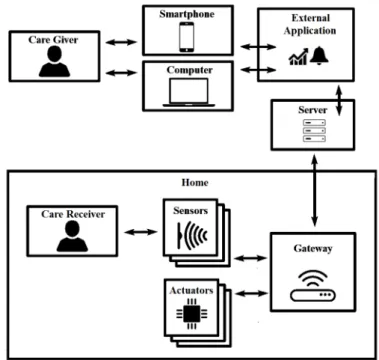
5.1 Architecture of the application scenario. . . 56
5.2 Main components used in the application scenario. . . 59
5.3 Deployment view depicting the connection between the body sensors and the sys-tem’s gateway. . . 63
5.4 Assembling of the ambient sensors and the ESP32 module. . . 64
5.5 Deployment view depicting the connection between the ambient sensors and the system’s gateway. . . 64
5.6 Deployment view depicting the connection between the actuators and the system’s gateway. . . 65
5.7 Dashboard’s widgets for the visualization of real time data. . . 65
5.8 Dashboard’s widgets the visualization of historic data. . . 66
5.9 Dashboard’s interface for alert management. . . 66
5.10 Deployment view depicting the connection between the system’s gateway and the system’s server. . . 67
5.11 Architecture illustrating the test case for temperature/humidity features. . . 70
5.12 Architecture illustrating the test case for heart rate monitoring features. . . 71
5.13 Architecture illustrating the test case for air quality monitoring features. . . 72
5.14 Architecture illustrating the test case for luminosity features. . . 73
5.15 Architecture illustrating the test case for weight monitoring features. . . 74
5.16 Architecture illustrating the test case for blood pressure monitoring features. . . . 75
2.1 Related projects in the area of remote health monitoring: summary of deployment
scenarios and technologies. . . 11
2.2 Summary comparison of available IoT testing tools. . . 21
3.1 Test patterns identified. . . 28
4.1 Attributes for the class Reading. . . 46
5.1 Categorization of heart rate for different intervals, defined as a percentage of the MHR. . . 57
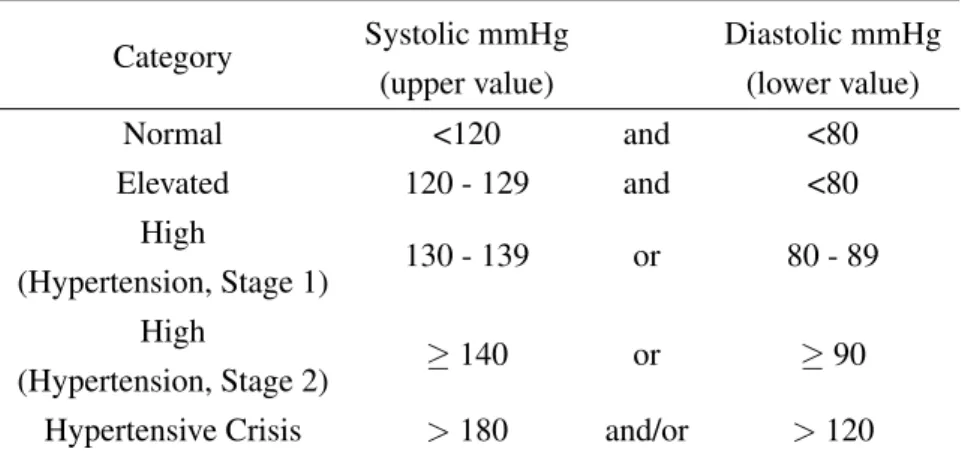
5.2 Healthy and unhealthy blood pressure ranges, as defined by the AHA. . . 57
5.3 Weight thresholds considered for the triggering of alerts. . . 58
5.4 Ambient condition parameters considered in the scenario and corresponding thresh-olds for the triggering of alerts. . . 58
5.5 Triggering conditions and respective actions considered in the scenario. . . 58
5.6 Devices and corresponding features. . . 68
AAL Ambient Assisted Living
AHA American Heart Association
AC Air Conditioner
API Application Programming Interface
BLE Bluetooth Low Energy
BPM Beats Per Minute
CI Continuous Integration
CoAP Constrained Application Protocol
EHR Electronic Health Record
GPRS General Packet Radio Service
GUI Graphical User Interface
HTTP Hypertext Transfer Protocol
IDE Integrated Development Environment
IoT Internet of Things
ISSTA International Symposium on Software Testing and Analysis
IT Integration Testing
LPWAN Low Power Wireless Personal Area Network
MBT Model-based Testing
MHR Maximum Heart Rate
MQTT Message Queue Telemetry Transport
NFC Near Field Communication
PPM Parts Per Million
REST Representational State Transfer
RFID Radio Frequency Identification
RPM Remote Patient Monitoring
ST System Testing
SUT System Under Test
UI User Interface
UML Unified Modelling Language
UT Unit Testing
Introduction
1.1 Context . . . 1
1.2 Objectives and Motivation . . . 4
1.3 Document Structure . . . 4
This chapter introduces the context, motivation, and the goals of this dissertation work. Finally, it presents the overall structure of this document.
1.1
Context
From its inception as a military experiment to becoming an integral part of everyday life, the Internet has come a long way. However, the journey is far from over. Now, we are entering the era of the “Internet of Things” (IoT), a time of even more pervasive connectivity in which anything and anyone, anywhere, are connected at anytime.
“IoT represents the next significant step in the Internet’s evolution” [TM17]. It envisions
a reality in which most devices will be connected to a network and interact with the physical environment through sensors and actuators, collecting and exchanging data.
Sensors gather data about the environment and once this data has been processed — either on the edge of the network or in a remote server —, some action is taken on the basis of the information extracted. That might involve directly modifying the physical world through actuators. These actions are often dependent on the state of the environment at a given point in time — in fact, this context awareness is one of the most important aspects of IoT [PZCG14].
IoT is a highly promising vision, and predictions show a rapid growth over the coming years both in terms of market value and the number of connected devices. According to the forecast in
Figure1.1, by 2020 the number of IoT connected devices worldwide will have grown to almost
predict different growth rates, they all show a rapid growth over the coming years. Despite the fact that some predictions can be viewed as unrealistic, it is safe to estimate that the number of IoT
connected devices worldwide will soon surpass the 10 billion mark [Nor16].
Figure 1.1: Evolution in the number of IoT connected devices worldwide from 2015 to 2025 [Sta01].
This technology is expected to impact our professional, personal and social environments, by allowing the development of new promising solutions in a variety of domains, including, but not limited to, agriculture, healthcare, utilities, and transportation, pushing towards the realization of
other concepts, such as smart cities and smart homes [Tan10, KBG13]. However, its impact on
healthcare will perhaps be its most important effect [Dim16].
In the not so distant past, health services turned to Electronic Health Records (EHRs), mo-bile health applications and electronic monitoring systems to improve the quality of patient care [VPZ12]. Nonetheless, these measures will likely prove insufficient to ensure the efficiency and safety of patient care in the future, as population aging and the increasing prevalence of chronic conditions put a strain on healthcare services.
The unprecedented aging of the population is a worldwide phenomenon — clearly noticeable
in Figure1.2— that shows no evidence of slowing down. Additionally, a population growth of 4%
is expected by 2050, a fact that will have profound implications in many aspects of everyday life [ESA01]. These demographic trends give rise to the need, on the one hand, to promote independent living and, on the other hand, reduce the increased pressure on health services.
Figure 1.2: Population aged 60 or over: world and development regions, 1950-2050 [ESA01].
Moreover, the last half century observed a continuous increase in the incidence and prevalence
of chronic conditions in most developed and developing countries [Wor01]. This wide range of
chronic conditions includes HIV/AIDS, tuberculosis, cardiovascular disease, diabetes, and long-term mental disorders, and their treatment comes at a high cost to society, governments, and families, and puts an additional strain on healthcare services [Wor01].
If the medical community is able to overcome its reluctance to embrace new technologies [SM14], integrating IoT features into medical devices will greatly improve the quality and effec-tiveness of health services, making it possible to cope with the issues of generalized aging of the population and with the increase in the prevalence of chronic conditions, while bringing especially high value for those requiring constant supervision.
By 2020, health-related technology will account for 20% of IoT market, and is projected to reach an estimated value of 1.335 trillion dollars that same year [Col17]. Even today, body sensors are no longer gadgets used exclusively by athletes, runners, and joggers and are making their way into the general market, while several other wearable devices to monitor a person’s health condition are being developed. With the increasingly common use of wearable devices such as smartwatches and fitness wristbands, we are already witnessing the convergence of healthcare and IoT, a trend which is expected to continue and, in addition to allowing a more independent life style, will revolutionize healthcare.
1.2
Objectives and Motivation
Current demographic and technological trends will likely drive to the emergence of IoT technol-ogy. Healthcare is only one of the domains that will benefit from the vast range of solutions IoT can provide. Thus, taking into consideration the range and scale of its applications, IoT will become an integral part of everyday life.
However, there are challenges associated with the development and testing of IoT applications and services, challenges that existing solutions have not yet properly addressed. Although there are already several tools that can be used in the testing of IoT systems, there are a number of faults that can be pointed out.
With the knowledge that failures in IoT applications can have dire consequences, the impor-tance of ensuring their correctness becomes apparent.
Nonetheless, implementing test suites and test cases covering multiple aspects, interfaces, and protocols is a demanding and tedious task, and it is from this fact that stems the need for a comprehensive test framework for IoT automated integration testing which will allow to ensure a solution’s conformity to the elicited requirements.
To address this issue, this work aimed to:
• Identify the short-comes of existing test solutions;
• Conceive a pattern-based approach that can be applied to various scenarios to test recurring behaviours in the scope of IoT, enhancing reuse;
• Develop a test framework for integration testing of IoT ecosystems that requires minimal technical knowledge and provides out-of-the-box functionality.
1.3
Document Structure
Beyond this introduction, this document is structured as follows:
• Chapter 2, Background and State-of-the-Art, provides some background on IoT and an
overview of the state-of-the-art in the field of software engineering and testing for IoT, along with a technological review of some tools that fit this scope, focusing on the engineer-ing challenges still to be tackled.
• Chapter3, A Feature Model and Test Patterns for IoT, introduces a feature model for IoT
ecosystems used in deriving a set of IoT test patterns, which are then further described.
• Chapter4, Izinto Test Framework, describes the framework developed with respect to its
functionality, its architecture, and implementation details.
• Chapter 5, Validation, describes the scenario considered for validating the framework —
in terms of its features, components, and architecture — and details the various test cases covered.
• Chapter6, Conclusion, concludes this dissertation with an overview of the work performed, outlines the contributions achieved throughout this dissertation, and lays out suggestions of future work.
• AppendixA, Configuration File Example, contains an example of a complete configuration
file, corresponding to the settings for testing the scenario considered for the purpose of validating the framework proposed.
• AppendixB, Scientific Publications, encloses — in full — the scientific publications written within the scope of this work of dissertation.
Background and State-of-the-Art
2.1 IoT Concepts, Architecture and Technologies . . . 8
2.2 IoT for Healthcare Ecosystems . . . 10
2.3 Software Development for IoT . . . 13
2.3.1 Challenges . . . 13
2.3.2 Existing Solutions . . . 14
2.4 Testing for IoT . . . 16
2.4.1 Challenges . . . 17
2.4.2 Existing Solutions . . . 18
2.5 Patterns and IoT . . . 22
2.6 Summary . . . 23
This chapter provides some background on IoT, with regard to key concepts, reference archi-tectures, and relevant technologies. Further on, it covers the application of IoT in the field of healthcare, reflecting on future applications and on the challenges specific to this domain, and listing some existing application scenarios. Then, an overview of the state-of-the-art in the field of software engineering for IoT is presented, with a focus on the engineering challenges posed by the development and testing of IoT systems. Particularly, a technological review of some tools that fit this scope is carried out and some background is provided on design patterns for IoT and related work on pattern-based approaches to testing.
2.1
IoT Concepts, Architecture and Technologies
The expression “Internet of Things” was first introduced by Kevin Ashton in 1999, used as the title of a presentation on supply chain management [Ash09]. Since then, its definition has become more inclusive, spanning various application domains — including home automation, smart cities, social life and entertainment, health and fitness, smart environment and agriculture, supply chain and logistics, and energy conservation [SS17].
Several definitions have been proposed. It can be viewed as the interaction between the physi-cal and digital worlds by means of sensors and actuators [VFG+09]. In a more convoluted way, it can be defined as the paradigm in which computing and networking capabilities are embedded in virtually any object and used to query and change the state of the object [ITU05].
The core infrastructure of an IoT framework is made up by sensors, actuators, servers, and the
underlying communication network [SS17].
Although there are several architectures proposed in the literature (Figures2.1and2.3) and
there is no consensus on a single architecture for IoT, we can distinguish a general three-layered architecture [AFGM+15,IKK+15], as depicted in Figure2.1, which captures the main idea of IoT, consisting of three distinct layers: a perception layer, a network layer, and an application layer.
The perception layer corresponds to the physical layer made up by the sensors used for sensing and gathering data about the environment. There are various types of sensors. They are usually of small size, have low cost, and low power consumption. The smartphone — which has embedded in
itself several different sensors — can be considered the most popular sensing device [LML+10],
but the use of other types of sensor is becoming increasingly common, such as it is the case of sensors for measuring temperature, pressure, humidity, physiological body parameters, and
chemical and biochemical substances [SS17].
In turn, the network layer enables the connection between the various devices, allowing for the transmission and processing of sensor data. IoT network technologies include Ethernet, cel-lular and WiFi networks, as well as new networking technologies being developed specifically to meet the challenges of IoT, such as Low-Power Wireless Personal Area Networks (LPWANs), Bluetooth Low Energy (BLE), ZigBee, Near Field Communication (NFC), and Radio Frequency Identification (RFID) [Ger18].
Lastly, the application layer delivers application specific services. The application layer is therefore responsible for data processing and presentation. This layer can be based in different
communication protocols for IoT devices, ranging from HTTP [FGM+99] to other novel protocols
for IoT environments such as Message Queue Telemetry Transport (MQTT) [OAS14] and
Con-strained Application Protocol (CoAP) [SHB13]. For each scenario, the most appropriate protocol
will depend on the specific requirements, as each protocol has its own strengths and drawbacks [Pat14].
Figure 2.1: Three-layered architecture.
The ability to collect data from large numbers of sensing devices and the need for processing
that data to obtain useful information as illustrated in Figure2.2makes Cloud Computing, Data
Visualization, Data Analysis, Machine Learning, and other Big Data topics, research areas with great business potential [SLMN15].
Figure 2.2: Detailed view of the emerging end-to-end IoT architecture, including its individual
Although cloud computing services can scale in ways that meet IoT’s storage and
process-ing requirements, there are applications that require low latency [GVGB17]. That is the case of
health monitoring, as delays introduced by the transfer of data between devices at the edge of the
network and the cloud can significantly hinder performance [GVGB17]. Figure2.3 shows the
Edge-Fog Cloud architecture, which follows a Fog computing paradigm and where cloud services
are extended to the edge of the network to decrease latency and network congestion [GVGB17],
as proposed in [MK17]. The edge layer corresponds to an assortment of loosely coupled devices
— the sensors, actuators, and other user devices. The fog layer resides on top of the edge layer and is made up by a set of networking devices — such as routers, and switches — able to run application logic. As a consequence, the core of the Edge-Fog Cloud architecture — the cloud — acts primarily as a repository for storing data.
Figure 2.3: Edge-Fog Cloud architecture for IoT [Spo17].
2.2
IoT for Healthcare Ecosystems
IoT applications are expected to impact several domains, but its impact on healthcare will perhaps
be its most important effect [Dim16]. Healthcare is a far-reaching field, encompassing personal
healthcare, the pharmaceutical industry, healthcare insurance, robotic prosthetics, and bio-sensors, and, therefore, the list of potential IoT applications in this area is endless [iS].
In [IKK+15], a comprehensive survey of IoT for healthcare is presented, reviewing the state-of-the-art network architectures, applications, and trends in IoT healthcare solutions.
In [MHAK17], a scenario consisting of a Wireless Body Sensor Network (WBSN) and a smart health gateway is used to analyse the issue of IoT security from the healthcare perspective, and confidentiality, integrity, and availability are listed as key security requirements.
The challenge imposed by the heterogeneous nature of IoT systems is the subject of [YD11],
in which is demonstrated that medical device data compliant with ISO/IEEE 11073 — a group
of standards addressing the interoperability of personal health devices [Sta10] —, can easily be
of electronic health information [Hl08]—, facilitating the interoperability of clinical applications and medical devices.
For now, the two main IoT use cases for healthcare are the remote health monitoring and the
tracking, monitoring, and maintenance of assets using RFID technology [iS]. Only by combining
IoT solutions with applications and technologies in the field of robotics [GRC+14], artificial in-telligence [ALNT14], and data mining [TLCY14] will it be possible to leverage the full potential of IoT.
Health sensing components are becoming ever more compact and portable, allowing them to be worn round the clock, continuously monitoring and recording health conditions and to trigger alarms in case any abnormality is found so that proper actions can be taken. The data collected can also be used to create detailed EHRs, with all the medical details of a person, generating statistics
which enable the surveillance and risk mapping of some diseases [SK16].
Remote Patient Monitoring (RPM) and Ambient-Assisted Living (AAL) are currently the main focus of IoT research in the field of healthcare. RPM and AAL systems make independent living possible for the elderly and enables patients with chronic or serious health conditions to avoid a prolonged hospital stay or reduce the number of visits to medical facilities, by allowing them to be monitored and advised from anywhere.
Because most IoT research in the field of healthcare has been focused on improving the quality of care through remote health monitoring solutions [iS], there is already some work in the area of
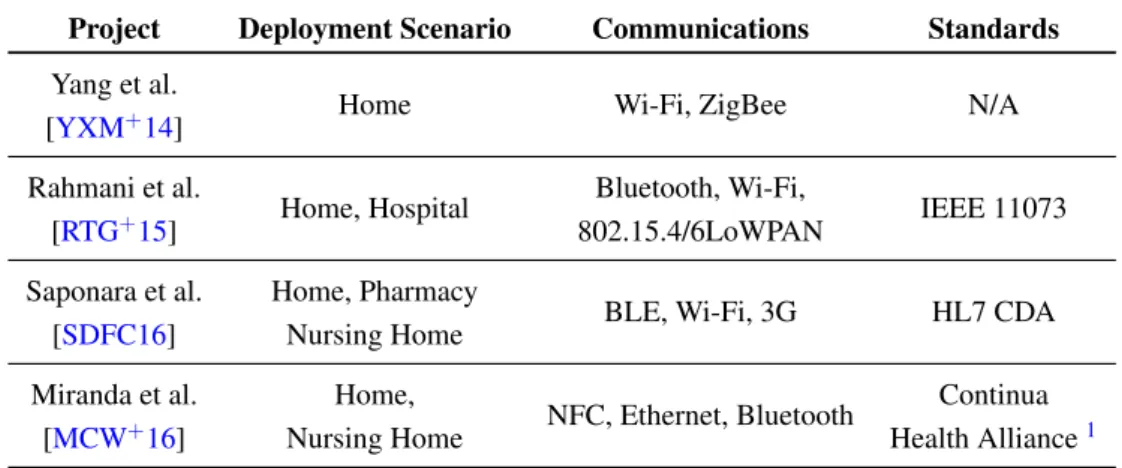
RPM and AAL, presenting solutions designed for specific deployment scenarios (Table2.1).
Project Deployment Scenario Communications Standards
Yang et al.
[YXM+14] Home Wi-Fi, ZigBee N/A
Rahmani et al. [RTG+15] Home, Hospital Bluetooth, Wi-Fi, 802.15.4/6LoWPAN IEEE 11073 Saponara et al. [SDFC16] Home, Pharmacy
Nursing Home BLE, Wi-Fi, 3G HL7 CDA
Miranda et al. [MCW+16]
Home,
Nursing Home NFC, Ethernet, Bluetooth
Continua Health Alliance1
Table 2.1: Related projects in the area of remote health monitoring: summary of deployment scenarios and technologies.
Yang et al. [YXM+14] presented an intelligent home-based platform — the iHome Health-IoT. It involves a medicine box — iMedBox —, a pharmaceutical packaging — iMedPack —, and a wearable bio-medical sensor device — Bio-Patch. The proposed platform allows the seamless integration of in-home healthcare devices and services, and is enabled by Wi-Fi, ZigBee, and RFID.
Rahmani et al. [RTG+15] proposed a conceptual gateway aimed at healthcare applications for
hospitals and private homes — the Smart e-Health Gateway —, with support for several commu-nication technologies such as BLE, Wi-Fi, and 6LoWPAN. Their work also included the develop-ment of a proof-of-concept IoT remote health monitoring system for gathering and storing electro-cardiography (ECG) data collected using wireless sensors. It focused on the implementation of the actual gateway and on technical aspects related to energy efficiency, scalability, interoperability, and reliability issues.
Saponara et al. [SDFC16] introduce a remote healthcare model, which exploits wireless
bio-medical sensors and a local gateway, responsible for sensor data acquisition, sending the data to a remote e-Health service centre after processing it to provide statistics and alerts about possible medical conditions. It is directed at the continuous and long-term monitoring of patients affected by chronic illness, and can be deployed either at the patients’ home, or in a healthcare unit.
Miranda et al. [MCW+16] present a platform — the CRIP — which aims at supporting
care-givers and citizens to manage health routines. NFC and fingerprint bio-metrics are used for iden-tification and authentication, while Bluetooth and Ethernet enable communication with health devices and web services for wider integration with other platforms.
2.3
Software Development for IoT
2.3.1 Challenges
In the age of IoT, everyday devices are becoming connected, remotely and dynamically pro-grammable. It is important to understand that IoT development differs from most typical mobile and web applications in several aspects, something that IoT developers must take into account.
The paradigm shift brought on by the IoT is making apparent that today’s development meth-ods, languages, and tools are poorly suited to face the challenges and technical issues that arise from the emergence of millions of programmable things in our everyday life. The work of
Taival-saari and Mikkonen [TM17] highlights such challenges — which are summarily presented next
—, providing a road-map to this new “programmable world”.
The first of these challenges pertains to the distributed, and always-on nature of IoT systems. From the software developer’s viewpoint, the possibility of device failure, and intermittent and often unreliable network connections require constantly preparing for failure. Though these char-acteristics are not new to software developers, they require them to program in a fault-tolerant and defensive manner. In doing so, developers incur the danger of writing too much code to handle po-tential errors and exceptions, thus making these systems much more difficult to maintain. Ideally, programming languages should make it easier to balance application logic and error handling.
The inadequacy of programming languages and development tools is a problem, as IoT de-velopment currently relies, for the most part, on mainstream programming languages, such as C, C#, Java, JavaScript, or Python. In fact, due to their popularity in web development, Node.js and JavaScript are becoming prominent tools for IoT development, even though not designed for writing asynchronous, distributed applications or for programming-in-the-large.
A related issue is that of multi-device programming. IoT devices are part of large, and highly dynamic systems, which must be managed and maintained. However, facilities for orchestrating such systems and mechanisms to allow flexible code migration are not widespread, making it harder to make development-and-deployment a standard practice for automating software delivery. With IoT systems being an amalgamation of devices with varying computing power, storage capabilities, network bandwidth, and energy requirements, heterogeneity poses yet another major challenge. If, on the one hand, interoperability of such diverse devices calls for well-defined standards, on the other hand, it may be desirable to explore this diversity so as to develop solutions which optimize efficiency, for instance, in terms of power consumption or network usage.
Last but not least, security is a concern of paramount importance. By advancing the way we monitor and track ourselves and the things around us, what we do with the data collected — and how it is sent across networks — can get sensitive. Because IoT creates such unique challenges to privacy, end-to-end security should be considered, including authentication and encryption. However, concerns will no longer be limited to privacy and the protection of sensitive information, since remote actuation and programming capabilities can pose an even higher threat to safety.
2.3.2 Existing Solutions
At the moment, no universal software development environments exist that will allow developers to effortlessly write one IoT application that runs on all types of devices, nor for the orchestration
and management of such large, and complex systems [TM17].
From an architectural stand point, a variety of design patterns have been observed and
docu-mented, establishing patterns that represent some key aspects of the IoT domain [CHA16]. Still
with respect to design, the ThingML — Internet of Things Modelling Language — is inspired by the idea of the Unified Modelling Language (UML), and aims to address the challenges of distri-bution and heterogeneity in IoT, whilst facilitating collaboration between service developers and
platform experts [MHF17]. Specifically, it allows writing code in a platform-independent way and
compiling it to different platforms. In addition, it is possible to write platform specific components and link them to exiting Application Programming Interfaces (APIs) or libraries. This approach has evolved over the past years and it has been applied to different domains, including the case of a commercial e-health application for fall detection [MHF17].
For development purposes, there are a number of tools to support the development of IoT
solutions, designed to help developers explore IoT devices and applications [Smi]. These include
IoT operating systems, IoT hardware platforms, IoT middleware tools, and IoT platforms [Smi].
Lightweight operating systems — such as Contiki [DGV04], and more recently RIOT [BHG+13]
—, have been developed and used as software platforms upon which it is possible to implement
network stacks and applications running on IoT devices [RWBO15].
IoT hardware platforms include development boards such as Arduino, Espruino, Intel’s Galileo, and Tessel [TM17].
A key technology in the realization of IoT systems is middleware. Middleware platforms abstract hardware details by providing an API for communication, data management, computation,
and security [SS17]. A number of middleware solutions are currently available, such as Oracle’s
Fusion Middleware2, OpenIoT3, and Kaa4.
OpenIoT is an open-source platform which enables the integration of IoT data and applica-tions within cloud computing infrastructures, by allowing the deployment of and secure access to semantically inter-operable applications [SKH+15].
Kaa is a multi-purpose middleware platform for IoT that allows building complete end-to-end IoT solutions in an expedited manner [Tecb]. It provides an open-source, feature-rich toolkit for IoT development, offering a set of out-of-the-box IoT features that can be easily used to implement various IoT use cases [Tecb].
2https://www.oracle.com/middleware/ 3http://www.openiot.eu/
IoT platforms can be divided into two categories: the platforms which provide cloud services
for IoT solutions — such as IBM Watson5, Azure6, and AWS7—, and the tools which support
the development process — as it is the case of Eclipse IoT8, Node-RED9, and Flogo10.
Eclipse IoT provides technology to build IoT devices, gateways, and cloud platforms [Smi],
encompassing a number of projects and tools with focus on the development of IoT systems [Foub].
Node-RED is a prime example of a visual approach to software development. It is an Inte-grated Development Environment (IDE) which allows to quickly connect a wide range of hardware
devices and software to web services [BL14]. It is a flow-based programming tool that makes it
easier to create even very advanced applications by wiring together graphical blocks — called nodes. Initially developed as an open-source tool at IBM in 2013, it has gained popularity as
a general purpose programming tool for IoT [CCH15], and there is a growing number of
open-source software components corresponding to different nodes.
Flogo is an ultra-lightweight development framework based on the Go programming language, capable of being run on a multitude of platforms — edge devices, gateways, cloud services — and
highly optimized for unreliable IoT environments [Wäh16]. Flogo supports the development of
IoT applications by integration and allows developers to work either by writing source code or by using the interface for visual coding, debugging, and testing [Wäh16].
In addition to the previous development tools already described, MySignals11was also
iden-tified, this one being specifically dedicated to the development of IoT healthcare applications. MySignals is a development platform for medical devices and healthcare applications. It allows the addition of several sensors to build custom solutions, measuring various different biometric parameters. This is a proprietary tool, and its use implies the subscription of a paid plan.
5https://www.ibm.com/watson 6https://azure.microsoft.com/ 7https://aws.amazon.com 8https://iot.eclipse.org 9https://nodered.org 10http://www.flogo.io/ 11http://www.my-signals.com
2.4
Testing for IoT
Testing is an important part of the software development process, being crucial to ensure a system’s compliance to both functional and non-functional requirements. In fact, verification and validation
activities are complex tasks and can amount to up to 75% of the development costs [HS02], making
testing automation essential.
The practice of merging code and automatically running a build process including tests in
production-like environments defines the concept of Continuous Integration (CI) [Guc], which
has emerged as a best practice for software development, being used extensively in the area of
web development, and increasingly so in the development of mobile applications [Mer06]. For CI
to be applied to IoT development, solutions for test automation will be required.
There are still no established good practices when considering a test strategy specific for IoT [Ger17]. Typically, the first level of testing is the testing of individual units — Unit Testing (UT) — , which can be applied to the test of the functioning of the components of each of the several layers of IoT (Figure2.4a). The next level of software testing is Integration Testing (IT), where individual units are combined and tested as a group with the purpose of exposing faults in the interaction between the units being tested [Fun], and it is critical to assure the proper interoperation between
the different layers of IoT (Figure2.4b). Finally, System Testing (ST) should be performed in a
manner transversal to all layers (Figure 2.4c), so as to evaluate the system’s compliance with its specified requirements.
(a) Breakdown of IoT applications into different layers for Unit Testing.
(b) Combination of different IoT applica-tion layers for Integraapplica-tion Testing.
(c) Abstraction of IoT applications for Sys-tem Testing.
In the context of IoT development, IT is of particular importance, as the definition of testing scenarios that go beyond checking separately the functionality of the individual components of the System Under Test (SUT) is crucial to ensure that not only does each component behave as expected, but they also work together as an IoT solution [Ger17].
2.4.1 Challenges
A number of challenges need to be overcome before the requirement of test automation is met and it becomes possible to achieve CI in the IoT [Mer06]. The effort and potential problems associated with the tasks of debugging and testing is likely to be underestimated by the vast majority of developers, who are not used to dealing with such issues, even though some are not necessarily
new [TM17]. Understanding the specifics of IoT and analyzing the most important technical
challenges are two crucial steps when preparing a testing strategy [Ger17].
As pointed out in [Pra17], testing IoT systems means performing end-to-end testing, and may
imply carrying out:
• Functional Testing to evaluate the SUT’s conformance to requirements;
• Compatibility Testing i.e., verifying and validating the possible combinations of commu-nication protocols and devices;
• Usability Testing so as to verify the SUT’s ease of using experience;
• Network Testing in order to validate the SUT with different network conditions; • Security Testing which includes verifying the SUT’s handling of data privacy;
• Performance Testing to ensure scalability and the overall performance of the SUT, for instance with respect to power consumption, and memory usage.
Non-functional requirements, namely those related to interoperability, connectivity,
scalabil-ity, and securscalabil-ity, tend to be difficult to test in a systematic way [Mer06]. IoT systems rely on
various closely-coupled hardware and software components. In order to ensure interoperability, it is necessary to test all possible software and hardware combinations, as it is not enough to adhere
to protocol specifications [RWBO15]. Another issue is that, because network connection plays a
vital role in the concept of IoT, these systems need to be tested in various network conditions — a testing methodology which takes into consideration various connectivity scenarios while focusing on ways to deal with security threats is required [Bis17].
Given the extremely dynamic nature of IoT systems, the debugging and testing these sys-tems — which often consist of a large number of devices, usually very distinct, and inserted into complex real-world environments — can be very challenging. This task can be made even more complex when the SUT has the ability to self-adjust and balance computation resources, network bandwidth, and battery consumption by re-allocating computation dynamically between its com-ponents [TM17].
Another difficulty has to do with the need for real time data and the interaction between the SUT and the environment. On the one hand, there is the problem of test data: exhaustive test data can be difficult to obtain for IoT projects, since it depends on real-world situations [Mer06]. Replicating these settings is not always possible, and so generating test data can be an alternative to collecting it from a real-world scenario. On the other hand, there is also the problem of simulating the actuation itself, since having physical actuators in a test environment is often not feasible.
These issues become even more problematic when the SUT is related to healthcare [Bis17].
While some tests can be conducted on device emulators or simulators, other tests might need to be performed on real devices, in order to ensure that the combination of software and hardware
works as specified [RWBO15]. Hence, it may be necessary to perform these tests in a network
consisting of real IoT devices, in a setup similar to that of the SUT.
In conclusion, testing automation of both software and hardware components is required to enact an automatic approach to the testing process and achieve systematic, and regular release processes.
2.4.2 Existing Solutions
The question of “what tools and frameworks can be used to efficiently test IoT systems” [RWBO15]
is relevant because, as seen, testing IoT applications is a complex task. Even so, up until now, both
research and industry have overlooked the topic of IoT testing to some extent [RWBO15].
Three distinct methodologies can be followed in IoT verification and validation: formal verifi-cation — proving or disproving the correctness of the SUT with respect to its specifiverifi-cation, using formal methods —, simulation — tools that allow designing, creating and testing IoT systems without actually using real IoT devices —, and pilot testing — which consists in deploying the SUT in a test environment as close as possible to the environment in which the system will be deployed.
The outline of a framework for automated testing must include protocol simulators, data col-lection capabilities, and virtualization [Pra17]. On the one hand, in the IoT the SUT is inherently
networked [RWBO15], and therefore it is important to test the communication between the various
device endpoints and interfaces under different network settings, and evaluate how the SUT will perform with respect to test metrics such as loss, delay, error, and quality of service. On the other hand, virtualization typically includes simulation tools, which enable the design, creation, and testing of IoT applications without actually using real IoT devices, minimizing the dependency on a real-time environment for testing.
Some software development and testing tools — such as ArduinoUnit [Mur13] and PlatformIO [Pla] — can be used for testing IoT applications, often relying on physical devices to conduct the testing, but focus mainly on the level of Unit Testing.
PlatformIO is an open-source IDE for IoT which offers several tools, including a cross-platform compiler, a library manager, a debugger, and a UT system. It makes it possible to perform UT only within the edge layer, specifically at the level of the individual physical devices.
ArduinoUnit is a UT framework for Arduino projects, which limits its application to perform-ing UT at the level of the individual physical devices within the edge layer [Mur].
Following an approach that resorts to a combination of model-based testing (MBT) techniques
and service oriented solutions, Ahmad et. al conceived MBTAAS [ABF+16] which allows to
systematically test IoT and data platforms.
Another possible approach to test IoT-based applications consists in using systems that
be-have like the SUT — emulators and/or simulators. TOSSIM [LL03] is a wireless sensor network
simulator, built with the specific goal of simulating TinyOS devices, supporting two program-ming interfaces — Python and C++ —, and allowing various levels of simulation, from hardware interrupts to high-level system events, such as packet arrivals.
Similarly, COOJA [ÖDE+06,ANR] is an extensible Java-based simulation/emulation
plat-form developed for the Contiki operating system. It provides a complete simulator for sensor node software, where the network, operating system and even the machine code instruction set are sim-ulated, allowing developers to test their code and systems before running it on the target hardware, allowing UT and IT of edge devices — both physical and simulated. COOJA has support for ra-dio link simulation, with recently added support for a more complex rara-dio interference simulation from Wi-Fi and Bluetooth.
Looga et al. presented an emulation platform for IoT — MAMMotH [LODYJ13]. Its
archi-tecture presumes three distinct scenarios based on General Packet Radio Service (GPRS) commu-nications. This is part of an ongoing project, with the ultimate goal of supporting nodes in the scale of tens of millions, and there are questions that are still open and need to be investigated in the future.
iFogSim is a simulator to model IoT and Fog environments which supports IT over virtualized devices — from within both the Edge and Fog layers —, but it focuses primarily on measuring the impact of resource management techniques in terms of latency, network congestion, energy
consumption, and cost [GVGB17,Gup].
IoTIFY is a comprehensive IoT simulation solution that makes it possible to develop and test IoT solutions in the cloud, by simulating large scale IoT installations in a virtual IoT lab [S.L]. It allows performing UT as well as IT using virtualized hardware and by generating traffic in real time via HTTP, MQTT, or CoAP to test a platform for scale, security, and reliability issues. This is however a commercial tool.
SimpleIoTSimulator is a simulator for creating IoT environments made up of a large num-ber of sensors and a gateway, supporting several of the common IoT protocols, including HTTP,
MQTT, and CoAP [Sim]. Though it is aimed at IT, the SimpleIoTSimulator does not allow the
modelling of Fog environments where services can be deployed both on edge and cloud devices [GVGB17].
To make it possible to test IoT systems as a whole, work has been pursued towards the devel-opment of IoT testbeds. A number of physical testbeds are already active and publicly available
[GKN+11]. Although these tend to cover multiple IoT layers, they usually focus on a specific
domain of application, and creating and maintaining these systems can be both complex and ex-pensive.
FIT IoT-LAB is a heterogeneous testing environment, consisting in an open testbed made up by various sensors available for experimenting with large-scale wireless IoT technologies [IL,
ABF+15]. It allows performing UT and IT remotely in a set of physical devices but it covers a
limited number of IoT use cases and applications.
Table2.2 presents a summary comparison of the IoT tools described above. Despite the fact
that there are several solutions for testing IoT systems, following different testing approaches and focusing different test levels, it is possible to identify several limitations in existing solutions. For a number of solutions presented in the literature — as it is the case with MBTAAS —, it is not possible to find actual tools or frameworks to support implementation, making it complex to adopt and use them. Other tools — including TOSSIM, and COOJA — focus on a specific platform, language, or standard, failing to account for the heterogeneity of the IoT field. Furthermore, most do not allow for the possibility of improvement or functionality extension — for instance, by not making source code publicly available —, and do not provide out-of-the-box functionality.
Tool IoT Layer Test Level Test Environ. Prog. Languages Supported
Platforms Scope License
PlatformIO Edge UT Physical
Device
C,C++,
Arduino Multiple Commercial Closed
ArduinoUnit Edge UT Physical
Device Arduino Arduino
Academic, Commercial Open MBTAAS Edge, Fog, Cloud UT, IT, ST
Platform OCL N/A Academic N/A
TOSSIM Edge IT Simulation Python,
C++ TinyOS Academic Open
COOJA Edge IT Emulation C ContikiOS Academic,
Commercial N/A MAMMotH Edge, Fog, Cloud IT,
ST Emulation N/A N/A Academic N/A
iFogSim Edge, Fog
IT,
ST Simulation Java N/A Academic Open
IoTIFY Edge, Fog, Cloud UT, IT, ST
Simulation N/A N/A Commercial Closed
SimpleIoT Simulator
Edge,
Fog IT Simulation N/A N/A Commercial Closed
FIT IoT-LAB Edge, Fog, Cloud UT, IT, ST Physical
Testbed N/A Multiple
Academic,
Commercial Open
2.5
Patterns and IoT
Patterns describe a problem and then offer a solution [CHA16].
The technological aspects of IoT systems and the details of their implementation reveal re-curring solutions for the common problems of the field, which can be described as design pat-terns. Although there is still a large number of recurrent solutions in the scope of IoT yet to be documented, efforts have already been made towards the definition and categorization of design patterns for IoT systems [CHA16]. Initial contributions in the context of defining these design pat-terns established patpat-terns representing some key aspects of the IoT domain were made by Reinfurt et al. [RBF+16,RBF+17]. Further work has been pursued in defining patterns that address how to deal with highly-changeable, error-prone and failing devices, and their networks [RDD+17].
If, on the one hand, design patterns help architects and designers build IoT applications of
varying levels of complexity [CHA16] and address some of the challenges to the development
of IoT solutions, on the other hand, pattern-based approaches have been proposed for testing
applications in other domains [PSCW10]. These approaches are based on the assumption that
systems similar in design, i.e., that follow the same set of design patterns, should share a similar test strategy.
Siddiqui and Khan [SK17] proposed a pattern-based technique for testing cloud applications
and identified a set of test patterns by studying what features this type of application would support. For the purpose of evaluation, they considered threats to cloud applications and discussed the applicability of these test patterns.
Moreira et. al [MPM13] put forward a pattern-based approach for Graphical User Interface
(GUI) modeling and testing in order to systematize and automate the testing process. The notion of User Interface (UI) test pattern is introduced, corresponding to the association of a set of test strategies to a UI pattern. Each UI test pattern may be instantiated so as to describe the slightly different implementations and check if a test is passed. Recognizing the need to develop test
strategies specific for the mobile world, Costa et. al [CPN14] performed an experiment to assess
if the same approach could be used to test mobile applications, which produced encouraging
re-sults. Morgado and Paiva [MP15] extended the set of UI test patterns previously mentioned by
2.6
Summary
More than a concept, IoT is an architectural framework for integration and data exchange between the physical and digital worlds over an underlying communication infrastructure.
IoT applications span several domains. In the case of healthcare, the focus is on the improve-ment of care, with some work already existing in the area of RPM and AAL, presenting solutions designed for specific deployment scenarios.
Nonetheless, there are several challenges to realizing IoT, such as scalability and interoper-ability, which are related to the plurality of devices, networks, and sensors involved, the various communication protocols employed and integration requirements.
If, from a technical point of view, these challenges create the need for new hardware develop-ment, new communication protocols and technologies, and new techniques to process and analyze the huge amounts of data collected, from a software engineering perspective there is also the de-mand for new development technologies, processes, methodologies, and tools.
The difficulty to test IoT systems as a whole — due to the number and diversity of individual components and the distributed nature of the system —, along with the difficulty to test said
components individually — due to the dependency on other components — [LF16], gives rise to
the need for an efficient and effective way to implement automated testing in IoT.
Test automation in IoT applications will make it possible to test various devices and services spread across different IoT layers, and in doing so, arrive at a common framework for fast software development. Although there has been some work put into the definition of patterns for IoT, no references to pattern-based approaches to testing IoT were found in the literature, even though this methodology has been explored in other domains.
Although there are already several tools that can be used in the testing of IoT systems, a num-ber of issues can be pointed out, such as focusing on a specific platform, language, or standard, hindering the possibility of improvement or extension, and not providing out-of-the-box function-ality.
A Feature Model and Test Patterns for
IoT
3.1 Feature Model . . . 26
3.2 Test Patterns . . . 28
3.2.1 Test Periodic Readings . . . 29
3.2.2 Test Triggered Readings . . . 31
3.2.3 Test Alerts . . . 33
3.2.4 Test Actions . . . 35
3.2.5 Test Actuators . . . 37
3.3 Summary . . . 38
This chapter explains the approach used to arrive at a set of Test Patterns for IoT ecosystems. It introduces a feature model for IoT ecosystems used to identify a set of IoT test patterns, which are then further described.
3.1
Feature Model
By its own nature, the field of IoT involves a wide variety of systems and devices with very diverse features and, consequently, any testing approach must take into consideration these differences.
The components of an IoT ecosystem can, generally speaking, be categorized and grouped according to their characteristics. Because the test of IoT systems is often closely related to these features, it is useful to devise a model that allows representing the plurality of components and their features within an IoT ecosystem. By identifying the different components of an IoT system and classifying each component in terms of its features, it is possible to determine which functionality must be tested and to select which test(s) pattern(s) should be applied accordingly. The model
depicted in Figure3.1is loosely based on the formalism of feature models [Bat05] and considers
four categories and subcategories: • Local Device
A local device can be either a sensor or an actuator. A sensor can be categorized in accor-dance to its reading mode, i.e., whether readings are performed automatically, in a periodic fashion and without human interaction, or, conversely, if readings are triggered by a user. Additionally, it is possible to differentiate sensors based on the way its data is transmitted — actively or passively. A sensor can actively send readings or keep data which must be retrieved. The ability of a sensor to measure various parameters as opposed to a single parameter is yet another differentiating factor.
• Hosting Device
The category of hosting devices corresponds to gateways, which can be defined by features such as reading, processing, and publishing data, and potentially trigger actions (either each time a condition is met, or each time a condition status changes).
• Remote Server
A remote server commonly handle communications and data persistence and may also sup-port the triggering of actions.
• External Application
External applications can support data visualization (either real time data or an historic record), and the generation of alerts (either each time a condition is met, or each time a condition status changes).
It is worth noting that this is only a partially-defined model, as there may be other characteris-tics and/or features that were not incorporated.
Read Data Publish Data
Trigger Type Trigger Type
Reading Mode Measurement Type
Actuator Periodic User Triggered Single Multiple Remote Server Communication Management Data Persistence Real Time Historic Data Visualization External Application Local Device Hosting Device Condition Met Condition Change IoT Sensor Condition Met Condition Change Alerts Feature (Sub) Category Domain Mandatory Mutually exclusive Gateway Trigger Action Trigger Type Condition Met Condition Change Trigger Action Server Process Data
3.2
Test Patterns
Taking into consideration the particularity of IoT systems, it is possible to recognize a set of test strategies to test recurring behaviours of IoT systems which can be described as test patterns. Because the implementation of a given functionality may differ across different IoT ecosystems, a given test pattern may be configured so as to describe slightly different implementations and verify if the various checks defined passed or failed.
Within the scope of this dissertation, five different test patterns were identified, as listed in Table3.1. These were derived from the feature model described in Section3.1, and reflect both key features of several system components and overall functionality that an IoT ecosystem commonly supports.
Pattern Description
Test Periodic Readings
Check whether a sensor is capable of performing readings at a fixed rate and that those readings are correctly transmitted
and persisted within the IoT system Test Triggered
Readings
Check whether a sensor is capable of performing measurements triggered by a user and that those readings are correctly
transmitted and persisted within the IoT system
Test Alerts Check whether alerts are sent to pre-set subscribers whenever
a pre-set condition is met
Test Actions Check whether pre-set actions are executed whenever a pre-set
condition is met
Test Actuators Check whether an actuator is capable of executing commands,
changing its state accordingly Table 3.1: Test patterns identified.
In order to make these patterns reusable and to facilitate the definition of more patterns, a
template based on the one proposed by Meszaros and Doble [MD97] was used. Each pattern is
distinguished by a name and further described through various fields, defined as follows: • Name: unique identifier to shortly refer the pattern;
• Context: situation where the problem occurs;
• Problem: description of the problem addressed by the pattern; • Solution: description of the proposed solution for the pattern; • Example: example where the (IoT Test) pattern can be applied.
3.2.1 Test Periodic Readings
Name:
Test Periodic Readings Context:
Under the paradigm of IoT, all things will be connected to the Internet and interact with the physical environment through sensors, collecting and exchanging data. Being equipped with sens-ing capability, these devices can periodically perform measurements on a number of parameters and transmit this data — either actively or passively, depending on their degree of autonomy. Problem:
It must be ensured that a sensor is capable of performing readings at a fixed rate and that those readings are correctly transmitted and persisted within the IoT system, under normal operation.
Therefore, it is necessary to:
• Check that the readings are performed with the pre-set periodicity, with acceptable devia-tions;
• Check that the readings are transmitted with a delay below a pre-set maximum; • Check that the readings are correctly transmitted;
• Check that the readings are valid and, optionally, that variations are observed.
Solution:
The test pattern for this type of behavior is only applied when a sensor supports the periodic execution of readings and consists of the following steps:
1. Setup the sensor(s);
This may include specifying the type of readings to be performed and setting an adequate rate for each type.
2. Setup a gateway (optional);
This may include configuring it to maintain a log of the data collected, so that it can be compared with the data persisted.
3. Induce some variation in the parameter(s) being measured (optional);
In some cases, it may be possible to use an actuator to produce those variations. In the cases in which that is not feasible, it may be possible to resort to human input to produce those variations.
4. Verify if valid readings are persisted within the IoT system, at the expected rate, accounting for possible transmission delays.
The validity of the readings relates to their value — specifically, whether pre-set thresholds and/or trends are observed — and to the consistency across the several points of the IoT system considered. Checking if the readings are performed with the pre-set periodicity and accounting for possible deviations and transmission delays may be done by checking the timestamps of reading and reception, assuming that the different components’ clocks are synchronized.
It should be noted that the total runtime for the test must be defined taking into account the periodicity of the readings, so as to ensure that a sufficient number of measurements are performed. Example:
Take an IoT system which consists of temperature and air quality sensors, which are setup to periodically perform measurements of the environment the system is in. The temperature sensors are expected to perform temperature readings every five minutes and are capable of measuring
temperatures from -40oC up to 80oC. The air quality sensors measure the level of Carbon
Monox-ide (CO) and Carbon DioxMonox-ide (CO2) every minute, in Parts Per Million (PPM). Using this pattern
it becomes possible to ensure that all sensors perform these readings at the expected rate and that those readings are correctly transmitted and persisted within the IoT system. This pattern can be instantiated simply by providing a set of inputs, including the test runtime, sensor settings — with regard to id, type of readings performed, expected periodicity, acceptable deviation and delay, and expected value ranges —, and the means for accessing the data collected.
3.2.2 Test Triggered Readings
Name:
Test Triggered Readings Context:
IoT devices are meant to work in concert for and with people at home, in industry or in the enterprise. In a number of situations, users are expected to trigger readings, commanding the sensor to perform measurements on a number of parameters and to transmit this data — either actively or passively, depending on their degree of autonomy.
Problem:
It must be ensured that a sensor is capable of performing measurements triggered by a user and that those readings are correctly transmitted and persisted within the IoT system, under normal operation.
Therefore, it is necessary to:
• Check that the readings are transmitted with a delay below a pre-set maximum; • Check that the readings are correctly transmitted;
• Check that the readings are valid and, optionally, that variations are observed.
Solution:
The test pattern for this type of behavior is only applied when a sensor supports the triggering of readings and consists of the following steps:
1. Setup the sensor(s);
This may include specifying the type of readings to be performed. 2. Setup a gateway (optional);
This may include configuring it to maintain a log of the data collected, so that it can be compared with the data persisted.
3. Trigger the readings;
In some cases, it might be possible to use an actuator to trigger the reading, or — in the cases in which that is not feasible —, have a human do it.
4. Induce some variation in the parameter(s) being measured (optional);
In some cases, it may be possible to use an actuator to produce those variations. In the cases in which that is not feasible, it may be possible to resort to human input to produce those variations.
5. Verify if valid readings are persisted within the IoT system, at the expected rate, accounting for possible transmission delays.
The validity of the readings relates to their value — specifically, whether pre-set thresholds and/or trends are observed — and to the consistency across the several points of the IoT system considered. Checking if the readings are performed and transmitted within the max-imum acceptable delay may be done by checking the timestamps of reading and reception, assuming that the different components’ clocks are synchronized.
It should be noted that the total runtime for the test must be defined taking into account the time necessary to trigger the readings, and in a way that allows a sufficient number of measurements to be performed.
Example:
Take an IoT system which includes a blood pressure monitor, which can be used to check di-astolic and systolic pressure, as well as heart rate. Using this pattern it becomes possible to ensure that this sensor is capable of performing measurements triggered by a user and that those readings are correctly transmitted and persisted within the IoT system, by providing a set of inputs, includ-ing the test runtime, sensor settinclud-ings — with regard to id, type of readinclud-ings performed, acceptable delay, and expected value ranges —, and the means for accessing the data collected.
![Figure 1.1: Evolution in the number of IoT connected devices worldwide from 2015 to 2025 [Sta01].](https://thumb-eu.123doks.com/thumbv2/123dok_br/18743044.920840/22.892.139.707.262.581/figure-evolution-number-iot-connected-devices-worldwide-sta.webp)
![Figure 2.2: Detailed view of the emerging end-to-end IoT architecture, including its individual elements [TM17].](https://thumb-eu.123doks.com/thumbv2/123dok_br/18743044.920840/29.892.149.785.580.886/figure-detailed-view-emerging-architecture-including-individual-elements.webp)
![Figure 2.3: Edge-Fog Cloud architecture for IoT [Spo17].](https://thumb-eu.123doks.com/thumbv2/123dok_br/18743044.920840/30.892.186.664.453.699/figure-edge-fog-cloud-architecture-for-iot-spo.webp)