DEAL OF THE DAY INDUSTRY
Acquisition or retention of MYGON users: a case of DoD industry
sustainability
Dissertation by
Mariana Carvalho Rosa de Lencastre Ascenso Student number: 152114312
Thesis written under the supervision of
Professor Paulo Marcos
Dissertation submitted in partial fulfilment of requirements for the degree of MSc in Management, Major in Marketing at CATÓLICA-LISBON School of Business & Economics
ii
Acknowledgements
First, I would like to thank my family for always believing in my capacities during my academic life and for giving me so many enriching opportunities throughout my life. I would like to leave a special note to my dear mother who was tireless in helping me during my bachelor’s and master’s degree, always contributing a little bit towards every single project.
I am also grateful to my thesis supervisor, Professor Paulo Marcos, for all the feedback, guidance and support that he gave me throughout these last 4 months.
I would like to thank MYGON and the whole team for welcoming me so warmly, contributing key information for the completion of this dissertation during my training period in the company these past 4 months. Special thanks also to Carlos Bispo, former Marketing Manager, as well as to Ricardo Vilares, CEO, for believing in me and giving me this great opportunity of working at MYGON and hopefully also contributing towards its future success.
Last but not least, I would like to thank my best friends from the bottom of my heart for always believing in me and motivating me. A special thanks to Simão Praxedes who was always available to help me and who gave me the best feedback throughout the dissertation process. To Bernardo Estevens for his patient, motivating and unconditional support during such an important phase of my life, a big thank you, and to my fellow students, Mariana Carriço and Margarida Freire, all my gratitude for their friendship and support during my bachelor’s and master’s degrees.
iii
Abstract
Dissertation Title: Acquisition or retention of MYGON users: a case of DoD industry
sustainability
Author: Mariana Carvalho Rosa de Lencastre Ascenso
MYGON is a Portuguese startup on daily deals set up in 2012. In Silicon Valley, the company was considered a potential global business with its innovative business model in the Deal of Day Industry in 2013 when the growth rates in this industry were still increasing. However, in the beginning of 2016 the results are completely different, the industry is stagnant, and the main players are struggling to survive and have even changed their business models. While looking at the sustainability of its business model, the question now is whether MYGON should enlarge its user base through constant acquisition of new users or retain its existing registered users, trying to turn them into real customers?
This dissertation provides a broad overview of relevant marketing topics in the Literature Review, both online customer acquisition and online customer retention, applied to the Deal of the Day Industry. Additionally, a Case Study about MYGON is included with a Teaching Note, where instructions are provided for in-class discussion. A Market Research is also conducted with an In-depth Interview with MYGON’s CEO and Marketing Manager, a Focus Group, a Win-back Survey, and an Online Survey. In conclusion, the implications of the findings as to which direction the Portuguese company should take are also discussed.
Keywords: Online Group Buying, Deal of the Day Industry, Customer Acquisition Online ,
iv
Resumo
Título da Dissertação: Aquisição ou retenção de utilizadores da MYGON: um caso de sustentabilidade na indústria Daily Deals
Autora: Mariana Carvalho Rosa de Lencastre Ascenso
A MYGON é uma startup portuguesa de daily deals criada em 2012. Esta empresa foi considerada um negócio de dimensão potencialmente global com o seu modelo inovador de negócio na indústria de Daily Deals, em 2013, em Silicon Valley, altura em que as taxas de crescimento desta indústria ainda estavam em alta. No entanto, no início de 2016, os resultados são completamente diferentes, a indústria estagnou e os principais intervenientes estão a lutar por sobreviver, tendo modificado os seus modelos de negócio. Olhando para a sustentabilidade do modelo de negócio, resta saber, agora, se a MYGON deve ampliar a sua base de utilizadores através de um esforço constante de aquisição de novos utilizadores ou se deve reter os utilizadores já registados, procurando torná-los verdadeiros clientes?
Esta dissertação proporciona uma ampla panorâmica dos relevantes tópicos de marketing recolhidos na Análise da Literatura, quer a nível da aquisição quer da retenção de clientes online, aplicada à indústria de Daily Deals. Além disso, foi incluído um Estudo de Caso acerca da MYGON juntamente com uma Nota de Ensino, onde são fornecidas instruções para discussão em aula. Também foi realizada uma Pesquisa de Mercado incluindo uma Entrevista Aprofundada com o CEO e o director de marketing da MYGON, um Focus Group, um Questionário de recuperação de antigos utilizadores e um Questionário Online. Finalmente e em conclusão, também são abordadas as implicações dos achados sobre a direcção que esta empresa portuguesa deve tomar no futuro.
Palavras-chave: Compras Colectivas Online, Indústria de Daily Deals, Aquisição de Clientes
v
Contents page
1. INTRODUCTION ... 7 1.1. PROBLEM STATEMENT ... 7 1.2. RESEARCH QUESTIONS: ... 7 1.3. METHODOLOGY... 81.4. ACADEMIC AND MANAGERIAL RELEVANCE OF RESEARCH ... 9
2. LITERATURE REVIEW ... 10
3. CASE STUDY ... 14
3.1. MYGON - KEEPING ITS BUSINESS MODEL SUSTAINABLE ... 14
3.2. DEAL OF THE DAY (DOD) INDUSTRY ... 15
3.3. THE USERS OF DAILY DEALS WEBSITES IN THE PORTUGUESE MARKET ... 18
3.4. COMPANY OVERVIEW ... 21
3.4.1. MYGON – My Geo Offers Network ... 21
3.4.2. The Business operations Model ... 23
3.4.3. MYGON – Offers Range ... 24
3.4.4. MYGON – The Users ... 25
3.4.5. Communication strategy ... 29
3.4.6. MYGON’s Positioning in the Portuguese market ... 29
3.4.7. Retention Strategy ... 32
3.5. MERCHANTS ROLE IN THE ACQUISITION AND RETENTION OF USERS ... 37
3.6. SUSTAINABILITY IN THE DOD INDUSTRY ... 39
4. MARKET RESEARCH ... 40
4.1. IN-DEPTH INTERVIEW ... 40
4.2. FOCUS GROUP ... 40
4.3. GOLD INACTIVE WIN-BACK QUESTIONNAIRE ... 40
4.4. ONLINE SURVEY ... 41
4.4.1. Survey Purpose ... 41
4.4.2. Sample Description ... 41
5. CONCLUSIONS ... 42
5.1. CONCLUSIONS AND RECOMMENDATIONS FOR MYGON ... 42
5.2. LIMITATIONS AND SUGGESTIONS FOR FUTURE RESEARCH ... 45
6. TEACHING NOTES ... 46
6.1. SYNOPSIS ... 46
vi 6.3. TEACHING PLAN ... 47 7. EXHIBITS ... 53 8. REFERENCES ... 83 8.1. ACADEMIC REFERENCES ... 83 8.2. OTHER REFERENCES ... 84
7
1. Introduction
1.1. Problem StatementIn 2012, MYGON entered the Deal of the Day (DoD1) Industry with a new and innovative business model – there are no coupons and payments online – which resulted in a Silicon Valley award in 2013. Four years have gone by and in the meantime Groupon, which was the biggest player, decided to leave the Portuguese market in the beginning of this year, 2016. Although there are still a lot of companies operating in the Portuguese market, the industry itself is stagnant and struggling to be sustainable in a near future. During these four years MYGON has been growing in the Portuguese market as the only company operating in the DoD industry with this new business model. Recently, a copycat emerged with the same business model, Carrega Descontos, and MYGON has to fight in order to keep its first mover advantage while proving its business model is sustainable. Since MYGON was set up, the company has been focusing on enlarging its user base in the Portuguese market, whilst simultaneously facing the problem of retention of its existing users due to its high attrition rate. In order to keep growing and considering that there is a restrained budget and a limited timeframe, while looking at the sustainability of its business model, MYGON is currently facing a dilemma: should MYGON keep focusing on enlarging its user base through
constant acquisition of new users or should it focus on retaining its existing registered users, trying to turn them into real customers?
1.2. Research Questions:
RQ1: Which characteristics describe the DoD Industry? RQ2: Who are the users of daily deals websites in Portugal? RQ3: What is MYGON’s STP2 in the Portuguese market?
RQ4: How could the merchants play a role in the acquisition and retention of users in this
business model?
RQ5: To what extent is MYGON’s business model in the DoD industry sustainable in terms
of retaining its users and attractive in terms of acquiring new ones?
1
Term used for Deal of the Day 2
8
1.3. Methodology
This study contains primary data collected from the company, its current users, and consumers in the Portuguese market, as well as secondary data collected in MYGON during the period of thesis execution (internal data) and external data about the DoD industry. The research focuses only on the Portuguese market and on MYGON only in its capacity as a daily deal company.
In order to answer the proposed Research Questions, primary data was used such as the In-depth Interview with Carlos Bispo, Marketing Manager, and Ricardo Vilares, CEO, regarding the challenges the company is facing in 2016 as well as the company’s retention and acquisition strategies. In addition to the qualitative research, a Focus Group was conducted with daily users who have never heard of and/or have never used MYGON in order to understand participant’s behavior towards daily deals and their perceptions about daily deal websites/apps with a view to assessing their potential interest in MYGON’s business model. Furthermore, part of this research was also quantitative, and was carried out by conducting two surveys: one directly with MYGON Gold Inactive Users3 by phone as a win-back strategy in order to understand why those users stopped using MYGON (243 respondents) – users’ general opinion and suggestions were asked; the other, a more general survey, targeting all Portuguese consumers with 295 valid responses in order to determine who the daily deal users in Portugal are exactly, their behavior and perceptions, and the positioning of MYGON in the Portuguese market. It was important to have consumers of both genders, with distinct income levels, from all age groups and with different backgrounds.
Secondary data came mainly from MYGON internal data, such as more specific information about the company, its offers, users’ behavior and segmentation. This work was also supported by information available on the Internet, including MYGON’s main website/application, and other relevant data about the DoD industry in Portugal.
3
9
1.4. Academic and Managerial Relevance of Research
The reason why the daily deals topic was chosen for study is that it is a hot topic both worldwide and in Portugal at the moment. Groupon, the company which has shown one of the fastest growing ever is nowadays struggling to survive and has recently left six international markets, including Portugal. The sustainability of the daily deal business model is an issue which has been discussed recently, since Groupon and other daily deal websites had to change the model. Therefore, writing a case study about MYGON makes special sense since the Portuguese company was considered, in 2013, a global potential business in Silicon Valley for its innovative business model in the DoD industry, and this year, 2016, the company is facing a big dilemma. The aim of this study is to help the company understand which way to go in the long run, how to deal with some of the issues it is facing and, ultimately, understand the sustainability of its innovative business model in the DoD industry.
This dissertation focuses particularly on two main marketing topics: customer acquisition as well as customer retention, both online, as applied to Online Group Buying4.
4
10
2. Literature Review
This section aims to review some relevant marketing topics online such as Retention and Acquisition by providing a broad overview of academic articles. The way these topics are applied in the Online Group Buying contexts is reviewed in this section. The literature on some of these topics, especially applied to Online Group Buying, is still scarce, as mentioned by several authors. Therefore, some cited articles are not as recent as desirable, and were not published in top journals.
Online Group Buying
Erdogmus and Çiçek (2011) claim that Online Group Buying is one of the most successful and profitable online businesses which both sellers and buyers benefit from. Anand and Aron (2003) and Edelman et al. (2010) both claim that primarily, merchants enjoy discrimination advantages by drawing in price-sensitive customers and therefore attracting them to the organization, especially for merchants going through hard times. Secondly, merchants also benefit from advertising when a large number of consumers know about their existence, especially companies with low recognition. Despite these advantages, Dholakia (2010) states that not all the merchants of this kind find the online group buying system as profitable and valuable as they would like. A Harvard study by Gupta et al. (2012) shows that 50% of the merchants lose money with daily deal campaigns, however the type of business really matters for merchants’ success with daily deals - Restaurants are generally not successful whilst Beauty Care is generally successful. Byers J. et al. (2011) even claim that daily deals could have negative effect on the merchants’ reputation in the long run.
In the users’ perspective, daily deals make for an exciting and surprising shopping experience, whereby the users are faced with different offers each day by visiting the website or application or checking their emails. However, there are some concerns that Daily deal users are tired of e-newsletters, particularly since most deals are advertised this way, as Dholakia and Kimes (2011) studied.
Consumers are mainly motivated by savings: although there is a significant effect of both monetary and exploration motives (search for novelty and variety), monetary motives have a higher visible effect on enjoyment value in daily deals transactions (Erdogmus and Çiçek, 2011).
11
Customer Acquisition Online
The customer acquisition process is particularly important for startups and firms competing in growth markets, meaning that for such firms, acquisition is the most important expense. Villanueva et al. (2008) state that the company could have an illusion of profitable growth when actually it is only acquiring unprofitable customers. This happens in the case of many Internet Startups that invest a lot in acquisition, hoping to lock customer revenue in the future. Moreover, it is also known that the acquisition process has an important effect on future retention probability (Thomas, 2001).
Customer acquisition could either come about through costly and fast-acting investments, marketing-induced strategies, such as marketing actions (broadcast media and direct mail) or through slower but cheaper word-of-mouth processes such as spontaneous referrals. Villanueva et al. (2008) examined the long-term contributions for the company of customers acquired from marketing-induced strategies and WOM processes, since customers acquired through different channels are expected to generate different value for the company (Lewis, 2006). The study was applied in a Web hosting company and revealed that marketing-induced customers add more short-term value, but WOM customers add twice as much in the long-term value of the firm.
Customer Retention
“Overall satisfaction has a strong positive effect on customer loyalty intentions [which is interpreted as actual retention (Gustafsson et al. 2005)] across a wide range of products and service categories” (Fornell 1992; Fornell et al. 1996). Moreover, Lemon et al. (2003) point out that customer retention is not only influenced by customer satisfaction (considerations of current and past evaluations of the company’s performance) but also influenced by future consideration about the service (expected future use and anticipated regret).
Managers decide to have loyalty rewards programs since increased satisfaction and loyalty have a positive influence on long-term financial performance (Anderson et al. 1994). Kannan and Bramlett (2000) show that customers who are members of a loyalty reward program discount negative evaluations of the company when comparing with the competition. The reason for this is that members perceive they are getting better quality and service for the
12 price they are paying, “good value”. Verhoef (2003) claims that although the effect is small, loyalty rewards programs that provide economic incentives positively affect customer retention as rewards can be highly motivating.
Recent studies such as Kumar et al. (2015) claim that ““lost” customers may pose a rewarding “last-resort” opportunity” for service firms with high attrition rates. The increasing interest in winning back the customers may be explained by the accepted notion that the acquisition of new customers is more expensive for the company than retaining existing customers (Stauss and Friege, 1999). Kumar et al. (2015) argue that the reason of defection and the win-back offer are indicative of how long customers will stay with the firm after reacquisition and how much the customers will spend. The study concludes that the stronger the first-lifetime relationship with the company, the higher the likelihood that the customer accepts the win-back offer.
Customer Retention Online
Vatariasombut et al. (2014) state that industries based on the Internet have advantages in that this gives companies a global presence and allows them to quickly acquire new customers in a cost-effective way. On the other hand, the Internet represents increasing competition, therefore reducing the likelihood of companies retaining customers in the long term. The author refers to three different forces which undermine customer retention in the Internet environment: reduction in users’ search costs; lower barriers to entry; and reduced distinctiveness of companies. The most important finding is that, for companies with a large online customer base, “the retention efforts should start with the categorization of users by their technological sophistication” (Vatariasombut et al. 2014), meaning the company should segment the current online customers according to their level of sophistication and address each segment according to their different needs.
Since the entry and switching costs are very low in the DoD industry, competition is huge. As price considerations are critical for these consumers, they have higher propensity to switch to another provider if a better offer is available (Krishnamurthi and Raj, 1991). Therefore it is challenging to maintain a loyal customer base in this industry. Nevertheless, promoting user loyalty in DoD platform and, therefore supporting sales, is the most important strategy to
13 ensure sustainability and long-term survival in the competitive DoD market (Krasnova et al. 2013).
Krasnova et al. 2013 found that customer loyalty is largely driven by monetary incentives, meaning that customers want to ensure better quality and save money. The same article states that merchant’s properties can decrease user’s intentions to repurchase if merchants fall short of users’ expectations concerning customer treatment standards. Hsu et al. (2014) also claim that the perceived merchants’ product/service quality is a big issue when people talk about the offers of daily deal websites, and has positive influence on repurchasing intentions.
14
3. Case Study
3.1. MYGON - Keeping its business model sustainable
Founder & CEO, Ricardo Vilares, and Carlos Bispo, Marketing Manager, were both seated at the first monthly meeting of 2016 on a sunny day, four hardworking years after MYGON – My Geo Offers Network – was first set up. They were carefully analyzing the positive results along these first operating years of constant investment and increasing growth of the company. During these first years, they focused most of their attention on the constant acquisition (Exhibit 1)of new users with the new innovative concept and new business model in the DoD industry – MYGON as a startup won a Silicon Valley award in 2013 for being considered a global potential business. Whilst talking amongst themselves, an issue kept creeping up: how to keep growing both nationally and globally whilst keeping the business model sustainable. Having reached the 4-year mark, Ricardo and Carlos decided that the time had come to start focusing on where to invest based on the results and restrained budget in order to keep growing and be better equipped to stand up to the competition. During the meeting, two options came up while looking at the results. MYGON and its team could keep investing in the acquisition of new users since there is still room to invest in the Portuguese market and, in their opinion, many people in Portugal do not even know of MYGON’s existence; or, on the other hand, MYGON could focus on the retention strategy, since most of the users registered are not real customers at MYGON and a considerable number of them have given up booking through MYGON. While discussing these aspects, both of them wondered if investing more in an effective loyalty system would be a good option.
Nevertheless, MYGON has to decide which way to go this year in order to keep growing in the Portuguese market whilst looking at its business model sustainability. At the end of the meeting, two options were put on the table: either MYGON focuses more on enlarging its user base or focuses on retaining the company’s existing users.
15
3.2. Deal of the Day (DoD) Industry
The DoD Industryi is composed of companies that operate online and generate most of the revenue through discounts on local services, such as Restaurants or Beauty Care services, as well as local products for a limited time frame. In most of those companies, the products sold by their website or mobile application are given as vouchers that consumers can redeem at local merchants for the physical good or service. This business model allows the merchants to promote discounted services or products directly to the customers of the daily deal company. This allows the merchants to build brand loyalty and quickly sell surplus inventory or try to fill venues in low demand times. This means that the users purchase the deal on the daily deal websites rather than directly from the merchant, allowing websites to retain user data.
In most of the companies of this industryi, the revenue consists of “the price paid by the customer for the voucher or the coupon after paying an agreed-upon percentage of the purchase price to the featured business”. The vouchers usually expire after a certain period but the original value paid is maintained. Included in this industry are offers such as Restaurants, Beauty Care, Products, and other service deals.
The deal-of-the-day concept gained popularity with the launching of Woot.com in July 2004 with the “One Day, One Deal” concept, which was later bought by Amazonii. By the end of 2006, the DoD industry had grown, adding up to 100 daily deal sites. In November 2008, Groupon entered the market and became the second fastest online company to reach a billion-dollar valuationiii. Other types of businesses, such as Facebookiv and Google, have also tested their own daily deal sites, but without success. Nevertheless, the rise of social networks, including Facebook and Myspace, has accelerated the growth of daily deal sites, making some deals virally popular. Online Group Buying proved to be a successful system with Groupon, and in a very short time, lots of clone group buying websites appeared and spread throughout the world: Lashou in China and Ihergo in Taiwan.
16
Industry Global Trends
From 2009 to 2014, Daily Deal sites experienced a huge revenue growth due to several factorsi. Firstly, industry operators took advantage of the lower purchasing power whilst merchants tried to attract more customers. Moreover, the growing number of mobile Internet connections promoted an increase in demand for daily deals sites. Nevertheless, as the global economy begins to stabilize, revenue growth will wane and daily deal companies will shift their strategy in order to boost their profit margins. Therefore, this industry is expected to grow at a much slower pace from 2014 to 2019 than it did before the year 2014. Some studiesii suggest there is a structural weakness to the industry that will have to be addressed in the future. These problems exist on both the user and merchant sides of the DoD industry. One good example is the fact that deal users very rarely return for a full price purchase, and a large percentage of businesses indicate their lack of interest in further deals in the future.
Groupon and LivingSocial were the most popular websites in the DoD Industry but are now both struggling to survivev. Groupon has changed its strategy by creating a “merchant platform” for businesses to manage their daily deals called “GROUPON Merchant”vi. Participating businesses “can track campaigns, market through social media, and use new tools to create customized deals more quickly”vii. In order to carry out this shift in strategies, both companies had to slash costs to fund them. Both companies had to cut on their staff in order to survive, and Groupon ceased operating in seven international markets, including Portugal, in January 2016.
Daily Deal Sites Industry in Portugal
In Portugal, this industry grew exponentially between 2010 and 2013 as a result of the economic and social crisis. There was a boom of new daily deal sites in Portugal right after the entrance of Groupon in June 2010. According to a 2013viii study, buying from daily deal sites was a trend that had been consistent in the previous years, Portugal having been the European country with the most interest in this type of service.
Meanwhile, a new concept in this industry was created by MYGON in 2012, putting an end to the voucher system and giving rise to a free booking system with no payments online. This new concept has a great advantage for the users, since they only have to pay the service or the product at the merchant. More recently, another player called Carrega Descontos has adopted
17 this system, becoming the first MYGON copycat. Since there is no inherent risk of booking in this business model – the user does not have to pay beforehand – the number of invalid bookings is significant (Exhibit 2).
In Portugal, this industryix is made up of the main players Odisseias, ClubeFashion, Descontos.pt, Goodlife and Letsbonus, and others present in ranking order in Exhibit 3. The main player was Groupon until the beginning of 2016 when the company decided to move out of the Portuguese market. The players mentioned work with a coupon system.
Discount Aggregators are also included in this industry, acting as partners of daily deals websites, aggregating all the discounts available in most of the websites. The main player in Portugal is Forretas, followed by Wone and Bownty. There are also other important aggregators in the Portuguese market as can be seen in Exhibit 4 in respective ranking order.
18
3.3. The users of daily deal websites in the Portuguese market
From the Focus Group, most of the participants agreed that they are not Discount Seekers, however and according to the results from the survey, 43% of the respondents agree or strongly agree with the sentence "I am constantly looking for discounts" (Figure 1). 76% of the Discount Seekers look for discounts online in websites and 21% in mobile applications (Exhibit 5).
From the respondents who are not Discount Seekers (those who answered that they do not agree or strongly disagree with the sentence above), the reason why they do not look for discounts is that they do not feel the need to do so (43,5%5), they do not feel the discounts are worth it (25%), or they do not know where to find discounts (17,4%) as shown in Exhibit 6. According to Figure 2, in the Portuguese market, 33% of the total respondents are currently users of these daily deal websites. However, the majority of the total respondents do not search in daily deal websites (59%). 8% of them used to search in the past, and the main reason why they have stopped doing so is that they lost interest in the offers available (63%), followed by those who have stopped searching for discounts in general (21%) as shown in
Exhibit 7.
5
In this dissertation, a comma “,” is going to be used as decimal mark 7%
24%
26% 33%
10%
"I am constantly looking for discounts"
Strongly Disagree Disagree
Neither Agree nor disagree Agree
Strongly Agree
33%
59% 8%
Search for discounts in daily deal websites
Yes, I do. No, I do not
No, but I used to search Figure 1. Source: Survey
19 From the survey (Exhibit 8), a typical daily deal user is female, aged 36-45, with a monthly income between €500 and €2000. Their occupation varies from working students, and both employed and unemployed people. Non-working students and retired people are not typical daily deal users.
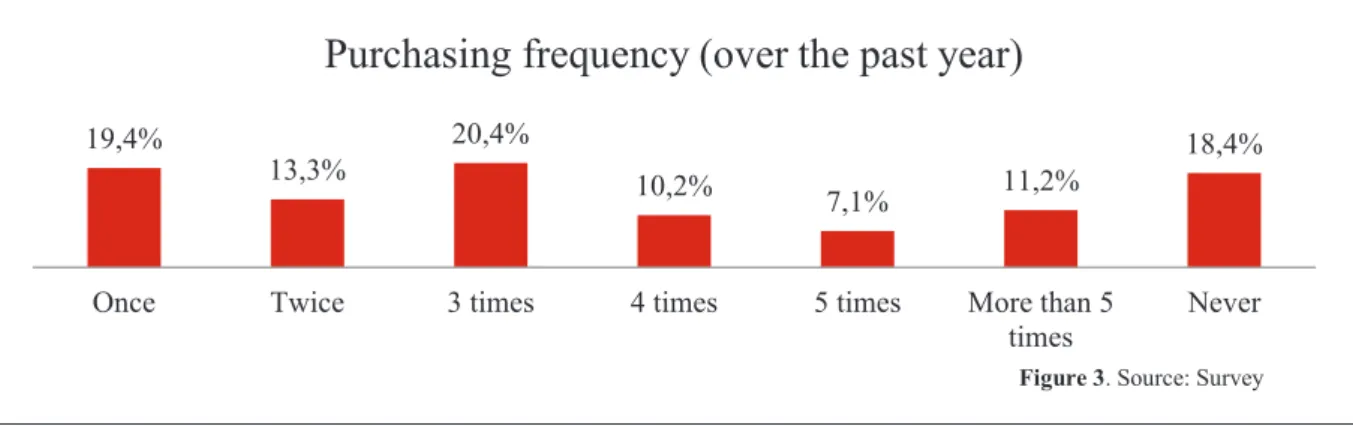
Of the daily deal users in the Portuguese market, 77% search for discounts at least once a month. Of these, 27% do it once a month, 30% once a week, 19% more than once a week, and just under 1% search for discounts every day (Exhibit 9). The most searched for categories are Restaurants in the first place, followed by Accommodation and Travelling, and Beauty & Care immediately after (Exhibit 10) which matches the categories most searched on the FG6. Regarding actual purchases in daily deals, 18% of the users of daily deals have not purchased anything over the last year, the other 82% are purchasing users who are not so frequent purchasers, since only 11% had purchased more than 5 times over the last year as shown in Figure 3.
Regarding the characteristics the daily deals users most value in the Portuguese market, the two most important ones are the ‘Discount offered’ itself, followed by the “Quality of the products/services offered” as shown in Exhibit 11.
Regarding the users’ habits towards daily deals, 85% of the daily deal users in Portugal go directly to the daily deal website/application when looking for discounts, which makes sense since not all of them (52%) agree or strongly agree that when in social media they spontaneously click on campaigns they find interesting. However, almost 60% of users agree that they usually have a look at the e-newsletter to see whether there is anything interesting for them.
As analyzed in Exhibit 12, most of the users purchase deals on special occasions with their boyfriend/girlfriend or husband/wife (60%), half of them make a purchase when they want to
6
Abbreviation for Focus Group 19,4% 13,3% 20,4% 10,2% 7,1% 11,2% 18,4%
Once Twice 3 times 4 times 5 times More than 5 times
Never
Purchasing frequency (over the past year)
20 do something with their friends, and just 27% of the users agree that they purchase deals when they want to offer themselves a personal treat.
Most of the daily deal users feel excited when searching for new opportunities in daily deals websites (67%), however not all consider that the experience itself is more interesting than the discount, since only 28% agree with this (Exhibit 12). A factor that was considered very important in the FG when searching/purchasing for daily deals – users only care about the merchants whose products/service the websites are offering and the website is not important for them – has not reached a consensus, since less than half of the respondents in the survey (43%) agree on this. In terms of loyalty, as mentioned in FG “I do not consider myself loyal to any website, I am always searching for the best offer and price” matches the survey since only 14% of the daily deal users consider themselves loyal to a specific daily deal website. The survey confirms what the FG brought to light, that is that only 28% of the users like to write reviews about their experiences, whilst 85% of them usually share their experiences with friends and family.
21
3.4. Company Overview
3.4.1. MYGON – My Geo Offers Network
Set up in April of 2012 by Ricardo Vilares and Gonçalo Bernardo as a startupx, MYGON entered the Portuguese market with a completely innovative business model in the DoD industry.
“We aim to give you the best experience and the best conditions in the market!” Ricardo Vilares, CEO at MYGON
Since it was set up, MYGON’s main mission is to correct several market shortcomings regarding discount and promotion services such as the excessive number of emails advertising unwanted promotions, lack of service customization, mandatory registration and especially the payment systems. Up until 2012, the only concept known in DoD websites was the coupons’ system where the user had to pay online for a coupon, voucher or ticket before using it. In 2012, MYGON created a revolutionary concept in the DoD industry which is more convenient and interesting, especially for the user: all they have to do is choose the campaign, book it for free and pay at the shop as is illustrated in Figure 4. Based on this idea, the company went to the USA and won a Silicon Valley award in 2013 for being considered a global potential businessxi. The award assessment criterion was based on competitiveness and the feasibility of the business model, the addressable market size, team qualification, and attractiveness of the business to international financing as well as presentation of quality solutions. Additionally, MYGON aims to be an App to use every day, meaning that the user gets advice on promotions around him which are sent through GPS analysisxii.
22 During the first two years, MYGON tried to communicate as an App/Website with the “Real time local deals”7 as can be seen in Figure 5, but due to market needs, MYGON decided to change its positioning in the market at the end of 2014. The company started to aspire to become the most complete, accurate and user-friendly discount provider and local guide in order to raise local brand awareness and consequently their market presence. The slogan has changed to “The most complete local guide”8, meaning that MYGON wants to be seen in this light while still promoting discounts.
Figure 5: “Real time local deals!” Figure 6: “The most complete local guide”
In September 2015, MYGON started its internationalization process. Madrid, Spain, was the first step, with an investment of €500.000. This process extended to Barcelona at the beginning of this year, 2016. MYGON aims to further internationalize the company and expand its operations to the United Kingdom, the Netherlands and even the USA. The company expects to invest €2 million in internationalizationxiii.
In 2016, the company has a team of approximately 30 employees among the Administrative, Marketing, Content and Sales Departments both in Portugal and Spain. Within the two markets, MYGON has more than 300.000 users and more than 15.000 partnerships. Since 2012, the company has had 500.000 valid bookings, 85.000 fans on Facebook and 2 million visits to the Website or App per year. Since the Spanish market is relatively recent, as already explained in the methodology, the study will focus only on the Portuguese market.
7
First slogan of the company (2012) 8
23
3.4.2. The Business operations Model How does it work for the merchant?
MYGON creates each merchant’s campaign in a tailor-made design with a view to promoting the business and its services, and attracting new customers in off-peak periods. It is a real time campaign, meaning that merchants can activate or deactivate the campaigns whenever they want. This promotion is free of charge for the merchants, meaning that the commission is only charged every time a user is sent by MYGON. By directly charging a commission from the local trader for each customer sent to their business, excluding additional fixed monthly costs and registration costs, MYGON aims to widen the variety of partnerships and maximizes the number of transactions in the platform. However, the value of the commission varies according to the category in which the discount is offered. For the categories Restaurants and Bars & Cafés, there is a fixed amount charged for each user MYGON sends. In the case of Beauty Care and the other four categories, there is a variable fee charged. Each merchant has an account in MYGON’s system to manage their transactions, and in order to have online campaigns, the merchant has to charge their own account. Each time a user books a campaign, a certain agreed commission is discounted from that account.
How does it work for the user?
MYGON works in a GeoLocalized way, showing the user all the merchants and campaigns available in the vicinity, selecting the most relevant at each moment in time. The users can use MYGON’s App or the Website, both are very accessible to look for new campaigns, choosing from the seven categories presented in the next section. From those campaigns, the users just have to choose one, book it for free and immediately receive a reservation code by email. In the Restaurants’ category, the users just have to call or simply head over to the merchant’s, present the reservation code, enjoy the offer and pay at the end. The payment already has MYGON’s discount included. In the other categories, an email is sent with the merchant’s phone number after the user has booked in order to schedule a convenient date for both.
There is also a Review system available, where the users have the opportunity to write about their experiences and rate them (from 1 to 5) and have a look at what others think about that specific venue.
24
3.4.3. MYGON – Offers Range
MYGON presents daily opportunities from seven types of categories such as Restaurants, Bars & Cafés, Health and Beauty9, Services, Leisure & Sports, Accommodation, and Products as illustrated in Figure 7. The campaigns are subdivided into subcategories such as Sushi Restaurants or Italian Restaurants in the Restaurants category (Exhibit 13).
Figure 7: Categories. Source: MYGON The number of merchants has been increasing since 2012, with 1270 partners to date (Exhibit
14). MYGON currently has 5653 campaigns online from the seven different categories, and
this number has been increasing as can be seen in Exhibit 15. As shown in Figure 8, most of the campaigns are in the Health and Beauty category (59%), followed by Restaurants with 17% of the campaigns available. The remaining 24% of the campaigns belongs to the other 5 categories. The exact number of campaigns per category can be seen in more detail in Exhibit
16.
The number of campaigns per category is quite proportional to the number of stores by category. Health & Beauty stores are again the biggest slice of the pie, representing 72% of the stores. Restaurants only account for 10% of the total number of stores as shown in Figure 9.
9
Same as Beauty Care
17% 1% 59% 7% 7% 1% 8%
Campaigns by Category
Restaurants Bars & Cafés Health and Beauty ServicesLeisure & Sports Accommodation Products Figure 8. Source: MYGON
25
3.4.4. MYGON – The Users Segmentation
“MYGON does not focus on any particular population group with a certain age, lifestyle or background. We try to match everyone’s needs. Implicitly, the users need to be comfortable in using technology but that applies to anyone navigating online.”
Carlos Bispo, Marketing Manager Nonetheless, MYGON does segment the market in order to improve their marketing strategy according to two main factors: user gender and user location, either at the location in real time, suggesting offers near to the user, or by area of residence. Internally, the company also segments based on user activity: user marketing status and user marketing type.
User marketing status
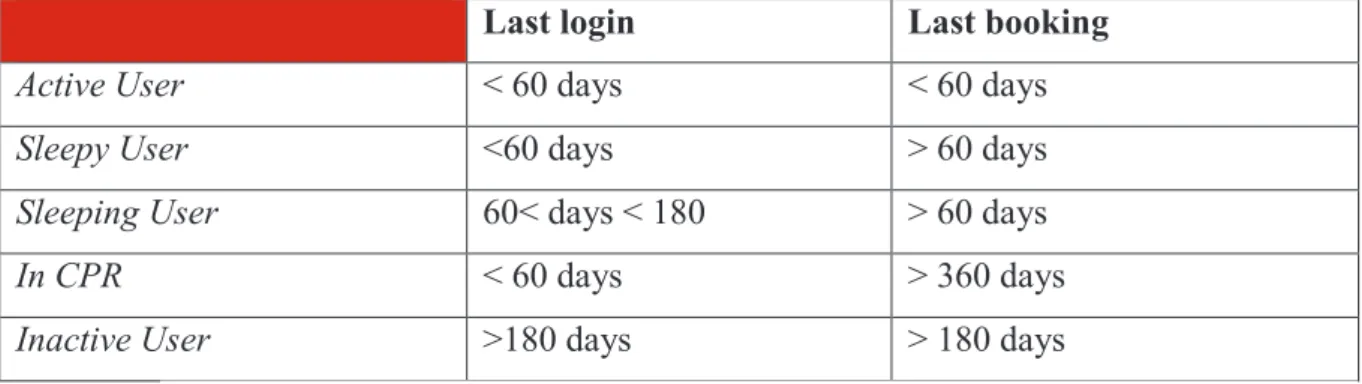
In order to segment the user based on their status, MYGON looks at the day on which the user logged in last and their last booking. These user statuses are summarized in Figure 10. The Active User is a user who has booked and logged in within the last 2 months. The Sleepy User has logged in but has no booking registered in the last 2 months. The Sleeping User had the last login between 2 and 6 months ago and has no booking registered in the last 2 months. In CPR means that MYGON is trying to recover this user, since they have not made any booking in the last year, but within the last 2 months the user has logged in. An Inactive User is any user who has neither logged in nor booked in the last 6 months.
10% 2%
72% 5%
4% 1% 6%
Number of stores by category
Restaurants Bars & Cafés Health & Beauty Services
Leisure & Sports Accomodation Products
26
Last login Last booking
Active User < 60 days < 60 days
Sleepy User <60 days > 60 days
Sleeping User 60< days < 180 > 60 days
In CPR < 60 days > 360 days
Inactive User >180 days > 180 days
Figure 10. Source: MYGON User marketing type
The user marketing types are segmented according to the number of bookings the user has made during MYGON’s user life. The user segments are classified into five different marketing types as shown in Figure 11. The Gold User is any user who has 5 or more valid bookings. The Repeat User is any user with more than 1 valid booking. Segment number 3 includes any User with One Valid Booking, number 4 any user who Has only invalid bookings, and number 5 any User with no bookings.
Bookings
1 – Gold User ≥ 5 valid bookings
2 2 – Repeat User > 1 valid booking
3- User with one valid booking = 1 valid booking
4 - Has only invalid bookings 0 valid bookings
5 – User with no bookings 0 valid or invalid bookings, just registered Figure 11. Source: MYGON The marketing strategies will then be adapted according to the different users’ status and type, adding to users’ gender and location. MYGON’s approach is also based on the users’ most searched categories and immediate location or even residence area and uses this information in order to propose to its users the most adequate campaigns.
27 66%
14% 20%
Users distribution in the
Portuguese market
Lisbon Oporto Other cities
Figure 13. Source: MYGON 37% 63%
Registered Users
Users with bookings User with no bookings Current usersThe public most engaged by MYGON is female aged 25-45. Carlos Bispo, Marketing Manager, added that “70% of MYGON users with purchasing power are in that age group”. MYGON users are Tech-savvy with smartphone, 55% of them book through the mobile application, and the remaining 45% use the website as shown in Exhibit 17.
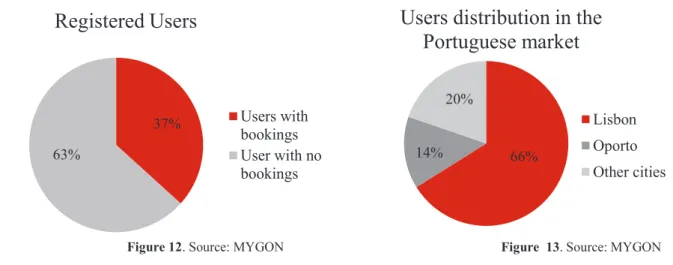
As shown in Figure 12, only 37% of the registered users actually have made any kind of booking either valid or invalid, meaning that most of MYGON users (63%) have no transactions within the company. Lisbon and Oporto represent 80% of MYGON’s penetration in the Portuguese market; the remaining 20% come from other cities in Portugal as represented in the Figure 13.
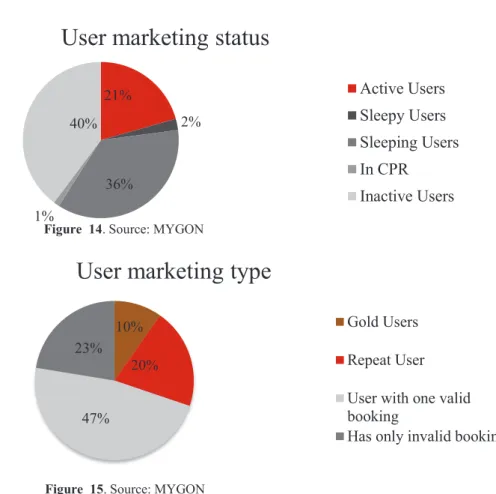
As shown below in Figure 14, within the User marketing status, the biggest slices of the pie belong to Inactive Users with 40% of the users, Sleeping Users with 36%, and Active Users with 21%. Figure 15 illustrates how the user marketing types are distributed: Gold Users represent only 10% of the users, the Repeat Users and users with Only invalid bookings represent 20% and 23%, respectively. Almost half of the users (47%) have only One valid booking.
28 54% 26% 15% 14% 6% 4% 2% 1% 26% 35% 34% 46% 1% 2% 1% 1% 13% 34% 49% 38% 0% 10% 20% 30% 40% 50% 60%
Gold User Repeat User User with one valid booking
Has only invalid bookings
Users marketing status per type
Active Sleepy Sleeping In CPR Inactive
As shown in Figure 16, each user marketing type could have a different marketing status. Within the Gold Users, 54% are active and 13% are inactive. Only 26% of the Repeat Users are still active and 34% are inactive. Half of the users with One valid booking (49%) are inactive, and only 15% are still active. Finally, within the users with Only invalid booking, 38% are inactive and 14% are still active. The Users marketing status per type can be seen in more detail in Exhibit 18.
21%
2%
36% 1%
40%
User marketing status
Active Users Sleepy Users Sleeping Users In CPR Inactive Users Figure 14. Source: MYGON
10% 20%
47% 23%
User marketing type
Gold Users Repeat User User with one valid booking
Has only invalid bookings
Figure 15. Source: MYGON
29
3.4.5. Communication strategy
MYGON communicates first as a booking daily deal platform, where the user can book any campaign they want free of charge (Exhibit 19), emphasizing MYGON’s differentiation point. Since the mobile App has a GPS system, it suggests to the user the offers close by, therefore the message “Smarter way to shop locally” is passed to the users. Moreover, “Do you already know what you are going to do today?” (Exhibit 20) is a message that works as a teaser present especially in the user e-newsletters. Since the end of 2014, MYGON has been trying to change its communication as being “The most complete local guide” which is its current slogan, whilst keeping the same message that the user can “1.Choose the campaign, 2. Book for free, 3. Pay the merchant” (Exhibit 21).
Communication Channels
The user can access MYGON platform through the Website, mobile App or tablet App (Exhibit 22). Newsletters are sent by email with some campaign suggestions, working as a reminder to the existing users. MYGON also communicates via social media networks such as Facebook, using Facebook Ads, Instagram, Twitter, and Blog (Exhibit 23). MYGON also invest in some Google Adwords to go up in Google rank position. Besides that, the company is also present in some Aggregator sites such as Forretas, inserting a few campaigns and therefore gaining some visibility in the daily deals world.
3.4.6. MYGON’s Positioning in the Portuguese market
In order to assess brand awareness and the most searched and purchased websites, the survey focused on the first 13 operating daily deal websites on the Alexa rankingxiv for the Portuguese market as well as Groupon. Although Groupon is not operating in Portugal anymore, the company was included in the survey due to its previous importance in the market, a fact that was highlighted in the FG (“when we used to think about searching discounts, the first that came to mind was Groupon”). The decision to include this company was made in order to better assess MYGON’s positioning in the market before and after Groupon decided to leave.
The 3 companies which are on the Top of Mind of Portuguese daily deal users - meaning that either the respondents have heard of or have already searched/purchased from - are Groupon
30 in the first place with 90,2%, Odisseias second (89,3%), and Lifecooler (77,9%) third (Figure 17). MYGON comes in fourth (68%) of the “Top of Mind”. As CEO, Ricardo Vilares, mentioned in the In-depth interview, there is still a significant number of daily deal users who have never heard about MYGON (32%) and 33% of them have heard of MYGON but have never tried to search/book something from the website (Exhibit 24).
In terms of actual searching/purchasing, the four companies which are on the Top of Mind of Portuguese users match the companies in which the users actually search and/or purchase. These four daily deal websites clearly stand out from the others as can be seen in Figure 18: Groupon and Odisseias are in the top level with 65,6% and 58,2% of the daily deal users searching and/or purchasing in, respectively (in the case of Groupon users who used to search/purchase); followed by Lifecooler and MYGON with 36,1% and 35,2% of the users, respectively. 89,3% 56,6% 64% 62,3% 51,6% 27,8% 68% 31,9% 22,9% 27,9% 54,9% 77,9% 15,6% 90,2%
"Top of Mind" companies
58,2 20,5 14,8 14,8 18 1,6 35,2 5,7 0,8 6,6 20,5 36,1 2,5 65,6
Actual searches/purchases
Figure 17. Source: Survey
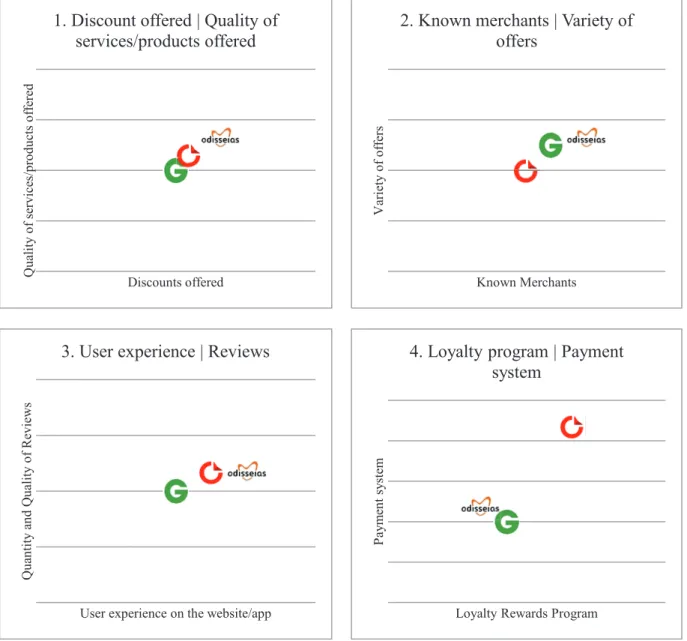
31 In order to understand the positioning of MYGON in the Portuguese daily deal market, the survey enquired about the users’ perceptions about MYGON when compared with Odisseias and Groupon regarding eight different criteria as shown in Figure 19. Odisseias and Groupon were chosen for the study as these were the two daily deal websites the participants as a whole could recall on the FG: Odisseias is currently the main player in Portugal and Groupon used to be number one in the market. The results presented in Figure 19 can be seen in more detail in Exhibit 25.
Figure 19. Source: Survey
In the “Discounts offered” and “Quality of services/products offered”, Odisseias is perceived as performing better than MYGON and Groupon (first perceptual map). As for “Known merchants” and “Variety of offers”, MYGON is perceived as performing worse than the other
V ariety o f o ff ers Known Merchants
2. Known merchants | Variety of offers P ay m en t sy ste m
Loyalty Rewards Program 4. Loyalty program | Payment
system Qu an ti ty a n d Qu ali ty o f Re v iew s
User experience on the website/app 3. User experience | Reviews
Qu ali ty o f se rv ice s/ p ro d u cts o ff ere d Discounts offered
1. Discount offered | Quality of services/products offered
32 two daily deal websites (perceptual map number 2). MYGON’s “User experience on the website/app” is perceived as performing worse than Odisseias. Moreover the “Quantity and quality of reviews” is similar to Odisseias and slightly better when compared to Groupon (perceptual map number 3). When asked about the “Loyalty rewards program” and “Payment system”, MYGON stands out, being perceived as performing much better than the other two (perceptual map number 4).
According to survey results, from the daily deal users: 29% of the users search/book at MYGON, 13% used to search/book (Exhibit 26) and the two main reasons why they have stopped were either because they forgot to login to the app/website or lost interest in the available campaigns (Exhibit 27). The most searched/booked categories at MYGON are Restaurants in the first place, followed by Beauty Care (Exhibit 28). Regarding users’ satisfaction towards MYGON, the users are generally satisfied with the Discounts offered, Quality of services/products offered, Variety of offers, User Experience in the website/app and Payment system as can be seen in Exhibit 29.
In order to assess the likelihood of daily deal users using MYGON, in the survey, after a presentation was made of the company, 83% of the respondents said they are likely to start booking from MYGON due to its point of differentiation (no online payment), 58% of which are very likely to do so (Exhibit 30).
3.4.7. Retention Strategy
Point System – The loyalty rewards program
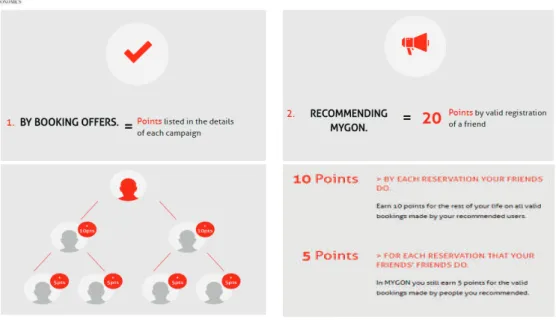
MYGON’s loyalty rewards program is based on a Point system. Through each booking, the user gains the points described in each specific campaign, which are proportional to the commission charged to the merchant. For instance, in a restaurant campaign, the user gains 30 points per person, but in an “eyelash extension” campaign, the user gains 234 points.
The user can also gain points by recommending MYGON to friends (20 points), but also by encouraging them to book, meaning that the user receives for the rest of MYGON’s life, 10 points each time a friend books through MYGON. Additionally, the user also receives 5 points forever each time a friend’s friend books through MYGON. These details are illustrated in Figure 20.
33 Figure 20. Source: MYGON
These points could be exchanged for prizes. Those prizes could be exchanged for MYGON’s credit to use in other bookings, since 500 points are equivalent to 5€, 950 points to 10€, 1850 points to 20€, and 4500 points to 50€ as illustrated in Figure 21. The latter prize was implemented in the beginning of 2016 (Exhibit 31).
Vouchers
500 points 950 points 1850 points 4500 points
Voucher 5€ Voucher 10€ Voucher 20€ Voucher 50€
Figure 21. Source: MYGON
Loyalty Rewards Program - Analysis
“If I am saving money and have the opportunity to save even more, it is obviously an incentive to keep booking from MYGON. It is also rewarding”.
Participant from the FG
From the survey results regarding MYGON’s Point System, only 53% of MYGON users know about the point system (Exhibit 32) and only 4% of the users who know the point system have already exchanged the points – according to MYGON internal results only 11% of the Gold Active Users have exchanged the points although on average they have sufficient points to exchange (Exhibit 33). Moreover, 56% of users have never exchanged the points since they have not reached sufficient points and 26% of users have no interest in the point system. However, 74% of the users do value the point system in the sense that it keeps them buying from MYGON.
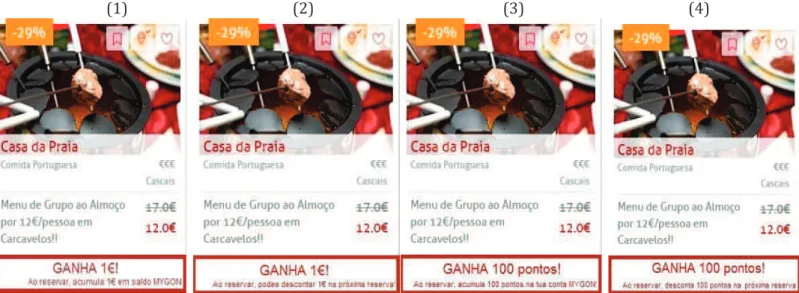
34 Since the effectiveness of the loyalty rewards system was discussed in depth in the FG, a question on the survey focused on the four possible types of loyalty programs for MYGON as illustrated in Figure 22. Some participants suggested that coins would be a more attractive option for MYGON (“adding points does not mean anything to me, but euros could be more meaningful”) as well as the option of benefiting from points or coins in the next purchase instead of accumulating those points or coins (“if I gain something with the booking, using it in the next booking would be better, since accumulating points is not attractive to me”). Curiously, from the survey the preferred options are in fact the two options in which the user gains, for instance, 1€ for a booking. In the users’ perspective, the best option is the second loyalty program in which the user discounts the euro gained in the next booking, followed by the first one in which the user accumulates that euro in MYGON’s account until they want to benefit from it. The least preferred option was the fourth in which the user gains, for example, 100 points for a booking and discounts those points in the next booking. The third option which has the same characteristics as current MYGON’s program is not within the preferred systems. According to the results shown in Exhibit 34 it lags far behind them, even for MYGON current users (Exhibit 35). Almost 80% of the respondents consider that the option chosen in the loyalty program is attractive for them (the responses vary from attractive to extremely attractive).
(1) (2) (3) (4)
35
E-newsletter – As a reminder
MYGON sends its users an e-newsletter with offers based only on the users’ location and gender. The company sends, approximately, 20 newsletters per week. Each day a category is covered, and some of the emails are based on different themes varying according to holidays or other special days of the year.
From the FG insights, only one participant out of eight likes to have a look at e-newsletters: “If there is something interesting for me from looking at the subject, I click to see in more detail”. On the contrary, almost 60% of daily users from the survey agree that they usually have a look at the e-newsletter to see whether there is anything interesting for them (covered in section 3.3).
Gold Inactive Questionnaire – Win-back process
MYGON has high numbers of Inactive users in the four marketing types of users as shown in Figure 16. This win-back questionnaire is conducted by MYGON on its Gold Inactive Users (users who have already made 5 valid bookings at MYGON but have no bookings in 6 months). After the win-back call, MYGON sends the user an email with the number of points the user currently has, and as a win-back reward, the inactive user gains extra points if they become active again in the next two weeks.
Win-back Results
From the users contacted, 18% are already Active Users, 8% are Sleeping, 2% are Sleepy and 6% are In CPR. The Inactive Users are still 66% of the contacted users as shown in Figure 23. As for the Win-back offer requests, only two of the 18% of the Gold Active Users asked for the win-back offer (extra points).
36 Figure 23. Source: Recovery Survey
Moreover, 84,7% of the users answered they were very likely to use MYGON again, but only 18% of these users actually turned Active during the recovery period (Exhibit 36).
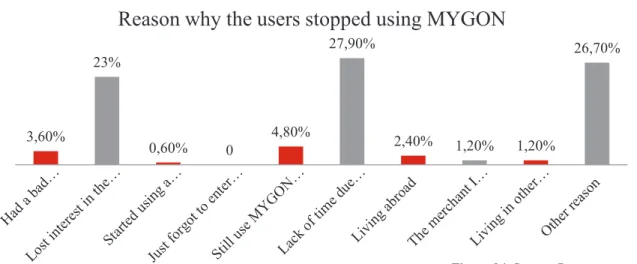
As can be seen in figure 24, the two main reasons why the Gold Inactive Users stopped using MYGON is that they lost interest in the available campaigns (23%) as well as the fact that they were short in time due to personal/professional reasons (27,9%).The category most purchased by these users was Restaurants. Moreover, 32% of the respondents admit using other websites/applications to search and/or purchase promotions (Exhibit 37).
18% 6%
66% 8%
2%
Changes in marketing status
Active User In CPR Inactive User Sleeping User Sleepy User 3,60% 23% 0,60% 0 4,80% 27,90% 2,40% 1,20% 1,20% 26,70%
Reason why the users stopped using MYGON
37
3.5. Merchants Role in the Acquisition and Retention of users
With the FG insight and survey results, the two most important characteristics for the participants and respondents are the “Discount offered” (“I need to be sure the website has the cheapest offers in the market”) followed by the “Quality of the offers”, and when this does not apply there is no interest in visiting the website. In order to assess the quality of merchants’ services and products, the participants from the FG mentioned how important the reviews and ratings of merchants are for them in the decision making process and in terms of expectations.
Therefore, analyzing MYGON users’ satisfaction with their experiences with the merchants is essential. MYGON users have the opportunity to rate their experiences from 1 to 5 (1 “very unsatisfied”, and 5 “very satisfied”). The results from these ratings show that in 60% of the experiences booked at MYGON, users end up satisfied, rating the experience either 4 or 5, and only 20% of the experiences at MYGON went very badly (ratings of 1 or 2) as can be seen in Figure 25.
The extent to which the customer repeats the same experience was also a big issue in the FG discussion since the criteria to repeat either the same experience with the same merchants and/or searching/purchasing from the same website was based on how the first experience went: “There is no second chance! The first experience is crucial”.
According to the survey results (Exhibit 38), after a good experience either the users have never repeated the experience with the same merchant (39%) in which case the website is not affected, or the users have visited the daily deal website again and have repeated the same experience with the same merchant (37%). In the case of a bad experience (Exhibit 39), a great number of users (36%) have never repeated the same experience (either with the
7% 13%
20% 27% 33%
MYGON users' satisfaction with their experiences with the
merchants
1 2 3 4 538 merchant or with the website), and 34% of daily deal users from the survey have never had a bad experience in a daily deal website.
In the FG the quality of merchants was a big issue since some argue that a daily deals’ offer itself could be very bad or the simple fact that this offer came from a daily deal website may sometimes make the service provided be perceived as not good: “If they [merchants] are making such a big discount, they are probably not good”. However, just 15% of the daily deal users who answered the survey agree with this sentence: “I think that products/services that have a discount in these websites are of worse quality" (Exhibit 40).
Since the issue of “paying the merchants’ full price” could be crucial for daily deal sustainability, one question on the survey asks to agree or disagree with this sentence: “After using a discount, it is hard for me to pay full price in future purchases in the same merchant”. Most of the daily deal users (57%) agree with this (Exhibit 41).
Participants also highlighted in the FG the fact that sometimes they are afraid to pay online without knowing the merchants’ availability, therefore there is an incentive to call the merchant and try to make the deal directly (“When I really want a hotel on a specific weekend, I have to pay before finding out whether they have availability. So, I call the hotel itself to ask about their availability and end up buying directly from the hotel at the same price or even less sometimes”). Although there is no payment online at MYGON, when the customer calls to ask more information about the campaign, almost 50% of the merchants try to sell directly (bypass), according to MYGON internal results.
Moreover and according to MYGON’s results, even if the customer shows up, there is a high incentive for the merchants to pretend that customers do not show up in this business model as the money is always on the merchants’ side and they want to avoid paying MYGON’s commission. Each merchant has an account in MYGON’s back office in order to manage users’ transactions. When the merchant chooses the option “did not show up”, an automatic email is sent to the user saying “you have not shown up” and the points are removed. MYGON could detect the fraud automatically if the user answered the email in case the information is incorrect.
39
3.6. Sustainability in the DoD industry
Are the daily deals websites a passing fad or are they here to stay?
From 2014 on, the daily deals industry has been growing at a slow pace as the economy has become more stable after the social and economic crisis, and comments such as “Daily deal is dead” have been commonxv. Questions like “How could the daily deal websites create value for the merchants?” and comments such as “Daily deals are bad for merchants!” are issues which have been discussed recently as part of the structural weaknesses of this industry. Moreover, as the digital know-how from merchants increases, its allows them to create their own campaigns and use other types of advertising online such as Facebook Ads and Google Ads rather than using daily deal websites to promote their products/services.
Groupon and LivingSocial are struggling to survive and recently have changed their strategy to a “merchant’s platform”. Is this strategy the solution for the problems mentioned above? Should the other websites and MYGON follow the same strategy to keep them sustainable? Is MYGON’s reward in Silicon Valley as a Global potential business still valid in 2016 with the same model?
What should MYGON do now?
Should MYGON increase the market share in the Portuguese market, keeping the same strategy? In order to acquire new users, should the offer be different?
Should MYGON invest more in retaining the existing users? Should the loyalty rewards program be changed as well as the win-back offer in order to retain current or past users?
40
4. Market Research
4.1. In-depth InterviewAn In-depth interview was conducted with Carlos Bispo, Marketing Manager at MYGON and Ricardo Vilares, Founder & CEO (Exhibit 42). This interview was essential to provide information about the company’s current situation, retention and acquisition strategies. Most of the insights collected have already been inserted along the Case Study.
4.2. Focus Group
The Focus Group was conducted with 8 Portuguese people between the ages of 20 and 30 who have never heard of or used MYGON before. The participants are of different genders (4 males and 4 females) and have different occupations. It took about 90 minutes to conduct and took place in Portuguese. The aim of this FG was to get a general insight of daily deal users’ purchasing habits, daily deal websites perceptions and an external perception about MYGON and its differentiation points. The guideline can be seen in Exhibit 43, and the most important insights are mentioned in the case study.
4.3. Gold Inactive win-back questionnaire
The win-back questionnaire was conducted by MYGON with the participation of the dissertation author as part of the quantitative research of this study. It consisted of a short phone call to 243 Gold Inactive Users (users who have already made 5 valid bookings at MYGON but have not booked for the past 6 months) in which some questions were asked, as can be found in Exhibit 44. The aim of this questionnaire was to understand the reason why Gold Users have stopped booking from MYGON, and to try to find out what the likelihood is that they will use MYGON again.