Altered inorganic composition of enamel and dentin in
mice teeth chronically exposed to an enriched mineral
environment at Furnas, São Miguel (Azores)
L
UISC
UNHA,
V.
Z
ANON,
A.
A
MARAL,
J.
F
ERREIRA&
A.
R
ODRIGUESCunha, L., V. Zanon, A. Amaral, J. Ferreira & A. Rodrigues 2011. Altered inor-ganic composition of enamel and dentin in mice teeth chronically exposed to an enriched mineral environment at Furnas, São Miguel (Azores). Arquipelago. Life and Marine Sciences 28: 33-37.
Active volcanic environments pose a multifactorial stress challenge to local organisms, in-cluding the domestic mouse Mus musculus. Energy-dispersive X-ray microanalysis was used to determine the elemental composition of lower incisor enamel and dentin from Mus musculus inhabiting the hydrothermal field at Furnas volcano in the Azores (Portugal). Elemental concentration for Ca, P, Na and Cl was found to be significantly different in mice from the volcanic site when compared to an unexposed group. Enamel surface was differently coloured; animals from the volcanic site showed a prominent yellow/red colora-tion when compared to the unexposed group, probably due to mineral deposicolora-tion in the former group. These results are discussed in relation to the environment in which speci-mens were caught.
Key words: volcanism, Mus musculus, geothermal, chemical composition, Azores
Luis Cunha (e-mail: [email protected]), Centro de Investigação de Recursos Naturais, Universidade dos Açores, APT 1422, PT-9501-855 Ponta Delgada, Portugal; Armindo Rodrigues & Vittorio Zanon, Centro de Vulcanologia e Avaliação de Riscos Geológicos, Universidade dos Açores, APT 1422, PT-9501-855 Ponta Delgada, Portugal; André Amaral, Spanish National Cancer Research Centre, Genetic and Molecular Epidemiology Group, C/Melchor Fernández Almagro, 3, ES-28029 Madrid, Spain; José Ferreira, Mdental, Av. S. Gonçalo 1007, PT-4835-104 Guimarães, Portugal.
INTRODUCTION
Geothermal biotopes are reducing environments with certain unique features, characterised by elevated soil, water, and atmospheric elemental composition, together with constant diffuse de-gassing and high temperatures (Cruz et al. 1999; Viveiros et al. 2008; Viveiros et al. 2009). Vol-canic gases typically comprise water vapour, car-bon dioxide, sulphur dioxide, hydrogen sulphide, and hydrogen chloride with lesser amounts of hydrogen fluoride (Ferreira & Oskarsson 1999). Rocks and volatiles of volcanic origin are en-riched with metals/metalloids, such as Al, As, Cu,
Hg, Pb, and Zn (Aiuppa et al. 2000; Bagnato et al. 2007; Cruz et al. 1999). The diffusion of acidic volcanic gases through the rocks mobilise metals in associated soils and water bodies, enhancing a continuous availability of elements to biota (Cunha et al. 2008; Cunha et al. 2011; Tarasov et al. 2005).
Exposure to such environments is revealed by high levels of bioaccumulated elements such as heavy metals, modified cell cycles or even tis-sue/cell morphometric changes (Moore et al. 1995; Zaldibar et al. 2006). Furthermore, a num-ber of human and domestic mammal diseases, such as fluorosis, several types of cancer and
chronic bronchitis seem to be more prevalent in volcanic environments or even increase after vol-canic eruptions (Amaral & Rodrigues 2007; Araya et al. 1993).
The composition and structure of calcified tis-sues have long been used as disease markers (Emingil et al. 2000; Paunio et al. 1993) as well as indicators of environmental contamination (Kierdorf et al. 1993). Additionally, tooth discol-oration has been widely used as a marker of fluorosis, revealed by the mottling of tooth enamel (Rubin et al. 1994).
This study aimed to investigate whether indi-viduals of Mus musculus (Linnaeus, 1758) ex-posed to an extreme environment of volcanic ori-gin revealed alterations in the mineral composi-tion and surface coloracomposi-tion of a calcified matrix, such as permanent teeth.
MATERIAL AND METHODS
Two sample groups of the domestic mouse Mus musculus, were collected from two sites differing in the presence of volcanic activity on São Miguel Island, Azores: i) Furnas caldera, characterised by the presence of an active hydrothermal field with a mean CO2 release of 734 td-1 (Viveiros et al.
2010) and, ii) Rabo de Peixe, with no degassing activity.
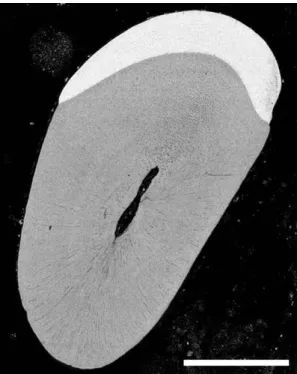
The mice were trapped with live-catch mouse-traps. The individuals were transferred to the laboratory, anesthetised with chloroform and sacrificed. They were housed in the lab for only the sufficient time necessary to sacrifice them. From each group, a set of 10 lower incisor teeth (left side) from adult male individuals were ex-tracted post-mortem. The enamel surface colour was registered using repeated blind measurements by a single operator. Each tooth was then embed-ded in epoxy, grinembed-ded with abrasives powders and polished with various diamond pastes (Fig. 1). The polished surfaces of enamel and dentin were analysed with a JEOL JSM-5410 scanning elec-tron microscope. Energy dispersive analyses were performed with an INCA X-sight microanalyser using an acquisition time of 120s, a current beam of 15 nA and an acceleration voltage of 15 kV.
Data were registered as weight percentage (wt %) and arcsin transformed prior to analysis by means of a factorial ANOVA and Tukey post-hoc tests. Cochran's test for homogeneity of variances amongst groups was used prior to analyses to ensure operation at α=0.05. The colour pattern was assessed using four rank criteria: 0, no col-oration; 1, weak colcol-oration; 2, strong colcol-oration; 3, very strong coloration. Results were analysed by means of a t-test for independent samples (n=20) (ZAR 1999).
Fig. 1. Polished fracture of mouse lower incisor. Scale bar = 500 µm
RESULTS AND DISCUSSION
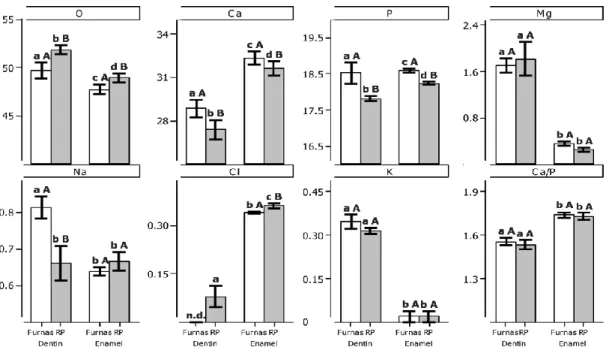
Calcium and phosphorus (in both dentin and enamel) and sodium (in dentin) were found to be significantly higher in mice inhabiting the vol-canic site (Fig. 2). Enamel showed a significantly higher ratio of Ca/P (measured as CaO/P2O5)
when compared to dentin, which is normal for domestic mice (Engel 1981) and humans (Frank et al. 1966).
Fig. 2. Content in wt % (±S.E.) of O, Ca, P, Mg, Na, Cl and K, and the ratio between Calcium and Phosphorus (Ca/P) in dentin and enamel of permanent teeth from Mus musculus inhabiting Furnas (with volcanic exposition) and RP (Rabo de Peixe) (with no volcanic exposition). Different capital letters (for site effect) and lower case let-ters (between structures) denote significant differences (p < 0.05).
Variations in dental elemental composition can reveal metabolic disorders during teeth develop-ment and after eruption (Hellwig & Lennon 2004; Kierdorf et al. 1993). Although these disorders may be of genetic origin, they are more fre-quently caused by variable environmental pres-sures (Rubin et al. 1994).
Chlorine was found in all enamel samples at higher concentration when compared to dentin composition, while potassium and magnesium were found in higher concentrations in dentin. The enriched mineralisation and trace element bioavailability in soil and water at Furnas, to-gether with diffuse degassing phenomena, which can alter the surrounding atmosphere, may influ-ence and perturb the normal input of elements and their metabolic pathways in animals (Baxter et al. 1999; Cunha et al. 2008; Cunha et al. 2011). Cell cycle and morphology are known to be altered under such extreme and abnormal environments (Cunha et al. 2008; Rodrigues et al. 2008), which
may also influence the development of calcified structures.
High metal levels in different organs in mice from Furnas have been documented (Amaral et al. 2007). Additionally, the effect of fluorine-rich waters, such as the water found at the Furnas springs (Cruz et al. 1999; Notcutt & Davies 1999) on teeth surface, is defined as a solid-state trans-formation of hydroxyapatite into fluorapatite. The first mineral species has weak Ca-P bonds in acidic environments, caused by bacteria typically living in the oral cavity and determines Ca deple-tion of the whole structure (Araya et al. 1993; Hellwig & Lennon 2004; Levy et al. 2010). Fluorapatite, with stronger Ca-P bonds, has a more resistant structure to acidic environments (Hellwig & Lennon 2004; Vieira et al. 2008). However, the microanalyser’s detection limit is above fluorine detection and therefore it was not possible to detect and quantify the fluorine pre-sent. Nonetheless, the action of fluorine is
proba-bly the reason for the conserved higher mineral content in teeth, revealed by the Ca/P variation (Vieira et al., 2008).
The external enamel surface of mice inhabiting near the hydrothermal field showed a conspicuous and strong orange/red coloration (Fig. 3), with an average rank of 2.4±0.13 (±S.E.). This value was found to be significantly higher than mice from the non-volcanic site 0.9±0.19 (±S.E.) (test: T-value = -2.24; p= 0.03), and may indicate distinct diets of both populations. The higher iron and fluoride content of mineral water at Furnas springs may also be one of the causes; iron and fluorine are normally deposited on the surface of teeth, conferring a brownish yellow/orange colour and mottling of teeth, respectively (Halse & Selvig 1974; Rubin et al. 1994).
Fig. 3. Typical lower incisor of Mus musculus inhabit-ing a place without volcanic activity (A) and inside the geothermal field (B), Scale bar = 2mm.
In normal circumstances it would seem impera-tive to attempt dissecting the effects of individual chemical and physical stressors. This could be done by performing controlled laboratory expo-sures and monitoring the induced changes with a suit of morphological, physiological and molecu-lar observations. Yet, active volcanic atmospheres comprise a range of dynamic and, in some cases, volatile constituents that are more or less con-tinuously expelled.
The mice inhabiting the active volcanic site showed conspicuous variations in enamel mineral composition and colouration, most probably due to the surrounding extreme environment. Taking into account the continuous growth of mice dental
structures (Halse & Selvig 1974) and their living habits, in close proximity to humans, these mammals may be promising models for risk as-sessment under such extreme environments.
ACKNOWLEDGEMENTS
The authors thank Paulo Melo for his support in field and laboratory work. Luis Cunha and Vitto-rio Zanon were supported by PhD and Post-Doc fellowships from the Direcção Regional da Ciên-cia e Tecnologia (Regional Government of the Azores) (M3.1.2/F/029/2007 and program RAA/DRCT, respectively). The present study complies with the laws in Portugal.
REFERENCES
Aiuppa, A., P. Allard, W. D’Alessandro, A. Michel, F. Parello, M. Treuil & M. Valenza 2000. Mobility and fluxes of major, minor and trace metals during basalt weathering and groundwater transport at Mt. Etna volcano (Sicily). Geochimica et Cosmochimica Acta 64(11): 1827-1841.
Amaral, A., C. Cabral, C. Guedes, & A. Rodrigues 2007. Apoptosis, metallothionein, and bioavailable metals in domestic mice (Mus musculus L.) from a human-inhabited volcanic area. Ecotoxicology, 16(6): 475-482.
Amaral, A.F.S. & A.S. Rodrigues 2007. Chronic exposure to volcanic environments and chronic bronchitis incidence in the Azores, Portugal. Environmental research 103(3): 419-423.
Araya, O., F. Wittwer & A. Villa 1993. Evolution of fluoride concentrations in cattle and grass following a volcanic eruption. Veterinary and human toxicology 35(5): 437-437.
Bagnato, E., A. Aiuppa, F. Parello, S. Calabrese, W. D’Alessandro, T. Mather, A. McGonigle, D. Pyle & I. Wängberg 2007. Degassing of gaseous (elemental and reactive) and particulate mercury from Mount Etna volcano (Southern Italy). Atmospheric Environment 41(35): 7377-7388. Baxter, P., J. Baubron & R. Coutinho 1999. Health
hazards and disaster potential of ground gas emissions at Furnas volcano, Sao Miguel, Azores. Journal of Volcanology and Geothermal Research 92(1-2): 95-106.
Cruz, J., R. Coutinho, M. Carvalho, N. Oskarsson & S. Gislason 1999. Chemistry of waters from Furnas
volcano, São Miguel, Azores: fluxes of volcanic carbon dioxide and leached material. Journal of Volcanology and Geothermal Research 92(1-2): 151-167.
Cunha, L., A. Amaral, V. Medeiros, G. Martins, F. Wallenstein, R. Couto, A. Neto & A. Rodrigues 2008. Bioavailable metals and cellular effects in the digestive gland of marine limpets living close to shallow water hydrothermal vents. Chemosphere 71(7): 1356-1362.
Cunha, L., I. Campos, R. Montiel, A. Rodrigues & A.J. Morgan 2011. Morphometry of the epidermis of an invasive megascoelecid earthworm (Amynthas gracilis, Kinberg 1867) inhabiting actively volcanic soils in the Azores archipelago. Ecotoxicology and Environmental Safety 74(1): 25-32.
Emingil, G., E. Buduneli, A. Aliyev, A. Akilli & G. Atilla 2000. Association between periodontal disease and acute myocardial infarction. Journal of Periodontology 71(12): 1882-1886.
Engel, M.B. 1981. Microprobe analysis of calcifying matrices and formative cells in developing mouse molars. Histochemistry and Cell Biology 72(3): 443-452.
Ferreira, T., & N. Oskarsson 1999. Chemistry and isotopic composition of fumarole discharges of Furnas caldera. Journal of Volcanology and Geothermal Research 92(1-2): 169-179.
Frank, R.M., M. Capitant & J. Goni 1966. Electron probe studies of human enamel. Journal of Dental Research 45(3): 672-672.
Halse, A. & K.A. Selvig 1974. Incorporation of iron in rat incisor enamel. European Journal of Oral Sciences 82(1): 47-56.
Hellwig, E., & A. Lennon 2004. Systemic versus topical fluoride. Caries research 38(3): 258-262. Kierdorf, U., H. Kierdorf & O. Fejerskov 1993.
Fluoride-induced developmental changes in enamel and dentine of European roe deer (Capreolus capreolus L.) as a result of environmental pollution. Archives of oral biology 38(12): 1071-1081. Levy, S.M., B. Broffitt, T.A. Marshall, J.M.
Eichenberger-Gilmore & J.J. Warren 2010. Associations Between Fluorosis of Permanent Incisors and Fluoride Intake From Infant Formula, Other Dietary Sources and Dentifrice During Early Childhood. The Journal of the American Dental Association 141(10): 1190-1190.
Moore, P.G., P.S. Rainbow, J.M. Weeks & B. Smith 1995. Observations on copper and zinc in an ecological series of talitroidean amphipo (Crustacea: Amphipoda) from the Azores. Açoreana (Suppl): 93-102.
Notcutt, G., & F. Davies 1999. Biomonitoring of volcanogenic fluoride, Furnas Caldera, Sao Miguel, Azores. Journal of Volcanology and Geothermal Research, 92(1-2): 209-214.
Paunio, K., O. Impivaara & J. Tiekso 1993. Missing teeth and ischaemic heart disease in men aged 45-64 years. European heart journal 14: 54-54. Rodrigues, A., L. Cunha, A. Amaral, J. Medeiros & P.
Garcia 2008. Bioavailability of heavy metals and their effects on the midgut cells of a phytopaghous insect inhabiting volcanic environments. Science of the Total Environment 406(1-2): 116-122.
Rubin, C.H., E.K. Noji, P.J. Seligman, J.L. Holtz, J. Grande & F. Vittani 1994. Evaluating a fluorosis hazard after a volcanic eruption. Archives of Environmental Health: An International Journal 49(5): 395-401.
Tarasov, V.G., A.V. Gebruk, A.N. Mironov & L.I. Moskalev 2005. Deep-sea and shallow-water hydrothermal vent communities: Two different phenomena? Chemical Geology 224(1-3): 5-39. Vieira, A., M. Lugtenborg, J.L. Ruben & M. Huysmans
2008. Brushing abrasion of eroded bovine enamel pretreated with topical fluorides. Caries research 40(3): 224-230.
Viveiros, F., C. Cardellini, T. Ferreira, S. Caliro, G. Chiodini, & C. Silva 2010. Soil CO2 emissions at Furnas volcano (São Miguel Island, Azores archipelago)-volcano monitoring perspectives, geomorphologic studies and land-use planning application. Journal of Geophysical Research 115: B12208.
Viveiros, F., T. Ferreira, J. Cabral Vieira, C. Silva & J.L. Gaspar 2008. Environmental influences on soil CO2 degassing at Furnas and Fogo volcanoes (São Miguel Island, Azores archipelago). Journal of Volcanology and Geothermal Research 177(4): 883-893.
Viveiros, F., T. Ferreira, C. Silva & J. Gaspar 2009. Meteorological factors controlling soil gases and indoor CO2 concentration: A permanent risk in degassing areas. Science of the Total Environment 407(4): 1362-1372.
Zaldibar, B., A. Rodrigues, M. Lopes, A. Amaral, I. Marigomez & M. Soto 2006. Freshwater molluscs from volcanic areas as model organisms to assess adaptation to metal chronic pollution. Science of the Total Environment 371(1-3): 168-175.
Zar, J. 1999. Biostatistical analysis (4th edition.) Simon & Shuster. New Jersey. 718 pp.