Comunicação e Sociedade, vol. 19, 2011, pp. 247-260
Discourse and manipulation – the miscegenation of genres
in written press
Alexandra Guedes Pinto*
Abstract: This paper focuses on the appearance of certain instances of “intermediate genres” in written press derived from the miscegenation of press editorials and adver-tisements. It analyses the case of a specific advertisement and health editorial printed in VIP – a Portuguese social magazine – in April 2010. It appeals to a theoretical frame-work from Discourse Analysis in order to prove the miscegenation of genres between the two chosen texts. Four aspects are developed: the context and co-text of the ana-lyzed discourses; the genres involved; the language and paralanguage used; the prag-matic values activated – locutionary, illocutionary, perlocutionary.
The study aims at proving that different genres combinations formed from adver-tisements and other types of discourse, especially in media discourses, are a sign of the colonization that advertising carries on other discourses financially dependent on it.1
Keywords: Discourse analysis, miscegenation of genres, manipulation, advertisements, press editorials.
Advertising has a double sided passive/active relationship with society in the sense that, on one side, it reflects the changes going on and, on the other side, it helps speeding up certain changes, preparing individuals for what is to come. This double sided nature makes it a valuable field of study.
One aspect of its behavior that makes it a prominent type of discourse amongst the others is its tendency to contaminate – sometimes intentionally sometimes not inten-tionally – other types of discourse with its way of working and its linguistic markers. * Professora Auxiliar na Faculdade de Letras da Universidade do Porto (UP) e membro do Conselho Científico da Unidade I&D Centro de Linguística da UP ([email protected]).
1 This paper is a developed version of the communication presented in the workshop “Discourse and Manipulation“ with Professor Christian Plantin in CLUP, June 2010.
The fusion between different discourse types is a sensitive issue in the advertising discourse in the sense that it is frequently “parasitic”2 upon other discourses, not only because it imitates other discourses generating instances of intertextuality, but also because it normally occurs together with or embedded in other discourses to which it makes no direct reference3, but with which it establishes and inevitable implicit dia-logue. Although many times undesired and seen as the “black sheep” of the flock, magazines, newspapers and television channels depend on advertisements to survive.
We approach the theme of manipulation through discourse in this paper by analyz-ing a recent advertisanalyz-ing campaign to a nutrition supplement indicated for weigh loss – Bioactive C.L.A. Booster. This analysis will be focused in a particular press context where the advertisements of the product appeared, specifically in a fashion and social Portuguese magazine called VIP. This magazine covers real life stories, particularly of the rich and famous and other matters related to fashion and lifestyle.
Describing the factual situation that originated this reflection, we can say that on the 685th edition of VIP (April 2010) any reader could come across two texts located on pages 68 and 71 that shared approximately the same theme but with different discursive approaches. On page 68 was located the health editorial – a regular Section of the mag-azine – covering the scientific discovery of the effects on weight loss of three chemical substances: chá verde, CLA and carnitina. This health editorial besides explaining the chemical compounds also mentioned the benefits of physical exercise on the reduction of adipose tissue. On page 71 was inserted an advertisement about a medicine named BioActivo CLA Triplo, indicated for the loss of weight and chemically composed by three substances: chá verde, CLA and carnitina.
These pages are shown in Annex I and from now on also identified as Text A (health editorial) and Text B (advertisement).
In fact, although consciously the reader might not establish an immediate connec-tion between the two texts, subconsciously, they seemed to complete one another, since the first talked about a recent discovery of three chemical substances with direct results on weight loss and the second gave these three substances a commercial name BioActivo CLA Triplo, an identity, an image, so that the buyer could recognize it, and useful infor-mation about where to find it in the market. One forced the attention upon the other, both forcing the attention upon the product – the same product that might have gone unnoticed had it been just promoted by a conventional advertisement.
So this was, in short, the factual frame that motivated my linguistic observations on the question. It is a relevant situation to de described in the frame of the Discourse Analysis, because it constitutes a new approach of the advertising discourse as a type of discourse. It constitutes a new approach that endangers (in a neutral sense) the frontiers of the types/the genres involved. It constitutes a new approach that generates a hybrid discourse genre and, as such, favors the miscegenation of genres in the press and it
2 Cf. Cook, 1992: 29.
3 This situation of embedding is the case that we are going to study further, since we extracted the advertisement from a press magazine.
comunicação e sociedade 19.indd 248
constitutes a new approach in the pragmatic sense, since it creates a sort of a pragmatic compound/complex that works together, manipulating the reader in a very subliminal way.
Framing the question in linguistic terms – a broad perspective of Linguistics, one that includes Discourse Analysis – implies that some assumptions about the following topics should be stated:
• the context and co-text of the analyzed discourses • the genres involved
• the language and paralanguage used
• the pragmatic values activated – locutionary, illocutionary, perlocutionary.
1. The health editorial
As far as the health editorial is concerned, we can say that it is an editorial article4, writ-ten by the staff of the magazine, usually unsigned and supposed to reflect the opinion of the periodical. It covers, in this particular case, a scientific matter and because of this thematic constraint, the piece stays more close to the tone of a news than to an opinion article, in the neutral tone; in the pragmatic aim and in the fact that it covers a recent discovery.
These editorial articles are common in the magazines and newspapers and very often inserted in regular items or sections that make the editorial frame of the magazine. As so, for instance, a reader of the magazine Visão knows that its editorial alignment is always made of the same sections – Radar; Portugal; Economy; World; Society; Culture and Opinion – that which changes, from edition to edition, are the particular themes covered in each section This alignment conveys a substantial part of the magazine’s identity and ideology, generating, thus, legitimate reading routines and expectations in the buyers.
In the case in analysis, the article was inserted in the section “Health”, a regular sec-tion of the magazine VIP.
The knowledge of the genres is a part of the communicative competence of the speaker, more specifically of his textual competence, it enables him to recognize differ-ent types of texts and activate in their presence differdiffer-ent types of perceptive strategies. Also, the preexistence of a genres competence in the speakers mind activates a frame of legitimate expectations towards a specific text. This discourse genres competence is an integrated competence, in the sense that it permits the identification of a genre through a set of characteristics that range from internal aspects of the text and the co-text, to external aspects of the context, as well as pragmatic issues (Cook, 1992: 4,5).
4 Editorial is used here as a synonym of being promoted and under the responsibility of the editorial board of the magazine. In this sense editorial means every piece of work that may belong to very different discourse genres, such as news, opinion article, interview, amongst others, that is opposed to the advertisements or pieces of propaganda or other materials promoted by other entities than the editorial board of the magazine. These other materials are normally paid.
To describe texts A and B as prototypical types of text implies the analyses of not only their internal textual features but also their visual frame since it is no peripheral feature in their definition as genres.
As far as Text A is concerned the section where it appears is a typical section in the magazine, as was said before. It is identified by means of a prototypical label in upper case inserted in a red text box. It has a title and a preliminary title. It is accompanied by a photo allusive to the theme. A part of the text is in a detached box, which is also a prototypic paralinguistic feature.
Some of the linguistic markers that are prototypical are:
• the technical approach of the matter with the description of the chemical com-pounds and processes involved in the loss of weigh by means of the substances described.
• the technical lexicon used: “A substância activa do chá verde, designada EGCG (galhato de epigalocatequina)…”
• the identification of the information source: “a investigação científica descobriu a formula”; “investigadores documentaram que” (cf. Text A);
• the use of quantitative data to support the argumentation: “o chá verde aumenta a oxidação das gorduras em 17%”.
Text A. Health Editorial, VIP, nº 685, 14 April 2010, p. 68
comunicação e sociedade 19.indd 250
On the other hand, some of the linguistic markers that are not prototypical are: • the positive qualifying adjectives present in the headline “perfeito” and in the body
copy: “espectacular”; “magro e firme”; “bela”; “elevada”, “positivo”, “eficazes”; • sequences of coordinated adjectives: “magro e firme”;
• the combination of intensifier adverbs with positive adjectives such as: “alta-mente eficazes”;
• the presence of explicit directive speech acts in the discourse: “Exercite-se” “Imagine”. • The direct interpellation of the reader by means of several instances of dictics: demonstratives “essa flacidez por um corpo magro e firme”;personal pronouns “si”, possessive pronouns “o seu estilo de vida” the use of the second person in the verbs5: “você” “se conseguisse” “pode tomar um comprimido que diminui a gordura”, “Tudo o que precisa de fazer”, “pode escolher”…
• The presence of rhetorical questions as a means of textual and argumentative con-struction: “Não seria espectacular se conseguisse substituir essa flacidez por um corpo magro e firme?” “Está curiosa em saber o que existe neste comprimido?”. Nevertheless, we can state that the context of Text A plays a decisive role to explain the hybrid features it shows. In fact, the press magazine where the texts were taken from was already briefly classified as a prototype of the social fait-divers magazines. This type of press implies linguistic constraints on the writing of the texts.
Two of the contextual constraints that are relevant for this study are thematic and stylistic constraints. As far as thematic constraints are concerned, the theme treated is weight loss, a theme that is highly valued by female readers, the main target of these magazines. As to stylistic constraints, the style of the writing is less neutral than the prototypic style of a reportage in a newspaper, allowing for a more dialogic tone, where the reader is directly involved in the text, by means of the linguistic resources we have identified; rhetorical questions, second person dictics, amongst others. This means that the information has to be given to the reader in a light version, with some effects of colloquialism to make it more interesting and with some strategies of “easy reading” to facilitate the input.
Although the text has hybrid features that approach it from the advertising dis-course and moves it away from the written news disdis-course, partially explained by the contextual constraints, there are also some negative markers that clearly distinguish it of advertising discourse:
• It has no identification of a product nor of a brand, only chemical substances • It has no identification of a point of sale
• It has no direct appeal to the purchase
5 The verbs are grammatically in the third person but their semantic and functional value is the second person. It is an idiomatic feature of the Portuguese language that the pronominal form “você” that conveys a more formal treatment than “you” is conjugated with the verb in the third person.
In this enunciative frame it is legitimate for the reader to extract one central assertive illocutionary value from the text that we could describe as “conveying information”. Derived from this value we could extract also a directive value of warning and advice. The reader is to decide on a perllocutionary value of belief/disbelief and acceptance/ non-acceptance.
It is also legitimate to presuppose in this enunciative frame that the speaker conveys the information without a persuasive aim over the reader. He adopts a neutral point of view and simply states the facts. The speaker who is not designated in the text is identi-fied with the editorial board of the magazine. This identification produces important effects on the credibility of the information and its sources. And this credibility pro-duces important derived pragmatic effects on the reader that interprets the information as reliable.
2. The advertisement
As far as the advertisement is concerned, we know that it is not an editorial product in the sense that it is promoted by an external entity. It corresponds to a bought space and is meant to promote a product or a brand. Viewing this fact, the reader is compelled to search for the enunciator of the message and establish whether he considers this enun-ciator a credible one.
In this type of text the central illocutionary values are directive: to make believe and to make act – buy the product; adhere to the brand, although there is also a non-direc-tive derived illocutionary value: to inform. Thus it is clear for both sender and addressee that, in this enunciative frame, the speaker arranges the information aiming at making the reader believe it (make believe = convince). Thus there is a basic persuasive objective that restrains the dispositio of the facts and the information.
The addressee receives the message aware of this manipulative intention of the sender and thus activates perceptive defenses towards the information conveyed: the addressee of an advertising message departs from the presupposition that the information he reads in the advertisement may not correspond to the truth but to an “alternative”, biased truth. This enunciative frame withdraws a certain degree of credibility to the sender and to the information conveyed in this type of discourse.
As we have seen for the editorial text, in the advertisement the paralanguages are also central to the identification of the text as a token of this type. In fact in this type of text the paralanguages such as the visual and graphic languages that coexist with the verbal text are decisive to the identity of the genre.
This derives from the fact that a press advertisement is normally a multimodal entity where several different languages converge to make meaning.
Thus in the advertisement in analysis we find the prototypical graphic substance of the type, such as: combination of image, photo and text; text written in different types of lettering and different colors, aligned in different text boxes. In terms of structure and content, we find the copy distributed in different functional text units such as headline; body copy; slogan; packshot; additional information. The text is presented in
informa-comunicação e sociedade 19.indd 252
tion chunks / topics introduced by graphical signs alien to the conventional writing signs, such as colored dots (cf. Text B).
The product is clearly identified by means of a photograph of the package and by a Name – CLA Triplo. And the pharmaceutical laboratory is also identified as well as the sale point of the product.
In argumentative terms, we find in this advertisement the combined technique of the personal testimony about the effects of the product, in this case made through the endorsement of a VIP that can function as a reference for the target audience. This technique of the endorsement carried out by the presence of a photograph of the VIP, a legend with her name and a quotation of her speech about the product – “BioActivo CLA Triplo ajuda-me a manter elegante e sinto-me fantástica!”; “Uma mulher que se sinta bem consigo mesma já tem o caminho aberto para o sucesso! Nada me faz sentir melhor do que manter um corpo elegante e firme”, is combined with the description of
the product and its benefits by the advertisement’s enunciator and also with the direct appeal to the addressee – “Queime 3 vezes mais gordura!”
3. Health editorial and advertisement: quantitative analysis
To analyze further the similarities and the differences between these two texts, we sub-mitted both of them to the syntactic analytical tool VISL – Visual Interactive Syntax Learning6 – in order to obtain an annotated corpus output. This procedure allowed us to get a lexical and syntactical x-ray of the texts, supporting our qualitative diagnosis with quantitative data.
As the total number of words was dissimilar – 277 in the advertisement compared to 586 in the health editorial – we reduced the two texts randomly to the same number of words in order to obtain comparable results. The tables 1 to 7 below show several aspects of the grammatical and lexical distribution of the two texts.
The lexical quantitative distribution, as can be seen in table 1, is not distinctive. The lexical words that could function as differential markers of genre such as the adjectives do not establish the difference between these two texts. Contrary to the expectations, they were more frequent in the health editorial than in the advertisement.
Table 1. Lexical quantitative distribution
TOTAL UNITS NAMES ADJECTIVES VERBS
Health Editorial 276 53 27 48
Advertisement 276 46 25 46
Previous studies carried out on larger corpora of press advertisements and newspa-per news showed a very distinctive distribution of the grammatical class of adjectives in these two types of texts7. In advertising discourse adjectives exhibited the double of the frequency as compared to journalistic discourse – news. Not only the frequency but also the semantic classes of the adjectives were distinctive, with the relational adjectives dominating in the journalistic discourse – news – and the qualifying adjectives dominat-ing in the advertisdominat-ing discourse.
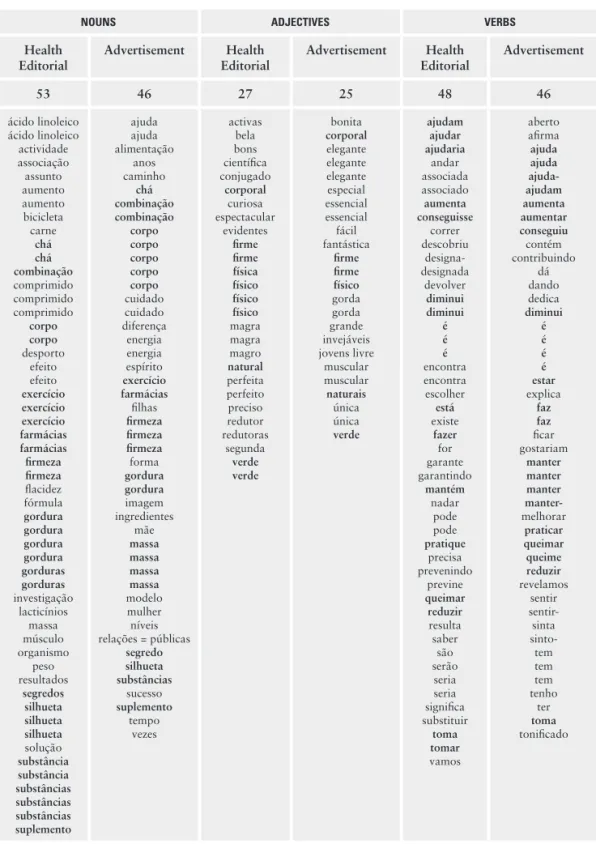
On the contrary, the lexicon comparison of the texts, shown in table 2, allows us to see that neither the frequency nor the type of adjectives show substantial differences from the advert to the health editorial. From a total of 52 adjectives, 16 are overlaps,
6 VISL is an internet-based grammar tool for research developed at the Institute of Language and Communication (ISK), University of Southern Denmark (SDU)., implemented since September 1996. It allows the parsing and syntactic-semantic annotation of corpora of large dimensions. It is based on the parsing system Palavras and generates an automatic grammatical analysis in a Constraint Grammar framework.
7 Cf Pinto, Alexandra Guedes – Aspects of the textualization of the Advertising Language: a typological delimitation. PHD Dissertation in Linguistics submitted to Faculdade de Letras da Universidade do Porto in August 2008.
comunicação e sociedade 19.indd 254
Table 2. Lexical overlaps
NOUNS ADJECTIVES VERBS
Health Editorial Advertisement Health Editorial Advertisement Health Editorial Advertisement 53 46 27 25 48 46 ácido linoleico ácido linoleico actividade associação assunto aumento aumento bicicleta carne chá chá combinação comprimido comprimido comprimido corpo corpo desporto efeito efeito exercício exercício exercício farmácias farmácias fi rmeza fi rmeza fl acidez fórmula gordura gordura gordura gordura gorduras gorduras investigação lacticínios massa músculo organismo peso resultados segredos silhueta silhueta silhueta solução substância substância substâncias substâncias substâncias suplemento ajuda ajuda alimentação anos caminho chá combinação combinação corpo corpo corpo corpo corpo cuidado cuidado diferença energia energia espírito exercício farmácias fi lhas fi rmeza fi rmeza fi rmeza forma gordura gordura imagem ingredientes mãe massa massa massa massa modelo mulher níveis relações = públicas segredo silhueta substâncias sucesso suplemento tempo vezes activas bela bons científi ca conjugado corporal curiosa espectacular evidentes fi rme fi rme física físico físico físico magra magra magro natural perfeita perfeito preciso redutor redutoras segunda verde verde bonita corporal elegante elegante elegante especial essencial essencial fácil fantástica fi rme fi rme físico gorda gorda grande invejáveis jovens livre muscular muscular naturais única única verde ajudam ajudar ajudaria andar associada associado aumenta conseguisse correr descobriu designa-designada devolver diminui diminui é é é encontra encontra escolher está existe fazer for garante garantindo mantém nadar pode pode pratique precisa prevenindo previne queimar reduzir resulta saber são serão seria seria signifi ca substituir toma tomar vamos aberto afi rma ajuda ajuda ajuda-ajudam aumenta aumentar conseguiu contém contribuindo dá dando dedica diminui é é é é estar explica faz faz fi car gostariam manter manter manter manter-melhorar praticar queimar queime reduzir revelamos sentir sentir-sinta sinto-tem tem tem tenho ter toma tonifi cado
correspondent to a level of 31% of them and the distribution of the relational and quali-fying adjectives is nor relevant (distinctive) in these corpora.
In the class of nouns, from 99 tokens 52 are overlaps, which means 53% and in the class of verbs we find a level of 46% of overlaps.
Another aspect of the texts’ lexical and grammatical performance that reveals a substantial level of overlap is shown in table 3, where the verbal tenses where analyzed, with the result of a 90% level of similarity between the two texts.
Table 3. Lexical quantitative distribution – Verbal tense
VERBAL TENSE Health Editorial Advertisement
Present indicative 22 24 subjunctive 2 2 Future indicative 1 -subjunctive 1 -Past 1 1 Imperfect subjunctive 1 -condicional 3 1 Infi nitive 12 14 Gerund 2 2 Participle 3 2
Analyzing now some aspects of the functional class distribution, present in tables 4 to 6, we can say that the difference from 9 to 15 conjunctions between the advertise-ment and the health editorial corresponds to different types of textualization: “disjunc-tive” and “discursive” as Leech (1966) put it.
Table 4. Functional quantitative distribution
KC Coordination conjunction KS Subordination conjunction Artd Defi nite Article
Arti Indefi nite Article
Health Editorial 11 4 25 9
Advertisement 7 2 24 9
comunicação e sociedade 19.indd 256
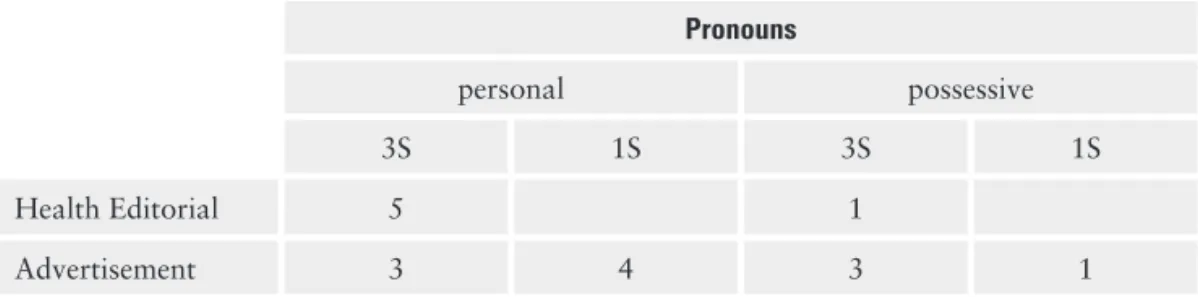
Table 5. Functional quantitative distribution – Pronouns Pronouns personal possessive 3S 1S 3S 1S Health Editorial 5 1 Advertisement 3 4 3 1
Table 6. Functional quantitative distribution – Verbal persons
VERBAL PERSONS
1S 3S Você 1P 3P
Health Editorial 20 6 1 3
Advertisement 1 22 1 1 2
According to this author (ibidem: 93), the appearance of the unit “phrase” – NP, AdjP, PrepP e AdvP – as an autonomous syntactic unit, isolated by full stops is a variable with such a distinctive value that it can work as a marker of the “disjunctive grammar” as opposed to the “discursive grammar”:
This brings us to the crux of the difference between discursive and disjunctive grammar: in fully discursive grammar, minor and non-finite clauses are dependent; in fully disjunctive grammar they are independent (…) in disjunctive language a sentence need not contain a finite predicator, and this in turn means that a single nominal group or a single adverbial group may be grammatically independent. Either of these groups may in turn consist of a single word. In other words, there is no limit to the simplicity of a grammatical unit. (Leech, 1966: 93)
Also, the preference for coordinated structures instead of subordinated structures is a marker of advertising discourse. Several studies show a very low frequency of explicit subordinated structures in this type of discourse (Leech, 1966; Lanao Bernad, 1992; Sánchez Corral; 1991). In semantic terms, the absence of explicit logical relations between sentences is an intended persuasive strategy as Leech defended (ibidem: 150) “Disjunctive copy communicates at a ‘sub-logical’ level and helps in the reinforcement of the associative, as opposed to the cognitive, side of the message.”
This same fact can be demonstrated by the difference in the frequency of full stops and commas shown in table 7. More full stops and fewer commas in the advertisement as compared to the inverse equation in the health editorial.
Table 7. Punctuation
Total signs . : ! ? ,
Health Editorial 32 12 2 - 2 8
Advertisement 31 15 1 5 - 4
As far as dictic markers are concerned, we view from table 5 and 6 that the advertise-ment shows the presence of the first person in the form of personal and possessive pro-nouns and verbal persons, justified by the fact that it is built in the format of personal testimony, as we saw above.
What comes as unexpected, and contributes to the thesis argued in this article of the miscegenation of genres in written press, are the 6 occurrences of verbal persons with the value of “você” in the health editorial, functioning, thus, as direct interpellations of the reader, as compared with 1 occurrence in the advertisement. The occurrence of question marks in the health editorial confirms this dialogic tone of the text.
In the advertisement it is important to signal 5 occurrences of exclamation points that mark expressive, commissive and directive illocutionary acts: “sinto-me fantás-tica!”; “Revelamos o seu segredo!”; “Queime 3 vezes mais gordura!”, respectively.
4. Conclusions
We can conclude that apart from paralinguistic markers that establish clear frontiers between the two genders represented here, a few linguistic characteristics such as the use of more technical lexicon or complex sentences and pragmatic aspects like the presence of a logo and a brand and information such as the sales point, in locutionary terms these two types of text are very alike, establishing a reciprocal intended intertextual remission. As we have seen above, the threshold level of overlapping vocabulary for the three basic lexical components of the texts is high, and cannot be attributed only to the fact that the two texts share the same theme. The vocabulary quantitative data gathered sup-port the thesis that these two texts have not been independently produced.
On the contrary, these texts work together as a sort of a pragmatic compound/com-plex that we could describe by means of the equation:
HEALTH EDITORIAL OF PRODUCT X (CREDIBLE INFORMATION AND SOURCE) + ADVERTISEMENT OF PRODUCT X (DIRECT APPEAL TO ACTION) = HIGHLY MANIPULATIVE PRAGMATIC COMPLEX
Probably, in this particular case, the brand responsible for the product announced in the advertisement – Laboratórios Farmacêuticos Pharmanord – is also the sponsor of the health editorial, concerning the effects on the loss of weigh of the substances, chá verde, CLA and carnitina.
comunicação e sociedade 19.indd 258
The sponsorship is a form of advertisement that allows the sponsor to assure its presence in the text or program in various ways. In this case the sponsor probably deter-mined the theme that should be treated in the section Health of the magazine and also imposed contextual constrains related to the location of the two texts: they should not be placed in continuous pages but they could neither have too many pages in between, being the location is in this case a determinant factor to the persuasive strategy of the announcer. Continuous pages would make the connection between the two texts too explicit, making them seem two parts of the same advertisement; too many pages in between would cancel the echoic effect upon which lies the persuasive strategy.
Due to pressures of financial profitability these types of interventions on the edito-rial content of the press media are likely to increase in the near future which will lead to a corresponding increase in miscigenated press genres.
It is the movement, described by Fairclough (1992) of colonization of other courses by the official discourse of capitalism and consumerism: the advertising dis-course.
To the reader, these more subliminal persuasive techniques derived from the mis-cegenation of genres raise the problem of a biased process of communication between sender and addressee: on the one hand, an intended manipulation of the sender; on the other hand, the lack of the awareness of the process by the addressee.
The advertising discourse is very quick in regenerating itself, building always new unattended forms of messages that meet a non prepared reader. This constant genetic change makes way for more efficient forms of manipulation.
This manipulation is strongly connected to the fact that media depend on advertise-ments to survive, creating, thus, dangerous areas of contact and contamination.
Advertising agencies can buy space in specific locations and exercise considerable control over the interaction of one discourse with another. Sponsoring certain sections of the magazines, newspapers or TV programs is an important means of cutting the costs of broadcasters and publishers and makes way to the rising of intermediate dis-course genres that tend to bloom in periods of economic recession.
We need, thus, to be especially attentive to see what new forms of colonialism will arise in this territory in the next few years.
References
Adam, J.-M. et Bonhomme, M. (1997) L’Argumentation publicitaire. Rhétorique de l’éloge et de la
persua-sion, Paris: Nathan.
Bick, E. (2000) The Parsing System Palavras – Automatic Grammatical Analysis of Portuguese in a Constraint
Grammar Framework, Aarhus:Aarhus University Press.
Cook, G. (1992) The Discourse of Advertising, London: Routledge. Fairclough, N. (1991) Language and Power, London: Longman. ––– (1992) Discourse and Social Change, Cambridge: Polity Press. ––– (1995) Media Discourse, London: Arnold.
Lanao Bernad, C. (1992) Aproximación al estudio del lenguaje publicitario en Inglés: aspectos semánticos y
pragmáticos, Zaragoza: Facultad de Filosofia y Letras.
Pinto, A. G. (2008) Aspects of the Textualization of the Advertising Language: A typological delimitation. PHD Dissertation in Linguistics, Porto: Faculdade de Letras da Universidade do Porto.
Sánchez Corral, L. (1991) Retórica y sintaxis de la publicidad: itinerarios de la persuasión, Cordoba: Universidad Cordoba.
––– (1997) Semiotica de la publicidad – Narración y discurso, Madrid: Editorial Síntesis.
comunicação e sociedade 19.indd 260