FUNDAÇÃO GETÚLIO VARGAS
ESCOLA BRASILEIRA DE ADMINISTRAÇÃO PÚBLICA E DE EMPRESAS
DOUTORADO EM ADMINISTRAÇÃO
TESE DE DOUTORADO APRESENTADA POR
Ricardo dos Santos Dias
ESSAYS IN BUSINESS MANAGEMENT
Orientador: Prof. Dr. Ronaldo Couto Parente
Rio de Janeiro 2020
RICARDO DOS SANTOS DIAS
ESSAYS IN BUSINESS MANAGEMENT
Thesis submitted at the Brazilian School of Public and Business Administration – EBAPE in partial fulfillment of the degree of Doctor of Philosophy.
Thesis Advisor: Prof. Ronaldo Couto Parente, Dr.
Rio de Janeiro 2020
Dados Internacionais de Catalogação na Publicação (CIP)
Ficha catalográfica elaborada pelo Sistema de Bibliotecas/FGV
Dias, Ricardo dos Santos
Essays in business management / Ricardo dos Santos Dias. – 2020.
76 f.
Tese (doutorado) - Escola Brasileira de Administração Pública e de Empresas, Centro de Formação Acadêmica e Pesquisa.
Orientador: Ronaldo Couto Parente Inclui bibliografia.
1. Desenvolvimento organizacional. 2. Gestão de negócios. 3. Mulheres em
cooperativas - Brasil. 4. Investimentos estrangeiros. I. Parente, Ronaldo Couto. II. Escola Brasileira de Administração Pública e de Empresas. Centro de Formação Acadêmica e Pesquisa. III. Título.
CDD – 658
PUBLICATIONS AND CONFERENCES
CONFERENCES (2016-2020)
Part of this thesis have been presented at the following conferences:- AAA Global Emerging Scholars Research Workshop, New York, United States, 6-10 August 2016.
- XL Encontro Nacional de Pós-Graduação e Pesquisa em Administração - EnANPAD, Costa do Sauípe, Bahia, Brasil, 25-28 October, 2016
- 42nd European International Business Academy (EIBA) Annual Conference, Vienna, Austria, 2-4 December 2016.
- XLI Encontro Nacional de Pós-Graduação e Pesquisa em Administração - EnANPAD, São Paulo, São Paulo, Brasil, 01-04 October, 2017
- 45th European International Business Academy (EIBA) Annual Conference, Leeds UK, 14-16 December 2019.
PUBLICATIONS (2016-2020)
- Dias, R. S., Parente, R. C., Murray, J., Kotabe, M. & Zhao, Y. (2020) Relational resources, tacit knowledge integration capability, and business performance. (Paper accepted for publication at Journal of Knowledge Management.)
- Dias, R. S., de Oliveira, I. G. S., Cardoso, S. P., & Júnior, P. B. (2019). Influence of Female boardroom presence on firm value: An analysis on companies listed on B3. Revista de Negócios, 23(3), 49-58.
- Dias, R. S. & Macedo, M. A. S. (2016). Private equity and venture capital funds: what drives the demand and supply?. BAR-Brazilian Administration Review, 13(2).
- Dias, R, S., de Oliveira, I. G. S., da Silva Neto, E. R., & da Silva, V. C. (2016). Strategies for the Creation of Portfolios with Different Degrees of Sophistication: An Analysis of the Brazilian Capital Market. International Business Management, 10(4), 429-437.
ACKNOWLEDGMENTS
Respecting the past and looking to the future, I want to fully dedicate this thesis to my 100-year-great grandmother Enerstina and to my son Gustavo Dias. Also, I want to thank my parents, Edson and Zélia, to all love and patience. I extend my gratitude to my sister, Letícia. To my family, I want to excuse myself for all moments that I lost.
The Ph.D. was the most challenging task of my life. It was an insane consumption of physical and mental energy. During that time, I travelled 2,000 km weekly in an endless coming-and-go between Rio, Vitória and Barra de São Francisco. I faced anxiety, panic and other psychological disturbs, but looking back I see that it was worth it ... and a lot!
I want to initially thank my advisor, Dr. Ronaldo Parente, for all his patience, supervision, and support in the execution of this thesis. Through the Fundação Getúlio Vargas, I traveled the world. I met new cultures and made friends around the globe. For that, I thank EBAPE immensely.
In this 4-year journey, I made many friends, and I would like to thank you for all the debates, conferences, drinks, trips, photos, dinners, hugs, joys, and sorrows. It was incredible, and GRATITUDE is the word for all of you.
I want specifically thanks to my fellows: Amandinha, André Feio, André Bonito, Arthur, Charlote, Cláudio, Daniel, Evelyn, Scusi, Gabriel, Gustavo Cesário, Gustavo Tavares, Inge, Jamil, Jinlong, Jorge, Layla, Léo, Lúcia, Luiz Moura, Marcelão, Marcelo Desterro, Mateus Moura, Miguel, Renato, Rodrigo Boina, Rodrigo Dias, Ula, and Yan.
I also thank my closest crew, Donini, Flávio, Pedro, Luda, and Luiz Sacramento, for all shared moments. It was fun hanging out with you guys!
I extend my gratitude to all staff of Instituto Federal do Espírito Santo – Campus Barra de São Francisco: it will be impossible to finish the PhD without your help.
To my friends from Vitória (Ana Paula, PJ, Bambu, Casão, Rowan, Antonio, Mirian and Dedeco): there is a bottle of vodka and coconut water waiting for us. Let us celebrate!
ABSTRACT
This thesis presents three papers in the Business Management field. Specifically, those papers are also related to the Accounting and Finance fields. In Chapter 1, I reported empirical evidence connecting the inflows of Foreign Direct Investment and Economic Complexity. There is a possibility that FDI affects ECI, and simultaneously ECI could impact FDI. If this is true, the association between FDI and ECI are dynamic and bidirectional. Using data from 42 countries in a time range of 45 years (1970-2015) and the Dumitrescu & Hurlin Test, which allows me to test Granger-causality in panel data, I report evidence of how ECI enhances FDI through positive externalities and business spin-offs.
In Chapter 2, I examined the relationship between firm life cycle persistence and the cost of capital. The firm life cycle persistence occurs when a firm stays at the same life cycle stage for several time-periods displaying cash flow consistency. My hypothesis lies that investors strongly change their perception of risk to firms in persistence "mode" due to a reduction in informational asymmetry, and this results in changes in the cost of capital. Also, I analyze the moderation effect of market concentration in this context.
In Chapter 3, I examined the participation of women in executive positions on the advisory and executive board of large corporations in Brazil. The purpose of this study is to go beyond an ethical and moral discussion of gender equality in the opportunity to access the top positions of large corporations. Even so, the aim was an investigation into the relationship between corporate value and women's presence in high-ranking positions.
RESUMO
Esta tese apresenta três trabalhos no campo da Administração. Especificamente, esses artigos também estão relacionados à Contabilidade e Finanças. No capítulo 1, relatei evidências empíricas conectando as entradas de investimento direto estrangeiro (FDI) e a complexidade econômica (CE). Existe a possibilidade de que o FDI tenha um efeito sobre o CE e, simultaneamente, o CE possa impactar o FDI. Se isso for verdade, a associação entre FDI e CE é dinâmica e bidirecional. Utilizando dados de 42 países em um período de 45 anos (1970-2015) e o Teste Dumitrescu & Hurlin, que me permite testar a causalidade de Granger em dados de painel, relato evidências de como a EC aprimora o FDI por meio de externalidades positivas e “business spin-offs”.
No capítulo 2, examinei a relação entre a persistência do ciclo de vida da empresa e o custo de capital. A persistência do ciclo de vida da empresa ocorre quando uma empresa permanece no mesmo estágio do ciclo de vida por vários períodos, exibindo consistência do fluxo de caixa. Minha hipótese é que os investidores mudam fortemente sua percepção de risco para as empresas no "modo" de persistência devido à uma redução na assimetria informacional e isso resulta em alterações no custo de capital. Além disso, analiso o efeito de moderação da concentração do mercado nesse contexto.
No capítulo 3, examinei a participação de mulheres em cargos executivos no conselho consultivo e executivo de grandes corporações no Brasil. O objetivo deste estudo é ir além de uma discussão ética e moral da igualdade de gênero na oportunidade de acessar as principais posições das grandes corporações. Mesmo assim, o objetivo era investigar a relação entre valor corporativo e presença de mulheres em posições de alto escalão.
TABLE OF CONTENTS
PUBLICATIONS AND CONFERENCES ... V
ACKNOWLEDGMENTS ... VI ABSTRACT ... IV RESUMO... V TABLE OF CONTENTS ... VI LIST OF TABLES ... IX LIST OF FIGURES ... X THESIS INTRODUCTION ... 1
ECONOMIC COMPLEXITY AND FOREIGN DIRECT INVESTMENTS: THE MODERATING ROLE OF ECONOMIC FREEDOM ... 2
INTRODUCTION ... 2
LITERATURE REVIEW:FOREIGN DIRECT INVESTMENTS ... 5
Determinants of Foreign Direct Investments Inflows ... 5
HYPOTHESES DEVELOPMENT ... 6
Connecting Foreign Direct Investments and Economic Complexity ... 6
The moderating effect of Economic Freedom on FDI and ECI ... 8
RESEARCH METHOD ... 9
Data and sample ... 9
VARIABLES AND MEASURES ... 9
Dependent variable ... 9
Independent variable and moderator ... 10
Economic Freedom ... 11
Control Variables ... 12
ANALYTICAL STRATEGY ... 12
Model Specification ... 15
DATA ANALYSIS AND RESULTS ... 16
Descriptive Analysis and Correlation Matrix ... 16
ECI-FDI Granger causality analysis ... 17
ECI-FDI Regression Analysis and Economic Freedom Moderating Role ... 19
DISCUSSION AND CONCLUSIONS ... 21
Limitations and Future research ... 22
FIRM LIFE CYCLE PERSISTENCE, THE IMPLIED COST OF CAPITAL AND MARKET CONCENTRATION ... 23
INTRODUCTION ... 23
THEORY AND HYPOTHESES ... 27
The emerging-market context ... 27
Life Cycle Theory and the formulation of Life Cycle Persistence ... 28
The moderating effect of market concentration ... 34
RESEARCH DESIGN ... 35
Sample Selection ... 35
Analytical strategy and variable description ... 35
VARIABLES MEASUREMENTS ... 36
Dependent Variable ... 36
Independent Variables ... 37
RESULTS ... 39
DISCUSSION AND CONCEPTUAL CONTRIBUTION ... 42
AN ANALYSIS OF FEMALE BOARDROOM PRESENCE ON FIRM VALUE: EVIDENCE OF BRAZILIAN CAPITAL MARKET. ... 44
INTRODUCTION ... 44
THEORETICAL FRAMEWORK ... 46
Diversity and Gender in Organizations ... 46
Social Responsibility and Sustainability and Diversity in Organizations ... 50
METHODOLOGY ... 51
Definition of Research and Sample ... 51
HYPOTHESIS ... 51
OPERATIONALIZATION OF VARIABLES ... 51
DATA ANALYSIS ... 52
Linear Regression ... 52
RESULTS AND DISCUSSION ... 55
CONCLUSION AND RECOMMENDATIONS ... 57
LIST OF TABLES
Chapter 1. Economic complexity and foreign direct investments: the moderating role of economic
freedom:
Table 1. Descriptive Statistics and Correlation Matrix……….……...21
Table 2. Panel-base unit root tests……….….22
Table 3. Granger Causality test……….……….23
Table 4. Bootstrap Analysis……….…..23
Table 5. OLS regression results……….……25
Chapter 2. Firm Life Cycle Persistence, The Implied Cost Of Capital And Market Concentration: Table 1. Combination of Cash Flows Signals………..……….35
Table 2. Variables measures and sources.……….44
Table 3. Descriptive statistics by life cycle stage.……….45
Table 4. Correlation Matrix….………..46
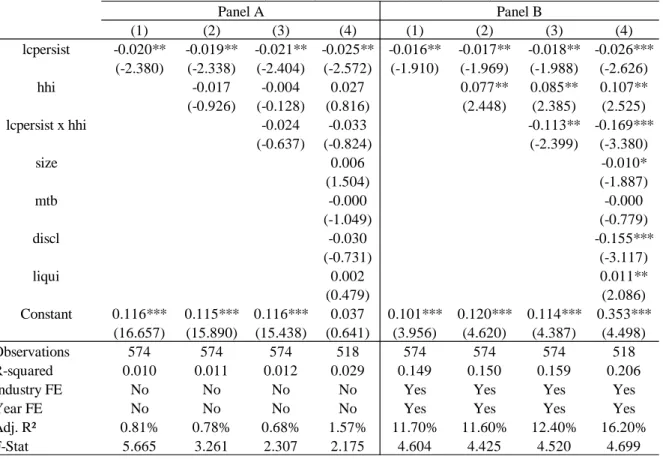
Table 5. Estimated coefficients with OLS (Panel A) and Fixed Effects (Panel B)...…………47
Table 6. Regression coefficients with persistence in maturity and growth stages only………48
Chapter 3. An Analysis Of Female Boardroom Presence On Firm Value: Evidence Of Brazilian Capital Market: Table 1. Research general variables……….……….59
Table 2. Linear Regression Results..……….62
Table 3. T-test for mean differences….……….63
Table 4. Probit Regression Results.……….………..63
LIST OF FIGURES
Chapter 1. Economic complexity and foreign direct investments: the moderating role of economic
freedom:
Figure 1. The moderating effect of economic freedom on the ECI-FDI relationship……26
Chapter 2. Firm Life Cycle Persistence, The Implied Cost Of Capital And Market Concentration:
“You must take your opponent into a deep dark forest where 2+2=5, and the path leading out is only wide enough for one.”
THESIS INTRODUCTION
Although the 3 articles are under the umbrella of the Business Management, each article deals with distinct themes. This choice is based on the need to demonstrate my ability to deal with different research problems and to examine in different units of analysis. I also chose to work in 3 different units of analysis (countries, firms, and boards of directors) as a way to demonstrate the specifics of each one and enhance my ability to develop ideas and find evidence regardless of the context.
Those 3 papers connect to each other from a methodological line where I use several statistical processes to report evidence that can contribute to the fields not only of Business Management but also in Finance and Accounting.
Chapter 1 is devoted to a macroeconomic analysis of the FDI determinants, and for this reason it differs from the other 2 chapters in the unit of analysis and methodological aspects. Chapters 2 and 3 are focused on the reality of emerging markets, especially the Brazilian context. This context has been little explored in the academic literature and there is little evidence in the comparative literature. Therefore, my findings contribute towards demonstrating similarities and differences from the reported evidence from developed countries.
CHAPTER 1
ECONOMIC COMPLEXITY AND FOREIGN DIRECT INVESTMENTS:
THE MODERATING ROLE OF ECONOMIC FREEDOM
Abstract: In this paper, we report evidence of the relationship between FDI and economic complexity
(ECI). Also, we analyze the moderating effect of economic freedom, as a proxy of institutional quality, on this relationship. Using panel data non-causality tests (Dumitrescu & Hurlin, 2012) and FDI inflows from 42 countries throughout 1970-2015, we find that economic complexity positively impacts on FDI inflows, but not the opposite. Also, we report evidence of the positive moderating effect of economic freedom on FDI-ECI relationship. However, our results also suggest that economic complexity may decrease the FDI inflows in environments with low levels of economic freedom.
Keywords: Foreign Direct Investment. Economic Complexity. Institutional Quality.
Granger-causality
Introduction
Since the 1990s, Foreign Direct Investment has become the primary source of external finance and a vital factor of the economic strategies by developed and developing countries. According to OECD data, Foreign Direct Investments (FDI) inflows increased more than eight times between 1990 (US$ 203,772 million) and 2011 (US$ 1660,558 million) (Villaverde & Maza, 2015). This global phenomenon has given rise to growing academic research into the determinants of FDI over the last three decades.
In the latest years, however, scholars have been investigating the main factors that affect a country’s level of FDI attractiveness which was focused on economic factors such as market size, labor market, political stability and institutional quality as the explanatory factors in countries’ ability to attract FDI (Dunning, 1980; François et al., 2020; Jin et al., 2019; Uddin et al., 2019). While these studies have contributed to understanding the factors on FDI attractiveness, they often lack consistency in their results, presenting conflicting among different papers. For instance, some
scholars find that tax rates are negative and statistically significant correlated to FDI attractiveness (Chakrabarti, 2001; Esteller-Moré et al., 2020), while others find no statistically significant relationship between the two variables. Hence, the relationship between political stability and FDI is also dubious: while some researchers found a positive and statistically significant association (Sethi et al., 2003; Seyoum & Ramirez, 2019), others find no meaningful relationship (Globerman & Shapiro, 2003).
To shed light on the topic, the present paper pursues an exploratory study of the relationship between Economic Complexity (ECI) and Foreign Direct Investments (FDI). Since existing literature already establishes an association of both FDI inflows (Alfaro et al., 2004; Iamsiraroj, 2016; Iamsiraroj & Ulubaşoğlu, 2015) and ECI (Felipe et al., 2012; Hidalgo & Hausmann, 2009) with economic growth of the host country.
So, using the seminal paper of Hidalgo & Hausmann (2009), this paper examines the path that FDI has an effect on ECI and simultaneously ECI could impact FDI. If this hypothesis holds, then the association between FDI and ECI is dynamic and bidirectional, suggesting a strong presence of endogeneity.
In their study, economic complexity follows two attributes: the diversity of the country's export portfolio and the ubiquity of a product, which in simple words means how rare is a given product measured by the number of countries that can produce and export it. Hidalgo & Hausmann (2009) explain that the theoretical mechanism is that countries have different sets of skills and capabilities. As a result, countries have a different level of economic complexity, which ultimately impacts economic development.
Relying on this framework, scholars estimated a positive association of economic complexity and economic outcomes, for instance, GDP (Gao & Zhou, 2018; Hidalgo & Hausmann, 2009) or inequality (Gao & Zhou, 2018; Hartmann et al., 2017). However, countries tend to diversify their exports by entering products that are related to their current exports, and this may result in lower levels of growth (Pinheiro et al., 2018).
In contrast, the literature established that MNEs, on average, possess a firm-specific advantage, are more efficient (Dunning & Lundan, 2008; Girma et al., 2019), faster and more innovative than local incumbents (Cai et al., 2007). Also, MNEs possess ownership advantages that allow them to overcome the additional cost of overseas investments as the presence of such advantages indicates that there is a potential for knowledge and business spillovers to domestic firms.
Considering the internationalization reasons based on the seminal work of Dunning (1980, 1995), we argue that MNEs invest abroad when economic complexity is growing in the host country. Mostly, because MNEs are overly sensitive to market interaction, and this allows MNEs to link with local business spin-offs and gain access to new knowledge/capabilities and actively take advantage of potential spillovers within a sector in the host country (positive externalities). Reversely, we also argue that the entry of MNEs bringing firm-specific assets possibly impacts the economic complexity of the host country, resulting in a Granger-causality relationship.
The contribution of this paper is twofold. First, since our primary purpose is theoretically describing the association between FDI and ECI, we report cross-country evidence of the unexplored relationship between FDI and ECI. Moreover, once the previous findings show a lack of research on moderating factors (Bailey, 2018) and in line with recent papers discussing FDI (Bailey, 2018; Bailey & Li, 2015; François et al., 2020; Hartmann et al., 2017; Uddin et al., 2019), we report evidence of the moderation role of institutional economic quality. We argue that an appropriate policy environment with dynamic economic institutions will create the necessary conditions to attract more FDI once policymakers should design initiatives that directly impact the accumulation of adequate human capital and the development of physical infrastructure (Dunning, 2006).
The remainder of the paper is structured as follows. Section I reviews empirical studies related to the determinants of Foreign Direct Investments. The next section reveals our hypotheses and our arguments linking ECI and FDI. Also, it illustrates the moderating effect of economic freedom. Section II describes the data and methods. Section III reports empirical evidence. In Section IV, we discuss the evidence, and in section V, we conclude and propose future research.
Literature Review: Foreign Direct Investments
Determinants of Foreign Direct Investments InflowsVarious factors may trigger the FDI process. Limitations in the domestic market and the desire for diversification to spread risk are classic examples of why MNEs invest abroad. However, some of these factors originate from opportunities in the host country.
François et al. (2020) divided the evidence of the determinants of FDI into two general categories: macroeconomic conditions and institutional characteristics. In the first category, an extensive effort has been paid to examine the host country's macro components. They consider the market size measured by GDP and GDP growth since they are correlated with potential revenues. For instance, Chakrabarti (2001), using the Extreme Bound Analysis, tested a variety of macroeconomic factors for FDI, including the market size of the host country measured by GDP per capita for a broad cross-section dataset. He reported that market size has a positive and statistically significant impact on FDI. However, factors like tax, wage, openness, exchange rate, and trade balance are susceptible to alterations in the conditioning information set.
According to Buckley et al. (2007), unpredictable rates of inflation has a negative and statistically significant impact on FDI inflows. Mostly because unpredictable inflation rates in the host country increase uncertainty and make long-term planning difficult. Also, high inflation rates may decrease export-oriented FDI on the local market by increasing prices locally and losing the cost advantage in other markets.
Natural resources have also been found to affect FDI. Hirsch et al. (2020) reported evidence of resource-seeking: water availability for rainfed crop production increases the number of hectares acquired by investors in a target country for Foreign Land Acquisition, a specific type of FDI. They explain that the rush for land is driven by the increased demand for products from the primary sector, which is met by a constrained supply of scarce resources of land and water.
The second category of studies includes those that tested institutional determinants of FDI. Some scholars report evidence of the impact of democracy and political stability on FDI. Holmes Jr
et al. (2013) divided formal institutions into three categories: regulatory, political, and economical. Their evidence suggests that the country’s informal institutions, in the form of the cultural dimensions of collectivism and future orientation, shape the country’s formal institutions. In turn, each of the three formal institutions affects the country’s level of inward foreign direct investment differently. Also, they point out that the democratic government attracts more FDI than autocratic ones.
Okada (2013) examines the hypothesis that the effect of financial globalization on international capital inflows depends on a country’s institutional quality. Despite financial openness and institutional quality do not individually have significant impacts on foreign capital inflows, their interaction effects are significant and positive influence on capital inflows.
Pajunen (2008) analyzes how and why countries with different institutional constraints attract or not more FDI inflows. He establishes that the same kind of institutions may be associated with a different outcome in different regions. The findings also show that specific countries may not be attractive or unattractive because of a single institutional factor.
Hypotheses Development
Connecting Foreign Direct Investments and Economic Complexity
Earlier authors on Industrial Organization stated that FDI is not only a way to transfer financial assets to other countries, but also a way to transfer different types of tangible and tacit assets (Hymer, 1960; Sethi et al., 2003). Once firms exist as a form of reducing transaction costs (Coase, 1937), IB researchers expand the field studying firms (MNEs: multinational enterprises) with internalized value-adding processes capable of exploiting where the transaction cost is high. Then, firms will compete overseas when they are capable to internally explore its assets to aggregate value and reduce costs to the point that makes the benefits offset the costs (Parente et al., 2018) and outperform local incumbents. In the microeconomic perspective, Dunning (1980) established the OLI (Ownership, Location, and Internalization) paradigm, which explains the necessary conditions for firms to involve abroad.
The (O)wnership advantage refers to exclusive assets possessed by firms and can be transferred to transnational firms at a low cost. Firms create O advantages through intangible assets prepared to be distributed globally, such as superior technology and intellectual property (IP).
The (L)ocation refers to country-specific advantages in determining which country will host transnational operations. In sum, it relies on the level of country attractiveness in terms of quality of institutions and government policies, infrastructure, social and cultural differences between home and host country. Furthermore, the (I)nternalization refers to basically about the entry mode. Dunning (1980) explains different reasons and ways in which firms can explore their asset advantages, doing agreements that might be signed by host country firms.
Considering that the IB literature typically categorizes internationalization reasons according to what firms are searching for in foreign markets (Conti et al., 2016), most scholars classify internationalization motives as resource-seeking, asset-seeking, efficiency-seeking, and market seeking (Dunning, 1995). Of four types of FDI, our theoretical arguments are most closely with asset-seeking and efficiency-asset-seeking: MNEs are sensitive to the market interaction and potential spillovers within a sector. So, MNEs are actively looking for ways to improve and make the best use of their core O-specific advantages (Dunning, 1995), but in some cases, complementary assets are not accessible on the local market and only can be bought in foreign markets.
Moreover, foreign direct investment frequently requires the establishment of bilateral relationships, then MNEs are sited near related partners who make it possible to quickly capture additional benefits and positive externalities associated with the gathering and the propagation of information, and the cross-fertilization of ideas and learning experiences (Dunning, 1995).
Some rare studies examine the variation of Economic Complexity (ECI) on FDI context. Pernet (2014) evaluates the impact of economic complexity on the location of foreign direct investment in China. The results suggest that access to exclusive and diverse capabilities is the key determinant of FDI inflows. Also, he provides evidence of the existence of agglomeration economies: foreign firms that are not from Hong-Kong, Macao, and Taiwan are more likely to invest in a city
where numerous firms of the same industry have already invested, potentially increasing the amount of knowledge embedded. Based on the above arguments, we can derive our baseline hypothesis:
Hypothesis 1A. Economic complexity has a positive effect on FDI, ceteris paribus.
Most of our arguments rely on how Economic Complexity is correlated with FDI. However, once previous literature does not cover this relationship in both ways, and the proxy of Economic Complexity is recent. Only a few papers have been used; we are assuming a rigorous position to not presuming which variable is affecting the other. Because of that, our hypothesis 1B will evaluate the opposite proposed by hypothesis 1A. So, based on that, our hypothesis 1B:
Hypothesis 1B. FDI has a positive effect on Economic Complexity, ceteris paribus.
The moderating effect of Economic Freedom on FDI and ECI
Although the economic complexity may play an essential role in the host country's FDI attractiveness, however, FDI itself cannot fully exert a positive influence on the host country if the initial conditions are not appropriate. Balasubramanyam et al. (1999) argue that the minimal level of proper human capital, physical infrastructure, and an appropriate policy environment are the necessary conditions for enhancing FDI.
However, on those three conditions, it is clear that an appropriate policy environment has a significant role once policymakers should design initiatives that directly impact the accumulation of necessary human capital and the development of physical infrastructure. For instance, economic institutions can encourage capital investments by increasing the capital availability and maintain an adequate money supply to ensure the availability of the capital necessary to fund investments and increase the opportunity costs of keeping capital in cash form, thereby encouraging investment.
Besides that, policymakers also should pay attention to the role of institutions once the transaction costs of economic activity rise when countries become more complex and specialized (North, 2006). So, the host country's institutional background will be essential to enhance some
actions to create the appropriate conditions to deal with the increment of complexity, which ultimately increases the volume of FDI. Considering this, our hypothesis is:
Hypothesis 2. Economic Freedom will positively moderate the positive relationship between
FDI and Economic Complexity, ceteris paribus.
Research Method
Data and sampleTo examine our hypotheses, we use the FDI data from World Bank’s World Development Indicator Database, which has been used in other studies (Agrawal, 2015; Bailey, 2018; Cannizzaro & Weiner, 2018; Villaverde & Maza, 2015). We also collect data from the World Bank’s World Development Indicator Database for the control variables. This database includes information of almost all countries in the world, updated annually and available for a large number of years. For economic complexity (ECI), I collected from the Observatory of Economic Complexity created by the MIT Media Lab (Hidalgo & Hausmann, 2009).
Initially, the sample covers countries with all time-points for both the variables without missing values. As a result, the sample is a strongly balanced panel data set consisting of 42 countries in the period between 1970-2015, and the final dataset has 1932 observations, for hypothesis 1A and hypothesis 1B. For the moderation analysis of hypothesis 2, the data became available only in 2000. So, our study covers the period between 2000-2015, and after all, exclusions result in a dataset of 640 observations.
Variables and measures
Dependent variableFor our dependent variable, we use the foreign direct investment, which is defined by the World Bank as the net inflows of investment to obtain a lasting controlling interest (at least 10% of
voting stock) in a company operating in a different economy of the investor. It is the sum of equity capital, reinvestment, long-term capital, and short-term capital, as shown in the balance of payments.
We use FDI inflows from 1970 to 2015 to test hypothesis 1. For the other hypotheses, we cover only the period between 2000 and 2015 because moderators started to be updated annually only from the year 2000. The reason to choose FDI inflows in our analysis instead of other internationalization modes (such as exporting) as the former requires higher financial commitment with the host country and allows MNEs to access and take advantage of local knowledge.
Independent variable and moderator
Economic Complexity
The Economic Complexity Index (ECI) is the complexity of a country's productive structure, and it is calculated by merging data on the diversity of a country (the number of products it exports), and the ubiquity of its products, which is the number of countries that export that product.
The ECI captures comparatively the level of sophistication and diversity of an economy. Hidalgo & Hausmann (2009) claims that sophisticated economies are diverse and export products that have low ubiquity since only a few distinct countries can make sophisticated products. In contrast, less sophisticated economies produce a few ubiquitous products. ECI uses the variation in the product diversity of countries and the ubiquity of products to measure of a country’s productive structure that incorporates information about the sophistication of products.
ECI is calculated from export data connecting countries to the products in which they have Revealed Comparative Advantages (Hidalgo & Hausmann, 2009). The Revealed Comparative Advantage (RCA) of a country a in a product b is:
𝑅𝐶𝐴𝑎𝑏 =
𝑋𝑎𝑏/ ∑ 𝑋𝑏′ 𝑎𝑏′ ∑ 𝑋𝑎′ 𝑎′𝑏/ ∑𝑎′𝑏′𝑋𝑎′𝑏′
Where 𝑋𝑎𝑏 is the sum of the total export of the country an in product b, RCA is larger than one if a country's export of a product is larger than what would be expected from the size of the
country’s export economy and the product’s global market. RCA is used to define a Matrix 𝑀𝑎𝑏. And 𝑀𝑎𝑏 =1 if 𝑅𝐶𝐴𝑎𝑏 ≥ 1 or 𝑀𝑎𝑏 = 0 if 𝑅𝐶𝐴𝑎𝑏 ≤ 1.
The matrix 𝑀𝑎𝑏 classifies the country’s diversity and the ubiquity of a product, as the number of products that are exported by a country with comparative advantage, and the number of countries that export a product with comparative advantage (Hidalgo & Hausmann, 2009).
Diversity = 𝑘𝑎0 = ∑𝑝𝑀𝑎𝑏 Ubiquity = 𝑘𝑏0 = ∑𝑐𝑀𝑐𝑝 And the ECI is defined as
𝐸𝐶𝐼𝑎 = 𝐾𝑎− 〈𝐾〉 𝑠𝑡𝑑(𝐾)
Where 𝐾𝑎 is the eigenvector of 𝑀̃𝑎𝑎′, associated with the second largest eigenvalue – the vector associated with the largest eigenvalue is a vector of ones (Hartmann et al., 2017).
Economic Freedom
In this study, we use the Economic Freedom of the World-index (EFW), which is published by the Fraser and The Cato Institutes, and several previous studies used as a proxy of institutional quality (Bengoa & Sanchez-Robles, 2003; Paramati et al., 2016; Uddin et al., 2019). The last edition includes five categories available for 150 countries. The index contains five unweighted average categories, reproduced for a country's institutional quality regarding 1) Size of Government; 2) Legal Structure and Security of Property Rights; 3) Access to Sound Money; 4) Freedom to International Trade; and 5) Regulations of the Credit market, labor market, and Business. The EFW applies a 0-to-10 scale for each category, calculating an average of these five categories to obtain the overall index. In this index, zero represents the lowest quality of economic institutions, and 10 represents the highest level. The data of the EFW index is available annually only from 2000. Our sample begins in 1970 and, hence, our moderation analysis will cover the period between 2000 and 2015.
Control Variables
To isolate the effects of other factors that may influence FDI inflows, we control for the country characteristics used in previous studies. Thus, we follow the FDI literature and consider the following economic variables as controls: income (GDP per capita) measured in constant 2010 US dollars. In line with François et al. (2020), we expect a positive effect. We also include the GDP growth rate in the host country and expect a positive impact (Bailey & Li, 2015). We use Trade as economic openness, which is operationalized by total exports and imports as a percent of GDP, and we expect a positive impact.
We use industry employment (percent of the total population) as a proxy of the country's' absorptive capacity and expect a positive effect on FDI attractiveness. We capture the influence of market size using the population (logarithm of the population)1 As a proxy, and we expect a positive impact. We assume that inequality (Gini index) and Consumer Price Index (inflation) has a negative effect. We capture the effect of natural resources exploitation on FDI with the portion of natural resources rents in GDP (Resource rents) and expect a positive impact. Finally, we control for financial freedom, and following Okada (2013), we expect a positive effect.
Analytical Strategy
We divided the analytical strategy into two steps. First, We investigate a bivariate framework using the Granger causality approach between two variables: Foreign Direct Investment (FDI), measured by the net inflow of foreign direct investment into a host country and Economic Complexity (ECI). Then, we tested hypothesis 2, the moderating effect of economic, institutional quality on FDI, and ECI.
Granger-causality in panel data
To address the first hypothesis, we evaluate the nature of the directionality between FDI and ECI using Granger causality (Granger, 1969), but in the panel data context. Granger (1969) stated if the previous values of x are significant predictors of the current value of y when previous values of y have been included in the right side of the equation, then x Granger-causes y. Suppose that 𝑥𝑡 and 𝑦𝑡 are stationary. The equation (1) tests where x Granger-causes y based on F test under the following null hypothesis:
𝐻0: 𝛽1 = 𝛽2 = 𝛽3 = ⋯ = 𝛽𝑘 = 0
If 𝐻0 is rejected in the following model
𝒴
𝑡= ∑ 𝛾
(𝑘)𝒴
𝑡−𝑘 𝑝 𝑘=1+ ∑ 𝛽
(𝑘)𝑥
𝑡−𝑘 𝑝 𝑘=0+ 𝒱
𝑡 (1)it is possible to conclude that x causes y. It is possible to test bidirectional Granger-causality interchanging x and y.
Dumitrescu & Hurlin (2012) extend the Granger test design to detect causality in panel data. This procedure allows the use of cross-sectional and time-series information simultaneously to test Granger-causality between x and y. The Dumitrescu & Hurlin Test (DHT) improves the Granger causality test because it increases sample size (n), which raises the degrees of freedom that ultimately improves the efficiency of the Granger-causality test. Considering a time-stationary VAR representation modified to a panel data context, for each individual i we have ∀ t ∈ [1,t]:
𝒴
𝑖,𝑡= ∑ 𝛾
𝑖(𝑘)𝒴
𝑖,𝑡−𝑘 𝑝 𝑘=1+ ∑ 𝛽
𝑖(𝑘)𝑥
𝑖,𝑡−𝑘 𝑝 𝑘=0+ 𝒱
𝑖,𝑡 (2)with p ∈ ℕ and 𝑣𝑖,𝑡 = 𝛼𝑖 + 𝜀𝑖,𝑡 and 𝜀𝑖,𝑡 are independent and identically distributed (0, 𝜎𝜀2). Assuming that lag orders, K is identical for all cross-section units of the panel, and the panel is
balanced. Also, we allow the autoregressive parameters 𝛾𝑖(𝑘) and the regression coefficients slopes 𝛽𝑖(𝑘) to differ across groups. As in Granger (1969), the null hypothesis is
𝐻0: 𝛽𝑖1 = 𝛽𝑖2 = 𝛽𝑖3 = ⋯ = 𝛽𝑖𝑘 = 0 ∀ 𝑖 ∈ [1, … , 𝑁] (3)
The Dumitrescu & Hurlin test assumes there can be Granger-causality for some individuals but not automatically for all. So, the alternative hypothesis is
𝐻1: 𝛽𝑖1 = 𝛽𝑖2 = 𝛽𝑖3 = ⋯ = 𝛽𝑖𝑘 = 0 ∀ 𝑖 ∈ [1, … , 𝑁1]
𝛽𝑖1 ≠ 0 𝑜𝑟 𝛽𝑖𝑘 ≠ 0 ∀ 𝑖 ∈ [𝑁1+ 1, … , 𝑁]
where 𝑁1 ∈ [0, N − 1], and it is indefinite. If 𝑁1 = 0, x Granger-causes y for all individuals in the panel. However, 𝑁1needs to be smaller than N; otherwise, the 𝐻0 is not rejected, and there is no causality for all individuals.
To solve that, DHT proposes run N separate regressions implicitly enclosed in (2), make F tests of the K linear hypotheses 𝐻0: 𝛽𝑖1 = 𝛽𝑖2 = ⋯ = 𝛽𝑖𝑘 = 0 to calculate individual Wald statistic 𝑊𝑖, and calculate the mean Wald statistic 𝑊̅ :
𝑊
̅ =
1
𝑁
∑ 𝑊
𝑖𝑁
𝑖=1
We highlight that the DHT test is designed to identify Granger-causality at the panel level, and
rejecting 𝐻0 does not exclude non-causality for some entities. Dumitrescu & Hurlin (2012) show that 𝑊̅ is asymptotically properly performed using Monte Carlo simulations and can be applied to examine Granger-causality in panel data.
Under the assumption that the 𝑊𝑖, are independently and identically distributed across entities, and it can be shown that the standardized 𝑍̅, when T is large relative to N, follows a normal distribution:
𝑍̅ = √𝑁
Also, for a fixed T dimension with T > 5 + 3K, the standardized statistic 𝑍̃ follows a normal distribution. The testing process of the 𝐻0 in (3) is based on 𝑍̅ and 𝑍̃. If these are larger enough than the critical values, then 𝐻0 is rejected and conclude that Granger causality exists.
In this study, the number of lags K was selected based on an information criterion (AIC/BIC). In this process, all estimations were merged on a common sample to be nested and, therefore, comparable. Both AIC and BIC information criteria resulted in K = 1. In addition, to avoid the cross-sectional dependence across countries, we tested using the bootstrap procedure recommended by Dumitrescu and Hurlin (2012) with 1000 replications.
Model Specification
We use cross-sectional OLS regression with robust standard errors to test hypotheses 2. Given the stability in the variance across time in economic complexity and FDI, we choose cross-sectional OLS instead of a longitudinal panel study as our statistical model. We employ robust standard errors to control for potential bias produced by non-constant error variance. All independent variables related to GDP are measured in the year 2010, as we are trying to predict the pattern of FDI inflows from 2000 to 2015. Also, we employed a one-year lag between the dependent and independent variables to help mitigate the possibility of the error term being correlated with the independent and dependent variables. To test hypothesis 2, our full model is:
𝐹𝐷𝐼𝑡 = 𝛽0+ 𝛽1𝐸𝐶𝐼𝑡−1+ 𝛽2𝐸𝑐𝑜𝑄𝑢𝑎𝑙𝑖𝑡𝑦𝑡−1+ 𝛽3𝐸𝐶𝐼𝑡−1 𝑥𝐸𝑐𝑜𝑄𝑢𝑎𝑙𝑖𝑡𝑦𝑡−1+ 𝛽4𝐶𝑜𝑛𝑡𝑟𝑜𝑙𝑠𝑡−1+ 𝜀 Where,
FDI is the foreign direct investment;
𝐸𝐶𝐼𝑡−1 is the economic complexity variable lagged by one year; 𝐸𝑐𝑜𝑄𝑢𝑎𝑙𝑖𝑡𝑦𝑡−1is the economic freedom variable lagged by one year; And 𝐶𝑜𝑛𝑡𝑟𝑜𝑙𝑠𝑡−1are the control variables lagged by one year;
Data Analysis and Results
Descriptive Analysis and Correlation Matrix
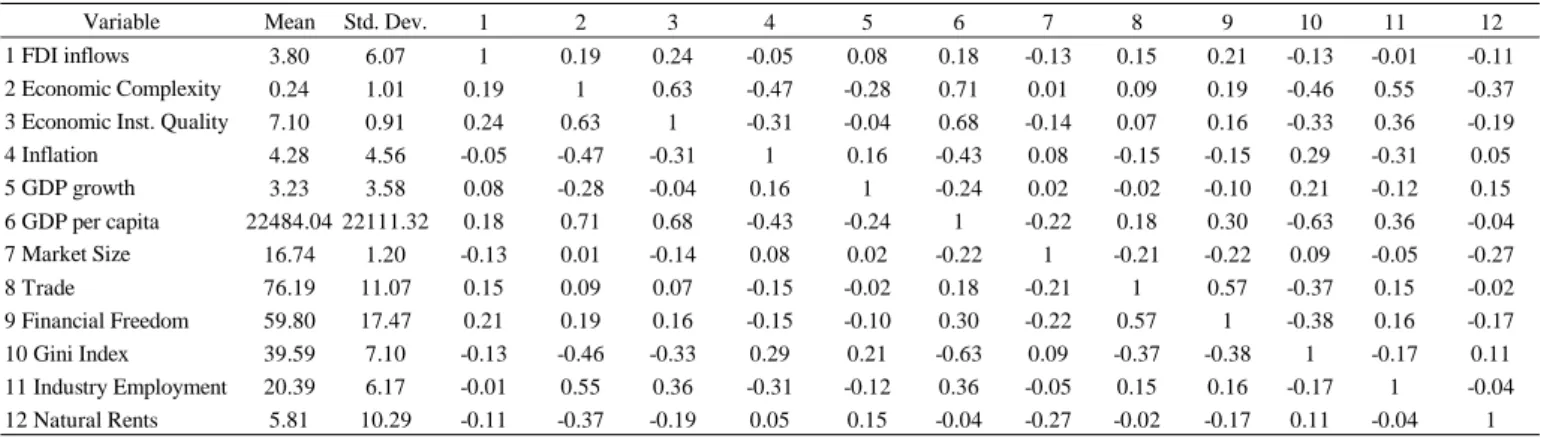
Table 1 presents the descriptive statistics and correlation matrices. The average FDI inflows over the 2000–2015 period was 3.8% of GDP. The average of GDP income is twice greater than reported by Bailey & Li (2015). A comparison between datasets shows that our GDP income is higher due to a more considerable time-period analysis (2000-2015 in our case, 2006-2011 on Bailey & Li( 2015)) and different countries on the (40 countries in our case; 110 countries on Bailey & Li (2015)) dataset. The correlations matrix, as well as preliminary analysis of various results, indicated the presence of some collinearity. However, we found no severe multicollinearity problems as the variance inflation factor (VIF) tests from the full model average 2.01, fairly below the limit for regression models of 10 (Hair et al., 1998). To minimize potential multicollinearity, we also mean-center the moderation terms.
In this data, the top-3 highest correlations are observed between Economic Complexity and GDP income (0.71), GDP income and Economic Institutional Quality (0.68), and Economic Institutional Quality and Economic Complexity (0.63). The correlation coefficients indicate that FDI and ECI are positively correlated and significant at 1% level.
Table 1. Descriptive statistics and correlation matrix*
Variable Mean Std. Dev. 1 2 3 4 5 6 7 8 9 10 11 12
1 FDI inflows 3.80 6.07 1 0.19 0.24 -0.05 0.08 0.18 -0.13 0.15 0.21 -0.13 -0.01 -0.11 2 Economic Complexity 0.24 1.01 0.19 1 0.63 -0.47 -0.28 0.71 0.01 0.09 0.19 -0.46 0.55 -0.37 3 Economic Inst. Quality 7.10 0.91 0.24 0.63 1 -0.31 -0.04 0.68 -0.14 0.07 0.16 -0.33 0.36 -0.19 4 Inflation 4.28 4.56 -0.05 -0.47 -0.31 1 0.16 -0.43 0.08 -0.15 -0.15 0.29 -0.31 0.05 5 GDP growth 3.23 3.58 0.08 -0.28 -0.04 0.16 1 -0.24 0.02 -0.02 -0.10 0.21 -0.12 0.15 6 GDP per capita 22484.04 22111.32 0.18 0.71 0.68 -0.43 -0.24 1 -0.22 0.18 0.30 -0.63 0.36 -0.04 7 Market Size 16.74 1.20 -0.13 0.01 -0.14 0.08 0.02 -0.22 1 -0.21 -0.22 0.09 -0.05 -0.27 8 Trade 76.19 11.07 0.15 0.09 0.07 -0.15 -0.02 0.18 -0.21 1 0.57 -0.37 0.15 -0.02 9 Financial Freedom 59.80 17.47 0.21 0.19 0.16 -0.15 -0.10 0.30 -0.22 0.57 1 -0.38 0.16 -0.17 10 Gini Index 39.59 7.10 -0.13 -0.46 -0.33 0.29 0.21 -0.63 0.09 -0.37 -0.38 1 -0.17 0.11 11 Industry Employment 20.39 6.17 -0.01 0.55 0.36 -0.31 -0.12 0.36 -0.05 0.15 0.16 -0.17 1 -0.04 12 Natural Rents 5.81 10.29 -0.11 -0.37 -0.19 0.05 0.15 -0.04 -0.27 -0.02 -0.17 0.11 -0.04 1 *All correlations greater 0.10 or less than -0.10 are significant at the 0.05 level. N = 640
ECI-FDI Granger causality analysis
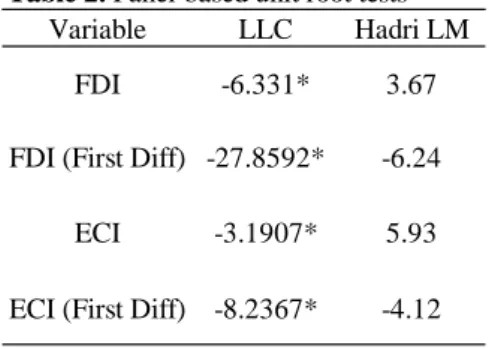
Before to report the Granger causality analysis, we test for the stationarity of FDI and ECI variables, using Levin-Lin-Chu unit-root test (hereafter LLC) proposed by Levin et al. (2002). This test has several advantages. First, LLC assumes that each unit in the panel shares the same AR(1) coefficient, but allows for individual effects, time effects and time trend which may provide improvements in statistical power in comparison to performing a separate unit root test for each time series (Chang et al., 2007). Also, LLC works better for a panel of moderate size in industry-level or cross-country econometric studies (Levin et al. (2002) define between 10 and 250 individuals, and 25 –250 time-series observations per individual). Moreover, the error variance and the pattern of higher-order serial correlation are also allowed to vary freely among individuals.
Also, we conducted the Hadri Lagrange multiplier (LM) test because the null and alternative hypotheses are reversed, which help to reject or not reject conclusions based on tests with the null hypothesis being non-stationarity. Hadri (2000) notes, classical hypothesis testing requires substantial evidence to the contrary to reject the null hypothesis. Table 2 shows the results of both tests.
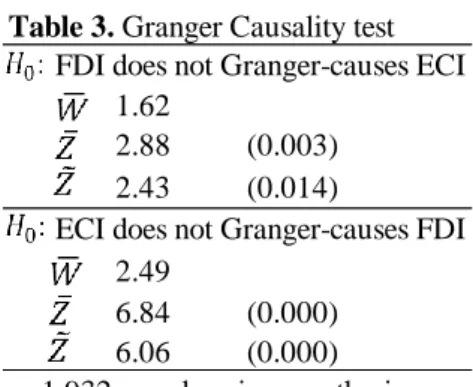
We find that the LLC result rejects the null hypothesis of non-stationarity for both variables. Also, the Hadri LM result does not reject the null hypothesis of stationarity. The results of both tests are the same for the first differences in FDI and ECI. In Table 3, we reported the results of the Granger causality test on the full sample. We find 𝑍̅ (2.88; p-value < 0.01) and 𝑍̃ (2.43 p-value < 0.02) are significant at 1% level, and 5% level, respectively rejecting the null hypothesis of FDI does not
Table 2. Panel-based unit root tests
Variable LLC Hadri LM 3.67 -27.8592* -6.24 FDI
FDI (First Diff) ECI ECI (First Diff)
-6.331*
-3.1907* 5.93 -8.2367* -4.12 * p<0.01; LLC is Levin-Lin-Chu unit-root test; Hadri LM is Hadri Lagrange multiplier (LM) test
Granger-cause ECI. The same can be said for the opposite: we find 𝑍̅ (6.84; p-value < 0.01) and 𝑍̃ (6.06; p-value < 0.01) are significant at 1% level rejecting the null hypothesis of ECI does not Granger-cause FDI.
Those results together are initial evidence of a possible reverse causality phenomenon which does not reject hypothesis 1A and 1B. However, to avoid type II error, we conduct a bootstrap analysis of 1,000 repetitions reported in Table 4 below. Considering those results, we can reject hypothesis 1B once the probability of having a different 𝑍̅ or 𝑍̃ increases (p-value > 0.2), and 𝑍̅-stat and 𝑍̃-stat is far away from the 95% critical values.
In sum, here we provide evidence that supports hypothesis 1A but not support 1B, and in conclusion, we may confirm that the direction of Granger-causality run from ECI to FDI. Unreported robustness check has shown that this evidence holds in the different time-window analysis.
Table 3. Granger Causality test
1.62 2.88 (0.003) 2.43 (0.014) 2.49 6.84 (0.000) 6.06 (0.000)
FDI does not Granger-causes ECI
ECI does not Granger-causes FDI
n=1,932; p-values in parenthesis
Table 4. Bootstrap Analisys
1.61 2.79 (0.025) 95% Critical = 4.72 2.35 (0.025) 95% Critical = 4.11 2.31 6.03 (0.003) 95% Critical = 3.85 5.29 (0.003) 95% Critical = 3.32 FDI does not Granger-causes ECI
ECI does not Granger-causes FDI
n=1,932; p-values computed using 1000 bootstrap replications (in parenthesis)
ECI-FDI Regression Analysis and Economic Freedom Moderating Role
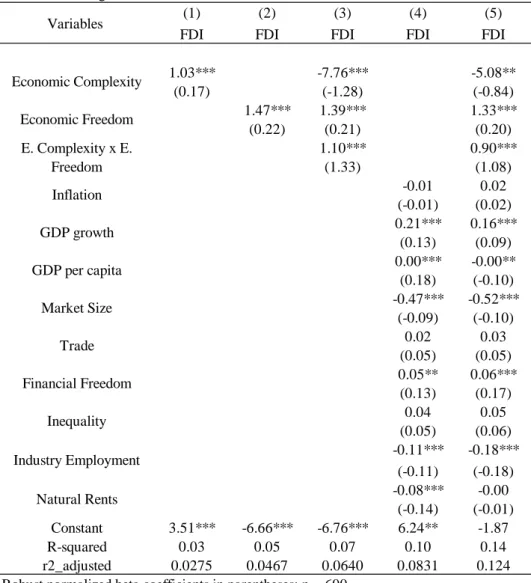
Considering previous evidence, Table 5 below reports the evidence of this relationship considering control variables. Model 4, we include only the control variables. GDP Growth, GDP per capita, Industry Employment, Market Size, and Financial Freedom are positive and significant (at 1% level for the first four and significant at 5% level for Financial Freedom).
This evidence suggests that countries growing, with higher income, more possible customers, better absorptive capacity, and financially free attracts more FDI. On the opposite, Natural Rents are negative and significant at 1% level, which suggests that countries with unexplored natural resources receive more FDI. Model 1 and 2 include the main independent variable ECI and the moderator ‘Economic Freedom’. As hypothesized, the main effect of ECI is positive and significant at 1% level. This evidence suggests that countries with exclusive production factors or resources and a higher level of diversification in the export basket attract more FDI, ceteris paribus.
In Model 3, the main effect of the moderation variable, Economic Freedom, is positive and significant, indicating that be economically free is an important step to attract FDI investments. In models 4 and 5, we add moderation analysis. We find support for hypothesis 2: economic freedom has a positive moderating effect on the relationship between FDI and ECI (p-value < 0.01).
This result suggests that the role of economic complexity in attracting FDI also depends on how well established are the economic institutions. Moreover, it is essential to highlight the negative effect of economic complexity in FDI in environments of low levels of economic freedom. This evidence strengths the notion defended by North (2006) that the importance of economic institutions to deal with a more complex and specialized environment.
Table 5. OLS regression results
(1) (2) (3) (4) (5)
FDI FDI FDI FDI FDI
1.03*** -7.76*** -5.08** (0.17) (-1.28) (-0.84) 1.47*** 1.39*** 1.33*** (0.22) (0.21) (0.20) 1.10*** 0.90*** (1.33) (1.08) -0.01 0.02 (-0.01) (0.02) 0.21*** 0.16*** (0.13) (0.09) 0.00*** -0.00** (0.18) (-0.10) -0.47*** -0.52*** (-0.09) (-0.10) 0.02 0.03 (0.05) (0.05) 0.05** 0.06*** (0.13) (0.17) 0.04 0.05 (0.05) (0.06) -0.11*** -0.18*** (-0.11) (-0.18) -0.08*** -0.00 (-0.14) (-0.01) Constant 3.51*** -6.66*** -6.76*** 6.24** -1.87 R-squared 0.03 0.05 0.07 0.10 0.14 r2_adjusted 0.0275 0.0467 0.0640 0.0831 0.124 Robust normalized beta coefficients in parentheses; n = 600
*** p<0.01, ** p<0.05, * p<0.1 Inequality Industry Employment Natural Rents Variables GDP growth GDP per capita Market Size Trade Financial Freedom Economic Complexity Economic Freedom E. Complexity x E. Freedom Inflation
Discussion and Conclusions
In this paper, we investigate whether the host country's economic complexity has an impact on FDI inflows. We also moderate this relationship with a proxy of institutional quality. Our main conclusion is that countries with higher levels of economic complexity attract more foreign direct investments, but not the contrary. This suggests that when economic complexity grows, the number of production factors grows, which allows one to combine the new set of skills with existing resources and create new products (or produce with lower levels of cost). Which attracts more foreign investors since MNEs view them as an opportunity to stay close and invest in spin-offs, which are in line with asset-seeking and efficiency-seeking strategies.
However, we also obtain strong evidence of the moderating effect of economic freedom. In particular, we find that depending on the level, and institutional quality significantly changes the impact of economic complexity on FDI, lending support for the notion that is increasing the economic complexity itself attract more FDI. But, may shrinkage the FDI inflows in cases of lower levels of economic freedom. This implies that a host country with a high level of economic complexity, but institutionally weak will generate a negative impact in FDI inflows (see Fig. 1).
We have a hypothetical reason why this may occur. Countries where economic freedom is low and the economic complexity is high (such as Russia) probably suffer from political unpredictability, which will exert a negative impact in the institutional structure such as labor and credit market regulations, crucial points in the foreign investor’s decision making. In sum, these results are following the extensive evidence of institutional theory but adding the evidence of negative impact even in complex and specialized countries.
In this paper, we reported results that have implications for both academics and policymakers. From an academic standpoint, this study is an extension of the OLI paradigm (Dunning, 1995). We have documented an important factor, such as Economic Complexity, that has significant impacts on FDI inflows and reported evidence of how countries may take full advantage in attracting more FDI evaluating institutional factors and the economic complexity as an integrated system. From the policy standpoint, our pieces of evidence provide guidelines to policymakers to attract more foreign investors.
Limitations and Future research
We identify two limitations, which represent opportunities for future research. First, we focus on the unexplored FDI-ECI relationship to observe the direction of the effect in the aggregate country-level data. It will be interesting to examine and observe micro-level data such as state-level in a country to explore the potential differences when the states receive, in theory, the same institutional quality from the federal level. Also, studies focused on economic complexity at the state-level in emerging countries will contribute to the literature once those countries have historically institutional imperfections and political instability.
CHAPTER 2
FIRM LIFE CYCLE PERSISTENCE, THE IMPLIED COST OF CAPITAL
AND MARKET CONCENTRATION
Abstract: This study examines the relationship between life cycle persistence and the cost of capital
moderated by the level of market concentration. Market concentration has an important role in market transactions, especially in the different life cycle stages: in a struggle to survive, external fundraising can be more expensive to new entrants in comparison to stable firms. By looking at São Paulo Stock Exchange firms (BOVESPA), we found a negative association between life cycle persistence and implied cost of capital. Further, our findings show that lowering market concentration, a sustainable situation in operating, investing, and financing issues lead to a reduction in the inherent risk and, consequently, reduce the implied cost of capital. The findings highlight important implications. First, in the decision-making process, investors and financial institutions taking into consideration the firm life cycle persistence as a signal of stable firm resource configuration lowering the premium risk. Also, managers can use firm life cycle persistence as a signalization tool to fundraise more efficiently. Theoretically, we add to the literature by bringing a novel and complementary proxy to the firm life cycle theory.
Keywords: Life Cycle Persistence; Market concentration; Implied Cost of Capital. INTRODUCTION
This study contributes to the existing literature on the firm life cycle theory by proposing a complementary approach to the estimation of the firm life cycle. Following Dickinson’s (2011) life cycle proxy2, we introduce the concept of firm life cycle persistence and examine the association between life cycle persistence and implied cost of capital. Also, we investigate the moderating effect of market concentration on this relationship. To better understand the phenomenon, we extend our analysis to examine the systematic relationship between the implied cost of capital and the persistence in specific firm life cycle stages.
Our primary purpose is to investigate how the market’s perception of risk is associated with life cycle persistence, and then examine how this perception varies across life cycle stages. Considering that the market tends to consistently adopt different discount rates to firms given their
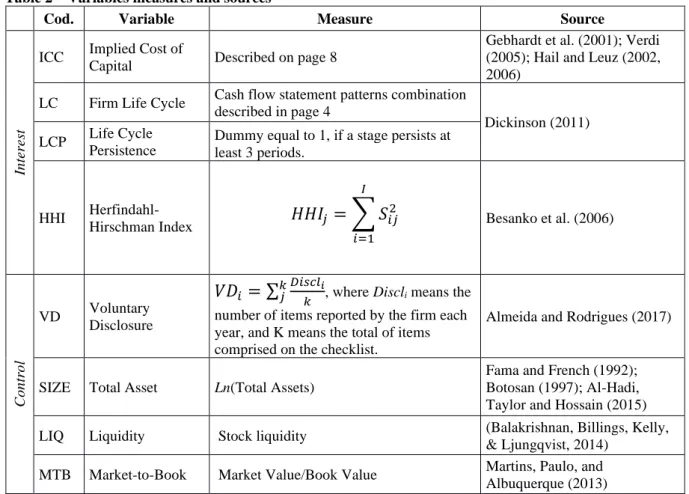
2 Dickinson (2011) created a firm life cycle proxy using the signal combination (positive or negative) of the three cash
flow statements (Operating, Investing and Financing) grouping firms in five stages: introduction, growth, maturity, shake-out, decline.
accounting fundamentals, industry characteristics and the macroeconomic “quality” of the country (Fama & French, 1989; Gebhardt et al., 2001; Dittmar & Lundblad, 2017), we argue that using firm life cycle persistence has the potential to improve the analysis of firm valuation and investment decision-making purposes.
The literature suggests that the ability to move and adapt in a chaotic environment must be reflected in the growth of the firm since growth should be the primary focus of the firm during its first years of existence (Mueller, 1972; Jensen, 1993; Arikan & Stulz, 2016). To grow, firms tend to invest in specific assets to boost its inimitability and develop a sustainable competitive advantage (Porter, 2008). However, the use of these assets as collateral may affect the asset valuation due to informational asymmetry. Thus, from the perspective of a financial institution, it is a tough task to determine which firms will be financed in a given industry considering asset specificity, and consequently, firm heterogeneity.
Therefore, due to asymmetric information and from an outsider perspective, it can be a problematic task to identify which resources or combination of resources drive firm performance, considering it is possible to see the effects of performance, but not its causes. The insight here is that independently of the specificity of the resource, its causes will be captured by firm life cycle persistence with the implied cost of capital vary accordingly. Mostly, because the firm life cycle persistence is an informational disclosure approach, which has the primary function of mitigating the information asymmetry problem by providing value-relevant information to investors and capital suppliers.
Moreover, firms make operational decisions that ascend from market equilibrium, which is the result of strategic interactions between rivals, which in turn, affect the level of risk and, ultimately, the implied cost of capital. Thus, market competition has a systematic risk that impacts the requirements of capital suppliers (Bustamante & Donangelo, 2017). Therefore, based on the theoretical foundations of industrial organization (Bain, 1954), we explore the moderating effect of market concentration on firm life cycle persistence and the implied cost of capital.
We contribute to prior research on the firm life cycle (Dickinson, 2011; Hasan et al., 2015), first by developing and testing a theoretical framework that examines the relationship between firm-level life cycle persistence and implied cost of capital. To the best of our knowledge, researchers have not yet tested this relationship, since the construct is a combination of many overlapping product life cycle stages in different moments (Dickinson, 2011). Moreover, the implied cost of capital is commonly calculated in previous studies using only ex-post returns, which is invariably inaccurate (Fama & French, 1997; Hou et al., 2012; Li & Mohanram, 2014; Drobetz et al., 2018). Following Gebhardt et al. (2001), we estimate expected returns by adding a discounted residual income model in the equation, without relying on ex-post returns, which consistently improves estimation (Li &
Mohanram, 2014; Drobetz et al., 2018).
Another significant contribution is that, to our knowledge, near to zero studies have explored the effect of firm life cycle theory on the implied cost of capital in emerging markets. Research reports evidence from developed countries, which may not apply to emergent markets. Thus, this research contributes to the literature by focusing on a transitional economy with substantial changes in market structure over the last decades since the start of the economic opening in early 1990: the end of trade barriers increased the access to better quality inputs forcing the national industry to improve its products and methods of production. These factors contributed to increases in productivity and competition (Rossi Jr. & Ferreira, 1999; Reis et al., 2018).
Additionally, this study has real implications for emerging markets and transitional economies: our evidence demonstrates that the policies have an economic consequence of lowering the cost of capital through market restructuration. Also, our evidence contributes to financial development with a better mechanism of firm valuation, which facilitates and intensifies investment transactions in the economic system.
A body of literature has investigated the life cycle theory to explain the relationship between the firms' stages of development and several phenomena of interest. For instance, there is research on the relationship between life cycle and the cost of capital (Cheynel, 2013; Francis, Nanda, & Olsson,
2008; Erosa, & González, 2019) and life cycle and corporate risk-taking (Habib & Hasan, 2017). However, different from all previous studies, we propose the use of firm life cycle persistence to capture value-relevant information from Dickinson's (2011) life cycle approach and used it to tackle the phenomenon of interest.
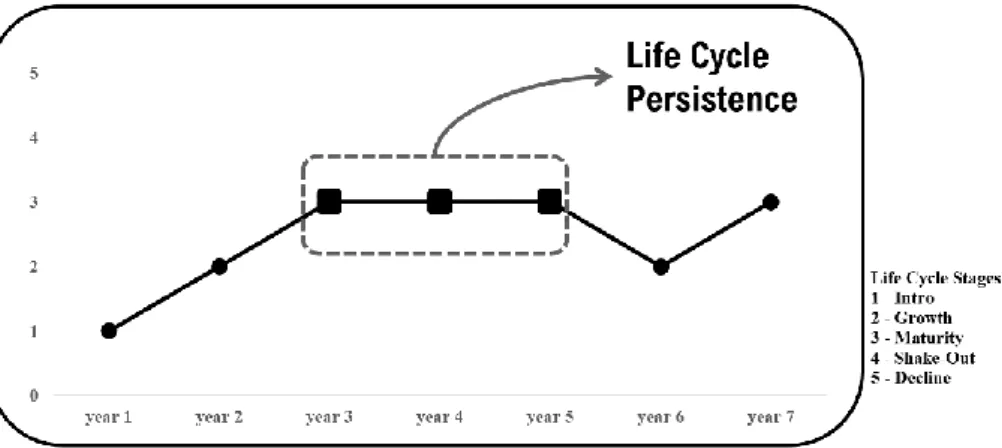
Conceptually, being a persistent firm consistently stays at the same life cycle stage for several time-periods, signaling to investors the resource allocation uniformity of the firm strategy. Given that the literature provides evidence of explanatory power in the life cycle related to profitability and earnings persistence (Dickinson, 2011), dividend payout policies (Bulan et al., 2007; DeAngelo et al., 2006; Trihermanto & Nainggolan, 2018) and other performances measures (De Angelo et al., 2010; Habib & Hasan, 2017), it is a reasonable insight that the persistence status can provide information to outsiders about the internal resource configuration of the firm and shifts the cost of capital.
Our findings suggest advances in the approximation between strategic management and accounting literature. Our evidence adds to the broad stream of work that focuses on financial decisions under uncertainty and the financial implications of the firm life cycle.
Overall, our research exposes the role that the firm life cycle plays in determining the implied cost of capital and how the firm life cycle persistence approach offers managers an analytic tool to evaluate firm's transitory state and may help optimize the resource configuration to surpass competitors and keep the firm on the desirable firm life cycle stage. Additionally, our persistence life cycle proxy enables a reexamination of the existing body of evidence using life cycle theory in different contexts.
The remainder of the paper is structured as follows. Section I reviews interrelated studies and explains the life cycle theory through Dickinson’s (2011) life cycle approach, then we explain the concept of life cycle persistence and how to construct it. Also, this section reveals how we motivate the hypotheses linking life cycle persistence to the implied cost of capital. Also, this section illustrates
reports empirical evidence. In Section IV, we discuss the pieces of evidence, and in section V, we conclude and propose future research.
THEORY AND HYPOTHESES
The emerging-market context
In the last few decades, emerging economies became significant players in the global business environment through market restructuration, improvements in the information flow, and communication technologies. As a result, developing countries increase financial and market integration, which induces a structural change in the local capital market.
According to financial development theories, policymakers need to promote the structural change to enforce mechanisms that strengthen economic transactions and help to develop financial markets that provide reductions in transaction costs and information asymmetry such as the cost of capital.
In this context, Brazil is an interesting scenario because it presents some factors that differ from developed countries that could have a significant impact on firms' performance. For instance, Brazil had rapid population growth, a low level of corporate governance mechanisms, a high level of social inequalities, and a lack of ethics in management procedures. Also, Brazil presents a complex structure of financial services, and the capital market is small in comparison with the banking system. For that reason, capital suppliers are still not able to finance long-term investments. In this context, the government becomes the primary long-term capital provider.
The consideration of these aspects is crucial as they allow a better understanding of how the context of several financing constraints impacts the implied cost of capital. Accordingly, understanding the Brazilian case may help to shed light on alternatives to overcome these issues and to make external resources less costly for investment decisions.
Life Cycle Theory and the formulation of Life Cycle Persistence
Firm life cycle theory explains how a firm is born, grows, and declines. Like an organism tends to progress through stages of development from birth to decline. Also, strategies, resource configuration, and actions correspond to their stages of development (Hasan et al., 2015). The life cycle theory's primary purpose is to group similar firms in categories (stages) then use these categories to analyze how varying incentives, restrictions, limitations, and strategies over a firm's life cycle are associated with firm performance (Drake, 2013).
Recent studies in accounting and finance present a growing contribution of firm life cycle theory to understanding performance issues (Costa et al., 2014; Dickinson, 2011; Drake, 2013; Jenkins & Kane, 2004; Alhadi et al., 2018) demonstrating that the firm life cycle has significant influence in management and business strategy (Hasan et al., 2015).
Using life cycle theory, there is research related to governance (Chiang et al., 2011), incentives and competitive advantage (Liao, 2008), research and development and capital expenditures (Ahmed and Jinan, 2011), and firm payout policy (Bulan & Subramanian, 2009; Huang & Chiu, 2018).
Two possible explanations for the growing application of life cycle theory in the literature emerge. First, firms are accumulations of different products, with different life cycle stages competing in many industries (Dickinson, 2011), which makes a firm-level life cycle desirable and easy to comprehend. And second, a firm is influenced by internal factors (strategy choices and financial resources) and the external environment (macroeconomic factors) to reach its goals (Dickinson, 2011), and the result of these interactions can be captured by firm life cycle.
Existing literature proposes different ways to define the stage in which the firm is in the life cycle. Anthony & Ramesh (1992) propose a model that demonstrates the utility of firm life cycle theory in the explanation of market performance. To group firms in life cycle stages, they used