THE EFFECT OF CORPORATE GOVERNANCE QUALITY
ON THE STRATEGIC USE OF NON-GAAP DISCLOSURES
TO BEAT EARNINGS BENCHMARKS
Filipa dos Reis Nunes
Dissertation for the degree of
Master of Accountancy
Supervisor:
Prof. Doctor Helena Isidro, Associate Professor, ISCTE-IUL Business School, Accounting Department
i Aos meus pais, padrinhos e irmão…
"After climbing a great hill, one only finds that there are many more hills to climb."
ii
Acknowledgments
Although writing a thesis is a lonely road (and though only my name appears on the cover of this dissertation), there are many other involved, who supported and guided me to complete this work. I would like to extend my appreciation especially to the following.
First and foremost, I would like to express my deepest gratitude to my supervisor, Prof. Doctor Helena Isidro, for her excellent guidance and for the continuous support. Also, a special acknowledgment to Prof. Doctor Ana Marques, who patiently helped me during the collection of the data.
I am also indebted to all my friends (particularly, my friends Joana, Luciana, Sofia, Luís, Pedro e Renato) who helped me stay sane during this work. Their support and care helped me overcome setbacks.
Last but not least, none of this would have been possible without the patience and understanding of my family. Specially, I would like to thank my parents and brother for their unconditional support, constant encouragement and love. To them I dedicate this thesis.
iii
Abstract
This study investigates the impact of corporate governance quality on the use of non-GAAP earnings measures to beat strategic earnings benchmarks. For this purpose, five strategic earnings benchmarks are considered: beating analysts’ forecasts, reporting growth in profits, portraying better performance, beating industry performance and avoiding losses. Firms’ governance quality is measured through an index combining 41 attributes.
For a sample of European firms, empirical results suggest that corporate governance has a strong influence on firms’ voluntary disclosure decisions. Overall, firms’ governance quality is capable of reducing managers’ propensity to use non-GAAP metrics to meet or beat earnings thresholds. However, it does not seem to have similar influence on all benchmark beating strategies. In fact, the discretionary disclosure of non-GAAP earnings to exceed analysts’ forecasts and to avoid losses is not mitigated by good governance practices. Also, governance mechanisms reduce the magnitude of the difference between non-GAAP earnings and both GAAP measures and analysts’ expectations.
Keywords: non-GAAP measures; pro forma; earnings benchmarks; corporate governance.
iv
Resumo
O presente estudo pretende investigar o impacto da qualidade do corporate governance (governanção das sociedades) na utilização de medidas non-GAAP, divulgadas com o intuito de atingir estrategicamente benchmarks relativos a indicadores de rentabilidade. Para esse efeito, são considerados cinco diferentes benchmarks: superar as previsões dos analistas, divulgar um crescimento dos lucros, apresentar uma melhor performance, superar a média do sector e evitar divulgar perdas. Por sua vez, a qualidade de governação das empresas é medida através de um índice composto por 41 atributos.
Tendo por base uma amostra constituída por empresas europeias, os resultados da análise empírica sugerem que o corporate governance influencia significativamente as decisões das empresas relativas à divulgação de informação voluntária. De um modo geral, verifica-se que a qualidade de governação é passível de reduzir a propensão para os gestores usarem medidas non-GAAP a fim de atingirem os objetivos de referência. Contudo, constata-se que esta não influencia de forma igual todos os benchmarks. Efetivamente, as boas práticas de governação são incapazes de atenuar a utilização discricionária de medidas non-GAAP divulgadas com o intuito de superar as expectativas dos analistas e de evitar a comunicação de prejuízos. Além disso, os resultados indicam que os mecanismos de governação reduzem o valor diferencial entre as medidas non-GAAP e as GAAP, bem como entre as non-GAAP e as previsões dos analistas.
Palavras-chave: medidas non-GAAP; pro forma; benchmarks referentes a indicadores de rentabilidade; governação das sociedades.
v
Executive Summary
In recent years, it has become common practice for many companies to voluntarily disclose non-audited performance metrics (frequently called non-GAAP measures) that fall beyond the scope of generally accepted accounting principles (GAAP). However, since these measures are often not subject to regulation, managers benefit from a considerable degree of discretion in defining their non-GAAP earnings figures. Prior literature asserts that this discretion can be used in two ways. On the one hand, managers can use their reporting freedom to reduce information asymmetry by providing a clearer picture of “core earnings” to the users of financial information. On the other hand, non-GAAP numbers can be opportunistically disclosed, in an attempt to manipulate investors’ perceptions of the financial results of the firm.
Regarding this opportunistic view of non-GAAP reporting, previous studies suggest two pro forma reporting decisions that are likely to indicate opportunistic behavior. First, firms frequently exclude recurring or persistent expenses that are included in GAAP-based income, in order to portray better firm performance. Second, non-GAAP numbers are often used to appear to meet strategic earnings benchmarks that otherwise would have been missed by GAAP earnings. This second practice constitutes the main subject of this study.
More specifically, this research intends to investigate the extent to which corporate governance mechanisms act as deterrents to potentially misleading non-GAAP reporting practices associated with benchmark beating strategies. For this purpose, five strategic earnings benchmarks are considered: beating analysts’ forecasts, reporting growth in profits, portraying better performance, beating industry performance and avoiding
vi losses. Firms’ governance quality is measured through an index combining 41 attributes.
The sample used in this analysis is drawn from the Financial Times 2006 classification of the 500 largest European firms. For each firm, the press releases of the annual earnings announcements for five fiscal years of 2003 to 2007 were collected and analyzed. After eliminating firm-years with missing press releases the final sample comprises 1551 observations representing 319 firms from 21 European countries. Overall, the empirical results suggest that corporate governance has a strong influence on firms’ voluntary disclosure decisions. In fact, firms’ governance quality is negatively associated with managers’ propensity to use non-GAAP measures for benchmark beating strategies. However, it does not seem to be effective at restraining the use of alternative earnings metrics to exceed analysts’ expectations and to avoid losses. Additionally, this study provides evidence that, in a virtually unregulated setting, such as the European markets, corporate governance is effective at reducing potentially misleading non-GAAP adjustments. In fact, good governance quality seems to be capable of reducing the discretionary behavior associated with higher levels of exclusions.
vii
Contents
1. Introduction ... 1
2. Background information and relevant literature ... 4
2.1 Corporate governance mechanisms ... 4
2.1.1 Why is Corporate Governance important? ... 5
2.1.2 Corporate Governance Standards ... 6
2.1.3 The determinants of corporate governance quality ... 7
2.2 Voluntary disclosure ... 9
2.2.1 Motives for reporting non-GAAP earnings: informative view versus opportunistic view ... 10
2.2.2 Regulation of non-GAAP disclosures ... 12
2.2.3 Prior research on determinants of non-GAAP disclosure decisions... 16
3. Hypotheses development ... 21
4. Sample selection and data collection ... 24
5. Research design ... 27
5.1 Model definition ... 27
5.2 Variable descriptions ... 28
5.2.1 Dependent variables ... 28
viii
6. Descriptive Evidence ... 34
7. Empirical results ... 42
7.1 Governance quality and earnings benchmark beating ... 42
7.2 Governance quality and the magnitude of non-GAAP adjustments... 48
7.2.1 Total non-GAAP adjustments made by managers ... 48
7.2.2 Non-GAAP adjustments made by managers to exceed analysts’ forecasts ... 50
7.3 Regression Assumptions ... 52
7.3.1 Linear regression model ... 52
7.3.2 Logistic regression model ... 53
8. Conclusion, limitations and future research ... 54
9. References... 56
Appendix 1 ... 64
Appendix 2 ... 65
Appendix 3 ... 66
ix
List of Tables
Table 1. Types of non-GAAP measures ... 26
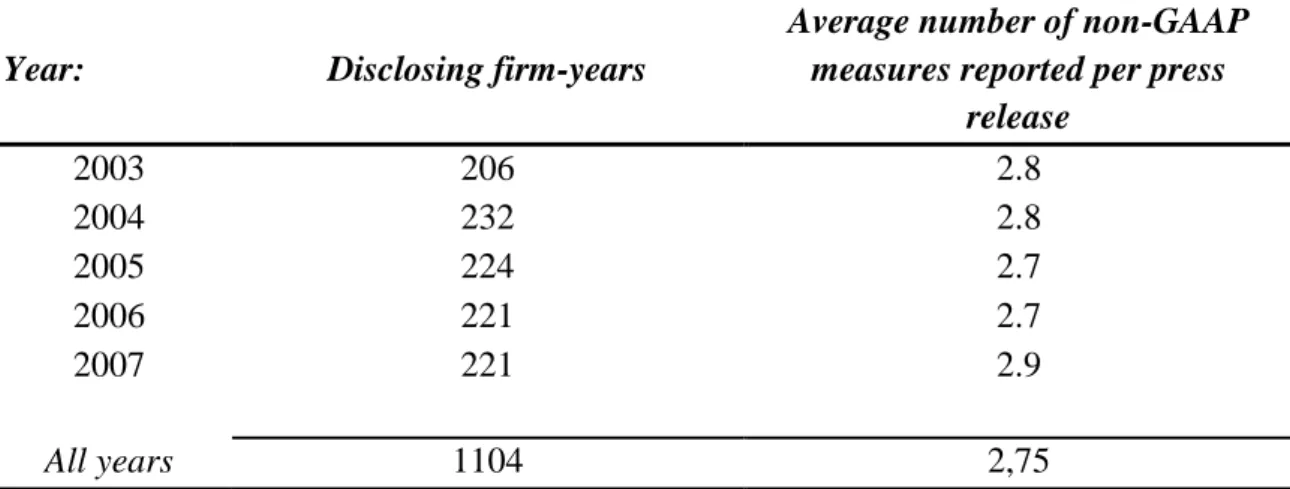
Table 2. Frequency of non-GAAP reporting ... 35
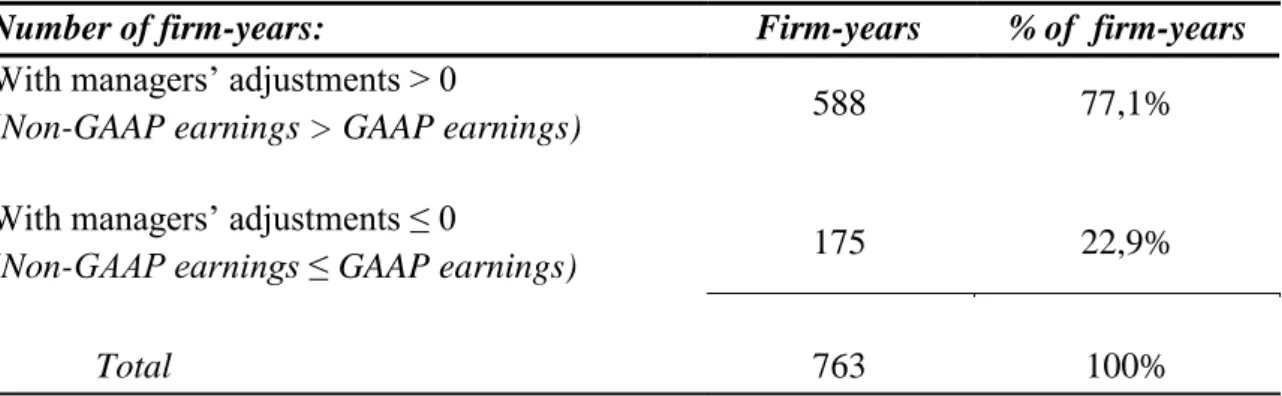
Table 3. Total adjustments made by managers to GAAP earnings ... 37
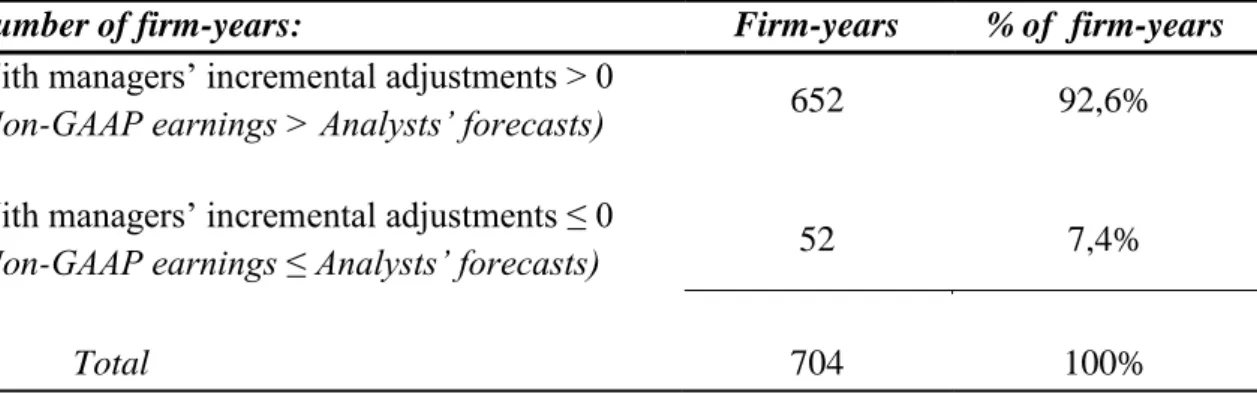
Table 4. Adjustments made by managers to beat analysts’ forecasts ... 38
Table 5. Descriptive statistics ... 39
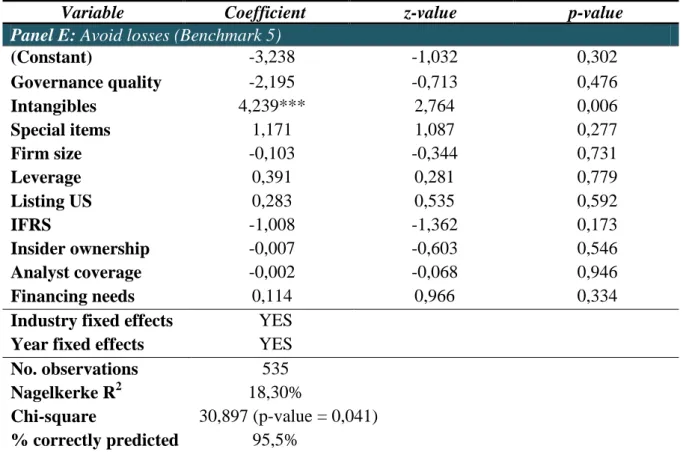
Table 6. The effect of governance quality on the use of non-GAAP disclosures to beat strategic earnings benchmarks ... 45
Table 7. The effect of governance quality on the level of non-GAAP adjustments made by managers ... 49
Table 8. The effect of governance quality on the level of non-GAAP adjustments made by managers to exceed analysts’ forecasts ... 51
Table 9. Firm-level governance attributes ... 64
Table 10. Variable definitions... 65
Table 11. Collinearity statistics for the linear regression model where the dependent variable is managers’ adjustments ... 68
Table 12. Collinearity statistics for the linear regression model where the dependent variable is managers’ incremental adjustments ... 68
Table 13. Residuals statistics for the linear regression model where the dependent variable is managers’ adjustments ... 68
Table 14. Residuals statistics for the linear regression model where the dependent variable is managers’ incremental adjustments ... 68
x
List of Figures
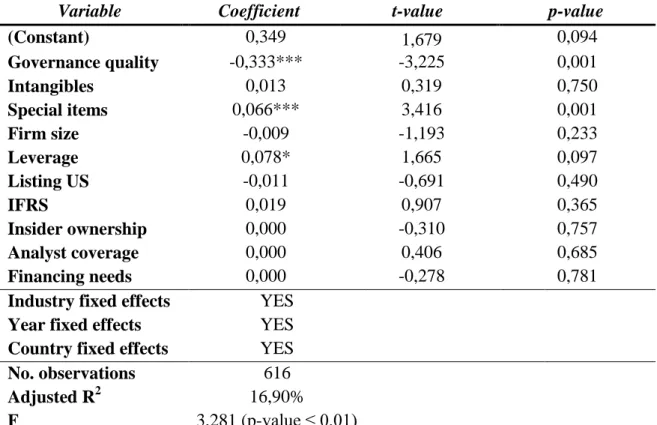
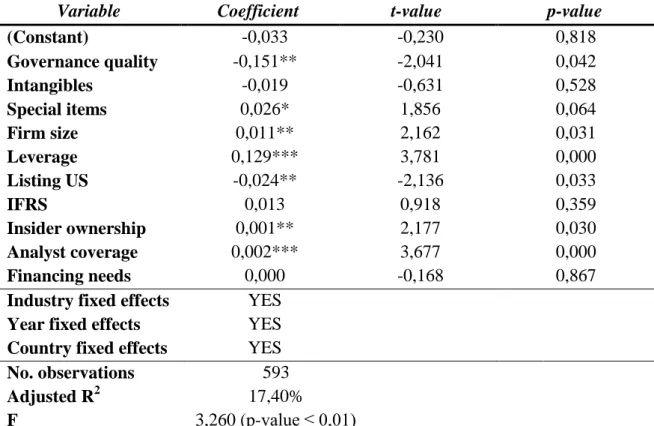
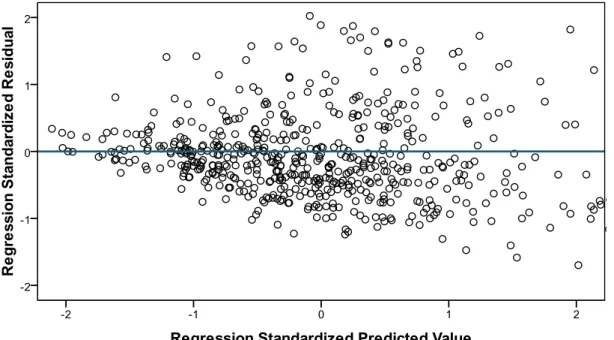
Figure 1. Governance quality mean by year ... 66 Figure 2. Scatter plot between standardized predicted values and standardized error residuals for managers’ adjustments... 67 Figure 3. Scatter plot between standardized predicted values and standardized error residuals for managers’ incremental adjustments ... 67 Figure 4. Histogram of the residuals for the linear regression model where the
dependent variable is managers’ adjustments ... 69 Figure 5. Histogram of the residuals for the linear regression model where the
1
1. Introduction
In recent years, it has become fairly common for companies to disclose non-audited earnings figures that do not follow generally accepted accounting principles (frequently called “non-GAAP” measures) in their earnings press releases. Since these measures are often not subject to regulation, managers benefit from a considerable degree of discretion in defining their non-GAAP earnings figures, which has fueled an intense debate among academics and regulators. On the one hand, managers can use their discretion to reduce information asymmetry by providing a clearer picture of “core earnings” to the users of financial information. On the other hand, non-GAAP numbers can be opportunistically disclosed, in an attempt to manipulate investors’ perceptions of the financial results of the firm. In this opportunistic view of non-GAAP reporting, prior research (e.g., Doyle and Solimon, 2002; Black and Christensen, 2009; Isidro and Marques, 2010) suggests that some managers may use non-GAAP numbers to appear to meet certain strategic earnings thresholds – that otherwise would have been missed by GAAP measures – as this can lead to an appreciation of the market valuation of the firm.
The primary objective of this study is to investigate the impact of corporate governance quality on the use of non-GAAP earnings measures to beat strategic earnings benchmarks. For this purpose, five strategic earnings benchmarks are considered: beating analysts’ forecasts, reporting growth in profits, portraying better performance, beating industry performance and avoiding losses. Firms’ governance quality is measured through an index combining 41 attributes.
2 Previous studies (Bushee, 1998; Peasnell et al., 2005; Frankel et al., 2011) find evidence suggesting that firms with a high proportion of institutional ownership and a high level of independent directors are less likely to make income-increasing adjustments in order to meet earnings benchmarks. This study complements prior literature by considering additional characteristics of governance quality. In addition, a significant amount of empirical research (e.g., Doyle et al., 2003; Entwistle et al., 2006b; Christensen, 2007) suggest that higher levels of adjustments are more likely to be associated with opportunistic behavior. To address this question, this research also explores the effect of governance quality on the magnitude of two types of potentially misleading non-GAAP adjustments: those that are made to exceed GAAP earnings and those that are made to meet or beat analysts’ forecasts.
The extant literature pertaining to the impact of governance mechanisms on voluntary reporting decisions typically focus on the U.S. environment. Klapper and Love (2004) find that “good governance practices are more important in countries with weak shareholder rights and inefficient enforcement”. Hence, it is important to analyze how governance quality influences firms’ financial reporting in the European context, as it is characterized by weak enforcement structures (compared to the U.S.) and by the inexistence of strict rules on the disclosure of non-GAAP financial measures.
The sample used in this analysis is drawn from the Financial Times 2006 classification of the 500 largest European firms, which is based on the 2005 financial reports. For each firm, the press releases of the annual earnings announcements for five fiscal years of 2003 to 2007 were collected and analyzed. In order to obtain the most accurate and credible information about the incidence of disclosure of non-GAAP financial measures, data within the original press releases was then hand-collected. After eliminating firm-years with missing press releases the final sample comprises 1551 observations representing 319 firms from 21 European countries.
Taken together, empirical results suggest that governance quality is capable of curbing opportunistic use of non-GAAP metrics to achieve earnings thresholds. However, there is no consistent evidence that good governance practices are effective at mitigating the discretionary disclosure of non-GAAP earnings to exceed analysts’ forecasts and to avoid losses. These findings are in line with the literature on the relative importance of earnings benchmarks (Brown and Caylor, 2005; Degeorge et al., 1999), which denotes
3 the great importance given by managers to these two earnings thresholds. This may explain why they seem to prevail even when firms adopt better governance attributes. Also, governance quality seems to be capable of reducing the magnitude of the difference between non-GAAP earnings and both GAAP measures and analysts’ expectations. Thus, although good governance quality does not seem to be effective at restraining the use of non-GAAP measures to exceed the analyst forecast benchmark, it is capable of reducing the difference between non-GAAP earnings and analysts’ forecasts.
The remainder of this study is organized as follows. Section 2 discusses the relevant prior literature. Section 3 presents the hypothesis development. Section 4 describes the data and sample. Section 5 outlines the research design. Section 6 reports the descriptive evidence. The empirical results are analyzed in Section 7. The last section concludes the study.
4
2. Background information and relevant literature
2.1 Corporate governance mechanisms
High profile accounting scandals at prominent companies such as Parmalat, Enron and WorldCom have raised concerns about business ethics and have brought the importance of corporate governance mechanisms to the spotlight. However, despite the fluent and widespread use of the term, there is no universally accepted definition of corporate governance (Solomon and Solomon, 1999).
The Cadbury Report1 broadly defines corporate governance as the system by which companies are directed and controlled. Using the definition of Shleifer and Vishny (1997), corporate governance “deals with the ways in which suppliers of finance to corporations assure themselves of getting a return on their investment”. OECD Principles of Corporate Governance (OECD, 2004) state that corporate governance structure specifies the distribution of rights and responsibilities among the different participants in the organization – such as the board, managers, shareholders and other stakeholders – and by doing this, it also provides “the structure through which the objectives of the company are set, and the means of attaining those objectives and monitoring performance are determined.” Claessens (2003) defines corporate governance as a set of mechanisms through which firms operate when there is a separation of ownership and control. In fact, due to this separation, there is a danger that managers have incentives to pursue their own goals at the expense of those of
5 shareholders (Hart, 1995), leading to a problem of moral hazard. This guides us to the agency problem2, which refers to the difficulties shareholders have in assuring that their funds are not expropriated or wasted on unprofitable projects (Shleifer and Vishny, 1997).
Several governance mechanisms can align managers and shareholders’ interests, reducing the inefficiencies that arise from information asymmetry and thus alleviating the agency problems associated with the separation of ownership and control. Corporate governance mechanisms can be split into two categories, internal and external (Aggarwal and Williamson, 2006; Gillan, 2006). Internal mechanisms include the equity ownership structure of the firm, performance-based compensation contracts, anti-takeover provisions, issues related to the board of directors (such as duality and the proportion of outside directors) and its sub-board committees (the audit, remuneration and nomination committees). On the other hand, external mechanisms include the legal and regulatory structure, the market for corporate control, labor and product markets, investor monitoring and media pressure (analyst ratings).
2.1.1 Why is Corporate Governance important?
James Wolfensohn, former president of the World Bank, has commented that “the governance of the corporation is now as important to the world economy as the government of countries” (Wolfensohn, 1998). Indeed, as markets become more open and global, economic interdependence increases and thus the ability to gain public confidence of global markets is becoming more and more crucial. In this regard, the presence of an effective corporate governance structure promotes the efficient use of resources, the timely and accurate financial disclosure and the effective monitoring of management, hence, enhancing market confidence. Furthermore, corporate governance holds “the balance between economic and social goals and between individual and communal goals” (Committee on the Financial Aspects of Corporate Governance, 1992) creating wealth, jobs and the sustainability of companies. In short, corporate governance has implications “not only to shareowners but also to employees, customers, those
2 Jensen and Meckling (1976) define an agency relationship as “a contract under which one or more
persons (the principal(s)) engage another person (the agent) to perform some service on their behalf which involves delegating some decision making authority to the agent.”
6 financing the company, and other stakeholders, including the communities in which the business operates” (IFC/UNGC, 2009).
A large number of studies (Gompers et al., 2003; Klapper and Love, 2004; Durnev and Kim, 2005; Black et al., 2006) report that sound corporate governance practices are associated with a higher firm’s market value.
Nonetheless, adopting better governance imposes some costs on companies as well. Aggarwal et al. (2009) report that firms may have to incur expenses related to the adoption of governance attributes (for instance, it is costly to use a higher-quality external auditor) and to ensure that its adoption of governance attributes is credible. Moreover, they assert that corporate governance practices may limit the flexibility of management.
2.1.2 Corporate Governance Standards
Highly-publicized accounting scandals led to the introduction in the U.S. of the Sarbanes Oxley (SOX) Act of 2002, designed with the purpose of strengthening corporate accountability and internal governance mechanisms. The Act established strict mandatory standards for all US publicly traded companies. First, it requires senior management to review each annual or quarterly report and to certify the accuracy of the information disclosed. Second, it mandates that management and external auditors establish an internal control structure for financial reporting and assess the adequacy and effectiveness of those controls. Zhang (2007) shows that this last requirement imposes significant costs on firms. In addition, in November 2003 the Securities and Exchange Commission approved new rules proposed by the NYSE and the NASDAQ. For instance, these rules require listed companies’ boards to consist of a majority of independent directors and propose the board to meet at regularly executive sessions without management being present. In this regard, Aggarwal and Williamson (2006) find that the market put higher value on companies that were complying with new regulations. Besides, they report the firm value impact is particularly strong for firms that had voluntarily adopted the new governance attributes, before the regulations were mandatory. Nevertheless, Ribstein (2002) asserts that the accounting scandals did not justify the new corporate regulations since “markets are capable of responding more quickly and precisely than regulation to corporate fraud.”
7 Concerns about inadequate corporate governance have not been limited to the U.S. In the European context, the European Commission issued in May 2003 a Communication titled “Modernizing Company Law and Enhancing Corporate Governance in the European Union—A Plan to Move Forward” in order to achieve two main objectives: to strengthen shareholder rights and to foster efficiency and competitiveness of business (Commission of the European Communities, 2003). This Action Plan is based on a comprehensive set of proposals aimed at improving corporate governance disclosure (in particular, better information on the role played by institutional investors is required), strengthening shareholder protection, modernizing board structures and enhancing directors’ responsibilities for financial and key nonfinancial statements. By 2007, all 27 Member States had issued codes of corporate governance. By 2009, listed companies in the EU have been required to include in their annual documents a corporate governance statement. This statement must describe the key structures and practices of the corporate governance code that the company is applying and explain whether, and to what extent, the company complies with that code. The European Commission believes that this principles-based approach centered on the comply-or-explain mechanism respects the differences in corporate traditions across the EU. Indeed, the Commission does not want to enact a European Code of Corporate Governance because “the basis of codes of corporate governance should come from the markets and/or national legislation” (International Finance Corporation, 2008).
2.1.3 The determinants of corporate governance quality
Aggarwal et al. (2009) stress that the controlling shareholder’s choice of governance mechanisms depends both on country-level as well as firm-level mechanisms. In fact, prior research has shown that the costs and benefits for minority shareholders resulting from the adoption of governance attributes differ across countries and across firms.
Country characteristics
Doidge et al. (2007) find that country characteristics are the most important determinant of a firm’s governance. In fact, their findings show that country characteristics explain much more of the variance in governance scores (ranging from 39% to 73%) than firm-specific characteristics (ranging from 4% to 22%). Using a sample covering 39
8 countries, they report that the quality of governance practices is positively related to the state protection of investor rights, the economic development and the financial development.
Consistent with these findings, Aggarwal et al. (2009) show that country-level investor protection plays an extremely important role in explaining the intensity of investment in internal governance. They use the internal governance of firms in the U.S. as a benchmark - since the U.S. is recognized to have high financial and economic development and to have strong investor protection - and find that foreign firms invest less in internal governance mechanisms that increase the power of minority shareholders than comparable U.S. firms do. In addition, they emphasize that laws and regulations requiring specific choices of governance attributes as well as culture and norms partly explain firms’ governance practices. In this regard, they show that the legal origin of the country in which a firm is incorporated is the most important variable in predicting whether a firm will invest more in governance than its U.S. counterpart: firms which invest more in governance come from countries with common law. In accordance with this evidence, Bushman et al. (2004) document that governance transparency is higher in common law countries.
Firm characteristics
Aggarwal et al. (2009) also demonstrate that smaller firms have much lower governance scores than larger firms. To assess firm-level corporate governance similarly across all the firms, they use a corporate governance index3 based on 44 governance attributes, covering four broad sub-categories: (1) Board; (2) Audit; (3) Anti-takeover and (4) Compensation and Ownership.
Moreover, several studies (Klapper and Love, 2004; Bujaki and McConomy, 2002; Bruno and Claessens, 2007) find that companies with greater needs for external financing adopt better governance practices, given that corporate governance establishes mechanisms that improve investors’ confidence about earning an adequate return on their investment (Shleifer and Vishny, 1997) and, hence, lowers the cost of external capital.
3
The index is expressed as a percentage. It assigns a value of one to a governance attribute if the company meets the threshold level for that standard and zero otherwise.
9 Other research shows that the quality of corporate governance is positively related to growth opportunities (Klapper and Love, 2004; Doidge et al., 2007) and to financial leverage (Silveira et al., 2009).
Regarding the firms’ ownership structure, Durnev and Kim (2005) report a positive association between ownership concentration and corporate governance. However, a significant number of empirical studies (Zheka, 2007; Lee and Park, 2008; Silveira et al., 2009) observed the opposite - a negative link between the presence of large shareholders and the corporate governance quality. This result is likely due to the fact that “large owners need less governance and protection of their rights” (Zheka, 2007). Moreover, Silveira et al. (2009) find that the type of controlling shareholder can be an important determinant of corporate governance quality. They build a corporate governance index for approximately 200 listed Brazilian firms and conclude that family-controlled firms adopt weaker governance practices. Likewise, based on a set of four governance indices, Khanchel (2007) examine the determinants of good governance in the US listed firms and find that directors’ and officers’ ownership have a positive and significant effect on corporate governance quality. Also, Aggarwal et al. (2011) report that firm-level governance is positively associated with institutional ownership. Specifically, institutions from countries with strong protection for minority shareholders rights play a predominant role in promoting governance improvements outside of the U.S.
Finally, using a corporate governance rating constructed for publicly listed German firms, Drobetz et al. (2005) report that firms with larger boards have lower governance ratings whereas firms that use performance-based compensation contracts have higher ratings.
2.2 Voluntary disclosure
Corporate disclosure is critical for the functioning of an efficient capital market (Healy and Palepu, 2001). However, in recent years, in addition to reporting mandatory financial results in accordance with generally accepted accounting principles (GAAP), it has become common practice for many companies to voluntarily disclose non-audited performance measures that do not follow GAAP. These last measures, commonly
10 known as “non-GAAP”, “pro forma” or “alternative performance measures”, are often not subject to regulation and therefore “may be used by firms in a discretionary way, potentially misleading investors and diminishing the efficient functioning of capital markets” (Isidro and Marques, 2011).
Frankel et al. (2011) define a non-GAAP earnings number as a “core” earnings measure that excludes components of GAAP earnings. According to Hitz (2010), these components are those “deemed non-recurrent or one-off items not representative of the entity’s ongoing business and future performance prospects”. Voluntary financial information may be provided through management forecasts, analysts’ presentations and conference calls, press releases, internet sites, and other corporate reports (Healy and Palepu, 2001).
2.2.1 Motives for reporting non-GAAP earnings: informative view versus opportunistic view
Jennings and Marques (2011) suggest that firms compute non-GAAP earnings for a variety of reasons, including for compliance with loan agreements (since some firms have debt covenants with restrictions based on non-GAAP measures of earnings), for determining executive compensations, and for reporting to investors ‘core’ earnings that are most likely to recur in the future. This last reason, along with the considerable level of flexibility offered to managers in defining their own pro forma earnings metrics, has fueled an intense debate among academics and regulators.
On the one hand, proponents of pro forma reporting argue that managers arrive at non-GAAP earnings by excluding transitory items (such as restructuring charges and gains and losses on the sales of assets), “essentially removing noise from GAAP-based earnings and providing a more useful non-GAAP earnings measure for predicting future performance” (Jennings and Marques, 2011). Hence, in this informative view of non-GAAP measures, managers intend to reduce information asymmetry by providing a clearer picture of “core earnings” and conveying value-relevant4
information to investors that a GAAP-based earnings figure may not effectively communicate (Doyle
4 Value relevance is defined in the extant literature as the “relation between stock market values (or
changes in values) and particular accounting numbers” (Holthausen and Watts, 2001). An accounting number is deemed value relevant if it has a significant association with stock market value.
11 and Solimon, 2002). On the other hand, regulators and other critics of non-GAAP reporting assert that managers may strategically use their discretion to exclude certain recurring or persistent expenses that are included in GAAP-based income, in order to depict a more favorable picture of firms’ performance. In this opportunistic view of pro forma reporting, non-GAAP numbers are disclosed in a manner that can potentially mislead investors to the extent they treat these exclusions from GAAP-based income as transitory (when in fact they are relatively persistent) when forecasting the future. Significant empirical research has found evidence consistent with these two competing disclosure motives for reporting non-GAAP earnings.
Supporting the informative purpose, prior studies (Brown and Sivakumar, 2003; Bradshaw and Sloan, 2002) show that alternative performance measures are more value-relevant than GAAP net income. Bhattacharya et al. (2003) find that non-GAAP earnings are more permanent than GAAP operating earnings, suggesting that non-GAAP earnings disclosures aid investors in predicting future earnings. Furthermore, Johnson and Schwartz (2005) find no evidence that “pro forma firms are priced differently by investors than are firms that disclose only GAAP earnings”, which means that share prices, on average, do not behave as if investors just focus myopically on non-GAAP numbers. This evidence suggests that investors are not, on average, misled by pro forma earnings disclosures. Finally, some proponents of non-GAAP reporting contend that because GAAP earnings include the effects of non-recurring items, alternative performance measures that exclude such items enhance comparability (Halsey and Soybel, 2002; Phillips et al., 2002).
However, predominant belief is that managers may be motivated by opportunistic incentives. Prior research suggests two pro forma reporting decisions that are likely to indicate opportunistic behavior.
First, empirical research (Bhattacharya et al., 2003; Isidro and Marques, 2011) shows that firms frequently exclude recurring expenses (such as depreciation, stock-based compensation and research and development) and that this practice is especially indicative of manager opportunism (Doyle et al., 2003; Black and Christensen, 2009). Dharan (2002) asserts that Enron is a major example since just six weeks before it filed for bankruptcy protection, the company’s earnings release said in an underlined and capitalized headline, “Enron Reports Recurring Third Quarter Earnings of $0.43 per
12 diluted shares”, while Enron actually lost $618 million that quarter, for a loss of ($0.84) per share. Thus, excluding $1.01 billion of expenses (labeled as “non-recurring”), Enron converted a net loss of $618 million into a “recurring net income” of $393 million. Second, previous studies document that non-GAAP numbers are strategically used to appear to meet earnings benchmarks that otherwise would have been missed by GAAP earnings. These studies report that non-GAAP adjustments help firms: (1) meet analysts’ earnings expectations (Doyle and Solimon, 2002; Black and Christensen, 2009; Lougee and Marquardt, 2004; Isidro and Marques, 2010); (2) convert an operating loss to a non-GAAP profit (Black and Christensen, 2009; Peasnell et al., 2005; Dechow et al., 2003); (3) show growth in profits (Burgstahler and Dichev, 1997; Peasnell et al., 2005; Lougee and Marquardt, 2004); (4) portray a better picture of firm’s performance (Isidro and Marques, 2010; Bhattacharya et al. 2004) and (5) beat industry performance (Isidro and Marques, 2010). Moreover, Hitz (2010) and Marques (2010) suggest that when non-GAAP earnings are higher than a specific earnings benchmark but the GAAP number falls short of this benchmark, managers strategically position the non-GAAP more prominently, in an attempt to influence readers’ perceptions of the financial results of the firm.
Furthermore, opponents of non-GAAP reporting argue that because no standard definition of non-GAAP earnings exists, alternative performance measures are not comparable across firms (Bhattacharya et al., 2003; Weil, 2001). Harvey Pitt, former chairman of the Securities & Exchange Commission, spoke about the pitfalls investors face with non-GAAP earnings: “An investor can't know what's been left out, why it's left out, or how it compares [with other companies' earnings]” (McNamee, 2001). A sharper criticism is that non-GAAP financial measures may not even be comparable within the same firm, when considering previous years’ numbers, since firms do not use a consistent definition of non-GAAP earnings over successive periods (EFRAG, 2006). Bhattacharya et al. (2003) emphasize that “these are serious criticisms because comparability and consistency are fundamental qualities of financial information”.
2.2.2 Regulation of non-GAAP disclosures
In the wake of a sharp increase in non-GAAP earnings reporting during the mid-nineties and widespread claims that firms use non-GAAP disclosures opportunistically to
13 mislead investors, regulators have expressed concerns about the inconsistent and obscure use of alternative performance measures. Moreover, several high profile accounting scandals such as the collapse of Enron and the fall of WorldCom have intensified legislators’ skepticism about unaudited and ad hoc corporate disclosures (Dreman, 2001; D’Avolio et al., 2001; Bhattacharya et al., 2003).
In the United States, the Financial Accounting Standards Board (FASB) has voiced apprehension that the proliferation of “alternative and inconsistent financial performance measures” reports is undermining the quality of financial reporting (FASB, 2002). Furthermore, the Securities and Exchange Commission has intervened twice on the topic of the disclosure of non-GAAP financial measures. In an “Investor Alert”, issued on December 4, 2001, the SEC intended to warn public companies on their use of non-GAAP financial measures and to alert investors that non-GAAP measures “might create a confusing or misleading impression and should be viewed with appropriate and healthy skepticism.”5
Lynn Turner, the then chief accountant of the SEC, has characterized non-GAAP metrics as EBS – ‘everything but the bad stuff’ – earnings. The second intervention was the implementation of a new disclosure regulation (Regulation G) in January of 2003 as directed by the Sarbanes-Oxley Act of 2002. Regulation G requires that, when a non-GAAP financial measure is disclosed, the firm must also provide a quantitative reconciliation between the non-GAAP number and the most directly comparable GAAP financial measure (clarifying the differences that exist between the two numbers). Prior studies (Marques, 2006; Heflin and Hsu, 2005; Entwistle et al., 2006a) report a significant decrease in the frequency of disclosure of GAAP earnings in 2003, suggesting a strong impact of the Regulation G on non-GAAP reporting.
In Europe, the need to provide a framework for boosting an adequate use of non-GAAP financial measures was first recognized in a cautionary statement issued by IOSCO (International Organization of Securities Commissions), in May 2002. In this statement, IOSCO (2002) mentions that “issuers, investors and other users of financial information are cautioned to use care when presenting and interpreting non-GAAP results measures” and that “regulatory actions may be taken if information is disclosed in a manner
5 The SEC has also issued “Tips for Investors” in order to recommend “a few things” investors should
keep in mind when they see non-GAAP financial information. These include asking “What is the company assuming?” or “What is the company not saying?”
14 considered misleading”. Nonetheless, from 2002 on, nothing happened in the process of regulating the disclosure of non-GAAP financial measures in European markets, until in October 2005 the Committee of European Securities Regulators (CESR) issued a recommendation on alternative performance measures. In this recommendation, CESR (2005) recognizes that non-GAAP measures “can assist investors in gaining a better understanding of a company’s financial performance and strategy” if appropriately used and presented. Furthermore, this document contains several proposals to encourage European listed companies which decide to disclose non-GAAP measures “to do so in a way that is appropriate and useful for investor’s decision making”. It recommends, for instance, that issuers should “define the terminology used and the basis of calculation adopted”, highlight GAAP defined measures with greater prominence than non-GAAP numbers, present alternative performance figures only in combination with defined measures and, in addition, explain the differences between both numbers (which might be done through a reconciliation).6 However, all of these guidelines are merely recommendations and therefore are not mandatory for European firms.
It is also important to consider that 2005 implementation of IFRS (International Financial Reporting Standards) in Europe has been associated with improvements in financial reporting quality, limiting management’s opportunistic discretion and leading to a decrease in the use of alternative performance measures (Barth et al., 2008). In line with this belief, Isidro and Marques (2010) show that the adoption of IFRS diminishes the number of non-GAAP figures managers choose to disclose. Another view is that IFRS adoption has “introduced significant new accounting and reporting recognition, measurement and disclosure requirements” (Ernst & Young, 2006), increasing accounting complexity for many European companies and leading to the presentation of figures that “are incomprehensible to anyone other than a specialist” (Bruce, 2007). Hence, this may boost rather than reduce non-GAAP disclosures, given that managers have realized that “they have to use other avenues to get their message across” (Bruce, 2007). This is consistent with findings of Ernst & Young (2006) – a study based on a survey of the disclosures of 65 large European companies reporting under IFRS – which reports that the widespread use of alternative performance measures in companies’
6
CESR also recommends the presentation of non-GAAP measures consistently over time. However, Isidro and Marques (2008) assert that this may be more difficult to implement, given that non-recurring items “do not occur every reporting period and so firms will only identify them as factors to adjust their earnings for, in their calculation of non-GAAP financial measures, when they occur.”
15 results announcements and presentations suggests that “companies do not seem confident that IFRS financial information is sufficient […] for the purpose of communicating their performance to the markets.”
More recently, in 2009, the European Financial Reporting Advisory Group (EFRAG) carried out a review of a sample of 50 European listed entities that have reported since 2005 under IFRS and discovered that the CESR recommendations, issued in 2005, were not taken seriously. The paper noted that the items adjusted for vary not only between different firms but also sometimes over time and that “an element of personal preference” might be involved. In addition, the survey suggests that “it is important that there are clear principles that underpin what is included and excluded” from GAAP earnings “in order to ensure the necessary comparability” (EFRAG, 2009).
In brief, while in the U.S. the regulator has implemented strict rules pertaining to voluntary disclosure of performance metrics, in Europe there is still no direct supra-national regulation and all of the issued guidelines are not mandatory. At the supra-national level, regulation is either absent or incomplete (Isidro and Marques, 2010). In the United Kingdom, Financial Reporting Standard 3 requires alternative earnings per share figures to “be presented on a consistent basis over time” and to be reconciled to the corresponding GAAP measure (Accounting Standards Board, 1992). In Sweden, Stockholm Stock Exchange require companies to include three specific GAAP measures (turnover, net profit and earnings per share) at the beginning of their earnings releases (Andersson and Hellman, 2007). In the French context, the Autorité des Marchés Financiers (AMF) has endorsed guidelines requesting a complete quantitative reconciliation between non-GAAP and GAAP metrics7. However, Aubert (2010) reports that French firms continue to use non-GAAP earnings in a discretionary way regardless of reconciliation requirements. In Germany, on a very broad level, the securities act forbids disclosure of misleading information but it is not specified whether this rule is applicable to non-GAAP reporting (Hitz, 2010).
7 In December 2011, the AMF issued a report in which identified “the presentation of non-GAAP
financial measures without presentation of the most directly comparable measures calculated in accordance with GAAP” as one of the main deficiencies identified in disclosure documents (Autorité des Marchés Financiers, 2011).
16 2.2.3 Prior research on determinants of non-GAAP disclosure decisions
As a result of the substantial proliferation of non-GAAP reporting and the growing perception of alternative performance metrics as a vehicle for potentially misleading investors, academic research on the disclosure of non-GAAP earnings has flourished. Several studies, mostly framed in a U.S. context, have addressed the question of what affects managers’ voluntary disclosure decisions. These studies have found important determinants of non-GAAP disclosure decisions: (1) corporate governance mechanisms; (2) strategic benchmark beating; (3) the value relevance of GAAP earnings and (4) other firm and environmental specific characteristics.
Corporate governance mechanisms
Prior research has documented that efficient governance mechanisms curb opportunistic financial reporting, which lead us to predict “better-governed firms tend to make more informative disclosures” (Beekes and Brown, 2006). Two measures of corporate governance, the proportion of independent members on the board of directors and the percent of shares held by institutions, have been found to particularly influence firms’ voluntary disclosure decisions (Jennings and Marques, 2011).
With respect to the proportion of outside directors, prior research indicates that board independence improves the quality of financial reporting and disclosure. Beasley (1996) and Uzun et al. (2004) report that the inclusion of independent outside members on the board of directors makes it more effective at monitoring management and reduces the likelihood of corporate wrongdoing and financial fraud. Using Asian data, Eng and Mak (2003) and Gul and Leung (2004) find that an increase in outside directors results in a lower level of voluntary disclosure. Ajinkya et al. (2005) and Karamanou and Vafeas (2005) report that firms with a higher percentage of outside directors are more likely to issue less optimistically biased forecasts. Frankel et al. (2011) provide evidence consistent with board independence constraining opportunism in the disclosure of non-GAAP earnings. Using a sample spanning from 1998 to 2005, they found that managers are more likely to exclude recurring expenses from non-GAAP earnings when boards contain fewer independent directors. Isidro and Marques (2011) have extended findings from previous studies by measuring board quality via a score of board characteristics, such as CEO duality, the boards’ attendance and the independence of committees. Their results show that an efficient board of directors can reduce the probability of reporting
17 discretionary GAAP measures and reduce the opportunistic emphasis given to non-GAAP information in the earnings release. However, they also found that the propensity to adjust for recurring items and the decision to provide reconciliation information are not influenced by the quality of the board.
Regarding the role of institutional ownership, Bushee (1998) provides evidence that managers are less likely to cut R&D expenses in order to reverse an earnings decline when institutional ownership is high, implying that institutional investors serve a monitoring role that reduces managerial behavior. In addition, Jiambalvo et al. (2002) and Velury and Jenkins (2006) report a positive association between institutional ownership and earnings quality. Consistent with the presence of institutional investors resulting in more transparent reporting, Isidro and Marques (2010) find that a strong presence of institutional investors reduces incentives to disclose more than one non-GAAP figure. On the other hand, El-Gazzar (1998) states that large institutional ownership may induce a high level of voluntary disclosure, given that institutional investors are considered to be more information demanding. Moreover, managers often justify the use of non-GAAP reporting because sophisticated users such as financial analysts and institutional investors find non-GAAP earnings incrementally informative (Bowen et al., 2005). Consistent with this view, Lakhal (2003) finds that French firms with a higher percentage of shares held by institutional investors are more likely to disclose voluntary financial information.
In addition, prior research suggests that a high level of insider ownership reduces incentives to disclose voluntary public information, as insiders have privileged access to information (Eng and Mak, 2003). Using European data, Isidro and Marques (2011) provide evidence that insider investors have a disciplinary effect of the adjustment for recurring items and thus help mitigate opportunistic behavior.
Furthermore, previous studies identify the legal/regulatory structures as an external governance mechanism particularly important in preventing opportunistic non-GAAP reporting. Bowen et al. (2005) and Entwistle et al. (2006b) find that subsequent to the SEC interventions firms present non-GAAP numbers in earnings releases in a much less prominent and less potentially misleading manner. Entwistle et al. (2006a) report that prior to the regulation, potentially misleading disclosure practices were seen in over 10% of all S&P 500 firms. Most commonly this was being done through the press
18 release headline using GAAP terminology to describe what later in the press release was revealed to be a non-GAAP metric. In the post-Regulation G period, they find less than 1% of cases of potentially misleading disclosure. Additionally, Yi (2007) and Kolev et al. (2008) show that non-GAAP exclusions are of higher quality (more transitory) and that non-GAAP earnings are more value-relevant following SEC intervention. In the European context, Hitz (2010) reports that firms that adopted IFRS prior to 2005 on a voluntary basis are less likely to disclose non-GAAP earnings than firms that were forced to adopt those standards by the EU regulation and Isidro and Marques (2010) provide evidence that efficient legal systems are important but not sufficient to improve voluntary reporting quality.
Moreover, Klapper and Love (2004) assert that good governance practices can offset the weakness of regulation and legal systems. In line with this, Jennings and Marques (2011) suggest that “corporate governance can be viewed as a substitute for regulation”. For firms with strong corporate governance8, they find no evidence that investors were misled by non-GAAP adjustments either before or after the SEC intervention. In opposition, for firms with weaker corporate governance, they find that prior to the SEC intervention in 2003 investors were misled by recurring non-GAAP adjustments. Nonetheless, their results indicate that the SEC intervention eliminated the extent to which investors were misled by firms with weaker corporate governance. Frankel et al. (2011) also found that the relation between board independence and the quality of non-GAAP exclusions is no longer significant after Regulation G, which is consistent with “board independence playing less of a role when there is an alternative monitoring mechanism”.
According to agency theory, performance-based compensation contracts are an effective way to align the interests of “risk-averse self-interested” managers with those of their shareholders (Murphy, 1998). While compensation contracts are not usually linked to non-GAAP numbers, non-GAAP information “can be used opportunistically to enhance the market valuation of the firm and thus increase performance-based compensation” (Isidro and Marques, 2011). Black et al. (2011) show that, in the U.S., compensation contracts can deter managers from using non-GAAP reporting in an opportunistic way but only if they include a long-term performance plan. On the other
8
Jennings and Marques (2011) measured corporate governance in two ways, as the percent of outsiders on the board of directors and the percent of shares held by institutional investors.
19 hand, when bonus compensation focuses on short-term performance, managers are more likely to engage in potentially misleading non-GAAP adjustments. Based on European data, Isidro and Marques (2011) report that the propensity to disclose non-GAAP metrics in earnings releases is significantly higher when compensation is tied to the market performance of the firm. Moreover, they provide evidence that when this type of compensation is used managers are more likely to engage in practices that are consistent with opportunistic non-GAAP reporting (such as report non-GAAP figures in the title of the press release, make more adjustments for recurring items, and avoid reporting reconciliations).
Also, prior literature emphasizes the critical monitoring role of auditors in capital markets to ensure that financial information is not misleading. As already pointed out above, earnings releases are not audited. Notwithstanding, anecdotal evidence suggests that auditors almost always review their clients’ earnings announcements before they are publicly released. Black et al. (2011) document that auditor effort (as measured by audit fees) is negatively associated with managers’ opportunistic use of non-GAAP adjustments.
At last, Mbagwu (2007) reports that strengthening the governance mechanisms enhances the perceived credibility of non-GAAP information and consequently increases investor confidence.
Strategic benchmark beating
As already mentioned, the use of non-GAAP figures to meet earnings benchmarks that otherwise would have been missed by GAAP earnings is most likely associated with discretionary reporting behavior. Isidro and Marques (2010) find that strategic benchmark beating is an important determinant of non-GAAP disclosure decisions in Europe. In fact, they report a positive association between the number of non-GAAP earnings measures reported in annual announcements’ press releases and the propensity to meet five different earnings benchmarks (meet analysts’ earnings expectations, avoid reporting losses, show growth in profits, portray better performance and beat industry performance). Their results also suggest that managers choose to disclose more than one non-GAAP measure and to repeat non-GAAP information in the same earnings release to convince investors of benchmark achievement. Moreover, they report that strong
20 investor protection and financial market development are the features capable of reducing this potentially misleading disclosure practice.
Value relevance of GAAP earnings
Prior research suggests that when GAAP earnings are less value-relevant (and thus less useful), managers are more likely to provide additional voluntary information to the market (Tasker, 1998). More importantly, Lougee and Marquardt (2004) provide evidence that firms with lower GAAP earnings quality are more likely to release non-GAAP earnings information than other firms. In addition, they also find that firms with negative earnings surprises9 are more willing to include non-GAAP earnings in their press releases.
Other firm and environmental specific characteristics
Several studies (Bhattacharya et al., 2004; Lougee and Marquardt, 2004) indicate that non-GAAP earnings announcers are concentrated in high-technology industries. This may be explained by the fact that high-technology firms tend to present less informative GAAP earnings since these firms invest heavily in intangibles such as research and development (Lev and Zarowin, 1999). Consequently, these companies may engage in non-GAAP reporting in order to remove the effects of non-recurring items and thus present a more meaningful and useful earnings number. Accordingly, Isidro and Marques (2010) find a positive relation between the frequency of disclosure of non-GAAP metrics and the business intangible intensity. Also, firms that choose to disclose non-GAAP earnings measures have greater sales growth and greater earnings variability (Lougee and Marquardt, 2004). Francis et al. (2005) and Isidro and Marques (2010) report that firms with external financing needs are more likely to disclose alternative performance measures as a way to reduce information asymmetries and thus obtain funds at a lower cost. Lastly, overall better institutional and economic conditions (such as efficient institutions, strong enforcement, developed financial markets and good communication channels) are associated with more non-GAAP disclosures (Isidro and Marques, 2010).
9
They define earnings surprise as “the net income for the current quarter minus net income for the comparable quarter in the prior year”.
21
3. Hypotheses development
According to the opportunistic view of non-GAAP disclosure, managers may strategically use their reporting freedom to manipulate readers’ perceptions of the financial results of the firm. The main purpose of this study is to investigate whether and to what extent corporate governance mechanisms affect opportunistic non-GAAP reporting practices.
Prior research suggests that some managers may use non-GAAP numbers to appear to meet certain earnings thresholds that otherwise would have been missed by GAAP earnings and usually recognizes this practice as especially indicative of opportunistic behavior (e.g., Doyle and Solimon, 2002; Black and Christensen, 2009; Isidro and Marques, 2010). In fact, managers seek to meet or beat these thresholds in order to build credibility with capital markets (Graham et al. 2004) and to enhance the market valuation of the firm and thus increase their own compensation and private benefits, since agents reward firms that achieve the desired earnings benchmarks (Isidro and Marques, 2010). Moreover, in the European markets, the absence of non-GAAP disclosures regulation may encourage the strategic use of non-GAAP numbers to meet analysts’ earnings expectations, avoid reporting losses, show growth in profits, portray better performance and beat industry performance.
As already mentioned, several studies provide evidence that efficient governance mechanisms (e.g., board independence, high institutional ownership) are particularly important in constraining opportunism in the disclosure of non-GAAP earnings, when regulation is weak (Klapper and Love, 2004; Durnev and Kim, 2005). Thus, good governance practices are expected to play an important role in preventing discretionary
22 use of non-GAAP numbers to clear earnings benchmarks in Europe, where voluntary disclosures are unregulated. In line with this, Peasnell et al. (2005) use UK data and find that firms with a higher proportion of outside board members are less likely to make income-increasing adjustments in order to avoid reporting both losses and earnings reductions. Additionally, Frankel et al. (2011) examine insider selling following earnings announcements where non-GAAP earnings enable the firm to meet or beat analysts’ forecasts. They find that managers strategically use non-GAAP adjustments to exceed analysts’ consensus forecasts before selling their personal shares and that this relation is stronger when boards are less independent. This evidence indicates that effective boards can mitigate the use of non-GAAP numbers for benchmark beating strategies. Further, Bushee (1998) provides evidence that managers are less likely to exclude recurring expenses in order to reverse an earnings decline when institutional ownership is high. Based on this literature, it is expected a negative association between firms’ governance quality and their propensity to use non-GAAP measures to achieve strategic earnings benchmarks. Thus, the first hypothesis is stated as follows:
H1: Good governance quality reduces the use of non-GAAP earnings measures to
meet strategic earnings benchmarks.
Prior literature suggests that firms using voluntary disclosures to influence investors’ perceptions are more likely to disclose non-GAAP earnings that exceed GAAP earnings. Several studies (Bhattacharya et al., 2003; Entwistle et al., 2006a; Isidro and Marques, 2011) find that non-GAAP figures are systematically higher than GAAP comparable measures, which indicates that expenses are excluded more often than revenue items. Moreover, Entwistle et al. (2006b) contend that the difference between non-GAAP and GAAP is likely to be larger for firms using voluntary disclosures opportunistically compared to firms disclosing non-GAAP numbers to convey relevant information about firm performance. Consistent with these findings, Isidro and Marques (2011) report that the value of the adjustments made to GAAP earnings is higher in firms where compensation is tied to market performance, which indicates an opportunistic motivation. Also, using a sample spanning from 1988 to 1999, Doyle et al. (2003) find that higher levels of non-GAAP adjustments are powerfully predictive of
23 future cash flows, indicating that the items excluded from the non-GAAP number are recurring and, therefore, have great potential to mislead investors.
Also, empirical research (Bhattacharya et al., 2003; Isidro and Marques, 2010; Black et al., 2011) finds that non-GAAP earnings are commonly higher than analysts’ expectations (i.e., managers exclude more expenses than analysts exclude from their forecasts). Furthermore, Christensen (2007) report that incremental manager exclusions (beyond those made by analysts) are more likely to be opportunistic in nature. In a recent paper, Black et al. (2011) show that compensation contracts including a long-term performance plan are a governance mechanism capable of reducing managers’ propensity to use non-GAAP adjustments to appear to meet or beat analysts’ expectations when they would fall short based on GAAP earnings.
Using data gathered from the earnings releases of S&P 500 companies, Entwistle et al. (2006b) document a sharp reduction in the magnitude of the gap between non-GAAP and GAAP earnings, following the introduction of Regulation G in 2003. Additionally, Jennings and Marques (2011) suggest that “corporate governance can be viewed as a substitute for regulation”. In fact, they find that, in the absence of regulation, corporate governance is effective at protecting investors from misleading non-GAAP adjustments (in particular, those that are recurring and those that are made to just meet or beat analysts’ forecasts). Hence, one can expect governance quality to be particularly important in decreasing the extent to which non-GAAP earnings communicate higher earnings than both GAAP and analysts’ consensus forecasts in Europe, as there is no regulation. In other words, it is expected a negative association between governance quality and the magnitude of the difference between non-GAAP earnings and both GAAP measures and analysts’ expectations. The second and third hypotheses are thus defined as indicated below:
H2: Good governance quality reduces the level of adjustments made by managers
to GAAP earnings in the calculation of non-GAAP earnings.
H3: Good Governance quality reduces the level of adjustments made by managers
24
4. Sample selection and data collection
The initial sample consisted of all firms included in the Financial Times 2006 classification of the 500 largest European firms, which is based on the 2005 financial reports. This sample was chosen for three reasons. First, this selection criteria results in a set of firms that, because of its size, are economically important, not only in Europe, but also in the context of the global economy. Second, since it comprises firms from several countries, it allows analyzing companies which operate in different institutional and economic environments. Lastly, the European context appears particularly suitable for investigating voluntary reporting practices, as there are still no strict rules on the disclosure of non-GAAP financial measures in any European country. Several authors (Klapper and Love, 2004; Durnev and Kim, 2005; Jennings and Marques, 2011) suggest that corporate governance can offset the weakness of regulation and thus good governance quality is expected to be particularly effective in curbing opportunistic behavior in Europe.
To focus on a more homogeneous set of companies, financial institutions and utilities’ firms were excluded from the sample, as these are subject to specific regulations. Thereafter, for each firm, the press releases of the annual earnings announcements for five fiscal years of 2003 to 2007 were collected and analyzed. This time-frame was used as it covers both periods before and after the mandatory IFRS application in 2005, which enables to investigate the evolution of non-GAAP earnings disclosures in the IFRS era. All press releases were obtained via Factiva or firms’ websites (where they can be found either in the Press or in the Investor Relations section). After eliminating
25 firm-years with missing press releases the final sample comprises 1551 observations representing 319 firms from 21 European countries.
In order to obtain the most accurate and credible information about the incidence of disclosure of non-GAAP financial measures, data within the original press releases was then hand-collected. Most prior studies that examine non-GAAP disclosures have used I/B/E/S (Institutional Brokers’ Estimate System) actual earnings, which are non-GAAP figures reported by analysts to proxy for these measures (e.g., Bradshaw and Sloan, 2002; Doyle, Lundholm, and Soliman, 2003). However, it has already been shown that there is a significant difference between I/B/E/S earnings figures and the non-GAAP numbers disclosed by managers in their earnings press releases. For example, Bhattacharya et al. (2003) conclude that non-GAAP earnings numbers are significantly greater10 than I/B/E/S actual earnings and thus using the latter as a proxy for the former “may be problematic”. Furthermore, analyzing the full press releases enables to gather information on the value and nature of adjustments used by managers to calculate non-GAAP earnings, which provides useful insights into perceiving the underlying motives for non-GAAP disclosure.
Due to the significant variety in the non-GAAP figures disclosed in the press releases, it turned out necessary to categorize them into 14 different types of financial measures (Table 1). It is important to note that only non-GAAP measures that portray a firm’s results (i.e., all sorts of earnings numbers) were collected - other aspects of a firm’s performance, such as sales, cash measures and financial ratios were ignored. In cases where the label given to the earnings measure was dubious, a conservative approach was adopted and such figures were not classified as non-GAAP financial measures. Additional data, such as whether or not the firms disclose a reconciliation, the value and nature of adjustments made to GAAP numbers and the emphasis given to the first GAAP and non-GAAP earnings measure disclosed in the press release was also hand-collected.
10
They found a statistically significant mean difference of approximately 4 cents per share between non-GAAP earnings disclosed in press releases and the numbers provided by I/B/E/S.