Contents lists available atScienceDirect
Marine Pollution Bulletin
journal homepage:www.elsevier.com/locate/marpolbul
Evaluating trace element bioavailability and potential transfer into marine
food chains using immobilised diatom model species Phaeodactylum
tricornutum, on King George Island, Antarctica
Maria Teresa Cabrita
a,⁎,1, Ana Padeiro
b, Eduardo Amaro
b, Margarida Correia dos Santos
b,
Marcelo Leppe
c, Sergey Verkulich
d, Kevin A. Hughes
e, Hans-Ulrich Peter
f, João Canário
b aPortuguese Institute of Sea and Atmosphere (IPMA), Av. de Brasília, 1449-006 Lisboa, PortugalbCentro de Química Estrutural, Instituto Superior Técnico, University of Lisbon, Av. Rovisco Pais, 1, 1049-001 Lisboa, Portugal cINACH, Chilean Antarctic Institute, Punta Arenas, Chile
dArctic and Antarctic Research Institute, Saint-Petersburg, Russia
eBritish Antarctic Survey, Natural Environment Research Council, High Cross, Madingley Road, Cambridge CB30ET, UK fJena University, Jena, Germany
A R T I C L E I N F O
Keywords:
Trace element bioavailability Immobilised Phaeodactylum tricornutum Biomonitoring tool
Marine trace element contamination King George Island
Antarctica
A B S T R A C T
In order to evaluate trace element bioavailability and potential transfer into marine food chains in human impacted areas of the Fildes Peninsula (King George Island, South Shetland Islands Archipelago), element levels (Cr, Ni, Cu, Zn, Cd, and Pb) were determined in water, sediments, phytoplankton, and in diatom Phaeodactylum tricornutum Bohlin (Bacillariophyceae) cells immobilised in alginate and exposed to water and sediments, from the Bellingshausen Dome (reference site) and Ardley Cove (human impacted area), during January 2014. High element concentrations in exposed P. tricornutum indicated element mobilisation from sediments into the water. Levels in exposed cells reflected the sediment element content pattern, comparable to those found in phyto-plankton, supporting phytoplankton as an important path of trace element entry into marine food chains. This study clearly shows immobilised P. tricornutum as good proxy of phytoplankton concerning element accumu-lation efficiency, and an effective tool to monitor trace element contamination in polar coastal ecosystems.
1. Introduction
Antarctica is one of the most pristine environments on Earth, with a vital role on the regulation of the global climate and biogeochemical cycles (Boyd, 2002), and contributing to our knowledge of how Earth works and is responding to environmental changes. The so called white continent has been formally designated as“a natural reserve devoted to peace and science” within the Protocol on Environmental Protection to the Antarctic Treaty. The Protocol clearly specifies measures regulating human activities in order to widen, complement and strengthen the protection of the Antarctic environment and ecosystems. Nevertheless, Antarctica has been under increasing pressure from human activities over the last decade, particularly the northern Antarctic Peninsula and surrounding islands (Parker, 1978; Bargagli, 2005; Peter et al., 2013). The Fildes Peninsula (62° 08′ S - 62° 14′S, 59° 02′ W - 58° 51′W), located in the south-western area of King George Island (South Shetland Islands
Archipelago), is a relatively ice-free area (Peter et al., 2013) and be-came easy to access following the construction of an airport in 1980. Therefore, the area is a major logistical hub for the northern Antarctic Peninsula, hosting a wide range of human activities, including scientific research, station operations, transport logistics and tourism and even large-scale events, such as marathons (Liggett et al., 2011; Braun et al., 2012; Peter et al., 2013). The Fildes Peninsula is also recognised for its high biodiversity, geological and historical value, with two Antarctic Specially Protected Areas (ASPAs), the ASPA No. 150 Ardley Island, Maxwell Bay, and the ASPA No. 125 Fildes Peninsula (SAT, 2010) de-signated by the Antarctic Treaty Consultative Meeting (ACTM). Fur-thermore, some researchers have proposed designating the Fildes pe-ninsula as an Antarctic Specially Managed Area (ASMA), due to the divergent interests of human activities and natural value (Peter et al., 2008). The increase in human pressure on the Fildes peninsula and particularly on the Maxwell Bay area, over the past ten years, will
http://dx.doi.org/10.1016/j.marpolbul.2017.05.059
Received 17 February 2017; Received in revised form 22 May 2017; Accepted 24 May 2017
⁎Corresponding author at: CEG/IGOT, University of Lisbon, Rua Branca Edmée Marques, 1600-276 Lisbon, Portugal.
1Present affiliation: Centro de Estudos Geográficos (CEG), Instituto de Geografia e Ordenamento do Território (IGOT), University of Lisbon, Rua Branca Edmée Marques, 1600-276
Lisbon, Portugal.
E-mail address:[email protected](M.T. Cabrita).
Marine Pollution Bulletin 121 (2017) 192–200
Available online 07 June 2017
0025-326X/ © 2017 Elsevier Ltd. All rights reserved.
presumably lead to a potential growing risk for the environment (Peter et al., 2013). Chemical contamination through oil and diesel fuel spills is the most extensive environmental impact of anthropogenic pressure in Antarctica and particularly in the Fildes Peninsula (Kennicutt et al., 2003; Bargagli, 2005; Amaro et al., 2015) and has not diminished with time mostly because management, containment and remediation mea-sures have been insufficient (Hale et al., 2008; Braun et al., 2012). Trace metals/metalloids (usually copper, zinc, arsenic, cadmium, mercury, lead) derived from these spills and abandoned waste disposal areas contaminate the soils and sediments (Santos et al., 2005; Bargagli, 2008; Lu et al., 2012). These elements can be released into the water column, due to leaching, runoff and, waste disposal activities in the peninsula, as found by Préndez and Carrasco (2003), Amaro et al. (2015)andPadeiro et al. (2016). The resulting increased trace element availability has detrimental effects in the ecosystems due to the per-sistent toxicity of several elements (Pan and Wang, 2012; Pereira et al., 2017), and because trace elements are transferred and biomagnified in marine food webs (Bargagli et al., 1996, 1998; Bargagli, 2005). Al-though the low temperatures may slow down chemical and biochemical processes controlling trace element mobility and bioavailability to the water column, accumulation of several elements in the tissues of seals, penguins and marine mammals of the Antarctic have been observed (McClurg, 1984; Honda et al., 1986; Yamamoto et al., 1987; Szefer et al., 1993, 1994; Bargagli, 2005), suggesting contamination in the lower trophic levels. Studies on trace element contamination in Ant-arctic marine organisms mainly concern species at the top of the food web, and little is known regarding trace element accumulation in phytoplankton, which are at the base of these webs. Phytoplankton are efficient scavengers of trace elements (González-Dávila, 1995), and quickly respond to element availability changes in the environment (Sunda and Huntsman, 1998; Cabrita et al., 2014). Accumulated trace elements in the microalgae provide an indication of the element bioa-vailability and transfer of toxic elements through the food chain (Luoma et al., 1982) and thus can potentially be used for trace element contamination screening in these extreme ecosystems.
Here we hypothesise that trace elements mobilised from sediments/ soils become bioavailable in the water column and are taken up by phytoplankton cells, and that immobilised phytoplankton species are an effective and reliable tool to assess trace element contamination in polar ecosystems. The present study reports trace element (Cr, Ni, Cu, Zn, Cd, and Pb) content in soils and water column, and examines changes in these elements in the diatom model species Phaeodactylum tricornutum, immobilised in alginate and exposed to water and soils
containing different levels of trace elements and sourced from con-taminated areas of the Fildes Peninsula, thereby investigating potential trace element incorporation into local food chains. P. tricornutum was selected because this species is an ubiquitous marine diatom that ra-pidly responds to trace element changes in the environment (Cabrita et al., 2014), has been used for a variety of studies regarding Antarctic food webs (ex.Quentin and Ross, 1985; Pearson et al., 2015) and also because diatoms are a major component of the phytoplankton com-munities and sediment in the Southern Ocean (Taylor et al., 1997). In order to conserve and protect the marineflora within these relatively pristine polar areas, and in accordance with the spirit of the Antarctic Treaty and related agreements (Bargagli, 2008; Tin et al., 2008, 2010), immobilised P. tricornutum cells were used in trace element exposure laboratory experiments as an alternative to in situ incubations or ex-tensive phytoplankton sampling. Immobilisation allowed easy micro-algae transport, maintenance and manipulation. The use of im-mobilisation techniques may help to lessen the environmental impact of scientific work and thereby help preserve the Antarctic environment and its unique intrinsic, wilderness and scientific values, as most of the work involved can be performed outside Antarctica, thus reducing ecosystem disturbance risks, logistics support, energy consumption and waste production. Furthermore, immobilised P. tricornutum has been used as a reliable and efficient biomonitoring tool for the assessment of trace element remobilisation (Cabrita et al., 2013, 2014, 2016). To the best of our knowledge, this is thefirst study to use the diatom model species P. tricornutum immobilised cells to estimate trace element bioavailability and accumulation in phytoplankton, and to assess po-tential element transfer into food chains, in the Fildes Peninsula eco-system.
2. Materials and methods 2.1. Sampling area
Sediments and water sampling were perform in the Bellingshausen Dome area and Ardley Cove (Maxwell Bay, Fildes Peninsula), located in King George Island, South Shetland Islands, Antarctica (Fig. 1), during January 2014. The term sediments is herein used to denote soil and transported sediments present above the soil surface which were both part of the collected samples. Ardley Cove is under the influence of past oil and fuel spills and abandoned waste that contaminate soils and se-diments. The Bellingshausen Dome is located on the Collins Glacier which has an area of 1313 km2and occupies most of King George Island
Fig. 1. Location of water (W) and sediment (S) sampling sites, at the Bellingshausen Dome area (W1, S1), Maxwell Bay (W2) and Ardley Cove (W3, W4, W5, W6, W7, W8, S2, S3, S4), King George Island, South Shetland Islands, Antarctica.
(Fig. 1), and has several domes, including the Bellingshausen Dome, with limbs that terminate before reaching the sea. Because the Bel-lingshausen Dome is 4 km from the Ardley Cove area, located away from the research stations and other infrastructure and therefore with seemingly low human impact, it was here considered as a putative re-ference site. Sediments (S) were collected in surrounding areas of the Bellingshausen Dome area (S1) and Ardley Cove (S2, S3, S4). Water (W) for the trace element exposure experiments was sampled as far away as possible from the Bellingshausen Dome (W1) and in the Maxwell Bay (W2) shores, to avoid possible influence of trace element contamina-tion. At site W2, chosen as representative of offshore waters, water samples were also collected for element determination in the offshore natural phytoplankton community. To evaluate trace element release from sediments into the water column due to leaching, runoff and waste disposal activities from the Fildes Peninsula, water was also obtained close to the shore of the Ardley Cove, located in the Maxwell Bay (W3, W4, W5, W6, W7, W8).
2.2. In situ observations and procedures
Surface water temperature (0.5 m depth) was determined in situ with an alcohol thermometer. Sampling was carried out with ultra-clean protocol techniques, using HNO3(20%) decontaminated material
and wearing powder-free latex gloves. Sediment samples were collected in triplicate with decontaminated plastic spatulas and stored in zip-lock fluorinated polyethylene bags. Surface water was sampled for the trace element exposure experiments and for phytoplankton, also in triplicate, directly into decontaminated 2-L polypropylene bottles. Dissolved trace elements (Cr, Ni, Cu, Zn, Cd, and Pb) were determined using diffusive gradient in thin-films (DGTs), indicating the bioavailable trace element fraction in the water column (Zhang and Davison, 1995). All DGT holders, Chelex 100 resins and diffusive gels (type APA, 0.8 mm thickness, open pore) (Zhang and Davison, 1999) were purchased from DGT Research. At the water sampling sites, the DGTs were suspended with a nylon threadfirmly attached to a fixed platform at 1 m depth, marked by a buoy, to keep them at sub-surface depth regardless of water level tidal fluctuations. For each set of triplicate DGT devices deployed at each water sampling site, a set of triplicate DGTs was randomly selected and stored in the laboratory cold room (2 ± 1 °C, approximately the same temperature measured at the water sampling sites) as blanks. After a 48 h period, the DGTs were carefully removed from the water and immediately brought to the laboratory.
2.3. Trace element exposure experiments
Phaeodactylum tricornutum Bohlin (Bacillariophyceae) cells im-mobilised in alginate beads were used for the trace element exposure laboratory experiments. This species was obtained from axenic cultures with f/2 growth medium (Guillard and Ryther, 1962), maintained at temperature-controlled conditions (4 ± 1 °C), under a 14-h light: 10-h dark cycle with cool-white fluorescent light (80 μmol photons m− 2s− 1). Cells collected during exponential phase (5 days after in-oculation), were concentrated by centrifuging (10 min at 3500 rpm) and resuspended in f/2 medium prior to immobilisation. Cell im-mobilised beads were prepared with 5% (w/v) alginate solution using alginic acid sodium salt from brown algae (SIGMA BioChemika), and hardened with a 5% (w/v) CaCl2 solution, to withstand salinity and
stirring, according toCabrita et al. (2013). Gel beads were maintained in f/2 medium, in the dark, at 4 °C during transportation to Antarctica and until the laboratory trace element exposure experiments were performed. Immobilised P. tricornutum beads were then placed in zip-lock transparent fluorinated polyethylene bags. Control and exposure incubation devices were produced: a control device comprised a bag filled with f/2 medium, to prevent contact with site water, whereas an exposure one consisted of a perforated bag to allow site water free access. A control and an exposure bag were placed in a 5-L incubation
bottle,filled with 2-L of site water (W1 or W2 water). For the evaluation of sediment trace element incorporation into the P. tricornutum cells, approximately 300 g of sediment (S1, S2, S3 or S4) were also added to the incubation bottle. Sediments were previously sieved using decon-taminated 2 mm nylon sieves and the < 2 mm fractions were used to avoid dilution effects associated to large particles with less affinity for trace elements. Immobilised cells were incubated with water or with water and sediment, as follows: W1, W2, W1 + S1, W2 + S2, W2 + S3, W2 + S4, in the laboratory cold room, at approximately the same water temperature measured in the field (2 ± 1 °C), which varied between 0.8 ± 1 and 2.8 ± 1 °C. For each exposure condition, 3 5-L incubation bottle replicates were performed. Sample handling and preparation were performed in the cold room. Three replicates for both control and exposed cells were used, with 10 beads each for cell counting, and 100 beads each for cell trace element determination. The exposure period lasted 24 h. All materials used were decontaminated with HNO3(20%) to avoid element contamination.
2.4. Analytical determinations
2.4.1. Trace element concentrations in sediment
Sediment samples were dried (40 °C), sieved through a sieve (2 mm mesh) and stored in PolyTetraFluoroEthylene (PTFE) tubes until trace element analysis which was carried out in Portugal. In the Portuguese laboratory, dried and sieved sediment samples were homogenized and pulverized in an acid-decontaminated agate mortar. All samples were analysed in triplicate sets. Sediment < 2 mm fractions were completely mineralized with HF (40%) and Aqua Regia (HCl-36%: HNO3–60%;
3:1) in closed Teflon bombs (100 °C for 1 h), evaporated to near dryness (DigiPrep HotBlock– SCP Science), redissolved with 1 mL of doubled-distilled HNO3and 5 mL of ultra-pure water, heated for 20 min at 75 °C,
diluted with 25 mL of ultra-pure water and heated for 20 min at 90 °C, and then diluted to 50 mL with ultra-pure water (Caetano et al., 2007). Procedural blanks and international certified standards of sediments (1646a from the National Institute of Standards and Technology; AGV-1 from United States Geological Survey, MESS-3 and MAG-1 from the National Research Council of Canada) were prepared using the same analytical procedure and reagents, and included within each batch of samples. The concentrations of Cr, Ni, Cu, Zn, As, Cd, and Pb were determined by ICP-MS. The calibration curves for all elements showed good linearity over the whole concentration range, with correlation coefficients higher than 0.997. Levels obtained for the reference ma-terials were consistently within the ranges of certified values, according to the t-test for a 95% confidence level. The precision expressed as re-lative standard deviation (SD) of three duplicates lower than 6% (p < 0.05) and considered satisfactory.
2.4.2. Trace element concentrations in water
At the laboratory, resins from both field and blank DGTs were carefully removed and immersed in 5 mL of 1 M HNO3, in deconta-minated sealed PTFE tubes and transported to Portugal at 4 °C. Back in Portugal, trace element concentrations were directly quantified in the resin eluates, obtained from thefield and blank DGTs, by an Inductively Coupled Plasma Mass Spectrometer, ICP-MS (Thermo Elemental, X-Series), equipped with a Peltier impact bead spray chamber and a concentric Meinhard nebuliser. Procedural DGT blanks were prepared using the same analytical procedure and reagents, and included within each batch of samples to check for contamination of blank DGTs brought from thefield. All eluates were analysed with reagent blanks to control eventual contaminations during the analytical procedure, and with an international standard of river water (SLRS-5, from the National Research Council of Canada) to control the accuracy of the procedure. All blank values were below detection limits, showing that there was no contamination introduced during sample transport or during the analytical procedure. The precision expressed as relative standard deviation (SD) of three duplicates was confirmed to be below
6% (p < 0.05) and found satisfactory.
2.4.3. Trace element concentrations in P. tricornutum and phytoplankton In the laboratory, phytoplankton samples were obtained by filtra-tion into decontaminated polycarbonatefilters (0.45 μM). Immobilised P. tricornutum cells were released by dissolving 100 beads in 30 mL of 0.5 M trisodium citrate solution (pH 6.5), according to the method described byMoreira et al. (2006). Both desimobilised P. tricornutum cells and phytoplankton samples were dried (40 °C), and stored in-dividually in decontaminated sealed Teflon falcons and membrane flat filter holders, respectively, prior to transport to Portugal where trace element analysis was carried out. Samples were then digested as pre-viously described for sediments (Caetano et al., 2007), as diatoms have a high silica percentage by dry weight (Sicko-Goad et al., 1984), and thus require the most complete decomposition procedure possible, with the use of HF to fully dissolve the silicates and the organic content (Polkowska-Motrenko et al., 2000), and HNO3to effectively solubilise
elements from the cells (Meeravali and Kumar, 2000). Reagents blanks and international certified standards (Plankton BCR 414 and Ulva lac-tuca BCR 279, from the Community Bureau of Reference) were pre-pared using the same analytical procedure of samples to control the accuracy of the procedure. The concentrations of Cr, Ni, Cu, Zn, Cd, and Pb were determined by ICP-MS. Concentrations obtained for the re-ference materials were consistently within the ranges of certified va-lues, according to the t-test for a 95% confidence level. The precision expressed as relative standard deviation (SD) of three duplicates was < 5% (p < 0.05) and found acceptable.
2.4.4. Cell viability and growth rates in P. tricornutum
Free P. tricornutum cells for each replicate were obtained from 10 beads dissolved in 3 mL of 0.5 M trisodium citrate solution, as men-tioned in the previous section. Cell viability was assessed with Evans blue (Crippen and Perrier, 1974). A 0.5% (w/v) Evans blue solution was added to cell suspensions (1:20) and enumeration of live (unstained) and dead (stained) cells was performed after 15 min. Cell counting was carried out on a Neubauer chamber, under a Zeiss IM 35 inverted mi-croscope, at 400 × magnification. Growth was estimated as the mean specific growth rate per day, calculated from the difference between initial and final logarithmic cell densities divided by the exposure period, as proposed by Nyholm and Källqvist (1989). The specific growth rates were expressed as a percentage of the control.
2.5. Statistical analysis
Trace element concentration data was not normally distributed, so differences in element concentrations between control and exposed microalgae, and between sampling sites, were compared through Kruskal-Wallis non-parametric test. Results yielding p < 0.05 were considered statistically significant. All statistical analyses were per-formed with Statistica 6.1 Software (StatSoft, Inc.).
3. Results and discussion
3.1. Trace element concentrations in sediments and water
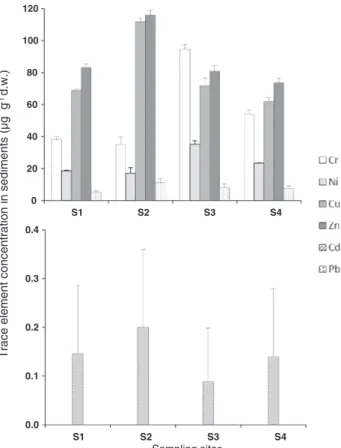
Fig. 2shows the average concentrations of Cr, Ni, Cu, Zn, Cd, and Pb in the sediments, at Bellingshausen Dome area (S1, reference site) and Ardley Cove (S2, S3, S4). Chromium, Ni, Cu and Zn were the most re-presentative trace elements in the sediments, ranging from 17 ± 3.5 to 116 ± 2.9μg g− 1d.w. (dry weight). Zinc reached higher concentra-tions than the other elements and was the most abundant trace element, at sites S1 (83 ± 2.2μg g− 1), S2 (116 ± 2.9μg g− 1 d.w.) and S4 (74 ± 2.9μg g− 1 d.w.), whereas both Cr and Zn were the most abundant trace elements in S3 sediments (95 ± 2.8 and 81 ± 3.6μg g− 1d.w., respectively). Contrastingly, levels of Cd and Pb
were below 11μg g− 1 d.w., Cd ranged from 0.088 ± 0.11 (S3) to
0.20 ± 0.16 (S2)μg g− 1d.w. and Pb varied from 5.3 ± 0.98 (S1) to 11 ± 2.7μg g− 1 d.w. Although trace element levels were not gen-erally significantly different (p ≥ 0.05) between Bellingshausen Dome area and Ardley Cove, Cr and Ni were up to two to four times higher in sediments S3 and S4 (Ardley Cove), than in those from the reference site. Levels of Cr, Ni, Cu, Zn, Cd, and Pb found in the sediments from the Ardley Cove varied within the ranges previously reported for the area (Lu et al., 2012; Amaro et al., 2015; Padeiro et al., 2016), and other areas of Antarctica under anthropogenic impact, such as the McMurdo area (Crockett, 1998) and Victoria Land (Malandrino et al., 2009). The trace element accumulation pattern in this study reproduced the sedi-ment elesedi-ment content pattern previously found for the Ardley Cove area (Amaro et al., 2015; Padeiro et al., 2016), with Cr, Cu and Zn presenting the highest concentrations among all surveyed trace elements. Never-theless, the sites chosen for sediment collection in this study were not within the most abundant trace element areas of Ardley Cove, as shown by the recent surveys on sediment trace element contamination, that densely covered the area (76 sampling sites) (Amaro et al., 2015; Padeiro et al., 2016). This explains why sediments from the Ardley Cove area generally presented trace element concentrations comparable to those from the Bellingshausen Dome area, here considered as reference site. Levels of Cr and Ni from sites S3 and S4 were, however, two to four times higher than in those in the reference site, and similar to those found in intermediately contaminated sediments from the Ardley Cove (Padeiro et al., 2016). Padeiro et al. (2016) calculated Enrichment Factors (EFs) in order to assess levels of trace elements that diverge from predicted natural levels in sediments from both Bellingshausen Dome and Ardley Cove, using the same method and background con-centrations reported by Lu et al. (2012), and iron as the reference element. The EFs values obtained therein, corresponding to the sam-pling sites from the present study, including the Bellingshausen Dome area (our reference site), were generally higher than 1 and lower than
Tr ace element concentr ation in sediments (µg g -1d.w.) 0 20 40 60 80 100 120 S1 S2 S3 S4 0.0 0.1 0.2 0.3 0.4 S1 S2 S3 S4 Sampling sites
Fig. 2. Mean and standard deviation values (n = 3) of trace element (Cr, Ni, Cu, Zn, Cd, Pb) concentration (μg g− 1d.w.) in sediments collected at Bellingshausen Dome area (S1)
and Ardley Cove (S2, S3, S4), located in King George Island, South Shetland Islands, Antarctica, during January 2014.
2, indicating trace element enhancement regarding local background levels, which may be possibly related to natural processes (ex. biogenic deposition) (Blaser et al., 2000; Padeiro et al., 2016). An exception was found for sites S3 and S4 located in Ardley Cove, with EFs values higher than 2 for Cr and Ni, showing that sediment levels of these elements deviated from background concentrations, which points to the possi-bility of anthropogenic contamination (Blaser et al., 2000; Padeiro et al., 2016).
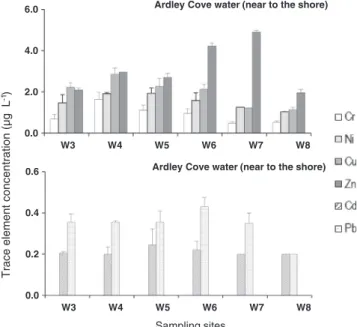
Fig. 3illustrates the average concentrations of Cr, Ni, Cu, Zn, Cd, and Pb in the water column from Maxwell Bay (W3, W4, W5, W6, W7, W8). Trace element levels varied between 0.20 ± 0.035 (Cd) to 4.9 ± 0.081 (Zn)μg L− 1. A similar element content pattern was visible at all sites, with element abundance generally increasing in the following order: Cd < Pb < Ni < Cr < Cu < Zn. Concentrations of Cd and Pb varied between 0.20 ± 0.035 and 0.43 ± 0.045μg L− 1, levels of Cr, Ni, Cu ranged from 0.49 ± 0.080 to 2.9 ± 0.30μg L− 1 and Zn reached the highest values (2.0 ± 0.16–4.9 ± 0.081 μg L− 1).
Average levels of trace elements (Cr, Ni, Cu, Zn, Cd, and Pb) in the water collected in the Bellingshausen Dome area (W1) and Maxwell Bay (W2), and used for the exposure experiments with immobilised P. tri-cornutum cells, are depicted inFig. 4. Concentrations of trace elements ranged from below the limit of detection to 0.66 ± 0.02μg L− 1, with the exception of Zn that reached 2.0 ± 0.41 and 4.5 ± 0.11μg L− 1at
Bellingshausen Dome area and Maxwell Bay, respectively. The higher trace element concentrations found in the sediments from the local area and from the water close to the shore of Ardley Cove, in comparison with the trace element levels determined in more offshore waters, in-dicate element mobilisation from sediments to the water column, pos-sibly due to leaching and runoff. Compared to known values of Cu, Zn, Cd, and Pb for the Weddell Sea (Sañudo-Wilhelmy et al., 2002), Ross Sea (Frache et al., 2001) and Southern Ocean (Scarponi et al., 1997; Harris and Fabris, 1979), which were < 0.55, 0.035, 0.093 and 0.035μg L− 1, respectively, our results (Fig. 3) point to the existence of
an enrichment by natural processes and local anthropogenic sources of trace elements as also found byAmaro et al. (2015)andPadeiro et al. (2016). The higher water element content observed close to the Ardley Cove shore (S3 and S4), relative to the concentrations found at the more distant control site, may be influenced by local anthropogenic con-tamination associated with the airport, and numerous established
research stations and touristic areas in the Fildes Peninsula, similar to reports for Deception Island (South Shetland Islands, Antarctic Pe-ninsula) (Mão de Ferro et al., 2013) which was also subject to cumu-lative impacts from human activities.
3.2. Trace element concentrations, cell viability and specific growth rate of P. tricornutum cells
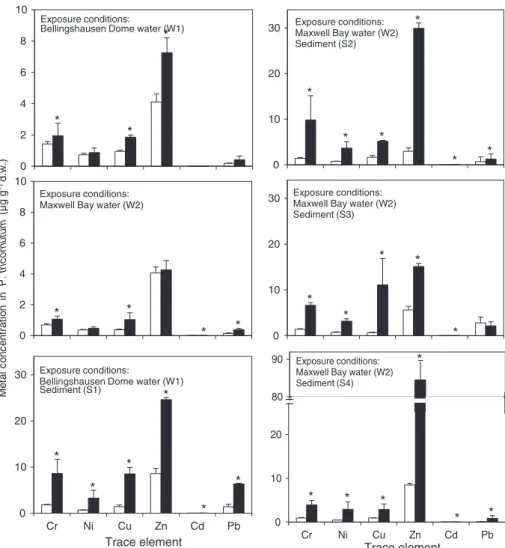
Average concentrations of Cr, Ni, Cu, Zn, Cd, and Pb found in P. tricornutum cells exposed to Bellingshausen Dome and (W1) and Maxwell Bay (W2) waters reflected the relatively low element con-centrations found in the water column of both sites (Fig. 5). Trace element accumulation in cells exposed to W1 water were slightly higher but not significantly different (p ≥ 0.05) than those found in control cells, except for Cu and Pb which were significantly (p < 0.05) en-hanced in exposed cells (1.9 ± 0.14 and 0.42 ± 0.24μg g− 1d.w.,
respectively) comparing to control ones (0.95 ± 0.080 and 0.19 ± 0.020μg g− 1d.w., respectively). For most elements, cells ex-posed to W2 water presented significantly (p < 0.05) enhanced con-centrations in comparison with control cells, varying from 0.0070 ± 0.0016, 0.27 ± 0.046, 0.38 ± 0.074, 1.04 ± 0.44 and 1.1 ± 0.19μg g− 1d.w. for Cd, As, Pb, Cu, Cr, respectively, and within
ranges comparable to those observed for W1 exposed cells. Cells ex-posed to water and sediments (W1 + S1, W2 + S2, W2 + S3, W2 + S4) showed significantly (p < 0.05) higher concentrations for all trace elements, than those of control cells and found in cells exposed to water only (Fig. 5). The cell element accumulation pattern ap-proximately reproduced the trace element content pattern in the sedi-ments from all sites: Cd < Pb < Ni < Cr≈ Cu < Zn. Cadmium and Pb showed the lowest concentrations in exposed cells, ranging from 0.017 ± 0.0052 for Cd (W2 + S2) to 6.3 ± 0.20μg g− 1d.w. for Pb (W1 + S1). Concentrations of Ni, Cr and Cu varied from 2.9 ± 1.7 for Ni (W2 + S4) to 11 ± 5.8μg g− 1d.w. for Cu (W2 + S3). Levels of Zn were significantly (p < 0.01) higher than those found for other trace elements in exposed cells, ranging from 15 ± 0.66 (W2 + S3) to 85 ± 5.2μg g− 1d.w. (W2 + S4). Cell mortality within the gel beads was < 5% in all cell samples. The high cell viability found in control and exposed cells indicated that P. tricornutum was alive during the exposure period which was crucial to accurately evaluate element ac-cumulation. Incorporation of trace elements in the immobilised P. tri-cornutum cells allowed the assessment of potential trace element transfer through phytoplankton into local food chains. The element concentrations in cells exposed only to water varied within the same
Trace element concentration (µg L
-1) 0.0 2.0 4.0 6.0 W3 W4 W5 W6 W7 W8
Ardley Cove water (near to the shore)
0.0 0.2 0.4 0.6 W3 W4 W5 W6 W7 W8 Sampling sites
Ardley Cove water (near to the shore)
Fig. 3. Mean and standard deviation values (n = 3) of dissolved trace element (Cr, Ni, Cu, Zn, Cd, Pb) concentrations (μg L− 1) in the water column collected close to the shore
of Ardley Cove (W3, W4, W5, W6, W7, W8), King George Island, South Shetland Islands, Antarctica, during January 2014.
0 1 2 3 4 5 W1 W2 Dissolved tr ace element co ncentr ation (µg L -1) Sampling sites Cr Ni Cu Zn Cd Pb
Water used in element exposure experiments
<DL
NA NA NA NA
Fig. 4. Mean and standard deviation values (n = 3) of dissolved trace element (Cr, Ni, Cu, Zn, Cd, Pb) concentrations (μg L− 1) in the water used for the trace element exposure
experiments, collected offshore of Bellingshausen Dome area (W1) and Maxwell Bay (W2), King George Island, South Shetland Islands, Antarctica, during January 2014. M.T. Cabrita et al. Marine Pollution Bulletin 121 (2017) 192–200
range also found in immobilised cells of the same phytoplankton species exposed to estuarine waters from an enclosed bay (Cabrita et al., 2013, 2014), because dissolved trace elements in coastal waters generally occur in low concentrations due to their low solubility and particle adsorption (Hoffmann et al., 2012), regardless of geographic location. The significantly higher trace element concentrations in P. tricornutum exposed to water and sediment as compared to control and water ex-posed cells, showed that the trace elements mobilised from sediments became bioavailable in the water column and were readily taken up by the cells. The trace element concentrations found in exposed P. tri-cornutum clearly reflected the trace element content pattern of both Bellingshausen Dome area (our reference site) and Ardley Cove sedi-ments (Figs. 5 and 2, respectively). Zinc was by far the most accumu-lated element by P. tricornutum, followed by Cr and Cu. In previous studies using P. tricornutum exposed to similar dissolved Zn con-centrations in the water, either in in situ conditions or in laboratory controlled exposure experiments, Zn cell accumulation has also been found the highest among other trace elements (Cabrita et al., 2014, 2016). Even though Zn associated with the exposed cells is high, only slight effects associated with this element on P. tricornutum growth and photosynthesis energetic pathways processes have been previously found (Cabrita et al., 2014, 2016). Tolerance to Zn, and also to Cu and Ni, as reported for several other phytoplankton species (Fisher, 1981), comply with these elements being essential components in many diatom metabolic pathways (Sunda, 1989). In the case of Ni, tolerance may be explained by the low cell binding capacity of Ni, found in several microalgae species (Horvatić and Peršić, 2007), preventing Ni to reach toxic concentrations within the cells. Nevertheless, high levels of these elements may be toxic to microalgae, as previously found for P.
tricornutum and other microalgae under high level and chronic condi-tions (Sunda, 1989; Horvatić and Peršić, 2007), which suggests that Zn, Cu and Ni levels in both Bellingshausen Dome area and Ardley Cove were not sufficiently high to cause severe damage to P. tricornutum cells. The values of“no observable effect concentration” (NOEC) and “lowest observable effect concentration” (LOEC) obtained from previous chronic toxicity tests with P. tricornutum, were < 1.5μg L− 1 and 1.5μg L− 1, for Cu, respectively (Levy et al., 2007, 2008), and a NOEC value of 2700μg L− 1was reported for Zn (Bodar, 2007). For Ni and the
other elements, no NOEC or LOEC values were found for P. tricornutum in the available literature. Copper and Zn levels in the water used for the exposure experiments were lower than these reported chronic threshold levels which further suggests that the observed effects of trace metals on P. tricornutum cell growth were probably not triggered by Zn and Cu, and also possibly not by Ni due to its low cell binding capacity, but rather by the other metals present in the water (e.g. Cr and Pb). In fact, Cr associated with the cells, has been found to cause impairment of photosynthetic energetic pathways processes, changes in pigment composition, blockage of cell division, inhibition of enzyme activity in microalgae cells (Monteiro et al., 2012). Pb was also incorporated by the P. tricornutum cells, as previously found byCabrita et al. (2014), although this element has no known role in the microalgae metabolism. The effect of Pb, even at low concentrations (Moreira et al., 2001), reducing cell growth rates (Irmer, 1985), and causing structural and functional damage in photosynthesis (Aggarwal et al., 2012; Cabrita et al., 2016), may have also contributed to the observed reduced P. tricornutum growth rates.
Average specific growth rates, expressed as percentage of control, of P. tricornutum are depicted in Fig. 6. Cells exposed to water and
M e ta l c o n c e n tr a tio n in P . tric o rn u tu m (µ g g -1 d. w .) 0 2 4 6 8 10 Exposure conditions:
Bellingshausen Dome water (W1)
0 2 4 6 8 10 Exposure conditions: Maxwell Bay water (W2)
0 10 20 30 Cr Ni Cu Zn Cd Pb Exposure conditions:
Bellingshausen Dome water (W1) Sediment (S1)
0 10 20
30 Exposure conditions:Maxwell Bay water (W2) Sediment (S2)
0 10 20
30 Exposure conditions:Maxwell Bay water (W2) Sediment (S3) 0 10 20 Cr Ni Cu Zn Cd Pb 80 90 Exposure conditions: Maxwell Bay water (W2) Sediment (S4)
*
*
*
*
*
*
Trace element Trace element
*
*
*
*
*
*
*
*
*
*
*
*
*
*
*
*
*
*
*
*
*
*
*
*
Fig. 5. Mean and standard deviation values (n = 3) of trace element (Cr, Ni, Cu, Zn, Cd, Pb) concentrations (μg g− 1
d.w.) in control (white bars) and exposed (black bars) Phaeodactylum tricornutum cells, incubated in water col-lected at the Bellingshausen Dome area (W1) and Maxwell Bay (W2), and in both water and sediments (W1 + S1, W2 + S2, W2 + S3, W2 + S4), collected at Bellingshausen Dome area (W1, S1) and Ardley Cove (W2, S2, S3, S4), King George Island, South Shetland Islands, Antarctica, during January 2014. The symbol * above standard deviation bars indicates values significantly different (p < 0.05) from control.
sediments showed a more accentuated decrease in growth rates (68 ± 1.8 to 86 ± 0.9%) than cells exposed to only water (92 ± 1.3 to 93 ± 1.2%). The lowest rates were observed in cells exposed to W2 + S2 (78 ± 1.0%) and W2 + S4 (68 ± 1.8%).
Given the effects of these trace elements on metabolic processes of P. tricornutum, the decrease in the P. tricornutum growth rates (ex-pressed as a percentage of control) appeared to be explained, particu-larly, by the elevated Cr and Pb concentrations found in exposed cells. The restraining effect of these elements on specific growth rate during trace element exposure, reflecting the trace element accumulation le-vels in the cells, highlights the sensitivity of P. tricornutum to variations in trace element availability.
3.3. Trace element concentrations in offshore phytoplankton. Potential element transfer into food chains
Trace element concentrations in the phytoplankton sample collected in offshore waters from the Maxwell Bay were 25, 60, 1.3 and 5.7μg g− 1d.w. for Cu, Zn, Cd and Pb (Fig. 7), respectively, and found comparable to those found in P. tricornutum cells, reproducing the trace
element content pattern found in the immobilised cells: Cd < Pb < Cu < Zn. The levels of trace elements in P. tricornutum cells agreed well with the concentrations found in phytoplankton collected from offshore waters from the Ardley Cove, showing that P. tricornutum was a good proxy of the natural phytoplankton community regarding element accumulation efficiency. This points to the possibility that trace ele-ments released into the bay's water column, due to leaching and runoff, may reach offshore waters and even affect the offshore phytoplankton, and consequently cause trace element relocation via phytoplankton into the marine food chains from the Maxwell Bay. Further studies of trace element sources and currents in the region should be performed in order to confirm this assumption. The results regarding trace element levels in P. tricornutum cells are in line with the element composition of individual diatom cells and natural phytoplankton communities from Antarctic regions, determined with light micrograph and Synchrotron X-ray Fluorescence (SXRF) (Twining et al., 2003; Twining and Baines, 2013). Although the type of trace element concentration data provided do not allow direct comparison with the results from this study, the Zn quota referred to in these studies was shown to be highest in phyto-plankton species and natural communities from the Southern Ocean, matching the generally high level of dissolved Zn concentrations in that ocean (Ellwood, 2004; Croot et al., 2011), and the high Zn levels found in P. tricornutum cells. This further supports the use of immobilised P. tricornutum cells as an effective and reliable tool to successfully monitor trace element contamination in polar coastal areas.
Table 1displays the percentage of trace elements removed by P. tricornutum cells exposed to water and sediments (W1 + S1, W2 + S2, W2 + S3, W2 + S4), based on bioavailability of total sediment element content. Trace element removal % varied within a relatively high range (0.82–24%), with the highest values for Zn (3.9–24%) and Pb (2.3–24%) and the lowest for Cu (1.0–3.2%). The high percentages of Zn, Cd and Pb removed by P. tricornutum cells exposed to water and sediments, based on bioavailability of total sediment trace element content, together with element levels in phytoplankton from Maxwell Bay offshore waters, suggest that phytoplankton may be an important path of trace element entry into local marine food chains (Bargagli et al., 1998). Biomagnification of mercury (Hg) in the Terra Nova Bay (Antarctica) marine coastal food web has been observed, with a pro-gressive increase in Hg concentrations in organisms at different levels of the food web (Bargagli et al., 1998), although Hg levels in the sedi-ments (0.012 ± 0.007μg g− 1
d.w.) were reported to be the lowest within the coastal marine environment. According to that study, the Hg concentrations (0.039 ± 0.007μg g− 1d.w.) found in primary produ-cers were much lower than those in higher trophic level consumers (e.g. 1.61 ± 1.22μg g− 1d.w. in skua eggs). Our results showed
compara-tively much higher trace element levels in the sediments (0.088 to 116μg g− 1 d.w.), and in the exposed P. tricornutum cells (0.017 ± 0.052–85 ± 5.2 μg g− 1 d.w.) which imply that trace
ele-ments, particularly Zn, Cr, Cu and Pb, can potentially accumulate in marine organism tissues and may biomagnify in the Antarctic Belling-shausen Dome area and Ardley Cove food webs, as observed for Hg in
0
20
40
60
80
100
W1 W2 W1+S1 W2+S2 W2+S3 W2+S4S
peci
fi
c
gr
ow
th
ra
te
(
as %
of
cont
rol
)
Imobilised cell exposure conditions
Fig. 6. Mean and standard deviation values (n = 3) of specific growth rate expressed as percentage of control, of Phaeodactylum tricornutum cells, incubated in water collected at the Bellingshausen Dome area (W1) and Maxwell Bay (W2), and in both water and se-diments (W1 + S1, W2 + S2, W2 + S3, W2 + S4), collected at Bellingshausen Dome area (W1, S1) and Ardley Cove (W2, S2, S3, S4), King George Island, South Shetland Islands, Antarctica, during January 2014.
0 20 40 60 Cu Zn Cd Pb Metal s in of fs hore phy toplank ton (µg g -1) Trace metal Offshore phytoplankton
Fig. 7. Mean and standard deviation values (n = 3) of trace element (Cu, Zn, Cd, Pb) concentrations (μg g− 1d.w.) in offshore phytoplankton, collected at Maxwell Bay (W2),
King George Island, South Shetland Islands, Antarctica, during January 2014.
Table 1
Percentage (%) of trace element removed during a 24 h period, based on bioavailability of total sediment trace element content, by Phaeodactylum tricornutum cells exposed to water and sediments (W1 + S1, W2 + S2, W2 + S3, W2 + S4), collected at the Bellingshausen Dome area (W1, S1) and at the Ardley Cove (W2, S2, S3, S4), King George Island, South Shetland Islands, Antarctica, during January 2014.
W1 + S1 W2 + S2 W2 + S3 W2 + S4 Cr 4.5 4.8 1.5 1.5 Ni 3.6 4.1 1.9 2.6 Cu 2.5 1.4 3.2 1.0 Zn 5.9 5.7 3.9 24 Cd 2.4 1.7 5.0 5.2 Pb 24 4.9 5.6 2.3
the Terra Nova Bay. 4. Conclusions
This study clearly shows that immobilised phytoplankton cells can be used as an effective and reliable tool to successfully monitor trace element contamination in polar coastal areas. Trace elements mobilised from sediments/soils became bioavailable in the water column and were readily taken up by P. tricornutum cells. Furthermore, trace ele-ment levels in exposed cells clearly reflected the trace element content pattern found in the sediments, also comparable to those found in off-shore phytoplankton. In particular, Zn, Cr, Cu and Pb were shown to have the potential to accumulate and biomagnify in the marine food webs of the Fildes Peninsula area. Following this line of reasoning, P. tricornutum was found a good proxy of the natural phytoplankton community regarding element accumulation efficiency, and a pro-mising model species with potential applications for trace element contamination screening in polar ecosystems.
Acknowledgements
Authors would like to thank the Portuguese Polar Program and Chilean Antarctic Institute (INACH) for providing logistics and support. This work was part of the CONTANTARC 3 Project from the Programa Polar Português funded by Fundação para a Ciência e Tecnologia (FCT). Maria Teresa Cabrita appreciates the grant by FCT (Grant No. SFRH/ BPD/50348/2009), and wishes to acknowledge both the project UID/ QUI/00100/2013 which funds Centro de Química Estrutural, and the Divisão de Oceanografia Ambiental e Bioprospeção from Instituto Português do Mar e da Atmosfera (Portugal), where work supporting this study was performed. This work is a contribution to the Scientific Committee on Antarctic Research (SCAR)‘State of the Antarctic Ecosystem’ (AntEco) programme. The authors would also like to thank the anonymous reviewers for their constructive comments, which helped to improve the manuscript.
References
Aggarwal, A., Sharma, I., Tripathi, B.N., Munjal, A.K., Baunthiyal, M., Sharma, V., 2012. Metal toxicity and photosynthesis. In: Itoh, S., Mohanty, P., Guruprasad, K.N. (Eds.), Photosynthesis: Overviews on Recent Progress and Future Perspectives, pp. 229–236 (Chapter 6).
Amaro, E., Padeiro, A., de Ferro, A.M., Mota, A.M., Leppe, M., Verkulich, S., Hughes, K.A., Peter, H.-U., Canário, J., 2015. Assessing trace element contamination in Fildes Peninsula (King George Island) and Ardley Island, Antarctic. Mar. Pollut. Bull. 97, 523–527.
Bargagli, R., 2005. Antarctic ecosystems: environmental contamination, climate change, and human impact. In: Ecological Studies 175. Springer-Verlag, Heidelberg, Germany.
Bargagli, R., 2008. Environmental contamination in Antarctic ecosystems. Sci. Total Environ. 400 (1–3), 212–226.
Bargagli, R., Nelli, L., Ancora, S., Focardi, S., 1996. Elevated cadmium accumulation in marine organisms from Terra Nova Bay (Antarctica). Polar Biol. 16 (7), 513–520.
Bargagli, R., Monaci, F., Sanchez-Hernandez, J.C., Cateni, D., 1998. Biomagnification of mercury in an Antarctic marine food web. Mar. Ecol. Prog. Ser. 169, 65–76.
Blaser, P., Zimmermann, S., Luster, J., Shotyk, W., 2000. Critical examination of trace element enrichments and depletions in soils: As, Cr, Cu, Ni, Pb and Zn in Swiss forest soils. Sci. Total Environ. 249, 257–280.
Bodar, C.W.M., 2007. Environmental Risk Limits for Zinc. In: RIVM Letter Report 11235/ 2007, (32 pp.).
Boyd, P.W., 2002. Environmental factors controlling phytoplankton processes in the Southern Ocean. J. Phycol. 38, 844–861.
Braun, C., Mustafa, O., Nordt, A., Pfeiffer, S., Peter, H.-U., 2012. Environmental mon-itoring and management proposals for the Fildes Region, King George Island, Antarctica. Polar Res. 31.
Cabrita, M.T., Raimundo, J., Pereira, P., Vale, C., 2013. Optimizing alginate beads for the immobilisation of Phaeodactylum tricornutum in estuarine waters. Mar. Environ. Res. 87-88, 37–43.
Cabrita, M.T., Raimundo, J., Pereira, P., Vale, C., 2014. Immobilised Phaeodactylum tri-cornutum as biomonitor of trace element availability in the water column during dredging. Environ. Sci. Pollut. Res. 21 (5), 3572–3581.
Cabrita, M.T., Gameiro, C., Utkin, A.B., Duarte, B., Caçador, I., Cartaxana, P., 2016. Photosynthetic pigment laser-inducedfluorescence indicators for the detection of changes associated with trace element stress in the diatom model species
Phaeodactylum tricornutum. Environ. Monit. Assess. 188 (5), 285–297.
Caetano, M., Fonseca, N., Cesário, R., Vale, C., 2007. Mobility of Pb in salt marshes re-corded by total content and stable isotopic signature. Sci. Total Environ. 380 (1–3), 84–92.
Crippen, R.W., Perrier, J.L., 1974. The use of neutral red and Evans blue for live-dead determination of marine plankton. Stain. Technol. 49 (2), 97–104.
Crockett, A.B., 1998. Background levels of metals in soils, McMurdo Station, Antarctica. Environ. Monit. Assess. 50 (3), 289–296.
Croot, P.L., Baars, O., Streu, P., 2011. The distribution of dissolved zinc in the Atlantic sector of the Southern Ocean. Deep-Sea Res. Pt II 58 (25–26), 2707–2719.
Ellwood, M.J., 2004. Zinc and cadmium speciation in subantarctic waters east of New Zealand. Mar. Chem. 87 (1–2), 37–58.
Fisher, N.S., 1981. On the selection for heavy metal tolerance in diatoms from the Derwent estuary, Tasmania. Aust. J. Mar. Freshwat. Res. 32, 555–561.
Frache, R., Abelmoschi, M.L., Baffi, F., Ianni, C., Magi, E., Soggia, F., 2001. Trace metals in particulate and sediments. In: Caroli, S., Cescon, P., Walton, D.W.H. (Eds.), Environmental Contamination in Antarctica: A Challenge to Analytical Chemistry. Elsevier, Amsterdam, pp. 219–236.
González-Dávila, M., 1995. The role of phytoplankton cells on the control of heavy metal concentration in seawater. Mar. Chem. 48 (3–4), 215–236.
Guillard, R.R.L., Ryther, J.H., 1962. Studies on marine planktonic diatoms, I. Cyclotella nana Hustedt and Detonula confervaceae (Cleve) gran. Can. J. Microbiol. 8 (2), 229–239.
Hale, R.C., Kim, S.L., Harvey, E., La Guardia, M.J., Mainor, T.M., Bush, E.O., Jacobs, E.M., 2008. Antarctic research bases: local sources of Polybrominated Diphenyl Ether (PBDE)flame retardants. Environ. Sci. Technol. 42 (5), 1452–1457.
Harris, J.E., Fabris, G.J., 1979. Concentrations of suspended matter and particulate cadmium, copper, lead and zinc in the Indian sector of the Antarctic Ocean. Mar. Chem. 8 (2), 163–179.
Hoffmann, L.J., Breitbarth, E., Boyd, P.W., Hunter, K.A., 2012. Influence of ocean warming and acidification on trace metal biogeochemistry. Mar. Ecol. Prog. Ser. 470, 191–205.
Honda, K., Yamamoto, Y., Hidaka, H., Tatsukawa, R., 1986. Heavy metal accumulation in Adelie penguin, Pygoscelis adeliae, and their variations with the reproductive process. Mem. Nat. Inst. Polar Res. 40, 443–453.
Horvatić, J., Peršić, V., 2007. The effect of Ni2 +, Co2 +, Zn2 +, Cd2 +and Hg2 +on the
growth rate of marine diatom Phaeodactylum tricornutum Bohlin: microplate growth inhibition test. Bull. Environ. Contam. Toxicol. 79, 494–498.
Irmer, G., 1985. Zum Einfluß der Apparatefunktion auf die Bestimmung von Streuquerschnitten und Lebensdauern aus optischen Phononenspektren. Exp. Tech. Phys. 33, 501–506.
Kennicutt, M.C., Wolff, G.A., Klein, A., Montagna, P., 2003. Spatial and temporal scales of human disturbance - McMurdo Station, Antarctica - preliminaryfindings. In: Huiskes, A.H.L., Gieskes, W.W.C., Rozema, J., Schorno, R.M.L., van der Vies, S.M., Wolff, W.J. (Eds.), Proceedings of the VIIIth SCAR International Biology Symposium. Backhuys Publishers, Lieden, Netherlands, pp. 271–277.
Levy, J.L., Stauber, J.L., Jolley, D.F., 2007. Sensitivity of marine microalgae to copper: the effect of biotic factors on copper adsorption and toxicity. Sci. Total Environ. 387, 141–154.
Levy, J.L., Angel, B.M., Stauber, J.L., Poon, W.L., S.L., 2008. Uptake and internalisation of copper by three marine microalgae: comparison of copper-sensitive and copper-tol-erant species. Aquat. Toxicol. 89 (2), 82–93.
Liggett, D., McIntosh, A.J., Thompson, A., Gilbert, N., Storey, B., 2011. From frozen continent to tourism hotspot? Five decades of Antarctic tourism development and management, and a glimpse into the future. Tour. Manag. 32 (2), 357–366.
Lu, Z., Cai, M., Wang, J., Yang, H., He, J., 2012. Baseline values for metals in soils on Fildes peninsula, King George Island, Antarctica: the extent of anthropogenic pollu-tion. Environ. Monit. Assess. 184 (11), 7013–7021.
Luoma, S.N., Bryan, G.W., Langston, W.J., 1982. Scavenging of heavy metals from par-ticulates by brown seaweeds. Mar. Pollut. Bull. 13 (11), 394–396.
Malandrino, M., Abollino, O., Buoso, S., Casalino, C.E., Gasparon, M., Giacomino, A., La Gioia, C., Mentasti, E., 2009. Geochemical characterisation of Antarctic soils and lacustrine sediments from Terra Nova Bay. Microchem. J. 92 (1), 21–31.
Mão de Ferro, A., Mota, A.M., Canário, J., 2013. Sources and transport of As, Cu, Cd and Pb in the environmental compartments of Deception Island, Antarctica. Mar. Pollut. Bull. 77 (1–2), 341–348.
McClurg, T.P., 1984. Trace metals and chlorinated hydrocarbons in Ross seals from Antarctica. Mar. Pollut. Bull. 15 (10), 384–389.
Meeravali, N.N., Kumar, S.J., 2000. Comparison of open microwave digestion and di-gestion by conventional heating for the determination of Cd, Cr, Cu and Pb in algae using transverse heated electrothermal atomic absorption spectrometry. Fresenius J. Anal. Chem. 366 (3), 313–315.
Monteiro, C.M., Castro, P.M.L., Malcata, F.X., 2012. Metal uptake by microalgae: un-derlying mechanisms and practical applications. Biotechnol. Prog. 28, 299–311.
Moreira, E.G., Vassilieff, I., Vassilieff, V.S., 2001. Developmental lead exposure. Behavioral alterations in the short and long term. Neurotoxicol. Teratol. 23, 489–495.
Moreira, S.M., Moreira-Santos, M., Guilhermino, L., Ribeiro, R., 2006. Immobilization of the marine microalga Phaeodactylum tricornutum in alginate for in situ experiments: bead stability and suitability. Enzym. Microb. Technol. 38 (1–2), 135–141.
Nyholm, N., Källqvist, T., 1989. Methods for growth inhibition toxicity tests with fresh-water algae. Environ. Toxicol. Chem. 8 (8), 689–703.
Padeiro, A., Amaro, E., Correia Dos Santos, M.M., Araújo, M.F., Gomes, S.S., Leppe, M., Verkulich, S., Hughes, K.A., Peter, H.-U., Canário, J., 2016. Trace element con-tamination and availability in Fildes peninsula, King George Island, Antarctica. Environ. Sci. Process. Impacts 18, 648–657.
environments in China. Sci. Total Environ. 421-422, 3–16.
Parker, B.C., 1978. Environmental Impact in Antarctica. Virginia Polytechnic Institute and State University, Blacksburg.
Pearson, G.A., Lago-Leston, A., Cánovas, F., Cox, C.J., Verret, F., Lasternas, S., Duarte, C.M., Susana Agusti, S., Serrão, E.A., 2015. Metatranscriptomes reveal functional variation in diatom communities from the Antarctic peninsula. ISME J. 9, 2275–2289.
Pereira, J.L., Pereira, P., Padeiro, A., Gonçalves, F., Amaro, E., Leppe, M., Verkulich, S., Hughes, K.A., Peter, H.-U., Canário, J., 2017. Environmental hazard assessment of contaminated soils in Antarctica: using a structured tier 1 approach to inform deci-sion-making. Sci. Total Environ. 574, 443–454.
Peter, H.-U., Büßer, C., Mustafa, O., Pfeiffer, S., 2008. Risk assessment of Fildes peninsula and Ardley Island, and the development of management plans for their designation as specially protected or specially managed areas. In: Federal Environment Agency (Germany), Report No. 20313124, UBA-FB 001155e.
Peter, H.-U., Braun, C., Janowski, S., Nordt, A., Nordt, A., Stelter, M., 2013. The current environmental situation and proposals for the management of the Fildes peninsula region. In: Federal Environment Agency (Germany), Report No. (UBA-FB) 001662/E.
Polkowska-Motrenko, H., Danko, B., Dybczyński, R., Koster-Ammerlaan, A., Bode, P., 2000. Effect of acid digestion method on cobalt determination in plant materials. Anal. Chim. Acta 408 (1–2), 89–95.
Préndez, M., Carrasco, M.A., 2003. Elemental composition of surface waters in the Antarctic peninsula and interactions with the environment. Environ. Geochem. Health 25 (3), 347–363.
Quentin, L.B., Ross, R.M., 1985. Feeding by Antarctic krill, Euphausia superba: does size matter? In: Antarctic Nutrient Cycles and Food Webs, Part 3, pp. 372–377.
Santos, I.R., Silva-Filho, E.V., Schaefer, C.E., Albuquerque-Filho, M.R., Campos, L.S., 2005. Heavy metal contamination in coastal sediments and soils near the Brazilian Antarctic Station, King George Island. Mar. Pollut. Bull. 50 (2), 185–194.
Sañudo-Wilhelmy, S.A., Olsen, K.A., Scelfo, J.M., Foster, T.D., Flegal, A.R., 2002. Trace metal distributions off the Antarctic peninsula in the Weddell Sea. Mar. Chem. 77 (2–3), 157–170.
SAT (Secretariat of the Antarctic Treaty), 2010. Register of the status of Antarctic spe-cially protected area and Antarctic spespe-cially managed area management plans. In: Supporting Paper 10. XXXIII Antarctic Treaty Consultative Meeting, 3–14 May, Punta del Este.
Scarponi, G., Capodaglio, G., Turetta, C., Barbante, C., Cecchini, M., Toscano, G., Cescon,
P., 1997. Evolution of cadmium and lead contents in Antarctic coastal seawater during the austral summer. Int. J. Environ. Anal. Chem. 66 (1), 23–49.
Sicko-Goad, L.M., Schelske, C.L., Stoermer, E.F., 1984. Estimation of intracellular carbon and silica content of diatoms from natural assemblages using morphometric techni-ques. Limnol. Oceanogr. 29 (6), 1170–1178.
Sunda, W.G., 1989. Trace metal interactions with marine phytoplankton. Biol. Oceanogr. 6 (5–6), 411–442.
Sunda, W.G., Huntsman, S.A., 1998. Processes regulating cellular metal accumulation and physiological effects: phytoplankton as model systems. Sci. Total Environ. 219 (2–3), 165–181.
Szefer, P., Czarnowski, W., Pempkowiak, J., Holm, E., 1993. Mercury and major essential elements in seals, penguins, and other representative faund of the Antarctic. Arch. Environ. Contam. Toxicol. 25 (4), 422–427.
Szefer, P., Szefer, K., Pempkowiak, J., Skwarzec, B., Bojanowski, R., Holm, E., 1994. Distribution and coassociations of selected metals in seals of the Antarctic. Environ. Pollut. 83 (3), 341–349.
Taylor, F., McMinn, A., Franklin, D., 1997. Distribution of diatoms in surface sediments of Prydz Bay, Antarctica. Mar. Micropaleontol. 32 (3–4), 209–229.
Tin, T., Fleming, Z.L., Hughes, K.A., Ainley, D.G., Convey, P., Moreno, C.A., Pfeiffer, S., Scott, J., Snape, I., 2008. Impacts of local human activities on the Antarctic en-vironment. Antarct. Sci. 21, 1–31.
Tin, T., Sovacool, B.K., Blake, B., Magill, P., El Naggar, S., Lidstrom, S., Ishizawa, K., Berte, J., 2010. Energy efficiency and renewable energy under extreme conditions: case studies from Antarctica. Renew. Energy 35 (8), 1715–1723.
Twining, B.S., Baines, S.B., Fisher, N.S., Maser, J., Vogt, S., Jacobsen, C., Tovar-Sanchez, A., Sanudo-Wilhelmy, S.A., 2003. Quantifying trace elements in individual aquatic protist cells with a synchrotron X-rayfluorescence microprobe. Anal. Chem. 75, 3806–3816.
Twining, B.S., Baines, S.B., 2013. The trace metal composition of marine phytoplankton. Annu. Rev. Mar. Sci. 5, 191–215.
Yamamoto, Y., Honda, K., Hidaka, H., Tatsukawa, R., 1987. Tissue distribution of heavy metals in Weddell seals (Leptonychotes rueddellii). Mar. Pollut. Bull. 18, 164–169.
Zhang, H., Davison, W., 1995. Performance characteristics of diffusion gradients in thin films for the in situ measurement of trace metals in aqueous solution. Anal. Chem. 67 (19), 3391–3400.
Zhang, H., Davison, W., 1999. Diffusional characteristics of hydrogels used in DGT and DET techniques. Anal. Chim. Acta 398 (2–3), 329–340.