www.elsevier.es/rlp
Revista
Latinoamericana
de
Psicología
ORIGINAL
ARTICLE
Study
on
homophobic
bullying
in
Portugal
using
Multiple
Correspondence
Analysis
(MCA)
Liliana
Rodrigues
a,
Rita
Grave
a,
João
Manuel
de
Oliveira
b,
Conceic
¸ão
Nogueira
a,∗aFacultyofPsychologyandEducationalSciencesoftheUniversityofPorto,Porto,Portugal
bISCTE-InstitutoUniversitáriodeLisboa,Lisboa,Portugal
Received11June2013;accepted17November2015 Availableonline27May2016
KEYWORDS
Homophobicbullying; Portugueseschools; Heterosexism
Abstract Educationalinstitutions,aswellaspolitical,socialandscientificdiscourses,have contributedtowardsdiscriminationandviolenceagainstpeoplewithnon-normativesexual ori-entations.Actsofviolenceamongpeers(bullying)motivatedbyhomophobiaoccuronafrequent basisinschoolcontexts.Thisstudyaimstoidentifythepatternsinwhichhomophobicbullying (victimidentified)takesplaceinPortugueseschoolsusingMultipleCorrespondenceAnalysis. Thisstudyinvolvedtheapplicationofaquestionnairetopeopleofbothsexesbeforeobtaining atotalof171participantsreportingthemselvesasvictimsofhomophobicbullyinginschools. Followingtheidentificationofeightindicatorsandtheselectionoftwodimensions,whilealso structuringtheaxesinaccordancewiththerepresentationspace,fourpatternsofhomophobic bullyingcouldbeidentified:masculineviolence,feminineviolence,violencewithlessperceived impact,andviolencewithgreaterperceivedimpact.Thesedifferentpatternshaveallowedus tolearnaboutthedifferentwaysinwhichpeerviolencetakesplaceinschoolsanditspossible effects.Amongthemainstudyconclusions,itishighlightedhowmaleparticipantswerevictims ofviolenceatanearlieragethanfemaleparticipantvictims.Anotherkeyfindingisthe com-pletelackofcasesinwhichtheaggressorswereonlyfemale.Finally,acommonconclusionto allparticipants,encapsulateshownoneofthevictimsreportedtheviolencetotheirfamilies forfearoflosingfamilysupportbyrevealinganon-heterosexualorientation.
©2016Fundaci´onUniversitariaKonradLorenz.PublishedbyElsevierEspa˜na,S.L.U.Thisisan openaccessarticleundertheCCBY-NC-NDlicense(
http://creativecommons.org/licenses/by-nc-nd/4.0/).
PALABRASCLAVE
Bullyinghomofóbico; Escuelasportuguesas; Heterosexismo
EstudiosobreBullyingHomofóbicoenPortugalconrecursoalAnálisisde CorrespondenciasMúltiples(ACM)
Resumen Las instituciones educativas, así como los discursos sociales, políticos y cien-tíficos, han contribuido a la discriminación y a la violencia contra las personas con
∗Correspondingauthor.
E-mailaddress:[email protected](C.Nogueira).
http://dx.doi.org/10.1016/j.rlp.2016.04.001
0120-0534/©2016Fundaci´onUniversitariaKonradLorenz.PublishedbyElsevierEspa˜na,S.L.U.ThisisanopenaccessarticleundertheCC BY-NC-NDlicense(http://creativecommons.org/licenses/by-nc-nd/4.0/).
orientacionessexualesnonormativas.Inclusoenelcontextoescolarsucedenactosdeviolencia entreiguales(bullying)motivadosporlahomofobia.Elestudiotienecomoobjetivoidentificar lospatronesenqueocurreelbullyinghomofóbico(identificadoporlasvíctimas)enlasescuelas portuguesas,recurriendoaunAnálisisdeCorrespondenciasMúltiples.Esteestudiosebasaenun cuestionarioenlínearealizadoapersonasdeambossexos,hastauntotalde171participantes quemanifestaronhabersidovíctimasdebullyinghomofóbicoenlasescuelas.Conla identifi-caciónde8indicadoresylaselecciónde2dimensionescomoejesestructuralesdelespaciode lasrepresentacionesfueposibleidentificar4patronesdelbullyinghomofóbico:laviolenciaen elmasculino,laviolenciaenelfemenino,laviolenciaconmenorimpactopercibidoyla violen-ciaconmayorimpactopercibido.Estospatronesdediferentescaracterísticasnoshanpermitido reconocerdiferentesformasenquetienelugarlaviolenciaentreigualesenlasescuelasysus posiblesefectos.Entrelasprincipalesconclusionesdelestudiodestacaelhechodequelos participantesdesexomasculinofueronvíctimasdeviolenciaenedadesmástempranas, mien-trasquelasparticipantesdesexofemeninofueronvíctimasenedadesmásavanzadas.Otra conclusiónprincipaldevelaquenoexisteningúncasoenelquelossujetosagresoresfueran únicamentedesexofemenino.Unaconclusiónmás,comúnatodoslospatronesidentificados, esqueninguna víctimacontóla violenciasufridaala familia,portemor aperderelapoyo familiaralrevelarunaorientaciónsexualnoheterosexual.
©2016Fundaci´onUniversitariaKonradLorenz.PublicadoporElsevierEspa˜na,S.L.U.Esteesun art´ıculoOpenAccessbajolalicenciaCCBY-NC-ND(
http://creativecommons.org/licenses/by-nc-nd/4.0/).
The European Convention for theProtection of Human Rightsand Fundamental Freedoms, through the Universal DeclarationofHumanRights(1998)andtheDeclarationon Fundamental Principles andRights at Work (2003), estab-lishes a solid legal basis for action against homophobia and other associated forms of discrimination (Warwick & Aggleton, 2014; Warwick, Chase, Aggleton, & Sanders, 2004).
InPortugal,someactionshavebeenimplementedatthe legislative levelin orderto recognizenew rightsfor peo-plewithnon-normativesexualidentities.Inparticularly,the inclusionofsexualorientationintothe13thArticleofthe PortugueseRepublicanConstitution---PrincipleofEquality (Canotilho&Moreira,2008);theapprovalofthestatelaw enactingcivilmarriagefor same-sexcouples, endorsedon May31,2010(LawNo.9/2010,allowscivilsame-sex mar-riage)(Decreto-Lei, 2010) although the3rd article ofthis lawprohibitstheadoptionbysame-sexcouples,andhence resultinginnewformoflawbaseddiscrimination;alongside thepassingofagenderidentitylaw---LawNo.7/2011,March 15---(Decreto-Lei,2011)referstosexchangeandfirstname changeintheCivilRegistry.
Despite the legal context prevailing for lesbian, gay, bisexual and transgender people (LGBT), this group still faces prejudice and exclusion throughout their lives in different moments and in different contexts (Nogueira & Oliveira,2010).
Furthermore,someresearchdoesindicatethatthe dis-coursesandpracticesofheterosexistviolence---whetherat work,atschoolorinothersocialinstitutions---significantly correlatewiththestress,depressionandsuicides ofLGBT people(Oliveira,Pereira,Costa,&Nogueira,2010;Smith& Ingram,2004).
Even though there is recognition that LGBT people do stillface discriminationin certaincontexts --- particularly
at school--- and the fact that an increasing concernover research on recognizing the sexual citizenship does sub-sist in Portugal and rendering LGBT issues visible (e.g.,
Costa & Davis, 2012; Costa, Nogueira, & López, 2009; Nogueira & Oliveira, 2010; Oliveira, 2010; Rodrigues, Oliveira, & Nogueira, 2010), peer violence against young LGBTpeople,ortothoseperceivedassuch,remains signifi-cantly silenced throughout the Portuguese school system. Is worth mentioning that homophobic bullying may also target individuals who have not yet identified with any sexual orientation, as well as those who identify them-selves as heterosexual. The motivation for homophobic bullying derives fromhomophobia evenwhenperpetrated against people who do not identify themselves as LGBT, but nevertheless get perceived as people contravening heteronormativity.
Despite the recognition that extends to howattitudes such as homophobia and transphobia encourage bullying (Clarke &Kiselica, 1997;Hong& Garbarino,2012;Kosciw, Greytak, & Diaz, 2009), the vast majority of researchon bullyingfailstomentionorapproacheithersexual orienta-tionorgenderidentitystandardsaspossibleriskfactorsfor occurrencesofthatviolence(Poteat,DiGiovanni,&Scheer, 2013). However, different studies focused on the experi-ences of LGBT people present results that allow for the assumptionoftheexistence ofvictimizationwithinschool contexts.SomestudiescarriedoutwithLGBTyouthreported thatbetween30%and50%ofparticipantshaveexperienced some kind of homophobic violence within school settings (Ellis&High,2004;Rivers&Duncan,2002;Warwicketal., 2004). Such experiences include verbal and physical vio-lence (Bontempo& D’Augelli, 2002; D’Augelli, Pilkington, &Hershberger,2002),sexualviolence(Bochenek&Brown, 2001;Gruber& Fineran,2007),socialexclusionand isola-tion(Fineran,2002;Rivers,2001b;Rivers&D’Augelli,2001)
andotherinterpersonalproblemswithpeers(e.g.,Pearson, Muller,&Wilkinson,2007).
These results originate in school, from its very begin-nings, have produced differences and dissimilarities that leadtosegregationamongpeople.Furthermore,evenwhen accesstoeducationbecamearightforall,discourses devel-opedinandabout schoolingthat havefrequently triedto organizethesocialstructuresoastomutethediversitythat coexistswithinthem(Louro,1997).
LGBT people represent part of this silenced diversity, arisingfromthe need tostandardize the schoolstructure and merge the normative discourses on sexuality other-wise adopted by societies. One such normative discourse relatesto heterosexism.Heterosexism is the beliefabout heterosexualityastheonlypossibleorientationand corre-spondinglyneglecting anyother sexuality (Oliveiraet al., 2010).
Sexismreferstoanothersociallecturesustainedby soci-eties, which recognizes menand masculinity asthe main approach to existence, relegating women to an inferior existence (Nogueira, 2001). Heterosexism and sexism are entrenchedin thebelief thatsome expressionsof sexual-ityandgenderare‘‘normal’’andacceptablewhile others prove‘‘deviant’’andreprehensible(Zavalkoff,2002).
AsButler(1993)reveals,androcentrismandheterosexism formessentialpartsofthehegemonicheterosexuality(i.e. aregulatorysystemthataffectsnotonlybehavioursbutalso thesubject’sownprocessofconstitution).
Features
of
bullying
(and
features
of
homophobic
bullying)
OneofthemainEuropeanlawsontheseissuesdeterminesan educationbasedontheprinciplesofcitizenshipand democ-racy,withoutanyviolence,forallchildren,adolescentsand the youth. Nevertheless, preventingthe conflict of inter-ests,injusticeorincompetencefromconcealingthesocial problemsafflictingtheyouthhasnotprovenpossible. Bul-lyingremains asone example of a hidden social problem (butcertainlynottheonlyone).Thishappensinallschool organizationsaswellasin differentinstitutionsand,even thoughmuchhasbeendonesinceitsrecognition asareal factwithevaluationsmade asregardsitsnegativeeffects onstudentssufferingsuchabuse,theproblemhasyettobe eradicated(Carrera,DePalma,&Lameiras,2011;Defensor DelPueblo,2007;Ortega,Mora-Merchán,&Jäger,2007).
Bullying does not represent a phenomenon exclusive tothePortuguese society.However,only recentlydid sci-entific outputs around this issue begin to increase and gainwidespreaddisseminationinthe media(DefensorDel Pueblo, 2006; Barrio, Martín, Almeida, & Barrios, 2003; Machado,2011).
Olweus(1993,1994)definesthetermbullyingas refer-ringtoastudentwhoisintimidatedandvictimizedthrough exposure to negative actions by one or more individuals, repeatedovertime.Thisnegativeactionincorporates some-one causing or attempting to cause intentional harm or distress toanother person (Olweus, 1994). This repeated violence may be psychological, physical and/or sexual (Carvalhosa, Kima, & Matos, 2001; Defensor Del Pueblo, 2006).
Thehomophobicbullyingconcepthasemergedfromthe needtoidentifymotivationsbehindactsofviolenceamong peerswithinschoolcontextsandcorrespondinglyperceived asspecificallymotivatedbysexualorientationbasedupon sexualorientation related prejudice. Therefore,this may representrepeatedviolentbehaviourperformedbyoneor morestudents towards their peers,withthe particularity thatthestudentsperpetratingsuchaggressionappropriate homophobia,sexismandthevaluesassociatedto heterosex-isminordertoexclude,isolate,insultandassaultpeerswho breakthenormativepatternsofgenderidentityandsexual orientationor,indeed,anyotherstudentwhoperceivesor representshimselforherselfasLGBT(Méndez,2007).
Somestudies indicatetwosimilarities betweengeneral bullying1 and homophobic bullying: both widely
dissemi-natedwithin the school context, and they are not often reported(Mishna,Newman,Daley,&Solomon,2009). How-ever,theseauthorsalsoidentifythreeitemsofhomophobic bullyingthatappearunique.First,thefactthatwelivein ahomophobicsocietyandourculture notonlylegitimizes thepracticeofhomophobiainschoolcontexts, butalsoin thefamily,inreligiousinstitutions,in socialpolicies,with statelawsandinthemedia.Secondly,theparadoxarising outof howrevealing one’s sexual orientation, potentially crucialtogainingsocialsupport,simultaneouslyrepresents afactorofriskas,formanyyounghomophobicbullying vic-tims, revealing their non-normative sexual orientation to theirpeersandtoadultsincreasestheriskoflosingsocial support(Newman, 2002). Finally, despite the exponential scientificproductionaboutbullyingingeneralandthe con-sequentiallaunchingofpublicpolicyinterventionsdesigned toeradicatethiskindofviolencebetweenequals,the moti-vationsencouragingthebullyingofLGBTpeoplehavebeen eitherdeniedordiluted---frequentlybycertain profession-alsandpoliticalorganizations.Thislattersituationleadstoa biaswhichhidesotherparticularmotivationsinreducingall formsofviolenceinschoolcontextsintoageneralbullying category(Greene,2006)therebycamouflaginginformation vitaltointerventionandthepreventionofhomophobic bul-lying.
Wewouldimportantlystressthatthebullyinglabelmay also ignore a series of actions, such as racist, xenopho-bic,ageist,2ableist,3homophobic,transphobic,ethnicand
religious attacks. Thus, attention should be paid to the motivations driving these behaviours in order to success-fullydealwithbullyingvictims(Greene,2006;Rigby,2002). Therefore,providingvisibilitytoresearchabouthomophobic bullyingprovesessentialalongsideunderstandingjustwhich characteristicsmakevictimsvulnerable.Hence,thisreflects the aims of this study: ascertaining the characteristics ofhomophobicbullyingin Portugueseschools;particularly identifying the most associated features such as the age group with the greatest probability of violence, the vic-tim’sandaggressor’ssex,themostcommonlocationsofsuch
1Generalbullyingstandsforthepracticeofviolenceand/orabuse amongpeersinunequalpowerrelationshipsbutdoesnotspecifically refertoviolenceand/orabusebypeersagainstlesbian,gay, bisex-ualandtransgenderpeopleoragainstothersperceivedassuch.
2Discriminationagainstpeoplebasedonage.
violence,themostfrequenttypesofviolence(e.g. psycho-logical,physicaland/orsexualviolence),thevictim’s feel-ings;withwhomthevictimstalkedaboutviolenceandthe reactionsobtained.Itissoughttoidentifytheconfigurations ofhomophobicbullyingand,consequently,promoteaction toolsabletoprotectthemostvulnerablestudentsfrompeer violenceinschools---specificallyhomophobicbullying.
Method
ParticipantsThree hundred and fifty-one Portuguese people attended thisstudy--- 152(43.3%)menand199(56.7%)women.The averageageofrespondentswas24.9years,withastandard deviationof 8.7.4 Regarding thesexual orientationof the
participants, 57 (16.2%) are heterosexual, 86 (24.5%) are bisexualand199(56.7%)arehomosexual,withoneperson (0.3%)statingan inabilitytoidentifyhim/herselfwithany sexualorientation5andeightparticipants(2.3%)not
answer-ingthisquestion.Intermsofthetotalsample,171(48.7%) participants reported having been victims of homophobic bullying with180 (51.3%) stating theyhave never experi-encedthiskindofviolence.Sincethestudypurposeincluded theidentificationofpatternsofhomophobicbullying,only thedatafromparticipantswhodescribedtheirexperience ashomophobicbullyingvictimswassubjecttoanalysis,i.e. 171(48.7%)oftheinitial sample.The averageageof par-ticipants reportinghomophobic bullying victimization was 23.7yearsold(withastandarddeviationof7.7years).Out of 171 participants, 104 (60.8%) are maleand 67 (39.2%) arefemale.Intermsoftheirsexualorientation,121(70.8%) identifythemselvesashomosexuals,41(24%)asbisexuals, five(2.9%)asheterosexualwithoneperson (0.6%)stating aninabilitytoidentifyhim/herselfwithanysexual orienta-tion,andthreeparticipants(1.8%)whodidnotreplytothis question.
Instruments
The main study instrument was a questionnaire about homophobic bullying at Portuguese schools. This was dis-tributed over the Internet6 to people of both sexes who
haveattendedPortugueseschools atdifferenteducational
4Thisaverage referstoparticipantageatthetimeof respon-dingtothequestionnaire.Thisagerangederivesfromapplyingthe questionnairetoanypersonofPortuguesenationalitywhoattended Portugueseschoolsacrosstheirdifferenteducationallevels (kinder-garten,primary school,secondaryschool,andhighereducation). Althoughthecurrentagevalueproveshighlyvariable,ourinterest doesnotfocusontheageofpeopleatthetimeofresponseand targetsascertainingtheiragesatthetimeofabuse.Insomecases, thisagewasfoundtobethesame.
5Thispersonstatedhe/shedoesnotidentifyhim/herselfwithany sexualorientation(heterosexuality,homosexualityandbisexuality), andalsosaidthathe/shefeelsattractedneithertosamesexpeople nortodifferentsexpeople.
6TheInternethasbecomeamajortoolfordisseminating infor-mationevenifnotaccessibletotheentirepopulation,inparticular toall thosesuffering and/orstillsuffering homophobicbullying,
levels.7Thedatacollectionprocesslastedapproximatelysix
months.
Asthetermbullyingconstitutesaconceptthatmightnot beperceivable toeveryone, weplaceda definitionat the beginningofthequestionnaire.Thequestionnairecomprises twomainsections.Thefirstsectionsspansgeneralquestions aboutanysituationofviolence.Wealsosoughttoleanthe biographicalcharacteristicsofparticipants,specificallysex, sexualorientation,age,nationality,religion,political orien-tation,qualificationsandareaofresidence.Allthequestions areclosed inthese sections(e.g.,he/sheis attractedto: same sexpeople, differentsex people,people fromboth sexes,other8),exceptfortheagequestion,whichwasleft
open.
The second section contains questions relating to the characteristics of the violence experienced. This section begins with a closed and dichotomic question (have you already experienced or are you currently suffering some form of intimidation, aggression or violence in schools relatedtoyourperceivedoreffectivesexualorientationor genderidentity?YesorNo).Thesamequestionlists exam-ples of types of violence (specifically, offend, humiliate, discriminate,exclude,intimidate,harass,stalk,rob,beat, steal,breakproperty,amongothers).Fourclosedquestions thenfollow:
1. What kindof aggression, intimidationor violencehave yousuffered?Physical,Psychological,Sexual,Other. 2. Atwhatagedidithappen?Underfiveyearsofage;From
fiveto11;From11to14;From14to20;over20years ofage;Other.
3. Where did it happen? On your way back home from school/college;Duringschoolbreaks, Intheclassroom; Inthecanteen,Other.
4. Howdidyoufeelwhenithappened?Itdidnotbotherme; Ifeltscared;Igotfrightened;Ifeltbad;Ididnotwantto gotoschool/collegeanymore;Igaveupschool/college; Other.Thenextquestionisclosedanddichotomic(after theoccurrenceofviolence,didyoutellanyoneaboutit?
specifically duetothe difficultyinaccessing victimsfrom lesser developedandsociallydisadvantagedbackgrounds.
7Wewerenotabletofullyguaranteethereliabilityofallanswers duetodifferentparticipantmemory processes.However, wedid trytoreducesuchbiaswithclosedquestions.Likewise,the ques-tionnaire includedspecificquestions thatallowedparticipantsto providethechronologicalcontext.WeagreewithNeisser (1982), whobelievesthatautobiographicalmemoriesarenotjust repro-ductions of past experiences but reconstructions based on the person’sunderstanding.Thus,fromaresearchperspective,rather thanrememberinganepisodeoreventjustasithappened, partic-ipantsmayrebuildandevenreviewtheirpersonalhistoriestaking intoaccounttheircurrentunderstandingofthephenomenaunder investigation.Suchtestsmustalsoberecovered;nevertheless,this makesnoreferenceto thecontextofapplication.Therefore,as statedbyRivers(2001a),retrospectivestudiesplayaroleinapplied researchwithmemorystability constitutingauseful indicatorof reliability.
8Thisoptionispresentedasanopenquestionforanopenanswer. Where theoptionsabove donotapply totheparticipant,he or shemaywriteoutthebestsolution.Thisoptionwasintroducedto almosteveryclosedanswer.
Yesor No).Then,the questionnairepresented another seriesofclosedquestions:
5. Whentellingsomeone,whodidyoutell?Father;Mother; Teacher;Psychologist;Other.
6. Which reaction did this person you told have? Found out who was responsible for the violence; Did not do anything;Toldmy parents;Gave me support; Took me tosomepsychologist; Other.The nextquestionisopen (‘‘Whenwasthe lasttimeyou experiencedsome form of intimidation,aggression or violence?’’). And finally, thereweretwoclosedquestions:
7. Whatisthesexofthepersonwhoassaultedyou?Mostly girls;Mostlyboys;Equallyboysorgirls;Boysonly;Girls only.
8. In your opinion, who do you think suffers most from homophobicviolence duringthe schoolyear? Lesbians; Gays;Bisexuals;Other.
Procedure
Inthis study,weappliedan Internetbased questionnaire, ameansofdatacollectioninstrumentincreasinglycommon inthesocialsciencesandhumanities.Increasingrecourseto onlinequestionnairesarises fromtheeaseofansweringas theInternetnowprovestheprimarychannelforexpanding andcollectinginformation,thusenablingthecollectionof moresignificantstudysamples.Inaddition,questionnaires viatheInternetalsoboostthefeasibilityofstudies, espe-ciallywhenresearchtopicstargetareasdepictedbymajor difficultiesforparticipants,inparticularvictimologyand/or LGBTstudies.
Wefirstdistributedthisquestionnairebyemailtosome Portuguese LGBT associations/organizations, in particular, redeexaequo,ILGAPortugal,PortugalGay;PanterasRosa, Nãoteprives,AMPLOS andtotwovictim support associa-tions,Associac¸ãoPortuguesadeApoioàVítima---APAVand theUniãodeMulheresAlternativaeResposta---UMAR.Later, and sincehomophobic bullying does not only afflictLGBT people,thequestionnaire wasalsodisseminated fromthe projectwebsitetoreachwidersocietyandmorepeoplewho mighthavebeenhomophobicbullyingvictims.
Although thequestionnaire wasappliedoverthe Inter-net,we madesure thatthestudy wasexplainedand that participantconfidentialitywasmaintained.Allthe informa-tion related to the study objectives and procedures was provided at the beginning of the questionnaire. Further-more, the responses were not mandatory in nature; this allowed theright for participants tonot answer (anytime andwithanyquestion).Thequestionnairealsostatedthat allthedatacollectedduringthecourseofthestudywould remaincompletelyconfidential,withguaranteedanonymity andappliedonlyfor scientificresearchpurposesin accor-dancewithPortugueseDataProtectionLaws(LawNo.67/98 October26)(Decreto-Lei,1998).
Dataanalysis
We applied Multiple Correspondence Analysis (MCA) as a method ‘‘particularly suitable for simultaneous multiple indicator approach and treatment of qualitative varia-bles(expandable toquantitativevariables,ina privileged
categorization)’’(Carvalho,2008,p.13,freetranslation), asisthiscase.
MCAprovidesfor thedescription ofamultidimensional space characterized by the interdependence of qualita-tive indicators, with the graphical representations herein constitutingafundamental support.Picturingthe topolog-ical structure of this space enables the identification of associationsestablishedbetweenthecategoriesofthe dif-ferentanalysisindicators,inordertoevaluatetheexistence ofsubassemblies(tendentiouslyhomogeneousgroups)with specificpatterns.
We undertook Multiple Correspondence Analysis (MCA) withthe goal of identifying patterns of homophobic bul-lyingin Portugal. Consequently, we were able toidentify eightindicators (how old the respondent wason becom-inga victim; the contextwhere violence happened; with whomhe/shespokeabouttheviolence;thereactionofthe personwhomtherespondenttoldabout theviolence;the victim’sfeelings;theaggressor’ssex;thevictim’ssex;the violencetype),interrelatedwiththeselectionoftwo dimen-sions as spatial structural representative axes (dimension one:victim’scharacteristics,anddimensiontwo: character-isticsandimpactofviolence).Finally,thisprocessresultsin adescriptionofthemultidimensionalspaceofhomophobic bullying,9 presented throughgraphic representations, the
usualprocedureforsettingoutthistypeofresults(Carvalho, 2008).
Results
Whilepresentingtheresults,we alsoindicatethe disposi-tionof the eightindicators (thediscrimination measures) andwefurtherdetailthetwodimensionsselected--- dimen-sionone: victim’s characteristics and dimension two: the characteristics and impacts of violence (Fig. 1) --- in con-junctionwithatablesettingoutthediscriminationvalues andthosevariablescontributingtothedimensions(Table1). Finally,weputforwardadescriptionofthemultidimensional spacecharacterizedbytheinterdependenceofthe qualita-tiveindicatorsthroughthefundamentalsupportofgraphical representations(Fig.2).
Thefirstdimensionchieflyincludestheindicators relat-ing to the victim’s features (how old he/she was when becoming a victim and the victim’s sex). In the second dimensionwe reportindicators relating to the character-isticsandimpactsof violence (violence type,thecontext whereviolencehappenedandthevictim’sfeelings).
Discrimination measures quantify the variance in each indicator.Anindicatorprovesequallyormoreimportanttoa
9Byidentifyingthesepatterns,weaimtorendervisiblethe spe-cificsetofhomophobicbullyingexperiencesofpeoplewhohave attendedorareattendingPortugueseschools.However,thesedata focusonlyonthesamplecollectedandwedonotintendto gen-eralizethistothePortuguesepopulation asawhole. Identifying patternsenables therecognitionof these situationsas real and facilitatesthedevelopmentofinterventions/campaignscountering thistypeofviolence.Nevertheless,wedorecognizethedata col-lectedfromtheexperiencesofeachpersonasunderstood,maybe particularandpossiblyuniquephenomena,evenwhilestillbearing relevanceintermsofscientificproduction(andintervention).
0.6
0.5
0.4
0.3
Violence type Context whereviolence happened
Victim’s feelings
Aggressor’s sex
With whom he/she spoke
about violence How old he/she was whenbecoming a victim
Victim’s sex The reaction of the person who
he/she told about violence 0.2
0.0 0.2 0.4
Dimension 1: Victim’s characteristics
Dimension 2:
Char
acter
istics and impact of violence
0.6 0.8 0.1
0.0
Figure1 Indicatorsdisplay(measuresofdiscrimination).
dimensionasitsabilitytodiscriminatebetweentheobjects underanalysisisgreater. Inadditiontothe discrimination measures,anothermeasureisoftendeemedrelevantto por-traythequalityof indicators--- theircontributiontowards explainingthevarianceineachdimension---througha com-parisonofthe importanceof theseindicators withineach dimension.
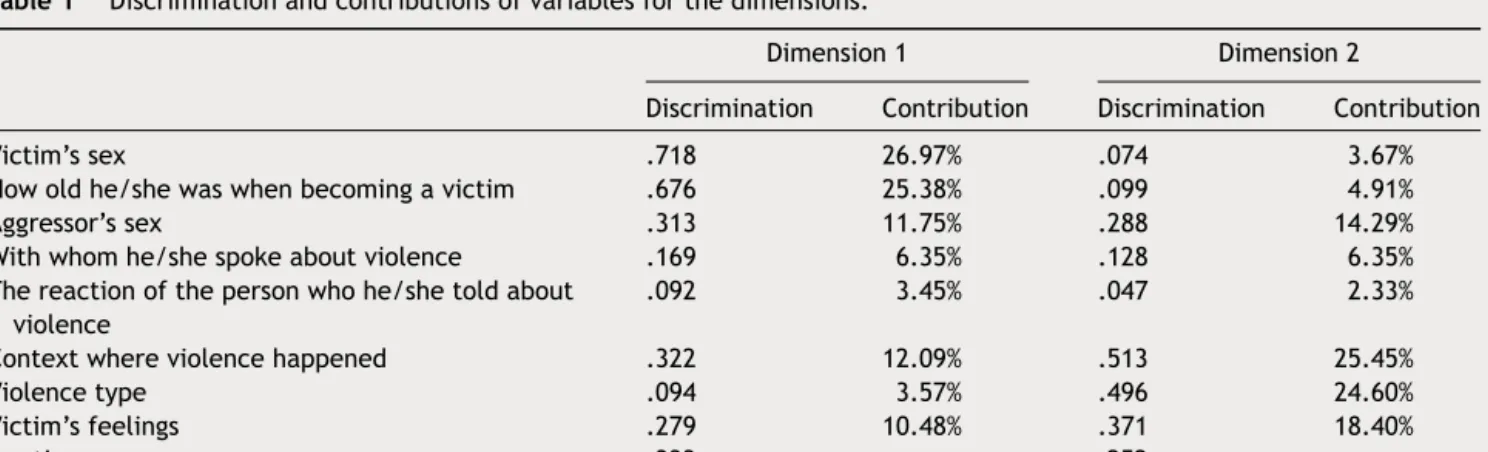
Thevictim’ssexandhowoldhe/shewaswhenbecoming avictimrepresenttheindicators bothmostdiscriminating andmakingthelargestcontributiontodimensionone.
Thecontextwhereviolencehappened,theviolencetype andthevictim’sfeelingsconstitutethestrongestindicators ofdiscriminationindimensiontwo.Thecontextwhere vio-lencehappenedstandsoutastheindicatorthatcontributes themosttothisdimension,followedbytheviolencetype and,finally,thevictim’sfeelings.
Theaggressor’ssex,withwhomhe/shespokeabout vio-lence,thereactionofthepersonwhohe/shetoldaboutthe
violencearetheindicatorsthatdiscriminatethisdimension themosteveniftheyonlydososlightly.
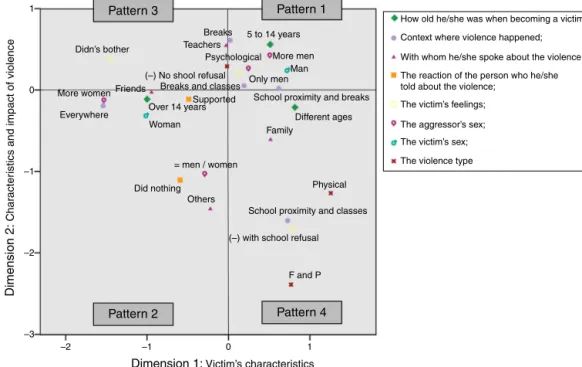
MCAfeaturesfour patternsof homophobicbullying for our sample with different features, described broadly as follows:
Patternone---alsostatedasmaleviolence---constituted of malevictims(boys).They werevictims,predominantly agedfromfiveto14yearsold;theviolencelocationswere mainlyduringbreaksinschoolandinitsvicinity.They suf-feredpsychologicalviolence,toldteachersandfriends,and experiencednegativefeelings,buttherewasnorefusalto gotoschool.Boysperpetratedtheattack.
Patterntwo---alsostatedasfemaleviolence---features femalevictims(girls).Thesevictimswereassaultedatages ofolderthan14yearsold.Theviolencelocationswerenot specificwiththeabuseoccurringindifferentsettingsboth inschoolandinthevicinityofschool.Theytoldfriendsand other peopleabout theviolence,somegavethemsupport
Table1 Discriminationandcontributionsofvariablesforthedimensions.
Dimension1 Dimension2
Discrimination Contribution Discrimination Contribution
Victim’ssex .718 26.97% .074 3.67%
Howoldhe/shewaswhenbecomingavictim .676 25.38% .099 4.91%
Aggressor’ssex .313 11.75% .288 14.29%
Withwhomhe/shespokeaboutviolence .169 6.35% .128 6.35%
Thereactionofthepersonwhohe/shetoldabout violence
.092 3.45% .047 2.33%
Contextwhereviolencehappened .322 12.09% .513 25.45%
Violencetype .094 3.57% .496 24.60%
Victim’sfeelings .279 10.48% .371 18.40%
1 Didn’s bother More women Everywhere Friends Over 14 years Woman Supported (–) No shool refusal
Breaks and classes Psychological Teachers Breaks 5 to 14 years More men Man Only men
School proximity and breaks
Family
Physical
School proximity and classes = men / women
Did nothing Others
Pattern 2 Pattern 4
Pattern 3 Pattern 1
(–) with school refusal
F and P
How old he/she was when becoming a victim Context where violence happened; With whom he/she spoke about the violence; The reaction of the person who he/she told about the violence;
The victim’s feelings; The aggressor’s sex; The victim’s sex; The violence type Different ages 0 –1 –2 –3 –2 –1 0 Dimension 2: Char acter
istics and impact of violence
Dimension 1: Victim’s characteristics
1
Figure2 Homophobicbullyingpatterns.
andsomedidnothing.Boysandgirlsperpetratedthe aggres-sion.
Patternthree---violencewithslighterperceptionsofthe impact--- does not differentiate between the victim’ssex andincludesbothboysandgirls.Theviolenceoccursduring schoolbreakswithvictimssufferingpsychologicalviolence andtellingteachersandfriends.Thevictim’sfeelingin rela-tiontotheviolencewasneutral/didnotbotherthem.
Pattern four---violencewithgreaterperceptionsofthe impact---iscomposedofmaleandfemalevictims.The vio-lenceoccurredinclassandinthevicinityoftheschooland happenedacrossvariousagegroups.Theysufferedphysical andpsychologicalviolencewithvictimsreportingnegative feelings,including refusaltogo toschool.In some cases, theabuseevenresultedinachangeofschool.
Discussion
and
conclusion
Using Multiple CorrespondenceAnalysis (MCA), we identi-fiedeightcore indicators relatedtohomophobicbullying. Wethenselectedtwodimensionsasspatialstructuralaxes ofviolencerepresentation(dimensionone:victim’s charac-teristics,anddimensiontwo:characteristicsandimpactsof violence).Theseresultscorroboratepreviousstudiesonthe fundamentalcharacteristicsinvolvedinbullyingsituations, particularlythevictim’scharacteristicsandthe character-isticsof the violence. From thesetwo dimensions andby evaluating these situations, victims would select coping strategies in orderto dealwith theviolence experienced (Kochenderfer-Ladd&Skinner,2002).Wheneverrecognizing externalsourcesofsupport,thesemayserveasprotective factorsagainsttheemergenceofnegativeconsequencesfor victims.
In addition, through MultipleCorrespondence Analysis, we were able to identify four different patterns to peer
violence in schools along with their respective possible effects.Analysis of thesepatternsresults in the observa-tionofthespecificcharacteristicsofeachpattern,aspects thatrespectivelyservedtonamethem:patternone---male violence;pattern two--- femaleviolence; pattern three ---violence withslighter perceptionsof the impact; pattern four---violencewithgreaterperceptionsoftheimpact.
Boysturnedouttobetheyoungestvictims(agedfromfive to14yearsold).Thevictimizationtookplaceduringschool breaks,duringclassesandintheschoolneighbourhood.
Victims have told teachers and friends about the vio-lence.Furthermore,thetypeofviolencewaspsychological, andwhile itgeneratednegativefeelingsitdidnotleadto refusalstoattendschool.Girlswereoldervictims(agedover 14yearsold)thanboys,withviolenceoccurringthroughout theschoolenvironment. Girlsinformedfriends about vio-lencebut didnot reportit toteachers (patterns oneand two).
Somestudies about bullyingindicatethat victimization takes place at an early age and that violence decreases withage(Matos&Carvalhosa,2001;Olweus,1994).Inthis regard,increasingageactsasaprotectivefactorforthese youngpeople.Wemayexplaintheseliteraturedataby tak-ingPatternoneintoaccount,sincevictimizationoccursto youngerpeopleinthispattern.Contrastingly,wemayreport thatvictimization occurredwitholder studentsin Pattern two.However,there isa fundamental differenceinthese twopatternsregardingthesexofvictims,i.e.victimization ofboysoccurredearlierthanthatoftheirfemalepeers.
Withregardtothe contextwhere homophobicbullying tookplace,thesearespecificinPatternonewhereasPattern twoencounterswidespreadlocationsofviolence.One possi-bleexplanationfortheseresultsencapsulatesthefollowing: in Pattern one, the victim’sevaluation of the occurrence of violence might lead him/her to adopt coping strate-gies whenever facing violent contexts and, consequently,
avoidingviolence,inparticular,tellingteachersabout vio-lence or even purposefully socializing with other people identifiedasharmless and non-threatening.Forgirls, and asthelocationsofaggressionremainednotspecific, possi-bleviolentsituationsmightprovemoredifficulttopredict and, therefore, they do not trust institutional support networks.
Somestudiesindicatethatboys---morethangirls---may simultaneously be the victims and also the perpetrators of bullying situations (Matos& Carvalhosa, 2001; Olweus, 1994). These findings are consistent with our research results; when identifying the aggressor’s sex, boys were always present, evenwhen the victims were female. We encounterednoeventinwhichtheperpetratorswere exclu-sivelyfemale.
Pattern three more closely relates to violence, with slighterperceptionsoftheresultingimpacts(fromthe vic-tim’sperspective).Inthispattern,wefoundbothmaleand femalevictims.Thisgroupstatedneutralfeelingstowards the situation of violence, and when telling friends and teachersabouttheviolence,theyspokeonlyabout psycho-logicalviolence,perhapsbecausethevictimperceivesthis patternashavinglowerlevelsofimpactonhim/herself.One possiblehypothesisfortheseresultsmaydrivefromthe vic-tim having chosen suitable coping strategies, particularly talkingtoteachersandfriendsaboutviolence.
BothPattern fourandPattern threeinclude both male and female victims. In Pattern four violence took place nearbyschool and duringclasses, occurred across diverse agerangeswiththeviolencebothphysicaland psychologi-calinnature.Thisistheonlygroupthatfeaturesphysical violenceandnegativefeelings,includingtherefusal togo toschool.Victimsperceivedviolenceashavingthelargest impact on their lives, encouraging negative feelings and refusaltoattendschool. Thisresultis stronglyassociated with the existence of two types of violence (psychologi-calandphysical)anditsreiteration,increasingtheseverity of violence.Rivers (2004) denotes thatthese peoplemay develop post-traumatic stress because they have experi-encedbullyinginschool,motivatedbyhomophobiaamong theirpeers,foralongtime.
Acentralfeature---whichiscross-cuttingtoallpatterns, relatestotheabsenceofsharingthisinformationwiththe family.Thisresultwasalsoreturnedbypreviousstudieson thissubject(Kochenderfer-Ladd&Skinner,2002).One fea-sibleexplanationforthefactthatvictimsdidnottalkwith theirfamiliesabouttheviolencemightinterrelatewithfears overlosingfamilysupportasdisclosureimpliesrevealinga non-normativesexual orientation.This may representthe centralmotivetosilencingviolence.
Although we might have predicted that non-normative sexualorientationconstitutesariskvariableforthe occur-rence of homophobic bullying, this was not confirmed. Violence wasalsoperpetrated againstpeople who identi-fied themselves as heterosexual but probably due to the perceptiontheywerehomosexualorbisexual.This percep-tionmaystemfromstereotypesasregardsthebehaviours and attitudes of homosexual and bisexual people. How-ever,someconfusionaboutthemeaningofgenderidentity andsexualorientationdoes seemtoprevail. Forinstance, there are boys who perform more feminine behaviours and girls whoperform more masculine behaviours. These
behaviours are more commonly associated with a non-heterosexualorientationthanwithanon-normativegender identity.
For school communities to act preventively towards situations of homophobic bullying in schools, learning is required about whothesevictims actuallyare,aswell as thesettingswhicharemostconducivetotheoccurrenceof violence.Thisconveysourmaingoalindevelopingthisstudy duetotheneedtoidentifythepatternswhereby homopho-bicbullyingoccursinPortugueseschools.
Inunderstandingthefourpatternsofhomophobic bully-ing,thisstudyactsasaguidefor thepreventionoffuture violencesituations,recognizingpeople,contexts,agesand characteristics that make one person vulnerable to such abuse.
Therefore, this study represents one contribution towards the development of tools of action able to strengthen sexual citizenship in young people attending Portugueseschools,andgivingeducationprofessionalsthe guidelinestoenablethemtoactdifferentlywithstudents. Thus, we need to encourage the development of studies renderingthistypeofviolencevisible,enablingevaluations andinterventionstooccurearlierandonamorespecialized basisand,overall,contributingtotheeradicationofsocial exclusionandviolenceinschoolcontexts.
Increasing awareness about homophobic bullying may also endorse an understanding of bullying in general and thusensuringallboysandgirlsbenefitandcorrespondingly providing a greater substance to multifaceted and multi-sectoralinterventions(Mishnaetal.,2009).Aspartofthe educational community, society and familieshold a clear responsibilityforviolenceatschoolingeneralandfor homo-phobicbullyinginparticular.Therefore,anintegratedand entirelyinclusiveinterventioniscrucial(Méndez,2007)to eradicate such violence and develop strategies to recog-nize,acceptandintegratedifferences(González& López, 2009).
References
Bochenek, M., & Brown,A. W. (2001). Hatred in the hallways: Violenceanddiscriminationagainstlesbian,gay,bisexual,and transgenderstudentsinUSschools.NewYork,NY:HumanRights Watch.
Bontempo, D.E., &D’Augelli, A.R. (2002). Effectsof at-school victimizationandsexualorientationonlesbian,gay,orbisexual youths’healthriskbehavior.JournalofAdolescentHealth,30, 364---374.http://dx.doi.org/10.1016/S1054-139X(01)00415-3
Butler,J.(1993).Bodiesthatmatter.NewYork,NY:Routledge.
Canotilho, J.J.,&Moreira,V.(2008).Constituic¸ãodaRepública Portuguesa:LeidoTribunalConstitucional.Coimbra:Coimbra Editora.
Carrera,M.V.,DePalma,R.,&Lameiras,M.(2011).Towardamore comprehensiveunderstandingofbullyinginschool.Educational Psychology Review, 23, 479---499. http://dx.doi.org/10.1007/ s10648-011-9171-x
Carvalho,H. (2008).Análisemultivariada dedadosqualitativos: Utilizac¸ãodaanálisedecorrespondênciasmúltiplascomoSPSS. Lisbon:Edic¸õesSílabo.
Carvalhosa, S., Lima, L., & Matos, M. (2001). Bullying: A provocac¸ão/vitimac¸ão entre pares no contexto escolar por-tuguês.AnálisePsicológica,19,523---537.
Clarke, E. A., & Kiselica, M. S. (1997). A systemic counseling approachtotheproblemofbullying.ElementarySchool Guid-ance&Counseling,31,310---325.
Costa,A.,& Davis, M.(2012).Portuguese adolescents’attitudes towardsexualminorities: Transphobia,homophobia,and gen-der role beliefs. Journal of Homosexuality, 59, 1424---1442.
http://dx.doi.org/10.1080/00918369.2012.724944
Costa,C.,Nogueira,C.,&López,F.(2009).Mysexualself,I sti-fledit:SexualsubjectivitiesamongyoungPortuguesewomen. Culture,Health& Sexuality,11,431---442.http://dx.doi.org/ 10.1080/13691050802710253
D’Augelli,A. R., Pilkington,N. W., & Hershberger,S. L. (2002). Incidenceandmentalhealthimpactofsexualorientation vic-timizationoflesbian,gay,andbisexualyouthsinhigh school. SchoolPsychologyQuarterly,17,148---167.http://dx.doi.org/ 10.1521/scpq.17.2.148.20854
Decreto-Lei n◦ 67/98 de 26deOutubro de1998. (1998). Lei da Protec¸ão Dados Pessoais. Transpõe para a ordem jurídica portuguesaaDir.n.◦95/46/CE,doPEedoConselho,24/10/95, relativaàprotec¸ãodaspessoassingularesnoquedizrespeito ao tratamento dados pessoais e à livre circulac¸ão desses dados.DiáriodaRepúblican◦ 247---ISérie-A.pp.5536---5546. Retrieved from http://www.pgdlisboa.pt/leis/leimostra articulado.php?nid=156&tabela=leis
Decreto-Lei n◦ 9/2010, de31de Maiode 2010. (2010). Permite o casamento civil entre pessoas do mesmo sexo. Diário da República,n◦105---ISérie.pp.1853.Retrievedfromhttp://dre.
pt/pdf1s/2010/05/10500/0185301853.pdf
Decreto-Lei n◦ 7/2011 de 15 de Marc¸o de 2011. (2011). Cria o procedimento de mudanc¸a de sexo e de nome próprio no registo civile procede à décima sétimaalterac¸ão aoCódigo do Registo Civil. Diário da República, n◦ 52 --- I Série. pp. 1450---1451. Retrieved from http://dre.pt/pdf1sdip/2011/03/ 05200/0145001451.pdf
Defensor Del Pueblo. (2006). Violencia escolar: El maltrato entre iguales en la Educación Secundaria Obligatoria 1999---2006.. Retrieved from http://www.madrid.org/dat norte/WEBDATMARCOS/supe/convivencia/ViolenciaEscolar2006. pdf
Defensor Del Pueblo. (2007). Violencia escolar: El maltrato entreigualesenlaEducaciónSecundariaObligatoria1999-2006. Retrievedfromhttps://www.defensordelpueblo.es/wpcontent/ uploads/2015/05/2007-01-Violencia-escolar-el-maltrato-entre- igualesen-la-Educaci%C3%B3n-Secundaria-Obligatoria-1999-2006.pdf
DelBarrio,C.,Martín,E.,Almeida,A.,&Barrios, A.(2003).Del maltratoyotrosconceptosrelacionadosconlaagresiónentre escolares,ysuestudiopsicológico.InfanciayAprendizaje,26, 9---24.
Ellis, V., & High, S. (2004). Something more to tell you: Gay, lesbian or bisexual young people’s experiences of secondary schooling.BritishEducationalResearchJournal,30,213---225.
http://dx.doi.org/10.1080/0141192042000195281
Fineran,S. (2002). Sexual harassment between same-sex peers: Intersectionofmentalhealth,homophobia,andsexualviolence inschools.SocialWork,47,65---74.
González,M.M.,&López,F.(2009).Relacionesfamiliaresyvida cotidianade ni˜nosy ni˜nasqueviven conmadres lesbianaso padresgays.CulturayEducación,21,417---428.
Greene,M.B.(2006).Bullyinginschools:Apleaforameasureof humanrights.JournalofSocialIssues,62,63---79.http://dx.doi. org/10.1111/j.1540-4560.2006.00439.x
Gruber, J. E., & Fineran, S. (2007). The impact of bullying and sexual harassment on middleand high school girls. Vio-lenceAgainstWomen,13,627---643.http://dx.doi.org/10.1177/ 1077801207301557
Hong, J. S., & Garbarino, J. (2012). Risk and protective fac-tors for homophobic bullying in schools: An application
of the social---ecological framework. Educational Psychology Review, 24, 271---285. http://dx.doi.org/10.1007/s10648-012-9194-y
Kochenderfer-Ladd, B., & Skinner, K. (2002). Children’s coping strategies: Moderators of the effects of peer victimization? Developmental Psychology, 38, 267---278. http://dx.doi.org/ 10.1037//0012-1649.38.2.267
Kosciw, J. G., Greytak, E. A., & Diaz, E. M. (2009). Who, what,where,when,andwhy:Demographicandecological fac-tors contributing to hostile school climate for lesbian, gay, bisexual, and transgender youth. Journal of Youth and Ado-lescence,38,976---988. http://dx.doi.org/10.1007/s10964-009-9412-1
Louro,G.L.(1997).Gênero,sexualidadeeeducac¸ão:Uma perspec-tivapós-estruturalista.Petrópolis,RJ:Vozes.
Machado,M.(2011).Bullyingemcontextoescolar:Umaproposta de intervenc¸ão.. Retrieved from http://www.psicologia.pt/ artigos/textos/A0577.pdf
Matos,M.,& Carvalhosa,S.(2001).Violêncianaescola:Vítimas, provocadoreseoutros.2(1)FMH.Retrievedfromhttp://www. fmh.utl.pt/aventurasocial/pdf/Violencia.pdf
Méndez,R. P.(2007).Mariconelúltima:Docentesqueactuamos anteelacosoescolarenelinstituto.Revistad’Estudisdela Violència,3,1---14.
Mishna,F.,Newman,P.A.,Daley,A.,&Solomon,S.(2009). Bully-ingoflesbianandgayyouth:Aqualitativeinvestigation.British Journal of Social Work, 39, 1598---1614. http://dx.doi.org/ 10.1093/bjsw/bcm148
Neisser,U.(1982).Snapshotsorbenchmarks?InU.Neisser (Ed.),
Memory observed: Remembering in natural contexts (pp.
43---48).SanFrancisco,CA:Freeman.
Newman, P. A. (2002). Coming out in a hostile social environ-ment: Challenges for HIV prevention among young gay men. JournalofHIV/AIDS&SocialServices,1,81---93.http://dx.doi. org/10.1300/J187v01n0107
Nogueira,C.(2001). Umnovoolhar sobreas relac¸õessociaisde género.Perspectivafeministacríticanapsicologiasocial. Lis-bon:Fundac¸ãoCalousteGulbenkian.
Nogueira,C.,&Oliveira,J.(2010).Umolhardapsicologia femi-nistacríticasobreosdireitoshumanosdepessoasLGBT.InC. Nogueira,&J.M.Oliveira(Eds.),Estudosobreadiscriminac¸ão emfunc¸ãodaorientac¸ãosexualedaidentidadedegénero(pp. 9---17).Lisbon:CIG.
Oliveira,J.M.(2010).Orientac¸ãosexualeidentidadede género napsicologia:Notasparaumapsicologialésbica,gay,bissexual, trans equeer.InC.Nogueira,& J.M.Oliveira(Eds.),Estudo sobre a discriminac¸ão em func¸ão da orientac¸ão sexual e da identidadedegénero(pp.19---44).Lisbon:CIG.
Oliveira,J.M.,Pereira,M.,Costa,C.G.,&Nogueira,C.(2010).
PessoasLGBT: Identidadesediscriminac¸ão. InC.Nogueira,& J.M.Oliveira(Eds.),Estudosobreadiscriminac¸ãoemfunc¸ão daorientac¸ãosexualedaidentidadedegénero(pp.149---210). Lisbon:CIG.
Olweus,D.(1993).Bullyingatschool.OxfordeCambridge: Black-well.
Olweus,D.(1994).Annotation---Bullyingatschool:Basicfactsand effectsofaschoolbasedinterventionprogram.JournalofChild PsychologyandPsychiatryandAlliedDisciplines,35,1171---1190.
http://dx.doi.org/10.1111/j.1469-7610.1994.tb01229.x
Ortega,R.,Mora-Merchán,J.A.,&Jäger,T.(Eds.).(2007).Acting against school bullying and violence: The role of media, local authorities and the Internet. Retrieved from http:// iamnotscared.pixel-online.org/data/database/publications/ 618Actingagainstschoolbullyingandviolence.pdf
Pearson,J.,Muller,C.,&Wilkinson,L. (2007).Adolescent same-sex attraction and academic outcomes: The role of school attachment and engagement. Social Problems, 54, 523---542.
Poteat,V.P.,DiGiovanni,C.D., &Scheer,J. R.(2013). Predict-inghomophobic behavior among heterosexual youth: Domain generalandsexualorientation-specificfactorsattheindividual and contextuallevel. Journal of Youth and Adolescence, 42, 351---362.http://dx.doi.org/10.1007/s10964-012-9813-4
Rigby,K. (2002).Newperspectivesonbullying. Philadelphia,PA: Kingsley.
Rivers,I.(2001a).Retrospectivereportsofschoolbullying: Stabil-ityofrecalland itsimplicationsfor research.BritishJournal ofDevelopmentalPsychology,19,129---141.http://dx.doi.org/ 10.1348/026151001166001
Rivers, I. (2001b). The bullying of sexual minorities at school: Its nature and long-term correlates. Educational and Child Psychology, 18, 32---46. Retrieved from http://www.lgbt.org. ar/blog/Matrimonio/archivos/educationalandchild%202001. pdf
Rivers,I.(2004).Recollectionsofbullyingatschoolandtheir long-termimplicationsforlesbians,gaymen,andbisexuals.Crisis, 25,169---175.http://dx.doi.org/10.1027/0227-5910.25.4.169
Rivers,I.,&D’Augelli,A.R.(2001).Thevictimizationoflesbian, gay,andbisexualyouths:Implicationsforintervention.InA.R. D’Augelli,&C.J.Patterson(Eds.),Lesbian,gay,andbisexual identitiesandyouth:Psychologicalperspectives(pp.199---223). NewYork,NY:OxfordUniversityPress.
Rivers,I.,&Duncan,N.(2002).Understandinghomophobicbullying inschools:Buildingasafelearningenvironmentforallpupils. Youth&Policy,75,30---41.
Rodrigues,L.,Oliveira,J.M.,&Nogueira,C.(2010).Violênciaem casaisLGB:Estudopreliminar.InC.Nogueira,&J.M.Oliveira (Eds.),Estudosobreadiscriminac¸ãoemfunc¸ãodaorientac¸ão sexualedaidentidadedegénero(pp.243---266).Lisbon:CIG.
Smith,N.G.,&Ingram,K.M.(2004).Workplaceheterosexismand adjustmentamong lesbian,gay,and bisexualindividuals: The roleofunsupportivesocialinteractions.JournalofCounseling Psychology, 51, 57---67.http://dx.doi.org/10.1037/0022-0167. 51.1.57
Warwick,I.,&Aggleton,P.(2014).Bullying,‘cussing’and‘mucking about’:Complexitiesintacklinghomophobiainthreesecondary schools in south London, UK. Sex Education, 14, 159---173. Retrieved from http://dx.doi.org/10.1080/14681811.2013. 854204
Warwick,I.,Chase,E.,Aggleton,P.,&Sanders,S.(2004). Homopho-bia,sexualorientationandschools:AreviewandImplications foraction (ResearchReport No.594).Retrievedfromhttp:// www.exceedingexpectations.org.uk/uploads/Homophobia%20-%20Implications%20for%20action.pdf
Zavalkoff, A. (2002). Teachingthe Teachers. Journal of Lesbian Studies,6,243---253.http://dx.doi.org/10.1300/J155v06n0320