Repositório ISCTE-IUL
Deposited in Repositório ISCTE-IUL:2018-01-11
Deposited version:
Post-print
Peer-review status of attached file:
Peer-reviewed
Citation for published item:
Loureiro, S. M. C., Koo, D.-M. & Breazeale, M. (2018). The role of need for self-expression and arousal to commit university students for environmental responsibility behaviours. World Review of Entrepreneurship, Management and Sustainable Development. 14 (1-2), 62-79
Further information on publisher's website:
10.1504/WREMSD.2018.10009035
Publisher's copyright statement:
This is the peer reviewed version of the following article: Loureiro, S. M. C., Koo, D.-M. & Breazeale, M. (2018). The role of need for self-expression and arousal to commit university students for
environmental responsibility behaviours. World Review of Entrepreneurship, Management and Sustainable Development. 14 (1-2), 62-79, which has been published in final form at
https://dx.doi.org/10.1504/WREMSD.2018.10009035. This article may be used for non-commercial purposes in accordance with the Publisher's Terms and Conditions for self-archiving.
Use policy
Creative Commons CC BY 4.0
The full-text may be used and/or reproduced, and given to third parties in any format or medium, without prior permission or charge, for personal research or study, educational, or not-for-profit purposes provided that:
• a full bibliographic reference is made to the original source • a link is made to the metadata record in the Repository • the full-text is not changed in any way
The full-text must not be sold in any format or medium without the formal permission of the copyright holders. Serviços de Informação e Documentação, Instituto Universitário de Lisboa (ISCTE-IUL)
Av. das Forças Armadas, Edifício II, 1649-026 Lisboa Portugal Phone: +(351) 217 903 024 | e-mail: [email protected]
Loureiro, S.M.C., Koo, Dong-Mo, & Breazeale, M. (2016). The role of need for self-expression and arousal to commit university students for environmental responsibility behaviours. World Review of Entrepreneurship, Management
and Sustainable Development. (forthcoming) Q2 in Business and International Mannagement SCImago Journal Rank (SJR): 0.28 (index: Scopus, Google Scholar) ISSN online: 1746-0581
ISSN print: 1746-0573
Special issue:
University Social Responsibility: International Models and
Impacts
ear Sandra Maria Correia Loureiro, Dong-Mo Koo, Michael Breazeale,
Ref: Submission " The role of need for self-expression and arousal to commit university students for environmental responsibility behaviours "
Congratulations, your above mentioned submitted article has been refereed and accepted for publication in the World Review of Entrepreneurship, Management and Sustainable Development. The acceptance of your article for publication in the journal reflects the high status of your work by your fellow professionals in the field.
You need now to login at http://www.inderscience.com/login.php and go to http://www.inderscience.com/ospeers/admin/author/articlelist.php to find your submission and complete the following tasks:
1. Save the "Editor's post-review version" on your local disk so you can edit it. If the file is in PDF format and you cannot edit it, use instead your last MS Word revised version, making sure to include there all the review recommendations made during the review process. Rename the new file to "authorFinalVersion."
2. Open the "authorFinalVersion" file and remove your reply or any response to reviewers that you might have in the front of your article.
3. Restore the author's identification, such as names, email addresses, mailing addresses and biographical statements in the first page of your local file "authorFinalVersion."
4. IMPORTANT: The paper is accepted providing that you, the author, check, edit and correct the English language in the paper. Please proofread all the text and make sure to correct any grammar and spelling mistakes.
5. Save your changes in the file "authorFinalVersion" and use the "Browse…" and "Upload" buttons to upload the file on our online system.
6. Click on "Update Metadata" to correct the title, abstract and keywords according the recommendations received from the Editor. You must make sure that the title, abstract and keywords are totally free of English Spelling and Grammar errors. Do not forget to click the "Update" button to save your changes.
7. Once you have updated the metadata, check the box "Yes."
8. Upload a zipped file with the Copyright Agreement forms signed by each author. We need a signed author agreement form for every author and every co-author. Please insert the full names of all authors, reflecting the name order given in the article.
9. To see a sample of real articles that have been published in the World Review of Entrepreneurship, Management and Sustainable Development visit
http://www.inderscience.com/info/ingeneral/sample.php?jcode=wremsd.
Finally click on the "Notify Editor" button to let the editor know that you have completed the six tasks.
Your continuing help and cooperation is most appreciated.
Best regards,
Prof. Leo Paul Dana
Chief Editor of World Review of Entrepreneurship, Management and Sustainable Development
Inderscience Publishers Ltd. [email protected]
The role of need for Self-expression and Arousal to Commit University Students for Environmental Responsibility Behaviors
Abstract
University social responsibility as recycling and environmental protection attitude is a core issue in higher education. However, scarce research examines the factors that influence individuals’ commitment to recycling and environmental preservation, and even less explores how that commitment can lead to preferential behavior, word of mouth and willingness to sacrifice for recycling and environmental preservation. This study
examines the roles of need for self-expression and arousal to explain commitment and
whether commitment leads to those behaviors. The study is duplicated in three countries,
each representing different cultural dimensions. Data collected from participants at Universities in South Korea, the United States and Portugal inform a model that supports the majority of the hypotheses and points out some interesting differences in the ways that recycling and environmental preservation should be presented in various cultures to achieve buy-in and behavior change.
Keywords: Recycling, Environmental preservation, Commitment, Self-expression,
Arousal, Willingness to sacrifice, Multi-cultural
Introduction
Over the past several decades, recycling and environmental preservation have been topics of growing interest in several countries (Loureiro et al., 2012). For instance, Japan has focused on sustainable technology in the car industry, China is concerned in solar and wind energy (Bacani, 2009); Portugal has been at the forefront in reducing pollution and implementing solar and wind energy (Loureiro et al., 2012); South Korea implemented a program of five-year green growth strategy in 2010 (Young, 2010); and in the United States great emphasis is being placed on sustainability issues by both the government and private sectors (Probst, 2013). While each of these countries has made efforts to encourage its citizens to commit to preservation behaviors, cultural differences are bound to impact the success of these campaigns, yet researchers have not explored the impact of culture on the success of environmental efforts. Actually, environmentally friendly actions of consumers, such as the altruistic actions of consumers to buy only from companies that have a strong record of protecting the environment, have been regarded as consumers’ ethical beliefs. Moreover, researcher on sustainable development in higher
education is till scarce (Vagnoni and Cavicchi, 2015). In order to contribute to fulfil this gap, the main goal of the current study is to apply a proposed model in universities in Portugal, the United States, and South Korea.
Literature Review and Hypotheses
Corporate Social Responsibility
Studies point out that corporate social responsibility (CSR) has a positive effect on companies because could maintain or even improve both the consumer’s and society’s well-being (Luo and Bhattacharya, 2006). A good CSR record might generate a favorable image that positively influences consumers’ evaluations and attitudes toward the organization. Other studies have also highlighted the benefits of CSR for companies, considering increased profits, customer loyalty, trust, positive brand attitude and combating negative publicity (McDonald and Rundle-Thiele, 2008).
Universities are organizations and the incorporation of social responsibility practices becomes important for the internal community (which includes students, professors, lectures, administrative and cleaner staff, rectory and deans of schools, among others), as well as for society in general. In this vein, students are one of the most important stakeholders to become committed to the cause. They can also be a vehicle to disseminate practices and knowledge to society.
According to the international standards for Social Responsibility (DIS/ISO 26000, 2010) and also following Loureiro et al. (2012), we may find seven mainly dimensions of CSR, which may be designed as: Labor practices, Community development, Consumer price (fair prices), Consumer quality (quality of goods/services), Relationship selling (empathy) and Environment cause. The current study focuses on environmental causes and deal with students as a stakeholder to be affectively committed to the cause. Actually,
commitment toward the cause is the key word to be environmentally responsible. Wright (2010) claims that university stakeholders (e.g., deans, directors, students, staff and professors) must be involved in initiatives of sustainability and in the decision process, to ensure long-term success in higher education sustainability programs.
Moore (2005) stress seven recommendations to help universities to be more environmentally sustainable: (i) The inclusion of the idea of sustainability in all decisions: (ii) Incentivize, involve and actively practice collaboration among all employees of the institution; (iii) Incentivize and actively practice flexibility in courses programs; (iv) Focus on individual and social sustainability; (v) Planning, decision-making and evaluation integrated; (vi) Integration of research, service and, teaching (by promoting and integrating scholarships, evaluating undergraduate, master, and doctorate programs, as well as curricula, and rethinking external relations with community, governments and industries); (vii) Create space for pedagogical transformation (student-centered and problem-solving-based learning and, experiential learning; by removing barriers and creating a space to pedagogic transformation; by improving student-instructor interaction). Therefore, the work with students in order to involved and affectively committed them to the environmental cause is crucial in a university that wish to become an organization socially responsible.
Antecedents of Affective Commitment to Environmental Causes
In close relationships theory, commitment has been regarded as a long-term orientation toward a relationship, the intent to persist in a relationship, and psychological attachment to a partner (Rusbult et al., 2001). Interdependence theory suggests that individuals are more committed to a relationship to the extent that they are dependent on the other (e.g., a person, a place, a brand or an idea or thought) to satisfy their needs. Employing the same theory, Davis et al. (2009) define commitment in person-environment relationships
as psychological attachment and long-term orientation to the natural world. Affective commitment is related to the degree to which a person identifies and feels involved with a company, a product, an idea over time (Bendapudi and Leone, 2002). This research focuses on affective commitment, which indicates that an individual affectively committed to recycling and environmental preservation will be more identified and personally involved with the cause.
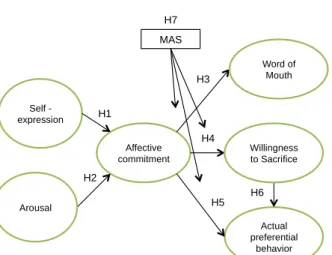
Personal involvement with a cause is similar to the kind of involvement that consumers have with brands. Consumers often build their self-identity and signal that identity to others through preferred brands based on perceived congruency between brand-user associations and self-image associations (Escalas and Bettman, 2005). Just as love for a brand can be used to define ones self-concept, strong belief in recycling and environmental preservation can be incorporated into the extended self (Davis et al., 2009). If an individual incorporates such beliefs into his sense of self, that person should demonstrate more affective commitment to related behaviors. Therefore (see figure 1):
H1: Self-expression through environmentally proactive behaviors is positively associated with affective commitment to recycling and environmental preservation.
Antonetti and Maklan (2014) suggest that eliciting emotions is more effective than providing factual information about how consumers’ choices affect ecological and social issues. In this study we consider arousal as a potential driver to commitment. Arousal is the extent to which an individual feels stimulated, active, excited or enthused (Finn, 2005). It can also describe a sense of incitement and encouragement (Loureiro and Kastenholz, 2011). Several studies have reported that arousal has a favorable positive influence on consumers’ behavior and decision making (Donovan and Rossiter, 1982). Arousal is primary in most emotion frameworks and, as an essential component of emotions, intensifies other emotions (Bagozzi et al., 1999, p. 192). Arousal tends to
produce a halo effect from attitude to positive beliefs. Accordingly, an individual who is more excited about recycling and environmental preservation should be more affectively committed with the cause. Thus,
H2: Arousal is positively associated with affective commitment to recycling and environmental preservation.
Consequences of Affective Commitment to Environmental Causes
Commitment exercises a direct and positive effect on loyalty behaviors such as intent to
repurchase and word of mouth (Johnson et al., 2006). Word of mouth refers to a personal
communication to another (e.g., family and friends) encouraging or persuading them toward a brand or product, a lodging (Loureiro and Miranda, 2008) or even a cause. Thus,
an individual committed to the environment and its preservation will be more engaged in
spreading the word about the benefits of green products and encouraging others to recycle. Davis et al. (2009) provide specific evidence that, in an environmental context, commitment predicts environmental behavioral intentions. Therefore:
H3: Affective commitment to recycling and environment preservation is positively
associated with word of mouth about environmental efforts.
In research on close relationships, sacrifice means to give up one’s immediate self-interest for the sake of a partner or the relationship (Van Lange, Rusbult et al., 1997). Sacrifice could be a stage for “co-dependency” relationship dissatisfaction and depression (Lerner, 1988). Willingness to sacrifice in relationships has been linked to outcomes such as satisfaction and a greater likelihood of persistence over time (Van Lange, Agnew et al., 1997; Van Lange, Rusbult et al., 1997). Accordingly, willingness to sacrifice is a relationship maintenance behavior utilized by committed individuals (e.g., Van Lange, Agnew et al., 1997; Van Lange, Rusbult et al., 1997). Sacrifice can be passive (an
individual forgoes a desired activity), active (an individual undergoes an undesired activity), or both (Rusbult et al., 2001).
Most empirical research on sacrifice has relied on interdependence theory (Impett et al., 2005). According to this theory, sacrifice will be unnecessary when the partners´ interests are aligned; however, when the partners´ interests are at odds, individuals have to decide whether they to choose their own self-interest or to sacrifice (Kelley and Thibaut, 1978). In the latter situation, individuals undergo a transformation of motivation in which self-interests may be supplanted by the well-being of the partner or the relationship. This transformation of motivation occurs because individuals are committed to their relationship (Agnew et al., 1998). Consequently, if a committed relationship were to end, there would be a threat to the self-concept of the involved individuals (Lewandowski et al., 2006) and of investments made such as time, effort, experienced emotions, mutual social networks, social status, and material resources (Le and Agnew, 2003).
Park et al. (2006) recognize two types of personal sacrifices in relationships. The first type represents the consumer’s willingness to sacrifice self-image resources for the brand (i.e., pride and self-esteem), and the second type describes the consumer’s willingness to sacrifice scarce discretionary resources (i.e., money, time, or energy) for the brand. As committed individuals are more willing to sacrifice than non-committed individuals (Powell and Van Vugt, 2003; Loureiro, 2011):
H4: Affective commitment to recycling and environmental preservation is positively
associated with the willingness to sacrifice on behalf of environmental efforts.
Actual behavior is regarded as an effect or consequence of intentions. In the
extended use acceptance model (Venkatesh et al., 2012), the intention to use an online
emotional attachment toward a company or a brand has also been demonstrated to exert
a positive effect on actual behavior (Morwitz and Fitzsimons, 2004). In a study of retail
sales people, Chandrashekaran et al. (2000) provide evidence for the influence of
commitment on intentions and actual behavior but also highlight that intention uncertainty plays a central role in determining when salespeople quit (actual behavior). Therefore, intentions may not lead to actual behavior when the level of uncertainty is high.
A commitment to environmental efforts often implies greater expenditures of temporal and monetary resources, as these behaviors and products have not yet become the norm in most countries. A person who believes that recycling and environmental preservation is important and who feels that this commitment reflects his values to others should be more willing to expend the extra resources required (e.g., choosing to buy green products, to buy products labeled as ecologically or environmentally friendly, or to purchase eco-friendly electronic devices). So, acting in favor of environmental preservation, as a preferential behavior, will be stronger for individuals whose environmental preservation play a key role in shaping their identity and are affectively
committed to the cause. An individual affectively committed to a cause will be more likely to make sacrifices for this cause and have an effective preferential shopping behavior of products labeled as ecologically and green products. Therefore:
H5: Affective commitment to recycling and environmental preservation is positively
associated with preferential behavior toward environmentally friendly products.
H6: Willingness to sacrifice on behalf of environmental efforts is positively associated with preferential behavior toward environmentally friendly products.
National culture is regarded as an important characteristic that underlies differences in individual behavior, in the ways people perceive situations or events, and also in differences in interactions with others (e.g., Hofstede, 2001; Inglehart, 1997; Triandis, 1999). Triandis (1999) alludes to the fact that cultures differ in terms of the types of information they choose to extract from their external environment. Thus, major differences are found between cultures that are located at different stages of economic development or between “tight” (i.e., many behavioral rules, intolerance of deviation from norms) and “loose” (tolerant of deviations from norms) cultures, as well as individualistic (driven mainly by personal, internal attributes) and collectivistic (focus on relationships, role duties, and obligations) cultures.
In this study we consider the widely accepted cultural dimensions proposed by Hofstede (2001) to explore the moderating effect of cultural dimension on the model we propose. Hofstede provides five separate dimensions to explain cultural differences among nations.
Power Distance (PD) refers to the degree to which the members of society who lack real power expect and even accept that power is distributed unevenly. Societies that are high in PD accept that there is a hierarchical order in which people have certain roles, while those societies that are low in PD tend to work for more equality and to demand justification when power differentials exist.
Uncertainty avoidance (UAI) expresses the level of uncertainty and ambiguity required to make a society uncomfortable. Essentially, the dimension describes whether a society allows an uncertain future to merely unfold or whether it tries to control the future. Societies with strong UAI exhibit little tolerance for unorthodox behavior and employ strict rules of conduct for its members, while those with a weaker UAI exhibit a more relaxed attitude toward norms, feeling that practice matters more than principle.
Cultures are also described in terms of their individualism versus collectivism (IDV).Individualistic societies exhibit a preference for loosely knit social frameworks in which members are responsible for themselves and their immediate family members only. Collectivistic societies believe instead that members bear responsibilities and loyalty to each other, if not to the society as a whole, then at least to certain in-groups that are still much larger than the circle of responsibility shared by individualistic society members.
Long-term orientation (LTO), relates to a society’s search for virtue. Those societies that are more short-term oriented exhibit an interest in finding the absolute Truth, with strong respect for tradition, little interest in saving for the future, and a desire to achieve quick results. LTO societies believe that truth is situation-dependent, strive to save and prepare for the future, and will persevere in order to achieve desired results. They also show an ability to adapt their traditions to changing conditions.
The final dimension, masculinity versus femininity (MAS) is the dimension that relates to a society’s preference for personal achievement, heroism, assertiveness, and material rewards for success, with femininity referring to a focus on cooperation, modesty, caring for the weak, and overall quality of life. Societies rated as more masculine tend to be more competitive. Those societies rated as more feminine prefer to reach consensus on important issues. While this dimension may be used less often than some of the others in marketing research to distinguish cultural characteristics, it is especially appropriate for the purposes of this research. In masculine societies individuals tend to be more assertive and self-centered, focusing on personal achievement. For this reason and the sake of parsimony, this study will examine only the moderating effects of MAS. While other dimensions could certainly impact the behaviors of the consumers studied, this dimension captures the driving role of ego in making the individual more assertive and proactive in his attitudes, decisions, and actions on behalf of environmental
issues. Therefore more masculine countries such as the United States and South Korea should exhibit greater willingness to act on their commitment to the cause. Accordingly:
H7: The positive relationships between (a) affective commitment and word-of-mouth; (b)
affective commitment and willingness to sacrifice; and (c) affective commitment and actual preferential behavior are stronger in more masculine cultures.
Based on the MAS scores of the three countries studied, the above hypothesis suggests that the three relationships will be strongest for the United States (MAS=62) and South Korea (MAS=39) and will be weakest for Portugal (MAS=31).The Hofstede scores for each of the three countries in this study can be found in Table 1.
INSERT TABLE 1 ABOUT HERE
See Figure 1 for the full model.
INSERT FIGURE 1 ABOUT HERE
Method
Samples
A survey was employed to empirically validate the theoretical model. Data was gathered from students enrolled in several universities in the three countries – United States (300 respondents), Portugal (300 respondents), and South Korea (250 respondents). Table 2 provides a demographic profile of the respondents. Both undergraduate and graduate students from a range of courses participated in the study. Each country sample is split almost evenly between genders.
INSERT TABLE 2 ABOUT HERE
Drawing from the literature review, a questionnaire containing the items designed to measure the latent variables and a section with the socio-demographic variables was first constructed in English (British) and then translated into the predominant languages of each of the three countries. The last part of the questionnaire concerned socio-demographic data. The questionnaire was pilot tested with the help of ten experts regarding students and professors in each country was conducted to ensure that the wording of the questionnaire was clear. Only a few adjustments were made.
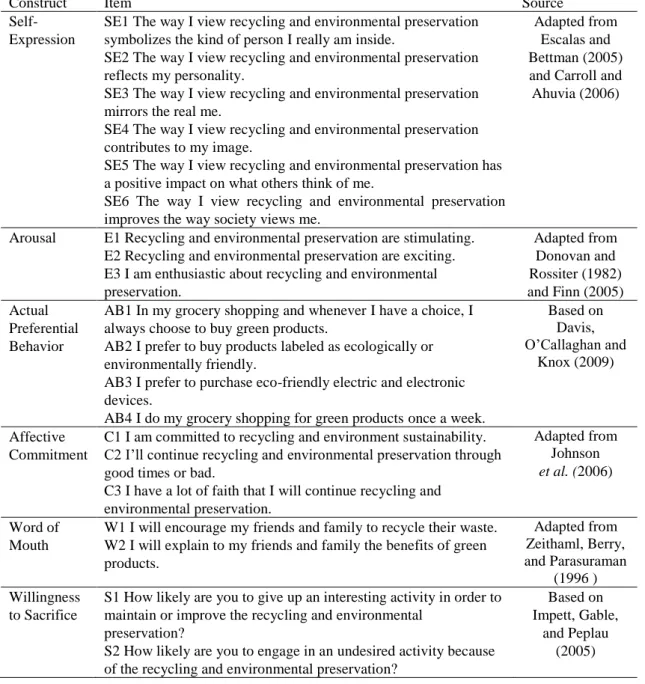
The items used to measure the constructs (See Table 3.) were adapted from previous studies. For each item, respondents were asked to rate their degree of agreement or disagreement on a 5-point Likert-type scale. (In the case of the questions used to assess willingness to sacrifice, the scales were weighted from 1 – Not at all Likely to 5 – Very Likely). Although the questionnaire was developed based on instruments used in previous studies, the structure took several aspects into consideration in order to avoid common method bias. Thus, the items and questions were prepared to avoid ambiguity, namely: keeping them simple and concise, without unfamiliar terms and complex syntax.
INSERT TABLE 3 ABOUT HERE
Data Analysis
The Partial Least Squares (PLS) approach was employed to estimate structural paths coefficients, R2, Q2, and Bootstrap techniques. PLS is based on an iterative combination of principal components analysis and regression, and it aims to explain the variance of the constructs in the model. R2 indicates the amount of variance explained by the exogenous variables. Q2 (chi-squared of the Stone-Geisser Criterion) is used to evaluate the structural model, the cross-validated redundancy. If the relationships in the model have predictive relevance, then Q2 > 0 (Fornell and Larcker, 1981). Tenenhaus et al. (2005) propose the geometric mean of the average communality (outer model) and the
average R2 (inner model) as overall goodness of fit (GoF) measures when using PLS (cross-validated PLS GoF). The GoF ranges from 0 to 1.
Results
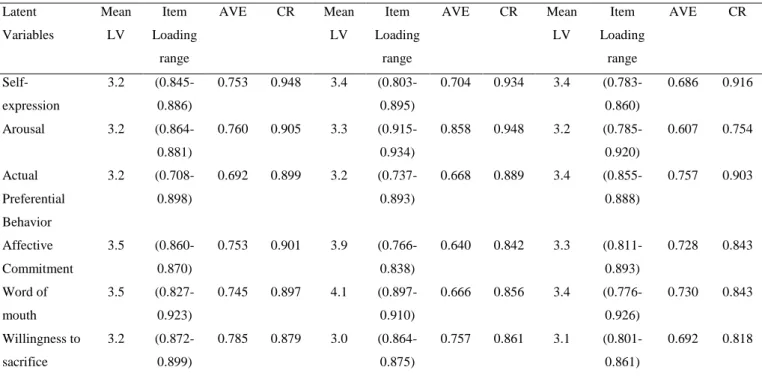
A PLS model should be analyzed and interpreted in two stages. First, the measurement model, or the adequacy of the measures, is assessed by evaluating the reliability of the individual measures, the convergent validity, and the discriminant validity of the constructs. Then, the structural model is evaluated. Item reliability is assessed by examining the loadings of the measures on their corresponding constructs. Item loadings of scales measuring reflective constructs should be 0.707 or more. For US and Portuguese samples all item loadings exceed 0.707, but items SE2 and AB4 were eliminated for the South Korean sample. All composite reliability (CR) values (See Table 4.) are above 0.8. The measures also demonstrate convergent validity as the average variances of manifest variables extracted by constructs (AVE) are above 0.5.
INSERT TABLE 4 ABOUT HERE
The square root of AVE should be greater than the correlation between the construct and other constructs in the model in order to demonstrate discriminant validity (Fornell and Larcker, 1981). This criterion was met for all constructs. The overall structural results are presented in Table 5, demonstrating that hypotheses H3, H4, H5 are supported, and hypotheses H1, H2, and H6 are partially supported.
INSERT TABLE 5 ABOUT HERE
All values of Q2 are positive and the model also demonstrates a good level of predictive power (R2). Generally, the proposed model structure holds across the different countries. The values of GoF reveal a relatively good fit. To systematically explore the
moderating effect of culture on the path coefficients, the estimated coefficients and the cultural dimensions were plotted (see Figure 2).
INSERT FIGURE 2 ABOUT HERE
Figure 2 shows the graph of the beta coefficient estimates and the MAS dimension of culture. H7 predicted that higher the country on the MAS scale, the stronger the values of its path coefficients would be. Thus, we find partial support for H7. South Korea and the United States do indeed exhibit stronger paths between affective commitment and willingness to sacrifice and between affective commitment and word of mouth, but the model predicts that the US would exhibit stronger paths than South Korea, and the opposite is true. Inglehart (1997) provides a possible explanation, describing South Korean culture as much more traditional. Perhaps in such a culture, a cause like recycling and environmental preservation is internalized as positive for the whole community, and therefore a more patriotic behavior.
Also contrary to the model, Portugal, exhibits the strongest path between affective commitment and actual preferential behavior. But the MAS dimension may also explain this finding. Portugal, the most feminine culture of the three would tend to focus on overall quality of life for its citizens. Perhaps in this culture, an abiding belief in a cause that benefits all of society is even more likely to lead to actual behaviors to ensure that benefit. This is consistent with the fact that willingness to sacrifice fails to predict actual preferential behavior only in Portugal. A strong belief in the cause may preclude a sense of sacrifice in this more feminine culture, making that feeling an even more important driver than in the other two cultures.
Recycling and environmental preservation continue to receive an increasing amount of attention in several domains of research. This study focuses on the antecedents and outcomes of affective commitment toward recycling and environmental preservation and also examines the influence of the masculinity of the home culture. The model is empirically tested in three different cultures.
Self-expression and arousal are the two predictors of affective commitment to recycling and environmental preservation. These two constructs are effective in predicting affective commitment in the US context and partially in the other two countries. Arousal as an antecedent to affective commitment is shown to be important in two of the three cultures, with South Korean being the exception. While this is not the hypothesized outcome, the lack of a significant effect in that sample could be related to a different Hofstede cultural dimension – IDV. Perhaps because arousal is by definition a self-centered emotion, the South Korean tendency to focus on the collective (IDV=18) may preclude the need for an individual to feel arousal in order to experience affective commitment toward the cause. Similarly, the Portuguese sample failed to show a significant path from self-expression to affective commitment. Perhaps that culture’s relatively low MAS score (31) could impact the importance of self-expression in developing affective commitment. In more masculine-focused nations, such as the US and South Korea, the individual’s perception of the degree to which the idea of recycling and environmental preservation enhances one’s social self and/or reflects one’s inner self is critical to becoming involved with that idea over time. (Bendapudi and Leone,
2002).We also examine three potential outcomes of commitment to recycling and
environmental preservation – propensity to spread word of mouth about environmental efforts, willingness to sacrifice on behalf of environmental efforts, and preferential behavior toward environmentally friendly products. The findings suggest that all three
outcomes are effectively predicted by affective commitment. These findings are consistent with previous research on salesperson behavior (Chandrashekaran et al., 2000) or consumer purchase context (Johnson et al., 2006) indicating that affective commitment plays an important role in driving behaviors that produce desired outcomes. These findings are unique, though, in that commitment to recycling and environmental preservation calls for the individual to place the cause above his own convenience or self-interest in some cases, unlike the salesperson that sees increased income or the consumer that receives a sought-after purchase.
All three predicted outcomes of affective commitment to recycling and environmental preservation are confirmed by the model and in all three cultures. The mediating effect of MAS, though, does not hold consistently for each culture. As predicted by the model, the more masculine countries do show the strongest effect of affective commitment on word of mouth and willingness to sacrifice, even though South Korea actually exhibits stronger relationships that the United States. The importance of affective commitment in predicting actual preferential behavior is, however, greatest for the US as predicted. Interestingly though, Portugal, the most feminine country studied, demonstrates the strongest effect of affective commitment on actual preferential behavior toward environmentally friendly products.
As predicted by the model, the more masculine nations require affective commitment to produce word of mouth and a willingness to sacrifice. In those nations there is also a causal relationship between self-expression and affective commitment with a need for self-expression and ego identification driving affective commitment to the cause. However in more feminine nations, such as Portugal, the emotions surrounding the cause (excitement and enthusiasm) appear to be the main activation mechanism driving preferential behaviors toward environmentally friendly products.
The model suggests that the South Korea demonstrate a greater role for affective commitment in driving word of mouth and willingness to sacrifice than United States or Portugal. The Hofstede dimension of IDV could possibly explain why South Koreans place more importance on affective commitment. In the more collective South Korean culture, affective commitment appears to be driven more by self-expression than by arousal. If that self-expression is on behalf of the collective rather than the individual, then the resulting effect is even stronger.
The findings lead to some interesting implications for universities and institutions of higher education interested in environmental preservation and sustainability issues, having or intending to implement corporate social responsibility practices. As demonstrated by the model, several factors impact the way that environmental causes should be presented in order to achieve real results. The way professors and lectures teach recycling and environmental preservation issues, the way families integrate these issues in their norms, and the way brands communicate the value of their green products depend on cultural characteristics of the home culture.
The first step in order to implement social responsibilities practices concerns the commitment of all staff, professors and students to the cause and be committed means that all people feel identified and understand the practices to be implemented. Overall, the motivation for recycling, not wasting paper, buy environmentally friendly products (inside and outside university) and other practices goes through a state of excitement, which together with self-expression can create a commitment, and this, in turn, leads to behavioral change.
In each of the cultures, affective commitment is important to some desirable behaviors. In more masculine cultures commitment tends to be driven by a need for self-expression and so environmental educators should strive to internalize the value of
environmental causes for their audience. If the individual in these countries feels that acting upon environmental messages expresses his/her own beliefs and enhances his/her standing within the community, then he/she is more likely to act on these beliefs. Conversely, in more feminine countries the best way to encourage desired environmentally sound behaviors is to appeal to the excitement around the cause, building a sense of enthusiasm in the intended audience.
The findings related to actual preferential behavior toward environmentally friendly products are those that would be most interesting to brand managers (like university deans and course directors). In every culture studied affective commitment is required to drive preferential buying behaviors. Therefore the audience for green products is already emotionally biased toward the products. To grow this market will require greater affective buy-in from the public at large. In more masculine countries this demands promotional messages that internalize the cause of environmental preservation. The consumer must believe that purchasing environmentally friendly products will enhance his/her own wellbeing. In these same cultures willingness to sacrifice also drives such purchases, so it is imperative to demonstrate to the consumer that his/her sacrifice (of time, money, or effort) actually matters. In more feminine countries willingness to sacrifice is not so important. There the greater the emotional connection to the cause, the more likely the consumer is to purchase green products. Indeed, emotional commitment is the strongest predictor in more feminine cultures.
This study has certain limitations and also presents some key opportunities for further research. The study incorporates a convenience sample of college students. Although university students are one of the most important stakeholder in a university and they will are or soon will be active in the whole society, understanding the behavior of other elements inside the university is important, and a more generalizability would be
achieved by analyzing this model across a wide range of age groups and stakeholders. Conducting the study across age groups would provide not only an interesting examination of the life cycle of cultural orientation, but also the evolution of recycling and environmental preservation identification.
We selected the countries for this study due to their historical reputation as masculine and feminine cultures, according to Hofstede (2001). Expanding this study across multiple countries would provide an interesting perspective, particularly if combined with the expansion of an age continuum. Moving forward, new measures that assess feelings, experiences and thoughts that people have about recycling and environmental preservation would be interesting to explore.
Another possibly exciting avenue for this research will be to explore the interaction of the various cultural dimensions on the behaviors we studied. Our results point to the fact that more than one dimension can drive not only commitment to environmental efforts but the outcomes of that commitment.
Regarding theoretical contributions, this study explores for the first time (a) self-expression and arousal as antecedents of affective commitment to recycling and environmental preservation; (b) willingness to sacrifice and actual preferential behavior as a consequence of affective commitment to recycling and environmental preservation; and (c) comparison of such a model among three different cultures.
References
Agnew, Ch. R., Van Lange, P. A. M., Rusbult, C. E. and Langston, Ch. A. (1998) “Cognitive interdependence: Commitment and the mental representations of close relationships”, Journal of Personality and Social Psychology, Vol. 74 No.4, pp. 939-954.
Antonetti, P. and Maklan, S. (2014) “Feelings that Make a Difference: How Guilt and Pride Convince Consumers of the Effectiveness of Sustainable Consumption Choices”, Journal of Business Ethics, Vol. 124 No.1, pp. 117–134.
Bacani, C. (2009). Asia challenges the U.S. for Green-Tech Supremacy. Retrieved from http://www.time.com
Bagozzi, R. P., Gopinath, M. and Nyer, P. L. (1999) “The role of Emotions in Marketing, Journal of the Academy of Marketing Science, Vol. 27 No.2, pp. 184-206.
Bendapudi, N. and Leone, R. P. (2002) “Managing Business-to-Business Customer Relationships Following Key Contact Employee Turnover in a Vendor Firm, Journal of Marketing, Vol.66 No.2, pp.83–101.
Carroll, B. A. and Ahuvia, A. C. (2006) “Some Antecedents and Outcomes of Brand Love, Marketing Letters, Vol.17 No.2, pp.79-89.
Chandrashekaran, M., McNeilly, K., Russ, F.A. and Marinova, D. (2000) “From uncertain intentions to actual behavior: a threshold model of whether and when salespeople quit”, Journal of Marketing Research, Vol.37No.4, pp.463–479.
Chin, W. W., Marcolin, B. L. and Newsted, P. R. (2003) “A partial least squares latent variable modeling approach for measuring interaction effects: results from a Monte Carlo simulation study and an electronic mail adoption study”, Information Systems Research, Vol.14 No.2, pp.189–217.
Davis, G., O’Callaghan, F. and Knox, K. (2009) “Sustainable attitudes and behaviours amongst a sample of non-academic staff: A case study from an Information Services Department, Griffith University, Brisbane. International, Journal of Sustainability in Higher Education, Vol. 10 No.2, pp.136-151.
DIS/ISO 26000, 2010. Guidance on Social Responsibility. ISO/TMB/WG SR N 172, 2010. in: http://www.iso.org/iso/catalogue_detail?csnumber¼42546 (accessed 2.05.16.).
Donovan, R. J. and Rossiter, J. R. (1982) “Store atmosphere: An environmental psychology approach”, Journal of Retailing, Vol. 58 No.1, pp.34–57.
Escalas, J. E. and Bettman, J. R. (2005) “Self-construal, reference groups, and brand meaning,” Journal of Consumer Research, Vol.32 No.3, pp. 378–389.
Finn, A. (2005) “Reassessing the foundations of customer delight” Journal of Service Research, Vol. 8 No.2, pp.103–116.
Fornell C. and Larcker, D. F. (1981) “Evaluating structural models with unobservable variables and measurement error” Journal of Marketing Research, Vol.18 No.1, pp.39– 50.
Hofstede, G. (2001) Culture’s Consequences: Comparing Values, Behaviors, Institutions, and Organizations across Nations (2nd ed.), Sage Publications, Thousand Oaks, CA. Impett, E. A., Gable, S. L. and Peplau, L. A. (2005) “Giving Up and Giving In: The Costs
and Benefits of Daily Sacrifice in Intimate Relationships”, Journal of Personality and Social Psychology, Vol.89 No.3, pp.327–344.
Inglehart, R. (1997) Modernization and Postmodernization: Cultural, Economic and Political Change in 43 Societies, Princeton University Press, Princeton, NJ.
Johnson, M. D., Herrmann, A. and Huber, F. (2006) “The Evolution of Loyalty Intentions”, Journal of Marketing, Vol.70 No.2, pp.122-132.
Kelley, H. H. and Thibaut, J. W. (1978). Interpersonal relations: A theory of interdependence. Wiley, New York.
Le, B. and Agnew, C. R. (2003) “Commitment and its theoretical determinants: A meta-analysis of the Investment Model”, Personal Relationships, Vol.10 No.1, pp.37-57. Lerner. H. G. (1988). Women in therapy. Perennial Library, New York.
Lewandowski Jr., G. W., Aron, A. Bassis, S. and Kunak, J., 2006. Losing a self-expanding relationship: Implications for the self-concept. Personal Relationships 13(3), 317-331. Loureiro, S. M. C. (2011) “Consumer´s Love and Willingness to Sacrifice for a Brand” In M. MacCarthy (Ed.), Conference book Proceedings of ANZMAC conference -
Marketing in the Age of Consumerism: Jekyll or Hyde?. PANDORA electronic collection, Perth, Australia. Retrieved from http://pandora.nla.gov.au/tep/25410 Loureiro, S. M. C. and Kastenholz, E. (2011) “Corporate reputation, satisfaction, delight,
and loyalty towards rural lodging units” International Journal of Hospitality Management, Vol.30 No.3, pp.575–583.
Loureiro, S.M.C. and Miranda G., F. J. (2008) “The importance of quality, satisfaction, trust, and image in relation to rural tourism loyalty”, Journal of Travel and Tourism Marketing, Vol.25 No.2, pp.117–136.
Loureiro, S.M.C., Sardinha, I. and Reijnders, L. (2012) “The effect of corporate social responsibility on consumer satisfaction and perceived value: the case of the automobile sector in Portugal, Journal of Cleaner Production, Vol.37, pp.172-178.
Luo, X. and Bhattacharya, C.B. (2006) “Corporate Social Responsibility, Customer Satisfaction, and Market Value”, Journal of Marketing, Vol. 70, No.4, pp. 1–18. McDonald, L.M. and Rundle-Thiele, S.R. (2008) “Corporate Social Responsibility and
Bank Customer Satisfaction: A Research Agenda”, International Journal of Bank Marketing, Vol. 26, No 3, pp. 170-182.
Moore, J. (2005) “Seven recommendations for creating sustainability education at the university level A guide for change agents”, International Journal of Sustainability in Higher Education, Vol. 6, No. 4, pp.326–339.
Morwitz, V. G. and Fitzsimons, G. J. (2004).”The Mere-Measurement Effect: Why Does Measuring Intentions Change Actual Behavior?”, Journal of consumer psychology, Vol.14 No.1&2, pp.64–73.
Park, C. W., Macinnis, D. J. and Priester, J. (2006) “Beyond Attitudes: Attachment and Consumer Behavior”, Seoul Journal of Business, Vol.12 No.2, pp.3-35.
Powell, C. and Vugt, M. V. (2003) “Genuine giving or selfish sacrifice? The role of commitment and cost level upon willingness to sacrifice”, European Journal of Social Psychology, Vol.33No.3, pp.403-412.
Probst, D. (2013, January 17). Five Trends Driving Action on Sustainability in 2013. Retrieved January 20, 2013) from http://www.greenbiz.com
Rusbult, C. E., Olson, N., Davis, J. L. and Hannon, M. A. (2001) “Commitment and relationship maintenance mechanisms” in J. M. Harvey & A. E. Wenzel (Eds.), Close romantic relationships: Maintenance and enhancement (pp. 87-113). Lawrence Erlbaum Associates, Mahwah, NJ.
Tenenhaus, M., Vinzi, V. E., Chatelin, Y.-M. and Lauro, C. (2005) “PLS Path Modeling”, Computational Statistics & Data Analysis, Vol.48 No.1, pp.159-205.
Triandis, H.C. (1999) “Cross-cultural psychology”, Asian Journal of Social Psychology Vol.2 No.1, pp.127-143.
Vagnoni E., and Cavicchi C, (2015)"An exploratory study of sustainable development at Italian universities", International Journal of Sustainability in Higher Education, Vol. 16 No.2 pp. 217 – 236.
Van Lange, P. A. M., Agnew, C. R., Harinck, F. and Steemers, G. E. M. (1997) “From game theory to real life: How social value orientation affects willingness to sacrifice in ongoing close relationships”, Journal of Personality and Social Psychology, Vol. 73 No.6, pp. 1330–1344.
Van Lange, P. A. M., Rusbult, C. E., Drigotas, S. M., Arriaga, X. B., Betty S., Witcher, B. S. and Cox, C. L. (1997) “Willingness to sacrifice in close relationships”, Journal of Personality and Social Psychology, Vol. 72 No.6, pp.1373–1395.
Venkatesh, V., Thong, J. Y. L. and Xin, X. (2012) “Consumer Acceptance and Use of Information Technology: Extending the Unified Theory of Acceptance and Use of Technology”, MIS Quarterly, Vol. 36 No.1, pp.157-178.
Young, T. (2010). South Korea set to cut coal imports ahead of green revolution. Retrieved from http://www.businessgreen.com
Wright, T. (2010) “University presidents’ conceptualizations of sustainability in higher education”, International Journal of Sustainability in Higher Education, Vol. 11, No. 1, pp.61–73.
Zeithaml, V. A., Berry, L. L. and Parasuraman, A. (1996) “The Behavioral Consequences of Service Quality”, Journal of Marketing, Vol.60 No.2, pp.31-46.
Figure 1. Proposed model
Table 1. Hofstede Scores of Three Countries in the Study Country Power Distance (PDI) Masculine vs. Feminine (MAS) Uncertainty Avoidance (UVI) Individualitic vs. Collectivistic (IDV) Long-term Orientation (LTO) Portugal 63 31 104 27 30 South Korea 60 39 85 18 75 United States 40 62 46 91 29
Table 2. Respondent Profile Country Gender Age Academic skills USA Male: 45.5%
Female: 54.5%
Mean= 25.2 SD= 7.1
Advertising, business, law, nursing, psychology, sociology, marketing
Self -expression Affective commitment Actual preferential behavior H1 H2 H3 H4 H5 H6 MAS H7 Arousal Willingness to Sacrifice Word of Mouth
Portugal Male: 40% Female: 60%
Mean= 26.3 SD= 7.8
Finance, biology, economy,
management, engineering, marketing, psychology, tourism, languages South Korea Male: 54% Female: 46% Mean= 23.9 SD= 3.4
Textile, language, business, engendering, law
SD – Standard Deviation
Table 3. Items Used to Measure Constructs
Construct Item Source
Self-Expression
SE1 The way I view recycling and environmental preservation symbolizes the kind of person I really am inside.
SE2 The way I view recycling and environmental preservation reflects my personality.
SE3 The way I view recycling and environmental preservation mirrors the real me.
SE4 The way I view recycling and environmental preservation contributes to my image.
SE5 The way I view recycling and environmental preservation has a positive impact on what others think of me.
SE6 The way I view recycling and environmental preservation improves the way society views me.
Adapted from Escalas and Bettman (2005) and Carroll and Ahuvia (2006)
Arousal E1 Recycling and environmental preservation are stimulating. E2 Recycling and environmental preservation are exciting. E3 I am enthusiastic about recycling and environmental preservation. Adapted from Donovan and Rossiter (1982) and Finn (2005) Actual Preferential Behavior
AB1 In my grocery shopping and whenever I have a choice, I always choose to buy green products.
AB2 I prefer to buy products labeled as ecologically or environmentally friendly.
AB3 I prefer to purchase eco-friendly electric and electronic devices.
AB4 I do my grocery shopping for green products once a week.
Based on Davis, O’Callaghan and Knox (2009) Affective Commitment
C1 I am committed to recycling and environment sustainability. C2 I’ll continue recycling and environmental preservation through good times or bad.
C3 I have a lot of faith that I will continue recycling and environmental preservation. Adapted from Johnson et al. (2006) Word of Mouth
W1 I will encourage my friends and family to recycle their waste. W2 I will explain to my friends and family the benefits of green products. Adapted from Zeithaml, Berry, and Parasuraman (1996 ) Willingness to Sacrifice
S1 How likely are you to give up an interesting activity in order to maintain or improve the recycling and environmental
preservation?
S2 How likely are you to engage in an undesired activity because of the recycling and environmental preservation?
Based on Impett, Gable,
and Peplau (2005)
Table 4. Measurement Results
Latent Variables Mean LV Item Loading range AVE CR Mean LV Item Loading range AVE CR Mean LV Item Loading range AVE CR Self-expression 3.2 (0.845-0.886) 0.753 0.948 3.4 (0.803-0.895) 0.704 0.934 3.4 (0.783-0.860) 0.686 0.916 Arousal 3.2 (0.864-0.881) 0.760 0.905 3.3 (0.915-0.934) 0.858 0.948 3.2 (0.785-0.920) 0.607 0.754 Actual Preferential Behavior 3.2 (0.708-0.898) 0.692 0.899 3.2 (0.737-0.893) 0.668 0.889 3.4 (0.855-0.888) 0.757 0.903 Affective Commitment 3.5 (0.860-0.870) 0.753 0.901 3.9 (0.766-0.838) 0.640 0.842 3.3 (0.811-0.893) 0.728 0.843 Word of mouth 3.5 (0.827-0.923) 0.745 0.897 4.1 (0.897-0.910) 0.666 0.856 3.4 (0.776-0.926) 0.730 0.843 Willingness to sacrifice 3.2 (0.872-0.899) 0.785 0.879 3.0 (0.864-0.875) 0.757 0.861 3.1 (0.801-0.861) 0.692 0.818
AVE: Average Variance Extracted; CR: Composite Reliability Table 5. Structural Results
Hypothesis Path β USA β
Portugal
β South Korea
Support
H1 Arousal -> Affective Commitment 0.405** 0.545*** 0.075 ns Partial
H2 Self-Expression -> Affective Commitment 0.359** 0.120 ns 0.512*** Partial
H3 Affective commitment ->Word of Mouth 0.742*** 0.675*** 0.860*** Full
H4 Affective Commitment -> Willingness to Sacrifice 0.513*** 0.453*** 0.659*** Full H5 Affective Commitment -> Actual Preferential Behavior 0.431*** 0.485*** 0.316*** Full H6 Willingness to Sacrifice -> Actual Preferential Behavior 0.366** 0.119 ns 0.232* Partial
R2 Affective Commitment (Q2) 52.2% (0.39) 39.5% (0.25) 31.8% (0.22) R2 Word of Mouth (Q2) 61.9% (0.46) 55.0% (0.34) 75.5% (0.52) R2 Sacrifice (Q2) 26.% (0.21) 20.5% (0.15) 43.4% (0.29)
R2 Actual Preferential Behavior (Q2)
48.1% (0.30) 30.1% (0.17) 25.0% (0.16) GoF 0.59 0.51 0.55 *p<0.05 **p<0.01 ***p<0.001 ns - Not significant
0 10 20 30 40 50 60 70 80 90 MAS
AFFECTIVE COMMITMENT -> WORD OF MOUTH AFFECTIVE COMMITMENT -> WILLINGNESS TO SACRIFICE WILLINGNESS TO SACRIFICE->ACTUAL PREFERENTIAL BEHAVIOR AFFECTIVE COMMITMENT->ACTUAL PREFERENTIAL BEHAVIOR
31 67,5 45,3 11,9 48,5 39 86 65,9 23,2 31,6 62 74,2 51,3 36,6 43,1