387
Vol. 52, n. 2 : pp. 387-396, March-April 2009
ISSN 1516-8913 Printed in Brazil BRAZILIAN ARCHIVES OF
BIOLOGY AND TECHNOLOGY
A N I N T E R N A T I O N A L J O U R N A L
Effects of Limnological and Morphometric Factors Upon
Z
min,
Z
maxand Width of
Egeria
spp Stands in a Tropical
Reservoir
Sandra Andréa Pierini
1and Sidinei Magela Thomaz
2*1
Faculdade Integrado de Campo Mourão; Rodovia BR 158; km 207; 87300-970; Campo Mourão - PR - Brasil. 2Universidade Estadual de Maringá; Av. Colombo, 5790; 87020-90; Maringá - PR - Brasil
ABSTRACT
In this work, regression analyses were used to test the effects of fetch, littoral slope and Secchi disk depth upon the stand width (Wi) and maximum (Zmax) and minimum (Zmin) colonization depths of Egeria spp in a large tropical reservoir (Rosana Reservoir). Littoral slope was the only variable correlated with Wi, which was larger in locations with lower slopes. The higher Wi values (up to 260m) were found in locations where slopes were lower than 0.05 m.m-1. Zmin and Zmax were correlated positively with fetch. Nevertheless, different relationships were found at lower and higher fetch values observed in the arms and in the main body of the reservoir, respectively. At lower values, Secchi disk depth was the main variable explaining EgeriaZmax. On the other hand, in locations where fetch was longer (i.e. in the main axis of the reservoir), it was the only variable that explained Zmaxsignificantly. Despite the great variability, the results indicated that the measured limnological (Secchi disk) and morphometric (fetch and slope) variables were important determinants of Egeria spp colonization in the Rosana Reservoir.
Key words: Egeria, fetch, littoral slope, Secchi disk
*
Author for correspondence: [email protected]
INTRODUCTION
The ecological role of aquatic macrophytes as habitats for macro-invertebrates (Bailey, 1988) and fish (Agostinho et al., 2003; Pelicice et al., 2005), in shore stabilization (Sand-Jensen, 1998), nutrient cycling (Esteves and Camargo, 1986) and in affecting water chemistry (Taniguchi et al., 2004) has been greatly emphasized. The importance of macrophytes in processes and patterns of other aquatic communities depends, however, on their degree of colonization (Bini, 2001). Aquatic ecosystems are not homogeneously colonized by macrophytes, which are usually
found in mono or multi-species patches varying in distribution and area (Sand-Jensen, 1998).
Although there is no consensus about the factors that affect the aquatic macrophyte populations and community attributes on different scales (Duarte and Kalff, 1986; 1988; 1990; Chambers and Kalff, 1985; Hudon et al., 2000; Riss and Hawes, 2003), littoral slope, fetch and Secchi disk depth have been frequently used in studies that aimed to
predict their occurrence and degree of
Pierini,S. A. and Thomaz, S. M. 388
The minimum depth of colonization (Zmin) has
been frequently related with the degree of wave exposure caused by fetch, wind velocity and wind duration (Spence, 1982; Chambers, 1987; Canfield and Hoyer, 1988; Riss and Hawes, 2003). On the other hand, the maximum depth of colonization
(Zmax) is usually related with Secchi disk depth
(Spence, 1982; Chambers and Kalff, 1985; Scheffer et al., 1992; Middelboe and Markager,
1997; Hudon et al., 2000; Bini, 2001). Both Zmin
and Zmax are attributes that express the degree of
colonization of submerged plants (Chambers and Kalff, 1985; Chambers, 1987; Riss and Hawes, 2003). Their values are helpful in assessing the areas that are potentially most affected by plant growth, as well as in predicting the areas of potential colonization by submerged macrophytes. Few studies have been carried out to measure the degree of colonization and to understand the main factors affecting the aquatic macrophytes in tropical and sub-tropical reservoirs (Neiff et al. 2000; Marcondes et al., 2003; Martins et al., 2008). Nevertheless, some large reservoirs in South America (especially Brazil) have been greatly affected by excessive growth of submerged vegetation. Among the main species that are considered nuisances and damaging to water use, especially energy production, are the submerged
macrophytes Egeria densa and E. najas (Thomaz
and Bini, 1998; Cavenaghi et al., 2003; Marcondes et al., 2003; Martins et al., 2008).
In this investigation, the effects of three widely used morphometric and limnological parameters (fetch, littoral slope and Secchi disk depth) was
tested upon Zmin, Zmax and width (Wi) of Egeria spp
stands. In spite of being exploratory, the results allow the assessment of the importance of each factor in the colonization of this genus and the building of the first predictive models of plant colonization in a large tropical reservoir.
STUDY AREA
This investigation was carried out in the Rosana Reservoir, Brazil (Fig. 1). It was built in 1986 and dammed the Paranapanema River, one of the main tributaries of the Paraná River. The reservoir has an area of ca. 27,600 ha and a mean residence time of 18.6 days (CESP, 1998). Rosana is the last reservoir of a cascade in the Paranapanema River and it is shallow (depths < 5.0m, in general), which allows extensive areas propitious for macrophyte colonization.
Based on samplings carried out every three months in 2002, the Secchi disk depths varied from 0.3m to 2.7m (mean = 1.7; SD = 0.8) and the alkalinity fluctuated from 191 M/L to 513 M/L (mean = 392; SD = 109). Low concentrations of total nitrogen (294-552 g/L; mean = 370; SD = 79) and total phosphorus (9-18 g/L; mean = 11; SD = 3), suggest that this reservoir is oligotrophic.
In intensive surveys carried out previously in the Rosana Reservoir, 37 species of aquatic macrophytes were recorded. In these surveys,
Egeria najas and E densa were the most frequent submerged species. These species occur either individually or together, forming large stands both
in the arms and in the main axis of the reservoir.
Effects of limnological and morphometric factors upon Zmin, Zmax 389
MATERIALS AND METHODS
The samplings were carried out in August 2003 and February 2004 in the main axis and in the five principal arms of the reservoir (Fig. 1). A total of 176 sampling stations were selected in an attempt to encompass sites with different environmental characteristics. Nevertheless, only 82 and 87
transects were colonized by Egeria in August and
February, respectively. In the main axis of the reservoir, transects were distributed at intervals varying from 1 to 1.5 km, covering the distance from the upper (fluvial) to the lower (lacustrine)
region of the reservoir. Given that E. najas and E.
densa were found together in several stands, and since their identification in the field was difficult due to the similarity of vegetative structure of the two species, both the species were considered together and attributed the results to the genus
Egeria.
In each transect, Egeria Zmin and Zmax were
recorded and their positions assessed using a GPS.
The distances between both the points
corresponded to the Wi values. The limits of
colonization (Zmin and Zmax) were found after
intensively surveying the sediments with a rake attached to a 4.5m aluminum pipe. Surveys started always close to the shore and finished at 5-6 meters depths. When necessary (i.e., in depths greater than 4.0m), additional surveys were carried out using a hook hold on a 10m line.
The values of Zmin and Zmax and the distance
between them were used to estimate the littoral slope at each sampling site. Its values were
expressed as the slope of a regression between Zmin
and Zmax (Bini, 2001). Secchi disk depth was used
to represent light availability. The degree of exposure to waves (fetch) was estimated as
´, . cos
cos .
s y
y x F
i i i
=
∑
∑
where xi was the distance between point i and the
nearest shore (or island) and yi the angle used to
measure this distance (distances were measured
every 10o ending at 180o). S’ was the map scale to
transform F into km. The distances (xi) were
measured using maps with a scale of 1:20,000. Note that the fetch values were not corrected for wind and thus their meaning could only be related with the “potential” effect of waves upon the shores surveyed. Despite this shortcoming, other investigations found reasonable predictions of
aquatic plant community attributes using similar measurements of fetch as an independent factor (Thomaz et al., 2003).
Stepwise multiple regressions, using the standard procedure, were applied to assess which independent variable (or combination of variables - littoral slope, fetch and Secchi disk) could best
explain the dependent variables (Wi, Zmax and Zmin).
The assumptions of the analyses were verified using residual analyses and Shapiro-Wilk test was used to assess the residuals distribution. When necessary, the data were log (natural logarithm) or square root transformed. Since the independent variables had values <1.0, all analyses (including the figures) were done by adding 1.0 to each value before log transformation. The variable was
considered significant when P<0.05. Multiple
regressions were applied using Statistica 5.5.
The scatterplot between littoral slope and Wi was
not linear. The points in the biplot figure were concentrated inside triangles (or envelopes). The probability of having such a concentration of points inside the triangle at random was assessed using the routine “Macroecology” from ECOSIM 7.22 (Gotelli and Entsminger, 2001). A Monte Carlo randomization, with 10,000 permutations, was applied to obtain the probabilities.
RESULTS
In general, a wide range of values was recorded
for all the variables (Table 1). For example, Wi
values varied from 1 to 261m, Zmin between 0.20
and 4.00m and Zmax between 1.40 and 6.00m.The
multiple regression model explained 51% of Wi
variability (N = 87; F1.80 = 27.77; P < 0.001).
According to this multiple regression, only littoral slope explained a significant proportion of the variability, but fetch and Secchi disk depth were not significant (Table 2; Fig. 2). The distribution
of the studentized residuals was normal (W = 0.98;
P = 0.337) and 95% of their values remained
between –1 and +1. Two outliers (>2) were observed in the distribution. Nevertheless, graphic inspections showed that the dispersion of the observed versus predicted values did not present any specific tendency.
Analysis of the scatterplot formed by Wi and
littoral slope suggested that points were
Effects of limnological and morphometric factors upon Zmin, Zmax
390
Table 1 - Descriptive statistics of the variables measured in the Rosana Reservoir (SD = standard deviation).
Variables N Mean Minimum Maximum SD
Wi (m) 157 32.66 1.00 261.30 39.94
Zmin (m) 129 1.52 0.20 4.00 0.74
Zmax (m) 104 3.31 1.40 6.00 0.78
Littoral slope (m.m-1) 87 0.09 0.01 0.52 0.09
Fetch (km) 169 3.58 0.36 5.98 1.71
Secchi disk (m) 163 2.26 0.65 3.45 0.64
.
.
Log littoral slope (m.m-1)L
o
g
w
id
th
(
m
)
1 2 3 4 5 6
-0.05 0.05 0.15 0.25 0.35 0.45
a
Log fetch (km)
L
o
g
w
id
th
(
m
)
0 1 2 3 4 5 6
0.0 0.4 0.8 1.2 1.6 2.0 2.4
b
Log Secchi disk (m)
L
o
g
w
id
th
(
m
)
0 1 2 3 4 5 6
0.4 0.6 0.8 1.0 1.2 1.4 1.6
c
Figura 2 - Relationship between EgeriaWi and littoral slope (a), fetch (b) and Secchi disk depth (c). Only the littoral slope was significant, according to the multiple regression analysis. The triangle indicates the envelope (a) that was tested using Monte Carlos randomization procedures.
The variability of Wi was usually higher where the
slopes were lower. At slope values greater than
0.15 m.m-1, Wi values were always lower than 3m.
Thus, in addition to using the multiple regression analysis to quantify the relationship, a Monte Carlo randomization procedure was applied to test the probability of finding such a concentration of points by chance alone. According to this analysis, the probability was 0.042. This meant that the
triangular relationship between Wi and littoral
slope was statistically significant using this method.
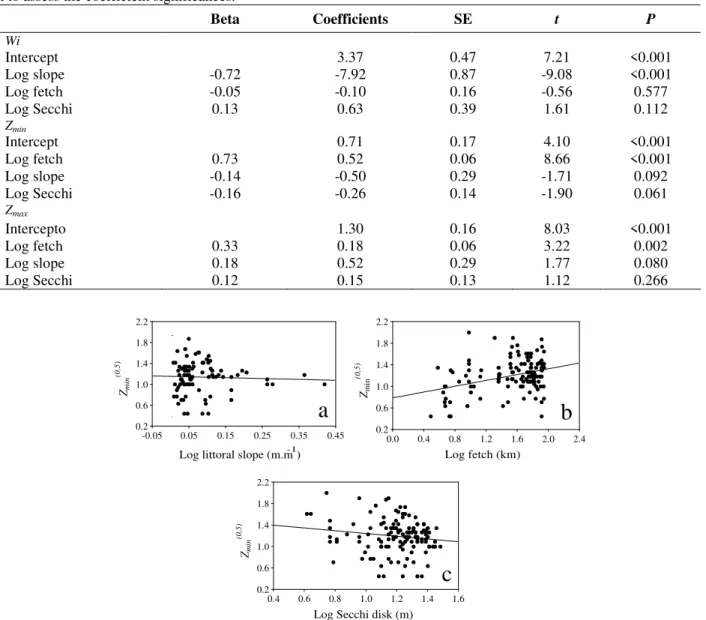
Considering Egeria Zmin, the multiple regression
results showed that 51% of the variability of its
values was accounted for by the model (N = 86;
F3.73 = 25.41; P < 0.001). Nevertheless, fetch was
the only variable significantly related to Zmin and
Secchi disk and littoral slope were not significant (Table 2; Fig. 3). The distribution of residuals was
normal (W = 0.99; P = 0.887). Despite the
observation of five outliers (>2), the residual analysis indicated that the model was suitable to
describe EgeriaZmin in the Rosana Reservoir
Applying the multiple regression to Zmax showed
that littoral slope and Secchi disk depth did not contribute to explain this variable which was
significantly explained only by fetch (N = 86; F3.82
= 6.29; P < 0.001) (Table 2; Fig. 4). Nevertheless,
the coefficient of determination was very low (19%). In addition, the distribution of residuals
Effects of Limnological and Morphometric Factors Upon Zmin, Zmax 391
Table 2 - Results of the multiple regression analysis assessing the effect of fetch, littoral slope and Secchi disk depth on Egeria stand width (Wi), Zmin and Zmax. Beta = standardized coefficients; SE = coefficient standard errors; t = test
t to assess the coefficient significances.
Beta Coefficients SE t P
Wi
Intercept 3.37 0.47 7.21 <0.001
Log slope -0.72 -7.92 0.87 -9.08 <0.001
Log fetch -0.05 -0.10 0.16 -0.56 0.577
Log Secchi 0.13 0.63 0.39 1.61 0.112
Zmin
Intercept 0.71 0.17 4.10 <0.001
Log fetch 0.73 0.52 0.06 8.66 <0.001
Log slope -0.14 -0.50 0.29 -1.71 0.092
Log Secchi -0.16 -0.26 0.14 -1.90 0.061
Zmax
Intercepto 1.30 0.16 8.03 <0.001
Log fetch 0.33 0.18 0.06 3.22 0.002
Log slope 0.18 0.52 0.29 1.77 0.080
Log Secchi 0.12 0.15 0.13 1.12 0.266
Log littoral slope (m.m-1)
Zm
in
(0
,5
)
0.2 0.6 1.0 1.4 1.8 2.2
-0.05 0.05 0.15 0.25 0.35 0.45
a
Log fetch (km)
Zm
in
(0
,5
)
0.2 0.6 1.0 1.4 1.8 2.2
0.0 0.4 0.8 1.2 1.6 2.0 2.4
b
Log Secchi disk (m)
Zm
in
(0
,5
)
0.2 0.6 1.0 1.4 1.8 2.2
0.4 0.6 0.8 1.0 1.2 1.4 1.6
c
Figure 3 - Relationship between EgeriaZmim and littoral slope (a), fetch (b) and Secchi disk depth (c).
A more detailed analysis of the dispersion diagram between the predicted and studentized residuals
obtained from regressing only Zmax on fetch
showed that, in general, discrepant values (both positive and negative) were found where fetch was lower than 2km. Such sampling sites were located in the arms of the reservoir. This indicated that the
relationship between Zmax and the independent
variables could be different if only the sampling sites less exposed to wind effect were considered. Then, an additional multiple regression was carried out separately for the sampling sites of the main axis (N = 69) and arms (N = 17). When both datasets were analyzed separately, a considerable
difference was found by multiple regressions.
Despite the great dispersion (R2 = 21.8%), fetch
explained a significant portion of Zmax in the main
axis of the reservoir (N = 69; F3.65 = 6.024; P =
0.001). On the other hand, Secchi disk depth
explained a significant proportion of Zmax in the
arms of the reservoir (N = 17; F1.15 = 20.09; P <
0.001). This regression was described by the
model: Zmax
0.5
= 1.38xlog Secchi. For this
regression, the determination coefficient was very
high (R2 = 62%) and the distribution of the
residuals was normal (W = 0.951; P = 0.576).
Effects of limnological and morphometric factors upon Zmin, Zmax
392
Log littoral slope (m.m-1)
Zm
a
x
(0
,5
)
1.0 1.2 1.4 1.6 1.8 2.0 2.2 2.4 2.6
-0.05 0.05 0.15 0.25 0.35 0.45
a
Log fetch (km)
Zm
a
x
(0
,5
)
1.0 1.2 1.4 1.6 1.8 2.0 2.2 2.4 2.6
0.0 0.4 0.8 1.2 1.6 2.0 2.4
b
0.4 0.6 0.8 1.0 1.2 1.4 1.6 Log Secchi disk (m)
1.0 1.2 1.4 1.6 1.8 2.0 2.2 2.4 2.6
Zm
a
x
(0
,5
)
c
Figure 4 - Relationship between EgeriaZmax (square root transformed) and littoral slope (a), fetch
(b) and Secchi disk depth (c).
Table 3 - Results of the multiple regression analysis assessing the effect of fetch, littoral slope and Secchi disk depth on Egeria (Zmax)0.5. Beta = standardized coefficients; SE = coefficient standard errors; t = test t to assess the
coefficient significances. The analyses were carried separately for values recorded in the reservoir main axis and in its arms.
beta Coeficientts SE t P
Main axis
Intercept 1.19 0.20 6.05 <0.001
Log fetch 0.44 0.35 0.09 3.96 <0.001
Log slope 0.17 0.35 0.23 1.54 0.129
Log Secchi 0.006 0.006 0.11 0.05 0.960
Arms
Intercept 0.34 0.45 0.76 0.466
Log fetch -0.16 -0.30 0.37 -0.81 0.435
Log slope 0.11 0.86 1.51 0.568 0.583
Log Secchi 0.77 1.38 0.37 3.71 0.004
DISCUSSION
These results showed that Egeria colonized mainly
areas with lower littoral slopes. This morphometric variable has been considered among the main factors affecting the limits of occurrence of submerged plants within aquatic ecosystems of temperate regions (Duarte and Kallf, 1986; 1990).
Present analyses showing Egeria Wi significantly
related to littoral slope indicated that this independent variable was a useful predictor of the degree of submerged plant colonization in the Rosana Reservoir
Effects of Limnological and Morphometric Factors Upon Zmin, Zmax 393
slope also influences the horizontal extent of the weedbed, possibly because the plants growing on steep slopes reach the depth of light compensation much closer to shore than would be the case with gentle slopes (Duarte and Kalff, 1988). Despite the
significant relationship between Wi and slope, the
biplot graphic display of both variables suggested
that the use of a traditional regression model, which assumed a continual and gradual process (Duarte and Kalff, 1990), was not totally suitable to describe such a relationship. According to Bini
(2001), who investigated E. najas distribution in a
large subtropical reservoir (Itaipu,
Brazil/Paraguay), the relationships in the shape of “envelopes” have lower predictive capacity; however, such relationships allow, within certain limits, the determination of the limits of
occurrence of Egeria stands. For example, in
regions where slopes are lower than 0.05 m.m-1,
Egeria Wi may reach up to 260m. Thus, this prediction indicates that prioritizing monitoring in areas with such low slopes would increase the efficiency of plant management in the Rosana Reservoir. Present results also corroborated the ones recorded by Duarte and Kalff (1986; 1990) and Scheffer et al. (1992), who showed that sites with lower slopes were usually more colonized by submerged macrophytes.
Egeria Zmin was positively affected by fetch. This
kind of relationship is usually explained by direct and indirect mechanisms acting upon the aquatic vegetation. An example of an indirect mechanism is the deposition of fine particles, richer in nutrients. The great energy derived from waves re-suspends mainly the fine particles and thus, in sites having longer fetches, the finer (and richer) particles are deposited in deeper sediments (Keddy, 1982; Chambers, 1987; Cyr, 1998; Riis and Hawes, 2003). As a result, sediments retained close to the shore (shallower areas) tend to have lower nutrient concentrations, reducing the capacity for plants to colonize and grow in these places. This inference was confirmed in the field experiments that showed that wave energy at shallow sites diverted small, richer particles to deeper sites, reducing submerged plant growth (Duarte and Kalff, 1988).
Waves also affect Zmin directly by causing physical
damage to aquatic plant tissues. Due to this damage, fetch is considered in several studies a measure associated with the disturbance (direct physical damage to plant tissues) (Spence, 1982; Keddy, 1983; Wilson and Keddy, 1986;
Chambers, 1987; Riis and Hawes, 2003), in addition to be also a measure of stress (i.e. indirect
effects caused by turbidity and nutrient
availability). Physical damage to Egeria tissues
may be severe because this genus usually grows close to the water surface, forming well-developed canopies. This is an advantageous strategy since the plants concentrate their photosynthetic tissues in well-illuminated areas, escaping the adverse effects of high turbidity (Scheffer et al., 1992; Bini, 2001). Nevertheless, as a result of such a
strategy, canopy-forming plants such as Egeria
(known as “eloideids”) are also more susceptible to wave damage (that may be considered a disturbance) than plants with linear, ribbonlike leaves and/or rosettelike forms growing close to the bottom. In fact, the natural distribution of plants in relation to wave energy provides correlational evidence of wave impacts (Doyle, 2001). Wind effect upon plant biomass was not suggested only from data obtained in the field. Experiments carried out in the laboratory clearly showed that several morphological attributes of
Valliseria americana, a submerged species, were affected by wave effect, even at moderate wave intensities (Doyle, 2001). In addition, waves may also affect the colonization by preventing the propagules from settling and by increasing their detachment from sediments (Rea et al., 1998; Hudon et al., 2000; Riis and Hawes, 2003). Although the present investigation did not allow
distinguishing between any direct (e.g.
disturbance) or indirect (e.g. nutrient limitation) mechanism, it could be inferred that the potential degree of wave exposure (our fetch measurements)
was the main factor controlling Egeria Zmin in the
Rosana Reservoir. Nevertheless, specific
experiments manipulating plant growth in more versus less-exposed sites are still necessary to assess this inference.
Differently from Zmin, the responses of Zmax to the
independent variables measured seem to be more
complex. The relationships between Egeria Zmax
and the explanatory variables in the Rosana Reservoir were different if one considered the more-exposed versus the more-protected sites. In
the main axis of the reservoir, Zmax was affected
mainly by fetch. The positive correlation between
Zmax and fetch indicated that Egeria colonized
Pierini,S. A. and Thomaz, S. M. 394
deepest areas colonized by Egeria varied, in
general, from 3.6 to 4.0m, although depths down to 6.0m were also found. These depths were higher than those found in other Brazilian reservoirs, where turbidity was higher. In Itaipu Reservoir, for
example, Egeria Zmax is, on average, 1.5m (Bini,
2001). In fact, the non-significant correlation
between Secchi disk depth and Zmax in the main
axis of the reservoir suggests that underwater radiation (or turbidity) has a secondary effect upon
Egeria growth in this compartment.
The coefficient of determination of the multiple
regression performed for Zmax in the main axis was
very low (R2 = 19%), indicating that other factors
not accounted for in this study interact to
determine Zmax. Other morphometric features,
chemical characteristics of the water and sediment, and flow velocity, among other factors, could be important in this respect (Canfield and Hoyer,
1988; Chambers et al., 1991; Hudon et al., 2000;
Pezzato and Camargo, 2004).
On the other hand, results obtained in the reservoir arms showed that Secchi disk depth significantly
explained Zmax variability. In several
investigations, Secchi disk depth has been
successfully used to predict submerged plant Zmax
(Chambers and Kallf, 1985; Scheffer et al., 1992;
Bini, 2001). In general, the regressions in these studies found positive intercepts significantly
different from zero (Scheffer et al., 1992; Bini,
2001), which meant that stem elongation occurred even under low underwater radiation. This could be explained by the plant physiology, since species with this strategy could store carbohydrates in
underground organs or in the stems (Scheffer et
al., 1992; Middelboe and Markager, 1997; Bini,
2001). According to Bini (2001), it is possible that
Egeria stores carbohydrates in its stem, although no experiments to verify this hypothesis have been performed. Thus, growth up to the surface could only occur, independent of underwater radiation availability, if during a previous time period radiation was available to the plant (i.e. if underwater radiation reached the sediment where the plant was starting to grow). Differently from the studies considered previously, the intercept of
the relationship between Zmax and Secchi disk
depth (using only data collected in the reservoir arms) was not significantly different from zero
(see Table 3). This indicates that Egeria did not
colonize successfully sites with low Secchi disk depth values (<1.0m) in sheltered places in the Rosana Reservoir. However, this result was
unexpected because the plants with canopy (such as Egeria) use sub-surface light and, thus, they are more independent from underwater radiation than the plants that do not form canopy. This way, canopy forming plants generally grew even at low levels of radiation which could cause the intercept
between Secchi versus Zmax to be positive and
significant.
A possible explanation for an intercept not different from zero could be that in more-protected areas (lower fetch values), the waves may not have enough energy to remove part of the periphyton attached to the plant surface. Although it was not measured, substantial periphyton accumulation
upon Egeria was observed at the more-protected
sites in this study. The presence of periphyton may
reduce light availability to submerged
macrophytes. In addition, at sites protected from wave exposure, phytoplankton and/or free-floating macrophytes may accumulate, negatively affecting
sub-surface and underwater radiation (Scheffer et
al., 1992; Weisner et al., 1997). Thus, it could be
inferred that Egeria Zmax was at least partially
controlled by competition for light with other autotrophic aquatic organisms at sheltered sites.
Using the regression between Zmax and Secchi
depths and the values of irradiance obtained by Pierini (2005) in the Rosana Reservoir, it was
estimated that the light intensity at Zmax in the
reservoir arms was 6.9% (on average) of the surface PAR. This value was lower than the one estimated by Chambers and Kalff (1985) for
several angiosperms (21%) and also for E. najas
colonizing Itaipu Reservoir (12% - Bini, 2001).
The radiation reaching Zmax might change
according to water level fluctuation; nevertheless, such alterations were usually small in the Rosana Reservoir (where water level fluctuation < 1.0m
year-1 has been recorded). According to Sculthorpe
(1967), the underwater radiation at the
compensation point of several submerged species varies from 1 to 4%. Thus, the present values are close to the higher limit presented by Sculthorpe (1967) for several angiosperms.
In summary, the results indicated that the
extension of Egeria stands in the Rosana Reservoir
might be generally described using some simple morphometric and limnological variables. Littoral slope, for example, was useful in predicting the
width of Egeria stands (Wi). Higher Wi values
Effects of Limnological and Morphometric Factors Upon Zmin, Zmax 395
(Zmin) could be predicted by potential wave
exposure (fetch). In addition, fetch also apparently
interacted with other factors to determine Egeria
Zmax. For example, at sites protected from wind
exposure (arms) Secchi disk depth was an
important variable for Zmax prediction, while at
more-exposed sites (main axis) fetch was
important in determining Zmax. Thus, Egeria tends
to colonize deeper places at more exposed sites. Despite the general predictions outlined in this work, a great variability of data was not explained by the independent variables. Future studies in tropical reservoirs should consider other important factors such as sediment and water characteristics, which will certainly increase the predictive capacity of the models.
ACKNOWLEGEMENTS
We thank Dr. Luis Mauricio Bini (UFG) and an anonymous reviewer for important suggestions. We also thank Dr. Thomaz A. Pagioro (CEFET-Curitiba), Raul Ribeiro (UEM) and Maria do Carmo Roberto for helping with samplings. S. M. Thomaz is especially thankful to the Brazilian Council of Research (CNPq), for continuous funding through a Research Productivity Grant. This research was funded by Duke Energy.
RESUMO
Regressões múltiplas foram utilizadas com o
objetivo de testar os efeitos do fetch (distância
livre para ação do vento), declividade da região litorânea e da profundidade do disco de Secchi sobre a largura e os limites de colonização
superior (Zmax) e inferior (Zmin) de bancos de
Egeria spp em um grande reservatório tropical (Reservatório de Rosana). A declividade foi a única variável correlacionada com a largura dos bancos, que foi maior em locais com menor declividade. Os maiores valores da largura (até
260m) foram registrados em locais com
declividade inferior a 0,05 m.m-1. ZmineZmax foram
correlacionadas positivamente com o fetch.
Entretanto, para o Zmax, diferentes relações foram
encontradas em valores de fetchs baixos e altos,
observados nos braços e no corpo central do
reservatório, respectivamente. Em valores de fetch
mais baixos, a profundidade de disco de Secchi foi
a principal variável que explicou Zmaxdos estandes
de Egeria. Por outro lado, em valores de fetch
mais elevados (obtidos no corpo central do
reservatório), o fetch foi a única variável
significativamente correlacionada com a Zmax.
REFERENCES
Agostinho, A. A., Gomes, L. C. and Julio Junior, H. F. (2003), Relações entre macrófitas aquáticas e fauna de peixes. In-Ecologia e Manejo de Macrófitas Aquáticas, eds. S. M. Thomaz and L. M. Bini. Eduem, Maringá, pp. 261-279.
Bailey, R. C. (1988), Correlations between species richness and exposure: Freshwater molluscs and macrophytes. Hydrobiologia, 162, 183-191.
Bini, L. M. (2001), Dinâmica populacional de Egeria najas Planchon (Hydrocharitaceae): sobrevivência de uma espécie submersa subtropical em um ambiente com elevada turbidez (reservatório de Itaipu Binacional, Brasil-Paraguai). PhD Thesis, Universidade Estadual de Maringá, Maringá, Brasil. CESP (1998), Conservação e manejo nos reservatórios:
Limnologia, ictiologia e pesca. Série Divulgação e Informação, 220, São Paulo. 166p.
Esteves, F. A. and Camargo, A. F. M. (1986), Sobre o papel das macrófitas aquáticas na estocagem e ciclagem de nutrientes. Acta Limnologica Brasiliensia, 1, 273-298.
Canfield, D. E. and Hoyer, M. V. (1988), Influence of nutrient enrichment and light availability on the abundance of aquatic macrophytes in Florida streams. Can. J. Fish. Aquat. Sci., 45, 1467-1472.
Cavenaghi, A. L., Velini, E. D., Galo, M. L. B. T., Carvalho, F. T., Negrisoli, E., Trindade, M. L. B., Simionato, J. L. A. (2003), Caracterização da qualidade de água e sedimento relacionados com a ocorrência de plantas aquáticas em cinco reservatórios da bacia do rio Tietê. Planta Daninha, 21, 43-52.
Chambers, P. A. (1987), Nearshore occurrence of submersed aquatic macrophytes in relation to wave action. Can. J. Fish. Aquat. Sci., 44, 1666-1669. Chambers, P. A. and Kalff, J. (1985), Depth distribution
and biomass of submersed macrophyte communities in relation to Secchi depth. Can. J. Fish. Aquat. Sci., 42, 701-709.
Chambers, P. A., Prepas, E. E., Hamilton, H. R. and Bothwell, M. L. (1991), Current velocity and its effect on aquatic macrophytes in flowing waters. Ecol. Appl., 1 (3), 249-257.
Pierini,S. A. and Thomaz, S. M. 396
Doyle, R. D. (2001), Effects of waves on the early growth of Vallisneria americana. Freshwater Biol., 46, 389-397
Duarte, C. M. and Kalff, J. (1986), Littoral slope as a predictor of the maximum biomass of submerged macrophyte communities. Limnol. Oceanogr., 31(5), 1072-1080.
Duarte, C. M. and Kalff, J. (1988), Influence of lake morphometry on the response of submerged macrophytes to sediment fertilization. Can. J. Fish. Aquat. Sci., 45, 216-221.
Duarte, C. M. and Kalff, J. (1990), Patterns in the submerged macrophyte biomass of lakes and the importance of the scale of analysis in the interpretation. Can. J. Fish. Aquat. Sci., 47, 357-363. Gotelli, N. J. and Entsminger, G. L. (2001), EcoSim:
Null models software for ecology. Version 7.0. Acquired Intelligence Inc. and Kesey-Bear. http://homepages.together.net/~gentsmin/ecosim.htm Hudon, C., Lalonde, S. and Gagnon, P. (2000), Ranking
the effects of site exposure, plant growth form, water depth, and transparency on aquatic plant biomass. Can. J. Fish. Aquat. Sci., 57 (Suppl. 1), 31-42. Keddy, P. A. (1982), Quantifying within-lake gradients
of wave energy: interrelationships of wave energy, substrate particle size and shoreline plants in Axe lake, Ontario. Aquat. Bot.,14, 41-58.
Keddy, P. A. (1983), Shoreline vegetation in Axe Lake, Ontario: Effects of exposure on zonation patterns. Ecology, 64(2), 331-344.
Marcondes, D. A. S., Mustafá, A. L. and Tanaka, R. H. (2003), Estudos para manejo integrado de plantas aquáticas no reservatório de Jupiá. In-Ecologia e Manejo de Macrófitas Aquáticas, eds. S. M. Thomaz and L. M. Bini. Eduem, Maringá, pp. 299-317. Martins D., Costa N. V., Terra M.A., Marchi S. R.
2008. Characterization of the aquatic plant communities of 18 reservoirs of five watersheds in Sao Paulo, Brazil. Planta Daninha, 26, 17-32. Middelboe, A. L. and Markager, S. (1997), Depth limits
and minimum light requirements of freshwater macrophytes. Freshwater Biol., 37, 553-568.
Neiff, J. J., Poi de Neiff, A. S. G., Patiño, C. A. E. and Basterra de Chiozzi, I. (2000), Prediction of colonization by macrophytes in the Yaciretá Reservoir of the Paraná River (Argentina and Paraguay). Rev. Brasil Biol., 60, 615-626.
Neiff, J. J. and Poi de Neiff, S. G. (2003), Connectivity process as a basis for the management of aquatic plants. In-Ecologia e Manejo de Macrófitas Aquáticas, eds. S. M. Thomaz and L. M. Bini. Eduem, Maringá, pp. 39-58.
Pezzato, M. M. and Camargo, A. F. M. (2004), Photosynthetic rate of the aquatic macrophytes Egeria densa Planch. (Hydrocharitaceae) in two rivers from the Itanhaem River Basin in São Paulo State, Brazil. Braz. arch. biol. technol., 47, 153-162.
Pierini, S. A. 2005. Fatores determinantes da distribuição de platnas submerses e dos atributos das assembléias de macrófitas aquáticas no reservatório de Rosana. Programa de Pós-graduação em Ecologia de Ambientes Aquáticos Continentais, UEM. 84p. Tese de doutorado.
Rea, T. E., Karapatakis, D. J., Guy, K. K., Pinder III, J. E. and Mackey Jr. H. E. (1998), The relative effects of water depth, fetch and other physical factors on the development of macrophytes in a small southeastern US pond. Aquat. Bot., 61, 289-299.
Riis, T. and Hawes, I.. (2003), Effect of wave exposure on vegetation abundance, richness and depth distribution of shallow water plants in a New Zealand lake. Freshwater Biol., 48, 75-87.
Pelicice, F. M., Agostinho, A. A. and Thomaz, S. M. (2005), Fish Assemblages Associated with Egeria in a Tropical Reservoir: Investigating the Effects of Plant Biomass and Diel Period. Acta Oecol., 27, 9-16 Sand-Jensen, K. (1998), Influence of submerged
macrophytes on sediment composition and near-bed flow in lowland streams. Freshwater Biol., 39, 663-679.
Scheffer, M., Redelijkheid, M. R. de. and Noppert, F. (1992), Distribution and dynamics of submerged vegetation in a chain of shallow eutrophic lakes. Aquat. Bot., 42, 199-216.
Spence, D. H. N. (1982), The zonation of plants in freshwater lakes. Advances in Ecological Research, 12, 37-125.
Sculthorpe, C. D. (1967), The biology of aquatic vascular plants. Edward Arnold, London.
Taniguchi, G. A., Bicudo, D. D. and Sennab, P. A. C. (2004), Abiotic variables in littoral-limnetic gradient of an Oxbow lake of Mogi-Guacu River floodplain, southeastern, Brazil. Braz. Arch. Biol. Technol., 47: 961-971.
Thomaz, S. M. and Bini, L. M. (1998), Ecologia e manejo de macrófitas aquáticas em reservatórios. Acta Limnologica Brasiliensia, 10(1), 103-116 Thomaz, S. M., Souza, D. C. and Bini, L. M. (2003),
Species richness and beta diversity of aqutic macrophytes in a large subtropical reservoir (Itaipu Reservoir, Brazil): the influence of limnology and morphometry. Hydrobiologia, 505, 119-128.
Weisner, S. E. B., Strand, J. A. and Sandsten, H. (1997), Mechanisms regulating abundance of submerged vegetation in shallow eutrophic lakes. Oecologia, 109, 592-599.
Wilson, S. D. and Keddy, P. A. (1986), Species competitive ability and position along a natural stress/disturbance gradient. Ecology, 67(5), 1236-1242.