E v a l u a t i o n o f t h e P r o n a t e c
c o u r s e s : b e n c h m a r k i n g w i t h
l o n g - t e r m t e c h n i c a l c o u r s e s
A L E X A N D R E N A S C I M E N T O D E A L M E I D AI M A R I A L U I S A H I L L E S H E I N D E S O U Z AII http://dx.doi.org/10.22347/2175-2753v12i34.2352 AbstractThe objective of this paper is to evaluate the effectiveness of the Programa
Nacional de Acesso ao Ensino Técnico e Emprego (Pronatec), between the
years 2013 and 2015, through a benchmarking of the short-term technical courses of the Federal Institute of Santa Catarina (IFSC) with long-term technical courses from the South of Brazil. The data were obtained from the questionnaire application and the methods used were: content analysis, chi-square test and Mann-Whitney U-test. The results indicated that the percentages of employed graduates of short or long-term courses were the same, but in the long-term courses the number of graduates working in their training area was statistically higher, besides having a greater mobility in the occupation of employment in different regions of Brazil.
Keywords: Technical Education. Professional qualification. Evaluation of public
policies.
Sub met i do em : 28/0 5/2019 Ap rova d o em : 04 /0 3 /2020
I Universidade de Brasília, Brasília (DF), Brasil; http://orcid.org/0000-0002-9113-0729; e-mail:
Resumo
O objetivo geral deste trabalho é o de avaliar a efetividade do Programa Nacional de Acesso ao Ensino Técnico e Emprego (Pronatec), entre os anos de 2013 e 2015, por meio de um benchmarking dos cursos técnicos de curta duração do Instituto Federal de Santa Catarina (IFSC) com os de longa duração da Região Sul do Brasil. Os dados foram obtidos a partir da aplicação de questionário e os métodos empregados foram: análise de conteúdo, teste do Qui-Quadrado e teste U de Mann-Whitney. Os resultados indicaram que as porcentagens dos egressos dos cursos de curta e dos de longa duração foram iguais, porém, nos cursos de longa duração, o número de egressos que trabalham na área de formação foi estatisticamente maior, além de eles possuírem uma maior mobilidade na ocupação de emprego em diferentes regiões do Brasil.
Palavras-chave: Ensino Técnico. Qualificação profissional. Avaliação de políticas
públicas.
E va l u a c i ó n d e l o s c u r s o s d e P r o n a t e c : b e n c h m a r k i n g c o n
c u r s o s t é c n i c o s a l a r g o p l a z o
Resumen
El objetivo de este trabajo es evaluar la efectividad del Programa Nacional de Acceso a la Educación Técnica y el Empleo (Pronatec), entre los años 2013 y 2015, mediante una evaluación comparativa de los cursos técnicos a corto plazo del Instituto Federal de Santa Catarina (IFSC) con cursos técnicos a largo plazo del sur de Brasil. Los datos se obtuvieron de la aplicación del cuestionario y los métodos utilizados fueron: análisis de contenido, prueba de chi-cuadrado y prueba U de Mann-Whitney. Los resultados indicaron que los porcentajes de graduados empleados de cursos a corto o largo plazo eran los mismos, pero en los cursos a largo plazo el número de graduados que trabajaban en su área de formación era estadísticamente mayor, además de tener una mayor movilidad en la ocupación del empleo. en diferentes regiones de Brasil.
Palabras clave: Educación Técnica. Cualificación profesional. Evaluación de políticas
Introduction
In order to meet the demand for professional qualification, some actions have been carried out since the 1990s in Brazil, such as the implementation of the National Plan of Professional Formation (Plano Nacional de Formação Profissional – Planfor) in 1995, the approval of the new Law on the Guidelines and Bases of National Education (Lei de Diretrizes e Bases da Educação Nacional – LDB) in 1996 (SEVERNINI; ORELLANO, 2010) and the implementation of the National Access Program To Technical Education and Employment (
Pronatec
) in the year 2011.Pronatec
was instituted by the Federal Government through Law no. 12,513 of October 26, 2011 and its purpose was to expand the offer of short-term professional and technological education courses (BRASIL, 2011). The program aimed to extend and democratize the provision of professional and technical education courses at the intermediate level, and of initial and continuing training courses or professional qualification, increasing educational opportunities to workers and, consequently, raising their income and life quality.Pronatec
was implemented in 2012 by the Federal Institutes (IFs) and expanded its offerings in several other public and private institutions. According to data released by the Ministry of Education and Culture (BRASIL, 2014), federal investment in the program between 2012 and 2014 was of R$ 14 billion, training 4.6 million people in more than 3,200 municipalities of Brazil. In the opinion of Lima and Pacheco (2017, p. 490):PRONATEC emerges without the participation of the wider society and is responsible for raising the number of enrollments in vocational education, revealing, however, a private character bias of government policy, prioritizing, via exchange training, predominantly short courses.
Pronatec
was one of the major investment fronts of the Dilma Roussef government (WALDOW, 2014), being drastically reduced in the next government of Michel Temer, and abandoned in the current government of Jair Bolsonaro. In 2016, the year of Dilma Rousseff's impeachment and Brazil’s worst economic recession, the expenses incurred byPronatec
were R$ 1.26 billion, reducing to R$ 141 million in 2018, last year of Michel Temer's interim government, and to R$ 5 million in 2019, the first year of the transitional government of Jair Bolsonaro (BRASIL, 2020). In 2019, with the criticism thatPronatec
courses did not meet the demand of the labor market, the ministry ofeducation abandoned it and launched the Novos Caminhos program, promising to offer 1.53 million vacancies in professional and technological education until 2023 (MEC..., 2019).
Just at the Federal Institute of Santa Catarina (IFSC), 12,000 enrollments were attained in different courses offered by
Pronatec
between 2012 and 2014. The IFSC is a federal public institution linked to the Ministério da Educação e da Cultura (Ministry of Education and Culture – MEC). It is headquartered in Florianópolis and has 22 other campuses spread throughout the state of Santa Catarina. It possesses administrative, patrimonial, financial, didactic-pedagogical, and disciplinary autonomy. It was considered for six consecutive times the best Federal Institute of Brazil, holding the highest score in MEC’s evaluation.The expansion of
Pronatec
in the IFSC and in Brazil was expressive. However, considering the short time implementation and the volume of people attended by this public policy, it becomes necessary to identify how this program was developed and if its goals are being achieved.Despite the government's concern with the creation of this and other social programs, it is observed that the performance of the network of professional and technological education was barely evaluated in its whole existence span. According to Severnini and Orellano (2010), the efforts in this direction were recent and it was still unknown, conclusively, if the training programs had succeeded in inserting their graduates in the job market and improved their well-being.
There was no institutionalized practice within IFs to assess the effectiveness of their programs and courses. The systematization of this practice could provide subsidies for restructuring the courses, allowing a focus on the market, as well as improving the graduates’ training and employability.
According to Neres (2015), the course evaluation becomes more effective when the graduates’ participation takes place. Course monitoring can happen in different ways, however, the graduates living the reality of the professional market are those who can best point out what in their training contributed to their career and professional life. Not to mention that evaluating a course with only secondary data such as the indicated number of enrollments, approved and dropouts, as has been done in Brazil, does not assess the quality of a course.
In the IFSC,
Pronatec
was characterized by the offer of courses in the Initial and Continuous Training (ICT) modality. These were fast courses, with a workload that ranges between 160 and 300 hours and were often seen with suspicion. There were common arguments that long-term and higher-level technical courses, as well as higher education courses, provide a more concise and concrete training, while ICT courses (smaller workload and duration) were populist and useful only to generate high numbers of enrolled students. However, there was no empirical evidence on the greater effectiveness of long-term courses compared to the short-term ones. Also, research on the graduates’ situation is rare, especially for short-term courses in Brazil.Therefore, comparative research between short and long-term courses was necessary to identify, from the graduates’ point of view, if the courses had fulfilled the objective of enabling the students a good employability and better life conditions.
Accordingly to these, the overall objective of this paper is to evaluate the effectiveness of the oldest and most popular short-term courses with highest number of enrolled people in the IFSC (Administrative Assistant, Mechanical Design and Electrician-Installer of Low Voltage Buildings) and compare it with the results of the long-term courses of the South of Brazil. Specifically, it will seek to:
• Compare the situation of graduates in short and long-term courses, focusing on their insertion in the labor market and the continuation of their studies;
• Investigate the alignment of short and long-term courses with the regional labor market;
• Compare the perception of graduates in short and long-term courses regarding the course quality, and suggestions to identify improvements for the short-term courses analyzed.
Theoretical reference
According to Andriola (2014), the educational system is in a dynamic and continuous interaction with the social context in which it is placed, so that nothing is more expressive than the investigation of the social repercussions of the activities of an educational institution. This investigation can happen through the systematic follow-up of the graduates, mapping opinions, attitudes and beliefs about the institution and the society. Within the approaches proposed by Borges and Rothen (2019), research with graduates can be classified as a results-based assessment, but
instead of evaluating students' academic performance, these surveys evaluate the situation and the perception of the egress.
Both (1999) emphasizes that the evaluation carried out by former students assumes importance as it manifests the real importance of the course in their life and professional practice. Santos and Takaoka (2007) corroborate and affirm that the graduates know intimately the reality of the courses they have taken, and can provide contextualized information, since they interact directly with the external environment of the Institution, being able to evaluate the effectiveness of the acquired knowledge. Few studies have been carried out aiming at the follow-up of high school graduates, and the number of studies carried out with graduates of professional courses is even lower (NERES, 2015), highlighting the research of Dutra, Coelho and Dutra (2019) that evaluated the educational performance in the Federal Institutes. It is important to highlight that research with graduates can clarify the weaknesses of the training offered compared to the demands of the labor market, as well as pointing out the positive aspects of the training that must be maintained and consolidated (CASTRO; TEIXEIRA, 2014).
Within the context of institutional evaluation, this information helps the Institution to reformulate its strategies and to promote the continuous improvement of the already established processes. In addition, it provides relevant information so that course managers can plan actions to enhance the processes involved in job vacancies (ANDRIOLA, 2001). However, Souza, Souza, Elliot and Hildenbrand (2018) pointed out that: "wrongly performed evaluation may lead to distorted or falsified information and may lead to disastrous problems for an organization."
According to the Institutional Pedagogical Project (IPP), an integral part of the Institutional Development Plan of the IFSC (PDI 2015–2019), designing actions for the graduates makes it possible to better understand how the training that the institution provides to the students impacts their lives. The document affirms the importance of detecting models of successful practices to feed pedagogical projects of the course and to subsidize the formulation of pedagogical strategies of the institution (IFSC, 2017).
In this sense, according to Melo, Carpinetti and Silva (2000), benchmarking is a powerful instrument of improvement, which seeks to achieve competitive advantage by learning the best practices.
For Spendolini (1993), benchmarking is defined as a continuous and systematic process for evaluation of organizations that are recognized for their successful practices, for the purpose of organizational improvement. Benchmarking is considered an organizational management tool that seeks practicality and ease in the search for improvements (MARTINS; SANTOS; CARVALHO, 2010).
Material and methods Data
The data obtained from this research was collected through the application of an electronic questionnaire to the graduates of the ICT courses (short duration) in the Electrician-Installer of Low Voltage, Administrative Assistant, and Mechanical Designer, graduated in 2013, 2014, and 2015 by the IFSC. These courses were chosen because they were the first created and have the largest number of students enrolled. The sample obtained amounted to 116 questionnaires answered, representing 16.8% of the population of 689 graduates analyzed.
The questionnaire was structured in three blocks of questions, covering: 1) the situation of the graduate (insertion of the graduate in the labor market); 2) the alignment of the course with the labor market; 3) the quality of the course. The content of all questions was the same as the questionnaire applied in the National Survey of Graduates of the Technical Courses of MEC of Feres and Patrão (2009).
The MEC survey, coordinated by Feres and Patrão (2009), interviewed graduates from all regions of Brazil, trained in long-term technical courses between 2003 and 2007. The sample achieved at this survey was of 2,649 questionnaires answered for a population of 71,657 students graduated in the period analyzed.
The primary data of MEC research by region, gender, course profile (agricultural or industrial) and year of graduation were fully made available, allowing the use of the same data in a comparative analysis with the data collected. In order to approximate the comparison with the IFSC, it used the data for all the years of the MEC survey, minimizing annual atypical oscillations within the sample, as well as using only data from the south region of the country, approaching the region of comparison.
Analytical Tools Chi-Square Test
The chi-square test is applied to variables on a nominal scale with two or more categories, comparing the frequencies observed in the sample with those expected in the universe (PESTANA; GAGEIRO, 2005).
Thus, this test was carried out to compare if the proportion of the graduates in short-term courses who are working is lower compared to the graduates in long-short-term technical courses of the South of Brazil, as well as whether the current job of graduates in long-term courses are more related to their training compared to the graduates in short-term courses.
In addition to the employability, the continuity of studies of the graduates was also evaluated by the Chi-Square test. To do so, the percentage of graduates who are studying was compared between the short and long term technical courses, analyzing in specific the percentage of those who are attending a graduation or another technical course.
The questions used to compare the situation among graduates regarding employability and continuity of studies are found in Chart 1.
Chart 1 – Block of questions of the questionnaire regarding the situation of the graduates
Fonte: O autor (2020).
In order to simplify the understanding of the results and the application of the Chi-Square test, the questions with multiple categories referring to the graduate situation were codified and compared in the following dichotomous divisions: a) Working or Not working; b) Studying or not studying; c) Current employment have or does not have relation with the course (Chart 2).
SITUATION OF THE GRADUATE 1. You are currently:
( ) Neither working nor studying ( ) Working
( ) Just studying ( ) Working and studying
2. What is the relationship between your current job and the course taken at the IFSC?
( ) Not working ( ) Weakly related to course
( ) It has no relation with the course ( ) Strongly related to the professional area of the course
3. After completing your technical course, did you complete or are attending any higher education course?
( ) Yes ( ) No
4. After completing your technical course, have you completed or are attending another technical course?
Chart 2 – Codification of the answer options of the questionnaire according to the dichotomous categories tested
Graduate Employability
Working and
studying Just working Just studying Not working or studying
Working Not working
Continuity of Graduate Studies
Working and
studying Just studying Just working Not working or studying
Studying Not studying
Relationship between undertaken course and current job
It does not have any relation to the course Weakly related Strongly related It has no relation to the course Has a relation with the course
Source: The authors (2016).
Since long-term technical courses theoretically allow for a broader and more solid training, it is expected that their graduates will attain a higher rate of employability after completing the course, as well as work in an area more related to the undertaken course. In relation to the continuity of the studies, unlike the long-term technical courses, for the ICT courses the average level of enrollment is not required, so in theory there is a greater space for training and continuity of studies for the graduates in the short-term technical courses. In addition, the supposedly less solid formation in short-term courses can lead to a greater need for continuity of studies in order to reach the labor market. Therefore, it is expected that the percentage of graduates in short-term courses who choose to continue their studies will be higher when compared to the rate of graduates in long-term courses.
The expected results for the modality of study chosen by the graduates are uncertain, not being defined, in principle, a tendency of continuity in the studies in courses of superior level or technical course for the analyzed graduates. Therefore for these questions the comparison of the results considered a two-tailed test in the Chi-square statistic evaluation.
The significance level allowed in the evaluation of all the hypotheses for the chi-square test was 5%. The software used to perform the test was the Statistical Package for Social Sciences – SPSS®, version 22. The calculations used in the test are relatively simple and can be found in Hoffmann (2006).
The U-test compares if there is a statistically significant difference between groups of independent variables. This is an alternative test to the T-test, used when assumptions of the T-test are not met or when the data measurement is not nominal (PESTANA; GAGEIRO, 2005). Instead of comparing the mean difference such as the T-test, the U-test compares the difference between the central trends of two independent samples, verifying if there is evidence to believe that the values of one sample are higher than the values of another.
The U-test compared the quality and alignment of short and long-term courses with the labor market. To do so, it used the questions in Chart 3.
Chart 3 – Block of questions of the questionnaire concerning the quality and the alignment of courses
Source: The authors (2016).
The assumptions of the U-test for the comparison of the quality and the alignment between the technical courses of short and long-term were tested at the level of 5% and defined as follows:
COURSE ALIGNMENT WITH THE LABOR MARKET 5. Where is your current job located?
( ) I'm not working
( ) In the municipality where the course was held
( ) With distance of up to 50 km from where he / she took the course
( ) In a municipality with distance between 50 and 100 km from the course held ( ) In a municipality with a distance between 100 and 400 km from the course held ( ) In a municipality with a distance greater than 400 km
6. How are the professional course offerings you made in the region of the campus you studied?
( ) There are many job offers ( ) There are few job offers ( ) I do not know ( ) There are job offers ( ) There are practically no job offers
COURSE QUALITY
7. How do you evaluate the overall IFSC infrastructure?
( ) Great ( ) Good ( ) Average ( ) Poor ( ) Terrible
8. How do you evaluate the theoretical knowledge presented in the course?
( ) Great ( ) Good ( ) Average ( ) Poor ( ) Terrible
9. How do you evaluate the practical knowledge presented in the course you have taken?
( ) Great ( ) Good ( ) Average ( ) Poor ( ) Terrible
10. How do you evaluate the qualifications / technical knowledge of your teachers?
( ) Great ( ) Good ( ) Average ( ) Poor ( ) Terrible
11. In general, how do you rate your course?
( ) Great ( ) Good ( ) Average ( ) Poor ( ) Terrible
12. Indicate suggestions for improvement of the course you have completed. _________________________________________________________________________
• Alignment of the course with the labor market
H0: The distance from the course to the labor market or the regional job offer between
short and long-term technical courses are the same.
H1: The distance from the course to the labor market or the regional job offer between
short and long-term technical courses are statistically different. • Quality of the course
H0: There is no statistically significant difference between the short and long-term technical
courses for the variables: infrastructure, theoretical and practical knowledge taught in the subjects, qualification of teachers, and general quality of the course.
H1: There is a statistically significant difference between short and long-term technical
courses for the variables: infrastructure, theoretical and practical knowledge taught in the subjects, teacher qualification, and general course quality.
As for the chi-square test, the software used to obtain the U-test estimates was the SPSS®, version 22. The U-test calculations can be tracked in Hoffmann (2006).
Content Analysis
In order to enrich the analysis of the quality of the short-term courses of the IFSC, the graduates’ suggestions to improve the courses were collected through an open question. According to Câmara (2013), the use of open-ended questions and qualitative research helps to deepen and improve the quality of interpretation of quantitative results, as it captures the nuances of the interviewees' perceptions and deepens the question of how people perceive the phenomena studied.
To evaluate the answers of the open question, the content analysis technique was used. For Bardin (2011), the method of content analysis consists of three phases: 1) pre-analysis, 2) exploration of the material and 3) treatment of result. The method is defined as:
A set of communication analysis techniques aiming to obtain, by systematic and objectives procedures of descriptions of message content, indicators (quantitative or not) that allow the inferences of knowledge related to the conditions of production/reception (inferred variables) of these messages (BARDIN, 2011, p. 47).
Results and discussions Graduate situation Employability
According to the research data, presented in Table 1, there is no statistically significant difference between the percentage of the short and long-term courses graduates that are working. This result counters the hypothesis that the proportion of ICT courses graduates who were working was lower than that of long-term graduates in the southern region of Brazil.
Table 1 – Difference in the employability and in the relation between current work and the course carried out for the graduates of short and long-term technical courses
SHORT-TERM COURSES LONG-TERM COURSES
Graduate Employability
Working and
studying working Just studying Just Not working or studying
Working and studying
Just
working studying Just
Not working or
studying
28% 49% 13% 10% 31% 43% 20% 6%
Working Not working Working Not working
77% ns 23% ns 74% ns 26% ns
Relationship between course and current work
It does not have any relation to the
course
Weakly
related Strongly related
Has no relation to the course Weakly related Strongly related 36% 27% 37% 14% 18% 68% Has no relation to
the course Has a relation to the course Has no relation to the course Has a relation to the course
36% 1 64% 1 14% 1 86% 1
Note: 1 or 2 statistically significant difference at 1 or 5% level. ns = Not significant
Source: The authors (2016).
The absence of a statistically significant difference between the percentage of graduates in short and long-term courses who were working can be explained by the profile of the students who seek technical courses, usually people from the lower income strata of the population (GOMES, 2011). These people need to enter the labor market at a very young age, regardless of the type and qualification of the job.
The percentage of graduates in long-term courses working in the training area was statistically higher than that of short-term graduates (Table 1). These results were in agreement with what was expected and can be explained by the greater consistency and tradition of the technical courses of long duration, suggesting a greater adequacy of the short-term courses to the needs of the labor market.
Although the results are comparatively lower than the long-term courses in terms of the relation between taken course and current work, considering the rapid growth and the recent offer of short-term technical courses in recent years, it is perceived that the percentage of graduates who declared to work in the area related to the course, 64% of total respondents, was significant and contributes to demystify the mistrust of short-term courses, in accordance with the results found by Trogiani, Pereira, Campos and Medina (2012).
From results of a qualitative analysis with 122 people directly involved with the
Pronatec
of Osasco, Trogiani, Pereira, Campos and Medina (2012, p. 54) stated:There is a prevailing perception that the content taught in offered courses helps at preparing for the labor market. The knowledge gained from the course was quoted by the vast majority of respondents, who noticed significant changes in their technical skills and professional behavior from the course. Even changes in social life (relationships with others, ways of dealing with problems, improvement in self-esteem) were perceived. On rare exceptions, some interviewees considered the course level to be very basic.
Continuity of studies
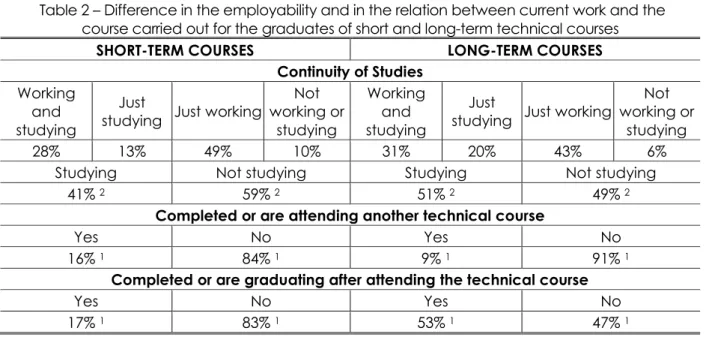
According to Table 2, the percentage of graduates of long-term courses who continued their studies was statistically higher than short-term graduates. While slightly more than half of the graduates in long-term courses declared to study, this percentage for graduates in short-term courses was 41%.
Table 2 – Difference in the employability and in the relation between current work and the course carried out for the graduates of short and long-term technical courses
SHORT-TERM COURSES LONG-TERM COURSES
Continuity of Studies
Working and studying
Just
studying Just working
Not working or studying Working and studying Just
studying Just working
Not working or
studying
28% 13% 49% 10% 31% 20% 43% 6%
Studying Not studying Studying Not studying
41% 2 59% 2 51% 2 49% 2
Completed or are attending another technical course
Yes No Yes No
16% 1 84% 1 9% 1 91% 1
Completed or are graduating after attending the technical course
Yes No Yes No
17% 1 83% 1 53% 1 47% 1
Note: 1 or 2 statistically significant difference at 1 or 5% level. ns = Not significant
The results were not as expected and showed that the more solid training offered by the long-term courses was not enough to reach a threshold where the graduates did not worry about the expansion of their own knowledge. On the contrary, comparatively, they demonstrated a greater search for knowledge.
Another reason that may help explain these results lies on the peculiarities of the short-term courses offered by
Pronatec
. These courses didn’t present greater selection demands, they offer a wide assistance to the students, and the offering unit has to offer the necessary materials, besides guaranteeing the beneficiaries’ transport and feeding (TROGIANI; PEREIRA; CAMPOS; MEDINA, 2012). Moreover, it does not provide the continuation of studies at a higher level (CASTIONI, 2013). Probably, the students of short-term courses offered byPronatec
have greater difficulties in continuing their studies, especially if this assistance given byPronatec
is not being fulfilled.In view of the above, it can be seen that the continuity of the studies is not directly related to the fact of possessing few years of schooling, but rather the opportunity to continue the studies.
In the results of Table 2 it is also noteworthy that 59% of graduates in short-term courses were not studying and 49% of graduates in long-term courses were not continuing the studies as well, in agreement with Sposito and Galvão (2004). According to these authors: [...] the continuity of studies does not seem to be an immediate path for most, the desire to work or to improve professionally for those already in the market becomes more urgent, with the perception of the imminent unemployment or occupational precariousness (SPOSITO; GALVÃO 2004, p. 374).
Also. according to the results presented in Table 2, it is verified that the graduates in the short-term courses who wanted to continue their studies sought intermediate level technical courses. On the other hand, for those who graduated in long-term technical courses the search for higher education courses was higher. These results were expected, considering that 34% of graduates in short-term courses, although all of them over the age of 17 still do not have the full average education. This reality is reinforced by Andrade (2012), pointing out that 48% of young people in Brazil do not have the formal requirements to compete for positions in higher education, since 21% of them did not complete primary education and 27% did not complete secondary education.
The search for technical education at the intermediate and higher levels by the graduates in the short and long term courses, respectively, corroborates the tendency of
education verticalization. According to Verdum (2015), verticalization allows the student to continue his studies, progressing in the area of initial training, this way favoring the continuous organization and reorganization of knowledge, constructing his formative itinerary that ranges from technical education to graduate school. According to the Department of Statistics and Academic Information (Deia), 27% of the students enrolled in 2015 had already taken a course at the institution before, confirming the verticalization of study in the institute.
More than half of the graduates in the long-term technical courses declared that they were attending or had already graduated before, corroborating the results of Souza (2010) and Vieira (2011). In part, this high percentage can be explained by the stigma that hangs over technical education which, unlike higher education, was historically seen as second class (ALVES, 2006).
In the same line of Alves (2006), for Grácio (1986) “the technical school is first and foremost a school for others, or for the children of others”, noting that many parents are reluctant to forward their child to a technical course and young people prefer, for example, to be civil or mechanical engineers rather than building technicians or mechanics, given the status of higher education in Brazil. Distortions of this kind may lead to a training that is not aligned with the needs of the labor market, leading to waste of resources, reduced productivity, and frustration of the workforce.
Course alignment with the labor market
Regarding the alignment of the courses with the labor market, it can be observed that the graduates in short-term courses work closer to the region where they attended the course, as well as indicate that there is a smaller regional job offer in their area in comparison to the perception of graduates in long-term courses. The results of the U-test are found in Table 3 and to facilitate their understanding, the distribution of the responses of the graduates in Figure 1 was presented.
Table 3 – Difference in work distance and regional job offer among graduates in short and long-term technical courses
Core Values of the U-Test
Short-term courses Long-term courses Distance from graduate job to
the training site 258 1 202 1
Source: The authors (2016).
According to the variable codings, the higher the central tendency value the lower the work distance from the graduate to the training site, and the greater the work offer in the campus region. Coding for the question concerning distance from work to the place of training: 1 - Distance greater than 400 km; 2 - Distance between 100 and 400 km; 3 - Distance between 50 and 100 km; 4 - Distance up to 50 km; 5 - Work in the same municipality. Coding for the question on the regional job offer: 1 - There are practically no job offers; 2 - There are few job offers; 3 - There are job offers; 4 - There are many job offers. Figure 1 – Distribution of short and long-term graduates' responses to the distance from their
work to the training campuses and the regional job offer
Source: The authors (2016).
Work in the same municipality Distance up to 50 km Distance between 50 and 100 km Distance between 100 and 400 km Distance greater than
400 Km
Work in the same municipality Distance up to 50 km Distance between 50 and 100 km Distance between 100 and 400 km Distance greater than
400 Km
There are practically no job offers There are few job
offers There are job offers
There are many job offers
There are practically no job offers There are few job
offers There are job offers
There are many job offers
The results indicated that, unlike long-term graduates, there are exceptions for graduates in short-term courses who work outside the municipality in which they graduated (Figure 1). According to Zukowski (2013), not working in the region of technical training should not be necessarily interpreted as a problem of the course alignment with the labor market, reflecting:
It is agreed that professional training offered by IFs should promote employability by first serving the productive sectors. This does not mean that it will only be geared to local and regional development (ZUKOWSKI 2013, p. 146).
The explanation for the lower mobility seen in short-term course graduates to work in different regions of the country may be associated with the course characteristics. The short-term
Pronatec
courses had the purpose of qualifying students in a certain area. It did not lead to higher education and was offered to a public with different education levels, thus, providing a more specific and basic training that probably would not lead to a financial gain that could allow graduates to leave their hometown or region.Given Zukowski’s considerations (2013), the importance of graduates’ perception of regional jobs offer increases as an indication of the alignment of the course with the labor market. In this regard, long-term courses graduates have declared there were many job offers in the training region. This offer was twice as many as short-term ones, suggesting a better alignment of long-term courses to the regional labor market.
The explanation for the more positive perception of graduates in long-term courses, regarding the job offer, is related to the supply and demand law. On the supply side, the rapid expansion of short-term courses can be highlighted in recent years, which may have led to a saturation of professionals with this training in the labor market. This concern was highlighted by Offe (1990), who warned the organization of the course offers, indicating the risk that the excess of skilled workforce would unbalance the supply and demand law, because there would be too many skilled individuals, causing a general salary demotion. On the labor demand side, it should be highlighted the period in which the surveys were carried out. While the MEC survey for long-term courses considered graduates from 2003 to 2007, a period in which the real growth of the Brazilian economy reached an average of 6% per year, the graduates in the short courses analyzed concluded their training from 2013 to 2015, when Brazil recorded an average decline in its real GDP of approximately 1.7% per year (IPEA, 2016).
Quality of the course
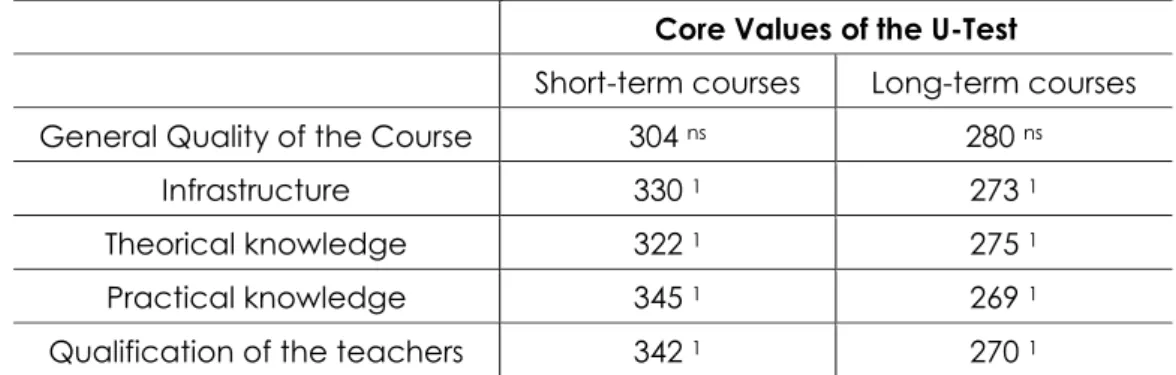
The graduates’ perception on short-term courses, as to the quality of aspects related to infrastructure, teacher qualification, and theoretical and practical knowledge presented in the courses in which they graduated, was superior comparatively to the opinion of the graduates on the long-term courses. However, when questioned about the general quality of the course, no statistical difference was found at the 5% level among the answers, indicating that the judgment about the general quality of the courses goes beyond the aspects addressed in the questionnaire (Table 4).
Table 4 – Difference between the perception of the graduates concerning the quality of the technical courses of short and long-term courses
Core Values of the U-Test
Short-term courses Long-term courses
General Quality of the Course 304 ns 280 ns
Infrastructure 330 1 273 1
Theorical knowledge 322 1 275 1
Practical knowledge 345 1 269 1
Qualification of the teachers 342 1 270 1
Note: 1 or 2 statistically significant difference at the 1 or 5% level. ns = not significant. According to the variable codings, the higher the central tendency value the better the graduate perception in relation to the variables that represent the quality of the courses.
Source: The authors (2016).
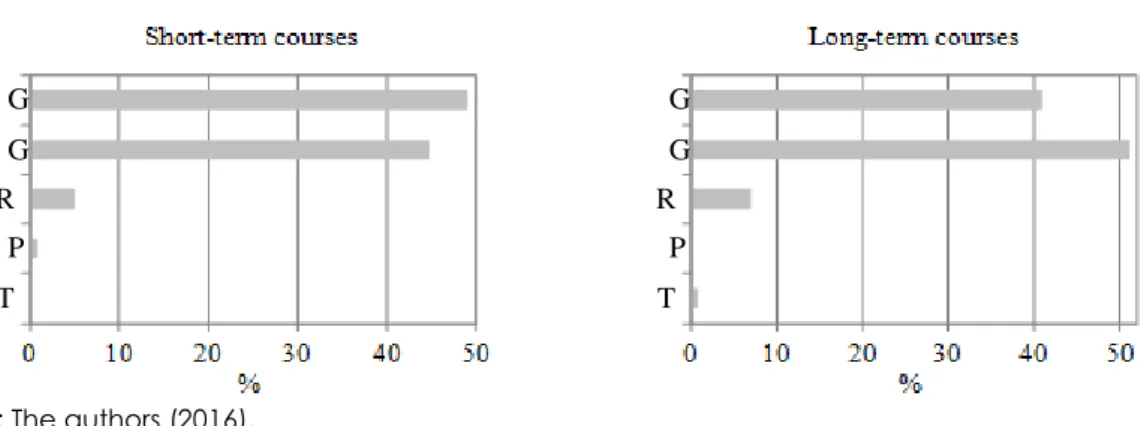
Overall, the quality evaluation of short and long-term courses was very positive, since most of the students' opinions scored the attributes as great or good (Figure 2). The results found were in accordance with Thuler, Bergmann, Cavalcanti, Sant'Ana and Rezende (2013), in which the researched technical course was considered excellent for 57.9% and good for 38.4% of the graduates. The graduates’ perception regarding the quality of long-term technical courses in agriculture carried out by Souza (2010) and Vieira (2011) was also positive and in agreement with the results found. Oliveira, Ferreira and Silva (2019) evaluated professional education financed by Pronatec, and the results indicated high rates of dropout and reproof in the courses offered.
Figure 2 – Distribution of the graduates' responses in relation to the general quality of the short and long-term technical courses
Source: The authors (2016).
Probably one of the reasons that increased the positive evaluation of the technical courses, especially the short-term ones offered by
Pronatec
, is the priority the program has given for students in situation of extreme poverty and with reduced opportunities. It is assumed that a student with a smaller number of opportunities has reduced comparison parameters and, therefore, a less critical vision.Figure 3 contributes to the understanding of the existence of the statistically significant difference between the quality perception of the graduates in short and long term courses for the following aspects: infrastructure, teacher qualification and theoretical and practical knowledge presented in the courses. While the choice of attributes as “great” was common for short-term graduates, most graduates in long-term courses ranked the aspects analyzed as “good”. The responses scored with “terrible” and “poor” attributes were insignificant for both kind of graduates.
G G R P T G G R P T
Figure 3 – Distribution of graduates' answers concerning aspects inherent to the quality of short and long-term technical courses
Source: The authors (2016). G G Re P Te G G Re P Te G G Re P Te G G Re P Te G G Re P Te G G Re P Te G G Re P Te G G Re P Te
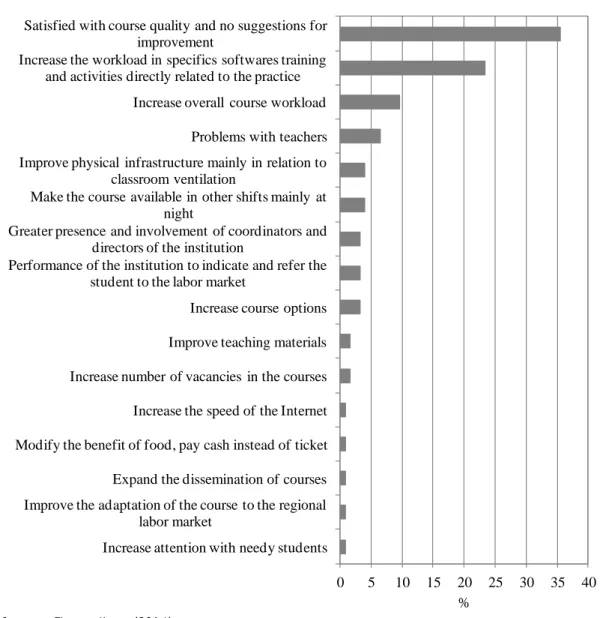
Overall, the results of the closed questions did not identify major problems regarding the quality of the short-term courses of the IFSC, thus, little contributed to the elaboration of intervention strategies. However, these results justified the use of a qualitative approach, which allows to identify some inconsistent problems in the closed questions used in the quantitative method. Content analysis permitted us to summarize 124 suggestions for improvement for the 16 dimensions mentioned in Figure 4.
Figure 4 – Summary of the suggestions of the graduates of the short courses analyzed
Source: The authors (2016).
As shown in Figure 4, the main dimension, comprising 35.5% of the total opinions, confirmed the course quality suggested by the quantitative results, being expressed by comments with compliments or suggestions without improvement such as:
In my humble opinion, you do not need to improve on anything (student 35). The course is great, everything is free: transportation,
0 5 10 15 20 25 30 35 40
Increase attention with needy students Improve the adaptation of the course to the regional
labor market
Expand the dissemination of courses Modify the benefit of food, pay cash instead of ticket Increase the speed of the Internet Increase number of vacancies in the courses Improve teaching materials Increase course options Performance of the institution to indicate and refer the
student to the labor market
Greater presence and involvement of coordinators and directors of the institution
Make the course available in other shifts mainly at night
Improve physical infrastructure mainly in relation to classroom ventilation
Problems with teachers Increase overall course workload Increase the workload in specifics softwares training
and activities directly related to the practice Satisfied with course quality and no suggestions for
improvement
study, food in general. The teachers are all well-qualified to help the students, I really liked it [...] (student 79).
The main suggestion (33.0% of the opinions) was related to the increase in the course workload, especially related to the training in specific software and in activities directly related to the practice of the profession (23.4% of opinions). The following comments:
Increase the workload of AutoCAD and SolidWorks as they are the most used in companies and the most difficult to learn (student 1). More practices and development of day-to-day problems (student 36). More course hours for better qualification (student 103).
The demand for practical activities was also pointed out by the graduates in the long-term agricultural training courses at the IF Catarinense - campus Sombrio (SOUZA, 2010) and in the IF of the Northern Minas Gerais – campus Januária (VIEIRA, 2011) through qualitative cut researches.
Some highlighted criticism was related to teachers’ performance (6,5% of opinions). These critiques addressed empathy problems in the teacher/student relationship, lack of technical qualification, insufficient didactics, teacher substitution throughout the course, among others. In this regard, Alves (2003) pointed out that the quality of a course is largely measured by the quality of its faculty.
It was clear from the students' opinions that teachers’ quality is measured not only by the technical qualification, but also by how much they are prepared to deal with the psychological aspects of the students, given the vulnerability of many of them. In this respect, Trogiani, Pereira, Campos and Medina (2012, p. 55):
Educators themselves need to work on to understand these people, the situation in which they live and their difficulties, to avoid stigma and prejudice. [...] It is difficult to deal with a situation of great social deficit, from drug problems to health problems, inattention, aggression, among others. [...] the educator is vital to the success of the courses and this entity must be well worked.
Similar to Trogiani, Pereira, Campos and Medina (2012), Souza’s graduate survey in 2010 identified teachers’ difficulties with students' behavior.
A relevant aspect that may have affected students' opinions regarding teachers is the hiring of temporary scholarship holders to teach at ICT
Pronatec
courses. Regardless of the advantage of reducing costs, it limits the bonds between teachers and the institution. It is common sense for people working in the IFSC that the program has precarious education in the face of hiring teachers via these means, considered by manyThe other dimensions of Figure 4 obtained a small number of responses that were not very representative. These dimensions included aspects inherent to the courses: infrastructure, time period of the offers (day or evening courses), number of vacancies, course options, didactic material, dissemination, and adaptation of the courses to the labor market. In addition, suggestions were made regarding the need for a greater involvement of the directors and coordinators with the institution, as well as the institution's actions in the referral of students to the job market, as well as greater attention to the needy students. However, this broad set of dimensions had little representativeness and added only 25% of all opinions on open questions, so they are not priority issues that deserve immediate attention.
Regarding the few criticisms about the infrastructure, focusing on the ventilation/ climatization aspects of the classrooms, it is important to mention that, unlike other technical courses, ICT
Pronatec
courses receive specific resources for the purchase of materials and machines. In addition, the students of the ICT courses use the general structure of the Institute, the same used by students in the long-term technical courses.Another important aspect that may help to explain students' positive perception of the IFSC infrastructure is related to the profile of the sample analyzed. The majority of graduates who evaluated the institution's infrastructure was trained in the administrative assistant course, which requires a smaller structure of laboratories, except for the computer lab that recently acquired new computers.
Conclusion
Few graduates of both short and long-term courses are unemployed, with no significant difference in employability between the two types of courses identified. However, the percentage of graduates in long-term courses who reported working in the training area was statistically higher.
The perception of long-term graduates regarding the regional job offer was statistically higher, indicating a greater alignment of training with the regional labor market. The results also indicated that the percentage of graduates in long-term courses working in a different region than that where they graduated was also higher. The understanding is that the more solid training provided by the long-term technical courses allows greater mobility in the choice of work, while the on-the-job training for short-term graduates may be associated with the employment to secondary jobs or non-formal
jobs. Therefore, the conclusion is that long-term courses have been more closely aligned with the regional employment offer, although this does not seem to be a critical problem for the two types of courses, given that the perception of both graduates regarding the regional job offer was positive.
The percentage of long-term graduates who continued their studies was higher than those in short-term courses, indicating that the continuity of the studies in the present case is not related to the fact of having fewer years of schooling, but the opportunities of study. The results also indicated a tendency of verticalization in the graduates’ training, while graduates in short-term courses prioritized the continuation of their studies in a long-term technical course, graduates in long-term courses sought higher education.
The quality of the short and long-term courses was well evaluated by the graduates, highlighting a very positive perception of the short-term courses on the IFSC infrastructure, the theoretical and practical knowledge taught in the courses, and the qualification of the teachers. The suggestions the graduates offered are mostly related to the increase in the hours of the course, specifically in the training of software and specific activities related to the practice of each profession.
In view of the results found it is concluded that the short courses offered through
Pronatec
were effective in its purpose, which is to increase the offer of courses and to allow the continuity of individuals’ studies and qualification, providing more opportunities of insertion in the job market. However, benchmarking with the long-term courses in the southern region of Brazil showed that the longer-term courses offer work opportunities in different regions of the country and a more selective choice of employment.References
ALVES, H. M. B. Uma abordagem de marketing à satisfação do aluno no ensino
universitário público: índice, antecedentes e consequências. 2003. 286 f. Tese
(Doutorado em Gestão) - Departamento de Gestão e Economia, Universidade da Beira Interior, Covilhã, Portugal, 2003.
ALVES, L. A. M. Ensino técnico: da formação de produtores ao capital humano. In: CONGRESSO LUSO BRASILEIRO DE HISTÓRIA DA EDUCAÇÃO, 6., 2006, Uberlândia, MG. Anais [...]. Uberlândia: [s. n.], 2006.
ANDRADE, C. Y. de. Acesso ao ensino superior no Brasil: equidade e desigualdade social. Revista Ensino Superior Unicamp, Campinas, SP, 31 jul. 2012. Available in: https://www.revistaensinosuperior.gr.unicamp.br/artigos/acesso-ao-ensino-superior-no-brasil-equidade-e-desigualdade-social. Access in: 29 apr. 2016.
ANDRIOLA, W. B. Factores caracterizadores de centros educativos eficazes. Bordón: Revista de Pedagogía, Madrid, v. 53, n. 2, p. 175-184, 2001.
ANDRIOLA, W. B. Estudo de egressos de cursos de graduação: subsídios para a autoavaliação e o planejamento institucionais. Educação em Revista, Curitiba, n. 54, p. 203-219, 2014. DOI: https://doi.org/10.1590/0104-4060.36720. Available in: http://www.scielo.br/pdf/er/n54/a13n54.pdf. Access in: 29 apr. 2016.
BARDIN, L. Análise de conteúdo. São Paulo: Edições 70, 2011.
BRASIL. Controladoria Geral da União. Pronatec. In: BRASIL. Controladoria Geral da União. Programas de Governo, Brasília, DF: CGU, [2020]. Available in:
http://www.portaltransparencia.gov.br/programas-de-governo/14-pronatec?ano=2019. Access in: 8 mar. 2020.
BRASIL. Lei nº 12.513 de 26 de outubro de 2011. Institui o Programa Nacional de Acesso ao Ensino Técnico e Emprego (Pronatec); [...]. Diário Oficial da União, Brasília, DF, 27 out. 2011. Available in:
http://www.planalto.gov.br/ccivil_03/_ato2011-2014/2011/lei/l12513.htm. Access in: 22 nov. 2014.
BRASIL. Ministério da Educação. Pronatec. Brasília, DF, [2014]. Available in: http://pronatec.mec.gov.br/index.php. Access in: 12 mar. 2014.
BOTH, I. J. Avaliar a universidade é preciso: agente de modernização administrativa e da educação. In: SOUZA, E. C. B. M. (org.). Avaliação institucional. 2. ed. Brasília, DF: Editora UnB, 1999.
BORGES, R. M.; ROTHEN, J. C. Avaliação educacional brasileira na década de 1980: o campo entre duas abordagens. Meta: Avaliação, Rio de Janeiro, v. 11, n. 31, p. 36-66, 2019. Available in:
http://revistas.cesgranrio.org.br/index.php/metaavaliacao/article/view/1678/pdf. Access in: 8 mar. 2020.
CÂMARA, R. H. Análise de conteúdo: da teoria à prática em pesquisas sociais aplicadas às organizações. Gerais: Revista Interinstitucional de Psicologia, Minas Gerais, v. 6, n. 2, p. 179-191, 2013. Available in:
http://pepsic.bvsalud.org/pdf/gerais/v6n2/v6n2a03.pdf. Access in: 29 apr. 2016. CASTIONI, R. Planos, projetos e programas de educação profissional: agora é a vez do PRONATEC. Sociais e Humanas, Santa Maria, RS, v. 26, n. 1, p. 25-42, 2013.
Available in: https://periodicos.ufsm.br/sociaisehumanas/article/view/5921. Access in: 29 apr. 2016.
CASTRO, A. K. D. dos S. S. de; TEIXEIRA, M. A. P. Evasão universitária: modelos teóricos internacionais e o panorama das pesquisas no Brasil. Psicologia Argumento, Curitiba, v. 32, p. 9-17, 2014. Available in:
https://www.researchgate.net/publication/325075876_Evasao_universitaria_modelos _teoricos_internacionais_e_o_panorama_das_pesquisas_no_Brasil. Access in: 29 apr. 2016.
DUTRA, R. S.; COELHO, A. C. D.; DUTRA, G. B. M. Indicadores educacionais e
proficiência no ENEM: um estudo nos institutos federais do Brasil. Meta: Avaliação, Rio de Janeiro, v. 11, n. 31, p. 124-153, 2019. Available in:
http://revistas.cesgranrio.org.br/index.php/metaavaliacao/article/view/1781. Access in: 8 mar. 2020.
FERES, M. M.; PATRÃO, C. N. (coord.). Pesquisa nacional de egressos dos cursos
técnicos da rede federal de educação profissional e tecnológica (2003-2007).
Brasília, DF: MEC, 2009.
MEC abandona Pronatec e lança novo programa para formação técnica. Gazeta
do Povo, Curitiba, 8 out. 2019. Educação. Available in:
https://www.gazetadopovo.com.br/educacao/mec-abandona-pronatec-e-lanca-novo-programa-para-formacao-tecnica/. Access in: 8 mar. 2020.
GOMES, C. A. A qualificação resignada: a má formação da força de trabalho como um problema estrutural do desenvolvimento brasileiro. Orientador: Waldir José de Quadros. 2011. 427 f. Tese (Doutorado em Educação) – Faculdade de
Educação, Universidade Estadual de Campinas, Campinas, SP, 2011.
GRÁCIO, S. Política educativa como tecnologia social: as reformas do ensino técnico de 1948 e 1983. Lisboa: Livros Horizonte, 1986.
HOFFMANN, R. Estatística para economistas. 4. ed. São Paulo: Pioneira Thomson Learning, 2006.
INSTITUTO FEDERAL DE EDUCAÇÃO, CIÊNCIA E TECNOLOGIA DE SANTA CATARINA.
Plano de desenvolvimento institucional 2015-2019. Florianópolis: IFSC, 2017. Available
in: https://pdi.ifsc.edu.br/files/2015/07/PDI_IFSC_revisado_2017.pdf. Access in: 12 mar. 2020.
IPEA. Dados. Brasília, DF, [2016]. Available in: http://www.ipeadata.gov.br. Access in: 29 apr. 2016.
LIMA, M.; PACHECO, Z. S. T. de A. As políticas públicas e o direito à educação: Programa Nacional de Acesso ao Ensino Técnico e Emprego versus Plano Nacional de Educação. Educação e Sociedade, Campinas, SP, v. 38, n. 139, p. 489-504, 2017. DOI: https://doi.org/10.1590/es0101-73302017167752. Available in:
http://www.scielo.br/pdf/es/v38n139/1678-4626-es-es0101-73302017167752.pdf. Access in: 8 mar. 2020.
MARTINS, S. G.; SANTOS, A. S.; CARVALHO, L. M. O benchmarking e sua
aplicabilidade em unidades de informação: uma abordagem reflexiva. Revista
Interface, Nova Iguaçu, RJ, v. 7, n. 1, p. 57-68, 2010. Available in:
http://repositorio.ufrn.br:8080/jspui/bitstream/123456789/19021/1/Martins_Santos_Car valho_2010_O-Benchmarking-e-sua-aplicabil_6707.pdf. Access in: 8 mar. 2020. MELO, A. M.; CARPINETTI, L. C.; SILVA, W. T. Proposta de metodologia para
identificação de objeto de estudo de benchmarking. In: ENCONTRO NACIONAL DE ENGENHARIA DE PRODUÇÃO, 20., 2000, São Paulo. Anais [...]. São Paulo: Abepro, 2000.
NERES, I. V. Comparação do perfil e da situação entre o aluno evadido e o egresso
da faculdade UnB / Planaltina – FUP. Orientador: Alexandre Nascimento de
Almeida. 2015. 92 f. Dissertação (Mestrado em Gestão Pública) - Faculdade UnB de Planaltina, Universidade de Brasília, Brasília, DF, 2015.
OLIVEIRA, A. D.; FERREIRA, V. A.; SILVA, C. M. C. de S. e. Implications of
concomitance in technical education financed by Pronatec in the Mato Grosso do Sul state education network (2012-2015). Ensaio: Avaliação e Políticas Públicas em Educação, Rio de Janeiro, v. 27, n. 103, p. 406-425, 2019. DOI:
https://doi.org/10.1590/s0104-40362019002701715. Available in: http://www.scielo.br/pdf/ensaio/v27n103/1809-4465-ensaio-S0104-40362019002701715.pdf. Access in: 8 mar. 2020.
OFFE, C. Sistema educacional, sistema ocupacional e política da educação: contribuição à determinação das funções sociais do sistema educacional.
Educação e Sociedade, Campinas, SP, v. 13, n. 35, p. 9-59, 1990.
PESTANA, M. H.; GAGEIRO, J. N. Análise de sados para ciências sociais: a complementaridade do SPSS. 4. ed. Lisboa: Edições Silabo, 2005.
SANTOS, G. D.; TAKAOKA, H. Qualidade da informação no ambiente acadêmico – estudo de caso de um sistema de acompanhamento de egressos utilizando QFD. In: ENCONTRO DA ANPAD, 31., 2007, Rio de Janeiro. Anais [...]. Rio de Janeiro: ANPAD, 2007. Available in: http://www.anpad.org.br/diversos/down_zips/33/ADI-B770.pdf. Access in: 22 nov. 2014.
SEVERNINI, E. R.; ORELLANO, V. I. F. O efeito do ensino profissionalizante sobre a probabilidade de inserção no mercado de trabalho e sobre a renda no período pré-Planfor. Revista Economia, Brasília, DF, v. 11, n. 1, p. 155-174, jan./abr. 2010.
SOUZA, M. L. H. Avaliação da efetividade dos principais cursos FIC Pronatec do
Instituto Federal de Santa Catarina: benchmarking com cursos técnicos de linga
duração. Orientador: Alexandre Nascimento de Almeida. 2016. 74 f. Dissertação (Mestrado em Gestão Pública) – Faculdade de Planaltina, Universidade de Brasília, Brasília, DF, 2016.
SOUZA, F. J. de; SOUZA, J. S.; ELLIOT, L. G.; HILDENBRAND, L. Avaliação da educação superior no Brasil: do provão ao ENADE: um estudo meta-avaliativo. Meta:
Avaliação, Rio de Janeiro, Edição Especial, n. 2, p. 22-42, 2018. DOI: http://dx.doi.org/10.22347/2175-2753v10i0.1956. Available in:
http://revistas.cesgranrio.org.br/index.php/metaavaliacao/article/view/1956/pdf. Access in: 8 mar. 2020.
SOUZA, S. C. L. de. A contribuição da educação profissional para a inserção dos
alunos no mercado de trabalho da microrregião do extremo Sul Catarinense: caso
IF campus Sombrio. Orientador: Olgamir Francisco de Carvalho. 2010. 117 f.
Dissertação (Mestrado em Educação) - Universidade de Brasília, Brasília, DF, 2010. SPENDOLINI, M. J. Benchmarking. São Paulo: Makroon Books, 1993.
SPOSITO, M. P.; GALVÃO, I. A experiência e as percepções de jovens na vida escolar na encruzilhada das aprendizagens: o conhecimento, a indisciplina, a violência.
Perspectiva, Florianópolis, v. 22, n. 2, p. 345-380, 2004. DOI:
https://doi.org/10.5007/%25x. Available in:
https://periodicos.ufsc.br/index.php/perspectiva/article/view/9649/8876. Access in: 22 nov. 2014.
THULER, L. C. S.; BERGMANN, A.; CAVALCANTI, I. L.; SANT'ANA, J. M. B.; REZENDE, M. C. R. Perfil dos egressos dos cursos do Instituto Nacional de Câncer José Alencar
Gomes da Silva: pós-graduação lato sensu e nível técnico. Revista Brasileira de
Cancerologia, Rio de Janeiro, v. 59, n. 4, p. 505-512, 2013. Available in:
http://www1.inca.gov.br/rbc/n_59/v04/pdf/03-artigo-perfil-dos-egressos-dos-cursos- do-instituto-nacional-de-cancer-jose-alencar-gomes-da-silva-pos-graduacao-lato-sensu-nivel-tecnico.pdf. Access in: 22 nov. 2014.
TROGIANI, C. de R.; PEREIRA, L. V.; CAMPOS, L. H. de; MEDINA, M. A. L. Desafios para
a implementação do programa PRONATEC/Osasco sem miséria. Orientador: Marco
Antônio Carvalho Teixeira. 2012. 150 f. Dissertação (Mestrado em Gestão e Políticas Públicas) – Escola de Administração Pública de São Paulo, Fundação Getúlio Vargas, São Paulo, 2012.
VERDUM, P. de L. Formação inicial de professores para a educação básica, no
contexto dos IFs: propondo indicadores de qualidade, a partir de um estudo de
caso no IFRS. Orientadora: Lucia Maria Martins Giraffa. 2015. 281 f. Tese (Doutorado em Educação) - Programa de Pós-Graduação em Educação, Pontifícia
Universidade Católica do Rio Grande do Sul, Porto Alegre, 2015.
VIEIRA, C. L. da S. Os egressos do Instituto Federal do Norte de Minas Gerais -
Orientador: Remi Castioni. 2011. 137 f. Dissertação (Mestrado em Educação) – Faculdade de Educação, Universidade de Brasília, Brasília, DF, 2011.
WALDOW, C. As políticas educacionais do governo Dilma, a formação para o trabalho e a questão do PRONATEC: reflexões iniciais. In: SEMINÁRIO DE PESQUISA EM EDUCAÇÃO NA REGIÃO SUL, 10.; REUNIÃO CIENTÍFICA REGIONAL DA ANPED, 10., 2014, Florianópolis. Anais [...]. Florianópolis: ANPED, 2014. Available in:
http://xanpedsul.faed.udesc.br/arq_pdf/1765-0.pdf. Access in: 29 apr. 2016.
ZUKOWSKI, N. B. S. Estudo comparativo entre o ensino médio integrado e o técnico
subsequente no IFTO-câmpus Palmas: formação, empregabilidade, satisfação.
Orientador: Bernardo Kipnis. 2013. 169 f. Dissertação (Mestrado em Educação) – Faculdade de Educação, Universidade de Brasília, Brasília, DF, 2013.