U
NIVERSIDADE DEL
ISBOA Faculdade de Motricidade HumanaC
OACHING ABROAD:
TEACHING THE GAME DEVELOPING A YOUTH SOCCER PLAN FROM THE U.
S.
FIELDA Logbook of an experience as a coach at Global Premier Soccer, Charleston, South Carolina, United States of America
Internship Report submitted in fulfilment of the requirements for obtaining the masters title in Sports Coaching
Advisor: Master Óscar Miguel Farias Fialho Tojo
Jury:
President: Doctor Fernando Paulo Oliveira Gomes Vogals: -Doctor José Maria Dionísio Calado Pratas
-Master Óscar Miguel Farias Fialho Tojo
Diogo André Direitinho Nunes de Almeida 2018
2 Soccer internship report presented to Faculdade de Motricidade Humana, as a requirement to obtain the masters title in Sports Coaching, with technical and scientific orientation, guided by professor Óscar Tojo.
3 ACKNOWLEDGEMENTS
First of all, thank you Mom! For providing me the opportunities to pursue my objectives, keeping the standards high, demanding the best of myself every day. To my father, for dawned a huge passion and addiction to sports, concretely to soccer. To my brother, for being always me reference of work and success. To my family that directly contributed to the conclusion of this document.
A big thank you to Global Premier Soccer, for providing me the opportunity to coach abroad, welcoming and giving me the conditions to work towards success. A very enrich experience in a personal and professional level, that contributed a lot for my development.
To the teachers Óscar Tojo and Ricardo Duarte for the support and cooperation during this journey, guiding and allowing me to conclude this paper.
To my Friends, that supported me during this period. They made me believe that success would come after hard work, although I would need to be ambitious, raising the expectations.
To conclude, a massive thank you to the institution that gave me a diversity of
knowledge, making me better prepared to face the challenges every day. It is my “second home”. Thank you, Faculdade de Motricidade Humana.
4 ABSTRACT
The aim of this report consists in describing personal experiences and feelings about a coaching activity working abroad. It is intended to explain and reflect on a daily activity as a coach of youth soccer, with self-reflections about his performance and behaviors.
The first area of this paper includes a logbook, defining some training and competitive moments. It reports some feelings, experiences and thoughts during the activity, with the purpose of make a self-reflection about the event every day.
Following that, it was analyzed the planning of a season, of the three different age groups, detailed research in each practice while taking into consideration the time planed for each exercise: SAQ, Playful, Technical exercises, Fundamental Forms, Complementary Forms and Regular game. Associating the data obtained with the development stages of the athletes and game formats, it was proposed an adjustment to the youth soccer planning.
In conclusion, it is mentioned the characterization, description and balance of an event developed by the internship group. The soccer day at Faculdade de Motricidade Humana with the theme “Training to compete: the different dimensions of the football training process”. This event provided the opportunity of knowledge and experiences sharing between youth and professional coaches.
Key-words: Soccer, Coaching, Logbook, Youth development, Teaching the game, Game
5 RESUMO
O objetivo deste relatório consiste em descrever uma experiência pessoal e os sentimentos de um treinador no estrangeiro. Uma reflexão sobre a rotina diária do treinador de futebol juvenil, com autorreflexões sobre os seus comportamentos e desempenho.
A primeira área inclui um diário de bordo, narrando alguns momentos de treino e competitivos. Sentimentos, experiências e pensamentos durante a atividade, com o objetivo de uma autorreflexão diária sobre o dia.
De seguida, foi analisado o planeamento de uma época, de três escalões diferentes, com uma análise detalhada sobre cada unidade de treino, tendo em consideração o tempo planeado para cada uma das seguintes categoria de exercícios: coordenação motora, recreativo, técnico, formas fundamentais, formas complementares e jogo regular. Posteriormente, foi realizada uma associação com os estádios de desenvolvimento dos atletas e formatos de jogo, sendo proposta uma adaptação para o modelo de futebol juvenil.
Em conclusão, é descrito um evento realizado pelo grupo de estágio. O dia do futebol na Faculdade de Motricidade Humana, com o tema: Treinar para competir: as diferentes dimensões do processo de treino. Este evento proporcionou a partilha de conhecimentos e experiências entre treinadores de futebol juvenil e profissional.
Palavras-chave: Futebol, Treino, Diário de bordo, Desenvolvimento de jovens, Ensino do jogo,
6 CONTENTS
1. INTRODUCTION ... 10
1.1. Contextualization of the internship ... 10
1.1.1. Club/Company ... 10 1.1.2. Conditions/Facilities ... 11 1.1.3. Competition... 11 1.2. Objectives ... 15 1.3. SWOT Analysis... 16 1.3.1. Strategies to Implement ... 17
1.4. Structure of the document ... 18
2. LITERATURE REVIEW ... 19
2.1. The game ... 19
2.2. Development stages... 22
2.3. The Coach ... 24
2.4. Logbook ... 28
3. THE LOGBOOK OF A COACH WORKING ABROAD: A SELF-REFLECTION... 29
3.1. Introduction ... 29
3.2. Logbook ... 29
3.2.1. Spring 2017 Season... 29
3.2.2. Summer 2017 Season ... 43
3.3. Reflection ... 55
4. PURPOSE OF INTERVENTION ON THE YOUTH SOCCER MODEL: A GUIDDING DOCUMENT ... 57
4.1. Introduction ... 57
4.2. Methodology ... 58
7 4.4. Data Analysis ... 59 4.4.1. 7v7 game format ... 59 4.4.2. 9v9 game format ... 65 4.4.3. 11v11 game format ... 71 4.5. Reflection/Conclusion ... 77 4.6. Innovation/Practical suggestion ... 86
5. TRAINING TO COMPETE: THE DIFFERENT DIMENSIONS OF THE TRAINING PROCESS IN SOCCER ... 90 5.1. Introduction ... 90 5.2. Event Description ... 90 5.3. Event... 92 5.4. Balance ... 95 6. CONCLUSION/FINAL THOUGHTS ... 96 7. REFERENCES ... 98
8 TABLES INDEX
Table 1. Fall 2016 season competitive schedule ... 12
Table 2. Spring 2017 season competitive schedule ... 13
Table 3. Summer 2017 season competitive schedule ... 14
Table 4. Fall 2017 season competitive schedule ... 15
Table 5. Association between phases, forms and technical-tactical actions. ... 20
Table 6. Coaching objectives for developing athletes’ outcomes in different contexts ... 26
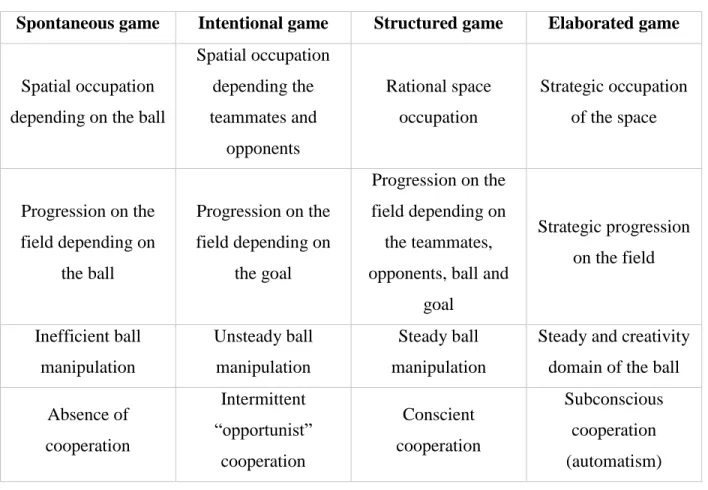
Table 7. Game domain levels ... 58
Table 8. Time and percentage of each exercise category. ... 59
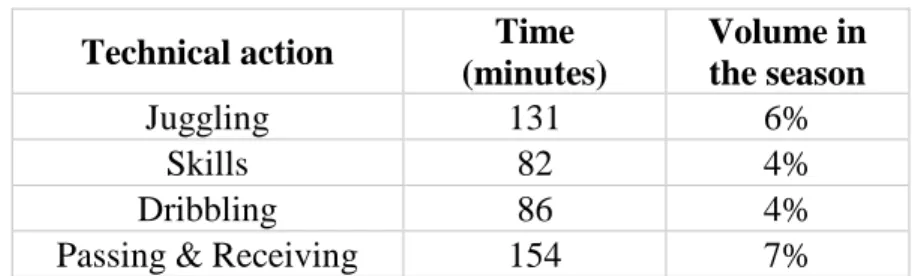
Table 9. Time and percentage of each technical action. ... 60
Table 10. Time and percentage of each phase. ... 60
Table 11. Time and percentage of the numerical relation. ... 60
Table 12. Time and percentage of each exercise category. ... 61
Table 13. Time and percentage of the number of defenders. ... 61
Table 14. Time and percentage of the number of attackers. ... 61
Table 15. Time and percentage of each phase. ... 62
Table 16. Time and percentage of each exercise category. ... 62
Table 17. Time and percentage of the number of defenders. ... 63
Table 18. Time and percentage of the number of attackers. ... 63
Table 19. Time and percentage of each phase. ... 63
Table 20. Time and percentage of each exercise category. ... 64
Table 21. Time and percentage of the number of defenders. ... 64
Table 22. Time and percentage of the number of attackers. ... 64
Table 23. Time and percentage of each phase. ... 65
Table 24. Time and percentage of each exercise category. ... 65
Table 25. Time and percentage of each technical action. ... 66
Table 26. Time and percentage of each phase. ... 66
Table 27. Time and percentage of each numerical relation. ... 66
Table 28. Time and percentage of each exercise category. ... 67
Table 29. Time and percentage of the number of defenders. ... 67
9
Table 31. Time and percentage of each phase. ... 68
Table 32. Time and percentage of each exercise category. ... 68
Table 33. Time and percentage of the number of defenders. ... 69
Table 34. Time and percentage of the number of attackers. ... 69
Table 35. Time and percentage of each phase. ... 69
Table 36. Time and percentage of each exercise category. ... 70
Table 37. Time and percentage of the number of defenders. ... 70
Table 38. Time and percentage of the number of attackers. ... 70
Table 39. Time and percentage of each phase. ... 71
Table 40. Time and percentage of each exercise category. ... 71
Table 41. Time and percentage of each technical action. ... 71
Table 42. Time and percentage of each phase. ... 72
Table 43. Time and percentage of each numerical relation. ... 72
Table 44. Time and percentage of each exercise category. ... 73
Table 45. Time and percentage of the number of defenders. ... 73
Table 46. Time and percentage of the number of attackers ... 73
Table 47. Time and percentage of each phase. ... 74
Table 48. Time and percentage of each exercise category. ... 74
Table 49. Time and percentage of the number of defenders. ... 75
Table 50. Time and percentage of the number of attackers. ... 75
Table 51. Time and percentage of each phase. ... 75
Table 52. Time and percentage of each exercise category. ... 76
Table 53. Time and percentage of the number of defenders. ... 76
Table 54. Time and percentage of the number of attackers. ... 76
Table 55. Time and percentage of each phase. ... 77
Table 56. Association between the offensive game specific principles, forms and constraints. .. 79
Table 57. Association between the defensive game specific principles, forms and constraints. .. 80
Table 58. Association between the offensive team's principles, forms and constraints. ... 81
Table 59. Association between the defensive team's principles, forms and constraints. ... 82
Table 60. Association between the sectoral work, forms and constraints. ... 84
10 1. INTRODUCTION
1.1.Contextualization of the internship
In August 2016, I accepted the offer to go abroad and work for Global Premier Soccer, in the region of Charleston, South Carolina, United States of America. This opportunity emerged after I had sent my Curriculum Vitae in answer of a job announcement, and successfully passed in the interviews and requirements. Along with that, I have done my internship in the club GPS NASA during the Fall 2016, Spring 2017, Summer 2017 and Fall 2017 seasons, from August 2016 to December 2017. Throughout this period, I have coached multiple teams and age groups. I was simultaneous the head coach of the U9, U10 and U13 age groups during the Fall 2016 and Spring 2017 seasons. In the Summer 2017, I have been head coach of the U9 GPS Carolina Elite Team and assistant coach of the U16 GPS Carolina Elite Team. Lastly, the head coach of the U9, U11 and U14 teams in the Fall 2017 season.
1.1.1. Club/Company
Global Premier Soccer (GPS) is a soccer club founded in Massachusetts, in 2001. Originally named Massachusetts Premier Soccer, it changed to the actual name in 2012. In 2014 has begun an extensive partnership with Bayern Munich, becoming the official North American partner. Nowadays, GPS covers 23 states in America, plus Canada, Puerto Rico, Spain and United Kingdom. The mission of the club is to be a leader in the development and growth of soccer across North America and beyond. Establish an identify of excellence, pursuing the pathway to success on and off the field. The primary focus is being the development of players and people, who can compete at the highest level of soccer around the world.
GPS Carolina is the club that oversees the clubs in the states of South Carolina and North Carolina, based in different locations. The club runs an Elite program with the purpose of bringing the best players from within our Global Premier Soccer network of clubs to compete on elite-level teams during the summer months. I coached two of the GPS Carolina Elite – Charleston teams during this period.
During the Fall and Spring seasons, I am coaching in the club GPS NASA (North Area Soccer Association), based in North Charleston. The club has 33 teams from the U8 to the U19 age groups, boys and girls (24 are boys teams, 9 are girls teams). The teams are differentiated in tiers: 1st team – maroon; 2nd team – white; 3rd team – black. In addition to the travel soccer program,
11 the club also runs different programs like recreational soccer, juniors programs and summer camps, that I had the opportunity to get involved.
1.1.2. Conditions/Facilities
The club GPS NASA has associations with various high schools, supporting their soccer programs providing playing opportunities to the students. The schools Cathedral Academy and R.B. Stall High School allow the club to use their facilities to practice. The space available is: two baseball fields, two softball fields, two football fields and one multi-purpose field with capacity to fit two 11v1 fields. All the fields have grass surface, with a total capacity to fit: four 11v11, three 7v7 and one 9v9 fields.
The practices are from Monday to Thursday, from 6pm to 8.30pm, with an hour of Technical Training on Fridays (combined session available for the teams that only practice twice a week). Every session is seventy-five minutes. The first session starts at 6pm and the second at 7.15pm. There is no interval between sessions. My schedule is: 2008 Boys Maroon Team (Monday and Wednesday at 6pm; 2007 Boys White Team (Tuesday and Thursday at 6pm); 2004 Boys White Team (Monday, Tuesday and Wednesday at 7.15pm); Technical Training on Fridays.
I have the following stuff available to use in practices: two bags of ten 10 balls, one size 4’s the other size 5’s; forty cones with four different colors; ten pennies of one color and 5 of a different one; poles and coordination ladders; various pop-up goals of different sizes; regular goals of different sizes. The balls, cones and pennies are personal, whilst the SAQ stuff and goals I share with the other coaches.
1.1.3. Competition
A calendar year in the United States Soccer Federation is divided in various seasons, that changes according to the different states. In the state of South Carolina, the organization responsible for the youth soccer is the South Carolina Youth Soccer Association. The season’s split is:
12 • Spring Season from January to May. The U14 and above age groups play High School
season, while the U13 and below age groups play a regular club season;
• Summer Season from May to August. This is an interval between the Spring and Fall seasons, where only the elite players have practices and competitions. This time of the year is occupied with summer camps and activities;
• Fall Season from August to December. There is only club practices and competitions, across the U8 to U19 age groups;
• Winter Season from December to January. This is a break between the Fall and Spring seasons. It is the time to prepare the older players for the High School tryouts, while some of the teams compete in Futsal Leagues.
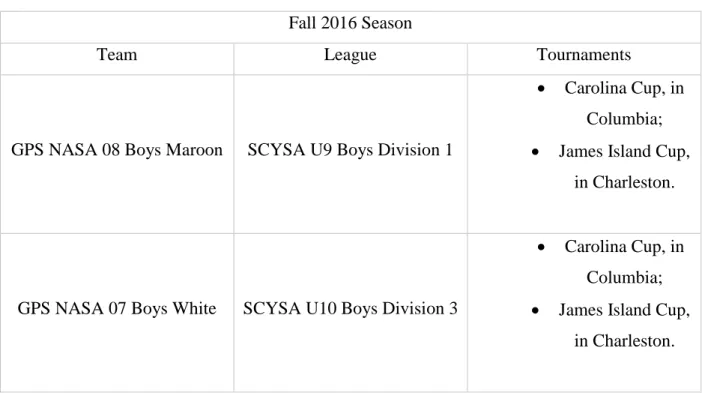
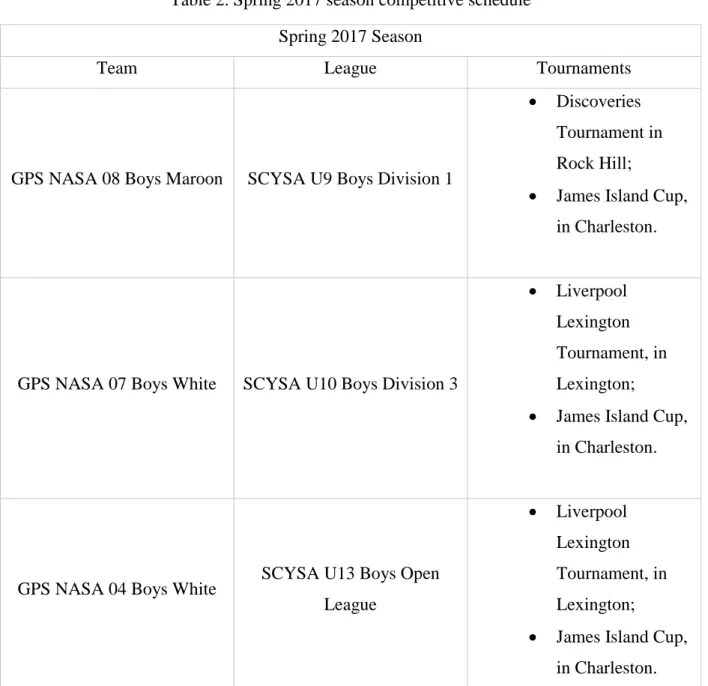
Each season has different competitive moments. Even the leagues and teams can be the same between the Spring and the Fall season, the competitions are independent. In the Spring season there is also high school competitions (leagues and tournaments). The Summer season consists only in tournaments. The tables below are showing the teams and competitions attended in every season.
Table 1. Fall 2016 season competitive schedule Fall 2016 Season
Team League Tournaments
GPS NASA 08 Boys Maroon SCYSA U9 Boys Division 1
• Carolina Cup, in Columbia; • James Island Cup,
in Charleston.
GPS NASA 07 Boys White SCYSA U10 Boys Division 3
• Carolina Cup, in Columbia; • James Island Cup,
13 GPS NASA 04 Boys White SCYSA U13 Boys Open
League
• Discoveries Tournament in
Rock Hill; • James Island Cup,
in Charleston.
Table 1. Fall 2016 season competitive schedule
Table 2. Spring 2017 season competitive schedule Spring 2017 Season
Team League Tournaments
GPS NASA 08 Boys Maroon SCYSA U9 Boys Division 1
• Discoveries Tournament in Rock Hill;
• James Island Cup, in Charleston.
GPS NASA 07 Boys White SCYSA U10 Boys Division 3
• Liverpool Lexington Tournament, in Lexington;
• James Island Cup, in Charleston.
GPS NASA 04 Boys White SCYSA U13 Boys Open League
• Liverpool Lexington Tournament, in Lexington;
• James Island Cup, in Charleston.
14 Table 3. Summer 2017 season competitive schedule
Summer 2017 Season
Team Tournaments
GPS Carolina Elite – Charleston 2009 Boys Team
• Savannah Tournament, in Savannah, GA; • GPS Carolina Summer Showcase, in Charllote, NC. GPS Carolina Elite – Charleston 2001 Boys Team
• GPS Carolina Summer Showcase, in Charllote, NC. • XVI National Cup
– Southeast Regional Tournament, in Winston-Salem, NC.
15 Table 4. Fall 2017 season competitive schedule
Fall 2017 Season
Team League Tournaments
GPS NASA 09 Boys Maroon SCYSA U9 Boys Division 1
• GPS NASA Fall Kick Off, in
Charleston; • James Island Cup,
in Charleston.
GPS NASA 07 Boys White SCYSA U11 Boys Division 2
• GPS NASA Fall Kick Off, in
Charleston; • James Island Cup,
in Charleston.
GPS NASA 04 Boys White SCYSA U14 Boys Open League
• GPS NASA Fall Kick Off, in
Charleston; • James Island Cup,
in Charleston.
1.2.Objectives
My main intention when I accepted this purpose was to understand the reality of soccer game and training in a different country, particularly in a country where the soccer is not the main sport.
I knew it would be an excellent opportunity to develop the English language (speaking and understanding) in general, because it is the universal language, but especially the soccer specific terminology. This experience will definitely enrich my knowledge and future opportunities in other countries.
16 Working in a totally different environment from Portugal made me adapt my coaching style, without losing my identity, as I challenge to deal with children of a different culture and knowledge of the game. Their points of view are based on working in a philosophy based and directed to technical actions more than specific game principles. At the same time, I tried to introduce my own ideas of the game and game teaching.
Obtaining the UEFA B coaching level that is international recognized, allowing me to continue my coaching formation abroad.
Understanding the importance and dynamics of an office role related to coaching and sports management, an opportunity that I didn’t have at my previous clubs. I was responsible for tasks such as tournament organization and registration, strategies of communication, especially with the parents, activities management and preparation and propagation of events.
1.3.SWOT Analysis
Strengths and Weaknesses Strengths:
- Perception of feelings and emotions by the players; - Global observation of what’s happening in the session; - Dynamic of sessions;
- Interaction with the players before, during and after the session; - Communication and feelings transmission;
- Capacity to adapt to different situations.
Weakness:
- Clearly expression in English idiom (direct and totally clarify messages); - Observation of the opponent team during the game;
17 Opportunities and Threats
Opportunities:
- Implement new ideas of training and a different from to teach the game; - Make the players thinking the game, making decisions by himself;
- Introduce drills as related to the game as possible (playing forms and small-sided games);
- Develop extra-game tasks, especially communication with parents.
Threats:
- British ideas have a big strength in this environment; - Lack of concentration by the players;
- Low perception of the game by the players. 1.3.1. Strategies to Implement
Understanding the environment and the culture in USA, knowing the dynamics of the kids and routines in the club, adapting myself to it and integrate me perfectly. Be part of the culture (country and club) is a very important point, in my opinion, to succeed.
It is also important to develop my speech and understand the language as soon as possible to make perfect communication with the athletes and avoid distractions/barriers with my accent or errors.
I plan to introduce my own ideas of the game and game teaching, incorporating them into the club philosophy. It is very necessary to recognize the knowledge of the game and game concepts by the players and after it teach my own ideas and definitions, adapting them to the old ones (in kinds of terms).
Getting involved in the office tasks, knowing the dynamics behind the game, understanding clearly my office role and trying to support in this “off-coaching” tasks as much as possible.
18 1.4.Structure of the document
This document is composed by seven chapters, in which are inserted the three areas of the internship. Area 1: Management of the training and competition process; Area 2: Innovation and investigation; Area 3: Relation with the community. It is a document mainly based on my job as a coach in a different country and culture, reporting personal experiences and thoughts, problems of my daily work and how did I get adapted to this new context.
The first chapter is the contextualization of the internship and club, with a brief description of the company’s role in youth sports (specifically soccer), the structure of the competitions and seasons in the United States of America, and a SWOT analysis and objectives to implement that were done in the first weeks of the internship.
Secondly is the literature review, approaching all the themes that were discussed in this document, supporting the ideas in previous scientific investigations. It is briefly talked about the game, highlighting its moments, phases and principles. Then it is expressed about the development stages, the role as a coach, and the autoethnography and logbook methods.
The third chapter focuses on the intervention as a coach, with an excerpt of a logbook done during the season. It reports two moments of the season, with the personal feeling and thoughts about practices and games. The aim of this chapter is to provide to the reader the comprehension and involvement in my own ideas, interventions and behaviors as a coach. Also, a self-reflection about myself and my coaching behaviors.
Following this structure, it is the analysis of the planning done by myself to the three teams that I was coaching. Each team has a different age-group and game format, so the aim of this document is to propose an adjustment of the youth soccer plan, appropriating the matters and the game format of each age group, respecting the ability of the players and the developing and learning stages.
The fifth chapter is the description and balance of the event organized to the community, to provide a good learning moment, sharing experiences and thoughts with other experienced coaches. The target-market is the soccer coaches, particularly the soccer students of the university. The last chapter, sixth, is the final conclusion of this internship report, emphasizing reflections and thoughts about the work done.
19 2. LITERATURE REVIEW
2.1.The game
Soccer is a simple game to play and to understand, with a framework of 17 rules, played in every direction, since that inside of bounds. The ball can be touched with any part of the body that is not the arms or hands (exception for the goalkeeper), being the physical contact with the opponent permitted (Ferreira & Queiroz, 1982). This game opposes two teams that are contesting the possession of the ball, with the objective of score more and concede less goals than the opposite team (Castelo, 2003).
This simplicity is composed by variables: physical, technical-tactical, psychological, sociological. It is fundamental to develop a correct process of analysis, rationalization and systematization of the game components, with the objective of responding to the constants referred. This is defined as the “reading of the game” (Ferreira & Queiroz, 1982). This quality must be developed since the early stages of training with young soccer players (Almeida, Ferreira & Volossovitch, 2013).
Due to the unpredictability that the game reveals, it can be considered as system (open, dynamic, complex and non-linear), because it has the following proprieties: it has components that are present in another systems; it has decision-making processes; there is a possibility to be modified; there is an objective and evaluation units for the success (Garganta & Gréhaigne, 1999). It is essential to respect its globosity, to systematize the game, simplifying its complex structure in a way that its elementary phases are the main themes of training. These elementary phases reflected in the didactic will determine the path of formation, as well as the methodological fundamental stages, according to the complexity of the game (Ferreira & Queiroz, 1982). This will determine the game fundamental actions as the contents of the training process, and the fundamental or elementary forms as the starting point and way for the learning and betterment.
The technical and tactical content of the game develops in an antagonistic framework of two fundamental phases of the game: attack and defense. These can be individual (attacker vs defender) or collective (attacking team vs defending team). Each element of the game (attacker or defender) tries to break the balance and create numerical advantage over the opponent to achieve the success (Teodorescu, as cited in Castelo, 2003). According to the same author, it was necessary
20 to establish principles, rules, forms, and other elements to ensure the success, in offense and defense.
The phases of the offensive and defensive process are the steps taken in the development of the attack or defense, since its beginning until it is done (Queiroz, 1893; Castelo, 2003). The three phases of the offensive process are: building offensive situations, creating finishing situations and finishing. The three phases of the defensive process are: impede the building of the offensive situations, avoid finish situations and defend the goal.
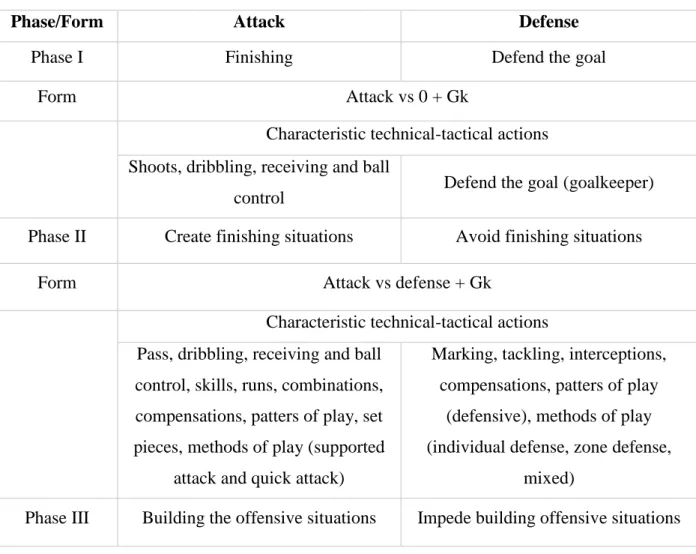
The forms are the organizing structure of the activity during the game and in the different phases (Queiroz, 1983). Each form corresponds to a phase, being developed through the different technical-tactical actions (Ramos, 2002). The table below shows the correspondence between phases, forms and technical-tactical actions.
Table 5. Association between phases, forms and technical-tactical actions.
Phase/Form Attack Defense
Phase I Finishing Defend the goal
Form Attack vs 0 + Gk
Characteristic technical-tactical actions Shoots, dribbling, receiving and ball
control Defend the goal (goalkeeper) Phase II Create finishing situations Avoid finishing situations
Form Attack vs defense + Gk
Characteristic technical-tactical actions Pass, dribbling, receiving and ball
control, skills, runs, combinations, compensations, patters of play, set pieces, methods of play (supported
attack and quick attack)
Marking, tackling, interceptions, compensations, patters of play
(defensive), methods of play (individual defense, zone defense,
mixed)
21 Form Gk + attack vs defense + Gk
Characteristic technical-tactical actions All actions of the phase II
Methods of play (counter-attack) Systems of play
All actions of the phase II Systems of play Table 5. Association between phases, forms and technical-tactical actions.
The game principles are the tactical rules that guide the players’ activity. They constitute a way of guiding the players actions, allowing the player to intervene in the different situations of the game (Ramos, 2002). The game fundamental principles (that are the same in offense and defense): refuse numerical disadvantage, avoid numerical equality and create numerical advantage (Queiroz, 1983; Ramos, 2002). The game specific principles are described below.
Offensive:
1. Penetration: Create numerical and spatial advantage, attack the goal or the opponent;
2. Cover: Support the player on the ball, defensive balance;
3. Mobility: variability of the positions, occupy free space, create free space, create passing lanes, keep possession of the ball, break the opponent defensive structure;
4. Space: Collective offensive actions to give width and depth.
Defense:
1. Delay: Marking the player on the ball, stop the counter-attack, give time for the team organize themselves;
2. Cover: Support the player that is pressuring the ball;
3. Balance: cover the free space and players, black the closest passing lanes; 4. Concentration: Collective defensive actions to take from the opposing team
22 2.2.Development stages
Nowadays, the training model is looking for methods and forms that provide the appropriation of technical-tactical behaviors, supported in the development of the specific physical abilities, closer to the real game situations. The learning/training process analyzes two key variables: the nature of what is going to be taught, the game (of soccer), and the object to which is addressed, the player (Ferreira, 1983).
The process of youth preparation shouldn’t be oriented to a permute specialization, expecting a planned and systematized preparation, in harmony with the athlete’s development process. The first stages of learning are the preparation for the future, being the practices and competition the way of formation and not the way to obtain immediate high performances (Ferreira, 1983).
In the development pathway, it is fundamental to adapt the contents to the player’s and team’s ability and level of the game. The superficial acquisition of the techniques and a quicker transition from the different learning stages, atrophies the player’s development (Ferreira, 1983). A planned teaching of the game, takes care about the child’s development, adapting the programmatic contents, structuring the process in stages, accommodating the levels of complexity of the game to the player’s level of ability.
Below is a summary of the stages of development and its principles. 1. Formation / Initiation (8/12 years old)
• Practice does not have the purpose to achieve immediate high performances; • Respect for the development and growth stages of the athlete;
• Predominant use of a global methodology (game) and constant analysis of the behaviors;
• Development of the weakest side and improvement of the strongest;
• Coordinate the training programs, adapting the planning according to: the level of ability to achieve and necessities of the competition;
• Lower level of complexity and higher number of repetitions in technical-tactical drills;
23 • Smaller groups and wide spaces.
2. Pre-specialization (13/14 years old)
• Practice does not have the purpose to achieve immediate high performances; • Respect for the development and growth stages of the athlete;
• Predominant use of an intervention that appeals to the comprehension of the situations;
• Development of the weakest side and improvement of the strongest;
• Coordinate the training programs, adapting the planning according to: the level of ability to achieve and necessities of the competition;
• Higher level of complexity and repetitions in the technical-tactical drills; • Technical-tactical actions combined (opposed and un-opposed);
• Smaller groups and progressive reduction of the space.
3. Specialization (15/16 years old)
• Practice does not have the purpose to achieve immediate high performances. Progressive introduction of the specific practice;
• Respect for the development and growth stages of the athlete;
• Predominant use of an intervention that appeals to the comprehension of the situations;
• Work on the weakest and strongest side equivalently;
• Adjustment of the training programs according to competition, level of ability to achieve and performances observed in competition;
• Higher level of complexity and repetitions in the technical-tactical drills; • Increase of the execution speed of the technical-tactical drills;
• Accuracy executing the technical-tactical drills;
• Selection of the individual technical actions in offense and defense according to the player’s position and role.
24 4. Betterment - 1st stage (17/18 years old)
• The technical-tactical preparation has the aim to achieve high performances in a mid-term, based in increasingly specific practices;
• Individual work on the strongest points, with higher performance requirements; • Adjustment of the training programs according to competition, level of ability
to achieve and performances observed in competition;
• Growth of the complexity and execution speed of the technical-tactical drills; • Lower number of repetitions with higher execution intensity;
• Specific practice of the technical and tactical actions according to the player’s role and position;
• Rise of the execution speed of the individual and collective actions in the real game situations.
5. Betterment - high performance (18 years old and above)
• The technical-tactical preparation has the aim to achieve high performances, based in increasingly specific practices;
• Maximize the work rate on the strongest points;
• Planning according to the team strategy, organization, characteristics and requirements of the competition;
• Highest levels of complexity with higher requirements of technical, tactical and physical nature;
• Specific practice of the technical and tactical actions according to the player’s role and position, with a vast number of high intensity repetitions, aiming to achieve the maximal performance and efficiency.
2.3.The Coach
Effective coaches are those who demonstrate the ability to apply and align their coaching expertise to particular athletes and situations in order to maximize athlete-learning outcomes. A definition proposed by Côte & Gilbert (2009, pp.316) is that coaching effectiveness is “the
25 consistent application of integrated professional, interpersonal and intrapersonal knowledge to improve athlete’s competence, confidence, connection and character in specific coaching contexts”. The same authors affirmed “coaches who demonstrate coaching effectiveness over an extended period of time (i.e., “consistent application” in our definition) may then be considered expert coaches”.
To be successful, coaches have to interact regularly with their athletes, assistant coaches, parents, and other professionals. It is important for coaches to continuously develop their interpersonal knowledge base so that can communicate appropriately and effectively with their particular athletes and other people. Coaching expertise is also about the ability to create and maintain relationships with others and the ability to learn from one’s own practice. Interpersonal knowledge refers to the understanding of oneself and the ability for introspection and reflection. A coach’s ability to maximize athletes’ outcomes rests not only on extensive professional knowledge and interpersonal knowledge, but also on constant introspection, review, and revision of one’s practice (Côte & Gilbert, 2009).
Coaching also involves providing the guidance that helps athletes become confident and reliant members of their sport and society, influencing on their characteristics such as self-esteem, satisfaction and perceived competence (Côte & Gilbert, 2009; Cruz et al., 2001). Through their interactions with athletes, coaches have unique opportunities to influence their athlete’s psychological growth. Sports can be a tremendous vehicle for athletes to develop confidence, connection with others and character. Deci and Ryan (as cited in Côte & Gilbert, 2009, pp.313) “suggested that the development of highly motivated, self-determined and invested individuals requires and environment that provides opportunities to make autonomous decisions, develop competence, and feel connected to others”.
“Athletes’ outcomes and coaches’ knowledge are characterized differently, at different stages of an athlete’s development, with respect to context. According to different coaching context, coaches will require a different mix of professional, interpersonal and intrapersonal knowledge to develop athlete’s competence, confidence, connection and character” citing Côte & Gilbert (2009, pp.315). The image below represents the coaching objectives for developing athletes’ outcomes in different contexts.
26 Table 6. Coaching objectives for developing athletes’ outcomes in different contexts
Participation Coach for Children
1. Adopt an inclusive focus on opposed to and exclusive selection policy based on performance;
2. Organize a mastery-oriented motivational climate;
3. Set up safe opportunities for athletes to have fun and engage playfully in low-organization games;
4. Teach and assess the development of fundamental movements by focusing on the child first;
5. Promote the social aspect of sport and sampling.
Participation Coach for Adolescents and Adults
1. Provide opportunities for athletes to interact socially;
2. Afford opportunities for athletes to have fun and playfully compete; 3. Promote the development of fitness and health-related physical activities;
4. Teach and assess sport-scientific skills in a safe environment for long-term sports involvement;
5. Teach personal and social assets through sport (citizenship).
Performance Coach for Young Adolescents
1. Organize the sport experience to promote a focus on one sport; 2. Teach “rules of competition”;
3. Offer opportunities for fun with increasingly greater demands for deliberate practice; 4. Teach and assess physical, technical, perceptual, and mental skills in a safe environment; 5. Present positive growth opportunities through sport (i.e. civic engagement,
responsibility).
Performance for Older Adolescents and Adults
1. Set up training regime grounded in deliberate practice; 2. Allow athletes appropriate mental and physical rest;
27 3. Prepare athletes for consistent high-level competitive performance;
4. Teach and assess physical, technical, perceptual, and mental skills in a safe environment; 5. Provide opportunities for athletes to prepare for “life after sport”
Table 6. Coaching objectives for developing athletes’ outcomes in different contexts
The coach is a sensible intermediate point between two types of units: the club or organization (that expect to see their expectations achieved) and the athletes (ensuring that their necessities are meet and they are satisfied with their improvement). Cruz et al. (2001) referred four specific target behaviors to promote: value the effort and the good performance, encouraging after the mistake, corrective instructions and technical instructions. The coaches are encouraged to adapt the approach of ‘do your best and have fun’ instead of only focus on winning. The same authors mentioned four guiding principles to the coach’s behaviors (adapted from Smith & Smoll, 1997; source Cruz et al., 2001).
• The idea of winning and success is defined by taking into consideration the maximum effort and personal improvement, with the main objective of having fun and joy of playing the game, without the fear of failing;
• Positive interactions coach-athlete, encouragement, positive feedback and technical instructions to improve the performance;
• Establish rules that promote the respect between teammates, team cohesion and bond; • Involve the players in the team’s decisions and rules, reinforcing the commitment with the
team;
• Look to obtain feedback from the players about the coaching behaviors and encourage a self-evaluation and awareness of these behaviors.
28 2.4.Logbook
Reflection is defined as “the mental process of structuring or restructuring an experience, a problem or existing knowledge or insights” (Korthagen & Wubbels, as cited in Korthagen, 1999, pp.193). A logbook is a notebook in which the person records his or her own reflections on a particular lesson, meeting or event (Korthagen, 1999). It is used as an instrument to register reflexive experiences – personal and professional – over a certain period of time, that includes interpretations, opinions, feelings and thoughts, with the objective intention of talk to oneself (Alves, 2004). The same author defined the logbook as a way of expression, as well as an effective way of learning.
The logbook was used with the intention of recording personal experiences and thoughts, relationships with the team and players, communications and decision-making actions. Afterwards, make a self-evaluation about the intervention as a coach.
29 3. THE LOGBOOK OF A COACH WORKING ABROAD: A SELF-REFLECTION
3.1.Introduction
This chapter is the reflection of the intervention as a coach during two moments of my experience. The first moment is one week of practices followed by the Liverpool Lexington Tournament, in the beginning of the Spring 2017 season. The second moment is part of the Elite program with the participation on the XVI Nation Cup - Southeast Regional Tournament, in the Summer 2017 season.
It is an excerpt of a logbook done through the Spring and Summer 2017 seasons. The feelings and thoughts were recorded in video every night before I went to bed. Later on, they were transcribed to text, allowing me to make a self-reflection about my coaching behaviors. Due to the lack of time and availability, I couldn’t register this self-reflection as often as I would like, being some reflections done mentally instead of registered. Although, when I had the change to accomplish the full process, it was helpful to rethink about some decisions in practices and/or games, like the management of the session, quality of the coaching intervention,
frequency of feedbacks and players’ performance and attitude.
While reading this paper, I would like the reader to get involved in my thoughts and feelings, as if he or she was living my own experience. Thereupon, I could share and pass my experiences to the reader, showing a little bit of myself as a coach.
3.2.Logbook
3.2.1. Spring 2017 Season Monday, January 30th, 2017
Sessions: 2008 Boys Maroon and 2004 Boys White
The first session tonight was okay. The intensity wasn’t as high as I was expecting, but it was important to work on this week’s topic “winning the ball back”. I focused my attention on the first defensive principle (delay/contain), giving a lot of feedbacks about the delay body shape. A side-side position, depending to which side the defender would like to show the attacker. Adding to that, the behavioral change after winning the ball back, looking for a target (the two gates in this
30 drill). At the same time, I was also giving some feedback to the attackers’ quickness changing direction. However, this is something that we need to work on, particularly the quickness getting closer to the attacker, reducing his space.
The session started with some ball manipulation and a simple triangle passing drill, focusing the objective on the passing and receiving technical action (using the inside part of the foot). At the end, the session ended with a four teams tournament (each team with 2 players), stimulating some competitive/winning attitude. During this last drill, the intensity was higher.
The second session had a very good intensity. We have a tournament coming this weekend and the players were focused. The aggressiveness in the first drill (3x1 rondos) was excellent. This allowed a great development of the session, because the topic of this week is “defending/pressing”. A simple passing drill to promote the passing and receiving technical actions was followed by some 1v1, 2v1 and 2v2 situations to a goal with a goalkeeper. My feedback was focused more on the defensive actions, making sure the delay body shape and defensive covers were being done correctly. But the offensive ones had some of the attention too, it is important to have a good and quick direction changing to beat an opponent.
We finished with a 1+3x3 game with three gates, working on the shuffling by the defenders depending where the ball is. Again, the focus was more on the defensive actions, making sure the three players were defending the right space. The quality on the defensive technical actions (delay, cover and balance) wasn’t so good here, but merit to the attackers, that were moving continually.
I didn’t appreciate one thing about this session: the players were needing my louder and frequently voice to raise the intensity of the exercise. It looks like sometimes they just work because I am demanding that. That is not right. Yes, it is my role to do that (if needed), but I would like the players to have that kind of behaviors by themselves. It is something to work on during this season.
Tuesday, January 31st, 2017
31 The session with the 2007 White team was similar to the one of the 2008’s yesterday. Only the last drill was different, where they played a 3v3 small-sided game. The weekly topics are the same for both teams, but in these first weeks of the season I am doing similar drills in order to compare the performance and acquisition concepts between both teams. The quality in the passing drill was higher, but the intensity in the 1v1 and 2v1 situations was similar. Again, my main attention was on the first defensive principle, the delay. Frequently feedbacks about the side-side body shape, guaranteeing they are understanding the importance of this defensive action to win the ball back. Connected to that, the behavioral changes after winning the ball back, looking for a target.
In the final scrimmage I introduced the lanes rule. Attacking they must have at least one player in each lane (right, center and left), defending, they should occupy one, or two lanes, depending where the ball is (side: two lanes; center: one lane). They took some time to understand the reason of that rules, but I stopped the session a couple of times to enforce the importance of it. At the time, I was doing some questioning making sure they were understanding the reasons, and not just doing them. The last seven minutes were rules free. I was only observing if they were still respecting these rules, but they didn’t. In the next session I will give them more playing time with that rules, making them used to them.
I lost my head in the first five minutes of the second session. The 2004 boys were being rubbish in the warm-up drill, the same that we do in the game day. We were talking yesterday about the importance of doing a good week of practices before the tournament, if they would like to take something from it. Everyone agreed on winning this game. But, instead, their attitude was not corresponding to their needs and goals. Absolutely no way! If they want to win the tournament, that was not the right attitude.
After that, the concentration and attitude were much better. The intensity was higher during the whole session, but again, it looked like was only because of my louder voice. It should be their natural behaviors, not just because of me. We did two exercises, which focuses was on the defensive principles, particularly the coordination between the three midfielders. The quality in the defensive actions and aggressiveness were good. Although, they misunderstood the covering interpersonal distance and where they should be at, avoiding the ball to go through the gap between the two players. It is important to defend well the center axis, avoiding spaces between the
32 midfielders. The three defensive principles were present (delay, cover, balance) with more feedbacks directed to the cover and balance. Because I am by myself in the sessions, it is difficult to focus the attention in a lot of behaviors at the same time. So, in the offensive actions, I was giving more attention to the movement off the ball, ensuring that they were looking for or creating free rom to receive the ball.
Overall, it was a good session, apart from the beginning. Maybe there was a lot of information in this session and some of the players didn’t get it all. But it is important they start thinking about this, or at least hearing what the right behaviors are. Particularly by the center midfielders, that are key for pressing the opposition. The delay principle has not been acquired as the cover and balance by some players. I don’t really understand why, but some of them struggle to do it well most of the times.
Wednesday, February 1st, 2017
Sessions: 2008 Boys Maroon and 2004 Boys White
I only had six players for the 2008 session tonight. I was thinking in finishing the session with a big sided scrimmage, but instead I did a conditioned game 3x3, no goalkeeper. That was the only change due to the reduced numbers showed up. After the ball manipulation warm-up, we did a passing channels drill in a competitive mode. It is a simple and funny exercise that works on the precision of passing and receiving. The players in the younger ages enjoy it a lot.
The focus was again on the defensive actions, delay and cover, based on 1v1, 2v1 and 2v2 situations, the same as Monday. However, instead of a square where they first needed to play the 1v1, I did a diamond, so the cover (in the 2v2’s) could have a reference of right or left, depending where the attacker was trying to go. The intensity today was higher and the defender were being more successful, due to the side-side body shape and tackling timing. Although my focus was the defensive part, the decision making in the offensive actions was being poor. I needed to intervene a couple of times to explain the indicators of when to dribble or to pass. The transition to the final 3x3 was good and the session ended with a very good intensity, with a couple of good goals scored.
33 In the transition between sessions I was trying to set up quickly the warm-up drill, but I got caught by some 2008 parents with questions. It took me five minutes to solve an issue that broke my routine. I had to tell the players to start some passing in groups of three while I was quickly finishing to set up the 4x2 rondos. I did pairs of 2 in each group in a competitive system. The groups with less ball’s recovers in three minutes have a punishment in the end of the drill. I was stimulating the defensive aggressiveness. Following that, we did a passing drill, looking for a lot of touches on the ball and precision on the passes.
To work on the defensive principles (delay, cover and balance) I did two fields, where each team was defending three gates (a right, left and center). Each field had a neutral that allowed the attacking team to create numerical advantage. I tried to focus my feedbacks mainly in the defensive process, particularly in body shape of the defender on the pressure and the distance of the cover, trying to give them references of where it should be. Although, I feel it is difficult for them to understand that, because I don’t think they have heard that terms (delay, cover, balance, interpersonal distances) a lot of times. I am here to help them understanding that!
In the final drill, attack vs defense I focus my feedbacks on the midfielders and defensive diagonal when the ball was on the side lanes. Also, the maximal width needed by the wingers, so we could have more space to play. The intensity and the behaviors were good, but the technical actions were being poor, which didn’t allow us to have a better flow in the game/session. At the end, I had a chat with the team about the expectations for the tournament, where they said they want to win, and what is the attitude/mindset needed if they really want that.
Thursday, February 2nd, 2017 Session: 2007 Boys White
Very good session tonight. I am enjoying a lot this group because they have desire to learn. I can see the willingness in their faces every session. Even though, they are aware that they are not top-level players, or their technical actions are poor, they try harder and want to reach a better level. That is a key point for me. I will do my best to help them achieve their objective.
34 The first part of the session (ball manipulation and rondo) was good, but the intensity raised a lot in the 1v1, 2v1 and 2v2 situations. The defensive actions, particularly the side-side body shape was being excellent and I could give a little bit more attention to the offensive ones, even the topic of the session was the defensive principles. Similar to the 2008 session, I did the diamond to the first 1v1, so then the second defender could have a reference for the cover. It worked pretty good once more.
The final drill, a 1+2x2 conditioned game split in three lanes, I let them play for thirty minutes, where the first fifteen had the lanes rule (3 attacking, 2 or 1 defending). I think today they comprehended better why the three lanes while attacking, because they had numerical advantage due to the neutral, so they could take advantage of it. I kept focusing my feedbacks in the defensive actions, with special attention to the correct defensive cover. Like the 2004 team, at the end I had a chat with the players about expectations for the tournament, but I took the pressure away from them, avoiding some players to stress out even before the first game. I want them to feel free!
Lexington Tournament, February 4th and 5th, 2017
Saturday
It is 5.30am. We are ready to leave. Lexington is our destination and the expectations are high. Added pressure to compete and play well in the tournament raises my focus for the pre-game preparation. The hour and forty-five-minute journey gives me time to review my notes. Starting teams and pre-game speeches are ready. I just a need to think of a couple of different options in case I need to change anything last minute.
My first game is with the 2004 team. Happily, everybody arrived on time. There will be plenty of time to have a good conversation with the team before the warm-up. Their expectations need to be on the same level as mine. Win the tournament! “What are your expectations for this tournament?”, I asked. “Win”, they said. “But just sitting there and saying “win” will not give us the victories. If we really want to do this, we need to step on this field and prove it! Trophies are won giving the best on and off the field. It is not only talking! I reinforced. Everybody is looking focus and concentrated on the objective. Just a couple more instructions about how I want them to defend without the ball. “Defensive cover and balance is going to be crucial. An efficiency
35 positioning will give us advantage to defend the center-zone and avoid getting ourselves in trouble. As we worked on during last week, when the ball is on the side zone we defend diagonal, being easier to win any ball that they will try to play in the back of our defense. With this, we can always guarantee a cover to the player on the pressure.”. The warm-up has been excellent. I can see the willingness to win on their faces. Let’s do this!
*1st Half*
Great first-half! 3-0 up at half time. We took advantage of the way that the opponent tried to defend, pushing high with their defensive line, leaving a big gap between them and the goalkeeper. Our center midfielders and wingers understood this, making some runs between the center backs and full backs to create trouble for the opposing team.
This is the attitude of a team that really wants to win this tournament. “We can’t lose the concentration now. As we scored three goals during the first 35 minutes, they can score three goals in the second-half! We can’t let-up.” The game is controlled and the opponent didn’t create any big opportunity. I will make some changes to give more minutes to the non-starting players. *2nd Half*
Game finished 3-2. I know I’m guilty for this. I think I wasn’t assertive as I should have been. I couldn’t pass the message in the way that I wanted. We didn’t take the second-half seriously. We were lucky we didn’t tie this game. “We almost ruin a great performance during the first-half. We were lucky, we can trust in this luck again! I hope that you have learned this lesson.”. Because I did it!
I’m running to my next game, with the 2007 team. Previously, I asked another GPS coach to warm-up the team, because I will arrive just in time for kick-off. The players are already on the field ready to start the game when I arrive. I didn’t have time to talk with them, but the coach said they were focused and they had a good warm-up.
*1st half*
Excellent performance, 3-0 at half-time. The defensive actions are being great (delay and defensive cover, particularly by both defenders). This didn’t allow the opponent to create chances. We scored majority of the opportunities created, making the game easier for us. “We need to keep
36 this attitude. This game is not over! On my previous game that just finished, we were winning at half time 3-0, final score was 3-2. We can’t let something similar happen here. Do you want to win the tournament?”. “Yes, we do!”, they answered with a big smile. “Don’t get yourself in trouble. Play with your head up so you can see all the options to play. Find the easier one. Let’s continue our great performance!”.
*2nd half*
Game finished 6-2. We were slower during the second-half, but we dominated the game and the opponent didn’t create many opportunities. Great start for these boys. If we continue with this focus and attitude, I’m sure we will win the tournament.
While I’m eating my lunch, I’m thinking what approach I should provide for the next game, with the 2004 team. The first-half was great, but the second was terrible. Should I have been more aggressive and focused the break from one half to the other? Or should I have been focus the great first-half and “ignore” the second, advising them that something similar can’t happen again? I will have the aggressive one. Concentration and focus are vital for this game. It is probably the hardest game of the group stage.
“A team that wants to win a tournament can’t lose the focus and do such different performances between the first and the half. We weren’t good enough during the second-half. Is this clear for everybody here? This is the game that will tell if can make the final or not. Don’t lose this opportunity!”
Warm-up has been poor. Focus is not even close to where it needs to be. So many passes and first touches missed. I’m feeling a bad game. I stopped the warm-up. “Bring it in, quickly! Are you being serious? What is this warm-up? Are you afraid to play, or do you just not want to do it?”. No one answers. I can see in their face a mixture of different feelings. Fear and distraction. “You have more quality than this! It’s on your side now. Show me, and more importantly, show yourselves what you want from this tournament! We can’t lose this game.”. I didn’t even talk about any tactical points for the game. It’s pointless with this lack of concentration.
37 1-0 down at half-time. An awful performance. We are being completely dominated. Quality connecting our passes is poor. We can’t reach the last third. I don’t think we had more than two shots, and none on target. “Is this the attitude of a team that wants to compete for the tournament? Are you sure that you really want to win this game? The opponent wants to win this game much more than you do! This is not good enough!”.
I am having difficulties understanding what I am missing. Should I be so aggressive? Trust more in the players and give them confidence? I must find a solution, and quickly. I gave them two minutes of self-reflection while the players were drinking water and resting. I decided that I will give them confidence and explain clearly how important it is to be successful. “When we work hard to reach an objective, and we achieve it, the feeling is something great. When we do it playing the sport that we love, the feeling is amazing. You have more than quality to turn this game, to step on the field and do the things that we’ve been practicing. Passing the ball with quality, so we can connect our passes and reach out the last third with more quality and more often. After a pass we should have movement! So you can be ready to give a new passing lane. It’s crucial the maximal width by the wingers so we can stretch the opposite back four and create spaces in the center axis, that can be explored by the striker or center midfielders, or get more space for the wingers, so they can look for 1v1 situations. Delay and defensive cover when we are on defense allowing us to recover the ball in the best moment. Be objective in the last third. Start the game with the right mindset!”.
*2nd half*
Game finishes 1-1. Reaction in the second-half was good. The opponent gave a good reply and created some difficulties, but we found a way to beat them. Exactly what we talked about at half-time. Maximal width by the wingers creating space in the center axis. When they started to defend tighter, we had a lot of 1v1 situations in the side zones that we took advantage of. “It’s not the best result, but we didn’t lose and we are still in this race to the final. Tomorrow we need to have the right mentality and have desire otherwise, we won’t be able to win this tournament. Go to the hotel. Rest. Have a good sleep and eat healthy!”.
I have some time now until the last game of the day. I will think about the past three games. The 2007 played well and I just need to make sure the concentration for the game is right so that they will not let-up and ensure their presence in the final. The 2004 team did excellent the first 35
38 minutes of the tournament. Then they switched off and only got back into it again in the last 25 minutes of the previous game. They have two options: work hard and be focus, or not be concentrated and perform sloppy. The right words at the right moment can make all the difference. I know that and it is my task to find these moments.
*2007 game*
The final score was 7-1. Managing the game was pretty smooth and all the players performed well. I’m tired from the day and by the way the game occurred helped me a lot. I didn’t need to intervene much during the game. Everyone was focused and determined on each task on the field. Finishing (in front of goal) has been excellent, but I would highlight again, the defensive actions as the best part of our performance. We didn’t allow the opponents to create chances because we defend well the 1v1 situations and when they beat us there, the defensive cover was always in the right position to win the second ball. Aggressiveness to win the ball back was outstanding as well.
It’s time to go to the hotel and lay down a bit. It was a long day. Tomorrow can be a great day and I want to be ready for it. I need to have the right words to pass on to the players to give them the confidence I’m feeling. I trust in them and in their abilities.
Sunday
I woke up with a good feeling of anxiety, the one that makes you be more focused and concentrated. The orange juice at the hotel was amazing and gave me the perfect feeling. The first game is with the 2004 team and I will pump them up. I will pass onto them confidence in a way they can believe in their capabilities and qualities to reach out the final.
It’s 7am and I’m already at the fields. It’s freezing but I want to make sure that everything is ready for the up and pre-game speech. While the players are arriving, I set up the warm-up. I’m clarifying to myself the message that I want to transmit to the team. It’s going to be vital that they get it in the perfect way. Confidence is the key to be successful.
“There is only one result for this game. Win and go to the final. I’m being as honest as I can with you. Although, I’m sure that you have enough quality and ability to do it. If you play in
39 the same way you did yesterday during the first-half, you will make it for sure! We need the center mids (midfielders) to be more aggressive pressuring the central axis, so we don’t allow the opposing team time and space to think on that zone”. Again, I reinforced the importance of the maximal width by the wingers, to stretch out the opposite back four. “Delay, defensive covers and balance as well as you did yesterday. You can do this. Together, as a team, as a unit, we can do this!”.
*1st half*
Great start of the game! High intensity, quick reactions and aggressiveness. 2-0 up, 15 minutes into the game. Excellent management after that. They (the opponent) reach the last third once and couldn’t get a shot. “Remember about yesterday! The game is not over. We have to continue working in the same way, with the same intensity and desire!”. When this team is focused, it’s easier to manage them, and their expectations. Half time speech was simple. They know what to do and I trust in them!
*2nd half*
2-1 final score. We managed the game well and we only conceded in the last 5 minutes of the second-half. We could have avoided this, but the most important thing is that we achieved our objective. We are in the final! “Congratulations! Your performance, attitude and mindset were excellent! First objective it is done (reach the final). Let’s work to achieve the second! (win the tournament). Rest until the next game. Make sure you drink a lot of water. Yes, Gatorades as well if you want to. Eat healthy!”.
I’m buzzing! What a performance from the team. It is a big pleasure to coach them when they perform like they did. It’s time to run to the next game. The 2007 team are playing their last group stage game. The players should be starting the warm-up now, organized by another GPS coach.
I arrived just on time to finish the warm-up and talk with the team. They look happy, relaxed and focused. “We are so close to achieving our first objective: reaching the final! If we play in the same way that we did yesterday, I have no doubts that we are going to make it! Attitude, concentration and intensity were great. Let’s do the same again today! Be clinical finishing off plays. Be smart defending our goal. Have fun and enjoy the game!”
40 *1st half*
2-1 up at half time. We started well, connecting our passes and looking to exploit the 1v1 situations on the side lanes. In a moment of distraction, we switch off in a defensive transition and we conceded a goal. We had opportunities to score more goals, but we lacked in confidence. “We are playing well, but this is not enough to win the game. We must play better during the second-half! Don’t lose concentration during the defensive moments, this can cost us more goals. Be objective in the last third! You have the quality to do it!”.
*2nd half*
Final score is 4-1. Defensively we were perfect during this second-half. Delay and defensive cover were always great. I think the opponent had only one shot during the second-half. “Congratulations for qualifying to the final! We deserve it. Excellent performance. Now get some rest, drink a lot of water and eat healthy! I will have a final with my 2004 team, so I might arrive just in time to run the warm-up, or during it.”.
The first objective is done: qualify both teams to the final. I love the pressure of playing I in a final. The feeling that you can achieve anything and at the end, celebrate – it is awesome. I want the players to use the pressure of playing in a final to help them focus in a positive way. Provide to the players that feelings and the opportunity to be attentional focus, in a positive way. I am more confident for the finals. I still have one hour before the first final with the 2004 team, to rethink my approach and pick my starting eleven. The 2007 team final is straight after, so I want to make sure that I have that game plan ready. Take the pressure away from the players, make them understand that we don’t play finals, we win them, and tell them that the most important thing is to give their best in every single moment. Independently the score, in the end we couldn’t say “I should have done better” or “I didn’t give my best”.
The players are back. Shin guards on, everyone making the last bits ready so I can start the pre-game speech. I’m talking with them to understand if there is any injury or someone that is not feeling good. Everything is set. “The big moment has arrived. This is what we were expecting since the beginning of the tournament. The final. It’s normal that you are feeling some anxiety and pressure, but this will make you work harder. It’s beautiful to play these games, to compete for something. A legend once said, we don’t play finals, we win them. This is the mindset that we