IUL - School of Social Sciences and Humanities
Department of Social and Organizational Psychology
“Liberté, Égalité, Fraternité?” How different conceptions of Laïcité
and threat perception motivate dehumanization of Muslims and vote
choices among (ir)religious majorities in France.
Margot Latasa
Dissertation submitted as partial requirement for the conferral of Master
in Psychology of Intercultural Relations
Supervisor:
Doutor Ricardo Borges Rodrigues, Professor Auxiliar Convidado,
ISCTE – University Institute of Lisbon
IUL - School of Social Sciences and Humanities
Department of Social and Organizational Psychology
“Liberté, Égalité, Fraternité?” How different conceptions of Laïcité
and threat perception motivate dehumanization of Muslims and vote
choices among (ir)religious majorities in France.
Margot Latasa
Dissertation submitted as partial requirement for the conferral of Master
in Psychology of Intercultural Relations
`
Supervisor:
Doutor Ricardo Borges Rodrigues, Professor Auxiliar Convidado,
ISCTE – University Institute of Lisbon
“The best way to overcome the threat of violence based on religion and
belief is by uniting our voices for good, countering messages of hate with
messages of peace, embracing diversity and protecting human rights.”
- UN Secretary-General António Guterres, New York, August 22, 2019, first-ever International Day of Victims of Violence Based on religion or Belief
Acknowledgements
I am deeply grateful for my supervisor Ricardo Rodrigues, who supported me during this long and challenging academic journey, and always found the rights words to encourage me. He understood my decision to change my topic after months of work when I realized I had reached an impasse. Most importantly, Ricardo always respected my ideas and knew how to guide them without imposing his views which means a lot to me - thank you!
Also, I would like to thank all the people who helped me distribute the online questionnaire, and the numerous participants who took the time to answer and share their feedback. I could not have written this dissertation without you.
Furthermore, I am deeply grateful for my parents, who allowed me to pursue the studies of my choice, and always showed me love and support regardless of where in the world I want to be. In addition, I want to express my thankfulness to my grandmothers for their support in many valuable ways, and my American family for their encouragement and patience. Also, I am grateful for my friends, who were there for me and provided me with understanding words and warm encouragement when I felt insecure. I would also like to thank Mia, Francisca, Maria and Vincent for hosting me in Toulouse and in Lisbon when I had to go back and forth between France and Portugal.
Last but not least, I would like to thank Ryan, who became my husband along this journey and patiently waited for the end of this project to visit his country. Thank you for being there in spite of my emotional rollercoaster and accompanying me all along the way.
Abstract
The present study analyzed the effect of a Historical form of Laïcité (more inclusive), and a Newer form of Laïcité (more restrictive), on intergroup relations in France. Precisely, it
assessed how exposure to different forms of laïcité impacts threat perception for the (ir)religious majorities (Atheists and Catholics), blatant and subtle dehumanization towards Muslims, and behavioral intention to vote for an inclusive president. Participants (N = 182) were randomly assigned to one of the three conditions (Historical Laïcité, New Laïcité or a control condition). Results indicated that both Historical and New forms of Laïcité can increase different levels of blatant dehumanization, and both equally decreased Catholic’s behavioral intention to vote for an inclusive president. Also, symbolic threat appeared to be a strong predictor of subtle and blatant dehumanization towards Muslims, and behavioral intention to vote for an inclusive candidate. Finally, our results revealed an implication of (ir)religious identification in blatant and subtle forms of dehumanization and perception of threat: Atheists (vs. catholics) seem to dehumanize more blatantly, Catholics (vs. Atheists) seem to dehumanize more subtly, and Catholics (vs. Atheists) seem to experience more symbolic and anxiety threat from Muslims.
Keywords:
Laïcité, intergroup threat, blatant dehumanization, subtle dehumanization
PsychINFO Codes:
3000 Social Psychology
3020 Group & Interpersonal Processes 3040 Social Perception & Cognition 2960 Political Processes & Political Issues 2920 Religion
Resumo
O presente estudo analisou o efeito de uma forma de Laicidade Histórica (mais inclusiva), e de uma forma de Laicidade Nova (mais restritiva) nas relações intergrupais em França.
Especificamente, analisou-se se a exposição a diferentes formas de Laicidade afeta a perceção de ameaça intergrupal das maiorias religiosas/não religiosas (ateus e católicos), assim como a expressão de formas flagrantes e subtis de desumanização dos muçulmanos, e a intenção de voto a favor de um presidente inclusivo. Os participantes (N = 182) foram aleatoriamente distribuídos por três condições experimentais (i.e., Laicidade Histórica, Nova Laicidade, condição de
controle). Os resultados indicam que, quer a Laicidade Histórica, quer a Nova Laicidade podem aumentar os níveis de desumanização flagrante, e que ambas diminuem a intenção de voto dos Católicos num candidato inclusivo. Além disso, a ameaça simbólica constitui um preditor forte da desumanização subtil e flagrante dos muçulmanos, e da intenção de voto num presidente
inclusivo. Finalmente, os resultados mostram uma implicação da identificação (ir)religiosa nas duas formas de desumanização a na perceção de ameaça: os ateus (vs. católicos) parecem desumanizar de forma mais flagrante, já os católicos (vs. ateus) parecem desumanizar mais de forma mais subtil e experimentam mais ameaça simbólica e ansiedade face aos muçulmanos.
Palavras-chave:
Laicidade, ameaça intergrupal, desumanização flagrante, desumanização subtil
Códigos PsycINFO:
3000 Psicologia Social
3020 Grupos & Processos Interpersonais 3040 Percepção Social & Cognição
2960 Processos Políticos & Questões Políticas 2920 Religião
Index
Acknowledgements II
Abstract III
Resumo IV
Index V
Index of figure VII
Introduction 1
Chapter I - Literature Review 4
Laïcité 5
History of Laïcité 5
Laïcité or Laïcités? 6
Correlates and outcomes of Historical and New Laicité for intergroup relations 8
Intergroup Threats 10 Religious Identification 11 Present study 13 Hypotheses 14 Chapter II - Method 16 Participants 16 Procedure 17
New and Historical Laïcité Manipulation 18
Measures 19
Demographics 19
Manipulation check 19
(Ir)religious identification 19
Symbolic and Anxiety threats 19
Subtle dehumanization 20
Blatant dehumanization 21
Behavioral intention to vote for an inclusive candidate 21
Chapter III - Results 23
Manipulation check 23
Blatant dehumanization of Muslims in comparison with (ir)religious ingroup. 24
Anxiety threat 24
Symbolic threat 24
Blatant dehumanization of Muslims in comparison with French. 25
Anxiety Threat 25
Symbolic threat 26
Blatant dehumanization of French vs. (ir)religious ingroup identification. 27
Anxiety Threat 27
Symbolic threat 28
Subtle dehumanization of Muslims in comparison with (ir)religious ingroup through the
attribution of Human Uniqueness traits 29
Positive Human Uniqueness traits 29
Negative Human Uniqueness traits 31
Subtle dehumanization of Muslims in comparison with (ir)religious ingroup through the
attribution of Human Nature traits 32
Positive Human Nature traits 32
Negative Human Nature traits 34
Behavioral intention to vote for an inclusive presidential candidate, in favor of receiving
Muslim migrants. 35
Anxiety Threat 36
Symbolic Threat 36
Chapter IV - Discussion 38
Limitations and future research 42
Conclusion 44
References 45
Index of figure
Figure 1. Theoretical model: the mediated effect of New & Historical Laïcité via anxiety and symbolic threat on blatant & subtle dehumanization and inclusive voting behavioral intention with moderating effect of (ir)religious identification.
Figure 2. Study procedure.
Figure 3. Significant effects of symbolic threat and (ir)religious identification on blatant dehumanization - Muslims vs. (ir)religious ingroup.
Figure 4. Significant effects of the priming, symbolic threat and (ir)religious identification on blatant dehumanization - Muslims vs. French.
Figure 5. Significant effects of the Historical Laïcité vs. New Laïcité, Laïcité vs. control and (ir)religious identification, on blatant dehumanization - French vs. (ir)religious ingroup, and on symbolic threat.
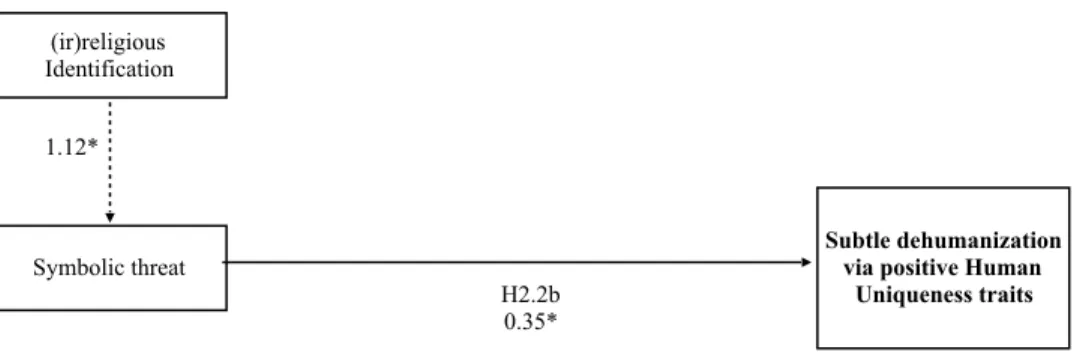
Figure 6. Significant effects of symbolic threat on subtle dehumanization via positive Human Uniqueness traits, and of (ir)religious identification on symbolic threat.
Figure 7. Marginally significant effects of (ir)religious identification on subtle dehumanization via negative HumanUniqueness traits.
Figure 8. Significant effects of the priming on anxiety threat; effects of symbolic threat, interaction effects of symbolic threat with (ir)religious identification and anxiety threat with (ir)religious identification on subtle dehumanization via positive Human Nature traits. Figure 9. Indirect effects of the primings on the intention to vote for a president in favor of welcoming more Muslim migrants.
Introduction
In the past five years, 1.8 million refugees have arrived in Europe (UNHCR, 2019), the majority of them identified as Muslims (UNHCR, 2019). Muslims represent the religious
minority that is the most discriminated against. In 2016 one Muslim person out of three reported being a victim of discrimination, harassment, or arrest (European Union Agency for Fundamental Rights, 2017). However, it is important to provide a more specific look at the national contexts in which these discrimination events can occur. In the French context, 3% of the population
identifies as Muslim, compared to 48% identifying as Catholic and 34% identifying as Atheist (Viavoice, 2019). France often times is referred to as the country of Human Rights (Gil-Robles, 2006), however, since 2004 the country has developed policies reported as discriminatory against the Muslim community (Kamiejski, De Oliveira, & Guimond, 2012), and islamophobic behaviors have been on the rise (CCIF, 2019). Moreover, during the last presidential election, the country had a record number of votes supporting the extreme right French party, Front National (today called Rassemblement National), which is known for its anti-immigration and anti-muslim policies. These policies include cancelling the right of regularization of “illegal migrants” and the automatization of their deportation, reducing the rights associated to family reunification and asylum right, and the extension of religious invisibility to the public and work space specifically targeting women wearing headscarves (Front National, 2017).
Research on intergroup relations often addresses the role of ideologies (see Vorauer, Gagnon, & Sasaki, 2009). Ideologies can be defined as a “a more or less systematic ordering of ideas with associated doctrines, attitudes, beliefs, and symbols that together form a more or less coherent philosophy or Weltanschauungfor a person, group, or sociopolitical movement.”(APA Dictionary). Until now, a significant number of studies focused on two ideologies in particular, namely: colorblindness, which encourages the minimization of the significance of racial group membership (Plaut, Thomas, Hurd, & Romano, 2018), group differences, and emphasizes
commonalities (Wilton, Apfelbaum, & Good, 2019); and multiculturalism, which encourages the recognition and the appreciation of group differences (Wilton, Apfelbaum, & Good, 2019) as well as the acknowledgement and respect of group memberships (Plaut, Thomas, Hurd, & Romano, 2018). Even though these ideologies can also be observed in the French context (Guimond, de la
Sablonnière, & Nugier, 2014; Mahfud, Badea, Verkuyten, & Reynolds, 2017), the most prominent secular ideology is Laïcité, which is based on a “legal principle enforcing the State and civil servants’ neutrality in terms of religious and political opinions, to guarantee freedom of expression and religion in public places” (Adam-Troian, Arciszewski, & Apostolidis, 2019). Recent works have exposed the dual nature of this ideology, differentiating between a more historical and tolerant conception, and a new and more restrictive one (Roebroeck & Guimond, 2017b).
The role of ideologies on intergroup relations has been analyzed in social psychology for quite some time (for a review see Rattan & Ambadi, 2013), however only a few studies have manipulated ideologies (such as Wolsko, Park, Judd, & Wittenbrink, 2000; Apfelbaum, Pauker, Sommers, & Ambady, 2010; Madera & Hebl, 2013; Wilton, Good, Moss-Racusin, & Sanchez, 2015; Mahfud, Badea, Verkuyten, & Reynolds, 2017). Even fewer have focused on Laïcité. A very recent study examined the influence of the New form of Laïcité on discrimination and support for discriminatory policies (Troian, Arciszewski, & Apostolidis, 2019). As Adam-Troian and colleagues (2019) demonstrated, New Laïcité directly predicts support for
discriminatory policies, and indirectly through a reinforced sense of identification with the national ingroup. Moreover, New Laïcité directly predicts a negative Maghrebi evaluation. Furthermore, studies have shown that colorblindness can predict greater implicit and explicit racial bias (Richeson & Nussbaum, 2004), suggesting that ideologies can impact different forms of intergroup bias.
Based on these findings, the current study aims to test and compare the influence of two different forms of Laïcité (e.g., Historical vs. New) on intergroup relations, which has not yet been thoroughly examined, and more specifically, if they might promote or hinder forms of prejudice (e.g., subtle and blatant dehumanization) towards religious minorities such as Muslims, and inclusive voting behavioral intention.
In the following sections, we present and define the main theoretical constructs that inform our theoretical model. We first focus on the French Laïque ideology, respectively retracing its history, its duality, and its outcomes. Then, we report the role of intergroup threats (e.g.,
role of (ir)religious identification in regard to the relationship between Laïcité and intergroup threat.
Chapter I - Literature Review
20 million Muslims currently live in Europe, which makes them the second largest religious group within the European Union (European Union Agency for Fundamental Rights, 2017). Still, this community cannot enjoy their right to inclusion and freedom of religion (European Union Agency for Fundamental Rights, 2017). Indeed, the European Union Agency for Fundamental Rights (2017) has reported that first and second generation Muslims both felt discriminated against because of their skin color, ethnic origin, immigrant background, religion or religious beliefs, including wearing visible religious symbols. Most Muslims living in Europe reside in Germany and in France (European Union Agency for Fundamental Rights, 2017) where the acts of islamophobia, which target mostly women, have increased 52% between 2017 and 2018. Importantly, institutions have been the first agents of discriminatory acts (CCIF, 2019). Indeed, since 2004, France has been reinforcing Laïcité in the school context (Roebroeck & Guimond, 2015), through policies supporting the ban of headscarves, both for children at school and mothers accompanying their children on schools trips, as well as for women working in organizations welcoming children under six years old. Additionally, in July 2010, the French National Assembly banned the complete covering of one’s face in public. These instances suggest that Laïcité can play a leading role in supporting and legitimizing prejudices and discriminations against Muslim communities in France.
One current form of prejudice in contemporary societies is dehumanization (Wilde, Martin, & Goff, 2014). Dehumanization is generally defined as the denial of human characteristic to individuals because of their group membership. According to Haslam (2006), two forms of dehumanization can be distinguished. One refers to the perception of lack of human uniqueness traits differentiating humans from animals (e.g., cognitive capacity, civility, and refinement); the other refers to the perception of lack of Human Nature traits differentiating humans from robots or objects (e.g., emotionality, vitality, and warmth) (Haslam, 2006). It affects moral standings (Bastian, Laham, Wilson, Haslam, & Koval, 2011) and predicts lower levels of prosociality (Haslam & Loughnan, 2014) such as prosocial responses to others (Vaes, Paladino, & Leyens. 2002), collective helping (Zebel, Zimmermann, Viki, & Doosje, 2008) or intergroup forgiveness (Wohl, Hornsey, & Bennett, 2012).
Furthermore, another distinction can be made between a subtle form of dehumanization, characterized by the perception that a given group, or its members, lack specific traits, and a blatant form of dehumanization, characterized by a direct association of someone with an animal or a robot. Blatant dehumanization is direct, consciously, and overtly assumed (Haslam & Loughnan, 2014), contributes strongly to negative attitudes and behaviors of intergroup hostility (Kteily, Bruneau, Waytz & Cotterill, 2015; Kteily, Hodson, & Bruneau, 2016), and support for extreme political candidates (Kteily & Bruneau, 2017).
The extreme right wing French party, known for its anti-immigration sentiments, was strongly supported in 2017, during the presidential elections, receiving 21.53% of votes cast (Pommiers, 2017), and during the European elections with 23.31% in 2019 (Boichot, 2019). In the meantime, the number of arrivals of refugees in Europe keeps on increasing, as well as the number of reported dead or missing refugees in the European area (UNHCR, 2019). France is the third highest country in Europe in terms of asylum applications, however it is 26th out of 28 countries when it comes to acceptance rate (Euractiv, 2018), with a rejection rate of 71.3% in 2018 (Forum Réfugiés, 2019). Since the French citizens can express their support or rejection of the French way to deal with immigration when electing a presidential candidate, it is important to understand what can predict the voting behavior in this regard. Adam-Troian and colleagues (2019) work suggests that New Laïcité predicts support for discriminatory policies. It would be interesting to understand if different forms of laïcité could be involved in the behavioral intention to vote for a presidential candidate in favor of muslims immigration.
Laïcité
History of Laïcité
The ideology of Laïcité is complex and many forms of Laïcité can be found throughout the world (Baubérot, 2010). In our study we focus specifically on the French context, where the notion of Laïcité emerged. Laïcité is simultaneously, a part of the national identity and political means to deal with the dimension of religiosity in society, but also a set of national values
(Baubérot, 2005). To provide a more complete and accurate definition of Laïcité requires that we put forward specific historical and socio-contextual information.
The initial components of Laïcité that emerged from the French Revolution in 1789 can be summarized as the freedom of conscience and collective practice of any cult; non domination of Religion on the State and the society, with separation of the political and the religious spheres; principle of equality and non-discrimination on the basis of religious reasons with the concept of “abstract citizen” independent from religious appearances (Baubérot, 2005). This initial form of laïcité has evolved from a legal framework to a shared identity around core values, grounded on the principle of protecting people from the influence of Catholicism and allowing them to engage in other religions or to be Atheist (Baubérot, 2005).
A second era of Laïcité, more restrictive and discriminatory, emerged in 1962, when France restored independence to Algeria marking the end of the French colonial empire
(Baubérot, 2005). Following this a succession of historical events involving Muslims led to the perception of Islamism as a threat to French laïques values and rights (Baubérot, 2005), creating a hostile environment for Muslims. Perhaps one major event that played a significant role in
ushering in the new era of Laïcité, occurred on March 15th, 2004, with the adoption of the Laïcité Law, which forbade people from wearing ostentatious religious symbols in public school settings. This event symbolically marked a clear divide and contradiction with the initial laïque principle stating the neutrality of the State and its agents with regards to religious matters. That law specifically targeted Muslim communities (Baubérot, 2012 ; Kamiejski, Guimond, Oliveira, Er-Rafiy, & Brauer, 2012 ; Nugier, Oppin, Cohu, Kamiejski, Roebroeck, & Guimond, 2016) which fostered feelings of stigmatization within the French Muslim community (Kamiejski et al., 2012). In the meantime, multiple deadly attacks by Islamist terrorist groups occurred in various cities of France between 2012 and 2018, which played a major role in further reinforcing the negative perception of Muslims (Anier, 2018a).
Laïcité or Laïcités?
Within the research on intergroup relations addressing the role of ideologies, such as multiculturalism and colorblindness, colorblindness and Laïcité have often been used as
synonyms (Guimond, de la Sablonnière, & Nugier, 2014). For instance colorblindness and Laïcité share their malleable aspects. Indeed, Knowles, Lowery, Hogan and Chow (2009) showed that
colorblindness is composed of the egalitarian principle of distributive justice and the anti-egalitarian principle of procedural justices. Typically, anti-anti-egalitarian individuals are disinclined to subscribe to colorblindness since they seem to firstly perceive in the ideology a principle of distributive justice. However, in the presence of a threat, these individuals might perceive colorblindness as a principle of procedural justice and endorse it to legitimize their status quo (Knowles, Lowery, Hogan, & Chow, 2009). Roebroeck and Guimond (2017a) found similar results for Laïcité. Indeed, French anti-egalitarian individuals showed more attachment to Laïcité 1 in a situation of symbolic threat, which led the authors to think that the participants were shifting between different notions of Laïcité depending on the context (threat vs. no threat). To confirm this belief, the authors measured the level of attachment to New Laïcité and found that support for this construal was the same for egalitarian and anti-egalitarian individuals in the absence of perceived threat. However, when exposed to symbolic threat, anti-egalitarian individuals
increased their support of New Laïcité. These findings suggest that colorblindness and Laïcité can both explain variations in anti-immigrant stances and Muslim prejudices (Roebroeck & Guimond, 2017a, Nugier et al., 2016). Moreover, colorblindness and Laïcité both downplay categorization processes (Guimond, de la Sablonnière, & Nugier, 2014) and both may have originated from the French revolution. However, colorblindness understates the importance of racial and ethnic group membership in order to guarantee citizen’s equality, while laïcité focuses exclusively on the religious affiliation, emphasizing the necessity of it remaining private, (Roebroeck & Guimond, 2017a), and the role of values and beliefs in public life (Roebroeck & Guimond, 2017a).
Both ideologies coexist within the French context (Roebroeck & Guimond, 2017a), and it is also the case for multiculturalism which supports the recognition of identities. Indeed, research indicates that even if French majority individuals do not perceive multiculturalism as normative in France, they are not opposed to it (Guimond, Streith & Roebroeck, 2015). Moreover,
Kamiejski and colleagues (2012) wanted to assess the relationship between the French republican ideology (supporting the elimination of social categories) and multiculturalism, generally
considered as its antithesis. In their work the authors considered Laïcité within the dual
et al., 2012). Kamiejski and colleagues (2012) showed that the concept of citizenship,
emphasizing the idea of the equality of every citizen independent of their religious beliefs, was independent from the concept of Laïcité, emphasizing the confinement of religious matters within the private sphere. Moreover, when they assessed the relationship between the French republican ideology and multiculturalism, their results showed that the republican ideology was not
contradictory with the multicultural ideology. As a matter of fact, the concept of citizenship was positively correlated with multiculturalism and negatively linked to prejudices. Simultaneously Laïcité was positively correlated to prejudices (Kamiejski et al., 2012), suggesting that citizenship would share with multiculturalism an egalitarian orientation.
However, Roebroeck and Guimond (2017b) replicated the study and suggested another way to interpret these two dimensions. Citizenship would actually be included in a dimension of Laïcité called “Historical Laïcité”, meaning that the concept Laïcité would be composed of two dimensions leading to different outcomes. The Historical Laïcité, is the basic form of the concept, defined by the law and political philosophy. It is liberal and inclusive, and since 1905 values the separation of the Church and State and the neutrality of the State in regards to religion. It also asserts the equality of all citizens, religious or not, in the eyes of the law, and the freedom of belief. This form of laïcité has positive outcomes such as tolerance (Roebroeck & Guimond, 2017b).
However, the most widespread form of laïcité is also the most recent one. New laïcité is a civil society concept, but is also identity related and an exclusive term (Roebroeck & Guimond, 2017b). It detaches itself from the historical version by applying the concept of neutrality, not only to the State and its representatives, but also to the citizens. As a result, the religious manifestations belong to the private sphere at the potential cost of freedom of conscience and equality of citizens (Roebroeck & Guimond, 2017b). This most recent adaptation of Laïcité seems to target one religious group in particular: Muslims (Kamiejski et al., 2012; Nugier et al., 2016).
There is abundant research on intergroup ideologies such as colorblindness or
multiculturalism suggesting that ideologies play an important role in prejudice, stereotyping, and intergroup relations (see Levin, Matthews, Guimond, Sidanius, Pratto, Kteily, Pitpitan, & Dover, 2012). On the contrary there is not a lot of research on Laïcité within social psychology since the topic is quite recent (Anier, Badea, Berthon, & Guimond, 2018).
A few correlational studies have highlighted interesting findings about New Laïcité and Historical Laïcité. For instance, New Laïcité systematically correlates with the expression of prejudice against North African descendants and immigrants (Roebroeck & Guimond, 2015; Guimond, de la Sablonnière, & Nugier, 2014; Kamiejski et al., 2012). In contrast, Historical Laïcité seems to be negatively linked to prejudices and social dominance orientation (Roebroeck & Guimond, 2017b). Also, beyond the nature of Laïcité as a dual concept, research suggests that both New Laïcité (Kamiejski et al., 2012) and Historical Laïcité (Anier, 2018) may have become a norm within the French Republican Model. A recent paper assessed the moderating role of the New and Historical Laïcité norms in regard to the impact of the perceived host culture adoption, which is “the extent to which immigrants are perceived as adopting the French culture” (Anier et al., 2018, p. 510.), and national identification on discrimination against immigrants. The results showed that when the perception of host culture adoption and national identification on the part of immigrants were weaker, the level of discriminatory behavior of the native French participants was higher, especially when the norms of New Laïcité were involved (Anier et al., 2018). These results suggest that New and Historical forms of Laïcité may influence differently intergroup discrimination (Anier et al., 2018). Still within this normative perspective, a more recent work showed that New Laïcité’s norms seem to increase discriminatory behaviors and demands of the French and Belgium majority groups towards the acculturation behavior of minority groups; which is the opposite for Historical Laïcité’s norms. These findings indicate that New and Historical Laïcité have opposite effects in regard to discrimination (Anier, 2018).
A very recent study tested the influence of New Laïcité as an independent variable (Adam-Troïan et al., 2019). Precisely, New Laïcité directly predicted support for discriminatory policies and a negative evaluation of North Africans as an outgroup. In addition, and on an exploratory basis, New Laïcité predicted support for discrimination through an increased sense of
national identification. These findings suggest that New Laïcité might predict negative intergroup outcomes. However, the study doesn’t provide a comparative impact of the two forms of Laïcité, which the present study aims to accomplish.
Intergroup Threats
The main idea of Realistic Conflict Theory (LeVine & Campbell, 1972; Sherif, 1966) is that group conflicts can result from a competition for scarce resources between two groups. More recently, Integrated Threat Theory (Stephan & Stephan, 1996, 2000) has offered supplementary explanations for intergroup conflicts which include various forms of threats such as symbolic threat and anxiety threat. These perceived threats have been tested and can predict prejudice (Riek, Mania, & Gaertner, 2006; McLaren, 2003; Esses, Dovidio, Jackson, & Armstrong, 2001; Bobo, 2000; LeVine & Campbell, 1972), even when they are not real (Stephan & Stephan, 2000).
Symbolic threat involves perceived opposing views in terms of values, morals standards, beliefs, and attitudes emerging from one’s conviction that the ingroup values are correct and the outgroup's values are wrong (Stephan & Stephan, 2000). This idea can be found in the French New Laïcité (Baubérot, 2012). This type of threat is induced by the perception that the outgroup challenges the ingroup’s value system (Stephan & Stephan, 2000). Intergroup anxiety is a feeling of personal threat due to an intergroup interaction that is perceived as potentially leading to negative outcomes for the self. This type of threat has directly been connected to intergroup prejudice in Integrated Threat Theory (Stephan & Stephan, 2000).
Prior level of anterior conflict increases the perception of threats such as symbolic threat and anxiety threat (Stephan & Stephan, 2000), and different political dynamics should lead to different levels of threat (Stephan, 2014). Also, a lack of knowledge about the outgroup leads to greater perception of differences and unfamiliarities triggering fear (Stephan & Stephan, 2000). New Laïcité tends to promote the avoidance of religious matters and restrains religious visibility in public life, and thus can lead to very little knowledge of religious outgroups. Indeed, Laïcité is an ideology connected to the role of values and beliefs in the public sphere, that can restrict religious practices perceived as a threat to the dominant cultural values (e.g., wearing a headscarf) (Roebroeck & Guimond, 2017a).
Different types of threats can impact different outgroups, and Muslims are mostly targeted by symbolic threat (Velasco González et al., 2008). Several works on symbolic threat characterize it as an antecedent of prejudices (Stephan & Stephan 2000; Stephan, Stephan, & Gudykunst, 1999; Spears, 1988). Also, symbolic threat has an explaining role in studies examining the indirect relationship between religious background (e.g., Christian vs. Muslims) and ill-treatment and exclusion of Muslims (Viki, Zimmermann, & Ballantyne, as cited in Pereira, Vala, & Leyens, 2009). Similarly, intergroup anxiety predicts intergroup prejudice among majority and minority (e.g., Muslims, see Tausch, Hewstone, & Roy, 2009), unfavorable behavioral intentions
concerning outgroup contact (Martínez, 2000), unwillingness to help outgroup members (e.g., immigrants, see Costello & Hodson, 2011), and offensive behavior (e.g., using stereotypes) or aggressiveness (Van Zomeren, Fischer, & Spears, 2007). It is also a strong mediator of the
relationship between contact and emotions (Binder et al., 2009), and between contact and attitude towards minorities (Swart, Hewstone, Christ, & Voci, 2010).
Religious Identification
(Ir)religious affiliation is a dimension of social identity involving a system of guiding beliefs, therefore it should impact psychological and social processes in a powerful and unique way (Ysseldyk, Matheson, & Anisman, 2010). A study showed that religious identification can play an important role in individual well-being and that some religious beliefs have positive effects on tolerance towards religious outgroups (Abu- Rayya & White, 2010). However it can at the same time serve as a basis for facilitating intergroup conflicts (Ysseldyk, Matheson, & Anisman, 2010). In other words, religious differences are often present in intergroup conflicts (Wellman & Tokuno, 2004). When religious identity is made salient, and when a faith-based threat is perceived from the outgroup’s set of beliefs, group-based division can be intensified (Ysseldyk, Haslam, Matheson, & Anisman, 2011). Indeed, self-categorization is associated with ingroup and outgroup differentiation (Turner, Oakes, Haslam, & McGarty, 1994), and in some contexts associated with ingroup favoritism and outgroup bias (Tajfel & Turner, 1979), outgroup depreciation (Aberson & Howanski, 2002; Branscombe & Wann, 1994), or outgroup prejudice and hostility (see Ysseldyk, Matheson, & Anisman, 2010). For instance, in a study, Christian
participants presented higher levels of ingroup favoritism and outgroup derogation towards Atheists (Hunter, 2001) when they felt ill-considered (Hunter, Kypri, Stokell, Boyes, O’Brien, & McMenamin, 2004). Also, a strong identification with Christianity can lead to perceiving a religious outgroup as threatening (Choma, Haji, Hodson & Hoffarth, 2016). Furthermore, studies have examined the relationship between political ideologies (i.e., conservatism and liberalism) and religiosity, and have found that Christianity and political conservatism often overlap (Jost, Nosek, & Gosling, 2008), and that a strong identification with Christianity induces more
opposition to pro-interfaith policies and practices, and support of policies and practices that foster religious expression (Choma, Haji, Hodson, & Hoffarth, 2016). Other recent works have shown that shared (ir)religious beliefs can foster ingroup favoritism in empathy for other’s pain in both Chinese Christian and Atheist participants (Huang & Han, 2014). More precisely, both Christian and atheist participants showed stronger empathy towards the suffering of people with the same beliefs as them. Their findings also showed that Christian participants reported greater in-group favoritism in the likability of people who shared the same beliefs as them compared to atheist participants. However, these results suggest that visible belief differences produce stronger
ingroup favoritism in empathy than dissimilarity in physical appearance (Huang & Han, 2014). In parallel, another work showed that atheism and low levels of self-reported religiosity were
associated with lower levels of racism and prejudice towards racial minority target groups (Hall, Matz, & Wood, 2010). Furthermore, other studies support the idea that Atheists have unique reactions to (ir)religious identity threat and (in)tolerance (Ysseldyk et al., 2010; Ysseldyk, Haslam, Matheson, & Anisman, 2011). For instance, in Uzarevic, Saroglou, and Muñoz-García’s study (2019) it was found that both believers and nonbelievers can show disdain towards moral and religious antiliberals (antigay activists and fundamentalists). However only atheists (and agnostic) can, not only show prejudicial discriminatory attitudes toward anti-liberals, but also towards mere religious group such as Christians and Buddhists (Uzarevic, Saroglou, Muñoz-García, 2019). Finally, for many people Atheism is characterized by the absence of beliefs, Atheists can be devoted by holding to a set of views, values, or philosophies through which they interpret the world (Fales, 2007; Taylor, 2007). When the Atheist's belief system is perceived as
threatened, similar coping and emotional responses can be observed in the context of religious identity threat.
Present study
The present study aims to test the effect of French Laïcité ideology on different forms of subtle dehumanization (i.e., lower assignment of traits associated to Human Uniqueness and Human Nature) and blatant dehumanization (direct association of someone with an animal, a robot, or an object) towards Muslims, and voting behavior related to the inclusion of Muslim immigrants. Two distinct forms of Laïcité that have been identified in the literature are tested and contrasted – Historical Laïcité (the most ancient and inclusive form) and New Laïcité (the most recent and restrictive form) – in their effects on dehumanization of Muslims and voting
behavioral intention. In addition, the study tests the potential mediating effects of anxiety and symbolic threat and if (ir)religious identification moderates the effect of Laïcité on anxiety and symbolic threat. From the literature review the following theoretical model and hypothesis can be derived.
Figure 1. Theoretical model: the mediated effect of New & Historical Laïcité via anxiety and symbolic threat on blatant & subtle dehumanization and inclusive voting behavioral intention with moderating effect of (ir)religious identification.
(ir)religious Identification Historical Laïcité New Laïcité Inclusive voting behavioral intention Anxiety threat Symbolic threat
Subtle and Blatant dehumanization
Hypotheses
In light of all the empirical findings previously presented, we expect New Laïcité to be associated with negative intergroup outcomes and Historical Laïcité to be associated with more positive ones. Specifically, we expect a negative effect of Historial Laïcité compared to New Laïcité on subtle and blatant dehumanization against Muslims and a positive effect on inclusive voting behavioral intention towards this same (ir)religious minority. Also, Adam-Troïan and colleagues (2019) findings suggest that support for discriminative policies (i.e., suppress free healthcare for French citizens of foreign descent, lower legal immigration quotas, prioritize employment of French citizens with no foreign background) can depend on different forms of Laïcité. Furthermore, Kamiejski and colleagues (2012) suggested that the relationship between Laïcité and intergroup relations could be tested through the perspective of Integrated Threat Theory (Stephan & Stephan, 1996, 2000). In line with this, we expect New Laïcité compared to Historical Laïcité to increase levels of symbolic and anxiety threat, and in turn, symbolic and anxiety threat to increase the expected negative outcomes of subtle dehumanization and blatant dehumanization, for outcomes variables including Muslims (e.g., Muslims vs. (ir)religious ingroup, Muslims vs. French). However, we do not have specific hypothesis for the contrast French vs. (ir)religious ingroup. Also, we expect low levels of symbolic and anxiety threat to increase the level of behavioral intention to vote for an inclusive candidate. Finally, our study assessed participants (ir)religious identification, namely as Catholics, or Atheists. According to the literature, ingroup identification can trigger intergroup threat (Stephan, 2014), notably in regard to religious identification (Costello & Hodson, 2011; Blair, Park, & Bachelor, 2003; Matthews, Levin, & Sidanius, 2009). Previous studies showed that Christians could present higher levels of ingroup favoritism compare to Atheists (Huang & Han, 2014) and that Catholics could feel their religious identity threatened by the presence of Muslims in the European context (Croucher, Galy-Badenas, & Routsalainen 2014). Also, lower levels of religiosity can be
associated to less racism and prejudices towards religious minorities (Hall, Matz, & Wood, 2010). In accordance, we expect the effect of New and Historical Laïcité on anxiety and symbolic threat to depend on the (ir)religious affiliation of participants. More specifically, we expect higher levels of anxiety and symbolic threat following the New Laïcité priming for participants identifying as
Catholics compared to Atheists. Each of the following hypothesis focuses on a specific outcome variable, respectively blatant dehumanization, subtle dehumanization, and behavioral intention to vote for an inclusive president, while specifying the effects that are included in the proposed model:
H1: We expect that Historical Laïcité will generate lower levels of blatant dehumanization toward Muslims (H1.1) than New Laïcité; that the level of blatant dehumanization of Muslims will be decreased via lower levels of anxiety threat (H1.2a) and symbolic threat (H1.2b); that Historical Laïcité will generate lower levels of anxiety threat (H1.3a) and symbolic threat (H1.3b) than New Laïcité; and that the effect of New Laïcité increasing anxiety threat (H1.4a) and symbolic threat (H1.4b) will be stronger for participants identifying as Catholics than Atheists.
H2: We expect that Historical Laïcité will generate lower levels of subtle dehumanization (H2.1) more than New Laïcité; that the level of subtle dehumanization will be decreased via lower levels of anxiety threat (H2.2a) and symbolic threat (H2.2b); that Historical Laïcité will generate lower levels of anxiety threat (H2.3a) and symbolic threat (H2.3b) than New Laïcité; and that the effect of New Laïcité increasing anxiety threat (H2.4a) and symbolic threat (H2.4b) will be stronger for participants identifying as Catholics than Atheists.
H3: We expect that Historical Laïcité will generate higher levels of inclusive voting behavioral intention (H3.1) than New Laïcité; that the level of inclusive voting behavioral intention will be increased via lower levels of anxiety threat (H3.2a) and symbolic threat (H3.2b); that Historical Laïcité will generate lower the levels of anxiety threat (H3.3a) and symbolic threat (H3.3b) than New Laïcité; and that the effect of New Laïcité increasing anxiety threat (H3.4a) and symbolic threat (H3.4b) will be stronger for participants identifying as Catholics than Atheists.
Chapter II - Method Participants
Recruitment of participants was done via social network platforms and text messages. Participants were invited to participate in a study about “Laïcité in France” and were informed that they could have the chance to be rewarded with a 60€ Wonderbox through a lottery. The data collection was stopped after one month of publication of the questionnaire. Participants were given an informed consent reminding the goal of the study, highlighting its anonymity and voluntary aspect, while providing more precise information regarding the lottery. The consent form was followed by an eliminatory question asking people to indicate whether they were living in France or not. Out of 230 participants, 48 were excluded because they did not meet the
inclusion requirement. Our final sample resulted in 182 French residents who had been randomly assigned to one of the three experimental conditions (56 to the Historical Laïcité, 59 to the New Laïcité, and 67 to the control condition).
The 182 eligible participants had a mean age of 26.68 (SD = 13.491, range: 18-82) and 118 identified as women (64.8%). The level of education of the sample was divided into three main categories: 68 participants had a high school level of education (38.6%), 61 participants had an undergraduate level of education (34.7%), and 47 had an either graduate or higher level of education (26.7%). 134 participants were employed (73.6%) and 116 had either no income or a maximum household income of 2500€ per month (66.7%). 87 people from the sample indicated a rather left-wing preference on the political self-placement-scale (47.5%), against 47 participants indicating a rather-right wing preference (25.7%), and 49 participants indicated not knowing where to stand (26.8%). 110 of the respondents identified as Atheists (60.4 %), while 72 identified as Catholics (39.6%). Atheists indicated a medium level of identification with their (ir)religious group (M = 5.22, SD = 1.48, range: 1-7) and Catholics indicated a rather medium to low level of identification with their (ir)religious group (M = 4.22, SD = 1.38, range: 1-7).
Procedure
The study includes 6 parts (Figure 2). In the first part, after validation of the consent form, participants were asked to confirm their French residency before we measured their religious identification. Then, part two displayed a scientific article consisting of two sections about the opinion of French citizens regarding Laïcité. Participants were instructed to read the scientific article, which served as the manipulation. Depending on the conditions, the articles contained information about either an inclusive side of Laïcité, a restrictive side of Laïcité or an unrelated topic (control condition). Following the second section of the article, participants were asked to elaborate two short answers in relation to the article. This last task served the double purpose of reinforcing the priming and generating content for a manipulation check. In the third part we measured our dependent variables. In the fourth part we collected participants’ demographic data. Finally, the participants were provided with their anonymous identification number allowing them to ask for an eventual removal of their responses and/or to participate in the lottery. Following this, the debriefing message informed them that they had been presented with
fabricated documents in order to study whether different perspectives of Laïcité would influence non-Muslim French in their perception of French Muslims and or migrants. Then, they were provided with a link leading to a follow-up lottery questionnaire.
Part 6: Debriefing + Lottery Part 5: Demographics
Part 4: Outcome Variables assessment: Subtle dehumanization, Blatant dehumanization, Inclusive voting behavioral intention.
Part 3: Mediators assessment: Symbolic and Anxiety Threat Part 2: Laïcité Manipulation
New and Historical Laïcité Manipulation
Participants were instructed that the documents presented to them (see appendix A) were divided into two sections. Also, they were asked to read the information very carefully because they would have to answer questions about the topic. For the control condition texts, participants were not informed about the questions to answer. The two sections of the articles consisted of a bar chart and a short report. Both Historical and New Laïcité conditions were showing
information about Laïcité adapted from Roebroeck and Guimond's work (2017b). Precisely, Roebroeck and Guimond (2017b) adapted the scale of Kamiejski and colleagues (2012) to create their own 15 items scale assessing the level of support for the Historical and the New Laïcité. To create the content of our priming we only selected four protruding and distinct items for each Laïcité to avoid redundancy. The content of the article was changing according to Historical or New Laïcité condition.
Both first sections of the Laïcité conditions were presented as “Results from the CNRS survey from September 2018 about French citizens opinions concerning Laïcité”. Next, a bar chart titled “Proportion of French citizens agreeing and disagreeing with items about Laïcité, results are presented in percentages” was displayed. The Historical Laïcité's graph contained four items showing high levels of agreement towards an inclusive form of Laïcité (e.g., It is important to respect the equality of all citizens in the eyes of the law, regardless of their origins, race or religion; I do not want people in France to be predefined based on their origins or religion; Each citizen must have the freedom to practice the religion of their choice; In a democratic State all religions should be considered as equal).
For the New Laïcité, the four items, also being predominantly agreed on, showed a restrictive form of Laïcité (e.g., I am in favor of the separation of religion and State in France as well as in other countries; The government must not finance the construction of religious
buildings; As much as possible, religious practices should remain private rather than public; It seems normal to me that in all the French public schools, visible religious symbols are
forbidden).
In the second part of the priming, both versions displayed the same message “The participants of this survey have also selected the elements that best define Laïcité. Among 10
elements, the following three were selected most frequently”. After that, Historical Laïcité presented elements highlighting the freedom to believe and practice and the equality of rights for all citizens, whereas for New Laïcité the elements highlighted restrictive dimensions such as the separation of religion and State, interdiction of wearing visible (ir)religious signs in public establishments, the limitation of (ir)religious practices to the private sphere. Then participants were asked to provide two reasons when answering to the following question, “Why do you think French agree with these ideas?” In the control condition participants read the results of a study about tap water which had a comparable length to the priming ones. Then they were then asked to provide two opinions about “Why do you think French people prefer consuming tap water?”.
Measures
Demographics
The following demographics were measured at the end of the questionnaire: gender, age, country of birth, time spent in France, education, political orientation, job situation, and income. The complete questionnaire is available in Appendix A.
Manipulation check
For the manipulation check we designed a measure to check if participants understood the content of the manipulation by asking them to provide two brief reasons why French people agree with the ideas of the article presented to them.
(Ir)religious identification
(ir)religious identification assessment consisted of one question. Participants were asked to indicate the (ir)religious group they identified with (e.g., Atheist, Catholic, Muslim, Protestant, Other: indicate). Also, to measure the level of (ir)religious identification, we used the single-item social identification (SISI) measure by Postmes, Haslam and Jans (2012) (e.g., I identify with [Atheists / Catholics / Muslims / Protestants / My religious group]).
To assess the level of symbolic threat we adapted a measure from Velasco, Gonzalez, Maykel and Verkuyten (2008) developed from Stephan and colleagues (1999, 2000, 2002). Symbolic threat was assessed with three items (e.g., In France Muslims should learn to conform with the norms and rules of the French society as soon as possible; Some Muslims are a threat for the French culture; From a (ir)religious and moral view, the values and beliefs of some Muslims aren't compatible with the French values and beliefs; α =.825). Participants that were not
identifying as Muslim were told “We would like to know how you perceive non-Muslims people opinions. To what extent do you think non-Muslim people would agree with the following affirmations”. All items were measured on a 7-points Lickert scale (1 = I don't agree at all, 7 = absolutely agree). Higher scores indicated higher levels of perceived symbolic threat.
Anxiety threat was measured through an adaptation of Stephan and Stephan anxiety threat scale (Koc & Anderson, 2018; Stephan & Stephan 1985). Koc and Anderson’s adaptation (2018) comprised six items (e.g., anxious, worried, tense, apprehensive, awkward, and nervous). We broke the scale down to four items for length purposes and picked the items that were most appropriate for our study. Participants had to indicate how they would feel if they had to interact with a Muslim person (e.g., anxious, nervous, tense, apprehensive; α = .955) on a 10-point scale (0 not at all – 10 totally). Higher scores indicated a higher level of anxiety threat. Participants identifying with Muslims had to answer the same question in regard to the outgroup “non-Muslims”.
Subtle dehumanization
To assess the level of subtle dehumanization, we created a scale based on both Bastian and Haslam (2010), and Viki and colleagues (2006) works. Our scale presented itself as an ipsative task similar to Viki and colleagues’ (2006). At first participants were asked to select between one and ten words characterizing Muslims and following this they were asked to select between one and ten words characterizing their (ir)religious ingroup (e.g., Atheist, Catholic, Muslim, Protestant, Own (ir)religious group). Every participant was being given the same set of twenty words composed of five positive Human Uniqueness traits (e.g., broadminded,
disorganized, hard-hearted, ignorant, rude, stingy), five positive Human Nature traits (e.g., active, curious, friendly, helpful, fun-loving) and five negative Human Nature traits (e.g., impatient, impulsive, jealous, nervous, shy) from Bastian and Haslam (2010). The order of the words was randomized for each participant. Relative subtle dehumanization of each group was computed the following way a) Positive Human Nature ingroup traits - Positive Human Nature outgroup traits, b) Positive Human Uniqueness ingroup traits - Positive Human Uniqueness outgroup traits, c) Negative Human Nature outgroup traits - Negative Human Nature ingroup traits, d) Negative Human Uniqueness outgroup traits - Negative Human Uniqueness ingroup traits, so higher values were indicating higher level of outgroup subtle dehumanization.
Blatant dehumanization
Blatant dehumanization was assessed with an adaptation of The Ascent of Man measure (Kteily, Bruneau, Waytz, & Cotterill, 2015). The original measure is preceded by an illustration of the human evolution. In our adapted version the image was removed and the scale was preceded by the following instructions “The human being hasn't stopped evolving and transforming through times. Using the slider, indicate the degree of evolution for each group from 0 (no evolution) to 100 (maximal evolution).”. Five groups were appearing in a chart (e.g.; Muslims, Atheists, Catholics, Protestants, French) each followed by a single slider bar. Relative dehumanization of each group was computed by subtracting the target group rating to the ingroup rating so higher scores were indicating higher level of outgroup dehumanization (α = .854).
Behavioral intention to vote for an inclusive candidate
We created a measure to assess participants’ intention to vote for an inclusive candidate. The instructions were “ In the context of future presidential elections, indicate the degree to which you would vote for:”. And the measure following it was a three items scale (e.g.; Candidate open to welcoming more Muslim refugees in France; Candidate open to welcoming more economic Muslim migrants in France; Candidate open to welcoming more Muslim students in France). Refugees, economic migrant, and students were chosen because of the differences in their status. For each item participants had to indicate their level of intention to vote on a 7-points Lickert
scale (1 = Absolutely improbable to 7 = Very probable). Higher scores indicated a higher intention to vote for a candidate that is inclusive of Muslims (α = .931).
Chapter III - Results Manipulation check
We conducted an independent-sample t-test to check for differences in the effectiveness of our Historical and New Laïcité manipulations. The results show that the Historical Laïcité (M = 1.15, SD = 0.98) was more effective compared to the New Laïcité manipulation (M = 0.47 , SD = 1.16) (t (105) = 3.24, p < .002). In addition, one sample t tests against 0 indicate that, despite the differences between the conditions, both manipulations were effective given that their scores were significantly higher than 0 (Historical Laïcité: t (46) = 8.06, p < .000; and New Laïcité: t (59) = 3.13, p < .003).
Indirect effect of Historical and New Laïcité
We ran sixteen moderated mediation models with 5000 bootstrap samples for percentile bootstrap confidence intervals using SPSS PROCESS macro (Hayes, 2018) to test the indirect effects of our experimental conditions on blatant dehumanization, subtle dehumanization and behavioral intention to vote. In eight models the Historical vs. New Laïcité served as predictor (contrast coding: historical Laïcité = lower value vs. New laïcité = higher value) and Laïcité (Historical Laïcité + New Laïcité) vs. Control was used as a covariate. In the other eight models Laïcité (Historical Laïcité + New Laïcité) vs. Control served as predictor (contrast coding: Control = lower value vs. Laïcité = higher value) and Historical vs. New Laïcité served as a covariate. In all of the sixteen models anxiety threat and symbolic threat were the mediators, and (ir)religious identification the moderator (contrast coding: Atheist = lower value vs. Catholic = higher value).
In the following section we present our results on: 1) Blatant dehumanization, of 1.1) Muslims versus the (ir)religious ingroup of participants, 1.2) Muslims versus French, and 1.3) French versus the (ir)religious ingroup of participants; 2) Subtle dehumanization of Muslims via, 2.1) Human Uniqueness traits, 2.1.1) positive and 2.1.2) negative, 2.2) Human Nature traits, 2.2.1) positive and 2.2.2) negative; and 3) Behavioral intention to vote for an inclusive
presidential candidate, in favor of receiving Muslim migrants. Results about the models with Laïcité vs. Control as dependent variable were only reported in footnote when significant.
Blatant dehumanization of Muslims in comparison with (ir)religious ingroup.
The results showed no direct effect of Historical Laïcité vs. New Laïcité condition on the level of blatant dehumanization of Muslims in relation to Atheists/Catholics, thereby not
confirming H1.1 (b H1.1 = -1.92, SE= 2.66, 95% CI [-7.17, 3.34]).
Anxiety threat
Also, no indirect effect of the Historical Laïcité vs. New Laïcité condition on blatant dehumanization of Muslims in relation to Atheists/Catholics via anxiety threat was found, thereby not confirming H1.3a and H1.2a. Specifically, the effect of Historical Laïcité vs. New Laïcité condition on anxiety and the effect of anxiety threat on the level of blatant dehumanization of the outgroup Muslim were both non-significant (respectively, b H1.3a = 0.16, SE= 0.18, 95% CI [-1.19, 0.51]; b H1.2a = 0.10, SE= 1.27, 95% CI [-2.42, 2.61]). Also, not supporting H1.4a, the results showed no reliable interaction effect between the Historical Laïcité vs. New Laïcité condition and participants (ir)religious identification on anxiety threat (b H1.4a = -0.02, SE = 0.37, 95% CI
[-0.76, 0.71]).
Symbolic threat
As for symbolic threat, the results showed no reliable indirect effects of the Historical Laïcité vs. New Laïcité condition on the level of blatant dehumanization of Muslims, thereby not supporting H1.3b. More specifically, the effect of the priming on symbolic threat was
non-significant (b H1.3b = 0.12, SE = 1.15, 95% CI [-0.18, 0.42]). Also, contrary to H1.4b, the results showed no reliable interaction effect between the Historical Laïcité vs. New Laïcité condition and the (ir)religious identification on symbolic threat (b H1.4b = 0.31, SE = 0.32, 95% CI [-0.32, 0.93]). However, the expected H1.2b relationship between symbolic threat and the level of blatant
dehumanization of Muslims was significant (b H1.2b = 3.49, SE= 1.49, p < .05; 95% CI [0.55, 6.43]), indicating that the increase in symbolic threat was associated to higher levels of blatant
dehumanization of Muslims (Figure 3). Finally, the results revealed a significant effect of (ir)religious identification on the level of blatant dehumanization of Muslims (b = -15.94, SE = 4.61, p < .001, 95% CI [-25.06, -6.83]). More specifically, results showed that the level of dehumanization of Muslims was higher for participants identifying as Atheist compared to those identifying as Catholic.
Blatant dehumanization of Muslims in comparison with French.
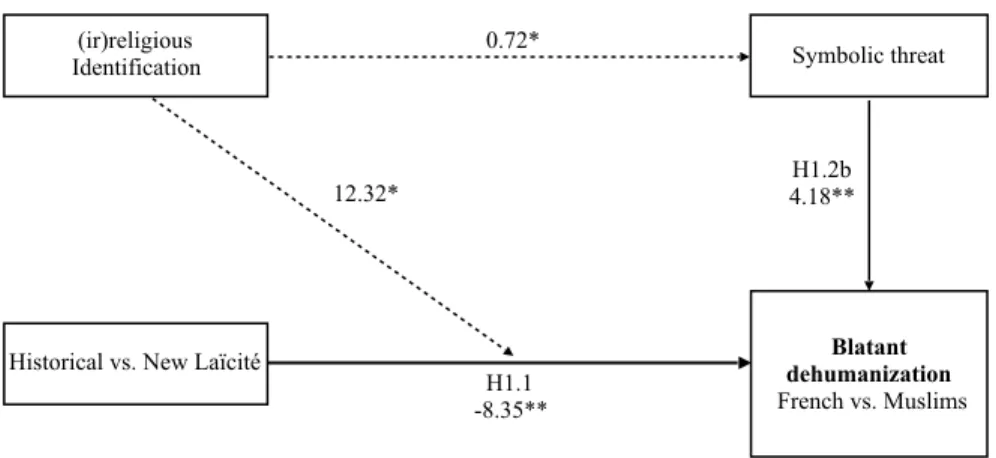
The results showed a significant direct effect of the Historical Laïcité vs. New Laïcité condition on the level of blatant dehumanization of the outgroup Muslim in relation to French (bH1.1 = -8.35, SE= 2.84, p < .004, 95% CI [-13.96, -2.74]), not supporting H1.1 (Figure 4) . Specifically, the results showed that participants in the Historical Laïcité presented a higher level of blatant dehumanization towards Muslims relative to French, than participants in the New Laïcité condition. Also, the results showed a significant interaction effect between the New Laïcité vs. Historical Laïcité condition and (ir)religious identification on participant's level of blatant dehumanization of the outgroup Muslim relative to the French (b = 12.32, SE= 5.92, p < . 04, 95% CI [0.62, 24.01]). Precisely, the results revealed that the Laïcité priming was significant for Atheists (b = -13.06, SE = 3.54, p < .0003, 95% CI [-20.05, -6.08]) but not for Catholics (b = -0.75, SE = 4.75, 95% CI [-10.12, 8.63]), and that Atheists they were dehumanizing more in the Historical Laïcité condition relative to New Laïcités .
Anxiety Threat
(ir)religious Identification
Symbolic Threat
Note. *** = p < .000, ** = p < .01, * = p <.05, - - - = new significant unexpected results
Figure 3. Significant Effects of Symbolic threat and (ir)religious identification on blatant dehumanization - Muslims vs. (ir)religious ingroup.
Blatant dehumanization
Muslims vs. (ir)religious ingroup 3.49*
Then, the results showed no reliable indirect effects of the Historical Laïcité vs. New Laïcité condition on the level of blatant dehumanization of the outgroup Muslim in relation to French via anxiety threat, not confirming H1.3a and H1.2a. Specifically, the effect of Historical Laïcité vs. New Laïcité condition on anxiety and the effect of anxiety threat on the level of blatant dehumanization of the outgroup Muslim were both non-significant, (respectively bH1.3a = 0.16, SE= 0.18, 95% CI [-1.19, 0.51]; bH1.2a = 0.96, SE= 1.36, 95% CI [-1.73, 3.64]). Also, and not supporting H1.4a, the results showed no reliable interaction effect between the Historical Laïcité vs. New Laïcité condition and participants (ir)religious identification on anxiety threat (bH1.4a = -0.02, SE= 0.37, 95% CI [-0.76, 0.71]).
Symbolic threat
As for symbolic threat, the results showed no reliable indirect effects of the Historical Laïcité vs. New Laïcité condition on the level of blatant dehumanization of Muslims in relation to French, not supporting H1.3b. More specifically, the effect of the priming on symbolic threat was non-significant (b H1.3b = 0.12, SE= 0.15, 95% CI [-0.18, 0.42]). Also, and contrary to H1.4b, the results showed no reliable interaction effect between the Historical Laïcité vs. New Laïcité condition and the (ir)religious identification on symbolic threat (b H1.4b = 0.31, SE= 0.32, 95% CI [-0.32, 0.93]). However, the expected H1.2b relationship between symbolic threat and blatant dehumanization of Muslims was significant (b H1.2b = 4.18, SE= 1.59, p < .01, 95% CI [1.05, 7.32]), indicating that the increase in symbolic threat was associated with higher levels of blatant dehumanization of Muslims compare to French. Finally, the results showed a significant effect of (ir)religious group on symbolic threat (b =0.72, SE= 0.26, p < .006, 95% CI [0.21, 1.22]).
Precisely, results revealed that Catholics participants presented a higher level of symbolic threat relative to Atheists.
Blatant dehumanization of French vs. (ir)religious ingroup identification.
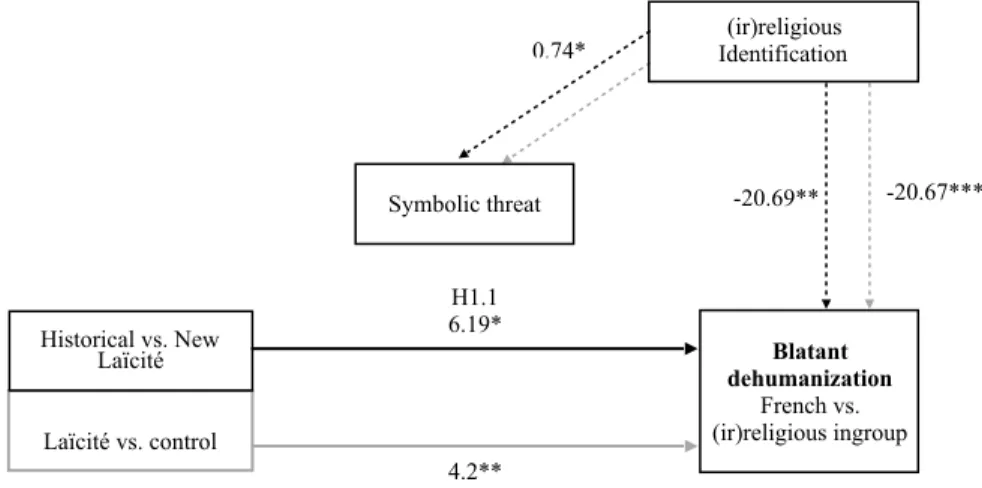
The results showed a significant direct effect of the Historical Laïcité vs. New Laïcité condition on the level of blatant dehumanization of the ingroup French in relation to Atheist/ Catholic, supporting H1.1 (b H1.1 = 6.19, SE= 2.65, p < .02, 95% CI [0.95, 11.42]) (Figure 5). Precisely, results showed that the level of dehumanization of the ingroup French in relation to Atheist/Catholic was higher for participants that were in the New Laïcité condition than those who were in the Historical Laïcité condition.
Anxiety Threat
Also, no indirect effect of the Historical Laïcité vs. New Laïcité condition on the level of blatant dehumanization of the ingroup French in relation to Atheist/Catholic via anxiety threat was found, not confirming H1.3a and H1.2a. Specifically, the effect of Historical Laïcité vs. New Laïcité condition on anxiety and the effect of anxiety threat on the level of blatant
dehumanization of the outgroup French were both non-significant, (respectively, b H1.3a= 0.19,
SE= 0.18, 95% CI [-1.16, 0.54]; b H1.2a = -1.03, SE= 1.26, 95% CI [-3.52, 1.46]). Also, the results showed no reliable interaction effect between the Historical Laïcité vs. New Laïcité condition and
Figure 4. Significant effects of the priming, symbolic threat and (ir)religious identification on blatant dehumanization - French vs. Muslims.
Note. *** = p < .000, ** = p <.01, * = p < .05, - - - = new significant unexpected results
Historical vs. New Laïcité
H1.1 -8.35** (ir)religious Identification 12.32* 0.72* Blatant dehumanization French vs. Muslims Symbolic threat H1.2b 4.18**
participants (ir)religious identification on anxiety threat (bH1.4a = 0.05, SE= 0.37, 95% CI [-0.68, 0.79]), not supporting H1.4a.
Symbolic threat
As for symbolic threat, the results showed no reliable indirect effects of the Historical Laïcité vs. New Laïcité condition on the level of blatant dehumanization of French, not supporting H1.3b and H1.2b. Specifically, the effect of Historical Laïcité vs. New Laïcité
condition on symbolic and the effect of symbolic threat on the level of blatant dehumanization of the outgroup French were both non-significant, (respectively, b H1.3b = 0.14, SE= 0.15, 95% CI
[-0.16, 0.44]; b H1.2b =-0.80, SE= 1.48, 95% CI [-3.73, 2.12]). Also, contrary to H1.4b, the results showed no reliable interaction effect between the Historical Laïcité vs. New Laïcité condition and the (ir)religious identification on symbolic threat (b H1.4b = 0.35, SE= 0.31, 95% CI [-0.27, 0.97]).
Finally, the results showed a significant effect of (ir)religious identification on symbolic threat (b = 0.74, SE= 0.26, p < .004, 95% CI [0.24, 1.25]). Specifically, results revealed that Catholic participants in relation to Atheists, presented a higher level of symbolic threat. Also, the results revealed a significant effect of (ir)religious identification (Atheist vs. Catholic) on the level of blatant dehumanization of the ingroup French in relation to Atheist/Catholic (b = -20.69, SE= 4.59, p < .0000, 95% CI [-29.76, -11.64]). Specifically, the results showed that the level of dehumanization of the ingroup French in relation to Atheist/Catholic was higher for participants identifying as Atheist than the one of participants identifying as Catholic. 2
The results revealed a significant direct effect of the Laïcité condition vs. control condition on the level
2
of blatant dehumanization of the ingroup French in relation to Atheist/Catholic (b = 4.26, SE= 1.56, p < . 0071, 95% CI [1.18, 7.34]). Precisely, results showed that the level of blatant dehumanization was stronger in the Laïcité condition than in the control. Also, the results showed a significant effect of (ir)religious group on symbolic threat (b = 0.75, SE= 0.26, p < .004, 95% CI [0.24, 1.26]). Specifically, the results revealed that Catholic participants in relation to Atheists, presented a higher level of symbolic threat. Finally, results revealed a significant effect of (ir)religious identification (Atheist vs. Catholic) on the level of blatant dehumanization of the ingroup French in relation to Atheist/Catholic (b = -20.67, SE= 4.61, p < .0000, 95% CI [-29.77, -11.57]). Precisely, the results showed that the level of dehumanization of the ingroup French in relation to Atheist/Catholic was higher for participants identifying as Atheist than the one of participants identifying as Catholic.
Subtle dehumanization of Muslims in comparison with (ir)religious ingroup through the attribution of Human Uniqueness traits
Positive Human Uniqueness traits
The results showed no reliable direct effect of Historical Laïcité vs. New Laïcité condition on the level of subtle dehumanization of the outgroup Muslim in relation to the ingroup Atheist/ Catholic, through the attribution of positive Human Uniqueness traits, not confirming H2.1 (b H2.1 = -0.04, SE = 0.22, 95% CI [-0.47, 0.]).
Anxiety Threat
Also, there was no indirect effect of the Historical Laïcité vs. New Laïcité condition on the level of subtle dehumanization of the outgroup Muslim in relation to Atheist/Catholic, not confirming H2.3a and H2.2a. Specifically, the effect of Historical Laïcité vs. New Laïcité condition on anxiety and the effect of anxiety threat on the level of subtle dehumanization of the outgroup Muslim in relation to Atheist/Catholic were both non-significant, (respectively, b H2.3a =
H1.1 6.19* 4.2** -20.69** -20.67*** Laïcité vs. control Historical vs. New Laïcité Blatant dehumanization French vs. (ir)religious ingroup (ir)religious Identification Symbolic threat
Figure 5. Significant effects of the Historical Laïcité vs. New Laïcité, Laïcité vs. Control and (ir)religious identification on blatant dehumanization - French vs. (ir)religious ingroup, and Symbolic threat.
Note. *** = p < .000, ** = p <.01, * = p < .05, - - - = new significant unexpected results