Deposited in Repositório ISCTE-IUL:
2019-04-03
Deposited version:
Post-print
Peer-review status of attached file:
Peer-reviewed
Citation for published item:
Rosa, M., Kavanagh, E., Kounov, P., Jarosz, S., Waldzus, S., Collins, E. C....Giessner, S. (2017). Change commitment in low-status merger partners: the role of information processing, relative ingroup prototypicality, and merger patterns. British Journal of Social Psychology. 56 (3), 618-630
Further information on publisher's website:
10.1111/bjso.12189
Publisher's copyright statement:
This is the peer reviewed version of the following article: Rosa, M., Kavanagh, E., Kounov, P., Jarosz, S., Waldzus, S., Collins, E. C....Giessner, S. (2017). Change commitment in low-status merger partners: the role of information processing, relative ingroup prototypicality, and merger patterns. British Journal of Social Psychology. 56 (3), 618-630, which has been published in final form at https://dx.doi.org/10.1111/bjso.12189. This article may be used for non-commercial purposes in accordance with the Publisher's Terms and Conditions for self-archiving.
Use policy
Creative Commons CC BY 4.0
The full-text may be used and/or reproduced, and given to third parties in any format or medium, without prior permission or charge, for personal research or study, educational, or not-for-profit purposes provided that:
• a full bibliographic reference is made to the original source • a link is made to the metadata record in the Repository • the full-text is not changed in any way
The full-text must not be sold in any format or medium without the formal permission of the copyright holders. Serviços de Informação e Documentação, Instituto Universitário de Lisboa (ISCTE-IUL)
Av. das Forças Armadas, Edifício II, 1649-026 Lisboa Portugal Phone: +(351) 217 903 024 | e-mail: [email protected]
This is the accepted version of the following article: Rosa, M., Kavanagh, E., Kounov, P., Jarosz, S., Waldzus, S., Collins, E. C., & Giessner, S. (2017), Change commitment in low-status merger partners: The role of information processing, relative ingroup
prototypicality, and merger patterns. British Journal of Social Psychology. doi:10.1111/bjso.12189, which has been published in final form at
http://onlinelibrary.wiley.com/doi/10.1111/bjso.12189/full. This article may be used for non-commercial purposes in accordance with the Wiley Self-Archiving Policy [
http://olabout.wiley.com/WileyCDA/Section/id-828039.html ].
Change commitment in low status merger partners: The role of information processing, relative ingroup prototypicality, and merger patterns
Miriam Rosa1,
Eithne Kavanagh 2, Pavel Kounov 3, Sywlia Jarosz 4, Sven Waldzus1, Elizabeth C. Collins1,&
Steffen Giessner5
1Instituto Universitário de Lisboa (ISCTE-IUL), CIS-IUL 2 Trinity College Dublin, Ireland
3 The University of Glasgow, United Kingdom 4 University of Lodz, Poland
5 Rotterdam School of Management, Erasmus University Rotterdam
Author Note
This research was conducted with support from the Portuguese Science Foundation, FCT, grant SFRH / BPD / 89846 / 2012 awarded to the first author, as well as the Junior Researcher
Program from the European Federation of Psychology Students Associations. Correspondence regarding this manuscript should be sent to Miriam Rosa, CIS-IUL, Avenida das Forças Armadas, 1649-026, Lisbon, Portugal (e-mail: [email protected])
Abstract
Merger announcements cause stress among employees, often leading to low change
commitment, especially among employees from the lower-status merger partner. Such stress influences how deeply employees process merger-relevant information. Previous research examined how merger patterns that preserve versus change status differences impact merger support, but did not address how employees’ information processing may influence this
relationship. The current research addresses this gap through a scenario experiment, focusing on the low-status merger partner. The interplay between merger patterns and information processing was examined regarding employees’ prototypicality claims in relation to merger support. Results suggest that an integration-equality merger pattern increases change commitment via
prototypicality claims in the new organization, conditional to employees’ systematic information processing.
Keywords: mergers and acquisitions; social identity; merger patterns; information processing; relative ingroup prototypicality
Change commitment in low status merger partners: The role of information processing, relative ingroup prototypicality and merger patterns
When a merger1 is announced, employees feel uncertainty thinking about its impact on their jobs, careers and work identity (Marks & Mirvis, 1985; Seo & Hill, 2005). Negative reactions can impair successful adaptation (e.g. low commitment to merger-instigated changes; Millward & Kyriakidou, 2004). Negative reactions are more pronounced within low-status merger partners (smaller, less powerful, less profitable firms), those usually less represented in the new organization and more disrupted (Amiot, Tery, & Callan, 2007; Boen, Vanbeselaere, & Wostyn, 2010; Rosa, Giessner, Guerra, Waldzus, Kersting, Gorski, Veličković, & Collins, 2016). Information about how existing companies will be represented in the new company—the merger pattern—impacts employees’ merger support (Giessner, Viki, Otten, Terry, & Täuber, 2006; Gleibs, Taüber, Viki, & Giessner, 2013). However, how employees’ beliefs are affected by situational constraints, such as cognitive elaboration, is unknown. On one hand, a merger announcement may trigger elaborated reasoning on possible outcomes/implications, resulting in somewhat stable attitudes towards the merger over time (Gleibs, Noack, & Mummendey, 2010). On the other hand, merger support may vary according to how much members of merging organizations are willing and/or able to elaborate on merger-related information and find arguments for or against it. Little is known about how such processes impact merger support.
The present research addresses this gap and extends previous research with an
information processing approach to elucidate early effects of merger announcements. Moreover, we examine how the planned merger pattern (equal vs. proportional integration of organizations)
influences employees’ perceptions of the pre-merged organization’s prototypicality in the post-merger organization and, in turn, commitment to changes entailed. This approach is integrated with the proposed cognitive-motivational framework, examining how prototypicality claims are influenced by heuristic or systematic processing of merger information.
A social identity approach to mergers
Individuals derive social identity and self-worth from their work (Ashforth & Mael, 1989; Haslam, 2004; Tajfel & Turner, 1986). When a merger is announced, an identity disruption can occur (Jetten, O’Brien, & Tindall, 2002; van Knippenberg, van Knippenberg, Monden, & de Lima, 2002; van Leeuwen, van Knippenberg, & Ellemers, 2003), causing negative reactions such as loss of purpose and lower productivity (Hogan & Overmyer-Day, 1994; Cartwright, 2005; Rosa et al., 2016), commonly preceded by low change commitment (Schweiger & De Nisi, 1991).
Mergers frequently involve organizations with unequal status and economic strength (Giessner, Ullrich, & van Dick, 2011; van Oudenhoven & de Boer, 1995), and employees from lower-status merger partners are more likely to react negatively (Amiot et al., 2007; Boen, et al., 2010; Fischer, Greitemeier, Omay, & Frey, 2007; Giessner et al., 2011; Terry & O’Brien, 2001). How much lower-status merger partner employees anticipate identity elements of their company will be integrated into the post-merger organization is a crucial element of merger support. Giessner and colleagues (Giessner et al., 2006) investigated four merger patterns: assimilation (the lower-status partner assimilates into the higher-status partner), integration-proportionality (pre-merger status differences are reproduced in the new organization), integration-equality (partners are equally represented) and transformation (partners form a completely new organizational culture). With the assimilation pattern, lower-status partners show less
commitment to the new organization, compared to integration or transformation configurations (Mottola, Bachman, Gaertner, & Dovidio, 1997; Nahavandi & Malekzadeh, 1998; Schoenauer, 1967). Consonant with social identity theory’s (Tajfel & Turner, 1986) notion that lower-status partners may be motivated to enhance their relative status, merger support is higher when the merger pattern is transformation or integration-equality, than when the pattern is assimilation or integration-proportionality (Giessner et al., 2006). Although actual mergers are unlikely to fit one pattern precisely, in the current research we build on the key-role of relative status
differences, focusing on integration-equality vs. integration-proportionality to represent merger-patterns that attenuate vs. preserve status differences, respectively.
Apart from merger-related attitudes, an important question regarding mergers is how expected changes are integrated meaningfully in employees’ constructions of their social context. Such contextualization can impact attitude formation, and provide sources of legitimacy and meaning that further change-related communication and the formation of shared beliefs within the organization. Thus it may provide a coping mechanism for the merger, as a stressful event. The current research focuses on two key-concepts for understanding the meaning mergers have for employees’ organizational identity: Self-categorization and relative prototypicality.
Self-categorization theory (Turner, Hogg, Oakes, Reicher, & Wetherell, 1987) describes how people find their place in the social world through ingroup identification and intergroup comparisons. Mergers create frictions because they offer a platform for intergroup comparisons between merger partners (Waldzus, 2009) by focusing attention on each partner’s position in the post-merger organization, a common superordinate category (SC). Members of each pre-merger partner, subgroups of the SC, frequently project their own distinctive attributes onto the SC (e.g. Gleibs, Mummendey, & Noack, 2008; Riketta & Nienaber, 2007; Ullrich, Crist, & Schüter,
2006). They might, therefore, see their group as more representative/prototypical of the SC relative to the other group (relative ingroup prototypicality (rIP); Mummendey & Wenzel, 1999). Indeed, rIP in the post-merged organization predicts merger support (Gleibs et al., 2008;
Waldzus, Mummendey, Wenzel, & Boettcher, 2004).
However, prototypicality cues are closely related to status (e.g. size, power), leading lower-status partners to claim lower rIP than higher-status partners (e.g. Devos & Banaji, 2005; Waldzus et al., 2004). Given that limited representation in the merged organization has
devastating consequences for post-merger identification and support (e.g. Amiot et al., 2007; Terry & O’Brien, 2001; van Knippenberg et al., 2002), providing a basis for higher
prototypicality claims might help lower-status merger partners cope with merger-related changes.
Information Processing
When a merger is announced it usually triggers stress and uncertainty (Buono & Bowditch, 1989; Cartwright & Cooper, 1993; van Dick, Ullrich, & Tissington, 2006). Employees often react to a merger with denial and disbelief, or by scrutinizing possible worst case scenarios (Marks & Mirvis, 1985). Since mergers are highly self-relevant, employees are motivated to glean implications from the available information, for instance on the set-up of the merger as it is captured by the merger pattern, including how their company will be represented in the new organization. While attitudes develop over time (Gleibs et al., 2010), the cognitions leading to them can form early, hence the importance of examining early information processing. One important contextual feature is workplace constraints on time and attention because of work and information overload, particularly in the face of a looming merger (Abrahamson, 2000;
of organizational changes, information about those changes is often less than 2 percent of all information provided. This implies that employees’ usage of the knowledge about the merger might be limited. Our research addresses these situations and raises the question of what influence such work settings potentially have on employees’ judgements. Indeed, how employees process information about the merger (e.g., merger pattern) early on is unknown.
According to the heuristic-systematic information processing model (Chen & Chaiken, 1999), people process most information using quick, efficient cognitive shortcuts (heuristic processing). However, if they have enough motivation and/or capacity, they will expend
cognitive effort by systematic processing. Information processing mode influences the formation of beliefs and perceptions, such as relative ingroup prototypicality (Rosa & Waldzus, 2012; Rosa et al., 2016; Rosa, Waldzus, & Collins, 2016), which can then influence long-term attitude formation. When cognitive capacity is low (e.g. under time pressure or cognitive load) the use of heuristics increases (Chaiken & Ledgerwood, 2012), leading employees to rely on direct and established prototypicality cues such as status. Conversely, when cognitive capacity is high and there is sufficient motivation for systematic processing, employees will engage in an effortful search for information, taking into account more detailed information about the merger and/or positive characteristics of their company.
We expect that, when asked for prototypicality judgments under time pressure, the resulting heuristic information processing will lead employees to focus on general status information as an available heuristic cue: Lower-status partners’ prototypicality claims will be lower than under no time pressure. Conversely, under systematic information processing,
employees will take into account more specific merger information, such as the expected merger pattern, elaborating on likely status differences between merger partners in the post-merger
organization. Thus, under systematic processing, the merger pattern will have an impact on prototypicality judgments and, in turn, influence change commitment.
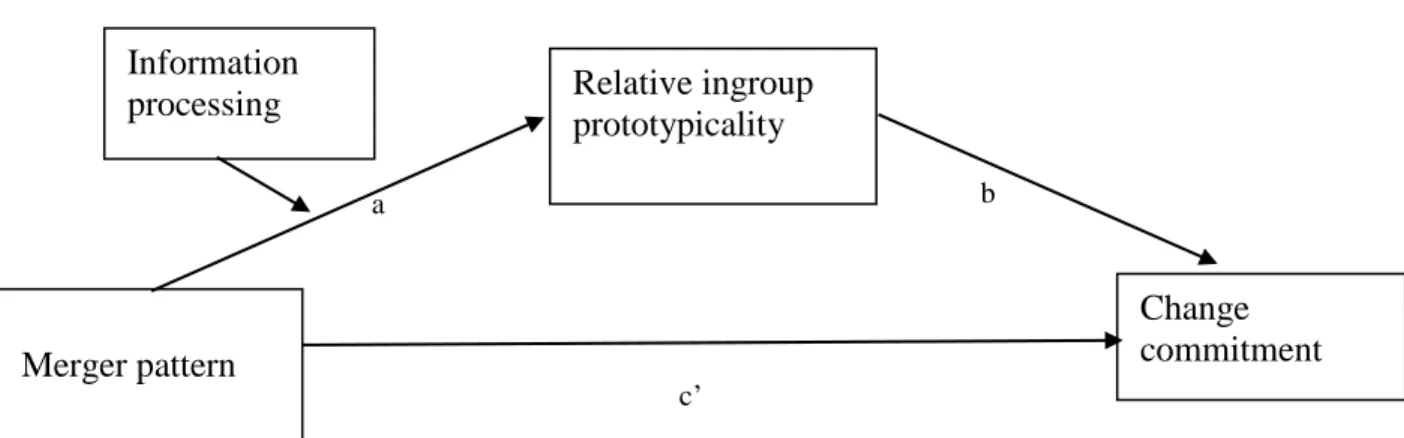
Overall, we hypothesize that merger pattern will affect change commitment via rIP, and the path from merger pattern to rIP will be moderated by information processing: the mediation being conditional to systematic processing (see Figure 1 for a conceptual model). A merger pattern that does not perpetuate status differences (such as integration-equality) should promote increased rIP of a lower-status merger partner, compared with a merger pattern that continues status differentiation (such as integration proportionality). Information processing should moderate this relation: integration-equality, as compared to integration-proportionality, should increase prototypicality claims for a lower status merger partner under systematic but not under heuristic information processing (H1). Greater rIP will be positively related to change
commitment (H2).
These hypotheses were tested in a sample of individuals from diverse organizations. It is difficult to know in advance when mergers will happen and, as a result, research with real-case organizational mergers tends to be retrospective. Scenario approaches are commonly used to investigate merger processes (e.g. Gleibs et al., 2013) because they are a privileged way of studying them experimentally (Rentsch & Schneider, 1991), and have been yielding results replicable in organizational contexts (e.g. Giessner et al., 2006; Giessner & Mummendey, 2008; Gleibs et al., 2013; Ullrich et al., 2006). In this research, both the merger case and merger pattern manipulation were based on fictitious scenarios, using the critical incident technique (Flanagan, 1954). In this framework, reactions to the merger are projected in the future (e.g. change
commitment is treated as a future intention).
Method
Participants. Participants were 144 individuals from various job sectors (45 male, 59
female; aged 21-80 years (M = 29; SD = 11.25). Thirty-two reported having worked at a company that undertook a merger, but this did not influence the results. There is missing data across the study and differences in degrees of freedom are due to that2.
Design and procedure. The study used a 2 (Merger pattern: equality vs. proportionality)
x 2 (Information processing: heuristic vs. systematic) between-participants design. Invitations to participate in the online survey were distributed via professional social media networks and advertisements containing a link to the study. Participants were randomly assigned to
experimental condition by the software, Qualtrics (Provo, UT) and were thanked and debriefed online after completing the study.
The intergroup situation was presented as a scenario, adapted from Giessner et al., (2006). Participants were asked to imagine they work at BOLT, a company about to merge with another company - ACME. Status information was kept constant, depicting BOLT as lower-status on a number of indicators provided in a fictitious memorandum concerning the planned merger. BOLT was described as being founded in 1989, with a lower national stock market share price, whereas ACME was described as being founded in 1919, with a worldwide presence and higher national stock market share price. BOLT and ACME were described as having a similar number of employees, but ACME had considerably higher transaction volume and annual profits.
Manipulation of merger pattern. Information in the scenario depicted the proportion of
logo and the proportion of employees within transition teams. The depiction was either that the two partners would be equivalent (equality) or proportional to the pre-merger status
(proportionality) in the new company (Giessner et al., 2006).
Manipulation of information processing. Elaboration on the information about the
merger was constrained after participants acquired the necessary knowledge about the fictitious organizations and the merger context. Information processing was manipulated with time pressure. In the no time pressure/systematic condition, participants were instructed to “take time and ponder while answering the questions”. In the time pressure/heuristic condition, they were instructed that “to mimic everyday life, [participants] have limited time to answer the questions”, with a countdown chronometer displayed for each question. Participants were told that they could still answer after the chronometer reached 0 seconds but should answer as fast as possible (Rosa & Waldzus, 2012).
Measures. If not otherwise stated, the response scale for the measures was a 7-point scale
from “1=Strongly disagree” to “7= Strongly agree.”
Relative ingroup prototypicality (rIP). A textual measure adapted from Rosa and
Waldzus (2012) was used, with two items targeting ingroup prototypicality (α= .62) and two items targeting outgroup prototypicality (α= .64). They were combined into a single scale, with outgroup-targeted items reverse-coded (α= .60)3.
Commitment to change. Four item scale from Fedor, Caldwell, and Herold (2006)
assessing future intentions to act on behalf of the change were used (α= .86 (e.g. “I will be fully supportive of this change”).
Relative status. A pictorial measure was used (see Rosa and Waldzus, (2012), with 2
vertical arrows divided in 7 sections, representing the status of the ingroup and the outgroup (lower portions representing lower status).
Manipulation checks. A 4-item scale from Rosa and Waldzus (2012) was used to check
the time pressure manipulation (e.g. “While answering these questions so far, I have been: ...focusing on answering quickly”; α= .82). A single-item measure from Giessner at al., (2006) was used to check the merger pattern manipulation, asking participants if both companies were equally acknowledged or if one was dominant.
Results
Descriptive statistics are included in Table 1.
Manipulation checks and preliminary analyses. A 2 (information processing) X 2
(merger pattern) ANOVA on the time pressure manipulation check showed just a main effect of time pressure, F (1,96) = 33.03, p <.001, η²p =.26. Participants perceived more time pressure in
the time pressure (M= 4.24, SD = 1.28) than the no time pressure condition (M= 2.81, SD = 1.17).
The same ANOVA on the merger pattern check showed only a main effect of merger pattern, F (1, 94) = 11.38, p=.001 , η²p = .12. Participants perceived more equal corporate
representation in the equality condition (M= 1.55, SD = 0.73) than in the proportionality
condition (M= 1.15, SD = 0.36). Finally, relative status was significantly lower than zero, t (96) = -7.60, p <.001 with no differences in relative status across experimental conditions (ps > .34). Although not required for our theoretical model, we tested whether there is an effect of merger pattern on change commitment moderated by information processing. A 2 (merger
pattern) x 2 (information processing) ANOVA showed no main effects of information processing or merger pattern, nor an interaction of both factors (ps > .35).
Hypotheses testing.
Our predictions were integrated in an overall model, predicting an indirect effect of merger pattern on change commitment through rIP, and a moderation of the effect of merger pattern on rIP by information processing (see Figure 1). This moderated mediation was tested with multiple regression using the SPSS Macro PROCESS, Model 7 (Hayes, 2013) 4. Both merger pattern and information processing level were contrast-coded (merger pattern: -1 = proportionality, 1 = equality; information processing: -1 = heuristic, 1 = systematic). Moreover, 10000 bootstrap samples were requested for estimating the indirect effects’ bias-corrected 95% bootstrap confidence intervals. As suggested by Hayes (2013), we decomposed the overall model into simple tests. Details can be found in the supporting information.
Results are reported in Table 2. The overall mediator model explained a significant proportion of the variance, R2 = .21, F (3, 100) = 9.11, p < .001: the merger pattern predicted rIP. This effect was qualified by an interaction between merger pattern and information processing, indicating that the effect of merger pattern on rIP was moderated by information processing (i.e., increasing under systematic processing). The effect of rIP on change commitment also explained a significant proportion of the variance, R2 = .08, F (2, 101) = 4.22, p = .02. The direct effect of merger pattern on change commitment was not significant, and the indirect effect was significant only in the systematic processing condition (see Table 2). The predicted Index of Moderated mediation was significant (Table 2)5.
This study examined the “human side” of a merger’s early stages. The uncertain future and identity discontinuity revealed with a merger announcement, creates unavoidable stress and anxiety that can lead to low commitment to the post-merger organization (Schweiger & DeNisi, 1991), likely affecting absenteeism, productivity and turnover (Schweiger & DeNisi, 1991; Krug & Hegarty, 2001).
We investigated mergers as identity processes, hypothesizing that an integration-equality (vs. integration-proportionality) merger pattern would increase the representativeness (rIP) of the lower-status merger partner, causing its employees to be more willing to commit to the changes the merger demanded (H1). Furthermore, we expected this relation should only occur when people have time to elaborate merger information (H2). We tested these predictions in a joint model andfound that an integration-equality merger pattern lead to stronger prototypicality claims by low-status partner employees than an integration-proportionality, which was linked higher change commitment intentions, as hypothesized. The link between merger pattern and rIP was conditional to systematic (rather than heuristic) processing: stronger when employees were instructed to take their time considering the information received.
These results offer insights for both the state-of-the art in mergers research and
management practice, reinforcing the importance of identity symbols in new organizations for low-status merger partners (at least). It brings a cognitive-motivational perspective by analysing employees’ processing after receiving information about an impending merger.This extends previous research (Giessner et al., 2006) that analysed how merger patterns influence merger support. Our study suggests that effects of merger pattern might be weaker than found
previously, because participants had no cognitive constraints, whereas in real merger situations, employees often do. However, if, when informing employees about an impending merger,
management emphasizes aspects of the merger where the organizations can be perceived as equal, and gives employees time to process that information, employees’ support for the changes might be increased.
Although promising, these preliminary results are limited by conditions that future research should examine. First, to increase participants’ involvement in the fictitious scenario, the
information-processing manipulation was introduced after the scenario. Therefore, we do not know the role of information processing at the moment people receive the merger announcement. Future research could replicate our findings with a common hypothetical scenario happening in the organization where participants work, and with employees from the same organization, therefore not requiring an initial learning phase.
Second, in the current study, we did not replicate previous effects of merger patterns on merger support (e.g. Giessner et al., 2006) at either of the information processing conditions. We found, however, the pattern of means reflecting a preference for integration-equality over
integration-proportionality. Thus, the effect seems to be weaker in this study. This may suggest that information processing plays a role in a more immediate consequence (providing meaning to the intergroup context - prototypicality), but not necessarily in longer-term outcomes (future commitment to changes). In order to address this question, future research could examine the scope of influence of information processing at the moment of merger announcement by examining its effects on proximal outcomes (e.g. prototypicality), mesial (e.g. organizational identification) and distal (e.g. change commitment). Also, in order to better establish continuity with previous research, a control condition of information processing could be added.
Third, although scenarios are a good tool to test causality and previous research has found results that tend to be generalizable to organizational contexts, with threat levels and effects
similar to those of real mergers (Giessner et al., 2006; Gleibs et al., 2013); nevertheless, threat elicited by a merger announcement might be experienced differently in a perspective-taking scenario compared to a real merger with a meaningful organizational membership. Thus,
research examining a case of an actual merger retrospectively could be conducted to add external validity.
Fourth, underlying motives for information processing leading to prototypicality claims could be studied. Different processing modes could be used depending on an employee’s job position, and future research could address how managers with/without decision-making power might be influenced by situational constraints. We speculate that managers would be more likely to engage in systematic processing, whereas less involved employees could be more influenced by heuristics.
Finally, the present research raises the question of whether merger support can be increased under heuristic processing. It would be interesting to test the role of potential
prototypicality cues beyond status, such as functional indispensability (contribution) to the post-merger organization’s results (Guerra, Antonio, Deegan, & Gaertner, 2015; Rosa et al., 2016; Verkuyten, Martinovic, & Smeekes, 2014).
As Buono, Bowditch and Lewis (1985) suggested, to understand corporate cultural change in light of a merger, priority should be given to studying the perceptions held by the people involved. The present study followed this suggestion, opening the door at a pertinent research question, towards a wider understanding of the entire merger process.
References
Abrahamson, E. (2000) Change without pain, Harvard Business Review, 78(4), 75–79.
Amiot, C. E., Terry, D. J., & Callan, V. J. (2007). Status, equity and social identification during an intergroup merger: A longitudinal study. British Journal of Social Psychology, 46(3), 557-577. DOI: 10.1348/014466606X146015.
Ashforth, B. E., & Mael, F. (1989). Social identity theory and the organization. Academy of Management Review, 14, 20–39. DOI: 10.5465/amr.1989.4278999.
Boen, F., Vanbeselaere, N. , & Wostyn, P. (2010) When the best become the rest: The interactive effect of premerger status and relative representation on postmerger identification and ingroup bias. Group Processes and Intergroup Relations, 13(6), 461-475.DOI: 10.1177/1368430209350746.
Buono, A. F., & Bowditch, J. L. (1989). The Human Side of Mergers and Acquisitions. San Francisco: Jossey-Bass. DOI: 10.1177/002194369002700408.
Buono, P.J., Bowditch, J.L., & Lewis, J.W. (1985) When Cultures Collide: the Anatomy of a Merger. Human Relations, 38(5), 477-500. DOI:10.1177/001872678503800506.
Cartwright, S. (2005) Mergers and Acquisitions: An Update and Appraisal. In G. P. Hodgkinson & J. K. Ford (Eds.) International Review of Industrial and Organizational Psychology, (Vol 20, pp 1-38). Chichester: John Wiley & Sons. DOI: 10.1002/0470029307.ch1. Cartwright, S. & Cooper, C. (1993). The Psychological Impact of Mergers and Acquisitions on
The Individual: A Study of Building Society Managers. Human Relations 46, 327-347. DOI: 10.1177/001872679304600302.
Chaiken, S., & Ledgerwood, A. (2012). A theory of heuristic and systematic information
processing. In P. A. M. van Lange, A. W. Kruglanski, & E. T. Higgins (Eds.), Handbook of theories of social psychology (pp. 246-266). Thousand Oaks, CA: Sage.
Chen, S. & Chaiken, S. (1999). The heuristic-systematic model in its broader context. In
S.Chaiken & Y. Trope (Eds.), Dual-process theories in social psychology (pp.73-96). New York: The Guildford Press.
Devos, T., & Banaji, M. (2005).American = white? Journal of Personality and Social Psychology, 88, 447-466. DOI:10.1037/0022-3514.88.3.447.
Fedor, D. B., Caldwell, S., & Herold, D. M. (2006). The effects of organizational changes on employee commitment: A multi-level investigation. Personnel Psychology, 59, 1-29. DOI: 10.1111/j.1744-6570.2006.00852.x.
Flanagan, J.C.(1954).The critical incident technique. Psychological Bulletin, 51(4), 327-358. DOI :10.1037/h0061470.
Fischer, P., Greitemeyer, T., Omay, S. I., & Frey, D. (2007), Mergers and group status: the impact of high, low and equal group status on identification and satisfaction with a company merger, experienced controllability, group identity and group cohesion. Journal of Community & Applied Social Psychology, 17, 203–217. DOI: 10.1002/casp.874. Gleibs, I. H., Noack, P. and Mummendey, A. (2010). We are still better than them: A
longitudinal field study of ingroup favouritism during a merger. European Journal of Social Psychology, 40, 819–836. doi:10.1002/ejsp.652
Gleibs, I. H., Mummendey, A., & Noack, P. (2008). Predictors of change in postmerger identification during a merger process: A longitudinal study. Journal of Personality and Social Psychology, 95(5), 1095-1112. DOI:10.1037/0022-3514.95.5.1095.
Gleibs, I. H., Täuber, S., Viki, G. T. & Giessner, S.R. (2013). When what we get is not what we want - The role of implemented versus desired merger patterns in support for mergers. Social Psychology, 44 (3), 177-190. doi: http://dx.doi.org/10.1027/1864-9335/a000102 Giessner, S.R. & Mummendey, A. (2008). United we win, divided we fail? Effects of cognitive
representations and performance feedbacks on merging groups. European Journal of Social Psychology, 38 (3), 412-435. doi: http://dx.doi.org/10.1002/ejsp.439
Giessner, S.R., Viki, G.T., Otten, S., Terry, D.J. & Täuber, S. (2006). The challenge of merging: Merger patterns, pre-merger status and merger support. Personality and Social Psychology Bulletin, 32 (3), 339-352. doi: http://dx.doi.org/10.1177/0146167205282151
Giessner, S.R., Ullrich, J. & van Dick, R. (2011). Social Identity and Corporate Mergers. Social and Personality Psychology Compass, 5 (6), 333-345. doi:
http://dx.doi.org/10.1111/j.1751-9004.2011.00357.x
Guerra, R., Gaertner, S. L., António, R., & Deegan, M. (2015) Do we need them? When immigrant communities are perceived as indispensable to national identity or functioning of the host society. European Journal of Social Psychology, 45, 868–879. DOI:
10.1002/ejsp.2153.
Haslam, S. A. (2004). Psychology in organizations: The social identity approach (2nd ed.). Thousand Oaks, CA: Sage Publications.
Hambrick, D. C, Finkelstein, S., & Mooney, A. C. (2005). Executive job demands: New insights for explaining strategic decisions and leader behaviors. Academy of Management Review, 30, 472– 491.DOI: 10.5465/AMR.2005.17293355
Hayes, A. F. (2013). Introduction to Mediation, Moderation and Conditional Process Analysis. New York, New York: Guilford Press.
Hogan, E., & Overmyer-Day, L. (1994). The psychology of mergers and acquisitions. International Review of Industrial and Organizational Psychology, 9, 248-281. Jetten, J., O'Brien, A. and Trindall, N. (2002), Changing identity: Predicting adjustment to
organizational restructure as a function of subgroup and superordinate identification. British Journal of Social Psychology, 41(2), 281–297. doi:10.1348/014466602760060147. Kotter, J. P. (2012) Leading Change (2nd Ed.)Boston: Harvard Business Review Press
Krug, J. A., & Hegarty, W. H. (2001). Predicting who stays and leaves after an acquisition: A study of top managers in multinational firms. Strategic Management Journal, 22, 185–196. DOI: 10.1002/1097-0266(200101)22:2<185::aid-smj149>3.0.co;2-m.
Marks, M.L. & Mirvis, P.H. (1985). The merger syndrome: stress and uncertainty. Mergers & Acquisitions, 20 (2), 50-55.
Millward, L., & Kyriakidou, O. (2004). Linking pre- and post-merger identities through the concept of career. Career Development International, 9, 1, 12-27.
DOI:10.1108/13620430410518110.
Mottola, G. R., Bachman, B. A., Gaertner, S. L. and Dovidio, J. F. (1997), How Groups Merge: The Effects of Merger Integration Patterns on Anticipated Commitment to the Merged Organization. Journal of Applied Social Psychology, 27(15), 1335–1358.
doi:10.1111/j.1559-1816.1997.tb01809.x.
Mummendey, A. & Wenzel, M. (1999). Social discrimination and tolerance in intergroup
relations: Reactions to intergroup difference. Personality and Social Psychology Review, 3 (2), 158-174. DOI: 10.1207/s15327957pspr0302_4.
Nahavandi, A., & Malekzadeh, A. R. (1988) Acculturation in mergers and acquisitions, Academy of Management Review, 13, 1, 79-90. DOI: 10.5465/AMR.1988.4306790.
Rentsch, J. R. & Schneider, B. (1991). Expectations for Postcombination Organizational Life: A Study of Responses to Merger and Acquisition Scenarios. Journal of Applied Social Psychology, 21, 233–252. DOI: 10.1111/j.1559-1816.1991.tb02725.x.
Rosa, M., & Waldzus, S. (2012). Efficiency and defense motivated ingroup projection: Sources of protoypicality in intergroup relations. Journal of Experimental Social Psychology, 48(3), 669–681. doi:10.1016/j.jesp.2011.12.004
Rosa, M., Giessner, S., Kersting, A-M., Veličković, K., Guerra, R., Waldzus, S., & Collins, E. C. (2016). "When they (don’t) need us: Lower-status merger partners’ perceptions of
representativeness and commitment to change. Manuscript in preparation
Rosa, M., Waldzus, S., & Collins, E. C. (2016). Our group is the best, you just don’t know it yet: Prototypicality judgments of low status minorities with strong belief systems. Manuscript in preparation.
van Dick, R., Ullrich, J., & Tissington, P. A. (2006), Working Under a Black Cloud: How to Sustain Organizational Identification after a Merger. British Journal of Management, 17, S69–S79. DOI: 10.1111/j.1467-8551.2006.00479.x.
Riketta, M. & Nienaber, S. (2007), Multiple Identities and Work Motivation: The Role of Perceived Compatibility between Nested Organizational Units. British Journal of Management, 18: S61–S77. DOI: 10.1111/j.1467-8551.2007.00526.x.
Schoenauer, A. W. (1967) Behaviour patterns of executives in business acquisitions. Personnel Administration, 30(1).
Schweiger, D. M., & DeNisi, A. S. (1991). Communication with employee following a merger: A longitudinal field experiment. Academy of Management Journal, 34(1), 110–135. DOI: 10.2307/256304.
Seo, M., & Hill, N. S. (2005). Understanding the human side of merger and acquisition: An integrative framework. Journal of Applied Behavioral Science, 41(4), 422-443. DOI: 10.1177/0021886305281902.
Tajfel, H. & Turner, J. C. (1986). The social identity theory of inter-group behavior. In S. Worchel & L. W. Austin (Eds.), Psychology of Intergroup Relations (pp.2-24). Chicago: Nelson Hall.
Terry, D., & O’Brien A. (2001).Status, legitimacy, and ingroup bias in the context of an organizational merger. Group Processes and Intergroup Relations, 4, 271-289. DOI: 10.1177/1368430201004003007.
Turner, J., Hogg, M. , Oakes, P., Reicher, S., & Wetherell, M. (1987). Rediscovering the social group: A self-categorization theory (pp. 42-67). Oxford, UK: Blackwell. Ullrich, J., Christ, O. & Schlüter, E. (2006). Merging on mayday: Subgroup and
superordinate identification as joint moderators of threat effects in the context of European Union's expansion. European Journal of Social Psychology, 36, 857- 876.doi: 10.1002/ejsp.319.
van Leeuwen, E., Van Knippenberg, D., & Ellemers, N. (2003). Continuing and changing group identities: The effects of merging on social identification and ingroup bias. Personality and Social Psychology Bulletin, 29, 679-690. DOI: 10.1177/0146167203029006001
van Knippenberg, D., van Knippenberg, B., Monden, L. & Lima, F. (2002). Organizational identification after a merger: A social identity perspective. The British Journal of Social Psychology, 41, 233-252. DOI: 10.1348/014466602760060228.
Van Oudenhoven, J. P., & de Boer, T. (1995). Complementarity and Similarity of Partners in International Mergers. Basic and Applied Social Psychology, 17(3), 343–356.
doi:10.1207/s15324834basp1703_4.
Verkuyten, M., Martinovic, B., & Smeekes, A. (2014). The Multicultural Jigsaw Puzzle:
Category Indispensability and Acceptance of Immigrants’ Cultural Rights. Personality and Social Psychology Bulletin, 40, 1480-1493. DOI:10.1177/0146167214549324.
Waldzus, S., & Mummendey, A. (2004). Inclusion in a superordinate category, in-group prototypicality, and attitudes towards out-groups. Journal of Experimental Social Psychology, 40(4), 466–477. doi:10.1016/j.jesp.2003.09.003
Waldzus, S., Mummendey, A., Wenzel, M. & Boettcher, F. (2004). Of bikers, teachers and Germans: groups’ diverging views about their prototypicality. British Journal of Social Psychology, 43, 1-16. doi:10.1348/0144666042037944
Waldzus, S. (2009): The ingroup projection model. In S.Otten, T.Kessler & K.Sassenberg (Eds.). Intergroup relations: The role of motivation and emotion. (pp. 41-60) London, UK:
Footnotes
1 The term “merger” will be used to describe a union of organizations
2 When missing value analyses and multiple imputations were performed, significance and direction of results were unchanged. Details are reported in the supporting information.
3 The questionnaire also included a pictorial measure, based on self-inclusion (Waldzus & Mummendey, 2004). However, it was not technically possible to depict the ingroup and outgroup perceptions side by side as in the original measure. Reliability scores for composite indices were low (α= .52 for ingroup, α= .49 for outgroup prototypicality), thus we opted to considering just the textual measure.
4 Macro written by Andrew Hayes, version 2.03, May 2013.
5 Although our model considered information processing as a situational constraint to intergroup perceptions/judgments, we tested two alternative models: 1) information processing also moderating the path from rIP to change commitment (Model 58, Hayes, 2013), with results showing that the interaction between rIP and information processing on change commitment is not significant; and 2) information processing moderating the direct effect of merger patterns on change commitment (Model 8, Hayes, 2013), with results showing no conditional direct effect.
Table 1
Means and standard deviations of the prototypicality measures and commitment to change, depending on merger pattern and information processing
Information processing Merger pattern Integration-equality Integration-proportionality M SD N M SD N Relative ingroup prototypicality Heuristic 3.95 0.78 24 3.62 0.93 30 Systematic 4.39 0.96 27 3.28 1.07 29 Overall score 4.19 0.90 51 3.46 1.01 59
Change commitment Heuristic 5.03 1.01 21 4.74 1.06 30
Systematic 5.15 1.21 26 5.01 1.30 27
Overall score 5.10 1.11 47 4.87 1.18 57
Manipulation checks – M SD N
Information processing Heuristic 4.24 1.28 48
Systematic 2.81 1.17 52
Merger patterns Int.equality 1.55 0.73 44
Int.proportionality 1.15 0.36 54
Table 2
Summary of moderated mediated results, H1 and H2
Mediator variable model (a)
F (3, 100) = 9.11, p<.0001; R2= .21 B SE t p
Effects on relative ingroup
prototypicality
Constant 3.72 .09 41.92 <.001
Merger pattern (-1=proportionality, 1= equality) 0.38 .09 4.31 <.001
Information processing (-1 =systematic; 1=heuristic)
.01 .09 0.11 .91
Merger pattern X information processing -0.26 .09 -2.88 .01
Dependent variable model (b)
F (2, 101) = 4.22, p=.02; R2= .08 B SE t p
Effects on change commitment
Constant 3.77 .46 8.23 <.001
Merger pattern -0.01 .12 -0.09 .93
Relative ingroup prototypicality 0.32 .12 2.71 .01
Direct effect B SE t p
-0.01 .12 -0.09 .93
Conditional indirect effects Ind. Effect SE bias corrected and
accelerated 95% confidence intervals
Lower level Upper level
Bootstrap estimates At heuristic processing 0.04 .05 -.02 .17
At systematic processing 0.21 .09 .05 .40
Figure 1. Conceptual model of the relation between functional indispensability and commitment to change, mediated by relative ingroup prototypicality
Merger pattern Relative ingroup prototypicality Change commitment Information processing a b c’