Master Thesis in Innovation and Technological Entrepreneurship
2015/2016
A Framework for Open Innovation through Automatic Analysis
of Social Media Data
Daniela Cecilia Ulloa Manzanarez
Supervisor: Rosaldo J. F. Rossetti, PhD
Co-Supervisor: Pedro Saleiro, MSc
Bio
Daniela Cecilia Ulloa Manzanarez, was born on April 2nd, 1990, in Chile, studied Industrial Engineering at University of La Frontera, Temuco, Chile, and graduated in 2014.
She started her journey in Portugal in 2014: her curiosity for goring abroad, allied with her interest in innovation and entrepreneurship as a tool for social development and to interact with different cultures were her main motivations for her next academic step, the Master in Innovation and Technological Entrepreneurship at the Faculty of Engineering/Faculty of Economics at University of Porto.
Throughout her academic experience, Daniela was involved in different associations, always related to student entrepreneurship and R&D within the university environment. Overall, all the experiences helped her improve her soft skills as well as her management skills.
Currently she is about to finish the Master program and thinking what her next challenge will be, in Chile, Portugal or elsewhere.
Dedicado a Dios, porque Él es el principio y el fin. A mis padres, Jorge y Cecilia, por su amor, confianza y ejemplo. A mis profesores guía, Rosaldo Rosetti y Pedro Saleiro, por compartir su conocimiento y guiarme en el buen trabajo. A mis colegas de MIETE y LIACC, por el apoyo y la ayuda; y a mis amigos, que están lejos y que están cerca, quienes me acompañaron diariamente en este camino que hoy llega a su fin. A todas las personas que de una u otra manera me hicieron sentir como en casa e hicieron de esta aventura algo inolvidable. Muchas gracias a todos!
***
Dedicado a Deus, pois Ele é o princípio e o fim. A meus pais, Jorge e Cecilia, pelo amor, confiança e exemplo. A meus professores orientadores, Rosaldo Rosetti e Pedro Saleiro, por compartilhar seu conhecimento e guiar-me pelo bom trabalho. A meus colegas do MIETE e LIACC, pelo apoio e ajuda; e meus amigos, que estão longe e estão próximos, que me acompanharam cada dia neste percurso que hoje chega ao fim. A todas as pessoas que de uma forma ou de outra me fizeram sentir em casa e fizeram de esta aventura algo inesquecível. Muito obrigada a todos!
***
Dedicated to God, because He is the beginning and the end. To my parents, Jorge and Cecilia, for their love, trust and example. To my supervisor teachers, Rosaldo Rossetti and Pedro Saleiro, for sharing their knowledge and guide me in the good work. To my colleagues from MIETE and LIACC, for the support and help; and to my friends, who are far away and are close, who accompanied me daily in this way that comes to an end today. To all the people who in one way or another made me feel at home and made this adventure unforgettable. Thank you very much to all!
Abstract
When talking about product or service innovation, the rates of success can certainly be improved. One option is incorporating inputs from a key stakeholder: the end user. In the specific case of software development, one on the most used ways of gathering users requirements is through questionnaires, where the collection and analysis of data is made manually, which is costly and time-consuming.
On the one hand people today consistently comment about products, releases and news on Online Social Networks (OSN), and on the other technology for word processing on OSN, such as sentiment analysis, is already available and accessible. This thesis proposes a methodological approach for exploring how information expressed by users can be incorporated into companies’ New Product Development (NPD) process. The framework presented concretes this idea by designing a methodology for assessing companies, specifically in the area of transportation, in incorporating user's inputs, using an open innovation approach based on automatic content analysis of social media data, to extract users' opinions from OSN, analyze them through opinion mining and sentiment analysis techniques, and finally obtaining relevant information about the product reception on the market. This information is intended to be helpful in order to improve company's NPD process by increasing the new products' rates of success.
As exemplification, a use case is developed, analyzing the mobile App Uber, which is today one of the most valuable technology companies in the world, the one with fastest growing and one of the most highly rated of all time. We measure how a controversial, highly diffused event influences the volume of tweets about Uber and on the perception of its users. While there is no change in the image of Uber against consumers, a large increase in the number of tweets mentioning the mark is registered, which meant a free and important publicity for them. This information is not only relevant for the company, but also for its competitors, who through this process can monitor what their users value of other services and explore possible ways to satisfy them.
Keywords: Innovation, Open Innovation, New Product Development, Co-Creation, Online Social
Networks, Twitter, mobile Apps, Uber
Index of Contents
1. INTRODUCTION ... 9
2. LITERATURE REVIEW ... 13
2.1 Innovation Process and New Product Development (NPD) ... 13
2.1.1 Innovation characteristics ... 14
2.1.2 NPD stages ... 14
2.2 External sources of collaboration ... 15
2.2.1 User Co-creation ... 17
2.3 Online Social Networks and NPD process ... 28
2.3.1 How social networks facilitate customer feedback ... 29
2.3.2 Social-Media Mining ... 30
2.4 Smart cities ... 31
2.4.1 Smart transportation ... 32
3. METHODOLOGY ... 34
3.1 Mapping metrics into innovation characteristics ... 35
3.2 Proposed NPD framework ... 40
3.3 Architecture ... 44
4. USE CASE ... 50
4.1 Presentation of Uber ... 50
4.2 Mapping Uber into innovation characteristics ... 52
4.3 Analysis of Uber ... 58 4.3.1 Quantitative analysis ... 58 4.3.2 Sentiment analysis ... 63 5. CONCLUSIONS ... 68 5.1 Summary ... 68 5.2 Discussion ... 69 5.3 Future work ... 72 REFERENCES ... 74 APPENDIX A: Tweets containing the term "Uber" from April 28th, 2016 ... 85
APPENDIX B: Tweets containing the term "Uber" from April 30th, 2016 ... 94
Index of figures
Figure 2.1: Conceptual framework of consumer co-creation ... 19
Figure 2.2: Types of co-creation ... 24
Figure 2.3: Co-creation flowchart ... 28
Figure 3.1: Co-creation flowchart, incorporating user's feedback through social media ... 42
Figure 3.2: System architecture ... 44
Figure 4.1: Number of tweets for entity "Uber" ... 58
Figure 4.2: Number of tweets for entity "Taxi" ... 61
Figure 4.3: Number of tweets for entity "Uber" plus entity "Taxi" ... 61
Figure 4.4: Number of tweets for entity "Taxi" (without entity "Uber") ... 62
Figure 4.5: Number of tweets for entity "Uber" (without entity "Taxi") ... 62
Figure 4.6: Percentages of tweets for every polarity value during April 28th, 2016 ... 63
Figure 4.7: Percentages of tweets for every polarity value during April 30th, 2016 ... 63
Figure 4.8: Distribution of tweets according Uber metrics during April 28th, 2016 ... 65
Figure 4.9: Distribution of tweets according Uber metrics during April 30th, 2016 ... 65
Index of tables
Table 2.1: Example of co-creation in companies ... 26
1. INTRODUCTION
Some decades ago, when thinking about value creation process, organizations and users acted in particular roles of producers and consumers. Nowadays, research about innovation places that this procedure lies in a joint approach to creation of value, posited in an individual-focused co-creation of value amongst users and organizations (Prahalad and Ramaswamy, 2004).
Through users’ inputs, it is possible to get improvements in the innovation process because their opinions represent substantial value, bringing benefits for companies that adopt them (Antorini and Muñiz, 2013). Authors state that when recurring to user communities, companies are facing interesting inputs of new ideas about product innovation (Antorini and Muñiz, 2013). Working along with innovative communities can reduce many economic risks attached to the New Product Development (NPD) process (von Hippel 2005; Ogawa and Piller 2006), which is translated into cost minimization. Besides that, user innovations come up typically in response to real needs, previously identifying and knowing the potential market can reduce the risk of failure (Antorini and Muñiz, 2013).
In some areas of knowledge, as software development, the involvement of the end user during the development process is not new: there is a need for bringing users’ inputs by collecting their needs through requirements engineering processes, which can be seen as a way of co-creating with users. This process is mainly done through interviews, questionnaires and surveys (Wellsandt et al., 2014). Nowadays, this type of data is no longer enough: companies now need access to digital behavioral data as well (Howe, 2008). With the improvement of Web 2.0, crowdsourcing developed as a method for rejoining distinctive sorts of user, permitting a "crowd" of individuals to work together through Web tools to harness the innovative arrangements of a dispersed community of people to endeavor the group’s insight and collect information from extensive quantities of people (Brabham, 2008). While the utilization of the spread knowledge of a substantial group of individuals to tackle solutions is a methodology utilized for long time (Howe, 2008), it is just in the last decades that organizations and different groups have begun progressively turning to web crowdsourcing as a method for acquiring outside knowledge, getting to the
aggregate wisdom and innovativeness present in the virtual crowd (Charalabidis et al., 2014). However, both physical and virtual requirements elicitation techniques require manual collection and/or analysis of data, which is costly and time-consuming (Meth et al., 2013).
In this regard it is interesting to make a sort of passive crowdsourcing. On the one hand people today comment on all products, releases, news on Online Social Networks (OSN) and on the other is already available and accessible technology for word processing on OSN such as sentiment analysis. Therefore, picking up the available technology and harnessing the huge quantity of data about people’s sentiment, preferences, thinking and opinions available in OSN, we propose a novel framework for the development of new products and services in transportation using an open innovation approach, based on automatic content analysis of social media data.
Social media applied to co-creation methods has received an increased deal of attention over the past years (Hinz et al., 2013), despite this update, the literature is mainly theoretical, needing more empirical research, because the role of social media in companies’ innovation process is not yet clear and its potential on becoming a source of users’ information for firms to improve their NPD process results has not being developed or tested.
Nowadays, when discussing about innovation environments, the idea of smart city is constantly present. The unstoppable urbanization, thanks to the progressive growth of their population has arisen a new kind of city, called a “smart city”. The important point about this is not to focus on the smartness of a city, but on the efforts the city makes to become smarter: at this, the core of a smart city join to innovation in the community (Caragliu and del Bo, 2015). The coordinated methodology of smart cities is likewise reflected in the transport sector, an imperative part of the economic and social improvement of urban zones (Garau et al., 2016). That is why authorities have focused on the development of tools that facilitate transportation for users, from new designs of routes and means of transport, to new forms of organization of the transportation system. Software developers have
displayed this need by creating specific mobile Apps that contribute to the development of smart transportation.
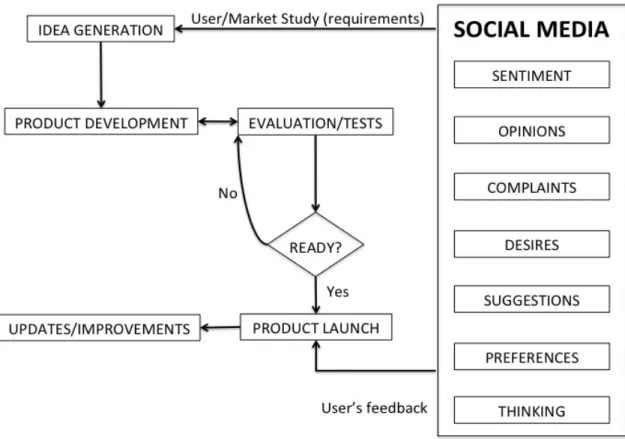
For building the framework, it is necessary to map the user metrics values in the Apps within the five characteristics of innovation defined by Rogers (1962) and assesses the extent to which the product fits this definition of innovativeness. To have clarity of how users’ opinions are considered into the process of value creation, and based on the traditional NPD framework, we design a flowchart where the views expressed by users in OSN through sentiment, opinions, complaints, desires, suggestions, preferences, thinking and so on are incorporated.
To achieve the objective, we apply an architecture pipeline where we extract users' opinions from those Online Social Networks whose API we have access to., according to previously defined heuristics, for being standardized and having a set of meaningful, general information. Next, using filters, we obtain a knowledge database, where the information gathered before is processed by a natural language processing (NLP), which involves natural language understanding, that is, enabling computers to derive meaning from human or natural language input. Once only data related to the field to be researched is held, we perform quantitative and sentiment analysis processes, with the objective of analyzing the opinion conveyed to each social content, assigning a categorical (positive, negative, neutral) or numerical sentiment score. Finally, the results are shown, through easily understandable ways of visualization.
Literature review 13
2. LITERATURE REVIEW
Four main topics complete the structure of this thesis: the innovation process described by its definition and how important it is for a company’s good performance; the different sources from where a company can obtain information and collaboration when innovating; how Online Social Networks (OSN) have raised during the last years and how they have become an important channel for communication between companies and their stakeholders, mainly customers, being necessary some techniques for recognizing them; and the arising of smart cities and the attached smart transportation as a focus of collective knowledge and innovation systems.
The objective of the present thesis is to assess the impact of OSN as a user-centered information provider for companies to improve their New Product Development processes, proposing a framework for companies, specifically in the transportation area, to harvest information provided by users.
2.1 Innovation Process and New Product Development (NPD)
Innovation is an important element of competitiveness (Luz et al., 2014). For achieving this, companies use innovation for getting advantages over their competitors, in order to improve their performance. There is a number of ways for doing it: launching new products, improving product quality, reaching new markets, etc. Crossan and Apaydin (2010) summarize the studies where the positive relation between firm innovation and good outcomes is evidenced. Other works studying this issue are the ones made by Li and Calantone (1998) where a positive relationship between the development of new products and key performance indicators, such as market share, before-tax profit and ROI is established; by Klomp and van Leeuwen (2001) where they prove that a better development of process innovation produces more sales; and by Calantone et al. (2002) about the relationship between firm’s skills to adopt innovations and financial performance through ROI and ROA.
2.1.1 Innovation characteristics
Innovation is an essential motor for sustainable competitive advantage (Dadfar et al., 2013). Innovation characteristics have been stated as a connector for consumer’s acceptance of innovation. Laby and Kinnear (1985) posit that innovation characteristics greatly influence new products and services adoption, being a strong predictor for it. Innovation characteristics are operationalized as “the characteristics of innovation that are perceived by individuals as useful to help explain the rates of adoption” (Rogers, 1962). Innovation characteristics that are perceived as having a greater a) relative advantage, b) compatibility, c) trialability, d) observability, and less e) complexity, are the variables that are supposed to improve the adoption of new technologies (Rogers, 1962).
Relative advantage: stated as “the degree to which an innovation is perceived as being
better than the idea it supersedes”.
Compatibility: stated as “the degree to which an innovation is perceived as consistent with
the existing values, past experiences and needs of the potential adopters”.
Trialability: stated as “the degree to which an innovation may be experimented with on a
limited basis”.
Observability: stated as “the degree to which the results of an innovation are visible to
others”.
Complexity: stated as “the degree to which an innovation is perceived as relatively
difficult to understand and use”.
2.1.2 NPD stages
Prandelli et al. (2010) defined the NPD process as “a development divided into four main stages”:
Literature review 15 Idea Generation
The initial step where abstract, concrete or visual ideas are created, developed and communicated. This process considers the emergence of the idea, improvement of the concept, development of the process and passage from concept to reality.
Product Design
This considers details about the characteristics of a manufactured item’s part and how they fit into the entire product. The design of the product considers how the part will reach its intended functionality in an efficient, safe and reliable way. It is also necessary to design the product in an economic and attractive to targeted consumers manner.
Commercialization
Through the commercialization process a new development is placed in the objective market. This process is divided into phases: initial introduction and mass production and adoption. Commercialization considers production, distribution, marketing, sales and post sale, which are necessary for new product’s commercial success.
Post-launch
Post-launch is seen as an evaluation period, through which valuable information about the results of the launch is collected. This information is used to determine if the product’s introduction goes according to expectations or if it needs to be rethought for getting the expected results.
2.2 External sources of collaboration
The OECD defines a national innovation system as “the flow of technology and information among people, enterprises, and institutions that are the key to the innovation process at the national level” (Yam et al., 2010). Because of this trend, researchers have stated that external knowledge is something to be considered on firms’ innovation process, among other reasons, because R&D is “a necessary complement to openness for ideas and resources from external actors” (Dahlander and Gann, 2010). When referring to external
knowledge researchers, we consider all main stakeholders: suppliers, competitors, research institutions and customers.
Suppliers have greater knowledge about raw materials, something critical to the NPD process. In this way, companies have an opportunity to add the vision and expertise of a supplier to come up with improved or new solutions (Bonaccorsi and Lipparine, 1994; Eisenhardt and Tabrizi, 1995). Through suppliers, companies can also predict potential technical problems, which allow them to develop the solution faster to respond to market demands (Kessler and Chakrabatri, 1996).
Although less frequent, firms also collaborate with competitors to develop product innovations (Bayona et al., 2001; Nieto and Santamaría, 2007). Through working together, they may share technological knowledge and skills. Because they are present in the same (or similar) industry, common problems exist and they can be solved outside the competitor’s area of influence (Tether, 2002).
Due to governmental incentives, nowadays more firms are seeking collaboration with universities and research institutions, which are “important centers for the creation and dissemination of scientific knowledge” (Hemmert, 2004). Because of this transfer of knowledge, companies have access to a new scientific knowledge for improving their new product development process (Caloghirou et al., 2004). On the other hand, a firm that does not benefit from technological knowledge of these institutions may fail, reducing the possibilities of success of a technological breakthrough when becoming a commercial product and entering the market (Spencer, 2003).
Customers are perhaps the main source of collaboration used by firms for improving its innovation performance (Gupta et al., 2000; Fritsch and Lukas, 2001). Faems et al. (2005) posit that customer collaboration has a positive impact for companies on their product innovation performance. In contrast to producers, who innovate for profit, users typically are seeking to satisfy their needs.
The concept of user-innovation is not new (e.g., von Hippel, 1976). Yet, many researches (Herstatt and von Hippel, 1992; von Hippel, 2005; Shah, 2006) have concluded that it is becoming more important; this can be observed in different types of product and industries. Despite this increased attention, studies about customers as innovators in services are not
Literature review 17
prolific. While a few studies have considered consumers inputs as valuables to service innovation (Drejer, 2004), most existing research do not share this statement (Menor and Roth, 2008).
Given that every firm is different, there are different approaches for co-innovation. For instance, Bossink (2002) states it as “collaborate innovation efforts between two or more organizations”. In contrast, this dissertation focuses on co-creation with customers, who “can provide firms ideas about discovering, developing and refining innovations” (Chesbrough et al., 2006).
2.2.1 User Co-creation
For having successful results, NPD process must have access to vital information about customers: (1) what are my user needs? and (2) how is the best way to fulfill those needs? (von Hippel, 2005).
Users are a rich source of innovation for companies. In a study made in the UK, USA and Japan, von Hippel et al. (2011) found out that between 3.7% and 6.1% of citizens of those countries innovate. If the evaluation of the situation is on communities of engaged and active consumers this improve notoriously: 37% of this kind of users innovate (von Hippel, 2005).
Today’s consumers are in a better situation of connection, information, empowerment and activeness (Prahalad and Ramaswamy, 2004), so they present different choices according to their experience and background, which increase competitive advantages for firms and improve efficiency, turning drive down costs.
Because of their characteristics, they expect some benefit from being involved and contributing to this innovation process, and companies often take advantage of “years of accumulated product knowledge and experience about the precise needs and problems that consumers experience to innovate more successfully” (von Hippel, 1986; Antorini and Muñiz Jr., 2013).
During the years, the degree of involvement of customers have changed, moving from being integrated in the front end innovation (early stages of the process) to a participation
in every stage, and most importantly, from the beginning or idea development/designing stage. Given this evolution it is important for companies to change the way they relate with users, shifting their proposition on value creation from an approach centered in the firm to an approach centered in the customer, also known as a co-creation view (Prahalad and Ramaswamy, 2004).
2.2.1.1 Building blocks of interaction
Prahalad and Ramswamy (2004) established the DART framework, a set of elements that make co-creation easier for the involved parts. These components are Dialog, Access,
Transparency and Risk-benefits (DART).
Dialogue: this component is based on the communication, engagement and compromise to
search the common good.
Access: it is vital that customer have access to information from the firm. The process
would be pointless if they don’t have all the knowledge they need to have about the product.
Transparency: if there is any difference between the information access of companies and
user, co-creation is not possible to evolve. Without transparency, both dialogue and access couldn’t exist.
Risk-benefits: users that co-create with companies understand more clearly the dynamics
of the corporation, thanks to the three previous elements. Because of this, they can analyze in a better way the risks and benefits of new technologies.
In the age of Web 2.0, companies have started to take advantage of the possibilities social media bring for developing and designing new technologies along with their users. This advance into an innovative point of view made the DART framework somehow incomplete (at least for this form of co-creation) because it does not consider the technological component. Schiavone et al., (2014) extended the traditional framework with a fifth
Literature review 19
dimension: technology management, which includes a company’s skills to bring contributors and engage them, to perform strategies through social media to motivate customers to make suggestions and contributions, and to guarantee the condition for their active involvement.
2.2.1.2 Conceptual framework of consumer co-creation
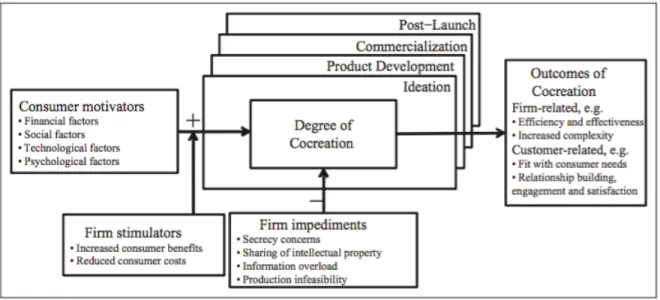
Hoyer et al. (2010) designed a framework for user creation, focused on the degree of co-creation effort, which includes the scope and intensity of co-co-creation. They studied three kinds of influencers of the degree of co-creation: consumer-level motivators, firm-level impediments, and firm-level stimulators. The three of them are able to influence the scope and intensity of co-creation.
Figure 2.1: Conceptual framework of consumer co-creation
Source: Hoyer et al., 2010
Degree of co-creation
It is the center build in the system and is an element of both the extent of co-creation and the intensity of these processes.
The extent of co-creation alludes to the affinity of firms to team up with customer over every one of the phases of the NPD process.
Intensity of co-creation alludes to the degree of which firms depend on co-creation to create items inside a specific phase of NPD.
Consumer-level motivators of co-creation
Not only small firms, but also big ones have trouble to incorporate the aptitudes of their users to improve the results of their new launches (O'Hern and Rindfleisch, 2009). Recently, researchers have recognized portions of users who may be particularly eager and ready to take part in co-creation activities, between them we can find innovators, lead users, emergent consumers, and business sector experts.
Innovators users are the ones with more potential to start using new products (Moore, 1991).
Innovators are the one who most probably receive new products positively (Moore, 1991). Lead users are people who confront lacks of certain features that will in the end be common in the commercial center, and are consequently well situated to comprehend these requirements using their knowledge (von Hippel, 1986). Emergent consumers are people who are particularly fit for using their instinct and judgment to enhance products ideas that standard users will discover engaging and helpful (Hoffman et al., 2010). Business experts are people who have knowledge about numerous sorts of products, spots to shop, and different features of the business sector, and a more willing to start examinations with and react to data demands from different users (Feick and Price, 1987).
The particular motivators of customer support in co-creation are not very well knew (Hoyer et al., 2010). Co-creation includes, with respect to users, money related and nonmonetary expenses of time, assets, physical and mental effort to learn and take an interest in the co-creation process. With respect to these costs, buyers think about advantages of participating in co-creation exercises (O'Hern and Rindfleisch, 2009). Budgetary, social, specialized, and mental elements all assume a role (Füller, 2008).
Firm-level impediments of consumer co-creation
At least four attributes can be obstructers of the co-creation process (Hoyer et al., 2010). In the first place, co-creation requires a decent measure of straightforwardness with respect to
Literature review 21
the firm, since it includes the disclosure to users (and in this way, maybe to other actors in the market) of data on NPD directions and ideas that may somehow have stayed secret only inside the company (Prahalad and Ramaswamy 2004).
Second, co-creation activities can oblige firms to ponder dubious inquiries around the ownership of intellectual property.
Third, co-creation can yield extensive volumes of customer info, some enough to prompt data over-burden.
Fourth, firms are also challenged to understand that despite the fact that customer co-makers may give clever thoughts, a considerable lot of these thoughts might be infeasible from a creation viewpoint (Magnusson et al., 2003).
Firm-level stimulators of consumer co-creation
Even customers who are generally inclined to dynamic participation in co-creation process may not be involved in this kind of activities with a specific company, if the advantages included are not enough or the costs included are too much. As needs be, for a given level of user inspiration for co-creation, firms have two bland alternatives accessible to them to empower co-creation (Hoyer et al., 2010).
In the first place, firms can fortify user co-creation by expanding the advantages that customers get from taking part in the co-creation process.
Second, firms can likewise fortify co-creation by decreasing the expenses to customers of participating in user co-creation (as far as time, effort, and foregone opportunities).
Consumer co-creation at the ideation and product development stages
The most common practice is to ask users to participate in co-creation at the initial phases of NPD, through the use of marketing research procedures (Hoyer et al., 2010). However, these strategies are costly and give constrained user-firm communications. Technology-related innovations that empower user-firm and user-user collaborations have definitely changed the co-creation scene (Sawhney et al., 2005). Nowadays, companies can influence innovations to co-create value, with the help of the customers, making the process more
understandable and proficient (Prahalad and Ramaswamy 2004). Focusing on the initial stage, companies can utilize online networking to immeasurably increment both the expansiveness and the profundity of information it can get from users at an essentially low cost (Evans and Wolf, 2005). Furthermore, they can include users in the development of the concept by opening the idea with them and effectively looking for their information (Grewal et al., 2006). Generally speaking, including user in the initial phases of NPD can make important savings in both time and cost and lessen the danger of an unsuccessful innovation (Hoyer et al., 2010).
Consumer co-creation at the commercialization and post-launch stages
The inclusion of users in value co-creation at the latest phases of NPD is regular in numerous contexts and is getting to be well known in others (Nambisan and Baron, 2009). Companies now have to face new opportunities and challenges in dealing with the latest phases of NPD and marketing process, given the multiplication of social innovations, for example, online customer communities, social networking sites, instant messaging, and wikis.
Positive outcomes of co-creation
Marketing practice and theory are progressively perceived as capable of providing big improvements to company’s performance through the performance of co-creation activities (Prahalad and Ramaswamy, 2000; 2004). By effectively executing and overseeing co-creation, a firm can find two valuable sources of advantages (Payne et al., 2008): (a) profitability increases through expanded proficiency and (b) enhanced viability.
When using co-creation, a firm can become more productive and efficient thanks to cost-minimization, since workers' contributions can be replaced by users’ contribution in the NPD process (Bowers et al., 1990). Cost saving emerges on different activities: almost costless procurement of user ideas and outsourcing of NPD activities, which diminish the requirement for inputs from conventional marketing research and workers (Evans and Wolf, 2005), reduced danger of unsuccessful products, which can lead to an increase of the cost of inventory (Ogawa and Piller, 2006; Cook 2008), quicker speed-to-market (Sawhney
Literature review 23
et al., 2005), and post-launch increases through permanent product enhancements and investigation of extra usages (Grewal et al., 2006). These results may specifically impact organizational execution, expanding the productivity of operations, product turnover, employee fulfillment and at last, incomes and profitability (Ostrom et al., 2010).
Additionally, co-creation is able to importantly make co-created items more effective, because they are closer to customer needs and have higher business potential (Lilien et al., 2002). Co-created items are regularly appeared to have high-expected advantages and novelty, which at last builds business attractiveness (Magnusson et al., 2003; Franke et al., 2006) and takes into account more differentiation with the competition (Song and Adams, 1993). A closer inclination fit of co-created products, thusly, can build uplifting attitudes toward the product, ensuing buy goals, willingness-to-pay, and referrals/verbal (Franke et al., 2009). Contribution in a co-creation process makes a user better alert on difficulties, expenses, and limitations of making a new product, resulting in conformities in inclinations and better valuation for the product (Joshi and Sharma, 2004). In this way, through the delivery of expanded quality and by expanding the quantity of connection points between the company and users, co-creation may fortify user-firm connections and in this way enhance consumer value (van Doorn et al., 2010).
2.2.1.3 Types of Co-creation
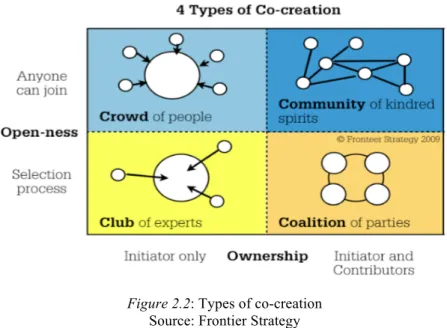
Two central characteristics define types of co-creation:
Open-ness: The degree to which anhyone can join the team, or just selected participants can be involved in the process.
Ownership: It deals with the ownership of the results, for example, if the outputs will belong to someone in particular, to the company, to the team, etc.
These two characteristics give rise to the four most diffused types of co-creation, as reresented in Figure 2.2:
Figure 2.2: Types of co-creation
Source: Frontier Strategy
Club of experts
Participants have similar interests and knowledge and are found through a dynamic determination process. Nature of info and science between members are critical to achievement.
Crowd of people
In this type otherwise called "Crowdsourcing", anybody can join. For any given challenge, there may be an individual with a very good idea that merits considering. Utilizing online tools, individuals can evaluate and react to everyone's recommendations. There is frequently a marketing and seeding component/objective connected to the procedure. Crowdsourcing “unleashes the force of the masses”, yet frequently takes longer, and there is no sure that the best individuals will (or will be able to) participate.
Coalition of parties
Some companies prefer to joint a “coalition” of people to discuss about thoughts and ventures. Every memeber conveys a particular resource or expertise to the venture. Specialized breakthroughs and the acknowledgment of principles frequently take place just when numerous participants collaborate - particularly imperative when capital
Literature review 25
consumptions are high. Vital achievement elements incorporate sharing information and making a typical competitive advantage.
Community of kindred spirits
The group of people structure is most important when creating something for the greater benefit. Communities with comparative interests and objectives can meet up and create. This model, in this way, works generally in programming improvement and influences the potential power of a huge group of individuals with reciprocal areas of expertise.
2.2.1.4 Examples of co-creation in companies
The table 2.1 below shows some examples of application,based on the co-creation types discussed above.
Table 2.1
Example of co-creation in companies
Company Name Co-creation example Source
BMW “M division” for customization of cars, also leading to general product improvements; engineering challenges: collaboration between customer and BMW engineers
Gloor and Cooper, 2007
Ducati Tech Café Virtual Customer Environment for product conceptualization
Sawhney et al., 2005
Nambisan and Nambisan, 2008 Eli Lilly Internet-based platform to support collaborative
innovation involving pharma customers
Sawhney et al., 2005 IBM Worldwide partner innovation centers to
facilitate collaborative innovation
Blazevic and Lievens, 2008 IKEA Customers can design their own kitchens in
interaction with a trained sales representative
Wikström, 1996 LEGO LEGO Factory for personalized LEGO models
and sharing/co-creation of virtual LEGO models with other consumers
Zwick et al., 2008
P&G P&G Advisor program where consumers contribute to product development (try new items and provide quality feedback)
Blazevic and Lievens, 2008
Philips Electronics Collaborated with software “hackers” for re-programming of “Pronto” universal remote control by providing access to program files, codes and other information
Prahalad and Ramaswamy, 2004
PSK (“Center for Creative Art)
Co-creation as a strategic tool for organizations learning and innovation
Chung, 2009 Samsung Virtual Product Launch Center to enlist
customers’ help in diffusion of new product information; shaping peer customers’ purchase behavior
Nambisan and Nambisan, 2008
Starbucks Business model where value is in experience (determined by the customer)
Lusch et al., 2006
Threadless.com Customers that submit, inspect, and approve t-shirt graphic designs
Elofson and Robinson, 2007
Literature review 27 2.2.1.5 Co-creation process along the NPD process
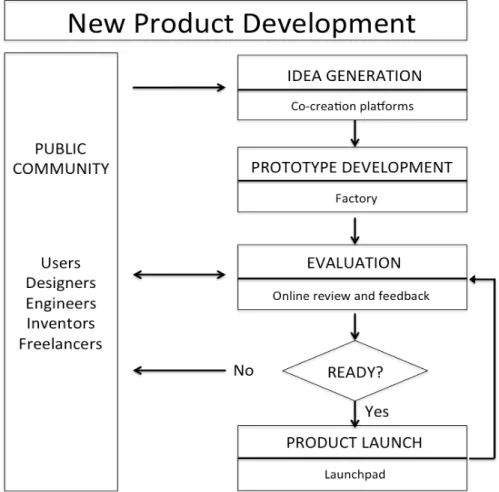
One of the most analyzed issues about the NPD process is how to know in what stage the customers should get involved (Bartl et al., 2010). An ideal innovation process details the evolution of products when transforming an idea into a concept, then into a design, for finally being tested and launched (Dahan and Hauser 2002). Directly related to this matter, we have the main of objective of a co-creation project, which is the production of ideas, the assessment and refinement of concepts, the establishment of product specifications or the creation of models. Even though the inclusion of users in the last stages of the process is regular, particularly in traditional market studies, nowadays NPD practices increasingly concentrate on the fuzzy front end and in addition on the design and improvement itself (Prandelli et al., 2006). Organizations should focus on strategies for allocating resources, in relation to the users’ preparation level, although the member will be challenged, it can’t be than they are able to (Bartl et al., 2010).
A co-creation process comprises of substituting outbound and inbound trades of data to connect inside innovation practices and the contribution of customers (Prahalad and Ramaswamy, 2004). By that implies inner innovative ability can be converged with outside learning and inventiveness. We can consider these sequences of information sharing between users and companies as a co-creative flowcharts, as represented in Figure 2.3:
Figure 2.3: Co-creation flowchart
Source: J.B. Speed School of Engineering
2.3 Online Social Networks and NPD process
With the rise of Web 2.0, a more social web, the Internet has moved from a space where users were mainly consumers of content to an interactive and collaborative space where users involve and contribute. This evolution of Web 2.0 has made the way for social networks to become a phenomenon.
During this decade abundant research about social media has been done, consequently, many definitions about it can be found in the literature. Kaplan and Haenlein (2010) stated it as a conjunction of applications based on Internet evolved from the ideology and technology of Web 2.0 for creating and exchanging “User Generated Content”. In 2010, Sterne proposed seven categories of social media sites, according to its characteristics: i)
“forum and messages boards” for sharing questions, answers and opinions in general; ii) “review and opinion sites” enabling customer feedback through reviews and opinions; iii) “social networks” interaction between people on different grades of privacy; iv)
Literature review 29 “blogging” for sharing longer opinions or experiences content; v) “micro-blogging”
similar to blogging but with shorter posts; vi) “bookmarking” for people to tag items of their interest; and vii) “media sharing” for sharing photos and/or videos.
Besides this categorization, OSN are every time more involved in people and companies activities, redefining how and for what purposes we use the Internet. With OSN the involvement of users in the innovation process has been facilitated (Sashi, 2012) because of five capabilities described by Sawhney et al. (2005): the Internet allows interactivity, it has a “global reach” that involves both customers and non-customers, it allows fluid communication so the frequency is higher, communication is much faster due to real-time interactions, and customers have more flexibility because they can involve at the level they want.
For firms, OSN have a variety of value propositions. For example, they are seen as a powerful and effective tool for marketing and communication, not only impacting the image of the company, but also its sales and profit (Kaplan and Haenlein, 2010). Also, through OSN it is possible to make a customization of the products offered by improving customer relationships and offering them special services (Kaplan and Haenlein, 2010). Lately, social media tools become more important for innovation-related activities, as users can give valuable inputs to the process (Gal-Tzur et al., 2014).
2.3.1 How social networks facilitate customer feedback
Social media represents new ways for firms to listen to the voice of their customers, and mining web data is more usual nowadays for supporting initiative of application in digital marketing and other business intelligence practices (Royle and Laing, 2014).
Twitter’s users generate data that, when analyzed, it is a valuable input for companies to get information about the market obtained directly from the customers (Lipizzi et al., 2015). As well as digital marketing, analyzing the initial commercialization of a new technology can help firms to know the customers’ reactions in real time and get ideas about what marketing actions are necessary to improve the launch strategy’s effectiveness (Banerjee et al., 2012), for obtaining customers’ inputs about possible improvements on different designs for new products (Marcus et al., 2011), or to be aware of how users feel about a
certain product or brand (Chamlertwat et al., 2012). For every company one of the main objectives is to get meaningful and representative online information and exploit it to identify how to effectively influence in attitudes and elections of the customers.
The most common methodologies when mining data from social web are based on Information Diffusion in Social Networks (Wasserman, 2011). There is also another popular type of tools based on semantic analysis, which considers sentiment and reputation analysis (Saif et al., 2012) or text mining of the public content from social media sites (He et al., 2013).
The limitations of these methods and approaches lie on their lack of support to analysts when needing a more accurate understanding of social media generated data.
Specifically, “none of them helps to capture the structure of the judgments behind the opinions expressed by users” (Lipizzi et al., 2015), which is why is necessary to make more practical studies.
2.3.2 Social-Media Mining
In social media sites it is possible to find a huge and diverse quantity of opinions from users about companies, products and services, and everything related to that. Besides this discussions and shares of thoughts, social media can also be exploited in order to examine and plan strategically. The content present in social networks is virtually costless, genuine and spontaneous, therefore, presents very attractive opportunities to get experiences and thoughts for progressing patterns and possible improvements (Welz et al., 2012).
OSN are an ever-present concept in any citizen life and an important communication tool nowadays. Within them stands out Twitter, with a huge amount of tweets produced every day. This fact, coupled with its public character makes this platform a source of unstructured information that can be exploited.
Literature review 31 2.4 Smart cities
Today, cities are facing an unstoppable urbanization, thanks to the progressive growth of their population. This has been the reason of the arise of a new kind of city, called a “smart city”, which represent a “conceptual urban development model on the basis of the utilization of human, collective, and technological capital for the development of urban agglomerations” (Angelidou, 2015).
Knowledge has always been a key part of evolution during the history of the world (Angelidou, 2015). At first, expertise of a city’s members greatly contributed to the local development of the cities, as seen during Greek, Romans and Arabs civilization periods. Besides that, there was a huge increase of knowledge during the Renaissance and the Industrial Revolution, influencing and changing science, art and other areas (World Bank, 2007).
Besides the evolution of individuals, nowadays knowledge is treat as an asset that contributes in a valuable way to the appreciation of a society, being a source of advantage for companies, public organizations and communities (Angelidou et al., 2012), representing an important tool in diverse areas such as war, industry, R&D, manufacture, science infrastructure or overall economy strength (Townsend et al., 2009).
Collective sources of innovation, such as clusters and hubs, smart technology districts and living labs has taken the lead in developing new technologies for improving the life quality of our cities (Komninos, 2009). World-leading organizations like the United Nations, the World Bank, the OECD and the European Union have stated that knowledge is an essential driver for global and local success: analyzing how the society has evolved during the last decades, it is very clear that knowledge management and urban evolution are strongly attached, because a city’s dynamics can be planned in order to improve the flow of knowledge (Angelidou, 2015).
All over, the beginning of the smart city concept was greatly influenced by the knowledge and innovation economy. They are a portion of what defines a smart city nowadays, the way it operates and what its potentials are (Angelidou, 2015).
2.4.1 Smart transportation
The core of smart cities can be reflected as well in the transportation industry, a key constituent of urban areas, when taking about its economic and social development (Garau et al., 2016). Smart transportation considerate a more efficient traffic services, supported by new technologies (Chun and Lee, 2015). The main components of a smart transportation network are smart applications providing new functionalities for transportation and traffic management and to give the facilities to users to be more informed and to have access to a safer, better coordinated and more efficient use of the transportation system in their cities (Caragliu and del Bo, 2015).
A smart city should be focused on its actions to become smart; this is why the concept is so related to city innovation. The status of smart city (therefore, smart transportation) provides the directions for coming up with solutions to urban problems generated by urban growth (Caragliu and del Bo, 2015). Through ICT tools, a smart city supports long-standing activities for making the operations and management of smart transportation systems, and with that, improving the life quality of its inhabitants, using advanced ICTs infrastructures (Harrison et al., 2010).
3. METHODOLOGY
The objective of the present thesis is to assess the impact of OSN as a user-centered information provider for companies to improve their New Product Development processes, proposing a framework for companies, specifically in the transportation area, to harvest information provided by users.
Applying the available technology, and harnessing the huge quantity of data about people’s sentiment, preferences, thinking and opinions available in OSN, this thesis proposes a novel methodological approach for the development of new products and services in transportation using an open innovation approach, based on automatic content analysis of social media data. The specific case of mobility mobile Apps development was considered. As a way to relate mobile App’s features with innovation indicators we propose a mapping between mobile Apps’ metrics and the characteristics of innovation defined by Rogers (1962), so that companies can consult this table in a fast and structured way, as an alternative that indicates which patterns a mobile App should contain to be perceived as innovative.
Based on the NPD framework presented in Section 2.2.1.5, we design a flowchart where the views expressed by users in OSN through sentiment, opinions, complaints, desires, suggestions, preferences, thinking and so on are incorporated.
Finally, the architecture system to collect and process information is presented. It extracts relevant information following the heuristics the user (company) defined, to conduct a quantitative and sentiment analysis and present results that are a guide for companies’ decision-making process.
For conducting the study, a use case is developed, in order to make the proposed framework comprehensible, using a popular and known mobile App that has come in a disruptive way.
3.1 Mapping metrics into innovation characteristics
Innovation characteristics are operationalized as “the characteristics of innovation that are perceived by individuals as useful to help explain the rates of adoption” (Rogers, 1962). As mentioned in section 2.2.1.1, the dimensions defined by Rogers (1962) that enhance the adoption of innovations are: a) relative advantage, b) compatibility, c) trialability, d) observability, and less e) complexity.
A total of 37 metrics for measuring performance is defined, divided into 6 customer values perspectives (Wang et al., 2013; Kim et al., 2013; Kang, 2014; Hsiao et al., 2016), established as values that affect the use of mobile Apps. In those studies, authors established general motivations for people to use and continue using mobile Apps, and for each of the motivations they defined questions that characterize them. We decided to express the questions as concepts, and to classify every concept into the innovation characteristics. After the literature review, we decided to stay with these four investigations since they are the most complete and among cover a full set of dimensions of what users value in a technological product like this.
As organized in Table 3.1, the metrics are classified into the 5 characteristics of innovation defined by Rogers (1962), in order to have a clear vision on what are the characteristics people value the most in a mobile App and how these characteristics match into their innovative potential.
Table 3.1
Mapping of mobile Apps metrics into innovation’s characteristics
Source: own elaboration
While in the literature, metrics that are traditionally used in engineering requirements when designing mobile Apps and what features should contain a product to be innovative are defined, it has not been made yet a correlation between these two approaches. That is why we propose this mapping as a methodology suggested to companies to complement their
Values/ Innovation characteristics
Relative advantage
Compatibility Trialability Observability Complexity
Functional - Affordable price - Fulfillment of needs - Acceptable quality - Consistent quality - Price/quality relationship
Social - Social fit
- Social acceptance - Social impression - Social approval - Social perception - Social connection - Social communication - Events update - Networking - Social interaction - Diffusion of benefits - Social support
Emotional - Interestingness - Satisfaction - Pleasure
- Relaxation
Epistemic - Test of new
technologies - New uses
- Exploration
Utilitarian - Alternate uses - New knowledge - Communication variety - Mobile technology updates - Time saving - Organization - Effective personal life management - Productive personal life management - Efficient personal life management Entertainment - Boredom relief - Entertainment - Hang out - Enjoyment
NPD process, leveraging resources freely available provided by users in OSN, in a passive engineering requirements process.
Functional value
Functional value alludes to the utilitarian capacities and services that the product can offer, showed through an product’s composite properties, for example, qualities or elements that can convey impressions of utilitarian execution (Wang et al., 2013), having respect with relative advantage and compatibility.
The price is an important factor to be considered when deciding whether to use an app or not (Hsiao, 2016). People prefer to use free or cheaper mobile Apps before paid or more expensive ones, so considering this variable the first case is more preferred, taking advantage over the second case.
Fulfillment of needs is a basic aspect to be taking into account when a person chooses an app. When we decide to use an app, we are looking for a tool that provides a solution to a need we have raised awareness, seeking that this tool is complemented by other tools that, in a greater or lesser extent, help us fill that need. Necessarily the app has to have the ability to be supplemented by other sources of solution. Furthermore, the quality of the app and its relationship with price is valued, seeking to be acceptable and consistent, ensuring that the tool effectively meets the need and is able to be used over time, favoring its implementation, being compatible with what is expected.
Social value
Social value alludes to social reception and the improvement of self-image among other people (Wang et al., 2013), being related with relative advantage, observability and complexity.
A product that delivers an improvement in the social qualities of its user is, for the latter, advantageous over other similar products. Social fit, acceptance, impression, approval and perception mean improvement in the image of an individual against others, so he/she will prefer the product that will provide these utilities, so that product will be preferred against one of its competition.
Social connection allows the user to have contact with their peers and to gain visibility using this product, given that mass communication today is in great demand because of the wide variety of media, especially digital. In this sense, the app must be compatible with the communication tools the user currently uses, to further enhance the connection with people who influence him.
The social factor greatly influences product visibility, since what users express about it contributes significantly as it becomes known to the market, and in what manner. Facilitating communication and interaction between users, the app will have more room in the market and its diffusion will be wider. Adding additional features such as update events, networking and diffusion of benefits the user will have more alternatives to publicize the app, and will be able to use it for multiple tasks.
Incorporate metrics focused on social issues also makes using the app easier because through the help and explanations given between users, and through promoting the sharing of use experiences between communities, users will perceive that its use makes it easier.
Emotional value
Emotional value relates to the emergence of enjoyment, playfulness, fun, and pleasure when using mobile Apps. Here, emotions are more related to compatibility and complexity. The user expects an app is interesting and has aspects that differ from the others, arousing greater interest. Thanks to this, the user can lean on this product over another, having advantage over the competition.
It is also expected that the experience and utility provided by the app is satisfactory, closely related to the functional value, where one of the metrics was how well the app satisfies the user's need. For this it is important that the app is adaptable and compatible with other tools that also help meeting the need of the user.
The emotional factor also influences the perception of complexity of the app, diminishing it. When an app delivers feelings of pleasure and relaxation, the user will feel that the app is not complex because it gives emotions that give comfort to the individual.
Epistemic value
Epistemic value alludes to when a product stimulates interest, gives novelty and/or fulfills a desire for learning (Wang et al., 2013). Case in point, an app can involve interest for new content and learning through testing new functionalities. This value fits into relative advantage and compatibility.
The discovery of new technologies and new ways of doing things deliver added value to the main purpose of the app, opening the door to developing new and better solutions. If an app will use other technologies to shape their different functions, the challenge is to arouse the interest of the user to experience these opportunities that the use of the app opens.
To be able to explore complementary technologies, the app must have a support system that allows interaction with new technologies and new approaches that emerge from the app.
Utilitarian value
Utilitarianism refers to the conscious of rightness or wrongness of an action, on the basis of whether the action maximizes affective concerns or not (Kim et al., 2013), which matches into relative advantage, compatibility and complexity.
Alternate uses of technology and the generation of new knowledge from this produces a relative advantage over other applications because this is not the main objective of the application, so offering these additions will generate the user a perception of more enhanced features, that enrich the experience. In addition, the user will have an advantage over other peers who do not use the application, and therefore do not have access, in the same way, to these new uses and knowledge.
By presenting alternatives of communication in various ways, the product complements existing alternatives, combining this service with others that the user currently uses or will use in the future. A similar situation occurs with updates through the application, which solves problems or adds features that users demand for satisfactory use, being compatible with user expectations.
In order to reduce the complexity of using an application, developers have created a number of features to simplify the daily tasks of users. Tasks that enable better ways to
manage activities such as saving time, organization, personal life management, etc. are perceived by the user as facilities, both in the proper use of the application, and the development of their daily lives.
Entertainment value
Entertainment value refers to when playfulness influences technology use and adoption (Kang, 2014). This value matches with complexity.
Entertainment motivation comes from exercises that are fun, energizing, and enjoyable, fulfilling inherent needs. As stated in literature (Kim et al., 2013), entertainment experiences support low user technology effort to deliver value, decreasing complexity of use. When being able to have fun with an application, users perceive that it is less complex to use it and it is easier to them to become familiar with it.
By consulting this map, mobile Apps developers can quickly and easily check and define what user needs the mobile App should comply to meet each of the innovation characteristics.
This classification is a first step in the attempt of determining the degree of innovation of a product or service, a topic in which more research is needed, because so far there is no tested methodology to measure the degree of innovation of a product or service, much of the research on measuring innovation is focused on organizations as a whole.
3.2 Proposed NPD framework
In the co-creation process, an ongoing collaboration between users and companies is present, through inside and outside iterations of gathering and understanding users’ contributions. This interaction goes beyond the traditional exchange of goods and services between buyers and sellers, as users get also involved in the design and delivery of this experience. Because of this, co-creation leads to the spread of value creation, by users taking active part in the definition and delivery of this value, instead of just being a receiver of the proposal.
While the ideal it is to implement co-creation at every stage of NPD process (Hoyer et al., 2010), the framework of this thesis is focused on the initial and final stages, i.e. idea generation and product launch. To incorporate the user in the other stages it is necessary a bidirectional information flow, while the approach presented in this thesis is primarily focused on one-way information flow (from users to companies) to collect opinions freely placed on OSN. Although considered information from companies to users by posting trigger questions for users to express their opinions on OSN, in this work it is not considered the provision of information in the process of developing the new product from the companies to the outside. That aspect of research remains for future work.
On the other hand, companies are challenged to set up infrastructures and environments for facilitating this collaboration. It is here where the utilization of information and communications technology (ICT) and OSN emerges: this is a new possibility for sharing values, discoveries and new recognitions into the innovation development.
To illustrate how co-creation can be implemented in the NPD process, we present a flowchart for a scenario of interaction between users’ opinions and value creation process stages, describing how users’ involvement is able to benefit each one of them.
Figure 3.1: Co-creation flowchart, incorporating user’s feedback through social media
Source: own elaboration
Idea generation
Keeping in mind the end goal to enhance the current offering or discover ideas for new technologies, customers are offered the chance to express their needs for the business. The open methodology is positive with regards to co-creation, since users not only collaborate with the organization, but also with each other, which prompts the exchange of thoughts based on associate feedback and to the formation of a group around the brand. Moreover, mainstream thoughts rapidly rise and their achievability can be examined. Communities have similar interests and ways of thinking, and meet up around similar thoughts (Antorini and Muñiz, 2013). In today's world, where technology drives a big portion of it, a large number of individuals meet in virtual spaces and have discussions about what passionate them.
In this initial stage, every idea gathered is handled so as to locate the ones that have the most potential and are feasible. The evaluation can be conducted by member of the firm or
by some users. In any case, the most common practice is to provide a platform where everyone can vote.
Product development
Generally, users’ contributions on the product development process would be restricted to tradition techniques, such as marketing research and focus groups. On these days, organizations can include buyers in the concept development by opening the idea to them and effectively looking for their inputs, which, like stated before, it is not the focus of this thesis.
At this point of the process, the new product has been made and is possible to be used, however it is not actually prepared to the market. Prior to the commercialization, the firm wants make tests, for being completely sure about its functionality before it is put available to the customers. Clients can be incorporated into this stage, as they are the target market and might have have comments about usage situations that may have been neglected during the production.
Product launch
At the point when co-creation is utilized as a part of the commercialization period of the value creation process, clients are given the chance to be part of the advertising. Much of the time, customer-created advertising is a substitute for a more conventional full-scale promoting effort that would cost significantly more while being less powerful at separating itself from other commercial content. Other than the cost, another motivation to utilize co-creation at this phase is that individuals trust peers more than they do organizations (Bhalla, 2010)
The every time more popular use of social technologies such as online customer communities and OSN sites make possible a bigger involvement of users in commercialization and post-launch phase of a NPD and marketing process. In particular, new developments give important chances to co-create value in each of the three stages required in the NPD process.