UNIVERSIDADE DA BEIRA INTERIOR
Ciências da Saúde
Development of a new technique for Inguinal Hernia
Repair and evaluation of the results of its use
Augusto Manuel de Almeida Lourenço
Thesis submitted in fulfillment of the requirements for the Ph.D. degree in
Medicine
(
3
rdcycle of studies
)
Supervisor: Prof. Doutor Luís Filipe da Fonseca Lopes Silveira, MD, PhD
Co-supervisor: Prof. Doutor José António Martinez Souto de Oliveira, MD, PhD
To my daughter
To my wife
To my parents
Acknowledgments
First of all, to my esteemed advisor Prof. Luís Silveira, a person I hold in high regard for his intellectual and scientific abilities associated with his simplicity. I extend my thanks for his availability and commitment to monitoring me on this project, with the ease and difficulties inherent to my age and professional experience. To Prof. Joaquim Viana to whom I am connected to by bonds of friendship rooted in respect for his honesty and scientific quality and who played a fundamental role in encouraging me to begin this doctorate.
I must thank Prof. Martinez de Oliveira for his friendly support and for the organization of the multi-thematic meetings that greatly enriched the training of its participants.
Two institutions have made a mark on my professional life, Sousa Martins Hospital – Local Healthcare Unit Guarda, EPE and the Faculty of Healthcare Sciences at the Beira Interior University. I began my activity as an intern in the first, having since become Senior Graduate Assistant and Chief of General Surgery Department. In the second I have developed a teaching activity since its beginnings.
To all my colleagues and friends who have helped me over the years with their availability, teachings and criticism, I could not fail to mention the names of Dr. António Lourenço and Dr. Joaquim Barbosa who left a lasting impression on my first years of activity.
To my dear friend, Dr Rui Soares da Costa, my partner and companion on great part of this adventure in the development of a technique and a product.
I cannot fail to mention my father-in-law, Prof. António Martinho, who left a profound mark in my life with his teachings and incentive, always guided by ethics and scientific rigor, which characterized him.
Last but not least, I thank my wife and daughter for their unconditional support and to whom I penalized with many absences for professional reasons.
To all, my sincere thanks. Thank you.
Resumo
O presente trabalho, tem como objetivo descrever e comprovar a eficácia duma nova técnica cirúrgica para a cura da hérnia inguinal, inicialmente designada “OPEN-TEP” e posteriormente apelidada de Open New Simplified Totally Extra-Peritoneal (“ONSTEP”). Esta técnica baseia-se em princípios que são: reparação posterior, sem tensão, e com mínima disseção.
O tratamento da hérnia inguinal é o procedimento mais comum da cirurgia geral, calculando-se entre 20 a 25 milhões operações realizadas anualmente, em todo o mundo.
O tratamento cirúrgico moderno começou com Bassini, sendo de referir que as soluções cirúrgicas chamadas genericamente herniorrafias evoluíram com o contributo de MacVay, Shouldice e outros. Desde sempre os seus críticos apontaram o elevado número de recidivas e dor, associando-os com a utilização de tecidos “doentes” na reparação, o aumento de tensão, e/ou a sutura entre planos anatómicos diferentes.
O aparecimento e a generalização dos materiais de prótese abriram um novo capítulo no tratamento da hérnia inguinal.
Lichenstein e a sua técnica são um grande marco na história da cura da hérnia, tendo-se registado uma grande redução da taxa de recidiva, mas mantendo taxas de dor crónica consideradas elevadas. Esta técnica continua a ser o gold-standard.
Após Lichenstein, a principal questão colocada acerca de uma técnica cirúrgica de tratamento da hérnia deixou de ser a recidiva para passar a ser a dor crónica consequente.
A cirurgia vídeo assistida tornou possível explorar abordagens posteriores, referindo-se a Totally Extra Peritoneal “TEP” e a Transabdominal Preperitoneal “TAAP” que permitem a colocação de uma prótese em localização pré-peritoneal.
Estas técnicas necessariamente vídeo assistidas apresentam bons resultados quando executadas por cirurgiões experientes. Habitualmente considera-se que são necessários mais de 50 procedimentos como aprendizagem para se atingir autonomia. Outros pontos fracos apontados estão associados com os custos relacionados com a utilização de equipamento específico e relacionado com o tempo médio de execução.
Técnicas como a Transinguinal Preperitoneal “TIPP” e a “ONSTEP”, têm como objetivo realizar uma reparação posterior, pré-peritoneal, por via anterior não necessitando de equipamentos específicos para ser realizadas.
Esta dissertação incorpora a descrição desta técnica que foi desenvolvida, originalmente, pelo seu autor, bem como a comprovação da sua eficácia exposta em dois trabalhos já publicados.
O primeiro, trata-se de um estudo maioritariamente prospetivo, em que são avaliados dados referentes ao ato operatório, ao pós operatório imediato, e as revisões ao mês e ao ano. Foram avaliados 693 procedimentos consecutivos operados pelos autores. Os critérios de exclusão foram idade inferior a 18 anos e procedimentos de urgência. Os principais achados desse trabalho foram a ausência de dor crónica, o baixo nível de complicações (precoces e tardias) e o baixo tempo de execução.
As maiores celeridade e simplicidade na execução do tratamento da hérnia inguinal com a técnica “ONSTEP”, permite prever redução de custos, até pela sua boa adaptação ao ambulatório.
No segundo trabalho, realizou-se um estudo retrospetivo em que foram avaliados os resultados à distância de três a cinco anos de seguimento. Os principais achados desse trabalho foram a ausência de dor crónica, mantendo-se a recidiva num baixo valor.
Paralelamente a estes estudos, com a experiência acumulada, foi desenvolvida uma nova prótese, que pensamos mais adaptada a esta técnica, que deu origem a um pedido de registo de patente e posterior venda da mesma a uma companhia, líder mundial em próteses para correção de hérnias, CRBard-Davol®. O novo produto já se encontra em comercialização, estando o seu lançamento a progredir conforme política da companhia.
Esta nova prótese incorpora melhorias tais como a substituição do anel de memória, anteriormente rígido e não reabsorvível, por um outro de reabsorção lenta e semirrígido, utilização de polipropileno de baixa densidade e alta porosidade, incremento das dimensões, existência de uma bolsa para facilitar o seu posicionamento e uma área que pode ser ajustada ao doente de acordo com a preferência do cirurgião.
Abstract
The aim of this project is to describe a new surgical technique to treat inguinal hernias. This was first known as OPEN-TEP and was subsequently named ONSTEP. This technique is based upon several principles such as: posterior repair, tension free and minimal dissection.
This project includes the description of the technique, originally developed by the author, as well as two studies, which have already been published that evaluate the immediate and the long-term results.
The first study is mainly a prospective one, in which various surgical approach-related data are analysed, at three time points: immediately after surgery and one month and one year after the procedure.
The second study is a retrospective one in which post-surgical results are analysed after three and five years of follow-up.
During the implementation of these studies and with the experience gathered, a new mesh which is better adapted to the ONSTEP technique was developed and this was the basis for the registration of a new patent and subsequent sale to the world leader company in meshes for treatment of hernias – CRBard-Davol®. This product is already on the international market and its launch is evolving in accordance with the company’s policy.
Index
1. Introduction ... 1
1.1. Inguinal hernias: types and consequences ...1
1.2. Classical surgical treatments of inguinal hernias ...2
1.3. Towards novel surgical treatments of inguinal hernias ...3
2. Objectives ... 7
3. Methods ... 9
3.1. Ethical Aspects ...9
3.2. Population and Sample ...9
3.3. Study Outcomes ...9
3.4. Statistical Analysis ... 10
4. Results ... 11
4.1. Description of the ONSTEP Technique ... 11
4.2. Article I ... 27
4.3. Article II ... 37
4.4. Further information regarding ONSTEP ... 45
4.5. Patent ... 47
5. Discussion ... 49 6. Conclusions ... 53 7. Future Perspectives ... 55 Bibliography ... 57 Attachments ... 59Attachment I – Consent Form ... 59
1. Introduction
1.1. Inguinal hernias: types and consequences
All abdominal hernias are due to two main factors: a weakness of the abdominal wall and/or an increased abdominal pressure.
Inguinal hernias can be classified as indirect, direct and femoral, according to the place of herniation relatively to the surrounding structures. Indirect hernias protrude through the deep inguinal ring, laterally to the inferior epigastric vessels. Direct hernias protrude medially to the inferior epigastric vessels, in the Hesselbach’s triangle. Femoral hernias protrude through the femoral ring.
Inguinal hernias are five times more common than femoral hernias. The prevalence of inguinal hernias increased whit age. The lifetime risk of inguinal hernia is 27 % in men and 3 % in women. In males, the incidence of inguinal hernias has a bimodal distribution, with a first peak in the first year of life and a second one after 40 years age. In spite of these incidence aspects, the social dimension and the economic burden of inguinal hernias are often underestimated. Inguinal hernias can be classified into congenital and acquired. Congenital hernias can be regarded as a development abnormality. In a normal development, in the third trimester, testes should descend from the intra-abdominal space indo the scrotum. If the peritoneum fails to close it will result in a patent processus vaginalis, which will predispose to an indirect inguinal hernia. The risk will depend on the presence of other risk factors. (1)
The presumed causes of groin herniation comprise coughing, chronic obstructive pulmonary disease, obesity (although is more difficult to diagnose inguinal hernias in obese patients), straining (constipation and prostatism), pregnancy, low birthweight (<1500g), family history of hernia, Valsalva’s maneuver, ascites, upright position, congenital connective tissue disorders, previous incision in the lower right quadrant, cigarette smoking, physical exertion, among others.
These causes are also risk factors for inguinal hernias, and it is really important to try to manage them in order to decrease the incidence of this surgical situation. In fact, effective solutions are needed at an appropriate cost to help solving this problem, which is an issue of public health.
In contrast with femoral hernias, which are more common in women due to anatomic reasons, a wider and lower pelvis, inguinal hernia repairs are more frequently carried out in men: 90 % have been reported in men and only 10 % in women. (2) In fact, inguinal hernia procedure is
the most commonly surgical operation performed all over the world, in general surgery. It is estimated that this procedure reaches 20 to 25 million per year.
Until now it has never been a technique that has clearly been considered superior to the others. Despite all the classifications there are two main groups and approaches to the treatment of inguinal hernias: for those who advocate techniques of defect repair, the classification is fundamental, being not so important for those who use repair techniques of all the inguinal region.
All general surgeons should be able to treat inguinal hernias using quality and cost-controlled techniques.
1.2. Classical surgical treatments of inguinal hernias
The modern history of the treatment of inguinal hernia begins with Bassini (1844-1924), an Italian surgeon who never published his studies but whose work was luckily made known to the world by one of his pupils.
Bassini advocated a surgical technique based on dissection and treatment of the hernia sac and the suture of the “conjoint tendon” to the iliopubic ligament reinforcing the transversalis fascia and calibrating the external inguinal orifice. Following of this evolution, many others names emerged, among which those of McVay and Shouldice cannot fail to be mentioned. (3)
Numerous techniques were developed, which are generically known as herniorrhaphies, since in all of them, besides the treatment of the hernia sac, a suture is performed between anatomical structures.
Criticism of herniorrhaphies arose based on the fact that anatomical structures are used, which are often weakened and subjected to tight sutures, increasing the risk of ischemia, and, sometimes different anatomical planes conditioning a high level of recurrences and post-operative or chronic pain.
Treatment of inguinal hernia in adults has undergone a real revolution, with the appearance of mesh material in the market, which allows the design of new technical solutions thus reducing tension on tissues and better repair of hernia defects.
Lichtenstein is a name that will remain in history as the first technique to use mesh material. It is a solution that causes no tension and has established itself as the gold standard to this day. (4)
In the search for the ideal solution for a cure for inguinal hernia, several techniques were developed. Some involve an endoscopic approach such as the Totally Extraperitoneal (TEP) and Transabdominal Preperitoneal (TAPP) techniques, which make a posterior repair with the use of fixation of the mesh. Others make use of the anterior approach with posterior repair, such as the Transinguinal Preperitoneal (TIPP) approach, criticised for the need of posterior dissection without direct visualisation, associated whit the risk of bleeding from epigastric vessel damage.
In order to validate a technical surgery some conditions are necessary such as ensuring its non-inferiority in relation to others, its added value and its reproducibility. Furthermore, originality presupposes a change in the philosophy of the treatment of hernias, a break with something that was, until then, regarded as fundamental.
1.3. Towards novel surgical treatments of inguinal
hernias
In the Open New Simplified Totally Extraperitoneal (ONSTEP) technique, a disruption of the “transversalis fascia” is regarded as the best option to obtain easy and safe access to the pre-peritoneal space, thereby allowing to feel and visualize the structures, as well as the placement of the mesh, which will repair all real and potential defects in the inguinal region.
Bassini and McVay techniques were replaced with new techniques since both promoted great tension and were associated with a significant rate of recurrence, while using diseased tissues for the repair of hernial defects.
It was with interest that I used Shouldice’s technique, it is particularly interesting due to its anatomical handling and by support the principle that hernia repair was associated with the repair of the transversalis fascia. This is a very interesting approach, but which only allowed the repair of direct and indirect inguinal hernias and not femoral hernias. However, an increase in tension persists with poor reproducibility of results from the Shouldice Clinic practice. The advent of repairs with mesh material, by allowing the avoidance of tension between structures, was a new hope, which evolved with the improvement of surgical techniques and with the development of new meshes.
In terms of surgical technique, the great step forward was Lichtenstein’s technique, which, as aforementioned, is still today considered the gold standard. It is worth noting, in favour of this technique, its reproducibility and consistent results in relation to hernia recurrence as well as the possibility of being performed with various types of anaesthetic techniques - local,
loco-regional and general. However, a factor against this technique is the appearance of chronic pain, which is very frequently reported in the literature.
Variants, said to be evolutions of the Lichtenstein technique such as the Rutkow Robbins technique have proven not to be compliant with its objectives. One good idea was to add a cone to the previous repair, a plug, which would be a posterior repair as this would be deployed in a dynamic way. However, it proved to be inaccurate since the previously mentioned plug was never deployed, and the procedure has never been a posterior repair, since the plug always converted itself into a cylinder of surplus mesh material.
Faced with a challenge that was launched with the conviction of the superiority of posterior repair, a new concept emerged, the repair of the wall – the myopectineal orifice - and not of the hernia defect.
Two great paths emerged: the endoscopic approach and the anterior approach.
The laparoscopic approach began with the placement of a plug in the hernia orifice, which was greatly disputed and quickly abandoned. The techniques known as TEP and TAPP asserted themselves on the basis of the change in their philosophy and the improvement of results. However, their performance has limitations, namely the low number of surgeons with training in video-assisted surgery, the extended learning curve, the need for general anaesthesia, the need for equipment, the association with elevated costs and poor reproducibility.
The anterior approach followed, in most cases, an approach through the hernial defect as a way of reaching the pre-peritoneal space, which was performed with its blind dissection, without direct visualisation of the structures. The absence of visualisation during the surgical act led many surgeons to fear lesion of the epigastric vessels, a report complication.
One of the authors who best conceptualized this approach was Edouard Pélessier who created and designed a polypropylene mesh with non-absorbable memory ring called PolySoft®. It was with this mesh that I began a new technique in 2005, initially called OPEN-TEP.
With the beginning of collaboration, that still remains, with Dr. Rui Soares da Costa, the idea of creating a mesh that was better adapted to the technique arose, and which we called ONSTEP came to reality. The beginning of a partnership and collaboration with Dr. Rui Soares da Costa allowed the gain of “critical mass” and a logistic reinforcement to embark upon a new phase of the project.
Along with the development and diffusion of the technique, the idea of choosing a new mesh which would be better adapted and would allow us to overcome some of the limitations of PolySoft® (namely residual pain or the sensation of being able to feel the mesh, in slender patients) emerged. The main changes planned for the new mesh were: the alteration of the
and high porosity, the increase in dimensions, the creation of an area that could be cut and adapted to the patient according to the surgeon’s preference and the existence of a pocket which facilitates the positioning of the mesh.
During the development of this new mesh, OnFlex®, we relied upon the collaboration of companies specialised in industrial design and conducted experimentation on corpses at the Surgical School of Paris.
The world launch of OnFlex® took place in May 2015 at the First World Conference on Hernias held in Milan.
2. Objectives
The general objectives of the work that led to this dissertation were to develop and evaluate a new technique for inguinal hernia repair and to create a new mesh adapted to the technique. The individual objectives were:
1) To evaluate the application of the ONSTEP technique in a large number of cases, by evaluating the duration of surgery, the length of time until discharge and time taken to return to work or normal daily activities as well as immediate or late post-operative complications. 2) To evaluate the long term results of the technique (between 3 and 5 years), by quantifying the incidence of recurrence, chronic pain and the level of patient satisfaction.
3. Methods
3.1. Ethical Aspects
The study protocols were approved by the Ethics Committee of the Guarda Local Health Unit. All patients were informed about the use of the new technique and all provided written consent. The model used was submitted and approved by the aforementioned committee.
3.2. Population and Sample
The casuistry described in the research of this dissertation included patients operated at Guarda Local Healthcare Unit by the author or by Dr. Rui Soares da Costa, Director of Ambulatory Surgery at S. João Hospital Centre, Porto. Study I was carried out between 2005 and 2011 and study II was carried out between 2009 and 2011. All consecutive patients over 18 years of age were included, without refusals being expressed by any patient. Patients operated in an emergency context were excluded.
3.3.Study Outcomes
In the first study, apart from the description of the ONSTEP technique for inguinal hernia repair, essential for its diffusion, the surgical procedure was characterised in relation to its duration, duration of hospitalization, post-operative complications (both immediate and late), return to work / daily activities, recurrences and pain. Surgery duration was evaluated in minutes and duration of hospitalisation in hours.
The term “residual pain” was used to describe pain or discomfort felt by some more slender patients due to the sensation of foreign body, provoked by the rigidity of the memory ring. Data relating to the surgical procedures and immediate postoperative were obtained from records of clinical files. These records were complemented by results of the follow-up made by consultation at the end of one month and by consultation or telephone contact at the end of first year.
All patients who reported any type of complaint after one year, related or not to the surgical procedure, were reviewed in a face to face consultation.
The second study sought to re-evaluate patients submitted to surgical treatment for inguinal hernia with the ONSTEP technique over a time period of three to five years.
The existence of recurrence, the existence or not of residual pain, as well as the degree of patient satisfaction were recorded, the latter by ascribing scores ranging between 1 and 5, with 1 being “not satisfied” and 5 being “totally satisfied”.
Data collection was carried out by telephone interview. All patients who presented any type of complaint were summoned for a face to face consultation.
The development of the mesh include its design and incorporation of new profile with high porosity and low density, as well as slow reabsorbable material.
Following the elaboration of various prototypes, one was selected and tested in corpses.
3.4. Statistical Analysis
The two studies presented (with n1=693 and n2=314) can be regarded as an Intervention Study - Phase II clinical trial (5), though for practical reasons, there was no control group. Instead our results with the ONSTEP prosthesis were compared with published results obtained by others with the current techniques.
Ideally, patients for the intervention group must be recruited randomly in order to prevent bias. In the two studies here presented all consecutive patients (satisfying the above-mentioned inclusion/exclusion criteria) were included. While randomization means that each member of a population has an equal chance of being chosen, in both studies all consecutive patients have been included, and not chosen, meaning that all participants had in fact the same chance, namely, a chance equal to 1.
In accordance with the CONSORT Statement for reporting trials (6), effect sizes and confidence intervals are provided in the results section (v.g., duration of surgery and duration of hospitalization, pain and degree of patient satisfaction, post-operative complications and recurrences, reported in absolute and relative values, together with the relevant 95 % confidence intervals).
4. Results
4.1. Description of the ONSTEP Technique
Technical aspects of the ONSTEP technique for Inguinal Hernia Techniquer using the PolySoft® Hernia Mesh with interrupted memory ring will now be described.
The most relevant elements of the ONSTEP technique for inguinal hernia repair are the following ones:
• The ONSTEP Inguinal Hernia Repair Technique offers the advantages of an anterior approach:
o The anterior anatomy is familiar to many surgeons and therefore assists in a shorter learning curve.
o The technique allows good visualisation of the inguinal canal and pre-peritoneal space.
o Loco-regional, general and local anaesthesia with sedation are possible. • The ONSTEP Inguinal Hernia Repair technique may offer advantages over other open
anterior approaches, by providing:
o A simple and concise 12 step technique.
o An incision located in an area that avoids major nerve structures to minimise risk of chronic pain.
o
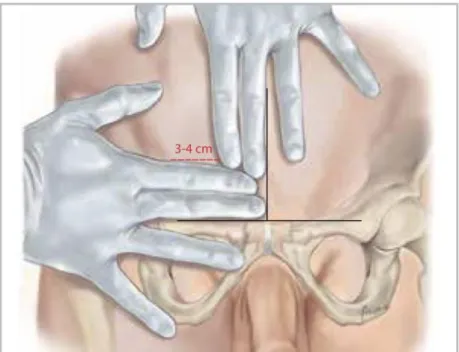
A technique designed to have a short operating time (17 +/- 6 min).• The ONSTEP Inguinal Hernia Repair technique is a minimally invasive, tension free repair that can be completed through a small 3-4 cm incision and requires no fixation due to type and extent of dissection in combination with the implant. It is a part pre-peritoneal, part intramuscular repair performed through an open anterior approach.
• The PolySoft® Hernia Patch has an oval anatomical shape that fits with the anatomical structures. The size of the implant must be selected to allow sufficient overlap of the hernia defect.
• Tissue ingrowth into the polypropylene mesh and pre-peritoneal placement allows a strong repair. Once the patch is placed, the interrupted “memory recoil ring” helps ensure the patch will spring open and maintain its shape.
• The PolySoft® Hernia Patch is made of soft polypropylene mesh, surrounded by an interrupted non-absorbable memory ring made of a PET polymer designed for tailoring the implant to the patient’s anatomical needs.
Summary of the 12 steps:
1. Selection of the incision site;
2. Identification and cauterisation of the superficial epigastric vein; 3. Dissection to the level of the internal oblique aponeurosis;
4. Development of the plane between the Internal and external oblique aponeurosis; 5. Identification and isolation of the spermatic cord;
6. Entry to the space of Retzius; 7. Insertion of large gauze; 8. Reduction of hernia sac;
9. Preparation of the POLYSOFT® Hernia Patch; 10. Removal of gauze;
11. Placement of the POLYSOFT® Hernia Patch; 12. Closure of Incision site.
1. Selection of the incision site:
• Draw two straight lines, superior and lateral from the midpoint of the pubic symphysis; • Place the index and middle fingers against each line;
• Mark an incision line from the intersection point of the index fingers, resulting in a 4cm horizontal and lateral line.
Note: The location of the incision line can also be identified by measuring 4 cm cranially and then 4cm laterally from the midpoint of the pubic symphysis.
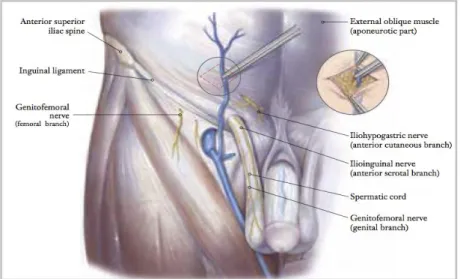
2. Identification and Cauterization of the Superficial Epigastric Vein:
• Incise the marked skin down to the level of the subcutaneous tissue; • Identify and cauterize the Superficial Epigastric Vein.
Note: The superficial epigastric vein, if present, should be in the medial portion of the 3-4 cm incision line. A deviation from this point suggests the incision line may be too medial.
The superficial epigastric vein is present in the majority of patients, but may be absent in around 18 % of patients.
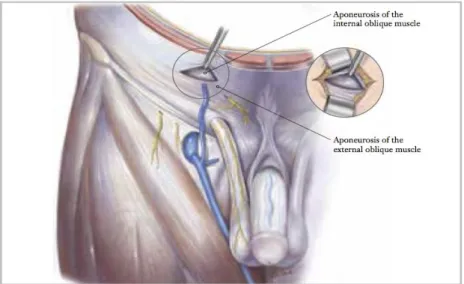
3. Dissection to the level of the Internal Oblique Aponeurosis:
• Continue sharp dissection of Scarpa’s fascia and subcutaneous fat, to reach the external oblique aponeurosis;
• Carefully begin dissection of the external oblique aponeurosis (laterally to the rectus sheath) with diathermy, exposing the underlying internal oblique aponeurosis. Take care not to dissect the anterior surface of the internal oblique aponeurosis;
• Complete dissection of the external oblique aponeurosis with diathermy.
Note: It is important to confirm that the correct tissue plane is properly identified which is evidenced by the visualisation of the avascular and white fibrous anterior surface of the internal oblique aponeurosis.
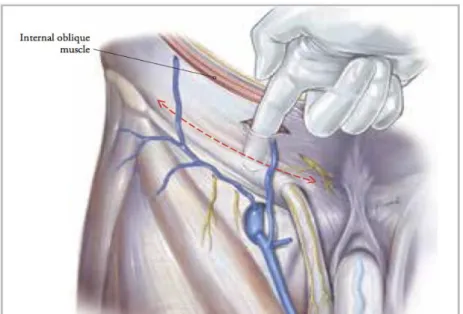
4. Development of the plane between the Internal and External Oblique Muscles:
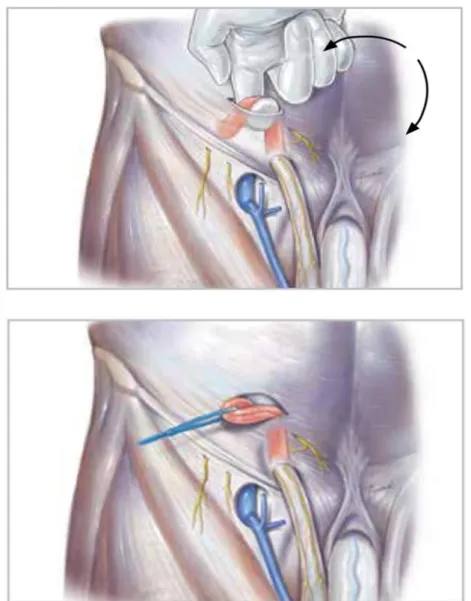
• Digitally dissect the space between the external and internal oblique aponeurosis, sweeping laterally and cranially up the superior iliac spine, to create a dissected tissue plane that will subsequently accommodate the placement of the lateral tails of the POLYSOFT® Hernia Patch;
• Continue the sweeping motion medially down the inguinal ligament to the pubic bone, to complete this dissection, and gain access to the posterior wall of the inguinal canal.
Figure 5 - Development of the plane between the Internal and External Oblique Aponeurosis
5. Identification and Isolation of the Spermatic cord:
• Identify and mobilise the spermatic cord structures by sweeping medial to lateral with an upward facing probing finger;
• Once the cord has been mobilised from the posterior wall of the external oblique aponeurosis, elevate the cord up and out of the incision site and isolate with a surgical loop.
6. Entry to Space of Retzius:
• Digitally explore the transversalis fascia down to the pubic bone and obliquely enter the space of Retzius, through spreading the fibers of the transversalis fascia.
Note: This can be done by either digitally dissecting through the fascia, or with the use of an appropriate surgical instrument to gently spread the fibres before digitally penetrating through the transversalis fascia.
7. Insertion of large gauze:
• Using blunt forceps, guide a large (20x20 cm) moist sterile gauze, down the index finger, into the retropubic space (space of Retzius), maintaining the position of the index finger protecting the epigastric veinsbehind the pubic bone;
• The index finger will act as a support for the posterior wall of the inguinal canal, preventing the transversalis fascia from entering the space of Retzius, when the gauze is pushed into this space.
Note: No digital dissection of the preperitoneal space or the space of Retzius is performed during the ONSTEP technique. All blunt dissection is completed by the gauze, when place in the space of Retzius.
8. Reduction of hernia sac:
• If an indirect hernia is identified, reduce the sac and contents and ligate/remove the excess sac as appropriate, according to general surgical practice;
• If a direct hernia is identified, it will be repaired with the placement of the POLYSOFT® Hernia Patch. In the case of a direct hernia, always ensure that there is no indirect hernia present.
Note: Hernia sacs should always be well dissected, to ensure they can be properly reduced, prior to the placement of the POLYSOFT® Hernia Patch.
9. Preparation of the POLYSOFT® Hernia Patch:
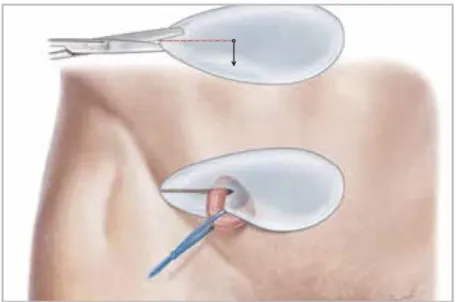
• Cut an axial slit in the prosthetic patch between the interrupted ends of the memory recoil ring, down to the apex of the curved notch of the patch. Do not cut the recoil
ring;
• Place the inferior tail of the POLYSOFT® Hernia Patch under the spermatic cord, so that the tails are pointing lateral.
Note: The curved notch of the POLYSOFT® Hernia Patch is always placed under the spermatic cord.
Do not place the POLYSOFT® Hernia Patch directly on the skin at any time during the procedure.
• Place three non-absorbable interrupted sutures into the POLYSOFT® Hernia Patch to join the prosthetic tails together.
o The first suture is placed to close the outer margin of the POLYSOFT® Hernia Patch;
o The second suture is placed in the midpoint of the slit made in the POLYSOFT® Hernia Patch;
o The third suture is placed adjacent to the spermatic cord. Appropriate space must be left to ensure good perforation of the cord.
Note: Take care that the three sutures are placed to ensure the opening around the spermatic cord is not too tight or too wide.
10. Removal of Gauze:
• Remove the sterile gauze from the operative site and return to the scrub nurse.
11. Placement of the POLYSOFT® Hernia Patch:
• Grasp the medial apex of the POLYSOFT® Hernia Patch with two index fingers (one finger on top of the patch and one placed underneath the patch). Insert into the incision and push the mesh down into the space of Retzius under the pubic bone, leaving the tails of the patch outside the incision;
• Digitally explore the POLYSOFT® Hernia Patch ensuring that it is fully deployed under the pubic bone, in the space of Retzius;
Note: If the POLYSOFT® Hernia Patch does not fully deploy within the space of Retzius, further blunt dissection may be required. Remove the POLYSOFT® Hernia Patch from this space and perform additional blunt dissection.
•
Insert the lateral tails of the POLYSOFT® Hernia Patch into the previously dissected space between the external and internal oblique aponeurosis, and digitally explore and smoothen the POLYSOFT® Hernia Patch to ensure proper placement without tension.
12. Closure of incision site:
• Close the external oblique aponeurosis with a suture type and a technique of choice. There is no need to close Scarpa’s Fascia;
• Inject local anaesthetic of choice as appropriate;
• Close the skin with a suture or clips of your choice as appropriate.
4.2. Article I
“The ONSTEP inguinal hernia repair technique: initial clinical experience of 693
patients, in two institutions”
Augusto Lourenço, Rui Soares da Costa
Hernia World Journal, Feb 2013
DOI: 10.1007/s10029-013-1057-z
4.3. Article II
“Long-Term Follow-Up of a Large Series of Patients Following ONSTEP Inguinal
Hernia Repair”
Augusto Lourenço, Rui Soares da Costa
Clinical Trials, Mar 2016
4.4. Further information regarding ONSTEP
It was with the polypropylene mesh with non-absorbable memory ring called PolySoft® that I began the new technique in 2005, initially called OPEN-TEP, and currently called ONSTEP. It was presented as a poster at the National Congress of Surgery and later as a presentation at the EHS congress in Berlin.
With the beginning of collaboration that still remains with Dr. Rui Soares da Costa, the idea of creating a mesh better adapted to the technique arose which we called ONSTEP. The beginning of a partnership and collaboration with Dr. Rui Soares da Costa allowed for the gain of “critical mass” and a logistic reinforcement to embark upon a new phase of the project.
To validate a surgical technique, it must be reproducible.
After national presentation of this technique as posters at two SPC congresses to promote its diffusion, a presentation at the Berlin Congress 2009 was done.
I was able to rely on the support of CRBard-Davol® and I began functions as company`s Iberian consultant for the treatment of inguinal hernia.
The first training session was held in UCMA directed by Dr. Ramon Gutierrez, an excellent professor in the treatment of ambulatory hernia, followed by visits with training sessions in Seville, San Sebastián, Badajoz, Zamora and Valencia.
At national level, I was visited by colleagues from many hospitals, reflecting a growing number of requests.
An improved structure of the technique to facilitate the teaching and training resulted in a technical guide and a 3D animation. This was followed by the development of a new mesh, which was believed to be better adapted to the ONSTEP technique in the follow up of acquired experience.
With the registration of the national patent application of European design and technique (in the United States of America) and its transaction to CRBard-Davol®, a new phase of the project was begun. We became world consultants of the company, which allowed us to develop a new mesh. This was presented worldwide in Milan in May 2015 during the First World Conference on Hernias where we were honoured to have been invited to perform a surgical demonstration, transmitted live.
A training centre at European level was headquartered in Porto, UCA S. João Hospital.
Our programme consists of receiving guests, usually four senior surgeons accompanied by delegates of the company having a presentation of the technique and results on the arriving
day. The next day, at the operating theatre, each one of the guests has later the opportunity to assist in the surgery of inguinal hernia and operate another with our help. Time is available later for discussion and future possible collaborations outlined.
This programme has allowed the training of approximately 150 surgeons across Europe and provided them with the same standard of training.
The aims of the training were to disseminate and teach the technique and to create new training centres. Some which should be mentioned for their dimension is the centre in Copenhagen, of Dr. Jacob Rosenberg, and the one in Berlin, of Dr. Ralph Laurent.
We have also been invited to visit some centres for better implementation of the technique and consolidation of previous training. Some examples include San Sebastián Hospital, Virgem de Macarena Hospital in Seville, Zamora Hospital, Herlev Copenhagen Hospital and Luxemburg Hospital among others, both national and foreign.
It was with great interest that we became aware of the publication of various articles about the use of the ONSTEP technique. It is an added value to verify the reproducibility of the results.
4.5. Patent
In order to improve the quality of the results of the ONSTEP technique we developed a mesh, which incorporated some advances, namely in terms of materials and a new design.
A mesh in polypropylene was created with tried and tested material in a low density, high porosity version. This allowed for a better adaptation of the anatomical region providing the patient with more comfort and which facilitates integration.
The inclusion of a memory ring for better placement and positioning without fixation was now in a slow re-absorbable material and less rigid than the POLYSOFT. Its objective was to avoid cases of residual pain and avert the need for its removal in some of the more slender patients.
The cavity at its most medial part facilitates the introduction and deployment of the mesh in the pre-peritoneal space.
The increase of dimensions in the medial half reinforces the quality of the repair.
The inclusion of an area that may be cut according to the physician’s preference allows for a better adaptation in accordance to the user’s choice.
The new ONFLEX is the result of the adaptation of the registered patent to industrial production.
Link to patent access:
• https://patents.google.com/patent/US20140379007?oq=Augusto+louren%C3%A7o • https://patents.google.com/patent/US20140012395?oq=Augusto+louren%C3%A7o • https://patents.google.com/patent/WO2013048272A1/en?oq=Augusto+louren%C3% A7o+hernia • https://patents.google.com/patent/EP2760370A1/en?oq=Augusto+louren%C3%A7o+ hernia
5. Discussion
Ideally, the technique for inguinal hernia repair should be reliable, replicable (with a rapid learning curve) and should imply the minimum of operative complications, such as post-operative pain and a recurrence rate. It should have good aesthetic results and the return to normal daily activities should be rapid. The costs of the technique must be considered and these should be acceptable.
Before the introduction of the use of meshes in techniques for inguinal hernia repair, the recurrence rate was the most important outcome to evaluate. Taking into account that this reduced significantly with the use of a mesh, at this time the most important outcome is post-operative pain, either immediate or chronic. (7)
According to a 2012 Cochrane Review, which compared Lichtenstein’s with other pre-peritoneal techniques, chronic pain is the main differentiator among the various techniques not to mention the advantages of minimal dissection and tension free repair.
The ONSTEP technique is completely tension free as the patch is placed in an anatomical space without any kind of fixation and it’s positioning is ensured in part by the memory ring. It is important to mention the association between chronic pain and fixation, widely cited in literature and which I had the opportunity to ascertain. (8)
From the description of the technique we can easily conclude that dissection is minimal and one of the breaking points with the past is the disruption of the transversalis fascia for a better and easier access to the pre-peritoneal space. The disruption of the transversalis fascia allows easy rapid access with the possibility of direct visualisation of the pre-peritoneal space, which increases the safety of the procedure. (9)
One of the difficulties in the diffusion of this technique involves the anatomy associated with this approach, which requires experienced surgeons so that they are comfortable with the dissection of the implicated structures.
Comparing open repair with endoscopic (TAPP and TEP) techniques, these are associated with lower rates of post-operative pain when compared with an open approach. However, they involves a long learning period (between 50-100 procedures), higher risk of complications associated with prosthesis as well as increased associated costs. The TEP technique, as it does not involve entry through the peritoneal cavity, is responsible for less organic damage and less immediate and chronic pain than the open approach.
A comparative study of ONSTEP with endoscopic is underway. It is expected that in terms of pain at 6 months, the rate of chronic pain with TAPP will be 8% while with ONSTEP it will be 0%
(although the figure calculated for this study will be 4%) and that at the end of the year, the values for TAPP and ONSTEP will be 6 % and 2 % respectively. (7)
It should be mentioned that Lichtenstein’s technique presents a higher rate of post-operative pain and chronic pain, between 15-40 %, than the ONSTEP technique.
In studies I and II, chronic pain corresponds to any pain above 0 on the VAS scale at the end of three months or more post-surgery and that residual pain corresponds to any pain or discomfort due to the sensation of a foreign body.
In study I, with a sample of 693 procedures submitted to inguinal hernia repair with the ONSTEP technique with the use of the POLYSOFT® Hernia Patch, the global rate of complications was 1 %. The rate of immediate complications after one week was 0.7 %. The documented complications were: seroma, hematoma and wound infection. The rate of late complications (after 6 months) was 1.1 %, corresponding to residual pain in four patients, of which 3 were re-operated and the removal of the memory ring efficient in pain relief. In study II, the rate of residual pain was 3.5 %, being 1.5 % of patients were re-operated and, the removal of the memory ring again efficient. It can be concluded that this residual pain, which is more common in very slender patients, is possibly a result of the rigidity of the memory ring. This complication may be reduced with the use of the ONFLEX mesh, taking into account that the memory ring is semi-rigid and re-absorbable and that it is a polypropylene mesh of less density and higher porosity compared to the POLYSOFT used when conducting this study.
The long-term recurrence rate, which was studied in study II, showed an increase in comparison with study I (2.0 % versus 0.6 %, respectively) a result which appears to be quite acceptable, considering that the sample of study II corresponds to a part of the sample in study I. Therefore, it is reasonable that the recurrence rate increases in a long term analysis, 3 to 5 years, as verified in study II. It is also important to mention that in study I, 11 % of the cases operated were recurrences.
In both of the studies and in all the studies performed to this moment using ONSTEP no cases of chronic pain were documented (10) (11) (12) (13) (14). In a comparative study of ONSTEP and Lichtenstein´s it was verified that with later two cases of chronic pain were described which were incapacitating for normal daily life activities. No such case was described with ONSTEP. Although the values are not statistically relevant, what is truly relevant is the non existence of chronic pain associated with the ONSTEP technique. This absence of chronic pain may possibly be associated with minimal dissection and using a tension free technique as well as with a low density mesh which is the case of POLYSOFT, used in studies I and II.
In this comparative study of ONSTEP and Lichtenstein, it was concluded that there was no significant difference in terms of post-operative pain, complications, and the time to return to normal daily activities. It was verified that the duration of surgery with ONSTEP was lower than
are less familiar with ONSTEP than with Lichtenstein’s technique, still finding themselves on a learning curve, which might lead to the undervaluation of ONSTEP. This fact could explain that the rate of recurrence was slightly higher with ONSTEP in relation to Lichtenstein (4.8 % and 4 % respectively), not statistically significant. The frequency of damage of nerve structures was higher with the use of the Lichtenstein technique, as well as the rate of complications albeit without statistical significance. (10) (12)
The duration of surgery, 17±6 minutes in study I, with a trend towards decreasing, is important for two reasons. Firstly, it allows the reduction of costs per patient and increases the number of patients operated. Secondly, each patient requires less anaesthesia time and has a faster post-operative recovery.
In comparison with ONSTEP, the OPEN-TEP technique requires approximately double the duration (32.6±10.5 minutes) a higher rate of complications with about 11.3 % compared to 1 % verified with ONSTEP in study I. The recurrence rate is similar to ONSTEP.
A comparative study between ONSTEP and Lichtenstein was also performed in relation to sexual dysfunction, which made it possible to conclude the superiority of ONSTEP. Pain associated with sexual function was verified in 17 patients with ONSTEP and in 30 with Lichtenstein. While 4 patients treated with Lichtenstein presented pain, which impeded sexual intercourse, this did not occur with any of the patients treated with ONSTEP. It was concluded that the ONSTEP technique allowed improvement of most cases in which pain associated with sexual function already existed before surgery despite having originated some new cases. Reduced sexual dysfunction associated with ONSTEP may be due to the fact that this does not imply sutures and therefore the risk of nerve damage is lower. (15)
One of the scores used to evaluate post-operative pain is CCS (Caroline´s Comfort Scale), which was used in a study of initial evaluation of ONSTEP. The rate of postoperative pain with ONSTEP according to the CCS was 5.2 %. The other techniques presented higher rates, TEP with 5.3 %, TAPP with 9.6 % and modified Lichtenstein with 5.9 %. (11) The rate of patients with complaints in this study is superior to that in study I, which can easily be explained taking into account the limitations of this study, the small sample, the fact that many surgeries were performed with the intention of training and that with the first 80 patients, surgeons were still in their learning curve.
Patient satisfaction is extremely important and the degree of satisfaction with the ONSTEP technique speaks for itself. According to study II, 81.5 % of patients rated satisfaction as excellent and 94.9 % of patients considered it good, very good or excellent. The use of more sophisticated measuring instruments could determine a better degree of satisfaction, but this implied an incompatible workload with the available means.
The ONSTEP technique has been the subject of attention of several authors. It has been mentioned in the HerniaSurge Group (World Guidelines for Hernia Management), where it is
considered a valid solution as the results presented, though scarce, seem to reveal non-inferiority in comparison with other surgical options. However, it is necessary to conduct further studies. (16)
Studies I and II are dependent on the study population, with this being minimised by its magnitude and representativeness of the general public. Another factor is that surgeries were performed by two surgeons, one of them the creator of the technique and the other who collaborated in its development and diffusion. Currently, other multicentre studies are being developed in various Portuguese hospitals in which we do not participate as practitioners. In terms of the registered patent, it was acquired by CRBard-Davol®. This was incorporated into the new OnFlex®, the company’s new commercial product which contests world leadership in this segment.
6. Conclusions
The ONSTEP technique is easy to perform. It has a short learning curve, approximately ten cases in contrast to the 50-100 cases referred with the endoscopic technique. (17) (18) Furthermore, it allows good visualisation of anatomical structures. The duration of hospital admission is between 2 and 23 hours and return to normal daily life activities occurs in a short space of time, approximately 6 days.
The ONSTEP technique is accessible to any surgeon and due to the duration of each procedure (17±6 minutes) and the fact that there is no need for special surgical instruments, it is associated with low unit costs. It can be performed with various anaesthetic techniques, from general anaesthesia with laryngeal mask to loco-regional or local anaesthesia with sedation. Also, the opinion of the residents is that it is much easier to learn ONSTEP than Lichtenstein. I consider it an added value that in all the studies carried out until the moment, no cases of chronic pain were registered.
It is necessary to conduct further studies to confirm and validate this technique for the treatment of inguinal hernia.
7. Future Perspectives
Soon, a comparative study between the technique carried out with Polysoft® mesh and ONFLEX® will be ready for publication.
I continue to closely follow all work related to ONSTEP.
Another study point, to which I believe I will dedicate more time to, is the evolution of the concept of mesh. Despite the expectations placed on biological meshes, these proved to have poor mechanical qualities and are associated to higher costs.
I have some interest in the behaviour of late re-absorption materials, which I await.
I believe that one of the paths will be the creation of hybrid meshes with something that could be called the dematerialisation of the polypropylene mesh.
Bibliography
1. Miltenburg DM., Nuchtern JG. and Jaksic T., Laparoscopic evaluation of the pediatric
inguinal hernia - a meta-analysis. J Pediatr Surg, 1998, Vol. 33:874.
2. Abramson JH., Gofin J. and Hopp C., The epidemiology of inguinal hernia. A survey in
western Jerusalem. J Epidemiol Community Health, 1978, Vol. 32:59.
3. Desarda M., Physiological repair of inguinal hernia: a new technique (study of 860 patients). Hernia, 2006, Vol. 10, pp. 143-146.
4. Shulman AG., Amid PK. and Lichtenstein IL., A survey of non-expert surgeons using the
open tension-free mesh patch repair for primary hernia repair. Int Surg, 1995, Vols. 80:35-36.
5. Ward H. et al., Oxford Handbook of Epidemiology for Clinicians. s.l., Oxford University Press, 2012, p. 192.
6. Schulz Kenneth F., Altman Douglas G. and Moher D., CONSORT 2010 Statement: updates
guidelines for reporting parallel group randomized trials. BMJ, 2010, Vol. 340, p. 332.
7. Andresen K., Burchart J. and Rosenberg J., ONSTEP versus laparoscopy for inguinal hernia
repair: protocol for a randomised clinical trial. Danish Medical Journal, 2015, Vol. 62/12.
8. Rodrigues D., Determinantes de Dor Crónica e da Qualidade de Vida em Pacientes sujeitos
a Hernioplastia Inguinal. 2015.
9. Andresen K. and Rosenberg J., Open preperitoneal groin hernia repair with mesh: A
qualitativa systematic review. The American Journal of Surgery, 2017, pp. 1-7.
10. Andresen K., et al., Short-term outcome after Onstep versus Lichtenstein technique for
inguinal hernia repair: results from a randomized clinical trial. Springer, 2015.
11. Andresen K., Burcharth J. and Rosenberg J., The initial experience of introducing the
onstep technique for inguinal hernia repair in a general surgical department. Scandinavian
Journal of Surgery, 2014, Vol. 0, pp. 1-5.
12. Andresen K., et al., Chronic pain after inguinal hernia repair with the ONSTEP versus the
Lichtenstein technique, results of a double-blinded multicenter randomized clinical trial.
Langenbecks Arch Surg, 2016.
13. Kohoutek L., et al., The ONSTEP inguinal hernia repair technique. Rozhl Chir, 2015, Vol. 94, pp. 152-155.
14. Marinis A. and Psimitis I., The Open New Simplified Totally Extra-Peritoneal (ONSTEP)
Inguinal Hernia Repair: Initial Experience with a Novel Technique. Hellenic Journal of Surgery,
2014, Vol. 86:6, pp. 362-367.
15. Andresen K., et al., Sexual dysfunction after inguinal hernia repair with the Onstep versus
Lichtenstein technique: A randomized clinical trial. Surgery, 2017, pp. 1690-1695.
16. Group, HerniaSurge. World Guidelines for Groin Hernia Management. 2016.
17. Andresen K., Laursen J. and Rosenberg J., Dificulties and Problematic Steps in Teaching
the Onstepp Technique for Inguinal Hernia Repair, Results from a Focus Group Interview.
Surgery Research and Practice, 2016.
18. Rosenberg J., Andresen K. and Laursen J., Team Training (Training at Own Facility) versus
Individual Surgeon's Training (Training at Trainer's Facility) When Implementing a New Surgical Technique: Example from the ONSTEP Inguinal Hernia Repair. Surgery Research and Practice,