Carlos André Stuepp(1), Ivar Wendling(2), Aloisio Xavier(3) and Katia Christina Zuffellato-Ribas(4)
(1)Universidade Estadual de Ponta Grossa, Departamento de Fitotecnia, Campus de Uvaranas, Bloco F, Sala 08, Avenida Carlos Cavalcanti, no 4.748, Uvaranas, CEP 84030-900 Ponta Grossa, PR, Brazil. E-mail: [email protected] (2)Embrapa Florestas, Estrada da Ribeira, Km 111, Caixa Postal 319, Guaraituba, CEP 83411-000 Colombo, PR, Brazil. E-mail: [email protected] (3)Universidade Federal de Viçosa, Avenida P.H. Rolfs, s/no, Campus Universitário, CEP 36571-000 Viçosa, MG, Brazil. E-mail: [email protected] (4)Universidade Federal do Paraná, Departamento de Botânica, Setor de Ciências Biológicas, Avenida Coronel Francisco H. dos Santos, no 100, Caixa Postal 19.031, CEP 81531-980 Curitiba, PR, Brazil. E-mail: [email protected]
Abstract – Understanding the mechanisms involved in tree species maturation, related mainly to ontogenetic age effects, has contributed significantly to the vegetative propagation process of Brazilian native tree species, with consequent application of clonal forestry. A number of methodologies has been developed to rescue and vegetatively propagate these species for silvicultural and environmental restoration purposes. However, the types and purposes of propagation, as well as the choice of suitable processes and propagules considering the intended objectives, still need to be better aligned. In addition, there is an evident knowledge gap and great potential regarding the use of native tree species in Brazilian clonal forestry, indicating the need of a greater interaction between studies on the vegetative propagation and vigor of these materials in the field. Therefore, this review aims to help understand the different types of techniques used and their application on the vegetative propagation and clonal forestry of Brazilian native tree species, besides proposing a schematic sequence of the stages involved in these processes for productive and environmental purposes.
Index terms: air-layering technique, cuttings, grafting, mini-cuttings technique, rejuvenation of forest tree species, vegetative rescue.
Propagação vegetativa e aplicação da silvicultura clonal
em espécies arbóreas nativas do Brasil
Resumo – A compreensão dos mecanismos envolvidos na maturação em espécies arbóreas, relacionados principalmente aos efeitos da idade ontogenética, tem contribuído de forma significativa ao processo de propagação vegetativa de espécies nativas, com consequente aplicação da silvicultura clonal. Uma série de metodologias tem sido desenvolvida para o resgate e a propagação vegetativa dessas espécies para fins silviculturais e de restauração ambiental. No entanto, ainda precisam ser mais bem alinhados os tipos e os propósitos da propagação, bem como a escolha dos processos e dos propágulos adequados tendo em vista os objetivos almejados. Além disso, há uma lacuna evidente de conhecimento e um grande potencial referente ao uso de espécies arbóreas nativas na silvicultura clonal brasileira, o que indica a necessidade de maior afinidade entre estudos de propagação vegetativa e do vigor desses materiais em campo. Assim, esta revisão tem por objetivo auxiliar no entendimento das diferentes técnicas e de suas aplicações na propagação vegetativa e na silvicultura clonal de espécies arbóreas nativas, bem como propor uma sequência esquemática das etapas envolvidas nesses processos para fins produtivos e ambientais.
Termos para indexação: alporquia, estaquia, enxertia, miniestaquia, rejuvenescimento de espécies florestais, resgate vegetativo.
Introduction
Much has been studied and discussed regarding
species well recognized by Brazilian silviculture,
mainly of the genera Eucalyptus and Pinus (Xavier et al., 2013). However, there are few researches on species native to the country and most of them do not go beyond the experimental stages.
In general, in forestry, native species can be used for the following purposes: commercial, for the production of timber and non-timber products; and environmental, including the restoration of forest
ecosystems. For environmental purposes, specifically
an adequate genetic variability in clonal plantations
(Carpanezzi & Carpanezzi, 2006).
The lack of knowledge about the potential use, production technologies, and management of native tree species, whether for productive or environmental purposes, has been one of the greatest limiting factors to the application of propagation techniques in clonal forestry. This not only includes the propagation process, but also the proper selection of genetic material with
sufficient quality and levels of genetic variability for
the intended purposes.
For the promising use of native species in clonal forestry, there must be a full understanding of the stages that precede it, including vegetative rescue and the establishment of the basic standards to achieve the desired objectives. Studies on the application of vegetative rescue techniques to native tree species have shown important aspects for the success of clonal forestry, highlighting the effects of ontogenetic age, which may vary according to the adopted technique (Xavier et al., 2013). In the case of vegetative propagation by cuttings, the use of crown shoots of an advanced ontogenetic age reduced the percentages of
propagule rooting (Ciriello & Mori, 2015). However,
satisfactory rooting indexes were obtained with the use of spontaneous or induced basal sprouts, resulting
in a greater efficiency in the vegetative rescue of the
species (Rickli et al., 2015).
The use of juvenile shoots in the vegetative propaga-tion of native tree species has been recommended since the middle of the last century, when there was already knowledge of the effects of using basal shoots and canopy (Baptist, 1939). When mature propagules are not required, vegetative propagation is easily obtained with juvenile propagules, whether young plants or even basal epicormic sprouts (Wendling et al., 2014a; Dias et al., 2015b).
If applied consistently, vegetative propagation can be an excellent alternative for the production of plants for environmental purposes, solving the problem of low genetic variability by using a larger number of mother trees to obtain the initial propagules
(Carpanezzi & Carpanezzi, 2006). This allows to
vegetatively propagate species that show limitations in seminal propagation, such as seed unavailability and high acquisition cost, low germination percentages, and a long period of time for seedling production
in programs aiming the restoration of degraded
ecosystems (Oliveira & Ribeiro, 2013).
A number of methodologies has been developed for the rescue and vegetative propagation of native tree species for silvicultural and environmental restoration purposes. However, there has been confusion regarding the different types and purposes of propagation, as well as the choice of suitable processes and propagules considering the intended objectives. In addition, there is an evident knowledge gap and great potential
regarding the use of these species in Brazilian clonal
forestry, indicating the need of a greater interaction between studies on the vegetative propagation and
vigor of these materials in the field. Therefore, this
review aims to help understand the different types of techniques and their application in vegetative
propagation and clonal forestry of Brazilian native
tree species, with a detailed bibliographical survey regarding the state of the art related to these themes, as well as discussions of the knowledge gaps that need
to be filled.
Induction of juvenile sprouts in Brazilian
native tree species
The rejuvenation and/or reinvigoration of adult plants is a frequently adopted technique in the vegetative rescue of superior genotypes. It has been regularly used in native tree species, aiming the induction (production) of juvenile propagules, which are more suitable for vegetative propagation, especially for adventitious rooting (Dias et al., 2015b; Rickli et al., 2015), often eliminating the need for plant regulator application (Rickli et al., 2015; Stuepp et al., 2015).
Rejuvenation and/or reinvigoration in native tree species have been achieved primarily by the coppicing, girdling, semi-girdling, and drastic pruning techniques (Xavier et al., 2013). Each technique should be evaluated individually for the species/clone to
be rescued and applied with the greatest efficiency
possible in order to cause less damage to the mother plant, ensuring its integrity.
The use of coppicing has been efficient in the
induction of epicormic sprouts in several native tree species (Santin et al., 2008; Dias et al., 2015b). However, the productivity and vigor of these stumps
was not assessed in a significant number of studies,
epicormic-sprout-producing purposes, where the focus is only propagation by cuttings (Stuepp et al., 2015). In other cases, coppicing was used for adult plant reinvigoration or even as a regrowth management technique (Sampaio et al., 2005).
Regardless of its purposes, coppicing has an excellent potential. In Hevea brasiliensis (Willd. ex A.Juss.) Müll.Arg. and Ilex paraguariensis A.St.-Hil., it has been effective when used to replace canopies through grafting (Pinheiro et al., 1988; Wendling et
al., 2009b). Specifically for I. paraguariensis, in order
to improve the efficiency of the cultivation process,
the technique has been recommended to recover degraded plantations (Santin et al., 2008) and to produce vegetative propagules (Stuepp et al., 2016a);
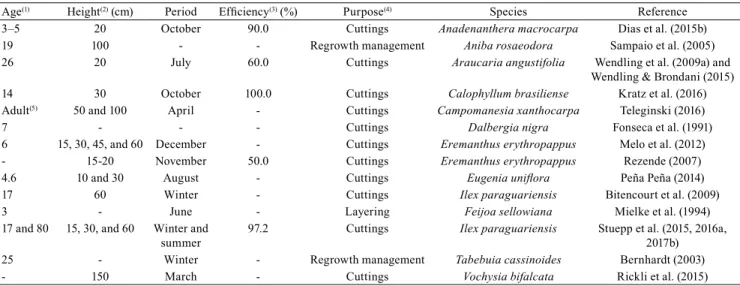
in both cases, a high efficiency was observed in the induction of epicormic sprouts (Table 1). The efficacy
of coppicing to induce epicormic sprouts has also been shown for several other species. For Araucaria angustifolia (Bertol.) Kuntze, the technique has been applied exclusively for vegetative propagation purposes, following the principles of woody plant maturation for logging (Wendling et al., 2014a;
Wendling & Brondani, 2015).
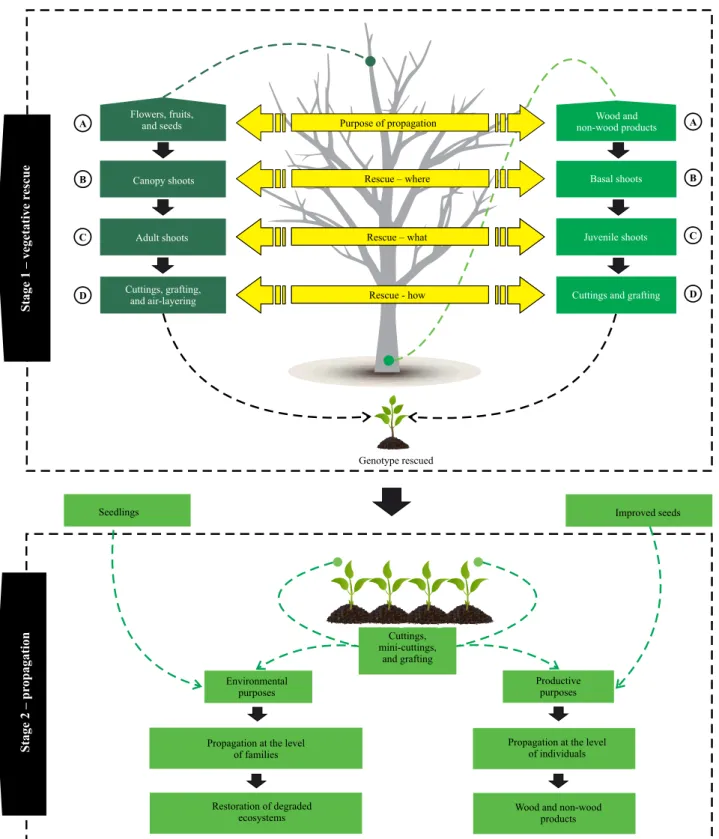
Total or partial girdling, similarly to coppicing, can be performed at different heights, always taking into account the increased maturity of sprouts from the trunk base towards the apex (Wendling et al., 2014b) (Figure 1). The two techniques cause less damage
to the mother plant, which often shows low vigor, usually due to old age, genetic characteristics, or even phytosanitary conditions, when coppicing becomes impractical (Dias et al., 2015b; Stuepp et al., 2015).
The results obtained until now regarding the use of the girdling technique have been promising. However, in comparison with coppicing, a lower sprout productivity was reported (Dias et al., 2015b;
Stuepp et al., 2015, 2016a; Kratz et al., 2016). It should
be noted, though, that, in the case of the vegetative rescue of high-genetic-value plants, both techniques are important because they interfere less on the mother
plant, better guaranteeing its survival (Kratz et al.,
2016).
The efficiency of total girdling regarding the
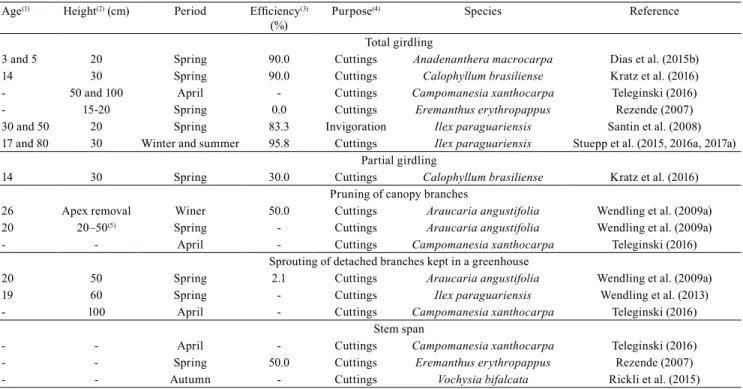
emission of epicormic sprouts has been described for some native species (Table 2). However, a limiting
factor is the difficulty of performing this technique without directly reaching the cambium (Kratz et al.,
2016), besides the fact that it alone causes serious and permanent damage to the girdled plants. Despite this, the adequate application of girdling may promote partial or total healing of the wound, justifying its use in vegetative rescue as a way to guarantee the maintenance of live plants (Santin et al., 2008).
Partial girdling is used even less than total girdling. The reason is that the research works that employ this vegetative rescue technique are usually not very
specific, use a large number of individuals, and show
Table 1. Application of the coppicing technique to induce juvenile sprouts in Brazilian native tree species.
Age(1) Height(2) (cm) Period Efficiency(3) (%) Purpose(4) Species Reference 3–5 20 October 90.0 Cuttings Anadenanthera macrocarpa Dias et al. (2015b)
19 100 - - Regrowth management Aniba rosaeodora Sampaio et al. (2005)
26 20 July 60.0 Cuttings Araucaria angustifolia Wendling et al. (2009a) and
Wendling & Brondani (2015)
14 30 October 100.0 Cuttings Calophyllum brasiliense Kratz et al. (2016)
Adult(5) 50 and 100 April - Cuttings Campomanesia xanthocarpa Teleginski (2016)
7 - - - Cuttings Dalbergia nigra Fonseca et al. (1991)
6 15, 30, 45, and 60 December - Cuttings Eremanthus erythropappus Melo et al. (2012)
- 15-20 November 50.0 Cuttings Eremanthus erythropappus Rezende (2007)
4.6 10 and 30 August - Cuttings Eugenia uniflora Peña Peña (2014)
17 60 Winter - Cuttings Ilex paraguariensis Bitencourt et al. (2009)
3 - June - Layering Feijoa sellowiana Mielke et al. (1994)
17 and 80 15, 30, and 60 Winter and summer
97.2 Cuttings Ilex paraguariensis Stuepp et al. (2015, 2016a, 2017b)
25 - Winter - Regrowth management Tabebuia cassinoides Bernhardt (2003)
- 150 March - Cuttings Vochysia bifalcata Rickli et al. (2015)
Wood and non-wood products
Canopy shoots
Adult shoots Flowers, fruits,
and seeds
Resgate vegetativo
Cuttings, mini-cuttings,
and grafting
Propagation at the level of families
Propagation at the level of individuals
Restoration of degraded ecosystems
Wood and non-wood products Genotype rescued
Environmental purposes
Productive purposes
Stage 2
–
pr
opagation
Stage 1
–
vegetative r
escue
Cuttings, grafting,
andair layering- Cuttings and grafting
Basal hootss
Juvenile shoots
Purpose of propagation
Rescue – where
Rescue – what
Rescue- how
Seedlings Improved seeds
A
B
D C
A
B
D C
little or no genetic improvement to the mother trees.
Therefore, more invasive and efficient techniques are
commonly adopted, such as coppicing or total girdling. Although it is less used in native tree species, partial girdling can be an excellent alternative when working with unique genetic materials, where the loss of a mother tree may result in irreparable genetic losses
(Kratz et al., 2016). The efficiency in epicormic sprout
emission using this technique in native tree species is lower than that of total girdling and coppicing (Tables 1 and 2), in the following order: coppicing > total girdling> partial girdling.
Other techniques for epicormic sprout induction in native tree species were evaluated, standing out pruning of canopy branches, sprouting of detached branches in a greenhouse, and stem span (Wendling et al., 2009a, 2013; Rickli et al., 2015). For A. angustifolia,
pruning was carried out on the orthotropic tip (apex) of adult plants for grafting and early seed production (Wendling et al., 2016b), as well as on plagiotropic branches (lateral branches) for cuttings (Wendling et al., 2009a). The branches of this same species (Wendling et al., 2009a) and of I. paraguariensis (Wendling et al., 2013) and Campomanesia xanthocarpa O.Berg (Teleginski, 2016) were detached in a greenhouse, aiming vegetative propagation by cuttings.
Finally, stem span, a technique quite dependent on the diameter and resistance of the stem and that is generally applied to younger plants, was reported for C. xanthocarpa (Teleginski, 2016), Eremanthus erythropappus (DC.) MacLeish (Rezende, 2007), and Vochysia bifalcata Warm. (Rickli et al., 2015) (Table 2).
Table 2. Application of total and partial girdling, pruning of canopy branches, sprouting of detached branches, and stem span in the induction of juvenile sprouts in Brazilian native tree species.
Age(1) Height(2) (cm) Period Efficiency(3) (%)
Purpose(4) Species Reference
Total girdling
3 and 5 20 Spring 90.0 Cuttings Anadenanthera macrocarpa Dias et al. (2015b)
14 30 Spring 90.0 Cuttings Calophyllum brasiliense Kratz et al. (2016)
- 50 and 100 April - Cuttings Campomanesia xanthocarpa Teleginski (2016)
- 15-20 Spring 0.0 Cuttings Eremanthus erythropappus Rezende (2007)
30 and 50 20 Spring 83.3 Invigoration Ilex paraguariensis Santin et al. (2008) 17 and 80 30 Winter and summer 95.8 Cuttings Ilex paraguariensis Stuepp et al. (2015, 2016a, 2017a)
Partial girdling
14 30 Spring 30.0 Cuttings Calophyllum brasiliense Kratz et al. (2016)
Pruning of canopy branches
26 Apex removal Winer 50.0 Cuttings Araucaria angustifolia Wendling et al. (2009a) 20 20–50(5) Spring - Cuttings Araucaria angustifolia Wendling et al. (2009a)
- - April - Cuttings Campomanesia xanthocarpa Teleginski (2016)
Sprouting of detached branches kept in a greenhouse
20 50 Spring 2.1 Cuttings Araucaria angustifolia Wendling et al. (2009a)
19 60 Spring - Cuttings Ilex paraguariensis Wendling et al. (2013)
- 100 April - Cuttings Campomanesia xanthocarpa Teleginski (2016)
Stem span
- - April - Cuttings Campomanesia xanthocarpa Teleginski (2016)
- - Spring 50.0 Cuttings Eremanthus erythropappus Rezende (2007)
- - Autumn - Cuttings Vochysia bifalcata Rickli et al. (2015)
In summary, information on coppicing and total and partial girdling in native tree species is still scarce, with gaps regarding vegetative vigor and the ability to produce epicormic shoots, either for vegetative rescue or for the reinvigoration of senescent plants.
Vegetative rescue in Brazilian native tree
species by canopy sprouts and basal epicormic
shoots
Vegetative rescue in native tree species can be performed by canopy sprouts and basal epicormics shoots. Each technique has its applications, advantages,
and disadvantages, defined mainly according to the
species and intended results.
Vegetative rescue by canopy sprouts has been carried out mostly by cuttings, layering, and grafting. Its application in clonal forestry has been linked to the maturation of propagules, and it is recommended for
the production of flowers, fruits, and seeds (Figure 1).
Its main advantage is maintaining maturity characteristics associated with the propagules or other parts of adult plants, while its disadvantages are observed especially when associated with the cuttings
technique, limiting or inhibiting rhizogenesis in most cases. In spite of this, this was the first method applied
to evaluate rooting capacity at an experimental level in native species, due to the immediate availability of shoots, without damaging the parent plant.
The experiments with canopy sprouts performed to date showed that the rooting capacity of this type of propagule varies according to species, age of the parent plant, climatic conditions at the time of application, and the effect of the use of plant regulators (Martins et al., 2015). Over the last ten years, most
obtained results were inefficient for rooting of canopy
shoots; however, based on the proposed goal for the vegetative rescue of adult plants, there is no need to achieve high rooting percentages for the technique to be considered viable. This is explained by the fact that, even in reduced percentages, rooting allows the subsequent multiplication of genetic material through
more efficient methodologies such as cuttings (clonal
hedge), mini-cuttings (mini-clonal hedge), or even grafting. It should be highlighted though that, based on the hypothesis that a greater maturity of canopy propagules leads to better sprouting (Wendling et al., 2014b), the use of the cuttings technique is not
recommended for the vegetative propagation of crown shoots (Figure 1).
There are species, however, with good aptitude for adventitious rooting of canopy shoots, standing out among them Maytenus muelleri Schwacke from plantations managed with up to 62.5% of cuttings rooted in summer (Lima et al., 2011). In spite of the good results for some tree species, the morphophysiological characteristics of this type of sprouting, in general, do not favor rooting and root vigor of the propagules. In experiments, its use tends to be evaluated jointly with methodologies for the induction of juvenile shoots that have greater aptitude for adventitious root formation (Bitencourt et al., 2009; Stuepp et al., 2016a), facilitating the vegetative rescue of native species.
Layering is not commonly used in native tree species, mainly because it is a high-cost method with
low operational efficiency. However, it has a high
potential for the rescue of superior genetic material, since it is only performed on the branches of the mother tree, causing little or no damage. As with the cuttings technique, the use of layering in woody species should take into account the maturity of the plant or of each part to be rescued, considering that the older the tree is, the lower is its capacity for adventitious root emission (Wendling et al., 2014b). The recommendation of layering is directly related to the productive purposes of the species to which it is being applied, since this technique uses the crown shoot, which shows characteristics related to maturity,
considered essential for the production of flowers,
fruits, and seeds (Figure 1). As shown in Table 3, layering has been successfully applied in some native tree species.
Similar to layering, grafting is not commonly used in the vegetative rescue of native forest tree species,
but of fruit trees (Franzon et al., 2010). The efficiency
of the technique depends on the compatibility between rootstock and graft (Han et al., 2013), the application
environment (field or nursery) (Wendling et al., 2016a),
and the physiological quality of the used propagules
(Martínez-Ballesta et al., 2010), among others.
Grafting has been widely adopted in commercial
horticulture and can provide great benefits for the
by serial grafting on juvenile rootstocks (Wendling &
Xavier, 2001; Santin et al., 2015).
Grafting is a technique that tends to be used more as the genetic improvement of native tree species evolves, being applied during the formation of clonal orchards for improved seed production and controlled crosses, as already reported for Pinus spp. and Eucalyptus spp. (Rocha et al., 2002). Its application in native tree species depends on the purpose of the rescue, since, with this technique, except serial grafting, characteristics related to the maturity of the parent plant are carried on. In general, the application of grafting tends to be more adequate when the objective
is producing flowers, fruits, and seeds (Figure 1).
Grafting has been a reference in the rescue of adult I. paraguariensis trees, primarily for multiplying
superior genetic material (Wendling et al., 2009b) and to obtain a certain degree of graft rejuvenation from adult propagules (Santin et al., 2015).
The first studies about rooting of basal epicormic
shoots in native tree species were performed on H. brasiliensis with the use of sprouts accidentally
stimulated at the base of the plants (Muzik & Cruzado,
1956). More recently, several works have dealt with the rooting of propagules originating from this type of shoot in native tree species (Table 4), with the preponderant use of coppicing for the induction of epicormic shoots.
In spite of the evident efficiency of using
reinvigorated propagules in the vegetative rescue of native tree species, studies on these techniques are still scarce (Bitencourt et al., 2009; Dias et al., 2015b).
Table 3. Vegetative rescue by air layering in Brazilian native tree species.
Origen IBA(1) growth regulator Efficiency(2) (%) Species Reference
1,000 mg L-1 100.0 Bixa orellana Mantovani et al. (2010)
Crown shoots * 100.0 Anacardium occidentale Almeida et al. (1990)
500 and 2,000 mg L-1 16.7 Calophyllum brasiliense Leite et al. (2007) 6,000 mg L-1 75.0 Cnidoscolus quercifolius Campos et al. (2015) 0, 500, 1,000, and 2,000 mg kg-1 0.0 Campomanesia xanthocarpa Teleginski (2016)
6,000 and 4,000 mg L-1 100.0 Plinia trunciflora Danner et al. (2006)
4,000 mg L-1 87.5 Plinia cauliflora Sasso et al. (2010)
4,000 mg L-1 - Schinus terebinthifolius Gonçalves et al. (2007) 10,000 mg L-1 73.0 Spondias tuberosa Lederman et al. (1991) (1)IBA, indole butyric acid. (2)Efficiency of rooting. *No application of the growth regulator. -, no information available.
Table 4. Vegetative rescue using rooting cuttings of epicormic shoots in Brazilian native tree species.
Origen IBA(1) growth regulator Efficiency(2) (%) Species Reference Basal sprouts 6,000 mg L-1 38.5 Anadenanthera macrocarpa Dias et al. (2015b)
- <30.0 Araucaria angustifolia Wendling & Brondani (2015) 1,000 mg L-1 83.3 Calophyllum brasiliense Ciriello & Mori (2015) 6,000 mg L-1 65.0 Calophyllum brasiliense Kratz et al. (2016)
- 25.5 Campomanesia xanthocarpa Teleginski (2016)
- 87.5 Eremanthus erythropappus Rezende (2007)
- 65.5 Ilex paraguariensis Bitencourt et al. (2009)
3,000 mg L-1 70.6 Ilex paraguariensis Stuepp et al. (2015)
- 88.7 Ilex paraguariensis Stuepp et al. (2017a)
- 81.0 Vochysia bifalcata Rickli et al. (2015)
Pruned canopy - <30.0 Araucaria angustifolia Wendling & Brondani (2015)
- 0.0 Campomanesia xanthocarpa Teleginski (2016)
- 20.4 Erythrina falcata Neves et al. (2006)
Stem span - 16.93 Campomanesia xanthocarpa Teleginski (2016)
- 31.0 Vochysia bifalcata Rickli et al. (2015)
Sprouting of detached branches kept in a greenhouse
- 44.4% Campomanesia xanthocarpa Teleginski (2016)
The use of this type of propagule can increase not only rooting success but also the physiological quality of the
plants produced, reflecting in an increase in vegetative
and radicular vigor (Stuepp et al., 2015).
Vegetative propagation in Brazilian native tree
species
The main difference between vegetative rescue and vegetative propagation is how each technique is applied. While the purpose of rescue is to obtain at least one individual genetically identical to the parent plant, vegetative propagation aims to produce a larger number of copies (clones) on a commercial scale or not, using methodologies that favor the multiplication of these propagules. In this case, cloning techniques should be recommended for different species and purposes following a logical structure, which should take into account the basic principle of propagule maturation, considering the objective intended for each species and scenario.
Vegetative propagation or cloning has been an
excellent tool for forest production in Brazil, where
it has increased the productivity of forests planted with non-native species, mainly Eucalyptus spp., consolidating clonal forestry. However, regarding the vegetative propagation of native tree species, a better understanding of the intended objectives, purposes, and propagation techniques applied is still necessary.
In general, studies evaluating the vegetative
propagation of Brazilian native tree species have
been of an experimental nature. The exception are researches about a few species with consolidated clonal planting like H. brasiliensis and Theobroma cacao
L., among others, which are nearly always justified
by environmental interests such as the restoration of degraded ecosystems. This technique is an important tool for species with limitations in their sexual propagation (Stuepp et al., 2015); however, although the potential of rooting has been assessed in several families, genera, and species with this characteristic, there are no known reports on the viability of applying
vegetative propagation under field conditions.
The vegetative propagation of native tree species can be divided into two groups, according to its purposes (Figure 1), which may be: environmental, for plant production; and productive, for the production of any product of forest origin, timber or non-timber. An overview of each of these purposes is presented
subsequently, seeking to relate the use of propagation techniques to the objectives established for native tree species.
Vegetative propagation from juvenile parents
(seedlings)
Juvenile plants obtained from seed propagation are frequently used to provide propagules of native tree species (Gratieri-Sossella et al., 2008; Lattuada et al., 2011). The reason for this is the greater ease of rooting of these propagules and also of meeting the desired objectives, considering the greater limitations involved in the vegetative propagation of adult plants (Wendling et al., 2014b).
Although used for the vegetative propagation of native tree species, this type of propagule is better supported for environmental purposes, when the main objective is to obtain the greatest genetic variability as possible. In this case, it is necessary to guarantee genetic variability for the restoration of degraded ecosystems. For this, propagules should be collected from a large number of mother trees, respecting the distance between them. According to the literature, the minimum number of unrelated regional mother trees required for environmental projects varies between
25 (Wendling et al., 2005) and 50 (Carpanezzi & Carpanezzi, 2006). In general, the use of as many
mother trees as possible is recommended, avoiding the formation of a large number of clones from the same mother tree.
For productive purposes, however, this technique presents some limitations since the expression of the genetic characteristics of the plants in their adult phase is still unknown. This is important because parent plants are usually assessed for productive purposes in their adult phase, when their phenotypic characteristics start being expressed. However, the use of juvenile plants may be an excellent alternative when there is availability of genetically improved seeds (controlled crosses) or for the maintenance of seedlings pruned in
nurseries, concomitant with their field evaluation, as verified for the genera Pinus spp., for example (Xavier et al., 2013).
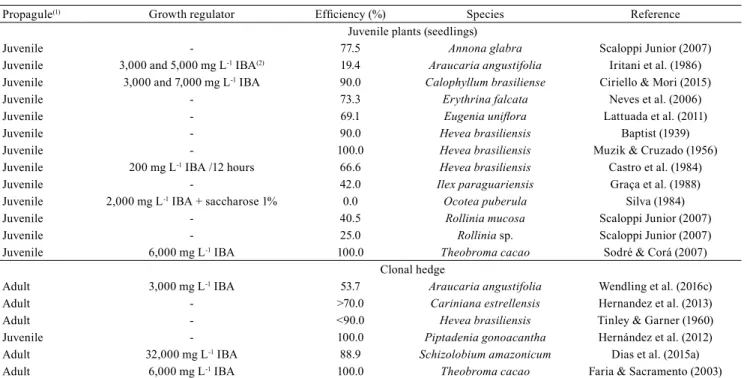
Plants of native tree species have been cloned using juvenile propagules, as shown in a number of studies (Table 5). In most of them, high rooting percentages
were observed, justified by the greater juvenility of the
Vegetative propagation from adult mother
trees
Cuttings, mini-cuttings, and grafting have been used and recommended for the macropropagation of native tree species (Figure 1). These techniques clearly
supply the need for qualification in mass production;
however, they show marked differences regarding the productivity and physiological quality of the produced propagules, resulting in different multiplication potentials and, particularly, vegetative and root vigor.
In the case of cuttings, the technique alone does not meet the mass propagation objective, requiring adequate methodologies for propagule production through the formation of clonal hedges and selected genetic material. Clonal hedges consist of clonal
clusters of plants sown directly in the soil under field
or nursery conditions for the production of genetically superior propagules (Xavier et al., 2013). The use of clonal hedges in the production of native tree species is not frequent, and most of the studies developed with these species are experimental and do not require the application of mass propagation techniques (Table 5).
In H. brasiliensis, clonal hedges were basically adopted in the production of grafting stems (Lemos
Filho et al., 1994). However, with increasing technology
and the qualification of propagation environments, by
the 1960s, plants produced by cuttings were also used
(Tinley & Garner, 1960). Currently, for Hevea spp., it has been shown that clones produced by cuttings have greater morphological quality, both for the root and shoot, than those obtained by grafting and also require a shorter production period (Monteiro et al., 2015). Among the few studies on the use of clonal hedges, stand out those with the species A. angustifolia (Wendling et al., 2016c), Cariniana estrellensis Kuntze
(Hernandez et al., 2013), H. brasiliensis (Tinley & Garner, 1960), Piptadenia gonoacantha J.F.Macbr.
(Hernández et al., 2012), Schizolobium amazonicum Huber ex Ducke (Dias et al., 2015a), and T. cacao
(Faria & Sacramento, 2003) (Table 5).
In spite of the low use in native species, experimental clonal hedges have presented high potential for propagule production, allowing adequate nutritional and phytosanitary management. The productivity and rooting indexes obtained were also greater than those found for vegetative rescue techniques.
Mini-clonal hedges consist of a set of clones established in protected environments under pruning and controlled nutritional management, according to
Table 5. Application of the cuttings technique as a method of mass propagation applied to Brazilian native tree species.
Propagule(1) Growth regulator Efficiency (%) Species Reference
Juvenile plants (seedlings)
Juvenile - 77.5 Annona glabra Scaloppi Junior (2007)
Juvenile 3,000 and 5,000 mg L-1 IBA(2) 19.4 Araucaria angustifolia Iritani et al. (1986) Juvenile 3,000 and 7,000 mg L-1 IBA 90.0 Calophyllum brasiliense Ciriello & Mori (2015)
Juvenile - 73.3 Erythrina falcata Neves et al. (2006)
Juvenile - 69.1 Eugenia uniflora Lattuada et al. (2011)
Juvenile - 90.0 Hevea brasiliensis Baptist (1939)
Juvenile - 100.0 Hevea brasiliensis Muzik & Cruzado (1956)
Juvenile 200 mg L-1 IBA /12 hours 66.6 Hevea brasiliensis Castro et al. (1984)
Juvenile - 42.0 Ilex paraguariensis Graça et al. (1988)
Juvenile 2,000 mg L-1 IBA + saccharose 1% 0.0 Ocotea puberula Silva (1984)
Juvenile - 40.5 Rollinia mucosa Scaloppi Junior (2007)
Juvenile - 25.0 Rollinia sp. Scaloppi Junior (2007)
Juvenile 6,000 mg L-1 IBA 100.0 Theobroma cacao Sodré & Corá (2007)
Clonal hedge
Adult 3,000 mg L-1 IBA 53.7 Araucaria angustifolia Wendling et al. (2016c)
Adult - >70.0 Cariniana estrellensis Hernandez et al. (2013)
Adult - <90.0 Hevea brasiliensis Tinley & Garner (1960)
Juvenile - 100.0 Piptadenia gonoacantha Hernández et al. (2012)
the characteristics of the species. Mini-cuttings is an evolution of the cuttings technique, differing mainly as to the nutritional and phytosanitary control of the produced propagules. The system most applied in forest species has been the denominated semi-hydroponic, composed of a channel containing inert substrate (sand) to support the mini-stumps (Wendling
et al., 2007; Xavier & Silva, 2010). However, in native
species, the establishment of mini-clonal hedges in pots, tubes, or polyethylene boxes has been tested frequently (Xavier et al., 2003a, 2003b; Peña Peña et al., 2015; Peña, 2015). Considering that plant nutritional management is limited to the area available for root development, the greatest difference between these two systems lies in the productive capacity and vigor of the propagules.
In mini-clonal hedges, rooting percentage is used to qualify propagule production. For Erythrina crista-galli L., for example, while semi-hardwood cuttings from crown shoots showed rooting below 10%, mini-cuttings reached 100% (Gratieri-Sossella et al., 2008). However, it should be pointed out that, in this case,
efficiency is not only linked to the mini-cuttings
technique, but also directly to the maturity of the mini-stumps, i.e., rooting percentages tend to be higher when juvenile mini-stumps are used, rather than adult propagules.
Regardless of the environment where mini-stumps are cultivated, the well-managed mini-clonal hedge is the basis for success in the mass propagation of forest species. However, this technique is still underused due to the reduced number of native tree species with selected genetic material available for scaling. Its application is almost entirely for experimental purposes, but is supported by good results for several species (Table 6).
Similar to the cuttings technique, grafting can be used both for the vegetative rescue of genetic genotypes of interest and for propagation on a commercial scale
(Pereira & Leal, 2012; Wendling et al., 2017b). Grafting,
as a propagation technique, has a wide application in native species, especially in fruit trees, when the main objective is to maintain the maturity of the propagules
(Moreira Filho & Ferreira, 2009), resulting in early flowering and, therefore, early production, besides reducing plant size (Wendling et al., 2017b).
Grafting has been the main technique used to clone H. brasiliensis since the beginning of the 20th
century. Already in the initial studies, the viability of the technique became evident, resulting in up to 81.1% of plant formation (Mendes, 1959). Currently, grafting has been applied to H. brasiliensis through the method of budding in seminal rootstocks (Cardinal et al., 2007) using green stems (grafting buds) produced in
a clonal garden (Pereira & Leal, 2012). Some studies
have sought to evaluate the potential of the mini-clonal hedge technique for viable stem production for Hevea spp. grafting, with promising results for shoot yield and graft survival (Borelli, 2016).
The first studies on the viability of grafting in
A. angustifolia date from the late 1960s to the
mid-1970s (Gurgel & Gurgel-Filho, 1967; Kageyama &
Ferreira, 1975). Since then, the technique has been improved (Wendling, 2011; Zanette et al., 2011), presenting percentages of survival greater than 90% by patch grafting with orthotropic buds originating from female stem apex sprouts (Wendling et al., 2016a).
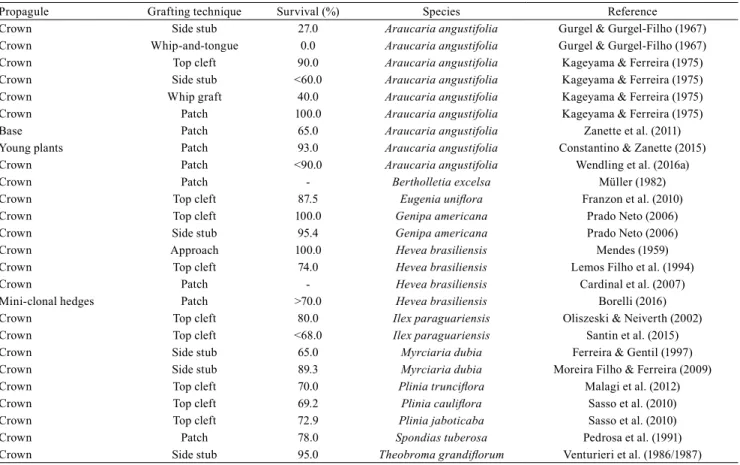
The qualification of the grafting technique has also
been assessed for other species (Table 7).
Clonal forests of Brazilian native tree species
For the genera Eucalyptus, clonal forestry is already
established and is in commercial expansion in Brazil,
constituting the pillar of the timber, energy, biomass, and, mainly, paper and pulp industry. However, with rare exceptions, native species with high silvicultural
potential have been neglected by the Brazilian forestry
sector.
Studies related to clonal forestry of native species have been concentrated in forest research institutions, and are mostly in the initial stages of collection and evaluation of seminal plantations, i.e., progeny and provenance assays (Pinto Júnior et al., 2013). Although there is a considerable evolution in clonal forestry for some species, including the selection of genetic material
and assessments at the clonal field level, no works been
carried out to disseminate such information.
Furthermore, even though vegetative propagation has been made viable for many species, little or nothing
is known about their growth in the field. Among
K.Schum., C. estrellensis, Cordia trichotoma (Vell.) Steud., Piptocarpha angustifolia Dusén ex Malme, S. amazonicum, and Schizolobium parahyba (Vell.) Blake (Tables 6 and 7).
Of the small number of native tree species with known clonal forestry, H. brasiliensis is the most evaluated. Studies on the species were initiated in the last century, assessing the rooting capacity of different
genetic materials (Muzik & Cruzado, 1956; Tinley & Garner, 1960). Advances in the clonal forestry of
H. brasiliensis trees yielded satisfactory productivity indexes, with average productivity increasing from
400 kg ha-1 per year for seminal plantations to 2,500 kg ha-1 per year for clonal plantations (Gonçalves
& Fontes, 2009). Over the last few decades, in addition
to the production of latex, there has been an attempt to include wood quality in breeding programs, considering the wood supply during the reformulation of plantations (Leonello et al., 2012).
Ilex paraguariensis has recently been included in the list of native species with proven potential in clonal
forestry (Santin et al., 2015; Wendling & Brondani,
2015; Sturion et al., 2017). Although it is still under
evaluation in the field, it has presented promising
Table 6. Application of the mini-cuttings technique as a mass propagation method applied to Brazilian native tree species.
Propagule(1) Growth regulator Efficiency (%) Species Reference
Mini-clonal hedge
Juvenile - 98.0 Anadenanthera macrocarpa Dias et al. (2012)
Juvenile 1,500 mg L-1 IBA(2) 32.0 Araucaria angustifolia Pires et al. (2013)
Juvenile - 83.0 Araucaria angustifolia Pires et al. (2015)
Juvenile - 95.8 Calophyllum brasiliense Silva et al. (2010)
Juvenile - 100.0 Calycophyllum spruceanum Gatti (2002)
Juvenile 2,000 mg L-1 NAA(3) 83.3 Cariniana estrellensis Gatti et al. (2011)
Juvenile - 84.0 Cedrela fissilis Xavier et al. (2003b)
Juvenile - 79.0 Cedrela fissilis Xavier et al. (2003a)
Juvenile - 100.0 Cordia trichotoma Carneiro (2013)
Juvenile 30 mmol L-1 IBA >45.0 Cordia trichotoma Kielse et al. (2013)
Juvenile - 38.3 Cordia trichotoma Kielse et al. (2015)
- 1,000 mg L-1 IBA 13.3 Cordia trichotoma Kielse et al. (2015)
Juvenile - - Dipteryx alata Martins et al. (2012)
Juvenile - 25.0 Eremanthus erythropappus Rezende (2007)
Juvenile 2,000, 3,000, and 4,000 mg L-1 IBA 100.0 Erythrina crista-galli Gratieri-Sossella et al. (2008)
Juvenile - 85.5 Erythrina falcata Cunha et al. (2008)
Adult - 1.9 Eugenia uniflora Peña Peña et al. (2015)
Juvenile 2,500 mg L-1 IBA 97.2 Eugenia uniflora Peña et al. (2015)
Juvenile - 100.0 Handroanthus heptaphyllus Oliveira et al. (2015b)
Juvenile - 80.0 Handroanthus heptaphyllus Oliveira et al. (2015a)
Juvenile - 90.0 Ilex paraguariensis Wendling et al. (2007)
Juvenile - 77.5 Ilex paraguariensis Brondani et al. (2007)
Adult 8,000 mg L-1 IBA 62.5 Ilex paraguariensis Brondani et al. (2008)
Adult - - Ilex paraguariensis Nagaoka et al. (2013)
Adult - 68.7 Ilex paraguariensis Kratz et al. (2015)
Juvenile - 94.3 Maytenus ilicifolia Lima et al. (2009)
Juvenile - 45.0 Piptocarpha angustifolia Ferriani et al. (2011)
Juvenile - 71.3 Piptocarpha angustifolia Stuepp et al. (2017c)
Juvenile - 58.7 Piptocarpha angustifolia Stuepp et al. (2016b)
Juvenile - 31.4 Plathymenia foliolosa Neubert (2014)
Juvenile - 92.0 Psidium cattleianum Altoé et al. (2011)
Juvenile - 96.0 Psidium guineense Altoé et al. (2011)
Juvenile - 80.6 Sapium glandulatum Ferreira et al. (2010)
Juvenile - >60.0 Schizolobium amazonicum Souza (2015)
Juvenile - >35.0 Schizolobium parahyba Souza (2015)
results (Santin et al., 2015). Due to its multiple-use purpose (leaves, branches, and wood), studies about I. paraguariensis clones have been extensive (Rakocevic et al., 2006; Santin et al., 2015). The obtained results show that clonal plants produced by the cuttings and mini-cuttings techniques present higher survival and productivity compared with seedlings, as well as leaves and thin branches up to 7 mm (Rakocevic et al., 2006; Santin et al., 2015), indicating its suitability for the clonal production of the species.
Araucaria angustifolia presents very interesting
characteristics for Brazilian silviculture, not only
regarding its already-proven superior wood quality but also the high productive potential of its seeds (pine nuts), appreciated as food. The clonal forestry of the species has followed two lines for plant production,
both already assessed in the field: grafting technique,
using juvenile and adult grafts for wood and nut production, respectively; and cuttings, using juvenile shoots from selected plants for wood production (Wendling et al., 2016a, 2016b, 2017b). Araucaria
angustifolia clones showed larger diameter at breast height (DBH) and an increase in total height compared with seminal plantations (Wendling et al., 2016b); the authors concluded that female clones produced by apical cuttings were superior to the others. In
comparison with plants grafted directly in the field
with juvenile propagules (basal shoots of adult trees) and seedlings, the clones were once again superior regarding DBH and total height (Wendling et al., 2017a). These authors also concluded that cuttings and grafting are potential techniques for A. angustifolia plant production for logging purposes. In this case, grafting stands out, being recommended for its low cost and for the formation of orchards aiming seed production, resulting in a volumetric increase and a form factor similar to that of seedlings.
Some native species, particularly fruit, have been the focus of the silvicultural evaluations of clonal plantations, especially T. cacao (Almeida et al., 2009) and Theobroma grandiflorum (Willd. ex Spreng.)
K.Schum. (Souza et al., 2002). Despite including
Table 7. General application of grafting for vegetative rescue and multiplication of Brazilian native tree species.
Propagule Grafting technique Survival (%) Species Reference
Crown Side stub 27.0 Araucaria angustifolia Gurgel & Gurgel-Filho (1967) Crown Whip-and-tongue 0.0 Araucaria angustifolia Gurgel & Gurgel-Filho (1967) Crown Top cleft 90.0 Araucaria angustifolia Kageyama & Ferreira (1975) Crown Side stub <60.0 Araucaria angustifolia Kageyama & Ferreira (1975) Crown Whip graft 40.0 Araucaria angustifolia Kageyama & Ferreira (1975)
Crown Patch 100.0 Araucaria angustifolia Kageyama & Ferreira (1975)
Base Patch 65.0 Araucaria angustifolia Zanette et al. (2011)
Young plants Patch 93.0 Araucaria angustifolia Constantino & Zanette (2015)
Crown Patch <90.0 Araucaria angustifolia Wendling et al. (2016a)
Crown Patch - Bertholletia excelsa Müller (1982)
Crown Top cleft 87.5 Eugenia uniflora Franzon et al. (2010)
Crown Top cleft 100.0 Genipa americana Prado Neto (2006)
Crown Side stub 95.4 Genipa americana Prado Neto (2006)
Crown Approach 100.0 Hevea brasiliensis Mendes (1959)
Crown Top cleft 74.0 Hevea brasiliensis Lemos Filho et al. (1994)
Crown Patch - Hevea brasiliensis Cardinal et al. (2007)
Mini-clonal hedges Patch >70.0 Hevea brasiliensis Borelli (2016)
Crown Top cleft 80.0 Ilex paraguariensis Oliszeski & Neiverth (2002)
Crown Top cleft <68.0 Ilex paraguariensis Santin et al. (2015)
Crown Side stub 65.0 Myrciaria dubia Ferreira & Gentil (1997)
Crown Side stub 89.3 Myrciaria dubia Moreira Filho & Ferreira (2009)
Crown Top cleft 70.0 Plinia trunciflora Malagi et al. (2012)
Crown Top cleft 69.2 Plinia cauliflora Sasso et al. (2010)
Crown Top cleft 72.9 Plinia jaboticaba Sasso et al. (2010)
Crown Patch 78.0 Spondias tuberosa Pedrosa et al. (1991)
woody species, breeding programs of these species have focused exclusively on fruit production (Almeida
et al., 2009; Souza et al., 2002).
Brazil presents an immense range of native species
with silvicultural potential, either for the production of wood or non-wood products. However, few species
were actually successful in Brazilian silviculture.
In the case of clonal forestry, the number of species
analyzed in the field is even lower, generally due to
the lack of knowledge about the productive potential of these materials and the unavailability of resources for this purpose, such as planting area, plants, and labor. Despite the information available about the vegetative propagation of many native tree species, studies on the topic usually begin without an adequate genetic
selection, making it difficult to evaluate quality genetic materials under field conditions. However,
the assessment of woody species propagation is key to enable clonal forestry, depending on, among other
factors, the continuity of studies in the field, even if at
experimental levels.
Therefore, there is an evident gap to be filled in Brazilian clonal forestry regarding the use of native
tree species. To increase the insertion of these species, a greater integration between studies on the vegetative
propagation and vigor of these materials in the field is
necessary; otherwise, the use of these species, whether for environmental or productive purposes, will always be limited to the experimental stage.
Concluding remarks
Vegetative rescue in native trees is feasible for
a significant number of species, as long as there is
a consistency in the choice of the applied technique and the intended objectives. For this, a better understanding of the different stages and purposes involved in the vegetative propagation of native tree species is necessary. In studies where the objective is
the production of flowers, fruits or seeds, it is essential
to identify techniques that maintain the maturity of the propagules. However, if the objective is the restoration of degraded ecosystems and the production of wood and leaves, techniques that facilitate vegetative propagation, offering greater juvenility of the propagules, are desired. The lack of experiments in
field conditions, i.e., less than 10% for the species cited
in this review, is evidence of the need to increase the
number of species evaluated in the clonal forestry of
Brazilian native species. Specifically for environmental
purposes, studies comparing multiple species using standard methods of analysis and research material (type and origin of propagules) are recommended,
enabling a better understanding and more efficient
application of the vegetative propagation techniques.
Acknowledgments
To Coordenação de Aperfeiçoamento de Pessoal de
Nível Superior (Capes), for financial support (process
number 1340661).
References
ALMEIDA, C.M.V.C. de; DIAS, L.A. dos S.; SILVA, A. de
P. Caracterização agronômica de acessos de cacau. Pesquisa Agropecuária Brasileira, v.44, p.368-373, 2009. DOI: 10.1590/ S0100-204X2009000400006.
ALMEIDA, F.C.G.; ALMEIDA, F.A.G.; ALMEIDA, F.F.G.;
CARVALHO, P.R.D. Influência do estiolamento e do ácido indolebutírico na formação de raízes do alporque de cajueiro anão
precoce (Anacardium occidentale L.). Acta Botânica Brasilica, v.4, p.9-12, 1990. DOI: 10.1590/S0102-33061990000300002. ALTOÉ, J.A.; MARINHO, C.S.; COSTA TERRA, M.I. da;
BARROSO, D.G. Propagação de araçazeiro e goiabeira via
miniestaquia de material juvenil. Bragantia, v.70, p.312-318, 2011. DOI: 10.1590/S0006-87052011000200009.
BAPTIST, E.D.C. Plant hormones. Journal of the Rubber Research Institute of Malaysia, v.9, p.17-39, 1939.
BERNHARDT, R. Análise quantitativa e qualitativa do crescimento de caixeta –Tabebuia cassinoides (LAM.) DC. –
em florestas manejadas, no Município de Iguape/SP. 2003. 61p.
Dissertação (Mestrado) – Universidade de São Paulo, Piracicaba. BITENCOURT, J.; ZUFFELLATO-RIBAS, K.C.; WENDLING,
I.; KOEHLER, H.S. Enraizamento de estacas de erva-mate
(Ilex paraguariensis A. St.-Hill.) provenientes de brotações rejuvenescidas. Revista Brasileira de Plantas Medicinais, v.11, p.277-281, 2009. DOI: 10.1590/S1516-05722009000300008. BORELLI, K. Produção de mudas de seringueira em viveiro suspenso. 2016. 87p. Dissertação (Mestrado) – Universidade de São Paulo, Piracicaba.
BRONDANI, G.E.; ARAUJO, M.A. de; WENDLING, I.; KRATZ,
D. Enraizamento de miniestacas de erva-mate sob diferentes
ambientes. Pesquisa Florestal Brasileira, n.57, p.29-38, 2008. BRONDANI, G.E.; WENDLING, I.; SANTIN, D.; BENEDETTI,
E.L.; ROVEDA, L.F.; ORRUTÉA, A.G. Ambiente de enraizamento
e substratos na miniestaquia de erva-mate. Scientia Agraria, v.8, p.257-267, 2007.
Cnidoscolus quercifolius por alporquia. Ciência Florestal, v.25, p.743-749, 2015. DOI: 10.5902/1980509819677.
CARDINAL, A.B.B.; GONÇALVES, P. de S.; MARTINS,
A.L.M. Influência de seis porta-enxertos sobre a produção de
clones superiores de seringueira. Bragantia, v.66, p.277-284, 2007. DOI: 10.1590/S0006-87052007000200011.
CARNEIRO, M.A. Crescimento inicial e propagação vegetativa de Cordia trichotoma (Vellozo) Arrabida Ex Steudel
(louro-pardo). 2013. 65p. Tese (Doutorado) – Universidade Federal da Grande Dourados, Dourados.
CARPANEZZI, A.A.; CARPANEZZI, O.T.B. Espécies nativas recomendadas para recuperação ambiental no Estado do
Paraná, em solos não degradados. Colombo: Embrapa Florestas,
2006. 52p. (Embrapa Florestas. Documentos, 136).
CASTRO, P.R.C.; FACHINELLO, J.C.; FAQUIM, V.; RAMALHO,
J.F.G.P.; BACCHI, O.O.S. Estimulação do enraizamento de
estacas de seringueira (Hevea brasiliensis Muell. Arg.). Anais da
Escola Superior de Agricultura Luiz de Queiroz, v.41,
p.349-357, 1984. DOI: 10.1590/S0071-12761984000100020.
CIRIELLO, E.; MORI, E.S. Rooting of guanandi (Calophyllum brasiliense Cambess) cuttings using indole-butyric acid. Cerne, v.21, p.641-648, 2015. DOI: 10.1590/01047760201521041803. CONSTANTINO, V.; ZANETTE, F. Produção de borbulhas ortotrópicas para enxertia de Araucaria angustifolia. Acta Biológica Paranaense, v.44, p.49-55, 2015. DOI: 10.5380/abpr. v44i1-4.47598.
CUNHA, A.C.M.C.M. da; WENDLING, I.; SOUZA JÚNIOR, L. Miniestaquia em sistema de hidroponia e em tubetes de corticeira-do-mato. Ciência Florestal, v.18, p.85-92, 2008. DOI: 10.5902/19805098513.
DANNER, M.A.; CITADIN, I.; FERNANDES JUNIOR, A. de A.; ASSMAN, A.P.; MAZARO, S.M.; DONAZZOLO, J.; SASSO,
S.A.Z. Enraizamento de jabuticabeira (Plinia trunciflora) por mergulhia aérea. Revista Brasileira de Fruticultura, v.28, p.530-532, 2006. DOI: 10.1590/S0100-29452006000300043. DIAS, P.C.; ATAÍDE, G. da M.; XAVIER, A.; OLIVEIRA, L.S. de; PAIVA, H.N. de. Propagação vegetativa de Schizolobium amazonicum por estaquia. Cerne, v.21, p.379-386, 2015a. DOI: 10.1590/01047760201521031467.
DIAS, P.C.; XAVIER, A.; OLIVEIRA, L.S. de; FÉLIX, G. de A.; PIRES, I.E. Resgate vegetativo de árvores de
Anadenanthera macrocarpa. Cerne, v.21, p.83-89, 2015b. DOI: 10.1590/01047760201521011381.
DIAS, P.C.; XAVIER, A.; OLIVEIRA, L.S. de; PAIVA, H.N. de; CORREIA, A.C.G. Propagação vegetativa de progênies de meios-irmãos de angico-vermelho (Anadenanthera macrocarpa (Benth) Brenan) por miniestaquia. Revista Árvore, v.36, p.389-399, 2012. DOI: 10.1590/S0100-67622012000300001.
FARIA, J.C.; SACRAMENTO, C.K. do. Enraizamento e
crescimento de estacas herbáceas do cacaueiro (clones Cepec 42, TSH 516 e TSH 1188) em função da aplicação do ácido indolbutírico (AIB). Revista Brasileira de Fruticultura, v.25, p.192-194, 2003.
FERREIRA, B.G.A.; ZUFFELLATO-RIBAS, K.C.; WENDLING, I.; KOEHLER, H.S.; NOGUEIRA, A.C. Miniestaquia de Sapium glandulatum (Vell.) Pax com o uso de ácido indol butírico e ácido naftaleno acético. Ciência Florestal, v.20, p.19-31, 2010. DOI: 10.5902/198050981758.
FERREIRA, S.A. do N.; GENTIL, D.F. de O. Propagação assexuada do camu-camu (Myrciaria dubia) através de enxertias do tipo garfagem. Acta Amazonica, v.27, p.163-168, 1997. DOI: 10.1590/1809-43921997273168.
FERRIANI, A.P.; ZUFFELLATO-RIBAS, K.C.; HELM, C.V.; BOZA, A.; WENDLING, I.; KOEHLER, H.S. Produção
de brotações e enraizamento de miniestacas de Piptocarpha angustifolia. Pesquisa Florestal Brasileira, v.31, p.257-264, 2011. DOI: 10.4336/2011.pf b.31.67.257.
FONSECA, C.E.L. da; SPERÂNDIO, J.P.; CORRÊA, M.P.F.; BUENO, D.M.; LIMA, R. Propagação vegetativa do jacarandá-da-baía através da estaquia. Pesquisa Agropecuária Brasileira, v.26, p.31-37, 1991.
FRANZON, R.C.; GONÇALVES, D. da S.; ANTUNES, L.E.C.; RASEIRA, M. do C.B. Propagação vegetativa de genótipos de pitangueira (Eugenia uniflora L.) do sul do Brasil por enxertia de garfagem. Revista Brasileira de Fruticultura, v.32, p.262-267, 2010. DOI: 10.1590/S0100-29452010005000003.
GATTI, K.C. Propagação vegetativa de pau mulato (Calycophyllum spruceanum (Benth) K. Schum.), jequitibá
(Cariniana estrellensis (Raddi) Kuntze) e teca (Tectona grandis Linn. f.) por miniestaquia. 2002. 72p. Tese (Doutorado) – Universidade Federal de Viçosa, Viçosa.
GATTI, K.C.; GONÇALVES, R. de C.; XAVIER, A.; PAIVA, H. de. Propagação vegetativa de jequitibá Cariniana estrellensis
(Raddi) por miniestaquia. Temas Agrários, v.16, p.54-63, 2011. DOI: 10.21897/rta.v16i2.691.
GONÇALVES, M. da P.M.; MAÊDA, J.M.; ABREU, H. dos S.; SILVA, S.P.; SOUZA, G.R. de. Propagação vegetativa da aroeira (Schinus terebinthifolius) por alporquia. Revista Brasileira de Biociências, v.5, p.363-365, 2007. Suplemento 2.
GONÇALVES, P. de S.; FONTES, J.R.A. Domesticação e melhoramento da seringueira. In: BORÉM, A.; LOPES, M.T.G.; CLEMENT, C.R. (Ed.). Domesticação e melhoramento: espécies
amazônicas. Viçosa: Ed. da UFV, 2009. p.395-423.
GRAÇA, M.E.C.; COOPER, M.A.; TAVARES, F.R.; CARPANEZZI, A.A. Estaquia de erva-mate. Colombo: Embrapa-CNPF, 1988. 6p. (Embrapa-CNPF. Circular técnica, 18). GRATIERI-SOSSELLA, A.; PETRY, C.; NIENOW, A.A. Propagação da corticeira do banhado (Erythrina crista-galli L.) (Fabaceae) pelo processo de estaquia. Revista Árvore, v.32, p.163-171, 2008. DOI: 10.1590/S0100-67622008000100018. GURGEL, J.T.A.; GURGEL-FILHO, C.A. Métodos de enxertia para o pinheiro brasileiro Araucaria angustifolia (Bertol.) O.
Ktze., visando à formação de pomares de sementes. Silvicultura
em São Paulo, v.6, p.153-155, 1967.
males and females. Plant, Cell & Environment, v.36, p.356-364, 2013. DOI: 10.1111/j.1365-3040.2012.02578.x.
HERNANDEZ, W.; XAVIER, A.; PAIVA, H.N. de; WENDLING, I. Propagação vegetativa do jequitibá-rosa (Cariniana estrellensis
(Raddi) Kuntze) por estaquia. Revista Árvore, v.37, p.955-967, 2013. DOI: 10.1590/S0100-67622013000500018.
HERNÁNDEZ, W.; XAVIER, A.; PAIVA, H.N. de; WENDLING, I. Propagação vegetativa do pau-jacaré (Piptadenia gonoacantha
(Mart.) Macbr.) por estaquia. Revista Árvore, v.36, p.813-823, 2012. DOI: 10.1590/S0100-67622012000500003.
IRITANI, C.; SOARES, R.V.; GOMES, A.V. Aspectos morfológicos da ação de reguladores do crescimento em estacas de Araucaria angustifolia (Bert) O. Ktze. Acta Biológica Paranaense, v.15, p.1-20, 1986. DOI: 10.5380/abpr.v15i0.815. KAGEYAMA, P.Y.; FERREIRA, M. Propagação vegetativa por enxertia em Araucaria angustifolia (Bert) O. Ktze. IPEF, n.11, p.95-102, 1975.
KIELSE, P.; BISOGNIN, D.A.; HAYGERT, K.L.; MELLO, U.S.; PIMENTEL, N.; RAUBE, M.A. Production and rooting of cordia -
Cordia trichotoma (Vell.) Arrab. ex Steud. mini-cuttings collected from ministumps of asexual and seminal origin. Ciência Rural, v.45, p.1164-1166, 2015. DOI: 10.1590/0103-8478cr20131011. KIELSE, P.; BISOGNIN, D.A.; HEBERLE, M.; FLEIG, F.D.; XAVIER, A.; RAUBER, M.A. Propagação vegetativa de Cordia trichotoma (Vell.) Arrab. ex Steudel por estaquia radicular. Revista Árvore, v.37, p.59-66, 2013. DOI: 10.1590/S0100-67622013000100007.
KRATZ, D.; PIRES, P.P.; STUEPP, C.A.; WENDLING, I. Produção de mudas de erva-mate por miniestaquia em substratos renováveis. Revista Floresta, v.45, p.609-616, 2015. DOI: 10.5380/rf.v45i3.36531.
KRATZ, D.; WENDLING, I.; STUEPP, C.A.; KALIL FILHO, A.N. Epicormic shoots induction and rooting cuttings of
Calophyllum brasiliense. Cerne, v.22, p.365-372, 2016.
LATTUADA, D.S.; SPIER, M.; SOUZA, P.V.D. de. Pré-tratamento com água e doses de ácido indolbutírico para estaquia herbácea de pitangueiras. Ciência rural, v.41, p.2073-2079, 2011. DOI: 10.1590/S0103-84782011001200006.
LEDERMAN, I.E.; BEZERRA, J.E.F.; ASCHOFF, M.N.A.; OLIVEIRA, E.N.M. de; ROSA, J.M.G. Propagação vegetativa
do umbuzeiro (Spondias tuberosa Arr. Cam.) e da gravioleira (Annona muricata L.) através da alporquia. Revista Brasileira de Fruticultura, v.13, p.55-58, 1991.
LEITE, G.L.D.; VELOSO, R.V. dos S.; CASTRO, A.C.R. de; LOPES, P.S.N.; FERNANDES, G.W. Efeito do AIB sobre a
qualidade e fitossanidade dos alporques de influência da Caryocar brasiliense Camb (Caryocaraceae). Revista Árvore, v.31, p.315-320, 2007. DOI: 10.1590/S0100-67622007000200014.
LEMOS FILHO, J.P. de; PEREIRA, J. da P.; MEDRADO, M.S.; COSTA, J.D.; PINTO, H.S. Mini-enxertia da seringueira (Hevea
spp.). II. Problemas e avanços na técnica. Pesquisa Agropecuária Brasileira, v.29, p.779-784, 1994.
LEONELLO, E.C.; BALLARIN, A.W.; OHTO, J.M.; PALMA,
H.A.L.; ESCOBAR, J.F. Classificação estrutural e qualidade da
madeira do clone GT 1 de Hevea brasiliensis Muell. Arg. Floresta e Ambiente, v.19, p.229-235, 2012. DOI: 10.4322/floram.2012.027.
LIMA, D.M. de; TANNO, G.N.; PURCINO, M.; BIASI, L.A.;
ZUFFELLATO-RIBAS, K.C.; ZANETTE, F. Enraizamento de
miniestacas de espinheira-santa (Maytenusilicifolia Mart. ex Reissek) em diferentes substratos. Ciência e Agrotecnologia, v.33, p.617-623, 2009. DOI: 10.1590/S1413-70542009000200040. LIMA, D.M.; BIASI, L.A.; ZANETTE, F.; ZUFFELLATO-RIBAS, K.C.; BONA, C.; MAYER, J.L.S. Capacidade de
enraizamento de estacas de Maytenus muelleri Schwacke com a aplicação de ácido indol butírico relacionada aos aspectos
anatômicos. Revista Brasileira de Plantas Medicinais, v.13, p.422-438, 2011. DOI: 10.1590/S1516-05722011000400008. MALAGI, G.; CITADIN, I.; SCARIOTTO, S.; WAGNER
JÚNIOR, A.; SACHET, M.R. Enxertia interespecífica de jabuticabeira: influência do tipo de garfo. Ciência Rural, v.42, p.221-224, 2012.
MANTOVANI, N.C.; GRANDO, M.F.; XAVIER, A.; OTONI, W.C. Resgate vegetativo por alporquia de genótipos adultos de urucum (Bixa orellana L.). Ciência Florestal, v.20, p.403-410, 2010. DOI: 10.5902/198050982055.
MARTÍNEZ-BALLESTA, M.C.; ALCARAZ-LÓPEZ, C.; MURIES, B.; MOTA-CADENAS, C.; CARVAJAL, M. Physiological aspects of rootstock–scion interactions.
Scientia Horticulturae, v.127, p.112-118, 2010. DOI: 10.1016/j.
scienta.2010.08.002.
MARTINS, I.S.; MANTELLI, M.; SANTOS, S.C.; NETTO, A.P.C.; PINTO, F. Estaquia e concentração de reguladores vegetais
no enraizamento de Campomanesia adamantium. Revista de Ciências Agrárias, v.38, p.58-64, 2015.
MARTINS, I.S.; MARTINS, R.C.; DIÓGENES, A.G. Produção de miniestacas em minicepas de Dipteryx alata Vogel (Barú).
Revista Científica Eletrônica de Engenharia Florestal, v.19,
p.109-117, 2012.
MELO, L.A. de; DAVIDE, A.C.; TEIXEIRA, L.A.F. Metodologia
para resgate de matrizes e enraizamento de estacas de Eremanthus erythropappus. Cerne, v.18, p.631-638, 2012. DOI: 10.1590/ S0104-77602012000400013.
MENDES, L.O.T. Considerações sobre a enxertia da seringueira. Bragantia, v.18, p.141-159, 1959. DOI: 10.1590/S0006-87051959000100011.
MIELKE, M.S.; FACHINELLO, J.C.; NACHTIGAL, J.C.; MATIUZ, B.; ENDRES, L.; SANTOS FILHO, B.G. dos.
Comportamento fisiológico de goiabeira serrana quando
multiplicada por mergulhia de cepa. Scientia Agricola, v.51, p.21-27, 1994. DOI: 10.1590/S0103-90161994000100004.
MONTEIRO, W.R.; MARQUES, J.R.B.; PACHECO, E.R.
Produção de mudas de seringueira por meio do enraizamento de
estacas coletadas em plantas adultas. Agrotrópica, v.27, p.191-198, 2015.
MÜLLER, C.H. Quebra da dormência da semente e enxertia
em castanha-do-Brasil. Belém: EMBRAPA-CPATU, 1982. 40p.
(EMBRAPA-CPATU. Documentos, 16).
MUZIK, T.J.; CRUZADO, H.J. Formation and rooting of adventitious shoots in Hevea brasiliensis. American Journal of Botany, v.43, p.503-508, 1956. DOI: 10.1002/j.1537-2197.1956. tb10524.x.
NAGAOKA, R.E.; PERES, F.S.B.; CARMO, A.L.M.; GARCIA, F.A. de O. Efeito do AIB no desenvolvimento de mudas clonais em genótipos de erva-mate. Enciclopédia Biosfera, v.9, p.1182-1191, 2013.
NEUBERT, V. de F. Propagação vegetativa do vinhático (Plathymenia foliolosa Benth) por miniestaquia. 2014. 38p. Dissertação (Magister Scientiae) – Universidade Federal de Viçosa, Viçosa.
NEVES, T. dos S.; CARPANEZZI, A.A.;
ZUFFELLATO-RIBAS, K.C.; MARENCO, R.A. Enraizamento de corticeira-da-serra em função do tipo de estaca e variações sazonais. Pesquisa Agropecuária Brasileira, v.41, p.1699-1705, 2006. DOI: 10.1590/ S0100-204X2006001200003.
OLISZESKI, A.; NEIVERTH, D.D. Recuperação de erveiras nativas por enxertia. Boletim de Pesquisa Florestal, n.44, p.127-132, 2002.
OLIVEIRA, M.A.; BARROSO, D.G.; LAMÔNICA, K.R.; CARVALHO, V.S.; OLIVEIRA, M.A. de. Efeito do ácido
indol-3-butírico (AIB) no enraizamento de miniestacas de ipê-roxo
(Handroanthus heptaphyllus Mattos). Ciência Florestal, v.25. p.1043-1051, 2015a. DOI: 10.5902/1980509820666.
OLIVEIRA, M.C.; RIBEIRO, J.F. Enraizamento de estacas de
Euplassa inaequalis (Pohl) Engl. de mata de galeria em diferentes estações do ano. Bioscience Journal, v.29, p.991-999, 2013. OLIVEIRA, T.P.D.F.; BARROSO, D.G.; LAMÔNICA, K.R.; CARVALHO, V.S.; de OLIVEIRA, T.P.D.F.; BARROSO, D.G.; LAMÔNICA, K.R.; DE ARAÚJO CARNEIRO, J.G.; DE OLIVEIRA, M.A. Productivity of polyclonal minigarden and rooting of Handroanthus heptaphyllus Mattos minicuttings.
Semina: Ciências Agrárias, v.36, p.2423-2432, 2015b. DOI:
10.5433/1679-0359.2015v36n4p2423.
PEDROSA, A.C.; LEDERMAN, I.E.; BEZERRA, J.E.F.; DANTAS, A.P.; GONZAGA NETO, L. Métodos de enxertia do
umbuzeiro (Spondias tuberosa Arr. Cam) em viveiro. Revista Brasileira de Fruticultura, v.13, p.59-62, 1991.
PEÑA PEÑA, M.L. Propagação vegetativa de pitangueira (Eugenia uniflora L.) por estaquia e miniestaquia. 2014. 80p. Tese (Doutorado) – Universidade Federal do Paraná, Curitiba. PEÑA PEÑA, M.L.; ZANETTE, F.; BIASI, L.A. Época de
coleta e ácido indolbutírico no enraizamento de miniestacas de
pitangueira. Semina: Ciências Agrárias, v.36, p.3055-3068, 2015. DOI: 10.5433/1679-0359.2015v36n5p3055.
PEÑA, M.L.; ZANETTE, F.; BIASI, L.A. Miniestaquia a partir de minicepas originadas por enxertia de pitangueira adulta.
Comunicata Scientiae, v.6, p.397-306, 2015. DOI: 10.14295/
CS.v6i3.817.
PEREIRA, J. da P.; LEAL, A.C. Efeito do período de inverno sobre o desempenho da propagação precoce da seringueira (Hevea spp.). Agrotrópica, v.24, p.91-98, 2012.
PINHEIRO, E.; LIBONATI, V.F.; CASTRO, C. de; PINHEIRO, F.S.V. A enxertia de copa na formação de seringais de cultivo
nos trópicos úmidos da Amazônia. Belém: FCAP, 1988. 27p.
(FCAP. Informe técnico, 13).
PINTO JÚNIOR, J.E.; SANTOS, P.E.T. dos; AGUIAR, A.V. de; KALIL FILHO, A.N.; PALUDZYSZYN FILHO, E.; STURION, J.A.; RESENDE, M.D.V. de; SOUSA, V.A. de. Melhoramento genético de espécies arbóreas na Embrapa Florestas: uma visão histórica. Colombo: Embrapa Florestas, 2013. 109 p. (Embrapa Florestas. Documentos, 259).
PIRES, P.; WENDLING, I.; AUER, C.; BRONDANI, G.
Sazonalidade e soluções nutritivas na miniestaquia de Araucaria angustifolia (Bertol.) Kuntze. Revista Árvore, v.39, p.283-293, 2015. DOI: 10.1590/0100-67622015000200008.
PIRES, P.P.; WENDLING, I.; BRONDANI, G. Ácido indolbutírico e ortotropismo na miniestaquia de Araucaria angustifolia. Revista Árvore, v.37, p.393-399, 2013. DOI: 10.1590/S0100-67622013000300002.
PRADO NETO, M. Germinação de sementes e enxertia de jenipapeiro. 2006. 46p. Dissertação (Mestrado) – Universidade
Federal da Bahia, Cruz das Almas.
RAKOCEVIC, M.; MEDRADO, M.J.S.; LUCAMBIO, F.;
VALDUGA, T.A. Influência do sexo, da sombra e da idade de
folhas no sabor do chimarrão. Análise, v.8, p.10, 2006.
REZENDE, A.A. Enraizamento de estacas de candeia (Eremanthus erytropappus (DC.) MacLeish). 2007. 75p. Dissertação (Mestrado) – Universidade Federal de Lavras, Lavras. RICKLI, H.C.; BONA, C.; WENDLING, I.; KOEHLER, H.S.; ZUFFELLATO-RIBAS, K.C. Origem de brotações epicórmicas
e aplicação de ácido indolilbutírico no enraizamento de estacas
de Vochysia bifalcata Warm. Ciência Florestal, v.25, p.385-393, 2015. DOI: 10.5902/1980509818457.
ROCHA, M. das G. de B.; ROCHA, D.; CLEMENTE, V.M.; FREITAS, M.V.; GOMES, R.; JESUS, S.V.; CHAVES, R.M.; TORRES, G.A.; XAVIER, A. Propagação vegetativa de espécies arbóreas nativas. In: ROCHA, M. das G. de B. Melhoramento de espécies arbóreas nativas. Belo Horizonte: Instituto Estadual de Florestas, 2002. p.91-108.
SAMPAIO, P. de T.B.; BARBOSA, A.P.; VIEIRA, G.; SPIRONELLO, W.R.; BRUNO, F.M.S. Biomassa da rebrota de copas de pau-rosa (Aniba rosaeodora Ducke) em plantios sob
sombra parcial em floresta primária. Acta Amazonica, v.35, p.491-494, 2005. DOI: 10.1590/S0044-59672005000400014. SANTIN, D.; WENDLING, I.; BENEDETTI, E.L.; BRONDANI, G.E.; REISSMANN, C.B.; MORANDI, D.; ROVEDA, L.F. Poda e anelamento em erva-mate (Ilex paraguariensis) visando a indução de brotações basais. Pesquisa Florestal Brasileira, n.56, p.97-104, 2008.
SANTIN, D.; WENDLING, I.; BENEDETTI, E.L.; MORANDI, D.; DOMINGOS, D.M. Sobrevivência, crescimento e