
Implementation of an Engine Condition Trend
Monitoring (ECTM) program in a Part M
organization
Pratt & Whitney PT6A-67D Engine
Diogo Maria Quintino Rogado de Mesquita Guimarães
Dissertação para obtenção do Grau de Mestre em
Engenharia Aeronáutica
(Ciclo de Estudos Integrados)
Orientador: Prof. Doutor Francisco Miguel Ribeiro Proença Brojo
Acknowledgements
First of all I have to thank you to my wife Patrícia for its fundamental role throughout this work. Her support and especially her words of encouragement gave me strength to do this study even after a long day of work.
I would like to thank you also to my family; my parents for my education during all these years, my brothers for all the comradeship and my sisters by jokes and smiles, who regaled me in the darkest moments.
I can’t forget my friends for their friendship, especially to Joel Fonseca and Tiago Domingues, without whom the completion of this Master would have been certainly harder to finish. Finally I would like to thank to my supervisor Prof. Doutor Francisco Miguel Ribeiro Proença Brojo for giving me the opportunity to do this study, for the motivation from the beginning and the patience during all this work.
Resumo
O presente trabalho pretende implementar um Programa de Engine Condition Trend Monitoring (ECTM) numa empresa EASA Part M, utilizando um sistema automático de aquisição dos dados, o ADAS (Aircraft Data Acquisition Unit).
O programa de ECTM vai consistir basicamente no estudo dos processos e metodologias a usar, na elaboração de um manual interno da empresa (Manual de ECTM) e na elaboração de relatórios de ECTM dos dois motores em estudo, P&W PT6A-67D, referentes ao ano de 2013. Este programa de ECTM além de ser obrigatório no que diz respeito à legislação, vai permitir estudar o desempenho dos motores, contribuindo para a segurança e fiabilidade das operações. Do ponto de vista de manutenção será possível monitorizar a deterioração dos motores, melhorar a manutenção planeada e aumentar o tempo de vida dos componentes. Economicamente espera-se uma grande diminuição de trocas de componentes não programadas e também uma diminuição nos custos das manutenções planeadas.
O programa de ECTM apresentado pode ser implementado em qualquer companhia aérea com este tipo de motores, independentemente do tamanho da frota.
Relativamente ao manual de ECTM elaborado, deverá ser posteriormente enviado para as autoridades aeronáuticas portuguesas (INAC) aprovarem.
Palavras-chave
Motor turbo-hélice, ECTM, Velocidade Compressor, Temperatura entre turbinas e combustível.
Resumo Alargado
Através deste trabalho implementou-se um programa de monitorização dos parâmetros do motor, mais especificamente um programa de Engine Condition Trend Monitoring (ECTM). Este programa aplica se a qualquer motor, no qual o fabricante o exija, neste caso o motor em estudo é um turbo hélice da Pratt & Whitney PT6A-67D.
É importante referir que para este estudo relativamente à obtenção dos dados utilizou se um sistema de aquisição de dados automático, através de um componente o Aircraft Data
Acquisition Unit, ADAS.
Inicialmente definiram-se as especificações e características do motor, o seu funcionamento e explicam-se algus factores relativos ao seu desempenho. Uma característica importante neste motor, é o facto de ele ser modular, ou seja, não é uma peça única.
Ele está dividido em duas partes: a secção de potência, com turbina livre, veio e hélice e a turbina a gás, com a parte do compressor, turbinas e câmara de combustão. Esta sua característica modelar é muito importante e muito útil em questões de manutenção.
De seguida explicou-se o que é um programa de ECTM; as suas características e benefícios e as várias etapas. Relativamente à aquisição de dados, foi focado na aquisição automática, o funcionamento e vantagens do ADAS. Outro ponto importante a definir é o papel de cada interveniente no programa, neste caso o dos: fabricante, operador e autoridades.
É de salientar que um programa de ECTM tem muitas vantagens. Através da sua implementação é possível diminuir os tempos e custos de manutenção, antecipar falhas de motor e perceber de uma forma mais eficaz as causas dos problemas encontrados.
Depois de terem sido explicadas as bases de um programa ECTM, elaborou-se um manual de procedimentos com o intuito de poder ser usado por qualquer operador com este tipo de motor, PW PT6A-67D. Foram também analisados alguns casos de estudo, onde foi possível perceber o desempenho do motor.
Abstract
The goal of the present work is to implement an Engine Condition Trend Monitoring (ECTM) program on EASA Part M organization, using an automatic system of data acquisition, ADAS (Aircraft Data Acquisition Unit).
The ECTM program will consist on the study of the process and methodologies to use, in the elaboration of an internal ECTM manual for the company and also the elaboration of reports for two P&W PT6A-67D engines, for the year 2013.
The ECTM program besides being mandatory by the aviation authorities, allows the study of an engine performance and that will improve the safety are reliability of the aircraft operation. From the maintenance point of view will be possible to monitor the engine damage, improve the schedule maintenance and the engine components life limit. Regarding the economics will have less non scheduled components change and also less money spend in schedule components replacements.
The ECTM program presented can be use in any other operator with this type of engines, regardless of the fleet size.
To finalize, the internal ECTM manual produced should be sent for approval to the local authorities, INAC.
Keywords
Contents
LIST OF FIGURES ... IX LIST OF TABLES ... X LIST OF ACRONYMS ... XI
1. INTRODUCTION ... 1
2. ENGINE MAINTENANCE CONCEPTS ... 3
2.1.P&WPT6A-67DENGINE SPECIFICATIONS ... 3
2.2.PERFORMANCE OF TURBO-PROP ENGINE PT6A-67D ... 5
2.2.1. Fuel System ... 10
2.2.2. Oil System ... 10
2.2.3. Engine Instrumentation ... 10
2.2.4. Cockpit Power Plant Controls ... 11
2.2.5. Example of Problems ... 12
2.3.AIRCRAFT MAINTENANCE PROGRAM ... 19
3. ECTM PROGRAM ... 21
3.1.DEFINITION AND BENEFITS... 21
3.1.1. In-flight data acquisition (manual or automatic) ... 22
3.1.2. Data entry, normalization and comparison to mathematical models ... 22
3.1.3. Data analysis for detection of anomalies (alerts) ... 23
3.1.4. Alert Management and Follow-up Actions ... 24
3.1.5. Computer hardware and software ... 24
3.2.THE ROLE OF THE OPERATOR,MANUFACTURE AND AUTHORITIES ... 25
3.2.1. Operator ... 25
3.2.2. Manufacturers ... 26
3.2.3. Authorities ... 26
3.3.1. Manual ... 30
3.3.2. Automatic... 32
3.4.AIRCRAFT DATA ACQUISITION SYSTEM (ADAS), ... 33
3.4.1. Engine Indicating Components ... 34
3.5.ERRORS ASSOCIATED TO THE ECTM ... 35
3.5.1. Engine not stabilized / Targeting Tq and/or Np ... 36
3.5.2. Precision of parameters recorded ... 36
3.5.3. Variable load extraction: ... 36
3.5.4. Large variations in Altitude: ... 37
3.5.5. Other factors that could affect the trend graph ... 37
3.6.DATA ANALYSES ... 37
3.6.1. ECTM parameters... 37
3.7.DATA ANALYSIS EXAMPLES ... 43
4. ECTM PROGRAM – CASE STUDY ... 47
4.1.GATHERING AND ANALYSIS FORM –ENGINE #1 ... 48
4.2.GATHERING AND ANALYSIS FORM –ENGINE #2 ... 50
5. CONCLUSION ... 52
6. BIBLIOGRAPHY ... 53
7. APPENDIX A ... 54
List of Figures
FIGURE 2.1:PT6A-67D SERIES TURBOPROP ENGINE.SOURCE:[4]. ... 3
FIGURE 2.2:P&WPT6-67D ENGINE.SOURCE:[4]. ... 5
FIGURE 2.3:P&WPT6A MODULAR SECTIONS.SOURCE:[4]. ... 6
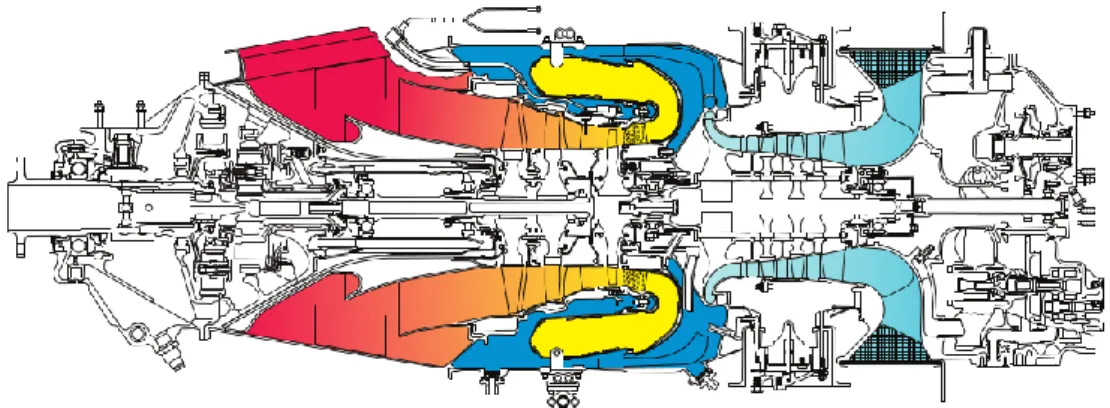
FIGURE 2.4:PT6A-67D GAS PATH THROUGH ENGINE (BLUE – INTAKE AND COMPRESSION, YELLOW – COMBUSTION CHAMBER, ORANGE/RED – TURBINE EXPANSION AND EXHAUST).SOURCE:[4]. ... 8
FIGURE 2.5:POWER TRANSMISSION ON THE PT6A-67D ENGINE.SOURCE:[4]. ... 8
FIGURE 2.6:PT6A-67D SHAFT SUPPORT SYSTEM.SOURCE:[4]. ... 9
FIGURE 2.7:FUEL, POWER AND PROPELLER CONTROLS.SOURCE:[4]. ... 11
FIGURE 2.8:INERTIAL PARTICLE SEPARATORS AT PT6 INTAKE.SOURCE:[5]. ... 14
FIGURE 2.9:COMPRESSOR BLADES SHOWING EROSION AND FOREIGN PARTICLE DAMAGE.SOURCE:[5]. ... 15
FIGURE 2.10:EXAMPLE OF MAINTENANCE MANUAL INSPECTION.SOURCE:[4]. ... 20
FIGURE 3.1:ENGINE CONDITION TREND MONITORING PROCESS.SOURCE:[6]. ... 24
FIGURE 3.2:ENGINE MECHANICAL MEASURING PARAMETERS.SOURCE:[7]. ... 29
FIGURE 3.3:ENGINE PARAMETERS RECORDING TABLE.SOURCE:[5]. ... 31
FIGURE 3.4:EXAMPLE OF MANUAL DATA ACQUISITION (INCORRECT). ... 31
FIGURE 3.5:EXAMPLE OF MANUAL DATA ACQUISITION (CORRECT). ... 32
FIGURE 3.6:TYPICAL ADAS+TWIN ENGINE APPLICATION.SOURCE:[1]. ... 35
FIGURE 3.7:FACTORS AFFECTING THE TREND GRAPH. ... 40
FIGURE 3.8:SYMBOLS ON TREND GRAPH. ... 40
FIGURE 3.9:ECTMGRAPHIC –EXAMPLE 1. ... 43
FIGURE 3.10:ECTMGRAPHIC –EXAMPLE 2. ... 44
FIGURE 3.11:ECTMGRAPHIC –EXAMPLE 3. ... 45
List of Tables
TABLE 2.1:FUEL, POWER AND PROPELLER CONTROLS LOCATION AND FUNCTIONS.SOURCE:[4]. ... 11
TABLE 2.2:SUMMARY OF COMPRESSOR AIR LEAKS CAUSES AND SYMPTOMS FOR PT6 ENGINE.SOURCE:[5]. ... 16
TABLE 2.3:SUMMARY OF TURBINE AIR LEAKS CAUSES AND SYMPTOMS FOR PT6 ENGINE.SOURCE:[5]... 18
TABLE 3.1:ECTM DATA.SOURCE:[7]. ... 29
TABLE 3.2: STABLE RECORDING CONDITIONS.SOURCE:[5]. ... 33
List of Acronyms
ADAS Aircraft Data Acquisition System AFM Aircraft Flight Manual
AGB Accessory Gearbox AOG Aircraft On Ground
AMP Aircraft Maintenance Program AMO Aircraft Maintenance Organization CT Compressor Turbine
EASA European Aviation Safety Agency ECTM Engine Condition Trend Monitoring FAA Federal Aviation Administration FOD Foreign Object Damage FSR Field Service Representative HSI Hot Section Inspection ITT Interturbine Temperature
INAC Instituto Nacional de Aviação Civil LCF Low Cycle Fatigue
Ng Gas Generator Speed Np Propeller Speed PLA Power Lever Assembly P/N Part Number
PT Power Turbine P&W Pratt & Whitney SB Service Bulletin S/N Serial Number
STOL Short Takeoff and Landing TBO Time Between Overhaul TSO Time Since Overhaul TCDS Type Certificate Data Sheet TTSN Total Time Since New TCSN Total Cycles Since New Wf Fuel Flow Rate
1.
Introduction
In the beginning, the aircraft maintenance was limited and did not have a preventive philosophy. Most of the engine maintenance performed were only to correct discrepancies and overhauled inspection, because of this the cost was high [1].
With the improvement of the aircrafts, more demanding aviation regulations and a higger concern with costs, it was inevitable to have a more efficient maintenance. For that reason the EASA Part M companies1 are required in according with the authorities and manufacture to have a continuous airworthiness maintenance programs. The Engine Condition Trend Monitoring, ECTM, is included in the conditions above, this is essential to assess the level of engine degradation and performance and thus prevent the engine failure in flight.
The engine diagnostics have a similar evolution with the engine itself. In the beginning the engine fault analysis was based on the manufacturer instructions (technical publication) and maintenance experience. Only in 1969, with the study of L. A. Urban, mathematical methods were introduced to improve the engine detection faults and performance. Since then several methods have been used by the manufactures in according with the different engine specifications [2].
In order to understand the significance of an ECTM program, it is important recall an accident occurred on November 27th 2001, with a Beech King air C90, with the registration VH-LQH, the aircraft had an engine failure right after the take off. The result was the destruction of the aircraft and all four occupants with fatal injuries. The problem occurred was a crack and release of a blade in the compressor turbine. Because of that the engine had lost thrust and failed. During the investigation, the Australian CAA found that in the left engine ECTM data there was a potential safe-critical problem register in the months before. Since there was no action taken to prevent the problem the engine failed [3].
Due to the importance of this program in the aviation world, this study shows how to implement the program ECTM at an airline and explains the advantages of this implementation on the P&W PT6-67D engine.
Although the study of the engine allow to study their performance, in this particular case, because of the confidential nature of the data, the purpose of this dissertation is more properly related to the method of implementation and all the requirements to take into account (including the form of analysis, reports and actions to be taken) and not with the study of the performance of a real engine. Therefore, all data presented in the graphics and reports are fictitious, but realistic, only to exemplify how is the data collected, and how to analyze it.
2.
Engine Maintenance Concepts
2.1. P&W PT6A-67D Engine Specifications
The PT6A-67D series turboprop engine is composed by a stage reduction gearbox, two-stage power turbine, single two-stage gas generator turbine and five-two-stage gas generator compressor (4 axial, 1 centrifugal). The fuel control is purely hydro-mechanical and the accessory gearbox design has a mounting provision for a second generator unit.
Figure 2. 1: PT6A-67D series turboprop engine. Source: [4].
According to the European Aviation Safety Agency (EASA), all major parts (aircraft, engine, APU) must have an approval specification document. This document is the Type-Certificate Data Sheet (TCDS).
Through the document described above, in this particular case the TCDS-IM.E.008, is possible to have access the specifications to approve the engines.
The engine was approved on February 15th 1994 and is certified by Airworthiness Standards JAR change 7 and CS-E issue 01 with the following specifications: [5]
Dimensions and weight:
Rating: PT6A-67D
Overall Length (mm): 1888.5 Overall Diameter (mm): 466.1 Dry Spec. Weight (kg): 242.2
Ratings:
Maximum Continuous Power (kW): 906 Take-off Power (5 minutes) (kW): 954
Maximum Permissible Air Bleed Extraction:
Maximum External (%): 5.25 Maximum during Start (kg/min): 0.68
Maximum Permissible Rotor Speeds:
Gas Generator (N1) (rpm): 39,000 Power Turbine Module Output (N2) (rpm): 1700 (100%) Power Turbine Module Output (N2) Transient (rpm): 1870 (110%)
Temperature:
Take off power is flat rated up to an ambient temperature (ºC): 48 Maximum Continuous power is flat rated up to an ambient temperature (ºC): 46.5
Temperature Limits – Maximum Interstage Turbine Temperature (ITT):
Maximum Continuous (ºC) 780 Take-off (5 minutes) (ºC) 800 Starting (Ground and Air) (ºC) 1000
Oil Temperature:
Minimum (ºC) -40 -40
Maximum Continuous Operation (ºC) 104 110 Maximum Ground Operation (ºC) 110 110 Maximum (10 minutes) (ºC) 110 ----
Fuel Pressure Limits at Engine Pump Inlet:
Ground Starting, Air Starting and Operation Minimum absolute pressure: 34.47 kPa
(5psi) absolute above the true vapour fuel pressure Maximum gauge pressure: 344.7 kPa
(50psi) with vapour/ liquid ratio of zero at all conditions.
Oil Pressure Limits:
Pressure range (gauge) 620.4 – 930.7 kPa (90-135 psi)
Gas Generator speed 27000 rpm or above and oil temperature 60-71 ºC Minimum Pressure (gauge): 413.6 kPa (90 psi)
2.2. Performance of Turbo-Prop Engine PT6A-67D
The Pratt and Whitney PT6A-67D (Figure 2.2) engine is one of the most reliable and popular turboprop, due to is unmatched versatility, dependability and performance.
The PT6, is a lightweight free turbine engine with a reverse flow combustion path and it is composed by two counter-rotating turbines; one driving the propeller through a reduction gearbox and the other driving to the compressor. The second turbine is independent or “free” of the compressor turbine and in the most recent models a two-stage power turbine was incorporated.
The PT6 engine is a turboprop with a very wide range of applications (utility aircraft, aerobatic trainers, agricultural aircraft, short takeoff and landing (STOL) aircraft and water bombers), the PT6B, C & T are Twin-Pac engines with turbo shaft variants, that are used in many helicopters and more recently in tilt rotors. The ST6, is an industrial variant developed for the United Aircraft Corporation (UAC) TurboTrain and intended for stationary applications. The engine in study is a version of the PT6A-67D with a unique characteristic; it is a modular engine splitted into two major parts called the Power Section assembly and the Gas Generator assembly (Figure 2.3), which is very useful and practical because allows the interchange and tracking of each module, without change all the engine.
Figure 2.3: P&W PT6A modular sections. Source: [4].
There are some specifications necessary to consider this a modular engine:
Each major assembly must be equipped with a data plate and a third data plate located on the inlet case for the complete engine assembly.
Logbook for each module, in order to register every maintenance action. Overhaul interval quoted for each module and the engine assembly.
Although its modular characteristic, there is one important condition, the power section assembly can be removed, but must be returned and installed always on the same gas generator assembly.
This modular characteristic has also advantages in routine field operation. During the engine start, only the compressor section needs be rotated by the starter-generator. In the other hand, in a fixed-shaft engine all rotating components must spin including the reduction gearbox and propeller, resulting in a heavier starting systems requirement.
The free turbine design allows the propeller RPM to be reduced and the propeller feathered during ground operation without shutting down the engine, this facilitates fast passenger loading/unloading and permits very quiet ground operation. The propeller RPM can also be varied in flight (on most applications) permitting propeller RPM to be set for quieter cruise and optimum efficiency.
As said before, the PT6A-67D engine consists of two main sections, the gas generator section and the power section.
The gas generator section compresses and delivers air to the combustion chamber where it is mixed with fuel and ignited, the resulting hot gases turn the compressor turbine which provides the power to run the compressor and the accessory gearbox located at the rear of the engine. The hot gases continue to the power turbine where the remaining energy is extracted to turn the propeller.
Air is directed to a compressor with three axial stages (in the largest models there are four axial stages) and one centrifugal stage, the compressed air leaving the compressor passes through diffuser pipes which turn the flow 90 degrees, reduce its speed and direct the air into the combustion chamber.
In the annular combustion chamber the air is mixed with fuel and burned, then two igniter plugs are used to light the fuel/air mixture at the engine start and finally when they are not required to maintain the combustion process (the engine has reached idle speed) can be shut off.
The expanding hot gases are directed first through the compressor turbine and then through the power turbine. After passage through the power turbine, the gases are exhausted through ports on each side of the engine. The exhaust stubs fitted to the engine are normally directed to utilize the remaining energy of the gases in the form of thrust for additional aircraft propulsion (Figure 2.4).
Two automatic bleed air systems are incorporated for the engine operation, the bleed air from the compressor prevents compressor stall during acceleration from low engine speeds or deceleration from high engine speeds. For aircraft use, air may be bled for heating or pressurizing aircraft cabins.
Figure 2. 4: PT6A-67D gas path through engine (blue – intake and compression, yellow – combustion chamber, orange/red – turbine expansion and exhaust). Source: [4].
A shaft connects the power turbine to the two-stage planetary reduction gearbox, the first stage reduction ring gear floats axially against a hydraulic torque meter cylinder (Figure 2.5). It’s important to say that the oil pressure in this cylinder is proportional to output torque, which is displayed on the cockpit torque indicator.
Bevel gears located forward of the second stage planetary gears drive the following accessories mounted on the forward reduction gearbox case:
propeller governor or constant speed unit propeller overspeed governor
tachometer-generator
The accessory gearbox, mounted on the rear of the engine, is used to drive the following engine accessories:
High-pressure fuel pump Fuel control unit
Oil scavenge and oil pressure pumps.
There is also some space for accessories such as the starter-generator, gas generator, tachometer-generator and fuel boost pumps or hydraulic pumps.
The support of the main shafts is accomplished by a combination of ball and roller bearings, the ball bearings support axial and radial loading; while the roller bearings support only radial loads, allowing for thermal expansion (Figure 2.6).
2.2.1. Fuel System
The fuel system is designed to deliver clean fuel to the engine at the pressure and flow rate necessary for all engine operating conditions. To accomplish the requirements, the fuel systems must contain boost pumps, transfer pumps, selector/shutoff valves, strainers and filters required to supply fuel to the engine(s) and to manage the fuel load distribution in the airplane.
The engine fuel system is composed by the following components: a fuel heater, high-pressure fuel pump, fuel filter, fuel control unit, start control or flow divider unit and a manifold with fuel injection nozzles.
The fuel control unit is either a hydro-pneumatic or a hydro-mechanical system which meters the correct amount of fuel to the engine to maintain the gas generator speed selected by the pilot via the power control lever. It also controls fuel flow during the engine operation: engine starting, acceleration and deceleration.
2.2.2. Oil System
The PT6A-67D engine has a self-contained oil system with the exception of the oil cooler, air duct and associated plumbing and one important operational curiosity is that the oil level should be verified after every engine shutdown and while the oil is still hot, using either a dipstick or a sight glass.
2.2.3. Engine Instrumentation
Incorporated into the design of the PT6A-67D engine are accurate and reliable torque (Tq) and Interturbine Temperature (ITT) measuring systems that give the pilot an accurate indication of the primary engine operating parameters.
Torque Pressure (Tq) is sensed by a torque pressure transducer mounted on the reduction gearbox, to indicate the torque being delivered by the engine, which is a very important parameter used to set power for takeoff and cruise operation for specified propeller speeds. The Interturbine Temperature (ITT), another important engine parameter is monitored to ensure that combustion gas temperature limits of the engine are not exceeded.
Two tachometer-generators are installed on the engine: one on the reduction gearbox to monitor propeller speed (Np) and the other on the accessory gearbox to monitor gas generator speed, (Ng).
The oil system is monitored by the pressure and temperature gauges.
2.2.4. Cockpit Power Plant Controls
The engine in study, the PT6A-67D, use the engine power management system and propeller beta control capability to obtain optimum airplane flight and ground handling capability. Another operational curiosity is that the powerplant functions are commanded from the cockpit by means of three control levers and push-pull cables (Figure 2.7).
Figure 2. 7: Fuel, power and propeller controls. Source: [4].
Table 2. 1: Fuel, power and propeller controls location and functions. Source: [4].
Control Location Control Function
Condition Fuel control unit
(or start control)
Fuel cut-off and idle speed(s)
Power Fuel control unit Gas Generator speed
There are also some secondary control inputs located on the propeller governor: the beta valve and the fuel governor reset. These controls are used in conjunction with the propeller low blade angle feedback system and the engine propeller reversing control system for propeller beta control and reverse thrust control.
A cambox unit is part of the engine control system and its purpose is to schedule gas generator speed and propeller angle by means of linkages to the fuel control power lever and to the propeller governor beta valve and fuel governor reset controls.
2.2.5. Example of Problems
During normal operation, gas turbine engines like turboprop engines are capable of producing rated power for extended periods of time.
Engine operating parameters, such as compressor speeds (NL/Nh/Ng/N2), interturbine temperature (ITT) and fuel flow (Wf) for individual engines are predictable under specific flight conditions.
These predictable characteristics may be used to advantage by establishing and recording individual engine performance parameters, which can then be compared periodically to predicted values to provide day-to-day visual confirmation of engine gas path efficiency. After extensive operation, engine gas path components, such as compressor vanes and blades, compressor impellers, compressor diffusers or turbine vanes and blades, are exposed to external factors that could deteriorate the airfoil surfaces.
This in turn could degrade the efficiency of the components in carrying out their intended compression or expansion functions. Similarly, hot section components can be exposed to high temperatures from inadvertent, irregular engine handling or faulty ground equipment.
By using a baseline as a stable reference, gas path component deterioration can be detected at an early stage and, if required, corrective actions can be taken.
The gas turbine engines operate within a wide range of altitudes, outside air temperatures and airspeeds (ambient conditions); each of these factors influences engine performance parameters in a fixed relationship.
Unless corrections for these varying ambient conditions are applied to the actual engine performance parameters, comparison of these parameters, as read from instruments or downloaded from on-board automatic recorder, can be misleading.
Corrections for ambient conditions are therefore necessary to place the data into a form whereby performance deterioration or change to the gas path characteristics can be detected.
The operator, after a complete analysis of the engine gas path, is then alerted to the need to carry out corrective or preventive maintenance action(s).
2.2.5.1. Compressor
Consists of all the gas path components upstream of the combustion chamber: inlet area, compressor, compressor bleed valve and gas generator case.
Compressor section problems, like compressor damage (FOD, erosion) or dirt build up, reduces the amount of air delivered to the combustion chamber thus causing a decrease in power.
In order to regain power, the airflow lost of the defective compressor must be recovered, by moving the power lever forward increases fuel flow (Wf) and will cause the compressor to turn faster. The additional air and fuel flow allows the engine to regain the lost power but engine parameters are now different from a normal condition.
A compressor speed higher than normal indicates that the compressor has to turn faster to draw the same amount of air, showing evidence that the compressor is not operating normally.
Compressor section problems can cause: Increase of Compressor speed (Ng, Nh, N2), Increase of interturbine temperature (ITT) or Increase of fuel flow (Wf).
Compressor section problems are similar in all engine families, there are five major sources of compressor section problems: Aircraft air intake, Dirty compressor, Compressor Erosion, Compressor Foreign Object, Damage (FOD) or Engine/aircraft air leaks.
a) Air Intake
The aircraft air intake duct and engine inlet area direct the incoming air to the compressor with minimum energy loss resulting from drag or ram pressure loss, minimizing turbulence to achieve maximum operating efficiency.
The amount of air (Wa) passing through the engine is dependent upon three factors: Compressor speed (Ng, Nh, N2), Aircraft speed (lAS) and Density of the ambient air.
The most common problem encountered with inlet area is a restriction in the passage, which results are loss of air flow, efficiency and pressure ratio. To maintain the power constant, the compressor will have to turn faster, resulting in higher interturbine temperature (ITT) and fuel flow (Wf).
One important note is that the deployed inertial particle separators will have a negative effect on engine performance.
Figure 2. 8: Inertial particle separators at PT6 intake. Source: [5].
b) Dirty Compressor
The efficiency of the compressor depends on the interior cleaning, if the compressor is dirty the efficiency will decrease and the airflow will also be reduced (Figure 2.9). With the power decrease, fuel flow (Wf) has to be increased to maintain power, therefore all the parameters go up (compressor speed, ITT & Wf).
One important note is that the Centrifugal compressors are less affected by dirt than axial compressors, due to the nature of their design, for this reason, a dirty centrifugal compressor is more difficult to detect on the trend graph.
c) Compressor Erosion
Related to the compressor erosion, normally caused by sand particles, the parameters shift the same way as on a dirty compressor.
d) Compressor Foreign Object Damage (FOD)
Compressor Foreign Object Damage (FOD) symptoms are the same as a dirty compressor, except that for FOD, the parameters move in a step shape (step change) as opposed to a gradual increase for a dirty compressor. This is because a compressor does not become dirty all of a sudden, while most of the time FOD occurs suddenly.
Consequently, the compressor loses efficiency and the engine power drops, therefore to maintain the power the power level (PLA) has to be pushed forward, resulting in an increase in fuel flow (Wf), engine temperature (ITT) and compressor speed (Nh, Ng).
Figure 2. 9: Compressor blades showing erosion and foreign particle damage. Source: [5].
e) Engine/aircraft air leaks
Air leaks result in two main causes: defective engine components and the effectiveness of aircraft components. Contributing defective engine components are: Compressor bleed valve, Air switching valve, Gas generator drain valve, Damaged fuel nozzle gaskets, Cracked diffuser pipe and Leaking flanges (Table 2.2).
Regarding the effectiveness, contributing aircraft components are: Anti-icing/de-icing system leaks, Cabin pressurization/air-conditioning/heating system leaks and Air inlet seals leaks.
f) Compressor section problems summary
Table 2. 2: Summary of compressor air leaks causes and symptoms for PT6 engine. Source: [5].
COMPONENT CAUSE SYMPTOMS
Air inlet Restriction
Wf , ITT , Ng
Compressor Dirty
FOD Erosion Rub Compressor Bleed valve
(P2.5/2.8 air loss)
Leaking Not closing Engine air leaks
(P3 air loss)
Gas generator case leaking Fuel nozzle gaskets leaking Drain valves leaking Airframe air leaks Air bleed extraction piping
leaking
2.2.5.2. Combustion & turbine section
Consist of all the gas path components in contact with the hot gases like: combustion chamber, vane rings and turbines.
In this section the problems that are known are: burnt compressor turbine vane ring or excessive compressor turbine tip, both of them will result on a reduced amount of power extracted by the turbine. In that case, the compressor needs more power than the turbine can provide, causing compressor speed and engine power to decrease.
In order to regain power, the Power Lever Assembly (PLA) is pushed forward to increase the Fuel Flow (Wf) and Interturbine Temperature (ITT), with more energy applied to the compressor turbine, compressor speed (Ng, Nh, N2) increases but remains below the initial speed.
The energy that was not extracted by the compressor turbine becomes available to the power turbine, this is how the nominal power can be produced with a lower compressor speed. At a specific power, a lower compressor speed indicates that the turbine is less efficient and the engine will require more fuel to maintain power, giving evidence that the problem is in the hot section.
Hot section problems can cause: Decrease of Compressor speed (Ng, Nh, N2), Increase Interturbine Temperature (ITT) and Fuel Flow (Wf).
Combustion and turbine section problems, like burnt compressor turbine vane ring or excessive compressor turbine tip clearance, reduce the amount of power extracted by the turbine. Compressor speed will be below the normal value, because of the compressor turbine's reduced efficiency, therefore the energy not extracted by the compressor turbine will be extracted by the power turbine(s).
Hot section problems are similar in all engine families. There are four major sources of hot section problems:
Compressor turbine vane ring (stator) burning Increase in compressor turbine blade tip clearance Change compressor turbine vane ring (stator) class Internal air leaks in the hot section
a) Compressor Turbine vane ring burning
Generally is caused by a dirty fuel nozzle, the progressive deterioration of the CT vanes will make the Fuel flow (Wf)/Interturbine Temperature (ITT) increase and the compressor turbine speed (Ng, Nh, N2) decrease.
To restore power, the Power Lever (PLA) is moved forward to increase the fuel flow (Wf) and engine temperature (ITT), the compressor speed increases but will still be below the normal value. The increased energy not extracted by the compressor turbine will be extracted by the power turbine(s).
b) Increase in Compressor Clearance
A typical problem found in the hot section is an increase of the compressor turbine blade tip clearance, normally an increased tip clearance is caused by rubbing or over temperature. Deterioration of the compressor turbine tip clearance due to rubbing or heat erosion will produce a loss in efficiency and the compressor turbine speed (Ng, Nh, N2) will decrease. To restore power, the Power Lever (PLA) is moved forward to increase fuel flow (Wf) and engine temperature (ITT), compressor speed increases but will still be below the normal value. The increased energy not extracted by the compressor turbine will be extracted by the power turbine(s).
c) Change Compressor Turbine Vane ring class:
The effect of the replacement of turbine vane ring class, affect several engines components: compressor speed (Ng, Nh, N2), engine temperature (ITT) and fuel flow (Wf).
For instance, if the throat area (class) of a vane ring is increased, the gases are decelerated, resulting in a lower compressor speed for a given Power. Because of that, the Compressor stall margin could also be reduced.
Also, if a larger vane ring class is installed on a PT6A-67D Compressor Turbine Vane Ring Class, the compressor speed (Ng, Nh, N2) will decrease and the engine temperature (ITT)\fuel flow (Wf) will increase.
One important note also is that the decreasing of the CT vane ring class will have the opposite effect and could reduce the engine stall margin.
d) Sealing Rings:
If the Interstate Sealing Ring is leaking, the compressor turbine absorbs less energy and therefore more power must be applied via the Power Lever (PLA), because of that Engine temperature (ITT) and fuel flow (Wf) will increase but compressor speed (Ng) will be slightly lower.
e) Combustion & turbine section problems summary
Table 2. 3: Summary of turbine air leaks causes and symptoms for PT6 engine. Source: [5].
COMPONENT CAUSE SYMPTOMS
Compressor turbine vane ring Burnt vanes Distorted vanes
Cracked vanes (missing) Wrong vane ring class (to large)
Wf , ITT , Ng Compressor turbine blades Blade tip rub
Excessive tip clearance Burnt blade tips
2.3. Aircraft Maintenance Program
The Aircraft Maintenance Program (AMP) is a document issued to each aircraft model. The AMP is according to the aircraft, engines and its components maintenance manuals and following the EASA Part M and EASA EU‐OPS requirements.
On the AMP are also included maintenance requirements defined by operating experience, modification and/or Service Bulletin (SB) inclusion and suggested by the contracted EASA Part 145 AMO to keep high safety standards of aircraft operation.
It is the operator responsibility to guaranty the airworthiness of the aircraft by developing the Aircraft Maintenance Program, so it is possible to conclude that the main goal is maintain up‐to‐date the Technical Publications of the Manufacturer and the Aviation Authority, source [9].
To have more flexibility to schedule maintenance actions and lower cost, nowadays, the maintenance programs used have been developed by the industry itself in order to meet the needs of operators.
There are two very important definitions in the Aircraft Maintenance Program:
“Inspection – Maintenance action by which it is possible to determine the material condition relatively to a standard or specification”
And
“Maintenance – The complete set of operations carried out in order to ensure the aircraft airworthiness. It includes inspections, overhauls, repairs, modifications, bench tests, preservation and replacement of components.” [10]
A scheduled Maintenance is repetitive inspection with a constant periodicity; normally these periodic intervals are carried out in accordance with the manufacture and authorities’ instructions.
For the order hand, a unscheduled maintenance is the complete set of maintenance actions carried out after the happening of an anomaly, or following a Technical Order whose purpose is to repair, inspect or modify the aircraft, a system or component.[10].
Regarding the engine, the periodic inspections are in the engine manual PT6A‐67D Maintenance Manual, chapter 72‐00‐00 Engine – Inspection
Figure 2. 10: Example of Maintenance Manual Inspection. Source: [4].
It is possible have any periodic inspection with a “pure” ECTM program, this allowed to predict the engine performance only with the analysis of the engine parameters.
For the engine in study although the manufacture has periodic inspection schedule, the ECTM is also important maintenance information. Since is airworthiness item the operator has to comply with this point.
3.
ECTM Program
3.1. Definition and Benefits
During normal operation, gas turbine engines like turboprop engines are capable of producing rated power for extended periods of time. Engine operating parameters, such as compressor speeds (NL/Nh/Ng/N2), interturbine temperature (ITT) and fuel flow (Wf) for individual engines are predictable under specific flight conditions.
These predictable characteristics may be used to advantage by establishing and recording individual engine performance parameters, which can then be compared periodically to predicted values to provide day-to-day visual confirmation of engine gas path efficiency. After extensive operation, engine gas path components, such as compressor vanes and blades, compressor impellers, compressor diffusers or turbine vanes and blades, are exposed to external factors that could deteriorate the airfoil surfaces.
This in turn could degrade the efficiency of the components in carrying out their intended compression or expansion functions. Similarly, hot section components can be exposed to high temperatures from inadvertent, irregular engine handling or faulty ground equipment.
By using a baseline as a stable reference, gas path component deterioration can be detected at an early stage and, if required, corrective action(s) can be taken.
As gas turbine engines operate within a wide range of altitudes, outside air temperatures and airspeeds (ambient conditions); each of these factors influences engine performance parameters in a fixed relationship.
Unless corrections for these varying ambient conditions are applied to the actual engine performance parameters, comparison of these parameters, as read from instruments or downloaded from on-board automatic recorder, can be misleading.
Corrections for ambient conditions are therefore necessary to place the data into a form, whereby performance deterioration or change to the gas path characteristics can be detected.
The operator, after a complete analysis of the engine gas path, is then alerted to the need to carry out corrective or preventive maintenance action(s).
The technical requirements of ECTM are specified by the engine manufacturer and it is necessary to add them to the engine maintenance program to ensure reliable and consistent outcomes.
To resume and define the ECTM concept, can be concluded that:
“Engine Condition Trend Monitoring (ECTM) is a process in which changes in certain performance parameters of engines are analyzed to identify engine performance deterioration and malfunction of engine components and accessories.” [11]
An effective ECTM program consists of five parts: In-flight data acquisition (manual or automatic)
Data entry, normalization and comparison to mathematical models Data analysis for detection of anomalies (alerts)
Alert Management and Follow-up Actions Computer hardware and software
3.1.1. In-flight data acquisition (manual or automatic)
In-flight data is recorded by the pilot or by an automatic recorder. Accuracy of the output is solely dependent on the accuracy of the readings taken and recorded.
3.1.2. Data entry, normalization and comparison to mathematical models
For manual data acquisition arrangement, data entry constitutes an area of potential errors and needs special focus as identified by the following elements.
The software should be of the latest revision status and, along with the relevant users manual, should be managed as a controlled technical document.
The ECTM data is usually identified by aircraft registration and it is important that this is transferred to engine serial number specific data at the time of data entry. There should be arrangements for timely incorporation of engine change data into the ECTM data.
There should be arrangements to ensure that relevant data for loan and lease engines are entered into the system as part of engine fleet induction procedure.
Inaccurate and missing data can impede analysis and there should be arrangements for feed back to the data acquisition area and corrective action.
Appropriate back-up systems for electronic data should be provided to avoid inadvertent data loss.
The data is mathematically converted to standard conditions (sea level) and then compared to a nominal engine (a mathematical model) to produce deviations that are presented graphically to permit trend analysis. The primary function of this program is to take the data inputs and produce a graphical output. The output can be quickly viewed on the screen or printed for detailed analysis.
3.1.3. Data analysis for detection of anomalies (alerts)
ECTM services are capable of auto-detecting basic anomalies such as threshold exceedances. However, even with this advanced tool, a professionally trained technician is required to properly assess shifts in trends and recommend remedial actions This professional should be able to interpret trend signature characteristics of the following anomalies: premature hot section deterioration, hot start, faulty fuel system, Foreign Object Damage (FOD), bleed leaks, instrumentation errors and compressor efficiency. Optimized feedback will be realized when the data is inserted (processed) and analysed on a frequent and regular basis.
Competent and timely analysis of data is central to the identification of engine deterioration. Other precautions to have is that the ECTM analysis is to be carried out by a person with adequate experience and familiarity with engines who has undergone the ECTM training provided by the manufacturer and on the job training, when carried out in a structured and adequate manner, provided the training details are appropriately documented.
The data analysis is to be carried out at intervals specified by the manufacturer and at intervals specified by the applicable Service Bulletin (SB), Engine Maintenance Manual (EMM) or Service Instruction Letters (SIL) and the findings recorded.
If the ECTM analysis is contracted out, the communication of analysis findings, feedback and measures to ensure the quality of ECTM must be documented and the data analysis should include review of engine parameter exceedances where such data is available from automatic data acquisition systems.
3.1.4. Alert Management and Follow-up Actions
The objective of ECTM is to take appropriate corrective action when required based on the trend data (Figure 3.1).
To accomplish the objective the following elements are to be considered, there should be clear procedures on how the recommended corrective actions emerging from the ECTM analysis are to be communicated for maintenance action. And finally there should be feedback on when the recommended actions have been carried out.
It’s important that the corrective actions, when carried out are to be recorded and the impact of these actions assessed.
3.1.5. Computer hardware and software
The computer hardware and software requirements specified by the engine manufacturer are to be complied with.
Figure 3. 1: Engine Condition Trend Monitoring process. Source: [6].
Benefits of an ECTM Program:
Economics - ECTM assists in maximizing flying time and revenue, while minimizing downtime, delays and cancellations and monitoring of the engine condition in
conjunction with Maintenance Manual periodic inspection requirements, enabling to address problems before they become costly.
Intervention Planning - Regular trend monitoring of Hot Section condition and available performance margins in conjunction with Maintenance Manual periodic inspection requirements enables the scheduling of repairs and Hot Section Inspection (HSI) at the most convenient time.
Reduced Maintenance Time - Reduce troubleshooting time by directing the technician to the general area of the engine requiring attention and performance recovery measurement versus performed maintenance (e.g. compressor wash) enables identification of the most effective line maintenance practices for your operation. Total Engine Performance Assessment – ECTM is used in conjunction with Maintenance
Manual Ground Performance Run (GPR) data, providing the best possible means of assessing engine total performance and determining when corrective action is required enabling to keep the engine in service or evaluate when an engine should be removed for internal repairs.
ECTM Detection Capabilities - Capable of auto-detecting basic anomalies such as threshold exceedances or a sudden shift in parameters. ECTM should allow to interpret trend signature characteristics of the following anomalies:
- Premature hot section deterioration - Hot start
- Faulty fuel system - Compressor efficiency - Foreign Object Damage - Bleed leaks
- Instrumentation errors.
3.2. The role of the Operator, Manufacture and Authorities
3.2.1. Operator
The operator need to establish an effective Engine Condition Monitoring process that includes a system for data collection and analysis, ensures timely analysis, investigation, correction of potential engine problems and also meet regulatory requirements.
To be continuously aware of overall health of each engine requires recording and process monitoring data on routine basis and Monitor trends for abnormal shifts. The primary goal is to detect engine deterioration at early stage, thus allowing for effective corrective action before safe operations are affected.
Operators also have to monitor relative health and long-term trends of all engines in fleet, including cruise trends and take-off performance levels, which should be used to plan maintenance of their engines.
3.2.2. Manufacturers
Manufacturers have an important role when helping operators monitor their engine. They receive monitoring data from costumers and process the data through the Diagnostics system, producing engine trends, generally including performance, vibration, oil pressure and more. These trends are automatically checked for abnormal shifts or levels of concern and diagnostics alerts are generated, if appropriated.
To make engine trends and alerts available to operators, various web-based Diagnostics tools are provided to access data, trends and alerts. Following, input data and all calculated results are retained in the manufacturer databases. Furthermore, the manufacturers take the responsibility to protect operator’s data and ensure the data remain only in the system. Manufacturers continue to leverage worldwide fleet experience for everyone’s benefit. There is continuous learning from entire fleet, in order to improve detection and root cause isolation algorithms. These improvements can be made immediately available for operators’ benefit. For instance, when a new failure mode is experienced, trends are carefully examined in an attempt to identify some warning signature that can be added to the diagnostic’s alerting systems.
3.2.3. Authorities
ECTM is considered to be part of a good engine maintenance program and is mandatory for Turbo-Prop engine powered aircrafts where the flight manual permits reduced power take offs. The flight manual will contain a mandatory requirement to have procedures to ensure that the engine will make the rated power. Incorporation of ECTM into the engine maintenance program, along with the specification of some engine parameter limits, to ensure rated power, is one of the methods to meet this requirement. In circumstances where the ECTM is not carried out in real-time, it may be necessary to supplement ECTM with full rated engine runs at regular intervals to meet the flight manual requirements.
Also engines operating under an on-condition program where ECTM is specified as a requirement and the aircraft is approved for Single Engine Powered Aircraft.
According with the main aeronautical authorities, FAA and EASA, the ECTM is considered an airworthiness task, so the operator is responsible and has the obligation to maintain as scheduled according to the maintenance manuals.
3.2.3.1. The FAA say’s in according with the regulation FAA CFR 121.363 that:
“(…) Responsibility for airworthiness:
a) Each certificate holder is primarily responsible for—
1) The airworthiness of its aircraft, including airframes, aircraft engines, propellers, appliances, and parts thereof; and
2) The performance of the maintenance, preventive maintenance, and alteration of its aircraft, including airframes, aircraft engines, propellers, appliances, emergency equipment, and parts thereof, in accordance with its manual and the regulations of this chapter.
b) A certificate holder may make arrangements with another person for the performance of any maintenance, preventive maintenance, or alterations. However, this does not relieve the certificate holder of the responsibility specified in paragraph (a) of this section”
3.2.3.2. The EASA is more specific in the regulation AMC M.A.201 (h)(1) Responsibilities:
“(…)AMC M.A.201(h)(1) Responsibilities
5. The operator is ultimately responsible and therefore accountable for the airworthiness of its aircraft. To exercise this responsibility the operator should be satisfied that the actions taken by sub-contracted organizations meet the standards required by M.A. Subpart G. The operator’s management of such activities should therefore be accomplished (a) by active control through direct involvement and/or
(b) by endorsing the recommendations made by the sub-contracted organization.
6. In order to retain ultimate responsibility the operator should limit sub-contracted tasks to the activities specified below:
(a) airworthiness directive analysis and planning (b) service bulletin analysis
(c) planning of maintenance
(d) reliability monitoring, engine health monitoring
(e) maintenance programme development and amendments
(f) any other activities which do not limit the operators responsibilities as agreed by the competent authority.(…)”. [9]
Even thought for some manufactures is not mandatory, if the aircraft is on a warranty program or any other type of engine contract, the ECTM is not negotiable condition.
3.3. Data Acquisition
ECTM relies on consistent and reliable engine performance data that includes altitude, outside air temperature (OAT), aircraft speed, turbine gas temperature, engine rpm, propeller rpm, power developed, fuel flow and others. Hence, it is imperative that the required data are acquired at consistent aircraft operating configurations including off-take bleed air, cabin air recirculation and anti ice.
There are essentially two different systems for data acquisition, manual and automatic, with the following general requirements to ensure reliability and consistency.
The effectiveness of an ECTM program is dependent on the quality of data recorded, a proper analysis of the trend data and rapid intervention when trend anomalies (alerts) are detected, it’s important that people involved in the recording, entry and appraisal of trend data should be adequately trained. This also applies to the pilots, if the recording system is not automatic.
The pilot or an on-board monitoring system must record the readings of the aircraft and engine gauges after the aircraft has been flying at a stable cruise condition for several minutes, the gauge readings are to be recorded daily or once per flight. Alternatively, you may send your recorded trend data to a designated analysis centre for processing and recommendations.
A
ccurate and consistent readings are crucial to effective trend monitoring; the quality of the engine condition evaluation is only as good as the quality of the data provided.The typical data used for ECTM are in table 3.1.
Table 3. 1: ECTM data. Source: [7].
ECTM Data
Input record identification: Aircraft identification (tail number, S/N) Time and date
Aircraft operating condition: Altitude; Mach number; Air temperature (TAT) Engine performance:
(Figure 3.2)
Compressor speed (Np, Nf, Ng); Interturbine Temperature (ITT); Fuel flow (Wf);
Torque (Tq);
Mechanical measurements: Vibration;
Oil pressure and temperature; VSV position.
Pneumatic bleed Information
It’s important to say that the specific data requirements and optional input differ by engine model.
3.3.1. Manual
The accuracy of a trend analysis will depend on the quality of the data input into the program and the flight configuration where the engine is most stable is in cruise condition.
In order to improve the data quality it’s important to follow the manufacture recommendations:
Record data once per day or at least every 6 to 8 hours.
If data is not recorded on each flight, select the flight with the longest cruise and that is at a representative altitude.
Record data within a reasonable time frame.
Allow the engine to stabilize 3 to 5 minutes without any power or propeller lever movement (do not target Tq and Np to preset values).
Record all parameters (actual Tq and Np) as indicated after the stabilization period. The same flight configuration must be repeated (i.e. electrical load, bleed air
extraction).
Remain within the same altitude band (5000' band) from day to day
Pressure altitude must be recorded with the altimeter calibration set at 29.92" Hg to determine the correct pressure altitude.
Get a decimal point reading when possible don't round off the numbers. Preferable that the same gauges are used by the pilots. Avoid parallax errors.
In the cases where total air temperature (TAT) and static outside air temperature (SAT) are available, the total air temperature should be recorded since the ECTM program takes into account the indicated air speed for correction.
Once data has been entered, it should be analyzed within 5 days.
The operator shall retain data and supporting documentation for a period of 7 years, or until the overhaul of the engine being analyzed whichever is longer.
To facilitate data recording and processing, it is suggested that a log sheet be designed locally for pilot use.
Figure 3. 3: Engine parameters recording table. Source: [5].
In the manual data acquisition it’s important to have a special attention to the sources of errors: human factors, interpretation of reading on small analogue gages, parallax ready, instrument accuracy and repeatability.
With the figure 3.4 it is possible to see one common error in the manual acquisition, the handwriting of the pilots it is not very defined. Because of that it is difficult to know the value of the parameters to insert on the manufacturer software.
Figure 3. 5: Example of Manual Data Acquisition (correct).
The figure above shows an interesting example of the manual data acquisition. Some annotations of the pilots regarding the flight are important to understand the parameters variations.
3.3.2. Automatic
To improve the accuracy of the trend graph, flight data recorders, also called Flight Data Acquisition Unit (FDAU) or Aircraft Data Acquisition System (ADAS), are introduced on some airframes.
Since the readings are taken directly from the engine sensors, errors due to the gages and human errors are no longer factors affecting accuracy.
According with the manufacture instructions, in order to have a stable recording is necessary to be in a stable cruise and the following conditions must apply:
Table 3. 2: stable recording conditions. Source: [5].
Conditions
Altitude Must be greater than 6000 ft;
Must remain ± 100 ft from reference altitude for 2 minutes. Indicated air speed Must remain steady within ± 10 knots for 2 minutes. Torque Must remain steady within ± 1.0% for 2 minutes. Np Must remain steady within ± 0.5% for 2 minutes. Nh Must remain steady within ± 0.2% for 2 minutes.
It’s important to follow the instructions because, if the previous conditions are not met, the clock will reset itself to repeat the validation process, before the data can be recorded. To improve the quality of the data, the proper procedure would also include: staying within the same altitudes band (5000 feet) from day to day and the variable loads extracted from the engines are always the same.
3.4. Aircraft Data Acquisition System (ADAS),
Aircraft and engine maintenance procedures are critical to flight safety and lower operating costs, so manufactures have developed some components to achieve those goals, like the Aircraft Data Acquisition System (ADAS)
With this component is possible to perform three primary functions:
Exceedance Event Recording: Monitor critical engine parameters and record instances where they have exceeded pre-set values (exceedances).
Engine Trend Monitoring: Gather and store engine data samples for trend analysis. Cockpit Indication: Can be configured to warn the pilot of a prior Exceedance on start
up or shutdown, and provide system self-test indication.
The ADAS enables the operator to control, quantify, and manage engine maintenance operations and reduce direct operating costs.
In its data acquisition role, ADAS is a passive receiver of information and can be configured to record data either manually or automatically.
In the manual mode, the pilot can quickly record a dataset from all sensors by pressing a cockpit-mounted trend button and in the automatic; the system may be configured to automatically record exceedance events and trends.
Also in the Automatic mode, the system may be configured to automatically record exceedance events/trends and be configured to record data samples when stable aircraft conditions are achieved.
3.4.1. Engine Indicating Components
In order to monitor the condition of the engines there are several sensors as described below: The engine Temperature Sensors (ITT) determines the temperature for each engine through a connection at the aircraft engine temperature indicator.
The Engine Ng Speed Sensor determines engine Ng speed(s) through spliced connections to the sensor inputs of the existing Ng cockpit indicator or engine tachometer.
The Engine Np Speed Sensor determines engine Np speed(s) through spliced connections to the sensor inputs of the existing Np cockpit indicator or engine tachometer.
The Propeller Np Speed Sensor determines propeller (Np) speed(s) by way of a splice at either the cockpit indicator or the engine sensor input of the existing Np cockpit indicator or engine tachometer.
Figure 3. 6: Typical ADAS+ Twin Engine Application. Source: [1].
3.5. Errors associated to the ECTM
Variable loads extracted from the engine, such as generator, hydraulic, air conditioning and bleed air, will have an effect on trend accuracy.
In order to reduce the "noise" or random fluctuations in the data is necessary to ensure the engine parameters are stabilized in the cruise regime of flight (about five minutes after entering cruising mode). The engine and flight parameters should be read separately for each engine and in a reasonable time frame.
3.5.1. Engine not stabilized / Targeting Tq and/or Np
One very common error is targeting precise values for torque (Tq) and propeller speed (Np). This is caused when the pilot moves the power/propeller levers constantly, preventing the engine to stabilize and the engine parameters recorded are erroneous transient data.
Also when transient data is used for ECTM software, the amount of noise on the trend graph is increased significantly, making analysis imprecise.
If the engine's power or propeller speed is mismatched, the ECTM software will compensate as long as actual parameters are provided.
The proper way is to select the reference cruise power (as per the flight manual), once in the five minute stabilization period, you should let the engine power drift (within reasonable limits) and then record the parameters, including the actual Tq and Np after the five minute period.
In the same line of thought, if we do not allow enough time for the engine to stabilize before the engine parameters are recorded, transient data will be used for ECTM software and the trend lines will show scatter.
3.5.2. Precision of parameters recorded
The human factor is also a source of error, interpretation of readings on small analog instruments, parallax error and instrument accuracy will contribute to increase noise on the trend graph.
Large errors will shift the delta points up or down depending on the error. Desired accuracy is to one decimal point when recording NL/Nh/Ng/N2/Np (if in %), and Tq (if in PSI or %).
3.5.3. Variable load extraction:
Variable loads extracted from the engine, such as: generator/alternator, hydraulic, air conditioning and bleed air will affect the total thermodynamic energy developed by the engine to obtain a given power.
These variable loads are not measured for the ECTM software program and any variation in the engine load will affect the trend accuracy because the engine parameters will change when engine load is changed.
To minimize the effect of these loads on the trend graph, it is necessary that the engine load condition be repeated as closely as possible, each time a set of parameters for trend is recorded.
3.5.4. Large variations in Altitude:
Keeping the same flight profile minimizes scatter on the trend graph. It is preferred to remain within the same altitude band (5000' band) from day to day.
Flying at many different altitudes (12,000 ft to 25,000 ft) will require different engine loads for pressurizing and heating the cabin, these changes in engine loads are not compensated for by the ECTM software program and will cause scatter on the trend graphs.
3.5.5. Other factors that could affect the trend graph
Others important factors are: engine change from one aircraft to another aircraft, modification done to the inlet area, instrumentation change, flight duration (stabilization time), change in flight profile (altitude change) and manual to automatic data recording (and opposite).
3.6. Data Analyses
3.6.1. ECTM parameters
New and newly overhauled turbine engines are tested to ensure that at take off power (one of the most important phases of the flight) the Compressor speed is within limits, Engine temperature is below the limit and Fuel consumption is below the limit.
However, it is inevitable that performance will deteriorate over time during the life of the engine, due to several events like: Airfoil surface deterioration from dirt deposit, Airfoil shape change from or erosion, Air leaks, Mechanical damage cause by overheat, etc.
The best way to verify engine performance is with the ECTM study, more specifically through actual flight data.
During the cruise it is possible to stabilized speeds and temperatures in the turbine area, after that once the cruise data is collected and processed, the manufacturer recommends that the analysis of the engine trend graphs should be carried out every 5 days.
Experience has shown that specific trend patterns involving one, two, three, or four parameters lead to specific problems.
![Figure 2. 1: PT6A-67D series turboprop engine. Source: [4].](https://thumb-eu.123doks.com/thumbv2/123dok_br/18672894.913964/14.892.208.730.461.736/figure-pt-a-d-series-turboprop-engine-source.webp)
![Figure 2. 2: P&W PT6-67D engine. Source: [4].](https://thumb-eu.123doks.com/thumbv2/123dok_br/18672894.913964/16.892.192.739.832.1050/figure-p-amp-w-pt-d-engine-source.webp)
![Figure 2.3: P&W PT6A modular sections. Source: [4].](https://thumb-eu.123doks.com/thumbv2/123dok_br/18672894.913964/17.892.245.690.428.748/figure-amp-pt-a-modular-sections-source.webp)
![Figure 2. 6: PT6A-67D shaft support system. Source: [4].](https://thumb-eu.123doks.com/thumbv2/123dok_br/18672894.913964/20.892.256.757.501.610/figure-pt-a-d-shaft-support-source.webp)
![Table 2. 1: Fuel, power and propeller controls location and functions. Source: [4].](https://thumb-eu.123doks.com/thumbv2/123dok_br/18672894.913964/22.892.140.795.926.1108/table-fuel-power-propeller-controls-location-functions-source.webp)
![Figure 2. 8: Inertial particle separators at PT6 intake. Source: [5].](https://thumb-eu.123doks.com/thumbv2/123dok_br/18672894.913964/25.892.308.604.349.663/figure-inertial-particle-separators-pt-intake-source.webp)
![Figure 2. 9: Compressor blades showing erosion and foreign particle damage. Source: [5]](https://thumb-eu.123doks.com/thumbv2/123dok_br/18672894.913964/26.892.234.685.417.790/figure-compressor-blades-showing-erosion-foreign-particle-source.webp)
![Table 2. 2: Summary of compressor air leaks causes and symptoms for PT6 engine. Source: [5]](https://thumb-eu.123doks.com/thumbv2/123dok_br/18672894.913964/27.892.140.791.235.573/table-summary-compressor-leaks-causes-symptoms-engine-source.webp)
![Table 2. 3: Summary of turbine air leaks causes and symptoms for PT6 engine. Source: [5]](https://thumb-eu.123doks.com/thumbv2/123dok_br/18672894.913964/29.892.141.796.801.1089/table-summary-turbine-leaks-causes-symptoms-engine-source.webp)