F
F
r
r
o
o
m
m
‘
‘
C
C
r
r
e
e
a
a
t
t
i
i
v
v
e
e
C
C
i
i
t
t
i
i
e
e
s
s
’
’
t
t
o
o
‘
‘
U
U
r
r
b
b
a
a
n
n
C
C
r
r
e
e
a
a
t
t
i
i
v
v
i
i
t
t
y
y
’
’
?
?
S
S
p
p
a
a
c
c
e
e
,
,
C
C
r
r
e
e
a
a
t
t
i
i
v
v
i
i
t
t
y
y
a
a
n
n
d
d
G
G
o
o
v
v
e
e
r
r
n
n
a
a
n
n
c
c
e
e
i
i
n
n
t
t
h
h
e
e
C
C
o
o
n
n
t
t
e
e
m
m
p
p
o
o
r
r
a
a
r
r
y
y
C
C
i
i
t
t
y
y
Pedro Costa
João Seixas
Ana Roldão
Dezembro de 2009
WP n.º 2009/80
DOCUMENTO DE TRABALHO WORKING PAPERDINÂMIA - Centro de Estudos sobre a Mudança Socioeconómica ISCTE – Instituto Universitário de Lisboa
Av. das Forças Armadas, 1649-026 Lisboa, PORTUGAL
Tel. 217938638 Fax. 217940042 E-mail: [email protected] Internet: www.dinamia.iscte.pt
F
F
r
r
o
o
m
m
‘
‘
C
C
r
r
e
e
a
a
t
t
i
i
v
v
e
e
C
C
i
i
t
t
i
i
e
e
s
s
’
’
t
t
o
o
‘
‘
U
U
r
r
b
b
a
a
n
n
C
C
r
r
e
e
a
a
t
t
i
i
v
v
i
i
t
t
y
y
’
’
?
?
S
S
p
p
a
a
c
c
e
e
,
,
C
C
r
r
e
e
a
a
t
t
i
i
v
v
i
i
t
t
y
y
a
a
n
n
d
d
G
G
o
o
v
v
e
e
r
r
n
n
a
a
n
n
c
c
e
e
i
i
n
n
t
t
h
h
e
e
C
C
o
o
n
n
t
t
e
e
m
m
p
p
o
o
r
r
a
a
r
r
y
y
C
C
i
i
t
t
y
y
11 P PeeddrrooCCoossttaa♣♣ J JooããooSSeeiixxaass♣♣♣♣ A AnnaaRRoollddããoo♣♣♣♣♣♣W
W
P
P
n
n
º
º
2
2
0
0
0
0
9
9
/
/
8
8
0
0
D
D
e
e
z
z
e
e
m
m
b
b
r
r
o
o
d
d
e
e
2
2
0
0
0
0
9
9
1This paper has been prepared within the framework of the research project CreatCity - "A governance culture for the creative city:
urban vitality and international networks", conducted by Dinâmia (Research Centre on Socioeconomic Change of the ISCTE/Lisbon) and financed by Fundação para a Ciência e a Tecnologia/Ministério da Ciência, Tecnologia e Ensino Superior, with the support of ERDF and national funds of the MCTES (Refª. Proj. PTDC/AUR/65885/2006).
♣ DINÂMIA – Centro de Estudos sobre a Mudança Socioeconómica / ISCTE-IUL
Contact: ISCTE – Lisbon University Institute – Economics Departament, Av. Forças Armadas, 1649–026 Lisbon, Portugal; Tel.: (+351) 217903007 / E-mail: [email protected].
♣♣ Instituto de Ciências Sociais / Universidade de Lisboa Contact: Rua Prof. Aníbal Bettencourt, 9, 1600-189 Lisbon, Portugal Tel: (+351) 217804700 / E-mail: [email protected].
♣♣♣ DINÂMIA – Centro de Estudos sobre a Mudança Socioeconómica / ISCTE-IUL Contact: Av. das Forças Armadas, Edifício ISCTE – Sala 2N18, Lisbon, Portugal Tel.: (+351) 217938638 / E-mail: [email protected].
A
A
b
b
s
s
t
t
r
r
a
a
c
c
t
t
1
1
.
.
I
I
N
N
T
T
R
R
O
O
D
D
U
U
C
C
T
T
I
I
O
O
N
N
332
2
.
.
T
T
H
H
E
E
C
C
R
R
E
E
A
A
T
T
C
C
I
I
T
T
Y
Y
P
P
R
R
O
O
J
J
E
E
C
C
T
T
:
:
O
O
N
N
G
G
O
O
I
I
N
N
G
G
R
R
E
E
S
S
E
E
A
A
R
R
C
C
H
H
G
G
E
E
N
N
E
E
R
R
A
A
L
L
F
F
R
R
A
A
M
M
E
E
W
W
O
O
R
R
K
K
773
3
.
.
M
M
E
E
T
T
H
H
O
O
D
D
O
O
L
L
O
O
G
G
I
I
C
C
A
A
L
L
F
F
R
R
A
A
M
M
E
E
W
W
O
O
R
R
K
K
:
:
T
T
H
H
E
E
E
E
X
X
P
P
L
L
O
O
R
R
A
A
T
T
O
O
R
R
Y
Y
I
I
N
N
T
T
E
E
R
R
V
V
I
I
E
E
W
W
S
S
I
I
N
N
T
T
H
H
R
R
E
E
E
E
C
C
I
I
T
T
I
I
E
E
S
S
884
4
.
.
D
D
I
I
S
S
C
C
U
U
S
S
S
S
I
I
O
O
N
N
O
O
F
F
C
C
O
O
R
R
E
E
C
C
O
O
N
N
C
C
E
E
P
P
T
T
S
S
:
:
V
V
I
I
T
T
A
A
L
L
I
I
T
T
Y
Y
,
,
C
C
O
O
M
M
P
P
E
E
T
T
I
I
T
T
I
I
V
V
I
I
T
T
Y
Y
A
A
N
N
D
D
C
C
R
R
E
E
A
A
T
T
I
I
V
V
I
I
T
T
Y
Y
I
I
N
N
T
T
H
H
E
E
C
C
I
I
T
T
Y
Y
11005
5
.
.
T
T
H
H
E
E
P
P
L
L
A
A
C
C
E
E
(
(
S
S
)
)
O
O
F
F
C
C
R
R
E
E
A
A
T
T
I
I
V
V
I
I
T
T
Y
Y
I
I
N
N
T
T
H
H
E
E
C
C
O
O
N
N
T
T
E
E
M
M
P
P
O
O
R
R
A
A
N
N
E
E
O
O
U
U
S
S
C
C
I
I
T
T
Y
Y
11446
6
.
.
M
M
O
O
B
B
I
I
L
L
I
I
S
S
A
A
T
T
I
I
O
O
N
N
A
A
N
N
D
D
C
C
O
O
N
N
S
S
E
E
N
N
S
S
U
U
S
S
O
O
N
N
U
U
R
R
B
B
A
A
N
N
C
C
R
R
E
E
A
A
T
T
I
I
V
V
I
I
T
T
Y
Y
22007
7
.
.
G
G
O
O
V
V
E
E
R
R
N
N
A
A
N
N
C
C
E
E
A
A
N
N
D
D
C
C
R
R
E
E
A
A
T
T
I
I
V
V
I
I
T
T
Y
Y
I
I
N
N
T
T
H
H
E
E
C
C
I
I
T
T
Y
Y
22228
8
.
.
C
C
O
O
N
N
C
C
L
L
U
U
S
S
I
I
O
O
N
N
2255B
B
I
I
B
B
L
L
I
I
O
O
G
G
R
R
A
A
P
P
H
H
Y
Y
2299A
A
N
N
N
N
E
E
X
X
DINÂMIA – Centro de Estudos sobre a Mudança Socioeconómica ISCTE – Instituto Universitário de Lisboa
Av. das Forças Armadas, 1649-026 Lisboa, PORTUGAL
Tel. 217938638 Fax. 217940042 E-mail: [email protected] Internet: www.dinamia.iscte.pt
2
F
F
r
r
o
o
m
m
‘
‘
C
C
r
r
e
e
a
a
t
t
i
i
v
v
e
e
C
C
i
i
t
t
i
i
e
e
s
s
’
’
t
t
o
o
‘
‘
U
U
r
r
b
b
a
a
n
n
C
C
r
r
e
e
a
a
t
t
i
i
v
v
i
i
t
t
y
y
’
’
?
?
S
S
p
p
a
a
c
c
e
e
,
,
C
C
r
r
e
e
a
a
t
t
i
i
v
v
i
i
t
t
y
y
a
a
n
n
d
d
G
G
o
o
v
v
e
e
r
r
n
n
a
a
n
n
c
c
e
e
i
i
n
n
t
t
h
h
e
e
C
C
o
o
n
n
t
t
e
e
m
m
p
p
o
o
r
r
a
a
r
r
y
y
C
C
i
i
t
t
y
y
22A
A
b
b
s
s
t
t
r
r
a
a
c
c
t
t
:
:
This paper derives from a broader research program studying the forms of governance associated with creative dynamics in cities (the “Creatcity” project) and draws on the first empirical results generated by the study following analysis of a set of exploratory interviews involving actors central to thinking and acting on the contemporary city (political decision makers, official structures and civil society) in the three metropolitan areas selected for the project: Lisbon (Portugal), São Paulo (Brazil) and Barcelona (Spain). Analysis of the responses sought to identify the different perspectives on the concepts of urban creativity and creative city and the relationship between creativity, vitality and competitivity within urban contexts while seeking to understand interviewee perspectives on the structural conditions necessary for the development of creativity in the city in terms of spatial/geographic configurations and the associated cultural ambiances and economic activities. In parallel, we aim to debate the means of fostering and supporting creativity in urban environments and discuss just which strategic policies and governance processes best achieve this.
K
K
e
e
y
y
w
w
o
o
r
r
d
d
s
s
:
:
Creativity; Urban Governance; Creative cities; Lisbon, São Paulo; Barcelona
2Este texto corresponde à comunicação apresentada pelos autores na Conferência City Futures’09 – “City Futures in a Globalizing World”, EURA/UAA Conference, 4-6 June 2009, Madrid, Spain, tendo a sua versão portuguesa sido apresentada no 15º Congresso da APDR / 1º Congresso de Desenvolvimento Regional de Cabo Verde / 2º Congresso Lusófono de Ciência Regional / 3º Congresso de Gestão e Conservação da Natureza: “Redes e Desenvolvimento Regional”, UniPiaget, Cidade da Praia, Cabo Verde, e publicada nas respectivas actas.
DINÂMIA – Centro de Estudos sobre a Mudança Socioeconómica ISCTE – Instituto Universitário de Lisboa
Av. das Forças Armadas, 1649-026 Lisboa, PORTUGAL
Tel. 217938638 Fax. 217940042 E-mail: [email protected] Internet: www.dinamia.iscte.pt
3
1. INTRODUCTION
The notion of creative city has been subject to widespread discussion in the academic world in recent years and has taken a rising profile in the discourse and public policies for urban areas at various different levels ranging from the major international institutions (the EU, OECD, UN) to local government, in the most diverse states (for which the concept has proven particularly attractive). The relationship between creativity and the level of urban development, the recognition of the role and importance of cultural and creative activities in economic growth and territorial development and the drive for competitivity through attracting the much vaunted ‘creative class’ are just some of the leading variants to this interest reflected in the multiple approaches and perspectives on this issue (for example, see Costa et al, 2007; Costa et al, 2008).
Despite the renewed interest and all the rhetoric(s) surrounding the role of creativity in the development of cities and regions, the fact remains that the relationship between cultural/creative activities and territory, in a far broader perspective, has various and remote origins and has long since been subject to study (cf. Costa et al, 2008). The new approaches to creative cities have only served to demonstrate their relevance (already quite an achievement…) and bring such issues not only to the centre of academic analysis and discourse but also political policies, where they have taken on an enhanced profile.
There are at least three major but distinct dimensions that may be highlighted in exploring the relationship between creativity and urban development: (i) the idea of a need for creativity in urban development “instruments”, that is, in the development of creative tools and solutions associated with the new socioeconomic and cultural contexts, (ii) the focus on creative activities/industries/sectors (frequently assimilated to a greater or lesser extent into culture activities) as structural foundations for urban development, hence, the idea that “cultural and creative”3 activities have a fundamental role in prevailing economies, deemed essential to urban development and in turn assumed as a new economic motor for a knowledge based society in which symbolic value is ever more legitimated, and finally, (iii) defence of the need to attract creative skills or, put otherwise, creative human resources (the creative classes of Florida4).
Whether adopting the more pragmatic and policy-oriented approach of authors such as Landry, Matarazzo, Fleming or others (who wield decisive influence through institutions such as COMEDIA, DCMS, NESTA or others and then replicated around much of the world) or in the more mediatised discourse (while also highly contested and questioned in academic circles irrespective of their huge influence) of writers such as Richard Florida or John Howkins or even through more academic based analysis on cities and creativity and the creative and cultural industries by authors from such diverse backgrounds and fields as
3 That in the meanwhile have been subjected to identification and mapping, in many parts of the world, and with significant controversy… (cf. Costa et al, 2008).
4 But also perspectives such as the new approaches to human capital (by Glaeser and others), or the idea of the city as an “entertainment machine” from Terry Clark.
DINÂMIA – Centro de Estudos sobre a Mudança Socioeconómica ISCTE – Instituto Universitário de Lisboa
Av. das Forças Armadas, 1649-026 Lisboa, PORTUGAL
Tel. 217938638 Fax. 217940042 E-mail: [email protected] Internet: www.dinamia.iscte.pt
4
Franco Bianchini, Justin O’Connor and Derek Wynne, Andy Pratt, Klaus Kunzmann, Richard Caves, Allan Scott, Michael Storper, Peter Hall, or Ann Markusen, among many others, these ideas took root over the course of the 1990s. The result has been a growing approximation between the perspectives and discussions that had been ongoing in fields such as the economics and sociology of culture, economic geography, industrial and innovation economics, urban geography, cultural studies or urban planning with themes including examples such as to how act on urban development, cultural policies, the economic role of culture, social integration through culture or multiculturalism and intercultural dialogue.
In recent years, the recognition in multiple reports produced by international institutions (e.g., OCDE, 2005; EC/KEA, 2006; UNCTAD, 2008) has produced greater visibility and above all progressive public legitimacy for such activities which has simultaneously been accompanied by heavy promotion of successful experiences of territorialised dynamics based on creativity and creative activities to a greater or lesser extent around the world (cf. Rato et al, 2009; Costa et al, 2008).
Among other factors, an underlying question seems to stand out amidst all this rhetorical affirmation of creative cities over more traditional forms of thinking and acting on the city and culture. In conjunction with clear discomfort regarding the (dissatisfactory) means of more conventional analysis and intervention, of a very subject and sector based character (acting on culture, on urbanism, on the economy, innovation, social inclusion, …), the discourse on creative cities maintains the possibility of designing and implementing more transversal interventions that overcome the old dichotomies and conflicts in terms of domains and forms of actions (e.g., economy vs. culture, public vs. private, ephemeral vs. permanent, local vs. global). This (in conjunction with the great political attractiveness of the theme) opened the opportunity for solutions (political, institutional, governance) to be tested and also purports to be creative and innovative insofar as facing up to new urban realities and the difficulties encountered in more traditional forms of action.
However, in parallel with this discussion on creative cities, the debate around creativity and its underlying factors has also continued with particular dynamism in various fields of study (cf. Costa et al, 2007). One fundamental question emerges out of the distinction between a traditional vision of creativity as something resulting from individual genius (natural or transcendental) and the vision of creativity as a social process that is well located and defined, as is the case with the contributions from authors with such diverse backgrounds and fields as Margaret Boden, Mihaly Csikszentmihalyi, Pierre Bourdieu, or Allan Scott. This is indeed a particularly interesting facet to the relationship between generating certain urban surroundings or “environments” and their fundamental role in the development of creativity and particularly in certain specific areas of the urban extent (cf., for further discussion Scott, 2006; Costa et al, 2007; Costa 2008; as well as approaches with a focus on the concept of the innovative environment such as Camagni et al, 2004).
While such questions are beyond the scope of this paper (see instead and for example Costa et al, 2008, 2007; Seixas, 2008), it must nevertheless be emphasised at this stage that a distinction needs to be made between two levels of differentiated discussion (but inter-linking and usually confused), which has
DINÂMIA – Centro de Estudos sobre a Mudança Socioeconómica ISCTE – Instituto Universitário de Lisboa
Av. das Forças Armadas, 1649-026 Lisboa, PORTUGAL
Tel. 217938638 Fax. 217940042 E-mail: [email protected] Internet: www.dinamia.iscte.pt
5
characterised this renewed interest in creativity as a driver of growth and territorial development across its various facets: a level of analysis consists of conceiving creativity as something transversal to the economy and society (and to urban life), assuming it represents a strong potential source of value creation in 21st century economies and transversally to any specific economic sector. However, another and distinct level of analysis on the contrary opts (as has often been the done in the resurgence of interest in creativity) to focus its perspective only on that which has been deemed as the creative activities (with greater or lesser coverage based on the notion of cultural and creative industries). Within these, the “creative” weighting is traditionally greater, but nevertheless creativity naturally still extends far further. Increasingly, creative content (aesthetic, symbolic or others) reach out to all activities and to all the scope of intervention and may correspondingly thus also be fostered in such areas. These two approaches are parallel and perhaps even complementary but it should be stressed that we do always encounter this distinction when referring to urban creativity (as well as when trying to set out the concepts and representations as to the multiplicity of related notions – creative/cultural classes/activities/industries – which have flourished) so as to be able to avoid the great equivocation that such concepts have also generated.
It was within this framework, and taking into consideration all of this rising interest and potential, in conjunction with the still considerable lack of clarity surrounding the concepts and perspectives on their interpretation and actions to be taken, and even of the consequences and impacts resulting from socio-political projects launched within this field, that the Creatcity research project structure was launched (“A culture of governance for a creative city: urban vitality and international networks”)5. This research program is based exactly on this discussion as to urban creativity (and consequently on concepts such as creative “neighbourhood” or “city”), seeking to identify forms and channels of governance that may be able to drive creativity based cohesive urban development strategies6.
Project implementation provides for the combination of a strong conceptual dimension along with an empirical study of urban dynamics and highly specific governance mechanisms via diverse methodologies for quantitative and qualitative data collection, including the analysis of action and development strategies
5 A DINÂMIA/ISCTE Project for the 2007 to 2010 period and financed by the Portuguese Foundation for Science and Technology (FCT/MCTES): PTDC/AUR/65885/2006.
6 Among the main areas of debate raised by the project are concepts associated with Creativity (what is/are ‘urban creativity’? the ‘creative city’? ‘creative spaces’? ‘creative activities’ / ‘creative industries’?), as well as the relationships between Creativity and Urban Development (what value is created and which catalysts bring about the existence of a creative urban environment? What are the ‘soft’ factors of location? What is relevant to the promotion and support for fostering creativity in urban regions?), between Creativity and Urban Planning (what degrees of interconnection and correlation are there between urban creativity and competitiveness, sustainability, quality of life and social, economic and spatial cohesion; urban policy / strategic and urban planning / governance), between Creativity and Urban Competitivity, between Creativity and the Internationalisation of cities and between Creativity and Urban Governance (the main project interlink: What governance structures and processes are best practice for driving urban creativity? What creative structures are able to improve the prevailing standards of governance? Which spaces and processes are able to consolidate a high level of synergy in terms of urban renewal – that is, in the sense of vitality, competitivity and sustainability?).
DINÂMIA – Centro de Estudos sobre a Mudança Socioeconómica ISCTE – Instituto Universitário de Lisboa
Av. das Forças Armadas, 1649-026 Lisboa, PORTUGAL
Tel. 217938638 Fax. 217940042 E-mail: [email protected] Internet: www.dinamia.iscte.pt
6
incorporated into ten case studies on three metropolitan areas: Lisbon (Portugal), Barcelona (Spain) and São Paulo (Brazil).
This paper presents the findings of the first part of this study and its most empirical phase putting forward the results from analysis of a set of exploratory interviews made of actors central to thinking and acting on the contemporary city (political decision makers, official entity representatives and civil society actors) from these three metropolitan areas.
Such analysis seeks to identify the different perspectives existing on the concepts of urban creativity and the creative city, in addition to the relationship between creativity, vitality and competitivity within the urban context and thereby seek to establish which, in the opinion of the interviewees, are the necessary structural conditions for the development of creativity in the city as regards its spatial/geographic configurations and the associated cultural milieus and economic activities. There is a simultaneous effort to ascertain the best means of promoting and supporting creativity in the urban environment and discuss just which political strategies and governance processes are best able to facilitate such objectives.
After a brief general framework on the project responsible for this paper (section 2) including a short description of the methodology underpinning the data collection process (section 3), the following sections deal with the analysis and critical interpretation of the opinions gathered across a series of aspects: discussion of the central project concepts (section 4), the places and conditions for contemporary creativity (section 5), the participative dimensions and consensuses on urban creativity (section 6) and the scope of public intervention to foster creativity (section 7), a brief conclusion (section 8) closes the analysis with a table presenting the results obtained.
DINÂMIA – Centro de Estudos sobre a Mudança Socioeconómica ISCTE – Instituto Universitário de Lisboa
Av. das Forças Armadas, 1649-026 Lisboa, PORTUGAL
Tel. 217938638 Fax. 217940042 E-mail: [email protected] Internet: www.dinamia.iscte.pt
7
2. THE CREATCITY PROJECT: ONGOING RESEARCH GENERAL FRAMEWORK
Analysis of the perceptions on creative spaces, factors of creativity and forms of governance set out in this article, based on the set of exploratory interviews carried out under the auspices of the Creatcity project, reflect the objectives and structural logic adopted for the project. Hence, prior to embarking on any explanation of the results, we first provide a brief framework of the structural project logic that was determinant in the methodological options and concepts in effect for the interviews.
In essence, the methodological project structure is based on six core analytical Work-Packages (WP) (to which another two of a more operational character are added) which approach very exact areas of analysis, even if strongly inter-related. The first of these WPs consists of setting out a conceptual framework for the study of governance mechanisms and the regulatory processes taking place in metropolitan areas and their respective dynamics in parallel with the socioeconomic and political framing of the creative city notions. This is a fundamental research stage carried out transversally and involving all team members and is the foundation stone for the more “specific” analysis that deepens throughout the following four WPs. The exploratory interviews carried out (as well as the choice of case studies to be included) necessarily derive from the reflection taking place within this scope.
Based on the conceptual and analytical grid, as well as the empirical analytical principles defined for this first stage, work of a more thematic type may proceed in parallel on the four WPs, deepening a series of questions that were considered fundamental to the analysis of urban creativity and forms of governance on which the creative dynamics are based: (i) an analysis of the mechanisms nourishing competitivity and the participation in international networks of economic actors, particularly in terms of concepts of territorial competitivity, economic restructuring and entrepreneurship, (ii) in turn, another facet seeks to balance the role of creativity and creative resources in urban development, restructuring and competitivity, based on the identification of creative activities and resources and especially in the field of cultural activities, (iii) the next WP holds the objective of striving to understand the impact of globalisation on the physical and social appropriation of urban space, its shared experiences and representations thus focusing in on problematic aspects to daily city life and the urban environment and the manner these condition creativity. Finally, the last thematic WP centres on issues relating to the internationalisation of city governance, its institutions and their policies seeking particularly to evaluate institutional actions of sub-national governments in the international promotion of cities. Each of these thematic areas thus represents a fundamental aspect of the empirical component of this research and naturally also including the completed set of exploratory interviews.
There is then the final WP with a core objective. Developed out of the preceding research and resulting from analysis of the conclusions obtained for each stage, incorporating analysis of the factors driving success or failure in the creative experiences and dynamics studied, taking into consideration the
DINÂMIA – Centro de Estudos sobre a Mudança Socioeconómica ISCTE – Instituto Universitário de Lisboa
Av. das Forças Armadas, 1649-026 Lisboa, PORTUGAL
Tel. 217938638 Fax. 217940042 E-mail: [email protected] Internet: www.dinamia.iscte.pt
8
question of the promotion of territorial development, the end objective constitutes the identification of strategic guidelines for urban governance with a particular focus on the city of Lisbon. The exploratory interviews carried out also have a fundamental role in the perception of the existing dynamics in each one of the cities, the governance mechanisms employed and their associated factors of success or failure.
Naturally, the development of each respective dimension incorporates a conceptual approach (which enables the analysis of governance mechanisms for urban development and an understanding of some of the recent dynamics associated with creativity, apparently successful within these urban areas) as well as an evaluation based on empirical studies of the planning mechanisms and tools that support benchmark policies tailored to the most diverse models of governance and strategies for urban development. For this empirical research, in sequence to the exploratory interviews analysed here, and in parallel with the other empirical work (statistical analysis, etc.) that is being undertaken by the various WPs, ten case studies were selected with very different institutional, morphological and socio-cultural characteristics from the three urban areas subject to analysis, with the respective results of this work now under analysis.
3. METHODOLOGICAL FRAMEWORK: THE EXPLORATORY INTERVIEWS IN THREE CITIES
As regards the analysis carried out within the scope of this paper, as detailed above, interviews were held with leading figures from each of the three project cities. The objective was to question and explore the defined framework both conceptually and empirically.
The selection of interviewees sought to reflect the diversity of participants in the sphere of creative city governance: the public sector across its different scales (local, regional and central/federal) and areas of intervention (culture, territorial planning, urban development), the private sector and finally associative and non profit organisations. In total, twenty-two exploratory interviews were completed in three cities: Lisbon (ten interviews), São Paulo (six) and Barcelona (six).
From across the three metropolitan areas, respondents were drawn from local public government (município, ayuntamiento, prefeitura), within diverse areas linked to the scope of the project (e.g., urbanism, social development, external relations), as well as institutional actors (from the fields of territorial planning and regional development and culture) linked to the respective governments (central, state, federal levels) and regional structures as well as from business entities directly or indirectly connected with urban development. Furthermore, the interviews also featured respondents from consultancies connected to urban development and public policies and the creative industries as well as institutions directly involved in the production and organisation of cultural events and activities. Figure 1 details the exploratory interviews covered by this analysis and participant backgrounds.
DINÂMIA – Centro de Estudos sobre a Mudança Socioeconómica ISCTE – Instituto Universitário de Lisboa
Av. das Forças Armadas, 1649-026 Lisboa, PORTUGAL
Tel. 217938638 Fax. 217940042 E-mail: [email protected] Internet: www.dinamia.iscte.pt
9
Figure 1: List of exploratory interviews
Public / Policy Making Consultant / Academic Creative / Cultural Production Lisbon
L01 Manuel Salgado Lisbon Municipal Council / Councillor for Urbanism
X
L02 Augusto Mateus Augusto Mateus e Associados X
L03 Domingos Rasteiro Almada Municipal Council / Culture Department
X
L04 Natxo Checa Associação Zé dos Bois X
L05 Rolando Borges Martins Parque Expo X
L06 Nuno Artur Silva Produções Fictícias X
L07 António Fonseca
Ferreira
CCDRLVT X
L08 Guta Moura Guedes Experimenta Design X
L09 Catarina Nunes Ministry of Culture X
L10 António Mendes
Baptista
Secretary of State for Territorial Planning
X (X)
Barcelona
B01 Maravillas Rojo Barcelona Council / Agência Barcelona Activa
X
B02 Jordi Pascual Agenda 21 Cultura de Barcelona X
B03 Oriol Nel.lo Generalitat da Catalunha X (X)
B04 Santiago Errando Associação Palo Alto X
B05 Josep Ramoneda CCCB X
B06 Oriol Clos i Costa Barcelona Council / Department of Urbanism
X
São Paulo
S01 Jorge Wilheim Jorge Wilheim Consultores (X) X
S02 Lidia Goldenstein Consultora Economia Criativa X
S03 Ana Carla Fonseca Reis Garimpo de Soluções X
S04 Flávio Goldman São Paulo Council / International Relations
X
S05 Bruno Feder Empresa Regional Planejamento X
S06 Luis Bloch São Paulo Council / Secretary of Planning
X
The field work was carried out in three cities at different times in 2008 and 2009. The semi-directed interview was recorded and processed by the project team with some of the results presented here. The interviews sought especially to explore some of the concepts and notions underlying the project (e.g., creativity, urban creativity, urban vitality, creative neighbourhoods/communities, urban competitiveness) and based on a series of questions on the following issues (the exploratory interview script is provided in annex 1):
- Understand where and in which form creativity is noticed in the respective city, - Discuss and express notions of creativity, vitality and urban competitiveness,
DINÂMIA – Centro de Estudos sobre a Mudança Socioeconómica ISCTE – Instituto Universitário de Lisboa
Av. das Forças Armadas, 1649-026 Lisboa, PORTUGAL
Tel. 217938638 Fax. 217940042 E-mail: [email protected] Internet: www.dinamia.iscte.pt
10
- Discuss under what conditions (physical, economic, cultural, social …) is creativity best developed in cities,
- Discuss what type of public intervention may serve as a driver of creativity,
- Suggest potential case studies and interesting experiences for more detailed analysis in the respective city.
4. DISCUSSION OF CORE CONCEPTS: VITALITY, COMPETITIVITY AND CREATIVITY IN THE CITY
One of the lines of inquiry and analysis featured discussion of some of the project structural concepts to discover how they were perceived and explained by the interviewees. This sought to identify what the respondents understood by the three leading project concepts (vitality, creativity and competitivity) and the way in which they themselves analyse the relationship between the three. We were specifically interested in ascertaining whether these were perceived as ‘states’ or ‘processes’ and whether they were truly desirable objectives for any reality or territory. These concepts had been subject to prior and extensive discussion by the project team and a set of operational definitions set out (cf. Seixas, 2008, Costa et al 2007) which were contrasted with the perceptions of these actors.
a. Urban vitality
In any urban scenario, vitality is essentially understood as a dynamic dimension, of energy and movement. Hence, the components that structure and produce these urban “energies” are correspondingly crucial to urban development and improvement (Guerra et al, 2006).
A ‘(re)vitalised urban area’, within this framework (Seixas, 2008) is conceived as the capacity to generate:
(i)
activities – given that vitality, energy, animation, events, within any determined urban context, demands the presence of people (residents, workers, visitors) and the viability and sustainability of that produced and their operational means. Such activities may correspond to economic vitality (investment in an area, employment, transactions of ownership), social vitality (use of public spaces) and cultural vitality (events, performances),(ii)
transactions – that is, exchanges in economic (consumption, transactions of ownership), social (relationships, commitments and participation) or cultural terms (networks, exchanges of information and ideas…), and(iii)
diversity – which may be economic (activities, establishments, habitation), social (the city as a facilitator for expressing creative individualism) and cultural (multi-identities, tolerant city …).DINÂMIA – Centro de Estudos sobre a Mudança Socioeconómica ISCTE – Instituto Universitário de Lisboa
Av. das Forças Armadas, 1649-026 Lisboa, PORTUGAL
Tel. 217938638 Fax. 217940042 E-mail: [email protected] Internet: www.dinamia.iscte.pt
11
Interview answers pointed to a strong bond between creativity and vitality, identifying creativity as a precursor to dynamism, density and a large number of events and happenings (in particular, those on a small scale – far more than large scale events).
This perception particularly stresses the importance of territorial dynamics specific to certain areas of the city, identified as the cultural neighbourhoods (namely in the city centres), and the operations and occupancy rates of run down or abandoned areas, especially the industrial. The potential was also noted (but questioned) as to urban creativity and the “creative activities” contributing towards the vitalisation of extensive areas of currently abandoned or disused areas (ports, industrial facilities, even when located away from the city centre), as well as for more “suburban” zones and more “normal” and “neutral” neighbourhoods in the city.
b. Urban competitiveness
The concept of competitiveness is understood in a relatively broad form by the team and not perceived as some monolithic form or as some mere set of static competitive advantages. The notion of territorial competitivity, in particular, has to be conceived as the capacity for a space to offer quality of life and wellbeing to its “users” and to maintain a sustainable development dynamic in relation to others (attracting residents, creating employment, guaranteeing amenities and quality of life to users, while ensuring the sustainability of resources, bringing about participation and cultural identity, etc.).
The understanding of competitivity, within this framework, should incorporate certain fundamental points of reflection (cf. Seixas, 2008): this deals with a complex concept relating to a “process” and not some “simple” concept associated with a “state”; it can refer to different levels and areas of diagnostic, behaviour and intervention, taking into consideration the “company”, the “industry”, the “country”, the “region”, the regional and supra-national “blocks”. This is a relative, comparative, dynamic notion requiring a relatively demanding consideration of “time”; it constitutes a pluri-dimensional variable deriving from complex economic, social and political processes and hence cannot be portrayed by any simplified or partial indicators.
What is certain is that creativity and the promotion of competitiveness do not necessarily proceed in tandem (many of the competitiveness promotion perspectives do not automatically and directly result in a boost to urban creativity – and vice versa). However, a broader approach to competitiveness – which includes urban values that are nowadays increasingly considered to be core, such as equitable development, quality of life, environmental sustainability, guarantees of citizenship and cultural and identity expression – serve considerably to bring perspectives on urban creativity together and generate complementary features and dynamics.
In effect, over the course of interview analysis, competitivity (understood in variable forms and sometimes with a highly ideological input) is not generally seen as an added value. In contrast to the
DINÂMIA – Centro de Estudos sobre a Mudança Socioeconómica ISCTE – Instituto Universitário de Lisboa
Av. das Forças Armadas, 1649-026 Lisboa, PORTUGAL
Tel. 217938638 Fax. 217940042 E-mail: [email protected] Internet: www.dinamia.iscte.pt
12
relationship perceived to exist between vitality and creativity, in the case of competitivity, many answers do not point to any such relationship even defending that a competitive city does not actually have to be creative. However, the majority of interviewees do assume that the promotion of a “creative” city necessarily encourages sustainability and competitivity.
c. Urban creativity
Attention also focused on understanding the perceptions of the various actors as regards the multiplicity of concepts and dimensions (cf. Kunzmann, 2005) developed in recent years around the idea of creativity and its application to the city and the way that the respondents perceived and took positions on the multiple debates and discussions around such notions (e.g. ‘urban creativity’, ‘creative city’, ‘creative spaces’, ‘creative activities’/‘creative industries’, ‘creative means’). This conceptual multiplicity has already been subject to thorough debate by the project team (cf. Costa et al, 2007, 2008; Costa, 2008; Seixas, 2008), based on broader and more consensual concepts in academic circles (take Csikszentmihaly (1996) who understands creativity as “any act, idea or product that alters a determined state-of-the-art, or that transforms one given situation into another”) and considering the vectors fundamental to analysis of the urban domain. As Costa et al (2007) concluded, attention needs paying to the various dimensions questioned by Boden (1990) - creativity (whether more fundamental or “incremental”) as something new, innovative and valuable -, with a particular emphasis on highlighting the role of social recognition and the legitimizing processes and social value attributed to creativity: there will only be creativity where creativity is recognised (irrespective of whether by many or by few) as creative (and many have only been so recognised well after their times, as is known …).
This recognition is not universal and is socially defined and determined, which leads us onto fundamental aspects to the organisation of urban space and in structuring the spatial organisation of ‘creative activities’ (cf. Scott, 2006; Costa, 2008), especially certain factors linked to the agglomeration and creation of specific means and environments, crucial to the emergence (and recognition) of creativity (for more on this, see Costa et al, 2007; Costa, 2008).
Identified as relatively “recent” by the majority of those interviewed, the concept of (or the concern with) urban creativity seems fairly well adjusted to the contemporaneous context, undermining the “classical sectors” and gaining corresponding popularity. It matches with the arrival of new influences on discussions about cities and implies an alteration and renovation in thinking on the urban.
The ideas expressed on urban creativity vary distinctly and different points of view are adopted as would only be expected given the dispersed concepts in this field. For many of the interviewees, urban creativity is the result of collective activities and projects that take place in the city and hence correspond to the sum of everything and not only to major interventions or undertakings. To others, creativity is intrinsically related to people (and not as much to cities) and implies public participation in social processes
DINÂMIA – Centro de Estudos sobre a Mudança Socioeconómica ISCTE – Instituto Universitário de Lisboa
Av. das Forças Armadas, 1649-026 Lisboa, PORTUGAL
Tel. 217938638 Fax. 217940042 E-mail: [email protected] Internet: www.dinamia.iscte.pt
13
(in some interviews, and above all in São Paulo, being highly associated with a “cultural” and identity dimension of the local population and perhaps bound up with a constant need to struggle against the difficulties posed by daily life).
In other cases, both perspectives are addressed with creativity deemed to be expressed at precisely the point of overlap between the two: a first personal dimension and a second more collective that is linked to the city and to collective planning (above all, there is reference to how an improved city attracts individuals and their creative input).
The approximation of the creativity concept towards the immaterial and intangible is also referred to and leading to a more abstract definition that does not correspond to any specific spaces, or to neighbourhoods or creative zones: an immaterial creativity, light, flexible and beyond any system and associated to behaviours or fields of action. In turn, another type of response defines the concept through the sectors where it is found: innovation in industry and in firms, in scientific research, in technology or in education. Still more immediate and frequent is the clear connection of creativity to culture and art (although not generally assumed to be exclusive). Finally, some interviewees detail its sheer multi-dimensionality (urban, commercial, artistic …), stressing the need for these dimensions to interact.
In practice, there is a certain lack of trust in relation to both the form and rhetoric surrounding creative cities that has taken place in some societies and situations. This may generally be understood as discomfort over the excessive labelling of “cultural” and even “creative (in its broadest sense)” activities and a need to identify urban creativity as transversal to the prevailing society and economy ( suggesting new forms of acting, producing, organising, intervening, consuming), and therefore also transversal to the city and the public policies for implementation on it.
DINÂMIA – Centro de Estudos sobre a Mudança Socioeconómica ISCTE – Instituto Universitário de Lisboa
Av. das Forças Armadas, 1649-026 Lisboa, PORTUGAL
Tel. 217938638 Fax. 217940042 E-mail: [email protected] Internet: www.dinamia.iscte.pt
14
5. THE PLACE(S) OF CREATIVITY IN THE CONTEMPORANEOUS CITY
After various decades of an almost unbroken trend in urban expansion brought about by continuous metropolisation, there are today at least two major and simultaneous trends in urban production and reproduction: on the one hand, movements towards the restoration and even revitalisation of classical urban patterns and built up through to the mid-20th century are gaining ground while at the same time there are ‘urban emergency’ movements and a continuation of metropolisation in new forms and increasingly structured according to the effects of time (of life, of consumption, of production) rather than space (while continuing to alter in an intense fashion). Spatial-temporal meta-structures thus gain ground while the old core variables of preferential location are stretched ever further and rendered spectral and relativised (Storper and Manville, 2006).
Effectively, the theories (and the practices) of urban choices, for families and companies – which supposedly preceded the theories (and the practices) of urban production – look today sharply different. In these new frameworks, diverse questions must be posed. Firstly: do the theoretical assumptions coincide – or are at least proximate – with on the one hand the urban choices inherent to revitalisation efforts and on the other for movements driven by the continuous metapolisation on the regional scale? Secondly: how to set out better systematised understandings for current urban development – so as to better render support to a fuller interpretation of the current evolutionary dynamics of metapoles as a whole? Furthermore, within this scope, how best to construct and support new and influential policies for contemporary cities, for their needs and opportunities? Finally, and of greatest concern to us here, what effective epistemological places, restrictions and /or catalysts for creativity are there within the city?
Florida (2002) concluded that urban political priorities should be focused above all on the improved qualification (or even excellence) of urban life, at least in certain and specific neighbourhoods (the ‘creative centres’) so as to establish the creative capital that wishes to live (more than work) in such locations. Hence, there needs to be an expansion in the diversity and tolerance in the city, a corresponding raising of not only environmental standards but also urban, cultural and social amenities. This is an essentially ‘competitive’ vision of cities, structured above all around the function of city urban qualification and particularly in terms of high quality urban standards – and furthermore in terms of the quality of the habitat-work interconnection so as to leverage powerful catalyst effects for the remaining urban areas of the meta-city through means of the three new Ts: technology, talent, tolerance.
However, this perspective raises various doubts where not open opposition. On the one hand, there is the idea of political prioritisation (and consequent secondary importance attributed to other sectors) in favour of the development of high quality urban areas. Various doubts were put forward as to the presence of ‘creative classes’ in any determined urban scenario able to necessarily induce socioeconomic development on any medium or wide spectrum. Furthermore, and while Florida explicitly calls for the maximum possible
DINÂMIA – Centro de Estudos sobre a Mudança Socioeconómica ISCTE – Instituto Universitário de Lisboa
Av. das Forças Armadas, 1649-026 Lisboa, PORTUGAL
Tel. 217938638 Fax. 217940042 E-mail: [email protected] Internet: www.dinamia.iscte.pt
15
reduction in the ‘entrance barriers’ (or a socio-urban ‘liberalism’) in the most diverse areas of the city (including those granted priority status as the more creative), the real and symbolic effects of these new pressure types, on the respective urban rents and costs, go some way to hindering the democratisation of access and opportunity. The author has his own doubts regarding possible rising socio-spatial inequalities – over the medium-long period that, to a certain extent, compares with the early decades of the former industrial paradigm.
Very recent empirical research seems to show that in various different European cities, the most creative neighbourhoods are significantly linked with social and functional variety. Nevertheless, at the end of a specific period of time, they begin to experience location and rental pressures due to the impact of the rise in their symbolic capital thus leading inevitably to a trend towards ‘gentrification’, and to the rise of new socio-economic segregation configurations (Musterd and Sako, 2006).
Within such debates, in face of our first question of the exploratory interviews – How do you feel and
where do you today see creativity in a city, and in particular, in your city-metropolis – the different
responses naturally reflected the different perspectives (of each interviewee) regarding the type of actors, places and times that emerge as most feasible, most stimulating and best able to serve as catalysts for creativity in contemporary cities and also as regards the spatial-temporal sustainability of the aforementioned urban creative activities.
Three typologies of positioning were framed within the scope of responses to this first question which we termed scepticism, objective positivism and substantive positivism:
1. Scepticism: Creativity is not and nor should it be an especially relevant dimension to urban analysis
and policy,
2. Objective positivism: Creativity should be a relevant dimension to current urban policies. The main
focus should be on the existence of actual physical spaces and locations – most notably, the urban and historical centres and in post-industrial and underdeveloped areas, which, given the availability of space, register lower than average rental levels,
3. Substantive positivism: Creativity should be a relevant dimension to current urban policies. The
main focus should be on urban society social, economic and cultural processes – whether in the fields of education, knowledge and scientific and technological research or in cultural and social projects (normally on a small and medium scale).
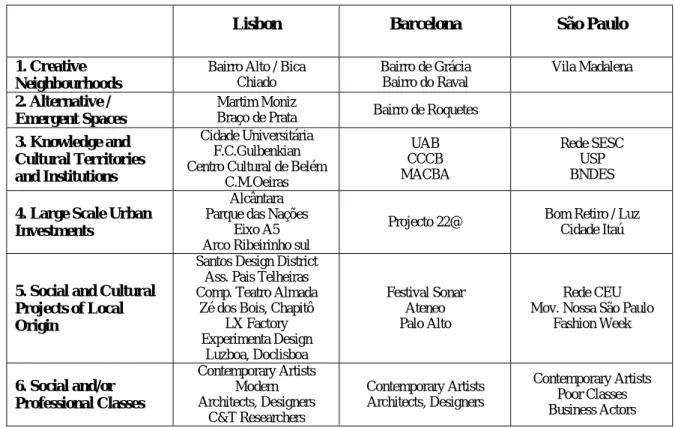
In the identification of specific examples in the field, whether for urban creativity institutions or projects and given the responses obtained from the interview panel, a standardised table was set out (Figure 2).
The following main features stand out for the differentiation and justification for the role of core dimensions within the panoramas of urban creativity:
DINÂMIA – Centro de Estudos sobre a Mudança Socioeconómica ISCTE – Instituto Universitário de Lisboa
Av. das Forças Armadas, 1649-026 Lisboa, PORTUGAL
Tel. 217938638 Fax. 217940042 E-mail: [email protected] Internet: www.dinamia.iscte.pt
16
1. Creative neighbourhoods are appreciated for their high level of symbolic capital, the strong cultural component in addition to their tourism and bohemian factors (Florida, 2000). The cases of Bairro Alto (Lisbon), Grácia (Barcelona) and Vila Madalena (São Paulo) are paradigmatic examples of these type of socio-cultural landscapes,
Figure 2: Typologies of the core spaces and processes to urban creativity
(in accordance with the interviews held in three cities)
Lisbon Barcelona São Paulo
1. Creative Neighbourhoods
Bairro Alto / Bica Chiado Bairro de Grácia Bairro do Raval Vila Madalena 2. Alternative / Emergent Spaces Martim Moniz
Braço de Prata Bairro de Roquetes 3. Knowledge and
Cultural Territories and Institutions
Cidade Universitária F.C.Gulbenkian Centro Cultural de Belém
C.M.Oeiras UAB CCCB MACBA Rede SESC USP BNDES 4. Large Scale Urban
Investments
Alcântara Parque das Nações
Eixo A5 Arco Ribeirinho sul
Projecto 22@ Bom Retiro / Luz Cidade Itaú
5. Social and Cultural Projects of Local Origin
Santos Design District Ass. Pais Telheiras Comp. Teatro Almada
Zé dos Bois, Chapitô LX Factory Experimenta Design Luzboa, Doclisboa Festival Sonar Ateneo Palo Alto Rede CEU Mov. Nossa São Paulo
Fashion Week 6. Social and/or Professional Classes Contemporary Artists Modern Architects, Designers C&T Researchers Contemporary Artists Architects, Designers Contemporary Artists Poor Classes Business Actors
2. The alternative / emergent spaces are taken up by social classes or groups that feature a high level of differentiation (artists, immigrants) and in the majority of the situations they stand in interstitial spaces and dimensions of the institutional and urban city, securing low rents. These spaces and groups have attracted growing interest including by local governments given the recognition of cultural differentiation as a factor very commonly found alongside high levels of creative – or at least alternative symbolic – capital,
3. The cultural and knowledge institutions in most cases are endowed with a strong institutional capacity and with considerable financial and human resources – as is the case with renowned cultural foundations (such as the Calouste Gulbenkian Foundation in Lisbon, or the CCCB in Barcelona), renowned university institutions, with an important mass of research and teaching staff (such as the UAB), or socio-cultural
DINÂMIA – Centro de Estudos sobre a Mudança Socioeconómica ISCTE – Instituto Universitário de Lisboa
Av. das Forças Armadas, 1649-026 Lisboa, PORTUGAL
Tel. 217938638 Fax. 217940042 E-mail: [email protected] Internet: www.dinamia.iscte.pt
17
institutions with deep roots in urban structures (as is the case with many of the SESC socio-educational centres, in São Paulo),
4. With at least two decades of strong policies (Borja and Castells, 1997, Jessop, 2002), large scale urban investments involves a statute of political priority, high social and symbolic visibility as well as the perspective of geographic meta-living experiences as regards regional scale strategies. The heavily publicised Projecto 22@ in Barcelona (with strong governmental enforcement) or the Cidade Itaú in São Paulo (completely planned and developed by a large private bank) are both wide reaching projects that represent important landmarks in the urban dynamics of the respective metropolises,
5. The multiple social and cultural projects of local origin and that emerge out of the most diversified urban networks are almost exclusively of private or community / associative initiative. As in relation to the underdeveloped areas of the city – frequently generating their own occupancy – there are projects put into effect by the widest variety of groups or associations while demonstrating a great potential for differentiation and creativity. Within this scope are projects for neighbourhood improvements (the symbolic-cultural affirmation of the Santos Design District to the socio-educational creativity Telheiras Parental Association in Lisbon), through to the scale of the big city (such as the civic intervention and think tank movement Nossa
São Paulo) as well as naturally the most varied creative and artistic projects and events (Experimenta Design
in Lisbon to the Sonar Festival in Barcelona),
6. The social and professional classes most closely linked to creativity are very close to the professional typologies set out for this field (cf. Costa et al, 2008), although those interviewed in São Paulo placed an interesting emphasis on poorer classes as well as on business / entrepreneurial actors – referring that their very survival depended, above all else, on their own creative capacities.
As mentioned above, and in accordance with the methodologies established for the ongoing research project, ten of these creative priority city situations were selected as case studies7, so as to deepen analysis and broaden the hypotheses available to the project.
7 The case studies currently under progress are the following:
a) Four cases studies in Lisbon – a creative neighbourhood (Bairro Alto / Chiado), a post-industrial zone (Alcântara) involving medium scale cultural projects and the perspectives for large scale political prioritisation, a historical and alternative/awaiting city zone, with a strong multi-cultural character and ethnic and cultural diversity (Martim Moniz); and finally the central zone of Almada, with interesting dynamics given the semi-peripheral location (on the opposite side of the river Tagus to central Lisbon) b) Three case studies in Barcelona – a creative neighbourhood (Grácia), a major urban redevelopment project associated with new technologies and creative activities (project 22@), and a social and cultural project implemented by a collective of creative actors within a derelict industrial facility (Palo Alto Association),
c) Three case studies in São Paulo – a creative neighbourhood (Vila Madalena); a cultural and economic project that has already established an important role in the symbolic panorama of the city (Fashion Week), and a networked socio-cultural institution, with an +important role in social inclusion and emancipation (SESC – São Paulo).
DINÂMIA – Centro de Estudos sobre a Mudança Socioeconómica ISCTE – Instituto Universitário de Lisboa
Av. das Forças Armadas, 1649-026 Lisboa, PORTUGAL
Tel. 217938638 Fax. 217940042 E-mail: [email protected] Internet: www.dinamia.iscte.pt
18
References by respondents to different types of spaces and fundamental processes to urban creativity in the contemporaneous city, is based on specific conceptual assumptions of the city. These were systematised in accordance with a metabolic perspective with an order similar to the interpretative proposals from Ferrão (2003) and Seixas (2006) understanding the city as an eco-systemic place, with spatial and landscape facets (the body of the city), networks and flows (the blood of the city) and its culture and cosmopolitism (the soul of a city).
It was relatively simple task to set out a structure for the city perspective types, based on scenarios for urban creativity, considered and described by each interviewee: a) the compact city, b) the informational meta-city, c) the cultural city, d) the intercultural city (cf. Figure 3).
Figure 3: Eco-System of Urban creativity
(in accordance with the interviews held in the three cities)
City types Compact Informational Meta-city Cultural Intercultural Spaces and Landscapes Creative Neighbourhoods, Areas undergoing restoration and emerging Universities and Technological parks Large scale investments
Imaginary and fictional spaces, Projects of local origin Multi-functional and heterogeneous spaces, Projects of local origin Networks and Flows
Social daily routines Proximity Knowledge Innovation Talent Technology Knowledge Innovation Talent Technology Diversity Social daily routines
Experimentation Tolerance Culture and
Cosmopolitism
Diversity Singularity Singularity Diversity
a) The type of the city most commonly referred to is the compact city, with the conditions to ensure shared daily experiences of nearby areas and high standards of mobility, thereby enabling greater social interaction and group dynamics (with these between differing groups) thus catalysing interaction, exchanges and opportunities. These are the perspectives that stand out most in creative neighbourhoods as well as emerging areas – whether post-industrial or post-habitation (abandoned), normally in areas deemed central to the respective metropolis. Importance is attached to personal contact for the “crossing of borders that enables creativity to be replicated and expanded” (as one respondent expressed it). While based on social relationships, this perspective inherently incorporates the relevance of compact size and urban proximity. Social and economic diversity is one of the most mentioned structural factors, highlighting the need for different types of space, function and urban typologies to coexist. Other factors suggested point to the importance of architecture that stimulates and disturbs, and the existence, within these frameworks, of elements that impact and influence. The presence of problems/tensions or opportunities are assumed – given
DINÂMIA – Centro de Estudos sobre a Mudança Socioeconómica ISCTE – Instituto Universitário de Lisboa
Av. das Forças Armadas, 1649-026 Lisboa, PORTUGAL
Tel. 217938638 Fax. 217940042 E-mail: [email protected] Internet: www.dinamia.iscte.pt
19
that, in this sense, a “normal” neighbourhood might not have either the significant problems or the significant opportunities. Finally, the most essential condition is deemed to be difference: “banality is the anti-city, common places impoverish the urban fiction” one respondent stated.
b) The information meta-city gets less mention by more culturally focused actors but in contrast is greatly mentioned by the more business and/or institutional interviewees. To the latter, the components of knowledge, science and technology are the greatest drivers of synergies from the interchange and creativity of a contemporaneous city. Simultaneously, sectors and clusters with the greatest potential within the scope of cutting-edge technologies and innovation gain much praise. There were references to the role of differentiation in consumption and production models and, to this end, the need to target uniqueness and diversity in production models and the design of products and services. These are positions that carry along with them their own assumptions as to urban-spatial aspects, most specifically as regards the need for high standards of daily connectivity in a meta-polis undergoing permanent structural adaptation.
c) The cultural city perspective posits that as or more important than the physical and social city is the intangible city. The fictional and imagined city, the city of dreams and emotions. An invisible city but which strongly defines the construction of stories out of the uniqueness of experiences – and experimentation – of each creative actor. Therefore, the organic dimensions are vital to the development of the most varied dynamics and projects, most specifically within the social and cultural field and essentially of a more local scale of origin. As one respondent stated “a city will be the richer the greater the diversity of fictions it can take on. The wealth of the city is and will be the memory of its residents and their eternal living and re-transformation, within a perspective of above all emotional living experiences”.
d) The perspective of the intercultural city invokes ambiences of diversity and tolerance that foster the exponential growth in creativity out of confrontation with asymmetry and difference – including economic and social differences. This points to far lesser control or even planning opting instead in favour of scenarios characterised by a degree of instability and disorganisation. Uncertainty and tension, created through the existence of elements that disturb emerge as motors able to create opportunities for the development of creativity and the dynamics and processes that foster new knowledge.