DOI: 10.9789/2175-5361.rpcfo.v12. 9432 | Moura RBB, Melo ABP, Chaves TR, et al. | Management Approach for Anorexia...
Management Approach for Anorexia in Palliative Care: An
Integrative Literature Review
Condutas para o Manejo da Anorexia em Cuidados Paliativos: Revisão
Integrativa
Conducta Para el Manejo de Anorexia en Cuidado Paliativo: Revisión Integradora
Raquel Bezerra Barbosa de Moura1*; Ângelo Brito Pereira Melo2; Thamires Ribeiro Chaves3; Luciana Maria
Martinez Vaz4; Janine Maciel Barbosa5; Renan Gondim Araújo6
How to quote this article:
Moura RBB, Melo ABP, Chaves TR, et al. Management Approach for Anorexia in Palliative Care: An Integrative Literature Review. Rev Fun Care Online.2020. Jan./Dec.; 12:737-743. DOI: http://dx.doi.org/10.9789/2175-5361. rpcfo.v12.9432
ABSTRACT
Objective: The study’s main goal has been to identify scientific evidence on the management of anorexia in palliative care. Methods: This is an integrative review, whose data collection occurred by researching four databases/virtual libraries. Articles in Portuguese, English, and Spanish, published over the last ten years and with the full text available, were included. Results: 25 articles were selected, and two thematic axes were assigned to better illustrate the data found: pharmacological and non-pharmacological management. Corticosteroids, progestins, anamorelin, and dronabinol were the most-researched drugs for the control of anorexia, with greater evidence of effectiveness for the first three. In the non-pharmacological treatment, nutritional counseling was the most recommended measure, including the fortification of foods and the use of supplements and the more-controversial artificial nutrition. Conclusion: The findings of this review may aid in the development of protocols for the treatment of anorexia in palliative care.
Descriptors: Palliative care, Nutrition, Diet therapy, Anorexia, Drug therapy.
1 Nutrition Graduate, Specialist’s Degree in Palliative Care by the Universidade Federal da Paraíba (UFPB), Specialist’s Degree in
Gerontology by the UFPB, Nutritionist at Hospital Universitário Lauro Wanderley (HULW) of the UFPB. Universidade Federal da
Paraíba (UFPB), Brazil.
2 Dentistry Graduate, PhD in Endodontics, Professor of Endodontics at UFPB, Member of the Center for Studies and Research in
Bioethics and Palliative Care of UFPB, Teaching and Research Manager at Universitário Lauro Wanderley (HULW). Universidade
Federal da Paraíba (UFPB), Brazil.
3 Nutrition Graduate, MSc in Nutrition Science by the UFPB. Universidade Federal da Paraíba (UFPB), Brazil.
4 Nutrition Graduate, MSc in Nutrition Science by the UFPB, Professor of the Undergraduate Nutrition Course at the Faculdade de
Ciências Médicas da Paraíba (FCM-PB). Universidade Federal da Paraíba (UFPB), Brazil.
5 Nutrition Graduate, Specialist’s Degree in Palliative Care by the UFPB, PhD in Nutrition by the Universidade Federal de Pernambuco
(UFPE), Nutritionist at Hospital Universitário Lauro Wanderley (HULW) of the UFPB. Universidade Federal da Paraíba (UFPB), Brazil.
6 Nutrition Graduate, Specialist’s Degree in Palliative Care by the UFPB, Specialist’s Degree in Nephrology Nutrition by the Hospital das
Clínicas of the UFPE, Nutritionist at Hospital Universitário Lauro Wanderley (HULW) of the UFPB. Universidade Federal da Paraíba (UFPB), Brazil.
RESUMO
Objetivo: Identificar evidências científicas acerca das condutas para o manejo da anorexia em cuidados paliativos. Métodos: Trata-se de uma revisão integrativa, cujo levantamento bibliográfico dos dados deu-se através da pesquisa em quatro bases de dados/bibliotecas virtuais. Incluíram-se artigos em português, inglês e espanhol, publicados nos últimos dez anos e com o texto completo disponível. Resultados: Foram elegíveis 25 artigos, e foram atribuídos dois eixos temáticos para melhor ilustrar os dados encontrados: o manejo farmacológico e o não-farmacológico. Corticosteroides, progestinas, anamorelina e dronabinol foram os fármacos mais pesquisados para o controle da anorexia, com maiores evidências de eficácia nos 3 primeiros. No contexto não-farmacológico, o aconselhamento nutricional foi a medida mais indicada, incluindo a fortificação de alimentos e uso de suplementos e a nutrição artificial mais controversa. Conclusão: Os achados desta revisão podem colaborar para a elaboração de protocolos para o manejo da anorexia em cuidados paliativos.
Descritores: Cuidados paliativos, Nutrição, Dietoterapia, Anorexia, Tratamento farmacológico.
RESUMEN
Objetivo: El propósito principal del estudio ha sido identificar evidencia científica sobre el manejo de la anorexia en los cuidados paliativos. Métodos: Esta es una revisión integradora, cuya investigación bibliográfica de datos ocurrió mediante búsqueda en cuatro bases de datos/bibliotecas virtuales. Se incluyeron artículos en portugués, inglés y español, publicados en los últimos diez años y con texto completo disponible. Resultados: Fueron elegibles 25 artículos, siendo atribuidos dos ejes temáticos para ilustrar mejor los datos encontrados: el manejo farmacológico y el no farmacológico. Corticosteroides, progestinas, anamorelina y dronabinol han sido los fármacos más buscados para el control de la anorexia, con mayores evidencias de eficacia en los 3 primeros. En el contexto no farmacológico, el asesoramiento nutricional fue la medida más indicada, incluyendo la fortificación de alimentos y uso de suplementos y la nutrición artificial más controversia. Conclusión: Los hallados de esta revisión pueden colaborar para la elaboración de protocolos para el manejo de la anorexia en cuidados paliativos.
Descriptores: Cuidados paliativos, Nutrición, Dietoterapia, Anorexia, rTatamiento farmacológico.
INTRODUCTION
Historically, the philosophy of Palliative Care (PC) is seen in the early Christian era. In Brazil, its beginning dates from the 1980s, with potential growth from the year 2000.1 The World Health Organization (WHO)
conceptualizes Palliative Care as an approach that seeks to prevent and alleviate suffering, thus improving the quality of life of patients and family members who are affected by fatal diseases, through early identification, evaluation and treatment of pain and other physical, psychosocial, and spiritual symptoms.2
Anorexia is the loss of appetite or the desire to eat, being common among patients with serious, chronic, and life-threatening diseases.3 In cases of advanced diseases, it
can lead to a decline in nutritional status, loss of lean body mass, as well as impaired muscle function, a fact that affects the quality of life and are indicators of poor prognosis.4
From this perspective, the role of the nutritionist is seen
as a major challenge in clinical practice in dealing with patients in palliative care, especially in the management of common clinical symptoms such as anorexia, weight loss and others that have a direct impact on the nutritional condition, with the need of an intervention that seeks to maintain nutritional status as well as promote well-being in the various stages of the disease. The objectives of nutritional support, as the end of life approaches, focus more on the quality of life than on nutritional adequacy. This is where the great dilemma between reconciling nutritional intervention and the purpose of palliation is to offer comfort and help control symptoms.5
Considering the aforesaid, the following guiding problem arises: What are the most effective conducts in the management of anorexia in palliative care?
Because of the problem raised, this study aims to identify scientific evidence about the management of anorexia in palliative care.
METHODS
It is an integrative review whose methodological path was divided into six stages: identification of the theme and selection of the guiding question, establishment of inclusion and exclusion criteria and search in the literature, categorization of studies, evaluation of included studies, interpretation of results and presentation of the review.6
The bibliographic survey was carried out through electronic search in the following databases: Medical Literature Analysis and Retrieval System Online (MEDLINE)/PubMed and Literatura Latino-Americana e
do Caribe em Ciências da Saúde (LILACS) [Latin American
and Caribbean Literature in Health Sciences], available at the Virtual Health Library (VHL) and at the electronic library Scientific Electronic Library Online (SciELO) from March to May 2019 using the following controlled descriptors, based on Health Sciences Descriptors (DeCS): “palliative care”, “nutrition” and “anorexia” together with the Boolean operator “AND”, the term “nutrition” being replaced by the descriptor “diet therapy” using the Boolean operator “OR”.
The inclusion criteria were complete articles published in the last ten years, in Portuguese, English, and Spanish, which presented the theme proposed in the title, abstract or descriptors. Exclusion criteria were: letters to the editor; editorials, and articles that were duplicated.
After selecting the articles, the relevant information for each study was defined, describing them in tables, grouping them into thematic categories and interpreting them in the light of the literature.
RESULTS AND DISCUSSION
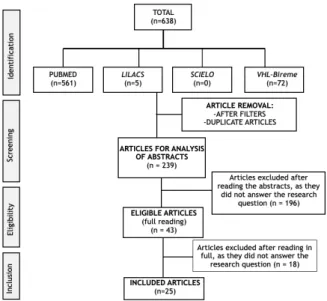
in the PRISMA flowchart (Figure 1), 25 articles were analyzed, whose inclusion criteria were met and answered the guiding question, as shown in Table 1 and 2.
Figure 1 –Flowchart for identification and selection of publications according to the PRISMA Statement.7
Table 1 – Identification of the articles included in the integrative review.
João Pessoa City, Paraíba State, Brazil, 2019
Table 2 - Main results of the articles included in the review. João Pessoa
City, Paraíba State, Brazil, 2019
ONS:Oral Nutritional Support; PN: Parenteral Nutrition; NT: Nutritio-nal therapies; OLZ: Olanzipine; DC: Dietary Counseling; MA: Megestrol acetate; QOL: Quality of Life; PC: Palliative Care; AN: Artificial Nutrition; NS: Nutritional Status.
It is observed that 64% of the articles bring the management of anorexia in the context of the cancer patient. This brings the perspective of the large number of publications on PC related to cancer patients, given that this pathology is the second leading cause of death in the world, where late presentation and inaccessible diagnosis and treatment are common31 being the palliative approach
essential.
To better illustrate the results, two thematic axes were elaborated regarding the management of anorexia in PC: pharmacological and non-pharmacological.
PHARMACOLOGICAL MANAGEMENT
From a total of 25 articles, 24 (96%) address the use of drugs used in the management of anorexia in PC. The most
cited medications were corticosteroids (70.8%), progestins (62.5%), anamorelin (33.3%), and dronabinol (33.3%).
Corticosteroids
The use of corticosteroids has demonstrated beneficial evidence in cancer patients, including dexamethasone, methylprednisolone, and betamethasone.23 According to
the European Society of Parenteral and Enteral Nutrition (ESPEN) Guideline for cancer patients,17 there is insufficient
evidence to recommend a particular type of corticosteroids over another, however, dexamethasone is often selected due to the absence of mineralocorticoid effects.28
In 2017, Matsuo et al conducted in Japan that aimed to identify the potential factors that predict responses to corticosteroids for anorexia in cancer patients receiving PC services and to explore the clinical effects of this treatment. Patients had advanced cancer and an anorexia intensity score above 4 on a scale of 0 to 10 (NRS). It was identified that the most important predictor was the patient’s general condition (Palliative Performance Scale - PPS> 40) and corticosteroids achieved a 2.3-point reduction on the NRS anorexia scale. It was concluded that patients with advanced cancer can benefit from the use of corticosteroids if they have a reasonable general condition and are not drowsy.19
The anti-anorectic effect of corticosteroids is considered transitory, disappearing after a few weeks. The most common side effects are associated with the duration of the treatment and cumulative dose: Cushing’s syndrome, insulin resistance, hyperglycemia, adrenal insufficiency, immunosuppression, risk of infection, and osteopenia.14,17
ESPEN (2017) suggests that the use of corticosteroids in cancer patients should be indicated in cases of short life expectancy, especially if they have other symptoms that can also be relieved with this type of medication, such as pain or nausea, due to adverse effects with prolonged use.17
Progestins (Megestrol Acetate)
Among the most studied progestational agents, is Megestrol Acetate (MA) - a synthetic derivative of the hormone progesterone.28 Recent reviews point to MA as
an effective appetite stimulant, being considered a first-line treatment for anorexia in cancer patients.29 A review
published in The Cochrane Library in 2013 showed that MA improves appetite, has a small effect on weight gain, does not improve the Quality of Life (QOL) and can have side effects, especially when used in high doses, such as the occurrence of thrombi and deaths.27 Corroborating these
findings, Childs and Jatoi presented, in 2019, a review of anorexia and how to manage it in cancer patients, the result of which showed that MA improves appetite in patients with advanced cancer.4 The most common side effects common
uses of MA were: increased risk of thromboembolism; being increased by concomitant chemotherapy;28 diarrhea;
adrenal insufficiency,14 and dyspnea.12
ESPEN Guideline brings, as a consensus, considering
the use of MA to increase the appetite of cancer patients in advanced conditions, being aware of the serious side effects. With a high level of evidence, there is an increase in appetite and weight, but no increase in lean mass.17
The duration of the response to MA is longer than with corticosteroids, which is indicated in patients with a life expectancy of a few months or more. For patients with low life expectancy or a history of thromboembolism, the use of dexamethasone is indicated, as it is less likely to promote side effects of corticosteroids in the short term.28 From all
the articles studied, the common doses of MA use were from 160 to 1,600mg, with a risk of thromboembolism and other adverse events at doses above 800mg.11, 17, 22, 24-26, 28
Anamorelin
Anamorelin is analogous to ghrelin, but with a half-life of almost 7 to 12 hours, therefore, longer than natural ghrelin,16 and it has been tested as an appetite-stimulating
agent, demonstrating its ability to improve anorexia in PC.4
Prommer, in 2017, carried out an oncological update that aimed to analyze the effect of anamorelin on cachexia, concluding that the drug reverses the symptoms of anorexia and increases lean mass in patients with advanced lung cancer, representing a new option for the management of cancer anorexia-cachexia.16
The dosage used for anamorelin in the studies was 100 mg/day and the common adverse reactions were hyperglycemia, nausea and edema.12
Dronabinol
Dronabinol is the most studied synthetic cannabinoid to reverse anorexia in PC patients.22
ESPEN Guideline shows that although dronabinol can improve chemosensory perception and appetite in patients with anorexia, such evidence is weak and does not support a recommendation.17 In contrast, a study carried
out in Canada, with 54 patients undergoing cannabinoid treatment for 3 months to assess changes in appetite scores, it showed, as a result, a significant improvement in this score between onset and follow-up after treatment, with no significant difference in weight.12
A recent systematic review assessed the use of cannabinoids in PC, so the authors concluded that no recommendation can be made for the use of cannabinoids in the PC treatment of cancer, HIV/AIDS (Human Immunodeficiency Virus/Acquired Immunodeficiency Syndrome) or dementia, and further research is needed to identify safety and effectiveness of this drug.13 Studies that
compared MA with dronabinol concluded that it is inferior for improving appetite and weight gain, in addition to not adding any benefit when used in combination with MA.22,4
A recent systematic review assessed the use of cannabinoids in PC, so the authors concluded that no recommendation can be made for the use of cannabinoids in the PC treatment of cancer, HIV/AIDS or dementia,
and further research is needed to identify safety and effectiveness of this drug. Studies comparing MA with dronabinol concluded that it is inferior for improving appetite and weight gain, and does not add any benefit when used in combination with MA.
The main adverse effects of cannabinoids are drowsiness, dizziness, euphoria,14 cognitive deceleration,24 anxiety,
fatigue, dry mouth,12 hallucinations, and cardiovascular
disorders, requiring a careful prescription because it is a drug listed as psychotropic and narcotic.17
NON-PHARMACOLOGICAL MANAGEMENT
The non-pharmacological management of anorexia is addressed in 40% of the articles, occurring mainly through Nutritional Counseling (NC), Oral Supplementation (OS) and Artificial Nutrition (AN).
Food plays an important role in the biopsychosocial well-being of patients in PC, affecting their QOL. In general, NC is the first intervention in anorectic patients in PC and occurs after the evaluation by the nutritionist, verifying food intake and the presence of symptoms related to low consumption, prescribing diet therapy individually.17
Counseling interventions provide instructions regarding food fortification, changes in consistency, guidance on the frequency and quantity of meals, taking into account the clinical picture and related symptoms, in addition to the conducive environment and family support, given that good communication it is essential to achieve the greater success of the intervention.4,5,15,29,17,18 It
is important to remember that, in PC, the objectives of diet therapy should be reviewed in the light of the stage of the underlying disease, recognizing, as the greatest intention, the search for comfort, relief of unpleasant symptoms and promotion of better QOL.5
In 2009, Andrew et al. sought to determine whether standardized assessment and management of common symptoms improved the symptoms of cancer patients in PC. The most widely used non-pharmacological advice was: eat little and often, eat what you want, when you want, use small dishes and eat your favorite foods. Symptoms improved over 4 weeks of the study, suggesting that basic advice and simple medication measures can have a rapid impact on symptoms.30
Day, in 2017, brought some strategies for managing anorexia listed by Miller in 2014: small meals or frequent snacks, snacks like nuts, seeds and dried fruits, individual desserts and enjoying the days with a better appetite. As for food fortification, the strategy would be to reduce the portions and increase the caloric-protein density by adding 2 to 4 tablespoons of skimmed milk powder in 580 mL of whole milk, using this preparation in cereals, soups, puddings, and vitamins. Another method is to add cheeses, butter, and creams to soups and potatoes and to add lentils or beans to soups. For those who have early satiety and are unable to eat a complete meal, adding protein to snacks
through individual desserts, Greek type yogurt, seeds, avocado, and cheese is valid.5
Corroborating Day’s review (2017), Lowey (2017) brought, as a non-pharmacological intervention: mouth care; encouraging small meals and frequent snacks; a larger meal in the morning or, when energy is better, start meals with fortified foods or liquids; avoid foods and liquids with little or no nutritional value; provide cultural dishes and maintain the rituals of family meals, with a pleasant environment.15 In addition to these interventions, Hurlow
(2019) brought the concern with food support to ensure accessibility to food and drinks through a better table positioning, use of implements adapted and physical assistance for food.9
Regarding the impact on weight gain, response to treatment and survival, the studies by Von Gunten and Gafford (2013), Hagmann and collaborators (2018), and Childs and Jatoi (2019) show that there is no positive impact in this sense, however, nutritional intervention is encouraged, in the last two articles cited, by the observation that many patients receiving NC report greater health and general well-being benefits than those who do not, thus justifying the importance of including the nutritionist as part of the PC team, showing interest and commitment to the well-being of those who have difficulties in eating.28, 14, 4
The use of Oral Nutritional Support (ONS) is indicated when an enriched diet is ineffective to meet needs and when there is low acceptance due to fluid retention and ascites.18, 26 The prescription must be individualized and its
use reevaluated.5
A study points to a reflection regarding the use of ONS in cancer patients with no appetite, whose strategy is related to the attempt to reduce weight loss. The use of ONS does not treat anorexia itself and acceptance of the supplement is hampered by inappetence. In this sense, there is the suggestion of trying to minimize anorexia to treat weight loss.4
The use of enteral and parenteral nutritional support in PC is quite controversial. Childs and Jatoi (2019) bring ESPEN’s uncertainty regarding the use of Enteral Nutrition (EN) in cancer patients, supporting its use only in patients with no food intake for more than a week or less than 60% of the needs for more than 1-2 weeks, with escalation between ONS, followed by EN and, only lastly, Parenteral Nutrition (PN).18 The National Comprehensive Cancer Network
guidelines for PC advise to consider EN or PN only when the prognosis is longer than weeks to days, however, this decision must be well determined individually, and in most cases, in patients with advanced cancer, there is a strong discouragement regarding the use of invasive nutritional support.4
In line with these findings, Day (2017) suggests that AN should be a patient-focused approach, taking into account their QOL, functional status and the path of the disease. As death approaches, it is natural for there is a reduction
in oral intake and continued AN can contribute to the exacerbation of symptoms, such as dyspnea, causing greater discomfort. The interruption of AN should be well worked out with family members, since many see this attitude as hastening death by starvation, when, in fact, the intention is to minimize suffering.5
Several studies such as those by Von Gunten and Gafford (2013), Goto (2019), Kumar and Panda (2014), and Lowey (2017) concluded that the use of AN does not, by itself, reverse anorexia and can worsen the QOL of patients, mainly in the terminal stage, due to the occurrence of complications such as nausea and vomiting, diarrhea, aspiration, dyspnea, edema, increased incidence of infections, and mechanical complications.28,8,26,15
CONCLUSIONS
The present review identified that the management of anorexia in PC must be done individually, according to the symptoms presented, disease stage and nutritional conditions. The use of dexamethasone is more indicated in patients with low life expectancy due to the potential side effects in cumulative doses, whereas MA is recommended for patients with a longer life expectancy, and should be avoided when there is a history of thrombotic events.
It was shown that anamorelin reverses anorexia in patients with lung cancer, and that the use of dronabinol did not show better effects on anorexia compared to the other drugs studied. AN is the main non-pharmacological measure, see-king to promote the relief of symptoms related to low food intake, in addition to guidelines for the use of fortified foods, stimulation of cultural meals and family support regarding accessibility and physical assistance. For the use of enteral and parenteral support, one must take into account the prognosis and the occurrence of complications.
These findings can assist nutritionists in the development of protocols for the treatment of this symptom so frequent in the context of PC, in order to promote a better QOL and well-being for these patients.
It is observed that most of the studies included in the research are review articles, given the low number of original publications bringing the theme addressed, which would be a limitation of this study, highlighting the need for more research related to the management of anorexia in patients in palliative care.
REFERENCES
1. Matsumoto DY. Cuidados paliativos: conceito, fundamentos e princípios. In: Manual de cuidados paliativos ANCP ampliado e atualizado. 2nd ed. Porto Alegre: Sulina; 2012. p. 23–41.
2. World Health Organization. Planning and implementing palliative care services: a guide for programme managers. 2016; Available from: http://www.who.int/about/licens-ing/copyright_form/en/ index.html
3. Del Ferraro C, Grant M, Koczywas M, Dorr-Uyemura LA. Management of anorexia-cachexia in late-stage lung cancer patients. J Hosp Palliat Nurs. 2012;14(6):397–402.
4. Childs DS, Jatoi A. A hunger for hunger: a review of palliative therapies for cancer-associated anorexia. Ann Palliat Med. 2019 Jan;8(1):50–8.
5. Day T. Managing the nutritional needs of palliative care patients. Br J Nurs. 2017;26(21):1151–9.
6. Tavares de Souza M, Dias da Silva M, de Carvalho R. Revisão integrativa: o que é e como fazer. Einstein. 2010;8(1):102–6. 7. Moher D, Shamseer L, Clarke M, Ghersi D, Liberati A, Petticrew M,
et al. Preferred reporting items for systematic review and meta-analysis protocols (PRISMA-P) 2015 statement. Syst Rev [Internet]. 2015 Dec 1;4(1):1. Available from: https://systematicreviewsjournal. biomedcentral.com/articles/10.1186/2046-4053-4-1
8. Goto H, Kiyohara Y, Shindo M, Yamamoto O. Symptoms of and palliative treatment for unresectable skin cancer. Curr Treat Options Oncol. 2019;20(4).
9. Hurlow A. Nutrition and hydration in palliative care. Br J Hosp Med [Internet]. 2019 Feb 2;80(2):78–85. Available from: http://www. magonlinelibrary.com/doi/10.12968/hmed.2019.80.2.78
10. Okamoto H, Shono K, Nozaki-Taguchi N. Low-dose of olanzapine has ameliorating effects on cancer-related anorexia. Cancer Manag Res [Internet]. 2019 Mar;11:2233–9. Available from: https://www. dovepress.com/low-dose-of-olanzapine-has-ameliorating-effects-on-cancer-related-anor-peer-reviewed-article-CMAR
11. Hisanaga T, Shinjo T, Imai K, Katayama K, Kaneishi K, Honma H, et al. Clinical guidelines for management of gastrointestinal symptoms in cancer patients: the japanese society of palliative medicine recommendations. J Palliat Med. 2019;22(8):1–12. 12. Kasvis P, Vigano M, Vigano A. Health-related quality of life
across cancer cachexia stages. Ann Palliat Med. 2018;8(1):33–42. 13. Mücke M, Weier M, Carter C, Copeland J, Degenhardt L, Cuhls
H, et al. Systematic review and meta-analysis of cannabinoids in palliative medicine. J Cachexia Sarcopenia Muscle. 2018;9(2):220– 34.
14. Hagmann C, Cramer A, Kestenbaum A, Durazo C, Downey A, Russell M, et al. Evidence-based palliative care approaches to non-pain physical symptom management in cancer patients. Semin Oncol Nurs [Internet]. 2018 Aug;34(3):227–40. Available from: https://linkinghub.elsevier.com/retrieve/pii/S074920811830038X 15. Lowey SE. Palliative care in the management of patients
with advanced heart failure. Adv Exp Med Biol [Internet]. 2018;1067:295–311. Available from: http://link.springer. com/10.1007/5584_2017_115
16. Prommer E. Oncology update: anamorelin. Palliat Care Res Treat [Internet]. 2017 Jan 21;10:1-6. Available from: http://journals. sagepub.com/doi/10.1177/1178224217726336
17. Arends J, Bachmann P, Baracos V, Barthelemy N, Bertz H, Bozzetti F, et al. ESPEN guidelines on nutrition in cancer patients. Clin Nutr. 2017;36(1):11–48.
18. Arends J, Baracos V, Bertz H, Bozzetti F, Calder PC, Deutz NEP, et al. ESPEN expert group recommendations for action against cancer-related malnutrition. Clin Nutr. 2017;36(5):1187–96. 19. Matsuo N, Morita T, Matsuda Y, Okamoto K, Matsumoto Y,
Kaneishi K, et al. Predictors of responses to corticosteroids for cancer-related fatigue in advanced cancer patients: a multicenter, prospective, observational study. J Pain Symptom Manage. 2016;52(1):64–72.
20. Hatano Y, Moroni M, Wilcock A, Quinn S, Csikós Á, Allan SG, et al. Pharmacovigilance in hospice/palliative care: the net immediate and short-term effects of dexamethasone for anorexia. BMJ Support Palliat Care. 2016;6(3):331–7.
21. Raghavan D, Holley JL. Conservative care of the elderly CKD patient: a practical guide. Adv Chronic Kidney Dis. 2016;23(1):51–6. 22. Prommer EE. Palliative pharmacotherapy: state-of-the-art
management of symptoms in patients with cancer. Cancer Control. 2015;22(4):403–11.
23. Miller S, McNutt L, McCann M-A, McCorry N. Use of corticosteroids for anorexia in palliative medicine: a systematic review. J Palliat Med. 2014;17(4):482–5.
24. Lynch MT. Palliative care at the end of life. Semin Oncol Nurs. 2014;30(4):268–79.
25. Alesi ER, del Fabbro E. Opportunities for targeting the fatigue-anorexia-cachexia symptom cluster. Cancer J. 2014;20(5):325–9.
26. Kumar M, Panda D. Role of supportive care for terminal stage hepatocellular carcinoma. J Clin Exp Hepatol. 2014;4(August):S130–9.
27. Ruiz Garcia V, López-Briz E, Carbonell Sanchis R, Gonzalvez Perales JL, Bort-Martí S. Megestrol acetate for treatment of
anorexia-cachexia syndrome. Cochrane Database Syst Rev. 2013 Mar 28;(3).
28. Von Gunten CF, Gafford E. Treatment of non-pain-related symptoms. Cancer J (United States). 2013;19(5):397–404. 29. McHugh ME, Miller-Saultz D. Assessment and management of
gastrointestinal symptoms in advanced illness. Prim Care Clin Off Pract [Internet]. 2011 Jun;38(2):225–46. Available from: https:// linkinghub.elsevier.com/retrieve/pii/S0095454311000182 30. Andrew IM, Waterfield K, Hildreth AJ, Kirkpatrick G,
Hawkins C. Quantifying the impact of standardized assessment and symptom management tools on symptoms associated with cancer-induced anorexia cachexia syndrome. Palliat Med. 2009;23(8):680–8.
31. OPAS. No Title [Internet]. OPAS. Folha informativa - câncer. 2019 [cited 2019 Jul 24]. p. https://www.paho.org/bra/index. php?option=com_cont. Available from: https://www.paho.org/bra/ index.php?option=com_content&view=article&id=5588:folha-informativa-cancer&Itemid=1094 Received on: 02/04/2019 Required Reviews: 11/27/2019 Approved on: 02/07/2020 Publicado em: 06/05/2020 *Corresponding Author:
Raquel Bezerra Barbosa de Moura Rua Eilzo Afonso Marques de Carvalho, 153, apt. 201
Água Fria, João Pessoa, Paraíba, Brasil E-mail address: [email protected] Telefone Number: +55 (83) 98840.7734 Zip Code: 58053-018 The authors claim to have no conflict of interest.