Repositório ISCTE-IUL
Deposited in Repositório ISCTE-IUL: 2018-11-14
Deposited version: Post-print
Peer-review status of attached file: Peer-reviewed
Citation for published item:
Godinho, C. A., Alvarez, M.-J. & Lima, M. L. (2016). Emphasizing the losses or the gains: comparing situational and individual moderators of framed messages to promote fruit and vegetable intake. Appetite. 96, 416-425
Further information on publisher's website: 10.1016/j.appet.2015.10.001
Publisher's copyright statement:
This is the peer reviewed version of the following article: Godinho, C. A., Alvarez, M.-J. & Lima, M. L. (2016). Emphasizing the losses or the gains: comparing situational and individual moderators of framed messages to promote fruit and vegetable intake. Appetite. 96, 416-425, which has been published in final form at https://dx.doi.org/10.1016/j.appet.2015.10.001. This article may be used for non-commercial purposes in accordance with the Publisher's Terms and Conditions for self-archiving.
Use policy
Creative Commons CC BY 4.0
The full-text may be used and/or reproduced, and given to third parties in any format or medium, without prior permission or charge, for personal research or study, educational, or not-for-profit purposes provided that:
• a full bibliographic reference is made to the original source • a link is made to the metadata record in the Repository • the full-text is not changed in any way
The full-text must not be sold in any format or medium without the formal permission of the copyright holders. Serviços de Informação e Documentação, Instituto Universitário de Lisboa (ISCTE-IUL)
Av. das Forças Armadas, Edifício II, 1649-026 Lisboa Portugal Phone: +(351) 217 903 024 | e-mail: [email protected]
1
Emphasizing the losses or the gains: Comparing situational and individual 2
moderators of framed messages to promote fruit and vegetable intake 3 4 Cristina A.Godinho1 5 Maria-João Alvarez2 6
Maria Luísa Lima1 7
8 9
1. Instituto Universitário de Lisboa (ISCTE-IUL), CIS-IUL, Lisboa, Portugal
10
2. Faculty of Psychology, University of Lisbon, Portugal
11 12
This study was supported by a grant from the Portuguese Foundation for Science 13
and Technology (FCT), with the reference SFRH/BD/66193/2009, awarded to the first
14
author. The authors would like to thank John Updegraff for his valuable feedback on the
15
original draft of this manuscript.
16 17 Corresponding author: 18 Cristina Godinho 19
CIS-IUL, Instituto Universitário de Lisboa 20
Av. das Forças Armadas, 21 1649-026 Lisboa 22 E-mail: [email protected] 23 24 25
Word count (excluding tables / figures): 5801 26
Abstract 28
Health messages are a commonly used way to promote changes in dietary habits but 29
their efficacy could be enhanced by strategies such as the way in which the presented 30
arguments are framed. This study aimed to test the effectiveness of framed messages 31
(gain vs. loss) on behavioural intention and fruit and vegetable (FV) intake, comparing 32
predictions based on prominent theoretical perspectives on message framing (perceived 33
function of the health behaviour and recipients´ motivational orientation) and by further 34
exploring the role of baseline intentions as a potential moderator of the framing effects. 35
Undergraduate students (N= 180) completed the three assessment points in time. At 36
baseline, individual moderators (motivational orientation and intentions) and fruit and 37
vegetable intake were assessed. One week later, participants were randomly assigned to 38
the loss or gain-framed message and indicated their intentions for FV intake the 39
following week. A week later, FV intake over the previous week was assessed. The 40
gain-frame was not conducive, per se, to higher intentions or behaviour. Having 41
intention as the outcome, only baseline intentions moderated the effects of message 42
frame. When considering FV intake as the outcome, both motivational orientation and 43
baseline intentions moderated the effects of message frame, with the loss-frame 44
promoting higher FV intake among individuals who were prevention-oriented and had 45
higher baseline intentions. Findings suggest that the success of framed messages for FV 46
intake depends upon the recipient's characteristics, such as motivational orientation, 47
baseline intentions, and cultural background, with implications for health 48
communication interventions. 49
50
Keywords: health communication, message framing moderators, fruit and vegetable
51
intake, behavioural intentions, behaviour change.
Emphasizing the losses or the gains: Comparing situational and individual moderators
53
of framed messages to promote fruit and vegetable intake
54
Fruit and vegetable intake is a critical aspect of a healthy diet due to its 55
association with a lower risk for cardiovascular diseases (He, Nowson, Lucas, & 56
MacGregor, 2007), type II diabetes (Carter, Gray, Troughton, Khunti, & Davies, 2010) 57
and certain types of cancer (Liu & Russell, 2008). Despite these benefits, many people 58
fall short of recommended guidelines for daily intake (Hall, Moore, Harper, & Lynch, 59
2009). Thus, it is vital to understand the conditions under which certain intervention 60
strategies, such as trying to persuade people about the benefits of fruit and vegetable 61
consumption, lead to increases in the adherence to recommended levels of this intake. 62
One question that can be raised in this regard is whether emphasizing either the 63
costs of non-performing a health behaviour (i.e., the use of a loss frame) or the benefits 64
of performing it (i.e., the use of a gain frame) make a difference when it comes to 65
persuading people to increase their fruit and vegetable intake. Indeed, two decades of 66
research on message framing support the claim that, even when communicating exactly 67
the same consequences, the particular frame that is used in a message may have a major 68
influence on behavioural outcomes (Gallagher & Updegraff, 2012; Rothman & Salovey, 69
1997). 70
The question about which frame might be more helpful in fostering health 71
behaviours has been rapidly transformed into under which conditions a loss- or a gain-72
frame is particularly effective. The range of framing effect moderators proposed in the 73
literature up to now have been either tied to the particular health behaviour and context 74
(situational moderators) or to the personal characteristics of the individual (dispositional 75
moderators). By far, the two most scrutinized moderators are the perceptions regarding 76
the function of a particular health behaviour (a situational moderator) and the 77
motivational orientation of the recipient (a dispositional moderator). 78
However, by and large, both bodies of the literature have developed separately, 79
and up to now few studies have made an explicit attempt to examine how these different 80
classes of moderators, situational and individual, contribute for the prediction of 81
specific behaviours (Rothman & Updegraff, 2011). The present study integrates 82
predictions from these two theoretical perspectives for a single health behaviour – fruit 83
and vegetable (FV) intake - and further explores the role that behavioural intentions 84
might also play as an individual moderator of framing effects. 85
A situational moderator: Function of the health behaviour 86
The first framing studies applied to health issues were derived from the Prospect 87
Theory (Tversky & Kahneman, 1981), which sustains that people are risk aversive 88
when contemplating possible gains, but are risk-seeking when confronted with possible 89
losses. The same rationale was applied to the health domain by Rothman and Salovey 90
(1997), who proposed that when thinking about the consequences of performing (or not 91
performing) a health behaviour, people should be more responsive to appeals that 92
emphasize the gains of performing it, as long as the behaviour itself is perceived as safe 93
(i.e., not risky). On the contrary, if performing a health behaviour is perceived as being 94
risky, as might be the case of undergoing a screening test, given that one 'risks' the 95
possibility of finding out that one has a disease, a loss-frame would be more effective. 96
The function of the health behaviour, whether related to illness prevention (e.g., eating a 97
balanced diet) or illness detection (e.g., doing a HIV test) was proposed to work as a 98
heuristic people use to infer the risk of a certain behaviour and should, therefore, be a 99
moderator of framing effects. 100
Many studies have demonstrated a relative effectiveness of loss-framed messages 101
in the promotion of detection behaviours (e.g., Kalichman & Coley, 1995; Rivers, 102
Salovey, Pizarro, Pizarro, & Schneider, 2005) and the use of gain-framed messages in 103
the promotion of prevention behaviours (e.g., Detweiler, Bedell, Salovey, Pronin, & 104
Rothman, 1999; Kiene, Barta, Zelenski, & Cothran, 2005). Only a few studies (e.g., 105
Bannon & Schwartz, 2006; Dijkstra et al.,2011) have tested the predictions derived 106
from the Prospect Theory specifically for FV intake in response to framed messages. 107
Results of these studies did not yield a clear advantage of the gain-frame condition for 108
the promotion of FV intake. An exception was found in a study where the messages 109
were personalized in order to be more self-relevant (Dijkstra et al., 2011). However, in 110
this particular study the results were not driven by the gain frame being more effective. 111
On the contrary, they were related to the loss frame being comparatively less effective. 112
Such result was attributed to defensive reactions in response to higher levels of threat 113
induced by the loss-framed message when they were perceived to be more self-relevant. 114
An individual moderator: Motivational orientation 115
The recipients´ characteristics, such as differences in motivational orientation, 116
have also been shown to moderate the effects of framed health messages, in what has 117
been called the 'congruency effect' (Mann, Sherman, & Updegraff, 2004). Motivational 118
orientation refers to the dominant motivational system involved in the regulation of 119
behaviour, and the existence of important individual differences towards gains and 120
losses has been demonstrated (Higgins, 1997). Promotion-focused individuals are 121
motivated by opportunities of accomplishment (e.g., eating fruit and vegetables in order 122
to have more energy and feel good), while prevention-focused individuals are motivated 123
by the prospect of preventing negative things from happening (e.g., eating fruit and 124
vegetables to prevent cancer or cardiovascular diseases). 125
Studies with different health behaviours have shown a clear advantage of the use 126
of gain-framed messages for promotion-focused individuals and of loss-framed 127
messages for prevention-focused individuals (e.g., Gerend & Shepperd, 2007; Latimer 128
et al., 2008a). Furthermore, in a study on fruit and vegetable intake an interaction 129
between frame and motivational orientation was found, in the expected direction 130
(Latimer et al., 2008b). Nevertheless, the results of this study are not readily comparable 131
to those following the Prospective Theory perspective on framing for FV intake, since 132
the intervention consisted of several materials other than just the framed health 133
messages. In a somewhat comparable study, individuals with high autonomy (i.e., who 134
act in accordance with their inner values or ideals, rather than by pressure of others or 135
'oughts') were found to increase their FV intake after being exposed to a gain-framed 136
rather than a loss-framed message (Churchill & Pavey, 2012). 137
Exploring the role of behavioural intention as an individual moderator 138
Behavioural intention is a key predictor in most of the social-cognitive models of 139
health behaviour (Armitage & Conner, 2000) and it has also been conceptualized as an 140
important marker of individuals´ mindset and their readiness for change (Conner & 141
Norman, 2015; Schwarzer, 2008). Most stage models of health behaviour change use 142
intention as an indicator of the stage at which individuals find themselves (Schüz, 143
Sniehotta, Mallach, Wiedemann, & Schwarzer, 2009), distinguishing motivational 144
processes, leading to intention formation, from volitional ones, leading to behavioural 145
enactment. Considering the recommendation to tailor health messages´ content 146
according to the individuals´ stage of change (Weinstein, Lyon, Sandman, & Cuite, 147
1998), and given the importance of intention as a turning point in the health behaviour 148
change process (Conner & Norman, 2015), one might ask what type of message frame 149
would be more suitable for individuals at different levels of intention. 150
Despite the prominence of intention among other social cognitive variables, namely for 151
the prediction of fruit and vegetable intake (Mullan, Allom, Brogan, Kothe, & Todd, 152
2014) to the best of our knowledge, it has never been explored as a moderator of 153
message framing effects. 154
Research has, nonetheless, shown that loss frames are more effective when the 155
topic is highly relevant to the receiver of the message and that gain frames are more 156
effective when the topic is lowly relevant to the receiver (de Graaf, van den Putte, & de 157
Bruijn, 2015; Maheswaran & Meyers-Levy, 1990). The moderating effects of issue 158
involvement can be explained by models of attitude change. According to these models, 159
issue involvement should promote a systematic processing of the information contained 160
in the message (Petty & Cacioppo, 1986) and under conditions of systematic 161
information processing, negative information receives greater weight and attention than 162
positive information, due to a negativity bias (Dijksterhuis, & Aarts, 2003). On the 163
contrary, when processing messages using the peripheral route, positive information is 164
used as a heuristic, and it may generate more positive associations with the topic and, 165
therefore, be conducive to higher attitudinal and/or behavioural change (Maheswaran & 166
Meyers-Levy, 1990). 167
As it is likely that individuals who have strong intentions to change their 168
behaviour are at the same time very involved with information pertaining to that 169
specific behavioural domain, intention stands out as a strong candidate as a moderator 170
of framed health messages. Previous research has, indeed, confirmed the existence of a 171
strong and positive relationship between intentions and issue involvement (e.g., Bae e 172
Kang, 2008; Pieters & Verplanken, 1995; Skumanich & Kintsfather, 1996). Thus, to the 173
extent that individuals who hold the intention to increase their FV intake consider health 174
messages related to FV intake as being more personally relevant than individuals 175
without the intention to increase FV intake, it may be expected the effects of message 176
framing to be moderated by individual´s intentions, similarly to the moderation pattern 177
that has been described for issue involvement (Maheswaran & Meyers-Levy, 1990). 178
Outcome measures of framing effects 179
Besides differences in the adopted theoretical perspectives, framing studies often 180
report on different outcome measures for the framing effects. Some studies report the 181
effects of framing on intentions to perform a given health behaviour (e.g., Dijkstra et al., 182
2011), while others report framing effects on actual behaviour (e.g., Latimer et al., 183
2008b). Such differences imply that results might not be readily comparable. While a 184
meta-analysis examining the role of framing in intentions to perform prevention 185
behaviours did not offer much support for the use of gain- over loss-framed messages 186
other than for the promotion of dental hygiene behaviours (O´Keefe & Jensen, 2007), 187
when using behaviour as the outcome measure, gain-framed messages were shown to be 188
more effective in the promotion of illness-prevention behaviours such as physical 189
activity, smoking cessation and skin cancer prevention (see Gallagher & Updegraff, 190
2012). 191
Framing manipulation 192
On the basis of the Regulatory Focus Theory (Higgins, 1997), and as stressed in 193
previous research (Dijkstra et al., 2011; Yi & Baumgartner, 2009), both the presence of 194
a positive and rewarding outcome and the absence of a negative and aversive outcome 195
might be considered a 'gain' and both the presence of a negative and aversive outcome 196
or the absence of a positive and rewarding outcome might be considered a 'loss'. This is 197
an important distinction that has been highlighted by Regulatory Focus Theory 198
(Higgins, 1997) and that has been more recently acknowledged in the health framing 199
literature deriving from a Prospect Theory perspective (e.g., Dijkstra, Rothman, & 200
Pietersma, 2011). 201
Regulatory focus theory further establishes that individuals differ in their 202
sensitivity to the end-states (or reference points) that motivate the behaviour, with 203
promotion-oriented individuals being mostly motivated by the prospect of achieving a 204
positive/desirable outcomes and prevention-oriented individuals being mostly motivated 205
by the prospect of avoiding negative/ undesirable outcomes (Scholer & Higgins, 2008). 206
Besides, it establishes a difference between (a) needs related to nurturance, 207
accomplishment and growth, which are regulated by representations of ideal end-states 208
(“wants”), and involve a promotion focus, and (b) needs related to security, duty and 209
responsibility (“oughts”), which involve a prevention focus (Scholer & Higgins, 2008). 210
Given that the different levels at which the messages can be framed have been 211
somewhat confounded in the literature (cf. Dijkstra, Rothman, & Pietersma, 2011), we 212
aimed to disentangle the different levels at which health messages may be more 213
appealing to individuals high in promotion vs. prevention motivational orientation. 214
Thus, we decided to present outcomes related to “wants” (e.g., feeling vs. not feeling 215
energized) and “oughts” (preventing vs. not preventing disease) in the two framed 216
messages, only switching the end-states (or reference points) that motivate the 217
behaviour, i.e., achieving a positive/desirable outcome (e.g., being energised / being 218
healthy) versus avoiding a negative/undesirable outcome (e.g., preventing being with 219
less energy / preventing being ill). 220
Aims and hypotheses 221
Several studies have already been conducted on the moderators of health message 222
framing, namely on the function of behaviour and motivational orientation, however 223
their interplay has seldom been studied. Likewise, to our knowledge, no prior study has 224
examined the potential role of intention as a moderator of framing effects. Furthermore, 225
framing studies are not always comparable in the sense that some use intention as the 226
main outcome variable while others use behaviour (either objectively assessed or by 227
means of self-report), and the way in which frame is manipulated may also diverge. 228
Thus, the aim of this experimental study on fruit and vegetable intake is three-fold: 1) to 229
compare predictions based on both theoretical perspectives on framing moderators (i.e., 230
function of health behaviour and motivational orientation), using a more controlled 231
manipulation of message frame; 2) to explore the role of behavioural intentions as a 232
potential moderator of framing effects; 3) to use both intention after message exposure 233
and behaviour over the following week as the outcome variables. 234
Drawing from the Prospect Theory and considering that fruit and vegetable 235
consumption is essentially a non-risky behaviour, the first hypothesis is that a gain-236
frame will be more effective for the promotion of both intentions and actual fruit and 237
vegetable intake. On the basis of the congruency effect, the second hypothesis is that 238
frame and motivational orientation will interact in the prediction of fruit and vegetable 239
intake one week later, in the sense that loss-framed messages will be more effective for 240
prevention-focused individuals and gain-framed messages will be more effective for 241
promotion-focused individuals. Finally, the third hypothesis is that for individuals 242
already holding an intention to change, a loss-frame will be more effective than a gain-243
frame, whereas for individuals who do not have the intention to change, a gain-framed 244
message will be more effective. 245
Method 246
Participants 247
One hundred and ninety five undergraduates of Psychology, Pharmacy, Dentistry, 248
Medicine, Biology and Chemistry courses were enrolled in the study, fifteen of whom 249
did not participate at all points of the study and were, therefore, excluded from the 250
analyses. The longitudinal sample consisted of 180 participants, 28 men (aged 18-50; M 251
= 24.4; SD = 8.54) and 152 women (aged 18-48; M = 23.0; SD = 4.94) from three 252
different Portuguese universities. At the end of the study, participants were granted a 253
course credit or a 5€ voucher. None of the participants had any allergies or restrictions 254
regarding the consumption of FV. 255
Procedure 256
During short breaks in the classes and/or through mailing lists of the students´ 257
associations, students were told that the aim of the study was to find out what the best 258
ways to communicate the results of scientific research to the general public were. Those 259
who agreed to participate provided their e-mail addresses to receive an initial online 260
questionnaire (Time 1) which started by explaining the study in more detail, namely the 261
name of the research centre and the average length of time it took to complete, in 262
addition to reminding participants what the aim of the study was, and assured data 263
confidentiality. Participants then provided their informed consent, in accordance with 264
the ethical standards of the three universities. This first questionnaire assessed 265
motivational orientation, baseline fruit and vegetable intake, intention towards the 266
eating of at least five portions of FV a day, and some demographic data as well as 267
specific questions on food restrictions and allergies. All moderator variables as well as 268
baseline levels of fruit and vegetable intake were measured one week before exposure 269
to the framed messages, so as to discard the possibility that this measurement might 270
have an effect on the dependent variables. 271
The experimental session (Time 2) was held at the same university to which the 272
participants belonged, approximately one week after completion of the first 273
questionnaire. The reason behind having the participants come to the lab was to ensure 274
they would all see the framed message in very similar conditions. At the beginning of 275
the session, participants were randomly assigned by the software to either the gain- or 276
loss-framed message. They were then asked about their intention to increase their FV 277
intake in the following week and completed the manipulation check. A further week 278
later (Time 3), participants received the last online questionnaire to assess their FV 279
intake. 280
Materials 281
In order to disentangle the notion of gain vs. loss from the presence vs. absence of 282
the outcomes, message framing was manipulated by presenting only the presence of 283
gains as a result of compliance (gain-framed message) vs. the presence of losses as a 284
result of non-compliance (loss-framed message), while referring in both versions to 285
exactly the same outcomes (i.e., same consequences framing). Also, according to the 286
Regulatory Focus Theory, some outcomes are intrinsically promotional (e.g., having 287
more energy), whereas others are intrinsically preventive (e.g., having better health). 288
Therefore, to control for such confoundedness, both types of outcomes (promotional 289
and preventive) were presented in both loss- and gain-framed messages. 290
The gain-framed message (412 words) explained the positive effects of eating at 291
least 5 portions of FV a day, whereas the loss-framed message (417 words) presented 292
the negative effects of not eating this same amount of FV (see Appendix A). The framed 293
messages were presented in a video format, where participants could read the text 294
presented in white font on a black screen, while simultaneously listening to a voice over 295
reading the text aloud. This presentation format intended to control for the effects of 296
other stimuli besides the message content and ensure that – even whenever not reading 297
the message carefully – all participants would at least hear it. The video presentation 298
lasted approximately two minutes in both message conditions. 299
Measures 300
Motivational Orientation. Motivational orientation was operationalized through 301
the Promotion/Prevention Scale by Lockwood, Jordan and Kunda (2002), which enables 302
assessment of both general and context-specific (i.e., academic) motivational 303
orientation. Since the interest here was to evaluate general motivational orientation, the 304
four items specifically related to academic motivations were excluded from the 305
questionnaire. The promotion sub-scale was composed of seven items related to the 306
prosecution of aspirations and an ideal self (e.g., ‘I frequently imagine how I will 307
achieve my hopes and aspirations’, ‘I often think about the person I would ideally like
to be in the future’), whereas the prevention sub-scale was originally composed by
309
seven items related to the avoidance of negative events and a feared self (e.g., ‘I often 310
think about the person I am afraid I might become in the future’, 'I often imagine myself
311
experiencing bad things that I fear might happen to me'). Responses were given on a
9-312
point scale ranging from 1 ('not at all true of me') to 9 ('very true of me'). 313
In order to examine the underlying structure of the scale in our sample, an 314
exploratory factor analysis was conducted using the principal components method of 315
factor extraction followed by varimax rotation. Considering that the final goal was to 316
extract only two factors – one for prevention and one for promotion - this was used as 317
an a priori criteria for the number of factors to be extracted (Hair, Black, Babin, & 318
Anderson, 2010). Results showed that communalities were very low (< .40) for items 1 319
and 15 of the original scale. Therefore, both items were removed, and the procedure was 320
repeated. In this second solution, there was still one item (item 2) that showed a rather 321
low communality (<.50) and was, therefore, removed. The final solution comprised all 322
the original seven items for the promotion sub-scale (loadings >.59), and four items for 323
the prevention sub-scale (loadings >.69), and enabled explanation of 61.5% of the total 324
variance. 325
The reliability of both sub-scales (Promotion Cronbach’s α= .87; Prevention 326
Cronbach’s α= .82) was slightly higher than the original ones (see Lockwood et al., 327
2002). The motivational orientation index was created by subtracting the mean of 328
prevention scores from the mean of promotion scores, so that positive values indicated a 329
prevalence of promotion orientation, whereas negative values were indicative of 330
prevention orientation predominance. The values of this index could vary between -8 331
and +8. 332
Intention. Three items were used to access intentions regarding FV intake: ‘I 333
intend to eat at least 5 portions of fruit and vegetables a day from today on’, ‘From now
on, I have the goal of eating 5 or more portions of fruit and vegetables a day’ and ‘I
335
want to eat a minimum of 5 portions of fruit and vegetables a day, everyday’. Answers
336
were given on a 7-point scale ranging from 1 ('totally disagree') to 7 ('totally agree') and 337
showed good reliability (T1 Cronbach´s α =.96; T2 Cronbach´s α = .95). 338
Fruit and vegetable intake. Two items, one for fruit and one for vegetables, 339
assessed FV intake: ‘In the (last two weeks (T1)/ last week (T3)) how many (pieces of 340
fruit / portions of vegetables) have you eaten every day?’. Some examples were
341
provided to help define the concept of portion (e.g., a soup, one bowl of salad, a glass of 342
freshly squeezed and 100% fruit juice) and it was clarified that potatoes should not be 343
considered. A similar self-report measure of FV intake has been validated against 344
dietary biomarkers and a food frequency questionnaire (Steptoe et al., 2003). Responses 345
were given on a 6-point scale ranging from 0 ('less than a portion per day') to 5 ('four 346
portions or more a day'). A fruit and vegetable intake index was created by summing the 347
reported number of pieces of fruit and vegetable portions. 348
Message involvement. Six items (Cronbach’s α = .94) similar to those used by 349
Cox and Cox (2001) assessed participants´ evaluation of their involvement with the 350
message: 'I got involved in what the message had to say', 'The message seemed relevant 351
to me', 'This message really made me think', 'This message was thought-provoking', 'The
352
message was very interesting'; 'I felt strong emotions while reading this message'. The
353
response scale ranged from 1 ('totally disagree') to 10 ('totally agree'). 354
Perceived message quality. A further two questions were used to create an index 355
of 'perceived message quality' (Cronbach’s α = .93). The first was: 'In your opinion, 356
how persuasive was the message?' and answers were given on a 10-point scale ranging
357
from 'not persuasive at all' to 'very persuasive'. The other question was: 'How would you 358
rate the message?' and the scale ranged from 1 ('not credible at all') to 10 ('extremely
359
credible'). 360
Tone of information. A question similar to the one presented in Rothman, 361
Martino, Bedell, Detweiler and Salovey (1999) was used to ensure the success of the 362
framing manipulation. Participants were asked to rate the tone of the information 363
contained in the message on a 9-point scale ranging from 'mostly negative' (-4) to 364
'mostly positive' (+4). 365
Analytic Strategy 366
Four regression hierarchical linear regression models were estimated1 in order to 367
test our three hypotheses on message framing effects on intention after message 368
exposure and fruit and vegetable intake over the subsequent week. In order to test our 369
first hypothesis, that a gain frame would be more effective in the promotion of intention 370
and fruit and vegetable intake (i.e., that there would be a main effect of frame), frame 371
was introduced in the second step2 in all four regression models. In order to test our 372
second and third hypotheses, i.e., whether motivational orientation - or baseline 373
intention - moderated the effects of message frame over intention and fruit and 374
vegetable intake, the interaction terms between frame condition (gain vs. loss) and 375
motivational orientation (promotion focus vs. prevention focus) or baseline intention 376
(high baseline intention vs. low baseline intention) were entered at the fourth step3.
377
Whenever a significant interaction was found between the frame and a moderator, 378
procedures by Aiken and West (1991) were followed, to test for differences across 379
message frame conditions at low (i.e., mean minus one SD) and high (i.e., mean plus 380
one SD) levels of the continuous moderator. 381
Results 382
1 Prior to inclusion in the regression models, the frame was dummy coded (with 0 corresponding to loss-frame and 1 to gain-loss-frame) and all continuous variables were centred.
2 In the first step, baseline fruit and vegetable intake (measured at Time 1), age and gender were included in the four tested models to control for their potential effects on the outcome variables.
3 In the third step, Motivational orientation - or baseline intention - were included in the third step to control for any effects of these variables on both intention and fruit and vegetable intake.
Manipulation checks 383
A difference was found between gain and loss conditions in the rating of the tone 384
of the information presented. Considering that '0' corresponded to the 'neutral' point, 385
participants in the gain-framed message rated the message as presenting mostly positive 386
information (M = 1.48; SD = 2.18), whereas participants in the loss-framed message 387
rated the message as presenting information that was slightly negative (M = -0.08; SD = 388
2.72), F(1,178) = 18.31, p <.001, attesting the success of the framing manipulation. 389
Importantly, ratings of involvement with the message and the perceived quality of the 390
message did not differ across message frame conditions (p ´s > .25). 391
Drop-out analyses, randomization check and descriptive statistics 392
Analyses of variance (ANOVA´s) showed no significant differences regarding the 393
levels of fruit and vegetable intake at baseline, intention, motivational orientation and 394
age between the longitudinal sample and those who dropped out (all p´s >.47), and a 395
chi-square test revealed no gender differences between the groups. 396
The descriptive statistics for both message conditions as well as the inter-397
correlations of the study variables, at the corresponding measurement time, are 398
presented in Table 1. A randomization check showed no differences across framing 399
conditions in age, gender, motivational orientation, intention for fruit and vegetable 400
increase and actual fruit and vegetable intake at baseline (all p´s >.32). 401
Table 1. 403
Bivariate correlations between study variables and descriptive statistics by message
404 frame condition 405 (1) (2) (3) (4) (5) (6) (7) (8) (9) Gain-Frame M (SD) Loss- Frame M (SD) 1. Age 1 22.12 (4.57) 22.63 (6.70) 2. Motiv. Orientation .01 1 1.34 (1.50) 1.38 (1.48) 3. Intention (T1) .02 .04 1 4.52 (1.67) 4.28 (1.50) 4. FV Intake (T1) .03 .06 .31** 1 2.56 (2.25) 2.70 (2.09) 5. Intention (T2) .01 .11 .67** .34** 1 4.97 (1.37) 5.06 (1.33) 6. M. Involvement (T2) .11 -.08 .25** .04 .42** 1 6.81 (1.79) 6.48 (1.99) 7. M. Quality (T2) .13 -.08 .25** .04 .43** .75** 1 6.51 (1.80) 6.21 (2.10) 8. Intention (T3) .06 .09 .64** .29** .76** .44** .37** 1 4.63 (1.61) 4.58 (1.58) 9. FV Intake (T3) .01 .06 .36** .57** .49** .10 .16* .47** 1 2.38 (1.79) 2.54 (2.06) Note. * p <.05;**p <.01. 406
Message frame effects on intention and fruit and vegetable intake 407
Baseline fruit and vegetable intake was, as anticipated, a significant predictor of 408
both intention at Time 2 (ß =.34, p <.001) and fruit and vegetable intake at Time 3 (ß 409
=.57, p <.001). The message frame, as entered in the second step of the four hierarchical 410
multiple regressions (Table 2), did not increase the amount of variance explained 411
beyond what was already accounted for by the baseline FV intake (for intention, Δ 412
R2<.001, F(1,177) = 0.08, p = .78, and for FV intake, Δ R2 = .001, F(1,175) = 0.16 , p = 413
.69). 414
The first hypothesis that a gain frame would be more effective than a loss frame 415
was, therefore, not confirmed, given that the message frame was neither a significant 416
predictor of intention to increase fruit and vegetable intake (ß = -.02, p =.78) nor of fruit 417
and vegetable intake one week later (ß = -.03, p =.69). 418
Table 2. 420
Message frame and motivational orientation (or baseline intention) as predictors of
421
intention (Time 2) and fruit and vegetable consumption (Time 3)
422 423
Outcome variable
Step Variables entered ß (Step 1) ß (Step 2) ß (Step 3) ß (Step 4) Semi-partial R2 In ten ti o n ( T2 ) 1 Baseline FV intake .34 *** .34 *** .33 *** .32 *** .10 2 Message frame -.02 -.02 -.02 .00 3 MO .114 .07 .00 4 Frame x MO .06 .00 R2 .11 .11 .13 .13 R2 .11 .00 .01 .00 F 22.72 *** 0.08 2.63 0.28 1 Baseline FV intake .34 *** .34 *** .14.2 * .15 ** .02 2 Message frame -.02 -.07 -.07 .01 3 BI .63 *** .75 *** .24 4 Frame x BI -.17 * .01 R2 .11 .11 .47 .48 R2 .13 .00 .36 .01 F 22.72 *** 0.08 119.90 *** 3.95 * FV In ta ke ( T3 ) 1 Baseline FV intake .57 *** .57 *** .57 *** .55 *** .30 2 Message frame -.03 -.02 -.02 .00 3 MO .030 -.10 .00 4 Frame x MO .18 † .01 R2 .33 .33 .33 .34 R2 .33 .00 .00 .01 F 85.41 *** 0.16 0.23 3.69 * 1 Baseline FV intake .57 *** .57 *** .51 *** .54 *** .25 2 Message frame -.03 -.04 -.04 .00 3 BI .20 ** .41 *** .07 4 Frame x BI -.30 ** .04 R2 .33 .33 .36 .40 R2 .33 .00 .04 .04 F 85.41 *** 0.16 9.45 ** 10.53 ** 424
Note. Message frame is a dummy variable (0 = loss-frame; 1= gain-frame); MO =
425
motivational orientation; BI = baseline intention; Semi-partial R2 are presented for each
426
predictor in the final model (Step 4). 427
† p <.10; *p <.05; **p <.01; *** p <.001.
428 429
Motivational orientation as a moderator of framing effects on intention and fruit 430
and vegetable intake 431
Motivational orientation, entered at the third step, failed to increase the amount of 432
variance explained for both intention (T2), Δ R2= .013, F(1, 176) = 2.63, p = .11, and
433
for fruit and vegetable intake (T3), Δ R2= .001, F(1, 174) = 0.23, p = .64 (Table 2).
434
Moreover, no interaction between motivational orientation and frame was found in the 435
prediction of intention to increase fruit and vegetable intake (T2) at the fourth step, ß = 436
.06, p = .60, Δ R2 = .001, F(1,175) = 0.28, p = .60. However, and as expected, 437
motivational orientation and frame interacted in the prediction of fruit and vegetable 438
intake. When the interaction term was included at the fourth step, the overall amount of 439
explained variance increased, Δ R2 = .014, F(1, 173) = 3.69, p = .056, with the final
440
model explaining a total of 34.2% of the variance (see Table 2). This interaction 441
between the message frame and motivational orientation (ß = .175, p = .056) in the 442
prediction of FV intake (T3) is depicted in Figure 1. 443
At lower levels of motivational orientation, the message frame was found to be a 444
significant predictor of FV intake (ß = - 0.23, p =.03), meaning that for increasingly 445
prevention-focused individuals, FV intake increased in response to a loss-framed 446
message. However, at higher levels of motivational orientation, the message frame was 447
not a significant predictor of FV intake (ß =.16, p = .13), which means that for 448
increasingly promotion-focused individuals, loss- and gain-framed messages were 449
equally effective in the promotion of FV intake. 450
452
Figure 1.Regression of fruit and vegetable intake on motivational orientation (MO) for
453
participants in the loss- and gain-framed message conditions, controlling for baseline 454
fruit and vegetable intake. 455
Baseline intention as a moderator of framing effects on intention and fruit and 456
vegetable intake 457
Baseline intention introduced in the third step was a significant predictor of both 458
intentions after message exposure, ß =.63, p <.001, and of FV intake one week later, ß 459
=.20, p =.002, explaining 35.9% of the variance of intention (T2) and 3.5% of the 460
variance of FV intake (Table 2). 461
The interaction term between baseline intention and frame entered at the fourth 462
step also proved to be significant for both the prediction of intention after message 463
exposure (T2), ß = -.17, p =.049, and FV intake one week later (T3), ß = -.30, p =.001, 464
and both models were significant [Δ R2 =.012, F(1, 175) = 3.95, p =.049, for intention,
465
and Δ R2 =.037, F(1, 173) = 10.53, p =.001, for FV intake] (see Table 2). The
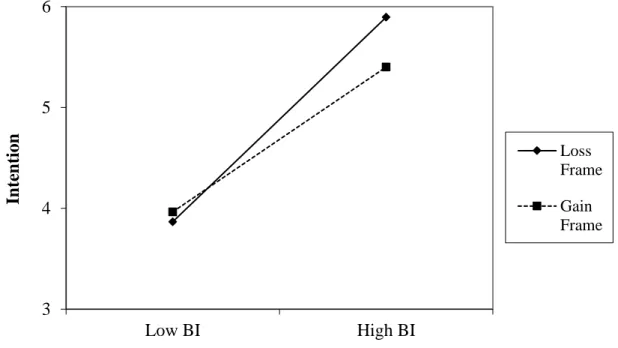
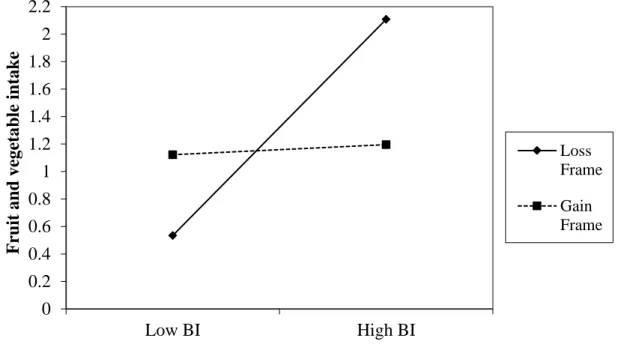
466
interaction between baseline intention and frame over intention (T2) is presented in 467
Figure 2 and the interaction over FV intake (T3) is presented in Figure 3. 468 0 0.2 0.4 0.6 0.8 1 1.2 1.4 1.6 1.8 2 2.2 Low MO High MO F ru it an d ve ge tabl e in take Loss Frame Gain Frame
469
Figure 2.Regression of intention to increase fruit and vegetable intake after message
470
exposure on baseline intention (BI) for participants in the loss- and gain-framed 471
message conditions, controlling for baseline fruit and vegetable intake. 472
473
A further inspection of the effects of frame at low and high levels of baseline 474
intention on intention after message exposure (T2) revealed that, at lower levels of 475
baseline intention, the frame was not a significant predictor of intention after message 476
exposure (T2), ß =.01, p =.91. However, at higher levels of baseline intention, the frame 477
was a significant predictor (ß = -.17, p =.03), such that as baseline intentions increased, 478
a loss-frame was conducive to higher intentions after message exposure (T2). 479
Exactly the same pattern was found for the effects of frame on FV intake, with 480
results showing that at lower levels of baseline intention, the frame was not a significant 481
predictor of FV intake (T3), ß = -.06, p =.57, but with loss-frame being conducive to 482
higher FV intake (T3) as baseline intentions increased, ß = -.192, p =.058. 483 484 3 4 5 6 Low BI High BI In te n tion Loss Frame Gain Frame
485
Figure 3.Regression of fruit and vegetable intake on baseline intention (BI) for
486
participants in the loss- and gain-framed message conditions, controlling for baseline 487
fruit and vegetable intake. 488
489
Three-way interaction among frame, motivational orientation and baseline 490
intention predicting fruit and vegetable intake 491
Given that message frame interacted both with the individual´s motivational 492
orientation and baseline intention for the prediction of FV intake at time 3, the full 493
model, with all the previous predictors plus the three-way interaction among frame, 494
motivational orientation and baseline intention was calculated. The new interaction term 495
was not significant, ß = -.001, p =.99, and failed to increase the explanatory value of 496
model, Δ R2 = .000, Δ F(1, 169) = .075, p = .79, revealing baseline intentions and
497
motivational orientation work as independent moderators of framing effects over fruit 498
and vegetable intake. 499 Discussion 500 0 0.2 0.4 0.6 0.8 1 1.2 1.4 1.6 1.8 2 2.2 Low BI High BI F ru it an d vegetab le in tak e Loss Frame Gain Frame
The function of the health behaviour and motivational orientation are among the 501
most studied moderators of health messages´ framing effects, but their interplay has 502
seldom been examined (Rothman & Updegraff, 2011). In the present study, 503
motivational orientation was found to moderate the effects of frame over FV intake, 504
with the loss-framed message leading to higher FV intake among prevention-focused 505
individuals. However, contrarily to what would be expected since fruit and vegetable 506
intake is an illness prevention behaviour, the gain frame was not, per se, conducive to 507
either increased intention or fruit and vegetable intake. These results corroborate those 508
of previous studies where an advantage of a gain-framed message for FV intake 509
promotion was not found (e.g., Bannon & Schwartz, 2006; Van Assema, Martens, 510
Ruiter, & Brug, 2001) and that of a study where an interaction between frame and 511
motivational orientation was found for FV intake (Latimer et al., 2008b). As other 512
authors have suggested (Rothman, Wlaschin, Bartels, Latimer, & Salovey, 2008), it 513
might be the case that FV intake does not induce a very strong set of beliefs or that there 514
is considerable variability regarding the way the behaviour is construed (i.e., either as 515
health-promoting or illness-preventing), rendering the framing effects more dependent 516
on the personal characteristics of the individuals. 517
Contrary to the results of Latimer and colleagues (2008b) and those of Churchill 518
and Pavey (2012), where the framing effect was particularly salient for promotion 519
focused individuals (or high in autonomy) when exposed to the gain-framed message, in 520
the present study the reverse occurred, with the most clear framing effects being for 521
prevention focused individuals when exposed to loss-framed messages. Such difference 522
might be due to cultural reasons. In fact, a body of research has demonstrated that 523
cultural factors play an important role in the effectiveness of health communications 524
(see Kreuter & McClure, 2004). More recently, studies specifically analysing the impact 525
of the individuals´ cultural background on the effect of health messages´ framing have 526
shown that individuals from cultures where a promotion focus is more pervasive (i.e., 527
individualistic cultures) were more persuaded by gain-framed messages, whereas 528
individuals belonging to a more preventive focus type of culture (i.e., collectivist 529
cultures) were more persuaded by loss-framed messages (Sherman, Uskul, & 530
Updegraff, 2011; Uskul, Sherman, & Fitzgibbon, 2009). In the same vein, other 531
research has shown that greater cultural exposure to the US culture (which emphasises 532
individualism) predicted a greater effectiveness of gain-framed messages, whereas 533
lower cultural exposure led to advantages of loss-framed messages (Brick et al., 2015). 534
Given that the Portuguese culture has proven to be close to Eastern cultures in terms of 535
collectivism (Gouveia & Ros, 2000), this might explain the obtained results, in the 536
sense that there was a maximal effect of frame when it matched the individuals´ 537
dispositions as well as the prevalent cultural background. 538
The fact that framing effects were found for behaviour one week later, but not for 539
intentions immediately after message exposure is also worth noting, although it is not 540
completely new. Framing effects for the adoption of prevention behaviours such as 541
smoking cessation, skin cancer prevention and physical activity have been found on 542
behaviour, but not necessarily on attitudes or intentions (Gallagher & Updegraff, 2012). 543
This pattern of findings leads to the question of identifying the psychological processes 544
that might mediate the observed effects, which clearly remains an important avenue for 545
future research. 546
The role of a new moderator - baseline intentions - in the message frame was also 547
demonstrated, with the loss-frame conducing to higher intention and behaviour among 548
participants who already had the intention to change, as predicted. This finding is 549
relevant for tailoring health messages according to the stage of change (Godinho, 550
Alvarez, & Lima, 2013; Godinho, Alvarez, Lima, & Schwarzer, 2015; Lhakhang, 551
Godinho, Knoll, & Schwarzer, 2014; Weinstein, Lyon, Sandman, & Cuite, 1998), 552
suggesting that loss-frames are preferable when targeting volitional individuals. 553
Nevertheless, it is advisable to replicate these findings for other behaviours and in other 554
cultures, in order to attest their generalisability. For example, it would be important to 555
test whether, in a more promotion-oriented type of culture, gain-frames might be more 556
effective for individuals who do not yet intend to change their behaviour. Future 557
research should also examine whether framing tailored messages according to the stage 558
of change results in increased effectiveness. 559
Some aspects of the present study might limit the generalisation of the above 560
conclusions. The sample of the study was composed by well-educated and mostly 561
female participants. Considering that women and highly educated people tend to already 562
eat more fruit and vegetables (De Irala-Estevez et al., 2000; Giskes, Turrell, Patterson, 563
& Newman, 2002; OECD, 2013) future studies should seek to replicate the presented 564
findings using more heterogeneous samples. All measures were collected by self-report, 565
including the assessment of FV intake, which might introduce some bias due to 566
difficulties in recollecting and/or evaluating the required information. Thus, it is 567
advisable that future studies complement the assessment of fruit and vegetable intake 568
with a food frequency questionnaire. In spite of these limitations, disentangling gains 569
and losses from the presence vs. absence of outcomes in the framing manipulation, the 570
inclusion of a manipulation check, the control of baseline behaviour, and testing the 571
different predictions both for intentions and behaviour are strengths of this study that 572
must be acknowledged. 573
In the present study some significant effects were found, despite being modest in 574
size. This should not be surprising if we recall that our aim was to change a very 575
complex behaviour that is influenced by a myriad of different factors, through a 576
minimal and very brief intervention consisting of a single exposure to differently 577
framed health messages. Moreover, the comparisons established are not between an 578
intervention and a non-intervention control group; the effect of a congruent and 579
incongruent message is being contrasted, which although theoretically less effective for 580
a specific audience segment, provides, nonetheless, persuasive information for changing 581
fruit and vegetable intake. Thus, despite their relatively modest size, these effects may 582
still be considered important effect sizes. From an epidemiological point of view, small 583
effects in a risk factor among a large group of people tend to lead to considerable and 584
meaningful changes at a population level (Rose, 1992). 585
To conclude, characteristics of the message recipient, rather than aspects of the 586
health behaviour, were found to be relevant for the choice of frame in messages aiming 587
to promote the increase of fruit and vegetable intake. In particular, when targeting 588
prevention-focused individuals, a loss-frame is recommended. The pronounced framing 589
effect for prevention focused individuals is attributed to the relevance of these 590
individuals' disposition in a collectivist culture, and highlights the importance of 591
considering the individual´s cultural background when evaluating the effects of message 592
framing in health behaviour change. Moreover, the finding that for individuals already 593
holding an intention to change, a loss-framed message is more effective, proved to be 594
the most innovative result, and has practical implications for the targeting of health 595
messages according to the individual´s readiness for change. 596
References 598
Aiken, L.S., & West, S.G. (1991). Multiple regression: Testing and interpreting 599
interactions. Thousand Oaks, CA: Sage.
600
Armitage, C. J., & Conner, M. (2000). Social cognition models and health behaviour: A 601
structured review. Psychology & Health, 15, 173–189. 602
doi:10.1080/08870440008400299 603
Bannon, K., & Schwartz, M. B. (2006). Impact of nutrition messages on children’s food 604
choice: Pilot study. Appetite, 46, 124–129. doi:10.1016/j.appet.2005.10.009 605
Brick, C., McCully, S. N., Updegraff, J. A., Ehret, P. J., Areguin, M. A., & Sherman, D. 606
K. (2015). Impact of cultural exposure and message framing on oral health 607
behaviour exploring the role of message memory. Medical Decision Making (E-608
Pub ahead of print). doi: 10.1177/0272989X15570114
609
Carter, P., Gray, L. J., Troughton, J., Khunti, K., & Davies, M. J. (2010). Fruit and 610
vegetable intake and incidence of type 2 diabetes mellitus: Systematic review and 611
meta-analysis. BMJ: British Medical Journal, 341, c:4229. doi: 612
10.1136/bmj.c4229. 613
Churchill, S., & Pavey, L. (2012). Promoting fruit and vegetable consumption: The role 614
of message framing and autonomy. British Journal of Health Psychology, 18(3), 615
610-622. doi:10.1111/bjhp.12007 616
Conner, M., & Norman, P. (2005). Predicting health behaviour. United Kingdom: 617
McGraw-Hill Education. 618
Cox, D., & Cox, A. D. (2001). Communicating the consequences of early detection: 619
The role of evidence and framing. Journal of Marketing, 65, 91–103. 620
doi:10.1509/jmkg.65.3.91.18336 621
De Graaf, A., van den Putte, B., & de Bruijn, G. J. (2015). Effects of issue involvement 622
and framing of a responsible drinking message on attitudes, intentions, and 623
behavior. Journal of Health Communication, 20 (8), 989-994. doi: 624
10.1080/10810730.2015.1018623 625
De Irala-Estevez, J., Groth, M., Johansson, L., Oltersdorf, U., Prättälä, R., & 626
MartínezGonzález, M. A. (2000). A systematic review of socio-economic 627
differences in food habits in Europe: Consumption of fruit and vegetables. 628
European Journal of Clinical Nutrition, 54(9), 706-714.
629
doi:10.1038/sj.ejcn.1601080 630
Detweiler, J. B., Bedell, B. T., Salovey, P., Pronin, E., & Rothman, A. J. (1999). 631
Message framing and sunscreen use: Gain-framed messages motivate beach-goers. 632
Health Psychology, 18(2), 189-196. doi: 10.1037/0278-6133.18.2.189
633
Dijksterhuis, A., & Aarts, H. (2003). On wildebeests and humans The preferential 634
detection of negative stimuli. Psychological Science, 14(1), 14-18. 635
doi:10.1111/1467-9280.t01-1-01412 636
Dijkstra, A., Rothman, A., & Pietersma, S. (2011). The persuasive effects of framing 637
messages on fruit and vegetable consumption according to regulatory focus theory. 638
Psychology & Health, 26(8), 1036–1048. doi:10.1080/08870446.2010.526715
639
Gallagher, K. M., & Updegraff, J. A. (2012). Health message framing effects on 640
attitudes, intentions, and behavior: A meta-analytic review. Annals of Behavioral 641
Medicine, 43(1), 101–116. doi:10.1007/s12160-011-9308-7
642
Gerend, M. A., & Shepherd, J. E. (2007). Using message framing to promote 643
acceptance of the human papillomavirus vaccine. Health Psychology, 26(6), 745– 644
752. doi:10.1037/0278-6133.26.6.745 645
Giskes, K., Turrell, G., Patterson, C., & Newman, B. (2002). Socio-economic 646
differences in fruit and vegetable consumption among Australian adolescents and 647
adults. Public Health Nutrition, 5(5), 663-670. doi: 10.1079/PHN2002339 648
Godinho, C. A., Alvarez, M.-J., & Lima, L. (2013). Formative research on HAPA
649
model determinants for fruit and vegetable intake: Target beliefs for audiences at
650
different stages of change. Health Education Research, 28(6), 1014-1028.
651
doi: 10.1093/her/cyt076
652
Godinho, C. A., Alvarez, M.-J., Lima, M. L., & Schwarzer, R. (2015). Health messages 653
to promote fruit and vegetable consumption at different stages: A match-mismatch 654
design. Psychology & Health, (just-accepted), 1-36. 655
Gouveia, V. V., & Ros, M. (2000). Hofstede and Schwartz’s models for classifying 656
individualism at the cultural level: Their relation to social and macro-657
economic variables. Psicothema, 12(Supl.), 25-33. 658
Hair, J., Black, W., Babin, B., & Anderson, R. (2010). Multivariate data analysis: A 659
global perspective (7th ed.). Upper Saddle River: Pearson Education.
660
Hall, J. N., Moore, S., Harper, S. B., & Lynch, J. W. (2009). Global variability in fruit 661
and vegetable consumption. American Journal of Preventive Medicine, 36(5), 662
402-409. doi: 10.1016/j.amepre.2009.01.029 663
He, F. J., Nowson, C. A., Lucas, M., & MacGregor, G. A. (2007). Increased 664
consumption of fruit and vegetables is related to a reduced risk of coronary heart 665
disease: Meta-analysis of cohort studies. Journal of Human Hypertension, 21(9), 666
717-728. doi:10.1038/sj.jhh.1002212 667
Higgins, E. T. (1997). Beyond pleasure and pain. American Psychologist, 52(12), 668
1280–300. Retrieved from http://www.ncbi.nlm.nih.gov/pubmed/9414606 669
Kalichman, S. C., & Coley, B. (1995). Context framing to enhance HIV-antibody-670
testing messages targeted to African American women. Health Psychology, 14, 671
247-254. 672
Kiene, S. M., Barta, W. D., Zelenski, J. M., & Cothran, D. L. (2005). Why are you 673
bringing up condoms now? The effect of message content on framing effects of 674
condom use messages. Health Psychology, 24(3), 321–6. doi:10.1037/0278-675
6133.24.3.321 676
Kreuter, M. W., & McClure, S. M. (2004). The role of culture in health communication. 677
Annual Review of Public Health, 25, 439-455. doi:
678
Latimer, A. E., Rench, T. A., Rivers, S. E., Katulak, N. A., Materese, S. A., Cadmus, L., 679
... & Salovey, P. (2008a). Promoting participation in physical activity using framed 680
messages: An application of prospect theory. British Journal of Health 681
Psychology, 13(4), 659-681. doi:10.1348/135910707X246186
682
Latimer, A. E., Williams-Piehota, P., Katulak, N. A., Cox, A., Mowad, L., & Salovey, 683
P. (2008b). Promoting fruit and vegetable intake through messages tailored to 684
individual differences in regulatory focus. Annals of Behavioral Medicine, 35(3), 685
363-369. doi:10.1007/s12160-008-9039-6 686
Lhakhang, P., Godinho, C., Knoll, N., & Schwarzer, R. (2014). A brief intervention 687
increases fruit and vegetable intake. A comparison of two intervention 688
sequences. Appetite, 82, 103-110. 689
Liu, C., & Russell, R. M. (2008). Nutrition and gastric cancer risk: an update. Nutrition 690
Reviews, 66(5), 237-249. doi: 10.1111/j.1753-4887.2008.00029.x
691
Lockwood, P., Jordan, C. H., & Kunda, Z. (2002). Motivation by positive or negative 692
role models: Regulatory focus determines who will best inspire us. Journal of 693
Personality and Social Psychology, 83(4), 854–864.
doi:10.1037//0022-694
3514.83.4.854 695
Maheswaran, D., & Meyers-Levy, J. (1990). The influence of message framing and 696
issue involvement. Journal of Marketing Research, 27, 361–367. Retrieved from 697
http://www.jstor.org/stable/3172593 698
Mann, T., Sherman, D., & Updegraff, J. (2004). Dispositional motivations and message 699
framing: A test of the congruency hypothesis in college students. Health 700
Psychology, 23(3), 330–334. doi:10.1037/0278-6133.23.3.330
701
Mullan, B., Allom, V., Brogan, A., Kothe, E., & Todd, J. (2014). Self-regulation and the 702
intention behaviour gap. Exploring dietary behaviours in university students. 703
Appetite, 73, 7-14. doi: 10.1016/j.appet.2013.10.010
704
O’Keefe, D. J., & Jensen, J. D. (2007). The relative persuasiveness of gain-framed and 705
loss-framed messages for encouraging disease prevention behaviors: A meta-706
analytic review. Journal of Health Communication, 12(7), 623–44. 707
doi:10.1080/10810730701615198 708
Organisation for Economic Cooperation and Development (2013). Health at a glance 709
2013: OECD indicators. OECD Publishing. Retrieved from:
710
http://www.oecd.org/els/healthsystems/Health-at-a-Glance-2013.pdf 711
Petty, R.E., & Cacioppo, J.T. (1986). The elaboration likelihood model of persuasion. 712
Advances in Experimental and Social Psychology, 19, 123–205.
713
Rivers, S. E., Salovey, P., Pizarro, D. A., Pizarro, J., & Schneider, T. R. (2005). 714
Message framing and pap test utilization among women attending a community 715
health clinic. Journal of Health Psychology, 10(1), 65–77. doi: 716
10.1177/1359105305048556 717
Rose, G. (1992). The strategy of preventive medicine. Oxford: Oxford University Press. 718
Rothman, A. J., & Salovey, P. (1997). Shaping perceptions to motivate healthy 719
behavior: the role of message framing. Psychological Bulletin, 121(1), 3–19. 720
Retrieved from http://www.ncbi.nlm.nih.gov/pubmed/9000890 721
Rothman, A. J., Martino, S. C., Bedell, B. T., Detweiler, J. B., & Salovey, P. (1999). 722
The systematic influence of gain-and loss-framed messages on interest in and use 723
of different types of health behavior. Personality and Social Psychology Bulletin, 724
25(11), 1355–1369. doi:10.1177/0146167299259003
725
Rothman, A. J., & Updegraff, J. A. (2011). Specifying when and how gain- and loss-726
framed messages motivate healthy behavior: An integrated approach. In G. Keren 727
(Ed.), Perspectives on Framing (pp. 257-278). London: Psychology Press / Taylor 728
& Francis. 729
Rothman, A.J., Wlaschin, J., Bartels, R.D., Latimer. A., & Salovey, P. (2008). How 730
persons and situations regulate message framing effects: The study of health 731
behavior. In A. Elliot (Ed.), Handbook of approach and avoidance motivation (pp. 732
475-486). New York, US: Psychology Press. 733
Scholer, A. A., & Higgins, E. T. (2008). Distinguishing levels of approach and 734
avoidance: An analysis using regulatory focus theory. In A. J. Elliott (Ed.), 735
Handbook of approach and avoidance motivation. New York: Psychology Press
736
/ Taylor & Francis. 737
738
Schüz, B., Sniehotta, F. F., Mallach, N., Wiedemann, A. U., & Schwarzer, R. (2009). 739
Predicting transitions from preintentional, intentional and actional stages of 740
change. Health Education Research, 24(1), 64–75. doi:10.1093/her/cym092 741
Schwarzer, R. (2008). Modeling health behavior change: How to predict and modify the 742
adoption and maintenance of health behaviors. Applied Psychology, 57(1), 1-29. 743
doi:10.1111/j.1464-0597.2007.00325.x 744
Sherman, D. K., Uskul, A. K., & Updegraff, J. A. (2011). The role of the self in 745
responses to health communications: A cultural perspective. Self and Identity, 746
10(3), 284-294.
747
Steptoe, A., Perkins-Porras, L., McKay, C., Rink, E., Hilton, S., & Cappuccio, F. P. 748
(2003). Psychological factors associated with fruit and vegetable intake and with 749
biomarkers in adults from a low-income neighborhood. Health Psychology, 22(2), 750
148–155. doi:10.1037/0278-6133.22.2.148 751
Tversky, A., & Kahneman, D. (1981). The framing of decisions and the psychology of 752
choice. Science, 211(4481), 453–458. 753
Uskul, A. K., Sherman, D. K., & Fitzgibbon, J. (2009). The cultural congruency effect: 754
Culture, regulatory focus, and the effectiveness of gain- vs. loss-framed health 755
messages. Journal of Experimental Social Psychology, 45, 535–541. 756
doi:10.1016/j.jesp.2008.12.005 757
Van Assema, P., Martens, M., Ruiter, R. A., & Brug, J. (2001). Framing of nutrition 758
education messages in persuading consumers of the advantages of a healthy diet. 759
Journal of Human Nutrition and Dietetics, 14(6), 435–42. Retrieved from
760
http://www.ncbi.nlm.nih.gov/pubmed/11906585 761
Weinstein, N. D., Lyon, J. E., Sandman, P. M., & Cuite, C. L. (1998). Experimental 762
evidence for stages of health behavior change: The precaution adoption process 763
model applied to home radon testing. Health Psychology, 17(5), 445–453. 764
Retrieved from http://www.ncbi.nlm.nih.gov/pubmed/9776003 765
Yi, S., & Baumgartner, H. (2009). Regulatory focus and message framing: A test of 766
three accounts. Motivation and Emotion, 33(4), 435–443. doi:10.1007/s11031-009-767
9148-y 768