Homology modeling and epitope prediction of Der f 33
Feixiang Teng
1, Jinxia Sun
1, Lili Yu
1, Qisong Li
1and Yubao Cui
2 1Department of Basic Medicine, Jiangsu Vocational College of Medicine, Yancheng, China 2Department of Clinical Laboratory, Wuxi People’s Hospital Affiliated to Nanjing Medical University, Wuxi, China
Abstract
Dermatophagoides farinae(Der f), one of the main species of house dust mites, produces more than 30 allergens. A recently identified allergen belonging to the alpha-tubulin protein family, Der f 33, has not been characterized in detail. In this study, we used bioinformatics tools to construct the secondary and tertiary structures and predict the B and T cell epitopes of Der f 33. First, protein attribution, protein patterns, and physicochemical properties were predicted. Then, a reasonable tertiary structure was constructed by homology modeling. In addition, six B cell epitopes (amino acid positions 34–45, 63–67, 103–108, 224–230, 308–316, and 365–377) and four T cell epitopes (positions 178–186, 241–249, 335–343, and 402–410) were predicted. These results established a theoretical basis for further studies and eventual epitope-based vaccine design against Der f 33.
Key words: Der f 33; Homology modeling; B-cell epitope; T-cell epitope; Prediction
Introduction
House dust mites (HDM), particularlyDermatophagoides farinae(Der f) andDermatophagoides pteronyssinus(Der p), are responsible for sensitization of more than 50% of allergic patients worldwide (1,2). Allergens from HDM (fecal material, secretions, body degradation products, and lysates of car-casses) can cause bronchial asthma, atopic dermatitis, and rhinitis (3).
Allergen specific immunotherapy (SIT) is one of the most effective treatments for allergic diseases (4). SIT can be improved by using recombinant allergens, which contain most of the IgE-binding epitopes of the source allergens and are pure and better standardized compared to natural gen extracts (5). A number of recombinant dust mite aller-gens have been cloned, expressed, and purified, including Der f groups 1–3, 5–8, 10, 11, 13–18, 22, 24, and 33 aller-gens (6,7). Allergen extracts of HDM have been used for diagnosis and treatment of IgE-mediated allergic diseases. However, these crude extracts include some inflammatory molecules, such as kallikreins, ceramides, and endotoxins, which could modify treatment outcomes and efficacy (8). Thus, these extracts have some limitations in both their safety and efficacy in SIT (5).
Some SIT approaches have shifted toward epitope-based vaccine design (9,10). In this approach, a recombi-nant allergen contains multiple B and T cell epitopes. Thus, identifying the major B and T cell epitopes of allergens is critical for effective immunotherapy of allergic diseases via epitope-based vaccine preparation.
To date, 36 groups of mite allergens have been listed in the Allergen Nomenclature Database (www.allergen. org). Der f 33 was identified in 2014 (GenBank accession KM010005), and it was characterized as having a molec-ular weight of 52 kDa and belonging to the alpha-tubulin protein family. Moreover, Der f 33 could react to the serum of patients with mite allergy; the positive rate of skin prick test to Der f 33 was 23.5% (4/17 patients). Also, it can modulate the functions of dendritic cells (DCs) and induce airway allergy (7). However, the major B and T cell antigen epitopes of Der f 33 have not been reported.
In this study, we used bioinformatics to predict the secondary and tertiary protein structures and identify the B and T cell epitopes of Der f 33. These findings provide theoretical support for mite allergen epitope-based vaccine design.
Material and Methods
Sequence retrieval and analyses
Der f 33 amino acid sequence (Accession Number: AIO08861.1) was obtained from the International Union of Immunological Societies (IUIS) nomenclature database and the protein database of National Center for Biotech-nology Information (NCBI). Family classification of Der f 33 was analyzed by Superfamily v1.75 (11) and InterPro v56.0 (12). TMHMM server 2.0 (13) was used for pre-dicting the transmembrane helices in Der f 33 proteins.
Correspondence: Yubao Cui:<[email protected]>
Received May 23, 2017 | Accepted January 8, 2018
Physicochemical analysis and secondary structure prediction
Physicochemical analysis including molecular weight, negatively charged residues, positively charged residues, theoretical pI, aliphatic index, grand average of hydro-pathicity (GRAVY), and instability index of Der f 33 was predicted by ProtParam (14). Characteristic patterns and functional motifs of Der f 33 were checked by using Prosite (15). Secondary structure of Der f 33 was pre-dicted by Jpred 4.0 (16).
Tertiary structure prediction and evaluation
Homology modeling was used for constructing the tertiary structure of Der f 33. BLASTP search was per-formed against the Protein Data Bank (PDB) tofind suitable Der f 33 templates, which were based on the high score, lower e-value, and maximum sequence identity. Tertiary structure was constructed by MODELLER v9.16 (17), which was imported to Chiron (18) to rectify unfavorable clashes and improve the quality of stereochemistry.
Estimating the quality of tertiary structure is a vital step. VERIFY_3D (19) was used to determine the com-patibility of an atomic model (3D) with its own amino acid sequence (1D) and compare the results to good struc-tures. PROCHECK (20) was used to check the stereo-chemical quality of Der f 33 structure. ERRAT (21) was used to analyze the statistics of non-bonded interactions between different atom types. ProSA (22) was used to analyze the Z-score, which shows the degree of match between the template protein and Der f 33. QMEAN (23) is a composite scoring function, which was used to derive both global (for the entire structure) and local (per residue) error estimates based on one single model. Visualization of tertiary structure was performed using UCSF Chimera 1.10.2 (24).
Prediction of B cell epitopes
ABCpred (25), BCPreds (26), BcePred (27), and Bio-informatics Predicted Antigenic Peptides (BPAP) system (28) were used for predicting B cell epitopes of Der f 33. ABCpred predicted B cell epitopes in antigen sequences, using an artificial neural network. BCPreds selected AAP method (26), BCPred (29), and FBCPred (30) to predict B cell epitopes. BcePred and BPAP system predicted B cell epitopes using the same physicochemical properties, such as hydrophilicity,flexibility/mobility, accessibility, polarity, exposed surface, and turns.
Prediction of T cell epitopes
T cell epitopes were predicted by identifying the bind-ing of peptides to MHC molecules with NetMHCII 2.2 (31) and NetMHCIIpan-3.1 (32).
NetMHCII 2.2 uses artificial neuron networks to predict binding of epitope peptides to HLA-DQ alleles in regions of HLA-DQA10101-DQB10501, HLA-DQA10102-DQB10602, HLA-DQA10301-DQB10302, HLA-DQA10401-DQB10402,
HLA-DQA10501-DQB10201, and HLA-DQA10501-DQB 10301.
NetMHCIIpan-3.1 was used for HLA-DR-based epi-tope prediction in regions of DR DRB101, HLA-DRB301, HLA-DRB401, and HLA-DRB501.
In the 2 programs, high binding peptides have an IC50 value below 50 nM. The ultimate T cell epitopes were obtained by combining the results of the HLA-DR alleles epitopes and HLA-DQ alleles epitopes.
Results
Amino acid sequence analysis
The ProtParam results showed that the complete amino acid sequence of Der f 33 comprises 461 amino acids and has a molecular weight of 51.6 kDa. The number of negatively charged residues (Asp+Glu) and positively charged residues (Arg+Lys) were 62 and 42, respectively. The theoretical pI and aliphatic index of Der f 33 were 5.04 and 79.11, respectively. The GRAVY and in-stability index were–0.286 and 43.23, respectively.
The results of InterPro v56.0 and Superfamily v1.75 showed that Der f 33 belonged to the alpha-tubulin protein family (InterPro No. IPR002452) and tubulin protein super-family (InterPro No. IPR000217). Prosite analysis of Der p 33 revealed that it contained a TUBULIN pattern (PS00227, 149–155, GGGTGSG). The computed results of TMHMM Server 2.0 showed that Der f 33 has no transmembrane helices, and the protein sequences are all located outside of the membrane.
Tertiary structure construction and analysis
As the homology modeling template, Cytotoxic Dolasta-tin 10 Analogues (PDB accession No.: 4X20) have a high sequence identity (82%), lower e-value (0.0) and a high score (761) with Der f 33.
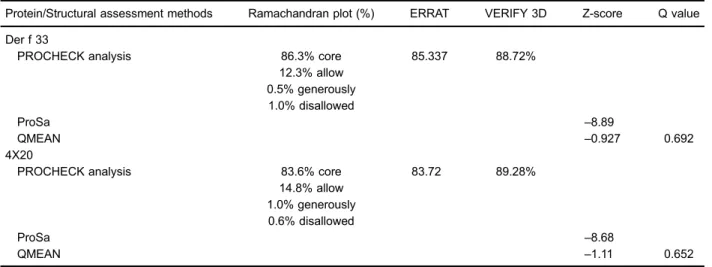
The Ramachandran plot of tertiary structure showed that 86.3% amino acid residues of Der f 33 were within the most favored regions, 12.3% of residues were in the additional allowed region, 0.5% residues in the generously allowed regions, and 1.0% residues in the disallowed region. The application of the ERRAT program showed that the overall quality factor is 85.34. VERIFY 3D pro-gram revealed that 88.72% of the residues had an averaged 3D-1D scoreX0.2. As indicated by the ProSa server, the Z-scores of Der f 33 and 4X20 are–8.89 and
–8.68, respectively. The QMEAN Z-score of Der f 33 was –0.927 and Q value was 0.692 (Table 1). The tertiary structure of Der f 33 is shown in Figure 1.
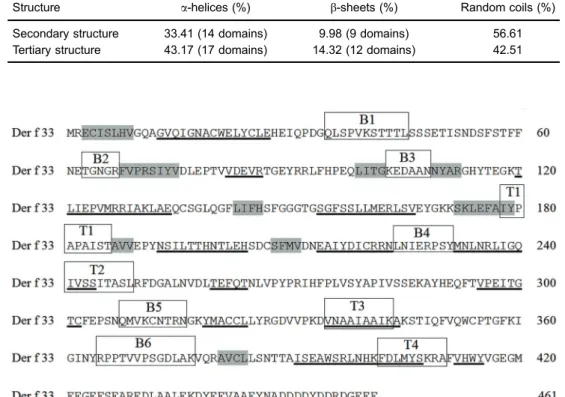
The percentages of overall amino acids of tertiary struc-ture located ina-helices,b-sheets, and random coils are 43.17% (17 domains), 14.32% (12 domains), and 42.51%, respectively (Table 2, Figure 2).
B cell epitope prediction
Combining the results of four programs, six antigenic epitope peptides (amino acid positions 34–45, 63–67,
103–108, 224–230, 308–316, and 365–377) were pre-dicted (Table 3, Figures 1 and 2).
T cell epitope prediction
NetMHCIIpan 3.1 and NetMHCII 2.2 were used for predicting T cell antigenic epitopes. Combining the results of the two programs, the consensus results were for four predicted T cell epitopes (amino acids positions 178–186, Table 1.Parameters of Der f 33 tertiary structure.
Protein/Structural assessment methods Ramachandran plot (%) ERRAT VERIFY 3D Z-score Q value
Der f 33
PROCHECK analysis 86.3% core 85.337 88.72%
12.3% allow 0.5% generously 1.0% disallowed
ProSa –8.89
QMEAN –0.927 0.692
4X20
PROCHECK analysis 83.6% core 83.72 89.28%
14.8% allow 1.0% generously 0.6% disallowed
ProSa –8.68
QMEAN –1.11 0.652
Core: most favored regions; allow: additional allowed regions; generously: generously allowed regions; disallowed: disallowed regions.
241–249, 335–343, and 402–410) (Table 3, Figures 1 and 2).
Discussion
HDM are important sources of inhalant and contact allergens that can cause a variety of allergic diseases (3).
Thus, molecular characterization and identification of epitopes of HDM allergens will promote a better under-standing of immune response and promote an effective epitope-based vaccine design.
To better understand the structure and function of Der f 33, wefirst analyzed the basic sequence properties. The bioinformatics analyses showed that Der f 33 is a Table 2.Secondary and tertiary structure elements of Der f 33.
Structure a-helices (%) b-sheets (%) Random coils (%)
Secondary structure 33.41 (14 domains) 9.98 (9 domains) 56.61 Tertiary structure 43.17 (17 domains) 14.32 (12 domains) 42.51
Figure 2.Secondary structure elements for Der f 33. Thea-helices are underlined,b-sheets are shown in gray highlight, random coils in unlabeled sequence, and epitopes are within a box.
Table 3.Predicted B and T cell epitopes of Der f 33.
Peptide Type of epitope Position Sequence
P1 B 34–45 GQLSPVKSTTTL
P2 B 63–67 TGNGR
P3 B 103–108 KEDAAN
P4 B 224–230 LNIERPS
P5 B 308–316 QMVKCNTRN
P6 B 365–377 RPPTVVPSGDLAK
P7 T 178–186 IYPAPAIST
P8 T 241–249 IVSSITASL
P9 T 335–343 VNAAIAAIK
P10 T 402–410 FDLMYSKRA
hydrophilic (GRAVY) and unstable (instability index) protein, which has no transmembrane helices, and the protein sequences are all located outside of membrane.
Homology modeling built a target structure based on the comparison with the data extracted from homologous sequences with suitable templates (33). A total 98.6% amino acid residues of Der f 33 were in favored and allowed regions, showing that the distribution of the amino acid is reasonable. The VERIFY 3D and ERRAT results showed that the tertiary structure of Der f 33 was good and had high resolution. The ProSa results showed that there was a high tertiary structure matching degree between Der f 33 protein and the template protein. The standard deviation value of QMEAN Z-score was less than 1, showing that the Der f 33 protein model variation rate was low, the overall folding and local structure both had high accuracy rate, and stereochemistry was reasonable. In addition, the Q value was between 0 and 1, showing that the predicted model of Der f 33 was reliable and could be adopted for this study.
The secondary and tertiary structure of Der f 33 both contain three elements (a-helices,b-sheets, and random coils); the amino acid percentages of these three elements in the tertiary structure differed slightly from the secondary structure. This phenomenon may be due to different methods of prediction for the secondary and tertiary structures.
Hydrophobicity, fragmentflexibility/mobility, surface acces-sibility, polarity, exposed surface, and turns are important
features for B cell antigenic epitope identification. These antigenic indexes showed the epitope-forming capacity of the Der f 33 amino acid sequence. Moreover, secondary and tertiary structures are important for B cell epitope prediction. Thea-helices andb-sheets have higher chemi-cal bond energy, making epitope formation difficult. Random coils are located in surface-exposed regions of a protein, which often contain epitope sequences (34). Integrating the results from the four programs and combining with the secondary and tertiary structures, thefinal B cell epitopes included six sequences: amino acid positions 34–45, 63–67, 103–108, 224–230, 308–316, and 365–377. The prediction results showed that T cell epitopes contained four sequences: amino acid positions 178–186, 241–249, 335–343, and 402–410.
Finally, allergen epitopes usually contained high proportion hydrophobic amino acids residues (Ala, Ser, Asn, Gly, and Lys) (35). The prediction results showed that the B and T cell epitopes of Der f 33 both contain multiple hydrophobic amino acids. However, these predicted epi-topes require experimental verification.
Acknowledgments
This work was supported by the National Natural Sciences Foundation of China (NSFC31572319, and NSFC31572319), the Key Program of Wuxi health and Family Planning Commission in 2017 (Z201701), and the 333 project of Jiangsu Province in 2017 (BRA2017216).
References
1. Vrtala S, Huber H, Thomas WR. Recombinant house dust mite allergens. Methods 2014; 66: 67–74, doi: 10.1016/ j.ymeth.2013.07.034.
2. An S, Shen C, Liu X, Chen L, Xu X, Rong M, et al. Alpha-actinin is a new type of house dust mite allergen.PLoS One 2013; 8: e81377, doi: 10.1371/journal.pone.0081377. 3. Thomas WR, Hales BJ, Smith WA. House dust mite
allergens in asthma and allergy.Trends Mol Med2010; 16: 321–328, doi: 10.1016/j.molmed.2010.04.008.
4. Bachmann MF, Kündig TM. Allergen-specific immunother-apy: is it vaccination against toxins after all?Allergy2017; 72: 13–23, doi: 10.1111/all.12890.
5. Focke-Tejkl M, Valenta R. Safety of engineered allergen-specific immunotherapy vaccines.Curr Opin Allergy Clin Immunol2012; 12: 555–563, doi: 10.1097/ACI.0b013e328357ca53.
6. An S, Chen L, Long C, Liu X, Xu X, Lu X, et al. Dermatophagoides farinae allergens diversity identification by proteomics.Mol Cell Proteomics2013; 12: 1818–1828, doi: 10.1074/mcp.M112.027136.
7. Wang H, Lin J, Liu X, Liang Z, Yang P, Ran P, et al. Identification ofa-tubulin, Der f 33, as a novel allergen from Dermatophagoides farinae.Immunobiology2016; 221: 911– 917, doi: 10.1016/j.imbio.2016.03.004.
8. Valenta R, Linhart B, Swoboda I, Niederberger V. Recombi-nant allergens for allergenspecific immunotherapy: 10 years
anniversary of immunotherapy with recombinant allergens.
Allergy2011; 66: 775–783, doi: 10.1111/j.1398-9995.2011.
02565.x.
9. Zhao J, Li C, Zhao B, Xu P, Xu H, He L. Construction of the recombinant vaccine based on T-cell epitope encoding Der p1 and evaluation on its specific immunotherapy efficacy.
Int J Clin Exp Med2015; 8: 6436–6443.
10. Koffeman EC, Genovese M, Amox D, Keogh E, Santana E, Matteson EL, et al. Epitope-specific immunotherapy of rheumatoid arthritis: clinical responsiveness occurs with immune deviation and relies on the expression of a cluster of molecules associated with T cell tolerance in a double-blind, placebo-controlled, pilot phase II trial.Arthritis Rheum2009; 60: 3207–3216, doi: 10.1002/art.24916.
11. Gough J, Karplus K, Hughey R, Chothia C. Assignment of homology to genome sequences using a library of hidden Markov models that represent all proteins of known struc-ture. J Mol Biol 2001; 313: 903–919, doi: 10.1006/jmbi. 2001.5080.
12. Mitchell A, Chang HY, Daugherty L, Fraser M, Hunter S, Lopez R, et al. The InterPro protein families database: the classification resource after 15 years. Nucleic Acids Res 2015; 43: D213–D221, doi: 10.1093/nar/gku1243.
Markov model: application to complete genomes.J Mol Biol 2001; 305: 567–580, doi: 10.1006/jmbi.2000.4315. 14. Wilkins MR, Gasteiger E, Bairoch A, Sanchez JC, Williams
KL, Appel RD, et al. Protein identification and analysis tools in the ExPASy server.Methods Mol Biol1999; 112: 531–552.
15. De Castro E, Sigrist CJ, Gattiker A, Bulliard V, Langendijk-Genevaux PS, Gasteiger E, et al. ScanProsite: detection of PROSITE signature matches and ProRule-associated func-tional and structural residues in proteins.Nucleic Acids Res 2006; 34: W362–W365, doi: 10.1093/nar/gkl124.
16. Drozdetskiy A, Cole C, Procter J, Barton GJ. JPred4: a protein secondary structure prediction server.Nucleic Acids Res2015; 43: W389–W394, doi: 10.1093/nar/gkv332. 17. Webb B, Sali A. Protein structure modeling with MODELLER.
Methods Mol Biol2014; 1137: 1–15, doi:
10.1007/978-1-4939-0366-5.
18. Ramachandran S, Kota P, Ding F, Dokholyan NV. Auto-mated minimization of steric clashes in protein structures.
Proteins2011; 79: 261–270, doi: 10.1002/prot.22879.
19. Bowie JU, Lüthy R, Eisenberg D. A method to identify protein sequences that fold into a known tertiary structure. Science 1991; 253: 164–170, doi: 10.1126/science.1853201. 20. Laskowski RA, Rullmannn JA, MacArthur MW, Kaptein R,
Thornton JM. AQUA and PROCHECK-NMR: programs for checking the quality of protein structures solved by NMR.
J Biomol NMR1996; 8: 477–486, doi: 10.1007/BF00228148.
21. Colovos C, Yeates TO. Verification of protein structures: patterns of nonbonded atomic interactions.Protein Sci1993; 2: 1511–1519, doi: 10.1002/pro.5560020916.
22. Wiederstein M, Sippl MJ. ProSA-web: interactive web service for the recognition of errors in tertiary structures of proteins.
Nucleic Acids Res2007; 35: W407–W410, doi: 10.1093/nar/
gkm290.
23. Benkert P, Tosatto SC, Schomburg D. QMEAN: A compre-hensive scoring function for model quality assessment.
Proteins2008; 71: 261–277, doi: 10.1002/prot.21715.
24. Pettersen EF, Goddard TD, Huang CC, Couch GS, Green-blatt DM, Meng EC, et al. UCSF Chimera - a visualization system for exploratory research and analysis. J Comput Chem2004; 25: 1605–1612, doi: 10.1002/jcc.20084.
25. Saha S, Raghava GPS. Prediction of Continuous B-cell epitopes in an antigen using recurrent neural network.
Proteins2006; 65: 40–48, doi: 10.1002/prot.21078.
26. Chen J, Liu H, Yang J, Chou KC. Prediction of linear B-cell epitopes using amino acid pair antigenicity scale. Amino
Acids2007; 33: 423–428, doi: 10.1007/s00726-006-0485-9.
27. Saha S, Raghava GPS. BcePred: prediction of continuous B-cell epitopes in antigenic sequences using physico-chemi-cal properties. Berlin, Heidelberg: Springer; 2004. p 197–204. 28. Zheng LN, Lin H, Pawar R, Li ZX, Li MH. Mapping IgE binding epitopes of major shrimp (Penaeus monodon) allergen with immunoinformatics tools.Food Chem Toxicol 2011; 49: 2954–2960, doi: 10.1016/j.fct.2011.07.043. 29. EI-Manzalawy Y, Dobbs D, Honavar V. Predicting linear
B-cell epitopes using string kernels.J Mol Recognit2008; 21: 243–255, doi: 10.1002/jmr.893.
30. EI-Manzalawy Y, Dobbs D, Honavar V. Predictingflexible length linear B-cell epitopes. Comput Syst Bioinformatics Conf2008; 7: 121–132, doi: 10.1142/9781848162648_0011. 31. Nielsen M, Lund O. NN-align. An artificial neural network-based alignment algorithm for MHC class II peptide binding prediction.BMC Bioinformatics2009; 10: 296, doi: 10.1186/ 1471-2105-10-296.
32. Andreatta M, Karosiene E, Rasmussen M, Stryhn A, Buus S, Nielsen M. Accurate pan-specific prediction of peptide-MHC class II binding affinity with improved binding core identifi ca-tion. Immunogenetics2015; 67: 641–650, doi: 10.1007/ s00251-015-0873-y.
33. Wong A, Gehring C, Irving HR. Conserved Functional Motifs and Homology Modeling to Predict Hidden Moonlighting Functional Sites. Front Bioeng Biotechnol 2015; 3: 82, doi: 10.3389/fbioe.2015.00082.
34. Sikic K, Tomic S, Carugo O. Systematic comparison of crystal and NMR protein structures deposited in the protein data bank.Open Biochem J2010; 4: 83–95, doi: 10.2174/ 1874091X01004010083.