ORIGINAL ARTICLE
Plasma PYY after oral administration of juice enriched with
hydrolysate collagen.
Carlos Alberto Nogueira-de-Almeida1, Ane Cristina Fayão Almeida2, Carla C. J. Nogueira de Almeida3, Adriana Pelegrino Ramos Pinho1, Geórgia A. De Castro _______________________________________________________________ 1 University of Ribeirão Preto.
2 University of São Paulo
3 CESNI University of Ribeirão Preto 4 Mondelez Brasil
Endereço para correspondência: Rua Eugenio Ferrrante, 170. Ribeirão Preto – SP CEP 14027-150 Telefone: +55 16 992217498 Carlos Alberto Nogueira-de-Almeida. Endereço eletrônico: [email protected]
Abstract
The current study aims to evaluate if a juice enriched with hydrolysate collagen can stimulate the production of PYY compared to the control group. This is an experimental, observational and analytical study conducted at the University of Ribeirão Preto (SP). They were eligible for the study 15 women who randomly were divided into two groups: intervention and control. At time zero, the selected women had blood samples taken for analysis of plasma concentrations of PYY. Following the blood collection, each woman received 1 cup of artificial fruit juice, packed in a non-transparent glass so as not to allow the recognition of its contents. The control group received artificial fruit juice and the intervention group received artificial fruit juice with 10 g of collagen hydrolyzate. After ingestion of the juices, at times 15, 30, 45 and 60 minutes, blood samples were again collected for plasma analysis of PYY concentrations. Results: It was observed that the PYY secretion was not influenced by collagen ingestion in the intervention group. In the control group, it was observed a maintaining the PYY concentration at all times. Comparing the two groups at each time, there was no difference. Conclusions: Collagen ingestion was not able to influence PYY secretion.
INTRODUCTION
Obesity sets, today, one of the biggest health problems in the world. High prevalence of obesity (BMI ≥ 30 kg / m²) in the adult population has been observed in Brazil. Despite of the entire scientific community recognizes the urgent need to implement individual and collective measurements; little has been evaluated to find solutions1. Nutrition education and programs to stimulate physical activity have been characterized theoretically the most effective way to control and several countries have invested in this kind of approach1. Another alternative includes foods with high power to induce satiety, which lead the subject cannot eat excessive amounts for feeling satiated early. This is the principle on which bases the dietary guidelines that teach the obese to start the meal eating salads. Proteins are considered the highest satiating macronutrient2,3.
A protein food with the potential ability to induce satiety is collagen hydrolysate4,5, which is obtained mainly from bones, cartilage and skin from cattle, fish and pork. In the hydrolysis process the molecule is broken into smaller peptides6. The amino acids found in collagen hydrolysate are the same found in intact collagen. There are twenty amino acids including eight from the nine essential ones, except tryptophan, and the predominance is of glycine, proline and hydroxyproline, which represent about 50% of the total amino acid content. Because of its use of safety in all age groups and the great number of possible presentation, it is considered that has significant potential as a functional food with satiating effect4,5.
One way of measurements of satiety is through PYY hormone dosage in plasma determined after food intake. PYY is a hormone produced by the colon and secreted when nutrient intake begins to achieve body site7. Its best known physiological function is to signal to the central nervous system has occurred food intake, causing it to produce the satiety feeling7. The PYY administration in human volunteers demonstrated significant ability to reduce food intake,
independent of the nutritional state8. In this sense, considering that was not identified PYY resistant action in obese subjects would be possible to assume the food ability to induce PYY secretion as one of the indicators to satiety to be very helpful for obesity treatment.
The current study aims to evaluate the PYY release having the intake of a beverage enriched with collagen hydrolysate compared with the control.
MATERIAL & METHODS
This is an experimental, observational and analytical study conducted at the University of Ribeirão Preto (SP). The 20 women who were on the waiting list to be attended originally in Obesity Clinic from the University were invited for this study. Inclusion criteria were: obese women (BMI ≥ 30, percentage of body fat> 25%) with constant weight in the last three months, aged 18 and 45, and healthy (n = 18). The criteria for non-inclusion were: absence of menarche or occurrence of menopause, use of medicines with central action, the presence of disease or gastrointestinal previous surgeries, presence of metabolic diseases such as diabetes, hypothyroidism, and the ones who were not able to perform anthropometry and bio-impedance (n = 3). Meeting the above criteria, were eligible for the study 15 women, chosen randomly, to be divided into two groups: intervention and control.
At time zero, the women selected were submitted to anthropometry and bioelectrical impedance and had blood samples taken for analysis of plasma concentration of PYY.
Such concentrations were analyzed by radioimmunoassay (Linco Research Inc.) at the Laboratory of Clinical Analysis of UNAERP (University of Ribeirão Preto, SP).
Following the blood collection, each woman received 1 cup of artificial fruit juice (same juice with same composition), packed in a non-transparent glass not to allow the recognition of its contents, aiming to obtain a blind study. The preparation of this juice on the following criterion: Control Group: 1 cup
containing 200 ml of artificial fruit juice; Group Intervention: 1 cup containing 200 ml of artificial fruit juice enriched with 10 g of hydrolysate collagen.
After ingestion of the artificial fruit juices, at the times 15, 30, 45 and 60 minutes, blood samples were again collected for analysis of PYY plasma concentrations. Data were compiled into a computerized database to conduct statistical analysis by the Mann-Whitney test, the PYY values at each of the moments. The volunteers received and signed free and informed consent. The study was approved by the Ethics Committee of the UNAERP under number 047/05.
RESULTS
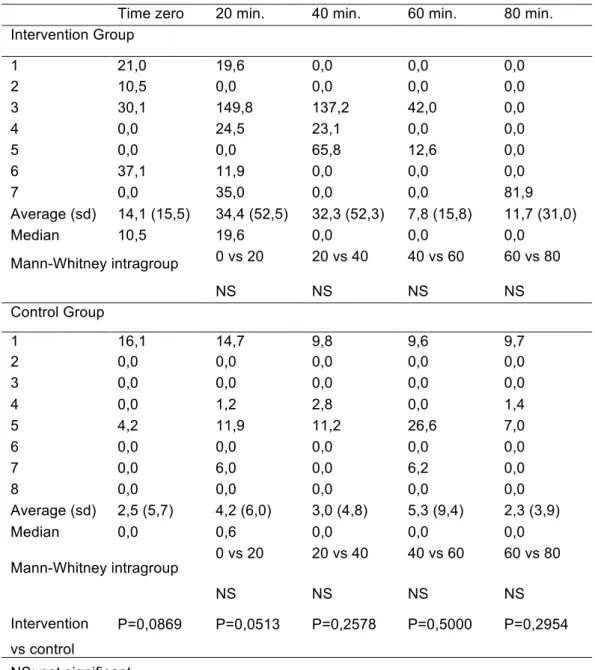
The mean plasma concentrations of PYY for all patients enrolled at 5 times, and the results of the statistical analysis are described in Table 1. Statistical analysis within each group, comparing the evolution of the concentration of PYY after the artificial fruit juice intake showed no significant difference in either group (study and control). Statistical analysis comparing the two groups at each time showed no difference.
DISCUSSION
Currently, there are evidences that increased protein consumption (about 1.2 to 1.6 g / day) or 25 to 30 grams of protein per meal, is a successful strategy to prevent and treat obesity by reducing of body weight and fat mass concomitant with the preservation of lean mass9. The effectiveness of these diets are in part due to modulation of the energy metabolism and appetite reduction, leading to reduction of energy consumption.
Table 1- Average plasma concentration of PYY at five different times, Ribeirão Preto (SP), 2005.
Time zero 20 min. 40 min. 60 min. 80 min. Intervention Group 1 21,0 19,6 0,0 0,0 0,0 2 10,5 0,0 0,0 0,0 0,0 3 30,1 149,8 137,2 42,0 0,0 4 0,0 24,5 23,1 0,0 0,0 5 0,0 0,0 65,8 12,6 0,0 6 37,1 11,9 0,0 0,0 0,0 7 0,0 35,0 0,0 0,0 81,9 Average (sd) 14,1 (15,5) 34,4 (52,5) 32,3 (52,3) 7,8 (15,8) 11,7 (31,0) Median 10,5 19,6 0,0 0,0 0,0 Mann-Whitney intragroup 0 vs 20 NS 20 vs 40 NS 40 vs 60 NS 60 vs 80 NS Control Group 1 16,1 14,7 9,8 9,6 9,7 2 0,0 0,0 0,0 0,0 0,0 3 0,0 0,0 0,0 0,0 0,0 4 0,0 1,2 2,8 0,0 1,4 5 4,2 11,9 11,2 26,6 7,0 6 0,0 0,0 0,0 0,0 0,0 7 0,0 6,0 0,0 6,2 0,0 8 0,0 0,0 0,0 0,0 0,0 Average (sd) 2,5 (5,7) 4,2 (6,0) 3,0 (4,8) 5,3 (9,4) 2,3 (3,9) Median 0,0 0,6 0,0 0,0 0,0 Mann-Whitney intragroup 0 vs 20 NS 20 vs 40 NS 40 vs 60 NS 60 vs 80 NS Intervention vs control P=0,0869 P=0,0513 P=0,2578 P=0,5000 P=0,2954 NS: not significant
It is still known that high protein meals promote greater satiety than meals rich in carbohydrates and fats10. However, the mechanisms by which proteins affect satiety are still unclear, and scientists presented various proposals. The first suggestion is that satiating effects of protein may involve
gastric kinetics. Some scientists demonstrated that high concentrations of protein in the stomach could slow gastric emptying, due to precipitation of some proteins in gastric pH, a phenomenon that inhibits the normal behavior of enzymes involved in protein metabolism. Peptides could possibly stimulate the secretion of cholecystokinin (CCK) in intestinal cells11. CCK is also known to slow the gastric emptying12. This hormone affects the vagal nerve that controls the opening of the pylorus, the end of the stomach. However, there is great variation in gastric emptying rates for various proteins rates being dependent on the physic-chemical properties, the amount and structure of each protein13. The second suggestion is that proteins can also stimulate the hormones involved in satiety.
This complex mechanism involves not only various hormones such as CCK, GLP1, GIP, peptide YY and pancreatic polypeptide, as each of the mechanisms involved may be different14,15. For the third mechanism, the proteins can modulate thermogenesis to affect satiety, which may lead to an increased satiety, and energy expenditure and satiety are positively correlated16,17. Thermogenesis has also been suggested in relation to the hydrolysate collagen, mainly because their degradation may still requires more energy than others protein18.
In an animal assay with mice conducted by the State University of Campinas, whose objective was to study a whey-isolated protein from bovine, a bovine collagen hydrolysate and mixtures of these two proteins, and the use of bovine collagen hydrolysate promoted weight loss of animals19. Another longitudinal Brazilian prospective, double-blind, consisting of 36 patients from the Faculty of Medical Sciences, University of Pernambuco, in order to assess the modification of clinical and metabolic parameters in obese patients treated with Orlistat and collagen hydrolysate versus collagen hydrolysate alone for a period of eight weeks, the result was reduction in weight, BMI, and waist circumference in the majority of patients for both group20. In this current article, the statistical analysis within each group, comparing the PYY concentration
release after artificial fruit juice intake, showed no significant difference in any of the cases (study and control).
The lack of statistical significance may mean that collagen is not able to influence PYY secretion. By the other hand, it is important to take into account that there was a small number of subjects in the study, associated to the fact of the baseline measurement in the intervention group presented high PYY values for some subjects, which may indicate that they had not met the agreed fasting period. These results do not corroborate to recent studies in the literature that showed a concentrate rich in amino acids, containing 20 to 30 grams of protein, it had a positive influence on satiety signaling system, which includes the hormone increase, such as: GLP-1, PYY, serotonin and insulin after this concentrate consumption by adult population (20).
Additionally, the observation from the Table 1 shows clearly the absence of a consistent pattern of response, especially in the intervention group, which may have affected also the statistical analysis. A deeper observation of this group shows that the number of patients 3, 4, 5 and 7 had pattern of rise and fall; since the patients 1, 2 and 6 fell. Even among those which had higher concentrations of PYY after taking the juice, patients 3, 4 and 7 had peak at 20 minutes and the number 5, after 40 minutes, and maybe the best methodological option had been replaced the PYY dosages at 20 and 40 minutes for a single one after 30 minutes.
Comparing the two groups at each time, a slight, but not significant, difference was found at the time of 20 minutes (p = 0.0513). From this result, it can be inferred that if the sample size would larger, the statistical difference could be higher.
Collagen ingestion was not able to influence PYY secretion. It is suggested to conduct more studies with collagen hydrolysate, which may include the satiety profile by analyzing other satiating hormones such as ghrelin and GLP-1; larger sample size and the use of different amounts of hydrolysate collagen.
CONCLUSION
Collagen ingestion was not able to influence PYY secretion.
COMPETING INTERESTS Nothing to declare
REFERENCES
1. Reilly JJ. Evidence-based obesity prevention in childhood and adolescence: critique of recent etiological studies, preventive interventions, and policies. Advances in nutrition. 2012;3(4):636S-41S.
2. Faipoux R, Tome D, Bensaid A, Morens C, Oriol E, Bonnano LM, et al. Yeast proteins enhance satiety in rats. J Nutr. 2006;136(9):2350-6.
3. Faipoux R, Tome D, Gougis S, Darcel N, Fromentin G. Proteins activate satiety-related neuronal pathways in the brainstem and hypothalamus of rats. J Nutr. 2008;138(6):1172-8.
4. Veldhorst M, Smeets A, Soenen S, Hochstenbach-Waelen A, Hursel R, Diepvens K, et al. Protein-induced satiety: Effects and mechanisms of different proteins. Physiology & Behavior. 2008;94(2):300-7.
5. Veldhorst MA, Nieuwenhuizen AG, Hochstenbach-Waelen A, Westerterp KR, Engelen MP, Brummer RJ, et al. A breakfast with alpha-lactalbumin, gelatin, or gelatin + TRP lowers energy intake at lunch compared with a breakfast with casein, soy, whey, or whey-GMP. Clinical nutrition. 2009;28(2):147-55.
6. Oesser S, Adam M, Babel W, Seifert J. Oral administration of (14)C labeled gelatin hydrolysate leads to an accumulation of radioactivity in cartilage of mice (C57/BL). J Nutr. 1999;129(10):1891-5.
Appetite Control. In: Joost H-G, editor. Handbook of Experimental Pharmacology. 209: Springer Berlin Heidelberg; 2012. p. 209-30.
8. Renshaw D, Batterham RL. Peptide YY: a potential therapy for obesity. Current drug targets. 2005;6(2):171-9.
9. Clifton P. Effects of a high protein diet on body weight and comorbidities associated with obesity. The British journal of nutrition. 2012;108 Suppl 2:S122-10. Leidy HJ, Clifton PM, Astrup A, Wycherley TP, Westerterp-Plantenga MS, Luscombe-Marsh ND, et al. The role of protein in weight loss and maintenance. Am J Clin Nutr. 2015.
11. Raybould HE. Capsaicin-sensitive vagal afferents and CCK in inhibition of gastric motor function induced by intestinal nutrients. Peptides. 1991;12(6):1279-83.
12. Zhao X-T, McCamish MA, Miller RH, Wang L, Lin HC. Intestinal Transit and Absorption of Soy Protein In Dogs Depend On Load and Degree of Protein Hydrolysis. J Nutr. 1997;127(12):2350-6.
13. Rolls BA, Porter JW, Westgarth DR. The course of digestion of different food proteins in the rat. 3. The absorption of proteins given alone and with supplements of their limiting amino acids. The British journal of nutrition. 1972;28(3):283-93.
14. Karhunen LJ, Juvonen KR, Huotari A, Purhonen AK, Herzig KH. Effect of protein, fat, carbohydrate and fibre on gastrointestinal peptide release in humans. Regulatory Peptides. 2008;149(1–3):70-8.
15. Lejeune MPGM, Westerterp KR, Adam TCM, Luscombe-Marsh ND, Westerterp-Plantenga MS. Ghrelin and glucagon-like peptide 1 concentrations, 24-h satiety, and energy and substrate metabolism during a high-protein diet and measured in a respiration chamber. The American Journal of Clinical Nutrition. 2006;83(1):89-94.
16. Westerterp-Plantenga MS, Lejeune MP, Nijs I, van Ooijen M, Kovacs EM. High protein intake sustains weight maintenance after body weight loss in humans. International journal of obesity and related metabolic disorders : journal of the International Association for the Study of Obesity.
2004;28(1):57-
17. Westerterp-Plantenga MS, Rolland V, Wilson SA, Westerterp KR. Satiety related to 24 h diet-induced thermogenesis during high protein/carbohydrate vs high fat diets measured in a respiration chamber. European journal of clinical nutrition. 1999;53(6):495-502.
18. Andrade IFA, A.H.I.C.; Guimarães Neto, V.; Linhares, N.T. Efeitos do uso de orlistate e colágeno hidrolisado sobre a perda de peso, níveis pressóricos e parâmetros metabólicos em pacientes obesos. Brazilian Archives of Endocrinology and Metabolism. 2011;55(Supll. 3):1.
19. Ziegler FLFS, V.C. Chemical-nutrition characterization of a whey protein isolate, a bovine collagen hydrolysate and mixtures of the two products. Rev Nutr Campinas. 2009;22(1):10.
20. Martens EA, Lemmens SG, Westerterp-Plantenga MS. Protein leverage affects energy intake of high-protein diets in humans. Am J Clin Nutr. 2013;97(1):86-93.